
Trefoil Factor 1 (TFF1) in Retinoblastoma: A Biomarker, Mediator, or Therapeutic Target?


Abstract
1. Introduction
2. Key Molecular Signatures in Retinoblastoma
3. Trefoil Factor Family
4. TFF1 in Various Cancers
4.1. Breast Cancer
4.2. Gastric Cancer
4.3. Ovarian Cancer
4.4. Colorectal Cancer
4.5. Pancreatic Cancer
4.6. Prostate Cancer
4.7. Lung Cancer

| Cancer Type | Sample Type | TFF1 Role | References |
|---|---|---|---|
| Breast Cancer | In vitro (MCF7 and T47D cell lines) | Oncogenic driver | [59] |
| In vitro (MCF7 cell line) | Oncogenic driver | [60] | |
| 26 metastatic and 24 non-metastatic breast cancer patients, 14 healthy controls | Oncogenic driver | [61] | |
| In vitro (MCF-7 and MDA MB231 cell lines) | Oncogenic driver | [62] | |
| In silico database, in vitro (TNBC, MDA-MB-231, and the ER+BC cell line, MCF-7 cell line), serum samples from 35 patients with TNBC, 35 patients with non-TNBC, and 32 healthy controls | Tumour suppressor | [64] | |
| In vitro (MCF7, ZR75.1, MDA-MB-231, and MCF10A cell lines) and mice model | Tumour suppressor | [63] | |
| In silico, in vitro (MCF7 cell line), patients, tumour xenograft mouse models | Oncogenic driver | [65] | |
| Gastric Cancer | Gastric adenocarcinoma cell lines (BGC823 and SGC7901), normal gastric epithelial cell line (GES-1 cells) | Tumour suppressor | [66] |
| In vivo (mice), AGS cell line, tissue microarrays containing cores from paraffin-embedded stomach tissue samples (39 normal mucosa, 43 gastritis, 88 intestinal metaplasia, 27 dysplasia, and 102 adenocarcinoma) | Tumour suppressor | [67] | |
| In vitro (AGS cell line), in vivo (mice) | Tumour suppressor | [68] | |
| In vitro (AGS cell line) | Tumour suppressor | [69] | |
| TMA108 paraffin-embedded gastric cancer tissue samples, in vitro (AGS, STKM2 cell line), in vivo (mice) | Tumour suppressor | [70] | |
| Ovarian Cancer | In vitro (OMC-3, MCAS, and CaOV-3 cell lines) | Oncogenic driver | [71] |
| 95 stage I-II OCs, 206 stage I-II ovarian cancers stratified by histotype: (high-grade serous carcinoma (HGSC), endometrioid carcinoma (EC), clear cell carcinoma (CCC), and mucinous carcinoma (MC) | Oncogenic driver | [72] | |
| 149 tumour types and 76 normal human tissue (TMA) samples | Oncogenic driver | [73] | |
| Colorectal Cancer | 75 tumour samples, 47 matched normal controls, 30 metastatic lymph nodes, and 10 metastatic livers, in vitro (HIEC cell line) | Tumour suppressor | [75] |
| Cohort 1: 12 sessile serrated lesions (SSLs) and 5 traditional serrated adenoma (TSAs), and 15 tubular adenomas (TAs); cohort 2: 24 serrated tumours (15 SSLs and 9 TSAs) and 15 TAs; cohort 3: 72 colorectal tumours | Tumour suppressor | [76] | |
| 20 SSLs, 17 TSAs, 23 Tas, and 12 hyperplastic polyps (HPs) | Tumour suppressor | [77] | |
| Pancreatic Cancer | In vitro (HPAF II, HPAC, Capan-I, Capan-II, SUR 99, BxPc3, Mpanc-96, CFPAC-1, Panc-1, HPDE, MOH, OSN-1, and SU 86.86 pancreatic cancer cell lines), primary tumours and normal and pancreatitis tissues, in vivo (mice) | Oncogenic driver | [78] |
| Publicly available cancer datasets, human tissue microarray, in vivo (mice), pancreatic cancer patient serum | Oncogenic driver | [81] | |
| Pancreatic cancer samples, in vitro (pancreatic cancer cell lines), in vitro (mice) | Tumour suppressor | [82] | |
| In vitro (SW1990, COLO357, PDAC cell lines), TCGA and GTEx databases of pancreatic adenocarcinoma (PAAD) | Oncogenic driver | [83] | |
| Prostate Cancer | In vitro (DU145 and PC3 cell lines), in vivo (mice) | Oncogenic driver | [84] |
| In vitro (PC3 cell line), in vivo (mice) | Oncogenic driver | [85] | |
| 15 benign prostate hyperplasia (BPH) and 47 prostate carcinomas | Oncogenic driver | [86] | |
| Lung Cancer | In vitro (H1650, H1975, SQ5, H1299, A549, PC-3, SBC-3, SBC-5, SmCC, LK2, EBC-1, and Lu-99 cell lines) | Tumour suppressor | [87] |
| Serum and urine samples of 199 patients with lung cancer and 198 healthy individuals | Tumour suppressor | [88] | |
| In vitro (LEWIS and TE1 cell lines), TCGA database analysis, in vivo (mice) | Oncogenic driver | [89] |
5. TFF1 in Retinoblastoma and Its Possible Role as Biomarker, Mediator, or Therapeutic Target
6. Conclusions
Author Contributions
Funding
Institutional Review Board Statement
Informed Consent Statement
Data Availability Statement
Acknowledgments
Conflicts of Interest
References
- Bouchoucha, Y.; Matet, A.; Berger, A.; Carcaboso, A.M.; Gerrish, A.; Moll, A.; Jenkinson, H.; Ketteler, P.; Dorsman, J.C.; Chantada, G.; et al. Retinoblastoma: From Genes to Patient Care. Eur. J. Med. Genet. 2023, 66, 104674. [Google Scholar] [CrossRef] [Scilit]
- Ortiz, M.V.; Dunkel, I.J. Retinoblastoma. J. Child Neurol. 2016, 31, 227–236. [Google Scholar] [CrossRef] [Scilit]
- Nag, A.; Khetan, V. Retinoblastoma—A Comprehensive Review, Update and Recent Advances. Indian J. Ophthalmol. 2024, 72, 778–788. [Google Scholar] [CrossRef] [Scilit]
- Knudson, A.G. Mutation and Cancer: Statistical Study of Retinoblastoma. Proc. Natl. Acad. Sci. USA 1971, 68, 820–823. [Google Scholar] [CrossRef] [Scilit]
- Rushlow, D.E.; Mol, B.M.; Kennett, J.Y.; Yee, S.; Pajovic, S.; Thériault, B.L.; Prigoda-Lee, N.L.; Spencer, C.; Dimaras, H.; Corson, T.W.; et al. Characterisation of Retinoblastomas without RB1 Mutations: Genomic, Gene Expression, and Clinical Studies. Lancet Oncol. 2013, 14, 327–334. [Google Scholar] [CrossRef] [Scilit]
- Kooi, I.E.; Mol, B.M.; Massink, M.P.G.; Ameziane, N.; Meijers-Heijboer, H.; Dommering, C.J.; Van Mil, S.E.; De Vries, Y.; Van Der Hout, A.H.; Kaspers, G.J.L.; et al. Somatic Genomic Alterations in Retinoblastoma beyond RB1 Are Rare and Limited to Copy Number Changes. Sci. Rep. 2016, 6, 25264. [Google Scholar] [CrossRef] [Scilit]
- McEvoy, J.; Nagahawatte, P.; Finkelstein, D.; Richards-Yutz, J.; Valentine, M.; Ma, J.; Mullighan, C.; Song, G.; Chen, X.; Wilson, M.; et al. RB1 Gene Inactivation by Chromothripsis in Human Retinoblastoma. Oncotarget 2014, 5, 438–450. [Google Scholar] [CrossRef] [Scilit] [PubMed]
- Kivelä, T. The Epidemiological Challenge of the Most Frequent Eye Cancer: Retinoblastoma, an Issue of Birth and Death. Br. J. Ophthalmol. 2009, 93, 1129–1131. [Google Scholar] [CrossRef] [Scilit] [PubMed]
- Rao, R.; Honavar, S.G. Retinoblastoma. Indian J. Pediatr. 2017, 84, 937–944. [Google Scholar] [CrossRef] [Scilit]
- Aschero, R.; Simao, M.; Catala-Mora, J.; L Chantada, G. Risk Factors for Extraocular Relapse in Retinoblastoma. Semin. Ophthalmol. 2025, 40, 474–484. [Google Scholar] [CrossRef] [Scilit]
- Das, S.; Meel, R.; Mahajan, A.; Bansal, R.; Reddy, V.A.; Prasad, S.; Lomi, N.; Bakhshi, S.; Kashyap, S.; Bhattacharjee, K.; et al. Lag Time for Diagnosis and Treatment in 1120 Retinoblastoma Children: Analysis from InPOG-RB-19-01. Indian J. Ophthalmol. 2025, 73, 1124–1131. [Google Scholar] [CrossRef] [Scilit] [PubMed]
- Kaliki, S.; Shields, C.L.; Cassoux, N.; Munier, F.L.; Chantada, G.; Grossniklaus, H.E.; Yoshikawa, H.; Fabian, I.D.; Berry, J.L.; McKenzie, J.D.; et al. Defining High-Risk Retinoblastoma: A Multicenter Global Survey. JAMA Ophthalmol. 2022, 140, 30–36. [Google Scholar] [CrossRef] [Scilit]
- Kaliki, S.; Srinivasan, V.; Gupta, A.; Mishra, D.K.; Naik, M.N. Clinical Features Predictive of High-Risk Retinoblastoma in 403 Asian Indian Patients: A Case-Control Study. Ophthalmology 2015, 122, 1165–1172. [Google Scholar] [CrossRef] [Scilit]
- Ancona-Lezama, D.; Dalvin, L.A.; Shields, C.L. Modern Treatment of Retinoblastoma: A 2020 Review. Indian J. Ophthalmol. 2020, 68, 2356–2365. [Google Scholar] [CrossRef] [Scilit]
- Li, N.; Wang, Y.Z.; Zhang, Y.; Zhang, W.L.; Huang, D.S. Characteristics of Patients with Recurrent Retinoblastoma: A Survival Analysis. BMC Cancer 2024, 24, 287. [Google Scholar] [CrossRef] [Scilit]
- Arazi, M.; Baum, A.; Casavilca-Zambrano, S.; Alarcon-Leon, S.; Diaz-Coronado, R.; Ahmad, A.L.I.A.; Mushtaq, A.S.M.A.; Hussain, M.; Ushakova, T.; Yuri, S.; et al. Treatment Outcomes and Definition Inconsistencies in High-Risk Unilateral Retinoblastoma. Am. J. Ophthalmol. 2024, 268, 399–408. [Google Scholar] [CrossRef] [Scilit]
- Hoffmann, W. Trefoil Factors TFF (Trefoil Factor Family) Peptide-Triggered Signals Promoting Mucosal Restitution. Cell. Mol. Life Sci. 2005, 62, 2932–2938. [Google Scholar] [CrossRef] [Scilit]
- Hoffmann, W. Trefoil Factor Family (TFF) Peptides and Their Diverse Molecular Functions in Mucus Barrier Protection and More: Changing the Paradigm. Int. J. Mol. Sci. 2020, 21, 4535. [Google Scholar] [CrossRef] [Scilit] [PubMed]
- Braga Emidio, N.; Brierley, S.M.; Schroeder, C.I.; Muttenthaler, M. Structure, Function, and Therapeutic Potential of the Trefoil Factor Family in the Gastrointestinal Tract. ACS Pharmacol. Transl. Sci. 2020, 3, 583–597. [Google Scholar] [CrossRef] [Scilit] [PubMed]
- Busch, M.A.; Haase, A.; Miroschnikov, N.; Doege, A.; Biewald, E.; Bechrakis, N.E.; Beier, M.; Kanber, D.; Lohmann, D.; Metz, K.; et al. TFF1 in Aqueous Humour-A Potential New Biomarker for Retinoblastoma. Cancers 2022, 14, 677. [Google Scholar] [CrossRef] [Scilit]
- Aschero, R.; Ganiewich, D.; Lamas, G.; Restrepo-Perdomo, C.A.; Ottaviani, D.; Zugbi, S.; Camarero, S.; Néspoli, E.; Vilanova, M.C.; Perez-Jaume, S.; et al. Immunohistochemical Expression of TFF1 Is a Marker of Poor Prognosis in Retinoblastoma. Pediatr. Blood Cancer 2024, 71, e30717. [Google Scholar] [CrossRef] [Scilit]
- Busch, M.; Metz, K.; Beier, M.; Biewald, E.; Dünker, N. Trefoil Factor Family 1 Expression Correlates with Clinical Outcome in Patients with Retinoblastoma. Retina 2018, 38, 2422–2428. [Google Scholar] [CrossRef] [Scilit]
- Liu, J.; Ottaviani, D.; Sefta, M.; Desbrousses, C.; Chapeaublanc, E.; Aschero, R.; Sirab, N.; Lubieniecki, F.; Lamas, G.; Tonon, L.; et al. A High-Risk Retinoblastoma Subtype with Stemness Features, Dedifferentiated Cone States and Neuronal/Ganglion Cell Gene Expression. Nat. Commun. 2021, 12, 5578. [Google Scholar] [CrossRef] [Scilit] [PubMed]
- Weise, A.; Dünker, N. High Trefoil Factor 1 (TFF1) Expression in Human Retinoblastoma Cells Correlates with Low Growth Kinetics, Increased Cyclin-Dependent Kinase (CDK) Inhibitor Levels and a Selective down-Regulation of CDK6. Histochem. Cell Biol. 2013, 139, 323–338. [Google Scholar] [CrossRef] [Scilit]
- Martínez-Sánchez, M.; Hernandez-Monge, J.; Rangel, M.; Olivares-Illana, V. Retinoblastoma: From Discovery to Clinical Management. FEBS J. 2022, 289, 4371–4382. [Google Scholar] [CrossRef] [Scilit]
- Ma, X.; Li, X.; Sun, Q.; Luan, F.; Feng, J. Molecular Biological Research on the Pathogenic Mechanism of Retinoblastoma. Curr. Issues Mol. Biol. 2024, 46, 5307–5321. [Google Scholar] [CrossRef] [Scilit]
- Rathore, S.; Verma, A.; Ratna, R.; Marwa, N.; Ghiya, Y.; Honavar, S.G.; Tiwari, A.; Das, S.; Varshney, A. Retinoblastoma: A Review of the Molecular Basis of Tumour Development and Its Clinical Correlation in Shaping Future Targeted Treatment Strategies. Indian J. Ophthalmol. 2023, 71, 2662–2676. [Google Scholar] [CrossRef] [Scilit]
- Corson, T.W.; Gallie, B.L. One Hit, Two Hits, Three Hits, More? Genomic Changes in the Development of Retinoblastoma. Genes Chromosomes Cancer 2007, 46, 617–634. [Google Scholar] [CrossRef] [Scilit]
- Masiakowski, P.; Breathnach, R.; Bloch, J.; Gannon, F.; Krust, A.; Chambon, P. Cloning of CDNA Sequences of Hormone-Regulated Genes from the MCF-7 Human Breast Cancer Cell Line. Nucleic Acids Res. 1982, 10, 7895–7903. [Google Scholar] [CrossRef] [Scilit] [PubMed]
- Jørgensen, K.H.; Thim, L.; Jacobsen, H.E. Pancreatic Spasmolytic Polypeptide (PSP): I. Preparation and Initial Chemical Characterization of a New Polypeptide from Porcine Pancreas. Regul. Pept. 1982, 3, 207–219. [Google Scholar] [CrossRef] [Scilit] [PubMed]
- Hauser, F.; Poulsom, R.; Chinery, R.; Rogers, L.A.; Hanby, A.M.; Wright, N.A.; Hoffmann, W. HP1.B, a Human P-Domain Peptide Homologous with Rat Intestinal Trefoil Factor, Is Expressed Also in the Ulcer-Associated Cell Lineage and the Uterus. Proc. Natl. Acad. Sci. USA 1993, 90, 6961–6965. [Google Scholar] [CrossRef] [Scilit]
- Suemori, S.; Lynch-Devaney, K.; Podolsky, D.K. Identification and Characterization of Rat Intestinal Trefoil Factor: Tissue- and Cell-Specific Member of the Trefoil Protein Family. Proc. Natl. Acad. Sci. USA 1991, 88, 11017–11021. [Google Scholar] [CrossRef] [Scilit]
- Wright, N.A.; Hoffmann, W.; Otto, W.R.; Rio, M.C.; Thim, L. Rolling in the Clover: Trefoil Factor Family (TFF)-Domain Peptides, Cell Migration and Cancer. FEBS Lett. 1997, 408, 121–123. [Google Scholar] [CrossRef] [Scilit] [PubMed]
- Hoffmann, W. Trefoil Factor Family (TFF) Peptides. Encyclopedia 2021, 1, 974–987. [Google Scholar] [CrossRef] [Scilit]
- Aihara, E.; Engevik, K.A.; Montrose, M.H. Trefoil Factor Peptides and Gastrointestinal Function. Annu. Rev. Physiol. 2017, 79, 357–380. [Google Scholar] [CrossRef] [Scilit]
- Rio, M.C.; Bellocq, J.P.; Daniel, J.Y.; Tomasetto, C.; Lathe, R.; Chenard, M.P.; Batzenschlager, A.; Chambon, P. Breast Cancer-Associated PS2 Protein: Synthesis and Secretion by Normal Stomach Mucosa. Science 1988, 241, 705–708. [Google Scholar] [CrossRef] [Scilit]
- Hanby, A.M.; Poulsom, R.; Singh, S.; Elia, G.; Jeffery, R.E.; Wright, N.A. Spasmolytic Polypeptide Is a Major Antral Peptide: Distribution of the Trefoil Peptides Human Spasmolytic Polypeptide and PS2 in the Stomach. Gastroenterology 1993, 105, 1110–1116. [Google Scholar] [CrossRef] [Scilit]
- Podolsky, D.K.; Lynch-Devaney, K.; Stow, J.L.; Oates, P.; Murgue, B.; DeBeaumont, M.; Sands, B.E.; Mahida, Y.R. Identification of Human Intestinal Trefoil Factor: Goblet Cell-Specific Expression of a Peptide Targeted for Apical Secretion. J. Biol. Chem. 1993, 268, 6694–6702. [Google Scholar] [CrossRef] [Scilit]
- Dignass, A.; Lynch-Devaney, K.; Kindon, H.; Thim, L.; Podolsky, D.K. Trefoil Peptides Promote Epithelial Migration through a Transforming Growth Factor Beta-Independent Pathway. J. Clin. Investig. 1994, 94, 376–383. [Google Scholar] [CrossRef] [Scilit]
- Barrera, G.J.; Sanchez, G.; Gonzalez, J.E. Trefoil Factor 3 Isolated from Human Breast Milk Downregulates Cytokines (IL8 and IL6) and Promotes Human Beta Defensin (HBD2 and HBD4) Expression in Intestinal Epithelial Cells HT-29. Bosn. J. Basic Med. Sci. 2012, 12, 256–264. [Google Scholar] [CrossRef] [Scilit]
- Andoh, A.; Kinoshita, K.; Rosenberg, I.; Podolsky, D.K. Intestinal Trefoil Factor Induces Decay-Accelerating Factor Expression and Enhances the Protective Activities against Complement Activation in Intestinal Epithelial Cells. J. Immunol. 2001, 167, 3887–3893. [Google Scholar] [CrossRef] [Scilit]
- Soriano-Izquierdo, A.; Gironella, M.; Massaguer, A.; May, F.E.B.; Salas, A.; Sans, M.; Poulsom, R.; Thim, L.; Piqué, J.M.; Panés, J. Trefoil Peptide TFF2 Treatment Reduces VCAM-1 Expression and Leukocyte Recruitment in Experimental Intestinal Inflammation. J. Leukoc. Biol. 2004, 75, 214–223. [Google Scholar] [CrossRef] [Scilit]
- Soutto, M.; Chen, Z.; Katsha, A.M.; Romero-Gallo, J.; Krishna, U.S.; Piazuelo, M.B.; Washington, M.K.; Peek, R.M.; Belkhiri, A.; El-Rifai, W.M. Trefoil Factor 1 Expression Suppresses Helicobacter Pylori-Induced Inflammation in Gastric Carcinogenesis. Cancer 2015, 121, 4348–4358. [Google Scholar] [CrossRef] [Scilit]
- Kang, M.H.; Eyun, S.I.; Park, Y.Y. Estrogen-Related Receptor-Gamma Influences Helicobacter Pylori Infection by Regulating TFF1 in Gastric Cancer. Biochem. Biophys. Res. Commun. 2021, 563, 15–22. [Google Scholar] [CrossRef] [Scilit]
- Soutto, M.; Bhat, N.; Khalafi, S.; Zhu, S.; Poveda, J.; Garcia-Buitrago, M.; Zaika, A.; El-Rifai, W. NF-KB-Dependent Activation of STAT3 by H. Pylori Is Suppressed by TFF1. Cancer Cell Int. 2021, 21, 444. [Google Scholar] [CrossRef] [Scilit] [PubMed]
- Reeves, E.P.; Ali, T.; Leonard, P.; Hearty, S.; O’Kennedy, R.; May, F.E.B.; Westley, B.R.; Josenhans, C.; Rust, M.; Suerbaum, S.; et al. Helicobacter Pylori Lipopolysaccharide Interacts With TFF1 in a PH-Dependent Manner. Gastroenterology 2008, 135, 2043–2054.e2. [Google Scholar] [CrossRef] [Scilit] [PubMed]
- Braga Emidio, N.; Hoffmann, W.; Brierley, S.M.; Muttenthaler, M. Trefoil Factor Family: Unresolved Questions and Clinical Perspectives. Trends Biochem. Sci. 2019, 44, 387–390. [Google Scholar] [CrossRef] [Scilit]
- Perry, J.K.; Kannan, N.; Grandison, P.M.; Mitchell, M.D.; Lobie, P.E. Are Trefoil Factors Oncogenic? Trends Endocrinol. Metab. 2008, 19, 74–81. [Google Scholar] [CrossRef] [Scilit]
- Luck, K.; Kim, D.K.; Lambourne, L.; Spirohn, K.; Begg, B.E.; Bian, W.; Brignall, R.; Cafarelli, T.; Campos-Laborie, F.J.; Charloteaux, B.; et al. A Reference Map of the Human Binary Protein Interactome. Nature 2020, 580, 402–408. [Google Scholar] [CrossRef] [Scilit] [PubMed]
- Yang, X.N.; Lu, Y.P.; Liu, J.J.; Huang, J.K.; Liu, Y.P.; Xiao, C.X.; Jazag, A.; Ren, J.L.; Guleng, B. Piezo1 Is as a Novel Trefoil Factor Family 1 Binding Protein That Promotes Gastric Cancer Cell Mobility in Vitro. Dig. Dis. Sci. 2014, 59, 1428–1435. [Google Scholar] [CrossRef] [Scilit]
- Rolland, T.; Taşan, M.; Charloteaux, B.; Pevzner, S.J.; Zhong, Q.; Sahni, N.; Yi, S.; Lemmens, I.; Fontanillo, C.; Mosca, R.; et al. A Proteome-Scale Map of the Human Interactome Network. Cell 2014, 159, 1212–1226. [Google Scholar] [CrossRef] [Scilit]
- Ramani, S.R.; Tom, I.; Lewin-Koh, N.; Wranik, B.; Depalatis, L.; Zhang, J.; Eaton, D.; Gonzalez, L.C. A Secreted Protein Microarray Platform for Extracellular Protein Interaction Discovery. Anal. Biochem. 2012, 420, 127–138. [Google Scholar] [CrossRef] [Scilit]
- Arroyo, R.; Suñé, G.; Zanzoni, A.; Duran-Frigola, M.; Alcalde, V.; Stracker, T.H.; Soler-López, M.; Aloy, P. Systematic Identification of Molecular Links between Core and Candidate Genes in Breast Cancer. J. Mol. Biol. 2015, 427, 1436–1450. [Google Scholar] [CrossRef] [Scilit] [PubMed]
- Lim, J.; Hao, T.; Shaw, C.; Patel, A.J.; Szabó, G.; Rual, J.F.; Fisk, C.J.; Li, N.; Smolyar, A.; Hill, D.E.; et al. A Protein-Protein Interaction Network for Human Inherited Ataxias and Disorders of Purkinje Cell Degeneration. Cell 2006, 125, 801–814. [Google Scholar] [CrossRef] [Scilit] [PubMed]
- Haenig, C.; Atias, N.; Taylor, A.K.; Mazza, A.; Schaefer, M.H.; Russ, J.; Riechers, S.P.; Jain, S.; Coughlin, M.; Fontaine, J.F.; et al. Interactome Mapping Provides a Network of Neurodegenerative Disease Proteins and Uncovers Widespread Protein Aggregation in Affected Brains. Cell Rep. 2020, 32, 108050. [Google Scholar] [CrossRef] [Scilit] [PubMed]
- Keller, K.E.; Doctor, Z.M.; Dwyer, Z.W.; Lee, Y.S. SAICAR Induces Protein Kinase Activity of PKM2 That Is Necessary for Sustained Proliferative Signaling of Cancer Cells. Mol. Cell 2014, 53, 700–709. [Google Scholar] [CrossRef] [Scilit]
- Lim, S.H.; Snider, J.; Birimberg-Schwartz, L.; Ip, W.; Serralha, J.C.; Botelho, H.M.; Lopes-Pacheco, M.; Pinto, M.C.; Moutaoufik, M.T.; Zilocchi, M.; et al. CFTR Interactome Mapping Using the Mammalian Membrane Two-Hybrid High-Throughput Screening System. Mol. Syst. Biol. 2022, 18, e10629. [Google Scholar] [CrossRef] [Scilit]
- Albert, T.K.; Laubinger, W.; Müller, S.; Hanisch, F.G.; Kalinski, T.; Meyer, F.; Hoffmann, W. Human Intestinal TFF3 Forms Disulfide-Linked Heteromers with the Mucus-Associated FCGBP Protein and Is Released by Hydrogen Sulfide. J. Proteome Res. 2010, 9, 3108–3117. [Google Scholar] [CrossRef] [Scilit]
- Amiry, N.; Kong, X.; Muniraj, N.; Kannan, N.; Grandison, P.M.; Lin, J.; Yang, Y.; Vouyovitch, C.M.; Borges, S.; Perry, J.K.; et al. Trefoil Factor-1 (TFF1) Enhances Oncogenicity of Mammary Carcinoma Cells. Endocrinology 2009, 150, 4473–4483. [Google Scholar] [CrossRef] [Scilit]
- Pelden, S.; Insawang, T.; Thuwajit, C.; Thuwajit, P. The Trefoil Factor 1 (TFF1) Protein Involved in Doxorubicin-Induced Apoptosis Resistance Is Upregulated by Estrogen in Breast Cancer Cells. Oncol. Rep. 2013, 30, 1518–1526. [Google Scholar] [CrossRef] [Scilit]
- Elnagdy, M.H.; Farouk, O.; Seleem, A.K.; Nada, H.A. TFF1 and TFF3 MRNAs Are Higher in Blood from Breast Cancer Patients with Metastatic Disease than Those Without. J. Oncol. 2018, 2018, 4793498. [Google Scholar] [CrossRef] [Scilit]
- Prest, S.J.; May, F.E.B.; Westley, B.R. The Estrogen-Regulated Protein, TFF1, Stimulates Migration of Human Breast Cancer Cells. FASEB J. Off. Publ. Fed. Am. Soc. Exp. Biol. 2002, 16, 592–594. [Google Scholar] [CrossRef] [Scilit]
- Buache, E.; Etique, N.; Alpy, F.; Stoll, I.; Muckensturm, M.; Reina-San-Martin, B.; Chenard, M.P.; Tomasetto, C.; Rio, M.C. Deficiency in Trefoil Factor 1 (TFF1) Increases Tumourigenicity of Human Breast Cancer Cells and Mammary Tumour Development in TFF1-Knockout Mice. Oncogene 2011, 30, 3261–3273. [Google Scholar] [CrossRef] [Scilit]
- Yi, J.; Ren, L.; Li, D.; Wu, J.; Li, W.; Du, G.; Wang, J. Trefoil Factor 1 (TFF1) Is a Potential Prognostic Biomarker with Functional Significance in Breast Cancers. Biomed. Pharmacother. 2020, 124, 109827. [Google Scholar] [CrossRef] [Scilit]
- Spadazzi, C.; Mercatali, L.; Esposito, M.; Wei, Y.; Liverani, C.; De Vita, A.; Miserocchi, G.; Carretta, E.; Zanoni, M.; Cocchi, C.; et al. Trefoil Factor-1 Upregulation in Estrogen-Receptor Positive Breast Cancer Correlates with an Increased Risk of Bone Metastasis. Bone 2021, 144, 115775. [Google Scholar] [CrossRef] [Scilit]
- Ge, Y.; Zhang, J.; Cao, J.; Wu, Q.; Sun, L.; Guo, L.; Wang, Z. TFF1 Inhibits Proliferation and Induces Apoptosis of Gastric Cancer Cells in Vitro. Bosn. J. Basic Med. Sci. 2012, 12, 74–81. [Google Scholar] [CrossRef] [Scilit]
- Soutto, M.; Belkhiri, A.; Piazuelo, M.B.; Schneider, B.G.; Peng, D.F.; Jiang, A.; Washington, M.K.; Kokoye, Y.; Crowe, S.E.; Zaika, A.; et al. Loss of TFF1 Is Associated with Activation of NF-ΚB-Mediated Inflammation and Gastric Neoplasia in Mice and Humans. J. Clin. Investig. 2011, 121, 1753–1767. [Google Scholar] [CrossRef] [Scilit]
- Soutto, M.; Peng, D.F.; Katsha, A.; Chen, Z.; Piazuelo, M.B.; Washington, M.K.; Belkhiri, A.; Correa, P.; El-Rifai, W. Activation of β-Catenin Signalling by TFF1 Loss Promotes Cell Proliferation and Gastric Tumourigenesis. Gut 2015, 64, 1028–1039. [Google Scholar] [CrossRef] [Scilit]
- Soutto, M.; Chen, Z.; Saleh, M.A.; Katsha, A.; Zhu, S.; Zaika, A.; Belkhiri, A.; El-Rifai, W. TFF1 Activates P53 through Down-Regulation of MiR-504 in Gastric Cancer. Oncotarget 2014, 5, 5663–5673. [Google Scholar] [CrossRef] [Scilit]
- Soutto, M.; Chen, Z.; Bhat, A.A.; Wang, L.; Zhu, S.; Gomaa, A.; Bates, A.; Bhat, N.S.; Peng, D.; Belkhiri, A.; et al. Activation of STAT3 Signaling Is Mediated by TFF1 Silencing in Gastric Neoplasia. Nat. Commun. 2019, 10, 3039. [Google Scholar] [CrossRef] [Scilit]
- Zhao, S.; Ma, Y.; Huang, X. Trefoil Factor 1 Elevates the Malignant Phenotype of Mucinous Ovarian Cancer Cell through Wnt/β-Catenin Signaling. Int. J. Clin. Exp. Pathol. 2015, 8, 10412. [Google Scholar] [PubMed]
- Werner Rönnerman, E.; Pettersson, D.; Nemes, S.; Dahm-Kähler, P.; Kovács, A.; Karlsson, P.; Parris, T.Z.; Helou, K. Trefoil Factor Family Proteins as Potential Diagnostic Markers for Mucinous Invasive Ovarian Carcinoma. Front. Oncol. 2023, 12, 1112152. [Google Scholar] [CrossRef] [Scilit]
- Lutz, F.; Han, S.Y.; Büyücek, S.; Möller, K.; Viehweger, F.; Schlichter, R.; Menz, A.; Luebke, A.M.; Bawahab, A.A.; Reiswich, V.; et al. Expression of Trefoil Factor 1 (TFF1) in Cancer: A Tissue Microarray Study Involving 18,878 Tumours. Diagnostics 2024, 14, 2157. [Google Scholar] [CrossRef] [Scilit]
- Häckel, C.; Falkenberg, B.; Günther, T.; Lippert, H.; Roessner, A. The PS2 Protein in Colorectal Carcinomas and Metastases. Pathol. Res. Pract. 1998, 194, 171–176. [Google Scholar] [CrossRef] [Scilit]
- Yusup, A.; Huji, B.; Fang, C.; Wang, F.; Dadihan, T.; Wang, H.J.; Upur, H. Expression of Trefoil Factors and TWIST1 in Colorectal Cancer and Their Correlation with Metastatic Potential and Prognosis. World J. Gastroenterol. 2017, 23, 110–120. [Google Scholar] [CrossRef] [Scilit]
- Sugai, T.; Osakabe, M.; Eizuka, M.; Tanaka, Y.; Yamada, S.; Yanagawa, N.; Matsumoto, T.; Suzuki, H. Genome-Wide Analysis of MRNA Expression Identified the Involvement of Trefoil Factor 1 in the Development of Sessile Serrated Lesions. Pathol. Res. Pract. 2022, 236, 153987. [Google Scholar] [CrossRef] [Scilit]
- Khaidakov, M.; Lai, K.K.; Roudachevski, D.; Sargsyan, J.; Goyne, H.E.; Pai, R.K.; Lamps, L.W.; Hagedorn, C.H. Gastric Proteins MUC5AC and TFF1 as Potential Diagnostic Markers of Colonic Sessile Serrated Adenomas/Polyps. Am. J. Clin. Pathol. 2016, 146, 530–537. [Google Scholar] [CrossRef] [Scilit]
- Arumugam, T.; Brandt, W.; Ramachandran, V.; Moore, T.T.; Wang, H.; May, F.E.; Westley, B.R.; Hwang, R.F.; Logsdon, C.D. Trefoil Factor 1 Stimulates Both Pancreatic Cancer and Stellate Cells and Increases Metastasis. Pancreas 2011, 40, 815–822. [Google Scholar] [CrossRef] [Scilit] [PubMed]
- Radon, T.P.; Massat, N.J.; Jones, R.; Alrawashdeh, W.; Dumartin, L.; Ennis, D.; Duffy, S.W.; Kocher, H.M.; Pereira, S.P.; Guarner, L.; et al. Identification of a Three-Biomarker Panel in Urine for Early Detection of Pancreatic Adenocarcinoma. Clin. Cancer Res. 2015, 21, 3512–3521. [Google Scholar] [CrossRef] [Scilit]
- Crnogorac-Jurcevic, T.; Chelala, C.; Barry, S.; Harada, T.; Bhakta, V.; Lattimore, S.; Jurcevic, S.; Bronner, M.; Lemoine, N.R.; Brentnall, T.A. Molecular Analysis of Precursor Lesions in Familial Pancreatic Cancer. PLoS ONE 2013, 8, e54830. [Google Scholar] [CrossRef] [Scilit] [PubMed]
- Jahan, R.; Ganguly, K.; Smith, L.M.; Atri, P.; Carmicheal, J.; Sheinin, Y.; Rachagani, S.; Natarajan, G.; Brand, R.E.; Macha, M.A.; et al. Trefoil Factor(s) and CA19.9: A Promising Panel for Early Detection of Pancreatic Cancer. EBioMedicine 2019, 42, 375–385. [Google Scholar] [CrossRef] [Scilit]
- Yamaguchi, J.; Kokuryo, T.; Yokoyama, Y.; Oishi, S.; Sunagawa, M.; Mizuno, T.; Onoe, S.; Watanabe, N.; Ogura, A.; Ebata, T. Trefoil Factor 1 Suppresses Stemness and Enhances Chemosensitivity of Pancreatic Cancer. Cancer Med. 2024, 13, e7395. [Google Scholar] [CrossRef] [Scilit]
- Shah, A.; Jahan, R.; Kisling, S.G.; Atri, P.; Natarajan, G.; Nallasamy, P.; Cox, J.L.; Macha, M.A.; Sheikh, I.A.; Ponnusamy, M.P.; et al. Secretory Trefoil Factor 1 (TFF1) Promotes Gemcitabine Resistance through Chemokine Receptor CXCR4 in Pancreatic Ductal Adenocarcinoma. Cancer Lett. 2024, 598, 217097. [Google Scholar] [CrossRef] [Scilit] [PubMed]
- Bougen, N.M.; Amiry, N.; Yuan, Y.; Kong, X.J.; Pandey, V.; Vidal, L.J.P.; Perry, J.K.; Zhu, T.; Lobie, P.E. Trefoil Factor 1 Suppression of E-CADHERIN Enhances Prostate Carcinoma Cell Invasiveness and Metastasis. Cancer Lett. 2013, 332, 19–29. [Google Scholar] [CrossRef] [Scilit] [PubMed]
- Radiloff, D.R.; Wakemana, T.P.; Feng, J.; Schilling, S.; Seto, E.; Wang, X.F. Trefoil Factor 1 Acts to Suppress Senescence Induced by Oncogene Activation during the Cellular Transformation Process. Proc. Natl. Acad. Sci. USA 2011, 108, 6591–6596. [Google Scholar] [CrossRef] [Scilit]
- Abdou, A.G.; Aiad, H.A.S.; Sultan, S.M. PS2 (TFF1) Expression in Prostate Carcinoma: Correlation with Steroid Receptor Status. APMIS J. Pathol. Microbiol. Immunol. 2008, 116, 961–971. [Google Scholar] [CrossRef] [Scilit] [PubMed]
- Minegishi, K.; Dobashi, Y.; Tsubochi, H.; Hagiwara, K.; Ishibashi, Y.; Nomura, S.; Nakamura, R.; Ohmoto, Y.; Endo, S. TFF-1 Functions to Suppress Multiple Phenotypes Associated with Lung Cancer Progression. Onco Targets Ther. 2021, 14, 4761–4777. [Google Scholar] [CrossRef] [Scilit]
- Minegishi, K.; Dobashi, Y.; Koyama, T.; Ishibashi, Y.; Furuya, M.; Tsubochi, H.; Ohmoto, Y.; Yasuda, T.; Nomura, S. Diagnostic Utility of Trefoil Factor Families for the Early Detection of Lung Cancer and Their Correlation with Tissue Expression. Oncol. Lett. 2023, 25, 139. [Google Scholar] [CrossRef] [Scilit]
- Fan, J.; Chen, B.G.; Wu, H.; Liang, X.; Shen, W.; Miao, X. Comprehensive Multi-Omics Analysis Identifies Chromatin Regulator-Related Signatures and TFF1 as a Therapeutic Target in Lung Adenocarcinoma through a 429-Combination Machine Learning Approach. Front. Immunol. 2024, 15, 1481753. [Google Scholar] [CrossRef] [Scilit]
- Philippeit, C.; Busch, M.; Dünker, N. Epigenetic Control of Trefoil Factor Family (TFF) Peptide Expression in Human Retinoblastoma Cell Lines. Cell. Physiol. Biochem. 2014, 34, 1001–1014. [Google Scholar] [CrossRef] [Scilit]
- Busch, M.; Große-Kreul, J.; Wirtz, J.J.; Beier, M.; Stephan, H.; Royer-Pokora, B.; Metz, K.; Dünker, N. Reduction of the Tumourigenic Potential of Human Retinoblastoma Cell Lines by TFF1 Overexpression Involves P53/Caspase Signaling and MiR-18a Regulation. Int. J. Cancer 2017, 141, 549–560. [Google Scholar] [CrossRef] [Scilit] [PubMed]
- Busch, M.A.; Haase, A.; Alefeld, E.; Biewald, E.; Jabbarli, L.; Dünker, N. Trefoil Family Factor Peptide 1-A New Biomarker in Liquid Biopsies of Retinoblastoma under Therapy. Cancers 2023, 15, 4828. [Google Scholar] [CrossRef] [Scilit] [PubMed]


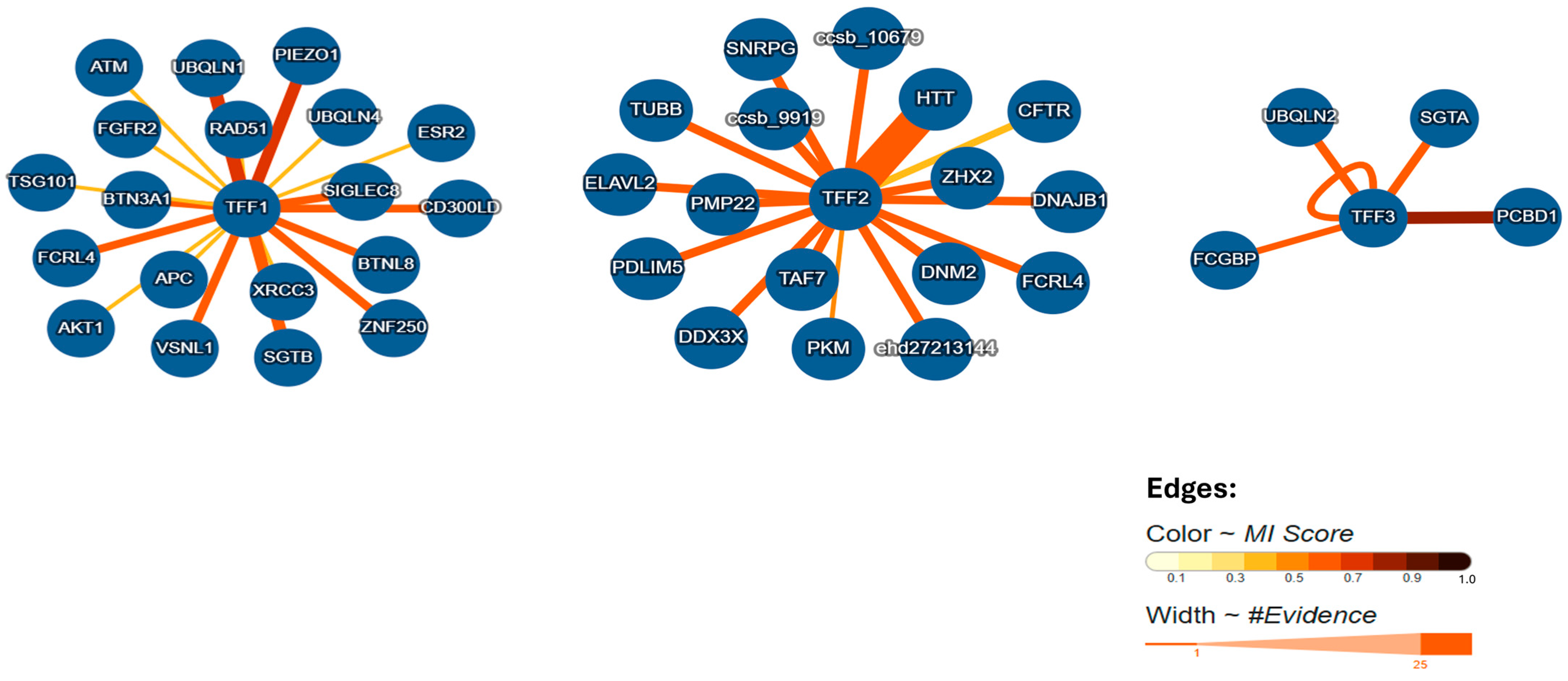
| TFF | Interacting Protein | Reference |
|---|---|---|
| TFF1 |
| [49,50,51,52,53,54] |
| TFF2 |
| [52,55,56,57] |
| TFF3 |
| [49,51,58] |
| Group/Model | Sample Type | Sample Size | Key Outcome | Interpretation | Reference |
|---|---|---|---|---|---|
| In vitro | Human retinoblastoma cell lines | N = 8 (RBL-13, RBL-15, RBL-30, RB 247C3, RB 355, RB 383, Y-79, and WERI-Rb1) | Rb cell lines with high TFF1 expression levels exhibited a selective downregulation of cyclin-dependent kinase (CDK) 6 | Tumour suppressor role of TFF1 | [24] |
| In vitro | Human retinoblastoma cell lines | N = 8 (RBL-13, RBL-15, RBL-30, RB 247 C3, RB 355, RB 383, WERI-Rb1, and Y-79 | Regulation of TFF1 expression in Rb cell lines requires the involvement of additional mechanisms | TFF1 may be regulated by epigenetic regulation, but requires additional mechanisms | [90] |
| In vitro and in vivo | Human retinoblastoma cell lines | N = 3 (Y79, RB355, and RBL-30) | Overexpression of TFF1 induces apoptosis and decreases proliferation and tumour growth of human retinoblastoma cell lines in a p53- and caspase-dependent manner, with implicated miR-18a regulation | Tumour suppressive and pro-apoptotic role | [91] |
| Retinoblastoma Patients | Tumour tissue and post-mortem retinal tissues | N = 59 (29 males and 30 females), 41 unilateral and 18 bilateral tumour cases | Increased TFF1 expression significantly correlates with unilateral tumours diagnosed in older children and with poorly differentiated tumours and higher tumour-node-metastasis stages | Unilateral tumours at a higher clinical tumour-node-metastasis stage and poorly differentiated tumour cells express significantly higher levels of TFF1 than those of differentiated tumours at lower tumour-node-metastasis stages | [22] |
| Retinoblastoma Patients | Tumour tissue, HRPF-specific fetal retinal tissue | N = 102 (50 males and 52 females) N = 112 (51 males and 61 females) N = 3 | TFF1 highly expressed in more aggressive subset 2, associated with cone dedifferentiation and expression of neuronal markers | Linked to aggressive patient having metastatic potential | [23] |
| Retinoblastoma Patients | Tumor tissue | N = 273 (sex not specified) | Non-mutually exclusive expression of ARR3 and TFF1 had an increased risk of relapse and death | Validated prognostic biomarker | [21] |
| Retinoblastoma Patients | Tumour tissue, aqueous humour, and human retinoblastoma cell lines | N = 15 (sex not specified) Cell lines = 2 (Rbl13 and Rbl30) | Nine out of fifteen aqueous humour patient samples exhibited TFF1 expressions, which correlated well with TFF1 levels of the original tumour. TFF1 expression in most of the corresponding primary cell cultures reflects the levels of the original tumour, although not all TFF1-expressing tumour cells seem to secrete into the aqueous humour | Potential biomarker | [20] |
| Retinoblastoma patients | Tumour tissue and aqueous humour, blood and aqueous humour from retinoblastoma patients under therapy and healthy controls | N = 8 (sex not specified) N = 7 (sex not specified), and N = 6 (sex not specified) | TFF1 consistently detectable in aqueous humour, confirming its potential as a biomarker. TFF1-secreting cells within the tumour mass originate from retinoblastoma tumour cells, not from surrounding stromal cells. IVC therapy-responsive patients exhibited remarkably reduced TFF1 levels post-therapy | TFF1 in aqueous humour of retinoblastoma patients potentially provides a minimally invasive tool for monitoring retinoblastoma therapy efficacy | [92] |
Disclaimer/Publisher’s Note: The statements, opinions and data contained in all publications are solely those of the individual author(s) and contributor(s) and not of MDPI and/or the editor(s). MDPI and/or the editor(s) disclaim responsibility for any injury to people or property resulting from any ideas, methods, instructions or products referred to in the content. |
© 2026 by the authors. Licensee MDPI, Basel, Switzerland. This article is an open access article distributed under the terms and conditions of the Creative Commons Attribution (CC BY) license.
Share and Cite
Verma, A.; Kapoor, M.; Soni, T.; Das, S.; Tiwari, A.; Verma, S. Trefoil Factor 1 (TFF1) in Retinoblastoma: A Biomarker, Mediator, or Therapeutic Target? Targets 2026, 4, 7. https://doi.org/10.3390/targets4010007
Verma A, Kapoor M, Soni T, Das S, Tiwari A, Verma S. Trefoil Factor 1 (TFF1) in Retinoblastoma: A Biomarker, Mediator, or Therapeutic Target? Targets. 2026; 4(1):7. https://doi.org/10.3390/targets4010007
Chicago/Turabian StyleVerma, Aman, Mohak Kapoor, Tanish Soni, Sima Das, Anil Tiwari, and Sudhir Verma. 2026. "Trefoil Factor 1 (TFF1) in Retinoblastoma: A Biomarker, Mediator, or Therapeutic Target?" Targets 4, no. 1: 7. https://doi.org/10.3390/targets4010007
APA StyleVerma, A., Kapoor, M., Soni, T., Das, S., Tiwari, A., & Verma, S. (2026). Trefoil Factor 1 (TFF1) in Retinoblastoma: A Biomarker, Mediator, or Therapeutic Target? Targets, 4(1), 7. https://doi.org/10.3390/targets4010007