

Review

Single-Cell Transcriptomics and Computational Frameworks for Target Discovery in Cancer

by
Martina Tarozzi
1,2,*,
Nicolas Riccardo Derus
1,
Stefano Polizzi
3,
Claudia Sala
1,2 and
Gastone Castellani
1,2
1
Department of Medical and Surgical Sciences, University of Bologna, 40138 Bologna, Italy
2
IRCCS Azienda Ospedaliero—Universitaria di Bologna, 40138 Bologna, Italy
3
IRCCS Istituto delle Scienze Neurologiche di Bologna, Data Science and Bioinformatics Laboratory, 40139 Bologna, Italy
*
Author to whom correspondence should be addressed.
Targets 2026, 4(1), 6; https://doi.org/10.3390/targets4010006 (registering DOI)
Submission received: 5 December 2025 / Revised: 13 January 2026 / Accepted: 28 January 2026 / Published: 3 February 2026

Abstract

Single-cell transcriptomics has redefined our understanding of cancer by exposing the complexity of tumor ecosystems and their therapeutic vulnerabilities. scRNA-seq studies have identified lineage hierarchies, immune evasion programs, and resistance-associated states across solid and liquid tumors, informing biomarker development and drug discovery. Advanced computational frameworks integrate these data with longitudinal profiling, RNA velocity, and network diffusion to prioritize targets and predict therapeutic response. Emerging multi-omics approaches further expand the scope of precision oncology by linking genetic alterations, protein-level markers, and spatial context to functional states. This narrative review aims to synthesize current applications of single-cell transcriptomics for target discovery, highlight computational frameworks that translate high-dimensional data into actionable insights, and explore how multi-omics integration is shaping future directions. By bridging molecular complexity with target prioritization, these approaches hold promise for translating single-cell insights into clinically actionable biomarkers and therapeutic strategies for personalized cancer treatment and rational drug development.

1. Tumor Ecosystems and Therapeutic Opportunities Revealed by Single-Cell Transcriptomics

Tumor heterogeneity is a defining hallmark of cancer, encompassing the genetic, epigenetic, transcriptomic, and phenotypic diversity observed both within individual tumors (intra-tumoral heterogeneity) and across tumors of the same histological type in different patients (inter-tumoral heterogeneity). This complexity arises from clonal evolution, stochastic mutations, epigenetic reprogramming, and dynamic interactions with the Tumor Microenvironment (TME), including immune and stromal components. As a result, tumors are not uniform masses of malignant cells but rather ecosystems composed of diverse cellular subpopulations with distinct functional roles, proliferative capacities, and therapeutic sensitivities [1]. Tumor heterogeneity is a major challenge to effective cancer treatment as it contributes to variable drug responses, immune evasion, and the emergence of resistant clones following therapy [2].
Single-cell transcriptomics have revealed extensive intratumoral heterogeneity, consistently identifying multiple distinct cell types along with their molecular signatures and functional states. For instance, in melanoma, Tirosh et al. [3] identified four major cell populations: malignant, immune, stromal, and endothelial cells. Within malignant cell populations, three major transcriptional programs were identified: a proliferation signature characterized by cell cycle genes, a pigmentation signature marked by high MITF expression, and a stromal signature featuring AXL expression. Subsequent studies have expanded the cellular landscape, revealing additional immune and stromal subtypes and dynamic cell states that influence therapy response and disease progression [4,5,6,7]. These works led to the identification of druggable pathways specific to melanoma cell subpopulations. CDK4, CDK2, and MEK1/2 were identified as therapeutic targets, with CDK4 and CDK2 showing homogeneous expression patterns. The MAPK pathway emerged as a druggable target, alongside epigenetic regulators. ABC transporters and ALDH genes marked stem-like cell subpopulations, while KDM5B (coding for the histone demethylase JARID1B) was identified as a novel target in these populations [3].
Another example is colorectal cancer (CRC), where scRNA-seq revealed extensive intratumoral heterogeneity across malignant, immune, and stromal compartments. Early foundational studies [8], identified distinct malignant cell expression patterns associated with unique immune and stromal interactions. More recent works [9,10,11,12] used single-cells and spatial transcriptomics to uncover dynamic changes in cell states and regulatory hubs during progression and were used to construct prognostic models and identify druggable targets, including TIMP1, MLXIPL, MLXIPL, AXIN2, TRAP1, TRIP6 and components of the KRAS signaling pathway [10]. These spatial and molecular patterns correlated with treatment response and disease progression, highlighting the clinical relevance of tumor cell subtypes.
A third example of how single-cell transcriptomics has been applied to increase biological understanding and hopefully improve clinical practice is Glioblastoma, a tumor characterized by profound intratumoral heterogeneity, which has historically limited therapeutic success. A seminal study by Patel et al. [13] was the first to apply single-cell RNA sequencing to primary glioblastoma. This work revealed that glioblastoma samples contain both malignant and normal brain cells, distinguishable through inferred copy number variation (CNV) profiles. Malignant cells exhibited variable expression of meta-signatures related to cell cycle, hypoxia, complement/immune response, and oligodendrocyte function, reflecting diverse functional states. Subsequent studies [14,15] have expanded on this framework, identifying hybrid cell states, treatment-induced transitions, and spatially distinct subpopulations, further underscoring the complexity of glioblastoma and the need for personalized, multi-targeted therapeutic strategies.
Interesting results emerged from liquid tumors as well, in which the element of heterogeneity is particularly pronounced due to clonal evolution and dynamic differentiation hierarchies. In acute myeloid leukemia (AML), single cell transcriptomics has been instrumental in resolving malignant blasts from normal hematopoietic cells and in mapping differentiation trajectories [16,17,18,19]. scRNA-seq studies have identified transcriptional programs associated with stemness, proliferation, and immune evasion, and revealed how treatment reshapes the cellular landscape by selecting resistant subclones. In hematologic malignancies, these approaches consistently revealed distinct malignant populations organized along differentiation hierarchies, ranging from primitive hematopoietic stem cell–like states to more differentiated cells, with cellular composition strongly correlating with specific genetic lesions. These insights have led to the identification of therapeutic targets such as CD123 and TIM3, which are enriched in leukemic stem-like cells [18].
Yet, a significant gap persists between target identification and therapeutic approval, reflecting biological complexity, resistance mechanisms, and the stringent validation required for clinical-grade drug development.
The complexity of tumor ecosystems revealed by single-cell transcriptomics demands robust computational strategies to extract actionable insights. In the following section, we explore the computational frameworks that enable researchers to translate high-dimensional single-cell data into prioritized therapeutic targets.

2. Computational Strategies for Target Discovery Using scRNA-Seq

2.1. Computational Frameworks for Target Discovery

The success of scRNA-seq in oncology depends heavily on robust computational frameworks that guide the analysis from raw data to actionable insights. Multi-purpose tools such as Seurat [20], Scanpy [21], and scCancer [22] serve as the backbone of scRNA-seq workflows, offering integrated pipelines for essential preprocessing steps including quality control (QC), normalization, dimensionality reduction, clustering, and cell-type annotation. These foundational steps are critical for ensuring data integrity and biological interpretability before any advanced analysis can be performed. Recent excellent reviews covered in details software and methods aimed at these steps [23,24], whose specific features fall beyond the scope of the present work. Beyond basic preprocessing, many frameworks support modular integration with advanced methods. Trajectory inference tools such as Monocle [25] and Slingshot [26] can be layered onto initial clustering results to model cellular differentiation and pseudotime analysis. Similarly, ligand–receptor interaction analysis tools like CellPhoneDB [27] and NicheNet [28] build on annotated cell types to infer intercellular communication, uncovering signaling pathways that mediate tumor–immune or tumor–stromal interactions. Target nomination typically follows a structured analytical flow: cell clustering defines biologically meaningful subpopulations, which are then subjected to differential gene expression analysis to identify subgroup-specific markers. These candidate genes are further evaluated through pathway enrichment and network-based analyses to uncover functional roles and prioritize druggable targets. This stepwise approach ensures that computational outputs converge toward clinically relevant hypotheses rather than isolated gene lists. By anchoring the analysis in these versatile frameworks, researchers ensure reproducibility, scalability, and compatibility with downstream methods for more advanced analyses to uncover dynamic processes, infer future cell states, and model intercellular communication, all of which are crucial for identifying actionable targets in cancer [29,30,31].
The following subsections focus on these advanced strategies, including longitudinal single-cell profiling, RNA velocity, and network-based approaches for druggable target discovery (mentioned software and methods in Table 1). These methods build upon the initial data processing steps and leverage the rich structure of scRNA-seq data to extract deeper biological insights (Figure 1).

2.2. Longitudinal Single-Cell Profiling in Cancer

Understanding how tumors adapt over time is critical for uncovering mechanisms of therapeutic resistance and disease progression. Most conventional single-cell studies provide only a static snapshot, limiting the understanding of dynamic processes. Longitudinal scRNA-seq enables temporal resolution of tumor dynamics by capturing cellular states across multiple time points (ideally three or more) revealing clonal evolution, treatment responses, and immune dynamics invisible in cross-sectional analyses. Computational frameworks translate these time-resolved data into biologically interpretable models, enabling reconstruction of clonal phylogenies, identification of resistance-associated mutations, and prediction of immune response trajectories.
Computational approach effectiveness depends on aligning method capabilities with biological timescale and sample characteristics, with no single framework demonstrating universal superiority across cancer contexts. Phylogenetic reconstruction methods excel for tracking clonal evolution over extended timeframes while demonstrating robustness even with limited cell numbers. LACE (Longitudinal Analysis of Cancer Evolution) employs Boolean matrix factorization with phylogenetic constraints via MCMC (Markov Chain Monte Carlo) sampling, demonstrating superior precision and recall compared to alternatives (CALDER, SCITE, TRaIT) when analyzing only 475 melanoma cells across four time points [32]. The weighted likelihood function accounts for sample size differences and error rates through parameter grid search for noise estimation, enabling reliable inference despite limited sampling [32]. LACE successfully identified genetic biomarkers including PRAME (established prognostic marker) and RPL5 (candidate tumor suppressor) as somatic mutations in clonal lineages, leveraging mutational profiles called directly from scRNA-seq data to investigate relationships between genomic and phenotypic evolution at single-cell resolution [32]. Canopy employs a Bayesian framework with BIC (Bayesian Information Criterion) model selection and Metropolis-Hastings sampling for reconstructing tumor phylogeny from somatic copy number alterations and single-nucleotide alterations. This approach allowed the identification of chr 18q deletion, RYR1 mutation, and chr 7q/12 Loss of Heterozygosity (LOH) as breast cancer metastatic potential biomarkers validated through single-cell sequencing [33]. These phylogenetic approaches prove particularly valuable for studies tracking clonal dynamics and genetic alterations driving therapeutic resistance or metastatic potential over weeks to months. Machine learning approaches demonstrate superior performance for capturing rapid immune dynamics and achieving cross-cancer generalizability without requiring method retraining. LiBIO, a predictive modeling framework, employs Lasso regression with fuzzy c-means clustering to identify dynamic gene expression changes in immune checkpoint blockade response, achieving AUCs (area under the ROC curve, where higher values reflect better prediction) of 0.80 ± 0.10 for melanoma, 0.73 ± 0.23 for Non-Small Cell Lung Cancer (NSCLC), and 0.72 ± 0.10 for breast cancer, with overall AUC of 0.78 ± 0.046 [34]. The composite transcriptional signature comprising 164 effector memory CD8+ T cell genes and 137 B cell genes demonstrated odds ratios of 4.0–5.0, outperforming the conventional PD-L1 CPS (Programmed Death-Ligand 1 Combined Positive Score) biomarker [34]. LiBIO’s generalizability across cancer types, validated through seven Head and Neck Squamous Cell Carcinoma (HNSCC) cohorts plus external melanoma, NSCLC, and breast cancer cohorts via five-fold cross-validation, represents a significant methodological advance for predictive biomarker development [34]. Complementary machine learning frameworks include MetaCell analysis in multiple myeloma, which generated 260 metacells from 95,380 cells across longitudinal treatment cycles, combined with shallow neural networks to achieve 88% overall response rate and identify PPIA and module-1 resistance signatures validated in the CoMMpass database [35]. Critical methodological insights include dataset size requirements varying from hundreds to tens of thousands of cells, temporal timescale matching (phylogenetic for extended periods vs. machine learning for acute responses), and validation stringency emerging as more critical than computational sophistication for clinical translatability. The optimal longitudinal method selection depends on study goals: phylogenetic approaches should be prioritized for tracking clonal evolution and identifying mutation-driven drug targets when sample sizes are limited and understanding genetic alterations is paramount, whereas machine learning approaches are more suitable for capturing immune dynamics and developing predictive biomarkers when cross-cancer generalizability and patient stratification capabilities are prioritized.

2.3. RNA Velocity: Inferring Future Cell States

While longitudinal sampling provides temporal resolution across clinical timepoints, RNA velocity offers a complementary approach to infer future transcriptional states from a single snapshot of scRNA-seq data. Introduced by La Manno et al. in 2018 [36], RNA velocity estimates the direction and speed of cellular state transitions by modeling the ratio of unspliced (nascent) to spliced (mature) mRNA transcripts. This allows researchers to predict how individual cells are likely to evolve, enabling the reconstruction of developmental trajectories and identification of dynamic regulatory programs, adding a temporal dimension to static single-cell data [37,38]. The underlying principle is expressed as
v = d s d t     α u β s
Biologically, this formulation (where α and β summarize spliced RNA production and decay, respectively) captures the balance between the production and loss of mature transcripts, where u (unspliced RNA) reflects nascent transcriptional activity and s (spliced RNA) represents mature mRNA. RNA velocity therefore estimates whether spliced transcript abundance is increasing or decreasing relative to steady state. A positive velocity indicates progression toward a future transcriptional state, while a negative velocity suggests regression or quiescence. In the context of therapeutic target discovery, these directional changes can reveal emerging resistant cell states or lineage trajectories that may harbor actionable vulnerabilities.
Since its introduction, computational frameworks have advanced significantly. Velocyto [37] pioneered the concept under a steady-state assumption, which works well for stable systems but struggles with transient states. To overcome this, scVelo [39] introduced a dynamical model that accounts for transient transcriptional states and non-equilibrium conditions, allowing more accurate inference of cell-state transitions in complex tissues. More recent methods derived from these, such as Bayesian frameworks like BayVel [40] that incorporate uncertainty quantification, providing confidence intervals for velocity estimates and mitigating identifiability issues. Additional innovations address batch effects, sparse data, and variability in transcriptional kinetics, making RNA velocity increasingly robust for clinical datasets. A comprehensive review about the specific features of the available methods can be found here [37].
Clinically, RNA velocity has proven particularly impactful in dynamic experimental setting such as developmental biology and oncology, where cellular plasticity and lineage transitions drive metastasis and therapy resistance. In AML, velocity-based models distinguished leukemia stem cells from regenerating hematopoietic cells, revealing transcriptional programs linked to relapse and poor prognosis [41]. In the immune context, velocity analysis has characterized distinct CD8+ T cell differentiation trajectories and identified stem-like T cell reservoirs that sustain antitumor immunity, as well as mapped neutrophil maturation in non-small cell lung cancer [42,43]. These applications underscore RNA velocity’s potential to uncover dynamic biomarkers and inform therapeutic strategies in precision oncology. Despite its utility, RNA velocity has limitations, including sensitivity to data sparsity, reliance on accurate splicing quantification, and vulnerability to noise in clinical samples. These factors can affect trajectory inference and should be considered when applying velocity-based insights to therapeutic decision-making.

2.4. Network Diffusion for Druggable Target Discovery

Tumor biology is shaped not only by individual gene expression changes but by the complex interplay of molecular networks. Network diffusion [44] models this principle by spreading information from experimentally derived sources -such as differentially expressed genes- through interaction networks, revealing functionally connected nodes that may not appear significant in isolation [45,46]. This approach enables the discovery of druggable targets that emerge from network context rather than single-gene statistics, offering opportunities for strategies such as synthetic lethality (where targeting a gene becomes lethal only in the presence of a cancer-specific alteration), drug repurposing, or identification of novel targets under specific conditions (e.g., healthy vs. pathological cells) [47]. For this analysis, two key components are needed: a list of sources and a network. Sources are “special” nodes chosen for a reason, such as genes significantly differentially expressed before and after treatment or genes associated with a disease. The network forms the backbone of the diffusion process, and its choice depends on the research question: tissue-specific pathways for targeted studies, or a protein–protein interaction (PPI) network for exploratory analyses [48,49,50,51]. Combining interaction networks can mitigate false negatives common in high-throughput interactomes. Information (e.g., differential expression or gene expression values) from scRNA-seq is then propagated through the network, yielding a node ranking that integrates experimental data with interaction information. This is a stochastic process with a stationary solution [46] governed by:
x t + 1 = α W x t + 1 α x 0
where W is the network matrix, x t the information at time t , and x 0 the initial scRNA-seq data and a critical parameter, α , controls how far information spreads from sources. While no universally accepted strategy for selecting this parameter exists, it should balance source genes and network-derived genes among top-ranked nodes. Several R packages implement diffusion with minimal prior knowledge [46,52,53,54], among them “dmfind” allows for a statistics-based selection of α .
Network diffusion has been successfully applied to prioritize biomarkers and identify druggable targets across multiple cancer types. For instance, diffusion-based integration of multi-omics data has been used to stratify papillary renal cell carcinoma into clinically relevant subtypes, revealing genes associated with poor survival and genomic instability [55]. Moreover, network propagation has been applied to prioritize rarely mutated “long-tail” genes that gain functional importance through network connectivity, identifying novel therapeutic targets validated by CRISPR screens [56]. It has also been applied with success to RNA sequencing of metabolically unhealthy obese individual, identifying the oxidative phosphorylation pathway as downregulated and 5 commonly deregulated gene [57]. Finally, diffusion-based frameworks combining scRNA-seq signatures with protein–protein interaction networks have refined cell-type-specific targets in immuno-oncology, enabling the identification of immunometabolic pathways in tumor-infiltrating T cells [58]. These examples highlight the versatility of network diffusion in bridging experimental data and interaction knowledge to accelerate biomarker discovery and therapeutic development. It is important to note that genes prioritized through network diffusion typically represent hypothesis-generating candidates rather than confirmed drug targets. While these rankings provide a rational starting point for experimental validation, only targets with demonstrated druggability or prior functional evidence can be considered clinically actionable. This distinction underscores the need for downstream validation pipelines to translate computational predictions into therapeutic strategies.

3. Single-Cell Multi-Omics: Current Advances and Future Directions

Single-cell transcriptomics has provided an essential foundation for understanding cellular heterogeneity in tumors. However, transcriptional profiles alone do not fully capture the regulatory, genetic, and functional complexity of cancer cells. To address these limitations, integrative single-cell multi-omics approaches have emerged, enabling simultaneous or sequential profiling of multiple molecular layers within individual cells [59]. These strategies provide a more comprehensive view of cellular states and are increasingly applied to therapeutic target discovery in oncology. This field is in rapid and intense development, excellent technical reviews cover the technological improvements and detailed features of the different specific methodologies [60,61].

3.1. Genome—Transcriptome Integration

The integration of genomic and transcriptomic data at single-cell resolution allows researchers to link somatic mutations, CNVs, and structural alterations to transcriptional signatures. Early pioneering methods such as G&T-seq [62] and DR-seq [63] allowed parallel sequencing of DNA and RNA from the same cell, providing a first glimpse into genotype–phenotype relationships, but were limited by low throughput and incomplete genome coverage. More recent platforms like TARGET-seq [64] and SIDR [65] improved mutation coverage, facilitating the identification of mutation-specific expression programs. Newer technologies overcome these limitations: HIPSD&R-seq [66] enables parallel profiling of thousands of cells, capturing low-coverage DNA and full-length RNA to identify rare clones and link copy number variations to transcriptional states. DEFND-seq [67] applies nucleosome depletion and droplet microfluidics to co-sequence RNA and DNA from individual nuclei, including archived tumor specimens, allowing detection of SNVs and CNVs alongside gene expression signatures. These approaches have revealed clonal hierarchies and mutation-specific expression programs in solid tumors, uncovered rare therapy-resistant subpopulations, and improved drug screening by associating genomic instability with transcriptional phenotypes. By integrating genotype and phenotype at single-cell resolution, these platforms provide a powerful framework for dissecting tumor heterogeneity, mapping evolutionary trajectories, and guiding precision oncology [68].

3.2. Integrating Proteome-Transcriptome

Transcript levels do not always correlate with protein abundance or activity, making proteomic integration important for functional interpretation. Technologies such as CITE-seq [69] and REAP-seq [70] combine scRNA-seq with antibody-based quantification of surface proteins, enabling simultaneous measurement of mRNA and protein expression in the same cell. For example, Stoeckius et al. applied CITE-seq to human PBMCs, refining immune cell classification and improving annotation of T cell states relevant for immunotherapy, while Mimitou et al. used REAP-seq to link CRISPR perturbations to protein-level changes in checkpoint pathways. These multimodal assays enhance cell-type annotation and reveal post-transcriptional regulation, but are based on a set of predetermined antibody panels, lacking the possibility to catch novel or unexpected proteins, as well as capture the full proteome.
Advanced methods like TEA-seq [71] and DOGMA-seq [72] extend this integration to include chromatin accessibility and mitochondrial DNA, offering a trimodal view of cellular regulation. TEA-seq has been used to uncover regulatory programs controlling checkpoint receptor expression, and DOGMA-seq revealed discordance between transcript and protein abundance for PD-1 and other immunotherapy targets in tumor-infiltrating lymphocytes. Such approaches are particularly relevant in immuno-oncology, where protein-level markers (e.g., checkpoint receptors) are direct therapeutic targets, and their expression may not be reliably inferred from transcriptomic data alone. These findings have informed immunotherapy strategies by identifying protein-level markers predictive of response. In solid tumors, multimodal profiling has uncovered discordance between transcript and protein abundance for key therapeutic targets, emphasizing the need for proteomic integration in biomarker discovery [73].

3.3. Other Multi-Omics Integrations and Future Directions

Beyond genome and proteome, additional modalities such as epigenomics, metabolomics, and spatial transcriptomics are being incorporated into single-cell studies. Multiome platforms (e.g., 10× Multiome) allow concurrent profiling of chromatin accessibility and gene expression, providing insights into regulatory mechanisms underlying transcriptional heterogeneity. In practice, trimodal assays have revealed regulatory programs that link accessible chromatin to protein-defined states in immune contexts relevant to cancer immunotherapy [71,72]. Spatial multi-omics technologies, including Slide-seq [74,75] and Spatial CITE-seq [76], add locational context, enabling the mapping of cell–cell interactions and niche-specific expression patterns within the tumor microenvironment. For example, Slide-seq/Slide-seqV2 have been used to resolve near-cellular gradients of tumor and stromal programs, uncovering microdomains where signaling pathways associated with therapy resistance are concentrated [74,75]. Spatial CITE-seq demonstrated high-plex co-mapping of proteins and whole-transcriptome readouts at cellular resolution, allowing identification of spatially restricted immune niches and ligand–receptor interactions that shape local anti-tumor responses [76]. Emerging methods also explore integration with metabolomic and phosphoproteomic data, offering dynamic views of cellular metabolism and signaling. In solid tumors, proteogenomic integration has delineated pathway activation states and clinically relevant molecular signatures [77]. At the single-cell scale, combined quantification of intracellular phospho-proteins with transcriptomics from fixed cells has enabled mapping of signaling activities that define pathway-dependent vulnerabilities [78]. These layers are particularly informative for identifying metabolic dependencies and pathway activation states that may be exploited therapeutically [77,78].
Computational frameworks for multi-omics integration—such as MOFA+ [79], Seurat v5 [80], and deep learning-based models—are essential for harmonizing disparate data types and extracting biologically meaningful patterns. These approaches have been used to learn factors that align multimodal cell states (e.g., RNA–protein–chromatin) with actionable pathways, improving prioritization of candidate targets by convergent evidence across layers [79,80]. These tools facilitate the construction of regulatory networks, inference of cell trajectories, and prioritization of candidate targets based on multi-layered evidence. However, widespread clinical adoption of single-cell multi-omics will require overcoming practical challenges such as high cost, data harmonization across platforms, and scalability, while AI-driven integration approaches must address interpretability and reproducibility concerns to ensure regulatory compliance and clinical trust.
Looking ahead, the field is moving toward comprehensive multi-modal single-cell profiling, AI-driven integration, and real-time clinical applications. Future directions include combining spatial multi-omics with temporal dynamics to capture tumor evolution in situ, leveraging generative AI for predictive modeling of therapy response, and developing standardized pipelines for clinical-grade multi-omics interpretation. As technologies mature and costs decline, single-cell transcriptomics will become a cornerstone of precision oncology. The field is still rapidly evolving, both on the technological side and even more on the computational side, especially to face the challenges associated with the integration of multimodal single-cell data.

Author Contributions

Conceptualization, M.T. resources, M.T., N.R.D., S.P., C.S. and G.C.; writing—original draft preparation, M.T., N.R.D., S.P. and C.S.; writing—review and editing, M.T., N.R.D., S.P., C.S. and G.C.; visualization, M.T.; supervision, G.C. All authors have read and agreed to the published version of the manuscript.

Funding

This research received no external funding.

Institutional Review Board Statement

Not applicable.

Informed Consent Statement

Not applicable.

Data Availability Statement

No new data were created or analyzed in this study.

Conflicts of Interest

The authors declare no conflicts of interest.

Abbreviations

The following abbreviations are used in this manuscript:
TMETumor Micro Environment
scRNA-seqSingle-cell RNA sequencing
CNVsCopy number Variations
PPIProtein–Protein Interaction
AMLAcute Myeloid Leukemia
NSCLC Non-Small Cell Lung Cancer
AUCArea Under the Curve

References

  1. MacDonald, W.J.; Purcell, C.; Pinho-Schwermann, M.; Stubbs, N.M.; Srinivasan, P.R.; El-Deiry, W.S. Heterogeneity in Cancer. Cancers 2025, 17, 441. [Google Scholar] [CrossRef]
  2. Maleki, E.H.; Bahrami, A.R.; Matin, M.M. Cancer Cell Cycle Heterogeneity as a Critical Determinant of Therapeutic Resistance. Genes Dis. 2024, 11, 189–204. [Google Scholar] [CrossRef]
  3. Tirosh, I.; Izar, B.; Prakadan, S.M.; Wadsworth, M.H., II; Treacy, D.; Trombetta, J.J.; Rotem, A.; Rodman, C.; Lian, C.; Murphy, G.; et al. Dissecting the Multicellular Ecosystem of Metastatic Melanoma by Single-Cell RNA-Seq. Science 2016, 352, 189–196. [Google Scholar] [CrossRef]
  4. Belote, R.L.; Le, D.; Maynard, A.; Lang, U.E.; Sinclair, A.; Lohman, B.K.; Planells-Palop, V.; Baskin, L.; Tward, A.D.; Darmanis, S.; et al. Human Melanocyte Development and Melanoma Dedifferentiation at Single-Cell Resolution. Nat. Cell Biol. 2021, 23, 1035–1047. [Google Scholar] [CrossRef]
  5. Centeno, P.P.; Pavet, V.; Marais, R. The Journey from Melanocytes to Melanoma. Nat. Rev. Cancer 2023, 23, 372–390. [Google Scholar] [CrossRef]
  6. Ng, M.F.; Simmons, J.L.; Boyle, G.M. Heterogeneity in Melanoma. Cancers 2022, 14, 3030. [Google Scholar] [CrossRef]
  7. Shi, A.; Yan, M.; Pang, B.; Pang, L.; Wang, Y.; Lan, Y.; Zhang, X.; Xu, J.; Ping, Y.; Hu, J. Dissecting Cellular States of Infiltrating Microenvironment Cells in Melanoma by Integrating Single-Cell and Bulk Transcriptome Analysis. BMC Immunol. 2023, 24, 52. [Google Scholar] [CrossRef] [PubMed]
  8. Li, H.; Courtois, E.T.; Sengupta, D.; Tan, Y.; Chen, K.H.; Goh, J.J.L.; Kong, S.L.; Chua, C.; Hon, L.K.; Tan, W.S.; et al. Reference Component Analysis of Single-Cell Transcriptomes Elucidates Cellular Heterogeneity in Human Colorectal Tumors. Nat. Genet. 2017, 49, 708–718. [Google Scholar] [CrossRef] [PubMed]
  9. Song, W.; Wang, Y.; Zhou, M.; Guo, F.; Liu, Y. Spatial Transcriptomics and ScRNA-Seq: Decoding Tumor Complexity and Constructing Prognostic Models in Colorectal Cancer. Hum. Genom. 2025, 19, 92. [Google Scholar] [CrossRef] [PubMed]
  10. Zhang, Y.; Song, J.; Zhao, Z.; Yang, M.; Chen, M.; Liu, C.; Ji, J.; Zhu, D. Single-Cell Transcriptome Analysis Reveals Tumor Immune Microenvironment Heterogenicity and Granulocytes Enrichment in Colorectal Cancer Liver Metastases. Cancer Lett. 2020, 470, 84–94. [Google Scholar] [CrossRef]
  11. Valdeolivas, A.; Amberg, B.; Giroud, N.; Richardson, M.; Gálvez, E.J.C.; Badillo, S.; Julien-Laferrière, A.; Túrós, D.; Voith von Voithenberg, L.; Wells, I.; et al. Profiling the Heterogeneity of Colorectal Cancer Consensus Molecular Subtypes Using Spatial Transcriptomics. npj Precis. Oncol. 2024, 8, 10. [Google Scholar] [CrossRef] [PubMed]
  12. Wang, Y.; Qiu, X.; Li, Q.; Qin, J.; Ye, L.; Zhang, X.; Huang, X.; Wen, X.; Wang, Z.; He, W.; et al. Single-Cell and Spatial-Resolved Profiling Reveals Cancer-Associated Fibroblast Heterogeneity in Colorectal Cancer Metabolic Subtypes. J. Transl. Med. 2025, 23, 175. [Google Scholar] [CrossRef] [PubMed]
  13. Patel, A.P.; Tirosh, I.; Trombetta, J.J.; Shalek, A.K.; Gillespie, S.M.; Wakimoto, H.; Cahill, D.P.; Nahed, B.V.; Curry, W.T.; Martuza, R.L.; et al. Single-Cell RNA-Seq Highlights Intratumoral Heterogeneity in Primary Glioblastoma. Science 2014, 344, 1396–1401. [Google Scholar] [CrossRef]
  14. Eisenbarth, D.; Wang, Y.A. Glioblastoma Heterogeneity at Single Cell Resolution. Oncogene 2023, 42, 2155–2165. [Google Scholar] [CrossRef]
  15. Ordóñez-Rubiano, E.G.; Rincón-Arias, N.; Shelton, W.J.; Salazar, A.F.; Sierra, M.A.; Bertani, R.; Gómez-Amarillo, D.F.; Hakim, F.; Baldoncini, M.; Payán-Gómez, C.; et al. Current Applications of Single-Cell RNA Sequencing in Glioblastoma: A Scoping Review. Brain Sci. 2025, 15, 309. [Google Scholar] [CrossRef]
  16. Wu, J.; Xiao, Y.; Sun, J.; Sun, H.; Chen, H.; Zhu, Y.; Fu, H.; Yu, C.; E, W.; Lai, S.; et al. A Single-Cell Survey of Cellular Hierarchy in Acute Myeloid Leukemia. J. Hematol. Oncol. 2020, 13, 128. [Google Scholar] [CrossRef]
  17. Shen, X.; Dong, P.; Kong, J.; Sun, N.; Wang, F.; Sang, L.; Xu, Y.; Zhang, M.; Chen, X.; Guo, R.; et al. Targeted Single-Cell RNA Sequencing Analysis Reveals Metabolic Reprogramming and the Ferroptosis-Resistant State in Hematologic Malignancies. Cell Biochem. Funct. 2023, 41, 1343–1356. [Google Scholar] [CrossRef]
  18. van Galen, P.; Hovestadt, V.; Wadsworth, M.H.; Hughes, T.K.; Griffin, G.K.; Battaglia, S.; Verga, J.A.; Stephansky, J.; Pastika, T.J.; Lombardi Story, J.; et al. Single-Cell RNA-Seq Reveals AML Hierarchies Relevant to Disease Progression and Immunity. Cell 2019, 176, 1265–1281.e24. [Google Scholar] [CrossRef]
  19. Naldini, M.M.; Casirati, G.; Barcella, M.; Rancoita, P.M.V.; Cosentino, A.; Caserta, C.; Pavesi, F.; Zonari, E.; Desantis, G.; Gilioli, D.; et al. Longitudinal Single-Cell Profiling of Chemotherapy Response in Acute Myeloid Leukemia. Nat. Commun. 2023, 14, 1285. [Google Scholar] [CrossRef] [PubMed]
  20. Satija, R.; Farrell, J.A.; Gennert, D.; Schier, A.F.; Regev, A. Spatial Reconstruction of Single-Cell Gene Expression Data. Nat. Biotechnol. 2015, 33, 495–502. [Google Scholar] [CrossRef]
  21. Wolf, F.A.; Angerer, P.; Theis, F.J. SCANPY: Large-Scale Single-Cell Gene Expression Data Analysis. Genome Biol. 2018, 19, 15. [Google Scholar] [CrossRef]
  22. Guo, W.; Wang, D.; Wang, S.; Shan, Y.; Liu, C.; Gu, J. ScCancer: A Package for Automated Processing of Single-Cell RNA-Seq Data in Cancer. Brief. Bioinform. 2021, 22, bbaa127. [Google Scholar] [CrossRef]
  23. Arya, A.; Tripathi, P.; Dubey, N.; Aier, I.; Kumar Varadwaj, P. Navigating Single-Cell RNA-Sequencing: Protocols, Tools, Databases, and Applications. Genom. Inform. 2025, 23, 13. [Google Scholar] [CrossRef]
  24. Rafi, F.R.; Heya, N.R.; Hafiz, M.S.; Jim, J.R.; Kabir, M.M.; Mridha, M.F. A Systematic Review of Single-Cell RNA Sequencing Applications and Innovations. Comput. Biol. Chem. 2025, 115, 108362. [Google Scholar] [CrossRef] [PubMed]
  25. Van den Berge, K.; Roux de Bézieux, H.; Street, K.; Saelens, W.; Cannoodt, R.; Saeys, Y.; Dudoit, S.; Clement, L. Trajectory-Based Differential Expression Analysis for Single-Cell Sequencing Data. Nat. Commun. 2020, 11, 1201. [Google Scholar] [CrossRef] [PubMed]
  26. Street, K.; Risso, D.; Fletcher, R.B.; Das, D.; Ngai, J.; Yosef, N.; Purdom, E.; Dudoit, S. Slingshot: Cell Lineage and Pseudotime Inference for Single-Cell Transcriptomics. BMC Genom. 2018, 19, 477. [Google Scholar] [CrossRef] [PubMed]
  27. Efremova, M.; Vento-Tormo, M.; Teichmann, S.A.; Vento-Tormo, R. CellPhoneDB: Inferring Cell–Cell Communication from Combined Expression of Multi-Subunit Ligand–Receptor Complexes. Nat. Protoc. 2020, 15, 1484–1506. [Google Scholar] [CrossRef]
  28. Browaeys, R.; Saelens, W.; Saeys, Y. NicheNet: Modeling Intercellular Communication by Linking Ligands to Target Genes. Nat. Methods 2019, 17, 159–162. [Google Scholar] [CrossRef]
  29. Aran, D. Single-Cell RNA Sequencing for Studying Human Cancers. Annu. Rev. Biomed. Data Sci. 2023, 6, 1–22. [Google Scholar] [CrossRef]
  30. Song, Q.; Liu, L. Single-Cell RNA-Seq Technologies and Computational Analysis Tools: Application in Cancer Research. Methods Mol. Biol. 2022, 2413, 245–255. [Google Scholar] [CrossRef]
  31. Boxer, E.; Feigin, N.; Tschernichovsky, R.; Darnell, N.G.; Greenwald, A.R.; Hoefflin, R.; Kovarsky, D.; Simkin, D.; Turgeman, S.; Zhang, L.; et al. Emerging Clinical Applications of Single-Cell RNA Sequencing in Oncology. Nat. Rev. Clin. Oncol. 2025, 22, 315–326. [Google Scholar] [CrossRef]
  32. Ramazzotti, D.; Angaroni, F.; Maspero, D.; Ascolani, G.; Castiglioni, I.; Piazza, R.; Antoniotti, M.; Graudenzi, A. LACE: Inference of Cancer Evolution Models from Longitudinal Single-Cell Sequencing Data. J. Comput. Sci. 2022, 58, 101523. [Google Scholar] [CrossRef]
  33. Jiang, Y.; Qiu, Y.; Minn, A.J.; Zhang, N.R. Assessing Intratumor Heterogeneity and Tracking Longitudinal and Spatial Clonal Evolutionary History by Next-Generation Sequencing. Proc. Natl. Acad. Sci. USA 2016, 113, E5528–E5537. [Google Scholar] [CrossRef]
  34. Wang, B.; Saddawi-Konefka, R.; Clubb, L.M.; Tang, S.; Wu, D.; Mukherjee, S.; Sahni, S.; Dhruba, S.R.; Yang, X.; Patiyal, S.; et al. Longitudinal Liquid Biopsy Identifies an Early Predictive Biomarker of Immune Checkpoint Blockade Response in Head and Neck Squamous Cell Carcinoma. Nat. Commun. 2025, 16, 8161. [Google Scholar] [CrossRef]
  35. Cohen, Y.C.; Zada, M.; Wang, S.Y.; Bornstein, C.; David, E.; Moshe, A.; Li, B.; Shlomi-Loubaton, S.; Gatt, M.E.; Gur, C.; et al. Identification of Resistance Pathways and Therapeutic Targets in Relapsed Multiple Myeloma Patients through Single-Cell Sequencing. Nat. Med. 2021, 27, 491–503. [Google Scholar] [CrossRef] [PubMed]
  36. La Manno, G.; Soldatov, R.; Zeisel, A.; Braun, E.; Hochgerner, H.; Petukhov, V.; Lidschreiber, K.; Kastriti, M.E.; Lönnerberg, P.; Furlan, A.; et al. RNA Velocity of Single Cells. Nature 2018, 560, 494–498. [Google Scholar] [CrossRef]
  37. Wang, Y.; Li, J.; Zha, H.; Liu, S.; Huang, D.; Fu, L.; Liu, X. Paradigms, Innovations, and Biological Applications of RNA Velocity: A Comprehensive Review. Brief. Bioinform. 2025, 26, 339. [Google Scholar] [CrossRef] [PubMed]
  38. Bergen, V.; Soldatov, R.A.; Kharchenko, P.V.; Theis, F.J. RNA Velocity—Current Challenges and Future Perspectives. Mol. Syst. Biol. 2021, 17, 10282. [Google Scholar] [CrossRef]
  39. Bergen, V.; Lange, M.; Peidli, S.; Wolf, F.A.; Theis, F.J. Generalizing RNA Velocity to Transient Cell States through Dynamical Modeling. Nat. Biotechnol. 2020, 38, 1408–1414. [Google Scholar] [CrossRef] [PubMed]
  40. Sabbioni, E.; Bibbona, E.; Mastrantonio, G.; Sanguinetti, G. BayVel: A Bayesian Framework for RNA Velocity Estimation in Single-Cell Transcriptomics. arXiv 2025, arXiv:2505.03083. [Google Scholar]
  41. Wu, B.; Chen, X.; Pan, X.; Deng, X.; Li, S.; Wang, Z.; Wang, J.; Liao, D.; Xu, J.; Chen, M.; et al. Single-Cell Transcriptome Analyses Reveal Critical Roles of RNA Splicing during Leukemia Progression. PLoS Biol. 2023, 21, e3002088. [Google Scholar] [CrossRef]
  42. Hu, J.; Zhang, L.; Xia, H.; Yan, Y.; Zhu, X.; Sun, F.; Sun, L.; Li, S.; Li, D.; Wang, J.; et al. Tumor Microenvironment Remodeling after Neoadjuvant Immunotherapy in Non-Small Cell Lung Cancer Revealed by Single-Cell RNA Sequencing. Genome Med. 2023, 15, 14. [Google Scholar] [CrossRef] [PubMed]
  43. Salcher, S.; Sturm, G.; Horvath, L.; Untergasser, G.; Kuempers, C.; Fotakis, G.; Panizzolo, E.; Martowicz, A.; Trebo, M.; Pall, G.; et al. High-Resolution Single-Cell Atlas Reveals Diversity and Plasticity of Tissue-Resident Neutrophils in Non-Small Cell Lung Cancer. Cancer Cell 2022, 40, 1503–1520.e8. [Google Scholar] [CrossRef]
  44. Zoidi, O.; Fotiadou, E.; Nikolaidis, N.; Pitas, I. Graph-Based Label Propagation in Digital Media: A Review. ACM Comput. Surv. 2015, 47, 1–35. [Google Scholar] [CrossRef]
  45. Hofree, M.; Shen, J.P.; Carter, H.; Gross, A.; Ideker, T. Network-Based Stratification of Tumor Mutations. Nat. Methods 2013, 10, 1108–1115. [Google Scholar] [CrossRef]
  46. Bersanelli, M.; Mosca, E.; Remondini, D.; Castellani, G.; Milanesi, L. Network Diffusion-Based Analysis of High-Throughput Data for the Detection of Differentially Enriched Modules. Sci. Rep. 2016, 6, 34841. [Google Scholar] [CrossRef]
  47. Vanunu, O.; Magger, O.; Ruppin, E.; Shlomi, T.; Sharan, R. Associating Genes and Protein Complexes with Disease via Network Propagation. PLoS Comput. Biol. 2010, 6, e1000641. [Google Scholar] [CrossRef]
  48. Herwig, R.; Hardt, C.; Lienhard, M.; Kamburov, A. Analyzing and Interpreting Genome Data at the Network Level with ConsensusPathDB. Nat. Protoc. 2016, 11, 1889–1907. [Google Scholar] [CrossRef]
  49. Huttlin, E.L.; Bruckner, R.J.; Paulo, J.A.; Cannon, J.R.; Ting, L.; Baltier, K.; Colby, G.; Gebreab, F.; Gygi, M.P.; Parzen, H.; et al. Architecture of the Human Interactome Defines Protein Communities and Disease Networks. Nature 2017, 545, 505–509. [Google Scholar] [CrossRef] [PubMed]
  50. Luck, K.; Kim, D.K.; Lambourne, L.; Spirohn, K.; Begg, B.E.; Bian, W.; Brignall, R.; Cafarelli, T.; Campos-Laborie, F.J.; Charloteaux, B.; et al. A Reference Map of the Human Binary Protein Interactome. Nature 2020, 580, 402–408. [Google Scholar] [CrossRef] [PubMed]
  51. Dall’Olio, D.; Magnani, F.; Casadei, F.; Matteuzzi, T.; Curti, N.; Merlotti, A.; Simonetti, G.; Della Porta, M.G.; Remondini, D.; Tarozzi, M.; et al. Emerging Signatures of Hematological Malignancies from Gene Expression and Transcription Factor-Gene Regulations. Int. J. Mol. Sci. 2024, 25, 13588. [Google Scholar] [CrossRef] [PubMed]
  52. Valentini, G.; Armano, G.; Frasca, M.; Lin, J.; Mesiti, M.; Re, M. RANKS: A Flexible Tool for Node Label Ranking and Classification in Biological Networks. Bioinformatics 2016, 32, 2872–2874. [Google Scholar] [CrossRef]
  53. Picart-Armada, S.; Thompson, W.K.; Buil, A.; Perera-Lluna, A. DiffuStats: An R Package to Compute Diffusion-Based Scores on Biological Networks. Bioinformatics 2018, 34, 533–534. [Google Scholar] [CrossRef]
  54. Sun, L.; Yin, Z.; Lu, L. ISLRWR: A Network Diffusion Algorithm for Drug–Target Interactions Prediction. PLoS ONE 2025, 20, e0302281. [Google Scholar] [CrossRef]
  55. Shetty, K.S.; Jose, A.; Bani, M.; Vinod, P.K. Network Diffusion-Based Approach for Survival Prediction and Identification of Biomarkers Using Multi-Omics Data of Papillary Renal Cell Carcinoma. Mol. Genet. Genom. 2023, 298, 871–882. [Google Scholar] [CrossRef]
  56. Mohsen, H.; Gunasekharan, V.; Qing, T.; Seay, M.; Surovtseva, Y.; Negahban, S.; Szallasi, Z.; Pusztai, L.; Gerstein, M.B. Network Propagation-Based Prioritization of Long Tail Genes in 17 Cancer Types. Genome Biol. 2021, 22, 287. [Google Scholar] [CrossRef]
  57. Meroni, M.; Chiappori, F.; Paolini, E.; Longo, M.; De Caro, E.; Mosca, E.; Chiodi, A.; Merelli, I.; Badiali, S.; Maggioni, M.; et al. A Novel Gene Signature to Diagnose MASLD in Metabolically Unhealthy Obese Individuals. Biochem. Pharmacol. 2023, 218, 115925. [Google Scholar] [CrossRef]
  58. Mangelinck, A.; Molitor, E.; Marchiq, I.; Alaoui, L.; Bouaziz, M.; Andrade-Pereira, R.; Darville, H.; Becht, E.; Lefebvre, C. The Combined Use of ScRNA-Seq and Network Propagation Highlights Key Features of Pan-Cancer Tumor-Infiltrating T Cells. PLoS ONE 2024, 19, e0315980. [Google Scholar] [CrossRef] [PubMed]
  59. Baysoy, A.; Bai, Z.; Satija, R.; Fan, R. The Technological Landscape and Applications of Single-Cell Multi-Omics. Nat. Rev. Mol. Cell Biol. 2023, 24, 695–713. [Google Scholar] [CrossRef]
  60. Wu, X.; Yang, X.; Dai, Y.; Zhao, Z.; Zhu, J.; Guo, H.; Yang, R. Single-Cell Sequencing to Multi-Omics: Technologies and Applications. Biomark. Res. 2024, 12, 110. [Google Scholar] [CrossRef] [PubMed]
  61. Chappell, L.; Russell, A.J.C.; Voet, T. Single-Cell (Multi)Omics Technologies. Annu. Rev. Genom. Hum. Genet. 2018, 19, 15–41. [Google Scholar] [CrossRef]
  62. Macaulay, I.C.; Haerty, W.; Kumar, P.; Li, Y.I.; Hu, T.X.; Teng, M.J.; Goolam, M.; Saurat, N.; Coupland, P.; Shirley, L.M.; et al. G&T-Seq: Parallel Sequencing of Single-Cell Genomes and Transcriptomes. Nat. Methods 2015, 12, 519–522. [Google Scholar] [CrossRef]
  63. Dey, S.S.; Kester, L.; Spanjaard, B.; Bienko, M.; Van Oudenaarden, A. Integrated Genome and Transcriptome Sequencing of the Same Cell. Nat. Biotechnol. 2015, 33, 285–289. [Google Scholar] [CrossRef]
  64. Rodriguez-Meira, A.; O’Sullivan, J.; Rahman, H.; Mead, A.J. TARGET-Seq: A Protocol for High-Sensitivity Single-Cell Mutational Analysis and Parallel RNA Sequencing. STAR Protoc. 2020, 1, 100125. [Google Scholar] [CrossRef] [PubMed]
  65. Han, K.Y.; Kim, K.T.; Joung, J.G.; Son, D.S.; Kim, Y.J.; Jo, A.; Jeon, H.J.; Moon, H.S.; Yoo, C.E.; Chung, W.; et al. SIDR: Simultaneous Isolation and Parallel Sequencing of Genomic DNA and Total RNA from Single Cells. Genome Res. 2018, 28, 75–87. [Google Scholar] [CrossRef] [PubMed]
  66. Otoničar, J.; Lazareva, O.; Mallm, J.P.; Simovic-Lorenz, M.; Philippos, G.; Sant, P.; Parekh, U.; Hammann, L.; Li, A.; Yildiz, U.; et al. HIPSD&R-Seq Enables Scalable Genomic Copy Number and Transcriptome Profiling. Genome Biol. 2024, 25, 316. [Google Scholar] [CrossRef] [PubMed]
  67. Olsen, T.R.; Talla, P.; Sagatelian, R.K.; Furnari, J.; Bruce, J.N.; Canoll, P.; Zha, S.; Sims, P.A. Scalable Co-Sequencing of RNA and DNA from Individual Nuclei. Nat. Methods 2025, 22, 477–487. [Google Scholar] [CrossRef]
  68. Ortega-Batista, A.; Jaén-Alvarado, Y.; Moreno-Labrador, D.; Gómez, N.; García, G.; Guerrero, E.N. Single-Cell Sequencing: Genomic and Transcriptomic Approaches in Cancer Cell Biology. Int. J. Mol. Sci. 2025, 26, 2074. [Google Scholar] [CrossRef]
  69. Stoeckius, M.; Hafemeister, C.; Stephenson, W.; Houck-Loomis, B.; Chattopadhyay, P.K.; Swerdlow, H.; Satija, R.; Smibert, P. Simultaneous Epitope and Transcriptome Measurement in Single Cells. Nat. Methods 2017, 14, 865–868. [Google Scholar] [CrossRef]
  70. Mimitou, E.P.; Cheng, A.; Montalbano, A.; Hao, S.; Stoeckius, M.; Legut, M.; Roush, T.; Herrera, A.; Papalexi, E.; Ouyang, Z.; et al. Multiplexed Detection of Proteins, Transcriptomes, Clonotypes and CRISPR Perturbations in Single Cells. Nat. Methods 2019, 16, 409–412. [Google Scholar] [CrossRef]
  71. Swanson, E.; Lord, C.; Reading, J.; Heubeck, A.T.; Genge, P.C.; Thomson, Z.; Weiss, M.D.A.; Li, X.J.; Savage, A.K.; Green, R.R.; et al. Simultaneous Trimodal Single-Cell Measurement of Transcripts, Epitopes, and Chromatin Accessibility Using TEA-Seq. eLife 2021, 10, e63632. [Google Scholar] [CrossRef]
  72. Mimitou, E.P.; Lareau, C.A.; Chen, K.Y.; Zorzetto-Fernandes, A.L.; Hao, Y.; Takeshima, Y.; Luo, W.; Huang, T.S.; Yeung, B.Z.; Papalexi, E.; et al. Scalable, Multimodal Profiling of Chromatin Accessibility, Gene Expression and Protein Levels in Single Cells. Nat. Biotechnol. 2021, 39, 1246–1258. [Google Scholar] [CrossRef]
  73. Liang, A.; Kong, Y.; Chen, Z.; Qiu, Y.; Wu, Y.; Zhu, X.; Li, Z. Advancements and Applications of Single-Cell Multi-Omics Techniques in Cancer Research: Unveiling Heterogeneity and Paving the Way for Precision Therapeutics. Biochem. Biophys. Rep. 2024, 37, 101589. [Google Scholar] [CrossRef] [PubMed]
  74. Rodriques, S.G.; Stickels, R.R.; Goeva, A.; Martin, C.A.; Murray, E.; Vanderburg, C.R.; Welch, J.; Chen, L.M.; Chen, F.; Macosko, E.Z. Slide-Seq: A Scalable Technology for Measuring Genome-Wide Expression at High Spatial Resolution. Science 2019, 363, 1463–1467. [Google Scholar] [CrossRef]
  75. Stickels, R.R.; Murray, E.; Kumar, P.; Li, J.; Marshall, J.L.; Di Bella, D.J.; Arlotta, P.; Macosko, E.Z.; Chen, F. Highly Sensitive Spatial Transcriptomics at Near-Cellular Resolution with Slide-SeqV2. Nat. Biotechnol. 2021, 39, 313–319. [Google Scholar] [CrossRef]
  76. Liu, Y.; DiStasio, M.; Su, G.; Asashima, H.; Enninful, A.; Qin, X.; Deng, Y.; Nam, J.; Gao, F.; Bordignon, P.; et al. High-Plex Protein and Whole Transcriptome Co-Mapping at Cellular Resolution with Spatial CITE-Seq. Nat. Biotechnol. 2023, 41, 1405–1409. [Google Scholar] [CrossRef] [PubMed]
  77. Chen, Y.J.; Roumeliotis, T.I.; Chang, Y.H.; Chen, C.T.; Han, C.L.; Lin, M.H.; Chen, H.W.; Chang, G.C.; Chang, Y.L.; Wu, C.T.; et al. Proteogenomics of Non-Smoking Lung Cancer in East Asia Delineates Molecular Signatures of Pathogenesis and Progression. Cell 2020, 182, 226–244.e17. [Google Scholar] [CrossRef] [PubMed]
  78. Gerlach, J.P.; van Buggenum, J.A.G.; Tanis, S.E.J.; Hogeweg, M.; Heuts, B.M.H.; Muraro, M.J.; Elze, L.; Rivello, F.; Rakszewska, A.; van Oudenaarden, A.; et al. Combined Quantification of Intracellular (Phospho-)Proteins and Transcriptomics from Fixed Single Cells. Sci. Rep. 2019, 9, 1469. [Google Scholar] [CrossRef]
  79. Argelaguet, R.; Arnol, D.; Bredikhin, D.; Deloro, Y.; Velten, B.; Marioni, J.C.; Stegle, O. MOFA+: A Statistical Framework for Comprehensive Integration of Multi-Modal Single-Cell Data. Genome Biol. 2020, 21, 111. [Google Scholar] [CrossRef]
  80. Hao, Y.; Stuart, T.; Kowalski, M.H.; Choudhary, S.; Hoffman, P.; Hartman, A.; Srivastava, A.; Molla, G.; Madad, S.; Fernandez-Granda, C.; et al. Dictionary Learning for Integrative, Multimodal and Scalable Single-Cell Analysis. Nat. Biotechnol. 2023, 42, 293–304. [Google Scholar] [CrossRef]
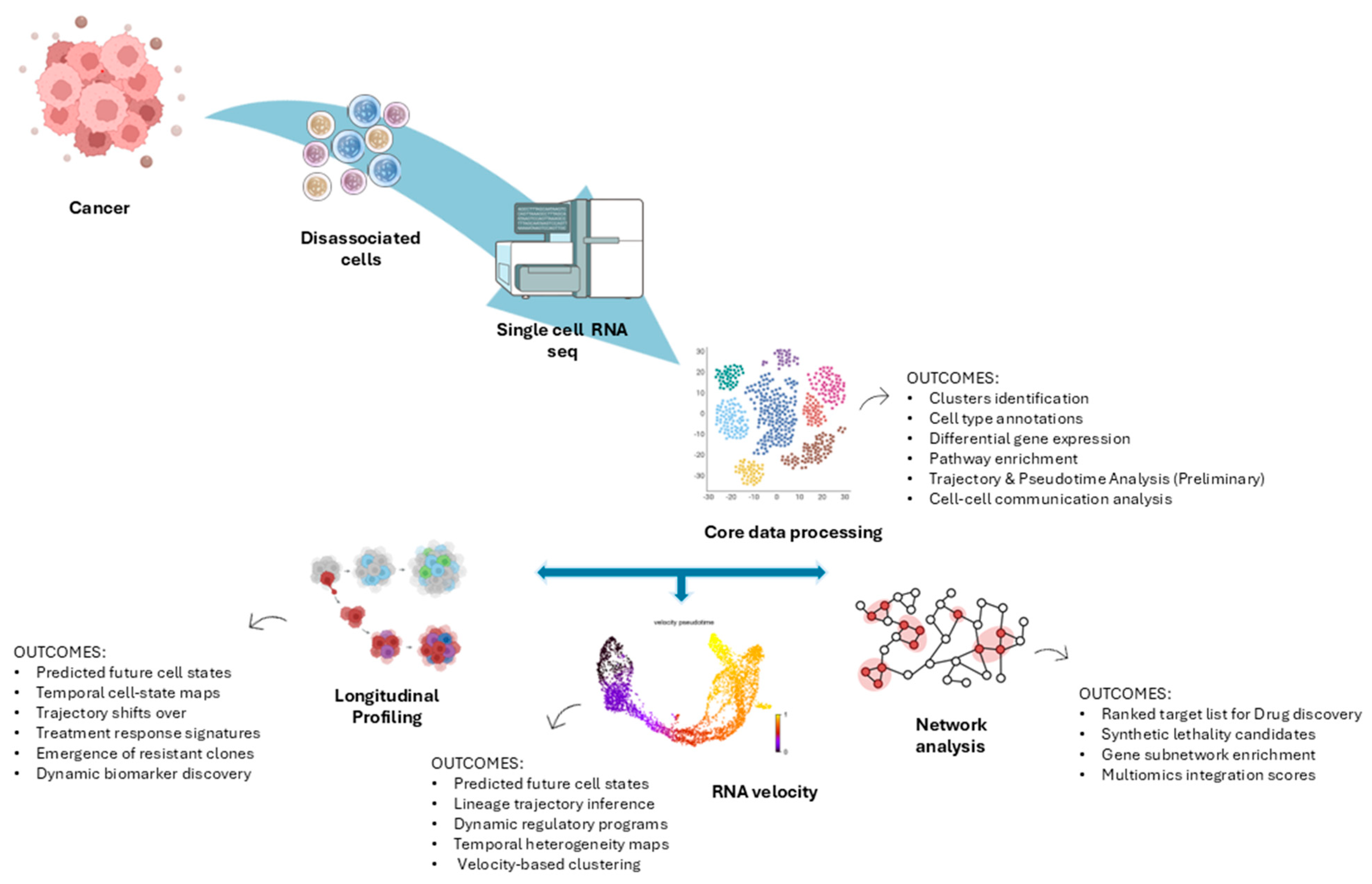
Figure 1. Overview of scRNA-seq analysis pipeline for target discovery. The workflow begins with preprocessing (QC, normalization, dimensionality reduction), followed by the core bioinformatic analysis (clustering, cell type annotation, differential gene expression, functional analysis). Advanced modules such as trajectory inference, RNA velocity, and ligand–receptor interaction mapping provide deeper biological insights. Target nomination occurs after differential expression and pathway/network prioritization, integrating multi-omics evidence to identify druggable candidates.
Targets 04 00006 g001
Table 1. Comparison of major computational frameworks discussed in this review, including their primary functions, strengths, limitations, role in target discovery, and programming language. This table illustrates the tools discussed in the text and it is not intended as a systematic and exhaustive list of all software available in the current literature.
Tool/MethodPrimary FunctionStrengthsLimitationsRole in Target DiscoveryLanguage
SeuratPreprocessing, clustering, integrationWidely used, rich ecosystem, strong multimodal supportMemory-intensive on very large objectsDefines subpopulations for DGE and pathway analysis leading to candidate targetsR
ScanpyEnd-to-end single-cell analysis at scaleScales to millions of cells; integrates with scverse toolsVisualization less turn-key than SeuratSame as Seurat; scalable for multi-sample screensPython
scCancerCancer-oriented scRNA-seq workflowsCancer-specific annotations; automated HTML reportsLess flexible beyond oncology use casesSeparates malignant/non-malignant cells; supports target prioritization in tumor contextsR
MonocleTrajectory inference & pseudotimeMature ecosystem; well-documentedSensitive to noise; multiple versions (v2 vs. v3)Reveals lineage-specific programs and resistance trajectories informing targetsR
SlingshotTrajectory inference (branching lineages)Robust lineage reconstruction; Bioconductor integrationFocused scope (trajectory module)Identifies dynamic states associated with therapy response/targetsR
CellPhoneDBLigand–receptor inference & CCI analysisCurated human LR database; new scoring & TF moduleRestricted to known interactions; database-centricHighlights signaling pathways & immunotherapy target candidatesPython
NicheNetLigand-target modeling using prior signaling/GRNsPredicts downstream target genes; strong Seurat interopRequires curated priors; R-centricPrioritizes ligands/receptors and downstream targets in receiver cellsR
LACELongitudinal phylogeny from single-cell mutationsR package + Shiny GUI; longitudinal clonal treesRequires multiple time points, computationally heavyIdentifies mutation-driven targets/resistance biomarkers over timeR
CanopyBayesian tumor phylogeny from SNV/CNAIntegrates SNAs & CNAs; outputs multiple tree configsRequires careful input prep; model complexityLinks genetic alterations to vulnerabilities for drug target nominationR
LiBIOML framework for longitudinal biomarker discoveryCross-cancer generalizability; strong AUCs reportedNo public package identified; study-specificPredictive biomarker development for Immune checkpoint blockade response-
scVeloRNA velocity (steady-state & dynamical models)Dynamical modeling; integrates with ScanpyNeeds spliced/unspliced layers; quality-sensitiveIdentifies dynamic programs & putative drivers/states for targetingPython
BayVelBayesian framework for RNA velocity estimationAdds uncertainty quantificationImplementation details not publicly released—not yet peer reviewedImproves confidence in velocity-based prioritizationJulia
Disclaimer/Publisher’s Note: The statements, opinions and data contained in all publications are solely those of the individual author(s) and contributor(s) and not of MDPI and/or the editor(s). MDPI and/or the editor(s) disclaim responsibility for any injury to people or property resulting from any ideas, methods, instructions or products referred to in the content.


