1. Introduction
1.1. Background
Systemic sclerosis (SSc) is a heterogeneous autoimmune disease characterized by immune dysregulation, microvascular injury, and progressive cutaneous and internal organ fibrosis [
1,
2,
3]. Clinically, SSc is commonly classified into limited cutaneous SSc (lcSSc) and diffuse cutaneous SSc (dcSSc) based on the extent of skin involvement [
1,
4]. These subsets differ significantly in the extent and rate of progression of cutaneous involvement, as well as in the risk profile for internal organ complications [
1,
5,
6,
7]. While dcSSc often exhibits rapid progression and early visceral involvement, lcSSc typically exhibits a slower progression, although it remains associated with clinically significant vasculopathy and extracutaneous manifestations [
1,
4,
8,
9]. Despite substantial advances in the understanding of SSc pathogenesis, effective disease-modifying therapies remain challenging [
1,
10,
11]. Current management largely relies on organ-based approaches using immunomodulatory agents and supportive treatments [
10,
11,
12].
Increasing evidence implicates the interleukin (IL)-23/T helper 17 (Th17) axis in SSc pathogenesis. Th17 cell infiltration occurs in SSc cutaneous lesions, and Th17-associated cytokines may act on both endothelial cells and fibroblasts to amplify vascular injury and fibrotic responses [
13,
14,
15,
16]. IL-23 is a key cytokine for the maintenance and pathogenicity of differentiated Th17 cells, thereby providing a biological rationale for targeting the IL-23p19 subunit in SSc [
17,
18]. However, SSc-specific clinical evidence for IL-23 inhibition remains limited. Furthermore, agents that target the shared IL-12/23p40 subunit (e.g., ustekinumab) cannot isolate IL-23-selective effects because IL-12 signaling is concurrently inhibited [
19]. Accordingly, this review focuses on guselkumab, a monoclonal antibody specifically targeting IL-23p19.
Overall, the clinical evidence base for IL-23 inhibition in SSc remains limited, consisting primarily of uncontrolled reports with heterogeneous phenotypes and endpoints. Therefore, a synthesis is necessary to consolidate currently available clinical signals, interpret them within clinically relevant domains (cutaneous, vascular, and selected extracutaneous manifestations), and clarify the current limitations.
This narrative review provides four contributions independent of the two source publications. First, it provides a structured domain-based synthesis that organizes heterogeneous clinical outcomes across reports differing in SSc subtype, phenotype, autoantibody profile, and endpoints into a framework aligned with American College of Rheumatology/European Alliance of Associations for Rheumatology (ACR/EULAR) outcome domains. Second, it conducts a critical appraisal of methodological biases and confounders—including publication and reporting bias, regression to the mean, natural disease fluctuation, and the confounding effects of comorbid psoriatic disease—that individual case reports are not designed to address. Third, it proposes a preliminary responder profile describing patient characteristics that may predict responsiveness to IL-23p19 inhibition. Fourth, it offers practical recommendations for future controlled trial design, including endpoint selection, patient stratification, and documentation standards.
In this narrative review, we summarize the published clinical outcomes of IL-23p19 inhibition in SSc, highlight potential confounders, and discuss priorities for future mechanistic and clinical studies.
1.2. Biological Rationale for Targeting the IL-23/Th17 Axis in SSc
A complex triad of immune dysregulation, vasculopathy, and fibrosis drives the pathogenesis of SSc [
1,
3,
20]. Although the initiating events remain incompletely understood, accumulating evidence highlights the central role of T-cell-mediated immune activation in promoting downstream vascular injury and tissue fibrosis [
21,
22,
23]. In this context, the IL-23/Th17 axis has attracted significant interest as a potential therapeutic target.
IL-23 is a heterodimeric cytokine that is critical for sustaining Th17 responses, thereby amplifying downstream effector cytokines (notably the IL-17 family) that contribute to a proinflammatory environment in early disease stages [
24,
25,
26]. Conceptually, this is highly relevant to SSc, as inflammatory signals closely link to microvascular dysfunction and profibrotic pathways [
1,
20].
This biological axis relates to the hallmark clinical domains of SSc in three primary ways: Autoimmunity and Inflammation: IL-23 serves as an upstream stabilizer of Th17-driven immune activation, influencing local cytokine networks and immune-stromal interactions in affected cutaneous tissues and potentially other organs [
25,
27,
28]. Vasculopathy: Endothelial dysfunction and microangiopathy are early, prominent features of SSc [
1,
29]. Th17-associated cytokines (particularly IL-17A) can promote endothelial activation and injury, suggesting a mechanistic link whereby IL-23–supported Th17 programs may contribute to microvascular pathology in SSc [
15,
30,
31]. Fibrosis: While SSc fibrosis is not solely Th17-driven, IL-23-supported inflammatory signaling can modulate fibroblast behavior indirectly via endothelial and immune mediators, and in some contexts directly through cytokine-driven profibrotic programs [
1,
13,
15,
32].
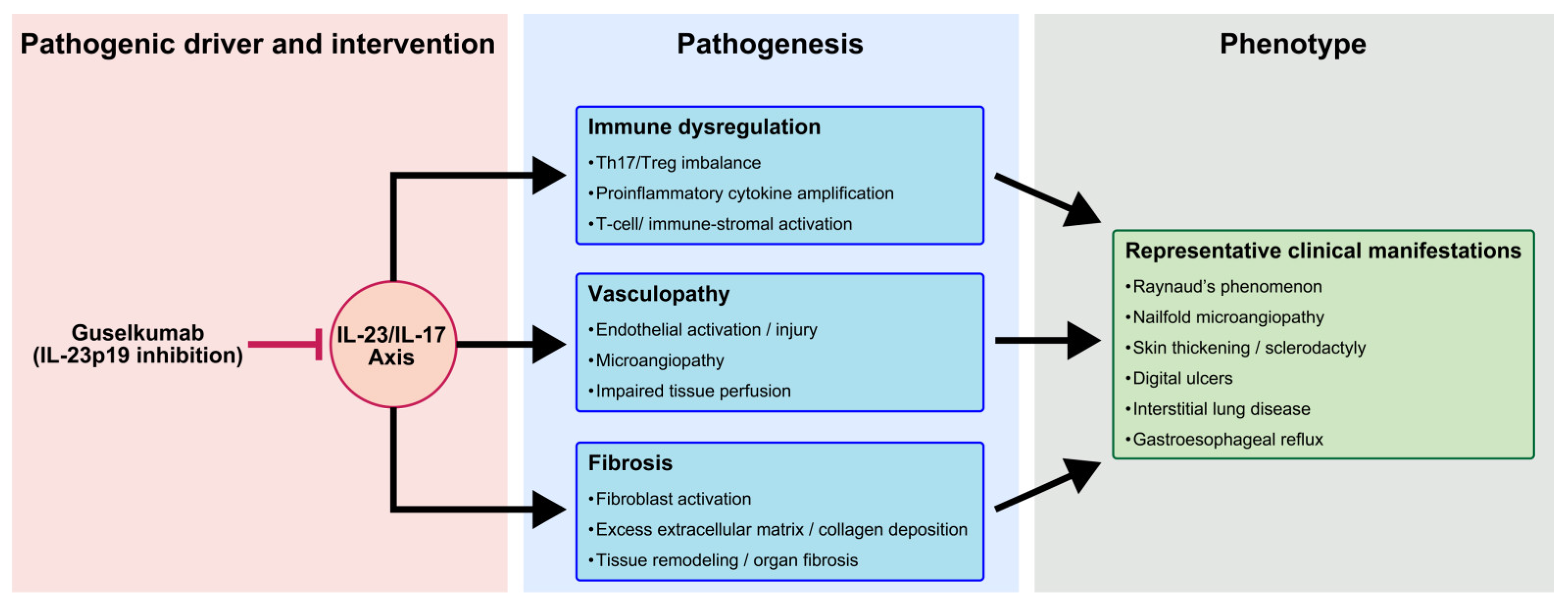
Taken together, available mechanistic observations support the hypothesis: IL-23-dependent Th17 programs significantly contribute to immune activation and microvascular injury in SSc. Consequently, targeted IL-23p19 blockade (e.g., via guselkumab) offers a targeted approach to attenuate this axis, potentially altering the disease course of cutaneous and microvascular manifestations. The proposed mechanistic framework linking IL-23/IL-17 signaling, core pathogenic processes, and representative SSc manifestations is summarized in
Figure 1.
2. Materials and Methods
This focused narrative review synthesized the available literature regarding (i) the IL-23/Th17 axis in systemic sclerosis (SSc) and (ii) reported clinical outcomes of selective IL-23p19 inhibition, centered on guselkumab. We searched PubMed/MEDLINE and Scopus from database inception to 26 February 2026. The search terms (“systemic sclerosis” OR “scleroderma”) AND (“guselkumab” OR “IL-23p19”) were applied across both databases; for Scopus, the search was restricted to Title, Abstract, and Keywords fields. Web of Science was not accessible through our institutional library; as Scopus provides broad coverage substantially overlapping with Web of Science for biomedical literature, we considered this two-database strategy adequate for the scope of this focused narrative review. Reference lists of relevant articles were also screened to identify additional eligible reports.
The PubMed/MEDLINE search identified 7 records, and the Scopus search identified 38 records. After de-duplication (45 combined; 43 unique records after removing 2 duplicates), all 43 records underwent title and abstract screening. Of these, 41 were excluded because they did not report original clinical outcomes of guselkumab in patients with SSc, did not allow direct attribution to IL-23p19 inhibition, or were review or mechanistic articles without extractable case-level clinical data. The remaining 2 publications were included as direct clinical evidence: one case report and one three-patient case series.
We included English-language original research articles, case reports, and case series that addressed the IL-23/Th17 pathway in SSc and/or reported clinical use of guselkumab in patients with SSc. Narrative and systematic reviews were consulted to contextualize the biological rationale and disease framework, but were not treated as direct clinical evidence. For the purposes of this review, clinical signals were defined as any reported changes in SSc-relevant outcomes after guselkumab exposure, interpreted using a domain-based framework (cutaneous, vascular including Raynaud’s phenomenon and nailfold microangiopathy, and selected extracutaneous manifestations such as pulmonary and gastrointestinal involvement).
We excluded reports focused on non-selective IL-12/23 inhibition (e.g., ustekinumab targeting p40) from the direct clinical efficacy synthesis to maintain specificity for IL-23p19 blockade. We also excluded articles that did not describe original guselkumab-treated SSc cases, did not report extractable SSc-specific clinical outcomes, or were mechanistic/review articles only. Because the available direct clinical evidence consisted solely of uncontrolled case-based reports with heterogeneous outcome measures, we did not perform a meta-analysis or formal risk-of-bias grading.
3. Results: Published Clinical Signals and Domain-Based Interpretation
Given that all available evidence consists of uncontrolled case-level reports, all outcome descriptions in this section should be understood as preliminary clinical signals and not as evidence of established efficacy.
3.1. Published Clinical Signals of IL-23p19 Inhibition (Guselkumab) in SSc
From a clinical-translational perspective, specific IL-23p19 blockade with guselkumab offers a targeted approach to attenuate the pathogenic Th17 axis [
25,
33]. The rationale is not that IL-23 inhibition fundamentally solves SSc, but rather that it may attenuate key inflammatory and vascular processes particularly relevant in early or inflammation-predominant phenotypes, thereby potentially altering the trajectories of cutaneous and microvascular manifestations [
34].
Currently, published clinical evidence for IL-23p19 inhibition in SSc remains limited to uncontrolled reports. To date, these include a three-patient case series of early dcSSc complicated by psoriasis, and a single case report of early-stage limited cutaneous SSc (lcSSc) with comorbid palmoplantar pustulosis [
35,
36]. The characteristics and reported outcomes of the currently available case-based literature are summarized in
Table 1. Across these reports, investigators reported consistent improvements in cutaneous involvement (evaluated via the modified Rodnan skin score [mRSS] and modified Rodnan Total Skin Score [mRTSS]), composite indices such as the ACR Combined Response Index in Systemic Sclerosis (CRISS), and nailfold microangiopathy. Furthermore, improvements in certain extracutaneous symptoms, such as gastroesophageal reflux, occurred without major safety signals.
These early observations are biologically coherent with the IL-23/Th17-centered hypothesis. However, clinicians must interpret them cautiously given the small sample sizes, the inherent risk of publication bias, and complex confounding factors, most notably the presence of comorbid psoriatic diseases and the natural disease fluctuation of early-stage SSc.
3.1.1. Case Report in Early lcSSc
A previous report described the case of a 59-year-old woman with palmoplantar pustulosis and pustulotic arthro-osteitis who fulfilled the 2013 American College of Rheumatology/European Alliance of Associations for Rheumatology (ACR/EULAR) classification criteria for SSc (score of 10). She presented with limited cutaneous involvement confined to the fingers (mRSS of 2) and Raynaud’s phenomenon of three years’ duration. Chest computed tomography showed no evidence of interstitial lung disease (ILD) at baseline.
Investigators reported improvements in cutaneous and vascular manifestations following guselkumab therapy. By four months, Raynaud’s phenomenon resolved even during the cold season, the mRSS improved to 0, and nailfold capillaroscopy showed improvement of the scleroderma-pattern microangiopathy, including reductions in giant capillaries and microhemorrhages. The authors suggested that IL-23 contributes to the pathogenesis of early lcSSc and that targeted IL-23 blockade might mitigate early disease progression in selected patients [
35].
3.1.2. Case Series in Early dcSSc with Comorbid Psoriasis Vulgaris
Another report described a case series of three patients with psoriasis complicated by early dcSSc (SSc disease duration ranging from 6 to 15 months). Baseline SSc phenotypes included anti-RNA polymerase III positivity (Case 1), anti-topoisomerase I positivity with ILD (Case 2), and anti-centromere antibody positivity (Case 3). Raynaud’s phenomenon and gastroesophageal reflux symptoms were present in all three patients. Importantly, at the time of evaluation, the patients were not receiving oral corticosteroids, immunosuppressants, gastrointestinal motility drugs, antifibrotics, vasodilators, antihypertensives, or topical treatments. This minimized background therapy reduced, although it did not entirely eliminate, confounding by concurrent systemic therapies.
At six months following standard guselkumab dosing, complete clearance of psoriasis (Psoriasis Area and Severity Index [PASI] of 0) occurred alongside improvements in SSc-related outcomes at the series level. These improvements included a decrease in cutaneous thickening (mRTSS decrease > 6) and a higher CRISS score. Gastroesophageal reflux symptoms, evaluated via the Frequency Scale for the Symptoms of Gastroesophageal Reflux Disease (F-scale), also improved, and investigators observed no worsening of ILD during follow-up. No adverse events occurred. Furthermore, nailfold capillaroscopy suggested improvements in microvascular structure and function, evidenced by increased capillary numbers, improved nailfold blood flow metrics, and trends toward improvement in the Cutolo scleroderma pattern, thus supporting a potential vascular benefit. Immunologic assessments revealed shifts in the Th17/regulatory T cell (Treg) balance, consistent with the on-target modulation of Th17-related immune programs [
36].
3.1.3. Interpretation and Limitations
While these reports provide biologically coherent early signals across clinically relevant domains, particularly the cutaneous and microvascular systems, several limitations currently preclude causal inference. The evidence is restricted to uncontrolled observations, is vulnerable to publication and reporting bias, and includes heterogeneous phenotypes and endpoints (e.g., mRSS versus mRTSS and CRISS).
In the dcSSc series, the presence of comorbid psoriasis introduces additional complexity; the significant reduction in systemic inflammation associated with psoriasis clearance could indirectly influence patient-reported symptoms or vascular measures. In cases with comorbid psoriasis, nailfold capillaroscopy improvements may in part reflect resolution of psoriasis-associated vascular changes rather than SSc-specific effects, as psoriasis and psoriatic arthritis are independently associated with capillaroscopy abnormalities [
37,
38]. Moreover, early SSc typically exhibits variable clinical trajectories, and the observed improvements may partially reflect regression to the mean or natural disease fluctuation. In Case 1 specifically, the resolution of Raynaud’s phenomenon cannot be attributed to guselkumab with certainty; alternative explanations include indirect improvement from better control of comorbid palmoplantar pustulosis with associated reduction in hand pain, and seasonal variation in Raynaud’s symptom burden. These possibilities do not, however, exclude a direct vascular contribution of IL-23p19 inhibition, which controlled studies will be required to assess. Although registered trials investigating guselkumab in SSc exist (e.g., NCT04683029/jRCT2051200133), peer-reviewed results are currently unavailable. Collectively, the current literature supports the hypothesis that IL-23p19 inhibition yields clinically measurable effects in selected SSc patients. However, adequately powered, controlled studies and peer-reviewed trial publications remain essential to robustly define efficacy, target phenotypes, and optimal outcome measures.
3.2. Domain-Based Interpretation
Given the marked clinical heterogeneity of SSc, domain-based endpoint organization represents an established methodological framework in SSc clinical trial design, reflecting the organ-based structure of SSc management guidelines and standardized trial recommendations developed prior to and independently of the present observations [
10,
11]. Cutaneous involvement, vasculopathy (including Raynaud’s phenomenon and nailfold microangiopathy), pulmonary function, and gastrointestinal symptoms correspond to the principal clinical domains defined in ACR/EULAR classification criteria and composite outcome measures such as CRISS [
1]. Applying this pre-established structure to the available uncontrolled reports allows descriptive characterization of which domains yield early signals, not as confirmatory evidence, but as an exploratory framework to generate hypotheses for future controlled studies. In addition, interpreting heterogeneous endpoints across small case reports requires domain organization to avoid spurious comparisons of incommensurable outcomes [
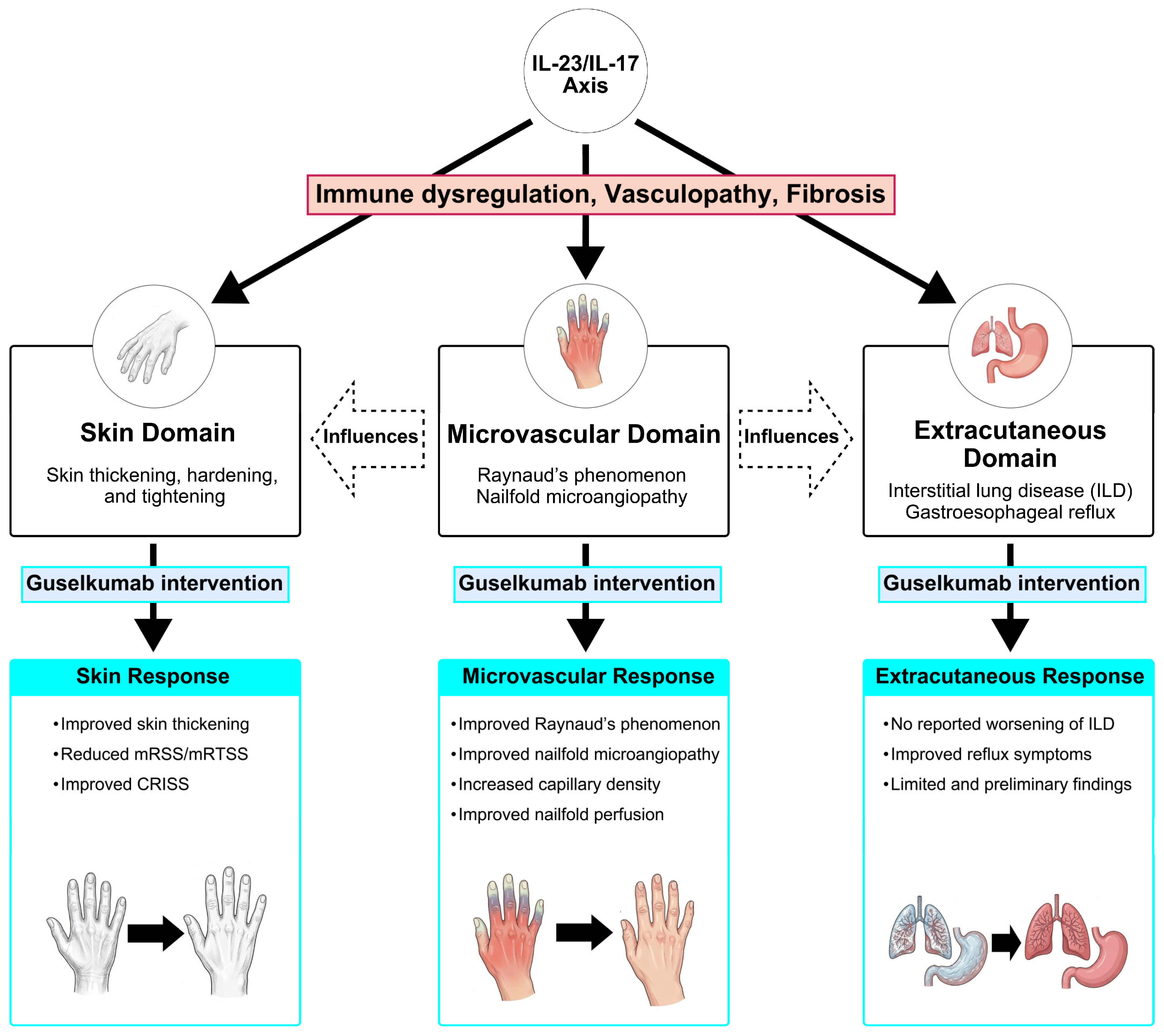
10]. In the following sections, we organize the published clinical outcomes of guselkumab by domain, specifically cutaneous, vascular, pulmonary, and gastrointestinal manifestations, to delineate areas where the therapeutic signal appears most consistent and where the evidence remains preliminary. A schematic overview of this domain-based interpretive framework and the reported domain-specific responses to guselkumab is shown in
Figure 2.
3.2.1. Skin Domain
Across the reported cases, the most consistently observed therapeutic signal pertains to cutaneous involvement. Investigators described clinically measurable improvements in cutaneous manifestations in early-stage patients across both limited and diffuse phenotypes, although the specific endpoints utilized varied between reports (e.g., mRSS versus mRTSS and CRISS) [
35,
36].
A critical interpretive consideration in this domain is baseline severity and disease duration. In reports of lcSSc including the case treated with guselkumab, patients often present with minimal baseline cutaneous involvement (e.g., an mRSS of 2 limited to the fingers). In such scenarios, small absolute changes can appear substantial and may be more susceptible to natural disease fluctuation [
1,
39,
40]. The observed change in mRSS from 2 to 0 falls below the minimal detectable change (MDC) threshold for the mRSS [
39,
40] and therefore cannot be interpreted as a clinically meaningful change independent of measurement variability. Conversely, cases of early dcSSc treated with guselkumab (disease duration of 6–15 months) have included moderate baseline cutaneous thickening (mRTSS of 10–20) [
36]. In this subset, rapid spontaneous improvement over short intervals is uncommon at this stage of disease. In early dcSSc, the mRSS typically follows an ascending trajectory before reaching a peak, with meaningful spontaneous improvement generally occurring only thereafter. In a large prospective cohort of early dcSSc, mRSS tended to rapidly progress, usually within the first 3–5 years of disease, before plateauing or subsequently falling [
41]. Crucially, the median time from skin thickening onset to peak mRSS was 19.0 months across autoantibody groups (range 12.9–30.0) [
41], and among patients with early diffuse scleroderma, peak skin scores were typically reached 0.5 to 1.2 years after initial evaluation (corresponding to approximately 1.7–2.4 years from disease onset) [
42]. Patients in the published guselkumab series had disease durations of 6–15 months at baseline; with 6 months of treatment, most would reach their observation endpoint at 12–21 months from disease onset—a timeframe that, for the majority, falls before or near the median mRSS peak, not within the established spontaneous improvement phase. This is further supported by the observation that, within the European Scleroderma Observational Study cohort, patients who progressed over 12 months had significantly shorter disease duration at baseline (median 8.1 vs. 12.6 months,
p = 0.001) [
41], placing the guselkumab-treated patients squarely within the demographic most likely to be progressing, not improving spontaneously. Skin scores may plateau and subsequently improve in some patients over longer time horizons [
41,
43], but attributing the observed mRSS improvements at 6 months primarily to natural disease fluctuation is inconsistent with available natural history data. The apparent cutaneous response across these different SSc phenotypes supports the hypothesis that IL-23 pathway modulation may favorably influence the inflammatory components of early cutaneous disease. However, the current uncontrolled data cannot definitively distinguish direct antifibrotic effects from indirect clinical improvements mediated via the reduction of systemic immune activation.
3.2.2. Vasculopathy Domain (Raynaud’s Phenomenon and Nailfold Microangiopathy)
Microvascular disease is a defining, early feature of SSc pathogenesis [
1,
9,
29]. Published cases receiving IL-23p19 inhibition have been reported to show both symptomatic and objective microvascular improvements [
35,
36].
Across these reports, authors noted symptomatic resolution of Raynaud’s phenomenon alongside objective amelioration of scleroderma-pattern nailfold abnormalities. Investigators reported changes in quantitative nailfold parameters, such as increased capillary density, improved blood flow metrics, and trends toward normalized Cutolo patterns. These findings are biologically plausible if IL-23/Th17-driven inflammation significantly contributes to endothelial activation and dysfunction in early SSc. Importantly, the vascular domain should not be interpreted as fully separate from cutaneous and extracutaneous disease expression. In SSc, microangiopathy is an early and upstream pathogenic process that may influence downstream tissue injury, fibrotic remodeling, and organ dysfunction across multiple domains, including the skin and internal organs [
1,
9]. Accordingly, Raynaud’s phenomenon and nailfold microangiopathy are discussed here as a practical clinical domain, while also representing a broader pathogenic layer that may influence subsequent skin and extracutaneous domains.
However, vascular outcomes are inherently sensitive to seasonal variations, behavioral factors, and measurement variability [
44,
45,
46,
47,
48]. Furthermore, symptomatic improvements in Raynaud’s phenomenon do not guarantee a reduction in the incidence of new digital ulcers or the prevention of long-term structural vascular complications [
49,
50]. Consequently, future studies aiming to evaluate the vascular domain must incorporate standardized nailfold metrics, objective perfusion assessments, and clinically meaningful hard endpoints (e.g., the occurrence of new digital ulcers) alongside validated symptom scales.
3.2.3. Pulmonary and Gastrointestinal Domains (ILD and Reflux Symptoms)
Evidence regarding the effects of IL-23p19 inhibition on the pulmonary domain remains sparse but holds high clinical importance. In early dcSSc cases treated with guselkumab, investigators observed stable pulmonary function over the follow-up period in a patient with baseline ILD and reduced forced vital capacity (%FVC) [
36]. While such stability is reassuring from a safety perspective, uncontrolled observations cannot determine whether this stabilization reflects a true therapeutic effect or merely the slower natural progression of the individual’s pulmonary disease.
Similarly, studies have primarily captured gastrointestinal involvement through patient-reported reflux symptoms. In early dcSSc cases treated with guselkumab, investigators noted improvements in specific symptom scores (e.g., the F-scale), suggesting a potential reduction in the gastrointestinal symptom burden [
36]. Given the complex, multifactorial nature of reflux in SSc, which involves motility impairment, lower esophageal sphincter dyscoordination, and lifestyle factors, clinicians must interpret these symptomatic improvements with caution [
51]. Nonetheless, they highlight the importance of including validated, patient-centered gastrointestinal outcomes in future clinical trials.
3.2.4. Summary of Domain Signals
Taken together, the currently published observations suggest that the most consistent early clinical signals lie within the cutaneous and microvascular domains. All evidence in this review, however, derives exclusively from uncontrolled case-level reports and is equally limited and preliminary across all domains; it must not be interpreted as evidence of established efficacy. The domain-based framework is an organizational tool, not a ranking of evidentiary strength, and future controlled studies should employ standardized, pre-specified domain-based endpoints.
4. Discussion: Critical Appraisal and Future Perspectives
4.1. How to Read the Evidence: Biases, Confounders, and a Preliminary Responder Profile
The current evidence for IL-23p19 inhibition (guselkumab) in SSc stems from uncontrolled case-based observations. While these reports yield preliminary clinical signals across cutaneous and microvascular domains, several methodological considerations remain essential for appropriate interpretation and for avoiding the overestimation of treatment effects.
4.1.1. Why Case Reports Can Appear Substantial
Case reports and small case series are inherently prone to publication and reporting bias; therefore, investigators are more likely to write up, submit, and cite favorable or unexpected responses, whereas they often underreport non-response. In addition, selective outcome reporting can occur when clinicians measure multiple clinical variables but highlight only the most improved parameters. These biases can inflate perceived efficacy, particularly when the literature consists of only a few cases.
4.1.2. Baseline Severity, Endpoint Selection, and Regression to the Mean
Cutaneous endpoints are sensitive to baseline severity and disease stage. In lcSSc with very limited cutaneous involvement, small absolute changes in the mRSS may appear substantial (e.g., an mRSS reduction from 2 to 0) and may not reflect a durable disease-modifying effect [
40,
52]. Conversely, the mRTSS and composite indices such as the CRISS may capture broader disease activity in dcSSc, but interpretation remains challenging without controls and standardized timing [
40,
53]. Moreover, early SSc shows variable clinical courses and spontaneous fluctuations; therefore, improvements observed after treatment initiation may partly reflect regression to the mean or natural variation rather than a causal drug effect [
54].
4.1.3. Background Therapy and Comorbid Disease as Key Confounders
Background systemic therapies can strongly influence SSc outcomes, and their presence, or changes over time, can confound attribution. In the published dcSSc case series, the absence of concurrent systemic therapies at the time of evaluation reduces one major confounder; however, uncontrolled observations remain vulnerable to other confounding factors, including differences in supportive care and time-varying disease activity [
36]. Because comorbid inflammatory cutaneous disease (psoriasis, palmoplantar pustulosis) introduces additional complexity, improvements in systemic inflammation associated with the control of psoriatic disease could indirectly affect patient-reported symptoms, microvascular measures, or composite indices [
55,
56]. Therefore, a key interpretive question is whether guselkumab acts primarily on a shared IL-23/Th17-driven inflammatory environment, yielding downstream benefits in SSc domains, or produces improvements secondary to better control of comorbid psoriatic inflammation. Comorbid psoriasis also confounds nailfold capillaroscopy interpretation, as psoriasis and psoriatic arthritis are independently associated with capillaroscopy abnormalities [
37,
38]; nailfold capillaroscopy improvement in Cases 2–4 cannot therefore be attributed exclusively to SSc-specific mechanisms. Case 1, which lacked comorbid psoriasis, may provide more interpretable nailfold data. The selection of guselkumab in these cases warrants brief comment. In the Fukasawa series, all three patients declined oral therapy and preferred biologic treatment; guselkumab was administered without prior or concomitant systemic therapy. In the Hirano report, guselkumab was the approved biologic for palmoplantar pustulosis with pustulotic arthro-osteitis, with the Fukasawa series cited as supporting precedent. Neither report documents a comparison with alternative biologic agents. The concurrent presence of SSc may plausibly have supported this choice over alternatives with less favorable mechanistic profiles in fibrotic autoimmune disease—such as TNF inhibitors or ustekinumab (see
Section 4.2)—though this reasoning cannot be confirmed from the published reports.
Definitive human data that cleanly separate direct IL-23/Th17 pathway engagement in SSc from psoriasis-driven secondary effects are currently unavailable. Nevertheless, three converging lines of evidence support the plausibility of a direct, SSc-specific contribution. First, preclinical studies demonstrate that IL-23 exerts paradoxical profibrotic effects on SSc fibroblasts. Whereas IL-23 suppresses type I collagen in normal fibroblasts via miR-4458 induction, it upregulates collagen in SSc fibroblasts through dysregulated miR-4458/miR-18a balance—a mechanism driven by constitutive TGF-β activation, and accelerates bleomycin-induced dermal fibrosis in vivo independently of psoriatic inflammation [
57]. These findings are consistent with a broader profibrotic role for IL-23 across autoimmune fibrotic conditions [
32]. Second, Th17 cell infiltration, markedly elevated serum IL-23 (49.1 ± 7.3 vs. 5.3 ± 0.6 pg/mL in controls,
p = 0.003), and increased IL-23R expression on CD4+ T cells have been documented in SSc patients across all disease subtypes and without psoriatic comorbidity, indicating that IL-23/Th17 axis overactivation is intrinsic to SSc pathogenesis [
58]. Third, case-level improvements in SSc-specific domains—including nailfold capillaroscopy metrics, modified Rodnan skin score, CRISS score, and Th17/Treg ratios—following guselkumab occurred in parallel with, and not exclusively as a consequence of, psoriasis clearance, suggesting at least partial IL-23 pathway engagement within SSc tissues [
35,
36]. Collectively, while the shared inflammatory milieu of comorbid psoriasis cannot be fully excluded as a confounder, these mechanistic and clinical observations are consistent with a direct, psoriasis-independent role for IL-23/Th17 signaling in SSc and provide biological grounding for controlled studies in non-psoriatic SSc populations.
The apparent discordance between IL-23/Th17 pathway activation in SSc and the limited efficacy of selective IL-17A blockade may reflect receptor-level resistance within the fibrotic compartment rather than pathway irrelevance. IL-17A exerts intrinsically anti-fibrotic effects on dermal fibroblasts via miR-129-5p induction and consequent suppression of connective tissue growth factor and type I collagen; however, constitutive TGF-β1 signaling in SSc fibroblasts downregulates IL-17 receptor type A (IL-17RA) expression, thereby impairing this protective pathway and paradoxically amplifying collagen accumulation [
59]. This receptor-level deficit provides a mechanistic explanation for why selective IL-17A neutralization fails to reach the fibrotic compartment, while leaving the broader IL-17/IL-23 axis pathologically active. Consistent with this interpretation, broad IL-17RA blockade with brodalumab, which intercepts multiple IL-17RA ligands independently of receptor abundance on target cells, demonstrated rapid and sustained mRSS improvement (
p < 0.001 from week 8 through week 52, with all patients exceeding the minimal clinically important difference) alongside Treg-dominant Th17/Treg rebalancing in an open-label phase 1 trial in early dcSSc [
60]. Upstream IL-23 blockade with guselkumab similarly bypasses this receptor-level resistance while additionally modulating miR-4458/miR-18a balance directly in fibroblasts [
57] and correcting systemic Th17/Treg imbalance [
36], offering a mechanistic rationale that is distinct from, and potentially broader than, selective IL-17A neutralization.
4.1.4. What the Current Signals May Suggest: A Preliminary Responder Profile
Despite these limitations, the pattern of reported improvements across cases suggests a preliminary responder profile. First, signals appear most consistent in cutaneous and microvascular domains, implying that IL-23 pathway modulation may be most relevant when inflammatory and vascular mechanisms are active. Second, the reported cases largely represent early disease durations (months to a few years), raising the possibility that IL-23 inhibition may be more effective in early, inflammation-predominant phenotypes, before established fibrotic remodeling becomes dominant. Third, a subset of patients may exhibit a Th17-skewed immune profile or clinical correlates of inflammatory activity (e.g., active inflammatory cutaneous disease, prominent microangiopathy), in whom IL-23 blockade could more readily translate into measurable clinical change.
Accordingly, we propose a cautious responder profile: guselkumab may be more likely to yield observable benefit in selected patients with early-stage SSc in whom inflammatory and microvascular processes are prominent, and less likely to produce substantial effects in late-stage, fibrosis-dominant disease where immune modulation alone may be insufficient. This profile aligns with the clinical domains showing early signals (cutaneous thickening and microangiopathy) but requires validation using adequately powered controlled studies and biomarker-informed stratification.
4.1.5. Practical Implications for Future Studies and Reporting
To move beyond anecdotal signals, future reports and trials require predefined domain-specific endpoints (cutaneous assessments, standardized nailfold metrics, clinically meaningful vascular outcomes such as digital ulcers, and pulmonary/gastrointestinal outcomes) and must document background therapies and time from disease onset with clarity.
Understanding the implications of these design choices requires briefly considering the natural history of SSc subtypes and the relationship between disease duration and cutaneous severity. Current proof-of-concept trials of guselkumab in SSc focus on early active dcSSc with predefined thresholds for skin involvement (e.g., enrollment restricted to participants with an mRSS range such as 10–22 and evidence of recent skin progression), which facilitates detection of measurable change but may underrepresent very early or minimally fibrotic phenotypes (NCT04683029; jRCT2051200133). This design choice reflects a methodological imperative: an mRSS floor of approximately 10 is required to ensure sufficient dynamic range to detect meaningful change above measurement variability [
40], and does not imply that the therapeutic hypothesis is restricted to moderate-to-severe cutaneous disease. In early active dcSSc, disease durations of less than two to three years are frequently associated with mRSS values in precisely this range [
41,
54], such that the trial population is simultaneously “early” in temporal terms—the dimension most relevant to the inflammation-predominant hypothesis—and “moderate” in severity terms as an operational design requirement. The lcSSc case with a baseline mRSS of 2 is not contradictory to this framework; rather, it reflects the well-established natural history of lcSSc, in which skin thickening typically remains limited regardless of disease duration [
8], making direct mRSS comparisons across subtypes methodologically inappropriate. Taken together, “early” as used in the therapeutic hypothesis primarily denotes short disease duration and active inflammatory-vascular phase, not a specific cutaneous severity stratum. Complementary studies enriched for very early or minimally fibrotic phenotypes across both subtypes remain warranted to test whether IL-23 pathway modulation is most effective during the inflammation–vascular predominant window.
4.2. Safety Considerations
Guselkumab is an IL-23p19-targeting monoclonal antibody with a well-characterized safety profile across approved indications such as psoriasis and psoriatic arthritis, where the overall risk of serious adverse events has generally been low and the most common concerns relate to infections, particularly of the upper respiratory tract [
61]. However, applying these safety data to SSc requires SSc-specific consideration because patients may have organ involvement, baseline frailty, and concomitant immunomodulatory therapies that can modify both infection risk and clinical monitoring needs [
10].
In the currently published SSc reports, investigators observed no major safety signals. In the three-patient dcSSc case series, clinicians reported no adverse events during follow-up, and ILD did not worsen [
36]. In the early lcSSc case report, the authors highlighted no serious adverse events [
35]. Nonetheless, clinicians cannot use the absence of reported adverse events in small uncontrolled reports to infer safety; thus, vigilance remains warranted when considering IL-23 inhibition in SSc.
Key practical considerations include: (i) infection risk, particularly in patients receiving concomitant corticosteroids or immunosuppressants; (ii) coexisting ILD, where careful baseline and longitudinal assessment (symptoms, pulmonary function testing, and imaging as clinically indicated) is advisable, even if clinicians do not expect IL-23 blockade to be directly pneumotoxic; and (iii) polypharmacy and comorbidity, including gastroesophageal dysmotility and malnutrition, which can increase vulnerability to adverse outcomes. Future controlled studies and post-marketing experience (if the pathway proves efficacious) will be necessary to define the safety profile of IL-23p19 inhibition specifically in SSc populations, including those with significant pulmonary disease and those receiving combination immunomodulatory regimens. Of note, morphea (localized scleroderma) has been reported during ustekinumab treatment, with a proposed mechanism of IL-12 blockade-mediated Th1 suppression and relative Th2 expansion driving profibrotic activity [
62,
63]. As guselkumab selectively targets IL-23p19 without blocking IL-12, this profibrotic pathway is not directly engaged, and no morphea reports with guselkumab were identified. Clinicians should nonetheless remain vigilant for any new or worsening fibrotic manifestations during guselkumab treatment in SSc patients.
For other selective IL-23p19 inhibitors (risankizumab, tildrakizumab), no published SSc case reports were identified at the time of our search. The signals described in this review therefore cannot be attributed to IL-23p19 inhibition as a pharmacological class and may reflect characteristics specific to guselkumab.
4.3. Future Directions
The current literature generates preliminary clinical signals but remains insufficient to establish efficacy or to define the patient subsets most likely to benefit from IL-23p19 inhibition. In addition to case-based evidence, registered proof-of-concept trials of guselkumab in SSc (NCT04683029; jRCT2051200133) represent a critical next step; however, peer-reviewed results are not yet available. Publication of these trial data will be critical to determine whether the reported signals, particularly in cutaneous and microvascular domains, are reproducible in controlled settings and to clarify target phenotypes and optimal endpoints.
First, controlled clinical studies should explicitly address clinical heterogeneity by enrolling well-defined SSc phenotypes (lcSSc and dcSSc) and capturing disease duration and activity in a standardized manner. A key hypothesis to test is whether IL-23 pathway modulation is most relevant in early, inflammation-predominant disease, before established fibrotic remodeling becomes dominant. Trial designs that enrich for early-stage disease and stratify analyses by baseline cutaneous severity and vascular involvement may improve interpretability.
Second, endpoint selection should align with a domain-based framework. For the cutaneous domain, standardized change in the mRSS/mRTSS over prespecified time points remains central, ideally complemented by patient-reported outcomes related to cutaneous tightness and function. For vasculopathy, symptom scales alone are insufficient; therefore, future studies should incorporate objective measures such as standardized nailfold capillaroscopy metrics and, where feasible, clinically meaningful outcomes (e.g., new digital ulcers or validated perfusion measures). Investigators should include pulmonary outcomes (FVC, DLCO, and imaging-based assessments) and patient-reported gastrointestinal outcomes as secondary domains, with careful attention to baseline organ involvement, concomitant therapies, and follow-up duration adequate to detect meaningful change.
Third, stratification and enrichment strategies may improve signal detection and mechanistic inference. Biomarker-informed approaches, such as baseline inflammatory activity, immune phenotypes suggestive of Th17 skewing, or markers of endothelial activation, could help identify subgroups more likely to respond and avoid confounding by late-stage fibrotic disease [
64,
65]. Importantly, while initial trials do not require extensive biomarker panels, even limited exploratory biomarkers that demonstrate pathway engagement and correlate with clinical domains (cutaneous or microvascular endpoints) would add value and support rational patient selection in subsequent studies.
Finally, future reports should prioritize transparency and standardization. Clear documentation of background therapies and their changes over time, seasonality and environmental factors relevant to vascular symptoms, and standardized assessment schedules are essential to interpret outcomes across studies. If controlled trials confirm benefit, subsequent work should define the place of IL-23p19 inhibition within organ-based SSc management, including the feasibility and safety of combination strategies with established immunomodulatory agents.
5. Conclusions
Published clinical experience with IL-23p19 inhibition in SSc remains limited to a small number of uncontrolled reports, consisting of one case report of early limited cutaneous SSc and a three-patient case series of early diffuse cutaneous SSc with comorbid psoriasis [
35,
36]. Despite the very low level of evidence, the reported outcomes align with the established role of the IL-23/Th17 axis in SSc and generate preliminary clinical signals in clinically relevant domains.
Across the available reports, the most consistent signals appear in the cutaneous and microvascular domains. Investigators described improvements in cutaneous thickening (mRSS/mRTSS and CRISS), Raynaud’s phenomenon, and nailfold microangiopathy, while information regarding pulmonary and gastrointestinal involvement remains preliminary and largely limited to the stability of interstitial lung disease and improvement in reflux symptoms. Importantly, these observations cannot establish causality; therefore, clinicians must interpret them in light of publication and reporting bias, the heterogeneity of phenotypes and endpoints, the potential confounding impact of comorbid psoriatic disease, and variability in the natural course of early SSc.
Nevertheless, consistent cutaneous and microvascular improvements support a cautious preliminary responder profile: IL-23 pathway modulation may be most relevant in selected patients with early-stage, inflammation-predominant SSc, in whom immune-vascular interactions are prominent and potentially reversible. At present, however, this profile remains speculative and requires confirmation.
Registered randomized trials of guselkumab in SSc and future controlled studies will be essential to determine whether these early signals translate into reproducible clinical benefit and to define responsive phenotypes. Domain-specific endpoints (particularly cutaneous and microvascular measures), standardized reporting of background therapies and seasonality, and biomarker-informed stratification represent practical priorities to advance the field and clarify the potential role of IL-23p19 inhibition within organ-based SSc management.
Overall, IL-23p19 inhibition represents a mechanistically targeted therapeutic approach in SSc, but its true therapeutic value will depend on controlled evidence that links pathway engagement to meaningful improvements in cutaneous and microvascular outcomes in appropriately selected patients.
Author Contributions
Conceptualization: Y.I. and N.F.; Writing—Original Draft Preparation, S.K. and Y.I.; Writing—Figure Preparation, Y.I.; Writing—Review and Editing, Y.I., M.Y., A.Y., T.T., A.A. and N.F.; Supervision, Y.I. and N.F. All authors have read and agreed to the published version of the manuscript.
Funding
This research received no external funding.
Data Availability Statement
No new datasets were generated or analyzed in this study. Data sharing is not applicable to this article.
Conflicts of Interest
The authors declare no conflicts of interest.
References
- Denton, C.P.; Khanna, D. Systemic sclerosis. Lancet 2017, 390, 1685–1699. [Google Scholar] [CrossRef] [PubMed]
- Ko, J.; Noviani, M.; Chellamuthu, V.R.; Albani, S.; Low, A.H.L. The Pathogenesis of Systemic Sclerosis: The Origin of Fibrosis and Interlink with Vasculopathy and Autoimmunity. Int. J. Mol. Sci. 2023, 24, 14287. [Google Scholar] [CrossRef]
- Son, H.H.; Moon, S.J. Pathogenesis of systemic sclerosis: An integrative review of recent advances. J. Rheum. Dis. 2025, 32, 89–104. [Google Scholar] [CrossRef]
- LeRoy, E.C.; Black, C.; Fleischmajer, R.; Jablonska, S.; Krieg, T.; Medsger, T.A., Jr.; Rowell, N.; Wollheim, F. Scleroderma (systemic sclerosis): Classification, subsets and pathogenesis. J. Rheumatol. 1988, 15, 202–205. [Google Scholar]
- Varga, J.; Hinchcliff, M. Connective tissue diseases: Systemic sclerosis: Beyond limited and diffuse subsets? Nat. Rev. Rheumatol. 2014, 10, 200–202. [Google Scholar] [CrossRef] [PubMed]
- Walker, U.A.; Tyndall, A.; Czirjak, L.; Denton, C.; Farge-Bancel, D.; Kowal-Bielecka, O.; Muller-Ladner, U.; Bocelli-Tyndall, C.; Matucci-Cerinic, M. Clinical risk assessment of organ manifestations in systemic sclerosis: A report from the EULAR Scleroderma Trials And Research group database. Ann. Rheum. Dis. 2007, 66, 754–763. [Google Scholar] [CrossRef]
- Domsic, R.T.; Rodriguez-Reyna, T.; Lucas, M.; Fertig, N.; Medsger, T.A., Jr. Skin thickness progression rate: A predictor of mortality and early internal organ involvement in diffuse scleroderma. Ann. Rheum. Dis. 2011, 70, 104–109. [Google Scholar] [CrossRef]
- Herrick, A.L.; Assassi, S.; Denton, C.P. Skin involvement in early diffuse cutaneous systemic sclerosis: An unmet clinical need. Nat. Rev. Rheumatol. 2022, 18, 276–285. [Google Scholar] [CrossRef] [PubMed]
- Pattanaik, D.; Brown, M.; Postlethwaite, A.E. Vascular involvement in systemic sclerosis (scleroderma). J. Inflamm. Res. 2011, 4, 105–125. [Google Scholar] [CrossRef]
- Del Galdo, F.; Lescoat, A.; Conaghan, P.G.; Bertoldo, E.; Colic, J.; Santiago, T.; Suliman, Y.A.; Matucci-Cerinic, M.; Gabrielli, A.; Distler, O.; et al. EULAR recommendations for the treatment of systemic sclerosis: 2023 update. Ann. Rheum. Dis. 2025, 84, 29–40. [Google Scholar] [CrossRef]
- Sieiro Santos, C.; Del Galdo, F. New horizons in systemic sclerosis treatment: Advances and emerging therapies in 2025. RMD Open 2025, 11, e005776. [Google Scholar] [CrossRef]
- Denton, C.P.; De Lorenzis, E.; Roblin, E.; Goldman, N.; Alcacer-Pitarch, B.; Blamont, E.; Buch, M.H.; Carulli, M.; Cotton, C.; Del Galdo, F.; et al. The 2024 British Society for Rheumatology guideline for management of systemic sclerosis. Rheumatology 2024, 63, 2956–2975. [Google Scholar] [CrossRef] [PubMed]
- Kurasawa, K.; Hirose, K.; Sano, H.; Endo, H.; Shinkai, H.; Nawata, Y.; Takabayashi, K.; Iwamoto, I. Increased interleukin-17 production in patients with systemic sclerosis. Arthritis Rheum. 2000, 43, 2455–2463. [Google Scholar] [CrossRef]
- Yang, X.; Yang, J.; Xing, X.; Wan, L.; Li, M. Increased frequency of Th17 cells in systemic sclerosis is related to disease activity and collagen overproduction. Arthritis Res. Ther. 2014, 16, R4. [Google Scholar] [CrossRef]
- Wei, L.; Abraham, D.; Ong, V. The Yin and Yang of IL-17 in Systemic Sclerosis. Front. Immunol. 2022, 13, 885609. [Google Scholar] [CrossRef]
- Ono, Y.; Mogami, A.; Saito, R.; Seki, N.; Ishigaki, S.; Takei, H.; Yoshimoto, K.; Chiba, K.; Takeuchi, T.; Kaneko, Y. Interleukin-17A is a potential therapeutic target predicted by proteomics for systemic sclerosis patients at high risk of pulmonary arterial hypertension. Sci. Rep. 2024, 14, 29484. [Google Scholar] [CrossRef]
- Langrish, C.L.; Chen, Y.; Blumenschein, W.M.; Mattson, J.; Basham, B.; Sedgwick, J.D.; McClanahan, T.; Kastelein, R.A.; Cua, D.J. IL-23 drives a pathogenic T cell population that induces autoimmune inflammation. J. Exp. Med. 2005, 201, 233–240. [Google Scholar] [CrossRef]
- Park, E.; Ciofani, M. Th17 cell pathogenicity in autoimmune disease. Exp. Mol. Med. 2025, 57, 1913–1927. [Google Scholar] [CrossRef]
- Trinchieri, G. Interleukin-12 and the regulation of innate resistance and adaptive immunity. Nat. Rev. Immunol. 2003, 3, 133–146. [Google Scholar] [CrossRef] [PubMed]
- Brown, M.; O’Reilly, S. The immunopathogenesis of fibrosis in systemic sclerosis. Clin. Exp. Immunol. 2019, 195, 310–321. [Google Scholar] [CrossRef] [PubMed]
- O’Reilly, S.; Hugle, T.; van Laar, J.M. T cells in systemic sclerosis: A reappraisal. Rheumatology 2012, 51, 1540–1549. [Google Scholar] [CrossRef] [PubMed]
- Asano, Y. The Pathogenesis of Systemic Sclerosis: An Understanding Based on a Common Pathologic Cascade across Multiple Organs and Additional Organ-Specific Pathologies. J. Clin. Med. 2020, 9, 2687. [Google Scholar] [CrossRef]
- Jin, W.; Zheng, Y.; Zhu, P. T cell abnormalities in systemic sclerosis. Autoimmun. Rev. 2022, 21, 103185. [Google Scholar] [CrossRef] [PubMed]
- Oppmann, B.; Lesley, R.; Blom, B.; Timans, J.C.; Xu, Y.; Hunte, B.; Vega, F.; Yu, N.; Wang, J.; Singh, K.; et al. Novel p19 protein engages IL-12p40 to form a cytokine, IL-23, with biological activities similar as well as distinct from IL-12. Immunity 2000, 13, 715–725. [Google Scholar] [CrossRef]
- Gaffen, S.L.; Jain, R.; Garg, A.V.; Cua, D.J. The IL-23-IL-17 immune axis: From mechanisms to therapeutic testing. Nat. Rev. Immunol. 2014, 14, 585–600. [Google Scholar] [CrossRef]
- Korn, T.; Bettelli, E.; Oukka, M.; Kuchroo, V.K. IL-17 and Th17 Cells. Annu. Rev. Immunol. 2009, 27, 485–517. [Google Scholar] [CrossRef]
- Stritesky, G.L.; Yeh, N.; Kaplan, M.H. IL-23 promotes maintenance but not commitment to the Th17 lineage. J. Immunol. 2008, 181, 5948–5955. [Google Scholar] [CrossRef]
- Bellando-Randone, S.; Della-Torre, E.; Balanescu, A. The role of interleukin-17 in the pathogenesis of systemic sclerosis: Pro-fibrotic or anti-fibrotic? J. Scleroderma Relat. Disord. 2021, 6, 227–235. [Google Scholar] [CrossRef]
- Cutolo, M.; Matucci Cerinic, M. Nailfold capillaroscopy and classification criteria for systemic sclerosis. Clin. Exp. Rheumatol. 2007, 25, 663–665. [Google Scholar]
- Xing, X.; Yang, J.; Yang, X.; Wei, Y.; Zhu, L.; Gao, D.; Li, M. IL-17A induces endothelial inflammation in systemic sclerosis via the ERK signaling pathway. PLoS ONE 2013, 8, e85032. [Google Scholar] [CrossRef] [PubMed]
- Pattanaik, D.; Brown, M.; Postlethwaite, B.C.; Postlethwaite, A.E. Pathogenesis of Systemic Sclerosis. Front. Immunol. 2015, 6, 272. [Google Scholar] [CrossRef]
- Sisto, M.; Lisi, S. Interleukin-23 Involved in Fibrotic Autoimmune Diseases: New Discoveries. J. Clin. Med. 2023, 12, 5699. [Google Scholar] [CrossRef]
- Sofen, H.; Smith, S.; Matheson, R.T.; Leonardi, C.L.; Calderon, C.; Brodmerkel, C.; Li, K.; Campbell, K.; Marciniak, S.J., Jr.; Wasfi, Y.; et al. Guselkumab (an IL-23-specific mAb) demonstrates clinical and molecular response in patients with moderate-to-severe psoriasis. J. Allergy Clin. Immunol. 2014, 133, 1032–1040. [Google Scholar] [CrossRef]
- Bellando-Randone, S.; Matucci-Cerinic, M. Very early systemic sclerosis. Best Pract. Res. Clin. Rheumatol. 2019, 33, 101428. [Google Scholar] [CrossRef]
- Hirano, S.; Ikuno, Y.; Yamaguchi, A.; Takahashi, T.; Arakawa, A.; Fujimoto, N. Early-Stage Limited Cutaneous Systemic Sclerosis Successfully Treated With Guselkumab: Possibility of Early Intervention in the Pathogenesis. J. Dermatol. 2025, 52, e716–e717. [Google Scholar] [CrossRef]
- Fukasawa, T.; Yoshizaki-Ogawa, A.; Yoshizaki, A.; Sato, S. Impact of guselkumab on three cases of SSc accompanying psoriasis. Rheumatology 2024, 63, e6–e8. [Google Scholar] [CrossRef]
- Lazar, L.T.; Guldberg-Moller, J.; Lazar, B.T.; Mogensen, M. Nailfold capillaroscopy as diagnostic test in patients with psoriasis and psoriatic arthritis: A systematic review. Microvasc. Res. 2023, 147, 104476. [Google Scholar] [CrossRef] [PubMed]
- Sivasankari, M.; Arora, S.; Vasdev, V.; Mary, E.M. Nailfold capillaroscopy in psoriasis. Med. J. Armed Forces India 2021, 77, 75–81. [Google Scholar] [CrossRef]
- Khanna, D.; Clements, P.J.; Volkmann, E.R.; Wilhalme, H.; Tseng, C.H.; Furst, D.E.; Roth, M.D.; Distler, O.; Tashkin, D.P. Minimal Clinically Important Differences for the Modified Rodnan Skin Score: Results from the Scleroderma Lung Studies (SLS-I and SLS-II). Arthritis Res. Ther. 2019, 21, 23. [Google Scholar] [CrossRef]
- Khanna, D.; Furst, D.E.; Clements, P.J.; Allanore, Y.; Baron, M.; Czirjak, L.; Distler, O.; Foeldvari, I.; Kuwana, M.; Matucci-Cerinic, M.; et al. Standardization of the modified Rodnan skin score for use in clinical trials of systemic sclerosis. J. Scleroderma Relat. Disord. 2017, 2, 11–18. [Google Scholar] [CrossRef]
- Herrick, A.L.; Peytrignet, S.; Lunt, M.; Pan, X.; Hesselstrand, R.; Mouthon, L.; Silman, A.J.; Dinsdale, G.; Brown, E.; Czirjak, L.; et al. Patterns and predictors of skin score change in early diffuse systemic sclerosis from the European Scleroderma Observational Study. Ann. Rheum. Dis. 2018, 77, 563–570. [Google Scholar] [CrossRef]
- Steen, V.D.; Medsger, T.A., Jr. Improvement in skin thickening in systemic sclerosis associated with improved survival. Arthritis Rheum. 2001, 44, 2828–2835. [Google Scholar] [CrossRef]
- Wyss, A.; Jordan, S.; Graf, N.; Carreira, P.E.; Distler, J.; Cerinic, M.M.; Siegert, E.; Henes, J.; Zanatta, E.; Riccieri, V.; et al. Does regression of skin thickening predict improvement of internal organ involvement and survival in patients with diffuse cutaneous systemic sclerosis? A EUSTAR analysis. Arthritis Res. Ther. 2024, 26, 187. [Google Scholar] [CrossRef]
- Watson, H.R.; Robb, R.; Belcher, G.; Belch, J.J. Seasonal variation of Raynaud’s phenomenon secondary to systemic sclerosis. J. Rheumatol. 1999, 26, 1734–1737. [Google Scholar]
- Taylor, L.; Hansen, D.; Morrisroe, K.; Fairley, J.; Calderone, A.; Oon, S.; Ross, L.; Stevens, W.; Ferdowsi, N.; Quinlivan, A.; et al. Impact of Season, Environmental Temperature, and Humidity on Raynaud Phenomenon in an Australian Systemic Sclerosis Cohort. Arthritis Care Res. 2025, 77, 61–68. [Google Scholar] [CrossRef]
- Daniels, J.; Pauling, J.D.; Eccleston, C. Behaviour change interventions for the management of Raynaud’s phenomenon: A systematic literature review. BMJ Open 2018, 8, e024528. [Google Scholar] [CrossRef]
- Dinsdale, G.; Moore, T.; O’Leary, N.; Tresadern, P.; Berks, M.; Roberts, C.; Manning, J.; Allen, J.; Anderson, M.; Cutolo, M.; et al. Intra-and inter-observer reliability of nailfold videocapillaroscopy—A possible outcome measure for systemic sclerosis-related microangiopathy. Microvasc. Res. 2017, 112, 1–6. [Google Scholar] [CrossRef]
- Murray, A.K.; Vail, A.; Moore, T.L.; Manning, J.B.; Taylor, C.J.; Herrick, A.L. The influence of measurement location on reliability of quantitative nailfold videocapillaroscopy in patients with SSc. Rheumatology 2012, 51, 1323–1330. [Google Scholar] [CrossRef]
- Hughes, M.; Allanore, Y.; Chung, L.; Pauling, J.D.; Denton, C.P.; Matucci-Cerinic, M. Raynaud phenomenon and digital ulcers in systemic sclerosis. Nat. Rev. Rheumatol. 2020, 16, 208–221. [Google Scholar] [CrossRef]
- Bobeica, C.; Tatu, A.L.; Craescu, M.; Solovastru, L. Dynamics of digital ulcers in systemic sclerosis. Exp. Ther. Med. 2020, 20, 61–67. [Google Scholar] [CrossRef]
- Luquez-Mindiola, A.; Atuesta, A.J.; Gomez-Aldana, A.J. Gastrointestinal manifestations of systemic sclerosis: An updated review. World J. Clin. Cases 2021, 9, 6201–6217. [Google Scholar] [CrossRef]
- Clements, P.; Lachenbruch, P.; Siebold, J.; White, B.; Weiner, S.; Martin, R.; Weinstein, A.; Weisman, M.; Mayes, M.; Collier, D.; et al. Inter and intraobserver variability of total skin thickness score (modified Rodnan TSS) in systemic sclerosis. J. Rheumatol. 1995, 22, 1281–1285. [Google Scholar]
- Khanna, D.; Berrocal, V.J.; Giannini, E.H.; Seibold, J.R.; Merkel, P.A.; Mayes, M.D.; Baron, M.; Clements, P.J.; Steen, V.; Assassi, S.; et al. The American College of Rheumatology Provisional Composite Response Index for Clinical Trials in Early Diffuse Cutaneous Systemic Sclerosis. Arthritis Rheumatol. 2016, 68, 299–311. [Google Scholar] [CrossRef]
- Herrick, A.L.; Pan, X.; Peytrignet, S.; Lunt, M.; Hesselstrand, R.; Mouthon, L.; Silman, A.; Brown, E.; Czirjak, L.; Distler, J.H.W.; et al. Treatment outcome in early diffuse cutaneous systemic sclerosis: The European Scleroderma Observational Study (ESOS). Ann. Rheum. Dis. 2017, 76, 1207–1218. [Google Scholar] [CrossRef]
- Visser, M.J.E.; Venter, C.; Roberts, T.J.; Tarr, G.; Pretorius, E. Psoriatic disease is associated with systemic inflammation, endothelial activation, and altered haemostatic function. Sci. Rep. 2021, 11, 13043. [Google Scholar] [CrossRef] [PubMed]
- Anyfanti, P.; Margouta, A.; Goulas, K.; Gavriilaki, M.; Lazaridou, E.; Patsatsi, A.; Gkaliagkousi, E. Endothelial Dysfunction in Psoriasis: An Updated Review. Front. Med. 2022, 9, 864185. [Google Scholar] [CrossRef]
- Nakayama, W.; Jinnin, M.; Tomizawa, Y.; Nakamura, K.; Kudo, H.; Inoue, K.; Makino, K.; Honda, N.; Kajihara, I.; Fukushima, S.; et al. Dysregulated interleukin-23 signalling contributes to the increased collagen production in scleroderma fibroblasts via balancing microRNA expression. Rheumatology 2017, 56, 145–155. [Google Scholar] [CrossRef] [PubMed]
- Radstake, T.R.; van Bon, L.; Broen, J.; Hussiani, A.; Hesselstrand, R.; Wuttge, D.M.; Deng, Y.; Simms, R.; Lubberts, E.; Lafyatis, R. The pronounced Th17 profile in systemic sclerosis (SSc) together with intracellular expression of TGFbeta and IFNgamma distinguishes SSc phenotypes. PLoS ONE 2009, 4, e5903. [Google Scholar] [CrossRef]
- Nakashima, T.; Jinnin, M.; Yamane, K.; Honda, N.; Kajihara, I.; Makino, T.; Masuguchi, S.; Fukushima, S.; Okamoto, Y.; Hasegawa, M.; et al. Impaired IL-17 signaling pathway contributes to the increased collagen expression in scleroderma fibroblasts. J. Immunol. 2012, 188, 3573–3583. [Google Scholar] [CrossRef]
- Fukasawa, T.; Yoshizaki, A.; Ebata, S.; Fukayama, M.; Kuzumi, A.; Norimatsu, Y.; Matsuda, K.M.; Kotani, H.; Sumida, H.; Yoshizaki-Ogawa, A.; et al. Interleukin-17 pathway inhibition with brodalumab in early systemic sclerosis: Analysis of a single-arm, open-label, phase 1 trial. J. Am. Acad. Dermatol. 2023, 89, 366–369. [Google Scholar] [CrossRef] [PubMed]
- Strober, B.; Coates, L.C.; Lebwohl, M.G.; Deodhar, A.; Leibowitz, E.; Rowland, K.; Kollmeier, A.P.; Miller, M.; Wang, Y.; Li, S.; et al. Long-Term Safety of Guselkumab in Patients with Psoriatic Disease: An Integrated Analysis of Eleven Phase II/III Clinical Studies in Psoriasis and Psoriatic Arthritis. Drug Saf. 2024, 47, 39–57. [Google Scholar] [CrossRef]
- Corral Magana, O.; Escalas Taberner, J.; Escudero Gongora, M.M.; Giacaman Contreras, A. Morphea in a Patient with Psoriasis on Treatment with Ustekinumab: Comorbidity or Adverse Effect? Actas Dermosifiliogr. 2017, 108, 487–489. [Google Scholar] [CrossRef]
- Shaffer, B.R.; Zaino, M.; Bowers, N.L.; Hunter, D.; Feldman, S.R. Morphea-like lesions after treatment with ustekinumab. Dermatol. Online J. 2024, 30, 19. [Google Scholar] [CrossRef] [PubMed]
- Mangoni, A.A.; Zinellu, A. Circulating cell adhesion molecules in systemic sclerosis: A systematic review and meta-analysis. Front. Immunol. 2024, 15, 1438302. [Google Scholar] [CrossRef] [PubMed]
- Komura, K.; Yanaba, K.; Bouaziz, J.D.; Yoshizaki, A.; Hasegawa, M.; Varga, J.; Takehara, K.; Matsushita, T. Perspective to precision medicine in scleroderma. Front. Immunol. 2023, 14, 1298665. [Google Scholar] [CrossRef] [PubMed]
Figure 1.
Conceptual overview of the IL-23/IL-17 axis as a pathogenic driver and therapeutic target in systemic sclerosis. Guselkumab inhibits IL-23p19 within the IL-23/IL-17 axis, an upstream pathway potentially linked to systemic sclerosis pathogenesis. The downstream disease framework is represented by a triad of immune dysregulation, vasculopathy, and fibrosis, which together may give rise to key clinical manifestations, including Raynaud’s phenomenon, nailfold microangiopathy, skin thickening/sclerodactyly, digital ulcers, interstitial lung disease, and gastroesophageal reflux.
Figure 1.
Conceptual overview of the IL-23/IL-17 axis as a pathogenic driver and therapeutic target in systemic sclerosis. Guselkumab inhibits IL-23p19 within the IL-23/IL-17 axis, an upstream pathway potentially linked to systemic sclerosis pathogenesis. The downstream disease framework is represented by a triad of immune dysregulation, vasculopathy, and fibrosis, which together may give rise to key clinical manifestations, including Raynaud’s phenomenon, nailfold microangiopathy, skin thickening/sclerodactyly, digital ulcers, interstitial lung disease, and gastroesophageal reflux.
Figure 2.
Domain-based summary of clinical manifestations and reported guselkumab responses in systemic sclerosis. This figure organizes reported clinical features of systemic sclerosis into skin, microvascular, and extracutaneous domains downstream of the IL-23/IL-17 axis and its associated processes of immune dysregulation, vasculopathy, and fibrosis. Reported responses to guselkumab are shown for each domain, with the most consistent signals observed in the skin and microvascular domains, whereas extracutaneous findings remain limited and preliminary. Abbreviations: CRISS, ACR Combined Response Index in Systemic Sclerosis; ILD, interstitial lung disease; mRSS, modified Rodnan skin score; mRTSS, modified Rodnan Total Skin Score.
Figure 2.
Domain-based summary of clinical manifestations and reported guselkumab responses in systemic sclerosis. This figure organizes reported clinical features of systemic sclerosis into skin, microvascular, and extracutaneous domains downstream of the IL-23/IL-17 axis and its associated processes of immune dysregulation, vasculopathy, and fibrosis. Reported responses to guselkumab are shown for each domain, with the most consistent signals observed in the skin and microvascular domains, whereas extracutaneous findings remain limited and preliminary. Abbreviations: CRISS, ACR Combined Response Index in Systemic Sclerosis; ILD, interstitial lung disease; mRSS, modified Rodnan skin score; mRTSS, modified Rodnan Total Skin Score.
Table 1.
Published clinical signals of guselkumab (IL-23p19 inhibition) in systemic sclerosis (SSc), summarized by case. This table summarizes all currently identified published reports describing clinical outcomes of guselkumab treatment in patients with SSc. The evidence consists of one case report of early limited cutaneous SSc and a three-patient case series of early diffuse cutaneous SSc with comorbid psoriasis vulgaris. For the case series, baseline characteristics are derived from the supplementary table of the original publication, and outcome signals are summarized as reported in the series. Concomitant systemic therapy indicates background systemic medications at the time of clinical evaluation as described by the authors. Abbreviations: ACA, anti-centromere antibody; AE, adverse event; CRISS, ACR Combined Response Index in Systemic Sclerosis; CT, computed tomography; dcSSc, diffuse cutaneous systemic sclerosis; FVC, forced vital capacity % predicted; GERD, gastroesophageal reflux disease; ILD, interstitial lung disease; lcSSc, limited cutaneous systemic sclerosis; mRSS, modified Rodnan skin score (range 0–51); mRTSS, modified Rodnan Total Skin Score; PASI, Psoriasis Area and Severity Index; PsV, psoriasis vulgaris; RNAP, anti–RNA polymerase III antibody; SSc, systemic sclerosis; Topo I, anti–topoisomerase I antibody; F-scale, Frequency Scale for the Symptoms of GERD.
Table 1.
Published clinical signals of guselkumab (IL-23p19 inhibition) in systemic sclerosis (SSc), summarized by case. This table summarizes all currently identified published reports describing clinical outcomes of guselkumab treatment in patients with SSc. The evidence consists of one case report of early limited cutaneous SSc and a three-patient case series of early diffuse cutaneous SSc with comorbid psoriasis vulgaris. For the case series, baseline characteristics are derived from the supplementary table of the original publication, and outcome signals are summarized as reported in the series. Concomitant systemic therapy indicates background systemic medications at the time of clinical evaluation as described by the authors. Abbreviations: ACA, anti-centromere antibody; AE, adverse event; CRISS, ACR Combined Response Index in Systemic Sclerosis; CT, computed tomography; dcSSc, diffuse cutaneous systemic sclerosis; FVC, forced vital capacity % predicted; GERD, gastroesophageal reflux disease; ILD, interstitial lung disease; lcSSc, limited cutaneous systemic sclerosis; mRSS, modified Rodnan skin score (range 0–51); mRTSS, modified Rodnan Total Skin Score; PASI, Psoriasis Area and Severity Index; PsV, psoriasis vulgaris; RNAP, anti–RNA polymerase III antibody; SSc, systemic sclerosis; Topo I, anti–topoisomerase I antibody; F-scale, Frequency Scale for the Symptoms of GERD.
| Case | Source | SSc Subset/Stage | Disease Duration at Baseline (Months) | Key Background (Phenotype) | Guselkumab Regimen | Concomitant Systemic Therapy | Follow-Up Period (Months) | Outcomes Reported | Clinical Signals Reported | Safety |
|---|
| Case 1 | Hirano et al. [35], J Dermatol (2025) | lcSSc, early; mRSS 2 (fingers) | Not specified in months (Raynaud’s onset 3 years prior; SSc features first recognized in 2024) | 59F; Raynaud 3y; ACA high; no ILD on CT | 100 mg subcutaneous week 0/4, then q8w | None | 4 | Raynaud symptoms; mRSS; nailfold capillaroscopy | By 4 months: Raynaud resolved, mRSS 0, nailfold abnormalities improved | Not emphasized (no major AE described) |
| Case 2 | Fukasawa et al. [36], Rheumatology (2024) | dcSSc, early + PsV | 10 | 67M; RNAP; PASI 18; mRTSS 20; ILD−; %FVC 83.4; GERD+ (F-scale 14); Raynaud+ | 100 mg subcutaneous week 0/4, then q8w | None at evaluation (no steroids/immunosuppressants/GI drugs/antifibrotics/vasodilators/etc.) | 6 | mRTSS; CRISS; PASI; GERD (F-scale); nailfold capillaroscopy; PFT/ILD course | Series-level signal: at 6 months PASI 0, mRTSS decreased (>6), CRISS improved, GERD improved, nailfold microangiopathy improved (trend) | No AE reported; ILD did not worsen |
| Case 3 | Fukasawa et al. [36], Rheumatology (2024) | dcSSc, early + PsV | 15 | 68F; Topo I; PASI 23; mRTSS 14; ILD+; %FVC 74.7; GERD+ (F-scale 13); Raynaud+ | 100 mg subcutaneous week 0/4, then q8w | None at evaluation | 6 | mRTSS; CRISS; PASI; GERD; nailfold capillaroscopy; PFT/ILD course | Series-level signal as above (skin/CRISS/GERD/nailfold); ILD did not worsen in follow-up | No AE reported |
| Case 4 | Fukasawa et al. [36], Rheumatology (2024) | dcSSc, early + PsV | 6 | 78M; ACA; PASI 14; mRTSS 10; ILD−; %FVC 106; GERD+ (F-scale 7); Raynaud+ | 100 mg subcutaneous week 0/4, then q8w | None at evaluation | 6 | mRTSS; CRISS; PASI; GERD; nailfold capillaroscopy | Series-level signal as above (skin/CRISS/GERD/nailfold) | No AE reported |
| Disclaimer/Publisher’s Note: The statements, opinions and data contained in all publications are solely those of the individual author(s) and contributor(s) and not of MDPI and/or the editor(s). MDPI and/or the editor(s) disclaim responsibility for any injury to people or property resulting from any ideas, methods, instructions or products referred to in the content. |



 ,
,