
Review

Recent Advances in Localized Scleroderma

by
Toshiya Takahashi
,
Takehiro Takahashi
and
Yoshihide Asano
*
Department of Dermatology, Tohoku University Graduate School of Medicine, 1-1 Seiryo-machi, Aoba-ku, Sendai 980-8574, Japan
*
Author to whom correspondence should be addressed.
These authors contributed equally to this work.
Sclerosis 2025, 3(4), 40; https://doi.org/10.3390/sclerosis3040040 (registering DOI)
Submission received: 9 October 2025 / Revised: 18 November 2025 / Accepted: 27 November 2025 / Published: 2 December 2025
(This article belongs to the Special Issue Advances in Systemic Sclerosis Research in Japan)

Abstract

Localized scleroderma (LSc), or morphea, is an autoimmune connective tissue disease causing inflammation and fibrosis of the skin and underlying tissues. While distinct from systemic sclerosis, its clinical presentation is highly diverse. This review summarizes recent advances in the understanding and management of LSc. Pathophysiological insights have evolved significantly; the somatic mosaicism hypothesis is now supported by the observation of all six of Happle’s classic lesion patterns in LSc. Furthermore, recent single-cell RNA sequencing has elucidated key cellular mechanisms, revealing an IFN-γ-driven pro-fibrotic crosstalk between T cells, dendritic cells, and specific inflammatory fibroblast subpopulations. The discovery of a rare monogenic form of LSc caused by a STAT4 gain-of-function mutation provides a powerful human model, solidifying the critical role of the JAK-STAT pathway. Clinically, LSc is classified into subtypes such as circumscribed, linear, and generalized morphea. Extracutaneous manifestations are common, particularly in juvenile LSc, and are associated with higher disease activity and reduced quality of life, necessitating a multidisciplinary approach. Management is becoming standardized, with methotrexate as the first-line systemic therapy for severe disease. For refractory cases, targeted treatments including abatacept, tocilizumab, and JAK inhibitors are emerging as promising options. In addition, reconstructive therapies like autologous fat grafting are crucial for managing atrophic sequelae. These recent advances are paving the way for more effective, targeted therapies to improve outcomes for patients with this complex disease.

1. Introduction

Localized scleroderma (LSc) is an autoimmune connective tissue disease characterized by inflammation and subsequent sclerosis of the skin and underlying tissues. Its pathogenesis involves autoimmunity. LSc is distinctly different from systemic sclerosis (SSc) in that it lacks vascular abnormalities and visceral organ involvement. While typically characterized by “skin sclerosis,” its clinical presentation is diverse. It can manifest as lesions with only hyperpigmentation, hypopigmentation, or atrophy without distinct sclerosis; lesions with only fat atrophy and no skin changes; or lesions with only inflammation or destruction of underlying muscles and bones [1,2,3]. Standardized management of LSc is becoming established, with the first edition of diagnostic criteria, severity classification, and clinical guidelines published by the Japanese Scleroderma Research Group in 2018 [4], consensus-based recommendations released by the European League Against Rheumatism in 2019 [5] and statement through discussion with a panel of 30 international experts in dermatology, rheumatology and related fields in 2024 [6]. This review provides an overview of new findings in LSc, including its classification, pathophysiology, clinical evaluation, and management. This review was conducted using PubMed and Google Scholar databases without date restrictions, employing MeSH and natural language terms in English.

2. Subtypes of Localized Scleroderma

LSc is a disease characterized by immunologically based injury and subsequent fibrosis of a localized area of the skin and its underlying tissues (subcutaneous fat, muscle, tendon, bone, etc.). It can occur anywhere on the body, and the extent and depth of individual lesions vary. The clinical presentation is extremely diverse due to the variety in shape, such as circumscribed or linear forms. This condition is classified into several subtypes based on its appearance, extent, and depth. Three main classification systems have been used to date: the classification by Tuffanelli and Winkelmann [7], the classification by Peterson et al. [8], and the Padua Consensus classification [9]. While various disease names from these three classifications are used in clinical practice, the Padua Consensus classification, published by the Pediatric Rheumatology European Society in 2004, is now the most widely used globally. The Japanese guidelines for LSc [4] also propose classification based on the Padua Consensus classification into circumscribed morphea, linear scleroderma, generalized morphea, pansclerotic morphea, and mixed morphea.

2.1. Main Subtypes (Padua Consensus Classification)

2.1.1. Circumscribed Morphea

This subtype is synonymous with morphea in the Tuffanelli and Winkelmann classification and plaque morphea in the Peterson et al. classification. Typically, one to several well-demarcated, round to oval plaques are scattered on the trunk and limbs. Individual lesions vary from erythematous to sclerotic plaques. The initial lesions are characteristic, often showing an ivory-like, shiny center with a surrounding erythematous border known as a “lilac ring.” This is the most common subtype in adults, with fibrosis and inflammation primarily affecting the reticular dermis.

2.1.2. Linear Scleroderma

This subtype occurs frequently in children and young adults. It presents as relatively well-demarcated, depressed, unilateral linear or band-like sclerotic plaques on the limbs, face, and head. Because the distribution follows Blaschko’s lines, somatic mosaicism is considered a contributing factor. The lesions often extend deep, potentially causing atrophy of adipose tissue, muscle, tendon, and bone. In the limbs, it can be accompanied by deformity and joint contracture, and in children, growth impairment of the affected limb is often seen. On the head, it appears as linear atrophy with mild depression and alopecia, where the skin is smooth and shiny. When it occurs from the parietal region to the forehead, it is called scleroderma en coup de sabre. The lesions sometimes affect the cheeks, nose, and upper lip, and if they extend deep, they can also cause facial and dental deformities. When the lesion affects one entire side of the face, it is called Parry-Romberg syndrome (PRS, progressive facial hemiatrophy).
While scleroderma en coup de sabre and PRS are related conditions within the spectrum of craniofacial morphea, they have important distinguishing features. Scleroderma en coup de sabre typically refers to a linear, groove-like depression with atrophy of the skin and subcutaneous tissue, resembling a sword cut. The lesion typically appears on the forehead and can extend superiorly into the frontal scalp, sometimes causing alopecia, seizures, migraine, headache and eye involvement. In contrast, PRS is defined by a progressive hemifacial atrophy of the subcutaneous fat, muscle, and sometimes bone, typically without overlying skin sclerosis. Despite this key difference, the two conditions share many features, including distribution along Blaschko’s lines and neurological complications. Furthermore, reports indicate that 42% of PRS cases are complicated by scleroderma en coup de sabre, 25% by linear scleroderma of the trunk and limbs, and circumscribed morphea may also coexist [10,11,12]. Therefore, part of PRS is considered a subtype of LSc, possibly representing a variant where deep tissue atrophy is the predominant feature over dermal sclerosis.

2.1.3. Generalized Morphea

This is a severe form of LSc characterized by the widespread, multiple occurrences of lesions on the trunk and limbs, regardless of whether the lesions are plaque-type or linear. It is generally defined by meeting two conditions: (1) having four or more lesions, each at least 3 cm in diameter, and (2) having lesions distributed over two or more of seven anatomical regions (head-neck, right upper limb, left upper limb, right lower limb, left lower limb, anterior trunk, and posterior trunk) [13]. This specific definition, proposed by Sato et al., is considered valid from a pathophysiological standpoint. The major autoantibodies in LSc are anti-histone antibodies, and their presence correlates strongly with the total number and widespread distribution of lesions, rather than the type of lesion (plaque or linear). By using these criteria, patients classified as generalized morphea have a significantly higher frequency of anti-histone antibodies compared to those with circumscribed morphea or linear scleroderma. This indicates that the classification successfully identifies a severe subgroup of patients with prominent immunological abnormalities, thus justifying its use [13].

2.1.4. Pansclerotic Morphea

This term is used for a form of generalized morphea in which the lesions are severe, progressive, and extend deep to invade muscle, tendon, and bone. It mainly affects children, leading to the term “pansclerotic morphea of childhood” in the Peterson et al. classification. However, as adult-onset cases were later reported, the Padua Consensus classification adopted the term “pansclerotic morphea.” In typical cases, skin sclerosis appears on the extensor surfaces of the limbs and the trunk, progressively affecting the skin of the entire body, including the head and neck, and causing joint contractures, deformities, ulcers, calcification, and malignancy. A characteristic feature is the sparing of the areolae and lateral pectoral regions, creating a pattern that has been described as the “tank top sign” [14].

2.1.5. Mixed Morphea

This is defined as the coexistence of two or more subtypes among circumscribed morphea, linear scleroderma, generalized morphea, and pansclerotic morphea.

2.2. Variants and Related Conditions

The Peterson et al. and Padua Consensus classifications also describe several variants:

2.2.1. Deep Morphea (Morphea Profunda/Subcutaneous Morphea)

The term ‘Deep Morphea’ was established in classifications such as that by Peterson et al. [8], and this concept is now categorized as a deep variant of circumscribed morphea within the Padua Consensus classification [9]. While circumscribed morphea is confined to the dermis, deep morphea involves underlying tissues. The lesions are more widespread and not as linearly distributed as in linear scleroderma.

2.2.2. Other Clinical Variants

Circumscribed morphea includes several clinical variants, which were detailed in classifications such as Peterson et al. [5] and are recognized within the spectrum of the Padua Consensus classification [6]. These include:
  • Guttate morphea, characterized by multiple, small, drop-like sclerotic plaques.
  • Nodular or keloidal morphea, which presents as firm nodules or keloid-like raised lesions.
  • Bullous morphea, a rare form where tense bullae develop on sclerotic plaques, sometimes with histopathological features overlapping with lichen sclerosus et atrophicus (LSA).

2.2.3. Atrophoderma of Pasini and Pierini

Atrophoderma of Pasini and Pierini is the term used for lesions that present from onset as mildly depressed, grayish-brown plaques, typically occurring on the trunk and proximal limbs [15]. It is widely considered a superficial or incomplete variant of plaque-type morphea [16]. This is because the lesions characteristically lack the distinct induration and inflammatory signs of classic morphea, with histopathology often showing only subtle changes. The association is further supported by observations that up to 20% of patients with circumscribed morphea have coexisting Atrophoderma of Pasini and Pierini [17], and that morphea lesions with fibrosis confined to the superficial dermis clinically resemble it [18]. It is classified as a variant of plaque morphea in the Peterson et al. While not explicitly listed in the Padua Consensus classification, it is thought to be encompassed within the superficial variant of circumscribed morphea.

2.2.4. Associated Sclerosing Conditions

Conditions whose relationship with LSc is debated but are sometimes classified as variants include lichen sclerosus et atrophicus and eosinophilic fasciitis. Both are often considered independent diseases but can coexist with LSc and share some histopathological features. For a detailed discussion of these two conditions, readers are referred to other excellent reviews [19,20,21,22,23].

3. Pathophysiology of LSc

3.1. A Concept Based on Clinical Features: Somatic Mosaicism and Neural Crest Cells

Although the cause of LSc is unknown, the presence of strong inflammatory cell infiltration in lesional skin and the frequent detection of autoantibodies suggest that abnormal autoimmunity is involved in its onset. Supporting this hypothesis, genetic factors have been implicated, with studies reporting associations with HLA class I and II genes. Notably, a strong association with HLA-DRB1*04:04 and HLA-B*37 has been identified in recent analyses, which differs from those reported in SSc, suggesting LSc is immunogenetically distinct from SSc [24].
The distribution of skin lesions along Blaschko’s lines in some cases suggests that somatic mosaicism may be the target of the autoimmune response. Mosaicism is the presence of two or more cell populations with different genomes within a single individual. A single Blaschko’s line is thought to derive from one precursor cell during embryonic development. If a minor somatic mutation occurs in such a cell, the resulting cell line will be genetically different. While the body is normally in a state of somatic mosaicism, these minor differences are typically not recognized by the immune system. However, triggers such as trauma, radiation therapy, burns, or vaccinations may activate the immune system, causing it to recognize these differences. Consequently, an autoimmune response may target Blaschko’s lines, causing tissue injury that leads to atrophy and fibrosis. This hypothesis is strongly supported by the established patterns of skin lesions in diseases caused by somatic mosaicism. In 1993, Happle proposed that the distribution of such lesions can be classified into six distinct patterns (Figure 1) [25]. Crucially, all of these patterns have been observed in patients with LSc, providing compelling evidence that LSc can be understood as an autoimmune response against somatically mosaic tissue.
The specific presentation of LSc in the head and neck region (including scleroderma en coup de sabre), which is characterized by destructive changes extending vertically from the skin to the bone and frequent ipsilateral brain lesions, can be understood by focusing on the role of neural crest cells [26,27]. During early development, cranial neural crest cells differentiate into a wide variety of tissues in the head and neck, including bone, cartilage, peripheral nerves, skeletal muscle, and connective tissue [26]. Because of this unique embryological background and the high risk of neurological and ocular complications, craniofacial morphea is increasingly recognized as a distinct clinical entity from other forms of linear scleroderma, requiring a multidisciplinary approach [28]. If a gene mutation occurs in a neural crest precursor cell, this abnormality would be passed on to all derived tissues, including both cranial nerve cells and the various tissues along a Blaschko’s line. This hypothesis explains how LSc of the head and neck can systematically affect the skin, subcutaneous tissue, nerves, muscle, bone, and brain parenchyma in various combinations.

3.2. A Concept Based on Gene Expression Patterns in Lesional Skin

3.2.1. Insights from Comparing LSc and SSc

Although the pathophysiology of LSc and SSc differ, they share the common outcome of skin fibrosis. A classification of SSc based on gene expression patterns in lesional skin has been proposed, which may lead to precision medicine. In 2008, Milano et al. analyzed gene expression in 24 SSc patients and stratified them into groups [29], which was later refined into four main subtypes: Fibroproliferative, Inflammatory, Normal-like, and Limited [30]. Importantly, diffuse cutaneous SSc (dcSSc) cases fall into the Fibroproliferative, Inflammatory, and Normal-like groups, with little overlap in gene expression, suggesting they are distinct entities. Stratified analysis of clinical trial data suggests that anti-inflammatory drugs (e.g., abatacept, mycophenolate mofetil) are more effective in the Inflammatory type, while other treatments (e.g., dasatinib, stem cell transplantation) may be more effective in the Fibroproliferative type [31,32,33,34].
In the original analysis by Milano et al., three LSc patients were also included. Their lesional skin showed increased expression of T-cell and IFN-γ-related genes, similar to the Inflammatory type of SSc [29]. This molecular finding supports the empirical use of immunosuppressive therapies like steroids and methotrexate (MTX) as first-line treatments for LSc.

3.2.2. Gene Expression Analysis in Lesional Skin of LSc

Previous research on LSc has focused on peripheral blood cytokines, autoantibodies, and T-cell subsets, reporting that disease activity correlates with peripheral blood Th1 cells and serum levels of IFN-γ-related chemokines (CXCL9, CXCL10) [35,36]
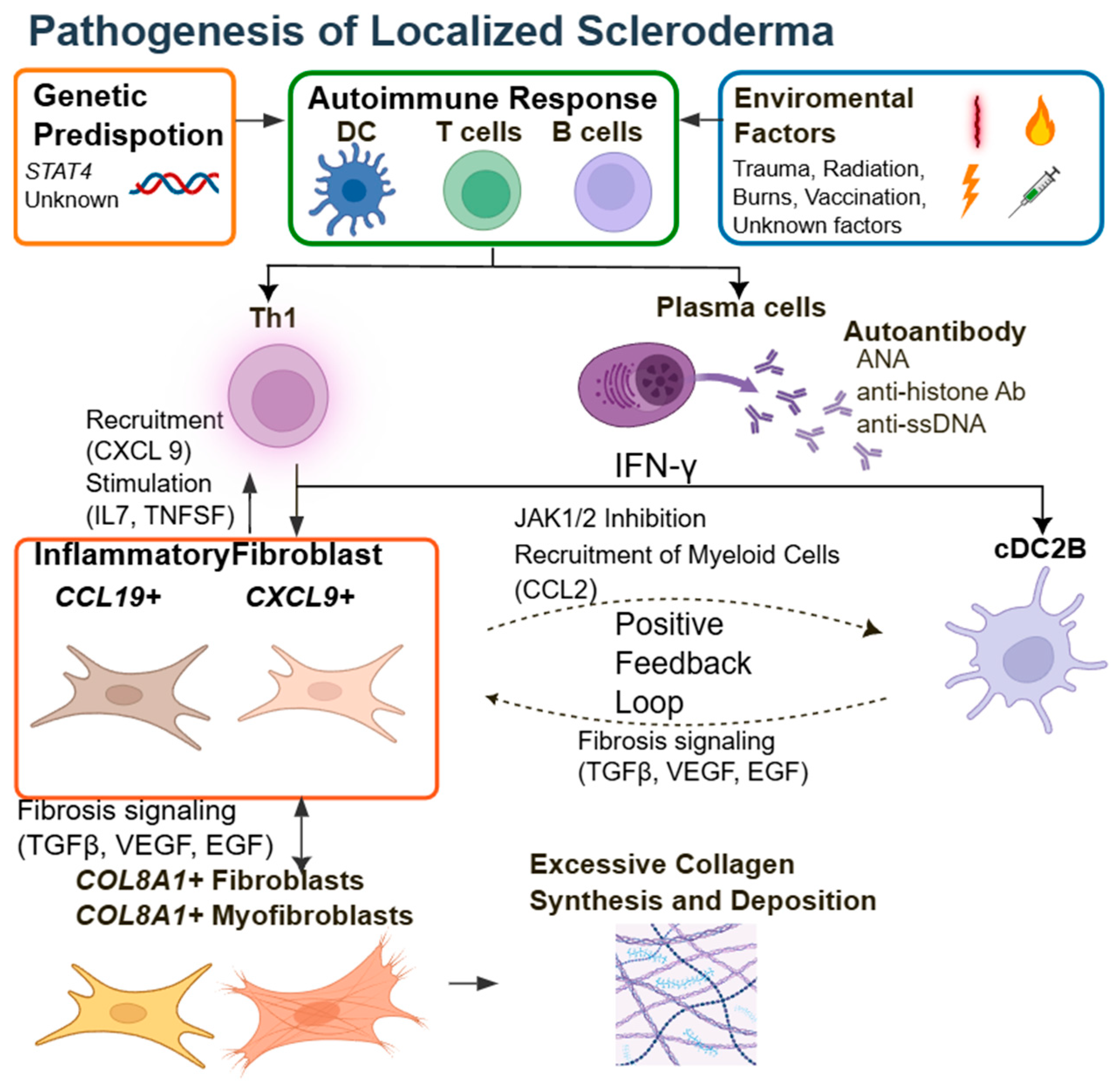
In 2021, Mirizio et al. performed RNA-seq on pediatric LSc lesional skin and reported several key findings [37]: (1) LSc lesional skin has higher expression of IFN-γ, IFN-α, and TNF-α-related genes compared to healthy skin; (2) active lesions show higher expression of IFN-γ and its inducible chemokines (CXCL9, CXCL10, CXCL11) compared to inactive lesions; (3) inactive lesions show higher expression of collagen and keratin-related genes; and (4) LSc lesional skin shows decreased expression of regulatory T-cell and Th17-related genes, with no change in TGF-β expression. These findings further highlight the important role of Th1 cells and IFN-γ signaling in the active phase of LSc (Figure 2). Notably, the JAK/STAT pathway showed the most distinct activation correlated with disease activity [37]. This, combined with case reports on the effectiveness of tofacitinib [38,39], suggests that JAK inhibitors are a promising new treatment avenue.
However, the existence of LSc cases resistant to steroids or MTX suggests that not all cases fit the “Inflammatory” gene expression profile. Further research with more cases is needed to establish a molecular subtype classification for LSc, similar to that for SSc.
Advancing this field, recent single-cell RNA sequencing studies have provided a more granular view of the cellular landscape in LSc. This research has identified distinct subpopulations of inflammatory fibroblasts that are highly enriched in LSc lesions. One key population is the CCL19+ inflammatory fibroblast subcluster, which expresses genes that recruit immune cells and promote fibrosis [40]. Complementary work, particularly in severe pansclerotic morphea, has further detailed this process, showing a critical crosstalk loop initiated by IFN-γ from T cells. This IFN-γ signal primes both CXCL9+ fibroblasts and conventional dendritic cells (cDC2B). These activated cell types then engage in a pro-fibrotic feedback loop, with dendritic cells and fibroblasts stimulating each other through signaling molecules like TGF-β and FGF, ultimately leading to the activation of collagen-producing COL8A1+ fibroblasts and driving the fibrotic process [41]. This level of cellular resolution highlights specific immune-fibroblast interactions as central to LSc pathogenesis and as precise targets for future therapies (Figure 2).

3.3. Immunological Findings and Biomarkers

The immune dysregulation in LSc involves both innate and adaptive immunity and is central to its pathogenesis. The early inflammatory stage is characterized by a mononuclear infiltrate, primarily composed of activated T lymphocytes. An imbalance in the Th1/Th2 paradigm has long been suggested, with a hypothesis that Th1/Th17-related cytokines drive the initial inflammation, followed by a shift toward Th2 cytokines, including IL-4, IL-5, IL-6, IL-10, and IL-13, during the subsequent fibrotic phase. These pro-fibrotic cytokines, particularly IL-4, IL-6, IL-13, and TGF-β, play a crucial role by activating fibroblasts [42]. This activation leads to the excessive production and deposition of collagen and other extracellular matrix components, ultimately resulting in the characteristic skin and tissue fibrosis of LSc [43].
In LSc, 46–80% of cases test positive for antinuclear antibodies (ANA) that reflect various immune dysfunction, with higher frequencies and titers often associated with more severe subtypes such as linear, generalized, or mixed morphea, as well as with extracutaneous manifestations and a longer disease course [4,44]. Anti-ssDNA antibodies are positive in approximately 50% of cases, and there is often a correlation between disease activity and antibody titer; therefore, referencing these antibodies as disease activity markers is advocated [4,44].
In addition, several serum molecules are under investigation as potential indicators of disease activity. The chemokine CCL18, for example, has been shown to be elevated in patients with active LSc, to correlate with disease activity scores, and to decrease after successful treatment [45]. Other promising pro-inflammatory and pro-fibrotic markers include progranulin (PGRN), periostin, galactosylated IgG (Ig-Gal), and various microRNAs, which may provide further insight into the underlying inflammatory and fibrotic processes [46]. The identification of these molecules supports the idea that a panel of biomarkers, rather than a single marker, will be necessary for accurate disease assessment in the future.

3.4. Monogenic Forms of LSc: Linking Genetics to Targeted Therapy

While most cases of LSc are considered polygenic, the recent identification of a rare monogenic autoinflammatory syndrome has provided profound insight into its pathophysiology. In patients presenting with a severe form of pansclerotic morphea, a de novo gain-of-function variant in STAT4 was identified as the cause. This mutation leads to constitutive activation of the STAT4 protein and enhanced downstream IFN-γ signaling, driving severe inflammation and fibrosis. This finding is significant as it provides a powerful human model demonstrating that dysregulated IFN-γ signaling via the JAK-STAT pathway can be a primary driver of the disease. Furthermore, the mechanistic understanding led to successful treatment with the JAK1/2 inhibitor ruxolitinib, resulting in clinical improvement. Although this specific mutation may account for only a small subset of severe LSc cases, this discovery helps elucidate key pathways in the broader disease spectrum and solidifies the rationale for targeting the JAK-STAT pathway in treatment [47].

4. General Clinical Course of LSc

The first nationwide epidemiological survey of juvenile-onset LSc in Japan has recently provided crucial local data, estimating the prevalence at 2.11 per 100,000 population. The study identified a mean age of onset of 7.5 years and a female-to-male ratio of 2.4:1, with linear scleroderma being the most common subtype (69.1%), followed by circumscribed morphea (22.2%) [48]. For international comparison, a large population-based study from Quebec, Canada, reported a higher prevalence of 7.33 per 100,000 people and a bimodal age of onset, with peaks in both childhood and mid-adulthood [49]. While studies from Canada and the US show that disease activity in LSc generally ceases in about 50% of cases within 3–5 years, careful long-term follow-up is necessary due to the risk of relapse after long periods of remission, a risk that is particularly high in childhood-onset linear scleroderma [50,51,52]. In juvenile-onset LSc, severe subtypes such as linear and craniofacial morphea are more common than in adults. Furthermore, a recent literature review reports that extracutaneous manifestations are found in 26.5% of patients, significantly impacting quality of life and underscoring the need for systemic evaluation and management beyond the skin [53].

5. Important Extracutaneous Manifestations

While LSc primarily affects the skin and subcutaneous tissues, extracutaneous manifestations are common. The recent nationwide survey in Japan found extracutaneous manifestations in 27.5% of juvenile patients, with arthritis/arthralgia (16.9%) and neurological symptoms (6.3%) being the most frequent, underscoring their clinical significance [48]. This aligns with international cohorts where the presence of extracutaneous manifestations is directly associated with higher disease activity and a greater negative impact on quality of life, highlighting that extracutaneous manifestations are a marker of overall disease severity [53,54]. The presence of extracutaneous manifestations is not only a source of significant morbidity but is also significantly associated with higher disease activity and a greater negative impact on quality of life [54]. The risk of extracutaneous manifestations is highest in patients with linear, generalized, and pansclerotic subtypes.

5.1. Musculoskeletal Complications

These are the most frequent extracutaneous manifestations, reported in up to 24% of patient [53]. They include arthralgia, inflammatory arthritis, joint contractures, myositis, and fasciitis. When linear lesions cross a joint or affect a limb during childhood, they can disrupt bone growth, leading to limb length discrepancy and significant functional disability [54,55,56,57,58].

5.2. Neurological Complications

Affecting approximately 10% of patients, neurological complications are strongly associated with craniofacial morphea (en coup de sabre and PRS) [53]. The most common findings are seizures and headaches. Structural brain abnormalities, such as parenchymal calcifications, white matter lesions, and brain atrophy, can be detected on Magnetic resonance imaging (MRI), even in asymptomatic patients. Therefore, baseline neurological evaluation and neuroimaging are recommended for all patients with craniofacial involvement [5].

5.3. Ocular Complications

Ocular involvement is an important extracutaneous manifestations, reported in approximately 5% of juvenile LSc patients [53]. The risk is significantly higher in those with craniofacial lesions, such as scleroderma en coup de sabre, where ocular issues are often associated with neurological complications. The spectrum of complications is extremely diverse, affecting any part of the eye from the eyelids (e.g., ectropion) and adnexa to the globe itself. While many findings such as dry eye or refractive errors can occur, the most significant are vision-threatening conditions like uveitis, episcleritis, and glaucoma. Although less frequent, ocular complications can also be seen in linear, generalized, and circumscribed morphea. A comparison of clinical features between LSc with and without ocular complications reported that the former group has a significantly higher frequency of scleroderma en coup de sabre and neurological complications [59]. On the other hand, since ocular complications can also occur, albeit less frequently, in linear scleroderma without en coup de sabre, generalized morphea, and circumscribed morphea, regular ophthalmologic examinations should be performed for all pediatric LSc patients [59]. Regarding the frequency of visits, it is stated that they should be every 3–4 months for the first 3 years after onset due to high disease activity, and thereafter upon relapse [59].

5.4. Growth and Developmental Complications

Beyond limb length discrepancy, LSc can cause profound cosmetic and functional issues related to growth. Facial hemiatrophy in craniofacial morphea can affect the development of underlying bone and dental structures, leading to significant asymmetry and oral health problems. Early and aggressive treatment is crucial to mitigate these long-term consequences during the critical growth period of childhood and adolescence.

5.5. Association with Antiphospholipid Antibodies

Furthermore, various antiphospholipid antibodies (aPL) have been reported in patients with LSc [60]. A study by Lis-Święty et al. detected aPL in a high proportion of LSc patients (51.1%), with anti-cardiolipin and anti-β2-glycoprotein I antibodies being the most frequent. However, in their cohort, the presence of these antibodies was not associated with clinical manifestations of antiphospholipid syndrome, such as thrombosis. This suggests that while aPL can be a feature of the autoimmune response in LSc, their utility as routine screening markers for thrombotic risk may be limited in the absence of suggestive clinical symptoms [61].

6. Diagnosis and Clinical Evaluation of LSc

The diagnosis of LSc is primarily clinical, based on these characteristic presentations. However, in cases of diagnostic uncertainty or atypical presentation, a skin biopsy is strongly recommended. Histopathological examination is essential to confirm the diagnosis and to rule out other sclerosing conditions, such as LSA, scleredema, or eosinophilic fasciitis [6]. High-frequency ultrasound (>20 MHz), including color Doppler imaging, is a recommended non-invasive tool for assessing lesion depth, inflammatory activity, and response to therapy [6,62]. MRI is valuable for evaluating deep tissue involvement (muscle, joints). In cases of craniofacial morphea (scleroderma en coup de sabre and PRS), brain MRI is crucial to screen for potential neurological complications, as abnormalities can be present even in asymptomatic patients. Common intracranial findings include T2 hyperintense white matter lesions, cerebral atrophy, leptomeningeal enhancement, parenchymal calcification, and vascular abnormalities. The presence of these findings, especially in patients with neurological symptoms such as seizures or headaches, necessitates a multidisciplinary evaluation, including consultation with a neurologist. Such findings may guide further management, potentially warranting the initiation or escalation of systemic immunosuppressive therapy [6,63,64].
Testing for ANA is clinically useful, as positivity is often associated with more severe subtypes (linear, generalized) and a higher risk of extracutaneous manifestations.
Furthermore, it is important to consider drug-induced scleroderma-like lesions in the differential diagnosis. These conditions can present with two distinct clinical manifestations: scleroderma-like lesions resembling systemic sclerosis, or morphea-like plaques [65]. A wide variety of drugs have been implicated [65]. Classic associations include agents like bleomycin (typically causing scleroderma-like lesions) and vitamin K1 (causing morphea-like lesions) [65]. Recent reports increasingly highlight newer therapeutic classes. Notably, taxane-based chemotherapeutics primarily induce scleroderma-like lesions, often starting with edema in the lower extremities, rather than morphea-like plaques. It has been recently proposed that taxane-based agent-induced scleroderma-like lesion be categorized as an independent disease entity [65].
In contrast, immune checkpoint inhibitors (ICIs) have been reported to be associated with both scleroderma-like lesions and morphea-like plaques [65,66,67]. However, given the mechanism of ICIs in activating the immune system, there is a growing recognition among specialists that these drugs may induce the onset of classic SSc or morphea itself, rather than simply causing a phenocopy, although this recognition is often based on anecdotal reports. Further accumulation and analysis of such cases are warranted to validate this observation.
In addition, other chemotherapeutic agents have also been suggested to be possibly associated with morphea-like plaque [68]. Separately, TNF-α inhibitors have also been frequently implicated in the development of morphea [69,70]. Therefore, a thorough review of the patient’s medication history is essential when evaluating sclerotic skin lesions, as discontinuation of the offending drug is a key component of management.

7. Management of LSc

In the pediatric population, the primary goal of treatment is the rapid induction of remission to prevent irreversible tissue damage, functional disability, and cosmetic disfigurement during critical periods of growth [28]. Given the high frequency of extracutaneous involvement, a multidisciplinary team (MDT) approach—including pediatric rheumatology, dermatology, ophthalmology, and neurology, among others—is essential for comprehensive screening and management, particularly for patients with linear and craniofacial subtypes [28,53]. In 2019, SHARE (Single Hub and Access point for pediatric Rheumatology in Europe), a European project aimed at optimizing and disseminating diagnosis and management for rheumatic diseases in children and young adults, published 16 recommendations for the management of childhood-onset LSc [5].

7.1. Disease Assessment Tools

For assessment at the initial visit and during regular follow-ups, the use of the LoScAT (Localized Scleroderma Cutaneous Assessment Tool) is proposed [5]. The LoSSI (Localized Scleroderma Skin Severity Index) and LoSDI (Localized Scleroderma Skin Damage Index, right half) are useful indices for assessing the activity/severity and degree of tissue damage of LSc lesions, respectively, and their use in clinical practice is strongly recommended [5,71].
Regarding evaluation, the recommendations state that: (1) infrared thermography can be used for activity assessment but may show false positives in the presence of skin atrophy (as it detects heat from deeper tissues due to atrophy of skin, subcutaneous fat, and muscle); (2) skin ultrasound (with standardized evaluation methods and color Doppler) can be a useful tool for assessing disease activity, lesion extent, and treatment response; (3) all patients should undergo careful evaluation of all joints, including the temporomandibular joint, at diagnosis and follow-up; (4) MRI can be a useful tool for evaluating musculoskeletal lesions, especially when lesions cross a joint; (5) a head MRI scan at diagnosis is strongly recommended for all patients with head and neck lesions, regardless of neurological symptoms; (6) dental and maxillofacial evaluation at diagnosis and follow-up should be performed for all patients with head and neck lesions; (7) an ophthalmologic evaluation (including screening for uveitis) is recommended for all patients at diagnosis, especially those with head and neck lesions; and (8) ophthalmologic follow-up (including uveitis screening) should be considered for all patients, especially those with head and neck lesions [5].

7.2. Standard Treatments for LSc

For treatment, six recommendations are provided: (1) for the active inflammatory stage, systemic steroid therapy (e.g., oral prednisolone 0.5–2.0 mg/kg/day for 2–4 weeks, or intravenous methylprednisolone 500–1000 mg/day (children: 30 mg/kg/day (max. 1000 mg)) for 3 consecutive days/month, up to 3–6 months) and/or MTX (12.5–25 mg/week in adults or 15 mg/m2/week (max. 25 mg/week) in children) may be useful to rapidly control inflammation [6]; (2) all patients with active disease who are at risk of deformity or functional disability should be treated with MTX 15 mg/m2/week (oral or subcutaneous); (3) once an acceptable clinical improvement is achieved, MTX should be continued without dose reduction for at least 12 months; (4) mycophenolate mofetil (MMF) is an acceptable treatment for severe cases, MTX-resistant cases, or patients intolerant to MTX; (5) medium-dose UVA1 phototherapy is acceptable for improving skin sclerosis in circumscribed morphea; and (6) topical imiquimod therapy is acceptable for improving skin sclerosis in circumscribed morphea [5]. Although these recommendations are for children, much of their content can be extrapolated to adult-onset LSc and serve as a useful reference in clinical practice. The 2016 clinical guidelines in Japan have a similar basic approach to treatment, with steroids and immunosuppressants as the mainstay for suppressing disease activity, and physical therapy or cosmetic surgery for functional impairment or cosmetic problems caused by inactive, established lesions [4]. Among these procedures, hyaluronic acid (HA) fillers have emerged as a safe and effective, minimally invasive option for correcting volume loss in atrophic areas, with high patient satisfaction [72].

7.3. Novel Treatments for LSc

Accumulating case reports and case series on tocilizumab [73,74,75,76,77] and abatacept [78,79,80] highlight their promise as new treatments, particularly for severe cases such as pansclerotic morphea, linear scleroderma, and scleroderma en coup de sabre with neurological or uveitis complications. For hydroxychloroquine, a retrospective study from the Mayo Clinic on 84 LSc patients treated for 6 months or longer between 1996 and 2013 reported favorable results, with complete remission in 36 cases (42.9%) and partial remission of 50% or more in 32 cases (38.1%) [81]. (Time to treatment effect: median 4.0 months (range: 1–14 months); time to maximum treatment effect: median 12.0 months (range: 3–36 months); relapse rate after HCQ discontinuation or reduction: 30.6%). Regarding JAK inhibitors, two cases have been reported where tofacitinib was effective [38,39].
For restoring volume loss in atrophic, inactive lesions, autologous fat grafting (lipofilling) has emerged as a promising technique. It not only provides volume but may also improve skin texture and pliability through the regenerative effects of adipose-derived stem cells [82,83,84]. To enhance the viability and regenerative potential of these grafts, a technique known as cell-assisted lipotransfer (CAL), which enriches the fat graft with autologous adipose-derived stem cells (ADSCs), has been developed. A pilot study using this method in LSc patients demonstrated improved fat retention rates and significant improvements in skin elasticity and dermal thickness, suggesting it may be a superior option for achieving durable reconstructive outcomes [85].
Looking further into the future, regenerative medicine approaches are being explored. Preclinical research using a human iPSC-derived organoid model has shown potential for reversing sclerotic changes. In a mouse model of scleroderma, the application of these epithelial and mesenchymal organoids was reported to reduce skin fibrosis and promote the regeneration of sweat glands and blood vessels. This approach suggests a future therapeutic strategy aimed not just at halting inflammation, but at actively repairing tissue damage [86]. At present, none of these treatments have high-level evidence, and it is hoped that high-quality evidence will be accumulated in the future.

8. Conclusions

This article has outlined the latest findings in the understanding and management of LSc. In the past, disease recognition for LSc was admittedly low, as it was often confused with SSc. However, thanks to efforts such as the publication of clinical guidelines and consensus-based recommendations both domestically and internationally in recent years, disease awareness is increasing annually [4,5,6]. It is expected that disease awareness will continue to grow and that more cases will be diagnosed early. In this disease, tissue damage that occurs during the inflammatory phase is not expected to recover; therefore, early diagnosis and early treatment are fundamental. Reports of cases where molecularly targeted drugs such as biologics and small molecule compounds were effective are increasing, and it is hoped that studies on their utility in larger populations will be conducted to build evidence in the future.

Author Contributions

Conceptualization, T.T. (Toshiya Takahashi) and Y.A.; Writing—Original Draft Preparation, T.T. (Toshiya Takahashi); Writing—Figure Preparation, T.T. (Takehiro Takahashi), Writing—Review and Editing, T.T. (Toshiya Takahashi), T.T. (Takehiro Takahashi) and Y.A.; Supervision, Y.A. All authors have read and agreed to the published version of the manuscript.

Funding

This work was supported by the Ministry of Education, Culture, Sports, Science and Technology (MEXT) KAKENHI [22K21370].

Conflicts of Interest

The authors declare no conflicts of interest.

References

  1. Marín-Hernández, E.; Suárez-Frías, B.; Siordia Reyes, A.G. Hyperpigmented Lesions with Acquired Atrophy Following Blaschko Lines in a Patient with Diagnosed with Localized Scleroderma. Bol. Med. Hosp. Infant. Mex. 2021, 78, 621–630. [Google Scholar] [CrossRef]
  2. Wu, S.; Li, J.; Zhang, W.; Yan, Z. Morphea: An Unusual Case Affecting Lip and Alveolar Bone. Int. J. Dermatol. 2023, 62, e623–e625. [Google Scholar] [CrossRef]
  3. Muroi, E.; Ogawa, F.; Yamaoka, T.; Sueyoshi, F.; Sato, S. Case of Localized Scleroderma Associated with Osteomyelitis. J. Dermatol. 2010, 37, 81–84. [Google Scholar] [CrossRef]
  4. Asano, Y.; Fujimoto, M.; Ishikawa, O.; Sato, S.; Jinnin, M.; Takehara, K.; Hasegawa, M.; Yamamoto, T.; Ihn, H. Diagnostic Criteria, Severity Classification and Guidelines of Localized Scleroderma. J. Dermatol. 2018, 45, 755–780. [Google Scholar] [CrossRef]
  5. Zulian, F.; Culpo, R.; Sperotto, F.; Anton, J.; Avcin, T.; Baildam, E.M.; Boros, C.; Chaitow, J.; Constantin, T.; Kasapcopur, O.; et al. Consensus-Based Recommendations for the Management of Juvenile Localised Scleroderma. Ann. Rheum. Dis. 2019, 78, 1019–1024. [Google Scholar] [CrossRef]
  6. Knobler, R.; Geroldinger-Simić, M.; Kreuter, A.; Hunzelmann, N.; Moinzadeh, P.; Rongioletti, F.; Denton, C.P.; Mouthon, L.; Cutolo, M.; Smith, V.; et al. Consensus Statement on the Diagnosis and Treatment of Sclerosing Diseases of the Skin, Part 1: Localized Scleroderma, Systemic Sclerosis and Overlap Syndromes. J. Eur. Acad. Dermatol. Venereol. 2024, 38, 1251–1280. [Google Scholar] [CrossRef]
  7. Tuffanelli, D.; Winkelmann, R. Systemic Scleroderma, A Clinical Study of 727 Cases. Arch. Dermatol. 1961, 84, 359–371. [Google Scholar] [CrossRef] [PubMed]
  8. Peterson, L.S.; Nelson, A.M.; Su, W.P.D. Classification of Morphea (Localized Scleroderma). Mayo Clin. Proc. 1995, 70, 1068–1076. [Google Scholar] [CrossRef]
  9. Zulian, F.; Woo, P.; Athreya, B.H.; Laxer, R.M.; Medsger, T.A., Jr.; Lehman, T.J.A.; Cerinic, M.M.; Martini, G.; Ravelli, A.; Russo, R.; et al. The Pediatric Rheumatology European Society/American College of Rheumatology/European League against Rheumatism Provisional Classification Criteria for Juvenile Systemic Sclerosis. Arthritis Rheum. 2007, 57, 203–212. [Google Scholar] [CrossRef] [PubMed]
  10. Błaszczyk, M.; Królicki, L.; Krasu, M.; Glińska, O.; Jabłońska, S. Progressive Facial Hemiatrophy: Central Nervous System Involvement and Relationship with Scleroderma En coup de sabre. J. Rheumatol. 2003, 30, 1997–2004. [Google Scholar]
  11. Tollefson, M.M.; Witman, P.M. En coup de sabre Morphea and Parry-Romberg Syndrome: A Retrospective Review of 54 Patients. J. Am. Acad. Dermatol. 2007, 56, 257–263. [Google Scholar] [CrossRef]
  12. Orozco-Covarrubias, L.; Guzmán-Meza, A.; Ridaura-Sanz, C.; Carrasco Daza, D.; Sosa-de-Martinez, C.; Ruiz-Maldonado, R. Scleroderma “en coup de sabre” and Progressive Facial Hemiatrophy. Is It Possible to Differentiate Them? J. Eur. Acad. Dermatol. Venereol. 2002, 16, 361–366. [Google Scholar] [CrossRef]
  13. Sato, S.; Fujimoto, M.; Ihn, H.; Kikuchi, K.; Takehara, K. Clinical Characteristics Associated with Antihistone Antibodies in Patients with Localized Scleroderma. J. Am. Acad. Dermatol. 1994, 31, 567–571. [Google Scholar] [CrossRef]
  14. Sherber, N.S.; Boin, F.; Hummers, L.K.; Wigley, F.M. The “Tank Top Sign”: A Unique Pattern of Skin Fibrosis Seen in Pansclerotic Morphea. Ann. Rheum. Dis. 2009, 68, 1511–1512. [Google Scholar] [CrossRef]
  15. Chung, L.; Lin, J.; Furst, D.E.; Fiorentino, D. Systemic and Localized Scleroderma. Clin. Dermatol. 2006, 24, 374–392. [Google Scholar] [CrossRef] [PubMed]
  16. Laxer, R.M.; Zulian, F. Localized Scleroderma. Curr. Opin. Rheumatol. 2006, 18, 606–613. [Google Scholar] [CrossRef]
  17. Kencka, D.; Blaszczyk, M.; Jabłońska, S. Atrophoderma Pasini-Pierini Is a Primary Atrophic Abortive Morphea. Dermatology 1995, 190, 203–206. [Google Scholar] [CrossRef] [PubMed]
  18. McNiff, J.; Glusac, E.; Lazova, R.; Carroll, C. Morphea Limited to the Superficial Reticular Dermis: An Underrecognized Histologic Phenomenon. Am. J. Dermatopathol. 1999, 21, 315–319. [Google Scholar] [CrossRef] [PubMed]
  19. Powell, J.J.; Wojnarowska, F. Lichen Sclerosus. Lancet 1999, 353, 1777–1783. [Google Scholar] [CrossRef]
  20. Murphy, R. Lichen Sclerosus. Dermatol. Clin. 2010, 28, 707–715. [Google Scholar] [CrossRef]
  21. Ihn, H. Eosinophilic Fasciitis: From Pathophysiology to Treatment. Allergol. Int. 2019, 68, 437–439. [Google Scholar] [CrossRef]
  22. Mazori, D.R.; Femia, A.N.; Vleugels, R.A. Eosinophilic Fasciitis: An Updated Review on Diagnosis and Treatment. Curr. Rheumatol. Rep. 2017, 19, 74. [Google Scholar] [CrossRef] [PubMed]
  23. Lebeaux, D.; Sène, D. Eosinophilic Fasciitis (Shulman Disease). Best Pract. Res. Clin. Rheumatol. 2012, 26, 449–458. [Google Scholar] [CrossRef]
  24. Jacobe, H.; Ahn, C.; Arnett, F.C.; Reveille, J.D. Major Histocompatibility Complex Class I and Class II Alleles May Confer Susceptibility to or Protection against Morphea: Findings from the Morphea in Adults and Children Cohort: Association of MHC Class I and Class II Alleles with Morphea. Arthritis Rheumatol. 2014, 66, 3170–3177. [Google Scholar] [CrossRef]
  25. Happle, R. Mosaicism in Human Skin. Understanding the Patterns and Mechanisms. Arch. Dermatol. 1993, 129, 1460–1470. [Google Scholar] [CrossRef] [PubMed]
  26. Miura, S.; Someya, M.; Toyama, S.; Kawai, T.; Yamashita, T.; Shishido, N.; Asano, A. Case of Scleroderma En coup de sabre with Ipsilateral Hearing Loss and Aphakia. Eur. J. Dermatol. 2019, 29, 423–425. [Google Scholar] [CrossRef] [PubMed]
  27. Lauesen, S.R.; Daugaard-Jensen, J.; Lauridsen, E.F.; Kjær, I. Localised Scleroderma En coup de sabre Affecting the Skin, Dentition and Bone Tissue within Craniofacial Neural Crest Fields. Clinical and Radiographic Study of Six Patients. Eur. Arch. Paediatr. Dent. 2019, 20, 339–350. [Google Scholar] [CrossRef]
  28. Pain, C.E.; Torok, K.S. Challenges and Complications in Juvenile Localized Scleroderma: A Practical Approach. Best Pract. Res. Clin. Rheumatol. 2024, 38, 101987. [Google Scholar] [CrossRef]
  29. Milano, A.; Pendergrass, S.A.; Sargent, J.L.; George, L.K.; McCalmont, T.H.; Connolly, M.K.; Whitfield, M.L. Molecular Subsets in the Gene Expression Signatures of Scleroderma Skin. PLoS ONE 2008, 3, e2696. [Google Scholar] [CrossRef]
  30. Franks, J.M.; Martyanov, V.; Cai, G.; Wang, Y.; Li, Z.; Wood, T.A.; Whitfield, M.L. A Machine Learning Classifier for Assigning Individual Patients with Systemic Sclerosis to Intrinsic Molecular Subsets. Arthritis Rheumatol. 2019, 71, 1701–1710. [Google Scholar] [CrossRef]
  31. Khanna, D.; Spino, C.; Johnson, S.; Chung, L.; Whitfield, M.L.; Denton, C.P.; Berrocal, V.; Franks, J.; Mehta, B.; Molitor, J.; et al. Abatacept in Early Diffuse Cutaneous Systemic Sclerosis: Results of a Phase II Investigator-Initiated, Multicenter, Double-Blind, Randomized, Placebo-Controlled Trial. Arthritis Rheumatol. 2020, 72, 125–136. [Google Scholar] [CrossRef]
  32. Hinchcliff, M.; Huang, C.-C.; Wood, T.A.; Matthew Mahoney, J.; Martyanov, V.; Bhattacharyya, S.; Tamaki, Z.; Lee, J.; Carns, M.; Podlusky, S.; et al. Molecular Signatures in Skin Associated with Clinical Improvement during Mycophenolate Treatment in Systemic Sclerosis. J. Investig. Dermatol. 2013, 133, 1979–1989. [Google Scholar] [CrossRef]
  33. Martyanov, V.; Kim, G.-H.J.; Hayes, W.; Du, S.; Ganguly, B.J.; Sy, O.; Lee, S.K.; Bogatkevich, G.S.; Schieven, G.L.; Schiopu, E.; et al. Novel Lung Imaging Biomarkers and Skin Gene Expression Subsetting in Dasatinib Treatment of Systemic Sclerosis-Associated Interstitial Lung Disease. PLoS ONE 2017, 12, e0187580. [Google Scholar] [CrossRef]
  34. Franks, J.M.; Martyanov, V.; Wang, Y.; Wood, T.A.; Pinckney, A.; Crofford, L.J.; Whitfield, M. Machine Learning Predicts Stem Cell Transplant Response in Severe Scleroderma. Ann. Rheum. Dis. 2020, 79, 1608–1615. [Google Scholar] [CrossRef]
  35. Torok, K.S.; Li, S.C.; Jacobe, H.M.; Taber, S.F.; Stevens, A.M.; Zulian, F.; Lu, T.T. Immunopathogenesis of Pediatric Localized Scleroderma. Front. Immunol. 2019, 10, 908. [Google Scholar] [CrossRef] [PubMed]
  36. O’Brien, J.C.; Rainwater, Y.B.; Malviya, N.; Cyrus, N.; Auer-Hackenberg, L.; Hynan, L.S.; Jacobe, H. Transcriptional and Cytokine Profiles Identify CXCL9 as a Biomarker of Disease Activity in Morphea. J. Investig. Dermatol. 2017, 137, 1663–1670. [Google Scholar] [CrossRef] [PubMed]
  37. Mirizio, E.; Liu, C.; Yan, Q.; Waltermire, J.; Mandel, R.; Schollaert, K.L.; Konnikova, L.; Wang, X.; Chen, W.; Torok, K.S. Genetic Signatures from RNA Sequencing of Pediatric Localized Scleroderma Skin. Front. Pediatr. 2021, 9, 669116. [Google Scholar] [CrossRef]
  38. Kim, S.R.; Charos, A.; Damsky, W.; Heald, P.; Girardi, M.; King, B.A. Treatment of Generalized Deep Morphea and Eosinophilic Fasciitis with the Janus Kinase Inhibitor Tofacitinib. JAAD Case Rep. 2018, 4, 443–445. [Google Scholar] [CrossRef]
  39. Scheinberg, M.; Sabbagh, C.; Ferreira, S.; Michalany, N. Full Histological and Clinical Regression of Morphea with Tofacitinib. Clin. Rheumatol. 2020, 39, 2827–2828. [Google Scholar] [CrossRef]
  40. Werner, G.; Sanyal, A.; Mirizio, E.; Hutchins, T.; Tabib, T.; Lafyatis, R.; Jacobe, H.; Torok, K.S. Single-Cell Transcriptome Analysis Identifies Subclusters with Inflammatory Fibroblast Responses in Localized Scleroderma. Int. J. Mol. Sci. 2023, 24, 9796. [Google Scholar] [CrossRef]
  41. Xing, E.; Ma, F.; Wasikowski, R.; Billi, A.C.; Gharaee-Kermani, M.; Fox, J.; Dobry, C.; Victory, A.; Sarkar, M.K.; Xing, X.; et al. Pansclerotic Morphea Is Characterized by IFN-γ Responses Priming Dendritic Cell Fibroblast Crosstalk to Promote Fibrosis. JCI Insight 2023, 8, e171307. [Google Scholar] [CrossRef] [PubMed]
  42. Saracino, A.M.; Denton, C.P.; Orteu, C.H. The Molecular Pathogenesis of Morphoea: From Genetics to Future Treatment Targets. Br. J. Dermatol. 2017, 177, 34–46. [Google Scholar] [CrossRef]
  43. Papara, C.; De Luca, D.A.; Bieber, K.; Vorobyev, A.; Ludwig, R.J. Morphea: The 2023 Update. Front. Med. 2023, 10, 1108623. [Google Scholar] [CrossRef] [PubMed]
  44. Falanga, V.; Medsger, T.; Reichlin, M. Antinuclear and Anti-Single-Stranded DNA Antibodies in Morphea and Generalized Morphea. Arch. Dermatol. 1987, 123, 350–353. [Google Scholar] [CrossRef]
  45. Mertens, J.S.; de Jong, E.M.G.J.; van den Hoogen, L.L.; Wienke, J.; Thurlings, R.M.; Seyger, M.M.B.; Hoppenreijs, E.P.A.H.; Wijngaarde, C.A.; van Vlijmen-Willems, I.M.J.J.; van den Bogaard, E.; et al. The Identification of CCL18 as Biomarker of Disease Activity in Localized Scleroderma. J. Autoimmun. 2019, 101, 86–93. [Google Scholar] [CrossRef]
  46. Snarskaya, E.S.; Vasileva, K.D. Localized Scleroderma: Actual Insights and New Biomarkers. Int. J. Dermatol. 2022, 61, 667–674. [Google Scholar] [CrossRef]
  47. Baghdassarian, H.; Blackstone, S.A.; Clay, O.S.; Philips, R.; Matthiasardottir, B.; Nehrebecky, M.; Hua, V.K.; McVicar, R.; Liu, Y.; Tucker, S.M.; et al. Variant STAT4 and Response to Ruxolitinib in an Autoinflammatory Syndrome. N. Engl. J. Med. 2023, 388, 2241–2252. [Google Scholar] [CrossRef]
  48. Hamaguchi, Y.; Ueda-Hayakawa, I.; Kaneko, U.; Shimizu, M.; Miyamae, T.; Ishikawa, H.; Ae, R.; Nakamura, Y.; Asano, Y.; Fujimoto, M.; et al. Nationwide Epidemiological and Clinical Survey of Juvenile-Onset Morphea in Japan. J. Dermatol. 2025, 52, 860–871. [Google Scholar] [CrossRef]
  49. Ghazal, S.; Muntyanu, A.; Aw, K.; Kaouache, M.; Khoury, L.; Piram, M.; McCuaig, C.; Chédeville, G.; Rahme, E.; Osman, M.; et al. Incidence, Prevalence, and Mortality of Localized Scleroderma in Quebec, Canada: A Population-Based Study. Lancet Reg. Health Am. 2025, 44, 101044. [Google Scholar] [CrossRef]
  50. Piram, M.; McCuaig, C.C.; Saint-Cyr, C.; Marcoux, D.; Hatami, A.; Haddad, E.; Powell, J. Short-and Long-term Outcome of Linear Morphoea in Children. Br. J. Dermatol. 2013, 169, 1265–1271. [Google Scholar] [CrossRef] [PubMed]
  51. Saxton-Daniels, S.; Jacobe, H. An Evaluation of Long-Term Outcomes in Adults with Pediatric-Onset Morphea. Arch. Dermatol. 2010, 146, 1044–1045. [Google Scholar] [CrossRef]
  52. Christen-Zaech, S.; Hakim, M.D.; Afsar, F.S.; Paller, A.S. Pediatric Morphea (Localized Scleroderma): Review of 136 Patients. J. Am. Acad. Dermatol. 2008, 59, 385–396. [Google Scholar] [CrossRef]
  53. Liguoro, I.; Simonini, G.; Martini, G. The Burden of Extracutaneous Manifestations in Juvenile Localized Scleroderma: A Literature Review. Autoimmun. Rev. 2025, 24, 103812. [Google Scholar] [CrossRef]
  54. Li, S.C.; Higgins, G.C.; Chen, M.; Torok, K.S.; Rabinovich, C.E.; Stewart, K.; Laxer, R.M.; Pope, E.; Haines, K.A.; Punaro, M.; et al. Extracutaneous Involvement Is Common and Associated with Prolonged Disease Activity and Greater Impact in Juvenile Localized Scleroderma. Rheumatology 2021, 60, 5724–5733. [Google Scholar] [CrossRef]
  55. Zulian, F.; Vallongo, C.; Woo, P.; Russo, R.; Ruperto, N.; Harper, J.; Espada, G.; Corona, F.; Mukamel, M.; Vesely, R.; et al. Localized Scleroderma in Childhood Is Not Just a Skin Disease. Arthritis Rheum. 2005, 52, 2873–2881. [Google Scholar] [CrossRef] [PubMed]
  56. Ardalan, K.; Zigler, C.K.; Torok, K.S. Predictors of Longitudinal Quality of Life in Juvenile Localized Scleroderma. Arthritis Care Res. 2017, 69, 1082–1087. [Google Scholar] [CrossRef] [PubMed]
  57. Li, S.C.; Torok, K.S.; Rabinovich, C.E.; Dedeoglu, F.; Becker, M.L.; Ferguson, P.J.; Hong, S.D.; Ibarra, M.F.; Stewart, K.; Pope, E.; et al. Initial Results from a Pilot Comparative Effectiveness Study of 3 Methotrexate-Based Consensus Treatment Plans for Juvenile Localized Scleroderma. J. Rheumatol. 2020, 47, 1242–1252. [Google Scholar] [CrossRef] [PubMed]
  58. Wu, E.Y.; Li, S.C.; Torok, K.S.; Virkud, Y.V.; Fuhlbrigge, R.C.; Rabinovich, C.E.; Childhood Arthritis and Rheumatology Research Alliance (CARRA) Legacy Registry Investigators. Baseline Description of the Juvenile Localized Scleroderma Subgroup from the Childhood Arthritis and Rheumatology Research Alliance Legacy Registry. ACR Open Rheumatol. 2019, 1, 119–124. [Google Scholar] [CrossRef]
  59. Zannin, M.E.; Martini, G.; Athreya, B.H.; Russo, R.; Higgins, G.; Vittadello, F.; Alpigiani, M.G.; Alessio, M.; Paradisi, M.; Woo, P.; et al. Ocular Involvement in Children with Localised Scleroderma: A Multi-Centre Study. Br. J. Ophthalmol. 2007, 91, 1311–1314. [Google Scholar] [CrossRef]
  60. Takehara, K.; Sato, S. Localized Scleroderma Is an Autoimmune Disorder. Rheumatology 2005, 44, 274–279. [Google Scholar] [CrossRef]
  61. Lis-Święty, A.; Brzezińska-Wcisło, L.; Arasiewicz, H.; Bergler-Czop, B. Antiphospholipid Antibodies in Localized Scleroderma: The Potential Role of Screening Tests for the Detection of Antiphospholipid Syndrome. Postepy Dermatol. Alergol. 2014, 31, 65–70. [Google Scholar] [CrossRef] [PubMed]
  62. Sator, P.-G.; Radakovic, S.; Schulmeister, K.; Hönigsmann, H.; Tanew, A. Medium-Dose Is More Effective than Low-Dose Ultraviolet A1 Phototherapy for Localized Scleroderma as Shown by 20-MHz Ultrasound Assessment. J. Am. Acad. Dermatol. 2009, 60, 786–791. [Google Scholar] [CrossRef]
  63. Gorolay, V.V.; Fisicaro, R.; Tsui, B.; Tran, N.-A.; Eltawil, Y.; Glastonbury, C.; Wu, X.C. Neuroimaging and Clinical Features of Parry-Romberg Syndrome and Linear Morphea En-Coup-de-Sabre in a Large Case Series. Acad. Radiol. 2025, 32, 4154–4163. [Google Scholar] [CrossRef]
  64. Kister, I.; Inglese, M.; Laxer, R.M.; Herbert, J. Neurologic Manifestations of Localized Scleroderma: A Case Report and Literature Review. Neurology 2008, 71, 1538–1545. [Google Scholar] [CrossRef]
  65. Hamaguchi, Y. Drug-Induced Scleroderma-like Lesion. Allergol. Int. 2022, 71, 163–168. [Google Scholar] [CrossRef]
  66. Tjarks, B.J.; Kerkvliet, A.M.; Jassim, A.D.; Bleeker, J.S. Scleroderma-like Skin Changes Induced by Checkpoint Inhibitor Therapy. J. Cutan. Pathol. 2018, 45, 615–618. [Google Scholar] [CrossRef]
  67. Cho, M.; Nonomura, Y.; Kaku, Y.; Nakabo, S.; Endo, Y.; Otsuka, A.; Kabashima, K. Scleroderma-like Syndrome Associated with Nivolumab Treatment in Malignant Melanoma. J. Dermatol. 2019, 46, e43–e44. [Google Scholar] [CrossRef]
  68. Toyama, S.; Sato, S.; Asano, Y. Localized Scleroderma Histologically Characterized by Liquefaction Degeneration and Upper Dermis Fibrosis: A Possible Association with Chemotherapy. Clin. Exp. Dermatol. 2020, 45, 632–634. [Google Scholar] [CrossRef]
  69. Mattozzi, C.; Richetta, A.G.; Cantisani, C.; Giancristoforo, S.; D’Epiro, S.; Gonzalez Serva, A.; Viola, F.; Cucchiara, S.; Calvieri, S. Morphea, an Unusual Side Effect of Anti-TNF-Alpha Treatment. Eur. J. Dermatol. 2010, 20, 400–401. [Google Scholar] [CrossRef] [PubMed]
  70. Venetsanopoulou, A.I.; Mavridou, K.; Pelechas, E.; Voulgari, P.V.; Drosos, A.A. Development of Morphea Following Treatment with an ADA Biosimilar: A Case Report. Curr. Rheumatol. Rev. 2024, 20, 451–454. [Google Scholar] [CrossRef] [PubMed]
  71. Arkachaisri, T.; Vilaiyuk, S.; Torok, K.S.; Medsger, T.A., Jr. Development and Initial Validation of the Localized Scleroderma Skin Damage Index and Physician Global Assessment of Disease Damage: A Proof-of-Concept Study. Rheumatology 2010, 49, 373–381. [Google Scholar] [CrossRef]
  72. Jaishree, S. Hyaluronic Acid Filler Injection for Localized Scleroderma-Case Report and Review of Literature on Filler Injections for Localized Scleroderma. Clin. Cosmet. Investig. Dermatol. 2022, 15, 1627–1637. [Google Scholar]
  73. Magro, C.M.; Halteh, P.; Olson, L.C.; Kister, I.; Shapiro, L. Linear Scleroderma “En coup de sabre” with Extensive Brain Involvement-Clinicopathologic Correlations and Response to Anti-Interleukin-6 Therapy. Orphanet J. Rare Dis. 2019, 14, 110. [Google Scholar] [CrossRef]
  74. Zhang, A.; Nocton, J.; Chiu, Y. A Case of Pansclerotic Morphea Treated With Tocilizumab. JAMA Dermatol. 2019, 155, 388–389. [Google Scholar] [CrossRef]
  75. Osminina, M.; Geppe, N.; Afonina, E. Scleroderma “En coup de sabre” With Epilepsy and Uveitis Successfully Treated With Tocilizumab. Reumatol. Clín. Engl. Ed. 2020, 16, 356–358. [Google Scholar] [CrossRef]
  76. Lythgoe, H.; Baildam, E.; Beresford, M.W.; Cleary, G.; McCann, L.J.; Pain, C.E. Tocilizumab as a Potential Therapeutic Option for Children with Severe, Refractory Juvenile Localized Scleroderma. Rheumatology 2018, 57, 398–401. [Google Scholar] [CrossRef] [PubMed]
  77. Martini, G.; Campus, S.; Raffeiner, B.; Boscarol, G.; Meneghel, A.; Zulian, F. Paediatric Rheumatology Tocilizumab in Two Children with Pansclerotic Morphoea: A Hopeful Therapy for Refractory Cases? Clin. Exp. Rheumatol. 2017, 35, S211–S213. [Google Scholar]
  78. Talia, J.; Bitar, C.; Wang, Y.; Whitfield, M.L.; Khanna, D. A Case of Recalcitrant Linear Morphea Responding to Subcutaneous Abatacept. J. Scleroderma Relat. Disord. 2021, 6, 194–198. [Google Scholar] [CrossRef] [PubMed]
  79. Li, S.C.; Torok, K.S.; Ishaq, S.S.; Buckley, M.; Edelheit, B.; Ede, K.C.; Liu, C.; Rabinovich, C.E. Preliminary Evidence on Abatacept Safety and Efficacy in Refractory Juvenile Localized Scleroderma. Rheumatology 2021, 60, 3817–3825. [Google Scholar] [CrossRef]
  80. Kalampokis, I.; Yi, B.Y.; Smidt, A.C. Abatacept in the Treatment of Localized Scleroderma: A Pediatric Case Series and Systematic Literature Review. Semin. Arthritis Rheum. 2020, 50, 645–656. [Google Scholar] [CrossRef]
  81. Kumar, A.B.; Blixt, E.K.; Drage, L.A.; El-Azhary, R.A.; Wetter, D.A. Treatment of Morphea with Hydroxychloroquine: A Retrospective Review of 84 Patients at Mayo Clinic, 1996–2013. J. Am. Acad. Dermatol. 2019, 80, 1658–1663. [Google Scholar] [CrossRef] [PubMed]
  82. Strong, A.L.; Rubin, J.P.; Kozlow, J.H.; Cederna, P.S. Fat Grafting for the Treatment of Scleroderma. Plast. Reconstr. Surg. 2019, 144, 1498–1507. [Google Scholar] [CrossRef] [PubMed]
  83. Palmero, M.L.H.; Uziel, Y.; Laxer, R.M.; Forrest, C.R.; Pope, E. En coup de sabre Scleroderma and Parry-Romberg Syndrome in Adolescents: Surgical Options and Patient-Related Outcomes. J. Rheumatol. 2010, 37, 2174–2179. [Google Scholar] [CrossRef] [PubMed]
  84. Chen, B.; Wang, X.; Long, X.; Zhang, M.; Huang, J.; Yu, N.; Xu, J. Supportive Use of Adipose-Derived Stem Cells in Cell-Assisted Lipotransfer for Localized Scleroderma. Plast. Reconstr. Surg. 2018, 141, 1395–1407. [Google Scholar] [CrossRef]
  85. Wang, C.; Long, X.; Si, L.; Chen, B.; Zhang, Y.; Sun, T.; Zhang, X.; Zhao, R.C.; Wang, X. A Pilot Study on Ex Vivo Expanded Autologous Adipose-Derived Stem Cells of Improving Fat Retention in Localized Scleroderma Patients. Stem Cells Transl. Med. 2021, 10, 1148–1156. [Google Scholar] [CrossRef]
  86. Ma, J.; Li, W.; Cao, R.; Gao, D.; Zhang, Q.; Li, X.; Li, B.; Lv, L.; Li, M.; Jiang, J.; et al. Application of an IPSC-Derived Organoid Model for Localized Scleroderma Therapy. Adv. Sci. 2022, 9, e2106075. [Google Scholar] [CrossRef]
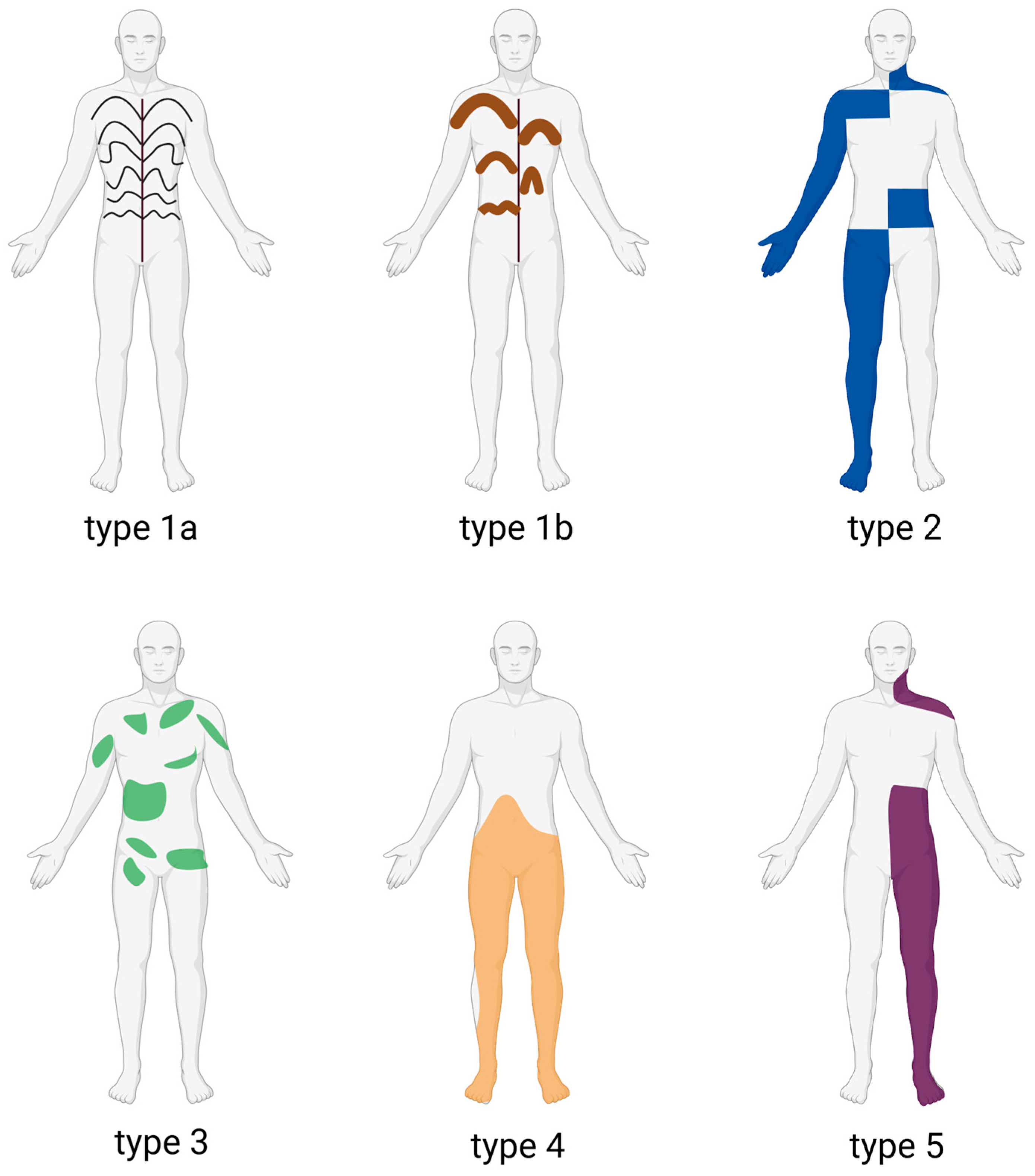
Figure 1. Six distinct patterns of the distribution of localized scleroderma originating from somatic mosaicism from Reference 24, with some modifications. Type 1a. Narrow sclerotic plaque aligned with the Blaschko line. Type 1b. Broad sclerotic plaque aligned with the Blaschko line. Type 2. Checkerboard pattern. Type 3. Leaf-like pattern. Type 4. Patchy pattern without midline separation. Type 5. Lateralization pattern. Created in BioRender by Takahashi, T. (2025). BioRender.com/rz6725v.
Sclerosis 03 00040 g001
Figure 2. Proposed pathogenic model of localized scleroderma based on recent single-cell transcriptomic analyses. The pathogenic process is initiated by activated T cells, which release interferon-gamma (IFN-γ). This IFN-γ signal, mediated through the intracellular JAK-STAT pathway, primes two key cell types: inflammatory fibroblast subpopulations (e.g., CXCL9+, CCL19+ fibroblasts) and conventional dendritic cells (cDC2B). These primed cells then engage in a pro-fibrotic crosstalk loop, mutually activating each other through signaling molecules like TGF-β. This amplification loop ultimately drives the activation of a distinct population of collagen-producing fibroblasts (e.g., COL8A1+ fibroblasts), leading to excessive collagen synthesis, collagen deposition, and clinical fibrosis. Created in BioRender. Takahashi, T. (2025). BioRender.com/rz6725v.
Sclerosis 03 00040 g002
Disclaimer/Publisher’s Note: The statements, opinions and data contained in all publications are solely those of the individual author(s) and contributor(s) and not of MDPI and/or the editor(s). MDPI and/or the editor(s) disclaim responsibility for any injury to people or property resulting from any ideas, methods, instructions or products referred to in the content.