1. Introduction
The surge in consumer price inflation across Europe between 2021 and 2023 was largely driven by the energy crisis. Following the post-pandemic economic recovery and the disruption of Russian energy exports after the 2022 invasion of Ukraine, wholesale prices of natural gas and crude oil reached unprecedented levels, transmitting rapidly to consumer prices across the continent. These developments were particularly significant for the Visegrád Group economies (Poland, Czechia, Hungary, and Slovakia), which combine a historically high dependence on Russian pipeline gas, energy-intensive industrial structures, and extensive government intervention in retail energy pricing.
During the recent energy crisis, Central and Eastern European economies experienced significantly stronger inflationary pressures than their Western euro-area counterparts [
1], slowing their income convergence with the older European Union member states [
2]. As a result, energy-driven inflation became a major policy challenge. Understanding the transmission of energy supply shocks to inflation in CEE economies is therefore crucial not only for explaining the recent inflationary episode but also for designing appropriate monetary and fiscal responses. This is particularly relevant for countries outside the euro area, where policymakers faced acute trade-offs between containing inflation and supporting economic activity.
The aim of this paper is to examine cross-country differences in the transmission and magnitude of energy supply shocks within the European Union. The analysis focuses on the Visegrád Group countries (i.e., Poland, Czechia, Hungary, and Slovakia) over the period 2015–2026. To identify energy-related shocks and assess their macroeconomic effects, we estimate Bayesian Structural Vector Autoregressive (BSVAR) models with sign restrictions imposed on the contemporaneous relationships among variables. As a robustness check, the main findings are complemented by Local Projection estimates based on externally identified global natural gas supply shocks.
Our results indicate that the Czech Republic and Hungary respond somewhat more strongly to energy commodity shocks. An average oil supply shock increases inflation in these countries by approximately 0.8 and 0.7 percentage points, respectively. This is higher than in Poland and Slovakia, where the estimated effects are closer to 0.5 percentage points. The main explanation appears to be a stronger pass-through from commodity prices to consumer inflation, resulting in a more pronounced transmission of energy shocks to domestic price dynamics. Similar magnitudes and transmission patterns can also be observed in the case of gas supply shocks. The estimated effects on inflation are broadly comparable to those found for oil shocks.
The study highlights certain methodological challenges associated with identifying the effects of increased LNG imports in the CEE countries. Both models produce estimates that are highly correlated with shocks related to pipeline gas supply, making it difficult to disentangle their individual effects. In practice, however, LNG imports served as an important source of support for the European energy market, helping to alleviate supply shortages and reduce energy prices. As a result, the economic impact of increased LNG imports is likely to have been disinflationary, even though the empirical identification of this effect remains challenging.
Despite the growing body of work on energy-driven inflation, the existing evidence remains concentrated on the euro area as a whole or on individual large economies, and it rarely addresses the cross-country heterogeneity of the transmission mechanism within Central and Eastern Europe. Studies that decompose European gas and oil shocks [
3,
4,
5] typically treat the euro area as a single unit, whereas analyses of the Visegrád economies tend to focus on energy security and gas dependence rather than on the quantitative pass-through of identified supply shocks to consumer prices. As a result, it is still not well understood why observationally similar economies, exposed to the same European energy market, exhibit markedly different inflation responses.
This paper addresses that gap along three dimensions. First, we provide a systematic country-by-country comparison of the inflationary effects of oil, pipeline gas, and LNG supply shocks across the four Visegrád economies. Second, we combine a Bayesian Structural VAR identified through sign restrictions with an externally identified Local Projection framework, so that the two approaches serve as mutual robustness checks. Third, we make the role of LNG explicit, documenting both its disinflationary contribution and the identification challenges that arise from its strong correlation with pipeline gas supply.
The structure of the paper is as follows:
Section 2 reviews the literature on identification of oil shocks and estimation of its pass-through on inflation.
Section 3 presents the empirical findings of our research.
Section 4 and
Section 5 conclude the paper.
2. Materials and Methods
This section discusses the main challenges associated with modelling energy shocks. It then presents two alternative approaches to their identification: Structural Vector Autoregressive (SVAR) models and Local Projections. While both methods aim to quantify the macroeconomic effects of energy market disturbances, they rely on different identification strategies and estimation frameworks.
The methods represent two complementary approaches to shock identification. SVAR and BVAR models integrate both stages of the analysis—shock identification and the estimation of macroeconomic responses—within a single dynamic framework [
6,
7,
8]. In contrast, Local Projections rely on a previously identified global shock series, which is then used as an explanatory variable to estimate the response of inflation across different horizons. This approach has been widely applied in the literature, including [
9,
10,
11].
Both approaches build on the framework proposed by Kilian [
12], who decomposes changes in the real price of oil into oil supply shocks, global demand shocks, and oil-specific idiosyncratic shocks. This distinction is intended to improve the identification of transmission channels, as an increase in oil prices driven by supply disruptions, stronger global economic activity, or concerns about future oil availability reflects fundamentally different macroeconomic mechanisms and may therefore have different implications for inflation and economic activity.
2.1. Identification of Oil and Natural Gas Shocks: A Literature Review
The framework proposed by Kilian has subsequently been extended in several directions. However, some of these extensions are difficult to apply in the context of Central and Eastern European (CEE) economies. For example, Kilian and Murphy [
13] augment the model by incorporating crude oil inventories, allowing for the identification of speculative demand shocks and the interpretation of a portion of oil price fluctuations as reflecting expectations regarding future market conditions. Baumeister and Hamilton [
14] demonstrate that the relative importance attributed to supply and demand shocks depends critically on assumptions regarding the short-run elasticities of oil supply and demand.
The shock identification methodology has been extended to the natural gas market. However, unlike the highly globalized crude oil market, natural gas markets retain a much stronger regional dimension, which complicates the direct application of existing frameworks. This issue is particularly evident in the work of Rubaszek, Szafranek, and Uddin [
15], who adapt the approach of Baumeister and Hamilton [
14] to the U.S. natural gas market and estimate short-run elasticities of supply, demand, inventories, and exports. The applicability of this framework to European gas shocks is limited by structural differences between the U.S. and European energy markets. Europe exhibits a different production and imports structure. Secondly, the model does not explicitly account for the merit-order mechanism. Under this mechanism, increases in natural gas prices may raise the prices of other energy commodities when gas-fired power plants set the marginal price in wholesale electricity markets. As a result, gas price shocks influence inflation not only through household heating costs but also through higher electricity prices and increased production costs in energy-intensive sectors.
Fabra [
16] argues that the European energy crisis exposed important limitations of electricity market designs based on marginal pricing. Similarly, analyses conducted by the European Commission suggest that merit-order dynamics are crucial for understanding why natural gas shocks are transmitted so strongly to wholesale electricity prices. Consequently, the inflationary effects of gas supply disruptions in Europe may be substantially larger than those implied by models that focus solely on direct energy price channels.
In the European Union, additional challenges are related to capturing heterogeneity in LNG flows and their role in the transmission of gas market shocks. Adolfsen et al. [
3] decompose European natural gas shocks into disruptions to pipeline gas supply, changes in global LNG supply, industrial demand shocks, weather-related demand shocks, and precautionary demand shocks. In their framework, the post-2022 energy crisis cannot be interpreted as a simple decline in gas supply. Instead, it reflects a combination of reduced Russian pipeline deliveries, increased gas storage accumulation, a higher scarcity and risk premium, and a structural shift in Europe’s position within the global LNG market. Among the countries considered in this study, the role of LNG is expected to be most pronounced in Poland. In contrast, the remaining countries rely almost exclusively on pipeline imports for their natural gas supply.
A second challenge concerns the risk of gas shortages during the winter season. Adolfsen et al. [
4] emphasize the role of inventory-related shocks in the European natural gas market. Their main finding highlights the heterogeneity of shock transmission means that increases in gas prices driven by supply or demand disturbances exert a stronger and more persistent effect on euro area inflation, whereas inventory shocks generate a considerably weaker pass-through to consumer prices. Given these findings, together with the limited availability of consistent data on gas inventories across the countries in our sample, we decided to exclude inventory-related shocks from the set of variables considered in the analysis.
A parallel strand of the literature examines the energy security dimension underlying these market shocks in Central and Eastern Europe. Żuk et al. [
17] characterize the Visegrád countries as semi-peripheral economies whose exposure to the post-2022 reconfiguration of energy and raw-material supply chains was largely determined by their historical dependence on Russian imports. Similarly, Weiner, Kotek, and Takácsné Tóth [
18] document two decades of evolving reliance on Russian natural gas, showing that diversification efforts achieved uneven success across the four countries. Gritz and Wolff [
19] further analyze the gas security strategies adopted by Germany and its Central and Eastern European neighbours during the 2022 energy crisis. Collectively, these studies suggest that the transmission of common European gas and oil shocks is likely to be characterized by country-specific and potentially time-varying parameters, reflecting differences in energy dependence, market structures, and policy responses.
2.2. The Inflationary Effects of Oil and Natural Gas Shocks: A Literature Review
The literature reviewed in the previous subsection provides a framework for identifying supply-side shocks in oil and natural gas markets. However, a separate challenge concerns the transmission of these shocks to retail prices and overall inflation within the economy.
In this context, autoregressive models once again serve as the primary analytical framework, enabling researchers to trace the dynamic effects of energy price shocks on inflation and other macroeconomic variables over time. Kilian and Zhou [
20] employ an SVAR framework to examine the effects of oil and gasoline prices on inflation and inflation expectations in the United States. Their findings suggest that a short-run increase in headline inflation following an energy price shock does not necessarily translate into a persistent rise in inflation expectations.
An important limitation of such estimations is the instability of the estimated parameters over time. Garzón and Hierro [
6] highlight the presence of transmission asymmetries that depend on the prevailing inflation environment, a feature that is difficult to capture within a standard linear VAR specification. More broadly, the differences between alternative empirical strategies extend beyond the estimation technique itself. They affect the entire empirical framework, including the definition of the shock, the identification approach, and the estimation of its effects on headline, core inflation, and inflation expectations [
6,
20,
21].
Prior to the 2021–2022 gas crisis, the literature typically approached this transmission channel in a relatively narrow manner, either by examining the response of inflation to oil price shocks or by estimating the elasticity of natural gas markets with respect to changes in supply, demand, and inventories, without fully accounting for the institutional features of the European energy market [
6,
15]. Ari et al. [
22] demonstrate that the pass-through of international energy prices to retail prices in Europe differs substantially across transport fuels, natural gas, and electricity. They further show that cross-country heterogeneity is driven by factors such as differences in energy mixes, price regulation schemes, taxation, and government support measures. While this framework provides a useful description of the retail transmission channel, it does not offer a structural identification of natural gas shocks or an assessment of their subsequent effects on core inflation.
This gap has only recently begun to be addressed in the literature. A notable example is the study by Casoli, Manera, and Valenti [
5], who developed a Bayesian Structural VAR (BSVAR) model to examine joint oil and natural gas shocks and their effects on headline inflation and inflation expectations in the euro area. Their results indicate that, in the post-pandemic period, natural gas supply shocks made a particularly strong contribution to inflation peaks. Similarly, Boeck and Zörner [
23] show that natural gas shocks affect not only inflation itself but also market-based measures of inflation expectations. Their findings extend the analysis of energy price pass-through by incorporating the expectations channel and highlighting the potential importance of second-round effects.
López et al. [
24] explicitly distinguish between the direct and indirect effects of natural gas shocks. Their findings indicate that, in the euro area, a substantial share of the impact on HICP operates through the use of natural gas as a production input and through electricity prices, rather than solely through the gas prices paid directly by households. However, such an approach is difficult to apply in the context of CEE economies. Direct changes in electricity and natural gas prices are often heavily influenced by regulatory measures and government interventions, limiting their usefulness for identifying market-driven transmission channels. As a result, our analysis focuses primarily on the indirect effects of energy shocks transmitted through production costs, broader price pressures, and other secondary channels.
Recent research also points to the existence of regime-dependent transmission mechanisms. Using a nonlinear structural model for the euro area, Bobeica, Holton, Huber, and Martínez Hernández [
25] show that the inflationary impact of energy shocks depends critically on their magnitude. While small shocks generate only limited price responses, large shocks produce disproportionately stronger inflationary effects, particularly at the earlier stages of the pricing chain, ranging from commodity prices and producer prices to consumer prices.
These findings have been widely confirmed in the literature. Chen, Wang, and Miao [
26] corroborate the evidence using a time-varying parameter SVAR to examine the impact of European gas supply shocks on inflation, while Cassinis, Ferrari Minesso, and Van Robays [
27] propose a methodology that extracts information on supply shocks directly from inflation swap markets. De Santis and Tornese [
28] further show that the macroeconomic effects of energy supply and global supply-chain shocks are regime-dependent. Complementary evidence on the financial and electricity-market transmission channels is provided by Rossi et al. [
29], who analyze the asymmetric response of European stock markets to the Russia–Ukraine energy shock, and by Pavlík, Kurimský, and Ševc [
30], who document the sharp increase in European electricity price volatility following the 2021 energy crisis.
2.3. Modelling Oil Shocks in the CEE Region Using a BVAR Framework
The literature regarding modelling oil shocks in the Central and Eastern European economies so far is relatively modest. Šestořád and Dvořáková [
31] decompose the drivers of post-COVID-19 inflation in the Central European countries and attribute a substantial role to imported and energy-related supply shocks, while Kufel and Rządkowski [
32] use wavelet methods to document the strong co-movement of energy-related HICP components between Poland and its neighbours during the 2022–2024 crisis.
Our study approaches the problem from a fundamentally different perspective by employing a methodology rooted in the mainstream macroeconometric analysis of energy price transmission. To estimate the transmission of energy supply disturbances to inflation, we employ a Bayesian Structural Vector Autoregression (BSVAR). The model includes HICP inflation, real natural gas prices, real crude oil prices, and import volumes of both commodities. For natural gas, we further distinguish between pipeline imports and LNG imports, allowing us to capture differences in the transmission of shocks associated with alternative supply channels. To capture demand-side factors, we additionally include the valuations of energy-related equity sectors in the model. Specifically, we use the STOXX Europe 600 Chemicals, Basic Resources, and Automobiles & Parts sector indices as proxies for demand conditions in commodity-intensive industries.
The data were obtained from Eurostat and financial databases provided by Yahoo Finance. HICP inflation is based on the dataset Harmonised Index of Consumer Prices—monthly data (online data code prc_hicp_midx). Import volumes of natural gas, including the split between pipeline and LNG deliveries, are obtained from Imports of natural gas by partner country—monthly data (nrg_ti_gasm table), and import volumes of crude oil from Imports of oil and petroleum products by partner country—monthly data (nrg_ti_oilm). Market prices and equity valuations are retrieved from Yahoo Finance: front-month Brent crude oil and Dutch TTF natural gas futures, together with the STOXX Europe 600 Chemicals (SX4P), Basic Resources (SXPP), and Automobiles & Parts (SXAP) sector indices. The full replication dataset and estimation code are available from the corresponding author upon request.
The analysis is based on monthly observations, with the sample period beginning in 2015. All series were transformed into log differences prior to estimation and seasonally adjusted with a TRAMO-SEATS algorithm.
Let
denote the vector of endogenous variables mentioned in the previous paragraph. The reduced form VAR of order
is given by Equation (1):
To obtain structural shocks, the standard VAR framework is augmented with a rotation matrix that assigns an economic interpretation to the model residuals. The estimation of this matrix requires the imposition of identifying restrictions on the model. The structural impact matrix is specified by Equation (2), as follows:
Our initial analysis relied on a standard SVAR specification. However, the results obtained for the CEE economies were often difficult to reconcile with macroeconomic theory and produced several economically implausible responses. To address these issues, we adopted a Bayesian framework, which provides greater flexibility in incorporating prior information and improves the stability of parameter estimates in relatively small samples. The Bayesian approach is particularly useful in medium-sized VAR systems, where the number of parameters increases rapidly with the number of variables and lags. Bayesian shrinkage priors help mitigate over-parameterization and improve out-of-sample performance. We deliberately retain a linear specification to keep the identification transparent and the parameter count manageable in a short sample; the resulting estimates should therefore be read as average responses, and we return to nonlinear and time-varying extensions in the concluding section.
Structural shocks are identified through sign restrictions imposed on the structural impact matrix . Admissible structural decompositions are obtained through orthogonal rotations of the reduced-form residual covariance matrix. We are interested in three structural shocks: a pipeline gas supply shock, an LNG supply shock, and an oil supply shock.
A negative pipeline gas supply shock is assumed to reduce pipeline gas imports, increase LNG imports through substitution effects, raise natural gas prices (TTF), and increase HICP inflation. An LNG supply shock is identified as an increase in LNG imports, accompanied by a decline in natural gas prices and lower inflationary pressures. An oil supply shock is defined as a reduction in oil supply, leading to higher crude oil prices (Brent) and an increase in HICP inflation. Sign restrictions are imposed over the first four periods following the shock to ensure that the identified disturbances are consistent with the expected economic transmission mechanisms. For illustrative purposes, the main identifying relationships are summarized in
Table 1.
2.4. Robustness Analysis Using Local Projections
To validate the results obtained from the BVAR model, we conduct a robustness analysis using Local Projections. The objective is to assess whether a comparable pattern of responses can be identified using an alternative empirical framework. Our first step is to identify shocks associated with declines in gas and oil supply transmitted to European countries. To obtain these series, we estimate two independent models.
First, to identify oil supply shocks, we estimate a SVAR model following the approach proposed by Lutz Kilian [
12]. The model includes quarterly changes in real Brent crude oil prices, a transportation price index used to capture global demand conditions, the valuation of European sectoral indices for industries highly dependent on commodity prices, and the supply of oil imported into Europe (the same as in BSVAR).
Second, following the framework of Adolfsen et al. [
4], we estimate a separate model to identify gas supply shocks. This specification includes real TTF natural gas prices, imports of natural gas delivered through pipelines, and imports from LNG terminals. The baseline specification is given by Equation (3).
where
denotes inflation at horizon (h),
is the externally identified energy shock,
is a vector of control variables, and (p) denotes the number of lags. The coefficient
measures the impulse response of inflation to the energy shock at horizon (h).
3. Results
In this section, we identify the magnitude of energy shocks using the BSVAR framework. We begin by presenting the accumulated impulse response functions of the three structural shocks on commodity prices, inflation, and energy supply variables included in
Table 1. Cumulative impulse responses capture overall changes in variable levels attributable to the occurrence of major stress events and structural shocks. Subsequently, we analyze the historical decomposition of the identified shocks to assess their contribution to the evolution of energy markets and inflation over the sample period. We then attempt to replicate these findings using the Local Projections methodology.
3.1. BSVAR: Impulse Responses and Historical Decomposition
The estimated impulse response functions suggest that an adverse oil or natural gas supply shock generates a persistent increase in prices and a gradual rise in inflation across all Visegrád economies. Detailed figures are presented in
Appendix A.
In the case of an oil shock, the strongest reaction to the oil supply shock is observed in Hungary and Slovakia. Following the shock, oil imports decline by approximately 14–16% on impact and remain substantially below baseline levels throughout the forecast horizon. In Czechia, the response is more moderate, with oil supply falling by around 7–8%, while Poland exhibits the smallest decline, with oil imports decreasing by only 2–3%. Still, the increase in oil prices is similar across countries. The response peaks at approximately 4–5% in Czechia and Hungary and remains slightly lower in Poland and Slovakia.
The transmission to inflation differs considerably between countries. The Czech Republic exhibits the strongest inflationary response, with HICP inflation increasing gradually to around 0.8 percentage points after twelve months. Hungary follows closely, reaching approximately 0.7 percentage points. The estimated effects are somewhat weaker in Poland and Slovakia, where the cumulative impact on inflation reaches around 0.5 percentage points by the end of the horizon.
The responses of the economies analyzed are broadly similar in the case of pipeline gas supply shocks. Following the shock, gas imports declined by approximately 10% after one year. The response is somewhat smaller in Slovakia, where the decline stabilizes at approximately 8–9%. Natural gas prices react immediately and strongly to the shock—gas prices are rising by approximately 10–12% within a few months and remaining elevated throughout the forecast horizon in Czechia, Slovakia and Poland. Hungarian data shows a somewhat smaller but still substantial increase of around 6–10%.
The inflationary consequences are statistically significant across all countries. The Czech Republic again displays the strongest response, with HICP inflation increasing steadily to approximately 0.9 percentage points (p.p) after twelve months. Hungary follows with a peak effect of around 0.7 p.p., while Poland and Slovakia reach approximately 0.5 p.p. Contrary to the oil shock, the confidence intervals remain largely above zero, indicating a robust pass-through from gas market disturbances to consumer prices. The response of consumer prices builds over time, suggesting that a large share of the pass-through operates indirectly through production costs, electricity prices, transportation services, and broader input-output linkages.
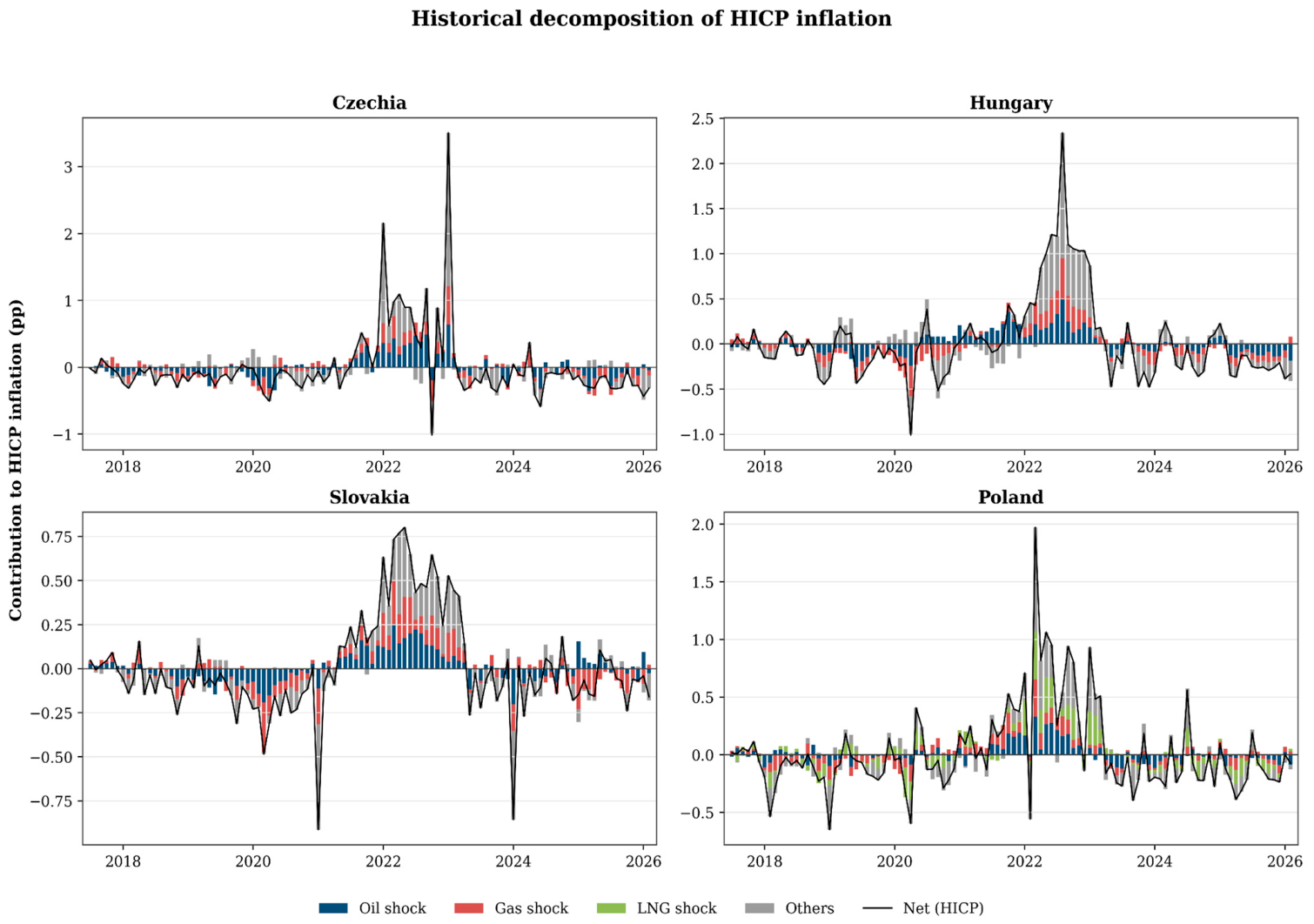
The identification of LNG-related shocks appears considerably weaker. Our results suggest a response pattern that is broadly similar to the shock associated with pipeline gas supply disruptions. This issue is most clearly illustrated by the historical decompositions in
Figure 1, which reveal a strong positive correlation between the two series. As a result, the model has limited ability to distinguish LNG-specific disturbances from broader gas supply shocks, indicating that the estimated LNG shock may capture dynamics that are also reflected in pipeline gas supply fluctuations.
The full historical decomposition indicates that energy-related shocks accounted for roughly 50–60% of the increase in inflation during 2021–2022 across all countries in the sample. Conversely, the fading of these shocks played a major role in the subsequent disinflation process, particularly during the later months of 2023 and throughout 2024. Across the CEE economies, the largest contributions of energy shocks are observed in the Czech Republic, while the smallest are found in Poland and Slovakia. This pattern is broadly consistent with the pass-through effects identified in the impulse response analysis, where Czech inflation exhibits the strongest response to energy supply disturbances, whereas the transmission mechanism appears considerably weaker in Poland and Slovakia. A detailed breakdown is presented in
Figure 1.
3.2. Robustness Check: Computation of Commodity Supply Indices and Local Projections
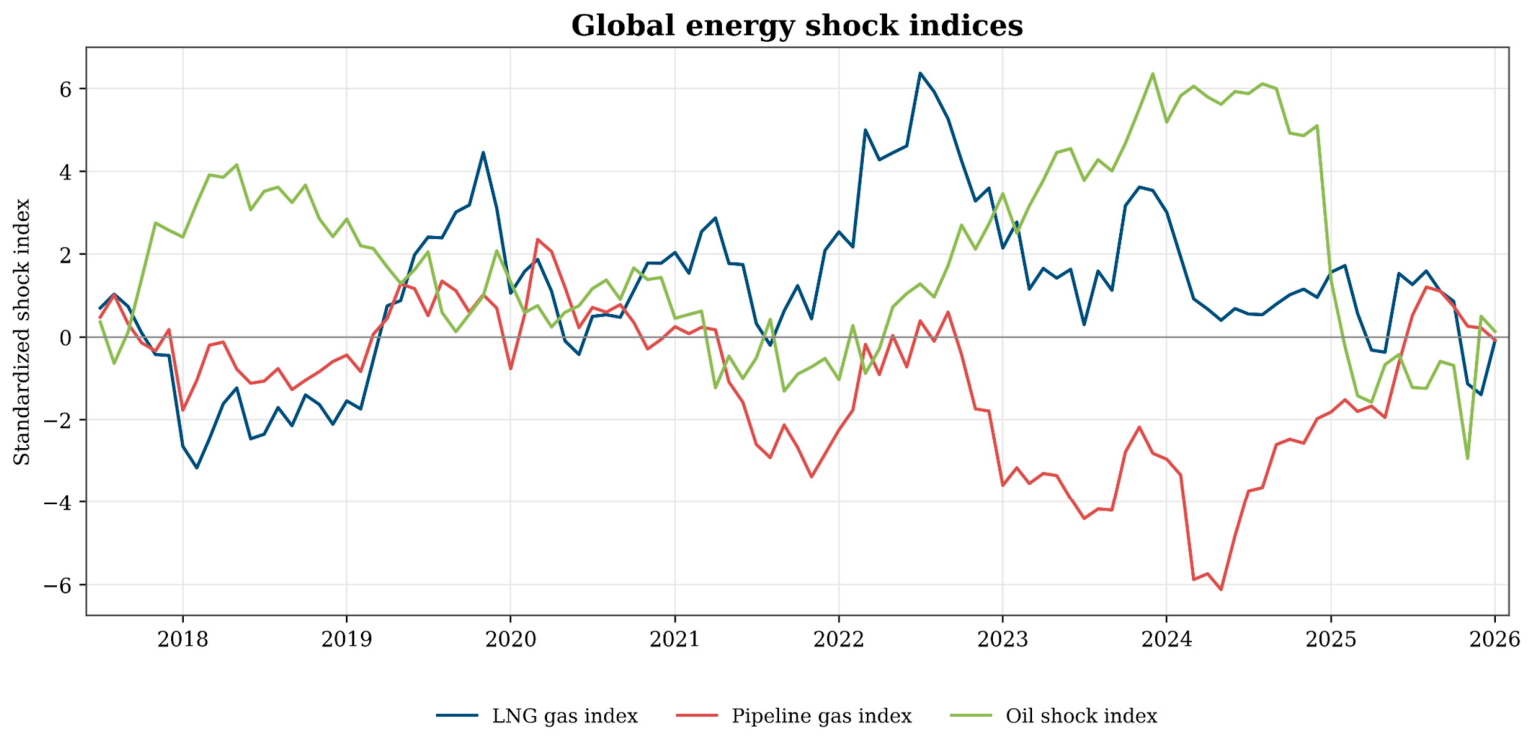
The second stage of the study seeks to validate the main findings using an alternative methodological framework based on comparable identifying assumptions. Specifically, we first estimate global commodity shocks and then employ these shock series to examine their effects on inflation and related economic variables. First, we employ two SVAR models to identify oil and gas shocks. In the case of natural gas, we distinguish between two separate series related to LNG supply and gas delivered through pipelines.
Our models indicate that, starting from 2019, Europe operated in an environment of systematically increasing LNG imports from the United States. The index reaches positive values, suggesting that these developments exerted upward pressure on inflation. At the same time, beginning in 2022, we observe a negative supply shock associated with Europe’s gradual decoupling from Russian energy assets and pipeline gas supplies. We observe relatively modest responses associated with the suspension of natural gas transit through Ukraine in late 2024. The complete set of indices is presented in
Figure 2.
The resulting indices were then used as shock variables in local projection models of inflation. The accumulated impulse response functions obtained for the oil supply shock are broadly consistent with the results derived from the BSVAR framework. At the same time, the local projection estimates are characterized by substantially wider confidence intervals. In most cases, these intervals include zero, indicating that the estimated effects are only weakly statistically significant. The full listing is presented in
Appendix B.
Similarly to the BSVAR estimates for Poland, we encounter difficulties in properly disentangling the effects of pipeline-related gas supply shocks and LNG shocks. The local projection results suggest that the pipeline shock index provides little evidence of a meaningful pass-through to inflation. At the same time, increases in the LNG shock index are incorrectly associated with higher consumer prices, despite the expectation that greater LNG availability should alleviate energy price pressures.
Nevertheless, these findings likely reflect identification challenges arising from the strong correlation between the two shock measures rather than genuine economic relationships. When the estimated effects of the pipeline and LNG indices are considered jointly across the separate regressions, the overall magnitude of the accumulated impulse response is broadly consistent with the results obtained from the BSVAR model.
4. Discussion
During the study, we identified energy supply shocks for the CEE countries using both a Bayesian Structural VAR (BSVAR) framework and the Local Projections methodology. The results indicate that the responses of CEE economies to energy shocks are broadly similar across countries. Furthermore, the contribution of energy shocks to overall inflation is comparable to the magnitudes reported for the euro area by Adolfsen et al. [
3]. Similarly, the estimated cumulative inflation responses of approximately 0.5–0.9 percentage points over a 12-month horizon following oil and gas supply shocks are broadly comparable to the corresponding euro-area estimates reported by Casoli, Manera, and Valenti [
5] and Adolfsen et al. [
3,
4].
Some differences nevertheless reflect cross-country variation in energy mixes and the greater role of regulated energy prices in Central and Eastern Europe. The stronger inflation responses estimated for Czechia and Hungary are consistent with the higher pass-through of commodity price shocks in these economies and with the findings of Šestořád and Dvořáková [
31], who identify imported supply shocks as a key driver of post-2021 inflation in the region. Moreover, the systematic cross-country variation in the estimated responses is consistent with the regime- and state-dependent transmission mechanisms documented by Bobeica et al. [
25] and De Santis and Tornese [
28].
The findings suggest that energy market disruptions have been a major driver of inflation dynamics across the region, despite differences in national energy mixes and supply structures. Idiosyncratic events, such as the termination of natural gas transit through Ukraine, appear to have had only limited effects on inflation dynamics in countries that historically relied most heavily on direct imports of Russian gas, namely Slovakia and Hungary. The estimated responses suggest that these country-specific disruptions were considerably less important than broader energy market shocks affecting the entire European region.
The study also highlights several challenges related to the identification of energy supply shocks in the CEE region. Most of the relevant variation in energy markets is concentrated within the last decade, resulting in relatively short estimation samples. This creates natural limitations for the construction of monthly shock indices and reduces the precision of the estimated effects. Consequently, both the impulse response functions and their accumulated counterparts are characterized by relatively wide confidence intervals.
In addition, the identification of LNG-related shocks often overlaps with, or partially crowds out, the effects attributed to pipeline gas supply shocks. This reflects the fact that both channels frequently respond to the same underlying disturbances in European energy markets, making it difficult to disentangle their individual contributions. Rather than being merely an estimation artefact, this overlap constitutes an economically meaningful finding. It suggests that, during the crisis, rising LNG imports and disruptions to pipeline gas supplies represented complementary dimensions of the same adjustment process in Europe’s increasingly integrated gas market, consistent with the interpretation of Adolfsen et al. [
3].
From a methodological perspective, these challenges are not easily resolved. One promising avenue for future research would be the use of higher-frequency information, which could provide additional identifying variation and improve the precision of shock measurement. Further extensions could also incorporate government interventions and strategic reserve policies, including the use of natural gas storage facilities and strategic petroleum reserves, which played an important role in mitigating the impact of recent energy market disruptions.
5. Conclusions
This paper examined the transmission of energy supply shocks to inflation in the Visegrád economies over the period 2015–2026. Using Bayesian Structural VAR models with sign restrictions and Local Projections as a robustness check, we identified oil, natural gas, and LNG-related supply disturbances and evaluated their contribution to inflation dynamics in Central and Eastern Europe.
The results indicate that energy shocks were a major driver of inflation developments across the region, particularly during the 2021–2022 energy crisis. Historical decompositions suggest that energy-related disturbances accounted for a 50–60% share of the inflation surge and subsequently contributed to the disinflation process observed in 2023–2024. While the transmission mechanisms were broadly similar across countries, the magnitude of the effects differed. The strongest inflationary responses were observed in Czechia and Hungary, whereas Poland and Slovakia exhibited a more moderate pass-through from commodity markets to consumer prices. Consistent with recent evidence for the euro area, the results confirm that natural gas supply disturbances can generate inflationary effects comparable to those associated with oil market disruptions.
Several methodological challenges were identified. The relatively short sample available for the post-2015 European energy market limits the precision of monthly shock identification. In addition, LNG-related shocks are difficult to disentangle from pipeline gas supply disturbances due to their strong correlation during the energy crisis period. These limitations are reflected in the relatively wide confidence intervals obtained in both the BSVAR and Local Projection frameworks. Future research should address these challenges.
From a policy perspective, the results carry three implications. First, because energy supply shocks account for a majority of the inflation surge yet transmit with a lag through production and electricity costs, monetary authorities in the region faced a genuine trade-off between looking through the initial impulse and containing second-round effects; the heterogeneity we document implies that a common European shock warranted differentiated national responses. Second, the disinflationary role of LNG imports supports continued investment in import diversification, regasification capacity, interconnectors, and storage, as a structural buffer against future pipeline disruptions. Third, the comparatively strong pass-through in Czechia and Hungary suggests that measures dampening the commodity-to-retail transmission, such as temporary and well-targeted price interventions, had larger stabilizing potential in these economies, albeit at the cost of complicating the identification of market-driven shocks.
Future research should extend the analysis in three directions. Methodologically, nonlinear, regime-switching, and time-varying-parameter specifications, along the lines of Chen, Wang, and Miao [
26] and De Santis and Tornese [
28], could capture the state dependence that our linear models average out. Empirically, higher-frequency or externally identified daily instruments would sharpen the separation of LNG and pipeline-gas shocks. Finally, incorporating government interventions, strategic reserves, and gas-storage policies would allow the framework to account for the measures that materially shaped the inflationary impact of the recent energy crisis.