Article

Total Energy Production and Financial Development: Evidence from Selected EMEs

Department of Finance, Risk Management and Banking, University of South Africa, Pretoria P.O. Box 392, South Africa
*
Author to whom correspondence should be addressed.
Commodities 2026, 5(3), 13; https://doi.org/10.3390/commodities5030013

Submission received: 24 February 2026 / Revised: 18 May 2026 / Accepted: 10 June 2026 / Published: 25 June 2026

Abstract

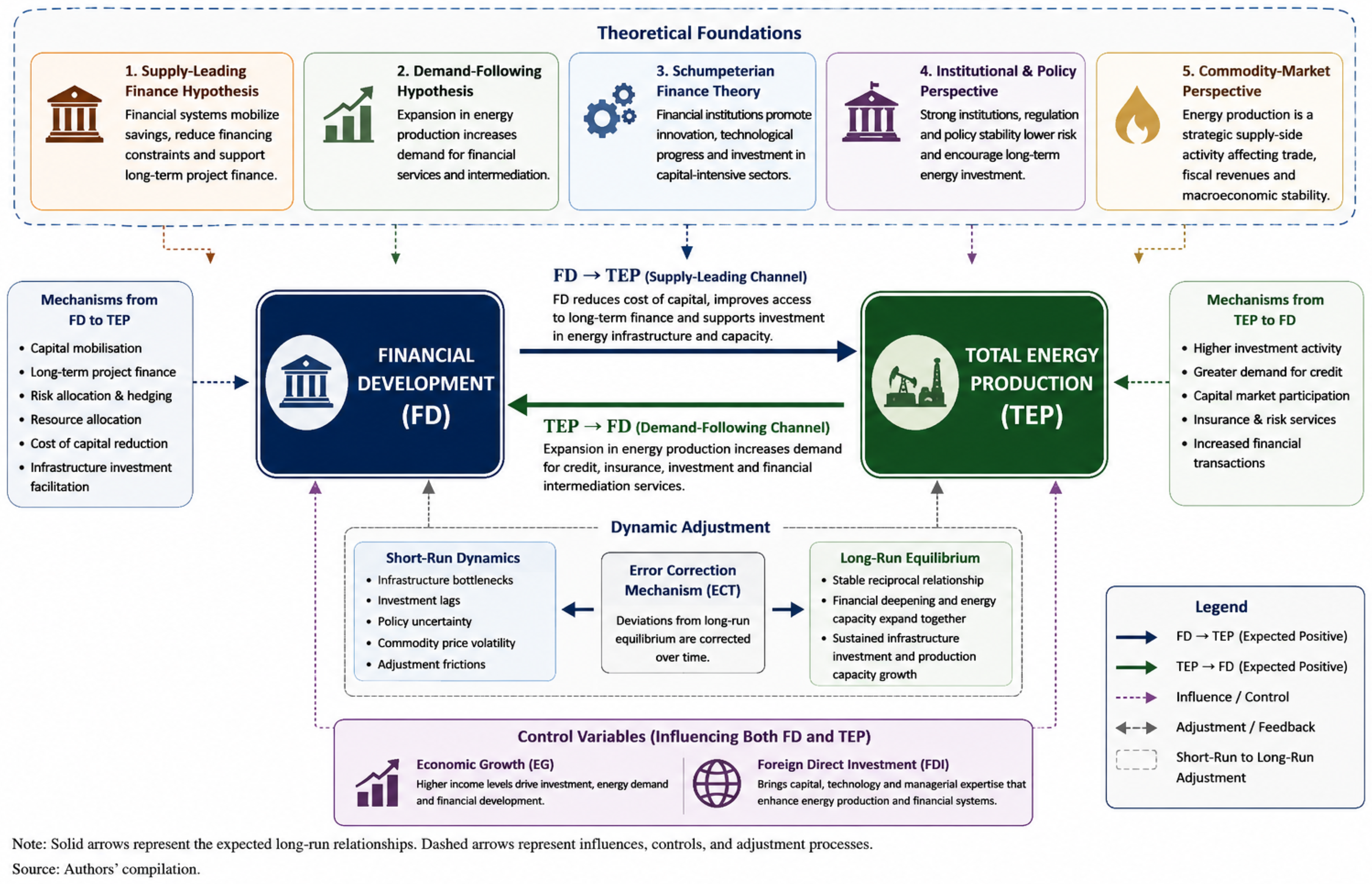
This study examines the dynamic relationship between financial development and total energy production in emerging market economies (EMEs) using a balanced panel of 20 countries over the period 2000–2020. Unlike much of the existing literature that focuses on energy consumption or specific energy types, this paper conceptualises total energy production as an aggregate supply-capacity indicator that captures infrastructure investment, capital intensity, and long-run energy system expansion. Employing a panel autoregressive distributed lag model with the Pooled Mean Group (ARDL–PMG) estimator, the analysis distinguishes between long-run equilibrium relationships and heterogeneous short-run adjustment dynamics. The results reveal a stable long-run reciprocal relationship between financial development and total energy production, suggesting that deeper financial systems are associated with higher energy production capacity over time, while expansion in energy production is also linked to financial deepening. Short-run dynamics, however, are asymmetric, indicating the presence of adjustment frictions and investment lags in capital-intensive energy sectors. Robustness checks using a two-step System GMM estimator confirm the qualitative consistency of the main findings after accounting for potential endogeneity and simultaneity. Overall, the results highlight the importance of financial system development in supporting aggregate energy supply expansion in EMEs, while underscoring the need to account for transitional constraints and differing adjustment speeds across sectors and countries. The findings offer policy-relevant insights for aligning financial development with energy infrastructure investment during periods of structural transformation.
Keywords: total energy production; financial development; emerging market economies; panel cointegration; energy-led growth; financial markets; energy transition; transition finance total energy production; financial development; emerging market economies; panel cointegration; energy-led growth; financial markets; energy transition; transition finance