1. Uranium as a Strategic Commodity
For decades, uranium has been regarded as a strategic raw material due to its unparalleled energy density and its essential role as nuclear fuel [
1]. In reactor use, uranium’s fission energy content vastly exceeds that of fossil fuels, enabling a steady supply of baseload power with minimal carbon emissions [
2]. This combination of high energy yield and low lifecycle greenhouse gas output gives nuclear energy a unique advantage in the clean energy transition, elevating the strategic importance of uranium beyond that of a common commodity.
Recent developments in the global energy landscape have further enhanced uranium’s strategic profile. Burgeoning concerns over energy security and strict carbon-neutrality targets have reignited worldwide interest in nuclear power [
3]. Analysts observe a pronounced resurgence of nuclear programs as many countries plan new reactors or extend plant lifetimes to meet mid-century climate goals [
4]. This renewed momentum is also evident in uranium markets: uranium-focused equities and funds have surged amid rising demand, reflecting expectations of expanded nuclear fuel needs [
3]. Geopolitical events have underscored this trend; supply disruptions during the 2022 energy crisis prompted strategic stockpiling of uranium and reinforced its role in national energy security planning [
1]. As a result, uranium is now viewed not only through the lens of typical boom–bust commodity cycles but as a long-term strategic asset in an era of decarbonization and power supply uncertainty.
Although nuclear power today accounts for only about 10% of global electricity generation, its role is rapidly shifting from a niche status to a cornerstone of net-zero strategies. Indeed, nuclear energy is one of the few firm, low-carbon energy sources capable of reliably replacing fossil fuels, making uranium fuel pivotal for achieving ambitious climate targets [
5]. This emerging recognition of uranium’s critical value motivates our review. In the following sections, we synthesize recent developments in the uranium sector and examine its evolving supply–demand dynamics, policy environment, and technological innovations. By framing uranium as a strategic commodity central to energy security and climate imperatives (rather than merely a subject of periodic market cycles), this work provides a timely state-of-the-art perspective. In doing so, we extend the current literature with an integrated analysis of how uranium’s market evolution and geopolitical significance are shaping a new energy paradigm, thereby contributing a novel understanding to the field beyond historical analyses of the uranium market alone.
Recent literature offers several review studies related to uranium markets, advanced reactor technologies, and nuclear fuel geopolitics. Shannak et al. [
6] analyze global uranium supply-demand projections through 2050, with emphasis on market trends and geopolitical drivers. Their econometric and modeling study finds a potential uranium supply shortfall by the mid-2030s and highlights how political factors (e.g., new alliances) could shape trade routes. However, this work remains focused on market fundamentals, without examining the implications of emerging reactor technologies or integration with other energy systems. Vinoya et al. [
7] provide a state-of-the-art review of small modular reactors, covering technological innovations, economics, environmental impacts, and socio-political aspects. Notably, they aim to move beyond the technology-centric scope of earlier SMR surveys by addressing broader issues like economics and public acceptance. Still, their review is limited to SMRs, not accounting for uranium market constraints or the potential of nuclear reactors in hybrid applications (e.g., hydrogen production). Buzzetti et al. [
8] examine the coupling of nuclear power with clean hydrogen production, focusing on advanced high-temperature reactors (e.g., VHTRs) as heat sources. They describe coordinated nuclear hydrogen configurations and conduct a techno-economic feasibility analysis using the IAEA HEEP model. This study illuminates technical feasibility and cost aspects of nuclear-derived hydrogen, but it is narrowly centered on the reactor–hydrogen coupling and does not address the broader fuel market or geopolitical context. Haneklaus et al. [
9] investigate the geopolitical dimension of nuclear fuel supply chains, quantifying Europe’s and the world’s dependence on Russian nuclear fuel cycle services. They report, for example, that Russia controls ~46% of global enrichment capacity and discuss strategies for Western countries to reduce this reliance in light of recent geopolitical tensions. This analysis provides a focused geopolitical insight (Russia–West fuel supply dynamics) but does not consider new nuclear technologies or decarbonization-driven demand changes.
In contrast to the above reviews, the present work offers an integrated perspective that bridges these domains. We explicitly address the intersection of market, technology, and geopolitics by examining how tightening uranium supply fundamentals and fuel security concerns interact with the deployment of emerging reactors (SMRs and advanced high-temperature systems) and their novel applications (e.g., industrial heat and large-scale hydrogen production). This holistic approach goes beyond the scope of any single prior review, for instance, linking SMR-driven nuclear expansion to uranium market sustainability and linking nuclear hydrogen cogeneration to strategic fuel considerations. By comparing and synthesizing insights across economic, technological, and geopolitical dimensions, our study closes a clear gap in the literature and demonstrates originality in providing a comprehensive analysis that the earlier works, each limited to one facet, have not delivered.
These dynamics point toward a structurally tightening uranium market under policy-supportive and high-nuclear deployment scenarios, particularly those aligned with deep decarbonization objectives. Alternative pathways, however, may yield more moderate outcomes depending on technology choices and policy continuity.
To operationalize the integrative contribution of this review,
Table 1 synthesizes the key linkages between uranium market dynamics, technological evolution, and geopolitical restructuring. Rather than treating these dimensions in isolation, the framework highlights how interactions across markets, technology, and policy collectively reposition uranium as a strategic enabler within low-carbon energy systems.
Building on this integrative framing, the remainder of the review is organized as follows:
Section 2 examines global uranium market dynamics and supply–demand fundamentals;
Section 3 focuses on emerging nuclear technologies, including SMRs and advanced reactors;
Section 4 situates nuclear energy within broader low-carbon systems alongside renewables and hydrogen;
Section 5 provides a regional and geopolitical assessment; and
Section 6 and
Section 7 consolidate policy implications and concluding remarks. In doing so, we substantiate how uranium’s revival as a strategic resource underpins a new paradigm of energy security and decarbonization, a connection that has remained largely unexplored in previous studies.
This review is conceived as a narrative synthesis grounded primarily in peer-reviewed academic literature spanning energy economics, nuclear engineering, and energy policy. Core analytical arguments and interpretations are derived from articles published in internationally recognized journals, while authoritative institutional databases (notably those of the OECD/NEA, IAEA, and World Nuclear Association) are used as complementary sources to provide standardized market statistics, fuel-cycle data, and long-term historical consistency. Literature identification was supported by structured searches in major scientific databases, focusing on publications addressing uranium supply–demand dynamics, enrichment capacity, advanced reactor fuel requirements, and geopolitical restructuring of nuclear value chains. The review primarily covers the period from approximately 2000 to 2024, with particular emphasis on post-2011 and post-2020 structural shifts. Sources were prioritized based on relevance, methodological transparency, and consistency across independent datasets, aiming to balance analytical rigor with the use of verified and widely referenced statistical compendia.
2. Global Uranium Market Dynamics
Current uranium supply–demand trends reflect a tightly balanced market shaped by nuclear power’s steady fuel needs.
Approximately 440 operational reactors (together ~390 GWe capacity) consume 67,500 tU of uranium annually [
10]. At present, about 90% of this uranium requirement is met by primary mine production, with the remaining ~10% covered by secondary sources such as civil stockpiles, reprocessed fuel, and down-blended military material. In 2022, world uranium mine output rebounded to roughly 49,000 tU, about three-quarters of global reactor requirements, after a period of curtailments. This resurgence of mining means utilities have become less reliant on inventory drawdowns than in prior years. Still, secondary supplies continue to play a modest but strategic role in bridging the gap between consumption and mine output [
10]. Overall, the uranium fuel cycle exhibits less short-term demand variability than most commodities (once reactors are running, they require a consistent fuel supply), but ensuring sufficient accessible uranium remains a critical concern for energy security.
2.1. Historical Market Context and Recent Price Trends
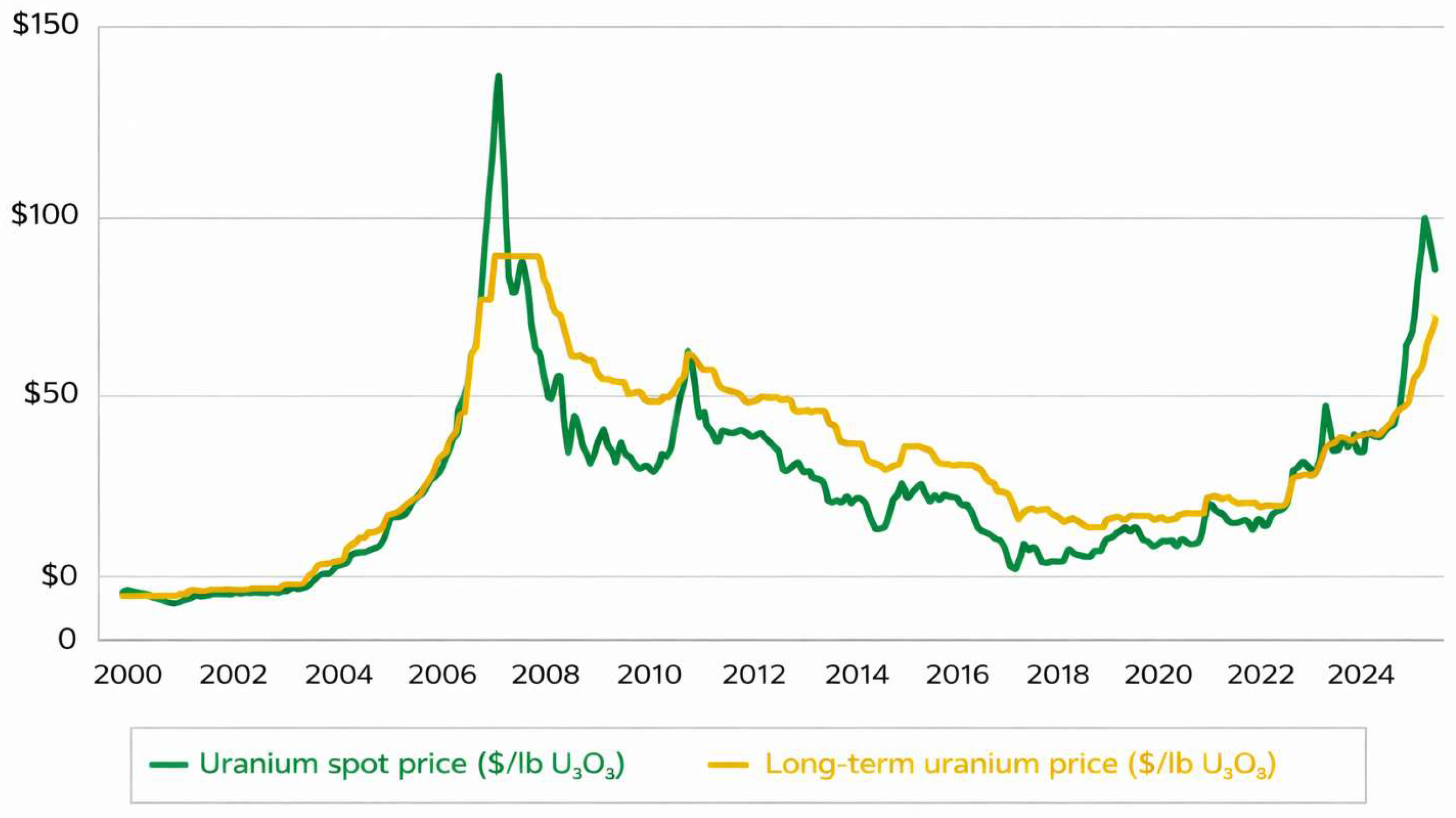
The uranium market experienced a prolonged bear phase following the early 1980s, after prices collapsed from late-1970s highs and remained depressed throughout the 1980s and 1990s. Abundant inventories and excess production capacity kept spot prices below most mining costs, leading to widespread mine closures and chronic underinvestment. A brief upswing during 2003–2007, driven by renewed reactor construction plans and supply delays, was short-lived. After the Fukushima accident in 2011, uranium demand growth stalled, inventories accumulated, and prices fell to multi-decade lows by the mid-2010s. As a result, for nearly two decades, the market remained oversupplied, characterized by a buyer’s market in which utilities relied heavily on low-cost inventory drawdowns. In this context,
Figure 1 shows the evolution of uranium spot and long-term contract prices since 2000, illustrating the pronounced cyclicality of the market. On the other hand,
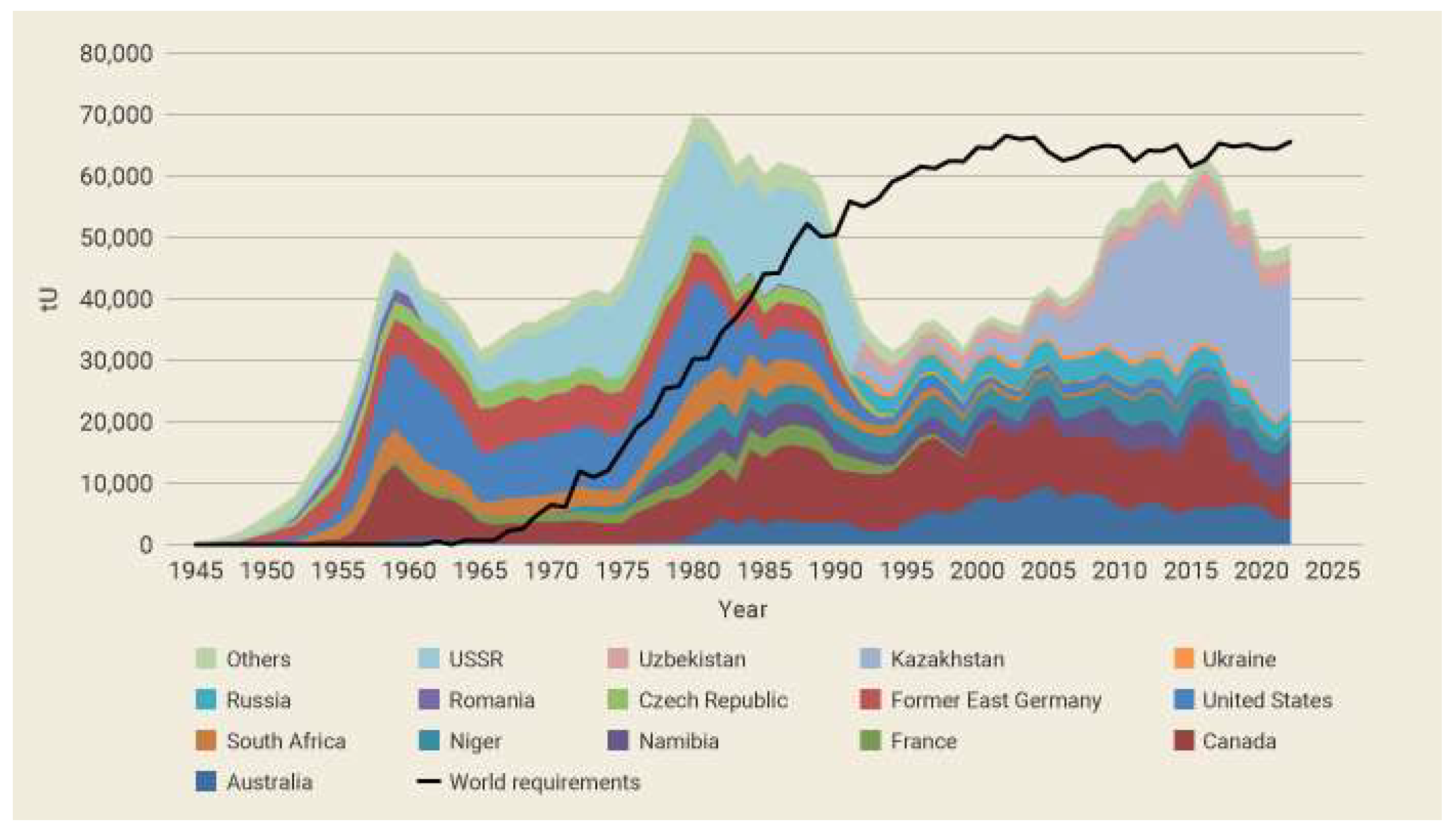
Figure 2 places recent uranium market developments within a longer historical context by comparing global uranium production with reactor requirements since the mid-20th century. The figure highlights repeated episodes in which production lagged behind reactor demand, followed by periods of overcapacity as new mines came online.
This paradigm began to shift in the early 2020s. Uranium prices rebounded sharply from their 2016 trough (below
$20/lb U
3O
8), reaching multi-year highs by 2022–2023 [
11]. The spot price ended 2022 at approximately
$48.60/lb U
3O
8 and continued rising through 2023, accompanied by strong gains in uranium mining equities and physical uranium investment vehicles. This resurgence reflects a convergence of structural factors, including heightened energy security concerns, renewed political support for nuclear power as a low-carbon energy source, and persistent supply-side constraints stemming from production cuts and delayed mine development [
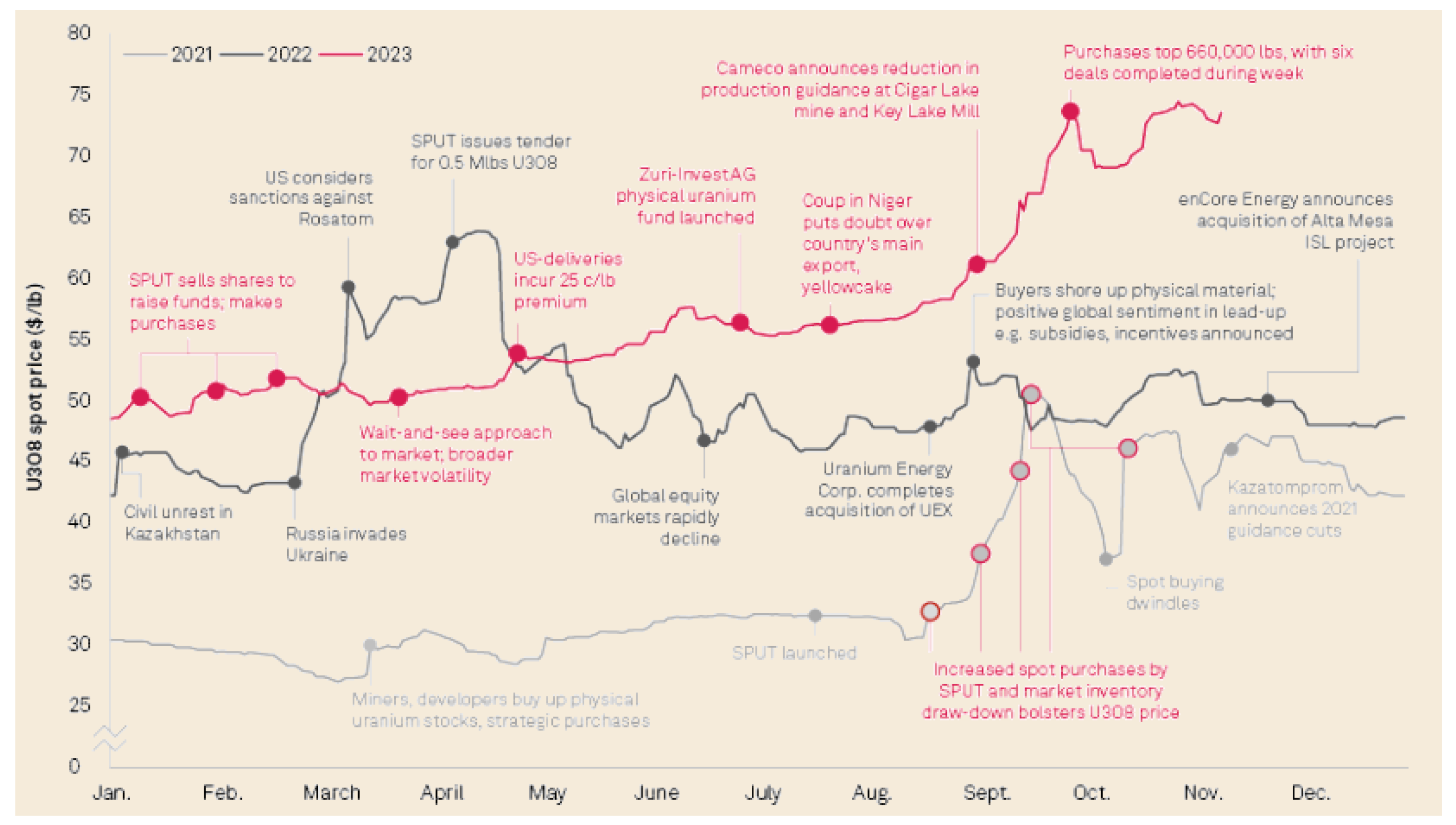
12]. Geopolitical disruptions further reinforced bullish sentiment, notably unrest in Kazakhstan in early 2022 and the broader uncertainty triggered by Russia’s invasion of Ukraine. Overall, since 2021, the uranium market has transitioned into an upswing phase marked by tightening fundamentals, firmer prices, and renewed efforts by utilities and traders to secure long-term supply amid expectations of future scarcity. In this framework,
Figure 3 illustrates short-term uranium price dynamics during 2021–2023, highlighting the sensitivity of spot prices to geopolitical events, supply announcements, and financial market participation.
From a causal perspective, geopolitical shocks affect uranium prices primarily through expectation and contracting channels rather than immediate physical supply losses. Events such as unrest in Kazakhstan or the war in Ukraine increased perceived supply risk in a highly concentrated and thin market, prompting utilities and financial actors to accelerate procurement and inventory accumulation. Given the limited liquidity of the spot market, this precautionary demand translated into disproportionate price responses. In addition, higher spot prices feed into long-term contract negotiations through index-linked pricing mechanisms, reinforcing price increases over time. This expectations-driven transmission mechanism helps explain why relatively contained physical disruptions can generate pronounced price volatility in uranium markets.
2.2. Concentration of Production and Reserves
A defining characteristic of the global uranium market is the high concentration of supply among a small number of producing countries, creating structural vulnerabilities and potential bottlenecks. Kazakhstan alone accounts for roughly two-fifths to nearly one-half of global uranium output [
13] (see
Table 2). In 2022, Kazakhstan produced approximately 22,000 tU, representing about 43% of the world mine supply, far exceeding the output of the second-largest producer, Canada (~15%). Other significant producers include Namibia (~11%), Australia, and Uzbekistan, while no other single country exceeds a 10–12% share of global production. Consequently, the top three producers (Kazakhstan, Canada, and Australia) typically account for nearly three-quarters of total uranium mine output.
To summarize the concentration patterns shown in
Table 2, the global uranium supply exhibits a pronounced dominance by a small number of producers. The top three producing countries (Kazakhstan, Canada, and Australia) collectively account for approximately 70–75% of global uranium mine output, indicating a highly concentrated market structure. From an industrial-organization perspective, this distribution corresponds to a high concentration regime, comparable to an HHI-style classification well above thresholds typically associated with competitive commodity markets. Such concentration amplifies the sensitivity of global supply to country-specific disruptions and policy decisions.
This concentration extends to uranium resources, with a limited group of countries holding the majority of identified recoverable reserves. Australia alone possesses roughly 28% of the world’s known resources, followed by Kazakhstan (~13%) and Canada (~10%), such that over half of economically recoverable uranium is located in these three jurisdictions. The combination of concentrated production and reserves renders the uranium supply chain highly sensitive to disruptions. Policy decisions, geopolitical instability, or technical failures in dominant supplier countries can therefore exert disproportionate influence on global supply, as illustrated by Kazakhstan’s coordinated production curtailments during 2017–2020 and renewed concerns following political instability in Niger in 2023.
2.3. Market Thinness, Contracting Practices, and Volatility
In commodity economics, market thinness refers to a condition in which trading volumes are low relative to total market size, with a limited number of buyers and sellers actively participating in spot transactions. In such markets, even modest changes in purchasing behavior can generate disproportionate price movements. Uranium markets exemplify this structure, as most transactions occur through long-term bilateral contracts, leaving only a small fraction of supply exposed to spot trading.
Beyond geographic concentration, this trading structure contributes directly to uranium price volatility. The market is relatively illiquid compared to other major commodities, with most uranium sold through long-term contracts between producers and nuclear utilities, typically spanning 3–10 years. Historically, spot transactions accounted for roughly 10% of total supply in the early 2000s, although this share has increased to approximately 20–25% in recent years [
10].
The limited depth of the spot market implies that coordinated buying or selling by utilities, traders, or financial entities can trigger sharp price swings. The entry of non-traditional players, such as the Sprott Physical Uranium Trust, which began sequestering significant physical uranium volumes in 2021, illustrates how financial participation can tighten available supply and amplify volatility. In addition, long-term contracts often rely on pricing formulas linked to spot indices, meaning that extreme spot movements eventually feed into contract prices and future procurement costs [
13].
As a result, uranium prices are particularly sensitive to shocks, including supply disruptions, export restrictions, or large purchasing tenders [
11]. This volatility complicates investment planning for producers and increases procurement risk for utilities. Consequently, market participants have shifted toward longer-term contracts and higher strategic inventories to mitigate exposure. While these strategies reduce short-term risk, they also further constrain spot availability, reinforcing market thinness and creating a self-reinforcing cycle of volatility as buyers compete to rebuild inventories.
2.4. Demand Growth Outlook and Emerging Pressures
On the demand side, uranium markets are shifting from a prolonged period of stagnation toward a more robust growth outlook as nuclear power experiences a renewed expansion. Throughout much of the 2010s, global uranium requirements remained flat or declined due to reactor retirements, particularly in Europe and Japan following 2011, and improvements in fuel efficiency. This phase is now ending. As of 2023, global operable nuclear capacity is rising again, supported by new reactor startups in Asia, life extensions of existing plants, and the restart of previously idled reactors, notably in Japan, with industry forecasts pointing to sustained demand growth over the coming decades [
10].
Quantitative projections reinforce this trend. The World Nuclear Association estimates an approximately 28% increase in annual uranium requirements by 2030 relative to 2023, driven by an 18% expansion in global nuclear generating capacity. Under its Reference Scenario, uranium demand is projected to rise by roughly 51% during 2031–2040. Similarly, the OECD/NEA–IAEA [
14] indicates that even conservative scenarios entail significantly higher uranium consumption by 2040, while high-growth pathways aligned with aggressive climate targets could more than double uranium use by mid-century.
It should be emphasized that these demand trajectories represent outcomes under specific scenarios, typically assuming sustained policy support for nuclear power, reactor life extensions, and new build programs. Under more conservative pathways—characterized by slower nuclear deployment or stronger competition from alternative low-carbon technologies—uranium demand growth could be more gradual.
It is important to note that uranium demand projections remain scenario-dependent and subject to considerable uncertainty. Institutional forecasts typically span a wide range of outcomes, from conservative cases assuming limited nuclear expansion to high-growth scenarios aligned with aggressive decarbonization pathways. Under lower-growth assumptions, demand increases are driven primarily by reactor life extensions and incremental capacity additions, whereas high-growth scenarios reflect accelerated deployment of large reactors and advanced technologies. As a result, projected uranium demand trajectories should be interpreted as conditional outcomes rather than deterministic forecasts, with realized demand ultimately shaped by policy choices, technology costs, and broader energy-system dynamics.
Several structural factors underpin this anticipated demand surge. Many countries have reversed nuclear phase-out policies or announced new reactor construction in response to climate objectives, energy security concerns, and elevated fossil fuel prices. Advanced reactor programs in France and the United Kingdom, new nuclear entrants such as Poland, Egypt, and Turkey, and the prospective deployment of small modular reactors all contribute to incremental uranium demand. Geopolitical disruptions have further reinforced nuclear energy’s strategic role, accelerating reactor life extensions and restarts, particularly in Japan. This political momentum was underscored at COP28, where more than 30 countries pledged to triple global nuclear capacity by 2050 [
14].
Collectively, these trends point toward a progressively tightening uranium market unless supply expands in parallel. Long lead times for new mine development, often exceeding a decade, imply that investment decisions made today will shape supply adequacy in the 2030s. While recent price increases have already prompted mine restarts, such as Canada’s McArthur River, and revived exploration activity, substantial additional investment will be required to avoid structural deficits. In response, utilities are increasingly securing long-term contracts and building strategic inventories, marking a transition from a prolonged oversupply regime toward a market characterized by sustained demand growth and tighter supply–demand balances.
2.5. An Evolving Uranium Trade Landscape
These dynamics are reshaping uranium trade patterns. The combined effects of supply concentration, market thinness, and rising demand expectations have renewed concerns over the security of supply among nuclear fuel buyers. Utilities are increasingly engaging in strategic stockpiling and securing long-term contracts with diversified producers well in advance, aiming to reduce exposure to price volatility and potential shortages [
6]. Governments have also responded by designating uranium as a critical mineral and supporting domestic mining and fuel-cycle initiatives to reduce reliance on foreign sources [
15].
On the supply side, major producers such as Kazatomprom and Cameco now exercise significant market influence and have adopted a cautious approach to output expansion, favoring balanced markets and sustainable pricing over past boom–bust cycles. As a result, long-term contracting has become increasingly dominant, while spot market availability has diminished. Although price formation continues to reference spot indices, opaque bilateral contracts and reduced liquidity leave the spot market vulnerable to speculative behavior and short-term volatility. Periodic tightness is therefore likely to persist, as illustrated by late-2023 price spikes when spot U3O8 briefly exceeded $80/lb, until substantial new production or secondary supplies emerge.
Overall, the uranium market is undergoing a structural rebalancing after decades of oversupply, characterized by a higher demand trajectory interacting with a constrained and consolidating supply base. This environment presents both opportunity and risk: opportunities for mining investment and returns, and risks associated with volatility and supply bottlenecks should major producers falter. Increasingly, the uranium trade is being shaped by strategic considerations, including energy security, geopolitical alignment, and climate policy, rather than purely short-term commercial signals. Barring a significant reversal in nuclear energy deployment, uranium markets are likely to continue moving toward a tighter and more robustly priced regime, where timely investment and diversified supply chains will be critical to meeting future demand [
16].
3. Nuclear Technology Trends: SMRs and Beyond
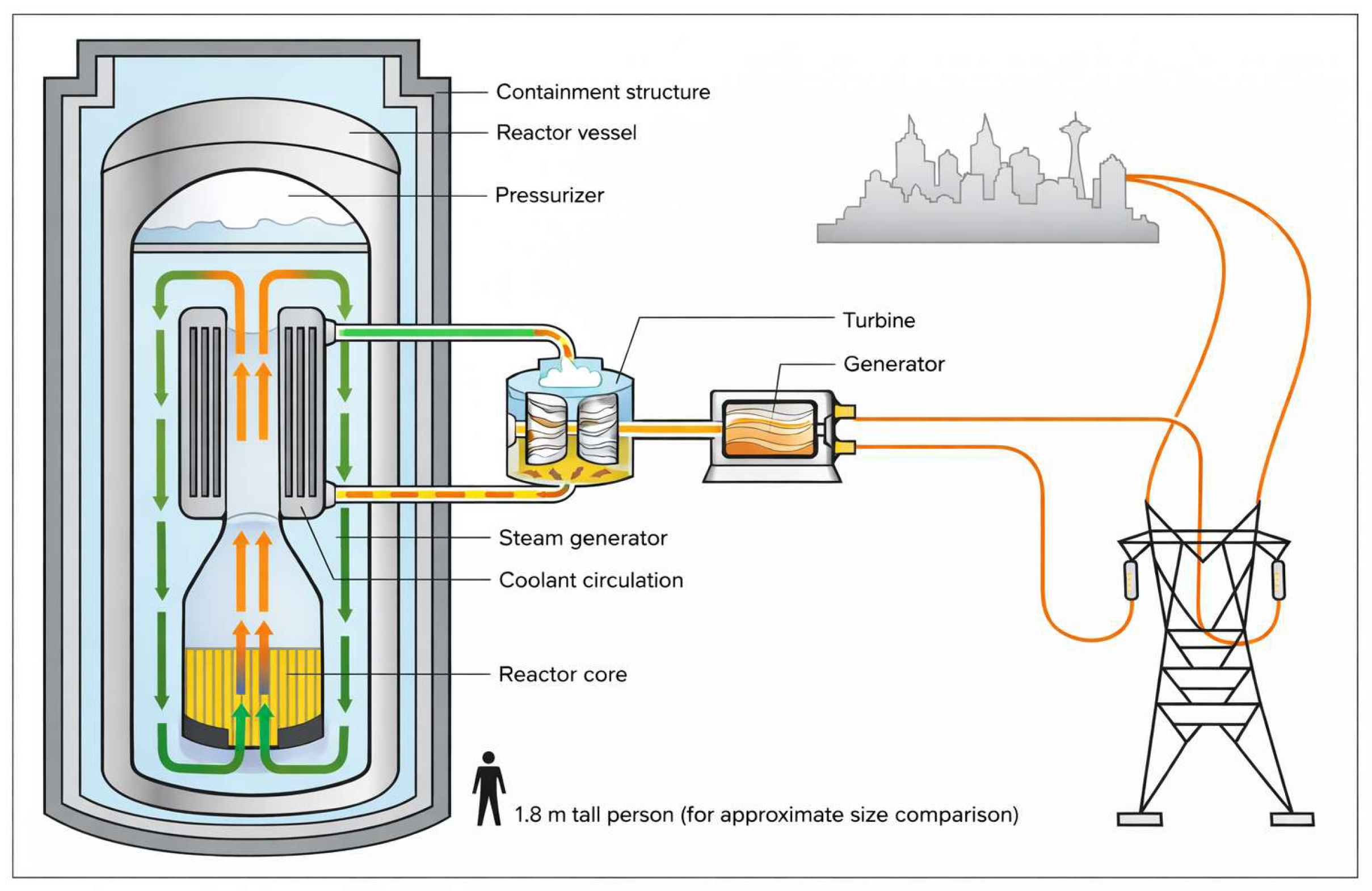
Beyond market dynamics, technological evolution is increasingly reshaping the strategic role of uranium by altering fuel requirements, supply chains, and risk profiles across nuclear systems. Recent years have witnessed a strategic shift in nuclear reactor technology towards smaller, modular designs and other advanced concepts, with important implications for reactor fuel requirements. Small Modular Reactors (SMRs) are broadly defined as nuclear power reactors of up to about 300 MWe capacity, built using modular, factory-fabricated components [
17] (See
Figure 4). It is important to note that SMRs encompass a heterogeneous set of reactor concepts with distinct fuel-cycle characteristics, and statements regarding enrichment levels, uranium intensity, or waste generation should therefore be interpreted in relation to specific reactor classes rather than SMRs as a uniform category.
In contrast to today’s gigawatt-scale reactors, SMRs are compact units intended for deployment in flexible arrays: multiple modules can be added progressively to match demand growth or to fit smaller electric grids. These reactors emphasize enhanced safety and simplicity, incorporating inherent and passive safety features (such as natural convection cooling and smaller core heat load) that improve overall robustness [
17]. For example, each SMR module produces far less thermal energy than a conventional reactor core, which eases post-shutdown cooling needs and reduces the theoretical risk of severe accidents. SMR designs often rely on gravity-driven cooling and other passive systems rather than complex active pumps. This inherent safety ethos builds on lessons from past reactors and aims to bolster public and regulatory confidence. Moreover, SMRs can be sited in locations unsuitable for large plants, including remote regions or smaller grids, due to their lower power output and compact footprint. Factory construction and modular assembly allow deployment in geographically isolated areas or sites with limited infrastructure (where transporting the massive components of a large reactor would be impractical) [
18]. These attributes position SMRs as a complement to intermittent renewables: they offer reliable, high-capacity-factor generation that can stabilize grids, and they require dramatically less land area than equivalent renewable capacity. Notably, SMRs are also capable of partial load-following, adjusting power output to follow demand fluctuations to an extent that traditional large reactors rarely do. This flexibility, combined with cogeneration potential, means SMRs could provide steady baseline power while diverting excess thermal energy to other uses when grid demand is low [
19].
Despite these advantages, SMRs face critical drawbacks and challenges. Foremost is the loss of economies of scale. A single SMR module may generate only a few percent of the electricity of a standard 1000 MWe reactor, yet it does not cost proportionally less to build and operate. In fact, analyses indicate that because of scale effects, the capital cost per unit power for SMRs is higher than for large reactors. A representative calculation shows that an SMR of ~200 MWe might have an overnight cost roughly 40% that of a 1000 MWe plant, but since it produces only 20% of the power, its cost per megawatt is about double that of the larger unit [
20]. This also tends to make the levelized electricity cost and fuel-cycle costs less favorable for smaller reactors unless savings are achieved through learning, modular mass-manufacturing, or deploying multiple units on one site. In economic terms, SMRs sacrifice traditional scale efficiencies; their proponents must therefore realize offsetting gains via serial production, streamlined construction, and shorter project lead times [
21]. Another challenge is regulatory adaptation. Licensing frameworks have been developed over decades for conventional large reactors and do not yet fully accommodate novel SMR designs. Each module of an SMR plant might, under current rules, be subject to the same licensing fees and requirements as a much larger reactor, eroding the cost advantage of deploying many small units [
22]. Efforts are underway to adjust regulations, for example, scaling certain fees to plant capacity, but regulators are naturally cautious in certifying first-of-a-kind reactors. It is telling that as of the mid-2020s, only one SMR design (NuScale’s 77 MWe light-water module) has received full design approval by the U.S. Nuclear Regulatory Commission (in 2020) [
20]. Most other designs remain in prototype or licensing stages, reflecting the evolving regulatory landscape that SMRs must navigate before widespread deployment. In addition, regulatory frameworks for advanced reactors remain under development in many jurisdictions. Licensing processes for SMRs and other novel designs are often adapted from conventional large reactor pathways, resulting in extended approval timelines, regulatory uncertainty, and increased project risk. These challenges may delay deployment schedules and exacerbate near-term fuel supply mismatches, particularly for reactor concepts relying on non-standard fuels. Additionally, there are concerns about nuclear waste and fuel usage for SMRs. By virtue of their smaller cores, some SMR designs achieve lower fuel burn-up per unit of energy generated compared to large reactors, which can result in a higher volume of spent fuel and activated waste per MWh produced. One study estimated that an integral pressurized-water SMR would require significantly more uranium fuel (and generate a larger volume of high-level waste) per unit of electricity, on the order of ~45% more uranium ore and enrichment work than a modern large reactor of equivalent output [
23]. This is partly a consequence of design trade-offs: SMRs often prioritize safety and simplicity (e.g., using lower core power densities or shorter fuel cycles), which can mean they extract less energy from each fuel load. Moreover, many advanced SMR concepts plan to use higher enriched uranium fuel than the ~3–5%
235U used in today’s large light-water reactors. Small reactors intended for long core life or compact cores (including so-called microreactors of only a few MWe) may require uranium enriched to 10–20% (HALEU) to achieve desired performance [
23]. This introduces proliferation sensitivities and new supply chain demands, since HALEU production capability is only just expanding. The emerging gap in HALEU availability has important policy implications. Given the limited number of enrichment facilities capable of producing HALEU and the current dependence on a narrow set of suppliers, governments are increasingly viewing advanced nuclear fuel supply as a strategic vulnerability. Addressing this gap will likely require coordinated policy action, including public support for domestic enrichment capacity, international fuel partnerships, and the incorporation of fuel availability considerations into reactor deployment strategies. In short, SMRs offer a new paradigm but must prove that modular construction and superior safety can overcome economic and regulatory hurdles, as well as address fuel cycle and waste management issues, on a commercial scale.
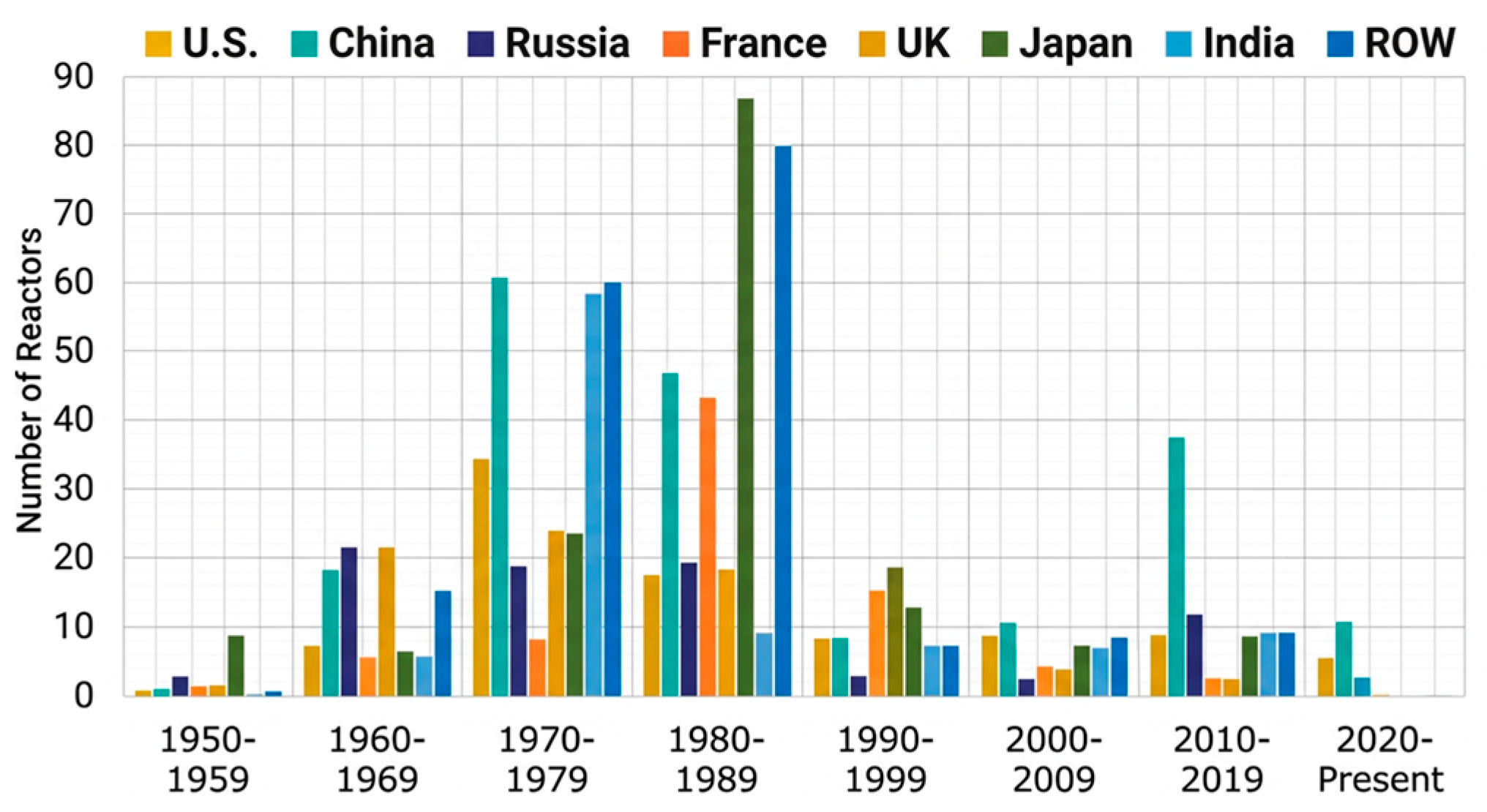
Since 1950, nuclear reactor construction has evolved through three key phases: a peak from 1970 to 1989 led by Japan, Russia, the U.S., and others; a sharp decline in Western countries from 1990 to 2010; and a recent surge driven by China, now the global leader in new reactor builds (see
Figure 5). The development status of SMRs underscores both the interest in and the nascent nature of this technology. As of the mid-2020s, an estimated 70+ SMR projects are in development globally. A few prototypes have operated (for example, a tiny 20 MWe unit in Argentina and demonstration high-temperature reactors in China), but only one SMR has achieved commercial grid-connected operation to date [
17].
This first-mover is Russia’s KLT-40S reactor (a ~70 MWe PWR) mounted on a floating barge, which began delivering power in 2020. Other nations, including the United States, China, Canada, and the UK, are racing to license or construct their first SMRs, spurred by the promise of easier financing and the ability to incrementally add nuclear capacity. The coming decade is expected to see the commissioning of several pilot SMR plants. Importantly, SMRs typically have longer refueling intervals than conventional reactors: many designs aim for core fuel cycles of 3 to 10 years (and some microreactors even target 20+ years sealed cores) before needing new fuel [
18]. This extended refueling period, enabled by higher enrichment and innovative core configurations, could simplify logistics and allow continuous operation of multi-module plants by staggering refuels. It means that although an SMR may use more uranium per megawatt-year, it may only be refueled a few times per decade, potentially reducing operational downtime. Such characteristics will influence uranium fuel demand patterns, fewer frequent reloads but larger batch refuels at once, possibly requiring more upfront enrichment. In parallel, some advanced SMRs are exploring alternative fuel cycles (for instance, reactors designed to use thorium or to breed fuel). While thorium-based reactors remain experimental, they could in principle reduce reliance on mined uranium by breeding fissile
233U from thorium, with one design study identifying thorium fuel as an attractive long-term option for small reactors due to its abundance and waste profile [
24]. However, for at least the next few decades, low-enriched uranium will remain the dominant fuel for both SMRs and conventional reactors. The net effect of SMR adoption on uranium markets is likely to be an increase in total demand for nuclear fuel, as these reactors enable new deployments (often in regions or applications not previously using nuclear power). At the same time, the demand may shift toward higher enrichment services and specialized fuel fabrication (e.g., production of HALEU and TRISO particle fuels), reflecting the new designs’ requirements [
23].
Beyond SMRs, a range of advanced reactor concepts is under development, often classified as Generation IV reactors, which promise to expand nuclear energy into new roles. A prominent example is high-temperature gas-cooled reactors (HTGRs), including the very-high-temperature reactor (VHTR) designs. These reactors use graphite-moderated cores and inert gas or molten salt coolants to achieve outlet temperatures far above those of current light-water reactors. Coolant temperatures of 550 °C up to ~1000 °C are projected for certain HTGR/VHTR systems [
25]. Such high-temperature operation, combined with modular sizes ranging from tens to a few hundreds of megawatts, opens the door for nuclear plants to cogenerate process heat and industrial products beyond electricity. In particular, advanced high-temperature reactors are considered ideal for coupling with hydrogen production processes that require substantial heat input. They can drive thermo-chemical water-splitting cycles or high-efficiency steam electrolysis, thereby producing hydrogen without fossil fuels. We highlight the emerging concept of nuclear-driven hydrogen (often dubbed pink hydrogen). Pink hydrogen refers to hydrogen fuel produced using nuclear energy, either via electrolysis powered by nuclear-generated electricity or via direct thermal processes powered by the reactor’s heat. This approach yields a carbon-free hydrogen supply, analogous to green hydrogen from renewables but with the advantage of continuous, controllable output [
20]. Nuclear reactors can operate at a steady baseload, avoiding the intermittency of wind or solar, which means an electrolyzer tied to a reactor can run at a high capacity factor. Studies show this improves efficiency and economics: the stable power avoids frequent shutdowns or part-load operation of the electrolyzers, reducing wear and unit hydrogen costs. For example, one techno-economic analysis found that a nuclear plant producing hydrogen could achieve higher equipment utilization and lower hydrogen cost compared to a scenario where the electrolyzer is powered by variable renewable electricity [
19]. High-temperature reactors make this even more attractive. An HTGR coupled to a high-temperature steam electrolysis unit can produce hydrogen with exceptional efficiency—one study estimates a modular HTGR could produce hydrogen at roughly
$3.5 per kilogram, slightly below the cost of hydrogen from grid-supplied electricity (around
$3.55/kg) [
26]. This competitive cost is achieved by leveraging both the electrical output and the thermal heat of the reactor to drive a high-efficiency electrolysis process (or potentially a thermochemical cycle), showcasing the potential of beyond electricity applications for advanced reactors. Indeed, demonstration projects are underway: for instance, China’s HTR-PM reactor (a high-temperature pebble-bed modular reactor) is being evaluated for large-scale hydrogen production, and Japan’s HTTR research reactor has demonstrated hydrogen generation in the laboratory [
27]. By providing high-grade heat, these reactors can directly supply industrial processes, from hydrogen production to ammonia synthesis or desalination, thereby expanding nuclear energy’s role in decarbonizing sectors traditionally reliant on fossil fuels.
The integration of SMRs and advanced reactors with renewable energy systems is another important trend. Rather than viewing nuclear and renewables as competitors, energy planners increasingly consider hybrid systems where small reactors complement renewable generation. SMRs, with their flexible modular deployment and cogeneration capability, are especially attractive for this purpose. In a renewable-rich grid lacking reliable baseload power, an SMR plant can provide the steady backbone of generation while also dynamically adjusting to balance the variable output of solar or wind. Excess reactor capacity, during periods of low electricity demand or high renewable output, can be diverted to produce hydrogen (or other energy carriers), effectively storing the energy or creating a useful byproduct, rather than curtailing generation [
28]. For example, a case study in South Korea examined a small island grid (Jeju Island) with significant wind penetration: a hybrid system of 12 × 50 MWe SMR modules was proposed to supply stable power and use surplus capacity for hydrogen production via electrolysis [
29]. Simulations showed that this nuclear-renewable hybrid could completely satisfy local demand while producing up to 10,000 tons of hydrogen per year as a byproduct, effectively utilizing what would otherwise be curtailed wind energy [
30]. Such hydrogen can be stored and later used to regenerate power or for transport fuel, enhancing overall system reliability and flexibility. More broadly, pairing SMRs with renewables in isolated or vulnerable grids can markedly improve energy security: the nuclear module ensures a dependable minimum supply (preventing blackouts when renewable output dips), while the renewables reduce fuel costs and emissions. In remote communities currently dependent on diesel generators, a small reactor could replace costly diesel fuel and operate in tandem with solar/wind, an approach that is not feasible with traditional large reactors due to their scale. These scenarios illustrate how the transition toward SMRs and other new reactor designs could materially affect uranium fuel demand patterns. If SMRs enable nuclear power to penetrate markets and uses that were previously impracticable, such as small-grid applications, off-grid or maritime power, or industrial heat and hydrogen production, the aggregate demand for uranium fuel is likely to grow. Each SMR or microreactor deployed instead of a diesel power station creates a new source of uranium consumption, often in regions that have never before contributed to nuclear fuel demand. Likewise, high-temperature reactors dedicated to hydrogen fuel production would effectively channel uranium demand into the transportation and industrial sectors (by producing hydrogen for trucks, steel plants, fertilizers, etc.). On the other hand, these advanced systems also drive innovation in fuel utilization: for instance, a breed-and-burn fast SMR (an advanced concept) could run for many years on a single fuel load by gradually converting fertile isotopes to fissile ones [
31]. Widespread adoption of such reactors in the future could reduce the need for fresh uranium mining by extracting more energy from each kilogram of fuel (and even consuming nuclear waste or thorium). In the near term, however, the dominant impact of new reactor technologies will be to increase and diversify the nuclear fuel market. A larger number of smaller reactors, spread across more countries and deployed for more varied purposes, implies a broadening base of uranium demand. This demand will include not only traditional low-enriched uranium for light-water SMRs, but also new categories like HALEU fuel for certain advanced designs and possibly specialized fuels (coated particle fuels, molten salt fuel mixtures, etc.) for Gen-IV reactors.
Accordingly, the contribution of SMRs to future uranium demand should be interpreted as conditional on successful licensing, cost containment, fuel availability, and supportive regulatory frameworks. In scenarios where these conditions are not met, the impact of advanced reactors on uranium markets may remain limited in the medium term.
Thus, Small Modular Reactors (SMRs) represent a diverse class of nuclear technologies with distinct design, fuel, and operational characteristics. The current discourse often treats SMRs as a homogeneous group; however, their uranium requirements, enrichment levels, and burnup rates vary significantly across types.
Table 3 presents a comparative synthesis of the main SMR classes under active development. Pressurized water-based designs (e.g., NuScale, CAREM) rely on conventional enrichment and fuel cycles, while advanced designs such as high-temperature gas-cooled reactors (HTGRs), molten salt reactors (MSRs), and sodium-cooled fast reactors operate with significantly higher enrichments and extended burnup.
While HALEU availability is often discussed qualitatively, the constraint is fundamentally an enrichment-capacity problem that scales non-linearly with assay. Advanced concepts relying on 5–20% U-235 do not simply require “more uranium,” but also a materially higher separative work throughput per unit of delivered fuel, thereby tightening the front-end of the fuel cycle. Fuel-cycle scenario simulations explicitly show that once HALEU-fueled reactors begin deployment, the associated enrichment burden can reach multi-million SWU per month with pronounced peaks. For example, transition cases to modular HTGR concepts report average requirements on the order of ~2.07 × 10
6 kg-SWU/month (with peaks up to ~20.3 × 10
6 kg-SWU/month) for the advanced-reactor fleet, and growth cases can raise average requirements to ~3.21 × 10
6 kg-SWU/month with peaks up to ~22.1 × 10
6 kg-SWU/month, implying that practical deployment schedules become tightly coupled to enrichment build-out and operational flexibility. In the same analysis, an illustrative enrichment facility sized at ~2.28 × 10
6 kg-SWU/month is presented as a scale reference for meeting sustained HALEU demand in a representative transition scenario [
9].
This supply-chain challenge is amplified by the geopolitical concentration of fuel-cycle services: recent quantified assessments estimate that Russia provides approximately 46% of global enrichment capacity (and ~20% of conversion capacity), meaning that efforts to de-risk dependencies can translate directly into a near-term “capacity gap” for higher-assay fuels unless alternative enrichment capability is expanded and qualified.
Despite their potential advantages, SMRs face significant uncertainties that may constrain near-term deployment. Key challenges include unresolved licensing pathways, cost escalation risks for first-of-a-kind units, supply-chain immaturity, and uncertainty over construction timelines. In addition, the availability of suitable fuels, particularly HALEU, remains a critical bottleneck. While SMRs offer promising long-term flexibility and deployment options, their contribution to uranium demand and system resilience will depend on how these technical, regulatory, and economic uncertainties are resolved in practice.
Accordingly, the implications of SMR deployment for uranium demand, enrichment capacity, and waste management depend strongly on the mix of reactor classes ultimately deployed, rather than on SMR adoption per se.
4. Nuclear vs. Renewables and Hydrogen in the Energy Mix
Nuclear energy, renewables, and hydrogen are no longer best understood as competing options, but as complementary pillars of integrated low-carbon energy systems. Unlike wind or solar facilities, which depend on weather and time of day, nuclear reactors provide continuous generation that can stabilize grids. Rather than displacing renewables, nuclear’s firm output can fill the gaps when solar and wind output dips. For example, in regions with limited wind or sunlight, the strategic deployment of small modular reactors (SMRs) is proposed to bolster energy security by smoothing out renewable intermittency [
32]. By leveraging nuclear plants’ reliable baseline power, these reactors complement intermittent renewables and help maintain a stable electricity supply.
A key difference between nuclear and renewables lies in their development timelines and economics. Building a new nuclear power plant remains a capital-intensive, long-term project, often requiring large upfront investment and close to a decade for planning and construction, whereas solar arrays or wind farms can be deployed more rapidly and at lower initial cost. Recent analyses underscore this contrast: the cost of nuclear power has risen over the past decades and generally exceeds that of wind and solar, whose costs have plummeted [
33]. In one scenario study for a future carbon-neutral grid, a high-nuclear electricity mix was estimated to be about €1.2 billion more expensive per year than an equivalent all-renewables case [
29], even after accounting for grid balancing needs. These economic realities reflect nuclear’s heavy construction and financing costs. However, once built, nuclear plants offer distinctive advantages: they run at very high capacity factors (often ~90% of full power on average, far above typical wind or solar utilization) and can operate for 60 or more years, providing decades of steady low-carbon energy. This long life and reliability mean that each reactor can deliver a vast total output over its lifetime, partially offsetting the slow, expensive start. Moreover, advanced reactor designs are being developed with improved load-following capabilities, enabling them to adjust power output to help meet fluctuating demand or variable renewable supply [
34]. In practice, a diverse generation mix can exploit the quick build-times and low cost of renewables alongside the round-the-clock output of nuclear, achieving both speed and stability in decarbonizing power systems.
A comprehensive cost comparison between nuclear and renewables should also account for financing risk, construction delays, and regulatory uncertainty, which are particularly salient for large nuclear projects. Nuclear new-build projects routinely exhibit significant cost escalation and schedule overruns, driven by financing structures, complex engineering requirements, and stringent regulatory processes; empirical studies document that these overruns can materially increase the levelized cost of nuclear electricity relative to initial estimates. For example, construction cost overruns and extended build times have been repeatedly observed in historical nuclear reactor projects, highlighting the financial risk associated with capital-intensive large-scale nuclear infrastructure, especially in liberalized markets where cost recovery is contingent on future electricity prices [
35].
By contrast, the modularity and shorter construction lead times of most renewable technologies tend to reduce exposure to such risks, supporting lower uncertainty premiums in financing and delivery. These differences in risk profiles imply that levelized cost comparisons should incorporate not only baseline cost estimates but also the potential for cost variance due to delays and regulatory uncertainty, which has been shown to disproportionately affect nuclear costs compared to renewables. Such risk-adjusted comparisons provide a more balanced perspective on the economic competitiveness of low-carbon energy options than baseline cost metrics alone.
Beyond electricity, the synergy between nuclear power and clean fuels like hydrogen is emerging as a promising frontier. Advanced reactors, especially high-temperature designs such as very high-temperature gas-cooled reactors (VHTRs), can produce hydrogen with minimal greenhouse emissions by supplying heat or electricity to drive hydrogen production processes [
36]. For instance, next-generation reactors operating at coolant outlet temperatures up to 600–950 °C enable efficient hydrogen generation through high-temperature electrolysis or thermo-chemical water-splitting cycles [
25]. This nuclear–hydrogen coupling extends the role of uranium beyond electricity: reactors could become multi-purpose energy hubs that simultaneously feed power to the grid and hydrogen to industries. Several studies indicate that nuclear-produced hydrogen could significantly decarbonize hard-to-abate sectors like heavy industry and transportation [
27]. By co-producing heat, power, and hydrogen, nuclear plants may improve their economics and flexibility, especially if operated in tandem with renewables. During periods of low electricity demand or high renewable output, a reactor’s thermal energy can be diverted to hydrogen production, essentially storing energy in chemical form; when grid demand rises, or wind/solar output falls, the reactor can prioritize electricity generation. Such integrated systems are drawing increased interest for their potential to reduce costs and enhance operational flexibility by coupling always-on reactors with variable renewables [
36]. In effect, hydrogen production provides a complementary outlet for nuclear energy, turning intermittent surplus or off-peak capacity into a storable fuel while maintaining steady reactor operation.
At the same time, it is important to recognize that the technical limitations associated with renewable variability are being partially addressed through rapid advances in storage technologies, grid interconnection, and demand-side flexibility. Utility-scale battery deployment has expanded significantly in recent years, and longer-duration storage concepts, digital grid management, and flexible demand strategies are increasingly incorporated into system planning models. These developments can mitigate short-term intermittency and enhance system resilience, particularly in regions with high renewable penetration. However, their scalability, cost trajectory, and ability to provide sustained firm capacity under deep decarbonization scenarios remain subject to ongoing evaluation. Consequently, while renewable system flexibility is improving, the comparative role of nuclear power as a firm low-carbon resource continues to be analyzed within broader system-level trade-offs.
This comparative analysis suggests that nuclear power and renewables need not be competitors in the race to net-zero emissions. On the contrary, they can function as cooperative partners, each contributing unique strengths to a balanced and resilient clean energy mix. Nuclear plants excel at delivering firm, dispatchable power and heat, thereby underpinning grid reliability and supporting processes like hydrogen generation. Renewable sources, for their part, bring rapidly scalable, increasingly inexpensive generation with zero fuel costs. When coordinated intelligently, these resources can collectively meet energy demand around the clock: nuclear filling in when sun and wind wane, and excess renewable electricity channeled into new applications such as electrolytic hydrogen production. Energy planners are thus exploring hybrid configurations where reactors and renewables operate in unison rather than in isolation [
36]. In regions from Europe to Asia, proposals to integrate SMRs with wind and solar farms (along with battery storage or hydrogen electrolyzers) aim to capture the benefits of both firm and variable sources [
34]. Looking ahead, this synergy could reshape the strategic value of uranium: no longer viewed only as a fuel for baseload electricity, it becomes an enabler of broader low-carbon energy services. In a future energy system, a kilogram of uranium might help keep the lights on and also produce clean hydrogen for steel factories or long-haul trucks. Such a vision positions nuclear and renewables as complementary forces driving deep decarbonization, cooperating rather than competing to deliver a stable, affordable, and zero-carbon energy future.
At the same time, the integration of nuclear energy into hydrogen production pathways is subject to important constraints. High capital intensity, infrastructure requirements, regulatory alignment across electricity and hydrogen markets, and competition from declining renewable-based electrolysis costs introduce uncertainty regarding the scale and timing of nuclear–hydrogen coupling. As a result, while nuclear energy may play a strategic role in specific hydrogen applications, particularly where high capacity factors or process heat are required, its broader deployment will remain context-dependent.
In this context, the complementarity between nuclear power, renewables, and hydrogen production elevates uranium’s strategic relevance beyond electricity generation alone. By supporting system flexibility, energy security, and deep decarbonization across multiple sectors, uranium becomes a foundational element of integrated low-carbon energy systems.
At the same time, it is important to acknowledge countervailing perspectives that may temper long-term projections of uranium’s strategic expansion. Continued cost declines in renewable generation and energy storage, potential technological breakthroughs in alternative low-carbon pathways, or shifts in political priorities could alter nuclear deployment trajectories. Similarly, policy reversals or regulatory setbacks in key markets may constrain capacity growth. Recognizing these uncertainties does not negate the strategic trends identified in this review, but rather situates them within a broader spectrum of possible energy transition outcomes.
5. Geopolitical and Regional Perspectives
Energy security concerns surrounding nuclear fuel vary widely by region. This section examines key regional dynamics in uranium supply and nuclear development, highlighting both current trends and their strategic implications. By analyzing cases in the United States, the European Union, China, Central Asia, Africa, and Southeast Asia, we illustrate how each region’s policies and circumstances are reshaping the global nuclear fuel landscape.
5.1. United States
The United States is actively bolstering its civilian nuclear sector with new policies and investments. In recent years, the federal government has introduced production tax credits, loan guarantees, and other incentives (e.g., under the 2022 Inflation Reduction Act and related laws) to stimulate nuclear projects [
37]. These measures aim to sustain existing reactors and support emerging designs like Small Modular Reactors (SMRs) as part of a strategy to reduce dependence on fossil fuels. The country is seeing a wave of new entrants exploring nuclear energy applications beyond the traditional utilities. Notably, several technology companies are considering dedicated nuclear power for energy-intensive facilities such as data centers [
38]. For example, major firms with 2030 carbon-neutral goals (Google, Microsoft, etc.) have expressed interest in SMRs to supply clean, reliable power for their server farms. This private-sector interest, alongside public programs, reflects a renewed confidence in nuclear technology’s role in a low-carbon economy [
39].
The electricity demand associated with large-scale data centers is no longer marginal. Recent peer-reviewed estimates indicate that data centers account for approximately 1% of global electricity consumption, with shares reaching 2–4% in advanced economies, and are projected to grow at annual rates of 7–10% under continued expansion of cloud computing and artificial intelligence workloads. Importantly, this demand is characterized by high capacity factors and continuous 24/7 load profiles, which complicate exclusive reliance on variable renewable generation without extensive storage or backup. As a result, energy system analyses identify firm low-carbon resources, including nuclear power, as potential complements to renewables for supplying such loads. While data centers do not directly drive uranium consumption, their contribution to sustained demand for reliable, low-carbon electricity may indirectly support nuclear capacity expansion, thereby reinforcing uranium’s strategic relevance [
40,
41].
Despite its history as a nuclear pioneer, the U.S. remains heavily reliant on foreign sources for nuclear fuel. Over 90% of the uranium used in U.S. reactors is currently imported, and a substantial portion of enrichment services comes from abroad. This has raised supply-chain security concerns, especially given geopolitical rivalries that could disrupt fuel supply. In response, U.S. policy has begun to treat uranium similarly to oil in terms of strategic importance. The government has initiated a strategic uranium reserve and is encouraging domestic mining and milling projects to rebuild the front end of the fuel cycle [
37]. Ensuring a diversified import portfolio is also a priority, with efforts to source more uranium from allied countries and to develop domestic enrichment capacity for both commercial fuel and advanced reactor needs. These steps are seen as crucial to reduce vulnerability and to support the planned expansion of nuclear capacity (including advanced reactors). The U.S. case illustrates how even advanced economies are refocusing on fuel security: robust support for nuclear energy is paired with measures to secure the uranium supply underpinning that energy, aligning national security with clean energy goals.
5.2. European Union
In Europe, ambitious climate targets and the fallout from Russia’s invasion of Ukraine have led to a dramatic resurgence of interest in nuclear power alongside renewables. Facing urgent energy security challenges, the European Union (EU) has adopted a more favorable stance toward nuclear, recognizing it as a firm, low-carbon source that can complement wind and solar. A pivotal development has been the EU’s push to eliminate reliance on Russian nuclear fuel supplies. Until recently, EU utilities obtained a significant share of their uranium and reactor fuel services from Russia, especially for Soviet-designed reactors in Eastern Europe. The war in Ukraine spurred efforts to unwind this dependency. European authorities have moved to ban Russian uranium and enrichment in principle and have pressed operators to shift to alternative suppliers. Contracts are being redirected to providers in Kazakhstan, Canada, Australia, and other countries to replace Russian deliveries. For example, Kazakhstan (the world’s largest uranium producer) and African suppliers like Niger now figure more prominently in European supply chains. These moves are part of a broader strategy to enhance self-sufficiency in the nuclear fuel cycle [
9]. EU institutions have also supported expanding domestic fuel-cycle capabilities, from conversion to fuel fabrication, to ensure security of supply for European reactors.
Nuclear energy’s role in Europe, however, differs by country, leading to internal debate. France and several Eastern European states (e.g., Poland, Hungary) remain strongly pro-nuclear, investing in new reactors or life extensions as a way to meet climate goals and reduce gas dependence. In contrast, countries like Germany and Belgium have chosen to phase out nuclear power, prioritizing other energy sources. These divergent views have made nuclear policy contentious, as seen in debates over the EU’s green taxonomy for sustainable investments. After protracted negotiation, nuclear energy was given a conditional green label in 2022, recognizing its low-carbon benefits, a decision that can facilitate financing for new reactors and uranium projects. This policy acknowledgment of nuclear’s strategic value is significant for uranium markets: it may spur investment in uranium mining and fuel facilities by treating them as part of the clean-energy supply chain. Europe is also treating uranium as a strategic material in a geopolitical sense. High-level commodity strategies now emphasize secure access to critical fuels, including uranium, mirroring strategies long applied to oil and natural gas. In sum, the EU is realigning its nuclear fuel procurement in response to geopolitical pressures. If successful, Europe’s shift away from Russian fuel will not only alter global trade flows (benefiting alternate suppliers) but could also raise costs in the short term as new arrangements and infrastructure are put in place [
9]. Over the longer term, Europe’s experience may underscore the importance of diversified uranium sourcing and fuel-cycle resilience as components of energy security.
5.3. China
China’s nuclear energy expansion is currently the fastest-growing in the world, with far-reaching global implications. Domestically, China has over 50 reactors in operation and dozens more under construction or planned, as it seeks to dramatically increase nuclear capacity for clean power and to reduce air pollution. This rapid build-out, the largest of any country, has driven up demand for uranium fuel and made China a major player in global uranium markets. Chinese utilities and state-owned nuclear companies have accordingly pursued international partnerships to secure long-term supply. One strategy has been investing in upstream uranium assets abroad. For instance, Chinese companies have acquired stakes in uranium mines in Kazakhstan, Namibia, and other resource-rich countries. In Kazakhstan (which produces ~40% of the world’s uranium), China General Nuclear Power Group (CGN) and others have joint ventures that provide a stable supply of Kazakh uranium for China’s reactors [
42]. Similarly, in Africa, a Chinese firm is the majority owner of Namibia’s Husab mine, one of the world’s largest uranium mines. These investments along the Belt and Road Initiative (BRI) underscore how China is leveraging its financial capacity to lock in uranium resources. By doing so, China not only secures fuel for its growing reactor fleet but potentially gains influence over global uranium trade patterns. A significant portion of Kazakh and African output is effectively tied up in Sino-foreign joint ventures, shifting those volumes into long-term contracts for China and reducing availability on the open market.
China’s strategy extends to exporting its nuclear technology and building reactors overseas, which can further bolster its sway in the nuclear fuel cycle. Under the BRI framework, China has marketed its reactor designs to developing countries and signed cooperation agreements to finance and construct new nuclear plants [
43]. This includes projects in Asia, the Middle East, and Eastern Europe that often come with fuel supply arrangements from China. Such efforts, if realized, could cement China’s role as a full-service nuclear supplier, from reactor construction to fuel provision and waste management. Geopolitically, the rise of China as a nuclear fuel heavyweight may tilt pricing power and standard-setting in its favor. Traditionally, Western suppliers dominated enrichment services and fuel fabrication markets, but Chinese entities are now expanding capacity in these areas as well. China’s expanding demand has already contributed to upward pressure on uranium prices in recent years, especially as it stockpiles strategic inventories. Going forward, China’s dual role as a top consumer and an emerging supplier/investor is likely to give it significant influence over global uranium flow and price stability. Its close partnerships with major producers (Kazakhstan, Russia, etc.) also raise the prospect of a more Sino-centric sphere in nuclear trade, potentially challenging the existing market architecture. In essence, China’s nuclear growth illustrates how demand from one country can reshape global resource linkages: by aggressively securing supply and exporting its model, China is becoming a pivotal determinant of uranium geopolitics and market trends.
5.4. Kazakhstan and Central Asia
Kazakhstan stands out as the world’s dominant uranium producer, and its policies carry disproportionate weight in global supply. The country accounts for roughly 40–45% of global uranium output, far ahead of the next-largest producers [
44]. Historically, Kazakhstan was primarily an exporter of unprocessed uranium concentrates, and its Soviet-era mining industry was tightly integrated with Russia’s nuclear complex. In recent years, however, Kazakh authorities have begun reframing uranium as a strategic national asset rather than just an export commodity. This shift is reflected in new initiatives to develop a domestic nuclear power sector and capture more value within the country. After extensive public debate, Kazakhstan approved plans for its first nuclear power plant, aimed at addressing looming electricity shortages and diversifying its coal-heavy energy mix. In a 2024 national referendum, more than 70% of voters supported building a nuclear plant, giving political impetus to proceed with reactor construction (with technology suppliers from Russia, China, and others under consideration). Alongside this, Kazakhstan is exploring steps up the fuel cycle, such as fuel fabrication partnerships, so that it can export not only raw uranium but higher-value products. The government’s narrative increasingly emphasizes energy sovereignty: by harnessing its uranium for domestic energy and by exerting greater control over exports, Kazakhstan seeks to leverage its resource for long-term security and economic gain.
Central Asia’s uranium geopolitics are closely tied to transport routes and great-power relations. One immediate concern has been Kazakhstan’s dependence on Russia for exporting its uranium. Traditionally, Kazakh uranium oxide is shipped by rail to processing facilities at St. Petersburg before entering global markets [
45]. The war in Ukraine and sanctions on Russia have raised the stakes for Kazakhstan to find alternative export corridors. Recent reports indicate that Kazakhstan has successfully started routing a significant portion of its uranium exports via the Caspian Sea and Caucasus, bypassing Russian territory [
46]. By 2023, over half of Kazatomprom’s shipments were using these alternative pathways, a remarkable logistical shift aimed at insulating the trade from potential Russian disruption. This realignment aligns with Kazakhstan’s broader multi-vector foreign policy, seeking to avoid overreliance on any single partner, especially a neighbor as dominant as Russia. Nonetheless, Russia remains influential: it has offered to build Kazakhstan’s first reactors and continues to import Kazakh uranium for its own enrichment industry. Tensions have subtly emerged as Kazakhstan balances between benefiting from Russian cooperation and hedging against it. The country’s moves to diversify export routes and potentially limit Russian stakes in new uranium projects illustrate Central Asia’s new assertiveness. For global markets, Kazakhstan’s policy choices are critical. Any change in its output levels, route to market, or alignment (eastward to China’s sphere or westward to international markets) can directly affect uranium availability and prices. By treating uranium as a strategic asset and carefully managing partnerships, Kazakhstan is asserting control that could reduce the risk of external coercion. However, such steps also mean that other nations must carefully maintain good relations with Astana, as Kazakhstan’s uranium could become a tool of geopolitical influence in its own right.
5.5. Africa
Africa holds some of the largest untapped uranium reserves in the world, and several African nations are moving to maximize the benefits of this endowment. Countries such as Namibia, Niger, and South Africa have long produced uranium, but traditionally, the raw material was mostly exported with limited local processing. Now a shift is underway to capture more of the value chain domestically and to exert greater sovereignty over the resource. Namibia, the continent’s top producer and the world’s third-largest uranium supplier, exemplifies this trend. It currently provides roughly 10–11% of global mine output [
44]. The Namibian government, in collaboration with international partners, is investing in local nuclear infrastructure and research to move beyond mining. Under a national development plan, Namibia has set up its first nuclear science and analytical laboratories, aiming to develop indigenous expertise in radiochemistry and fuel technology. Plans are being laid to assess the viability of a uranium conversion plant on Namibian soil, which would enable the country eventually to convert yellowcake into reactor-ready fuel intermediates. Training programs are underway to build a skilled workforce of engineers and technicians in the nuclear field. These efforts, supported by agreements with entities in China, Russia, and the European Union, are intended to empower Namibia to participate in higher stages of the nuclear fuel cycle rather than selling all its uranium in raw form. If successful, Namibia could increase its revenue from uranium and create high-tech jobs, all while strengthening energy ties with global powers interested in its output. The broader strategic significance is that African producers are no longer content to be mere raw material suppliers; they are leveraging competition among foreign investors to secure technology transfers and better terms, thereby slowly redressing the historical imbalance in the uranium trade.
Political developments in Africa are also reshaping uranium geopolitics. In Niger, which has been a major supplier of uranium to Europe (second only to Kazakhstan for the EU’s natural uranium in recent years), the government has taken bold steps to assert control over its resources. In 2022–2023, amid rising resource nationalism and a military coup that strained relations with France, Niger moved to nationalize the Somair uranium mine previously operated by France’s Orano [
47]. Officials accused the French operator of unfairly benefiting from Niger’s uranium and decided to seize operational control. This nationalization, completed in 2024, sent shockwaves through the industry: it signaled that African states may not hesitate to revoke foreign concessions if they feel their sovereignty or interests are undermined. While the long-term outcome (and legal disputes) are still playing out, Niger’s stance has already prompted European utilities to seek alternative supply and has underlined uranium’s role as a bargaining chip in broader political realignments. Elsewhere on the continent, new uranium players are emerging. For instance, Tanzania has outlined plans for a uranium processing plant as part of its aim to develop a nascent uranium mining sector. And in North Africa, Morocco is exploring the recovery of uranium from its vast phosphate deposits, an unconventional resource that, by some estimates, contains millions of tonnes of uranium [
48]. Moroccan phosphates could thus become an enormous secondary source of uranium if extraction technologies prove economic, potentially vaulting Morocco into a leading position in the global uranium hierarchy. Across these examples, the common thread is that African countries are reframing uranium as a strategic asset for their own development and energy security. By demanding greater local benefits (through processing, partnerships, or ownership stakes), African producers are altering traditional supply chains. In the long run, this could diversify where and how the world’s uranium is processed and traded, a trend that might decentralize the market and give producing nations a stronger voice in global nuclear affairs.
5.6. Southeast Asia
Southeast Asia has historically had no nuclear power, but this is poised to change as several ASEAN countries reconsider nuclear energy to meet growing electricity demand and climate commitments. Rapid economic growth in the region is driving a surge in energy consumption, and governments are now exploring nuclear alongside renewables as a way to ensure reliable, low-carbon power. Recent analyses project that Southeast Asian nations could invest on the order of
$200+ billion in nuclear power by 2050, resulting in roughly 25 GW of nuclear capacity [
49]. Notably, small modular reactors (SMRs) are expected to be the technology of choice in this scenario. Even though SMRs currently have higher unit energy costs than large conventional reactors, their smaller size and greater flexibility are seen as better suited to Southeast Asia’s needs. They can be factory-produced and deployed on islands or weaker grids where a 1000+ MW plant would be infeasible. According to a 2025 report by Wood Mackenzie [
49], SMRs would comprise the bulk of new nuclear capacity in the region’s nuclear rollout plans, due in part to their simpler siting and enhanced safety features [
49]. This marks a significant shift in thinking, as recently as a decade ago, most ASEAN countries had shelved nuclear plans, but now several are actively studying reactor projects again. The growing interest has been fueled by factors such as the rising cost of natural gas (a dominant fuel in the region), the pressure to cut coal use, and technological advances in reactor design that promise easier deployment.
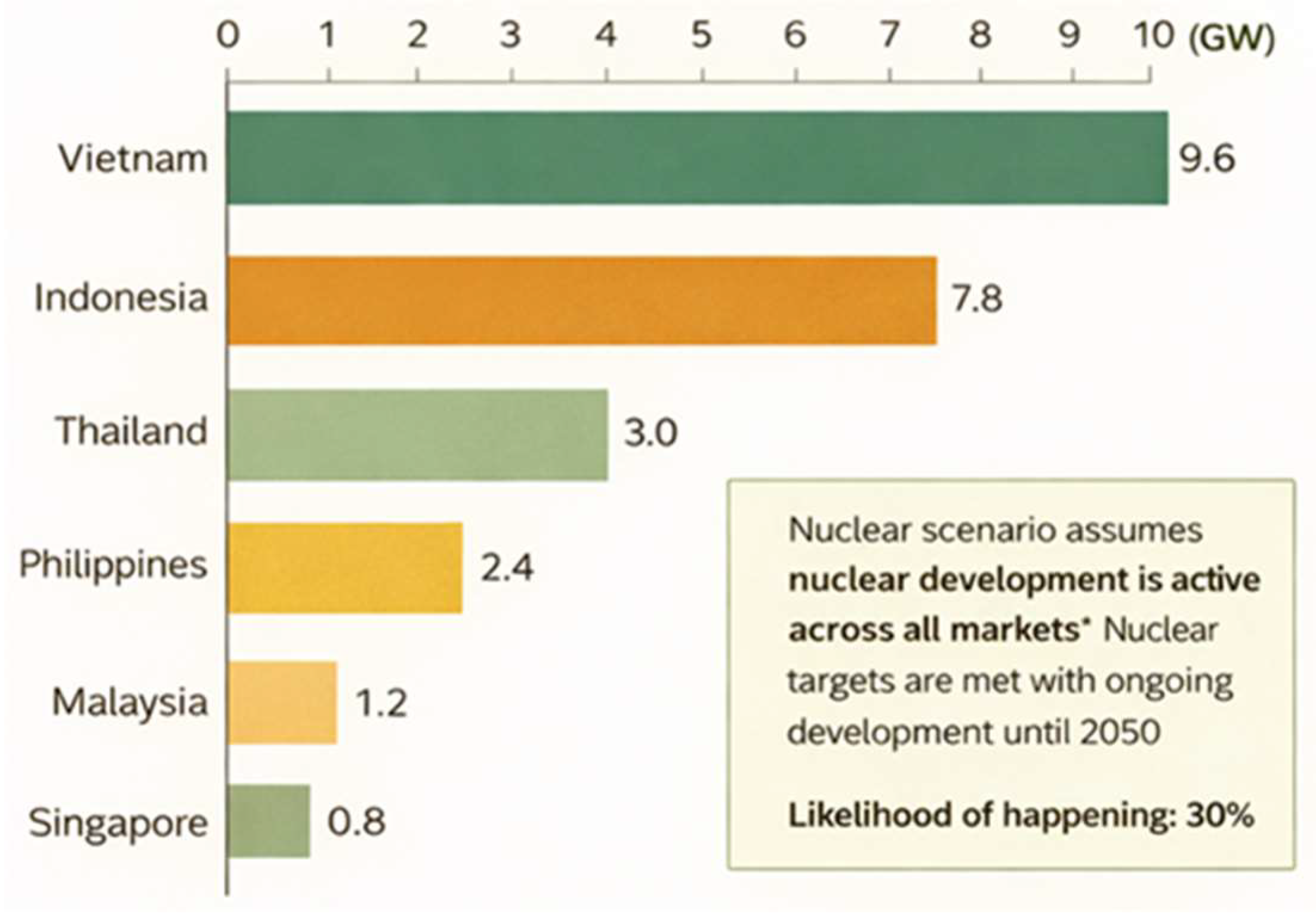
Figure 6 illustrates projected nuclear capacity under an active development scenario across selected Southeast Asian economies, assuming continued nuclear deployment through 2050. The projections indicate substantial potential capacity additions, particularly in Vietnam (9.6 GW) and Indonesia (7.8 GW), followed by Thailand (3.0 GW), the Philippines (2.4 GW), Malaysia (1.2 GW), and Singapore (0.8 GW). While the likelihood of full implementation is estimated at 30%, the scenario highlights the scale of latent nuclear demand that could emerge in non-traditional markets.
Several Southeast Asian countries illustrate this renewed momentum. Vietnam had suspended a major reactor project in 2016, but is now reconsidering nuclear power in its energy strategy. The Vietnamese government in 2022–2023 commissioned new feasibility studies on SMRs and included nuclear power as a potential option in its national Power Development Plan. Indonesia, which operates a research reactor but no power reactors, is also evaluating SMR technology for deployment in remote areas and industrial islands by the 2030s. Indonesian authorities have signed memoranda of understanding with international vendors to assess small reactor designs that could help replace diesel generation on outer islands. The Philippines, after decades of dormancy (its Bataan plant was never fueled), has taken concrete steps under President Marcos Jr. to move toward nuclear energy, including legislation to adopt IAEA safety standards and talks with U.S. and Korean firms about modular reactors. Even Thailand and Malaysia have quietly conducted pre-feasibility studies for nuclear in the longer term, focusing on SMRs as a way to incrementally add capacity. These developments show that, for many emerging economies in Southeast Asia, nuclear power is back on the agenda as part of a balanced energy mix. The strategic significance of this trend is twofold. First, if Southeast Asia proceeds with nuclear programs, it represents a new source of demand growth for uranium and fuel services, potentially tightening the global market over the next two decades. Second, it creates a new arena of competition for nuclear supplier countries: already, Japan, South Korea, China, Russia, and Western nations are courting ASEAN governments with offers of reactor technology and financing. The preferred turn to SMRs could also accelerate innovation and cost reduction in SMR designs as multiple projects get underway. In summary, Southeast Asia’s nuclear exploration exemplifies how emerging economies are pragmatically weighing all options to achieve energy security and decarbonization—a choice that may reshape regional power networks and introduce new stakeholders into the global nuclear enterprise [
49].
5.7. Russia
Russia occupies a uniquely influential position in the global nuclear fuel cycle, not primarily through uranium mining, but through its dominant share of downstream fuel services. Empirical assessments indicate that Russia contributes around 6% of global uranium production yet accounts for roughly 20% of conversion capacity and 46% of uranium enrichment capacity worldwide, with about 10% of nuclear fuel fabrication capacity located within Russian-controlled facilities [
9].
This disproportionate control of enrichment, a critical step in preparing fuel for reactors, gives Russia strategic leverage over fuel supply chains that are essential for operational nuclear fleets. Estimates suggest that Russia and its state-owned corporation Rosatom collectively control approximately 40–46% of global enrichment capacity, a structural concentration that far exceeds its share of mined uranium [
50].
Western dependence on Russian fuel services has been non-trivial. As recently as 2021, Russia supplied approximately 28% of uranium enrichment services used by U.S. utilities, while European utilities also relied on Russian enrichment and conversion at significant levels, even as efforts at diversification have progressed [
50].
The strategic implications of this concentration are multi-faceted: control over enrichment capacity not only influences the availability and pricing of nuclear fuel but also affects geopolitical calculations around energy security, sanctions policy, and supply-chain resilience. This dynamic has prompted policymakers in the U.S., EU, and Japan to pursue investments in domestic enrichment capacity and alternative supplier networks, aiming to mitigate the risks associated with heavy reliance on a single geopolitical actor.
5.8. Strategic Implications
The above regional analyses underscore that nuclear fuel dynamics are entering a new era of strategic importance. In each case, decisions about uranium, whether securing supply, diversifying sources, or building domestic capability, are intertwined with broader concerns of energy sovereignty, geopolitical alignment, and economic development. For instance, African countries asserting greater control over uranium may shift global supply chains and make access more contingent on bilateral ties or fair agreements. China’s burgeoning demand and investment strategy could concentrate a large share of uranium flows under its influence, affecting pricing and availability for others. The United States and Europe, by contrast, are treating uranium security as critical to their clean energy transitions and are forging new partnerships (with countries like Kazakhstan, Namibia, and Australia) to guard against supply shocks. Southeast Asia’s tentative entry into nuclear power could create new demand centers and opportunities for supplier nations to extend influence through reactor deals and fuel provision. Overall, the geopolitics of uranium now reflects a multipolar competition akin to that of oil and gas, but with the added overlay of non-proliferation and long-term climate goals. This complexity means that uranium policy, from mining investments to fuel stockpiling, will remain a key strategic issue for governments, directly linked to how the global energy system evolves in the coming decades.
The preceding regional analysis illustrates a wide spectrum of approaches to uranium governance, nuclear deployment, and supply-chain strategy. To synthesize these findings,
Table 4 categorizes the key geopolitical actors along three strategic dimensions: (i) net uranium trade position (importer vs. producer), (ii) level of control over upstream and downstream segments of the nuclear fuel cycle, and (iii) degree of geopolitical vulnerability, understood as exposure to supply disruptions or foreign dependency.
This comparative framework reveals distinct patterns. Major producers like Kazakhstan and Canada exhibit strong upstream control but limited downstream enrichment capacity, whereas regions such as the European Union and Southeast Asia rely heavily on imports and external processing services, resulting in higher systemic vulnerability. Hybrid strategies also emerge: China combines upstream investments (both domestic and abroad) with expansive downstream development, positioning itself as a vertically integrated actor. Meanwhile, countries like the United States are pursuing diversification and stockpiling to mitigate geopolitical risks, yet remain partially dependent on foreign enrichment.
Looking ahead, several geopolitical flashpoints and institutional responses are likely to shape uranium markets over the coming decades. Potential disruptions include renewed instability in key exporting regions, accelerated decoupling from Russian fuel-cycle services, and intensified competition for enrichment and advanced fuel capabilities such as HALEU. In response, governments and regional blocs are expected to expand strategic uranium stockpiles, support domestic conversion and enrichment capacity, and formalize fuel-supply alliances through long-term agreements and multilateral frameworks. Institutions such as the IAEA, alongside emerging fuel-bank and assurance mechanisms, may play an expanded role in mitigating supply risks while balancing non-proliferation objectives. Together, these developments suggest that uranium governance will increasingly resemble that of other critical strategic commodities, where market outcomes are shaped as much by institutional coordination and geopolitical alignment as by resource availability.
Taken together, the interaction between supply concentration, enrichment capacity constraints, differentiated SMR fuel requirements, and regional strategic positioning reveals a tightly coupled system rather than isolated market segments. High upstream concentration, particularly in Kazakhstan and a limited number of major producers, interacts with downstream bottlenecks in enrichment and conversion, especially in the context of HALEU-dependent reactor designs. As advanced SMR concepts increase reliance on higher-assay fuels, front-end fuel-cycle constraints may amplify the strategic leverage of actors controlling enrichment infrastructure. These technical dependencies are reflected in regional policy responses: the United States prioritizes domestic HALEU production to reduce vulnerability; the European Union seeks diversification away from Russian fuel-cycle services; China pursues vertical integration across mining, enrichment, and reactor deployment; and Kazakhstan reassesses its role beyond raw uranium exports. The strategic significance of uranium thus emerges not from any single dimension, but from the interaction of geological concentration, fuel-cycle technology, and geopolitical realignment.
7. Conclusions
This review demonstrates that uranium has re-emerged as a strategically critical resource in the global energy transition, driven by the convergence of climate imperatives, energy security concerns, and technological innovation in nuclear power. Quantitatively, the analysis shows that current uranium supply remains highly concentrated and structurally constrained: approximately 90% of global reactor demand is now met by primary mining, with Kazakhstan alone accounting for more than 40% of global production. Mine output has only recently returned to levels approaching total demand, while long development timelines for new projects raise the risk of structural supply deficits in the 2030s. At the same time, uranium prices have entered a new regime, rising from historic lows to multi-year highs, signaling tighter market conditions and renewed investment incentives.
From a technological standpoint, the expansion of small modular reactors and advanced high-temperature systems represents a qualitative shift in nuclear energy deployment. Although SMRs may require up to 40–45% more uranium per unit of electricity than large conventional reactors, their modularity, enhanced safety, and flexibility enable nuclear power to penetrate previously inaccessible markets, including small grids, remote regions, and industrial energy systems. Advanced reactors further extend uranium’s strategic value by enabling non-electrical applications, particularly low-carbon hydrogen production, where nuclear-derived hydrogen has been shown to achieve competitive production costs while offering superior reliability compared to renewable-only pathways.
Geopolitically, the review highlights a global realignment of uranium supply chains. Major consumers such as the United States and the European Union are increasingly treating uranium as a critical material, pursuing diversification strategies, strategic stockpiles, and domestic fuel-cycle capabilities. China’s rapid nuclear expansion and overseas investment strategy are reshaping global uranium flows, while producing regions such as Central Asia and Africa are asserting greater control over resources to capture more value and strengthen national energy sovereignty. Emerging nuclear interest in Southeast Asia represents an additional source of long-term demand growth, further reinforcing the strategic importance of uranium.
Overall, the findings indicate that uranium markets are transitioning from a long period of oversupply to a structurally tighter and more geopolitically sensitive regime. The central conclusion of this work is that uranium can no longer be analyzed solely as a commodity subject to cyclical price movements; instead, it must be understood as a foundational enabler of secure, low-carbon energy systems and industrial decarbonization pathways. Effective policy coordination, sustained investment in mining and fuel-cycle infrastructure, and integration of nuclear energy with renewables and hydrogen systems will be essential to ensure that the revival of nuclear power strengthens global energy security rather than introducing new vulnerabilities. Thus, navigating this new paradigm will ultimately require enhanced international cooperation across governments, industry, and institutions to ensure that uranium supply chains remain secure, resilient, and aligned with long-term climate and energy transition goals.