
Predicting ESG Scores Using Machine Learning for Data-Driven Sustainable Investment



Abstract
1. Introduction
1.1. Background and Motivation
1.2. Role of ESG in Sustainable Finance
1.3. Research Problems and Objectives
- Development and independent verification of ML architectures capable of deriving ESG ratings from a comprehensive suite of corporate and financial data.
- Synthesis of heterogeneous and, to some extent, real-time data reservoirs, including, for the first time, innovative environmental indices, in order to elevate the granularity and robustness of the prediction.
- Enablement of sustainable investment decision-making through the generation of more transparent, harmonized and data-driven ESG evaluations.
1.4. Contributions of This Study
2. Literature Review
2.1. ESG Scoring and Sustainable Finance
2.2. Applications of Machine Learning in ESG Prediction
2.3. Gaps in Existing Research
2.4. Research Positioning
3. Research Framework
3.1. Conceptual Model
3.2. Research Hypotheses
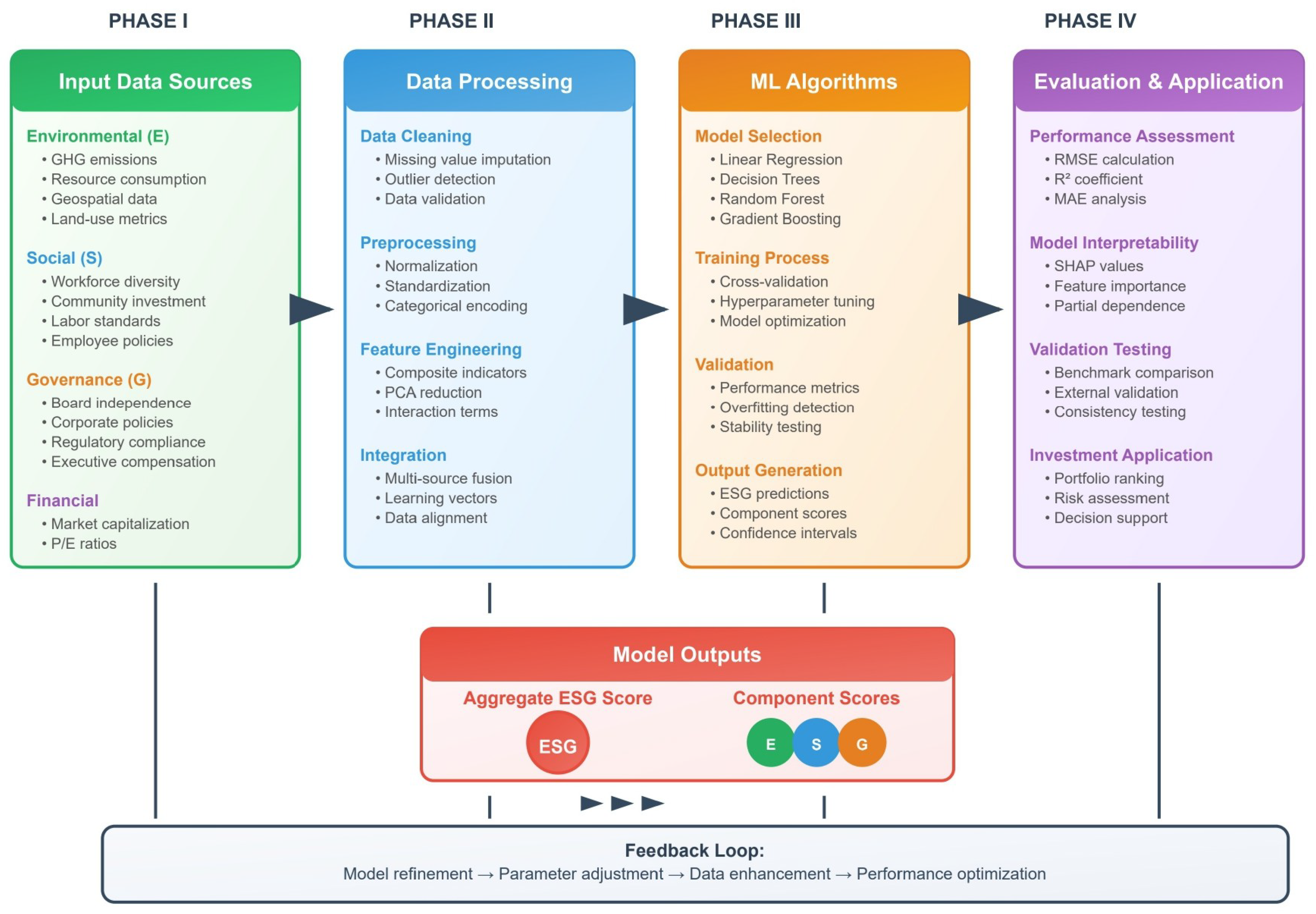
3.3. Workflow Overview
4. Materials and Methods
4.1. Dataset Collection
4.2. Data Pre-Processing and Feature Engineering
4.2.1. Exploratory Data Analysis (EDA)
4.2.2. Missing Value Imputation
4.2.3. Feature Encoding
4.2.4. Feature Scaling (Normalization)
4.2.5. Train–Test Split
4.3. Model Development and Evaluation Framework
4.3.1. Selection of Base Machine Learning Models
4.3.2. Hyperparameter Tuning
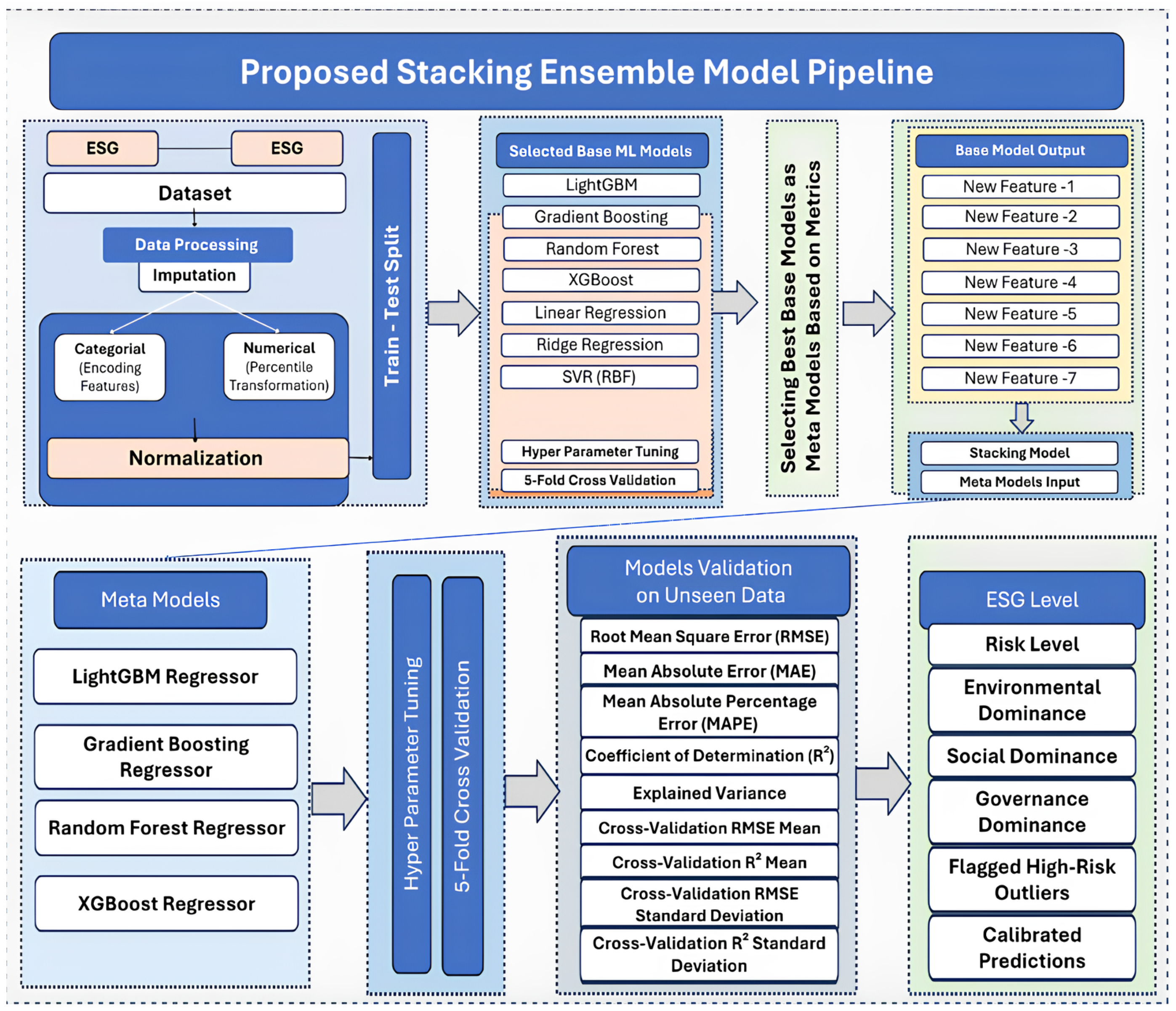
4.4. Stacked Ensemble Learning Model (Proposed Approach)
4.4.1. Level-0: Base-Learners (First-Layer Models)
4.4.2. Level-1: Meta-Learner (Second-Layer Model)
5. Experimental Results
5.1. Evaluation Metrics Used
5.2. Performance of the Models
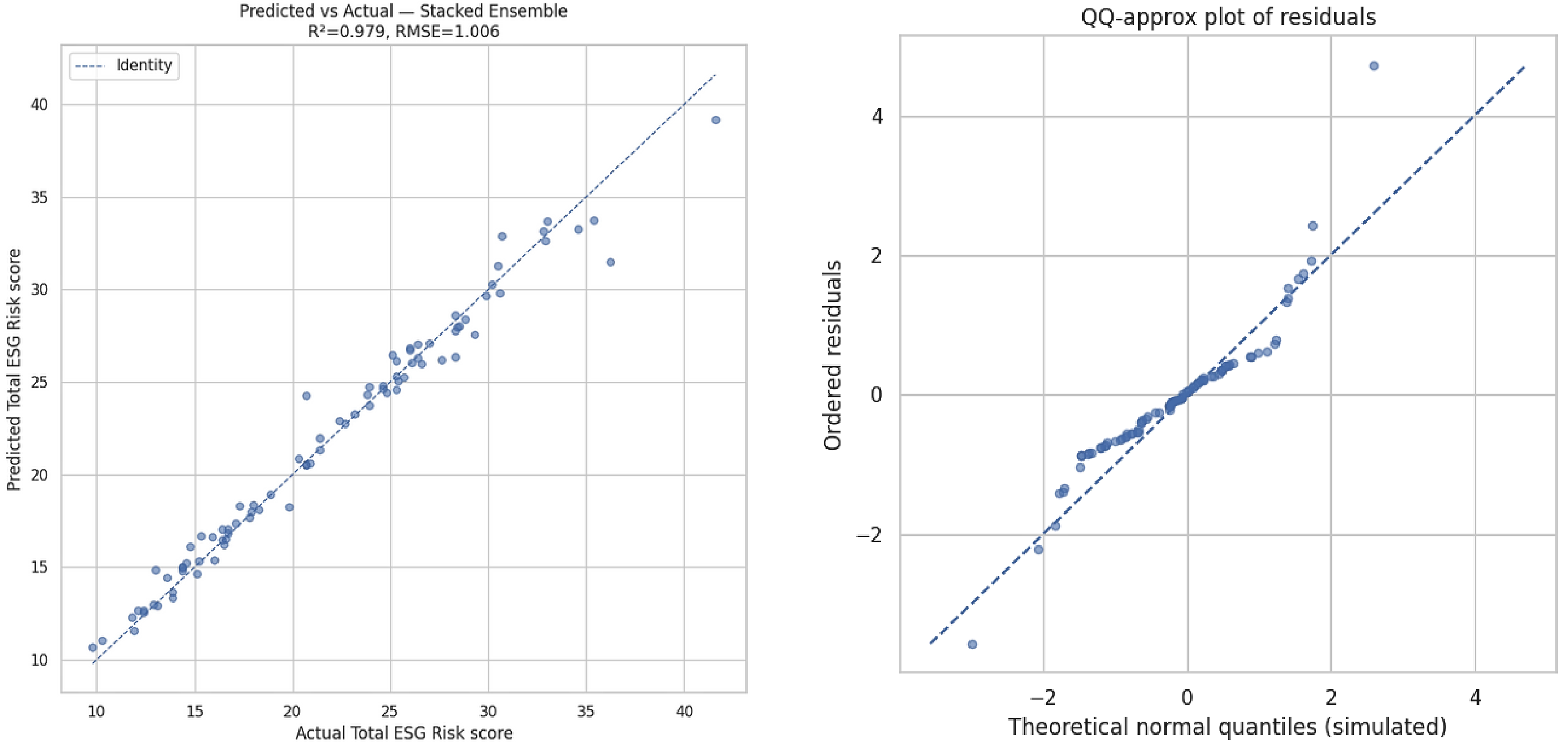
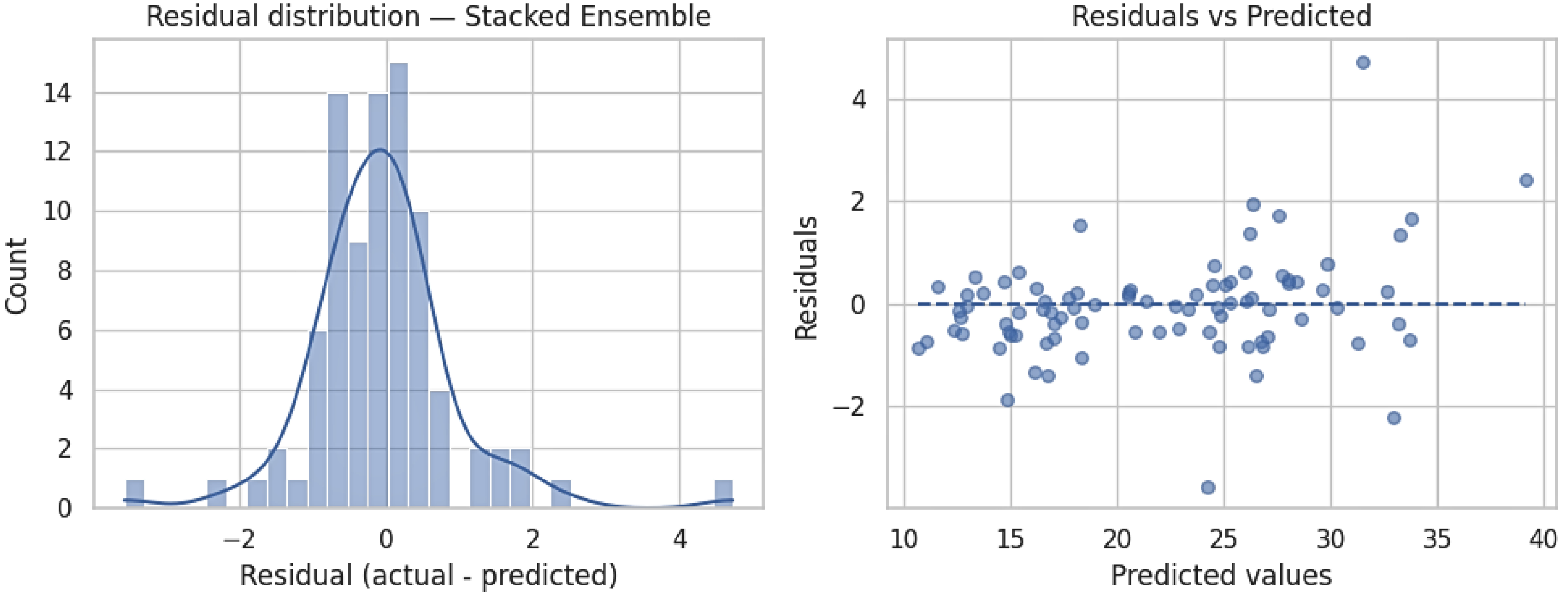
5.3. Error Distribution and Model Calibration Assessment
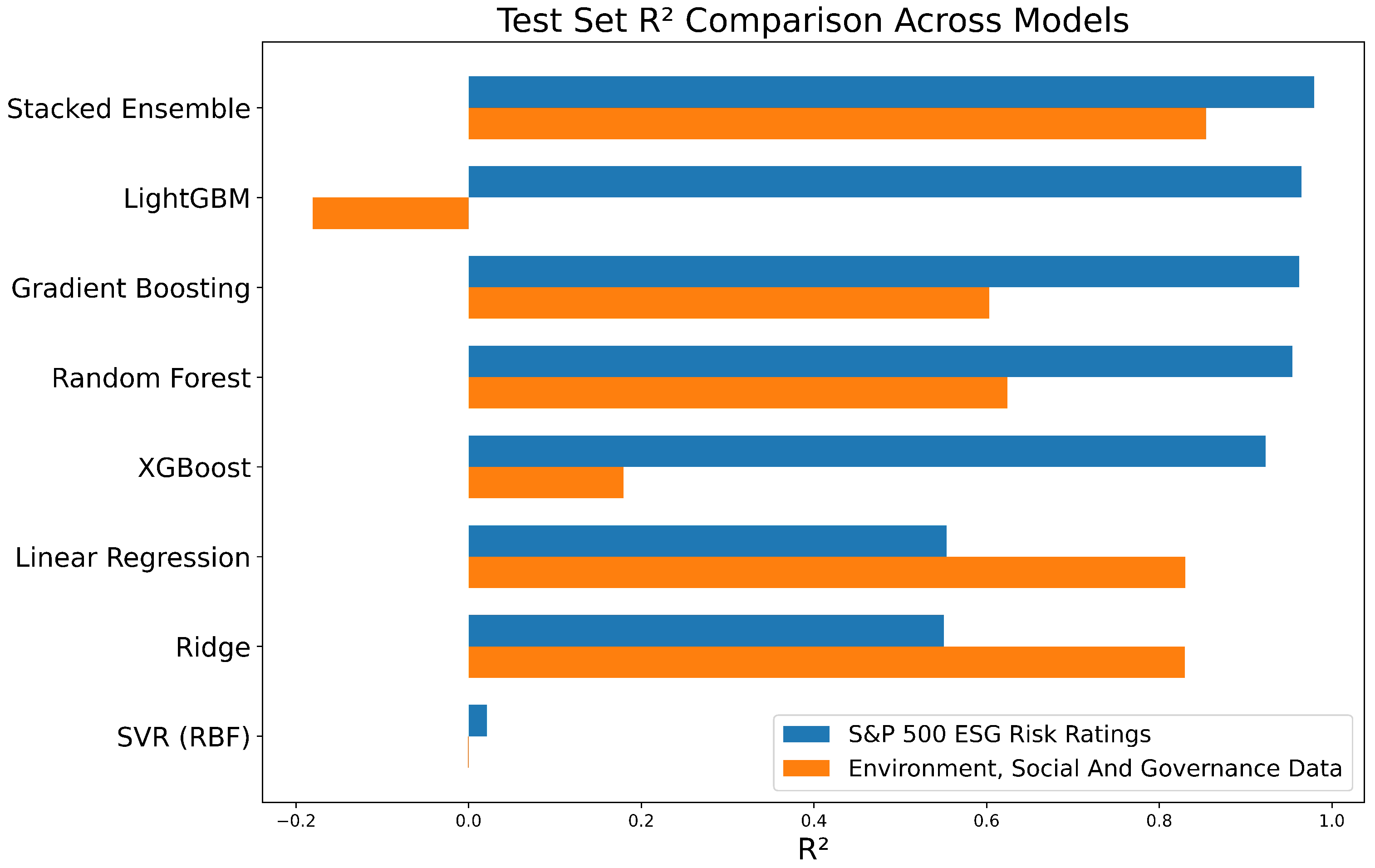
5.4. Comparative Explanatory Power of Regression Models
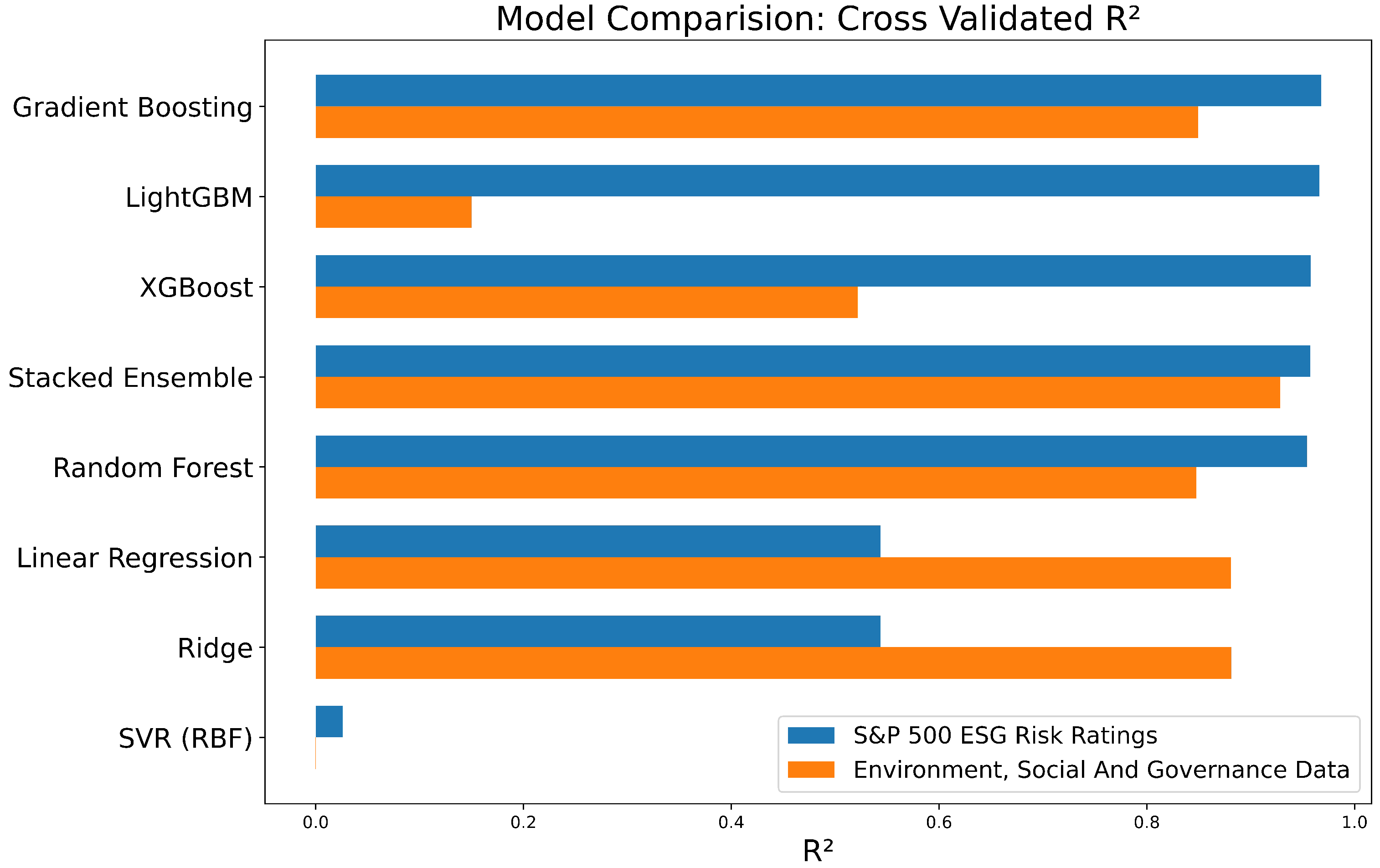
5.5. Cross-Validation Results Confirming Model Stability
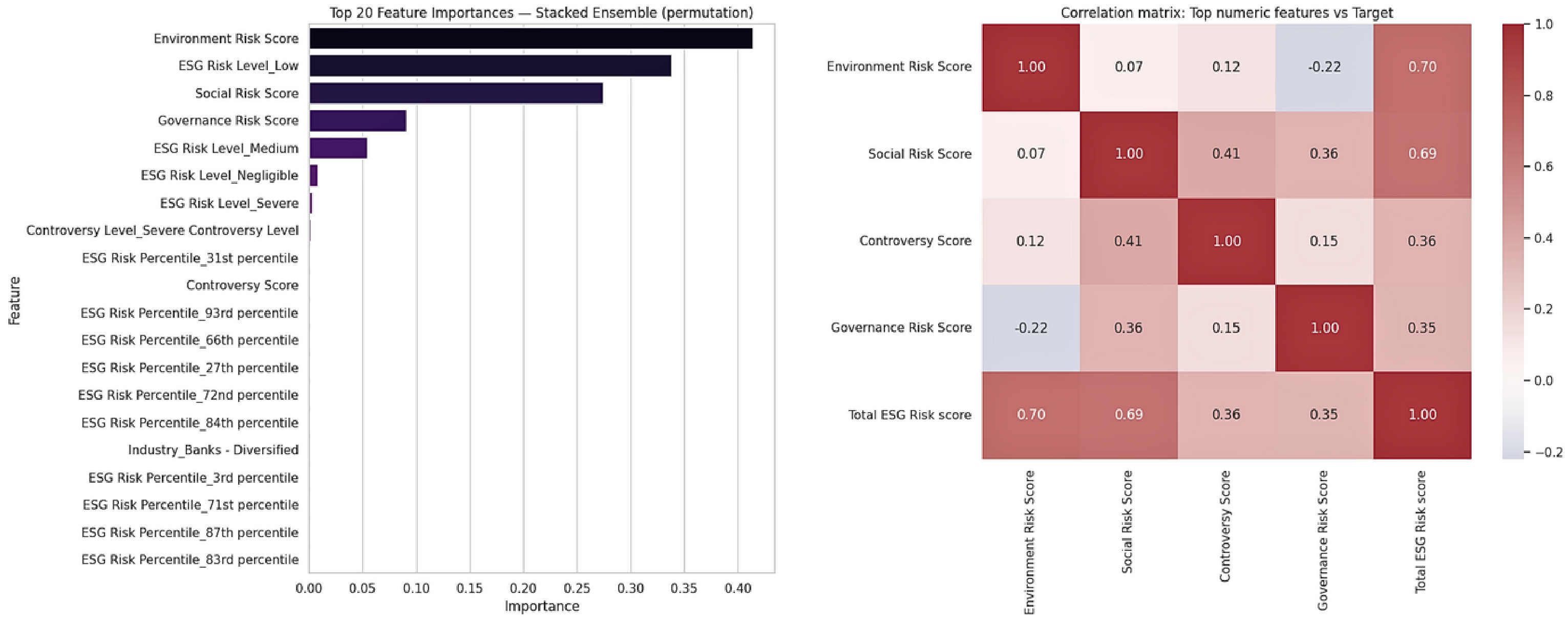
5.6. Feature Importance and Correlation Insights
5.7. Practical Implications
5.8. Comparative Performance with Prior Studies
5.9. Firm-Level Illustrative Explanation and Decision Usefulness
6. Conclusions
Author Contributions
Funding
Data Availability Statement
Conflicts of Interest
Abbreviations
| ESG | Environmental, social and governance |
| S&P 500 | Standard & Poor’s 500 Index |
| ML | Machine learning |
| AI | Artificial intelligence |
| RMSE | Root mean square error |
| MAE | Mean absolute error |
| MAPE | Mean absolute percentage error |
| R2 | Coefficient of determination (R-squared) |
| CV | Cross-validation |
| k-fold | k-fold cross-validation |
| CV_RMSE_Mean | Mean cross-validated RMSE |
| Mean cross-validated R2 | |
| LightGBM | Light gradient boosting machine |
| GBM | Gradient boosting machine |
| CSR | Corporate social responsibility |
| SRI | Socially responsible investment |
| EU | European Union |
| KDD | Knowledge discovery and data mining |
| ACM | Association for Computing Machinery |
| IEEE | Institute of Electrical and Electronics Engineers |
References
- Apergis, N.; Poufinas, T.; Antonopoulos, A. ESG scores and cost of debt. Energy Econ. 2022, 112, 106186. [Google Scholar] [CrossRef] [Scilit]
- Clément, A.; Robinot, É.; Trespeuch, L. Improving ESG Scores with Sustainability Concepts. Sustainability 2022, 14, 13154. [Google Scholar] [CrossRef] [Scilit]
- Xiao, R.; Deng, J.; Zhou, Y.; Chen, M. Analyzing Contemporary Trends in Sustainable Finance and ESG Investment. Law Econ. 2023, 2, 44–52. Available online: https://www.paradigmpress.org/le/article/view/867 (accessed on 15 October 2025). [CrossRef] [Scilit]
- Bifulco, G.M.; Savio, R.; Paolone, F.; Tiscini, R. The CSR committee as moderator for the ESG score and market value. Corp. Soc. Responsib. Environ. Manag. 2023, 30, 3231–3241. [Google Scholar] [CrossRef] [Scilit]
- Sciarelli, M.; Cosimato, S.; Landi, G.; Iandolo, F. Socially responsible investment strategies for the transition towards sustainable development: The importance of integrating and communicating ESG. TQM J. 2021, 33, 39–56. [Google Scholar] [CrossRef] [Scilit]
- Senadheera, S.S.; Withana, P.A.; Dissanayake, P.D.; Sarkar, B.; Chopra, S.S.; Rhee, J.H.; Ok, Y.S. Scoring environment pillar in environmental, social, and governance (ESG) assessment. Sustain. Environ. 2021, 7, 1960097. [Google Scholar] [CrossRef] [Scilit]
- Clément, A.; Robinot, É.; Trespeuch, L. The use of ESG scores in academic literature: A systematic literature review. J. Enterp. Communities People Places Glob. Econ. 2023, 19, 92–110. [Google Scholar] [CrossRef] [Scilit]
- Dumrose, M.; Rink, S.; Eckert, J. Disaggregating confusion? The EU Taxonomy and its relation to ESG rating. Financ. Res. Lett. 2022, 48, 102928. [Google Scholar] [CrossRef] [Scilit]
- Li, S.; Xu, X.; Zhu, F. Can heterogeneous environmental policies mitigate ESG divergence?—Based on corporate green innovation and bleaching green behavioral options. Sustain. Future 2024, 8, 100351. [Google Scholar] [CrossRef] [Scilit]
- Binzaiman, F.; Edhrabooh, K.M.; Alromaihi, M.; AlShammari, M. Predicting Environmental, Social, and Governance Scores with Machine Learning: A Systematic Literature Review. In Proceedings of the 2024 5th International Conference on Data Analysis and Business Intelligence (ICDABI 2024), Zallaq, Bahrain, 23–24 October 2024; pp. 117–122. [Google Scholar] [CrossRef] [Scilit]
- Rossi, C.; Byrne, J.G.D.; Christiaen, C. Breaking the ESG rating divergence: An open geospatial framework for environmental scores. J. Environ. Manag. 2024, 349, 119477. [Google Scholar] [CrossRef] [Scilit]
- Gupta, S.; Agarwal, S. Applications of Machine Learning and Artificial Intelligence in Environmental, Social and Governance (ESG) Sector. In Proceedings of the 3rd International Conference on Optimization Techniques and Future Engineering, Tamilnadu, India, 23–24 October 2024. [Google Scholar] [CrossRef] [Scilit]
- Sepetis, A.; Rizos, F.; Pierrakos, G.; Karanikas, H.; Schallmo, D. A Sustainable Model for Healthcare Systems: The Innovative Approach of ESG and Digital Transformation. Healthcare 2024, 12, 156. [Google Scholar] [CrossRef] [Scilit] [PubMed]
- Pritish509. S&P 500 ESG Risk Ratings; Kaggle Dataset. Available online: https://www.kaggle.com/datasets/pritish509/s-and-p-500-esg-risk-ratings (accessed on 5 October 2025).
- Tunguz, B. Environment, Social and Governance Data; Kaggle Dataset. Available online: https://www.kaggle.com/datasets/tunguz/environment-social-and-governance-data (accessed on 16 December 2025).
- Nijman, S.W.J.; Groenhof, T.K.J.; Hoogland, J.; Bots, M.L.; Brandjes, M.; Jacobs, J.J.L.; Asselbergs, F.W.; Moons, K.G.M.; Debray, T.P.A. Real-time imputation of missing predictor values improved the application of prediction models in daily practice. J. Clin. Epidemiol. 2021, 134, 22–34. [Google Scholar] [CrossRef] [Scilit] [PubMed]
- Makhijani, P.; Nath, A.; Vakani, H.; Mistry, M.; Koradiya, H.; Jayswal, H.S.; Chaudhari, J.P.; Patel, A.; Dubey, N. Lime Diseases Classification Using Machine Learning and Spectrometry. In Information Systems for Intelligent Systems, ISBM 2024; Londhe, N.S., Bhatt, N., Kitsing, M., Eds.; Springer Nature: Singapore, 2025; pp. 405–414. [Google Scholar] [CrossRef] [Scilit]
- Desai, S.; Ouarda, T.B.M.J. Regional hydrological frequency analysis at ungauged sites with random forest regression. J. Hydrol. 2021, 594, 125861. [Google Scholar] [CrossRef] [Scilit]
- Sprangers, O.; Schelter, S.; de Rijke, M. Probabilistic Gradient Boosting Machines for Large-Scale Probabilistic Regression. In Proceedings of the 27th ACM SIGKDD Conference on Knowledge Discovery & Data Mining (KDD 2021), Singapore, 14–18 August 2021; ACM: New York, NY, USA, 2021; pp. 1510–1520. [Google Scholar] [CrossRef] [Scilit]
- Lartey, B.; Homaifar, A.; Girma, A.; Karimoddini, A.; Opoku, D. XGBoost: A tree-based approach for traffic volume prediction. In Proceedings of the 2021 IEEE International Conference on Systems, Man, and Cybernetics (SMC 2021), Melbourne, Australia, 17–20 October 2021; pp. 1280–1286. [Google Scholar] [CrossRef] [Scilit]
- Zhang, F.; O’Donnell, L.J. Chapter 7—Support vector regression. In Machine Learning; Mechelli, A., Vieira, S.B.T.-M.L., Eds.; Academic Press: Cambridge, MA, USA, 2020; pp. 123–140. [Google Scholar]
- Anand, P.; Rastogi, R.; Chandra, S. A class of new Support Vector Regression models. Appl. Soft Comput. 2020, 94, 106446. [Google Scholar] [CrossRef] [Scilit]
- Malakar, A.; Kumar, A.; Vyas, S. Comparative Study of Proposed linear regression algorithm to Scikit-Learn Algorithm. In Proceedings of the 2023 10th IEEE Uttar Pradesh Section International Conference on Electrical, Electronics and Computer Engineering (UPCON 2023), Gautam Buddha Nagar, India, 1–3 December 2023; pp. 301–304. [Google Scholar] [CrossRef] [Scilit]
- Magklaras, A.; Gogos, C.; Alefragis, P.; Birbas, A. Enhancing Parameters Tuning of Overlay Models with Ridge Regression: Addressing Multicollinearity in High-Dimensional Data. Mathematics 2024, 12, 3179. [Google Scholar] [CrossRef] [Scilit]
- Tarekegn, A.N.; Michalak, K.; Giacobini, M. Cross-Validation Approach to Evaluate Clustering Algorithms: An Experimental Study Using Multi-Label Datasets. SN Comput. Sci. 2020, 1, 263. [Google Scholar] [CrossRef] [Scilit]
- Wager, S. Cross-Validation, Risk Estimation, and Model Selection: Comment on a Paper by Rosset and Tibshirani. J. Am. Stat. Assoc. 2020, 115, 157–160. [Google Scholar] [CrossRef] [Scilit]
- Hodson, T.O. Root-mean-square error (RMSE) or mean absolute error (MAE): When to use them or not. Geosci. Model Dev. 2022, 15, 5481–5487. [Google Scholar] [CrossRef] [Scilit]
- Amar, S.; Sudiarso, A.; Herliansyah, M.K. The Accuracy Measurement of Stock Price Numerical Prediction. J. Phys. Conf. Ser. 2020, 1569, 032027. [Google Scholar] [CrossRef] [Scilit]
- Wang, Z.; Wang, X.; Liu, X.; Zhang, J.; Xu, J.; Ma, J. A Novel Stacked Generalization Ensemble-Based Hybrid SGM-BRR Model for ESG Score Prediction. Sustainability 2024, 16, 6979. [Google Scholar] [CrossRef] [Scilit]
- Schrauf, M.F.; de los Campos, G.; Munilla, S. Comparing Genomic Prediction Models by Means of Cross Validation. Front. Plant Sci. 2021, 12, 734512. [Google Scholar] [CrossRef] [Scilit] [PubMed]
- Lin, H.-Y.; Hsu, B.-W. Empirical Study of ESG Score Prediction through Machine Learning—A Case of Non-Financial Companies in Taiwan. Sustainability 2023, 15, 14106. [Google Scholar] [CrossRef] [Scilit]
- Alsayyad, M.; Fadel, S.M. Predicting ESG Scores Using Firms’ Financial Indicators: A Machine Learning Regression Approach. Preprints 2025. [Google Scholar] [CrossRef] [Scilit]
- Jiang, X. Predicting Corporate ESG Scores Using Machine Learning: A Comparative Study. Adv. Econ. Manag. Political Sci. 2024, 118, 141–147. [Google Scholar] [CrossRef] [Scilit]
- Krappel, T.; Bogun, A.; Borth, D. Heterogeneous Ensemble for ESG Ratings Prediction. arXiv 2021, arXiv:2109.10085. [Google Scholar] [CrossRef] [Scilit]
- Zeng, F.; Wang, J.; Zeng, C. An Optimized Machine Learning Framework for Predicting and Interpreting Corporate ESG Greenwashing Behavior. PLoS ONE 2025, 20, e0316287. [Google Scholar] [CrossRef] [Scilit]



| Model | Key Hyperparameters Tuned | Typical Search Range | Purpose |
|---|---|---|---|
| Linear Regression | No hyperparameters to tune | - | Serves as a baseline linear model to evaluate other regressors. |
| Ridge Regression | alpha | 0.001–10 | Controls regularization strength; higher values reduce model complexity and multicollinearity. |
| Random Forest Regressor | n_estimators, max_depth, min_samples_split, min_samples_leaf, max_features | (100–500), (5–30), (2–10), (1–5), (‘auto’, ‘sqrt’) | Controls tree size and ensemble diversity. |
| Gradient Boosting Regressor | learning_rate, n_estimators, max_depth, subsample | (0.01–0.1), (100–500), (3–10), (0.6–1.0) | Balances learning rate and model complexity. |
| XGBoost Regressor | learning_rate, n_estimators, max_depth, gamma, lambda, colsample_bytree | (0.01–0.1), (100–500), (3–12), (0–1), (0–1), (0.5–1.0) | Incorporates regularization and feature sampling. |
| LightGBM Regressor | num_leaves, learning_rate, n_estimators, max_depth, feature_fraction, bagging_fraction | (20–80), (0.01–0.1), (100–500), (3–12), (0.6–1.0), (0.6–1.0) | Optimizes tree complexity, feature sampling and learning speed for faster, efficient boosting. |
| Support Vector Regressor (SVR) | C, epsilon, gamma, kernel | (0.1–100), (0.01–1.0), (‘scale’, ‘auto’), (‘rbf’) | Adjusts trade-off between margin width and error tolerance. |
| Component | Parameter(s) | Typical Range/Options | Purpose |
|---|---|---|---|
| Meta-model (final estimator) | Model type (e.g., Linear, Ridge, SVR, XGB) | Linear, Ridge( = 0.01–10), SVR(C = 0.1–10), XGB(learning_rate = 0.01–0.1) | Determines how base model outputs are integrated. |
| Cross-validation folds (cv) | Number of splits for base model stacking | (3, 5, 10) | Affects stability of meta-features and overfitting risk. |
| Passthrough setting | Passthrough | (True, False) | If True, concatenates original features with base predictions for meta-model input. |
| Base model selection | Number of top-performing models | (2–5) | Excludes weak base-learners to reduce noise. |
| Stacking depth (optional) | Layers of meta-learning | (1, 2) | Adds a second-level meta-model to capture higher-order residuals. |
| Model | RMSE | MAE | MAPE | Explained-Var | CV_RMSE _Mean | CV_RMSE _STD | _Mean | _STD | |
|---|---|---|---|---|---|---|---|---|---|
| Stacked Ensemble | 1.0061 | 0.6638 | 0.0313 | 0.9794 | 0.9794 | 1.3831 | 0.3617 | 0.9572 | 0.0196 |
| LightGBM | 1.3178 | 0.8278 | 0.0349 | 0.9646 | 0.9647 | 1.2512 | 0.1043 | 0.9659 | 0.0067 |
| Gradient Boosting | 1.3639 | 0.8583 | 0.0387 | 0.9621 | 0.9621 | 1.2115 | 0.1000 | 0.9679 | 0.0068 |
| Random Forest | 1.4978 | 1.1223 | 0.0540 | 0.9543 | 0.9543 | 1.4636 | 0.1277 | 0.9540 | 0.0049 |
| XGBoost | 1.9414 | 1.1122 | 0.0585 | 0.9232 | 0.9255 | 1.3824 | 0.2969 | 0.9577 | 0.0178 |
| Linear Regression | 4.6814 | 3.9054 | 0.1984 | 0.5536 | 0.5564 | 4.6265 | 0.4131 | 0.5436 | 0.0130 |
| Ridge | 4.6970 | 3.9232 | 0.2002 | 0.5506 | 0.5526 | 4.6277 | 0.4192 | 0.5435 | 0.0140 |
| SVR (RBF) | 6.9311 | 5.8818 | 0.2946 | 0.0214 | 0.0418 | 6.7552 | 0.5569 | 0.0262 | 0.0154 |
| Model | RMSE | MAE | MAPE | R2 | Explained-Var | CV_RMSE _Mean | CV_RMSE _STD | _Mean | _STD |
|---|---|---|---|---|---|---|---|---|---|
| Stacked Ensemble | 1.3272 | 1.1123 | 1.9487 | 0.8542 | 0.8544 | 1.7752 | 0.3986 | 0.9285 | 0.0605 |
| LightGBM | 2.9086 | 2.9468 | 1.1039 | −0.1806 | −0.1786 | 4.5984 | 1.0103 | 0.1500 | 0.5044 |
| Gradient Boosting | 1.6858 | 1.2290 | 9.7966 | 0.6034 | 0.6034 | 1.8465 | 0.3910 | 0.8496 | 0.1248 |
| Random Forest | 1.6404 | 1.2307 | 3.9136 | 0.6244 | 0.6244 | 1.8403 | 0.3996 | 0.8476 | 0.1138 |
| XGBoost | 2.4246 | 1.6784 | 8.0082 | 0.1795 | 0.1809 | 3.3467 | 0.8584 | 0.5219 | 0.2776 |
| Linear Regression | 1.1029 | 0.9525 | 1.7885 | 0.8302 | 0.8306 | 1.2353 | 0.2017 | 0.8810 | 0.0600 |
| Ridge | 1.1049 | 0.9163 | 1.2794 | 0.8296 | 0.8299 | 1.2275 | 0.2071 | 0.8813 | 0.0604 |
| SVR (RBF) | 2.6778 | 2.2908 | 1.7458 | −0.0008 | 0.0000 | 5.8501 | 2.4179 | −0.0004 | 0.0003 |
| Study | Dataset/Scope | Methodology | Target Variable | Reported R2 |
|---|---|---|---|---|
| H.-Y. Lin & B.-W. Hsu (2023) [31] | Taiwanese non-financial firms (2018–2021), 27 financial/corporate features | RF, ELM, SVM, XGBoost | Taiwan ESG Sustainable Development Index | R2 reported (varies by model; XGBoost inconsistent with RMSE) |
| M. Alsayyad & S. M. Fadel (2025) [32] | 497 oil & gas firms (2010–2022) | 10 ML models including XGBoost, RF, LightGBM | ESG Score (LSEG/Refinitiv) | Best R2 ≈ 0.922 |
| Xuran Jiang (2024) [33] | Corporate ESG scores (various firms) | Linear, Random Forest, Gradient Boosting | ESG Score | R2 ≈ 0.386 |
| T. Krappel et al. (2021) [34] | Fundamental data for ESG ratings | Heterogeneous ensemble (NN + CatBoost + XGBoost) | ESG Ratings | R2 ≈ 0.54 |
| Zeng et al. (2025) [35] | Bloomberg & Wind ESG ratings | Optimized ML framework | ESG disclosure & performance | R2 = 0.97 |
| Proposed Stacked Ensemble | S&P 500 firms | Two-level stacked ensemble | Total ESG Risk Score | R2 ≈ 0.98 (ensemble) |
Disclaimer/Publisher’s Note: The statements, opinions and data contained in all publications are solely those of the individual author(s) and contributor(s) and not of MDPI and/or the editor(s). MDPI and/or the editor(s) disclaim responsibility for any injury to people or property resulting from any ideas, methods, instructions or products referred to in the content. |
© 2026 by the authors. Licensee MDPI, Basel, Switzerland. This article is an open access article distributed under the terms and conditions of the Creative Commons Attribution (CC BY) license.
Share and Cite
Patel, S.; Nath, A.; Desai, P. Predicting ESG Scores Using Machine Learning for Data-Driven Sustainable Investment. Analytics 2026, 5, 7. https://doi.org/10.3390/analytics5010007
Patel S, Nath A, Desai P. Predicting ESG Scores Using Machine Learning for Data-Driven Sustainable Investment. Analytics. 2026; 5(1):7. https://doi.org/10.3390/analytics5010007
Chicago/Turabian StylePatel, Sanskruti, Abhay Nath, and Pranav Desai. 2026. "Predicting ESG Scores Using Machine Learning for Data-Driven Sustainable Investment" Analytics 5, no. 1: 7. https://doi.org/10.3390/analytics5010007
APA StylePatel, S., Nath, A., & Desai, P. (2026). Predicting ESG Scores Using Machine Learning for Data-Driven Sustainable Investment. Analytics, 5(1), 7. https://doi.org/10.3390/analytics5010007