1. Introduction
Nowadays, photovoltaic (PV) systems are seen as a potential replacement for fossil fuels as a clean energy source, and solar photovoltaic (PV) technology is one of the fastest-growing renewable energy sources worldwide [
1,
2]. Large-scale solar power systems, or utility-scale photovoltaic (PV) technology, are emerging in vast, open areas with abundant sunlight, making these locations ideal for large-scale solar projects [
3]. Site selection is an important issue for solar photovoltaic (PV) systems, and it is very important to consider various factors in selecting a suitable site for a solar PV system, including solar potential, sunshine duration, PV surface slope, temperature gradient, airflow speed, level of dust haze, humidity ratio, government assistance and policies, climate, soil texture, proximity to the grid network, roads, and residential areas, as well as suitable water resources [
4]. It is also advisable to carefully assess various social and environmental impacts, including wildlife habitat, the presence of protected areas, and local community concerns, and in regions where land availability is limited, it is essential to choose a site that balances the potential for energy production with the need to minimize environmental disturbance. Additionally, during the site selection process, it is important to account for the possibility of future expansion and ease of maintenance access. Therefore, the selection of suitable sites is an important step in the development of solar energy projects, which lays the foundation for efficient, cost-effective, and sustainable energy production, increases the long-term performance and economic feasibility of the enterprise, and maximizes energy production while minimizing environmental impact.
Mukherjee, A. K. et al. [
5] conducted a comparative study on various renewable energy sources and evaluated the optimal renewable energy sources considering multiple criteria. Based on the evaluation, solar energy was the second most optimal renewable energy source for sustainable development. That study motivated us to study the solar energy domain. Further, Dinçer, S. [
6] studied the energy crisis worldwide and the development of a sustainable environment. Kishore, T. S. et al. [
7] provided a review of the sustainability of solar energy, focusing on its importance and impact in the global context.
This study targets India, which has strong potential for solar energy generation due to its diverse geography and favourable solar PV conditions [
8]. Since selecting a suitable location for a solar project is a complex process and the geographical structure of different regions in India varies, the decision-making process must also be region-based. The study aims to propose an effective decision-making process for setting up PV plants in India that balances power generation, environmental conservation, and economic development to support renewable energy targets and sustainable growth.
Solar PV site selection problems can be solved using various MCDM methods that evaluate multiple criteria, including solar potential, terrain, climate, environmental impact, and proximity to infrastructure [
9]. Integration with GIS allows these methods to provide more accurate suitability assessments [
10,
11]. Overall, MCDM techniques make the PV site selection process systematic, unbiased, and highly reliable. This study uses the CRITIC and VIKOR methods to select solar power plant sites across different regions of India, evaluating 12 criteria and considering Rajasthan, Uttar Pradesh, Andhra Pradesh, Tamil Nadu, Karnataka, Maharashtra, Gujarat, and West Bengal as alternatives. MCDM methods help prioritise conflicting criteria during site selection. The selection of a suitable location for installing a solar PV power plant depends on various criteria (as discussed above). But in practice, it is difficult to obtain precise data on these because factors such as airflow speed, radiation, dust haze levels, and labour availability are variable. We note that these criteria involve greater uncertainty that cannot be effectively captured by simpler fuzzy sets. They do not separately account for non-membership, which limits their ability to model incomplete or ambiguous information. Therefore, pentagonal intuitionistic fuzzy numbers are used to represent these criteria more comprehensively, including both membership and non-membership degrees, which allows uncertainty to be handled within a mathematical framework. By combining the pentagonal intuitionistic fuzzy set (PIFS) with MCDM, the study improves decision-making, providing a more accurate and flexible method for solar PV site selection than conventional models.
1.1. Motivation for This Study
India has enormous potential for solar energy due to its diverse geography and high solar radiation. However, selecting a suitable location for a solar PV power plant is very challenging because of variations in climate, solar radiation, infrastructure, dust and fog levels, wind speed, labour availability, and socio-economic factors. Traditional site selection methods often fail to address the inherent uncertainties and complexities of this multi-dimensional decision-making process. Inspired by the goal of selecting an optimal site while considering these challenges, in this project, the decision-making process incorporates pentagonal intuitionistic fuzzy numbers (PIFNs) to evaluate and rank potential sites, accurately measuring the inherent vagueness and errors in various parameters related to the project, thereby simplifying the site selection process.
1.2. Research Outline
Based on the introduction and research motivation, the preliminary outlines of this study are presented below:
To construct a solar (PV) power plant in India, choose suitable locations, considering various environmental, economic, and infrastructural factors.
Identify the various challenges for constructing a solar (PV) power plant in India and their comparative studies.
Create a decision matrix combining criteria and alternatives using pentagonal intuitionistic fuzzy numbers (PIFNs), allowing decision-makers to effectively capture and address all forms of ambiguity, uncertainty, and vagueness.
Determine the criteria weights using the MCDM method CRITIC. Based on input from decision experts, this step identifies the most important criteria for constructing the solar (PV) power plant.
Rank the alternatives by the MCDM method VIKOR. This step consists in evaluating and ordering the alternatives based on their performance relative to the criteria, using the VIKOR method.
We perform sensitivity and comparative analysis to check the ambiguity and neutrality of the results. Through this, we realize how closely aligned and well matched our results are.
1.3. Novelties
The key innovations of the proposed work are outlined below:
This study presents an approach using pentagonal intuitionistic fuzzy numbers (PIFNs) integrated with the CRITIC and VIKOR techniques for selecting optimal locations for constructing solar (PV) power plants in India.
A developed de-i-fuzzification method is proposed, based on the concept of the relative difference between two real numbers.
A sensitivity analysis is performed for the CRITIC–VIKOR method, considering practical issues (such as downtrends in the stock market, climatic change due to pollution, etc.) to evaluate the stability of the MCDM results.
The validity of the proposed framework is verified by conducting a comparative analysis with other methods to ensure its effectiveness.
1.4. Structure of This Paper
In this section, we present the overall structure of the present study. The introduction and motivation for this study are presented in
Section 1.
Section 2 contains the literature survey gathering existing research knowledge. All necessary preliminary mathematical tools, including a new de-i-fuzzification method for this research work, are given in
Section 3.
Section 4 covers both proposed MCDM methodologies. Criteria and alternatives for this study are selected in a logical way, and they are nicely described in
Section 5 and
Section 6, respectively. Details of the model structure and the data collection process are described in
Section 7. Based on the previous section, a numerical approach is conducted and presented in
Section 8. Sensitivity analyses and a comparative analysis are described in
Section 9 and
Section 10, respectively, to check the stability of the result. The research implication of the study is provided in
Section 11. Finally, a conclusion is presented in
Section 12, along with the study’s future research scope and limitations. Additionally, the preparation of mathematical tools is presented in
Appendix A.
2. Literature Survey of This Study
In this section, we present a literature survey relevant to the present study. The literature survey is divided into three parts, namely, background on application, background on mathematical tools, and literature on methodologies, and each part is neatly described below.
2.1. Background on Application
As a renewable energy source, solar (PV) energy has a wide range of practical applications. We have gained substantial insights from prior studies on solar (PV) energy, and this section discusses the various directions of its applications.
Various farm applications of solar PV systems, along with the associated technologies, have been highlighted in [
12]. Recent advances in photovoltaics, including thermal and photovoltaic–thermal panels, are reviewed in [
13], while developments in robotics and agricultural automation are discussed in [
14]. A photovoltaic water pumping system uses solar energy in [
15]. In a rail transit power supply system, the implementation of photovoltaic power generation is notable [
16]. In agricultural practices, various energy-saving strategies and applications, as well as the potential for using commercial building rooftops for solar photovoltaics, are highlighted in [
17] and [
18], respectively. There is a research article on the applications of various solar energy technologies in North Africa, with a focus on Algeria, Egypt, Libya, Morocco, and Tunisia [
19]. There is extensive use of solar energy for charging various electric vehicles through TISO DC–DC converters [
20]. Biomass–solar PV–battery hybrid power plants effectively support local needs in various remote areas [
21]. In addition, numerous further applications of solar photovoltaic power, such as in transportation, the domestic sector, street lighting, water management, and district heating and cooling (DHC), are documented in [
22,
23].
Recently, the use of solar energy has increased rapidly. The following
Table 1 presents some of the latest research on solar PV energy applications.
2.2. Background on Mathematical Tools
The pentagonal intuitionistic fuzzy number (PIFN) is a valuable tool in decision-making theory, combining the features of both the pentagonal fuzzy set and the intuitionistic fuzzy set. Many researchers have employed the pentagonal intuitionistic fuzzy number (PIFN) to make significant contributions to their work.
A production model is presented using pentagonal intuitionistic fuzzy numbers (PIFNs) [
34]. A PIFN is used to select a software engineer for a software company in [
35]. A new de-i-fuzzification method for non-linear PIFNs is proposed and applied to a minimum spanning tree problem in [
36]. The shortest path of a network is found using an intuitionistic pentagonal fuzzy number in [
37]. Pentagonal intuitionistic fuzzy numbers are used to study multi-objective linear fractional programming problems in [
38]. There is a detailed explanation of how to evaluate the performance of a fuzzy queue model in an intuitionistic pentagonal fuzzy environment in [
39]. A procedure for solving an integral equation with the help of PFNs is given in [
40]. A method is developed for solving problems of transportation using an intuitionistic fuzzy environment with PIFNs in [
41]. In the paper [
42], Yuvashri, P. et al. formulated a multi-objective optimisation problem within a pentagonal intuitionistic fuzzy environment. A study on a green inventory EPQ model applying PIFNs is performed by Dey, A. et al. in [
43]. In the paper [
44], PIFNs are incorporated for a study on disease awareness campaigns using the PROMETHEE method.
2.3. Literature on Methodologies
Multi-criteria decision-making (MCDM) is a complex decision-making technique and is very effective for identifying the best option from a set of available alternatives where multiple criteria or features are taken into consideration. Two popular MCDM methods, namely, CRITIC and VIKOR, were chosen for this study. Till now, there have been various research work related to real-world problems where these two MCDM methods were applied. A brief literature survey on the CRITIC and VIKOR method is discussed below.
In decision-making problems, the CRITIC method is very effective at assigning the objective weights of criteria [
45]. This method provides a systematic and structured framework, which also increases the popularity of this method in different fields.
The CRITIC method is applied under a neutrosophic environment in an aircraft selection process in [
46]. In a paper on wearable health technology [
47], a new picture fuzzy CRITIC method along with the REGIME method were used. In the paper [
48], a new score function-based CRITIC–MARCOS method is introduced, where the considered information is given in a spherical fuzzy environment. The assessment of smartphone-related addiction is performed using the Pythagorean fuzzy CRITIC–TOPSIS method in [
49]. A framework using a fuzzy CRITIC–TOPSIS approach is introduced for evaluating the risks during the demolition of building in [
50]. The CRITIC and MARCOS methods are applied in a model to rationalise the ranking of zero-carbon measures in [
51]. In a problem of selecting sites for a nursing home in [
52], the CRITIC method is used under an interval type-2 fuzzy environment. A method for determining the location of an IoT-based product warehouse has been described using a fuzzy CRITIC technique [
53]. A strategy for selecting the CCN cache placement has been proposed using fuzzy CoCoSo and CRITIC methodologies [
54]. Spherical fuzzy D-CRITIC methods are applied to select suitable locations for electric vehicle charging stations in [
55]. A method for selecting a suitable agricultural crop has been analysed using the CRITIC–VIKOR framework [
56]. A new approach has been introduced that uses the CRITIC method to select a software reliability growth model [
57].
In the current era, numerous studies have been developed using the CRITIC approach.
Table 2 below presents some of the latest research and related application areas utilising the CRITIC approach.
The VIKOR technique provides a compromise solution that ranks and selects the best alternative when multiple conflicting criteria are involved [
68]. Numerous researchers have applied the VIKOR method to solve a wide range of multi-criteria decision-making problems. Some notable contributions and studies related to the application of the VIKOR method are described below.
A study applied the VIKOR method with complex Fermatean fuzzy sets to find a suitable location for a nuclear power plant [
69]. An MCDM method based on TIVF-VIKOR has been proposed to solve a fuzzy MCGDM problem and applied to machine fault detection [
70]. The VIKOR method has been extended with spherical fuzzy sets and applied to supplier selection [
71]. The VIKOR method has been used effectively for rail transportation systems and genset selection [
72,
73]. The VIKOR method has been used for third-party logistics selection in a sustainable supply chain [
74]. The application of the VIKOR method in an intuitionistic fuzzy environment for renewable energy source selection has been reported in [
75]. The VIKOR approach has been applied in hydrogen production technology using an Intuitionistic Hypersoft Sets (IHSSs) framework [
76]. The ITARA and VIKOR techniques are improved using two-tuple linguistic q-rung picture fuzzy sets in [
77]. Sustainable carbon dioxide storage in geological formations has been evaluated using a modified Pythagorean fuzzy VIKOR and DEMATEL approach [
78].
Recently, many researchers have presented various studies using the VIKOR technique, contributing to a wide range of applications across different fields.
Table 3 below lists some of the most recent works related to the VIKOR approach.
3. Preliminaries on Mathematical Tools
In this section, we provide a comprehensive overview of the mathematical concepts and techniques that constitute the pentagonal intuitionistic fuzzy number (PIFN) framework presented in this paper. The preparation of the mathematical tools, such as fuzzy sets and their extensions, is presented in
Appendix A.
3.1. Pentagonal Intuitionistic Fuzzy Number (PIFN)
Pentagonal intuitionistic fuzzy numbers (PIFNs) serve as a powerful tool for managing uncertainty and ambiguity in applications dealing with complex and uncertain information in real-world environments. The concept of PIFNs is given below.
Definition 1. Pentagonal Intuitionistic Fuzzy Number (PIFN)
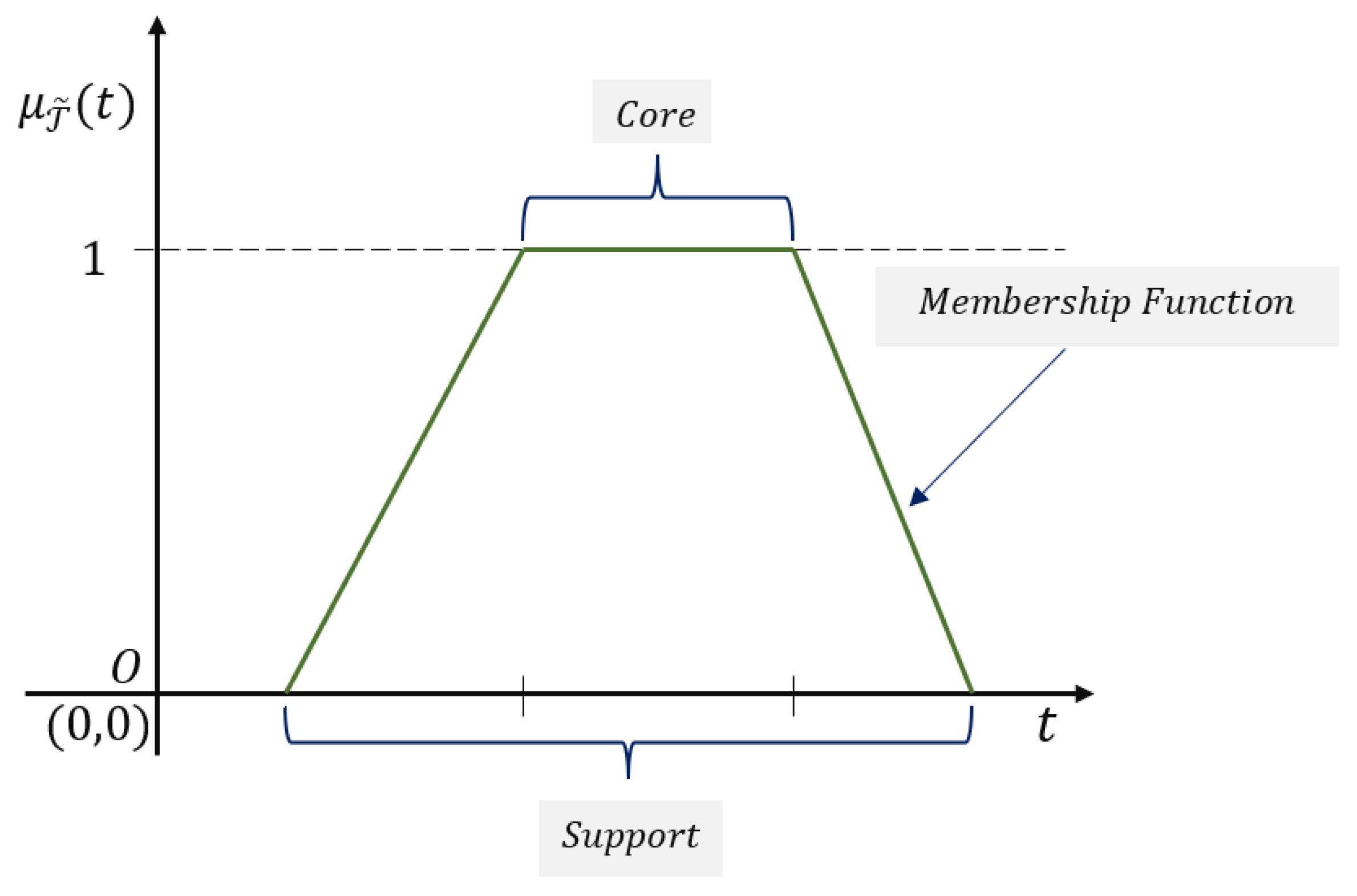
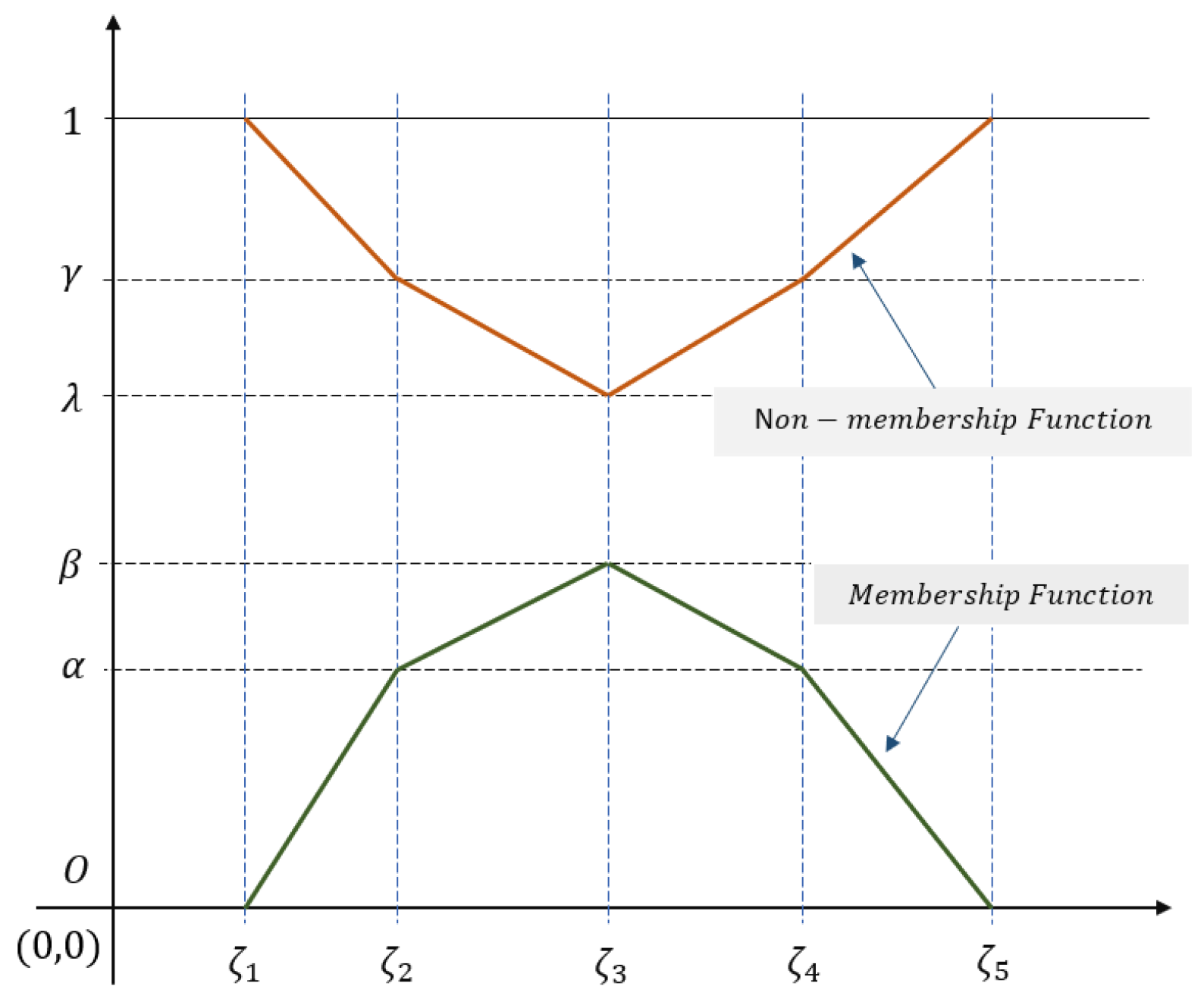
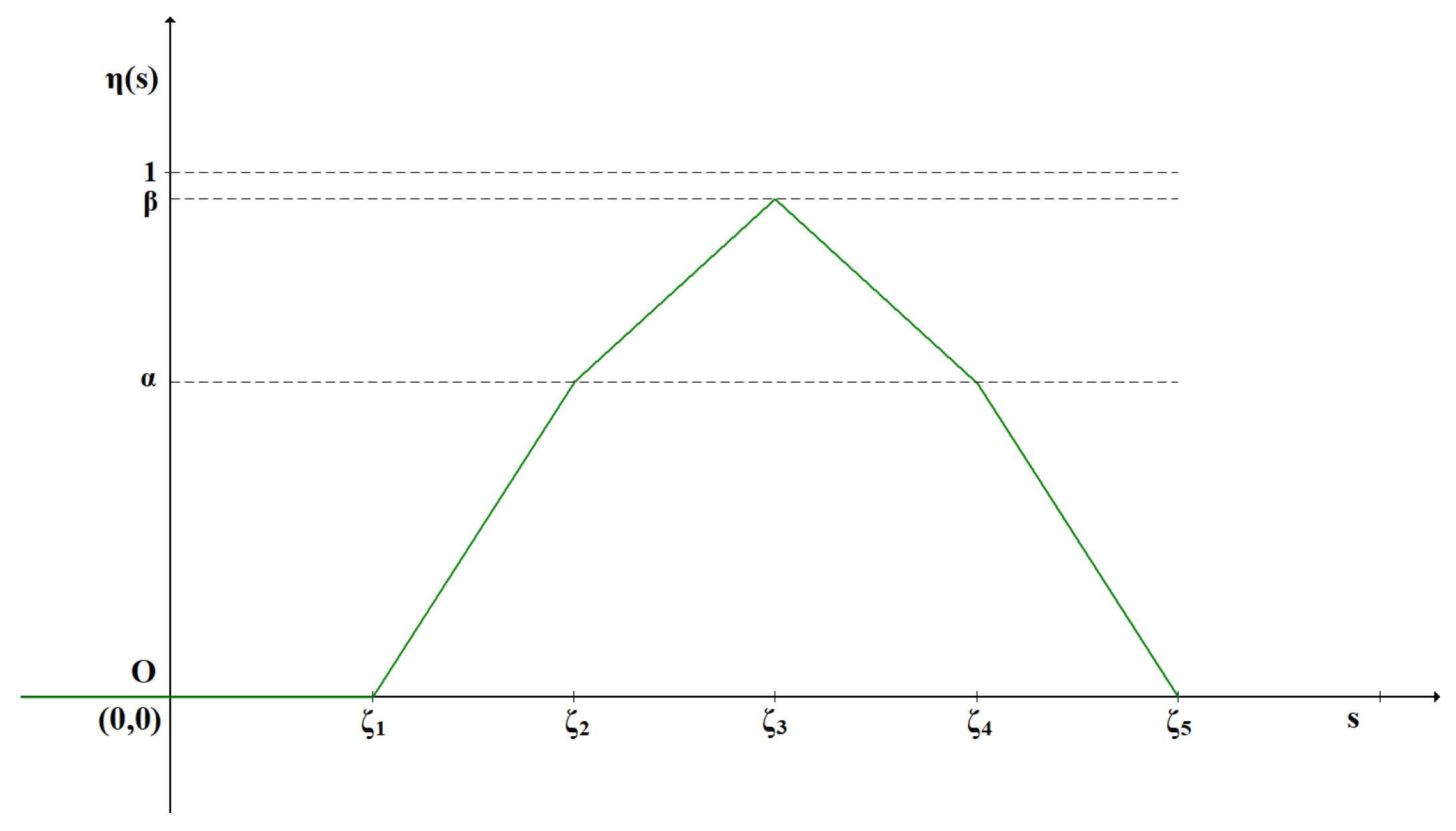
A pentagonal intuitionistic fuzzy number (PIFN) [34] is defined as , where each for and . The membership function, , and the non-membership function, of , are defined as follows:andwhere , , and for all s. Figure 1 beautifully captures the visual representation of the pentagonal intuitionistic fuzzy number (PIFN).
Remark 1. To maintain the convexity of the membership function, the interior angles created at points and must be less than . A similar concept is applied to the non-membership function to ensure convexity.
Remark 2. If and , the above fuzzy number takes the shape of a trapezoidal intuitionistic fuzzy number (TrIFN). To obtain a triangular-shaped intuitionistic fuzzy number, set and .
3.2. Justification for Using Pentagonal Intuitionistic Fuzzy Numbers (PIFNs)
Selecting a suitable site for building a solar PV power plant depends on several criteria, such as high solar radiation, available land, wind speed, labour availability, good transport system, and government approval. In a practical situation, it is hard to obtain exact and accurate data because factors like wind speed, solar radiation, dust haze, and labour availability often change, and their correct values are not always known. The uncertainty in these criteria cannot always be handled by simple fuzzy sets, so more complex fuzzy sets are needed. Pentagonal intuitionistic fuzzy numbers (PIFNs) are one such type, which use both membership and non-membership degrees to show the criteria more clearly and provide a mathematical way to handle such uncertainty. This helps decision-makers use PIFNs in different models to evaluate sites under uncertain conditions and select the most suitable site for the project. For this reason, we adopted PIFNs for this study.
3.3. Operations on Pentagonal Intuitionistic Fuzzy Numbers (PIFNs)
Let and be two PIFNs. The mathematical operations between and are outlined below with details on the process and outcome of the interaction between them.
- (i)
Addition:
- (ii)
Subtraction:
- (iii)
Multiplication by a scalar:
where
c is a real number.
- (iv)
Multiplication:
- (v)
Division:
where
for
.
- (vi)
Inverse:
Remark 3. The operations performed above are valid for positive PIFNs. Some modifications are needed to work with negative PIFNs, especially for multiplication, division, and inverse operations.
3.4. De-i-Fuzzification Technique of PIFN
We work with fuzzy concepts in fuzzy set theory, where values lie on a spectrum of possibilities rather than just true or false. These fuzzy representations, including membership levels, are defuzzified to produce a crisp result. There are several common methods for defuzzification, such as the Centroid method, the Weighted Average method, the Mean of Maxima, and the Bisector method. In this section, a novel de-i-fuzzification (the term “de-i-fuzzification” refers to defuzzification with the intuitionistic nature of fuzzy numbers) method is proposed using the concept of the relative difference between two real numbers for the de-i-fuzzification of pentagonal intuitionistic fuzzy numbers (PIFNs). The detailed preliminary concept and the de-i-fuzzification procedure are very well described in the following.
Definition 2. Absolute difference of two real numbers [89] The absolute difference between two real numbers is defined as the absolute value of the difference between those numbers. In a mathematical way, if represents the absolute difference between two real numbers, γ and δ, then Definition 3. Relative difference of two real numbers [90] The relative difference between two real numbers, γ and δ, denoted as , is defined as follows: Remark 4. The above formula expresses how large the difference between two numbers is in proportion to the size of the larger number.
Remark 5. Based on the context of the application, can be replaced by , , , , , etc.
Proposed De-i-Fuzzification of PIFNs
Consider the pentagonal intuitionistic fuzzy number (PIFN)
outlined in
Section 3.1. To convert the fuzzy number into a crisp value, we introduce a new type of de-i-fuzzification technique based on the concept of the relative difference between two real numbers, as defined in Definition 3. The steps associated with the proposed de-i-fuzzification technique are described below:
- I.
Calculate the area bounded by the membership function and x-axis:
The area
enclosed by the membership function
of the given pentagonal intuitionistic fuzzy number (PIFN)
and the
x-axis is given as follows:
- II.
Calculate the area bounded by the non-membership function, and the straight line .
The area
enclosed by the non-membership function,
of the given pentagonal intuitionistic fuzzy number (PIFN)
and the straight line
is taken as follows:
- III.
Determine the proposed de-i-fuzzified value .
The de-i-fuzzified value
of the pentagonal intuitionistic fuzzy number (pifn)
is taken as follows:
where
and
are outlined in Equations (
11) and (
12), respectively.
Remark 6. The main advantage of the proposed method is that it directly incorporates the normalised relative difference between the membership and non-membership areas. In this approach, the difference between the membership and non-membership areas is divided by the maximum value of the two areas. As a result, the generated weight is scale-invariant and bounded, ensuring that the crisp value is not distorted even if the parameters associated with the PIFN are increased or decreased uniformly. It is often observed that some PIFNs are able to produce the same or very close centroids, but with this method, those cases can also be clearly distinguished. Therefore, this new de-i-fuzzification method provides reliable crisp values for decision-making and ranking.
Example 1. Let be a PIFN, defined as in Definition 1. Clearly, the maximum degree of membership of is 0.8, and the maximum degree of non-membership is 0.2. Also, the sum of the maximum membership and non-membership values is less than or equal to 1. We find the corresponding crisp value of using the de-i-fuzzification formula defined in Equation (13). For this, we have to calculate the area bounded by the membership function and the x-axis, and the area bounded by the non-membership function and the line . Now, the area bounded by the membership function and x-axis of the pentagonal intuitionistic fuzzy number is , and the area enclosed by the non-membership function and the straight line is . Thus, the de-i-fuzzified value of is determined as Razzaq, O. A. et al. [
44] invented the de-i-fuzzification method on PIFNs, and the de-i-fuzzification value of PIFNs
was
The de-i-fuzzification value of PIFNs
is 1.208 using the proposed method (see in Equation (
13)) and 6.56 by Equation (
15) (see in Razzaq, O. A. et al. [
44]), respectively.
4. Proposed MCDM Methodologies Under Pentagonal Intuitionistic Fuzzy Number (PIFN)
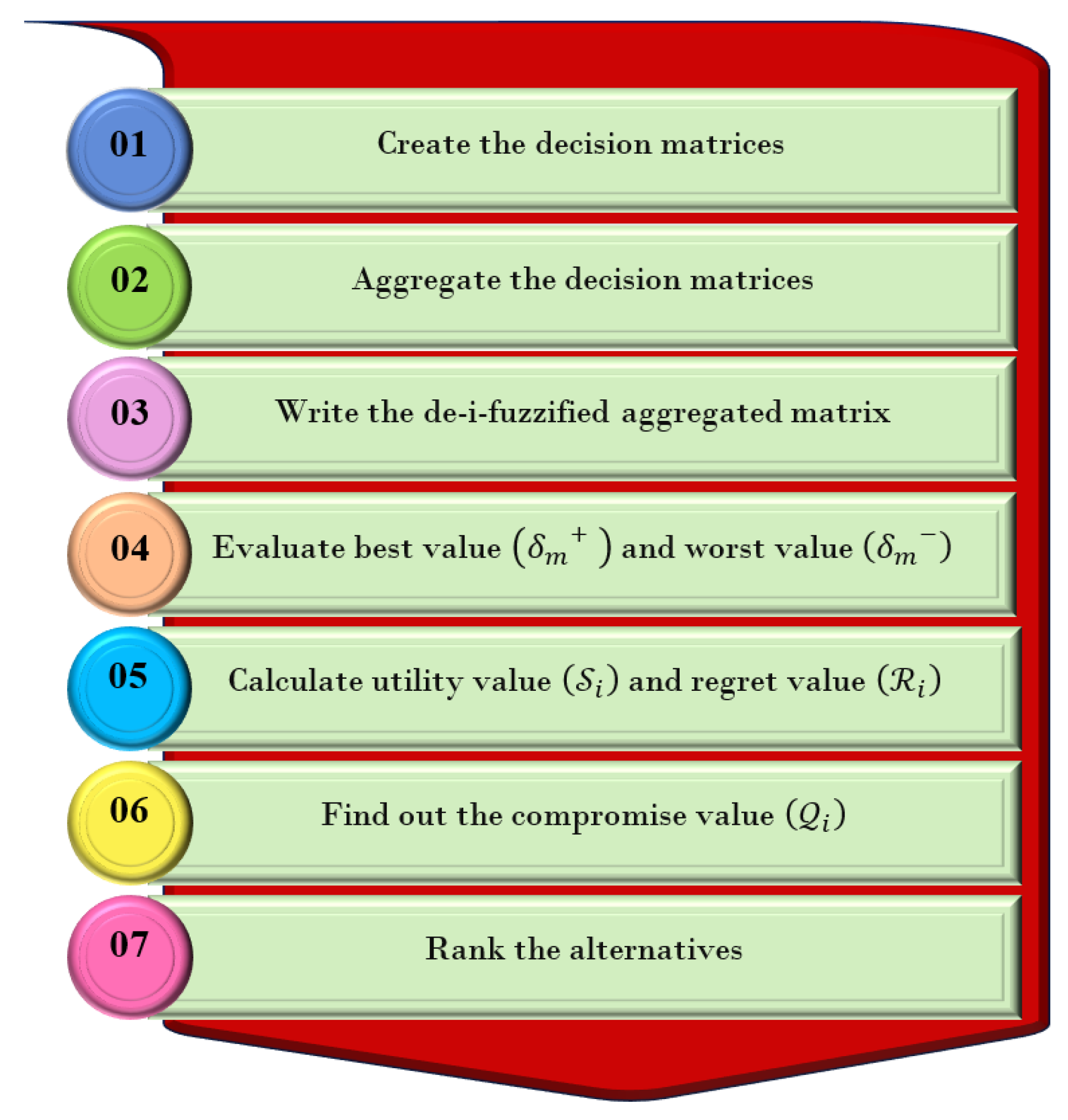
This section explains the MCDM methodologies applied to determine the criteria weight and prioritise the alternatives for the current research. To perform the present research work, we selected two MCDM approaches: Criteria through Inter-Criteria Correlation Technique (CRITIC) and Višestruki Kriterijumska Optimizacija Kompromisno Rešenje (VIKOR). CRITIC was employed to calculate the criteria weights, while VIKOR was utilised to rank the chosen alternatives. The detailed mathematical procedures of the two methodologies are described below.
4.1. Weight Calculation Method: CRITIC
In this study, let f represent the number of criteria and p is the number of alternatives. We assume there are q decision-makers (DMs), each providing data in linguistic terms. Consequently, decision matrices are constructed by each qth DM, with an order of . The mathematical formulation of the CRITIC methodology is as follows:
- A.
Formulate the decision matrices .
The decision matrix is formed by the
th DM based on their views in terms of linguistic decisions, where
. Here,
q decision matrices are created, and all the linguistic terms are converted to pentagonal intuitionistic fuzzy numbers (PIFNs). The
th decision matrix can be expressed as follows:
where
and
is a matrix of order
, and each entry of the decision matrices is expressed as a pentagonal intuitionistic fuzzy number (PIFN), i.e.,
for each criteria
m and alternative
l and
.
- B.
Combine the decision matrices .
Merge the
q decision matrices provided by the decision makers (DMs) into a single consolidated decision matrix. To create this, the following format is used:
- C.
Form the combined matrix with de-i-fuzzified values .
The de-i-fuzzified combined decision matrix is derived from the combined decision matrix using Equation (
13). The de-i-fuzzified aggregated decision matrix is represented by
where the de-i-fuzzified value
of the pentagonal intuitionistic fuzzy number (PIFN)
is calculated for all
and
.
- D.
Normalize the updated decision matrix .
To transform the given fuzzy values into a standardized scale, the updated decision matrix is normalised using the following Equation (
20):
where
- E.
Compute the standard deviation for each criterion.
The standard deviation
for each criterion is derived from Equation (
22) as follows:
where
indicates the population mean,
N is the size of the population, and
.
- F.
Determine the linear correlation coefficient between the criteria m and .
Let the vectors
and
be the performance values of
p alternatives for criteria
m and
, respectively. Each vector contains performance values for
p alternatives, i.e.,
so the linear correlation coefficient between the criteria
m and
can be defined as follows
where
- G.
Measure of the conflict generated by the criteria.
Here, we need to calculate a measure of the conflict created by criterion
m about the decision situation defined by the remaining criteria, defined as follows:
- H.
Determining the amount of information associated with each criterion.
The amount of information associated with each criterion is taken from Equation (
27):
where
.
- I.
Calculate the objective weights.
Compute the weight of criterion
m, denoted as
, as follows:
Equation (
28) determines the criterion weight
for each criterion
. In
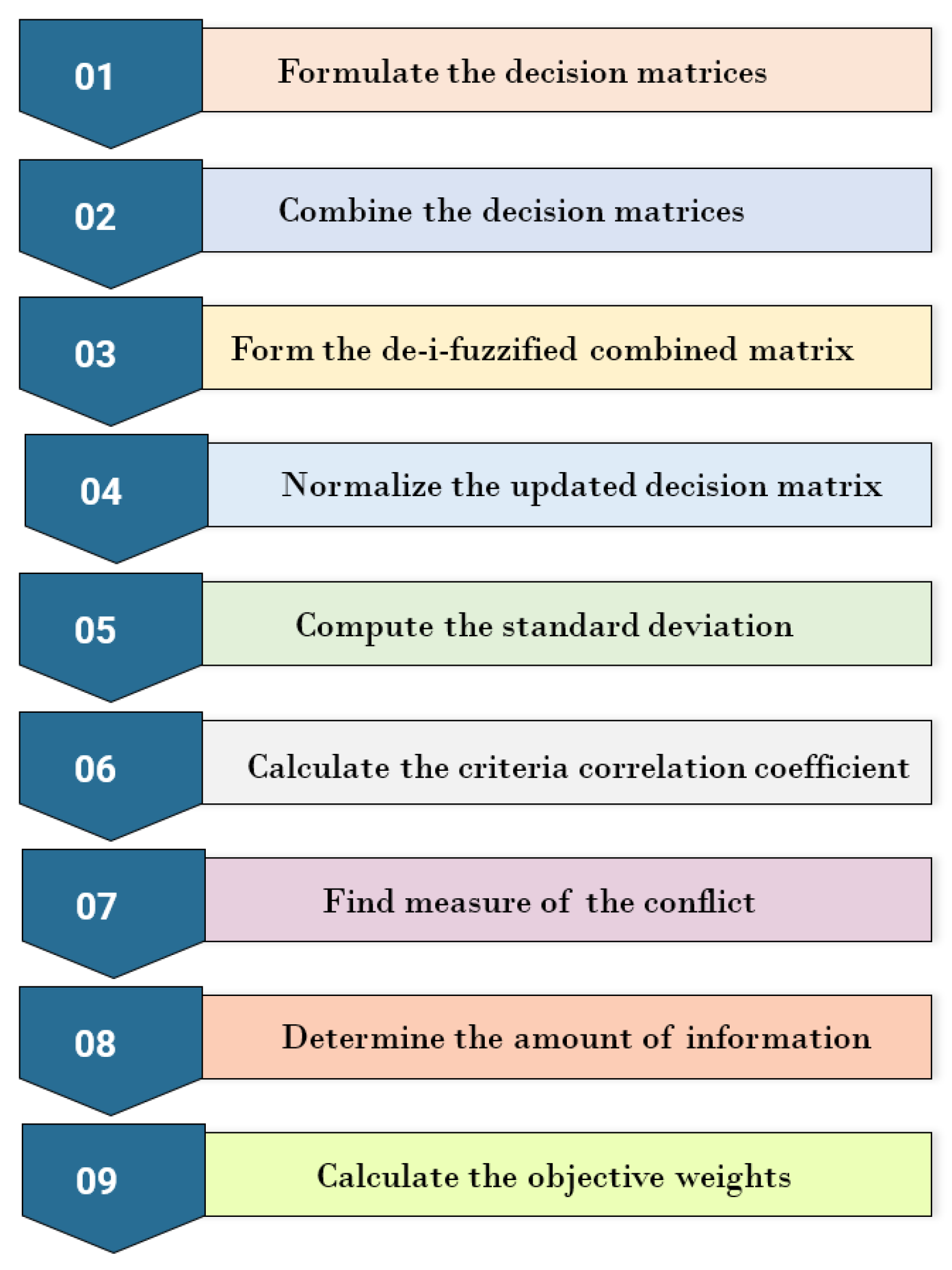
Figure 2 below, a methodical representation of the CRITIC method is shown.
Remark 7. The CRITIC method determines the correlation between the criteria. If two criteria are highly correlated, the approach will give one less weight because they provide similar information.
4.2. A Ranking-Oriented MCDM Approach: VIKOR
This study considers f criteria and p alternatives. Opinions are provided by q decision-makers (DMs) based on their experience, ensuring a comprehensive evaluation. The steps of the VIKOR method are given below:
- I.
Establishment of decision matrices .
We developed a decision matrix using linguistic terms and converted it into pentagonal intuitionistic fuzzy numbers to capture the opinions of decision makers and handle uncertainty in evaluations. In the previous section, Equation (
16) represents the
th decision matrix for
.
- II.
Aggregation of decision matrices.
The process of combining the decision matrix into a single aggregated decision matrix is performed using Equation (
18), which provides a clear and structured format for subsequent evaluation.
- III.
Determine the de-i-fuzzified valued aggregated matrix .
The de-i-fuzzified aggregated decision matrix
is obtained from the aggregated decision matrix
by using the method described in Equation (
13), and the matrix is shown in Equation (
19).
- IV.
Calculate the best value and worst value .
The best and worst values for each criterion are defined by
and
, respectively, in Equations (
29) and (
30):
and
where
.
- V.
Evaluate the utility value and regret value .
The concepts of utility and regret values are used to balance the compromise solutions. The values of
and
are evaluated from Equations (
31) and (
32):
and
where
.
- VI.
Find out the compromise value .
The compromise value,
is determined using Equation (
33) as follows:
where
is the coefficient of the decision mechanism. The compromise solution is chosen based on the value of : majority , consensus , or veto .
- VII.
Rank the alternatives.
To rank alternatives using the , , and values, first classify these values in ascending order. It produces three separate ranking lists: , , and , where each list shows the alternatives from smallest to largest value. The alternative, say , with the smallest value is considered the compromise solution.
- VIII.
Validation of compromise solution.
To ensure that a compromise solution is appropriate, it must meet the following two conditions:
- (i)
Acceptable Advantage:
, where and are the two best alternatives of .
- (ii)
Acceptable Stability:
Based on the values of and , the alternative should be ranked as the best choice. If both and indicate that the alternative has the highest performance among all alternatives, it can be confidently considered as the best choice.
Multiple compromise solutions can be observed when not all conditions can be met simultaneously, i.e., no single solution fully satisfies everything. If only condition is not satisfied, we consider only alternatives and . If condition is not satisfied, we take all the alternatives , where is defined as for maximum n.
A systematic framework of the VIKOR approach is presented in
Figure 3 below.
5. Selection of Criteria for Construction of Solar Photovoltaic (PV) Power Plant
In this section, we discuss the different factors (or criteria) for choosing the best location to build a solar PV power plant in India. After consulting several experts, we identified the following twelve criteria.
5.1. Land Accessibility and Geographical Features
Geographical features and availability of land are essential for setting up solar photovoltaic (PV) power plants [
91]. Generally, areas with broad, flat, and gently sloping land are identified. Moreover, sites near rivers or in flood-prone areas should be carefully considered, as solar panels and electrical systems can be damaged by flooding.
5.2. High Solar Radiation
The impact of high solar radiation on solar photovoltaic (PV) power plant construction is unparalleled [
10]. Different regions have different geographical features. Valleys and high mountains, for example, can significantly limit the amount of sunlight that certain areas receive at certain times of the day. Thus, the land intended for installing solar PV power plants should have the maximum exposure to sunlight, as it is essential to optimise energy production from solar panels.
5.3. Ecological Effect
It is essential to assess the environmental impact of solar PV plants for their construction and operation [
92]. The potential impacts on wildlife habitat, local ecosystems, soil, air, water, usable agricultural land, etc., should be properly analysed. Large solar installations can fragment natural habitats, hamper wildlife movement, reduce biodiversity, cause temperature changes, and increase pollution [
93]. Special plans should be adopted to minimize negative impacts.
5.4. Availability of Labour and Resources
Building a solar photovoltaic (PV) power plant is impossible without adequate labour and resources [
94]. Adequately skilled workers are needed for planning, construction, installation of solar panels, supply of necessary materials, and management. In addition, the availability of raw materials required for the project, such as photovoltaic cells, inverters, cables and wiring, transformers, battery storage, infrastructure materials, electrical components, protective coatings, and sealants, etc., must be ensured to avoid any interruption of equipment resources.
5.5. Airflow Speed
To construct a solar power plant, it is necessary to have an ideal wind speed [
95]. Medium-velocity airflow is suitable for solar photovoltaic (PV) power plant construction projects because it maintains the optimal operating temperature of the solar panels and improves their performance. High-velocity airflow reduces the stability of the mounting structure. If the project is to be built in areas with high wind speeds, strong structures and precise panel adaptations need to be implemented to ensure wind-speed protection and stability.
5.6. Level of Dust Haze
Dust and fog levels in areas where solar PV power plants are being constructed should be as low as possible. High levels of dust can disrupt the process of installing solar panels. If excessive dust accumulates on the panels, sunlight cannot penetrate them properly, reducing panel efficiency. Excessive dust is also a major challenge in panel maintenance. If dust levels are too high at a selected location, necessary dust control measures must be taken to maintain panel performance.
5.7. Local Community Support and Approval
Installing solar photovoltaic (PV) power plants in a region is not possible without the support and approval of the local community [
96]. It is essential to increase economic benefits such as job creation, reducing energy costs, and developing the local infrastructure. When the community feels included in the importance and real benefits of the project, the likelihood of approval increases. The greater the positive community participation, the more smoothly the project will run without social conflict.
5.8. Proximity of the Transmission Network
The proximity of the transmission network is an essential factor in planning the construction of solar photovoltaic (PV) power plants [
97]. If the transmission network is not located near the designated area, plans need to be adopted to install new transmission lines, substations, or other grid infrastructure, which increase the project cost. An optimally positioned transmission network ensures that the solar power generated at the plant can be delivered to users cost-effectively.
5.9. Humidity Ratio
When identifying specific areas for installing solar PV power plants, it is necessary to accurately determine the amount of moisture in the air [
98]. This is because excess moisture traps dust on the panels and blocks sunlight from reaching them, thereby reducing the effectiveness of the panels. Problems arise due to corrosion of various electrical components and other metal parts of the infrastructure [
99]. Generally, those areas should be chosen where the air moisture content is moderate.
5.10. Grid Reliability
Reliability of the electrical grid is an essential factor in the design of solar photovoltaic (PV) power plants [
100]. They should be highly reliable to ensure a continuous, uninterrupted supply of electricity. Solar power generation can vary due to weather, time of day, and seasonal changes, so it is necessary to use modern inverters that control frequency and voltage to ensure grid stability. In addition, adding energy storage solutions, such as batteries, is vital to capture the excess energy generated during peak sunlight hours and use it during periods of low solar output [
101].
5.11. Seamless Transport Network
To implement the solar PV power plant construction project, it is necessary to identify areas with improved transportation facilities [
102]. Large and heavy components used in construction must be easily transported from the manufacturing facility to the construction site. It is essential to have reliable connectivity between the railway station and the airport, and to the construction site, so that workers and project personnel can travel easily. In addition, an efficient logistics management system is needed [
103] to streamline transportation activities, reduce project timelines, and lower costs.
5.12. Government Assistance and Policies
Government support and policies play an essential role in the development and construction of solar photovoltaic (PV) power plants [
104]. Government promotion of projects, low-interest loans, and convenient financing schemes (such as power purchase agreements), etc., increases incentives for investment in projects [
105]. In the early stages, infrastructure requires various external permits, which should be simplified wherever possible. Additionally, policies such as government subsidies, grants, and tax credits reduce the financial constraints of the project.
6. Selection of Alternatives for Construction of a Solar Photovoltaic (PV) Power Plant
In this section, we selected eight states from the Indian region based on the criteria described in the previous section. The selected states are thoroughly described with careful consideration of these criteria. Based on these criteria and alternatives, the next section addresses a practical problem related to the construction of a solar PV power plant in India.
6.1. Rajasthan
There are various reasons for choosing this state for setting up a solar PV power plant, one of which is the high solar power predominance in areas such as Jodhpur, Jaisalmer, Barmer, Bikaner, Nagaur, Pushkar, etc. Its semi-arid climate, ample sunlight, high temperatures, and clear skies are ideal for solar energy production [
106]. Also, it is well connected to various international airports, including Jaipur, Jodhpur, Udaipur, Ajmer, and Bikaner; railway junctions; and 33 National Highways (NHs) [
107]. There are several government initiatives to support solar energy [
108]. In addition, the environmental benefits of solar energy in Rajasthan include lower carbon emissions.
6.2. Uttar Pradesh
Uttar Pradesh is ideal for setting up solar PV power plants due to its dry winters, high solar radiation, and humid subtropical climate. Thus, Agra, Moradabad, Varanasi, Ghaziabad, Allahabad, Kanpur, Lucknow, and Ayodhya regions were selected for setting up solar PV power plants. The cities of Uttar Pradesh (especially major cities like Lucknow, Varanasi, Agra, Jhansi, and Kanpur) are well connected by a strong road, airport, and railway network [
109]. The current state government has released the Solar Policy 2022 [
110]. The governmental efforts to establish solar PV power plants are very encouraging [
105].
6.3. Andhra Pradesh
The areas adjacent to the coastal plains in Andhra Pradesh are ideal for setting up solar PV power plants. These areas include Srikakulam, Vizianagaram, Parvathipuram, Manyam, Alluri Sitarama Raju, Visakhapatnam, Anakapalli, Kakinada, Konaseema, East Godavari, West Godavari, Eluru, Krishna, NTR, Guntur, Palnadu, Bapatla, Prakasam, and Nellore. The coastal regions of Andhra Pradesh have well-developed rail, bus, port, and air connectivity. Various government-funded solar projects, such as street lighting and solar water heating systems, are being implemented [
111] and are accompanied by significant local community support and an abundance of workers.
6.4. Tamil Nadu
Tamil Nadu has a very high level of solar radiation, which is highly favourable for installing solar PV power plants. The coastal areas around Madurai, Thoothukudi, Theni, and Chennai experience high solar radiation, making these areas ideal for setting up solar PV power plants. The region is well connected by an extensive network of roads, highways, railways, airports, and ports [
112]. The region has an abundance of skilled labour, and the local community is enthusiastic about the project. There is considerable government support for the expansion of solar energy in the state [
113]. Therefore, keeping these factors in mind, Tamil Nadu was selected for this study.
6.5. Karnataka
Due to the diverse climate of Karnataka, many regions, especially Tumkur, Chitradurga, Kalaburagi, Kolar, Davanagere, Koppal, Ramanagar, Bagalkot, Belagavi, Vijayapura, and Bidar, are ideal for the installation of solar photovoltaic PV power plants. Karnataka’s infrastructure plays a vital role in supporting renewable energy projects. It includes Bengaluru International Airport, the airports at Mangalore, Belgaum, Bellary, Gulbarga, and Mysore, Mangalore Port, and various railway stations. The state government has promoted the expansion of solar energy through various initiatives [
114]. Additionally, significant community involvement and a ready supply of skilled labour make it easier to develop and maintain solar energy projects across the state.
6.6. Maharashtra
Due to its well-developed infrastructure and favourable climate, Maharashtra is an excellent location for establishing solar PV power plants. Regions such as Solapur, Dhule, Satara, Pune, Nashik, Ahmednagar, Aurangabad, and parts of Vidarbha were identified as ideal sites for solar power plants due to their high solar radiation. Maharashtra has an extensive transportation network, with major cities well connected by roads, railways, and air travel [
115]. The state government has shown significant commitment to renewable energy, including the Maharashtra Solar Policy 2021 [
116]. Active government support and natural advantages make it a top candidate for solar energy development.
6.7. Gujarat
Gujarat is an ideal location for setting up solar PV power plants due to its rapidly developing infrastructure and favourable climate. The western part of the state, especially Kutch and the Saurashtra region (Jamnagar, Porbandar, Rajkot, and Junagadh), and nearby areas receive high solar radiation, making them suitable for solar energy production. Cities like Ahmedabad, Surat, Rajkot, Bharuch, Ankleshwar, Valsad, and Bhavnagar were identified as key sites because they receive sunlight throughout the year. Gujarat has a well-developed network of roads, railways, and airports, providing excellent connectivity for transporting solar equipment. The state government is highly committed to renewable energy [
117].
6.8. West Bengal
The state has a moderate climate and receives enough sunlight throughout the year, especially in Purulia, Bankura, Bardhaman (East and West), and Birbhum, making these areas suitable for solar energy production. The state is well connected with major transport facilities, making it easier to transport solar equipment and technology [
118]. The West Bengal government is especially focused on developing renewable energy, particularly solar energy [
119]. With government support, natural resources, and strategic efforts to create a solar-friendly environment, West Bengal is on track to play an important role in India’s renewable energy sector.
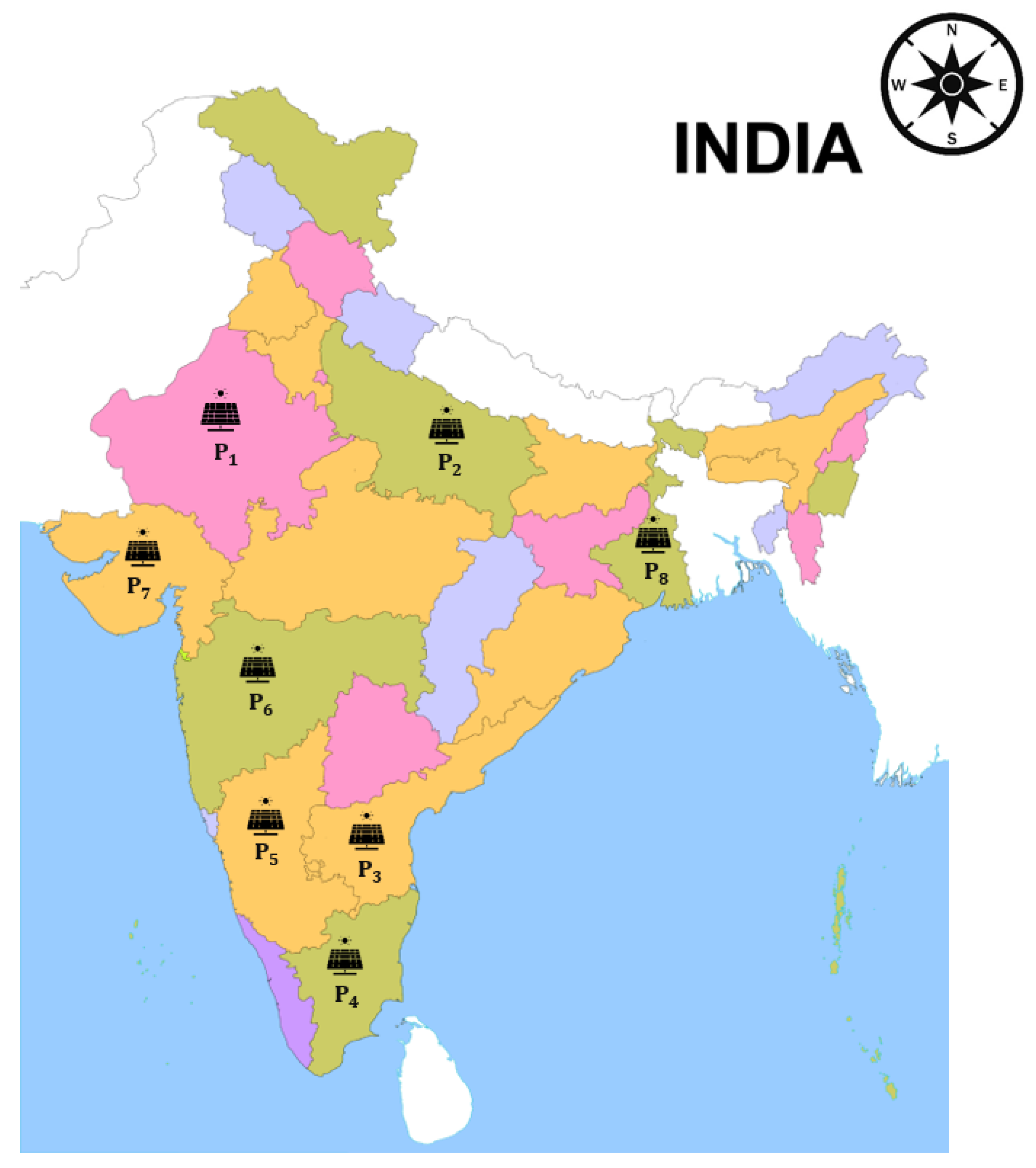
In
Figure 4 below, we have marked the aforementioned alternatives on the map of India. Each black logo with the symbol of a solar panel represents a different state in India.
The study has been carried out in Indian regions, but the proposed method and analytical framework are not limited to any specific geographical area. With suitable adaptation based on relevant data and context, it can be applied in any country or region of the world and used effectively for any type of industrial location decision problem.
7. Model Structure and Data Collection
Here, we consider the problem of selecting a suitable site for constructing a solar (PV) power plant in India, taking into account economic, environmental, technical, socio-economic, and political factors. This section describes the model structure and the data collection process used in the study.
For setting up the model, we considered the twelve criteria for the present study, which were described elaborately in
Section 5. Also, eight states located in India were selected as alternatives. The states were Rajasthan
, Uttar Pradesh
, Andhra Pradesh
, Tamil Nadu
, Karnataka
, Maharashtra
, Gujarat
, and West Bengal
. The purposes for selecting these states for our study were nicely described in
Section 6. The proposed problem was structured in an uncertain environment. Pentagonal intuitionistic fuzzy numbers (PIFNs) was employed here to manage uncertainty-related issues. For selecting the optimal location (or alternative), two multicriteria decision-making methods were adopted: the Criteria through Inter-Criteria Correlation Technique (CRITIC) and VIsekriterijumsko Kompromisno Rangiranje (VIKOR). The CRITIC method was used to calculate the weight of the criteria, while the VIKOR method was used to rank the eight alternatives. Based on the data provided by decision makers related to this research study, the decision matrices were constructed by combining the twelve criteria and the eight alternatives. Each of the decision matrices was of order
and was defined according to Equation (
16).
The valuable data related to this problem in our proposed study were collected by considering several steps. Four decision-makers were employed for this study. Each decision-maker was highly experienced and well qualified in their field. For collecting data, we informed them about the main perspective, our proposed planning, and a detailed description of selected criteria and alternatives connected to the study. We arranged an interview session in either physical or online mode (if the candidate was unavailable in person), through questionnaires or verbal conversations. They provided their valuable information about our decision-making problem in linguistic terms or descriptive languages (such as highly important, very important, minor important, etc.). The decision-makers ensured that they maintained impartiality in the information they provided. Since our problem was structured in an uncertain environment, for evaluation and analysis purposes, we transformed the linguistic information provided by the decision-makers into pentagonal intuitionistic fuzzy numbers (PIFNs).
In the following, we list the designations and related fields of decision-makers (DMs) involved in our study:
- (a)
A project manager for solar power plant development;
- (b)
A senior environmental consultant with 15 years of experience;
- (c)
A Chief Executive Officer (CEO) of a renewable energy company;
- (d)
A senior energy analyst.
In
Table 4, we present the converted form of the linguistic terms (or descriptive language) provided by the decision-makers mentioned above. In addition, the de-i-fuzzified values of the PIFNs obtained from the linguistic terminology provided by the decision-makers are listed in the table. These crisp values were later used for evaluation purposes.
Table 5 presents the ratings given by the decision-makers (DMs) using linguistic terms, which form the decision matrix that represents the relationship between criteria and alternatives. All the data were collected in the period from July to August 2025. These ratings reflect subjective assessments based on the professional skills and experience of DMs. Linguistic terms were used to represent qualitative assessment, which helped to better understand the decision-making process. The use of linguistic terms increased the flexibility of the model, capturing the uncertainties and nuances in human decision-making.
Remark 8. All the information provided by the DM presented in Table 5 was unbiased and accurate and is later used in the numerical analysis section. The following steps in the decision-making process were conducted based on this information. 8. Numerical Illustration and Discussion
In this section, a detailed explanation of numerical computation and discussion is given. This section outlines the two MCDM methods CRITIC and VIKOR presented in
Section 4, which combine the essential mathematical tools described in
Section 3. In addition, to support and perform various analyses and calculations, we used the datasets mentioned in
Section 7.
The CRITIC method was used to evaluate the weights of various criteria (described in
Section 4.1) related to the current work. According to the personal opinions of the decision-makers (DMs), a set of four decision matrices was constructed using PIFNs (pentagonal intuitionistic fuzzy numbers), as outlined in Equation (
16). We then combined the decision matrices into a single decision matrix using Equation (
18). Then, the proposed de-i-fuzzification process was applied as described in Equation (
13) to convert the PIFNs into crisp values and construct the de-i-fuzzified combined matrix as follows:
In the next step, we normalised the updated decision matrix using Equation (
20) and then calculated the standard deviation
for each criterion. The standard deviations for each criterion are provided in
Table 6 below.
We then calculated the linear correlation coefficients between each pair of criteria and assessed the measure of conflict
generated by the criteria. The conflict measure for each criterion is presented in the following
Table 7.
Then, the amount of information associated with each criterion
was calculated. The amount of information for each criterion is listed in
Table 8 below.
Lastly, the factor weight
for each factor was calculated using Equation (
28), and the resulting factor weights are shown in
Table 9.
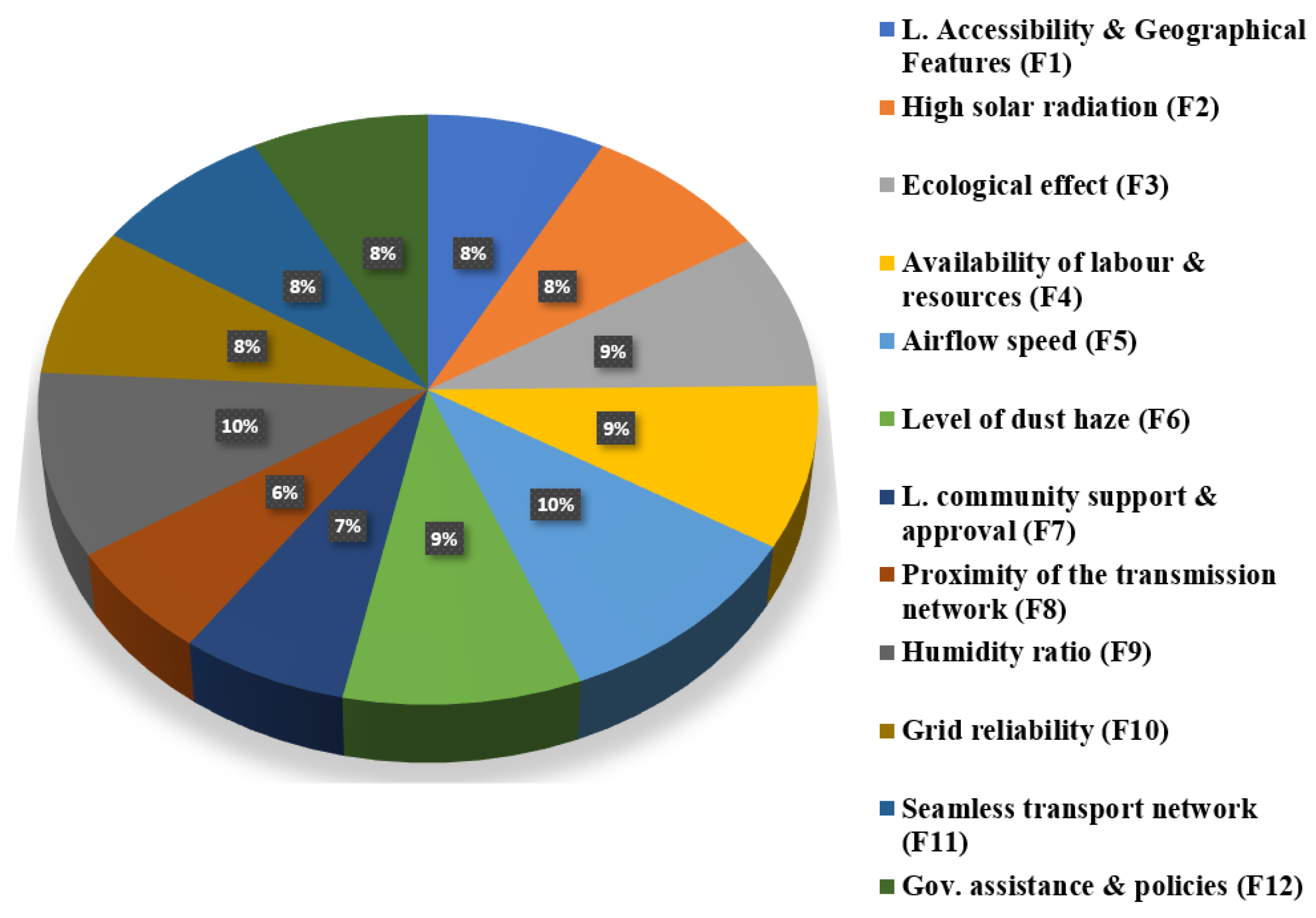
In
Figure 5, we show the pie diagram of the criteria weights. Based on the above discussion, and as can be seen from
Table 9 and
Figure 5, it is clear that the most important criterion for building a solar PV power plant in India was the airflow speed
, with a weight of
. This indicates that the speed of the airflow plays an important role in the efficiency and performance of the power plant.
The second most important criterion was the humidity ratio with a weight of , followed by the level of dust haze , availability of labour and resources , ecological effect , high solar radiation , grid reliability , seamless transport network , land accessibility and geographical features , government assistance and policies , local community support and approval , and proximity of the transmission network .
Remark 9. Figure 5 presents a visual representation of the criteria weights for the current study in the form of a pie chart. This diagram highlights that airflow speed is the most significant criterion for constructing a solar PV power plant in India. The VIKOR method was applied to determine the rank of the selected alternatives or states located in the Indian territory, which was neatly described in
Section 4.2. The decision matrices were formulated based on the information provided by four decision-makers. These matrices were then aggregated using Equation (
18), and a de-i-fuzzified-valued aggregated matrix was constructed by de-i-fuzzifying the PIFN through the proposed de-i-fuzzification method. The de-i-fuzzified aggregated matrix is presented in Equation (
19). The criteria weights are listed in
Table 9.
In this study, there were four non-beneficial criteria, ecological effect
, airflow speed
, level of dust haze
, and humidity ratio
, while the remaining eight were beneficial criteria. We calculated the best and worst values by taking these beneficial and non-beneficial criteria into account. The best and worst values for each criterion are provided in
Table 10 below.
Next, we evaluated the utility value
, regret value
, and compromise value
. After calculating these values, we generated the ranking of the alternatives, determining which state was most suitable for constructing the solar PV power plant. The associated data for ranking the alternatives are provided in
Table 11 below.
In
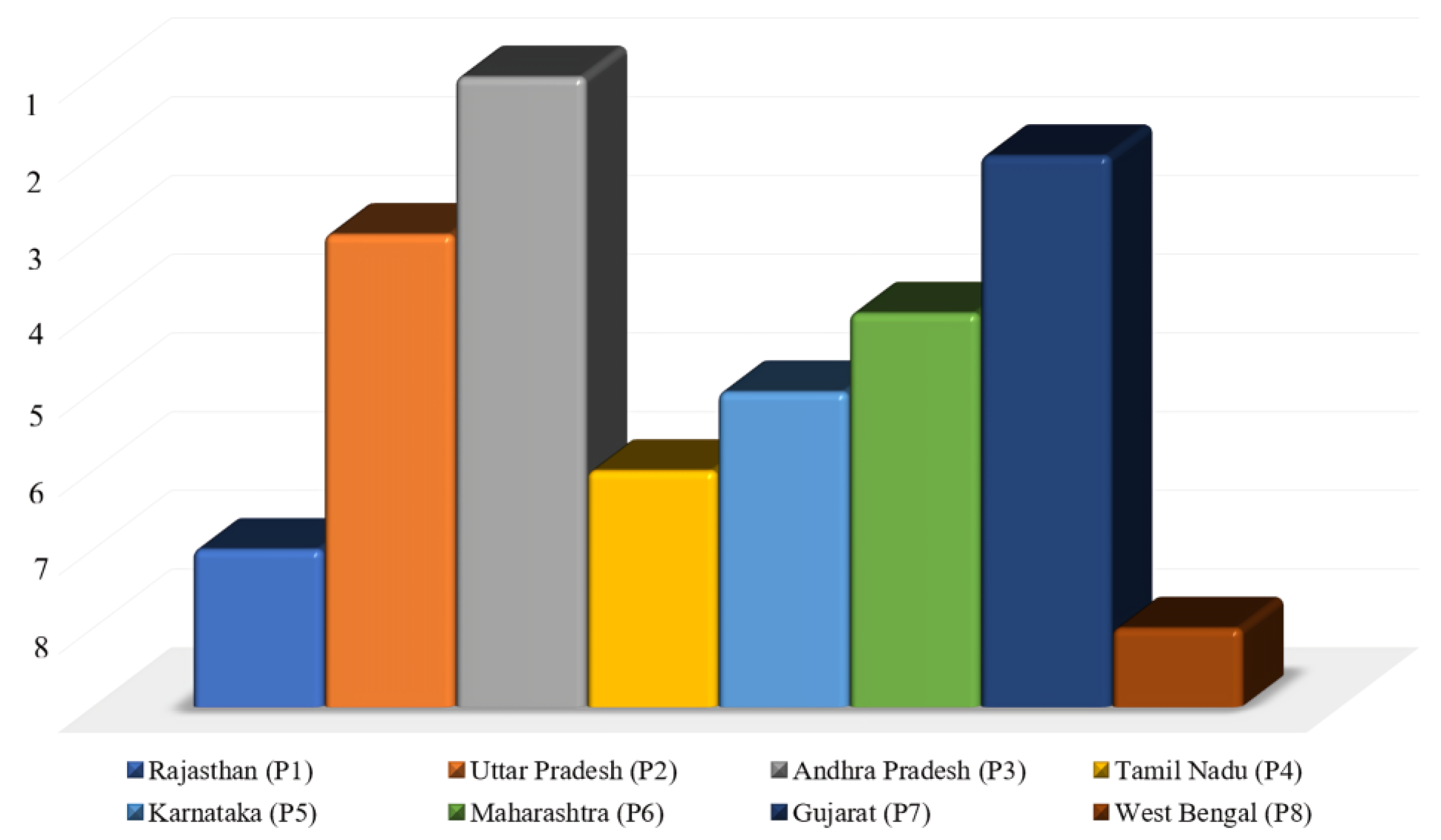
Figure 6, we present a graphical representation of ranking the alternatives in a column chart format. Based on the previous discussion,
Table 11 and
Figure 6 indicate that the state of Andhra Pradesh
was the most favourable option with rank one for constructing a solar power plant in India.
Gujarat , with its strategic geographical location and selected criteria, emerged as the second state for setting up power plants and obtained the second rank. It was followed by Uttar Pradesh , Maharashtra , Karnataka , Tamil Nadu , Rajasthan , and West Bengal . Despite being ranked lower, West Bengal retained its position as a valuable participant in the selection process. Together, these states represent a spectrum of opportunities, each contributing strengths to a broader development vision.
Remark 10. Figure 6 provides a visual depiction of the alternative rankings for the current study, presented as a column chart. This chart clearly illustrates that Andhra Pradesh emerged as the most suitable state for establishing a solar PV power plant in India, followed by the other states in the ranking. 9. Sensitivity Analysis
In this section, we conducted a sensitivity analysis for the present work considering the following cases, which are discussed in detail.
9.1. Case 1: Removing the Criterion Local Community Support and Approval
Community involvement and approval are sometimes not required due to existing regulatory frameworks or legal provisions. Thus, in this section, the criterion “Local community support and approval” was removed, and we proceeded to rank the alternatives based on the remaining criteria. The updated rankings of the alternatives (or selected states) are presented in
Table 12 and
Figure 7. As a result of the removal of the criterion “Local community support and approval
”,
Figure 7 shows that Tamil Nadu’s rank went up by one position to fifth, while Karnataka’s rank dropped by one position to sixth.
9.2. Case 2: Impact Due to a Stock Market Crash
At the initial stage of site selection, scenarios such as a stock market crash can directly affect the financial viability of a solar PV project. Since a solar PV project requires substantial upfront investment, the impact of a stock market crash generally changes investor sentiment associated with the project and can significantly alter the financial cost structure. As a result, the attractiveness of the potential sites may also be affected. Therefore, this section describes how the impact of a stock market crash could influence the proposed project.
A stock market crash has a direct impact on a variety of criteria selected for the current study, including government assistance and policies , local community support and approval , and grid reliability . During stock market downturns, economic recessions, budget cuts, subsidy cuts, and changes in government spending priorities often occur. This financial instability could result in reduced investment in community engagement, slower progress in improving grid infrastructure, and delays in integrating renewable energy into the grid.
Considering the above, in this section, the weightage of criteria for government assistance and policies
, local community support and approval
, and grid reliability
was increased, and a modified weightage list was prepared (from
Table 9; the weights of the above-mentioned criteria were doubled, while the remaining weights were kept the same, and then normalised, i.e., divided by their sum). The alternatives were then ranked based on the modified weight list. The modified weight list is given in
Table 13, and the updated rank list is presented in
Table 12 and
Figure 7. There were several changes in the alternative ranking due to the stock market crash. Rajasthan and West Bengal retained the same rank, while the ranks of the remaining selected states changed, either increasing or decreasing.
9.3. Case 3: Impact of Climate Change Caused by Pollution
The impact of climate change caused by pollution directly affects the environmental and technical feasibility of solar PV installations. Since site selection for a solar PV project depends on long-term, stable solar resource availability, this section discusses how pollution-driven climate change may influence PV installations to assess how sustainable and effective a site will remain under such conditions.
Due to climate change, several criteria (selected for the study) were significantly affected during the construction of solar power plants. In the following, we list which criteria strongly influenced the current project and how they affected the current project in terms of climate change due to pollution.
- 1.
High solar radiation : The type of solar radiation can change, which affects the efficiency of solar power generation.
- 2.
Ecological effect : The environmental impact of pollution affects ecosystems and biodiversity, which can affect the development of solar power plants.
- 3.
Airflow speed : Climate change affects the flow of air, which can increase or hinder the efficiency of solar panel cooling and energy production.
- 4.
Level of dust haze : An excessive amount of pollution causes high levels of dust haze in the atmosphere, which reduces the amount of sunlight reaching the solar panels.
- 5.
Humidity ratio : Climate change affects humidity levels, thus disrupting solar panel performance and overall energy production.
- 6.
Government assistance and policies : The overall cost increases due to the impact of climate change on different aspects, resulting in delays in obtaining various government permits and benefits.
Considering the above situation, in this section, the importance of the mentioned criteria was increased, and a modified weight list was created (from
Table 9, the weights of the above-mentioned criteria were doubled, while the remaining weights were kept the same, and then normalised, i.e., divided by their sum). The alternatives were ranked according to the adjusted weight list. The updated weight list is shown in
Table 13, while the revised ranking is presented in
Table 12 and
Figure 7. The impact of climate change caused by pollution yielded significant changes in alternative rankings. Rajasthan
, Uttar Pradesh
, Andhra Pradesh
, Gujarat
, and West Bengal
retained their original rank, while the rank of other states changed, either rising or falling.
Figure 7 illustrates the graphical representation of the above three cases, displaying their original rankings alongside comparisons with themselves.
10. Comparative Analysis
For the comparative analysis, we introduced two techniques. One could change the fuzzy number without altering the MCDM methodologies, i.e., we simply replaced pentagonal intuitionistic fuzzy numbers (PIFNs) by adopting conventional pentagonal fuzzy numbers (PFNs). On the other hand, we employed an MCDM technique, namely COmplex PRoportional ASsessment (COPRAS), in place of the VIKOR method, without altering the initial fuzzy numbers (PIFNs) and weight calculation method (CRITIC method). For both scenarios, we listed the new rankings of the alternatives and compared them with our initial results. The detailed description of the scenarios mentioned above is provided below.
10.1. Scenario I: Comparative Analysis When Changing the Fuzzy Numbers While Keeping the Method Unchanged
Here, we employed pentagonal fuzzy numbers (PFNs) in place of pentagonal intuitionistic fuzzy numbers (PIFNs). The MCDM methods used in the initial stage of the current study were kept as the CRITIC method and the VIKOR technique. In this scenario, we kept the methods unchanged and collected a new ranking list of the alternatives.
To convert pentagonal fuzzy numbers (PFNs) into a crisp quantity, we employed the following de-fuzzification technique for PFNs, as described in the research article by Onyenike, K. and Ojarikre, H. I. [
121].
Definition 4. De-fuzzification of PFNs:
Consider a pentagonal fuzzy number (PFN) . Then, the de-fuzzified value [121], of is given as follows: A detailed description of the data collection process for the current study is provided in
Section 7. In
Table 14 below, we present the data that have been transformed into PFNs from the linguistic information provided by the selected decision-makers.
Using the CRITIC method (described in
Section 4.1), the weights of the criteria were calculated. This method objectively assigns weights utilising the intensity of the contrast and conflict between criteria. The resulting criteria weights are presented in
Table 15 below, along with their initial weights. These weights were used to determine the ranking of the alternatives in the following step.
For the decision analysis, the VIKOR method was applied to rank the available alternatives. A detailed explanation of the methodological framework of the VIKOR strategy is given in
Section 4.2. Based on the VIKOR method, the alternatives were ranked, and the updated rankings are listed in
Table 16, alongside the initial rankings obtained using PIFNs within the VIKOR framework.
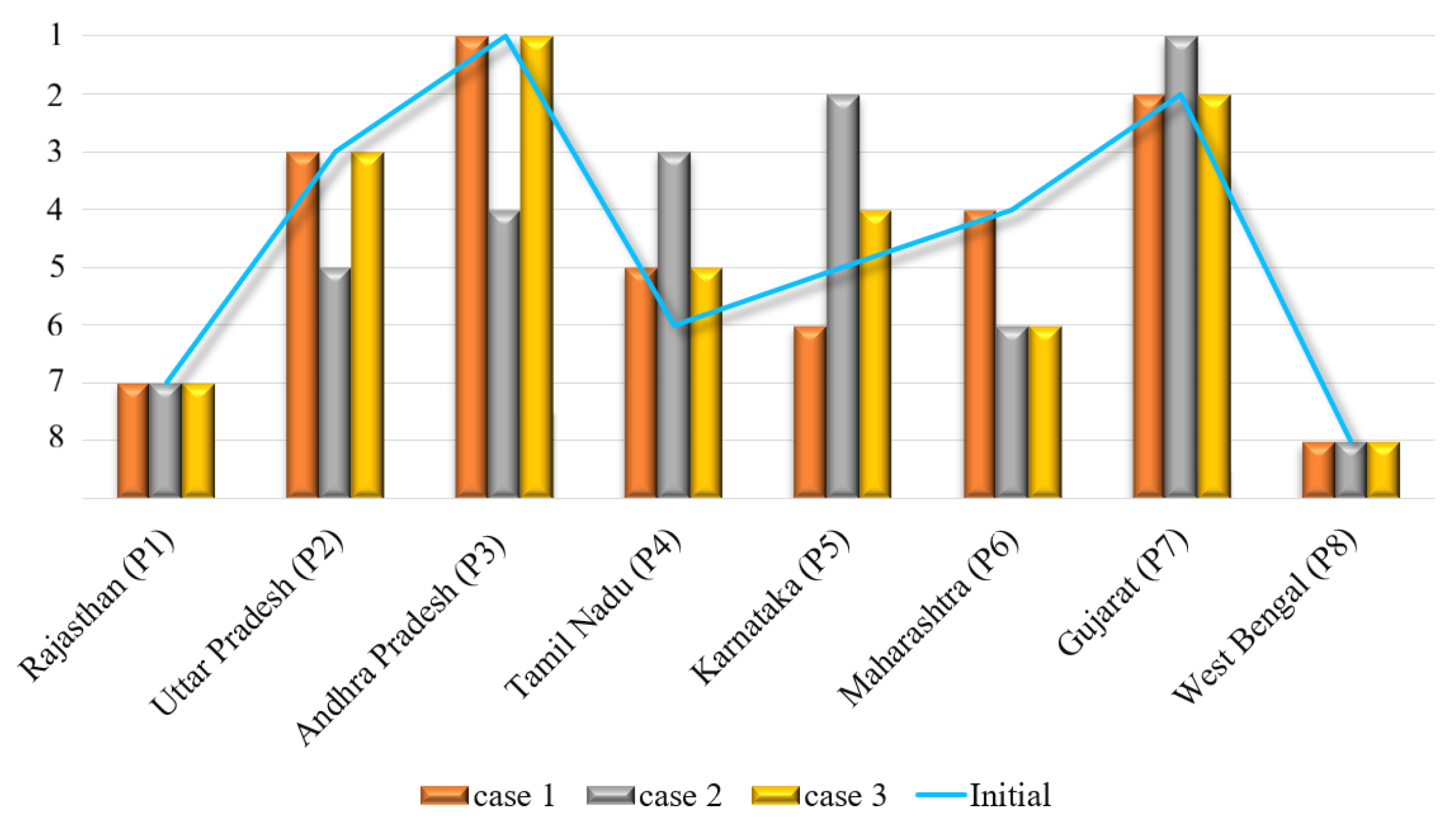
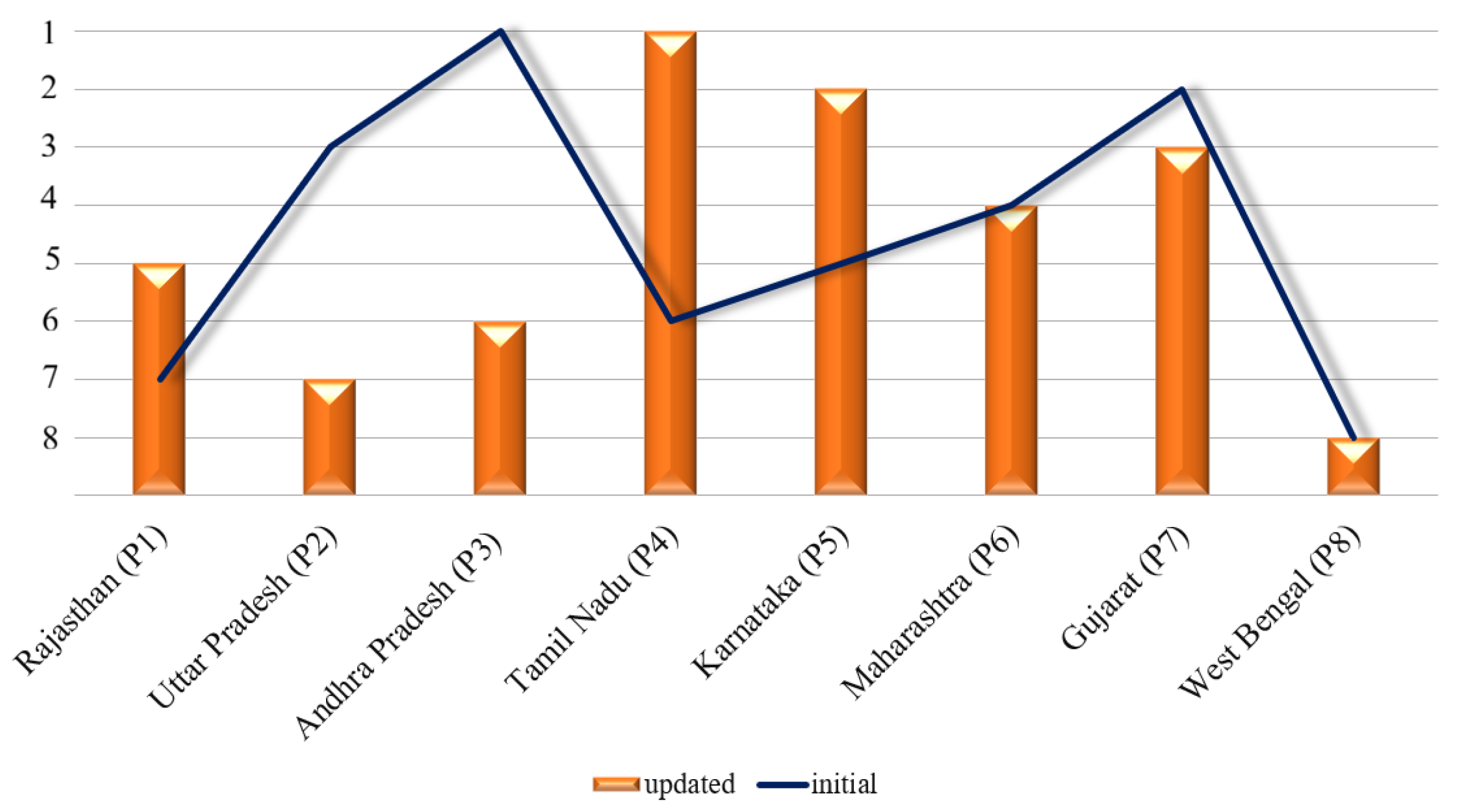
By referencing
Table 16, we created a chart for comparing the initial and updated rankings of the alternatives, as shown in
Figure 8. The updated rankings are displayed in columns, whereas the initial rankings are arranged in a single line.
Remark 11. Table 16 and Figure 8 in the above discussion represent a comparison between the initial and updated rankings of eight alternatives within the PIFN-based VIKOR framework. Some changes can be noticed in the ranking positions. Tamil Nadu displayed a significant improvement, rising from an initial rank of six to the top position. Karnataka also improved significantly, moving from the fifth to second place. In contrast, Andhra Pradesh , which was initially in first place, dropped to sixth place. Similarly, Uttar Pradesh fell from third to seventh. Maharashtra retained its fourth position, showing consistency in its assessment. Gujarat slipped slightly from second to third place, and Rajasthan improved slightly from seventh to fifth place. West Bengal remained at the eighth position, showing no change. 10.2. Scenario II: Comparative Analysis Using the COPRAS Method Instead of the VIKOR Technique
Here, we introduced the multi-criteria decision-making COPRAS methodology, instead of the VIKOR technique. The adopted fuzzy numbers (PIFNs) and weight calculation method (CRITIC) were maintained as in the original setup.
To determine the rank of the alternatives, we utilised the initial weights of the criteria, as shown in
Table 9. For the COPRAS approach, we followed the steps described in several established research works [
122,
123]. Applying the COPRAS method, we obtained a new ranked list of alternatives, as presented in
Table 17 below.
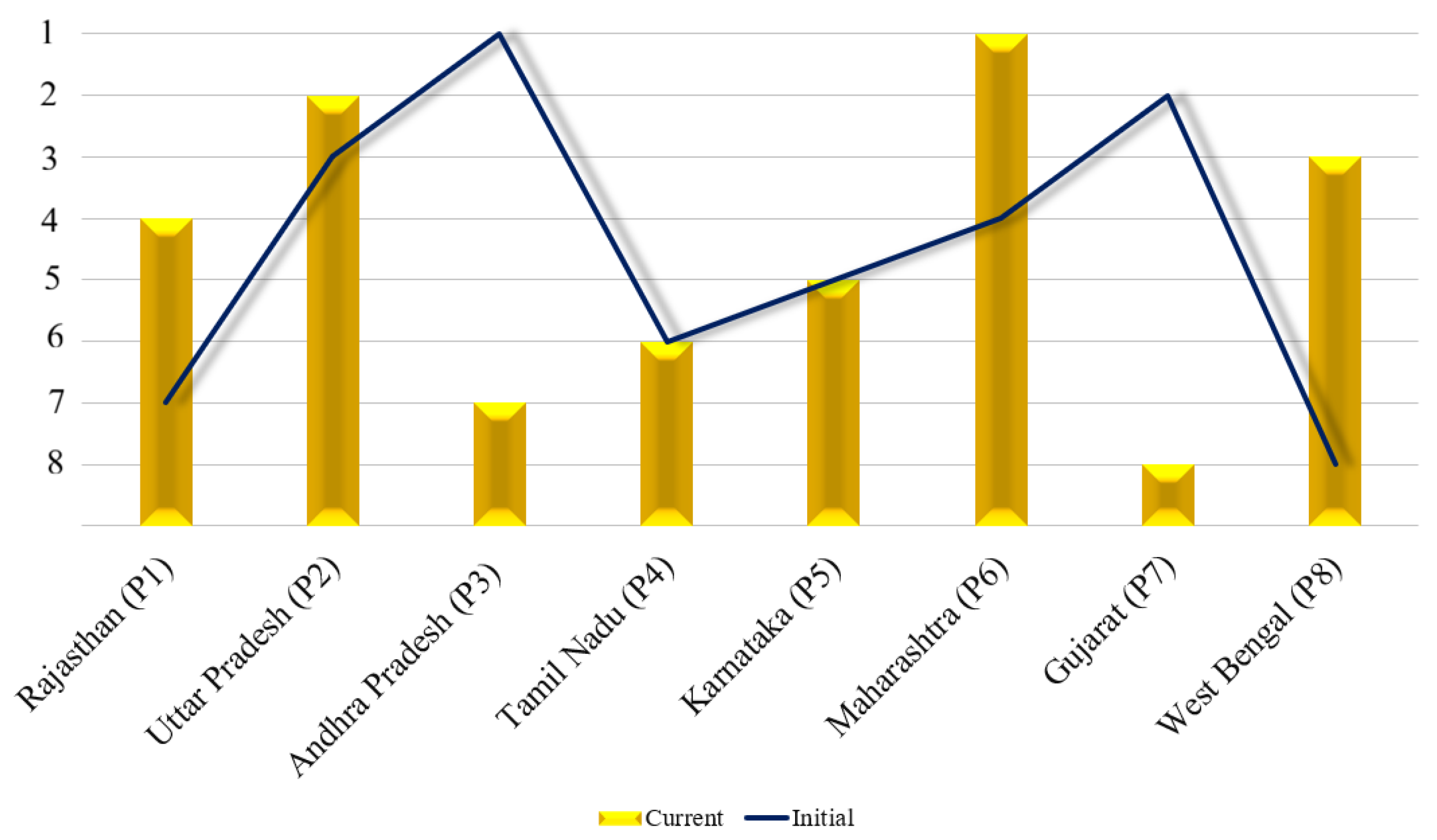
Using the data in
Table 17, we created a graphical representation comparing the ranks of the alternatives obtained by the COPRAS method with the initial ranks determined by the VIKOR technique, as shown in
Figure 9. In the graph, the current ranks are displayed in columns, and a single line indicates the initial ranks.
Remark 12. From the above discussion, Table 17 and Figure 9 illustrate the differences between the current and initial rankings of various alternatives using the COPRAS method. Maharashtra improved the most, moving from fourth place to first. West Bengal also showed significant improvement, moving from last place (eighth) to third place. Rajasthan improved slightly from seventh to fourth place, and Uttar Pradesh improved slightly from third to second place. However, some changes were also negative. Andhra Pradesh dropped sharply from first place to seventh. Based on the new assessment, Gujarat dropped from second to last place (eighth), showing a decline in performance. Tamil Nadu and Karnataka retained their previous positions, remaining in sixth and fifth place, indicating that their performance was stable. 11. Research Implication
There are different angles from which the implications of this work can be analysed. This research work gives us a clear view of how effectively the pentagonal intuitionistic fuzzy numbers (PIFNs) can be incorporated in a CRITIC–VIKOR based approach. This model offers an approach to site selection problems in which uncertainty can be incorporated into decision-making. From this study, a scientific and realistic method was developed for identifying the most suitable site for establishing a new solar PV power plant in India. This work also promotes the sustainable expansion of solar energy through the installation of new solar power plants, which enhances energy security. It also helps increase employability and overall economic growth. This study helps develop renewable energy policies in India and mitigate environmental impacts.
Our proposed method includes an MCDM-based model that incorporates pentagonal intuitionistic fuzzy numbers (PIFNs) and a new de-i-fuzzification technique. It helps convert the judgments of decision experts into actionable site scores to establish a new solar photovoltaic (PV) power plant in India. This method improves the ranking process, which becomes more flexible and reliable. It also makes the result capable of integrating with GIS layers and being used by policymakers.
12. Conclusions and Future Research Scope
This research developed a framework for selecting and ranking locations for constructing solar photovoltaic (PV) power plants in various states in India, each with distinct regional characteristics and solar energy potential. The weights of the criteria were determined using the CRITIC method, and the optimisation of the alternatives was performed using the VIKOR-based MCDM methodology. To address internal uncertainties, pentagonal intuitionistic fuzzy numbers (PIFNs) were employed, along with a novel de-i-fuzzification approach based on the relative difference between two real numbers. All necessary data were collected from four decision-makers (DMs) or experts, in linguistic form, to ensure impartial assessments. Thus, this study is not only relevant to India but also applicable to industrial location planning worldwide, offering an effective and practical approach to selecting optimal locations for solar photovoltaic (PV) power plants.
We observe that airflow speed had the highest weight among the criteria, while the proximity of the transmission network was the least weighted criterion in this study. After ranking the alternatives according to the aforementioned criteria, it was observed that Andhra Pradesh received the highest rank, whereas West Bengal retained the lowest rank. To assess the stability of the results, a sensitivity analysis was performed across three practical cases. A comparative analysis was also conducted. Lastly, we can talk about the fact that according to the DM’s information, Andhra Pradesh was an ideal state for constructing a solar PV power plant. Other states were also suitable for the construction of solar PV power plants. Since West Bengal retained the lowest rank, the state has better opportunities in the future.
12.1. Limitation of the Study
The present study identified a suitable location for constructing a solar PV power plant in India but did not consider countries with different geographical environments. The proposed method and analytical framework can be appropriately adapted to relevant data and context and applied in any country or region of the world, and they can be effectively used for any type of industrial location decision problem. The study was conducted using a few decision-makers and a small dataset. Only 12 criteria and 8 alternatives were considered in the survey, and some less essential criteria were omitted. Integrating PIFN causes some complexity, but it helps manage uncertainty. The study could not discuss future changes such as climate change or technological improvements and focused on a few stakeholders.
12.2. Future Research Scope
In the future, various avenues exist to further develop and improve this research. The present study employed two MCDM methods, namely, CRITIC and VIKOR. In addition to these two approaches, researchers can apply other MCDM methodologies, such as AHP, entropy, TOPSIS, MARCOS, MABAC, MAIRCA, etc. Additionally, a combination of genetic algorithms and fuzzy logic can yield improved results. Researchers can use geospatial information systems (GISs) and remote sensing data to select the correct location. The study can be extended by adding supplementary criteria and sub-criteria related to the model, as well as different types of fuzzy numbers, such as spherical fuzzy numbers, hexagonal fuzzy numbers, and heptagonal fuzzy numbers.
Author Contributions
Conceptualization, K.H.G., A.K.M., S.P.M. and A.G.; methodology, K.H.G., A.K.M., S.B.M. and S.S.; software, K.H.G., A.K.M., S.P.M. and A.G.; validation, A.K.M., S.B.M., S.S. and A.G.; formal analysis, K.H.G., A.K.M., S.B.M. and S.P.M.; investigation, S.B.M., S.P.M., S.S. and A.G.; resources, K.H.G., S.B.M., S.P.M. and A.G.; data curation, K.H.G., A.K.M. and S.P.M.; writing—original draft preparation, K.H.G., A.K.M. and A.G.; writing—review and editing, A.K.M., S.B.M., S.P.M. and S.S.; visualization, K.H.G., A.K.M., S.B.M. and S.P.M.; supervision, S.B.M., S.P.M. and S.S.; project administration, K.H.G., A.K.M., S.B.M. and S.P.M.; funding acquisition, K.H.G. and S.P.M. All authors have read and agreed to the published version of the manuscript.
Funding
There is no funding for this research.
Data Availability Statement
No new data were created or analyzed in this study.
Acknowledgments
The author Kamal Hossain Gazi also conveys his heartiest thanks to the Maulana Azad National Fellowship (MANF) under the University Grants Commission (UGC), Government of India, New Delhi, India, for giving the fellowship (Fellowship ID: PLNG/13/2023-PLANNINGNMDFC/CSIR NET JUNE 2021) and support for preparing the article.
Conflicts of Interest
The authors declare no conflict of interest.
Appendix A. Preliminaries on Mathematical Tools
In this section, we discuss the basic concept of fuzzy sets and the development of pentagonal intuitionistic fuzzy numbers (PIFNs) from fuzzy sets.
Appendix A.1. Fuzzy Set and Fuzzy Number
A fuzzy set is a type of mathematical set with a degree of membership rather than binary inclusion or exclusion of elements [
124]. A fuzzy number is a particular type of fuzzy set that represents uncertain quantities. A brief conceptual overview of fuzzy sets and fuzzy numbers is provided below.
Definition A1. Fuzzy Set
A fuzzy set, symbolized as , within a group of elements, called , can be represented as a set of pairs likewhere indicates the membership function for the fuzzy set and is called the degree of membership of t in . Figure A1 visually illustrates the concept of a fuzzy set.
Figure A1.
Membership function of a fuzzy set.
Figure A1.
Membership function of a fuzzy set.
Remark A1. The degree of membership of an element indicates the level of its connection to the set. A membership degree of “zero” signifies complete absence, while “one” indicates full presence. Intermediate values represent varying degrees of partial presence of an element within the set.
Definition A2. Fuzzy Number
A fuzzy subset defined on the universal set is termed a fuzzy number if it satisfies the following conditions:
- (i)
forms a convex fuzzy set, i.e., for every and .
- (ii)
The height of the fuzzy set is 1, i.e.,
- (iii)
is a piece-wise continuous function in its domain.
- (iv)
must have a bounded support, i.e., is contained in a bounded subset of .
Remark A2. A fuzzy number is a specific type of fuzzy set, where the membership function quantifies a numerical value by indicating the degree of membership.
Appendix A.2. Pentagonal Fuzzy Number (PFN)
A pentagonal fuzzy number (PFN) is an improved and more comprehensive extension of various other types of fuzzy numbers, including triangular and trapezoidal. These types of fuzzy numbers are commonly used to represent uncertain or unclear quantities. A brief description of PFNs is given below.
Definition A3. Pentagonal Fuzzy Number (PFN)
A fuzzy number, formed as , is said to be a pentagonal fuzzy number (PFN) defined on a universal set , where each for , if , and are the intermediate membership values with . The membership function of is as follows: Figure A2 below elegantly portrays the visual representation of a pentagonal fuzzy number (PFN).
Figure A2.
Visual representation of a pentagonal fuzzy number (PFN).
Figure A2.
Visual representation of a pentagonal fuzzy number (PFN).
Remark A3. To preserve the convexity of the membership function, the interior angles created at points and must be less than .
Remark A4. If , the resulting fuzzy number takes the shape of a triangle. On the other hand, if , the PFN represents a trapezoidal-shaped fuzzy number.
Appendix A.3. Intuitionistic Fuzzy Set (IFS)
The intuitionistic fuzzy set (IFS) extends the traditional fuzzy set by including membership and non-membership degrees for each element. The definition of IFS and its properties are outlined below.
Definition A4. Intuitionistic Fuzzy Set (IFS)
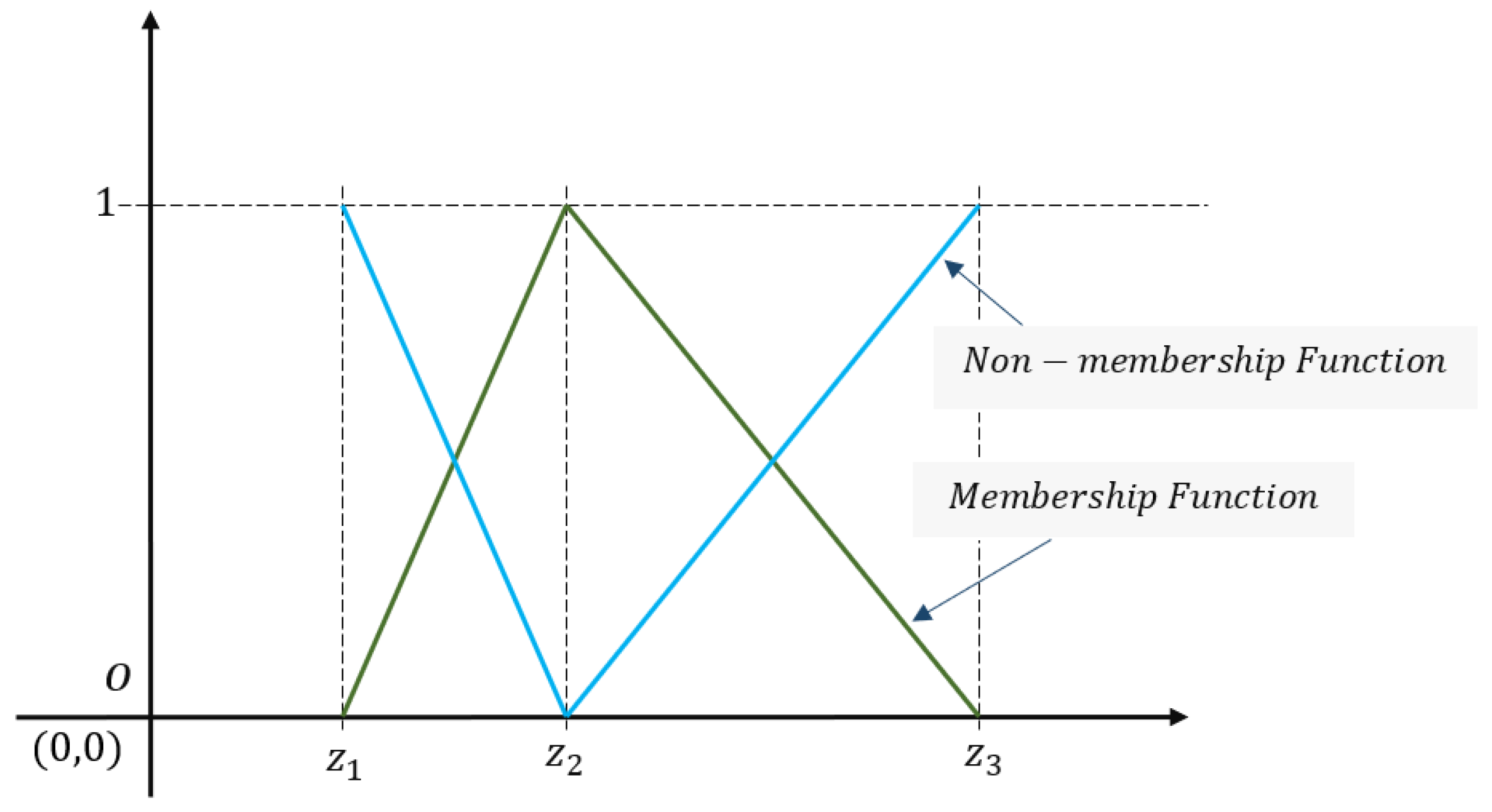
An intuitionistic fuzzy set (IFS), defined on a finite universal set can be represented aswhere and are referred to as the membership function and non-membership function of in with and for all . Figure A3 illustrates the visual representation of the membership and non-membership degrees of an intuitionistic fuzzy set (IFS).
Figure A3.
Graphical representation of an intuitionistic fuzzy set (IFS) illustrating its membership and non-membership degrees.
Figure A3.
Graphical representation of an intuitionistic fuzzy set (IFS) illustrating its membership and non-membership degrees.
Remark A5. Intuitionistic fuzzy sets make fuzzy sets more explicit by including a non-membership degree for each element within the set.
Definition A5. Indeterminacy Function
Consider an intuitionistic fuzzy set (IFS), , as defined in Definition A4 above. The function defined asis called indeterminacy function for an intuitionistic fuzzy set . The functional value, , is termed the degree of indeterminacy of an element . Remark A6. When and , there is no uncertainty about the element’s membership, yielding , i.e., no indeterminacy. For and , indeterminacy is maximized, resulting in , with intermediate values for other combinations.
References
- Peters, I.M. From fossil fuels to photovoltaics: Energy’s role in human development and sustainability. EES Sol. 2025, 1, 712–723. [Google Scholar] [CrossRef]
- Mdallal, A.; Alami, A.H.; Yasin, A.; Mahmoud, M.; Olabi, A.G. A comprehensive review on solar photovoltaics: Navigating generational shifts, innovations, and sustainability. Sustain. Horiz. 2025, 13, 100137. [Google Scholar] [CrossRef]
- Zhou, J.; Ding, Q.; Zou, Z.; Deng, J.; Xu, C.; Yang, W. Land suitability evaluation of large-scale photovoltaic plants using structural equation models. Resour. Conserv. Recycl. 2023, 198, 107179. [Google Scholar] [CrossRef]
- Hassan, I.; Alhamrouni, I.; Azhan, N.H. A CRITIC–TOPSIS Multi-Criteria Decision-Making Approach for Optimum Site Selection for Solar PV Farm. Energies 2023, 16, 4245. [Google Scholar] [CrossRef]
- Mukherjee, A.K.; Gazi, K.H.; Mukherjee, S.B.; Ciurdariu, L.; Biswas, A.; Ramalingam, S.; Mondal, S.P.; Singh, P. Identifying alternative energy sources: A multi-criteria intuitionistic fuzzy approach to sustainable alternatives. Frankl. Open 2025, 12, 100363. [Google Scholar] [CrossRef]
- Dinçer, S. Alternative Renewable Energy Sources in the Context of Global Energy Crises and Sustainable Environment. Kapanaltı Derg. 2025, 7, 19–30. [Google Scholar] [CrossRef]
- Kishore, T.S.; Kumar, P.U.; Ippili, V. Review of global sustainable solar energy policies: Significance and impact. Innov. Green Dev. 2025, 4, 100224. [Google Scholar] [CrossRef]
- Kanchan; Mineekshi; Kumar, R. Photovoltaic Solar Energy in Achieving India’s Renewable Energy for Sustainable Development. J. Electr. Syst. 2024, 20, 9495–9507. [Google Scholar]
- Wang, C.N.; Chung, Y.C.; Wibowo, F.D.; Dang, T.T.; Nguyen, N.A.T. Site Selection of Solar Power Plants Using Hybrid MCDM Models: A Case Study in Indonesia. Energies 2023, 16, 4042. [Google Scholar] [CrossRef]
- Almasad, A.; Pavlak, G.; Alquthami, T.; Kumara, S. Site suitability analysis for implementing solar PV power plants using GIS and fuzzy MCDM based approach. Sol. Energy 2023, 249, 642–650. [Google Scholar] [CrossRef]
- Garni, H.Z.A.; Awasthi, A. Solar PV power plant site selection using a GIS-AHP based approach with application in Saudi Arabia. Appl. Energy 2017, 206, 1225–1240. [Google Scholar] [CrossRef]
- Gorjian, S.; Singh, R.; Shukla, A.; Mazhar, A.R. Chapter 6-On-farm applications of solar PV systems. In Photovoltaic Solar Energy Conversion; Academic Press: Cambridge, MA, USA, 2020; pp. 147–190. [Google Scholar] [CrossRef]
- Ahmad, L.; Khordehgah, N.; Malinauskaite, J.; Jouhara, H. Recent advances and applications of solar photovoltaics and thermal technologies. Energy 2020, 207, 118254. [Google Scholar] [CrossRef]
- Gorjian, S.; Minaei, S.; MalehMirchegini, L.; Trommsdorff, M.; Shamshiri, R.R. Chapter 7-Applications of solar PV systems in agricultural automation and robotics. In Photovoltaic Solar Energy Conversion: Technologies, Applications and Environmental Impacts; Academic Press: Cambridge, MA, USA, 2020; pp. 191–235. [Google Scholar] [CrossRef]
- Gevorkov, L.; Kirpichnikova, I. Model of Solar Photovoltaic Water Pumping System for Domestic Application. In Proceedings of the 2021 28th International Workshop on Electric Drives: Improving Reliability of Electric Drives (IWED), Moscow, Russia, 27–29 January 2021; pp. 1–5. [Google Scholar] [CrossRef]
- Tian, L.; Huang, Y.; Liu, S.; Sun, S.; Deng, J.; Zhao, H. Application of photovoltaic power generation in rail transit power supply system under the background of energy low carbon transformation. Alex. Eng. J. 2021, 60, 5167–5174. [Google Scholar] [CrossRef]
- Dhonde, M.; Sahu, K.; Murty, V.V.S. The application of solar-driven technologies for the sustainable development of agriculture farming: A comprehensive review. Rev. Environ. Sci. Bio Technol. 2022, 21, 139–167. [Google Scholar] [CrossRef]
- Ghaleb, B.; Asif, M. Application of solar PV in commercial buildings: Utilizability of rooftops. Energy Build. 2022, 257, 111774. [Google Scholar] [CrossRef]
- Alsharif, A.; Ahmed, A.A.; Mohamed, H.; Khaleel, M.; Hebrisha, H.; Almabsout, E.; AbouSif, M.; Al-Naas, Y. Applications of Solar Energy Technologies in North Africa: CurrentPractices and Future Prospects. Int. J. Electr. Eng. Sustain. IJEES 2023, 1, 164–174. [Google Scholar]
- Kunjuramakurup, L.; Sulthan, S.M.; Ponparakkal, M.S.; Raj, V.; Sathyajith, M. A High-Power Solar PV-fed TISO DC-DC Converter for Electric Vehicle Charging Applications. Energies 2023, 16, 2186. [Google Scholar] [CrossRef]
- Susilowati, Y.; Hardiyasanti, D.C.; Widianingrum, S.; Endrasari, F.; Djamari, D.W.; Bahar, A.H.; Wahono, J.; Veza, I. Carbon credit and economic feasibility analysis of biomass-solar PV-battery power plant for application in Indonesia remote area. Renew. Energy 2013, 219, 119383. [Google Scholar] [CrossRef]
- Alami, A.H.; Ramadan, M.; Abdelkareem, M.A.; Alghawi, J.J.; Alhattawi, N.T.; Mohamad, H.A.; Olabi, A.G. Novel and practical photovoltaic applications. Therm. Sci. Eng. Prog. 2022, 29, 101208. [Google Scholar] [CrossRef]
- Sukumaran, S.; Laht, J.; Volkova, A. Overview of Solar Photovoltaic Applications for District Heating and Cooling. Environ. Clim. Technol. 2023, 27, 964–979. [Google Scholar] [CrossRef]
- Maka, A.O.M.; Chaudhary, T.N.; Alaswad, G.; Elsayah, O. Applications of solar photovoltaics in powering cathodic protection systems: A review. Clean Technol. Environ. Policy 2024, 26, 2755–2776. [Google Scholar] [CrossRef]
- Sarvar-Ardeh, S.; Rashidi, S.; Rafee, R.; Li, G. Recent advances in the applications of solar-driven co-generation systems for heat, freshwater and power. Renew. Energy 2024, 225, 120256. [Google Scholar] [CrossRef]
- Xiao, H.; Lai, W.; Chen, A.; Lai, S.; He, W.; Deng, X.; Zhang, C.; Ren, H. Application of Photovoltaic and Solar Thermal Technologies in Buildings: A Mini-Review. Coatings 2024, 14, 257. [Google Scholar] [CrossRef]
- Kok, C.L.; Fu, X.; Koh, Y.Y.; Teo, T.H. A Novel Portable Solar Powered Wireless Charging Device. Electronics 2025, 13, 403. [Google Scholar] [CrossRef]
- Asgari, N.; Hayibo, K.S.; Groza, J.; Rana, S.; Pearce, J.M. Greenhouse applications of solar photovoltaic driven heat pumps in northern environments. Renew. Sustain. Energy Rev. 2025, 207, 114920. [Google Scholar] [CrossRef]
- Yang, H.; Guan, B.; Zhang, J.; Zhang, T.; Liu, X.; Wang, X. Application potential of rooftop photovoltaics (PV) in elevated metro station for a low-carbon future: Characteristic analysis and strategies for supply-demand mismatch. Renew. Energy 2025, 238, 121983. [Google Scholar] [CrossRef]
- González, P.E.; Montañés, E.B. Chapter 15-Solar PV for Space Applications. In Fundamentals of Solar Cells and Photovoltaic Systems Engineering; Academic Press: Cambridge, MA, USA, 2025; pp. 487–504. [Google Scholar] [CrossRef]
- Terkes, M.; Demirci, A.; Gokalp, E.; Cali, U. Impact analysis of battery control strategies on battery aging for grid-connected and solar-powered residential battery applications. Heliyon 2025, 11, e42903. [Google Scholar] [CrossRef]
- Tripathi, S.; Shrivastava, A.; Jana, K.C. EO based fuzzy optimal controller for solar MPPT and battery charging circuit for EV charging application. Int. J. Dyn. Control 2025, 13, 66. [Google Scholar] [CrossRef]
- Saha, S.K. Empowering rural South Asia: Off-grid solar PV, electricity accessibility, and sustainable agriculture. Appl. Energy 2025, 337, 124639. [Google Scholar] [CrossRef]
- Chakraborty, A.; Pal, S.; Mondal, S.P.; Alam, S. Nonlinear pentagonal intuitionistic fuzzy number and its application in EPQ model under learning and forgetting. Complex Intell. Syst. 2022, 8, 1307–1322. [Google Scholar] [CrossRef]
- Kamble, P.N.; Parveen, N. Extended TOPSIS and VIKOR Methods Based on a New Distance Measure of Intuitionistic Fuzzy Number. In Artificial Intelligence and Sustainable Computing. Algorithms for Intelligent Systems; Pandit, M., Gaur, M.K., Rana, P.S., Tiwari, A., Eds.; Springer: Berlin/Heidelberg, Germany, 2022; pp. 495–509. [Google Scholar] [CrossRef]
- Mert, A. Defuzzification of Non-Linear Pentagonal Intuitionistic Fuzzy Numbers and Application in the Minimum Spanning Tree Problem. Symmetry 2023, 15, 1853. [Google Scholar] [CrossRef]
- Raut, P.K.; Behera, S.P. Evaluation of shortest path of network by using an intuitionistic pentagonal fuzzy number with interval values. Int. J. Reason.-Based Intell. Syst. 2024, 16, 154–159. [Google Scholar] [CrossRef]
- Sahoo, D.; Tripathy, A.; Pati, J. Study on multi-objective linear fractional programming problem involving pentagonal intuitionistic fuzzy number. Results Control Optim. 2022, 6, 100091. [Google Scholar] [CrossRef]
- Srinivasan, R.; Nakkeeran, T.; Saveetha, G. Evaluation of fuzzy non-preemptive priority queues in intuitionistic pentagonal fuzzy numbers using centroidal approach. Malaya J. Mat. 2020, S, 427–430. [Google Scholar] [CrossRef]
- Mondal, S.P.; Mandal, M.; Mahata, A.; Roy, T.K. Integral equations with pentagonal intuitionistic fuzzy numbers. Notes Intuitionistic Fuzzy Sets 2018, 24, 40–52. [Google Scholar] [CrossRef]
- Vivek, E.; Uma, N. The Transportation Problem of Pentagonal Intuitionistic Fuzzy Number Using Sign Distance Ranking Method. In Proceedings of the International Interdisciplinary Research Conference on Recent Technological Development in Computational Mathematics and Its Applications (RTDCMA 2022), Coimbatore, India, 17 May 2022; pp. 302–307. [Google Scholar]
- Yuvashri, P.; Saraswathi, A. Multiobjective linear fractional programming model with equality and inequality constraints under pentagonal intuitionistic fuzzy environment. Opsearch 2024, 62, 1991–2028. [Google Scholar] [CrossRef]
- Dey, A.; Ray, P.; Seal, S. A Study of an EPQ Model of Deterioration Items with Effect of Carbon Emission under Pentagonal Intuitionistic Fuzzy Number. Res. Sq. 2024, 1–21. [Google Scholar] [CrossRef]
- Razzaq, O.A.; Alzahrani, F.; Fahad, M.; Khan, N.A.; Alshomrani, A.S.; Ullah, M.Z. Prioritaization of Awareness Campaigns for a Diseases Through Fusion of Pentagonal Intuitionistic Fuzzy Number and PROMETHEE. Appl. Comput. Math. 2023, 22, 45–65. [Google Scholar]
- Diakoulaki, D.; Mavrotas, G.; Papayannakis, L. Determining objective weights in multiple criteria problems: The critic method. Comput. Oper. Res. 1995, 22, 763–770. [Google Scholar] [CrossRef]
- Kaur, G.; Dhara, A.; Majumder, A.; Sandhu, B.S.; Puhan, A.; Adhikari, M.S. A CRITIC-TOPSIS MCDM Technique under the Neutrosophic Environment with Application on Aircraft Selection. Contemp. Math. 2023, 4, 1180–1203. [Google Scholar] [CrossRef]
- Haktanır, E.; Kahraman, C. A novel picture fuzzy CRITIC & REGIME methodology: Wearable health technology application. Eng. Appl. Artif. Intell. 2022, 113, 104942. [Google Scholar] [CrossRef]
- Ali, J. A novel score function based CRITIC-MARCOS method with spherical fuzzy information. Comput. Appl. Math. 2021, 40, 280. [Google Scholar] [CrossRef]
- Ertemel, A.V.; Menekse, A.; Akdag, H.C. Smartphone Addiction Assessment Using Pythagorean Fuzzy CRITIC-TOPSIS. Sustainability 2023, 15, 3955. [Google Scholar] [CrossRef]
- Alipour-Bashary, M.; Ravanshadnia, M.; Abbasianjahromi, H.; Asnaashari, E. Building demolition risk assessment by applying a hybrid fuzzy FTA and fuzzy CRITIC-TOPSIS framework. Int. J. Build. Pathol. Adapt. 2021, 40, 134–159. [Google Scholar] [CrossRef]
- Krishankumar, R.; Mishra, A.R.; Rani, P.; Ecer, F.; Ravichandran, K.S. Assessment of Zero-Carbon Measures for Sustainable Transportation in Smart Cities: A CRITIC-MARCOS Framework Based on Q-Rung Fuzzy Preferences. IEEE Internet Things J. 2023, 10, 18651–18662. [Google Scholar] [CrossRef]
- Zhang, H.; Bai, X.; Hong, X. Site selection of nursing homes based on interval type-2 fuzzy AHP, CRITIC and improved TOPSIS methods. J. Intell. Fuzzy Syst. 2022, 42, 3789–3804. [Google Scholar] [CrossRef]
- Sbastian, F.; Ridwan, A.Y.; Novitasari, N. Implementation of Multi Criteria Decision Making (MCDM) Fuzzy Neutrosophic TOPSIS-CRITIC in Determining Sustainability Aspects of the Location of IoT Based Products Warehouse. In Proceedings of the 2021 International Conference on Computer Science and Engineering (IC2SE), Padang, Indonesia, 16 November 2021; pp. 1–8. [Google Scholar] [CrossRef]
- Peng, X.; Garg, H. Intuitionistic fuzzy soft decision making method based on CoCoSo and CRITIC for CCN cache placement strategy selection. Artif. Intell. Rev. 2022, 55, 1567–1604. [Google Scholar] [CrossRef]
- Zhang, H.; Wei, G. Location selection of electric vehicles charging stations by using the spherical fuzzy CPT–CoCoSo and D-CRITIC method. Comput. Appl. Math. 2023, 42, 60. [Google Scholar] [CrossRef]
- Mishra, A.R.; Rani, P.; Bharti, S. Assessment of Agriculture Crop Selection Using Pythagorean Fuzzy CRITIC–VIKOR Decision-Making Framework. In Pythagorean Fuzzy Sets; Garg, H., Ed.; Springer: Berlin/Heidelberg, Germany, 2021; pp. 167–191. [Google Scholar] [CrossRef]
- Saxena, P.; Kumar, V.; Ram, M. A novel CRITIC-TOPSIS approach for optimal selection of software reliability growth model (SRGM). Qual. Reliab. Eng. Int. 2022, 38, 2501–2520. [Google Scholar] [CrossRef]
- Wang, Y.; Wang, W.; Wang, Z.; Deveci, M.; Roy, S.K.; Kadry, S. Selection of sustainable food suppliers using the Pythagorean fuzzy CRITIC-MARCOS method. Inf. Sci. 2024, 664, 120326. [Google Scholar] [CrossRef]
- Alkan, N. Evaluation of sustainable development and utilization-oriented renewable energy systems based on CRITIC-SWARA-CODAS method using interval valued picture fuzzy sets. Sustain. Energy Grids Netw. 2024, 38, 101263. [Google Scholar] [CrossRef]
- Zolfani, S.H. Objective Weighting in MCDM: A Comparative Study of CRITIC, ITARA, MEREC, and Beyond. Decis. Mak. Artif. Intell. Trends 2024, 1, 105–120. Available online: https://dmait.sci-flag.com/article_211202.html (accessed on 30 September 2025).
- Alkan, N.; Kahraman, C. Continuous Intuitionistic Fuzzy CRITIC & WASPAS: Smart City Evaluation. Intell. Fuzzy Syst. 2024, 1088, 725–734. [Google Scholar] [CrossRef]
- Kara, K.; Yalçın, G.C.; Çetinkaya, A.; Simic, V.; Pamucar, D. A single-valued neutrosophic CIMAS-CRITIC-RBNAR decision support model for the financial performance analysis: A study of technology companies. Socio-Econ. Plan. Sci. 2024, 92, 101851. [Google Scholar] [CrossRef]
- Mao, L.X.; Lan, J.; Chen, A.; Shi, H.; Liu, H.C. New Approach for Quality Function Deployment Based on Linguistic Distribution Assessments and CRITIC Method. Mathematics 2025, 13, 240. [Google Scholar] [CrossRef]
- Nguyen, V.T.; Chaysiri, R. CRITIC-CoCoSo Model Application in Hybrid Solar-Wind Energy Plant Location Selection Problem: A Case Study in Vietnam. Energy Eng. 2025, 122, 515–536. [Google Scholar] [CrossRef]
- Akpınar, M.E. Analysis of Logistics 4.0 Service Provider Alternatives with CRITIC-Based WASPAS Method. Veriml. Derg. Product. Logist. 2025, 77–88. [Google Scholar] [CrossRef]
- Fan, J.; Han, Y.; Wu, M. CRITIC-TOPSIS Method Based on Pairwise Preference Graph Neural Similarity and Its Application in Vehicle Selection. Int. J. Fuzzy Syst. 2025, 1–15. [Google Scholar] [CrossRef]
- Rasool, Z.; Gurmani, S.H.; Niazai, S.; Zulqarnain, R.M.; Alballa, T.; Khalifa, H.A.E.W. An integrated CRITIC and EDAS model using linguistic T spherical fuzzy Hamacher aggregation operators and its application to group decision making. Sci. Rep. 2025, 15, 6122. [Google Scholar] [CrossRef]
- Opricovic, S. Multicriteria optimization of civil engineering systems. Fac. Civ. Eng. Belgrade 1998, 2, 5–21. [Google Scholar]
- Akram, M.; Muhiuddin, G.; Santos-Garćıa, G. An enhanced VIKOR method for multi-criteria group decision-making with complex Fermatean fuzzy sets. Math. Biosci. Eng. 2022, 19, 7201–7231. [Google Scholar] [CrossRef] [PubMed]
- Wang, X.; Wang, K. A multi-criteria decision-making method based on triangular interval-valued fuzzy numbers and the VIKOR method. J. Intell. Fuzzy Syst. 2021, 40, 221–233. [Google Scholar] [CrossRef]
- Sharaf, I.M. Spherical Fuzzy VIKOR with SWAM and SWGM Operators for MCDM. In Decision Making with Spherical Fuzzy Sets. Studies in Fuzziness and Soft Computing; Kahraman, C., Kutlu Gündoğdu, F., Eds.; Springer: Berlin/Heidelberg, Germany, 2021; Volume 392, pp. 217–240. [Google Scholar] [CrossRef]
- Demir, E.; Ak, M.F.; Sarı, K. Pythagorean Fuzzy Based AHP-VIKOR Integration to Assess Rail Transportation Systems in Turkey. Int. J. Fuzzy Syst. 2022, 25, 620–632. [Google Scholar] [CrossRef]
- Vaid, S.K.; Vaid, G.; Kaur, S.; Kumar, R.; Sidhu, M.S. Application of multi-criteria decision-making theory with VIKOR-WASPAS-Entropy methods: A case study of silent Genset. Mater. Today Proc. 2022, 50, 2416–2423. [Google Scholar] [CrossRef]
- Wang, C.N.; Nguyen, N.A.T.; Dang, T.T.; Lu, C.M. A Compromised Decision-Making Approach to Third-Party Logistics Selection in Sustainable Supply Chain Using Fuzzy AHP and Fuzzy VIKOR Methods. Mathematics 2021, 9, 886. [Google Scholar] [CrossRef]
- Gupta, P.; Mehlawat, M.K.; Ahemad, F. Selection of renewable energy sources: A novel VIKOR approach in an intuitionistic fuzzy linguistic environment. Environ. Dev. Sustain. 2023, 25, 3429–3467. [Google Scholar] [CrossRef]
- Saqlain, M. Sustainable Hydrogen Production: A Decision-Making Approach Using VIKOR and Intuitionistic Hypersoft Sets. J. Intell. Manag. Decis. 2023, 2, 130–138. [Google Scholar] [CrossRef]
- Khan, A.; Ahmad, U.; Shahzadi, S. A new decision analysis based on 2-tuple linguistic q-rung picture fuzzy ITARA–VIKOR method. Soft Comput. 2023, 1–24. [Google Scholar] [CrossRef]
- Paul, T.K.; Jana, C.; Pal, M.; Simic, V. Sustainable carbon-dioxide storage assessment in geological media using modified Pythagorean fuzzy VIKOR and DEMATEL approach. Int. J. Hydrogen Energy 2023, 48, 9474–9497. [Google Scholar] [CrossRef]
- Büyüközkan, G.; Karabulut, Y.; Göçer, F. Spherical fuzzy sets based integrated DEMATEL, ANP, VIKOR approach and its application for renewable energy selection in Turkey. Appl. Soft Comput. 2024, 158, 111465. [Google Scholar] [CrossRef]
- Mahmudah, R.S.; Putri, D.I.; Abdullah, A.G.; Shafii, M.A.; Hakim, D.L.; Setiadipura, T. Developing a Multi-Criteria Decision-Making model for nuclear power plant location selection using Fuzzy Analytic Hierarchy Process and Fuzzy VIKOR methods focused on socio-economic factors. Clean. Eng. Technol. 2024, 19, 100737. [Google Scholar] [CrossRef]
- Dağıstanlı, H.A. An Interval-Valued Intuitionistic Fuzzy VIKOR Approach for R&D Project Selection in Defense Industry Investment Decisions. J. Soft Comput. Decis. Anal. 2024, 2, 1–13. [Google Scholar] [CrossRef]
- Shahidpoorfalah, B.; Androod, S.H.; Kabir, G. Risk Assessment of Digital Technologies in Sustainable Supply Chain Management: A Fuzzy VIKOR Method. Eng. Proc. 2024, 76, 20. [Google Scholar] [CrossRef]
- Thakur, P.; Gandotra, N.; Saini, N. Novel Pythagorean Fuzzy Entropy for Selection of Vehicles’ Battery using VIKOR Approach. In Proceedings of the 2024 11th International Conference on Computing for Sustainable Global Development (INDIACom), New Delhi, India, 28 February–1 March 2024; pp. 1144–1149. [Google Scholar] [CrossRef]
- Kumari, S.; Ahmad, K.; Khan, Z.A.; Ahmad, S. Analysing the Failure Modes of Water Treatment Plant Using FMEA Based on Fuzzy AHP and Fuzzy VIKOR Methods. Arab. J. Sci. Eng. 2025, 50, 16821–16836. [Google Scholar] [CrossRef]
- Runtuk, J.K.; Christanto, S.; Ng, P.K. Optimizing Supplier Selection: A Comparative Study of Fuzzy VIKOR and Fuzzy Moora for Performance-Based Decision Making. IEEE Access 2025, 13, 8456–8468. [Google Scholar] [CrossRef]
- Baki, R.; Ecer, B.; Aktas, A. A Decision Framework for Supplier Selection in Digital Supply Chains of E-Commerce Platforms Using Interval-Valued Intuitionistic Fuzzy VIKOR Methodology. J. Theor. Appl. Electron. Commer. Res. 2025, 20, 23. [Google Scholar] [CrossRef]
- Wang, T.; Yang, L.; Liu, L. Integrating GRA with intuitionistic fuzzy VIKOR model to explore attractive design solution of wickerwork cultural and creative products. J. Eng. Des. 2025, 36, 52–86. [Google Scholar] [CrossRef]
- Ahıskalı, A.; Akkan, T.; Bas, E. Evaluation of a New Approach in Water Quality Assessments Using the Modifed VIKOR Method. Environ. Model. Assess. 2025, 30, 613–623. [Google Scholar] [CrossRef]
- Absolute Difference. Stdlib. 2025, Volume 1, pp. 1–3. Available online: https://stdlib.io/docs/api/latest/@stdlib/math/base/utils/absolute-difference (accessed on 30 September 2025).
- Relative Difference. Stdlib. 2025, Volume 1, pp. 1–5. Available online: https://stdlib.io/docs/api/latest/@stdlib/math/base/utils/relative-difference (accessed on 30 September 2025).
- Noorollahi, E.; Fadai, D.; Shirazi, M.A.; Ghodsipour, S.H. Land Suitability Analysis for Solar Farms Exploitation Using GIS and Fuzzy Analytic Hierarchy Process (FAHP)—A Case Study of Iran. Energies 2016, 9, 643. [Google Scholar] [CrossRef]
- Turney, D.; Fthenakis, V. Environmental impacts from the installation and operation of large-scale solar power plants. Renew. Sustain. Energy Rev. 2011, 15, 3261–3270. [Google Scholar] [CrossRef]
- Hernandez, R.; Easter, S.; Murphy-Mariscal, M.; Maestre, F.; Tavassoli, M.; Allen, E.; Barrows, C.; Belnap, J.; Ochoa-Hueso, R.; Ravi, S.; et al. Environmental impacts of utility-scale solar energy. Renew. Sustain. Energy Rev. 2014, 29, 766–779. [Google Scholar] [CrossRef]
- Wu, Q.; Zhang, X.; Wang, Q. Integrating Renewable Energy in Transportation: Challenges, Solutions, and Future Prospects on Photovoltaic Noise Barriers. Sustainability 2024, 16, 2358. [Google Scholar] [CrossRef]
- Mekhilef, S.; Saidur, R.; Kamalisarvestani, M. Effect of dust, humidity and air velocity on efficiency of photovoltaic cells. Renew. Sustain. Energy Rev. 2012, 16, 2920–2925. [Google Scholar] [CrossRef]
- Scovell, M.; McCrea, R.; Walton, A.; Poruschi, L. Local acceptance of solar farms: The impact of energy narratives. Renew. Sustain. Energy Rev. 2024, 189, 114029. [Google Scholar] [CrossRef]
- Zambrano-Asanza, S.; Quiros-Tortos, J.; Franco, J.F. Optimal site selection for photovoltaic power plants using a GIS-based multi-criteria decision making and spatial overlay with electric load. Renew. Sustain. Energy Rev. 2021, 143, 110853. [Google Scholar] [CrossRef]
- Hamdi, R.T.A.; Hafad, S.A.; Kazem, H.A.; Chaichan, M.T. Humidity impact on photovoltaic cells performance: A review. Int. J. Recent Eng. Res. Dev. IJRERD 2018, 3, 27–37. [Google Scholar]
- Sohani, A.; Shahverdian, M.H.; Sayyaadi, H.; Garcia, D.A. Impact of absolute and relative humidity on the performance of mono and poly crystalline silicon photovoltaics; applying artificial neural network. J. Clean. Prod. 2020, 276, 123016. [Google Scholar] [CrossRef]
- Morjaria, M.; Anichkov, D.; Chadliev, V.; Soni, S. A Grid-Friendly Plant: The Role of Utility-Scale Photovoltaic Plants in Grid Stability and Reliability. IEEE Power Energy Mag. 2014, 12, 87–95. [Google Scholar] [CrossRef]
- Bortolini, M.; Gamberi, M.; Graziani, A. Technical and economic design of photovoltaic and battery energy storage system. Energy Convers. Manag. 2014, 86, 81–92. [Google Scholar] [CrossRef]
- Garni, H.Z.A.; Awasthi, A. Solar PV Power Plants Site Selection: A Review. In Advances in Renewable Energies and Power Technologies; Elsevier Science: Amsterdam, The Netherlands, 2018; pp. 57–75. [Google Scholar] [CrossRef]
- Iakovou, E.; Pistikopoulos, E.N.; Walzberg, J.; Iseri, F.; Iseri, H.; Chrisandina, N.J.; Vedant, S.; Nkoutche, C. Next-generation reverse logistics networks of photovoltaic recycling: Perspectives and challenges. Sol. Energy 2024, 271, 112329. [Google Scholar] [CrossRef]
- Haley, U.C.; Schuler, D.A. Government Policy and Firm Strategy in the Solar Photovoltaic Industry. Calif. Manag. Rev. 2011, 54, 17–38. [Google Scholar] [CrossRef]
- KhareSaxena, A.; Saxena, S.; Sudhakar, K. Solar Energy Policy for India: An Overview. Csee J. Power Energy Syst. 2024, 10, 2308–2320. [Google Scholar] [CrossRef]
- Pingale, S.M.; Khare, D.; Jat, M.K.; Adamowski, J. Spatial and temporal trends of mean and extreme rainfall and temperature for the 33 urban centers of the arid and semi-arid state of Rajasthan, India. Atmos. Res. 2014, 138, 73–90. [Google Scholar] [CrossRef]
- Purohit, D.N.K. Development of Infrastructure In Rajasthan. Int. J. Soc. Sci. Interdiscip. Res. 2013, 2, 66–77. [Google Scholar]
- Sahoo, S.K. Renewable and sustainable energy reviews solar photovoltaic energy progress in India: A review. Renew. Sustain. Energy Rev. 2016, 59, 927–939. [Google Scholar] [CrossRef]
- Mitra, S.; Gupta, K.; Nikore, M. Infrastructure and Investment Planning for Inclusive Growth in Uttar Pradesh. ADB Briefs 2019, 120, 1–8. [Google Scholar] [CrossRef]
- Uttar Pradesh New & Renewable Energy Development Agency. Solar Energy Policy & GO’s. Department of AdditIonal Sources of Energy, Government of Uttar Pradesh. 2025, Volume 1, pp. 1–3. Available online: https://solar.upneda.in/ (accessed on 30 September 2025).
- New & Renewable Energy Development Corporation of Andhra Pradesh Ltd. Bio Energy and Solar Energy Programmes/Schemes. New & Renewable Energy Development Corporation of Andhra Pradesh Ltd. 2025, Volume 1, pp. 1–5. Available online: https://nredcap.in/BioEnergy_Solar_Programs.aspx (accessed on 30 September 2025).
- Kanthavel, R.; Sangeetha, S.; Keerthana, K. Design of smart public transport assist system for metropolitan city Chennai. Int. J. Intell. Netw. 2021, 2, 57–63. [Google Scholar] [CrossRef]
- The Director of Tamil Nadu, Database on Energy Resources in Tamil Nadu. Tamil Nadu State ENVIS Hub. 2020; pp. 1–174. Available online: https://environment.tn.gov.in/assets/report/Database%20on%20Energy%20Resources%20in%20Tamil%20Nadu.pdf (accessed on 30 September 2025).
- Karnataka, G. Renewable Energy Policy 2022–2027 Karnataka RE Policy 2022-27 & Ammendment. Karnataka Renewable Energy Development Ltd. 2025; Volume 1, pp. 1–5. Available online: https://kredl.karnataka.gov.in/storage/pdf-files/ECREGIONALWRKSHP/Karnataka%20Renewable%20Energy%20Policy%202022-27.pdf (accessed on 30 September 2025).
- Wikipedia. Maharashtra. Wikipedia. 2025, Volume 1, pp. 1–5. Available online: https://en.wikipedia.org/wiki/Maharashtra#Geography (accessed on 30 September 2025).
- MSEDCL. Benefits of Solar Agricultural Pumps. Chief Minister Solar Agricultural Pump Scheme. 2025, Volume 1, pp. 1–3. Available online: https://mahadiscom.in/solar/ (accessed on 30 September 2025).
- GUVNL. Gujarat Urja Vikas Nigam Limited Sardar Patel Vidyut Bhavan. Government of Gujarat. 2025, Volume 1, pp. 1–5. Available online: https://www.guvnl.com/ (accessed on 30 September 2025).
- Wikipedia. West Bengal. Wikipedia. 2025, Volume 1, pp. 1–5. Available online: https://en.wikipedia.org/wiki/West_Bengal#Geography (accessed on 30 September 2025).
- West Bengal Renewable Energy Development Agency. WBREDA. 2025, Volume 1, pp. 1–5. Available online: https://www.wbreda.org/ (accessed on 30 September 2025).
- Arise, L. India Map with States, UTs & Capital. Lotus Arise. 2025, Volume 1, pp. 1–5. Available online: https://lotusarise.com/maps/india-map/ (accessed on 30 September 2025).
- Onyenike, K.; Ojarikre, H. A Study on Fuzzy Inventory Model with Fuzzy Demand with No Shortages Allowed using Pentagonal Fuzzy Numbers. Int. J. Innov. Sci. Res. Technol. 2022, 7, 772–776. [Google Scholar]
- Patel, A.; Soni, R.; Jha, S.; Fuse, K. Comparative study of MCDM Techniques COPRAS and TOPSIS for selection of Electric Motorcycles. In Proceedings of the 2020 IEEE 7th International Conference on Industrial Engineering and Applications (ICIEA), Bangkok, Thailand, 16–21 April 2020; pp. 16–21. [Google Scholar]
- Goswami, S.S.; Behera, D.K.; Afzal, A.; Kaladgi, A.R.; Khan, S.A.; Rajendran, P.; Subbiah, R.; Asif, M. Analysis of a Robot Selection Problem Using Two Newly Developed Hybrid MCDM Models of TOPSIS-ARAS and COPRAS-ARAS. Symmetry 2021, 13, 1331. [Google Scholar] [CrossRef]
- Zadeh, L.A. Fuzzy sets. Inf. Control 1965, 8, 338–353. [Google Scholar] [CrossRef]
Figure 1.
Visual depiction of a pentagonal intuitionistic fuzzy number (PIFN).
Figure 1.
Visual depiction of a pentagonal intuitionistic fuzzy number (PIFN).
Figure 2.
Methodical framework for the CRITIC method.
Figure 2.
Methodical framework for the CRITIC method.
Figure 3.
Systematic structure for the VIKOR method.
Figure 3.
Systematic structure for the VIKOR method.
Figure 4.
Location of selected alternatives (or states) on the map of India [
120].
Figure 4.
Location of selected alternatives (or states) on the map of India [
120].
Figure 5.
Visual representation of the criteria weights in a pie chart.
Figure 5.
Visual representation of the criteria weights in a pie chart.
Figure 6.
Graphical representation of ranking the alternatives in the VIKOR method.
Figure 6.
Graphical representation of ranking the alternatives in the VIKOR method.
Figure 7.
A combined graphical representation of rankings considering cases 1, 2, and 3 along with the initial rank.
Figure 7.
A combined graphical representation of rankings considering cases 1, 2, and 3 along with the initial rank.
Figure 8.
Graphical representation of the comparison of ranking performance for Scenario 1, including the initial rank.
Figure 8.
Graphical representation of the comparison of ranking performance for Scenario 1, including the initial rank.
Figure 9.
Visual comparison of the ranking performance for Scenario 2, including the initial rank.
Figure 9.
Visual comparison of the ranking performance for Scenario 2, including the initial rank.
Table 1.
Recent studies on the application of solar photovoltaic energy.
Table 1.
Recent studies on the application of solar photovoltaic energy.
|
Authors | Year | Application Area |
|---|
| Maka, A. et al. [24] | 2024 | Cathodic protection system |
| Ardeh, S. S. et al. [25] | 2024 | Production of heat, electricity and desalinated water |
| Xiao, H. et al. [26] | 2024 | Solar heat technology |
| Kok, C. L. et al. [27] | 2024 | Wireless charging device |
| Asgari, N. et al. [28] | 2025 | Heat pump systems for greenhouses |
| Yang, H. et al. [29] | 2025 | Rooftop PV projects at elevated metro stations. |
| González, P. et al. [30] | 2025 | Space applications |
| Terkes, M. et al. [31] | 2025 | Battery control strategies for prosumers |
| Tripathi, S. et al. [32] | 2025 | Battery charging system for EV |
| Saha, S. K. [33] | 2025 | Agriculture |
Table 2.
Recent studies on CRITIC methodology with related data.
Table 2.
Recent studies on CRITIC methodology with related data.
|
Authors | Year | Optimization Tools | Application Area |
|---|
| Wang, Y. et al. [58] | 2024 | CRITIC, MARCOS | Sustainable food supplier selection |
| Alkan, N. [59] | 2024 | CRITIC, SWARA, CODAS | Renewable energy systems |
| Zolfani, S.H. [60] | 2024 | CRITIC, ITARA, MEREC | Urban planning project |
| Alkan, N. et al. [61] | 2024 | CRITIC, WASPAS | Evaluation of a smart city |
| Kara, K. et al. [62] | 2024 | CIMAS, CRITIC, RBNAR | Financial performance analysis |
| Mao, L. et al. [63] | 2025 | CRITIC | Product development |
| Nguyen, V. et al. [64] | 2025 | CRITIC, CoCoSo | Selection of solar-wind energy plant location |
| Akpınar, M. E. [65] | 2025 | CRITIC, WASPAS | Logistics 4.0 |
| Fan, J. et al. [66] | 2025 | CRITIC, TOPSIS | Vehicle Selection |
| Rasool, Z. et al. [67] | 2025 | CRITIC, EDAS | Green technology for environmental sustainability |
Table 3.
Recent studies on the VIKOR method with their related data.
Table 3.
Recent studies on the VIKOR method with their related data.
|
Authors | Year | Optimization Tools | Application Area |
|---|
| Büyüközkan, G. et al. [79] | 2024 | DEMATEL, ANP, VIKOR | Selection of renewable energy |
| Mahmudah, R. S. et al. [80] | 2024 | AHP, VIKOR | Identifying a location for a nuclear power plant in Indonesia |
| Dağıstanlı, H. A. [81] | 2024 | VIKOR | Selecting R&D projects for defence investments |
| Shahidpoorfalah, B. et al. [82] | 2024 | VIKOR | Assessment of risks in digital technologies |
| Thakur, P. et al. [83] | 2024 | VIKOR | Vehicle battery selection process |
| Kumari, S. et al. [84] | 2025 | FVIKOR | Evaluation of water treatment plant failures |
| Runtuk, J. K. et al. [85] | 2025 | VIKOR, MOORA | Supplier selection |
| Baki, R. et al. [86] | 2025 | FVIKOR | Supplier selection for e-commerce supply chains |
| Wang, T. et al. [87] | 2025 | GRA, FVIKOR | Designing wickerwork cultural and creative products |
| Ahıskalı, A. et al. [88] | 2025 | VIKOR | Evaluation of water quality |
Table 4.
Translation table between linguistic terms and PIFNs.
Table 4.
Translation table between linguistic terms and PIFNs.
|
Linguistic Terms | Pentagonal Intuitionistic Fuzzy Number (PIFN) | De-i-Fuzzified Value of PIFN |
|---|
| Exceptionally Important (EI) | | |
| Highly Important (HI) | | |
| Very Important (VI) | | |
| Important (I) | | |
| Minor Important (MI) | | |
| Weakly Important (WI) | | |
| Negligibly Important (NI) | | |
Table 5.
Decision matrices between criteria and alternatives in linguistic terms provided by four decision-makers (DMs).
Table 5.
Decision matrices between criteria and alternatives in linguistic terms provided by four decision-makers (DMs).
| Criteria vs. Alternative | | | | | | | | | | | | |
| DM 1 | Rajasthan | HI | EI | I | VI | MI | EI | MI | HI | MI | HI | I | HI |
| Uttar Pradesh | I | VI | VI | HI | WI | I | I | HI | HI | I | HI | VI |
| Andhra Pradesh | I | HI | VI | I | HI | MI | VI | VI | HI | HI | VI | VI |
| Tamil Nadu | I | HI | VI | VI | I | I | HI | HI | I | VI | HI | HI |
| Karnataka | VI | HI | I | HI | HI | I | HI | HI | VI | HI | VI | HI |
| Maharashtra | HI | I | I | VI | I | I | VI | HI | VI | HI | HI | VI |
| Gujarat | HI | EI | MI | I | I | EI | I | HI | I | HI | I | HI |
| West Bengal | EI | HI | HI | I | MI | HI | I | VI | HI | I | HI | HI |
| Criteria vs. Alternative | | | | | | | | | | | | |
| DM 2 | Rajasthan | HI | HI | VI | I | I | HI | HI | HI | VI | HI | VI | HI |
| Uttar Pradesh | VI | VI | I | HI | I | I | VI | HI | HI | HI | HI | HI |
| Andhra Pradesh | HI | VI | I | I | HI | MI | VI | HI | HI | I | VI | I |
| Tamil Nadu | I | EI | MI | HI | HI | MI | VI | VI | VI | HI | I | VI |
| Karnataka | HI | HI | VI | VI | I | I | HI | HI | I | HI | HI | HI |
| Maharashtra | HI | I | VI | HI | VI | VI | I | VI | MI | VI | HI | HI |
| Gujarat | EI | HI | I | HI | HI | I | HI | HI | I | HI | HI | HI |
| West Bengal | HI | I | VI | VI | VI | I | HI | VI | HI | I | VI | VI |
| Criteria vs. Alternative | | | | | | | | | | | | |
| DM 3 | Rajasthan | EI | HI | MI | I | VI | VI | HI | I | VI | I | MI | HI |
| Uttar Pradesh | VI | I | HI | I | VI | I | MI | HI | VI | VI | I | HI |
| Andhra Pradesh | HI | EI | VI | MI | VI | I | VI | I | I | I | HI | I |
| Tamil Nadu | HI | VI | I | I | I | HI | HI | VI | VI | I | I | HI |
| Karnataka | VI | VI | HI | HI | I | I | I | I | VI | HI | I | I |
| Maharashtra | VI | I | I | I | HI | VI | MI | HI | I | I | VI | VI |
| Gujarat | EI | VI | I | HI | VI | I | VI | EI | VI | VI | I | I |
| West Bengal | VI | HI | VI | VI | I | HI | I | MI | EI | I | MI | EI |
| Criteria vs. Alternative | | | | | | | | | | | | |
| DM 4 | Rajasthan | HI | HI | EI | I | MI | I | MI | I | HI | I | I | HI |
| Uttar Pradesh | VI | I | VI | HI | I | HI | HI | HI | I | VI | HI | I |
| Andhra Pradesh | HI | EI | I | HI | VI | I | VI | I | VI | HI | VI | HI |
| Tamil Nadu | I | EI | VI | I | HI | VI | I | HI | VI | HI | HI | VI |
| Karnataka | VI | HI | I | VI | I | I | HI | VI | I | VI | I | VI |
| Maharashtra | HI | I | I | HI | VI | HI | HI | HI | HI | I | HI | HI |
| Gujarat | VI | EI | HI | VI | HI | VI | VI | I | VI | HI | HI | I |
| West Bengal | EI | VI | VI | I | I | HI | VI | I | HI | I | I | EI |
Table 6.
Standard deviation for each criterion.
Table 6.
Standard deviation for each criterion.
| | | | | | | | | | | |
|---|
| 0.33694 | 0.36518 | 0.36493 | 0.338 | 0.40499 | 0.40615 | 0.27697 | 0.28752 | 0.34129 | 0.31409 | 0.32788 | 0.32321 |
Table 7.
Measure of the conflict generated by the criteria.
Table 7.
Measure of the conflict generated by the criteria.
| | | | | | | | | | | |
|---|
| 10.6921 | 10.385 | 10.7277 | 11.976 | 11.6684 | 10.4379 | 10.7615 | 9.6294 | 13.4387 | 12.0056 | 11.0783 | 11.0846 |
Table 8.
The amount of information associated with each criterion .
Table 8.
The amount of information associated with each criterion .
| | | | | | | | | | | |
|---|
| 3.6026 | 3.79234 | 3.91486 | 4.04786 | 4.72564 | 4.23935 | 2.98065 | 2.76863 | 4.58644 | 3.7708 | 3.63238 | 3.58266 |
Table 9.
List of criteria weights calculated using the CRITIC method.
Table 9.
List of criteria weights calculated using the CRITIC method.
|
Criteria | Weight |
|---|
| Land accessibility and geographical features | |
|
High solar radiation | |
| Ecological effect | |
|
Availability of labour and resources | |
| Airflow speed | |
|
Level of dust haze | |
| Local community support and approval | |
|
Proximity of the transmission network | |
| Humidity ratio | |
|
Grid reliability | |
| Seamless transport network | |
|
Government assistance and policies | |
Table 10.
The best values and worst values for each criterion.
Table 10.
The best values and worst values for each criterion.
| | | | | | | | | | | | | |
|---|
| 5.10798 | 5.10798 | 3.44408 | 4.63509 | 3.40613 | 2.85619 | 4.63509 | 5.24938 | 3.47026 | 4.56753 | 4.63509 | 4.95314 |
| 3.49746 | 2.86957 | 4.57817 | 3.44408 | 4.56753 | 4.82782 | 3.33333 | 3.54084 | 5.10798 | 2.86957 | 3.51339 | 4 |
Table 11.
Ranking of alternatives using the VIKOR technique and their corresponding data.
Table 11.
Ranking of alternatives using the VIKOR technique and their corresponding data.
|
Alternative | | | | Ranking |
|---|
| Rajasthan | | | | 7 |
|
Uttar Pradesh | | | | 3 |
| Andhra Pradesh | | | | 1 |
|
Tamil Nadu | | | | 6 |
| Karnataka | | | | 5 |
|
Maharashtra | | | | 4 |
| Gujarat | | | | 2 |
|
West Bengal | | | | 8 |
| | | |
| | | |
Table 12.
Updated ranking list considering cases 1, 2, and 3 along with their initial rankings.
Table 12.
Updated ranking list considering cases 1, 2, and 3 along with their initial rankings.
|
Alternatives | Case 1 | Case 2 | Case 3 | Initial |
|---|
| Rajasthan | 7 | 7 | 7 | 7 |
|
Uttar Pradesh | 3 | 5 | 3 | 3 |
| Andhra Pradesh | 1 | 4 | 1 | 1 |
|
Tamil Nadu | 5 | 3 | 5 | 6 |
| Karnataka | 6 | 2 | 4 | 5 |
|
Maharashtra | 4 | 6 | 6 | 4 |
| Gujarat | 2 | 1 | 2 | 2 |
|
West Bengal | 8 | 8 | 8 | 8 |
Table 13.
Modified criteria weights based on case 2 and case 3.
Table 13.
Modified criteria weights based on case 2 and case 3.
|
Criteria | Case 2 | Case 3 |
|---|
| Land accessibility and geographical features | | |
|
High solar radiation | | |
| Ecological effect | | |
|
Availability of labour and resources | | |
| Airflow speed | | |
|
Level of dust haze | | |
| Local community support and approval | | |
|
Proximity of the transmission network | | |
| Humidity ratio | | |
|
Grid reliability | | |
| Seamless transport network | | |
|
Government assistance and policies | | |
Table 14.
Conversion table from linguistic information to pentagonal fuzzy numbers along with their de-fuzzified values.
Table 14.
Conversion table from linguistic information to pentagonal fuzzy numbers along with their de-fuzzified values.
|
Linguistic Information | Pentagonal Fuzzy Number (PFN) | De-Fuzzified Value |
|---|
| Exceptionally Important (EI) | | 14 |
| Highly Important (HI) | | 13 |
| Very Important (VI) | | 12 |
| Important (I) | | 11 |
| Minor Important (MI) | | 10 |
| Weakly Important (WI) | | 9 |
| Negligibly Important (NI) | | 8 |
Table 15.
Comparison of initial and current criteria weights calculated using the CRITIC method.
Table 15.
Comparison of initial and current criteria weights calculated using the CRITIC method.
| Criteria | Weight |
|---|
| Current | Initial |
|---|
|
Land accessibility and geographical features | 0.078 | 0.079 |
|
High solar radiation | 0.082 | 0.083 |
|
Ecological effect | 0.080 | 0.086 |
|
Availability of labour and resources | 0.083 | 0.089 |
|
Airflow speed | 0.081 | 0.104 |
|
Level of dust haze | 0.082 | 0.093 |
|
Local community support and approval | 0.098 | 0.065 |
|
Proximity of the transmission network | 0.076 | 0.061 |
|
Humidity ratio | 0.088 | 0.100 |
|
Grid reliability | 0.070 | 0.083 |
|
Seamless transport network | 0.081 | 0.080 |
|
Government assistance and policies | 0.102 | 0.078 |
Table 16.
Comparison between initial and updated rankings of alternatives in the PIFN-based VIKOR framework.
Table 16.
Comparison between initial and updated rankings of alternatives in the PIFN-based VIKOR framework.
| Alternatives | Rank |
|---|
| Updated | Initial |
|---|
| Rajasthan | 5 | 7 |
| Uttar Pradesh | 7 | 3 |
| Andhra Pradesh | 6 | 1 |
| Tamil Nadu | 1 | 6 |
| Karnataka | 2 | 5 |
| Maharashtra | 4 | 4 |
| Gujarat | 3 | 2 |
| West Bengal | 8 | 8 |
Table 17.
Comparison of current and initial ranks of alternatives performed by the COPRAS method.
Table 17.
Comparison of current and initial ranks of alternatives performed by the COPRAS method.
| Alternatives | Rank |
|---|
| Current | Initial |
|---|
| Rajasthan | 4 | 7 |
| Uttar Pradesh | 2 | 3 |
| Andhra Pradesh | 7 | 1 |
| Tamil Nadu | 6 | 6 |
| Karnataka | 5 | 5 |
| Maharashtra | 1 | 4 |
| Gujarat | 8 | 2 |
| West Bengal | 3 | 8 |
| Disclaimer/Publisher’s Note: The statements, opinions and data contained in all publications are solely those of the individual author(s) and contributor(s) and not of MDPI and/or the editor(s). MDPI and/or the editor(s) disclaim responsibility for any injury to people or property resulting from any ideas, methods, instructions or products referred to in the content. |






 ,
,