Article

Polarization 3D Virtual Reality Head-Mounted Display with Removal Function of Polarization Crosstalk

Department of Research and Development, Choi-Ogas Platform, 403, Excellent24, Shimizu-ku, Shizuoka 424-0056, Japan
Virtual Worlds 2025, 4(4), 54; https://doi.org/10.3390/virtualworlds4040054
Submission received: 11 October 2025 / Revised: 10 November 2025 / Accepted: 13 November 2025 / Published: 14 November 2025

Abstract

To develop a full-color laser virtual reality head-mounted display (VR-HMD), a white laser light source, obtained by overlapping red–green–blue (RGB) lasers, is necessary. Although many studies on VR-HMD incorporating RGB lasers have been performed, there have been no studies on the removal of interferences such as electric field synthesis generated among the laser beams irradiated at a sample, namely “polarization crosstalk removal”. Therefore, the developing methods for electric field control are crucial. In this study, an attempt has been made to build a function that avoids crosstalk among the RGB beams after the irradiation of samples by separating them in time using the “time-shift” technique. If this function is realized, negative influences such as electric field synthesis can be eliminated. Consequently, the fabrication of the polarization-adjustable VR-HMD is expected in the future.

1. Introduction

Laser-type virtual reality head-mounted displays (VR-HMDs) have a wide range of applications, including simulators and games. Although the laser light source used in an HMD is often a simple monochrome type, a full-color laser source makes users comfortable. Thus, it is necessary to create a white laser beam mixed with an RGB laser [1,2]. To this end, many researchers have attempted to create an overlap between two colors in the laser [3].
Despite many studies having been performed on VR-HMD using RGB lasers [4], no studies have sufficiently examined the removal of crosstalk among the lasers. Namely, unless the importance of cleaning the interference generated in VR images is high, no removal function has been developed. This should be improved. In particular, removal function of polarization interference (i.e., polarization crosstalk) leads to some issues in terms of contrast, noise, and so on. These problems must be solved urgently.
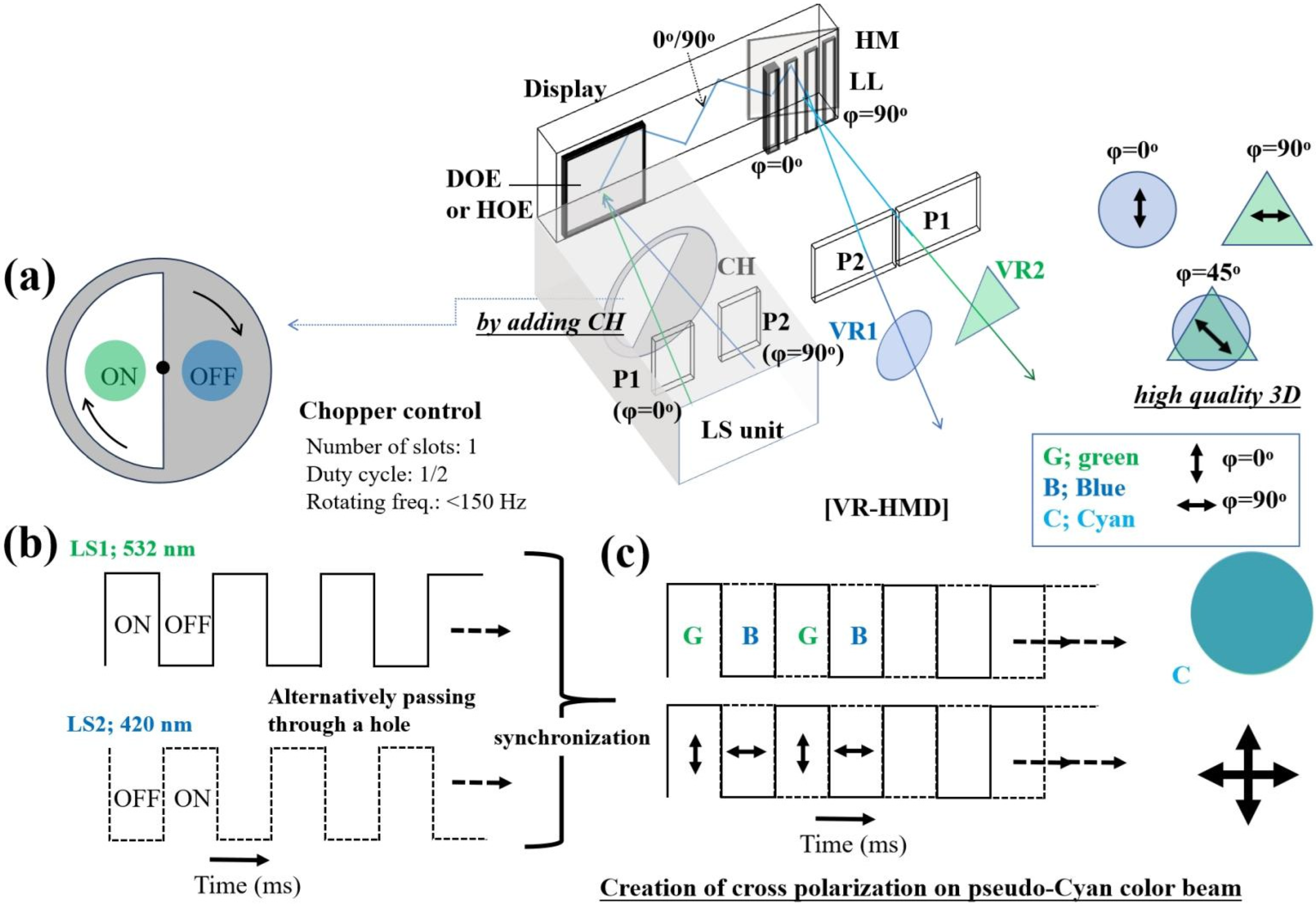
As a representative example of VR imaging research involving polarization crosstalk, a binocular-type polarization 3D-VR-HMD [5,6] presents a promising application. As illustrated in the upper-right corner of Figure 1, when two beams are polarized perpendicularly to each other, the binocular polarization 3D-VR-HMD can generate a fused 3D image by overlapping the VR images using binocular disparity cues.
For instance, if the two beams correspond to G-colored circle-shaped light with a polarization angle of φ = 0° and B-colored triangle-shaped light with φ = 90° (TM), their superposition results produce a 3D image composed of two types of VR elements such as circle and triangle in a beam with a 45° linear polarization. Alternatively, instead of combining linear polarizations (TE/TM), circular polarizations—specifically, right-handed circular (RHC) and left-handed circular (LHC)—can be used with a quarter-wave plate to achieve similar 3D-VR effects. The circular polarization model offers increased robustness against alignment errors [5]. However, a key issue in both approaches is polarization crosstalk between the two images. If crosstalk is not properly removed, it can lead to negative effects such as reduced contrast and increased noise in the final VR image.
Sub-issues for polarization crosstalk also exist. For example, they are present when using the laser ablation (LA) technique [7,8]. Consider two beams, each with different polarization modes, that are simultaneously focused onto a metal surface. In this situation, the electric fields will combine at the surface, possibly resulting in grooves with an oblique orientation. Alternatively, such simultaneous pulses may simply disrupt the surface structure [8]. If the experimenter intends to fabricate cross-groove structures (e.g., a net structure), this effect will have a detrimental impact.
The connection between the VR-HMD and LA techniques is of interest. In 3D-VR imaging, polarization interference removal techniques may improve image quality issues such as contrast reduction and image distortion. In the LA technique, polarization interference removal may improve sample quality by reducing micro-structural changes and destruction caused by overlapping laser shots.
For these problems (especially regarding polarization 3D-VR-HMD), namely, to avoid synthesis of electric field components, the polarization status of each beam must be fixed. (The complicated problem of color crosstalk [4] is not extensively discussed in this paper.) Even in past works, unless the polarization control for VR imaging was important for making adjustments during binocular polarization 3D-VR-HMD [5,6], its control function has not yet been developed. Thus, the development of a light source device with electric field control functions is desirable.
In this work, an attempt has been made to create a function which removes the interference between the beam’s irradiation to any coupler [9] sample by independently separating two-color polarization beams via a “time shift” by using a chopper (CH) (see Figure 1a,b). This temporal separation effectively eliminates intensity spectral overlaps at specific wavelengths and any undesired electric field interactions between the beams (see Figure 1c). This approach has the potential to improve the performance of 3D-VR-HMDs, leading to better contrast and lock-in functions. In principle, polarization crosstalk originates from the polarization degree α, which represents the quality of the polarization filter, the polarization state, and phase disturbances in the display structure. Crosstalk occurs when users simultaneously perceive both the intended image and a ghost image from the opposite eye, leading to degraded image quality—reduced contrast, image strain, and loss of stereoscopic perception—resulting in discomfort. The perceptibility of ghost images increases with image contrast and binocular disparity. It is known that users may experience discomfort even with 5% polarization crosstalk; therefore, achieving low or zero crosstalk is essential.
For example, by combining linear polarizations at φ = 0° (TE) and φ = 90° (TM), VR polarization encryption can be implemented. Additionally, by adjusting parameters such as amplitude A and phase l, the number of possible combinations increases, thereby enhancing the encryption capability. As a result, the overall security for the communication system would be improved.

2. Principles

Employing a chopper (CH) unit to temporally separate laser beams is an effective method for managing combined electric field effects. When two beams alternately pass through a CH unit with an opening ratio R < 1/2 and a high-speed rotator with a frequency f > 100 Hz, the electric field synthesis originating from beam overlap should be mostly avoided after passing through any samples.
Figure 1 illustrates the principle of temporally separating the beams to avoid electric field interactions. The wavelengths used in this example are S1: λ1 = 532 nm and S2: λ2 = 420 nm, overlapped mutually in time. Here, wavelengths of lasers to be used in the work are not restricted. Figure 1a shows the fabricated CH unit, consisting of the following: number of slots = 1, duty cycle = 1/2, and rotational speed = 150 Hz (=9000 rpm). Figure 1b shows the timing diagram of beams S1 and S2 passing through the CH. After the G- and B-colored lasers pass through the CH, it is possible to artificially create a cyan (C) beam (see the top-right area of Figure 1c). When the polarizations of the two beams are set to TE and TM, cross-polarization can also be achieved (see the bottom-right area of Figure 1c). Because of these two advantages, unique optical devices can be designed.

3. Materials and Methods

This study explores a method for temporally modulating two laser beams using a combination of optical and mechanical components. The following subsections present the details of the developed function.

3.1. Optical System

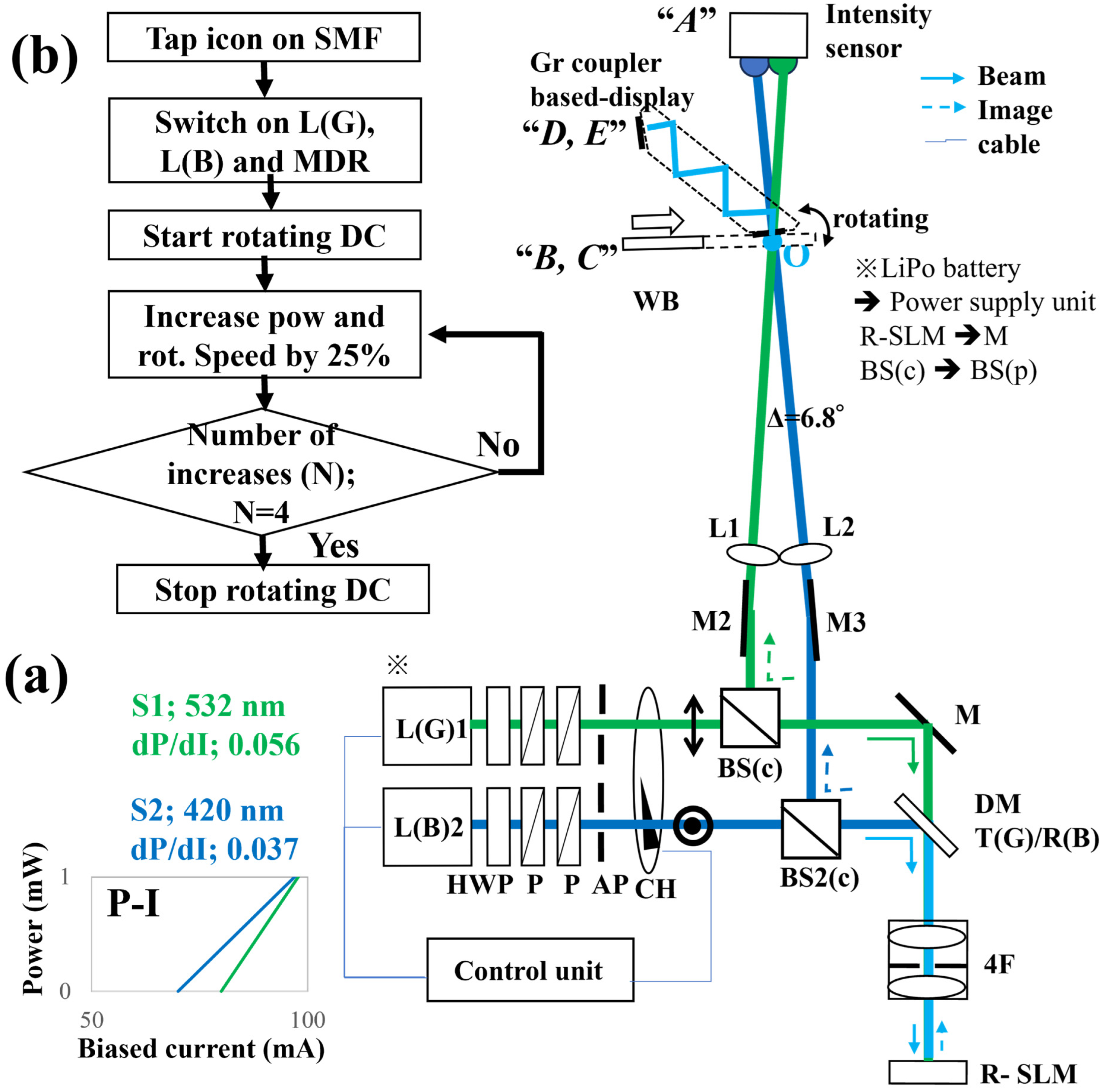
Figure 2a shows the optical configuration of the light source device with crosstalk removal functionality. The B- and G-colored beams (L) with diameter 1 mm and output power 2 mW were polarized to transverse electric (TE) and transverse magnetic (TM) modes, respectively, by each broadband polarizer (P). Subsequently, the polarized beams passed through a CH with a diameter of 20 mm, where they were mutually cut off in time. The B and G beams were passed through tilted beam splitters (BSs) and then reflected by a mirror (M) and a dichroic mirror (DM), respectively. After passing through a 4F filter (4F), the beams were reflected with images by a reflection-type spatial light modulator (R-SLM). Following the same optical path, the beams were reflected by the tilted BSs at specific angles, assumed to beam diffractions at the Gr sample at the beam matching point. Then, they were further focused by lenses (L1 and L2), proceeding toward the detection system assumed to be the whiteboard (WB), metal/semiconductor materials, or sensor. Point O represents the point where the two beams converge; the optical path for L1-O was required to be the same as that for L2-O. Furthermore, the path for the M-DM was required to be an integer multiple of the number of rotations made by the CH. Otherwise, the desired system cannot be fabricated.

3.2. Mechanical System

Figure 2b shows the flowchart for the optimization process of the mechanical setup. A couple of lasers and a DC motor were operated by a wireless telecom unit, such as a Bluetooth-equipped smartphone (SMF) [10]. To operate the light source and DC motor, an Arduino nano board (ARD), Bluetooth board (BL), and motor driver (MDR) were used. A signal from the SMF was delivered to the BL, and activated L1 and L2 by the ARD. The signal was also delivered to an MDR-rotated DC motor at a rotation speed slower than 9000 rpm. Thus, an alternative high-speed optical switch was created. In this experiment, the laser intensity and motor rotation speed were modulated appropriately, then optimized. The obtained optimal condition made it easy to determine the color and polarization changes that occurred during overlapping.
By using the combined optical and mechanical system, the fabrication of mutually open/closed G- and B-colored lasers with TE- and TM-polarizations was possible. Also, this system could be transferred to a wearable device that can be fabricated later.

4. Results and Discussions

A.
Real-time intensity measurement for GB beams
As an activation test for the fabricated open/closed G- and B-colored lasers mutually, real-time measurement of the light intensity was performed. The obtained results are presented below.
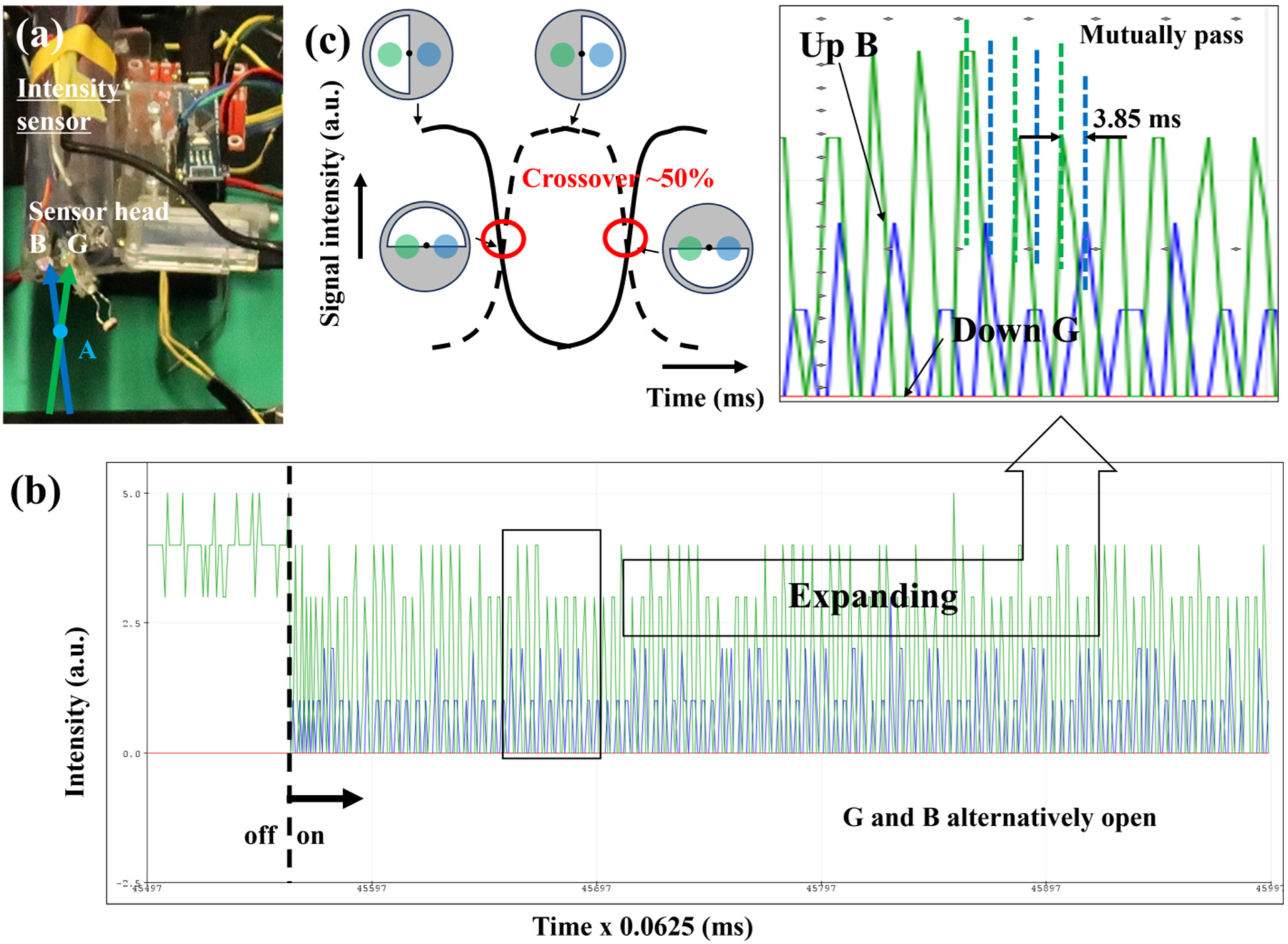
Figure 3a shows the setup used for measuring the optical intensity of the G- and B-colored lasers in real time. In this setup, the beams separated beyond point O were detected by the sensor heads on a previously fabricated three-lane optical sensor device [11]. The obtained signals were further projected onto a PC screen.
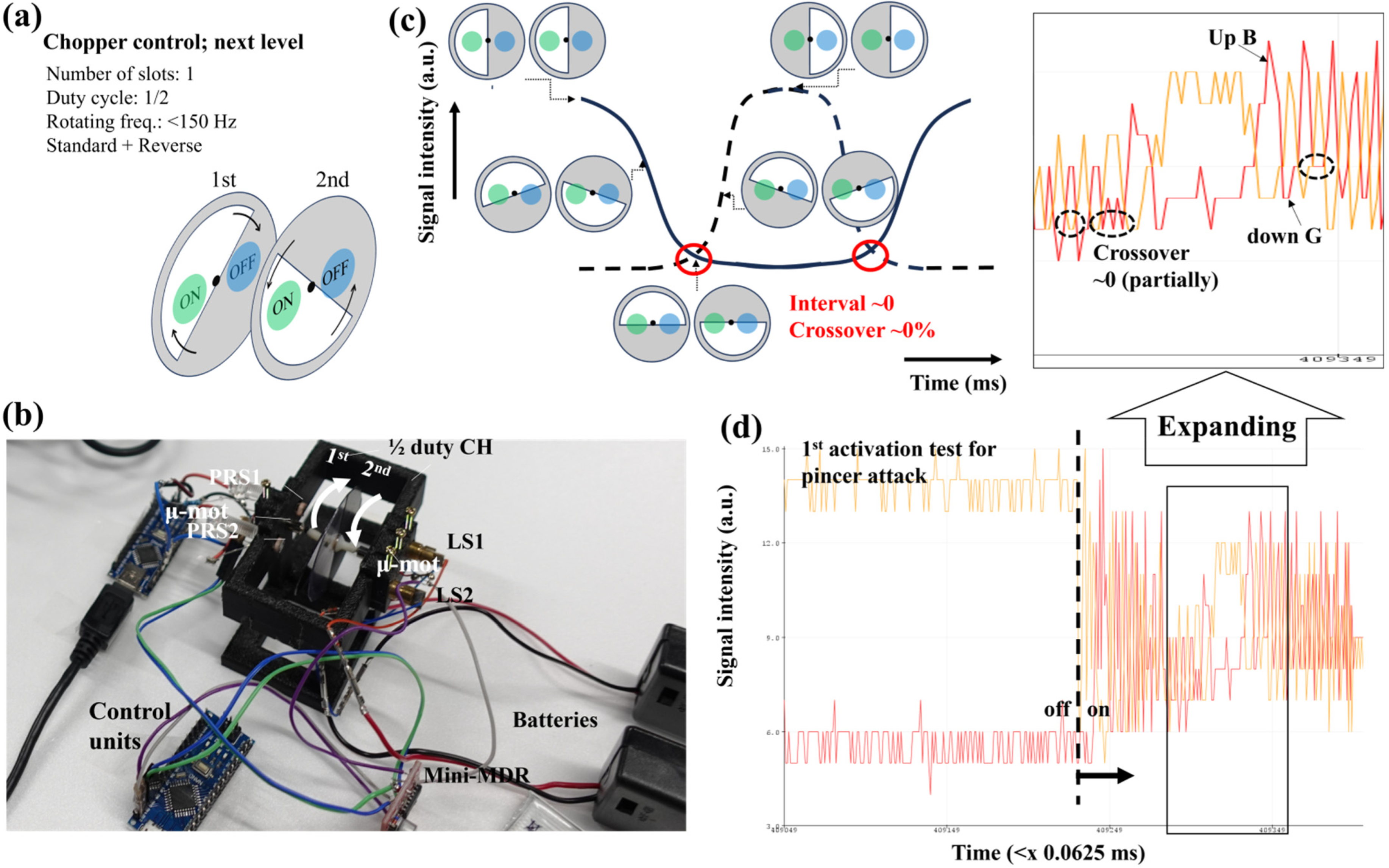
Figure 3b shows the results of the real-time measurement of the beam intensities detected by the sensor heads. When the G- and B-colored lasers were opened, the intensity of each laser was kept constant, whereas when they were opened alternately at a duration of 3.85 ms (e.g., either G up/B down or G down/B up), a wave intensity pattern with a crossover between beams was observed, as seen in Figure 3c. This is because the beam-blocking rate of the CH changed with time when the two beams passed through it, eventually leading to something like “phases of the moon.” The crossover-shaped beam intensity, as illustrated in Figure 3c, was one of the features obtained by this system, which can be confirmed by the zoomed-in view shown by the black box. This unique phenomenon negatively impacts the current system. Specifically, it means that the current system cannot perfectly remove interaction modulation (i.e., crossover) between beams. To remove the crossover perfectly, a duty cycle of the CH is required to change 1/2 to 1/4 or pincer attack 1/2 (see Appendix A).
Quantitatively, the use of a half (1/2) CH can reduce polarization crosstalk by approximately 95% compared to a system without a CH, in an ideal scenario. Here, note that the possibility of polarization crosstalk is not included in this work. This estimate is based on the following calculation: Assume the beam diameter is 1 mm and the distance between the two beams is 15 mm. In a 1/2 duty cycle CH, each beam passes through the unblocked half of the rotating CH. The transmission rate through the CH can be approximated as 1 − {1/(30π × 1/2)} = 0.948.
This yields a transmission efficiency of approximately 95%. However, in real-time measurements, the low sampling rate results in longer measurement intervals (on the order of several milliseconds), which causes unsmoothed spectra and unclear crossover points. For the ATmega328P (baud rate 9600 bps), the transmission time is 0.104 ms per bit. With 10-bit transmission (8 data bits + 1 stop + 1 parity), the effective sampling interval is 1.04 ms. Including A/D conversion time (0.1 ms) and microcontroller overhead, the effective rate becomes slightly longer (1.04 + α ms). Within the 3.3335 ms open window of the chopper, 3–4 data points are recorded, resulting in unsmoothed spectra. Increasing the baud rate to 250,000 bps raises sampling density around eightfold, improving smoothness. This optimization is planned for future work. As a result, the observed intensity fluctuation exhibits a standard deviation of about ~10%, leading to polarization crosstalk suppression in the range of 85% to 95%.
For this ~10% fluctuation, with the exception of the sampling rate, two main factors have contributing effects. The first is related to the physical properties of the CH material. The material’s air resistance and the imbalance caused by the center of gravity of the CH wings affect the rotation speed slightly. The CH shutter was covered with dark-colored tape (0.05 mm thickness), which introduces additional air resistance. Moreover, because the tape is applied to only one side of the CH wing, the added weight causes a slight tilt in the rotational axis of the shaft. These factors are assumed to interfere with the ideal rotational speed. Such issues may be mitigated by improving the fabrication process of CH.
The second factor is related to detection errors from the previously fabricated intensity sensor. The photoresist (PR) sensor used in this experiment is highly sensitive to external influences, such as temperature fluctuations. For example, changes in room temperature affect the accuracy of the detected spectra, contributing to reduced removal efficiency.
Motor heating primarily increases coil resistance and reduces magnetic power, decreasing frequency stability when compared to non-heated operations. The chopper motor used here is a brushless DC motor, and because PWM pulses are not employed, frequency drift was not observed.
Jitter in real-time measurements shown in Figure 3 was determined to be 0.0000625 ms per clock cycle at 16 MHz using the ATmega328P micro-controller. Sampling accuracy is mainly influenced by interrupt delays from peripheral devices, totaling 10–100 clock cycles of activation time, leading to an estimated timing error of approximately 0.00625 ms. Thus, the practical error range is estimated to be at 0.01–0.05 μs (±1.5%).
These influences can be addressed by optimizing the experimental environment and conditions. Concretely, optimizing methods are: 1. resetting the micro-controller parameter, 2. improving the CH wing, 3. using a PD detector, and 4. escaping motor heating.
B.
Fabrication for cross-polarized pseudo-C beam spot
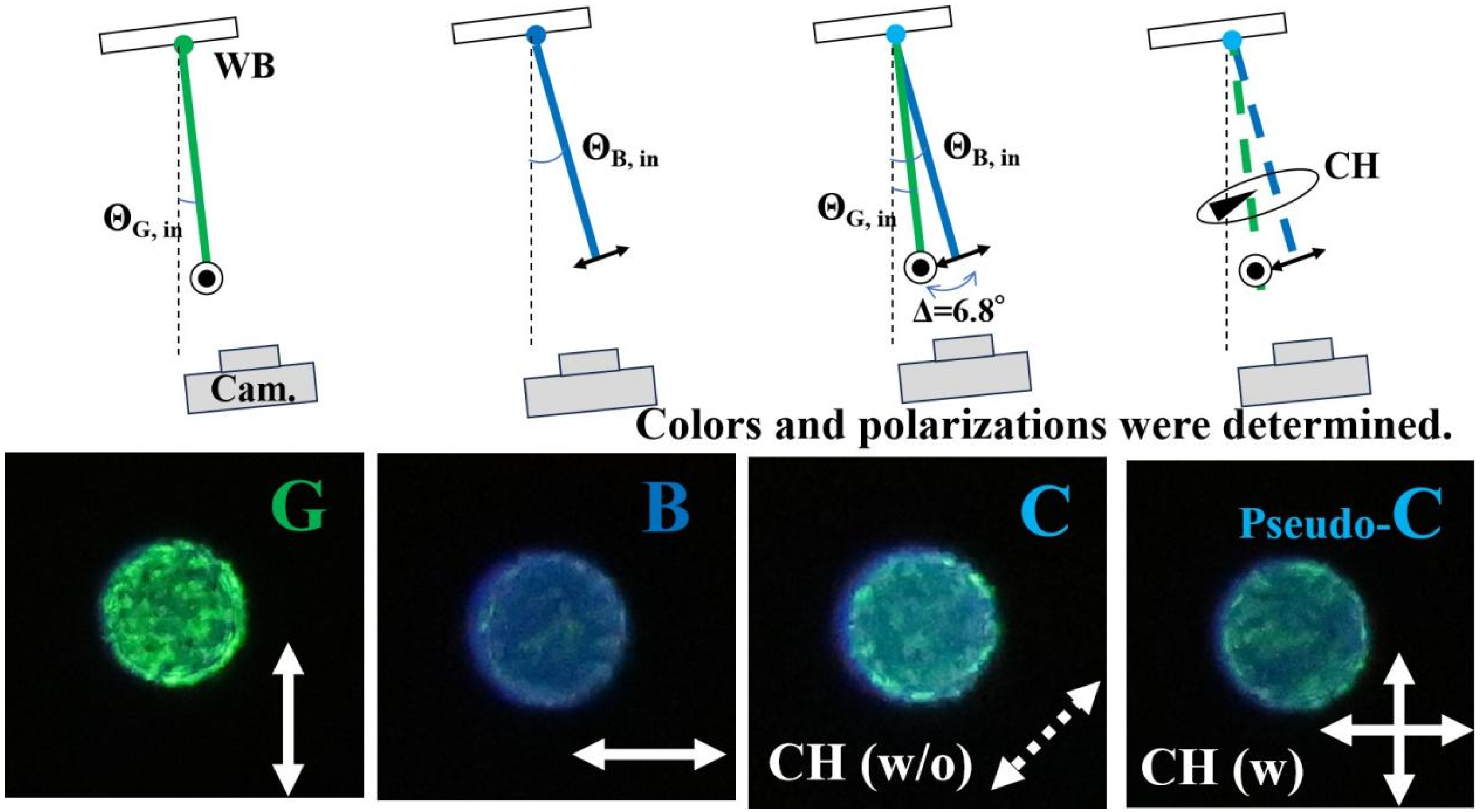
The beam spots and polarizations for the GB beams were also analyzed. Figure 2a showed the setup for polarization crosstalk removal. The TE-polarized G laser or TM-polarized B laser alternately appeared by passing through the CH, resulting in a pseudo-C-colored laser with cross-polarization.
Figure 4 shows photographs of the G beam spot with TE-polarization (left), the B beam spot with TM-polarization (center-left), C beam spot with any polarization (center-right), and the pseudo-C beam spot with cross-polarization (right) observed on a WB. The color of the pseudo-C beam was confirmed visually by using a camera with a long exposure time. The pseudo-C beam spot was also able to be confirmed by the user’s naked eye, even when a camera was not used. As a result, the color of the obtained pseudo-C beam color is the same as that of the C beam. On the other hand, the possibility of the color mixture induced by “afterimage effect” must be considered. In general, the afterimage is maintained for 40 ms after the target image entered the retina of the user’s eye. In this work, the CH frequency f was adjusted to 150 Hz (time duration ~6.67 ms), so that the effect would be maintained. The afterimage effect would be required to be discussed contentiously. For f = 150 Hz and 200 Hz, color perception by the human eye remained stable, indicating that afterimage colors are consistent for f > 150 Hz. This suggests that the system functions effectively for applications such as VR goggles, where human perception operates at 90–120 Hz.
The polarization modes of the output beams were checked by rotating a polarizer placed in front of a WB. For example, only G color is seen when the polarizer is set to TE. In contrast, only B color is seen when the polarizer is set to TM. Because the G and B beams were confirmed to have TE- and TM-pol., respectively, the pseudo-C beam was assumed to be cross-polarized under the situation without the polarizer. This pseudo-C beam with cross-polarization indicates quite different behavior from field-synthesized C beam with 45° linear polarization formed on the assumed material’s surface. However, this beam mode can be fused as pure C beam mode on the user’s eye. This result shows one of the technical infrastructures for polarization tuning [12,13] (see Appendix B).
C.
Analysis for cross-polarized pseudo-C beam spot
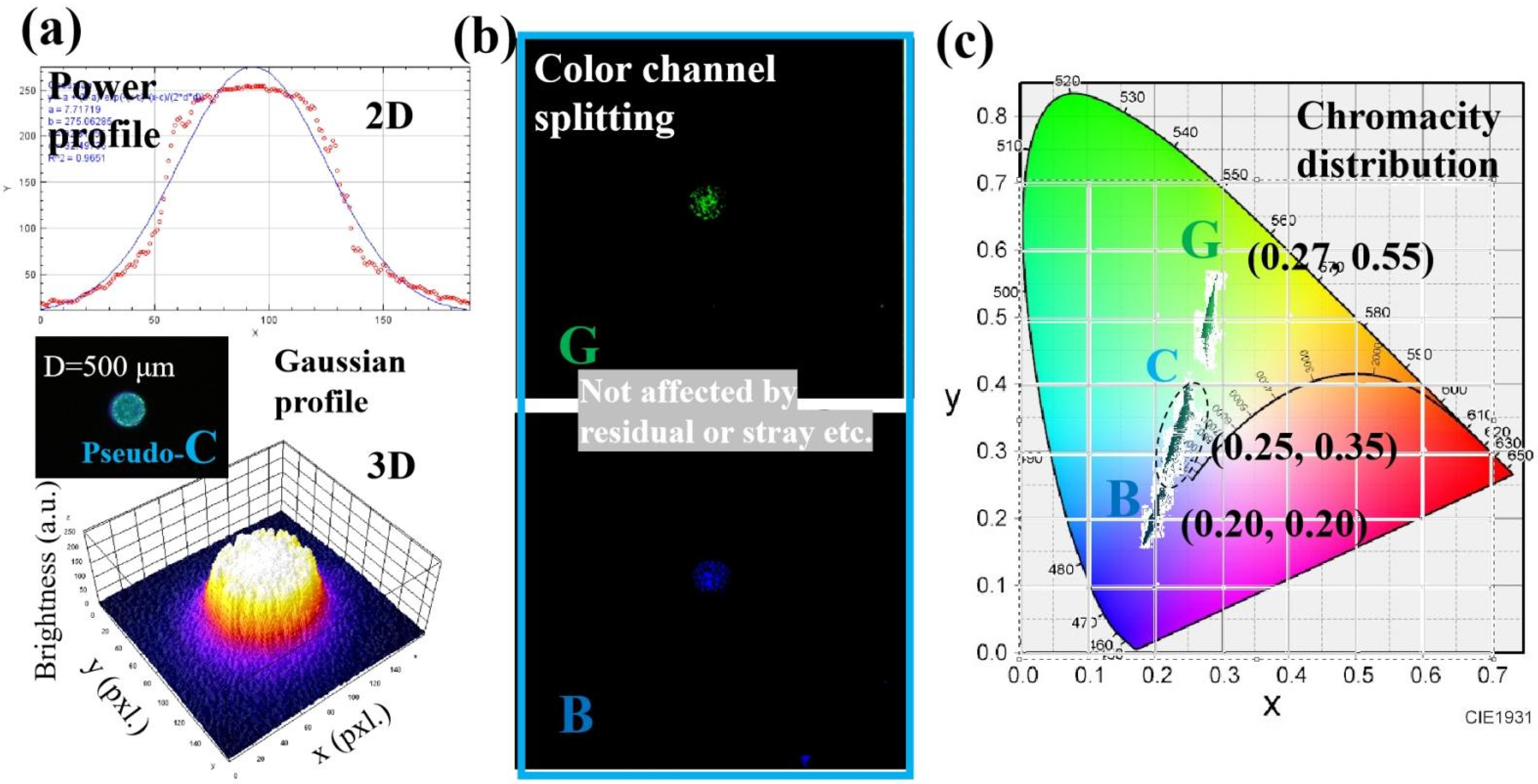
Figure 5a shows the 2D and 3D power profiles for the obtained cross-polarized pseudo-C beam spot. According to the profile, the intensity of the beam spot with diameter D = 500 μm obeyed a Gaussian distribution for x and y directions. The measured 2D and 3D beam intensity profiles fit a Gaussian distribution with R2 = 0.9851 (least-squares fitting). The small deviation indicates slight intensity non-uniformity, potentially leading to minor color smudge effects caused by residual crosstalk. The G and B beams separated by color splitting channel function also took Gaussian profiles as seen in Figure 5b,c. This fact shows that the creation of C color is not affected by negative influences such as residual or stray light. The chromaticity value (x, y) [2] was on a GB line as shown in Figure 5c. In conclusion, the cross-polarized pseudo-C beam can be used as an ordinal mixed-color beam.
D.
Beam irradiation test for Gr coupler-based optical display using functional pseudo-C beam with individual polarizations
Using the fabricated functional pseudo-C beam, an attempt has been made to perform the irradiation test on the optical display attached to the Gr coupler (as the first approach assumed dual Gr coupler). Although the types of Gr are not limited, slanted [5,14], or blazed [15,16,17], Gr with relatively high diffraction efficiency is suited for this study. Simulations were performed using VirtualLab (ver. 23.1) software, which analyze both electromagnetic waves and ray traces.
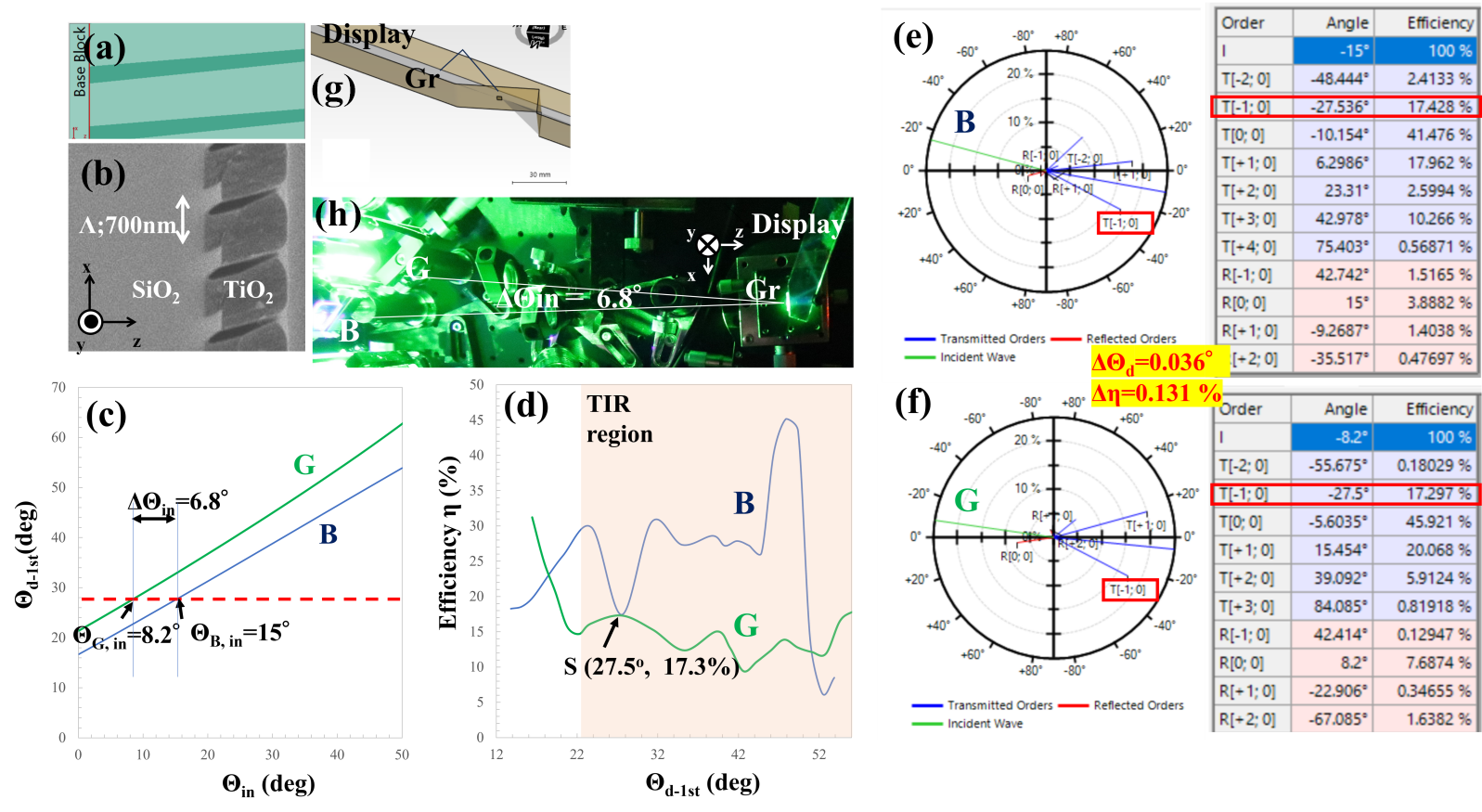
As a Gr coupler, a SiO2-embedded TiO2 nano-Gr sample (size; 3 × 3 × 0.5 mmt) fabricated previously, as shown in Figure 6a,b, was used [15]. As an optical display, a SiO2-based trapezoidal substrate (size; 300 × 15 × 20 mmt), fabricated to satisfy the total internal reflection (TIR) condition, was used as shown in Figure 6c,d and shows the theoretical design.
Diffraction angles (Θd) were calculated using the Bragg equation: 2d sin Θ = mλ (where m = 1, 2, 3,…) as referred to in paper [18]. Based on these calculations, the diffraction angle for the −1st order was found to be Θd ~27.5° for both B and G beams. Diffraction efficiencies |ET|2 (=η) were obtained through a rigorous diffraction approximation as expressed in Equation (1):
| E T | 2 = i = T i exp j 2 π λ ε A i r sin Θ i i 2 π Λ x + 2 π ε T i O 2 λ 2 2 π λ ε A i r sin Θ i i 2 π Λ 2 1 2 z d 2
where Λ is the Gr period, ε is the dielectric constant, λ is the laser wavelength, j is (−1)1/2, x and z are spatial coordinates, d is the Gr depth, and Ti represents higher-order diffraction terms. Using Equation (1), the calculated transmission efficiencies |ET|2 for the −1st diffraction order were 17.4% (B) at Θi = ~8.2° and 17.3% (G) at Θi = ~15.0°.
Figure 6e shows the experimental setup. In the experiment, TE-polarized G and B beams with diameter D = 1 mm were hit to the Gr sample with angle difference.
Figure 6f shows the simulated relation between the incident angle Θin and −1st order diffraction angle Θd, −1st for B and G beams. When the Θd, −1st are equal for both beams, the difference between their incident angles remains at approximately 6.8° within the range of 0° to 50° [19].
Next, Figure 6g shows the simulation result for the relation between Θd, −1st and diffraction efficiency η. Due to the trapezoidal shape of the display, the G and B beams undergo total internal reflection (TIR) within the display when Θd, −1st > 21.5°. To achieve optimal color contrast in the pseudo-C beam, the diffraction efficiencies η for the G and B beams should be matched. To do so, an attempt has been made to find a matching point between B and G in the TIR region. According to the simulation data, the η corresponded to be 17.3% if the Θ was set at 27.5°. Typically, the full wide at half maximum (FWHM) for the diffraction peak is narrow. However, note that here, imperfections in the fabricated sample may broaden the diffraction peak [14,20].
Figure 6h,i shows the diffraction radar patterns at the specific incident angles for B and G beams. To achieve a Θd, −1st = 27.5° (ΔΘd, −1st = 0.036°) and η = 17.3% (Δη = 0.131%), the incident angles Θin for B and G beams were set to Θin,B = 15° and Θin,G = 8.2°, respectively. With this, the condition for beam incidence was determined.
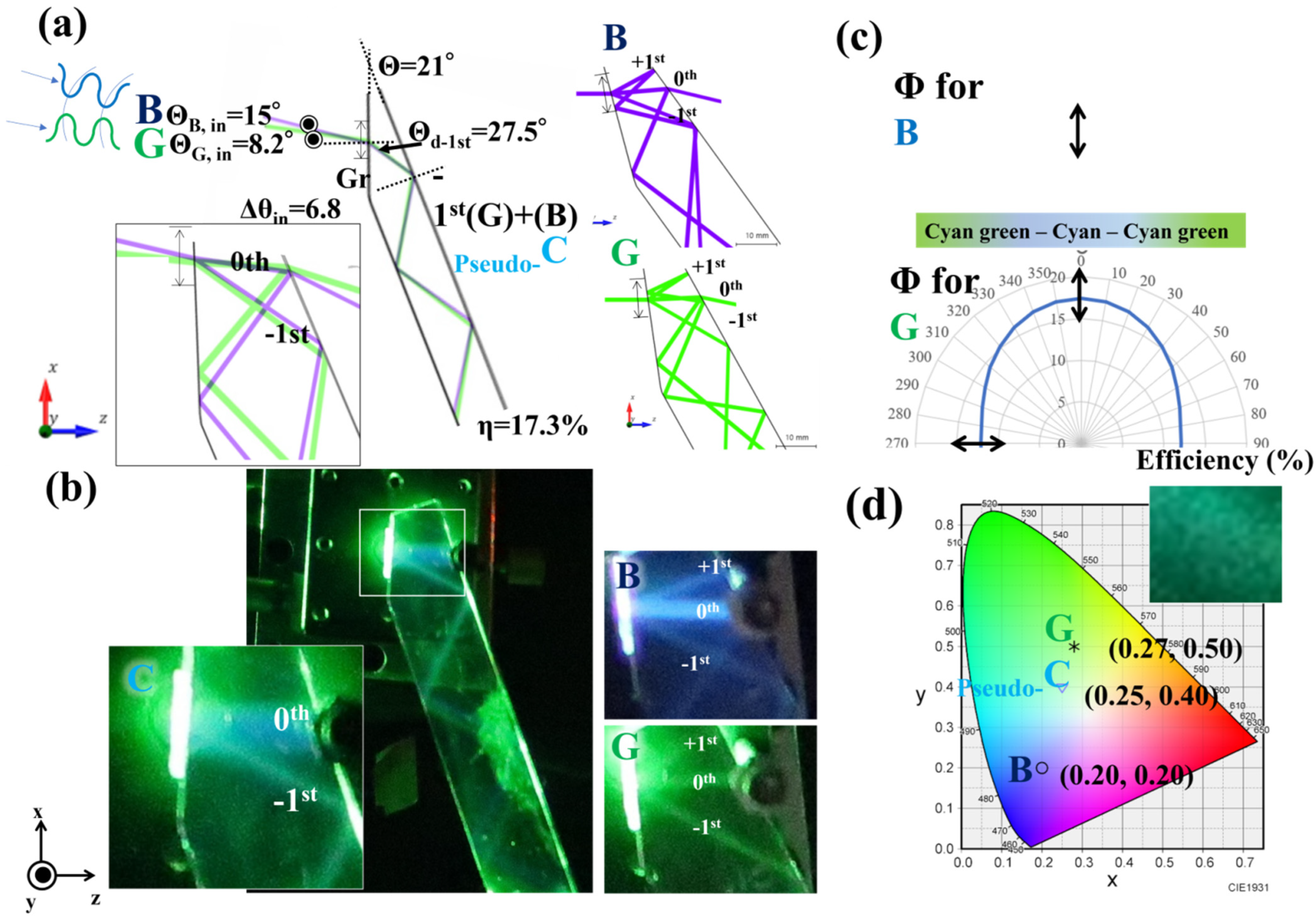
Figure 7 shows the optical paths and calculated effects when the B and G beams are set at Θin,B = 15° and Θin,G = 8.2°. Figure 7a is the simulation data of the TIR waveguide in the display for G and B diffractions with −1st order. The simulation results show good agreement between G and B beam behavior. The inset in Figure 7a shows the behavior of both −1st and 0th order diffracted beams. Figure 7b shows the photo of the TIR waveguide in the display, which reproduces the data seen in Figure 7a. In the expanding image, beams separated by −1st and 0th orders were confirmed. Although it is hard to see, the +1st order diffraction ray also exists. It comes from the fact that the B and G beams are separated at Gr into three rays
It is important to investigate efficiency η change by rotating polarization φ. Figure 7c shows the η as a function of φ. The data showed that η could be controlled in the range of ±5 % by tuning φ. During TM mode incidence, the diffraction efficiency η is relatively high. This may be due to guided mode resonance (GMR) and/or surface roughness. Since the CH system is activated, the color of the beam after passing through the Gr coupler must be verified again. Figure 7d presents the chromatic values for the brightness line shown in Figure 7b. From the data, the chromatic value for the brightness line is plotted at (0.25, 0.40), which corresponds to point (C) on the GB line. In conclusion, individual control of beam polarization and pseudo-mixture of beam colors have been successfully established.
The crosstalk removal applied to the generated TE/TM-polarization combination produces a single VR image based on a 45° linear polarization mode, as mentioned in the introduction, leading to the formation of a polarization-based encryption system. As a more advanced approach, an ultra-secure encryption system can be developed by utilizing a combination of the following two vortex polarization modes: azimuthal and radial polarizations (AP and RP) [21]. The twin polarization beam, described in the equation for the electric field E, which includes both weight and polarization angle φ, supports three distinct photon polarization modes: in-plane, out-of-plane, and 3D-plane. As noted in Reference [21], the irradiation using twin beams in AP/RP modes must be carefully considered. By individually adjusting the power of each beam, the number of distinguishable polarization states can be increased from three to five. Consequently, after implementing the crosstalk removal system, it becomes possible to generate five distinct high-quality VR images without interference. When used together, these modes enable a highly advanced form of encryption, potentially approaching ultimate security.
If a time-shift system for a two-color beam as GB is established, it can be extended to a three-color beam as RGB. Although synchronizing RGB beams with a 1/3 duty cycle is complex, it may help suppress flicker and eye-movement artifacts (saccades). In this case, the laser sources must be configured with a 120-degree temporal separation. The entire optical setup must be carefully aligned to accommodate the additional beam paths. Crucially, the 1/2 duty cycle CH must be replaced with a 1/3 duty cycle CH to achieve perfect temporal separation of the three beams. As the whole system, the current setup splits G and B beams for each eye using polarization filters. In the next stage, the R beam will be combined with G and B, using micro-polarization filters. Consequently, each eye will perceive composite G/R and B/R images with equal optical power, forming a full-color stereoscopic VR-HMD system.
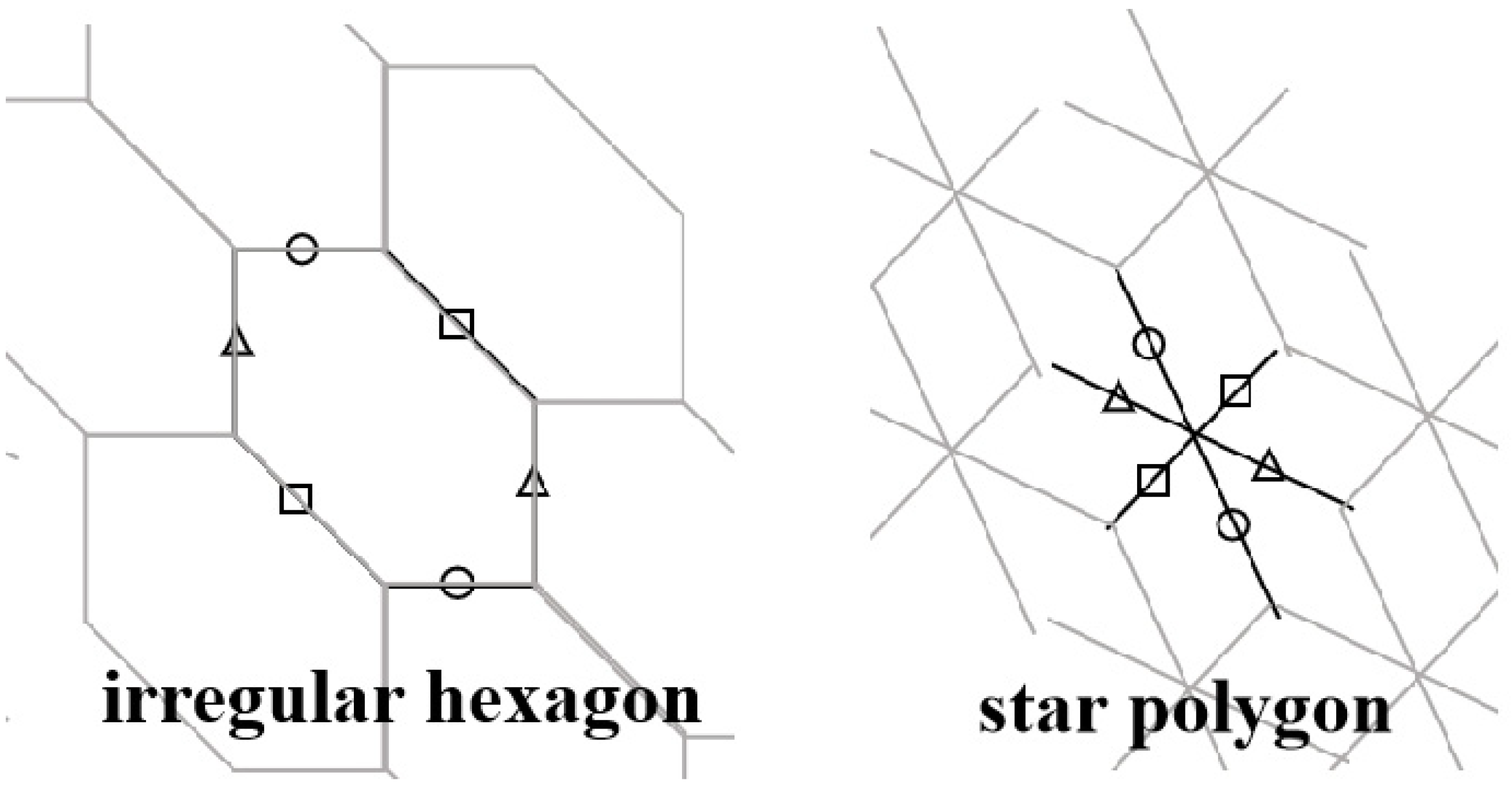
In actuality, if an R beam is added to this system, its polarization state should be either TM or TE. Although the RGB laser system with a crosstalk removal function is not appropriated to the 3D-VR-HMD, in the field of LA, the mechanism can be interpreted more intuitively. When two beams are incident on the surface of a Gr, surface propagation typically occurs perpendicular to the polarization plane, leading to the formation of dual periodic grooves. However, when electric fields from multiple beams are synthesized (e.g., with differing polarization states), the resulting interference pattern may generate grooves at oblique angles or break the surface structure [7,8]. This unintended effect must be carefully controlled or avoided during ablation. A similar complication arises when using three beams, as the synthesized electric field becomes even more complex. If three polarization axes are directed to center, ablated materials would be irregular hexagonal structure arrays (see left in Figure 8). Similarly, if three polarization axes are directed outside, the ablated materials would be star polygon structure arrays (see right in Figure 8). However, if this system is not installed, this may potentially result in irregular groove orientation or an unpredictable surface. Therefore, polarization control is critical to building a prediction of fabrication process.
E.
Fabrication of the wearable device
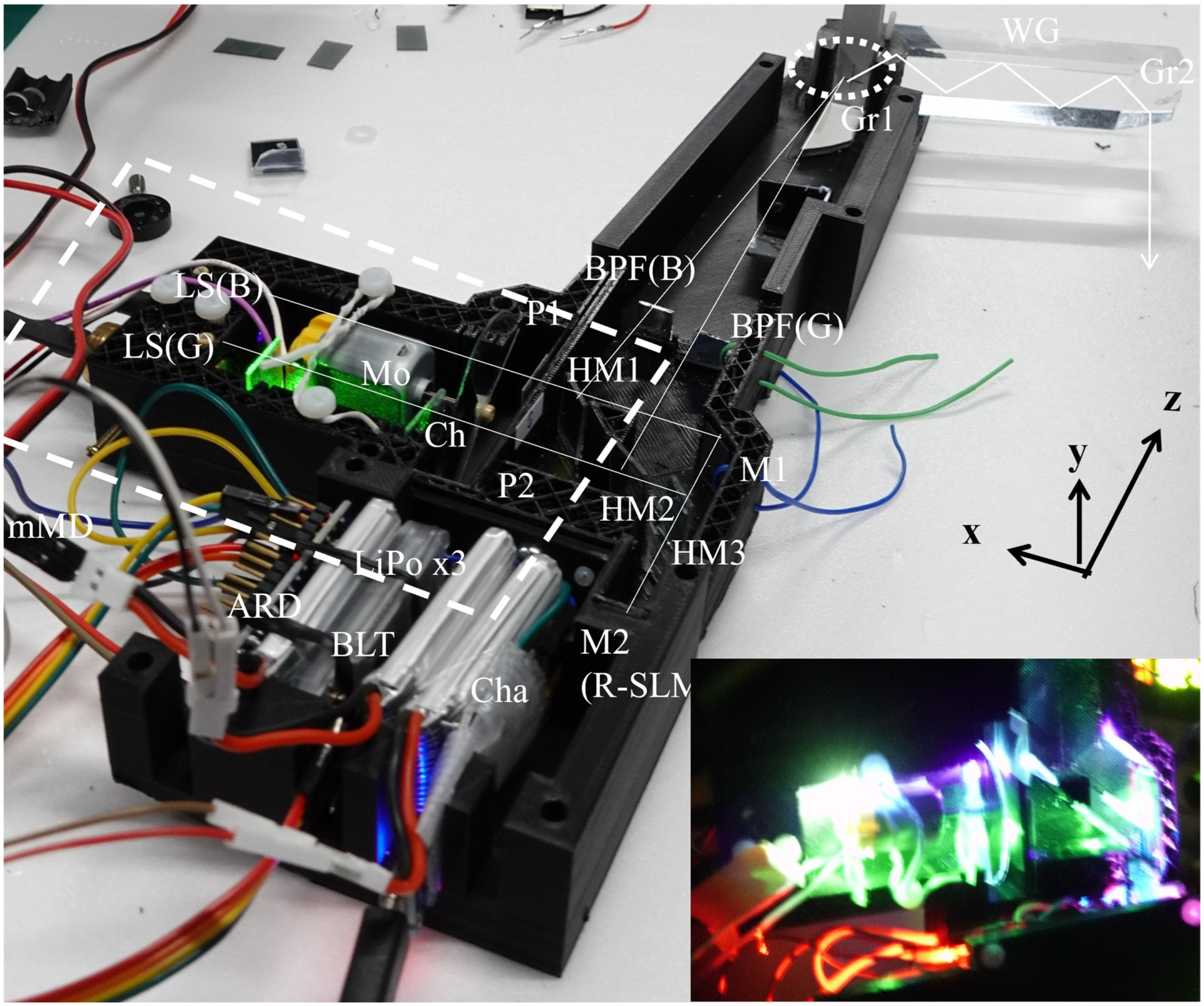
Finally, an attempt was made to fabricate a VR device based on this light source. The device housing was designed using 3D computer-aided design (CAD) software (Fusion 360, ver. 2024.) and fabricated using a fused deposition modeling (FDM) 3D printer (Kobra Neo, ver. 1.3.3.). The housing was made from polylactic acid (PLA) plastic, with a stacking accuracy of 0.10 ± 0.02 mm. The dimensions and weight of the housing were 250 × 120 × 30 mmt and 274 g, respectively. After printing, optical elements and electronic components were integrated into the housing, resulting in a wearable device.
Based on the calculated optical path, achieving miniaturization requires a rigorous re-calculation of the system. However, device compactification is feasible. By maintaining similar relations in the optical design, it is possible to reduce the optical path length for the two beams, resulting in a more compact device size. It should be noted, however, that the physical dimensions of optical elements impose practical limits. Taking these into account, the device size can be miniaturized up to approximately five times smaller than the current system at maximum.
Figure 9 shows the experimental setup for this device. The configuration slightly differs from the setup shown in Figure 2. The key differences are as follows: (1) the addition of bandpass filters (BPFs) in the long-distance optical path, (2) the replacement of the half mirror (HM) with a dichroic mirror (DM), and (3) collimation of the beam by removing the lens units. These modifications slightly altered the device’s performance compared to the original design but significantly reduced the prototype’s production cost. The spatial resolutions of the obtained virtual images were 11.3 lp/mm and 5.66 lp/mm before and after the setup modification, respectively.
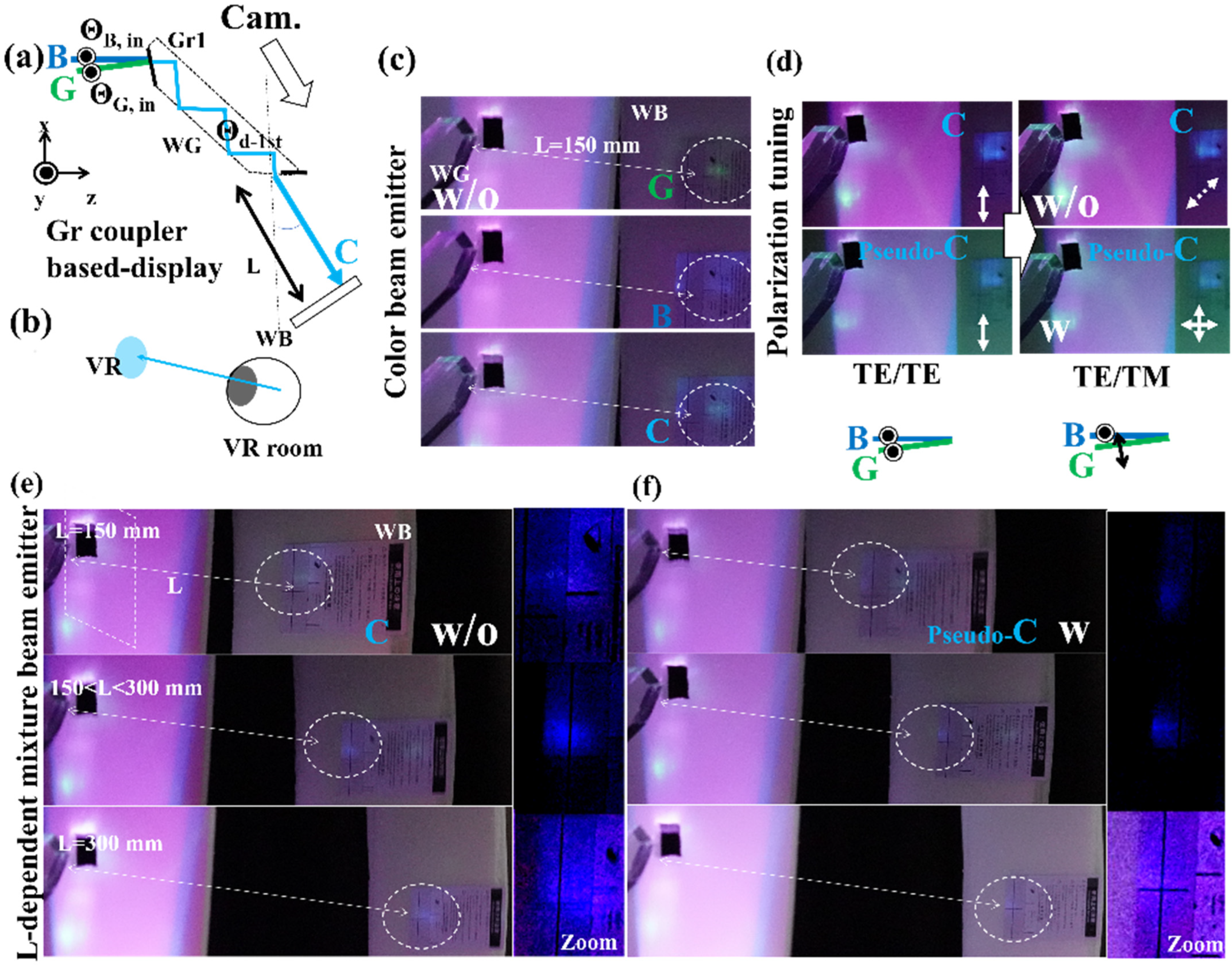
Note that this work focuses on polarization tuning on a mixing beam. Figure 10a,b illustrates the optical configuration and viewer image for VR imaging in the waveguide glass (WG) using a single Gr coupler. The user can see the C-colored VR image on a WB through a WG. Figure 10c shows the photo when G, B, and C beams are projected onto a WB at L = 150 mm. According to the data, the differences in G, B, and C beam color were confirmed.
Figure 10d shows the polarization-tuned VR beam emissions. By tuning polarization TE to TM for either input beam, as in the case of CH, new polarization modes such as cross-polarization are created. In general, TM-beam incidence does not diffract at the Gr surface. However, as described above, if the effect of GMR and/or surface roughness is included in this Gr coupler, the story differs. The obtained results showed good agreement with data for polarization tuning as seen in Figure 4 and Figure 7c. Namely, beam polarization status can be checked by using a polarization filter, and the obtained result proves that there is no influence of polarization crosstalk generated by the Gr.
Figure 10e,f shows the behaviors of C beam and pseudo-C beam as a function of distance L. When distance L is shifted from 150 to 300 mm, accumulated intensity for C and pseudo-C beams were kept and projected onto a WB, where intensity for the pseudo-C beam is half of that for the C beam. On the other hand, the divergence angle for beam was expanding a bit with better angular dispersion effect by the Gr input coupler.
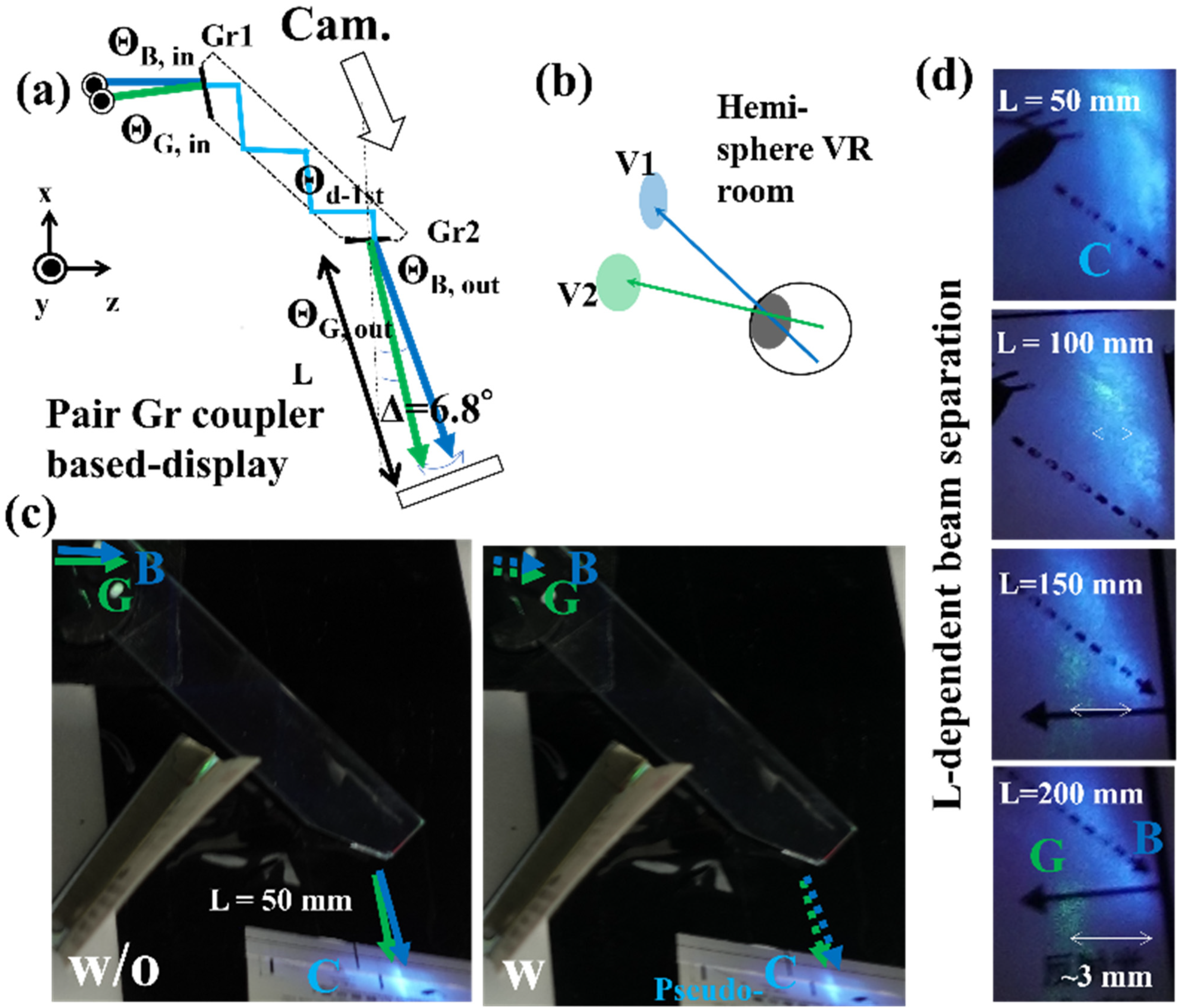
Figure 11a,b illustrates the optical configuration for VR imaging in the WG by using a pair Gr coupler. As described in the main text, B and G beams are diffracted by the input coupler Gr, generating the pseudo-C color beam. This beam is then waveguided with TIR within the display. At the display’s endpoint, the output coupler re-diffracts the pseudo-C beam, which is subsequently split into B and G beams again. The divided beams are emitted in specific directions and projected onto a WB placed at a distance L. This configuration visualizes the separation of the beams.
Figure 11c shows the visualization of waveguides for G, B, C (w/o), and C (w) beams. The behavior of the beams, as recorded in the data, aligns with the optical configuration presented in Figure 11a. In the VR image observed on a WB, the spot sizes for G, B, C (w/o), and C (w) beams were approximately φ = ~0.5 mm, and their resolutions were lower than those observed on the laser table. The reason why the image resolution is not high is due to disturbance of optical path arising from the thermal swelling of the PLA-housing. Therefore, current analysis is restricted by quantitative analysis. Note that the separation between the B and G beams was relatively loose, causing the C beam spots to appear in both the cases with and without CH, when L = 50 mm.
Figure 11d displays the results of VR image observation as a function of the distance L. According to the data, at L = 50 mm, the spot color maintains C color. However, at L > 100 mm, the spot color separates into B and G, and the spots spread out. These results indicate that the fabricated device projects a VR image with C color onto a semi-sphere VR space when L is shorter than 50 mm. In contrast, when L exceeds 50 mm, the device projects VR images with G and B colors onto a semi-sphere VR space.
On this device, two types of VR images using functional C beam were observed. However, in the future, device fabrication using augmented reality (AR) rather than VR is encouraged.


5. Conclusions

Using a CH-based B/G twin-laser system, I successfully fabricated a pseudo-C-colored beam with a new polarization mode. The beams obtained in this study are intended for use in beam incidence with a dual Gr coupler. This system offers two main advantages, as follows: (1) By using an independent polarization beam that can avoid electric field synthesis (=polarization crosstalk removal), I can finely tune the diffraction efficiency η. Furthermore, (2) the pseudo-mixture beam color is almost same as the mixture beam color unless the beams do not overlap; more specifically, this means that the fused image can be seen by the human eye. Most likely, the color smudge in the VR image may be possibly suppressed, thus also enabling the color crosstalk removal function. However, the duty cycle of the CH may need adjustment, as the finite intensity at the crossover segments during real-time measurements could negatively impact these advantages. Fortunately, diffraction experiments using the Gr sample fabricated previously have successfully demonstrated independent-polarization control and pseudo-mixture color for beams. In the future, diffraction testing using the dual Gr coupler sample could be conducted. With that data, the possibility for high quality, full-color VR-HMDs could then be discussed. When the user anticipates interactions between the sample and the laser, this beam will play a crucial role. As such, the potential applications for this system are broad. For example, it could be used not only in diffraction VR but also in microscopes (e.g., laser VR microscopes [22], near-field optical microscopes [23], and nonlinear optical microscopes [24]), and (quantum) encryption [25]. The formation of a twin-color “soft cream”-type lasers are also achievable if vortex beams [26] with G and B colors can be fabricated, paving the way for their further application.

Funding

This research received no external funding.

Institutional Review Board Statement

Not applicable.

Informed Consent Statement

Not applicable.

Data Availability Statement

Data underlying the results presented in this paper are not publicity available at this time but may be obtained from the author upon reasonable request.

Acknowledgments

The author would like to thank Masui from the University of Tokyo for the discussion on the Gr sample, and would also like to thank Y. Matsumoto of Keio University for the discussion on mycon application. Also, the author would like to thank Rolland and the UR nano staff at the University of Rochester for providing tips related to HMDs and demonstrating analytical techniques for nanosample examination.

Conflicts of Interest

The author declares no conflict of interest.

Appendix A. Fabrication of an Asymmetric CH with a 1/4 and Double CH 1/2 × 2 Open

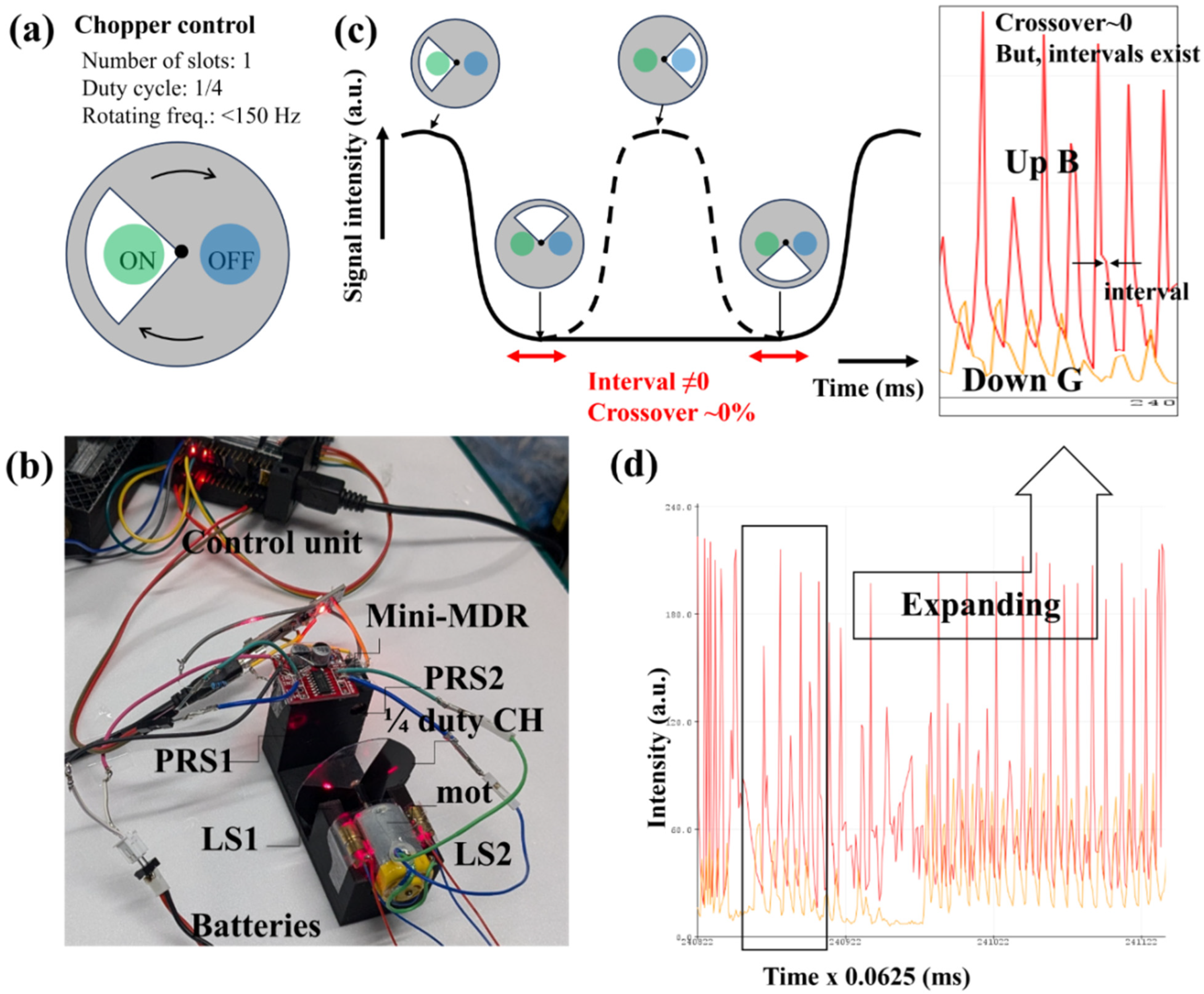
Usage of a 1/2-open CH results in crossover occurring at the segments between the B and G beams, as illustrated in the expanded view in Figure 3. At these segments, the intensities of the B and G beams are equally distributed, with each beam contributing 50%. While the presence of such segments is phenomenologically interesting, they indicate that their complete elimination is necessary to achieve the goal of this work. To accomplish this, a new CH system modifying the CH wing from a 1/2 to a 1/4 model (see Figure A1) is necessary.
Figure A1. Asymmetric 1/4 open CH unit. (a) Setting parameters for the CH and a (b) photo of the CH unit. (c) Diagram and (d) measurement data for real-time signal intensities for the two beams. Curve and dotted curve: signal intensities for G and B. During the measurement, the sampling rate was too low to obtain smooth spectra. (Top right): expanding data. Line: G. Dot: B. Double arrows: Crossover zero points with finite interval. PRS: photo resist sensor. mot: DC motor.
Virtualworlds 04 00054 g0a1
Figure A1b shows a photo of the compact (40 × 70 × 30 mmt) and lightweight (<40 g) type 1/4-open CH system. An activation test was conducted by setting the CH’s rotational speed at <150 Hz. According to the test, perfect crosstalk elimination could be confirmed by real-time intensity data. When the BG beams pass through either side of the 1/4-open CH, eventually, simultaneous transmission of both beams is prevented. However, this design introduces a period where neither beam passes through the CH as seen in Figure A1c,d), resulting in efficiency loss during beam delivery. To mitigate this issue, a 1/2-open CH model was reconsidered.
The choice of CH is largely due to the trade-off between crosstalk removal efficiency and optical flux throughput. While a 1/4 duty cycle CH improves polarization crosstalk suppression by 5%, it significantly reduces the transmitted optical flux by 50%, compared with that of the 1/2 duty cycle CH. From both experimental and application perspectives, reduced optical flux presents a practical disadvantage, especially in real-time measurements.
To further optimize performance, 1/2 open-CHs were connected using reverse rotation motor system, as illustrated in Figure A2a. Figure A2b shows a photo of the compact (40 × 90 × 40 mmt) and lightweight (<20 g) device. This pincer attack operation effectively suppresses efficiency loss by maintaining continuous beam transmission as described in Figure A2c. As seen in Figure A2d, the intensity data from the test mode confirmed the zero-intensity points and an inverse relationship between B and G beam intensities. These results indicate successful beam delivery with improved efficiency. However, signal to noise (S/N) ratio is not so high, requiring further analysis for refinement.
Figure A2. A pincer attack type 1/2 open CH unit. (a) Setting parameter for the CH and a (b) photo of the CH unit. (c) Design and (d) detection test of real-time signal intensities for the two beams. During the measurement, the sampling rate was too low to obtain smooth spectra. (Top right): expanding and overlapping data. Line: G. Dot: B. Circle: Crossover zero points without finite interval periods.
Virtualworlds 04 00054 g0a2
In summary, the degree of suppression of electric field synthesis is proportional to the removal rate, as expressed by 95% (1/2CH) < 100% (1/4CH) = 100% (1/2 × 2CH). The related data show the following relationships: Crossover rate; 50% (1/2CH) < 100% (1/4CH) = 100% (1/2 × 2CH) and beam yielding rate (A); A≠0%cutoff (1/4CH) < A≠0%cutoff (1/2CH) < A~0%cutoff (1/2 × 2CH).
The beam-chopping system used in this work is limited by a mechanical CH, while electromagnetic (EM) shutters are also one of the candidates. The use of an EM shutter enables precise control of shutter speed, which could allow for near-zero polarization crosstalk. This method eliminates the need to manually replace CH wings to adjust timing or duty cycle. It has clear advantages, which include the following: there is no need for lubrication, zero wear of motor and bearings, and no noise is emitted from mechanical or harmonic sources, resulting in minimal error. For precision, operational stability, and future application potential, the EM shutter is superior to the mechanical CH in terms of crosstalk suppression.
However, there are practical constraints, specifically regarding prototype cost, size/weight, synchronization, and heat. In general, mechanical CHs are significantly less expensive, costing approximately 1/50th of an EM shutter. Since two shutters are required to modulate two beams independently, the total cost could be reduced by 1/100 times by using mechanical CHs. In addition, to the best of our knowledge, compact EM shutters suitable for HMD integration are not currently available. Also, if a pair of shutters are used, their synchronization is necessary. Otherwise, shutter timing that alternatively opens and closes is not enabled, leading to the crossover in real-time intensity spectra. Also, lasers and batteries in the device emit heat. As a heat measure, the function of the mechanical CH system as a cooling fan is useful. Therefore, considering cost-effectiveness, system weight/size, synchronization, and heat constraints in the development of an HMD prototype, the use of a retro-style mechanical CH system remains the most viable solution for this work.

Appendix B. Creation of Forced-Oblique Linear-Polarized Pseudo-C Beam

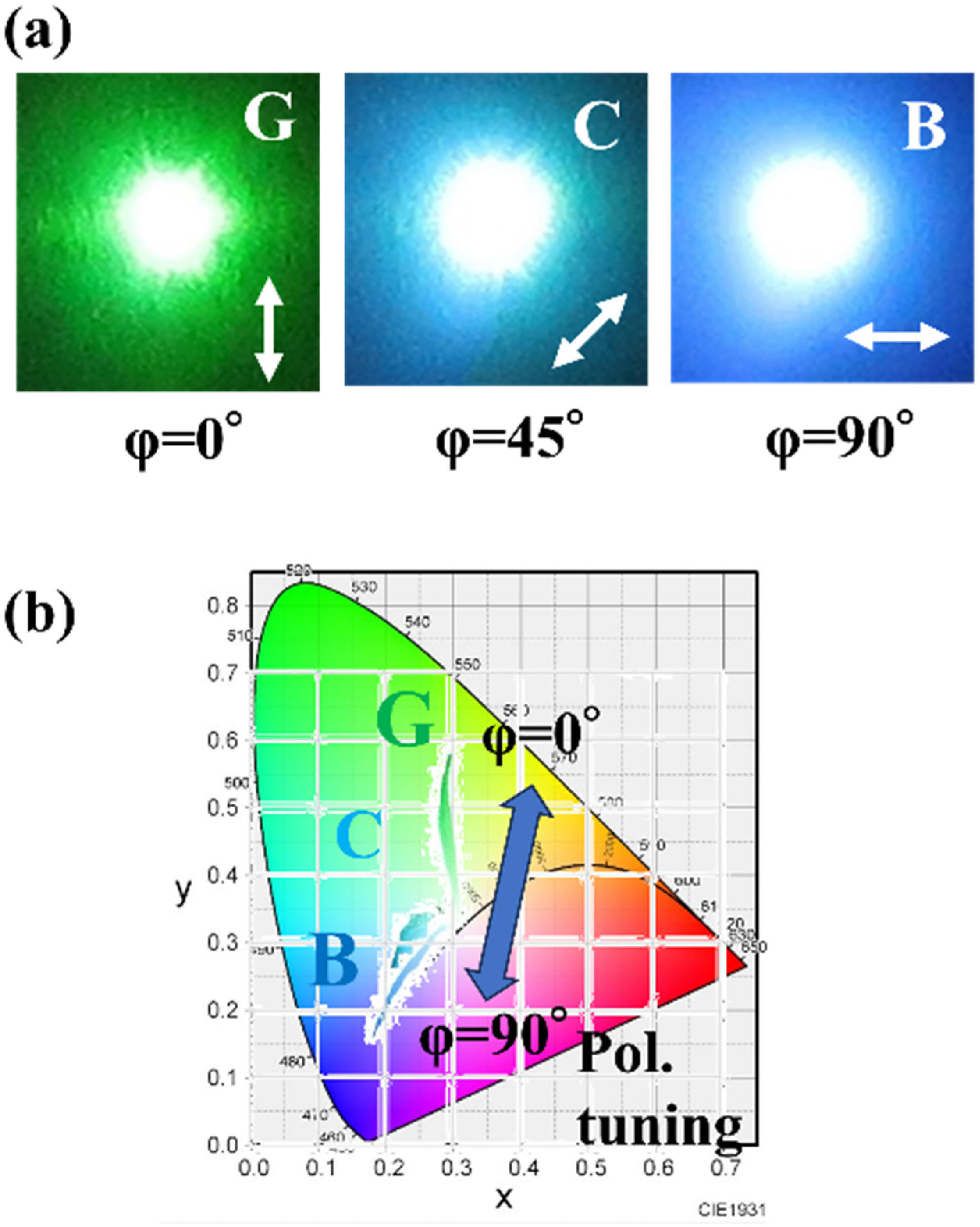
To control the polarization mode forcibly, cross-polarization mode as well as other polarization modes should be explored. As an alternative, an attempt was made to generate a pseudo-C beam with an oblique 45° linear polarization mode. The method used to create this involves two steps: (1) Placing a polarizer prior to point O and (2) varying the polarization angle, φ. Through this operation, polarization states for the two beams can be changed simultaneously. Here, the undesired angle error (ρ < ±3.4°), with respect to the installation plane for the polarizer, can be disregarded. By sweeping the polarization angle from φ = 0° (TE) to 45° to 90° (TM), the beam color transitions gradually from G to C to B. Simultaneously, the polarization mode shifts from TE-pol. (0°) to 45° pol. to TM-pol. (90°) as shown in Figure A3a.
Figure A3. (a) Photos of beam spots as functions of polarization angle φ: φ = 0° (TE) (G) (left), φ = 45° (C) (center), φ = 90° (TM) (B) (right). (b) Polarization tune ranging from TE to TM on chromaticity distribution.
Virtualworlds 04 00054 g0a3
Figure A3b illustrates the chromaticity values (x, y) during polarization tuning from TE to TM. Polarization angle-dependent observations reveal that the chromaticity value changes linearly from B to G in real time. This result indicates that a variety of C colors can be reflected on the beam spot.

References

  1. Yeom, H.; Kim, H.; Kim, S.; Zhang, H.; Li, B.; Ji, Y.; Kim, S.; Park, J. 3D holographic head mounted display using holographic optical elements with astigmatism aberration compensation. Opt. Express 2015, 23, 32025–32034. [Google Scholar] [CrossRef]
  2. Huang, Y.-F.; Chi, Y.-C.; Kao, H.-Y.; Tsai, C.-T.; Wang, H.-Y.; Kuo, H.-C.; Nakamura, S.; Huang, D.-W.; Lin, G.-R. Blue Laser Diode Based Free-space Optical Data Transmission elevated to 18 Gbps over 16 m. Sci. Rep. 2017, 7, 10478. [Google Scholar] [CrossRef]
  3. Piao, M.; Kim, N. Achieving high levels of color uniformity and optical efficiency for a wedge-shaped waveguide head-mounted display using a photopolymer. Appl. Opt. 2014, 53, 2180–2186. [Google Scholar] [CrossRef] [PubMed]
  4. Wang, Z.; Zhang, X.; Tu, K.; Lv, G.; Feng, Q.; Wang, A.; Ming, H. Lensless full-color holographic Maxwellian near-eye display with a horizontal eyebox expansion. Opt. Lett. 2021, 46, 4112–4115. [Google Scholar] [CrossRef]
  5. Huang, Z.; Marks, D.L.; Smith, D.R. Polarization-selective waveguide holography in the visible spectrum. Opt. Exp. 2019, 27, 35631–35645. [Google Scholar] [CrossRef] [PubMed]
  6. Chang, C.; Bang, K.; Wetzstein, G.; Lee, B.; Gao, L. Toward the next-generation VR/AR optics: A review of holographic near-eye displays from a human-centric perspective. Optica 2020, 7, 1563–1578. [Google Scholar] [CrossRef] [PubMed]
  7. Xie, J.; Wang, F.; Jiang, L.; Zhao, L.; Lu, Y. Periodic surface structures induced by femtosecond laser single pulse and pulse trains on metals. Laser Phys. 2015, 25, 056103. [Google Scholar] [CrossRef]
  8. Huang, M.; Zhao, F.-L.; Jia, T.-Q.; Cheng, Y.; Xu, N.-S.; Xu, Z.-Z. A uniform 290 nm periodic square structure on ZnO fabricated by two-beam femtosecond laser ablation. Nanotechnology 2007, 18, 505301. [Google Scholar] [CrossRef]
  9. Bai, B.; Laukkanen, J.; Kuittinen, M.; Siitonen, S. Optimization of nonbinary slanted surface-relief gratings as high-efficiency broadband couplers for light guides. Appl. Opt. 2010, 49, 5454–5464. [Google Scholar] [CrossRef]
  10. Jing, L.; Matsumoto, Y.; Zhang, Z. Editorial for the Special Issue on Exploring IoT Sensors and Their Applications: Advancements, Challenges, and Opportunities in Smart Environments. Micromachines 2024, 15, 1048. [Google Scholar] [CrossRef]
  11. Kim, Y.K.; Jang, I.G.; Kim, K.S.; Kim, S. Design improvement of the three-beam detector towards a precise long-range 6-degree of freedom motion sensor system. Rev. Sci. Instrum. 2014, 85, 015004. [Google Scholar] [CrossRef] [PubMed]
  12. Shrestha, V.-R.; Lee, S.-S.; Kim, E.-S.; Choi, D.-Y. Polarization-tuned Dynamic Color Filters Incorporating a Dielectric-loaded Aluminum Nanowire Array. Sci. Rep. 2015, 5, 12450. [Google Scholar] [CrossRef] [PubMed]
  13. Huo, P.; Chen, W.; Zhang, Z.; Zhang, Y.; Liu, M.; Lin, P.; Zhang, H.; Chen, Z.; Lezec, H.; Zhu, W.; et al. Observation of spatiotemporal optical vortices enabled by symmetry-breaking slanted nanograting. Nat. Commun. 2024, 15, 3055. [Google Scholar] [CrossRef] [PubMed]
  14. Ogata, Y. Drive Type Virtual Reality Image on a Head-Mounted Display. Coatings 2023, 13, 961. [Google Scholar] [CrossRef]
  15. Ogata, Y.; Mizutani, G. Absolute second order nonlinear susceptibility of Pt nanowire arrays on MgO faceted substrates with various cross-sectional shapes. Appl. Phys. Lett. 2013, 103, 093107. [Google Scholar] [CrossRef]
  16. Huang, Q.; Jia, Q.; Feng, J.; Huang, H.; Yang, X.; Grenzer, J.; Huang, K.; Zhang, S.; Lin, J.; Zhou, H.; et al. Realization of wafer-scale nanogratings with sub-50 nm period through vacancy epitaxy. Nat. Commun. 2019, 10, 2437. [Google Scholar] [CrossRef]
  17. Fu, Y.; Bryan, N.K.A.; Zhou, W. Self-organized formation of a blazed-grating-like structure on Si (100) induced by focused ion-beam scanning. Opt. Express 2004, 12, 227–233. [Google Scholar] [CrossRef]
  18. Moharam, M.G.; Gaylord, T.K. Diffraction analysis of dielectric surface-relief gratings. J. Opt. Soc. Am. 1982, 72, 1385–1392. [Google Scholar] [CrossRef]
  19. Zhang, Y.; Fang, F. Development of planar diffractive waveguides in optical see-through head-mounted displays. Precis. Eng. 2019, 60, 482–496. [Google Scholar] [CrossRef]
  20. Sarkar, S.; Poulose, S.; Sahoo, P.K.; Joseph, J. Flexible and stretchable guided-mode resonant optical sensor: Single-step fabrication on a surface engineered polydimethylsiloxane substrate. OSA Contin. 2018, 1, 1277–1286. [Google Scholar] [CrossRef]
  21. Li, X.; Lan, T.-H.; Tien, C.-H.; Gu, M. Three-dimensional orientation-unlimited polarization encryption by a single optical configured vectorial beam. Nat. Commun. 2012, 3, 998. [Google Scholar] [CrossRef] [PubMed]
  22. Ogata, Y.; Kolchiba, M. Virtual reality images created on the back and front of a display. Opt. Lett. 2024, 49, 1632–1635. [Google Scholar] [CrossRef] [PubMed]
  23. Kawata, S. Near-field microscope probes utilizing surface plasmon polaritons. In Near-Field Optics and Surface Plasmon Polaritons; Kawata, S., Ed.; Topics in Applied Physics; Springer: Berlin/Heidelberg, Germany, 2001; Volume 81. [Google Scholar]
  24. Mizutani, G.; Koyama, K.; Tomizawa, S.; Sano, H. Distinction between some saccharides in scattered optical sum frequency intensity images. Spectrochim. Acta Part A Mol. Biomol. Spectrosc. 2005, 62, 845–849. [Google Scholar] [CrossRef] [PubMed]
  25. Sit, A.; Fickler, R.; Alsaiari, F.; Bouchard, F.; Larocque, H.; Gregg, P.; Yan, L.; Boyd, R.W.; Ramachandran, S.; Karimi, E. Quantum cryptography with structured photons through a vortex fiber. Opt. Lett. 2018, 43, 4108–4111. [Google Scholar] [CrossRef]
  26. Toyoda, K.; Miyamoto, K.; Aoki, N.; Morita, R.; Omatsu, T. Using optical vortex to control the chirality of twisted metal nanostructures. Nano Lett. 2012, 12, 3645–3649. [Google Scholar] [CrossRef]
Figure 1. Crosstalk removal + polarization control mechanism. Top-center: optical configuration on the assumed polarization 3D-VR-HMD device. Top-right: fused polarized 3D-VR image with high contrast and lock-in function. Double arrow: polarization direction. Single (color) arrow: beam. Dotted arrow: time flow. (a) Mechanical chopper in a VR-HMD. (b) Alternative shutter timing diagram. (c) Pseudo color + polarization display (pulse model). Initial: color; φ: polarization angle. Note: we are focusing on TE/TM mixture beam when waveguiding in a display. After this, 3D-VR image can be observed through a pair of polarization glasses. Projection device such as a digital micro mirror device is not used, so this work disregards each beam shape. LL: lenticular lens; P: polarizer; D/HOE: diffractive/holographic optical element; VR: virtual reality; LS: light source; and HM: half mirror.
Virtualworlds 04 00054 g001
Figure 2. Optical and mechanical setup: (a) Diagram. Left side inset; power vs. current (dP/dI) curves [2] for G and B lasers. Note that their values do not correspond to referenced external quantum efficiency. As a test model, power supply unit, M, and BS(p) were substituted for LiPo battery, R-SLM, and BS(c), respectively. “Italic”; experimental setups for sub-parts in Section 4. (b) Flowchart of mechanical operation.
Virtualworlds 04 00054 g002
Figure 3. (a) Photos of a real-time measurement device equipped with sensor head parts. (b) Detection signals for mutually opened G and B lasers. Square: expanding region. During the measurement, the sampling rate was too low to obtain smooth spectra. (c) Illustration for real-time intensity. Line, G; Dot, B.
Virtualworlds 04 00054 g003
Figure 4. (Upper side) Optical configurations for beam irradiation on a WB. (Lower side) The observed G, B, and C beam spots and their polarization modes on a WB. Two types of C-colored beam spots; with (w) and without (w/o) CH. Arrow and dotted arrows indicate situations for nonsynthesized and synthesized electric fields at the surface. However, the nonsynthesized one is fused on the user’s eye.
Virtualworlds 04 00054 g004
Figure 5. (a) The intensity for x, y line profiles, and their 3D power profile for pseudo-C beam spot. This beam does not seem to have Gaussian profile, due to the intensity saturation at maximum brightness. Red dotted: measured points. Blue curve: least square fitting simulation. Color in 3D: brightness level of high (white) to low (purple). (b) Channel-splitting data for G and B colors. The obtained pseudo-C beam spot is not affected by the residual or stray lights. (c) The chromaticity value (x, y) for pseudo-C spot values. The values for (x, y) are determined to be (0.25, 0.35) on a GB line.
Virtualworlds 04 00054 g005
Figure 6. Beam irradiation test using the Gr coupler-based display; (a,b) the cross-sectional (a) topographical image and (b) scanning electron microscope (SEM) image for Gr coupler. (c) Theoretical relation between incident angle Θin and diffraction angle Θd, −1st for G and B beams. Dotted red line corresponds to Θd, −1st line; ΔΘin is the angle difference for incident angles between beams. (d) Theoretical relation between diffraction angle Θd, −1st, and efficiency η for G and B beams. S: matching point for G and B. Orange part: region satisfied with TIR. (e,f) Radar patterns for diffraction beams, and tables for diffraction angles Θd, −1st, and efficiencies η for G and B beams. (g) The configuration for display. (h) The experimental setup.
Virtualworlds 04 00054 g006
Figure 7. (a) The ray trace data for G and B diffraction beams. Left side inset: the expanding data at Gr part. (b) The (inversion) photo of TIR waveguides for diffraction beams. Left side inset: the expanded image of the surroundings. Thinner brightness line and spot showed the existence of diffraction with +1st order. Right side inset: B and G individual paths. (c) When polarization angle φ is tuned, diffraction efficiency η for B, G beams can be controlled. (d) The chromatic distribution on the waveguide beam.
Virtualworlds 04 00054 g007
Figure 8. Assumed structures when RGB laser light with crosstalk removal function are ablated. Two types of laser-ablated structures (hexagonal and star polygon array). Ablated structures for R/G/B are attributed as circle/triangle/square. By using the crosstalk removal system, these two structures would be of better quality (i.e., easy recognition, no disturbance) compared with the case where conventional techniques are used. This is because surface nanostructures created by first shot pulse do not affect those created by second shot pulse.
Virtualworlds 04 00054 g008
Figure 9. A photo of the device. White line: beam path. Dotted circle: Gr part. Bottom-right inset: brightness image of a dotted square when B and G beams are turned on.
Virtualworlds 04 00054 g009
Figure 10. (a) Optical configuration and (b) viewer image for the single coupler-based waveguide experiment. (c) Beam emissions for decomposed G and B, and mixed C. (d) Polarization-tuned beam emissions. When input beam polarizations are set at TE/TM, cross-polarization mode is created with CH. (e,f) L-dependent C and pseudo-C beam emissions with and without Ch. Right sides: zoomed-in views. Note that a partial cropping beam blocker is set after an exit port of an output coupler to cut off the stray and illuminated light from the light source device. Cam. and arrow: camera position and shot direction.
Virtualworlds 04 00054 g010
Figure 11. (a) Optical configuration and (b) viewer image for the pair Gr coupler-based waveguide experiment. (c) The observed VR spots of G, B, C and pseudo-C beams. (d) The VR images as a function of distance L.
Virtualworlds 04 00054 g011
Disclaimer/Publisher’s Note: The statements, opinions and data contained in all publications are solely those of the individual author(s) and contributor(s) and not of MDPI and/or the editor(s). MDPI and/or the editor(s) disclaim responsibility for any injury to people or property resulting from any ideas, methods, instructions or products referred to in the content.