
The Effect of Belonging-Oriented Psychosocial Interventions for Medical Students: An Exploratory Systematic Review and Meta-Analysis

Abstract
1. Introduction
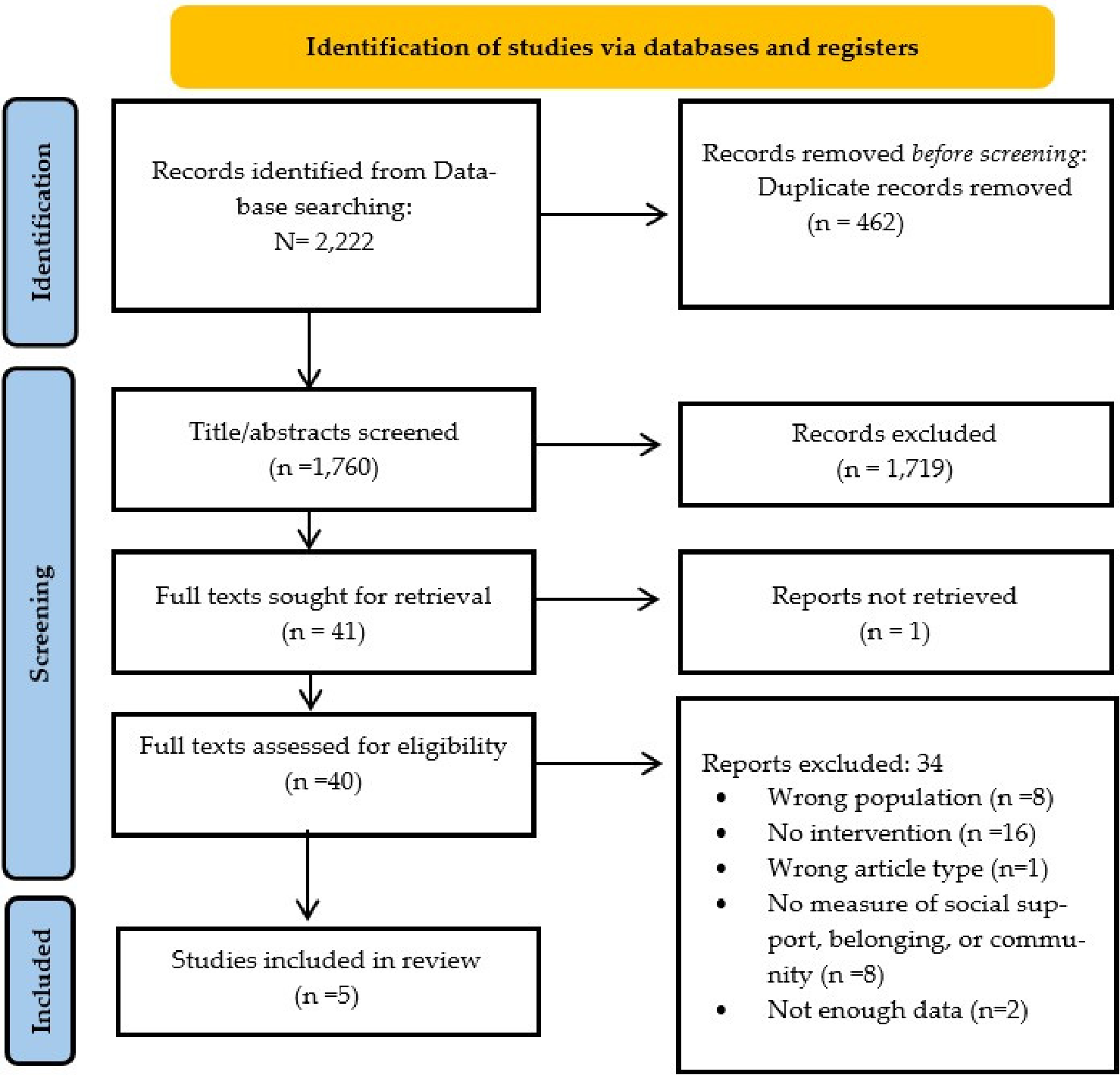
2. Materials and Methods
2.1. Inclusion and Exclusion Criteria
2.2. Search Strategies
2.3. Data Management
2.4. Data Extraction and Coding
2.5. Data Analysis
3. Results
3.1. Study and Participant Characteristics
3.2. Intervention Characteristics

| Study | Outcome Measure and Direction | Underlying Construct(s) | Psychometric Properties | Construct Definition |
|---|---|---|---|---|
| Burt-Miller et al. (2025) [34] | (1) PROMIS Social Isolation Short-Form [37] Higher score = greater social isolation (2) Modified Simple School Belonging Scale [38] Higher score = greater sense of belonging | Belonging and Social isolation | PROMIS Reliability: Standard error of measurement ≤ 3.0 (~0.9 reliability) Validity: Pearson’s correlation coefficients r = 0.52 to 0.76 [39] Simple School Belonging Scale: Reliability: Cronbach’s α = 0.91 Construct validity r = 0.64 [40] | Belonging: The “extent to which students feel personally accepted, respected, included and supported by others in the school environment” [38] “Quality of social support refers to functional aspects of supportive relationships, i.e., interpersonal relationships that serve particular functions. This includes the interactive process by which emotional, instrumental or informational support is obtained from one’s social network. It also includes companionship, feeling cared for and valued as a person, communication with others, and feelings of belonging and trust.” [40] |
| Cheng et al. (2022) [16] | (1) PROMIS Social Isolation Short-Form [38] (see above) (2) Social Connectedness Scale [41] Higher score = better connectedness | Social isolation and social connectedness | PROMIS: See above Social Connectedness Scale Reliability: Raykov’s rho 0.78–0.81 Validity: High convergent and discriminatory validity [42] | “Social connection/connectedness is a multidimensional construct that is defined as a continuum of the size and diversity of one’s social network and roles, the functions that these relationships serve, and their positive or negative qualities.” [41] |
| Gold et al. (2019) [14] | Revised UCLA Loneliness Scale [43] Higher score = greater loneliness | Loneliness | Reliability: Cronbach’s α = 0.89–0.96 [41,42] Test–retest reliability r = 0.73 [44] Construct validity shown by “significant relationships with measures of interpersonal relationships” [44] | “…designed to measure one’s subjective feelings of loneliness as well as feelings of social isolation.” [45] “…reflection groups may be a feasible, effective intervention to improve loneliness and social belonging in medical school.” [36] |
| Li et al. (2014) [35] | Interpersonal Support Evaluation List (ISEL) [46] Four subscales; only Belonging subscale coded here. Higher score = greater interpersonal support | Belonging | Reliability: Cronbach’s α = 0.83 Validity: Moderate relationship between ISEL (r = 0.45) and belonging subscale (r = 0.38) and the Lubben Social Network Scale (LSNS) [47] | “…belonging support [refers] to the perceived availability of others for companionship.” [35] |
| Perry et al. (2021) [36] | Adapted from the Situational Belonging scale [48] Higher score = greater sense of belonging | Belonging | Reliability: Cronbach’s α = 0.91 Validity: not reported [48] | “One important psychological threat that people may be vigilant to is social identity threat—a threat that occurs when people recognize they may be devalued in a setting because of one of their social identities… by triggering objective experiences of identity threat (e.g., cognitive and physiological vigilance) and subjective experiences of identity threat (e.g., a decreased sense of belonging…)… subtle situational cues may have powerful and far-reaching effects…” [48] |
3.3. Mapping Scale Constructs to Belonging-Oriented Psychosocial Interventions
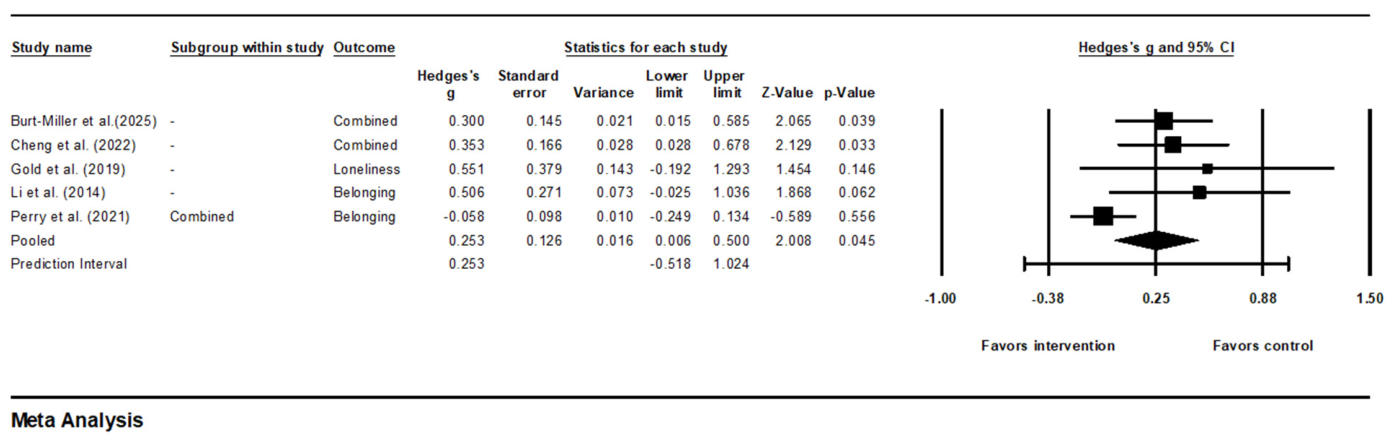
3.4. Summary Effect Size
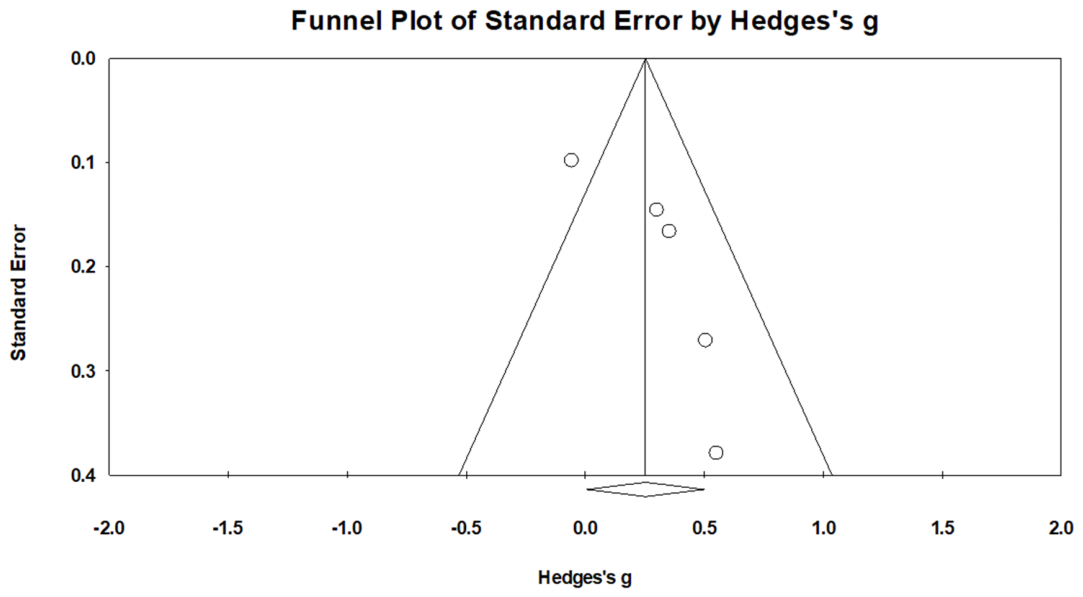
3.5. Publication Bias
3.6. Moderator Analyses
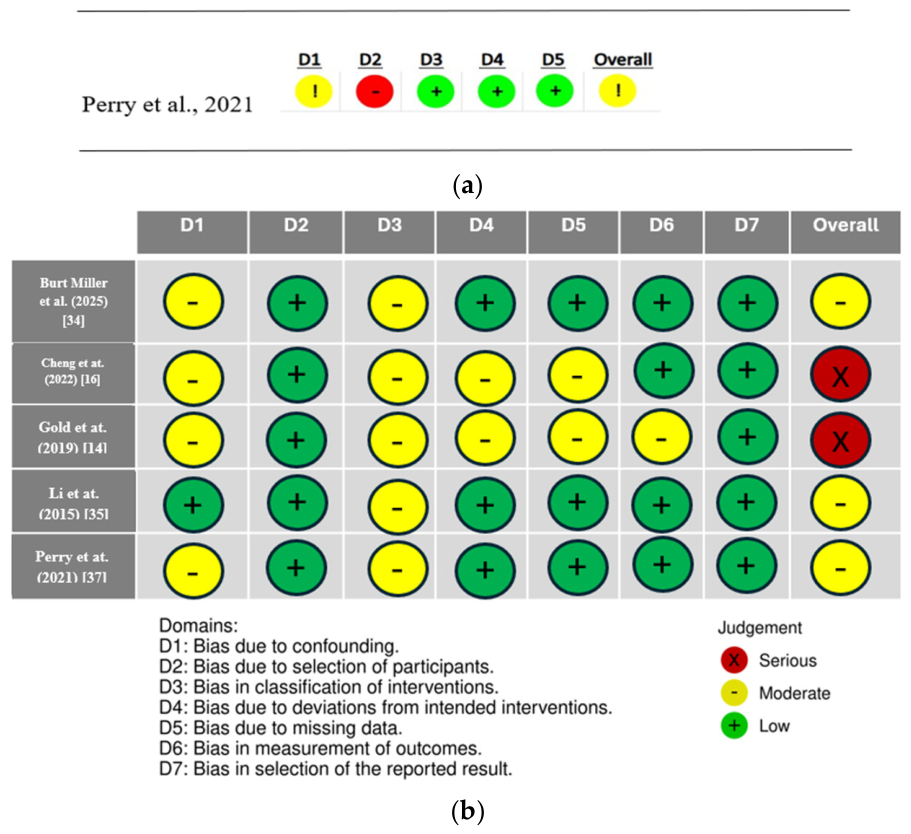
3.7. Risk of Bias in Primary Studies
4. Discussion
4.1. Practical Implications for Medical Education
4.2. Recommendations for Future Research
4.3. Limitations
5. Conclusions
Supplementary Materials
Author Contributions
Funding
Institutional Review Board Statement
Informed Consent Statement
Data Availability Statement
Conflicts of Interest
Abbreviations
| AY | Academic year |
| CI | Confidence interval |
| PRISMA | Preferred Reporting Items for Systematic Reviews and Meta-analysis |
| PROMIS | Patient-Reported Outcomes Measurement Information System |
| NR | Not reported |
| RCT | Randomized controlled trial |
| RoB2 | Risk of Bias—version 2 |
| ROBINS-I | Risk of Bias in Non-Randomized Studies of Interventions |
| SD | Standard deviation |
| UCLA | University of California—Los Angeles |
References
- Ayala, E.E.; Winseman, J.S.; Johnsen, R.D.; Mason, H.R.C. U.S. medical students who engage in self-care report less stress and higher quality of life. BMC Med. Educ. 2018, 18, 189. [Google Scholar] [CrossRef] [PubMed]
- Brazeau, C.; Shanafelt, T.; Durning, S.; Massie, F.; Eacker, A.; Moutier, C.; Satele, D.V.; Sloan, J.A.; Dyrbye, L.N. Distress among matriculating medical students relative to the general population. Acad. Med. 2014, 89, 1520–1525. [Google Scholar] [CrossRef]
- Dyrbye, L.N.; Thomas, M.R.; Huschka, M.M.; Lawson, K.L.; Novotny, P.J.; Sloan, J.A.; Shanafelt, T.D. A multicenter study of burnout, depression, and quality of life in minority and nonminority US medical students. Mayo Clin. Proc. 2006, 81, 1435–1442. [Google Scholar] [CrossRef] [PubMed]
- Hope, V.; Henderson, M. Medical student depression, anxiety and distress outside North America: A systematic review. Med. Educ. 2014, 48, 963–979. [Google Scholar] [CrossRef]
- MacLean, L.; Booza, J.; Balon, R. The impact of medical school on student mental health. Acad. Psychiatry 2016, 40, 89–91. [Google Scholar] [CrossRef]
- Rotenstein, L.S.; Ramos, M.A.; Torre, M.; Segal, J.B.; Peluso, M.J.; Guille, C.; Sen, S.; Mata, D.A. Prevalence of depression, depressive symptoms, and suicidal ideation among medical students: A systematic review and meta-analysis. JAMA 2016, 316, 2214–2236. [Google Scholar] [CrossRef] [PubMed]
- Rosal, M.C.; Ockene, I.S.; Ockene, J.K.; Barrett, S.V.; Ma, Y.; Hebert, J.R. A longitudinal study of students’ depression at one medical school. Acad. Med. 1997, 72, 542–546. [Google Scholar] [CrossRef]
- Caceres, J.W.; Lizotte-Waniewski, M. Addressing medical student wellness over the long term: How should we be evaluating wellness programs? Med. Sci. Educ. 2021, 31, 877–878. [Google Scholar] [CrossRef] [PubMed]
- Leep Hunderfund, A.N.; Saberzadeh Ardestani, B.; Laughlin-Tommaso, S.K.; Jordan, B.L.; Melson, V.A.; Montenegro, M.M.; Brushaber, D.E.; West, C.P.; Dyrbye, L.N.M. Sense of belonging among medical students, residents, and fellows: Associations with burnout, recruitment retention, and learning environment. Acad. Med. 2025, 100, 191–202. [Google Scholar] [CrossRef]
- Sattar, K.; Yusoff, M.S.B.; Arifin, W.N.; Yasin, M.A.M.; Nor, M.Z.M. Effective coping strategies utilised by medical students for mental health disorders during undergraduate medical education-a scoping review. BMC Med. Educ. 2022, 22, 121. [Google Scholar] [CrossRef]
- McLuckie, A.; Matheson, K.M.; Landers, A.L.; Landine, J.; Novick, J.; Barrett, T.; Dimitropoulos, G. The relationship between psychological distress and perception of emotional support in medical students and residents and implications for educational institutions. Acad. Psychiatry 2018, 42, 41–47. [Google Scholar] [CrossRef] [PubMed]
- Sajid, M.R.; Raddaoui, L.; Abu Shagra, F.; Shaikh, A.S.; Tamim, H.; Al-Kattan, K. Faith, friends, and humor: How medical students cope with academic stress in a private medical university in Saudi Arabia. Adv. Med. Educ. Pract. 2024, 15, 1205–1213. [Google Scholar] [CrossRef] [PubMed]
- Silva, A.G.; Cerqueira ATde, A.R.; Lima, M.C.P. Social support and common mental disorder among medical students. Braz. J. Epidemiol. 2014, 17, 229–242. [Google Scholar] [CrossRef]
- Gold, J.A.; Bentzley, J.P.; Franciscus, A.M.; Forte, C.; De Golia, S.G. An intervention in social connection: Medical student reflection groups. Acad. Psychiatry 2019, 43, 375–380. [Google Scholar] [CrossRef]
- Rospenda, K.M.; Halpert, J.; Richman, J.A. Effects of social support on medical students’ performances. Acad. Med. 1994, 69, 496–500. [Google Scholar] [CrossRef]
- Cheng, S.M.; Taylor, D.L.; Fitzgerald, A.A.; Kuo, C.C.; Graves, K.D. Build & Belong: A peer-based intervention to reduce medical student social isolation. Teach. Learn. Med. 2022, 34, 504–513. [Google Scholar] [CrossRef] [PubMed]
- Lau, C.; Chen, S.; Saklofske, D.H. Distinguishing received and perceived social support in medical education: Key predictors of medical student loneliness. Acad. Psychiatry 2025, ahead of print. 1–5. [Google Scholar] [CrossRef]
- Ray, M.E.; Coon, J.M.; Al-Jumaili, A.A.; Fullerton, M. Quantitative and qualitative factors associated with social isolation among graduate and professional health science students. Am. J. Pharm. Educ. 2019, 83, 69–83. [Google Scholar] [CrossRef]
- Chen, S.; Li, H.; Wen, D. Social support and daytime sleepiness among Chinese medical students: Mediating roles of loneliness and problematic smartphone use. Psychol. Res. Behav. Manag. 2023, 16, 4083–4093. [Google Scholar] [CrossRef]
- Abrams, M.P.; Salzman, J.; Rey, A.E.; Daly, K. Impact of providing peer support on medical students’ empathy, self-efficacy, and mental health stigma. Int. J. Environ. Res. Public Health 2022, 19, 5135. [Google Scholar] [CrossRef]
- Mongrain, K.; Simmons, A.; Shore, I.; Prinja, X.; Reaume, M. Side-by-side: A one-on-one peer support program for medical students. Acad. Med. 2022, 97, 1170–1174. [Google Scholar] [CrossRef]
- Taylor, A.J.; Samson, A. Power of the mentor and potential of the mentee: How mentoring relationships support or thwart mentees’ aspirations. Int. J. Mentor. Coach. Educ. 2026; ahead of print. [CrossRef]
- Page, M.J.; McKenzie, J.E.; Bossuyt, P.M.; Boutron, I.; Hoffmann, T.C.; Mulrow, C.D.; Shamseer, L.; Tetzlaff, J.M.; Akl, E.A.; Brennan, S.E.; et al. The PRISMA 2020 statement: An updated guideline for reporting systematic reviews. BMJ 2021, 372, n71. [Google Scholar] [CrossRef]
- Cooper, H. Research Synthesis and Meta-Analysis: A Step-by-Step Approach, 5th ed.; Sage Publications, Inc.: Thousand Oaks, CA, USA, 2017. [Google Scholar]
- Comprehensive Meta-Analysis (CMA); Biostat, Inc.: Englewood, NJ, USA, 2026; Available online: https://meta-analysis.com/ (accessed on 1 June 2026).
- Sperling, E.L.; Khoury, B.; Sutton, A.; Price-Blackshear, M.A.; Bettencourt, B.A. Enhancing rigor in quantitative meta-analyses for mindfulness research: A comprehensive guide. Mindfulness 2025, 16, 315–331. [Google Scholar] [CrossRef]
- Lin, L.; Aloe, A.M. Evaluation of various estimators for standardized mean difference in meta-analysis. Stat. Med. 2021, 40, 403–426. [Google Scholar] [CrossRef] [PubMed]
- Cohen, J. Statistical Power Analysis for the Behavioral Sciences, 2nd ed.; Routledge: New York, NY, USA, 1988. [Google Scholar]
- Sterne, J.A.C.; Savović, J.; Page, M.J.; Elbers, R.G.; Blencowe, N.S.; Boutron, I.; Cates, C.J.; Cheng, H.Y.; Corbett, M.S.; Eldridge, S.M.; et al. RoB 2: A revised tool for assessing risk of bias in randomised trials. BMJ 2019, 366, l4898. [Google Scholar] [CrossRef]
- Sterne, J.A.C.; Hernán, M.A.; Reeves, B.C.; Savović, J.; Berkman, N.D.; Viswanathan, M.; Henry, D.; Altman, D.G.; Ansari, M.T.; Boutron, I.; et al. ROBINS-I: A tool for assessing risk of bias in non-randomised studies of interventions. BMJ 2016, 355, i4919. [Google Scholar] [CrossRef]
- Duval, S.; Tweedie, R. A nonparametric “Trim and Fill” method of accounting for publication bias in meta-analysis. J. Am. Stat. Assoc. 2000, 95, 89–98. [Google Scholar] [CrossRef]
- Egger, M.; Smith, G.D.; Schneider, M.; Minder, C. Bias in meta-analysis detected by a simple, graphical test. BMJ 1997, 315, 629–634. [Google Scholar] [CrossRef] [PubMed]
- Kossmeier, M.; Tran, U.S.; Voracek, M. Visual inference for the funnel plot in meta-analysis. Z. Psychol. 2019, 227, 83–89. [Google Scholar] [CrossRef]
- Burt-Miller, J.F.; Rismani, M.; Hopkins, A.; Cunningham, T.; Farquharson, D.; Balcázar, A.G.; Chosed, R.J.; McPhail, B.; Green, L.; Gordon, M.C.; et al. “I realized I was not alone”: A mixed-methods investigation of the implementation of Ubuntu groups to reduce burnout and social isolation in an allopathic medical school in the Southeastern United States. Med. Teach. 2025, 47, 249–259. [Google Scholar] [CrossRef]
- Li, C.; Chu, F.; Wang, H.; Wang, X.P. Efficacy of Williams LifeSkills training for improving psychological health: A pilot comparison study of Chinese medical students. Asia-Pac. Psychiatry 2014, 6, 161–169. [Google Scholar] [CrossRef]
- Perry, S.P.; Wages, J.E.; Skinner-Dorkenoo, A.L.; Burke, S.E.; Hardeman, R.R.; Phelan, S.M. Testing a self-affirmation intervention for improving the psychosocial health of Black and White medical students in the United States. J. Soc. Issues 2021, 77, 769–800. [Google Scholar] [CrossRef] [PubMed]
- Hahn, E.A.; DeVellis, R.F.; Bode, R.K.; Garcia, S.F.; Castel, L.D.; Eisen, S.V.; Bosworth, H.B.; Heinemann, A.W.; Rothrock, N.; Cella, D., on behalf of the PROMIS Cooperative Group. Measuring social health in the patient-reported outcomes measurement information system (PROMIS): Item bank development and testing. Qual. Life Res. Int. J. Qual. Life Asp. Treat. Care Rehabil. 2010, 19, 1035–1044. [Google Scholar] [CrossRef] [PubMed]
- Whiting, E.F.; Everson, K.; Feinauer, E. The Simple School Belonging Scale: Working towards a unidimensional measure of student belonging. Meas. Eval. Couns. Dev. 2017, 51, 163–178. [Google Scholar] [CrossRef]
- Hahn, E.A.; DeWalt, D.A.; Bode, R.K.; Garcia, S.F.; DeVellis, R.F.; Correia, H.; Cella, D. New English and Spanish social health measures will facilitate evaluating health determinants. Health Psychol. 2014, 33, 490–499. [Google Scholar] [CrossRef]
- Goodenow, C. The psychological sense of school membership among adolescents: Scale development and educational correlates. Psychol. Sch. 1993, 30, 79–90. [Google Scholar] [CrossRef]
- Lee, R.M.; Robbins, S.B. Measuring belongingness: The social connectedness and the social assurance scales. J. Couns. Psychol. 1995, 42, 232–241. [Google Scholar] [CrossRef]
- Kelley, B.; Fraser, B.; Wells, A.; Ferdock, M. Psychometric analysis of the social connectedness instrument. Front. Psychol. 2025, 16, 1565267. [Google Scholar] [CrossRef] [PubMed]
- Russel, D.; Peplau, L.A.; Ferguson, M.L. Developing a measure of loneliness. J. Personal. Assess. 1978, 42, 290–294. [Google Scholar] [CrossRef]
- Russell, D. UCLA Loneliness Scale (Version 3): Reliability, validity, and factor structure. J. Personal. Assess. 1996, 66, 29–40. [Google Scholar] [CrossRef] [PubMed]
- Russell, D.; Peplau, L.A.; Cutrona, C.E. The revised UCLA Loneliness Scale: Concurrent and discriminant validity evidence. J. Personal. Soc. Psychol. 1980, 39, 472–480. [Google Scholar] [CrossRef]
- Cohen, S.; Hoberman, H. Positive events and social supports as buffers of life change stress. J. Appl. Soc. Psychol. 1983, 13, 99–125. [Google Scholar] [CrossRef]
- Payne, T.J.; Andrew, M.; Butler, K.R.; Wyatt, S.B.; Dubbert, P.M.; Mosley, T.H. Psychometric evaluation of the Interpersonal Support Evaluation List–Short Form in the ARIC study cohort. Sage Open 2012, 2, 2158244012461923. [Google Scholar] [CrossRef]
- Murphy, M.C.; Steele, C.M.; Gross, J.J. Signaling threat: How situational cues affect women in math, science, and engineering settings. Psychol. Sci. 2007, 18, 879–885. [Google Scholar] [CrossRef]
- Lin, L.; Chu, H. Quantifying publication bias in meta-analysis. Biometrics 2018, 74, 785–794. [Google Scholar] [CrossRef] [PubMed]
- da Silva, A.N.; Lucietto, D.A.; Bastos, M.V.d.S.; do Nascimento, T.Q.; Vettore, M.V. The relationship of dental students’ characteristics to social support, psychosocial factors, lifestyle, and quality of life. Health Psychol. Behav. Med. 2022, 10, 596–616. [Google Scholar] [CrossRef]
- Fazia, T.; Bubbico, F.; Nova, A.; Buizza, C.; Cela, H.; Iozzi, D.; Calgan, B.; Maggi, F.; Floris, V.; Sutti, I.; et al. Improving stress management, anxiety, and mental well-being in medical students through an online Mindfulness-Based Intervention: A randomized study. Sci. Rep. 2023, 13, 8214. [Google Scholar] [CrossRef]
- Sperling, E.L.; Hudson, M.G. Examining the effects of a small process group on grit, resilience, and stress levels among medical students: A pilot study. J. Spec. Group Work 2024, 49, 120–138. [Google Scholar] [CrossRef]
- Libbey, H.P. Measuring student relationships to school: Attachment, bonding, connectedness, and engagement. J. Sch. Health 2004, 74, 274–283. [Google Scholar] [CrossRef] [PubMed]
- Cisneros, V.; Goldberg, I.; Schafenacker, A.; Bota, R.G. Balancing life and medical school. Ment. Illn. 2015, 7, 5768. [Google Scholar] [CrossRef]
- Jaber, J.; Gould-Suarez, M.; Tran, C.; Lee, E.; White-Satcher, D.; Okoh, J.; Morrow, A.; Poythress, E.L.; Appelbaum, N.; Lin, D. Utilizing learning communities to implement a wellness-in-action session in undergraduate medical education. South. Med. J. 2025, 118, 644–648. [Google Scholar] [CrossRef]
- Brandl, K.; Schneid, S.D.; Smith, S.; Winegarden, B.; Mandel, J.; Kelly, C.J. Small group activities within academic communities improve the connectedness of students and faculty. Med. Teach. 2017, 39, 813–819. [Google Scholar] [CrossRef]
- Preovolos, C.; Grant, A.; Rayner, M.; Fitzgerald, K.; Ng, L. Peer mentoring by medical students for medical students: A scoping review. Med. Sci. Educ. 2024, 34, 1577–1602. [Google Scholar] [CrossRef]
- Oliveira, N.M.; Viana, D.A.; Santos, J.R.; Quintanilha, L.F.; de Jesus, R.F.; Avena, K.M.; Andrade, B.B. Engagement in extracurricular activities during medical school: A cross-sectional study on student motivations and challenges. J. Med. Educ. Curric. Dev. 2024, 11, 1–11. [Google Scholar] [CrossRef]
- Kilic, R.; Nasello, J.A.; Melchior, V.; Triffaux, J.M. Academic burnout among medical students: Respective importance of risk and protective factors. Public Health 2021, 198, 187–195. [Google Scholar] [CrossRef] [PubMed]
- Chole, R.A.; Ogden, M.A. Predictors of future success in otolaryngology residency applicants. Arch. Otolaryngol.—Head Neck Surg. 2012, 138, 707–712. [Google Scholar] [CrossRef]
- Strowd, L.C.; Gao, H.; O’Brien, M.C.; Reynolds, P.; Grier, D.; Peters, T.R. Performing under pressure: Varsity athletes excel in medical school. Med. Sci. Educ. 2019, 29, 715–720. [Google Scholar] [CrossRef] [PubMed]
- Babenko, O.; Mosewich, A. In sport and now in medical school: Examining students’ well-being and motivations for learning. Int. J. Med. Educ. 2017, 8, 336–342. [Google Scholar] [CrossRef] [PubMed]
- Eather, N.; Wade, L.; Pankowiak, A.; Eime, R. The impact of sports participation on mental health and social outcomes in adults: A systematic review and the ‘Mental Health through Sport’ conceptual model. Syst. Rev. 2023, 12, 102. [Google Scholar] [CrossRef]


| Study/Location | Design | Intervention | Sample Characteristics | Results/Outcome Measure |
|---|---|---|---|---|
| Burt-Miller et al. (2025) [34] United States | Pre/post one-arm | Duration in wks: 8 Session duration: 1 h Frequency: 1x/wk Total no. sessions: 8 | n: 48 Mean age: 24.9 (SD: 2.6) % female: 72.9 % White: 54.2 | g = 0.30 PROMIS Social Isolation Short-Form and Modified Simple School Belonging Scale |
| Cheng et al. (2022) [16] United States | Pre/post one-arm | Duration in wks: 1 AY Session duration: 30 min Frequency: NR Total no. sessions: 3 | n: 63 Age range: 24–26 % female: 66.7 % White: 55.6 | g = 0.35 PROMIS Social Isolation Short-Form and Social Connectedness Scale |
| Gold et al. (2019) [14] United States | Pre/post one-arm | Duration in wks: 26 Session duration: 1 h Frequency: Bimonthly Total no. sessions: 13 | n: 25 Mean age: NR % female: 83.3 % White: NR | g = 0.55 Revised UCLA Loneliness Scale |
| Li et al. (2014) [35] China | Non-randomized two-arm trial | Duration in wks: 8 Session duration: 1 h Frequency: 1x/wk Total no. sessions: 8 | n: 29 Mean age: 23.5 (1.0) % female: 55.2 % White: NR | g = 0.51 Interpersonal Support Evaluation List (ISEL) Belonging subscale |
| Perry et al. (2021) [36] United States | RCT | Duration in wks: 3 Session duration: 1 h Frequency: 1x/wk Total no. sessions: 3 | n: 416 Mean age: 25.2 (3.0) % female: 58 % White: 43.8 | g = −0.06 Situational Belonging scale |
Disclaimer/Publisher’s Note: The statements, opinions and data contained in all publications are solely those of the individual author(s) and contributor(s) and not of MDPI and/or the editor(s). MDPI and/or the editor(s) disclaim responsibility for any injury to people or property resulting from any ideas, methods, instructions or products referred to in the content. |
© 2026 by the authors. Published by MDPI on behalf of the Academic Society for International Medical Education. Licensee MDPI, Basel, Switzerland. This article is an open access article distributed under the terms and conditions of the Creative Commons Attribution (CC BY) license.
Share and Cite
Sperling, E.L.; Leff, A.; Manninen, H.; Walzer, N. The Effect of Belonging-Oriented Psychosocial Interventions for Medical Students: An Exploratory Systematic Review and Meta-Analysis. Int. Med. Educ. 2026, 5, 54. https://doi.org/10.3390/ime5020054
Sperling EL, Leff A, Manninen H, Walzer N. The Effect of Belonging-Oriented Psychosocial Interventions for Medical Students: An Exploratory Systematic Review and Meta-Analysis. International Medical Education. 2026; 5(2):54. https://doi.org/10.3390/ime5020054
Chicago/Turabian StyleSperling, Edie L., Abigail Leff, Hayden Manninen, and Natalie Walzer. 2026. "The Effect of Belonging-Oriented Psychosocial Interventions for Medical Students: An Exploratory Systematic Review and Meta-Analysis" International Medical Education 5, no. 2: 54. https://doi.org/10.3390/ime5020054
APA StyleSperling, E. L., Leff, A., Manninen, H., & Walzer, N. (2026). The Effect of Belonging-Oriented Psychosocial Interventions for Medical Students: An Exploratory Systematic Review and Meta-Analysis. International Medical Education, 5(2), 54. https://doi.org/10.3390/ime5020054