
Modelling and Measuring Professional Vision in Medical Education: A Cognitive Process Framework
 ,
,
Abstract
1. Introduction
2. Modelling Professional Vision for the Medical Profession
2.1. What Makes Visual Work in Medicine Distinctive
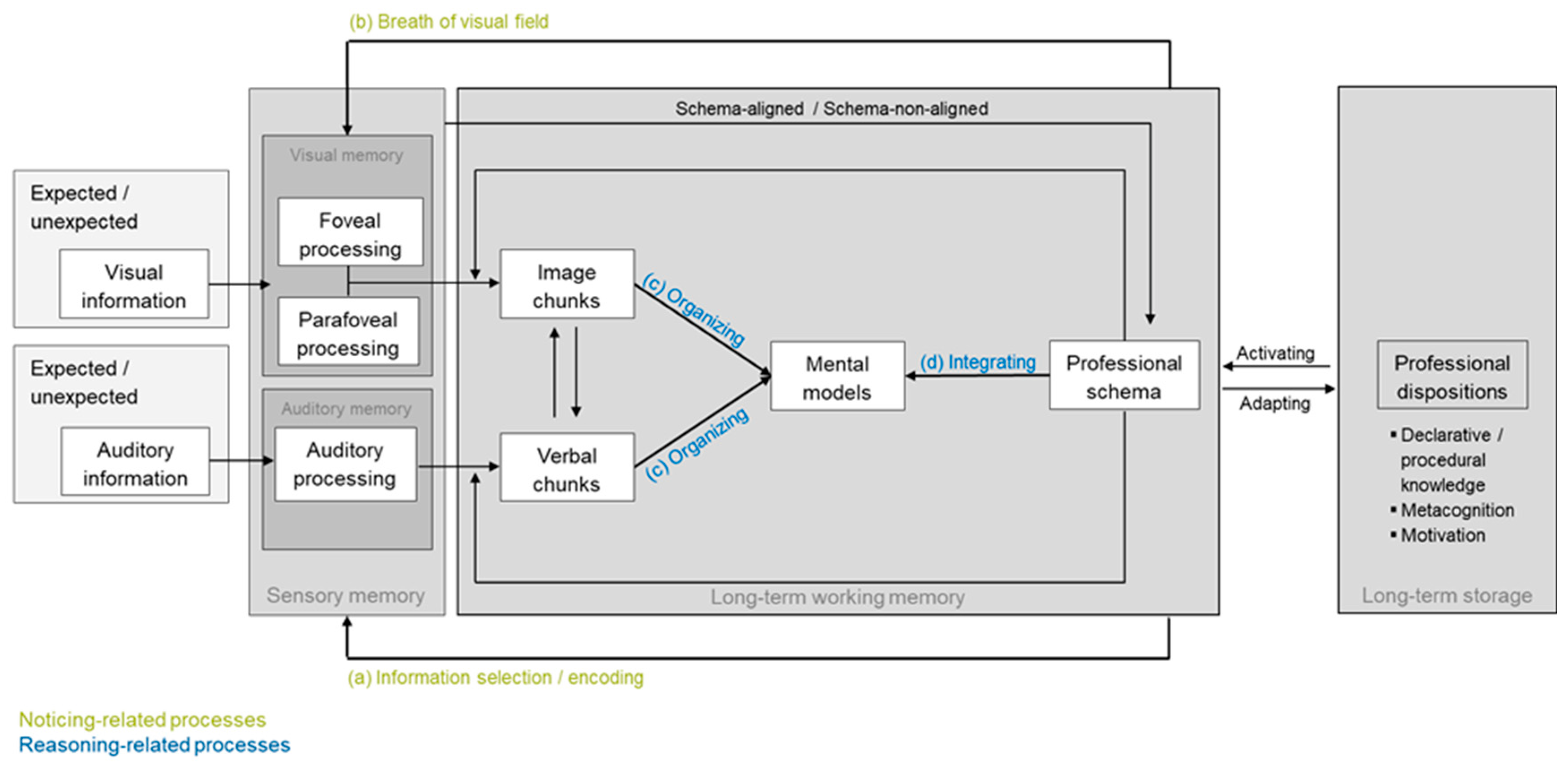
2.2. A Cognitive Process Model for the Demands of Medical Visual Work
2.3. Determinants and Outcomes of Professional Vision Skills
3. Measuring Professional Vision Skills in the Medical Field
Applying Noticing and Reasoning Measurements Based on the PV-CP Model
- Information selection, reflected in fixation-based measures such as fixation count, fixation duration, or dwell time on diagnostically relevant areas of interest (AOIs).
- Relational and structural processing, reflected in transition-based measures and scanpath characteristics that capture how visual elements are sequentially connected over time.
- Strategic organization of viewing behavior, reflected in global distributional measures such as entropy or dispersion, which indicate the degree to which visual sampling is focused, exploratory, or systematically organized.
4. A Multimodal Measurement Framework for Professional Vision
4.1. Gaze-Based Indicators of PV Subprocesses
4.1.1. Fixation-Based Measures: Information Selection and Cue Prioritization
4.1.2. Transition- and Scanpath-Based Measures
4.1.3. Entropy and Variability Measures: Strategic Organization of Visual Exploration
4.2. Verbal Indicators of PV Subprocesses
- justify why specific visual cues are considered relevant,
- articulate diagnostic or explanatory hypotheses for predictions and decision making,
- and construct causal chains linking observed cues to underlying conditions or decisions.
4.3. Indicator Families and Analytical Approaches
4.3.1. Cue Justification and Relevance Attribution
4.3.2. Hypothesis Articulation
4.3.3. Causal Explanations and Coherence Building
4.3.4. Structural and Network-Based Representations
5. Implications for Research in Medical Education
5.1. Implications for Research on Visual Processing and Expertise Development
5.2. Implications for the Design and Evaluation of Learning Environments
5.3. Implications for Professional Competence Development
6. Conclusions
Author Contributions
Funding
Data Availability Statement
Conflicts of Interest
References
- Jarodzka, H.; Scheiter, K.; Gerjets, P.; van Gog, T. In the eyes of the beholder: How experts and novices interpret dynamic stimuli. Learn. Instr. 2010, 20, 146–154. [Google Scholar] [CrossRef]
- Waite, S.; Grigorian, A.; Alexander, R.G.; Macknik, S.L.; Carrasco, M.; Heeger, D.J.; Martinez-Conde, S. Analysis of Perceptual Expertise in Radiology–Current Knowledge and a New Perspective. Front. Hum. Neurosci. 2019, 13, 213. [Google Scholar] [CrossRef]
- Blake, Y. Better Watch the Invisible: A Systematic Review of Technological Breakthroughts in the 2025 Medical Imaging Landscape; Zenodo (CERN European Organization For Nuclear Research): Geneva, Switzerland, 2025. [Google Scholar] [CrossRef]
- Brunyé, T.T.; Drew, T.; Weaver, D.L.; Elmore, J.G. A review of eye tracking for understanding and improving diagnostic interpretation. Cogn. Res. Princ. Implic. 2019, 4, 7. [Google Scholar] [CrossRef]
- Jarodzka, H.; Balslev, T.; Holmqvist, K.; Nyström, M.; Scheiter, K.; Gerjets, P.; Eika, B. Conveying clinical reasoning based on visual observation via eye-movement modelling examples. Instr. Sci. 2012, 40, 813–827. [Google Scholar] [CrossRef]
- Sablić, M.; Mirosavljević, A.; Škugor, A. Video-Based Learning (VBL)—Past, Present and Future: An Overview of the Research Published from 2008 to 2019. Technol. Knowl. Learn. 2020, 26, 1061–1077. [Google Scholar] [CrossRef]
- Gaudin, C.; Chaliès, S. Video viewing in teacher education and professional development: A literature review. Educ. Res. Rev. 2015, 16, 41–67. [Google Scholar] [CrossRef]
- Goodwin, C. Professional Vision. Am. Anthropol. 1994, 96, 606–633. [Google Scholar] [CrossRef]
- Wilson, I.; Cowin, L.S.; Johnson, M.; Young, H. Professional identity in medical students: Pedagogical challenges to medical education. Teach. Learn. Med. 2013, 25, 369–373. [Google Scholar] [CrossRef]
- Seidel, T.; Böheim, R.; Kosel, C. Developing a cognitive model of advanced teacher professional vision for understanding processes of noticing and reasoning. Front. Psychol. 2025; in review.
- Seidel, T.; Kosel, C.; Böheim, R.; Gegenfurtner, A.; Stürmer, K. A cognitive perspective on teachers’ professional vision: How teachers’ professional knowledge shapes a professional vision. In Teacher Professional Vision: Theoretical and Methodological Advances; Gegenfurtner, A., Stahnke, R., Eds.; Routledge: London, UK, 2025; pp. 43–56. [Google Scholar] [CrossRef]
- Seidel, T.; Stürmer, K. Modeling the structure of professional vision in pre-service teachers. Am. Educ. Res. J. 2014, 51, 739–771. [Google Scholar] [CrossRef]
- Fischer, F.; Kollar, I.; Ufer, S.; Sodian, B.; Hussmann, H.; Pekrun, R.; Neuhaus, B.; Dorner, B.; Pankofer, S.; Fischer, M.; et al. Scientific Reasoning and Argumentation: Advancing an Interdisciplinary Research Agenda in Education. Frontline Learn. Res. 2014, 2, 28–45. [Google Scholar] [CrossRef]
- Boshuizen, H.P.; Schmidt, H.G. On the Role of Biomedical Knowledge in Clinical Reasoning by Experts, Intermediates and Novices. Cogn. Sci. 1992, 16, 153–184. [Google Scholar] [CrossRef]
- Kosel, C.; Bauer, E.; Seidel, T. Where experience makes a difference: Teachers’ judgment accuracy and diagnostic reasoning regarding student learning characteristics. Front. Psychol. 2024, 15, 1278472. [Google Scholar] [CrossRef]
- Kundel, H.L.; Nodine, C.F.; Conant, E.F.; Weinstein, S.P. Holistic component of image perception in mammogram interpretation: Gaze-tracking study. Radiology 2007, 242, 396–402. [Google Scholar] [CrossRef] [PubMed]
- Just, M.A.; Carpenter, P.A. A capacity theory of comprehension: Individual differences in working memory. Psychol. Rev. 1992, 99, 122–149. [Google Scholar] [CrossRef] [PubMed]
- Drew, T.; Vo, M.L.H.; Wolfe, J.M. The invisible gorilla strikes again: Sustained inattentional blindness in expert observers. Psychol. Sci. 2013, 24, 1848–1853. [Google Scholar] [CrossRef]
- Gegenfurtner, A.; Lehtinen, E.; Helle, L.; Nivala, M.; Svedström, E.; Säljö, R. Learning to see like an expert: On the practices of professional vision and visual expertise. Int. J. Educ. Res. 2019, 98, 280–291. [Google Scholar] [CrossRef]
- Haider, H.; Frensch, P.A. Information reduction during skill acquisition: The influence of task instruction. J. Exp. Psychol. Appl. 1999, 5, 129–151. [Google Scholar] [CrossRef]
- Boshuizen, H.P.A.; Gruber, H.; Strasser, J. Knowledge restructuring through case processing: The key to generalise expertise development theory across domains? Educ. Res. Rev. 2020, 29, 100310. [Google Scholar] [CrossRef]
- Norman, G.R.; Monteiro, S.D.; Sherbino, J.; Ilgen, J.S.; Schmidt, H.G.; Mamede, S. The Causes of Errors in Clinical Reasoning: Cognitive Biases, Knowledge Deficits, and Dual Process Thinking. Acad. Med. 2016, 92, 23–30. [Google Scholar] [CrossRef]
- Heitzmann, N.; Seidel, T.; Opitz, A.; Hetmanek, A.; Wecker, C.; Fischer, M.; Ufer, S.; Schmidmaier, R.; Neuhaus, B.; Siebeck, M.; et al. Facilitating diagnostic competences in simulations: A conceptual framework and a research agenda for medical and teacher education. Frontline Learn. Res. 2019, 7, 1–24. [Google Scholar] [CrossRef]
- Gegenfurtner, A.; Gruber, H.; Holzberger, D.; Keskin, Ö.; Lehtinen, E.; Säljö, R.; Seidel, T.; Stürmer, K. Cognitive theory of visual expertise. In Re-Theorizing Learning and Research Methods in Learning Research; EARLI series “New Perspectives on Learning and Instruction”; Damşa, C., Rajala, A., Ritella, G., Brouwer, J., Eds.; Routledge: London, UK, 2022. [Google Scholar]
- Brunswik, E. Perception and the Representative Design of Psychological Experiments; University of California Press: Oakland, CA, USA, 2023. [Google Scholar]
- Schnitzler, K.; Holzberger, D.; Seidel, T. Connecting Judgment Process and Accuracy of Student Teachers: Differences in Observation and Student Engagement Cues to Assess Student Characteristics. Front. Educ. 2020, 5, 602470. [Google Scholar] [CrossRef]
- van der Gijp, A.; Ravesloot, C.J.; Jarodzka, H.; van der Schaaf, M.F.; van der Schaaf, I.C.; van Schaik, J.P.; ten Cate, T.J. How visual search relates to diagnostic performance: A narrative systematic review of eye-tracking research in radiology. Adv. Health Sci. Educ. 2017, 22, 765–787. [Google Scholar] [CrossRef]
- Blömeke, S.; Gustafsson, J.-E.; Shavelson, R.J. Approaches to competence measurement in higher education. Z. Für Psychol. 2015, 233, 1–2. [Google Scholar] [CrossRef]
- Sherin, M.G.; Jacobs, V.R.; Randolph, P.A. (Eds.) Mathematics Teacher Noticing: Seeing Through Teachers’ Eyes; Routledge: London, UK, 2011. [Google Scholar]
- Seidel, T.; Stürmer, K.; Schäfer, S.; Jahn, G. How Preservice teachers perform in teaching events regarding generic teaching and learning components. Z. Fur Entwicklungspsychologie Padagog. Psychol. 2015, 47, 62–74. [Google Scholar] [CrossRef]
- Weinert, S.; Artelt, C.; Prenzel, M.; Senkbeil, M.; Ehmke, T.; Carstensen, C.H. Development of competencies across the life span. Z. Fur Erzieh. 2011, 14, 67–86. [Google Scholar] [CrossRef]
- Holzberger, D.; Philipp, A.; Kunter, M. How teachers’ self-efficacy is related to instructional quality: A longitudinal analysis. J. Educ. Psychol. 2013, 105, 774–786. [Google Scholar] [CrossRef]
- Kersting, N.B.; Givvin, K.B.; Thompson, B.J.; Santagata, R.; Stigler, J.W. Measuring Usable Knowledge: Teachers’ Analyses of Mathematics Classroom Videos Predict Teaching Quality and Student Learning. Am. Educ. Res. J. 2012, 49, 568–589. [Google Scholar] [CrossRef]
- Daumiller, M.; Böheim, R.; Alijagic, A.; Lewalter, D.; Gegenfurtner, A.; Seidel, T.; Dresel, M. Guiding attention in the classroom: An eye-tracking study on the associations between preservice teachers’ goals and noticing of student interactions. Br. J. Educ. Psychol. 2025, 95, S115–S132. [Google Scholar] [CrossRef] [PubMed]
- Gold, B.; Pfirrmann, C.; Holodynski, M. Promoting Professional Vision of Classroom Management Through Different Analytic Perspectives in Video-Based Learning Environments. J. Teach. Educ. 2020, 72, 431–447. [Google Scholar] [CrossRef]
- Santagata, R.; Kersting, N.; Givvin, K.B.; Stigler, J.W. Problem Implementation as a Lever for Change: An Experimental Study of the Effects of a Professional Development Program on Students’ Mathematics Learning. J. Res. Educ. Eff. 2010, 4, 1–24. [Google Scholar] [CrossRef]
- Stürmer, K.; Seidel, T.; Holzberger, D. Intra-individual differences in developing professional vision—Preservice teachers’ changes in the course of an innovative teacher education program. Instr. Sci. 2016, 44, 293–309. [Google Scholar] [CrossRef]
- Faihs, V.; Heininger, S.; McLennan, S.; Gartmeier, M.; Berberat, P.O.; Wijnen-Meijer, M. Professional Identity and Motivation for Medical School in First-Year Medical Students: A Cross-sectional Study. Med. Sci. Educ. 2023, 33, 431–441. [Google Scholar] [CrossRef]
- Kusurkar, R.A.; Ten Cate, T.J.; van Asperen, M.; Croiset, G. Motivation as an independent and a dependent variable in medical education: A review of the literature. Med. Teach. 2011, 33, e242–e262. [Google Scholar] [CrossRef]
- Lievens, F.; Coetsier, P.; De Fruyt, F.; De Maeseneer, J. Medical students’ personality characteristics and academic performance: A five-factor model perspective. Med. Educ. 2002, 36, 1050–1056. [Google Scholar] [CrossRef]
- Kosel, C.; Holzberger, D.; Seidel, T. Identifying Expert and Novice Visual Scanpath Patterns and Their Relationship to Assessing Learning-Relevant Student Characteristics. Front. Educ. 2021, 5, 612175. [Google Scholar] [CrossRef]
- Seidel, T.; Schnitzler, K.; Kosel, C.; Sturmer, K.; Holzberger, D. Student Characteristics in the Eyes of Teachers: Differences Between Novice and Expert Teachers in Judgment Accuracy, Observed Behavioral Cues, and Gaze. Educ. Psychol. Rev. 2021, 33, 69–89. [Google Scholar] [CrossRef]
- Santagata, R.; Yeh, C. Learning to teach mathematics and to analyze teaching effectiveness: Evidence from a video- and practice-based approach. J. Math. Teach. Educ. 2014, 17, 491–514. [Google Scholar] [CrossRef]
- Gegenfurtner, A.; Lehtinen, E.; Säljö, R. Expertise differences in the comprehension of visualizations: A meta-analysis of eye-tracking research in professional domains. Educ. Psychol. Rev. 2011, 23, 523–552. [Google Scholar] [CrossRef]
- Kundel, H.L.; Nodine, C.F.; Krupinski, E.A. Searching for lung nodules: Visual dwell indicates locations of false-positive and false-negative decisions. Investig. Radiol. 1990, 25, 472–478. [Google Scholar] [CrossRef]
- Holmqvist, K.; Nyström, M.; Andersson, R.; Dewhurst, R.; Jarodzka, H.; Van De Weijer, J. Eye Tracking: A Comprehensive Guide to Methods and Measures; Oxford University Press (OUP): Oxford, UK, 2011. [Google Scholar]
- Litchfield, D.; Ball, L.J.; Donovan, T.; Manning, D.J.; Crawford, T. Viewing another person’s eye movements improves identification of pulmonary nodules in chest x-ray inspection. J. Exp. Psychol. Appl. 2010, 16, 251–262. [Google Scholar] [CrossRef]
- Duchowski, A.T. Eye Tracking Methodology: Theory and Practice; Springer: Berlin/Heidelberg, Germany, 2007. [Google Scholar]
- Goldberg, J.H.; Helfman, J.I. Visual scanpath representation. In Proceedings of the 2010 Symposium on Eye-Tracking Research & Applications; Association for Computing Machinery: New York, NY, USA, 2010; pp. 199–206. [Google Scholar] [CrossRef]
- Kundel, H.L.; Nodine, C.F. A visual concept shapes image perception. Radiology 1983, 146, 363–368. [Google Scholar] [CrossRef]
- Chi, M.T.H. Quantifying qualitative analyses of verbal data: A practical guide. J. Learn. Sci. 1997, 6, 271–315. [Google Scholar] [CrossRef] [PubMed]
- Ericsson, K.A.; Simon, H.A. Protocol Analysis: Verbal Reports as Data; eBooks; The MIT Press: London, UK, 1993. [Google Scholar] [CrossRef]
- Charlin, B.; Roy, L.; Brailovsky, C.; Goulet, F.; Van der Vleuten, C. The Script Concordance Test: A Tool to Assess the Reflective Clinician. Teach. Learn. Med. 2000, 12, 189–195. [Google Scholar] [CrossRef]
- Chernikova, O.; Heitzmann, N.; Stadler, M.; Holzberger, D.; Seidel, T.; Fischer, F. Simulation-based learning in higher education: A meta-analysis. Rev. Educ. Res. 2020, 90, 499–541. [Google Scholar] [CrossRef]
- Cook, D.A.; Hatala, R.; Brydges, R.; Zendejas, B.; Szostek, J.H.; Wang, A.T.; Erwin, P.J.; Hamstra, S.J. Technology-enhanced simulation for health professions education: A systematic review and meta-analysis. JAMA 2011, 306, 978–988. [Google Scholar] [CrossRef] [PubMed]
- van Gog, T.; Paas, F.; Marcus, N.; Ayres, P.; Sweller, J. The mirror neuron system and observational learning: Implications for the design of educational animations. Educ. Psychol. Rev. 2009, 21, 21–42. [Google Scholar] [CrossRef]
- Azevedo, R.; Gašević, D. Analyzing multimodal data in learning analytics: Opportunities and challenges. Comput. Hum. Behav. 2019, 92, 3–12. [Google Scholar] [CrossRef]


| PV Subprocess (PV-CP Model) | Functional Description | Indicator Family | Exemplary Metrics | Examples of Typical Medical Applications | Interpretive Scope and Limitations |
|---|---|---|---|---|---|
| Information selection/encoding (a) | Selective encoding of diagnostically or instructionally relevant visual information into working memory | Fixation-based measures a | Fixation count; mean fixation duration; dwell time; proportion of fixations on diagnostically relevant AOIs | Radiological image interpretation; monitoring patient cues during ward rounds; inspection of medical devices | Indicates what information is selected, not why; longer fixations may reflect deeper processing or uncertainty |
| Breadth of visual field (b) | Allocation of visual processing resources across foveal and parafoveal regions | AOI-based distribution measures b | Relative dwell time on central vs. peripheral AOIs; fixation dispersion; fixation ratios | Differentiating focal abnormalities from surrounding anatomical context; patient vs. environment monitoring | Sensitive to AOI definition; does not capture semantic interpretation |
| Schema-aligned vs. schema-non-aligned processing | Differential processing of expected versus unexpected visual information based on activated professional schema | Fixation- and transition-based measures c | Dwell time on expected vs. unexpected regions; re-fixations; transitions toward anomalies | Detection of atypical findings in diagnostic images; noticing deviations during clinical routines | Requires theory-driven definition of “expected”; anomaly detection does not imply correct interpretation |
| Organizing (c) | Structuring visual information into meaningful perceptual chunks | Transition- and scanpath-based measures d | Transition frequencies; transition probabilities; scanpath similarity; gaze sequence graphs | Coordinating patient cues with monitor data; linking symptoms across image regions | Reveals structural organization of viewing, not semantic integration |
| Global structuring and regulation of visual exploration over time | Entropy and variability measures e | Spatial entropy; transition entropy; gaze dispersion; recurrence quantification | Shifts from broad overview to focused inspection in diagnostic tasks | Entropy reflects organization, not correctness; high or low entropy can both be adaptive |
Disclaimer/Publisher’s Note: The statements, opinions and data contained in all publications are solely those of the individual author(s) and contributor(s) and not of MDPI and/or the editor(s). MDPI and/or the editor(s) disclaim responsibility for any injury to people or property resulting from any ideas, methods, instructions or products referred to in the content. |
© 2026 by the authors. Published by MDPI on behalf of the Academic Society for International Medical Education. Licensee MDPI, Basel, Switzerland. This article is an open access article distributed under the terms and conditions of the Creative Commons Attribution (CC BY) license.
Share and Cite
Seidel, T.; Kosel, C.; Böheim, R.; Gartmeier, M.; Berberat, P.O. Modelling and Measuring Professional Vision in Medical Education: A Cognitive Process Framework. Int. Med. Educ. 2026, 5, 52. https://doi.org/10.3390/ime5020052
Seidel T, Kosel C, Böheim R, Gartmeier M, Berberat PO. Modelling and Measuring Professional Vision in Medical Education: A Cognitive Process Framework. International Medical Education. 2026; 5(2):52. https://doi.org/10.3390/ime5020052
Chicago/Turabian StyleSeidel, Tina, Christian Kosel, Ricardo Böheim, Martin Gartmeier, and Pascal O. Berberat. 2026. "Modelling and Measuring Professional Vision in Medical Education: A Cognitive Process Framework" International Medical Education 5, no. 2: 52. https://doi.org/10.3390/ime5020052
APA StyleSeidel, T., Kosel, C., Böheim, R., Gartmeier, M., & Berberat, P. O. (2026). Modelling and Measuring Professional Vision in Medical Education: A Cognitive Process Framework. International Medical Education, 5(2), 52. https://doi.org/10.3390/ime5020052