

Nursing Students’ Experiences in Clinical Simulation at the End of Life: A Look at the Professional and Family Role

 , ,
, ,  ,
,  , ,
, ,  and
and 
Abstract
1. Introduction
2. Materials and Methods
2.1. Study Design
2.2. Experience or Role of Researchers
2.3. Participants and Setting
2.4. Simulation Scenario and Learning Design
2.5. Data Collection Instrument
2.6. Data Analysis
- Familiarization with the data, through transcription and repeated reading of the material.
- Generation of initial codes, systematically identifying relevant characteristics.
- Searching for themes, grouping the codes into possible thematic categories.
- Review and refinement of themes to ensure internal coherence and alignment with research objectives.
- Defining and naming the themes, clearly articulating the findings.
- Presentation of the themes, supported by illustrative quotations that strengthen the credibility of the analysis.
2.7. Quality and Rigor Criteria
3. Results
3.1. Participants’ Characteristics
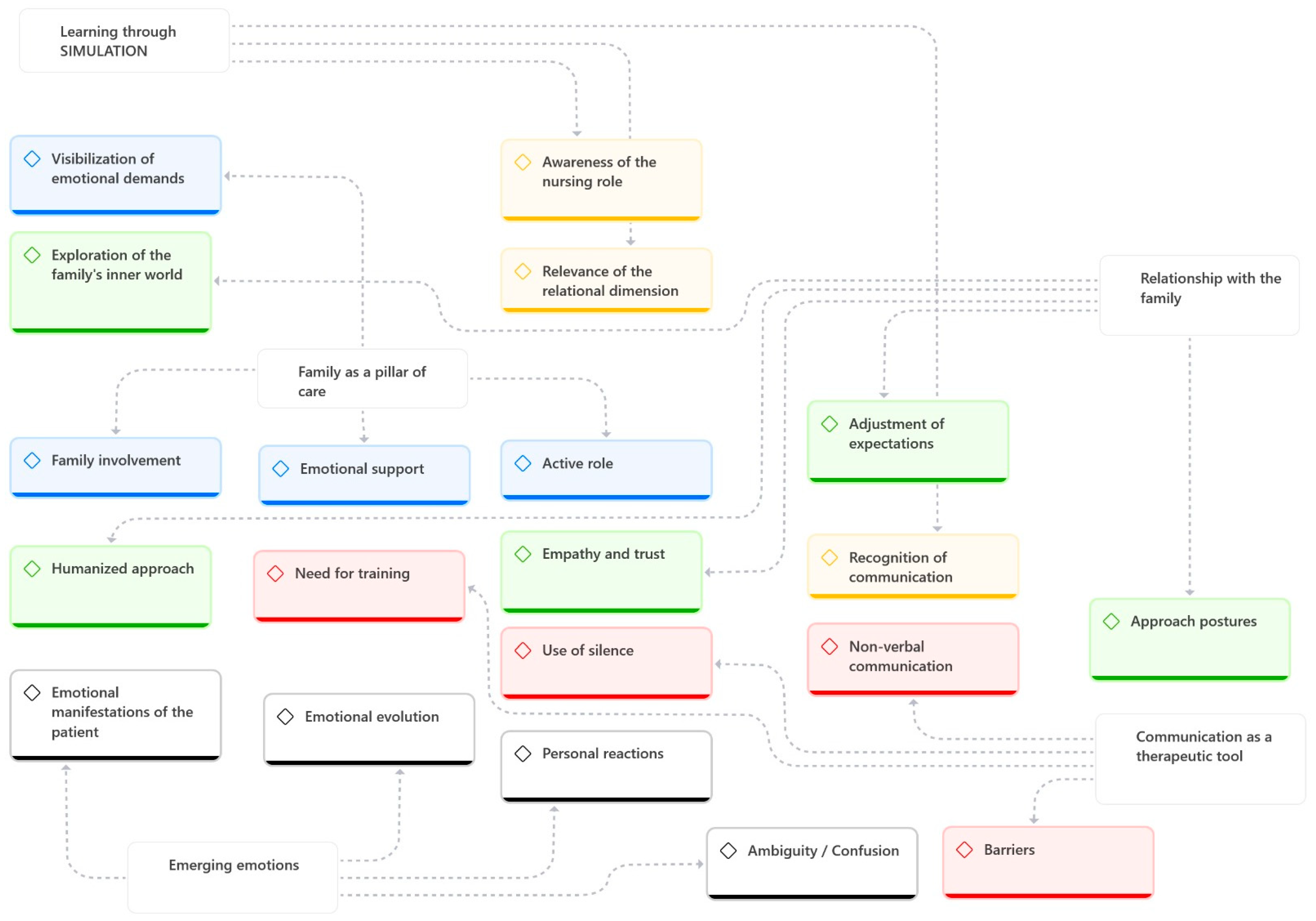
3.2. Themes
- Theme 1. Family as a pillar of care.
- Theme 2. Relationship with the family.
- Theme 3. Communication as a therapeutic tool.
- Theme 4. Emerging emotions.
- Theme 5. Learning through simulation.
4. Discussion
4.1. Comparison with Existing Evidence
4.2. Strengths and Limitations
5. Conclusions
Supplementary Materials
Author Contributions
Funding
Institutional Review Board Statement
Informed Consent Statement
Data Availability Statement
Acknowledgments
Conflicts of Interest
Abbreviations
| COREQ | COnsolidated criteria for REporting Qualitative research; |
| FG | Focus Group |
| RN | Reflexive narratives |
| SBL | Simulation-based learning |
References
- Martins Pereira, S.; Hernández-Marrero, P.; Pasman, H.R.; Capelas, M.L.; Larkin, P.; Francke, A.L. Nursing education on palliative care across Europe: Results and recommendations from the EAPC Taskforce on preparation for practice in palliative care nursing across the EU based on an online survey and country reports. Palliat. Med. 2021, 35, 130–141. [Google Scholar] [CrossRef]
- Mengual, T.E.; Chover-Sierra, E.; Ballestar-Tarín, M.L.; Saus-Ortega, C.; Gea-Caballero, V.; Colomer-Pérez, N.; Martínez-Sabater, A. Knowledge about Palliative Care and Attitudes toward Care of the Dying among Primary Care Nurses in Spain. Healthcare 2023, 11, 1018. [Google Scholar] [CrossRef] [PubMed]
- Brezis, M.; Lahat, Y. What can we learn from simulation-based training to improve skills for end-of-life care? Insights from a national project in Israel. Isr. J. Health Policy Res. 2017, 6, 48–49. [Google Scholar] [CrossRef]
- Chover-Sierra, E.; Martínez-Sabater, A. Analysis of Spanish nursing students’ knowledge in palliative care. An online survey in five colleges. Nurse Educ. Pract. 2020, 49, 102903. [Google Scholar] [CrossRef] [PubMed]
- Carey, M.L.; Zucca, A.C.; Freund, M.A.; Bryant, J.; Herrmann, A.; Roberts, B.J. Systematic review of barriers and enablers to the delivery of palliative care by primary care practitioners. Palliat. Med. 2019, 33, 1131–1145. [Google Scholar] [CrossRef]
- King, D.; Schockett, E.; Rizvi, G.; Fischer, D.; Amdur, R.; Benjenk, I.; Yamane, D.; DelPrete, B.; Davison, D.; Seneff, M. The Growth of Palliative Practice and End of Life Care in an Academic Teaching Intensive Care Unit. J. Intensive Care Med. 2022, 37, 1397–1402. [Google Scholar] [CrossRef] [PubMed]
- Xu, M.; Li, Z.; Yang, J. Nurse-led cancer palliative care compared to oncologist-led cancer palliative care: A retrospective analysis of Chinese patients suffering from cancer and receiving chemotherapy. Adv. Clin. Exp. Med. Off. Organ Wroc. Med. Univ. 2022, 31, 1081–1086. [Google Scholar] [CrossRef] [PubMed]
- Yoong, S.Q.; Schmidt, L.T.; Chao, F.F.T.; Devi, K.M.; Wang, W.; Zhang, H. Nursing students’ perspectives and learning experiences of participating in a palliative and end-of-life care simulation programme: A qualitative study. Nurse Educ. Today 2024, 134, 106103. [Google Scholar] [CrossRef]
- Felber, S.J.; Guffi, T.; Brem, B.G.; Schmitz, F.M.; Schnabel, K.P.; Guttormsen Schär, S.; Eychmüller, S.; Zambrano, S.C. Talking about dying and death: Essentials of communicating about approaching death from the perspective of major stakeholders. Palliat. Support. Care 2024, 22, 1199–1208. [Google Scholar] [CrossRef] [PubMed]
- Ehrlich, O.; Kruse, J.A.; Lackowski, A.; Glover, T.L. A Nursing Faculty Intervention for Teaching Primary Palliative Care in Baccalaureate Nursing Competency-Based Education. Palliat. Med. Rep. 2025, 6, 61–70. [Google Scholar] [CrossRef]
- Selman, L.E.; Brighton, L.J.; Hawkins, A.; McDonald, C.; O’Brien, S.; Robinson, V.; Khan, S.A.; George, R.; Ramsenthaler, C.; Higginson, I.J.; et al. The Effect of Communication Skills Training for Generalist Palliative Care Providers on Patient-Reported Outcomes and Clinician Behaviors: A Systematic Review and Meta-analysis. J. Pain Symptom Manag. 2017, 54, 404–416.e5. [Google Scholar] [CrossRef]
- Zahra, R.; Khadijeh, Y.; Reza, M.S.G. Perceived stress in end-of-life care: A qualitative study of Iranian nurses’ experiences. Int. J. Palliat. Nurs. 2025, 31, 30–38. [Google Scholar] [CrossRef] [PubMed]
- García Carpintero-Blas, E.; Del Pozo-Herce, P.; Hernández-Cediel, M.d.C.; Rodríguez-García, M.; Navas-Echazarreta, N.; Chover-Sierra, E.; Martínez-Sabater, A.; Juárez-Vela, R.; Tovar-Reinoso, A. First Contact With Care Through Clinical Simulation in Nursing Students: Qualitative Study. JMIR Nurs. 2025, 8, e81617. [Google Scholar] [CrossRef] [PubMed]
- Carrió-Fito, J.; Terrón-Pérez, M. Knowledge and training among nursing students regarding the conspiracy of silence in palliative care: A participatory action research. Nurse Educ. Pract. 2024, 79, 104086. [Google Scholar] [CrossRef]
- Faulds, S.; Taylor, A. Simulated Practice Learning Experience in a Virtual Environment: An Innovative Pedagogical Approach to Practice Learning for Nursing Students. Nurs. Rep. 2025, 15, 61. [Google Scholar] [CrossRef] [PubMed]
- Condry, H.M.; Kirkpatrick, A.J. Simulation in End-of-Life Nursing Education: A Literature Review. Clin. Simul. Nurs. 2021, 59, 98–110. [Google Scholar] [CrossRef]
- Skedsmo, K.; Nes, A.A.G.; Stenseth, H.V.; Hofsø, K.; Larsen, M.H.; Hilderson, D.; Smis, D.; Hagelin, C.L.; Olaussen, C.; Solberg, M.T.; et al. Simulation-based learning in palliative care in postgraduate nursing education: A scoping review. BMC Palliat. Care 2023, 22, 30. [Google Scholar] [CrossRef]
- Anderson, M.; Campbell, S.H.; Nye, C.; Diaz, D.; Boyd, T. Simulation in Advanced Practice Education: Let’s Dialogue. Clin. Simul. Nurs. 2019, 26, 81–85. [Google Scholar] [CrossRef]
- Smith, M.B.; Macieira, T.G.R.; Bumbach, M.D.; Garbutt, S.J.; Citty, S.W.; Stephen, A.; Ansell, M.; Glover, T.L.; Keenan, G. The Use of Simulation to Teach Nursing Students and Clinicians Palliative Care and End-of-Life Communication: A Systematic Review. Am. J. Hosp. Palliat. Med. 2018, 35, 1140–1154. [Google Scholar] [CrossRef] [PubMed]
- Kirkpatrick, A.J.; Cantrell, M.A.; Smeltzer, S.C. Palliative Care Simulations in Undergraduate Nursing Education: An Integrative Review. Clin. Simul. Nurs. 2017, 13, 414–431. [Google Scholar] [CrossRef]
- Zhang, L.; Huang, Y.; Wu, X.; Liu, C.; Zhang, X.; Yang, X.; Lai, H.; Fu, J.; Yang, M. The impact of virtual clinical simulation on nursing students’ palliative care knowledge, ability, and attitudes: A mixed methods study. Nurse Educ. Today 2024, 132, 106037. [Google Scholar] [CrossRef]
- Chung, B.P.M.; Chan, E.A.; Chang, K.K.P.; Leung, D.Y.L. Senior year nursing students’ self-regulated learning in complex simulation-based palliative education: A qualitative study. Nurse Educ. Today 2025, 147, 106609. [Google Scholar] [CrossRef]
- Wolfe, A.H.J.; Hinds, P.S.; du Plessis, A.J.; Gordish-Dressman, H.; Soghier, L. Describing the Impact of Physician End-of-Life Communication Training on Simulated Stress Using a Novel Stress Marker. Am. J. Hosp. Palliat. Med. 2025, 10499091251330279. [Google Scholar] [CrossRef] [PubMed]
- Valen, K.; Haug, B.; Holm, A.L.; Jensen, K.T.; Grov, E.K. From Palliative Care Developed During Simulation, to Performance in Clinical Practice—Descriptions From Nursing Students. J. Hosp. Palliat. Nurs. 2020, 22, 204–212. [Google Scholar] [CrossRef]
- Lewis, C.; Reid, J.; McLernon, Z.; Ingham, R.; Traynor, M. The impact of a simulated intervention on attitudes of undergraduate nursing and medical students towards end of life care provision. BMC Palliat. Care 2016, 15, 67. [Google Scholar] [CrossRef][Green Version]
- Smith, J.A.; Flowers, P.; Larkin, M. Interpretative Phenomenological Analysis; SAGE Publications: Los Angeles, CA, USA; London, UK; New Delhi, India; Singapore; Washington, DC, USA; Melbourne, Australia, 2022. [Google Scholar]
- Doyle, L.; McCabe, C.; Keogh, B.; Brady, A.; McCann, M. An overview of the qualitative descriptive design within nursing research. J. Res. Nurs. 2020, 25, 443–455. [Google Scholar] [CrossRef]
- Bradshaw, C.; Atkinson, S.; Doody, O. Employing a Qualitative Description Approach in Health Care Research. Glob. Qual. Nurs. Res. 2017, 4, 2333393617742282. [Google Scholar] [CrossRef] [PubMed]
- Moser, A.; Korstjens, I. Series: Practical guidance to qualitative research. Part 3: Sampling, data collection and analysis. Eur. J. Gen. Pract. 2018, 24, 9–18. [Google Scholar] [CrossRef] [PubMed]
- Creswell, J.W. Qualitative Inquiry & Research Design; SAGE: Los Angeles, CA, USA; London, UK; New Delhi, India; Singapore; Washington, DC, USA, 2013. [Google Scholar]
- Kitzinger, J. Qualitative Research: Introducing focus groups. BMJ 1995, 311, 299–302. [Google Scholar] [CrossRef] [PubMed]
- McLafferty, I. Focus group interviews as a data collecting strategy. J. Adv. Nurs. 2004, 48, 187–194. [Google Scholar] [CrossRef]
- Jayasekara, R.S. Focus groups in nursing research: Methodological perspectives. Nurs. Outlook 2012, 60, 411–416. [Google Scholar] [CrossRef]
- Brimmer, D.J.; Lin, J.S.; Unger, E.R. Voice of the patient: People with myalgic encephalomyelitis/chronic fatigue syndrome (ME/CFS) share in their own words. Fatigue 2025, 13, 135–145. [Google Scholar] [CrossRef]
- Clandinin, D.J. Engaging in Narrative Inquiry; Developing Qualitative Inquiry; Routledge, Taylor & Francis Group: New York, NY, USA; London, UK, 2023; Volume 9. [Google Scholar]
- Wong, L.P. Focus group discussion: A tool for health and medical research. Singap. Med. J. 2008, 49, 256. [Google Scholar] [PubMed]
- Hennink, M.M.; Kaiser, B.N.; Weber, M.B. What Influences Saturation? Estimating Sample Sizes in Focus Group Research. Qual. Health Res. 2019, 29, 1483–1496. [Google Scholar] [CrossRef] [PubMed]
- Romero, R.A.M. Qualitative Data Analysis with ATLAS.ti, por Susanne Friese. Qual. Res. Educ. 2016, 5, 226–228. [Google Scholar] [CrossRef][Green Version]
- Nowell, L.S.; Norris, J.M.; White, D.E.; Moules, N.J. Thematic Analysis: Striving to Meet the Trustworthiness Criteria. Int. J. Qual. Methods 2017, 16, 1609406917733847. [Google Scholar] [CrossRef]
- Braun, V.; Clarke, V. Using thematic analysis in psychology. Qual. Res. Psychol. 2006, 3, 77–101. [Google Scholar] [CrossRef]
- Tong, A.; Sainsbury, P.; Craig, J. Consolidated criteria for reporting qualitative research (COREQ): A 32-item checklist for interviews and focus groups. Int. J. Qual. Health Care 2007, 19, 349–357. [Google Scholar] [CrossRef]
- Prakke, H.; Wurster, J. [Quality criteria for qualitative research]. Pflege 1999, 12, 183–186. [Google Scholar] [CrossRef] [PubMed]
- Amin, M.E.K.; Nørgaard, L.S.; Cavaco, A.M.; Witry, M.J.; Hillman, L.; Cernasev, A.; Desselle, S.P. Establishing trustworthiness and authenticity in qualitative pharmacy research. Res. Soc. Adm. Pharm. 2020, 16, 1472–1482. [Google Scholar] [CrossRef]
- Morse, J.M. Critical Analysis of Strategies for Determining Rigor in Qualitative Inquiry. Qual. Health Res. 2015, 25, 1212–1222. [Google Scholar] [CrossRef]
- Guba, E.G.; Lincoln, I.S. Paradigmatic Controversies, Contradictions, and Emerging Confluences Justice. In The Sage Handbook of Qualitative Research; Sage Publications: Thousand Oaks, CA, USA, 2005; pp. 191–215. [Google Scholar]
- Lin, M.; Lin, S.; Lee, Y.; Wang, P.; Wu, H.; Hsu, H. The effectiveness of simulation education program on shared decision-making attitudes among nurses in Taiwan. PLoS ONE 2021, 16, e0257902. [Google Scholar] [CrossRef]
- Dorney, P.; Pierangeli, L. A Phenomenological Study: Student Nurses’ Perceptions of Care of the Dying in a Hospice-Based Facility. J. Hosp. Palliat. Nurs. 2021, 23, 162–169. [Google Scholar] [CrossRef] [PubMed]
- Kurji, Z.; Dias, J.; Rattani, S.A.; Khowaja, A.A.; Alisher, A.N. Describing Perceptions and Experiences of Undergraduate Nursing Students Regarding Death and Dying in Palliative Care Setting. J. Palliat. Care Med. 2019, 9, 354. [Google Scholar]
- Harder, N.; Lemoine, J.; Harwood, R. Psychological outcomes of debriefing healthcare providers who experience expected and unexpected patient death in clinical or simulation experiences: A scoping review. J. Clin. Nurs. 2020, 29, 330–346. [Google Scholar] [CrossRef] [PubMed]
- Ruiz-Pellón, N.; Sarabia-Cobo, C.; Amo-Setién, F.; Fernández-Peña, R.; Abajas, R.; Martín, R.; Ortego-Mate, C. Experiences of nursing students participating in end-of-life education programs: A systematic review and qualitative metasynthesis. Nurse Educ. Today 2020, 90, 104442. [Google Scholar] [CrossRef] [PubMed]
- Gillan, P.C.; Johnston, S. Nursing students satisfaction and self-confidence with standardized patient palliative care simulation focusing on difficult conversations. Palliat. Support. Care 2024, 22, 1237–1244. [Google Scholar] [CrossRef]
- Fabro, K.; Schaffer, M.; Scharton, J. The Development, Implementation, and Evaluation of an End-of-Life Simulation Experience for Baccalaureate Nursing Students. Nurs. Educ. Perspect. 2014, 35, 19–25. [Google Scholar] [CrossRef] [PubMed]
- Sarabia-Cobo, C.M.; Alconero-Camarero, A.R.; Lavín-Alconero, L.; Ibáñez-Rementería, I. Assessment of a learning intervention in palliative care based on clinical simulations for nursing students. Nurse Educ. Today 2016, 45, 219–224. [Google Scholar] [CrossRef]
- Ferguson, J.; Astbury, J.; Willis, S.; Silverthorne, J.; Schafheutle, E. Implementing, embedding and sustaining simulation-based education: What helps, what hinders. Med. Educ. 2020, 54, 915–924. [Google Scholar] [CrossRef]
- Son, S.; Min, D.; Kim, S. Effectiveness of a simulation programme with lectures about end-of-life care using a standardised patient: A quasi-experimental study. BMC Nurs. 2025, 24, 371. [Google Scholar] [CrossRef] [PubMed]
- Ernst, A.; Schade, F.; Stiel, S.; van Baal, K.; Herbst, F.A. The implementation of guidelines in palliative care—A scoping review. BMC Palliat. Care 2025, 24, 102–123. [Google Scholar] [CrossRef] [PubMed]
- Escribano, S.; Cabañero-Martínez, M.J.; Fernández-Alcántara, M.; García-Sanjuán, S.; Montoya-Juárez, R.; Juliá-Sanchis, R. Efficacy of a Standardised Patient Simulation Programme for Chronicity and End-of-Life Care Training in Undergraduate Nursing Students. Int. J. Environ. Res. Public Health 2021, 18, 11673. [Google Scholar] [CrossRef] [PubMed]
- Yamamoto, K. Families’ Experiences of Surrogate Decision-Making and Challenges of Shared Decision-Making: A Cross-Sectional Study. Curēus 2025, 17, e79866. [Google Scholar] [CrossRef] [PubMed]
- Valen, K.; Holm, A.L.; Jensen, K.T.; Grov, E.K. Nursing students’ perception on transferring experiences in palliative care simulation to practice. Nurse Educ. Today 2019, 77, 53–58. [Google Scholar] [CrossRef]
- Hingley, S.; Shimoinaba, K.; Wettenhall, J.; Recoche, K. A palliative care communication simulation for undergraduate nursing and midwifery students: A pilot study. Palliat. Support. Care 2024, 22, 1653–1660. [Google Scholar] [CrossRef] [PubMed]


| Interview Questions |
|---|
| How did you experience the end-of-life simulation? What emotions arose during or after the experience? How did you experience the interaction with the family members in the simulation? How did you handle this situation? How did you feel during the simulation, both towards the patient and the family? How did you perceive the role of the family in the patient care process? Did this experience change the way you view the end of life from a professional role? How do you think the simulation experience influences your preparation to face real situations with patients at the end of life? What key learnings did you take away from this simulation that you think you will carry with you? |
| Themes (T) | Categories | |
|---|---|---|
| T1 | Family as a pillar of care | Family involvement Visibilization of emotional demands Active role Emotional support |
| T2 | Relationship with the family | Empathy and trust Adjustment of expectations Exploration of the family’s inner world Humanized approach Approach postures |
| T3 | Communication as a therapeutic tool | Non-verbal communication Active listening and emotional containment Use of silence Barriers Need for training |
| T4 | Emerging emotions | Personal reactions Emotional manifestations of the patient Ambiguity/Confusion Emotional evolution |
| T5 | Learning through simulation | Awareness of the nursing role Relevance of the relational dimension Recognition of communication |
Disclaimer/Publisher’s Note: The statements, opinions and data contained in all publications are solely those of the individual author(s) and contributor(s) and not of MDPI and/or the editor(s). MDPI and/or the editor(s) disclaim responsibility for any injury to people or property resulting from any ideas, methods, instructions or products referred to in the content. |
© 2026 by the authors. Published by MDPI on behalf of the Academic Society for International Medical Education. Licensee MDPI, Basel, Switzerland. This article is an open access article distributed under the terms and conditions of the Creative Commons Attribution (CC BY) license.
Share and Cite
García Carpintero-Blas, E.; Sanz-Cortés, A.; Del Pozo-Herce, P.; Rodríguez-García, M.; Hernández-Cediel, M.D.C.; Chover-Sierra, E.; Martínez-Sabater, A.; Ruiz De Viñaspre-Hernández, R.; Juárez-Vela, R.; Tovar-Reinoso, A. Nursing Students’ Experiences in Clinical Simulation at the End of Life: A Look at the Professional and Family Role. Int. Med. Educ. 2026, 5, 17. https://doi.org/10.3390/ime5010017
García Carpintero-Blas E, Sanz-Cortés A, Del Pozo-Herce P, Rodríguez-García M, Hernández-Cediel MDC, Chover-Sierra E, Martínez-Sabater A, Ruiz De Viñaspre-Hernández R, Juárez-Vela R, Tovar-Reinoso A. Nursing Students’ Experiences in Clinical Simulation at the End of Life: A Look at the Professional and Family Role. International Medical Education. 2026; 5(1):17. https://doi.org/10.3390/ime5010017
Chicago/Turabian StyleGarcía Carpintero-Blas, Eva, Ana Sanz-Cortés, Pablo Del Pozo-Herce, Marta Rodríguez-García, Maria Del Carmen Hernández-Cediel, Elena Chover-Sierra, Antonio Martínez-Sabater, Regina Ruiz De Viñaspre-Hernández, Raúl Juárez-Vela, and Alberto Tovar-Reinoso. 2026. "Nursing Students’ Experiences in Clinical Simulation at the End of Life: A Look at the Professional and Family Role" International Medical Education 5, no. 1: 17. https://doi.org/10.3390/ime5010017
APA StyleGarcía Carpintero-Blas, E., Sanz-Cortés, A., Del Pozo-Herce, P., Rodríguez-García, M., Hernández-Cediel, M. D. C., Chover-Sierra, E., Martínez-Sabater, A., Ruiz De Viñaspre-Hernández, R., Juárez-Vela, R., & Tovar-Reinoso, A. (2026). Nursing Students’ Experiences in Clinical Simulation at the End of Life: A Look at the Professional and Family Role. International Medical Education, 5(1), 17. https://doi.org/10.3390/ime5010017