


Abstract
Background: Communication with patients and families at the end of life is key to quality care, allowing for informed decisions and emotional support. This study explores the experience of nursing students in clinical simulations, analyzing their emotions, perceptions of the family role, the impact on their communication skills, and their reflection on the role of nursing in these contexts. Methods: This study was conducted at the Faculty of Health Sciences of UNIE University, Spain, with 44 first-year students enrolled in the Fundamentals of Psychology in Health Sciences course. Data were collected through focus groups and reflective narratives with open-ended questions between January and February 2025. Following data collection, transcripts were generated and subjected to a thematic analysis following the COREQ checklist. Results: Five thematic blocks and their categories were identified: (T1) Family as a pillar of care; (T2) Relationship with the family; (T3) Communication as a therapeutic tool; (T4) Emerging emotions; (T5) Learning through simulation. Conclusions: The family is a fundamental pillar at the end of life, providing emotional and practical support to the patient and the care team. Communication is key to building trust and facilitating acceptance of the process. Students experience diverse emotions that reflect the complexity of the accompaniment. Simulation at the end of life allows nursing students to develop communication skills, reflect on their professional role, and manage complex emotions.
1. Introduction
In the context of the changing healthcare landscape and the growing global aging crisis, nursing professionals are increasingly exposed to caring for people at the end of life [1,2]. However, they often face this challenge despite limited end-of-life care training and experience in managing complex end-of-life situations [3,4]. For this care to be genuinely effective and humanized, education and continuing education for healthcare personnel are key, as they enable the development of the necessary competencies to provide comprehensive end-of-life care [5,6,7]. In addition to knowledge deficits, students and professionals often experience emotional difficulties and barriers to effective communication with patients and their families [8,9]. Communication at the end of life poses a significant challenge in healthcare, as it involves managing complex, emotionally charged conversations that affect not only the patient but also the patient’s family and the care team.
In end-of-life care, nurses’ roles are particularly significant, as they are often the healthcare professionals who maintain the closest and most continuous contact with patients and their families. This proximity enables nurses to not only deliver essential technical care but also provide emotional support and accompaniment during periods of profound vulnerability. Their sustained presence and capacity to establish trusting relationships position nurses as key contributors to comprehensive end-of-life care [10].
Effectively managing these situations requires advanced communication skills that extend beyond technical knowledge [11]. Interactions with patients and families in end-of-life contexts demand sensitive, clear, and empathetic communication that conveys understanding and support while addressing complex issues such as death, end-of-life care decision-making, and acceptance of the clinical situation [12]. For nursing students, initial exposure to these scenarios often generates feelings of insecurity, anxiety, and fear related to uncertainty about how to respond appropriately [13]. Insufficient preparation in end-of-life communication may hinder the establishment of trust with patients and their families, ultimately compromising the quality of care [14].
Simulation-based learning (SBL) is a pedagogical strategy that uses simulated scenarios to replicate real clinical situations, enabling students to gain practical experience in a safe, controlled environment. This methodology has become well established as an effective tool in health education, particularly in nursing education, by facilitating the development of clinical skills, fostering critical thinking, and strengthening students’ confidence [15].
By recreating realistic clinical situations in a protected learning environment, students can develop, practice, and reflect on their communication skills and emotional regulation. SBL allows learners to confront ethical and emotional dilemmas in a guided and structured manner, promoting reflective learning [16,17]. Integrating SBL into the nursing curriculum allows students to not only develop technical skills but also broaden their theoretical knowledge and improve their decision-making abilities in complex clinical contexts [18]. Several literature reviews have analyzed the use of SBL as an effective teaching method in end-of-life care. This area requires sensitive communication and relationship skills, as well as a thorough understanding of comprehensive end-of-life patient management [19].
In addition, the effectiveness of SBL has been well documented in communication skills training and the teaching of end-of-life care-specific content for nursing students and other healthcare professionals [20]. Other reviews have highlighted the positive impact of SBL in both undergraduate and graduate nursing programs [17]. Evidence indicates that its implementation significantly improves students’ confidence, knowledge, practical skills, and attitudes toward caring for patients in the terminal phase of illness, as well as toward empathic communication with patients and their families [8,21].
Through simulation, future nursing professionals learn to engage in active listening, to provide transparent and honest information tailored to individual needs, and to offer emotional support while respecting patient dignity during the final stages of life [22]. Moreover, these experiences may help reduce the stress and anxiety associated with exposure to death, thereby facilitating better adaptation to real clinical practice [23]. Previous research has primarily focused on analyzing the components of simulation, learning outcomes among participants, and the role and competencies of facilitators within simulation-based learning contexts [24,25]. However, there is limited evidence exploring how nursing students subjectively experience end-of-life simulation scenarios, particularly at the early stages of their academic training.
The emotional responses, meaning-making processes, and reflections on professional identity that emerge when first-year nursing students are first exposed to end-of-life communication through simulation remain largely unexplored. Understanding these early experiences is particularly relevant, as they may shape students’ attitudes, confidence, and relational approaches to end-of-life care throughout their professional development.
Addressing this gap, the present study explores the lived experiences of first-year nursing students participating in simulation-based learning focused on communication in end-of-life situations. By examining students’ perceptions, emotions, and reflections on their professional role, this study aims to deepen understanding of the formative impact of early exposure to end-of-life care through simulation.
2. Materials and Methods
2.1. Study Design
A qualitative descriptive exploratory design was employed to gain an in-depth understanding of nursing students’ experiences during participation in end-of-life clinical simulation. This approach is particularly appropriate for studies aiming to describe participants’ perceptions and experiences in a comprehensive, low-inference manner, while remaining close to the data and participants’ own accounts [26]. Qualitative descriptive designs allow for a rich, contextualized description of complex phenomena without the theoretical or philosophical commitments required by phenomenological methodologies. This design was considered suitable given the study’s objective of exploring students’ experiences and reflections rather than generating interpretative phenomenological meanings [27,28].
2.2. Experience or Role of Researchers
The research team consisted of seven women and four men, including five professionals with qualitative research design experience (EGC; ATR; PPH; ASC; MCHC), two researchers with clinical and research experience in clinical psychology and mental health (PPH; ASC), and two researchers with palliative and end-of-life care experience (MCHC; ECS). Data were triangulated by two external researchers (RJV; AMS). Two researchers specialized in the use of clinical simulation (EGC, ASC) conducted focus groups (FG). The investigators’ positions were established within the theoretical framework, their beliefs, previous experience, and personal motivations for participating in the research. The entire team participated in evaluating each stage of the research process to reduce investigator bias.
2.3. Participants and Setting
This study was conducted at a university in the Community of Madrid, Spain, where the undergraduate nursing degree comprises four academic years. The course Fundamentals of Psychology in Health Sciences, which forms part of the first-year curriculum, carries 6 European Credit Transfer and Accumulation System (ECTS) credits.
Purposive sampling was employed to select participants based on their capacity to provide relevant and information-rich data in relation to the research questions [29]. The inclusion criteria were: (i) first-year undergraduate nursing students and (ii) enrolment in the course Fundamentals of Psychology in Health Sciences at a Spanish university, with completion of the clinical simulation.
Participation was offered to all students and did not influence their academic evaluation, regardless of whether they chose to participate in the study. Of the 60 students invited, 44 agreed to participate; among them, 21 participated in focus groups (FG) and 23 contributed reflective narratives (RN) [30].
Participation in the qualitative phase was voluntary. All eligible students were invited to participate in the study after completing the simulation. Students who were available and willing to participate at the scheduled time were included in the focus groups (FGs). Those who were unable to attend the group sessions or preferred an individual format were offered the option to contribute through a written reflective narrative (RN). This strategy ensured that all students had the opportunity to share their experiences, regardless of logistical constraints or personal preferences.
2.4. Simulation Scenario and Learning Design
The simulation-based learning experience was designed using standardized patients to recreate realistic end-of-life care situations focused on communication with patients and families. 2 distinct simulation scenarios were developed, both aligned with the learning objectives of the course Fundamentals of Psychology in Health Sciences and aimed at fostering reflection on communication, emotional management, ethical dilemmas, and the professional role of nurses in end-of-life contexts.
Each simulation scenario lasted approximately 45 min and followed a structured process comprising prebriefing, briefing, and debriefing phases. During the prebriefing, students were informed about the learning objectives, the simulation environment, and the rules established to ensure psychological safety. The briefing phase provided contextual and clinical information specific to each scenario, including the roles participants would assume. After completion of each scenario, a structured debriefing was conducted and facilitated by faculty members with expertise in clinical simulation, focusing on emotional experiences, communication strategies, ethical challenges, and reflection on the nursing role.
Students participated in the simulation assuming the role of nurses. For each scenario, 2 students actively engaged in the simulated interaction. In contrast, the remaining students observed the scenario in situ, allowing them to reflect on communication dynamics, emotional responses, and professional behaviors from an observer perspective. The first scenario represented a hospitalized patient at the end of life who was unaware of the severity of their condition and the imminence of death. At the same time, the family was fully informed and explicitly requested that the patient not be informed of the prognosis. This scenario was designed to explore communication challenges related to the conspiracy of silence, ethical tensions, and the management of complex family–patient dynamics.
The second scenario depicted a patient receiving end-of-life care at home, with a primary family caregiver present. The focus of this scenario was on providing emotional support to the caregiver, facilitating empathetic communication, and addressing the needs of both the patient and the family within a home-based end-of-life care context. The primary learning objectives of the simulation experience were to develop communication skills in end-of-life situations, explore the family’s role in care, identify and manage emotional responses, and promote critical reflection on nurses’ professional roles in palliative and end-of-life care.
2.5. Data Collection Instrument
Focus groups (FGs) were selected as the primary data collection strategy due to their suitability for exploring shared experiences and collective reflection following simulation-based learning. This methodology allowed participants to discuss and jointly reflect on their experiences, creating a dialogical space that facilitated the emergence of diverse perspectives and deepened the data. Focus groups are particularly appropriate in qualitative research, as they encourage interaction among participants and promote the exploration of meanings constructed through social exchange. The design and implementation of the FGs followed established methodological guidelines for focus group research [31,32,33].
All eligible students were invited to participate in the qualitative phase of the study after completing the simulation experience. Participation was voluntary and independent of academic evaluation. Students who were available and willing to participate at the scheduled time were included in the focus groups. Those who were unable to attend the group sessions or preferred an individual, more reflective format were offered the opportunity to contribute through a written reflective narrative (RN). This approach was intentionally adopted to promote inclusivity and to ensure that all students could share their experiences, regardless of logistical constraints or personal preferences.
Each FG comprised 9–11 participants, guided by a moderator and accompanied by an observer. They took place at the university with participants seated facing each other to encourage interaction, data collection, and direct observation. The moderator asked questions, and each participant responded in turn. The observer complemented the moderator’s work, highlighting key points and taking notes. A thematic guide was used, which, although focused on obtaining information specific to the study area, allowed sufficient flexibility to promote discussion and interaction among participants (Table 1). Due to the flexible nature of data collection in qualitative studies, the moderator also explored additional themes that emerged from the participants’ interventions and related to the research question. All FGs were audio-recorded with participants’ prior consent. Two sessions were conducted, in which no new relevant information emerged during data analysis, and their average duration was 87 min. Before starting the analysis, participants were allowed to review the transcripts. The group dynamics fostered the expression of a wide range of perceptions and emotions, facilitating a deeper understanding of the feelings and insights that emerged from this formative experience.
Table 1.
Semi-structured question script.
In addition to the focus groups (FGs), researchers’ field notes and participants’ reflective narratives (RNs) were included to capture a broader range of perspectives. These narratives were provided by students who did not participate in the FGs but expressed interest in contributing to the study. The guiding questions were identical for both the focus groups and the reflective narratives.
Participants submitted their written reflections voluntarily via the virtual campus, thereby enriching the qualitative analysis. A total of 23 individual narratives were collected, comprising 3506 written words. Within these narratives, participants shared detailed accounts of their experiences during the simulations, describing not only the events themselves but also incorporating in-depth subjective reflections [34].
These contributions provided a more intimate and enriched understanding of the participants’ experiences [35]. This methodological triangulation enabled a more nuanced and contextualized exploration of lived experiences during the simulation focused on end-of-life communication [36]. Data collection was conducted between January and February 2025, which facilitated a detailed analysis of the topic [37].
2.6. Data Analysis
Textual transcriptions were made for each FG, field notes from the researchers, and the reflective narratives. These data were meticulously stored, managed, classified, and organized using ATLAS.ti.24, a qualitative data analysis software [38]. The collected data were analyzed using thematic analysis [39]. This method was selected for its flexibility and its ability to identify and interpret significant patterns in the qualitative data. An inductive approach was adopted, involving the systematic identification of relevant text segments to address the research objectives. From the participants’ narratives, a categorization process was developed based on the meanings inherent in their experiences, organizing them into thematic groups. This interactive procedure allowed us to generate a nuanced understanding of their perceptions and experiences, culminating in the identification of general themes that capture the essence of their narratives. The analysis was carried out following these steps [40]:
- Familiarization with the data, through transcription and repeated reading of the material.
- Generation of initial codes, systematically identifying relevant characteristics.
- Searching for themes, grouping the codes into possible thematic categories.
- Review and refinement of themes to ensure internal coherence and alignment with research objectives.
- Defining and naming the themes, clearly articulating the findings.
- Presentation of the themes, supported by illustrative quotations that strengthen the credibility of the analysis.
Thematic analysis, following the framework proposed by Braun and Clarke, was selected because it aligns well with a qualitative descriptive approach, allowing for the systematic identification and organization of patterns in participants’ accounts while maintaining closeness to the data and minimizing interpretative abstraction.
Six researchers (EGC; ATR; PPH; RMP; ASC; MCHC), experts in qualitative research, independently developed the process for obtaining themes and categories, culminating in the exchange of both and a consensus on the final analysis decisions. In the event of divergent opinions, the theme was identified by consensus among the research team.
2.7. Quality and Rigor Criteria
The study followed the Consolidated Criteria for Qualitative Research Reporting (COREQ) [41] (See Supplementary File S1). The Guba and Lincoln reliability criteria were applied [42,43,44,45]. Data triangulation was applied among the researchers involved in the analysis, and independent researchers reviewed the analytical process to enhance credibility. Participants were invited to review the transcripts and provide additional relevant information. Transferability was supported through a detailed description of the research setting, participants, context, and methodological procedures. Confirmability was strengthened by incorporating variability in participants’ experiences and perspectives. Each researcher conducted the reading and initial analysis independently, after which emerging themes and categories were compared, discussed, and agreed upon through consensus.
3. Results
3.1. Participants’ Characteristics
Of the nursing students who met the inclusion criteria, 44 (73.3%) participated in the study. The majority of participants were female (n = 36; 81.8%), while eight participants were male (18.2%). The mean age of the sample was 20.4 years (range: 17–28 years). The gender distribution reflects the predominance of female students in undergraduate nursing programs in Spanish universities. All participants were first-year nursing students enrolled in the Fundamentals of Psychology in Health Sciences course.
3.2. Themes
Five thematic blocks and their respective categories were identified (see Table 2): (T1) Family as a pillar of care, (T2) Relationship with the family, (T3) Communication as a therapeutic tool, (T4) Emerging emotions, (T5) Learning through simulation.
Table 2.
Themes and categories.
- Theme 1. Family as a pillar of care.
In the analysis of the narratives, the family’s central role at the end of life emerges as a cross-cutting theme, positioning it as a fundamental pillar of support for both the patient and the healthcare team. This theme reflects students’ perceptions that the family not only accompanies the patient, but also assumes active emotional and practical roles throughout the end-of-life process. This theme shows how participants rely on their family as a foundation for coping with challenges.
A first dimension that emerges from the narratives is the family’s involvement in the care process. It is perceived as a key element for a person at the end of life to face their illness. “It is important to give the family member a voice; the person in end-of-life care is coping with this situation thanks to his or her family” (FG1-1). Family accompaniment is not an ancillary element but a fundamental source of emotional support and stability for the patient. Making the emotional needs of both the patient and their family context visible is essential, as the increased caregiving burden is also associated with a significant emotional impact that often remains unacknowledged.
Recognizing these needs enables not only more comprehensive support but also the prevention of exhaustion or overload that may compromise caregivers’ well-being. This process requires ongoing professional accompaniment to ensure that family involvement does not place primary caregivers under emotional or physical strain. Within this framework, the family’s role in the care plan is acknowledged as highly relevant—not merely in terms of presence, but in understanding and actively participating in care-related decisions and dynamics. Healthcare professionals, particularly nurses, should intentionally facilitate and support this active involvement. “I think it is useful as a nurse to explain the situation to the family to involve them” (FG2-4). Clear, close communication, adapted to the family context, becomes essential to empower family members to act in a safer, more conscious manner. In this same vein, the need to create spaces for dialog that integrate the team, the patient, and the patient’s family environment is emphasized, promoting a holistic view of care. “It is possible to talk to the patient and the team so that the family is also involved in the situation” (FG2-8). The family, moreover, represents a constant and multifaceted support that is not limited to the physical or logistical, but also includes a deep emotional accompaniment, often invisible but absolutely decisive in the experience of the end of life. “The protagonist is the family at the end of life” (FG1-9). In this sense, the students’ simulated experience enabled them to recognize, more experientially, the family’s central role in accompanying the patient at the end of life.
- Theme 2. Relationship with the family.
In the end-of-life context, the importance of the relationship with the family is clearly evident, not only as part of the accompaniment process but also as a fundamental element for effective communication, building trust, and emotionally supporting both the patient and their relatives. This theme focuses on the quality, dynamics, and emotional aspects of interactions with family members, including closeness, communication, and relational tensions.
One of the first categories to emerge in the testimonies is empathy and trust as the basis of the relationship. According to the students, establishing a bond of trust and understanding with family members makes it possible to create a space where emotional expression and respectful accompaniment are possible. “Trust with the family facilitates contact with them” (FG1-3). For them, this trust does not arise automatically, but is built through continuous presence, active listening, and respect for family members’ time and needs. There are times when family members do not feel prepared to face the imminence of death, and that is where professional accompaniment becomes essential: “When a decisive moment arrives, they may not feel prepared for that moment and need our help” (FG1-6).
Transparency and the adjustment of expectations constitute another fundamental dimension of this issue. In end-of-life care, one of the main challenges is helping family members understand that the goal is no longer cure but the preservation of quality of life. This shift in the therapeutic approach requires deliberate, ongoing communicative work to facilitate acceptance and realign expectations: “The family member has to understand and internalize that we are not going to cure” (FG2-1). This understanding is not always immediate and often generates internal tensions or family conflicts. “I think the objective of end-of-life care is different; you have to be prepared, you are not going to recover” (FG2-8). From this need to emotionally accompany also arises the exploration of the family member’s internal world. Some reflect the importance not only of informing, but also of understanding from where the family member is speaking: “I think it is necessary to explore the motives of the family members in that situation at the end of life, how they felt” (FG2-8).
This humanized approach seeks to establish a deeper connection with those surrounding the patient, enabling more personalized accompaniment. Participants also highlighted the importance of bringing perspectives closer together, understood as the team’s ability to recognize each family member’s emotional state and to adapt both communication and the pace of accompaniment to each family member’s level of understanding and acceptance. This process, rather than being linear, requires continuous active listening, sensitivity, and responsiveness to individual needs: “To see where each one is in the situation of the disease and to bring positions closer together” (FG2-1). It is a matter of recognizing that each family experiences its process differently, and that care must be tailored to these differences to be genuinely effective.
- Theme 3. Communication as a therapeutic tool.
The analyzed narratives and focus groups indicate that communication is not only a professional tool, but also a profoundly human component that directly influences the quality of care and the emotional experience of both patients and their families. Students recognized that nonverbal communication, physical positioning, and the manner of approaching others are fundamental elements in creating an environment of trust and respect. “It seems that when you are standing, there is more distance. I like to sit next to him, to approach him” (FG1-2). This apparently unimportant action makes a difference in the relationship by conveying availability and closeness. At the same time, it is recognized that not all gestures are well received and that it is necessary to adapt body language to each person: “We don’t all like the same thing, for example, touching them” (FG1-2). This sensitivity to the other’s individuality reflects an affective and ethical communication, attentive to personal limits. The dimension of active listening and emotional containment is also very present. Listening implies not only hearing, but also capturing emotions, sustaining silences, and knowing when to intervene. “The fact of not pressuring at that moment, that they could change their mind at any time, is fundamental” (FG1-6).
Recognizing the other person’s time and allowing dialog to unfold at their own pace is an essential component of accompaniment. Students demonstrated a clear awareness that, although suffering can be alleviated, it does not disappear entirely, and that an essential part of communicative work lies in accompanying this suffering with empathy: “We must alleviate, but the suffering does not disappear…” (FG1-4). Beyond words, what relatives and patients value is the feeling that they are being understood in their pain and concern. This idea is expressed by one of the students: “Perhaps what is important is that the family feels that we are empathizing with them” (FG1-5). This dimension also extends to the treatment, the tone, and the use of silence as a form of respectful presence. “It has been a complicated and uncomfortable time, but it has to be done with tact and above all respecting and having silences, which for me have been key and very useful” (RN7). The silences, far from being empty, become spaces of emotional containment and respect.
The accounts clearly reflect the difficulties students experience when communicating with family members, particularly when conveying sensitive information or responding to intense emotions. Feelings of insecurity and fear of causing harm or saying something inappropriate were recurrent across several testimonies: “There were so many things I wanted to say that I did not know how to do it, what I could say that would be good for her or not” (FG2-1); “I was afraid to say something because I do not know how she will feel, how she lives it” (FG2-2). These fragments evidence the emotional burden of communicating in these contexts, and how they may feel overwhelmed by the uncertainty of the other’s reaction. In addition, they describe moments when they faced difficult questions from patients: “When the patient starts asking questions that you don’t know how to answer, about his diagnosis, how serious we saw him, and if he was going to die, among others” (RN1); ‘Having to answer uncomfortable and difficult to answer questions from the patient’ (RN3). These situations generate tension and require strategies to manage the emotional impact of what is said and what cannot be said. “Not being able to answer everything the patient asked, I tried to divert his concern and focus it on something else” (RN4). A particularly interesting perspective appears when a student refers to his own experience as a patient, and how that modified his way of communicating: “I was admitted, and I remember how important it was for me how they addressed me, how they spoke to me, so I know how necessary it is” (FG1-3). This statement offers a reflective perspective that links lived experience with professional practice, reinforcing the importance of careful, humanized, and empathetic communication.
Students recognize the need to be trained not only technically, but also in specific communication and relationship skills: “I think we need to have a lot of communication skills to be able to deal with these situations” (FG1-6). In this sense, another student states, “I would ask her what concerns she has and give her the resources we can offer her family member, make that situation as good as possible” (FG1-5), reflecting an approach centered on the other, proactive, and sensitive. Direct experience with real or simulated situations leads those being trained to reflect on their communicative preparation. “In general, dealing with the patient was something new for me, and I found it more complicated than I thought” (RN9), expresses one student. At the same time, another student pointed, “In part, well, I knew how to handle the situation. But in others, it was a bit of a ‘what do I tell him now’ block” (RN19).
These experiences reflect the challenge of sustaining authentic communication in high-emotion contexts and highlight the need for specialized training in advanced communication skills. Students also describe the need to address situations of denial or the repeated expression of unrealistic demands by family members or patients, as part of the communicative work involved in conveying compassionate truth: “If it comes back again and again I would intervene to give a touch of reality, tell him that indeed we are not going to cure him but that, although it is bad we are here to help him to carry it” (FG1-7). This type of intervention requires balance, clarity, and affection, and becomes a therapeutic act in itself.
- Theme 4. Emerging emotions.
Throughout the experiences reported, different personal reactions emerge, linked both to the interaction with the patient and their relatives and to the difficulty of the professional experience itself. In some cases, fear is expressed at the possibility of encountering altered emotional states and without resources for grief management: “I was afraid of encountering an angry person without grief management. I think it would be difficult for me to communicate with such a person, it would be difficult for me” (FG1-2). However, emotions of reassurance and trust are also expressed, especially when the other person is perceived as open to receiving help: “I felt reassured, because when I asked for information I said that he/she would let me advise him/her” (FG1-4).
Regarding the emotional manifestations of the patient or family members, some describe an attitude of acceptance and normalization, considering that crying does not represent a difficulty in the interaction: “If the family member cries, it seems to me a normal reaction, he cries, I let off steam, it does not seem a problem for me” (FG1-6). In these situations, crying is perceived as a legitimate and healthy form of emotional expression that does not interfere with the therapeutic bond and may even strengthen it by creating a space for authenticity. In contrast, students reported greater difficulty when family members had not accepted the situation, even when emotional expression, such as crying, was present: “It would have been more difficult for me, even if I cried, if the family member had not accepted the situation” (FG1-5). Here, it is not seen only as an emotional discharge, but as a possible sign of blockage or denial, which adds complexity to the intervention. Concern arises when relatives entirely delegate decisions to professionals: “And if the relatives throw the ball to us to decide on a decision-making that worries me” (FG1-8). Despite this, some find comfort in establishing an empathic connection that facilitates mutual understanding: “I felt good asking their fears in case I could solve” (FG1-8).
In intense situations, emotions are experienced in an ambiguous or confused way, “The fact that the patient started to cry, I handled it as if on autopilot, I did not know exactly what I was doing” (RN4), or the feeling of not being completely sure of the way to communicate: “I did not feel one hundred percent sure of myself when it came to expressing it” (RN10). This expression illustrates how, in certain circumstances, an almost instinctive response is activated, leading students to act without full awareness of their words or gestures and to be guided more by the emotional urgency of the moment than by a planned communicative strategy. Fear of saying something inappropriate, uncertainty about how to adequately contain emotional reactions, or concerns about failing to meet the other person’s needs are commonly present in these encounters, generating a significant emotional burden that often extends beyond the immediate clinical interaction.
Finally, an emotional evolution stands out, where the initial nervousness gives way to a greater calm and relief, especially when the patient has assumed her situation: “I was nervous about screwing up, but then I relaxed when I talked to her and saw that she had assumed her death” (FG2-4). This emotional transition reflects not only the nursing student’s personal adaptation in a context of uncertainty and vulnerability, but also the strength that the therapeutic relationship can offer when grounded in authenticity and emotional connection.
- Theme 5. Learning through simulation.
The simulation experience has deepened understanding of the complexity of the professional role and underscored the importance of the human component in care. These experiences are considered key to developing skills in managing complex situations: “We must learn to manage these situations because we work with people” (FG1-3). From these experiences, students show a change in their approach to care, giving greater weight to the relational dimension than to the technical dimension. “I think we are going to live similar situations that here in simulation helps me to put myself in that difficult situation for me more than the technical one” (FG2-7).
The simulation also generates a critical reflection on the profession, promoting self-knowledge and the rethinking of competency development: “It has changed my concept of nursing. Doing this simulation, I have been able to rethink what nursing professionals do, what I have to focus on when developing my competencies, and how difficult it is to achieve everything…” (FG1-7). They begin to visualize their role beyond technical tasks, recognizing themselves as an essential support for patients and families: “You see the tasks, but we also see beyond that, the contact with family members, the support we give to patients” (FG2-3). “You are going to be a fundamental support… You are going to be their face… they are going to remember you when their relative is gone” (FG1-4).
Among the most significant learnings that emerged from the simulation, students highlighted the recognition of communication as a key competence in nursing practice, in some cases perceived as more relevant than technical knowledge. The following statement illustrates this perspective: “I have realized that communication is more important than technique in these situations” (FG1-2); “I think we have to develop many communication skills to be able to deal with this type of situation” (RN5). The experience also revealed aspects of nursing practice that were previously unfamiliar to students, thereby broadening their understanding of the professional role, particularly in sensitive contexts such as end-of-life care: “I did not have this idea of nursing; this simulation has helped me understand what is done in end-of-life situations” (RN11); “Until you are a family member, a patient or get involved in this area, you do not get to know the depth of what studying nursing involves” (FGP1-4).
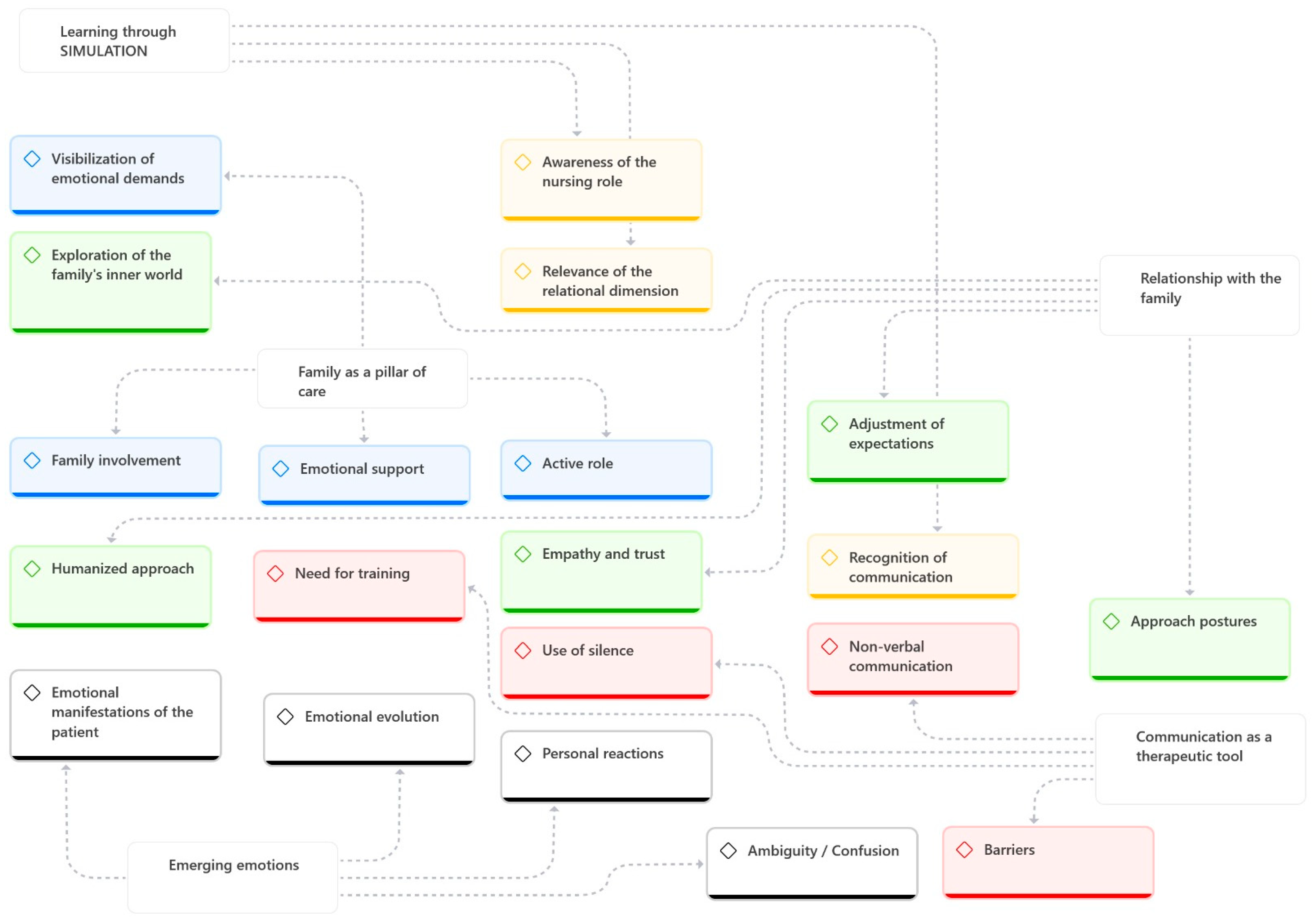
These results reflect the complexity of understanding the communication of bad news in situations of high emotional complexity. Figure 1 allows us to establish the following themes: (T1) Family as a pillar of care; (T2) Relationship with the family; (T3) Communication as a therapeutic tool; (T4) Emerging emotions; (T5) Learning through simulation.
Figure 1.
Qualitative Data Analysis.
The ATLAS-ti.24 program was used to code and synthesize the data, and a graphic designer prepared the results as a map of agents and interactions, as shown in Figure 1.
4. Discussion
The study aimed to analyze the impact of SBL on nursing students’ communication skills, their understanding of the complexity of end-of-life situations for both the patient and the family, and their improved identification of the nursing role within multidisciplinary teams in this field. In this sense, the results of this study highlight its value as a learning strategy for training nursing students in end-of-life communication, in line with other authors’ findings [19,20]. It has been observed that it not only improves students’ communication skills but also significantly impacts their emotional development and professional role recognition. Through simulation-based experiences, it was possible to not only observe the dynamics of caregiving but also identify emotional reactions among students and family members, revealing the depth of relationships built at the end of life.
4.1. Comparison with Existing Evidence
The complexity of communication in end-of-life situations requires specific preparation, as it involves technical, ethical, and emotional aspects that cannot always be acquired solely through theoretical teaching or traditional clinical experience [22]. Central to the findings is the reduction in anxiety and increase in confidence among students following their participation in the simulated scenarios. Before the simulation, many expressed fear and insecurity about the possibility of giving inappropriate responses or of not knowing how to handle patients’ and their families’ emotional reactions. However, after the experience, there was evidence of strengthened communication skills and greater confidence in their performance. These results align with previous studies showing that clinical simulation favors the acquisition of competencies in high-emotional-load situations, reducing anticipatory anxiety and improving preparation for professional practice [23,46].
It is also reaffirmed that, despite previous experiences, students continue to face intense emotional reactions to death and the dying process in real clinical settings [47,48]. Ensuring their psychological safety is therefore critical when designing and implementing SBL related to palliative and end-of-life care. This approach not only allows these experiences to be addressed from a space of containment and protection but also favors deep and meaningful learning, without causing emotional harm [49]. The SBL has enabled students to experience the emotional impact of accompanying patients at the end of life more authentically [50]. Underlying many discourses is the need to make visible the emotional demands of the family environment, since students recognize that care is not only directed at the sick person, but also extends to their family, who often go through the process in silence, caring and supporting without asking for help. In this context, the SBL becomes a space for emotional and professional exploration where students can observe how a trusting relationship is built and which communicative strategies are most effective in providing emotional support [51]. Thus, the simulated scenarios have facilitated the recognition and management of both one’s own and others’ emotions, allowing practice in identifying nonverbal cues, exploring underlying emotions, and adjusting intervention from an empathic and personalized perspective [52].
Another relevant finding is the perception of the simulation as a safe space for learning and experimentation. The students noted that being able to make mistakes and receive feedback in a safe, controlled environment enabled them to reflect on their performance and improve their skills [53]. This reflection-based learning component is key, as it allows for the integration of theoretical knowledge with practical experience, reinforcing the ability to make informed and ethically grounded decisions in real situations [54]. In addition, active learning is encouraged, promoting self-awareness and self-evaluation, fundamental skills for professional practice [55].
From an ethical and emotional perspective, the results indicate that simulation contributes to the development of empathy and active listening skills in nursing students. End-of-life communication involves not only conveying information clearly and understandably [56] but also providing emotional containment and validating patients’ and their families’ feelings [18]. Students emphasized that the experience heightened their awareness of the impact that their words and attitudes can have on individuals experiencing profound vulnerability. These findings reinforce the importance of incorporating structured training in empathic communication into nursing education programs, ensuring that future professionals are prepared to adopt an accompanying role that respects and preserves patient dignity [19,57].
On the other hand, the SLB allowed students to reflect on the role of the family in end-of-life care. In many cases, family members are the ones who make crucial decisions and require guidance and support from healthcare professionals [58]. It became evident that care is not exclusively directed to the patient but also extends to their family environment, which often goes through this process in silence, holding and caring for one another without asking for help. The students were able to visualize more clearly these emotional demands of the family environment, recognizing the need to adapt their interventions so that these are genuinely effective and respectful of the diversity of experiences [24,59].
However, the study also identified specific challenges in implementing simulation as a learning tool. Students’ emotional responses varied considerably and influenced their levels of participation and learning. Those with prior personal experiences related to death reported a greater emotional burden during the simulation, which in some cases adversely affected their performance. These findings suggest the need to intentionally integrate experiential learning strategies with structured emotional support, ensuring that students can process their emotions effectively and learn from the experience without becoming overwhelmed [19].
A comprehensive understanding of nursing education enables the design of more effective and sensitive pedagogical strategies to prepare professionals capable of delivering holistic and deeply humanized care to patients and their families during the most delicate moments of life. In this regard, the progressive incorporation of tools such as clinical simulation into nursing curricula represents a formative commitment that extends beyond the acquisition of technical skills, emphasizing the development of ethical, communicative, and empathic competencies that are essential for sensitively accompanying the final stages of the life cycle. Consistent with previous studies, these findings reaffirm the value of SBL as an innovative strategy for teaching end-of-life communication, as it allows students to experience and reflect on the human dimension of care while promoting comprehensive training aligned with the principles of patient-centered care [19,50,53,60]. The findings underscore the need to explore further and refine these methodologies to ensure that future professionals are prepared to meet the emotional and ethical challenges of this type of care, benefiting not only their training but also the quality and humanity of care provided in clinical settings.
4.2. Strengths and Limitations
This study highlights two key strengths. First, it offers an innovative perspective on transforming the university educational model, advocating the use of clinical simulation to enhance understanding and reflection on realistic scenarios in a safe, controlled environment. Secondly, SBL not only stimulates student engagement and participation but also promotes deeper, more meaningful learning.
Despite these contributions, the study has several limitations. Conducted at a single university in Spain, the findings may not be generalizable to other educational or healthcare contexts without further complementary research. In addition, while the qualitative approach provides an in-depth understanding of students’ experiences and their satisfaction with the methodology, it does not allow for an objective assessment of the impact of simulation-based learning on communicative competencies.
Other methodological considerations should be acknowledged. Self-selection bias may have influenced the results, as participating students could have been more motivated or engaged than their peers. Social desirability bias is also possible, with participants providing more positive feedback to align with the researchers’ expectations. Moreover, data were collected immediately after simulation sessions, capturing only initial reactions and potentially overlooking longer-term reflections or changes in competence. The lack of a comparison group limits the ability to contextualize these experiences or evaluate the added value of simulation relative to traditional teaching methods. Finally, the translation process of qualitative data introduces potential interpretation bias, despite careful efforts to maintain fidelity.
Future research could address these limitations by expanding the range of simulation scenarios; for example, incorporating situations such as breaking bad news or facilitating shared decision-making, and by complementing qualitative approaches with quantitative studies to assess the impact of simulation-based learning on student outcomes objectively.
5. Conclusions
Clinical simulation in end-of-life scenarios is perceived as a valuable pedagogical strategy in nursing education, as it provides a safe environment for students to explore both professional competencies and emotional responses. Students initially experience fear, insecurity, and anxiety about the possibility of making mistakes or feeling unprepared to respond emotionally. However, simulation-based learning facilitates the development of advanced communication skills adapted to specific clinical contexts, strengthens professional identity, and fosters an empathetic, reflective, and patient-centered approach.
The study also highlights the family’s central role in the dying process. Students learn that communication with family members is not merely a means of exchanging information but a therapeutic intervention that profoundly influences care quality and the emotional experience of both patients and healthcare teams. Simulation helps students develop skills in empathy, trust-building, active listening, and compassionate presence, reinforcing the humanized approach essential in end-of-life care.
Overall, SBL enhances students’ understanding of the nursing role in clinical practice, integrating technical, relational, and emotional competencies, and preparing them to provide holistic, patient- and family-centered care.
Supplementary Materials
The following supporting information can be downloaded at: https://www.mdpi.com/article/10.3390/ime5010017/s1. Supplementary File S1 (COREQ checklist).
Author Contributions
Conceptualization, E.G.C.-B., A.S.-C. and M.D.C.H.-C.; Data curation: E.G.C.-B., A.T.-R. and P.D.P.-H.; Formal analysis: P.D.P.-H.; Funding acquisition: E.C.-S.; Investigation, A.T.-R.; Methodology, E.G.C.-B. and A.T.-R.; Project administration, A.M.-S. and R.J.-V.; Resources, M.R.-G.; Software: A.T.-R.; Supervision: R.J.-V.; Validation: E.C.-S.; Visualization: R.R.D.V.-H.; Writing—original draft preparation: E.G.C.-B., A.S.-C., A.M.-S. and M.D.C.H.-C.; Writing—review and editing, P.D.P.-H.; visualization, R.R.D.V.-H. All authors have read and agreed to the published version of the manuscript.
Funding
This research received no external funding.
Institutional Review Board Statement
Ethical clearance to conduct the research was obtained from the UNIE University Research Ethics Committee (CEID2025_07). All participants gave written consent before participating in this study. To ensure anonymity and confidentiality, a code was assigned to each participant in the FGs and reflective narratives (RN).
Informed Consent Statement
Informed consent was obtained from all subjects involved in the study.
Data Availability Statement
The data are available upon request from the first author.
Acknowledgments
We would like to thank all the participants who contributed to this research.
Conflicts of Interest
The authors declare no conflicts of interest.
Abbreviations
The following abbreviations are used in this manuscript:
| COREQ | COnsolidated criteria for REporting Qualitative research; |
| FG | Focus Group |
| RN | Reflexive narratives |
| SBL | Simulation-based learning |
References
- Martins Pereira, S.; Hernández-Marrero, P.; Pasman, H.R.; Capelas, M.L.; Larkin, P.; Francke, A.L. Nursing education on palliative care across Europe: Results and recommendations from the EAPC Taskforce on preparation for practice in palliative care nursing across the EU based on an online survey and country reports. Palliat. Med. 2021, 35, 130–141. [Google Scholar] [CrossRef] [Scilit]
- Mengual, T.E.; Chover-Sierra, E.; Ballestar-Tarín, M.L.; Saus-Ortega, C.; Gea-Caballero, V.; Colomer-Pérez, N.; Martínez-Sabater, A. Knowledge about Palliative Care and Attitudes toward Care of the Dying among Primary Care Nurses in Spain. Healthcare 2023, 11, 1018. [Google Scholar] [CrossRef] [Scilit] [PubMed]
- Brezis, M.; Lahat, Y. What can we learn from simulation-based training to improve skills for end-of-life care? Insights from a national project in Israel. Isr. J. Health Policy Res. 2017, 6, 48–49. [Google Scholar] [CrossRef] [Scilit]
- Chover-Sierra, E.; Martínez-Sabater, A. Analysis of Spanish nursing students’ knowledge in palliative care. An online survey in five colleges. Nurse Educ. Pract. 2020, 49, 102903. [Google Scholar] [CrossRef] [Scilit] [PubMed]
- Carey, M.L.; Zucca, A.C.; Freund, M.A.; Bryant, J.; Herrmann, A.; Roberts, B.J. Systematic review of barriers and enablers to the delivery of palliative care by primary care practitioners. Palliat. Med. 2019, 33, 1131–1145. [Google Scholar] [CrossRef] [Scilit]
- King, D.; Schockett, E.; Rizvi, G.; Fischer, D.; Amdur, R.; Benjenk, I.; Yamane, D.; DelPrete, B.; Davison, D.; Seneff, M. The Growth of Palliative Practice and End of Life Care in an Academic Teaching Intensive Care Unit. J. Intensive Care Med. 2022, 37, 1397–1402. [Google Scholar] [CrossRef] [Scilit] [PubMed]
- Xu, M.; Li, Z.; Yang, J. Nurse-led cancer palliative care compared to oncologist-led cancer palliative care: A retrospective analysis of Chinese patients suffering from cancer and receiving chemotherapy. Adv. Clin. Exp. Med. Off. Organ Wroc. Med. Univ. 2022, 31, 1081–1086. [Google Scholar] [CrossRef] [Scilit] [PubMed]
- Yoong, S.Q.; Schmidt, L.T.; Chao, F.F.T.; Devi, K.M.; Wang, W.; Zhang, H. Nursing students’ perspectives and learning experiences of participating in a palliative and end-of-life care simulation programme: A qualitative study. Nurse Educ. Today 2024, 134, 106103. [Google Scholar] [CrossRef] [Scilit]
- Felber, S.J.; Guffi, T.; Brem, B.G.; Schmitz, F.M.; Schnabel, K.P.; Guttormsen Schär, S.; Eychmüller, S.; Zambrano, S.C. Talking about dying and death: Essentials of communicating about approaching death from the perspective of major stakeholders. Palliat. Support. Care 2024, 22, 1199–1208. [Google Scholar] [CrossRef] [Scilit] [PubMed]
- Ehrlich, O.; Kruse, J.A.; Lackowski, A.; Glover, T.L. A Nursing Faculty Intervention for Teaching Primary Palliative Care in Baccalaureate Nursing Competency-Based Education. Palliat. Med. Rep. 2025, 6, 61–70. [Google Scholar] [CrossRef] [Scilit]
- Selman, L.E.; Brighton, L.J.; Hawkins, A.; McDonald, C.; O’Brien, S.; Robinson, V.; Khan, S.A.; George, R.; Ramsenthaler, C.; Higginson, I.J.; et al. The Effect of Communication Skills Training for Generalist Palliative Care Providers on Patient-Reported Outcomes and Clinician Behaviors: A Systematic Review and Meta-analysis. J. Pain Symptom Manag. 2017, 54, 404–416.e5. [Google Scholar] [CrossRef] [Scilit]
- Zahra, R.; Khadijeh, Y.; Reza, M.S.G. Perceived stress in end-of-life care: A qualitative study of Iranian nurses’ experiences. Int. J. Palliat. Nurs. 2025, 31, 30–38. [Google Scholar] [CrossRef] [Scilit] [PubMed]
- García Carpintero-Blas, E.; Del Pozo-Herce, P.; Hernández-Cediel, M.d.C.; Rodríguez-García, M.; Navas-Echazarreta, N.; Chover-Sierra, E.; Martínez-Sabater, A.; Juárez-Vela, R.; Tovar-Reinoso, A. First Contact With Care Through Clinical Simulation in Nursing Students: Qualitative Study. JMIR Nurs. 2025, 8, e81617. [Google Scholar] [CrossRef] [Scilit] [PubMed]
- Carrió-Fito, J.; Terrón-Pérez, M. Knowledge and training among nursing students regarding the conspiracy of silence in palliative care: A participatory action research. Nurse Educ. Pract. 2024, 79, 104086. [Google Scholar] [CrossRef] [Scilit]
- Faulds, S.; Taylor, A. Simulated Practice Learning Experience in a Virtual Environment: An Innovative Pedagogical Approach to Practice Learning for Nursing Students. Nurs. Rep. 2025, 15, 61. [Google Scholar] [CrossRef] [Scilit] [PubMed]
- Condry, H.M.; Kirkpatrick, A.J. Simulation in End-of-Life Nursing Education: A Literature Review. Clin. Simul. Nurs. 2021, 59, 98–110. [Google Scholar] [CrossRef] [Scilit]
- Skedsmo, K.; Nes, A.A.G.; Stenseth, H.V.; Hofsø, K.; Larsen, M.H.; Hilderson, D.; Smis, D.; Hagelin, C.L.; Olaussen, C.; Solberg, M.T.; et al. Simulation-based learning in palliative care in postgraduate nursing education: A scoping review. BMC Palliat. Care 2023, 22, 30. [Google Scholar] [CrossRef] [Scilit]
- Anderson, M.; Campbell, S.H.; Nye, C.; Diaz, D.; Boyd, T. Simulation in Advanced Practice Education: Let’s Dialogue. Clin. Simul. Nurs. 2019, 26, 81–85. [Google Scholar] [CrossRef] [Scilit]
- Smith, M.B.; Macieira, T.G.R.; Bumbach, M.D.; Garbutt, S.J.; Citty, S.W.; Stephen, A.; Ansell, M.; Glover, T.L.; Keenan, G. The Use of Simulation to Teach Nursing Students and Clinicians Palliative Care and End-of-Life Communication: A Systematic Review. Am. J. Hosp. Palliat. Med. 2018, 35, 1140–1154. [Google Scholar] [CrossRef] [Scilit] [PubMed]
- Kirkpatrick, A.J.; Cantrell, M.A.; Smeltzer, S.C. Palliative Care Simulations in Undergraduate Nursing Education: An Integrative Review. Clin. Simul. Nurs. 2017, 13, 414–431. [Google Scholar] [CrossRef] [Scilit]
- Zhang, L.; Huang, Y.; Wu, X.; Liu, C.; Zhang, X.; Yang, X.; Lai, H.; Fu, J.; Yang, M. The impact of virtual clinical simulation on nursing students’ palliative care knowledge, ability, and attitudes: A mixed methods study. Nurse Educ. Today 2024, 132, 106037. [Google Scholar] [CrossRef] [Scilit]
- Chung, B.P.M.; Chan, E.A.; Chang, K.K.P.; Leung, D.Y.L. Senior year nursing students’ self-regulated learning in complex simulation-based palliative education: A qualitative study. Nurse Educ. Today 2025, 147, 106609. [Google Scholar] [CrossRef] [Scilit]
- Wolfe, A.H.J.; Hinds, P.S.; du Plessis, A.J.; Gordish-Dressman, H.; Soghier, L. Describing the Impact of Physician End-of-Life Communication Training on Simulated Stress Using a Novel Stress Marker. Am. J. Hosp. Palliat. Med. 2025, 10499091251330279. [Google Scholar] [CrossRef] [Scilit] [PubMed]
- Valen, K.; Haug, B.; Holm, A.L.; Jensen, K.T.; Grov, E.K. From Palliative Care Developed During Simulation, to Performance in Clinical Practice—Descriptions From Nursing Students. J. Hosp. Palliat. Nurs. 2020, 22, 204–212. [Google Scholar] [CrossRef] [Scilit]
- Lewis, C.; Reid, J.; McLernon, Z.; Ingham, R.; Traynor, M. The impact of a simulated intervention on attitudes of undergraduate nursing and medical students towards end of life care provision. BMC Palliat. Care 2016, 15, 67. [Google Scholar] [CrossRef] [Scilit]
- Smith, J.A.; Flowers, P.; Larkin, M. Interpretative Phenomenological Analysis; SAGE Publications: Los Angeles, CA, USA; London, UK; New Delhi, India; Singapore; Washington, DC, USA; Melbourne, Australia, 2022. [Google Scholar]
- Doyle, L.; McCabe, C.; Keogh, B.; Brady, A.; McCann, M. An overview of the qualitative descriptive design within nursing research. J. Res. Nurs. 2020, 25, 443–455. [Google Scholar] [CrossRef] [Scilit]
- Bradshaw, C.; Atkinson, S.; Doody, O. Employing a Qualitative Description Approach in Health Care Research. Glob. Qual. Nurs. Res. 2017, 4, 2333393617742282. [Google Scholar] [CrossRef] [Scilit] [PubMed]
- Moser, A.; Korstjens, I. Series: Practical guidance to qualitative research. Part 3: Sampling, data collection and analysis. Eur. J. Gen. Pract. 2018, 24, 9–18. [Google Scholar] [CrossRef] [Scilit] [PubMed]
- Creswell, J.W. Qualitative Inquiry & Research Design; SAGE: Los Angeles, CA, USA; London, UK; New Delhi, India; Singapore; Washington, DC, USA, 2013. [Google Scholar]
- Kitzinger, J. Qualitative Research: Introducing focus groups. BMJ 1995, 311, 299–302. [Google Scholar] [CrossRef] [Scilit] [PubMed]
- McLafferty, I. Focus group interviews as a data collecting strategy. J. Adv. Nurs. 2004, 48, 187–194. [Google Scholar] [CrossRef] [Scilit]
- Jayasekara, R.S. Focus groups in nursing research: Methodological perspectives. Nurs. Outlook 2012, 60, 411–416. [Google Scholar] [CrossRef] [Scilit]
- Brimmer, D.J.; Lin, J.S.; Unger, E.R. Voice of the patient: People with myalgic encephalomyelitis/chronic fatigue syndrome (ME/CFS) share in their own words. Fatigue 2025, 13, 135–145. [Google Scholar] [CrossRef] [Scilit]
- Clandinin, D.J. Engaging in Narrative Inquiry; Developing Qualitative Inquiry; Routledge, Taylor & Francis Group: New York, NY, USA; London, UK, 2023; Volume 9. [Google Scholar]
- Wong, L.P. Focus group discussion: A tool for health and medical research. Singap. Med. J. 2008, 49, 256. [Google Scholar] [PubMed]
- Hennink, M.M.; Kaiser, B.N.; Weber, M.B. What Influences Saturation? Estimating Sample Sizes in Focus Group Research. Qual. Health Res. 2019, 29, 1483–1496. [Google Scholar] [CrossRef] [Scilit] [PubMed]
- Romero, R.A.M. Qualitative Data Analysis with ATLAS.ti, por Susanne Friese. Qual. Res. Educ. 2016, 5, 226–228. [Google Scholar] [CrossRef] [Scilit]
- Nowell, L.S.; Norris, J.M.; White, D.E.; Moules, N.J. Thematic Analysis: Striving to Meet the Trustworthiness Criteria. Int. J. Qual. Methods 2017, 16, 1609406917733847. [Google Scholar] [CrossRef] [Scilit]
- Braun, V.; Clarke, V. Using thematic analysis in psychology. Qual. Res. Psychol. 2006, 3, 77–101. [Google Scholar] [CrossRef] [Scilit]
- Tong, A.; Sainsbury, P.; Craig, J. Consolidated criteria for reporting qualitative research (COREQ): A 32-item checklist for interviews and focus groups. Int. J. Qual. Health Care 2007, 19, 349–357. [Google Scholar] [CrossRef] [Scilit]
- Prakke, H.; Wurster, J. [Quality criteria for qualitative research]. Pflege 1999, 12, 183–186. [Google Scholar] [CrossRef] [Scilit] [PubMed]
- Amin, M.E.K.; Nørgaard, L.S.; Cavaco, A.M.; Witry, M.J.; Hillman, L.; Cernasev, A.; Desselle, S.P. Establishing trustworthiness and authenticity in qualitative pharmacy research. Res. Soc. Adm. Pharm. 2020, 16, 1472–1482. [Google Scholar] [CrossRef] [Scilit]
- Morse, J.M. Critical Analysis of Strategies for Determining Rigor in Qualitative Inquiry. Qual. Health Res. 2015, 25, 1212–1222. [Google Scholar] [CrossRef] [Scilit]
- Guba, E.G.; Lincoln, I.S. Paradigmatic Controversies, Contradictions, and Emerging Confluences Justice. In The Sage Handbook of Qualitative Research; Sage Publications: Thousand Oaks, CA, USA, 2005; pp. 191–215. [Google Scholar]
- Lin, M.; Lin, S.; Lee, Y.; Wang, P.; Wu, H.; Hsu, H. The effectiveness of simulation education program on shared decision-making attitudes among nurses in Taiwan. PLoS ONE 2021, 16, e0257902. [Google Scholar] [CrossRef] [Scilit]
- Dorney, P.; Pierangeli, L. A Phenomenological Study: Student Nurses’ Perceptions of Care of the Dying in a Hospice-Based Facility. J. Hosp. Palliat. Nurs. 2021, 23, 162–169. [Google Scholar] [CrossRef] [Scilit] [PubMed]
- Kurji, Z.; Dias, J.; Rattani, S.A.; Khowaja, A.A.; Alisher, A.N. Describing Perceptions and Experiences of Undergraduate Nursing Students Regarding Death and Dying in Palliative Care Setting. J. Palliat. Care Med. 2019, 9, 354. [Google Scholar]
- Harder, N.; Lemoine, J.; Harwood, R. Psychological outcomes of debriefing healthcare providers who experience expected and unexpected patient death in clinical or simulation experiences: A scoping review. J. Clin. Nurs. 2020, 29, 330–346. [Google Scholar] [CrossRef] [Scilit] [PubMed]
- Ruiz-Pellón, N.; Sarabia-Cobo, C.; Amo-Setién, F.; Fernández-Peña, R.; Abajas, R.; Martín, R.; Ortego-Mate, C. Experiences of nursing students participating in end-of-life education programs: A systematic review and qualitative metasynthesis. Nurse Educ. Today 2020, 90, 104442. [Google Scholar] [CrossRef] [Scilit] [PubMed]
- Gillan, P.C.; Johnston, S. Nursing students satisfaction and self-confidence with standardized patient palliative care simulation focusing on difficult conversations. Palliat. Support. Care 2024, 22, 1237–1244. [Google Scholar] [CrossRef] [Scilit]
- Fabro, K.; Schaffer, M.; Scharton, J. The Development, Implementation, and Evaluation of an End-of-Life Simulation Experience for Baccalaureate Nursing Students. Nurs. Educ. Perspect. 2014, 35, 19–25. [Google Scholar] [CrossRef] [Scilit] [PubMed]
- Sarabia-Cobo, C.M.; Alconero-Camarero, A.R.; Lavín-Alconero, L.; Ibáñez-Rementería, I. Assessment of a learning intervention in palliative care based on clinical simulations for nursing students. Nurse Educ. Today 2016, 45, 219–224. [Google Scholar] [CrossRef] [Scilit]
- Ferguson, J.; Astbury, J.; Willis, S.; Silverthorne, J.; Schafheutle, E. Implementing, embedding and sustaining simulation-based education: What helps, what hinders. Med. Educ. 2020, 54, 915–924. [Google Scholar] [CrossRef] [Scilit]
- Son, S.; Min, D.; Kim, S. Effectiveness of a simulation programme with lectures about end-of-life care using a standardised patient: A quasi-experimental study. BMC Nurs. 2025, 24, 371. [Google Scholar] [CrossRef] [Scilit] [PubMed]
- Ernst, A.; Schade, F.; Stiel, S.; van Baal, K.; Herbst, F.A. The implementation of guidelines in palliative care—A scoping review. BMC Palliat. Care 2025, 24, 102–123. [Google Scholar] [CrossRef] [Scilit] [PubMed]
- Escribano, S.; Cabañero-Martínez, M.J.; Fernández-Alcántara, M.; García-Sanjuán, S.; Montoya-Juárez, R.; Juliá-Sanchis, R. Efficacy of a Standardised Patient Simulation Programme for Chronicity and End-of-Life Care Training in Undergraduate Nursing Students. Int. J. Environ. Res. Public Health 2021, 18, 11673. [Google Scholar] [CrossRef] [Scilit] [PubMed]
- Yamamoto, K. Families’ Experiences of Surrogate Decision-Making and Challenges of Shared Decision-Making: A Cross-Sectional Study. Curēus 2025, 17, e79866. [Google Scholar] [CrossRef] [Scilit] [PubMed]
- Valen, K.; Holm, A.L.; Jensen, K.T.; Grov, E.K. Nursing students’ perception on transferring experiences in palliative care simulation to practice. Nurse Educ. Today 2019, 77, 53–58. [Google Scholar] [CrossRef] [Scilit]
- Hingley, S.; Shimoinaba, K.; Wettenhall, J.; Recoche, K. A palliative care communication simulation for undergraduate nursing and midwifery students: A pilot study. Palliat. Support. Care 2024, 22, 1653–1660. [Google Scholar] [CrossRef] [Scilit] [PubMed]

Disclaimer/Publisher’s Note: The statements, opinions and data contained in all publications are solely those of the individual author(s) and contributor(s) and not of MDPI and/or the editor(s). MDPI and/or the editor(s) disclaim responsibility for any injury to people or property resulting from any ideas, methods, instructions or products referred to in the content. |
© 2026 by the authors. Published by MDPI on behalf of the Academic Society for International Medical Education. Licensee MDPI, Basel, Switzerland. This article is an open access article distributed under the terms and conditions of the Creative Commons Attribution (CC BY) license.