1. Introduction
Students in health disciplines are traditionally taught history and physical (H&P) skills using templates [
1]. These include the mnemonic OPQRSTU for a focused, chief- complaint history [
2] and DRUGS for medication and drug history [
3].
While helpful for more junior learners, these standard H&Ps lack nuances specific to certain specialties, such as oncology, which may not revolve around acute medical ailments or general well-visits. Given their focus on the overarching human experience, complex conditions, and longitudinal care, oncology rotations (and other fields such as palliative care and psychiatry) provide challenges for students who have been trained for acute, one-issue H&Ps, such as the OPQRST model [
4,
5]. Indeed, as the complexity of patients increases with advances in medical care, one-issue H&P templates may become increasingly restricting for the novice medical learner.
A systematic review by Keifenheim et al. [
1] identified different ways of teaching H&P to medical students, including role-play and interviews with real patients, followed by feedback and discussion. This review highlights the importance of focusing on thorough history-taking to arrive at the correct diagnosis. However, guidance is needed for novice medical providers who are still learning to be comfortable with clinical assessments. Neeley et al. [
6] surveyed medical students across the United States on their perspectives of oncology curricula in their medical students. This article identified an under-emphasis in medical education to fields of oncology, in addition to highlighting variability in how history-taking is taught in the oncology setting. While individual medical providers have unique styles that vary across oncology subspecialties, it is helpful for a novice learner to follow a series of questions that can later be developed into their own interview format.
Guidelines outlining oncology-focused history and physical exam for advanced practice providers focus on the initial important history for a patient with a new diagnosis of cancer [
7]. Rosenzweig et al. [
7] recommends using national guidelines to inform diagnostic workup and gather relevant information for the tumor type, obtaining relevant cancer-focused history, performing the physical exam, and organizing the data for proper presentation and documentation. The recommendations provided are certainly helpful for advanced practitioners and can certainly be used by medical students. However, when specialized scripts have been made for other fields with unique history and physical exams, such as child psychiatry and gynecology, the structured interview was found to be particularly effective in helping novice learners navigate inherently difficult, complex cases to obtain relevant information and accurate diagnoses [
8,
9]. To best assist medical students, we sought to develop an H&P template that includes phrases to obtain relevant medical information and ensure empathy to help structure the learners’ history.
2. Materials and Methods
This project is a quality improvement project developed by two medical students and a medical oncologist through experience in an oncology clinic.
The template was first developed by two medical students after rotating once weekly in an outpatient oncology setting for 6 months, with input from the supervising medical oncologist. The students first identified the gaps in the history when using a standard, chief complaint focused history. These included values in life, goals of treatment, understanding of present illness, family oncological history and genetic testing, and functional independence. Then, history questions were written to address these gaps and produce the first iteration of the guiding questions. This draft was reviewed by the supervising medical oncologist before being used in an outpatient oncology clinic.
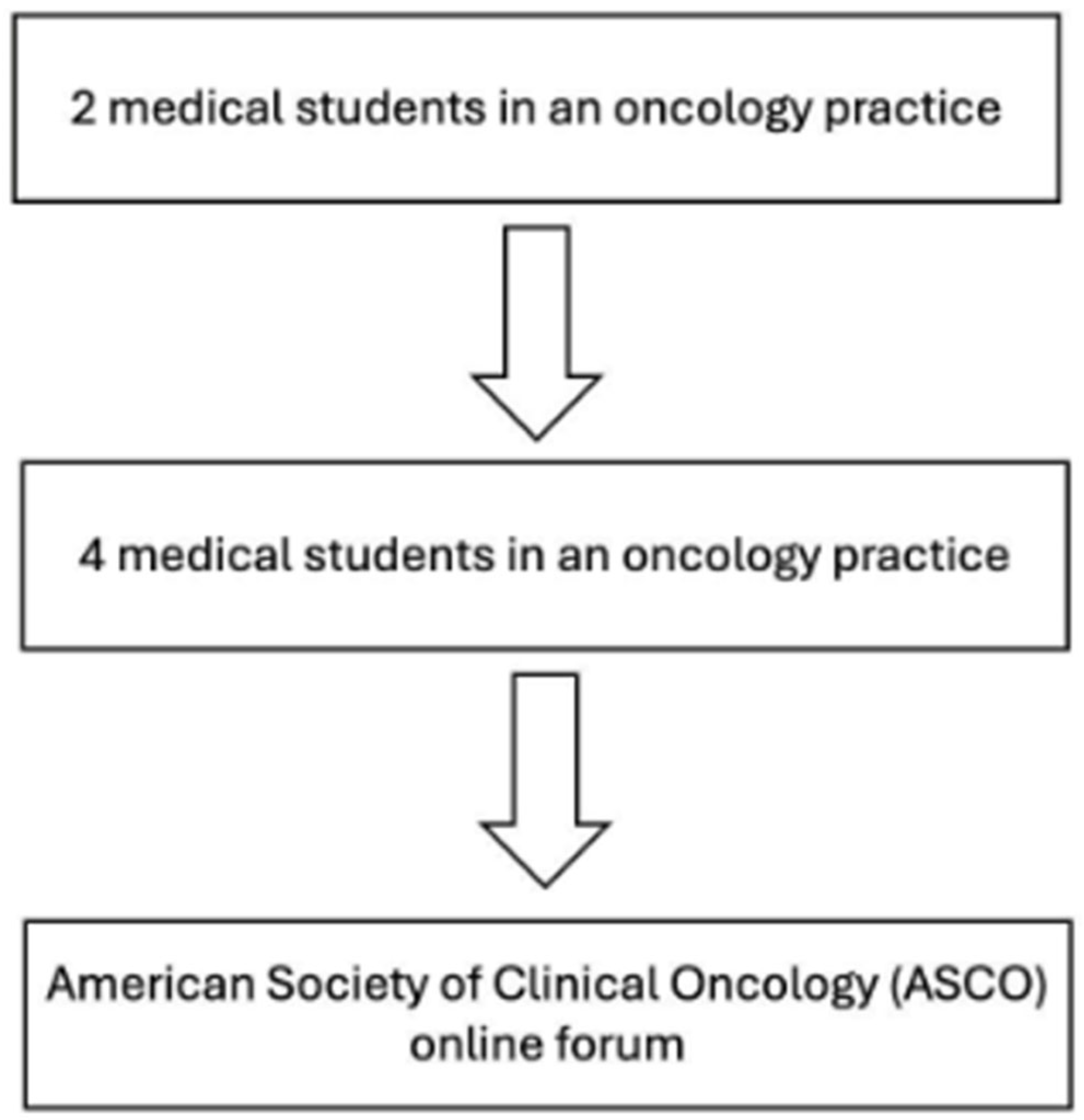
After being used and implemented by the two medical students for 2 months, the model underwent three rounds of iterative feedback with subsequent edits to the template (
Figure 1). All feedback was open-ended and voluntary. A formal survey or analysis tool to evaluate the template was not used, as this was a Quality Improvement initiative. The script was shared with four medical students all in oncology practices, who provided their narrative feedback in-person and via e-mail. After edits based on this feedback, the template was finally shared to an online forum on the America Society of Clinical Oncology (ASCO) and via the social media platform X (Twitter), and edited again based on the suggestions online.
3. Results
Feedback highlighted the strengths of the template, including the utility of the template (See
Appendix A). Many students found the H&P template helpful, especially sections on review of systems (ROS), past treatments, functional independence, and cancer history. These areas helped guide focused patient conversations, which differ significantly from other clinical settings. Students reported that the template helped guide patient interviews, reduce cognitive overload during complex visits, and encourage more holistic, empathetic conversations. Specific sections noted as especially helpful included prompts for functional status, review of prior treatments, and support systems. Students also highlighted the value of having scripted phrasing for emotionally sensitive encounters, such as discussing goals of care or addressing fear and uncertainty. Based on feedback, revisions included clarifying prompts, incorporating follow-up visit adaptations, and expanding side effect review questions.
Clinical educators mentioned the template’s strength in preparing medical students for patient encounters by providing valuable context, such as the importance of discussing treatment values and goals, which many learners had not encountered before. Finally, reviewers praised the guide as a useful introductory tool for junior learners that effectively balances the complexities of oncology care.
Reviewers offered several suggestions to enhance the guide. Adding more specific prompts about past treatments and their potential side effects, such as dry mouth or skin changes, was recommended to ensure comprehensive patient evaluations. Dividing the template into sections tailored for new and return visits was another suggestion, though some expressed concerns that this could introduce unnecessary complexity. Including questions about short-term treatment goals, such as next steps in therapy over the coming weeks or months, was proposed and implemented to complement existing prompts on life values and long-term goals.
Several medical educators expressed strong interest in utilizing the guide in their teaching, including a third- and fourth-year elective. They encouraged publication to allow broader implementation and integration into medical education.
4. Discussion
This oncology-specific guide for medical students has significant potential to enhance the quality of education and patient care in oncology settings. By providing a structured H&P template and detailed prompts, the guide equips learners with tools to navigate complex patient encounters, fostering a more patient-centered approach.
The inclusion of tailored questions about treatment history, side effects, and functional goals allows students to develop a deeper understanding of the unique needs of oncology patients, while the focus on treatment priorities and short-term goals ensures meaningful conversations that align with patients’ priorities. The guide also prepares students to address nuanced considerations that are critical to comprehensive cancer care, such as balancing comorbidities and treatment side effects. The template questions can be further modified and expanded to fit oncologic subspecialties, particularly regarding specific cancer course and symptoms, treatments for a specific cancer, and common side effects associated with those treatments.
Beyond individual encounters, this guide has broader implications for medical education. It serves as a foundation for improving competency in oncology across various levels of training and could be adapted for use in clerkships, electives, and interprofessional settings. Educators have already expressed interest in incorporating the guide into their curricula, demonstrating its potential for widespread adoption both within and outside of oncology. This template could inspire the development of similar scripts in different fields to guide medical learners on their learning journey.
Further dissemination of this resource could standardize oncology-specific education. As a field, oncology poses unique challenges to medical learners, as they learn to navigate complex medical histories and a myriad of emotions that are tied to a cancer diagnosis. Breaking bad news, comforting patients in vulnerable moments, and carrying conversations about death are skills of their own that take years to develop, and learning those skills alongside the skills of basic history-taking can prove overwhelming. We hope that our template empowers students with a tool to help develop rapport, advance patient care, and the opportunity to learn—balancing the oft-discussed tension between patient care and education.
Author Contributions
Conceptualization, A.P., L.A., B.T.B.P.; methodology, A.P., L.A., B.T.B.P.; validation, A.P., L.A., B.T.B.P.; investigation, A.P., L.A., B.T.B.P.; resources, A.P., L.A., B.T.B.P.; data curation, A.P., L.A., B.T.B.P.; writing—original draft preparation, A.P., L.A.; writing—review and editing, A.P., L.A., B.T.B.P.; visualization, A.P., L.A.; supervision, B.T.B.P.; project administration, B.T.B.P. All authors have read and agreed to the published version of the manuscript.
Funding
This research received no external funding.
Institutional Review Board Statement
Emory does not require IRB review of studies that do not meet the definitions of “human subjects research” (DHHS) or “clinical investigation” (FDA). This project does not qualify for humans subject research, and therefore is not eligible for IRB review.
Informed Consent Statement
Not applicable.
Data Availability Statement
The raw data supporting the conclusions of this article will be made available by the authors on request. The data of this project includes the direct quotes of feedback given through each cycle of review, and these statements can be provided by the authors upon request.
Conflicts of Interest
The authors declare no conflicts of interest.
Abbreviations
The following abbreviations are used in this manuscript:
| H&P | History & Physical |
| ROS | Review of Systems |
| ASCO | America Society of Clinical Oncology |
Appendix A
Table A1.
Guiding Questions for Medical Learners to Help Obtain the Patient’s Medical History.
Table A1.
Guiding Questions for Medical Learners to Help Obtain the Patient’s Medical History.
| Rapport-building | Hello, my name is _____, and I am a ______ working with Dr X today. [A sentence describing the reason the learner is seeing the patient instead of Dr X, and asking for permission if applicable]. How are you doing today? What brings you into the clinic today? What are your goals for today’s visit? Is there anything you wanted to bring up for today’s visit? What is your understanding about why you’re here today?
|
| General Open-Ended Prompts | Can you tell me more about that? Can you describe for me…? Is there anything else you wanted to bring up/discuss?
|
| Recent symptoms | Have you noticed any new symptoms or complaints since your last visit? |
| General review of systems | Have you been having any new pain? Trouble breathing? Bowel changes? Nausea or vomiting? Diarrhea or constipation? Weight loss or change in appetite? Numbness or tingling? Rash? Fevers or chills? |
| Cancer history | For new patient appointments: Can you tell me about your cancer journey, from the time when you first had symptoms? How did you find out you had cancer? What treatments have you had for your cancer? When were those? How did those go for you? What side effects, if any, are you having from treatment? If you stopped any treatment, what was the reason the treatment ended?
|
| Pertinent past medical history | Besides the cancer discussed above, what other conditions do you have that you have seen a doctor for, or take medications for? |
| Family cancer history | Do you have any family members with cancer? What kind? What’s your best guess about how old they were when they first learned about the cancer? Has anyone in your family (or you) had genetic testing for cancer?
|
| Current medications | |
| Social history | Can you tell me a bit about yourself? Help me to get to know you as a person. What do you do for entertainment or fun? Do you work? What do you do/what did you do? Who do you live with? Who would you consider to be your support system? How do you get to clinic? Do you have concerns about access to transportation, food, medications, or housing? Do you drink/smoke/use recreational drugs or drugs not prescribed to you?
|
| Functional Independence | Do you have to take naps or rest during the day? For how many hours? Are you able to walk around your house and perform all the tasks and housework you need to? Do you struggle to get dressed or shower? Do you need help with any of these activities?
|
| Values and goals of treatment | When people face cancer diagnoses, different things can matter to them. What is important to you, thinking about the journey ahead? What do you value/prioritize in life? What goals do you have for your health and life? What/who matters most in life to you? In the short-term, what do you hope that your treatment plan accomplishes?
|
| Physical Examination | General inspection, vital signs Cardiac examination Lung examination Abdominal examination Examination of the lower extremities Other examination, as indicated (lymph nodes, neurological). Ask supervisor prior to conducting sensitive examinations such as breast, testicular, or DRE.
|
| Empathy/Responding to Emotion | Silence and allowing patient to speak! I hear what you are saying. It sounds like this has been very difficult/frustrating/scary. It is normal for people with cancer to feel scared/frustrated/overwhelmed. What you are feeling is very normal and natural. Can you tell me more about how you are feeling about X? Can you tell me more about why you are scared/worried about X?
|
| Assessment and Plan | Thank you for taking the time to speak with me. I will take everything we’ve just spoken about and discuss with Dr X, and then we’ll be back to speak with you together. |
References
- Keifenheim, K.E.; Teufel, M.; Ip, J.; Speiser, N.; Leehr, E.J.; Zipfel, S.; Herrmann-Werner, A. Teaching history taking to medical students: A systematic review. BMC Med. Educ. 2015, 15, 159. [Google Scholar] [CrossRef] [PubMed]
- Eloge, J.; Napier, T.C.; Dantz, B. OPQRST(U): Integrating Substance use Disorders or “Use” into the Medical History. Subst. Abus. 2018, 39, 505–508. [Google Scholar] [CrossRef] [PubMed]
- Hocking, G.; Kalyanaraman, R.; deMello, W.F. Better drug history taking: An assessment of the DRUGS mnemonic. J. R. Soc. Med. 1998, 91, 305–306. [Google Scholar] [CrossRef] [PubMed]
- Lacasse, M.; Maker, D. Fishing and history taking: From the net to the line. Can. Fam. Physician Médecin Fam. Can. 2008, 54, 891–892. [Google Scholar]
- Kushner, R. Taking a Weight History—Using Mnemonics to Learn a Missing Skill in Medical Education. MedEdPublish 2017, 6, 215. [Google Scholar] [CrossRef] [PubMed]
- Neeley, B.C.; Golden, D.W.; Brower, J.V.; Braunstein, S.E.; Hirsch, A.E.; Mattes, M.D. Student Perspectives on Oncology Curricula at United States Medical Schools. J. Cancer Educ. 2019, 34, 56–58. [Google Scholar] [CrossRef] [PubMed]
- Rosenzweig, M.; Gardner, D.; Griffith, B. The History and Physical in Cancer Care: A Primer for the Oncology Advanced Practitioner. J. Adv. Pract. Oncol. 2014, 5, 262–268. [Google Scholar] [PubMed][Green Version]
- Jiménez-Hernández, J.L.; López-Sanchez, J.L.; Moreno-Arias, C.; Santamaría-Rubio, E.; Juárez-Calvo, V.; Crespo-Hervás, D.; Muñoz-Villa, A.; López, M. The medical history in child and adolescent psychiatry. Actas Esp. Psiquiatr. 2020, 48, 234–255. [Google Scholar] [PubMed]
- Aryal, S.; Atreya, A. History taking in gynecology revisited: An LGBTQ perspective from Nepal. Acta Biomed. Atenei Parm. 2021, 92, e2021554. [Google Scholar]
| Disclaimer/Publisher’s Note: The statements, opinions and data contained in all publications are solely those of the individual author(s) and contributor(s) and not of MDPI and/or the editor(s). MDPI and/or the editor(s) disclaim responsibility for any injury to people or property resulting from any ideas, methods, instructions or products referred to in the content. |
© 2025 by the authors. Published by MDPI on behalf of the Academic Society for International Medical Education. Licensee MDPI, Basel, Switzerland. This article is an open access article distributed under the terms and conditions of the Creative Commons Attribution (CC BY) license (https://creativecommons.org/licenses/by/4.0/).