Article

Game Theory and Artificial Life Models for Prostate Cancer Growth and the Evaluation of Therapeutic Regimens


by
Dimitrios Morakis
1,*,
Athanasia Kotini
2,
Alexandra Giatromanolaki
3 and
Adam Adamopoulos
1
1
Laboratory of Computational Medicine, Computational-Artificial Intelligence and Artificial Life, Department of Medicine, School of Health Sciences, Democritus University of Thrace, University Campus of Alexandroupolis, 68100 Alexandroupolis, Greece
2
Medical Physics Laboratory, Department of Medicine, School of Health Sciences, Democritus University of Thrace, University Campus of Alexandroupolis, 68100 Alexandroupolis, Greece
3
Department of Pathology, University Hospital of Alexandroupolis, Democritus University of Thrace, 68100 Alexandroupolis, Greece
*
Author to whom correspondence should be addressed.
Appl. Biosci. 2026, 5(2), 31; https://doi.org/10.3390/applbiosci5020031
Submission received: 27 December 2025 / Revised: 20 March 2026 / Accepted: 30 March 2026 / Published: 7 April 2026

Abstract

Castrate-resistant prostate cancer (PCa) is a critical situation in which many patients will relapse. Hormonal androgen deprivation therapy (HADT) is the gold standard of care when a patient relapses, following primary surgical or radiation therapy. Usually, the benefits from HADT are poor and recurrent disease after HADT treatment is termed castrate-resistant prostate cancer (CRPC), which is in most cases fatal. The therapeutic regimens for CRPC include chemotherapy with docetaxel, immunotherapy agent sipuleucel-T, the taxane cabazitaxel, the CYP17 inhibitor abiraterone acetate and the androgen receptor (AR) antagonist enzalutamide. Thus, it is imperative to study the inherent property of prostate cancer cells, to resist therapy and reconsider the therapeutic protocols (continuous v’s intermittent). We make use of a hybrid mathematical model which consists of an extension of a very potent ordinary differential equation (ODE) Baez–Kuang model, combined with two Game Theory components: the Minority Game for adaptive behavior and the Axelrod model for heterogeneity behavior. Our study suggests that increasing tumor adaptability, through Minority Game dynamics, improves short-term prostatic-specific antigen (PSA) control and stabilizes therapy cycles. However, this comes at the cost of driving the tumor to a homogeneous, androgen-independent (AI) state, which is therapy-resistant. Conversely, maintaining heterogeneity, via Axelrod dynamics, sustains a mixed population, with androgen-dependent (AD) cells persisting longer and potentially delaying resistance emergence.

1. Introduction

Androgen deprivation therapy is a key issue in the treatment of metastatic and locally advanced prostate cancer [1,2,3]. Even though there is a suppression in tumors in over 90% of the patients [4], eventually, patients will relapse and develop castration-resistant prostate cancer (CRPC) [5]. The protocol in hormonal androgen deprivation therapy (HADT) consists mainly of two methods: the continuous androgen deprivation therapy (CADT) and the intermittent androgen suppression (IAS) therapy [6,7,8]. There are many mathematical models that have studied the dynamics of prostate cancer on these two protocols (CADT-IAS) [9,10,11,12,13,14,15,16]. Exceptional models, like the Ideta et al. [10] and Baez–Kuang [17], have studied the dynamics of prostate cancer under both CADT and IAS therapy. The Portz–Kuang–Nagy (PKN) model used the cell quota model [17], which correlates intracellular nutrient with growth rate, to model the growth of androgen-dependent (AD) and androgen-independent (AI) cells. The cell quota is the intracellular androgen concentrations for both populations. Another very interesting study, conducted by Everett et al. [18], compared the Hirata et al. and the PKN models for their accuracy of fitting clinical data and the capability of predicting PSA levels [17]. All these models use ODE to study the underlying dynamics. Furthermore, very interesting models have been developed to study the effects of the heterogeneity of cancer, from a Game Theory perspective, like Laruelle et al. [19], who explored interactions between cancer cells by using the Hawk–Dove game. They analyzed the heterogeneity of tumors by considering 2 or 3 subpopulations that compete for resources using the evolutionary stable strategy (ESS) theory and they focused on their payoffs. Their findings suggest that a tumor with low intratumor heterogeneity follows a more aggressive path than a tumor with higher heterogeneity [19]. It should be stressed that the efficacy of current therapies in modern oncology relies on the intratumor heterogeneity [20].
In this paper, we introduce a hybrid mathematical framework which combines, into a unified model, an extension of the Baez–Kuang model [17] with the Minority Game [21] and the Axelrod cultural dissemination model [22,23]. This will be a mix of agent-based dynamics, Game Theory and continuous-time evolution. Intratumoral heterogeneity (ITH) is a hallmark of cancer, reflecting the presence of genetically and phenotypically diverse subpopulations of tumor cells within a single neoplasm. This heterogeneity poses a significant challenge for therapy, as diverse subclones can exhibit variable sensitivity to treatment, enabling the tumor to adapt and resist. Understanding how heterogeneity evolves and interacts with therapeutic pressures is therefore crucial for designing more effective treatment strategies.
As already mentioned, Laruelle et al. (2023) [19] extended the analysis of heterogeneity through the lens of Evolutionary Game Theory. However, their approach is purely game-theoretic and does not couple the cellular strategies to biochemical or physiological compartments like androgen and PSA, which are clinically relevant biomarkers. Our study integrates the strengths of both approaches:
  • It extends the Baez–Kuang ODE model of prostate cancer by incorporating dynamic heterogeneity through an agent-based component inspired by the Axelrod cultural dissemination model and the Minority Game.
  • The hybrid model allows subpopulations to adjust their traits dynamically (heterogeneity) and adaptively compete for minority status under therapy, while simultaneously coupling their dynamics to androgen and PSA levels.
We argue that this hybrid approach provides a more realistic representation of tumor evolution under therapy, capturing both the physiological (ODE-based) and behavioral (agent-based) dimensions of heterogeneity. Our model thus bridges the gap between purely continuous population-level models and purely game-theoretic discrete models, offering new insights into how heterogeneity and adaptation shape treatment response and tumor stability.
In summary, the key contribution of this work is the development of a hybrid prostate cancer model that combines agent-based modeling of tumor heterogeneity and adaptive behavior with physiologically grounded ODE dynamics of androgen and PSA. We hypothesize that the interplay between heterogeneity and minority-driven adaptation critically shapes the tumor’s response to intermittent therapy. Specifically, we test whether maintaining a balance between heterogeneity and adaptive minority strategies (as quantified by a tunable parameter in our model) leads to improved stability, reduced PSA levels and more predictable therapy outcomes, compared to existing models that assumed fixed or purely heterogeneous populations.
We note that our study is purely theoretical and computational. Model parameters were selected based on plausible biological ranges reported in the literature [9,10,11], but the model was not calibrated or validated using patient-specific data. No individual-level clinical or experimental datasets were used in this work.

2. Formulation of the Hybrid Game-Theoretic and ODE Model

2.1. Axelrod Model Overview

In this component of the hybrid model, the Axelrod model [22] is used to capture epigenetic heterogeneity among cancer cell populations. Each agent (representing a subpopulation of cancer cells) is assigned a vector of binary traits, representing epigenetic states. Epigenetics refers to heritable changes in gene expression, without changes to the DNA sequence itself [24]. These changes can be influenced by environmental factors and can affect various cellular processes. Key examples of epigenetic mechanisms include DNA methylation, histone modification and chromatin remodeling [25], all of which can switch genes “on” or “off”. Epigenetic effects on cell behavior include: (a) sensitivity to hormones (i.e., how cells respond to hormones), which can be crucial in many biological processes and disease development, (b) proliferation rate (i.e., cell growth and division rates), and (c) resistance to therapy (altered gene expression, involved in drug metabolism or target pathways). Epigenetic heterogeneity is a hallmark of cancer. Tumor cells may be genetically identical but behave differently due to epigenetic differences. These differences allow tumors to adapt rapidly to stress (like therapy) without waiting for mutations. In prostate cancer, some cells become androgen-independent due to epigenetic silencing of androgen receptor signaling [26]. Others may re-express it, if therapy is withdrawn. Epigenetic heterogeneity among agents drives differences in how clones respond to androgen therapy and creates subpopulations that persist even when androgen is low. The Axelrod mechanism allows these epigenetic states to evolve over time through local interactions, mimicking how cells in the same microenvironment can influence each other’s gene expression [27].
At each simulation step, pairs of agents interact and may adopt one another’s traits with a probability proportional to their similarity, as defined by the number of shared features. This mechanism reflects the tendency of cells in a tumor to partially homogenize through local interactions, while maintaining diversity at the population level. The Axelrod dynamics helps simulate the degree of intratumoral heterogeneity and allows the investigation of how heterogeneity evolves under selective pressure. Notably, higher heterogeneity may correspond to a broader phenotypic repertoire of the tumor, which can affect therapeutic outcomes.
Furthermore, we model the heterogeneity of cancer cells using the Axelrod framework. Each agent i is assigned to a vector of f binary epigenetic traits:
Ti = (Ti1, Ti2, …, Tif), Tik ∈ {0, 1}.
At each time step, pairs of agents (i,j) are randomly selected to interact. The number of shared features is as follows: S i j = k = 1 f 1 { T i k = T j k } . The probability of interaction and trait adoption is given by the following: P i j = 0 , if   S i j = 0   or   S i j = f , 1 L 2 · S i j f · 1 f S i j , otherwise .
If an interaction occurs, agent i randomly selects one differing trait and adopts it from agent j. This mechanism captures the tendency of cells to partially homogenize while maintaining heterogeneity at the population level.

2.2. Minority Game of Adaptive Phenotypic Switching

In the present framework, the agent-based component is used to represent a phenotypically distinct tumor subpopulation, rather than an individual cancer cell. Each agent corresponds to a coarse-grained group of cells sharing similar adaptive tendencies, allowing the model to capture population-level heterogeneity and phenotypic plasticity without resolving molecular-scale mechanisms. The Minority Game formalism is therefore employed as an abstract representation of adaptive competition under selective pressure, rather than a literal description of cellular decision-making.
The Minority Game [21], where subpopulations compete to be in the minority, has been widely studied in complex systems and is known to generate chaotic, non-equilibrium dynamics, when many agents adapt simultaneously [28]. In large, adaptive populations, learning and switching strategies generate complex feedback loops. As the number of agents increases, the region of stable equilibrium shrinks, making chaotic regimes almost inevitable. Theory shows that, as more agents update adaptively, the system can oscillate or become unpredictable, even without external shocks [29]. The Minority Game framework in our hybrid model captures the adaptive behavior of cancer subpopulations under therapy. Each agent is assigned a strategy (androgen-dependent AD or androgen-independent AI phenotype) and a payoff mechanism favors those agents that choose the less common strategy in the population, representing a competition for limited resources and a fitness advantage to being in the minority.
At each time step, agents update their strategies with a probability that depends on the recent history of outcomes, mimicking adaptive learning and phenotypic switching. This component of the model emphasizes the role of adaptive heterogeneity as a survival strategy of cancer cells, particularly under changing environmental pressures such as intermittent androgen suppression therapy.
To capture dynamic adaptation, each agent adopts one of two strategies: AD or AI, encoded as s i = +1 for AD and s i = −1 for AI. At each time step, the payoff of a strategy depends on its prevalence in the population over a recent history window. The probability of switching to the minority strategy is influenced by the recent crowding of the majority strategy: P s w i t c h = a a d a p t · (1 − H ¯ ), where H ¯ is the mean history of the fraction of agents choosing each strategy. Agents that remain in the minority gain a score increment. This mechanism reflects the survival advantage of phenotypic plasticity and adaptation to therapy-induced selective pressures.

2.3. ODE Tumor Dynamics

The population-level dynamics of the tumor and its reaction with androgen levels are modeled using a system of ODE. The ODE system includes compartments for AD and AI cancer cells, serum androgen concentration and PSA levels. The growth rates of AD and AI cells are weighted by contributions from both the Axelrod heterogeneity and Minority Game adaptation, reflecting the interplay between static diversity and dynamic adaptation in determining cell proliferation.
Androgen dynamics are modeled as a balance between homeostatic production and therapy-induced suppression, while PSA production reflects both baseline androgen and tumor burden. This component captures the macroscopic tumor dynamics and allows direct comparison with clinical markers like PSA levels.
The macroscopic tumor dynamics are described by a system of four coupled ODEs for the population of AD cells x 1 (t), AI cells x 2 (t), serum androgen concentration Q(T) and PSA P(t):
AD Cells
d x 1 d t = μ m 1 q 1 Q x 1 W A D [ D 1 Q + δ 1 x 1 ] x 1 λ ( Q ) x 1
AI Cells
d x 2 d t = μ m 1 q 2 Q x 2 W A I [ D 2 Q + δ 2 x 2 ] x 2 + λ ( Q ) x 1
Androgen
d Q d t = γ Q m Q Q q 1 x 1 + Q q 2 x 2 u t K q
PSA Level
d P d t = b Q + σ Q x 1 + x 2 ε P
where W A D and W A I are the weighted contributions of Axelrod heterogeneity and minority adaptation, given by the following:
W A D = α · minority_AD + (1 − α) · axelrod_AD
W A I = 1 − W A D
The quantities WAD and WAI are dimensionless, bounded weights that modulate the relative growth contributions of androgen-dependent and androgen-independent tumor populations in the ODE system. By construction, WAD and WAI  [0, 1] and WAD + WAI = 1 at all times.
These weights do not represent individual cellular fitness or probabilities at the single-cell level. Instead, they act as population-level modifiers that summarize the aggregate influence of agent-based heterogeneity (Axelrod dynamics) and adaptive strategy selection (Minority Game) on tumor growth under therapy. In some parameter regimes, WAD may approach extreme values, reflecting model-predicted homogenization toward androgen-dependent or androgen-independent phenotypes.
This system captures tumor growth dynamics and PSA production, combining static heterogeneity (Axelrod dynamics) and dynamic adaptive behavior (Minority Game dynamics). The parameter α  [0, 1] is a weighting parameter that controls the relative contribution of the Minority Game-derived adaptive behavior (minorityAD) and the Axelrod-derived heterogeneity component (axelrodAD) to the population-level growth weights WAD and WAI.

2.4. Divergence from the Original Baez–Kuang Model

The proposed hybrid model extends the original Baez–Kuang framework by incorporating behavioral heterogeneity and adaptive decision-making dynamics at the population level. While the BK model focuses solely on the deterministic interaction between androgen-dependent (AD) and androgen-independent (AI) tumor populations, under intermittent androgen suppression therapy, our approach introduces two additional layers of complexity: (1) Axelrod-type cultural dynamics, representing local imitation and feature-based heterogeneity among subpopulations, and (2) Minority Game-based adaptation, capturing strategic responses based on historical outcomes. These components are integrated through dynamically weighted coefficients W A D and W A I , modulated by a tunable parameter α, which governs the influence of social imitation versus strategic adaptation. Additionally, while the original Baez–Kuang model includes PSA dynamics, our hybrid model retains this feature and explores how PSA responds to micro-level behavioral heterogeneity, which is not captured in the original formulation. Furthermore, the present model introduces a dynamic therapy term u t k Q , which captures the effect of intermittent androgen deprivation therapy (IADT) by simulating androgen removal during treatment. This extension enables exploration of asymmetric therapy schedules, enhancing clinical realism beyond the original Baez–Kuang model, where therapy was either fixed or indirectly modeled. From a biological point of view, the term u t k Q models active clearance of androgen (Q) during therapy. It is grounded in a clinical understanding that androgen suppression therapies (like enzalutamide or LHRH agonists) increase androgen degradation or inhibit production. This therapeutic effect is typically proportional to the current androgen level, i.e., the more androgen present, the more gets cleared [14]. This fact justifies a linear clearance term in Q and the control switch u(t)   0 , 1 models intermittent therapy, where u(t) = 1 denotes that therapy is on and androgen is being removed, while u(t) = 0 denotes that therapy is off, and there is no active clearance. This binary control function models the on–off dynamics of intermittent androgen deprivation (IAD), a clinically relevant treatment strategy aimed at reducing side effects and delaying resistance [30]. The switching of u(t) introduces external forcing into the system, leading to time-dependent fluctuations in androgen levels and downstream effects on tumor cell populations. The addition of this term strengthens the negative feedback on Q during therapy and allows the model to reflect realistic androgen suppression dynamics observed in clinical ADT protocols. To mathematically justify the insertion of the term in the ODE system of equations, we check the dimensional consistency, where all the terms in ODE must have the same units. Let us assume, Q: androgen concentration (e.g., ng/mL), k: clearance rate (per time unit, e.g., day 1 ), then kQ has units of ng/mL/day, which is correct for a term in d Q d t . Since u(t) is dimensionless (just a switch), the term u(t)kQ is dimensionally valid.
As for the structural validity in dynamical systems, the androgen dynamics equation is formulated as a mass balance system:
d Q d t = production natural   consumption t h e r a p y - i n d u c e d   clearance .
This structure follows the standard pattern of dynamical systems with source terms (positive), sink terms (negative), and a control modulation term u(t) that switches the clearance on or off depending on the therapy phase. Such formulations are widely used in compartmental models for pharmacokinetics (PK), viral load dynamics (e.g., HIV models), and cancer therapy models [31]. The inclusion of u(t)kQ as a sink term is thus mathematically consistent, dimensionally correct, and biologically interpretable as a first-order clearance process modulated by therapy. In the current work, we assume that intracellular androgen levels Q(t) equilibrate rapidly with serum androgen, consistent with the original BK model assumptions [17]. However, in another work [11], referring to the PKN model, it is suggested that serum and intracellular androgen levels can diverge under intermittent therapy, motivating a two-compartment model.

3. Methods

3.1. Model Parameters and Formulation

The hybrid model integrates discrete agent-based interactions with continuous tumor dynamics governed by ODE. The parameters involved in both components are informed by prior mathematical oncology models, particularly those from Baez & Kuang [17], as well as subsequent modeling studies on prostate cancer and intermittent androgen deprivation therapy. While this study does not use patient-specific clinical data, the parameter values are either calibrated from the literature or selected within biologically plausible ranges to ensure qualitative relevance and internal consistency.
The ODE system describes the macroscopic tumor state via four dynamic variables:
  • x 1  (t): androgen-dependent (AD) cancer cell population
  • x 2  (t): androgen-independent (AI) cancer cell population
  • Q t serum androgen concentration
  • P ( t ) : prostate-specific antigen (PSA), used as a biomarker of tumor burden
All state variables in the model are expressed in normalized, dimensionless units. Specifically, x1 and x2 represent relative tumor population sizes, Q denotes normalized serum androgen concentration, and P represents a normalized PSA proxy. Parameter values were selected to ensure internal consistency and qualitative agreement with previously published prostate cancer models, rather than direct quantitative calibration to clinical measurements.
The key parameters governing cell proliferation, androgen regulation, and PSA production are summarized in Table 1.
Three additional functional terms describe nonlinear dependencies on androgen level:
  • D 1 (Q) = d 1 · Q and  D 2 (Q) = d 2 · Q, death rates due to androgen exposure.
  • λ Q (Q) = l Q Q + 1 , plasticity from AD to AI phenotype.
The phenotypic switching rate λ Q (Q) governs adaptive transitions from androgen-dependent to androgen-independent phenotypes and is treated as a tunable parameter, rather than a directly measurable biological rate.
For the base model:
  • d 1 = 0.01, d 2 = 0.02, l Q = 0.05.
Finally, the hybrid nature of the model is introduced via the combination of:
  • Axelrod-style cultural traits (to model heterogeneity).
  • Minority Game dynamics (to model adaptive behavior).
  • A mixing parameter α ∈ [0, 1] controls the balance between these influences on therapy sensitivity.

3.2. Simulation Framework

To numerically explore the behavior of the hybrid model, we implemented a time-discrete simulation framework that integrates agent-based dynamics with continuous tumor growth equations. Each simulation was executed over a fixed time horizon T = 1000 days, with a time step Δt = 0.1, using an explicit Euler method to integrate the system of ODE.

3.2.1. Discrete Agent Layer

A population of N = 50 agents is initialized, each representing a subpopulation of cancer cells. Every agent is endowed with:
  • A binary cultural vector (traits) used in Axelrod-style interactions.
  • A strategy for therapeutic adaptation, represented as a binary action {+1, −1}, updated through the Minority Game mechanism.
At each time step, agents interact in two ways:
  • Axelrod interactions occur with probability determined by cultural similarity. One differing trait is adopted during each interaction.
  • Minority Game adaptation updates strategies based on the past behavior of the population and a fixed adaptation probability  p a d a p t  = 0.1.
These interactions affect the following weights:
W AD ( t ) = α · Minority AD ( t ) + ( 1 α ) · Axelrod AD ( t ) , W AI ( t ) = 1 W AD ( t )
Which modulate the relative growth of androgen-dependent (AD) and androgen-independent (AI) cell populations in the ODE system.

3.2.2. Therapy Function

Intermittent androgen deprivation therapy (IADT) is implemented through a binary control function u(t) {0, 1}, which modulates the androgen clearance term –u(t)kQ in the androgen dynamics equation.
In the present study, therapy scheduling is prescribed as a fixed periodic protocol, independent of the state variables of the system. Specifically, therapy is applied for 180 days (ON phase) followed by 90 days without therapy (OFF phase), and this cycle is repeated throughout the simulation horizon.
Consequently, u(t) follows a predefined square-wave pattern in time and does not depend on androgen concentration or PSA levels.This design choice allows us to isolate the effects of tumor heterogeneity and adaptive dynamics on treatment response without introducing additional feedback control mechanisms.

3.2.3. Coupled Dynamics

At every time step:
  • Agent weights WAD(t), WAI(t) are updated;
  • The ODE system is evaluated using the current state and weights;
  • The variables x 1 (t), x 2 (t), Q t , P ( t ) are updated via Euler integration.
PSA values are recorded from the dynamic equation:
d P d t = bQ + σ Q ( x 1 + x 2 ) ε P
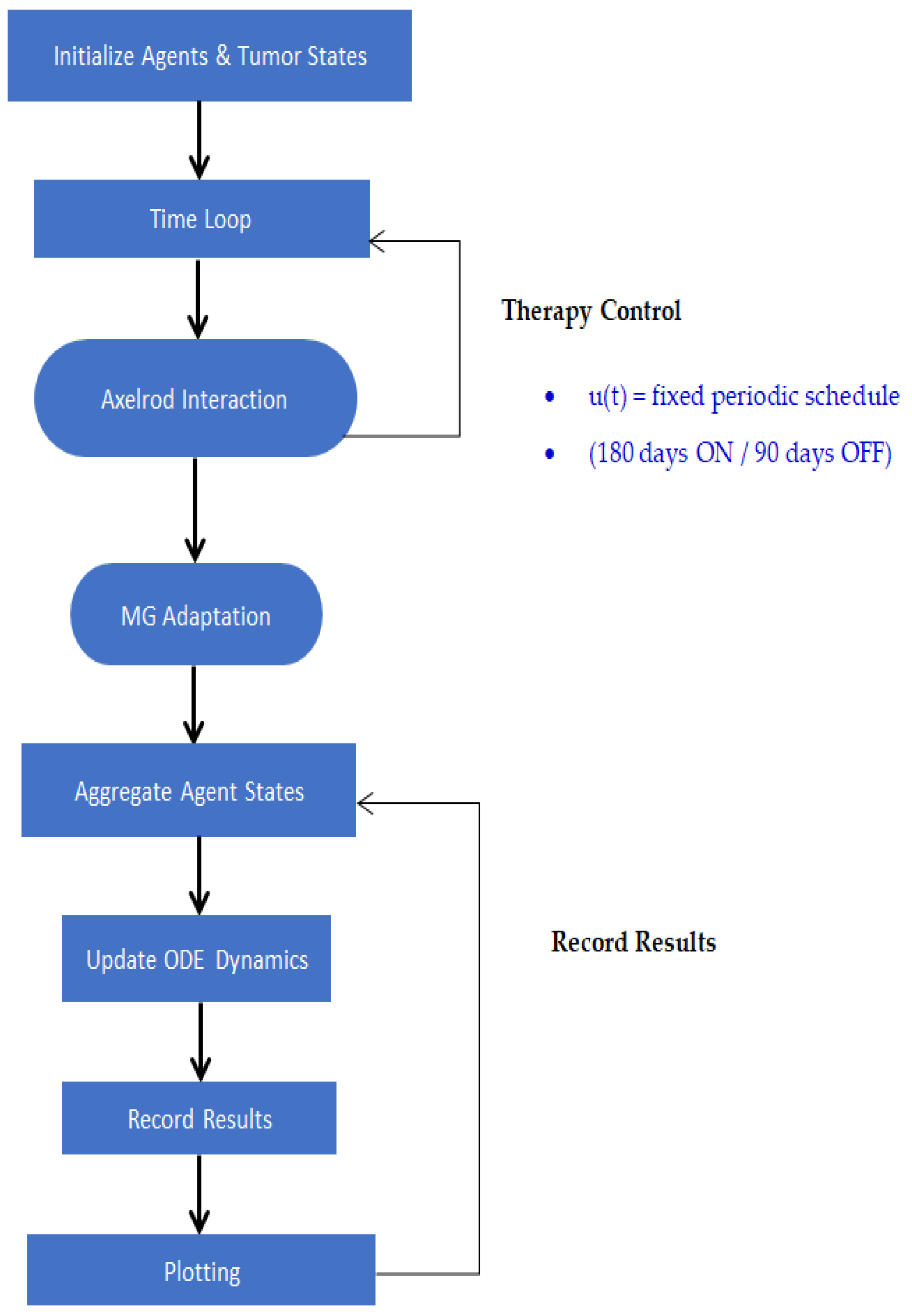
Which accumulates androgen and tumor burden over time, mimicking clinical PSA measurements. A schematic representation of the proposed hybrid model is presented in Figure 1.
To ensure statistical robustness, we conduct 30 independent computer simulations per value of the hybridization parameter α ∈ {0.0, 0.3, 0.5, 0.7, 1.0}. For each run, we compute:
  • Mean and maximum PSA;
  • Final values of x 1 ( t ) , x 2 ( t ) ;
  • Number of therapy cycles.
Results are aggregated and reported as mean  ±  standard deviation for each metric.

3.3. Analytical Stability Assessment

In this section, we assess the local stability of the hybrid tumor dynamics model by analyzing the behavior near equilibrium points using both linearization techniques and Lyapunov theory.

3.3.1. Equilibrium Point Estimation

The equilibrium point ( x 1 , x 2 , Q ) is obtained by solving the steady-state conditions of the reduced nonlinear ODE subsystem governing androgen-dependent cells, and serum androgen concentration, i.e., where x ˙ 1 = x ˙ 2 = Q ˙ = 0. PSA dynamics are treated as a downstream observable and are therefore not included in the equilibrium computation.The steady-state equations are solved numerically using root-finding methods (e.g., SciPy’s root() function with the hybrid method [32]).

3.3.2. Jacobian Matrix and Eigenvalue Analysis

The Jacobian matrix of the system is [33] computed numerically around the equilibrium using finite differences. Since the local stability analysis is performed on the reduced state vector (x1, x2, Q), the Jacobian matrix is three-dimensional (3 × 3). The local dynamics are then studied by computing the eigenvalues of this Jacobian. If all eigenvalues have strictly negative real parts, the equilibrium is locally asymptotically stable. For example, in our baseline case with α = 0.5, d1 = 0.01, and d2 = 0.02, P* = 4.57:
Eigenvalues = [−2.40, −0.01, −0.003]
Since all Re( λ i ) < 0, the system is locally stable.

3.3.3. Lyapunov Function Candidate

A Lyapunov function candidate [34,35,36,37] was proposed in the quadratic form:
V ( t ) = ( x 1 x 1 ) 2 + c 1 ( x 2 x 2 ) 2 + c 2 ( Q Q ) 2
By construction, V(t) 0 for all system states [38]. Its time derivative was numerically evaluated using the ODE system. Simulations showed that V ˙ (t) < 0 in a local neighborhood of the equilibrium, supporting local asymptotic stability. Due to the system’s nonlinearity and parameter coupling, a formal analytic proof of global negative definiteness of V ˙ (t) is not claimed.

3.3.4. Stability Trends Across a Values

The analytical equilibrium and stability analysis reveals distinct regimes of tumor behavior governed by the heterogeneity parameter a, which balances cultural imitation (Axelrod model) and adaptive strategic behavior (Minority Game). For low α values (e.g., α = 0.0), where cultural imitation dominates, the system consistently fails to reach stable biologically meaningful equilibria. The state variables x 1 , x 2 converge toward near-zero or nonphysical values and the corresponding PSA levels remain flat, indicating pathological instability or tumor extinction scenarios that lack realism.
As α increases to intermediate values (e.g., α = 0.3 and 0.5), the model begins to exhibit bifurcation-like behavior: Certain combinations of the apoptosis parameters D1, D2 lead to biologically relevant, stable equilibria, characterized by positive tumor volumes, feasible androgen levels and PSA values within physiologically plausible ranges. This reflects a transition zone where adaptive behavior introduces sufficient variability to prevent collapse, but is still tempered by imitation, resulting in partial control of tumor progression.
For high α values (e.g., α = 0.7 and 1.0), minority adaptation dominates. While more regions in the D 1 D 2 parameter space support stability, the equilibria tend to shift toward lower tumor volumes and PSA values, consistent with self-limiting dynamics, where adaptive behavior may suppress over-proliferation through competitive pressure and strategy diversity. However, some configurations exhibit marginal or unstable behavior, indicating that over-adaption can also destabilize growth regulation.
A comprehensive summary of selected equilibrium outcomes for varying α and D 1 , D 2 combinations is presented in Table 2. Table 2 highlights the sensitivity of system stability and PSA output to model parameters and underscores the role of α as a critical bifurcation control. These findings reinforce the notion that tumor dynamics under treatment can be viewed as emergent behavior arising from local adaptation and imitation mechanisms.

3.3.5. Lyapunov Validation via Asymmetric Dynamics

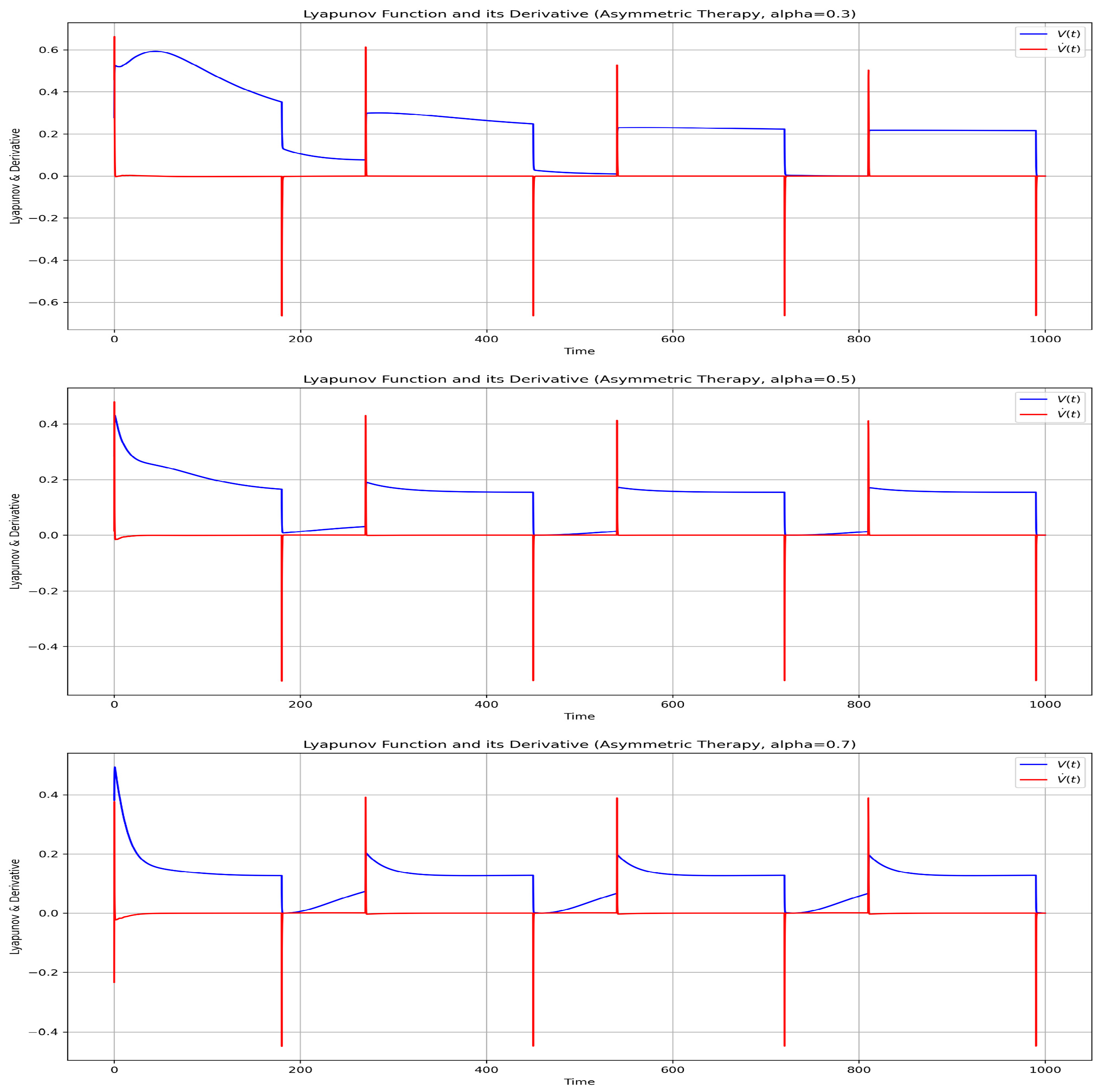
To complement the local linear stability analysis, we simulated the behavior of the Lyapunov function candidate V(t) = ( x 1 x 1 ) 2 + c 1 ( x 2 x 2 ) 2 + c 2 ( Q Q ) 2 , presented in Section 3.3.3, under dynamic treatment conditions governed by a hybrid Axelrod–Minority Game framework. Using numerical trajectories from the full nonlinear system (lyapunov_asymmetric.py), we evaluated V(t) and its derivative V ˙ t for representative α values. For stable α regimes (e.g., α = 0.3, 0.5, 0.7), we observed that V ˙ t < 0 in the neighborhood of the equilibrium, indicating convergence toward the steady state and providing additional numerical evidence of local asymptotic stability. These simulations confirm that, even under hybrid agent-driven dynamics and intermittent therapy, the system tends to return to equilibrium, reinforcing the analytical eigenvalue-based stability findings. A representative plot of V(t) and V ˙ t for α = 0.5 is shown in Figure 2.

3.3.6. Biological Interpretation

Local asymptotic stability implies that, near equilibrium, small perturbations in tumor subpopulations and androgen levels will decay over time, leading the system back to a steady state. This supports the robustness of therapy response under small biological fluctuations.

3.4. Sensitivity Analysis

To further investigate the stability characteristics of the hybrid model, we performed a parametric sensitivity analysis by systematically varying three critical parameters: the androgen-dependent clearance rate D 1 ( Q ) , the androgen-independent clearance rate D 2 ( Q ) , and the phenotypic switching rate λ Q ( Q ) . These parameters govern, respectively, the elimination of sensitive and resistant cell populations and the plasticity between them, all of which are highly relevant in the context of adaptive resistance under androgen deprivation therapy.

3.4.1. Methodology

For each chosen value of the weighting parameter α ∈ {0.3,0.5,0.7}, we simulated the system across a 2D grid of values:
  • D 1   [0.01, 0.05].
  • D 2   [0.01, 0.05].
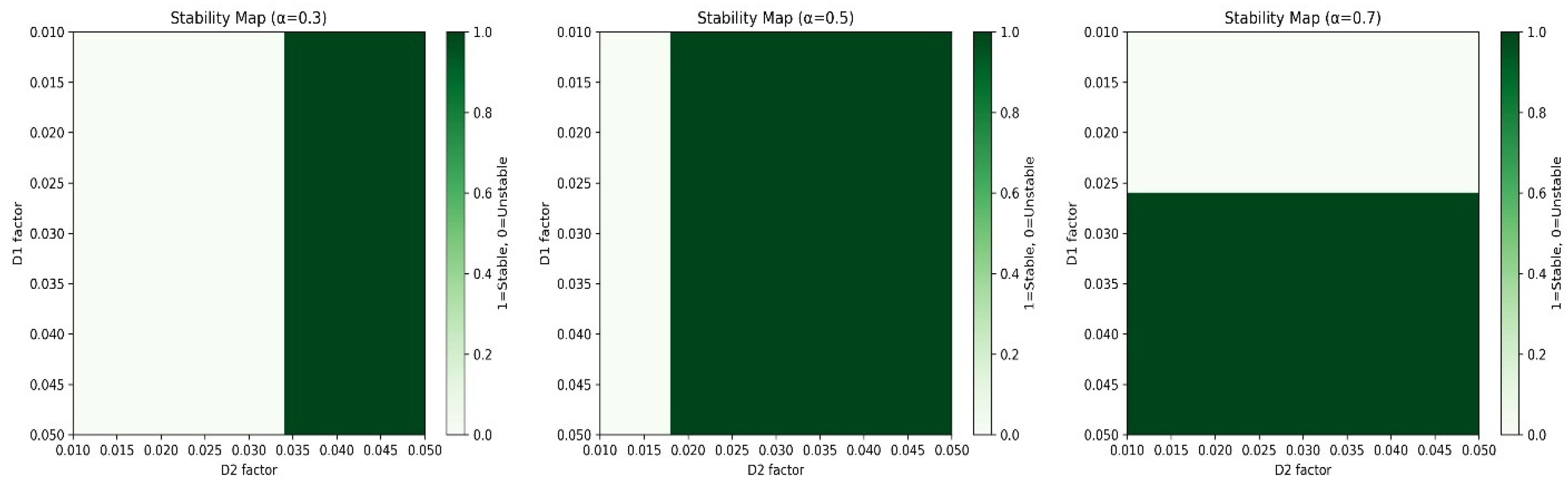
The phenotypic switch parameter λ Q was held fixed, as exploratory simulations showed qualitatively similar trends for moderate changes. At each point on the ( D 1 , D 2 ) grid, the equilibrium point ( x 1 , x 2 , Q ) was computed numerically. The Jacobian matrix at equilibrium was evaluated using finite differences, and the real parts of its eigenvalues were analyzed to determine local stability. A binary outcome—stable (all eigenvalues with negative real parts) or unstable—was recorded and visualized in heatmaps. The resulting heatmaps for α = 0.3, 0.5, and 0.7 are shown in Figure 3, highlighting regions of stability (green) and instability (white) over the parameter grid.
Several qualitative trends emerge from these maps:
  • Low α (e.g., 0.3): The system is mostly unstable across the ( D 1 , D 2 ) range. Few stable regions appear only for relatively high clearance rates. This suggests that, when androgen-dependent cells dominate, achieving stability requires aggressive therapy clearance.
  • Intermediate α (0.5): A substantial stable region appears, especially for moderate-to-high values of D 1 and D 2 . This indicates that a balanced mixture of AD and AI phenotypes enhances the likelihood of reaching a biologically meaningful and stable tumor state under therapy.
  • High α (0.7): The stability region becomes more confined again, suggesting that, if the tumor composition is heavily skewed toward androgen-dependent cells, the system may lose robustness to parameter variation unless treatment is precisely tuned.

3.4.2. Interpretation

These sensitivity results demonstrate that stability in tumor population dynamics is highly dependent on both cell-type composition and treatment efficacy. The non-monotonic trend in stability (peaking at intermediate α) suggests that a diverse phenotypic mix under therapy may paradoxically yield more controllable tumor dynamics. This insight could have therapeutic relevance, hinting that complete depletion of AI subpopulations may not always be the most stable outcome.

3.4.3. Sensitivity Analysis of λ Q and k

To assess the robustness of the hybrid model with respect to key adaptive and therapeutic parameters, additional one-factor-at-a-time sensitivity analyses were performed for the phenotypic switching rate λ Q and the therapy-induced androgen clearance rate k.
Simulations were repeated for representative values spanning ±50% of the baseline parameter values reported in Table 1, while holding all other parameters fixed. For each parameter variation, system behavior was evaluated in terms of equilibrium stability, PSA dynamics, and qualitative treatment response patterns.
Across the explored parameter ranges, the qualitative behavior of the system—including stability regimes, PSA cycling patterns, and relative dominance of androgen-dependent and androgen-independent populations—remained unchanged. These results indicate that the main conclusions of the study are robust and not driven by fine-tuned parameter choices.
Specifically, simulations were conducted for the phenotypic switching parameter λQ and the therapy-induced androgen clearance rate k, varied independently within ±50% of their baseline values, resulting in nine parameter combinations. Across all tested cases, the system consistently converged to finite equilibrium points, indicating preserved local stability.
Increasing either k or λQ led to reduced final PSA levels (Pfinal), consistent with stronger therapy-induced suppression and enhanced adaptive transition toward androgen-independent phenotypes. As clearance strength increased, the androgen-independent population (x2) became dominant, while the androgen-dependent population (x1) decreased in size without destabilizing the system.
These results demonstrate that the qualitative stability properties and treatment response patterns of the hybrid model are robust to moderate variations in key adaptive and therapeutic control parameters.

4. Quantitative Analysis of Agent-Driven Therapy Outcomes

To assess the influence of behavioral adaptation on long-term therapy outcomes, we conducted multiple stochastic simulations of the hybrid model under intermittent androgen deprivation (IAD). For each α value ∈ [0.0, 1.0], we ran 30 simulations using random agent initializations. Key outcome measures included average and peak PSA levels, final AD and AI subpopulation sizes, and total number of therapy cycles completed within the simulation window.
The results in Table 3 indicate that, while the number of therapy cycles remains constant across α values due to the fixed treatment scheduling (180 ON / 90 OFF days), other key outcome metrics such as average PSA, maximum PSA, and final tumor subpopulations do vary significantly. Intermediate values of α (e.g., α = 0.5) tend to yield moderate PSA levels and balanced tumor compositions, suggesting a trade-off between excessive adaptive plasticity and rigid imitation. This reflects the stabilizing role of hybrid decision-making in therapeutic response dynamics.
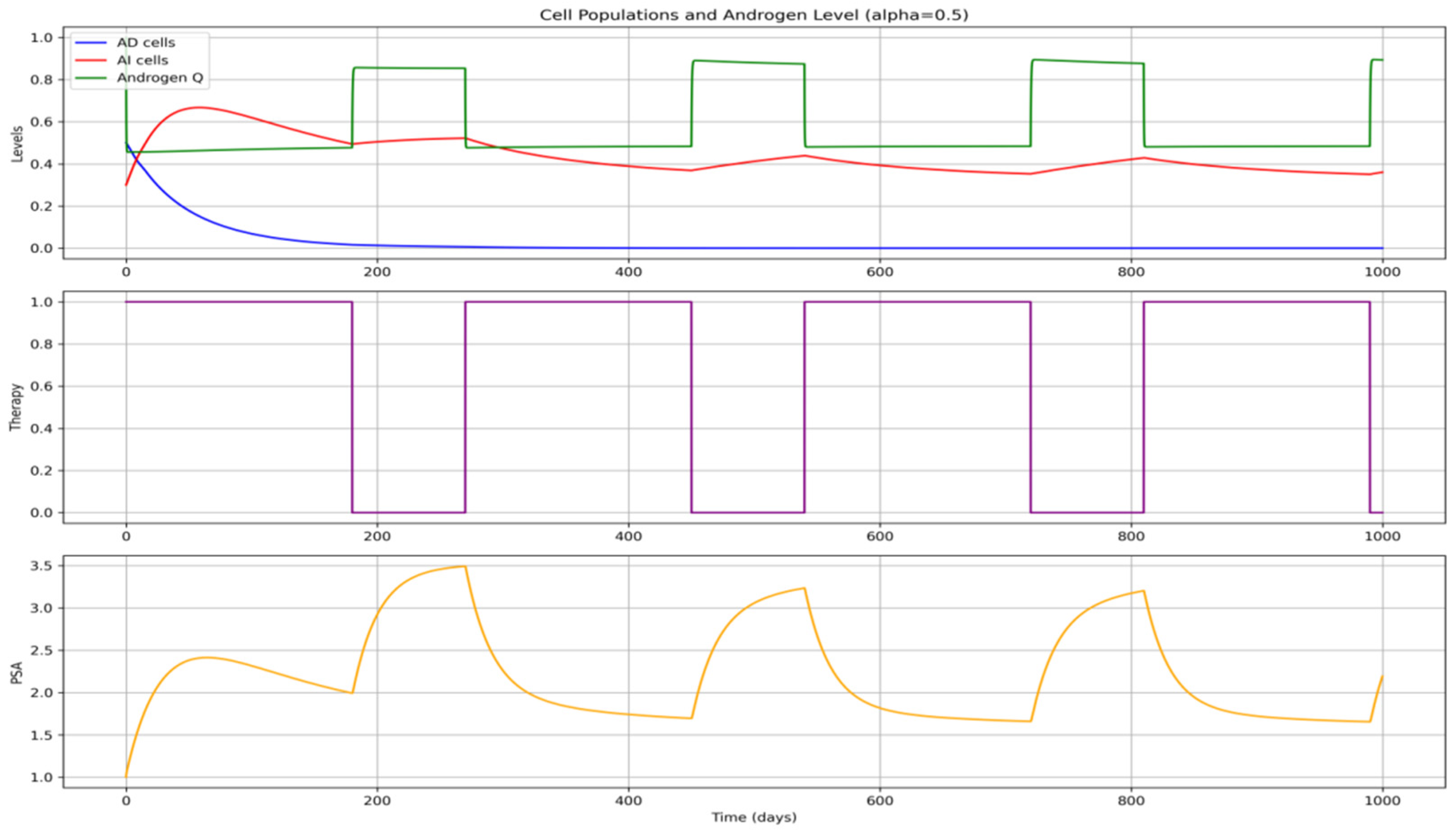
In Figure 4 are illustrated the hybrid tumor dynamics for α = 0.5, capturing the evolution of androgen-dependent (AD) and androgen-independent (AI) cell populations, androgen levels (Q), therapy administration schedule, and PSA levels over a 1000-day simulation. The system exhibits cyclical behavior synchronized with therapy, as seen in the therapy panel (middle subplot), where intermittent androgen deprivation (IAD) triggers oscillatory responses in both androgen levels and PSA. The AD population (blue line) rapidly declines and remains suppressed, while the AI population (red line) stabilizes at a moderate level, reflecting the evolutionary shift toward resistance. The androgen level (green line) clearly responds to therapy on–off phases, validating the treatment control logic. PSA (bottom panel, orange line) shows a pattern of partial suppression and regrowth, demonstrating realistic biomarker behavior under IAD. These dynamics support the hypothesis that intermediate α values are associated with stable and controllable tumor evolution within the model, characterized by PSA cycling and reduced overgrowth. In particular, simulations around α = 0.5 illustrate a regime exhibiting these features under the assumptions of the proposed framework.

5. Discussion

This study introduces a novel hybrid modeling framework combining Evolutionary Game Theory (Axelrod cultural imitation and Minority Game strategic adaptation) with differential equation-based tumor dynamics to simulate prostate cancer under intermittent androgen deprivation therapy (IAD). We explored how intratumoral behavioral heterogeneity, driven by these game dynamics and modulated via α, influences treatment outcomes and resistance dynamics. These behaviors are qualitatively consistent with reported patterns of adaptive resistance and clonal dynamics observed in cancer evolution studies, although no direct quantitative comparison is intended.
Although the parameter α plays a central role in balancing imitation-driven heterogeneity and adaptive strategy selection, tumor evolution in the proposed framework is governed by the combined effects of multiple parameters. In particular, the phenotypic switching rate λQ and the therapy-induced androgen clearance rate k directly influence resistance emergence and androgen suppression strength. Sensitivity analyses indicate that the qualitative stability regimes and treatment response patterns persist across moderate variations in these parameters, underscoring that α functions as an abstract, interpretable control parameter within a broader multi-parameter dynamical landscape rather than as a uniquely dominant driver. At present, α does not correspond to a directly measurable biological quantity, but instead facilitates systematic exploration of behavioral regimes within the model, rather than to represent a specific tumor property. Variations in α may, however, qualitatively reflect differences in selective pressure within the tumor microenvironment, such as resource limitation or therapy-induced stress, although this interpretation remains conceptual.

5.1. Key Findings

Our key findings are summarized as follows
1.
Stability across equilibrium regimes: Analytical stability assessment using the Jacobian and eigenvalue analysis revealed that intermediate α values (e.g., 0.3–0.7) promote biologically feasible, stable equilibria with positive tumor compartment levels and realistic PSA outputs
2.
Lyapunov validation: Numerical simulation of the Lyapunov function V(t) under adaptive therapy cycles demonstrated monotonic descent and negative derivative (i.e., V ˙ t < 0 ) around equilibria, reinforcing evidence of local asymptotic stability even under hybrid dynamics.
3.
Clinical-like cycling outcomes: Our simulation with α = 0.5 (balanced imitation and adaptation) yielded consistent patterns of AD suppression and transient PSA reduction tied to therapy cycles. Notably, PSA suppression resurfaced after each cycle, evoking realistic biochemical responses under clinical IAD regimens.
4.
Evolutionary trade-off: Higher adaptability (Minority Game dominance) leads to swift PSA control and stable therapy cycles, but fosters rapid transition toward a homogeneous, androgen-independent (AI) tumor, risking long-term treatment resistance. In contrast, imitation-heavy dynamics preserve heterogeneity—allowing some AD cells to persist, potentially delaying full resistance, albeit at the cost of subdued PSA control.

5.2. Broader Context and Supporting Theory

These findings echo Evolutionary Game Theory insights—where intratumoral heterogeneity often enhances tumor adaptability and aggressiveness, while maintaining heterogeneity may slow homogeneous-resistant dominance [19]. Game-theoretic models underscore the importance of strategic treatment designs that exploit physician–tumor asymmetries (e.g., Stackelberg game dynamics), emphasizing adaptive leader-driven interventions rather than static dosing regimens [39].
Moreover, earlier prostate cancer models of intermittent androgen suppression align with our fixed-duration simulation (180-day on/90-day off), demonstrating improved quality of life and noninferior overall survival compared to continuous therapy [40]. Mathematical IAD models have similarly aimed to personalize and optimize on/off schedules [41]. Our approach also builds on recent efforts to combine hybrid modeling and data-driven methods for prostate cancer analysis. In particular, the integration of algorithmic insights from hybrid machine learning models has shown promise in evaluating progression patterns and guiding therapeutic decisions [42].
The hybrid integration of Axelrod and Minority Game dynamics enables behaviors that are not accessible in simpler heterogeneity models. While static heterogeneity models capture fixed diversity, and adaptive models capture switching alone, their combination allows the system to dynamically alternate between homogenization and diversification. This interplay produces transient stabilization, delayed dominance of resistant phenotypes, and recovery of sensitivity under certain parameter regimes—behaviors that emerge specifically from the hybrid structure.

5.3. Clinical Implications

  • Therapeutic strategy: Intermediate levels of behavioral heterogeneity (α ~ 0.5) are associated, within the proposed framework, with reduced tumor overgrowth and delayed dominance of resistant phenotypes, reflecting a balance between suppression and heterogeneity-driven adaptation.
  • Game-theoretic treatment: Rather than rigid regimens, adaptive cycling—potentially informed by biomarkers—can exploit physician leadership to steer evolution toward more controllable phenotypes (Stackelberg principle).
  • Heterogeneity monitoring: Future models and therapies should aim to sustain a heterogeneous cellular milieu to avoid therapy-resistant AI dominance, consistent with findings that low heterogeneity correlates with aggressive tumor progression [19].

5.4. Limitations and Future Directions

  • Spatial and multi-type modeling: Our model is non-spatial and limited to two cell types. Extending to spatial agent-based models or public goods frameworks could capture richer heterogeneity dynamics
  • Clinical validation: Translating this framework into data-driven parameterization and trial-guided validation (e.g., via deep reinforcement learning or longitudinal data) is a promising next step.
  • Game-theoretic optimization: Embedding differential Game Theory models could help optimize α and therapy timing with formal strategy planning.
  • The present study is intended as a conceptual and theoretical investigation of how adaptive heterogeneity and phenotypic switching may influence tumor dynamics under intermittent therapy. Model parameters are chosen from plausible ranges to explore qualitative behavior, rather than to achieve quantitative agreement with experimental or clinical data. Accordingly, the results should be interpreted as model-internal dynamical insights, not as direct biological or clinical predictions.

6. Conclusions

Our hybrid game-theoretic model suggests that intermediate levels of behavioral heterogeneity can, within the proposed framework, give rise to tumor dynamics characterized by short-term control without premature dominance of resistant phenotypes. These findings highlight how adaptive, evolution-informed modeling approaches can be useful for exploring robust dynamical regimes in theoretical studies of prostate cancer progression.

Author Contributions

Conceptualization, A.A. and D.M.; methodology, A.A. and D.M.; software, D.M.; validation, A.A. and D.M.; formal analysis, A.A. and D.M.; investigation, D.M.; resources, D.M.; data curation, D.M.; writing—original draft preparation, D.M.; writing—review and editing, A.A., A.K. and A.G.; visualization, D.M.; supervision, A.A.; project administration, A.A.; funding acquisition, none. All authors have read and agreed to the published version of the manuscript.

Funding

This research received no external funding.

Institutional Review Board Statement

Not applicable.

Informed Consent Statement

Not applicable.

Data Availability Statement

The raw data supporting the conclusions of this article will be made available by the authors on request.

Conflicts of Interest

The authors declare no conflicts of interest.

References

  1. Lian, F.; Sharma, N.V.; Moran, J.D.; Moreno, C.S. The biology of castration-resistant prostate cancer. Curr. Probl. Cancer 2015, 39, 17–28. [Google Scholar] [CrossRef]
  2. Wang, Q.; Li, W.; Zhang, Y.; Yuan, X.; Xu, K.; Yu, J.; Chen, Z.; Beroukhim, R.; Wang, H.; Lupien, M.; et al. Androgen receptor regulates a distinct transcription program in androgen-independent prostate cancer. Cell 2009, 138, 245–256. [Google Scholar] [CrossRef]
  3. Zarour, L.; Alumkal, J. Emerging therapies in castrate-resistant prostate cancer. Curr. Urol. Rep. 2010, 11, 152–158. [Google Scholar] [CrossRef]
  4. Karantanos, T.; Corn, P.G.; Thompson, T.C. Prostate cancer progression after androgen deprivation therapy: Mechanisms of castrate resistance and novel therapeutic approaches. Oncogene 2013, 32, 5501–5511. [Google Scholar] [CrossRef]
  5. Kim, S.J.; Kim, S.I. Current treatment strategies for castration-resistant prostate cancer. Korean J. Urol. 2011, 52, 157–165. [Google Scholar] [CrossRef]
  6. Agarwal, N.; Di Lorenzo, G.; Sonpavde, G.; Bellmunt, J. New agents for prostate cancer. Ann. Oncol. 2014, 25, 1700–1709. [Google Scholar] [CrossRef] [PubMed]
  7. Ezzell, E.E.; Chang, K.S.; George, B.J. New agents in the arsenal to fight castrate-resistant prostate cancer. Curr. Oncol. Rep. 2013, 15, 239–248. [Google Scholar] [CrossRef]
  8. Saad, F.; Miller, K. Treatment options in castration-resistant prostate cancer: Current therapies and emerging docetaxel-based regimens. Urol. Oncol. 2014, 32, 70–79. [Google Scholar] [CrossRef]
  9. Jackson, T.L. A mathematical investigation of the multiple pathways to recurrent prostate cancer: Comparison with experimental data. Neoplasia 2004, 6, 697–704. [Google Scholar] [CrossRef] [PubMed]
  10. Ideta, A.M.; Tanaka, G.; Takeuchi, T.; Aihara, K. A Mathematical Model of Intermittent Androgen Suppression for Prostate Cancer. J. Nonlinear Sci. 2008, 18, 593–614. [Google Scholar] [CrossRef]
  11. Portz, T.; Kuang, Y.; Nagy, J.D. A clinical data validated mathematical model of prostate cancer growth under intermittent androgen suppression therapy. AIP Adv. 2012, 2, 011002. [Google Scholar] [CrossRef]
  12. Hirata, Y.; Bruchovsky, N.; Aihara, K. Development of a mathematical model that predicts the outcome of hormone therapy for prostate cancer. J. Theor. Biol. 2010, 264, 517–527. [Google Scholar] [CrossRef] [PubMed]
  13. Swanson, K.R.; True, L.D.; Lin, D.W.; Buhler, K.R.; Vessella, R.; Murray, J.D. A quantitative model for the dynamics of serum prostate-specific antigen as a marker for cancerous growth: An explanation for a medical anomaly. Am. J. Pathol. 2001, 158, 2195–2199. [Google Scholar] [CrossRef] [PubMed]
  14. Jain, H.V.; Clinton, S.K.; Bhinder, A.; Friedman, A. Mathematical modeling of prostate cancer progression in response to androgen ablation therapy. Proc. Natl. Acad. Sci. USA 2011, 108, 19701–19706. [Google Scholar] [CrossRef]
  15. Vardhan Jain, H.; Friedman, A. Modeling prostate cancer response to continuous versus intermittent androgen ablation therapy. Discret. Contin. Dyn. Syst. Ser. B 2013, 18, 945–967. [Google Scholar] [CrossRef]
  16. Friedman, A.; Jain, H.V. A partial differential equation model of metastasized prostatic cancer. Math. Biosci. Eng. MBE 2013, 10, 591–608. [Google Scholar] [CrossRef]
  17. Baez, J.; Kuang, Y. Mathematical Models of Androgen Resistance in Prostate Cancer Patients under Intermittent Androgen Suppression Therapy. Appl. Sci. 2016, 6, 352. [Google Scholar] [CrossRef]
  18. Everett, R.A.; Packer, A.M.; Kuang, Y. Can mathematical models predict the outcomes of prostate cancer patients undergoing intermittent androgen deprivation therapy? Biophys. Rev. Lett. 2014, 9, 173–191. [Google Scholar] [CrossRef]
  19. Laruelle, A.; Rocha, A.; Manini, C.; López, J.I.; Inarra, E. Effects of Heterogeneity on Cancer: A Game Theory Perspective. Bull. Math. Biol. 2023, 85, 72. [Google Scholar] [CrossRef]
  20. Middleton, G.; Robbins, H.; Andre, F.; Swanton, C. A state-of-the-art review of stratified medicine in cancer: Towards a future precision medicine strategy in cancer. Ann. Oncol. 2022, 33, 143–157. [Google Scholar] [CrossRef] [PubMed]
  21. Yeung, C.H.; Zhang, Y.-C. Minority games. In Computational Complexity: Theory, Techniques, and Applications; Meyers, A.R., Ed.; Springer: Berlin/Heidelberg, Germany, 2008; pp. 2249–2265. [Google Scholar] [CrossRef]
  22. Axelrod, R. The dissemination of culture: A model with local convergence and global polarization. J. Confl. Resolut. 1997, 41, 203–226. [Google Scholar] [CrossRef]
  23. Lanchier, N. The Axelrod model for the dissemination of culture revisited. Ann. Appl. Probab. 2012, 22, 860–880. [Google Scholar] [CrossRef]
  24. Al Aboud, N.M.; Tupper, C.; Jialal, I. Genetics, Epigenetic Mechanism. In StatPearls [Internet]; StatPearls Publishing: Treasure Island, FL, USA, 2025. Available online: https://www.ncbi.nlm.nih.gov/books/NBK532999/ (accessed on 20 December 2025).
  25. Hamilton, J.P. Epigenetics: Principles and practice. Dig. Dis. 2011, 29, 130–135. [Google Scholar] [CrossRef]
  26. Ehsani, M.; David, F.O.; Baniahmad, A. Androgen Receptor-Dependent Mechanisms Mediating Drug Resistance in Prostate Cancer. Cancers 2021, 13, 1534. [Google Scholar] [CrossRef]
  27. Casado-Pelaez, M.; Bueno-Costa, A.; Esteller, M. Single cell cancer epigenetics. Trends Cancer 2022, 8, 820–838. [Google Scholar] [CrossRef]
  28. Sanders, J.B.T.; Farmer, J.D.; Galla, T. The prevalence of chaotic dynamics in games with many players. Sci. Rep. 2018, 8, 4902. [Google Scholar] [CrossRef]
  29. Bielawski, J.; Cholewa, Ł.; Falniowski, F. The Emergence of Chaos in Population Game Dynamics Induced by Comparisons. Dyn. Games Appl. 2025, 15, 1317–1362. [Google Scholar] [CrossRef]
  30. Shore, N.D.; Crawford, E.D. Intermittent androgen deprivation therapy: Redefining the standard of care? Rev. Urol. 2010, 12, 1–11. [Google Scholar] [PubMed]
  31. Pasetto, S.; Enderling, H.; Gatenby, R.A.; Brady-Nicholls, R. Intermittent Hormone Therapy Models Analysis and Bayesian Model Comparison for Prostate Cancer. Bull. Math. Biol. 2021, 84, 2. [Google Scholar] [CrossRef] [PubMed]
  32. Mirzaev, I.; Bortz, D.M. A numerical framework for computing steady states of structured population models and their stability. Math. Biosci. Eng. 2017, 14, 933–952. [Google Scholar] [CrossRef] [PubMed]
  33. Strogatz, S.H. Nonlinear Dynamics and Chaos: With Applications to Physics, Biology, Chemistry, and Engineering, 2nd ed.; Westview Press: Boulder, CO, USA, 2018. [Google Scholar]
  34. Blanchini, F. Lyapunov methods in robustness—An overview. Annu. Rev. Control 2016, 41, 13–30. [Google Scholar]
  35. Sassano, A.; Astolfi, A. Dynamic Lyapunov functions. Automatica 2013, 49, 1058–1067. [Google Scholar] [CrossRef]
  36. Kruthika, H.A.; Mahindrakar, A.D.; Pasumarthy, R. Stability analysis of nonlinear time-delayed systems with application to biological models. Int. J. Appl. Math. Comput. Sci. 2017, 27, 91–103. [Google Scholar] [CrossRef]
  37. Hsu, S.B. A survey of constructing Lyapunov functions for mathematical models in population biology. Taiwan. J. Math. 2005, 9, 151–173. [Google Scholar] [CrossRef]
  38. Khalil, H.K. Lyapunov stability. Control Syst. Robot. Autom. 2009, 12, 115. [Google Scholar]
  39. Stanková, K.; Brown, J.S.; Dalton, W.S.; Gatenby, R.A. Optimizing Cancer Treatment Using Game Theory: A Review. JAMA Oncol. 2019, 5, 96–103. [Google Scholar] [CrossRef] [PubMed]
  40. Crook, J.M.; O’Callaghan, C.J.; Duncan, G.; Dearnaley, D.P.; Higano, C.S.; Horwitz, E.M.; Frymire, E.; Malone, S.; Chin, J.; Nabid, A.; et al. Intermittent androgen suppression for rising PSA level after radiotherapy. N. Engl. J. Med. 2012, 367, 895–903. [Google Scholar] [CrossRef]
  41. Jimi, E.; Hirata, S.; Osawa, K.; Terashita, M.; Kitamura, C.; Fukushima, H. The current and future therapies of bone regeneration to repair bone defects. Int. J. Dent. 2012, 2012, 148261. [Google Scholar] [CrossRef]
  42. Morakis, D.; Adamopoulos, A. Hybrid Machine Learning Algorithms to Evaluate Prostate Cancer. Algorithms 2024, 17, 236. [Google Scholar] [CrossRef]
Figure 1. Flowchart of the hybrid modeling framework, integrating discrete agent-based dynamics and continuous ODE tumor evolution, with therapy applied through a fixed periodic control function u(t).
Applbiosci 05 00031 g001
Figure 2. Numerical Lyapunov validation.
Applbiosci 05 00031 g002
Figure 3. Stability heatmaps for crucial α values.
Applbiosci 05 00031 g003
Figure 4. Hybrid tumor dynamics.
Applbiosci 05 00031 g004
Table 1. Key parameters.
SymbolDescriptionValue
μ m Maximum proliferation rate0.1
q 1 , q 2 Androgen thresholds for AD and AI cells0.2, 0.3
δ 1 , δ 2 Density-dependent death rates0.01, 0.02
γRate of androgen homeostasis2.0
Q m Homeostatic androgen level1.0
kTherapy-induced androgen clearance coefficient2.0
bBasal PSA production rate0.1
σPSA production from tumor cells0.2
εPSA decay rate0.05
Table 2. Equilibrium solutions and stability outcomes for selected a values and apoptosis parameters.
αD1D2Q*P*Stable?
0.00.010.011.02.0
0.30.010.040.8453.609
0.50.010.020.7644.57
0.70.030.040.9132.8
1.00.010.011.02.0
Table 3. Tumor dynamics and therapy outcomes across heterogeneity parameter a.
αAvg PSA (±SD)Max PSA (±SD)Final AD (±SD)Final AI (±SD)Therapy Cycles (±SD)
0.02.779 ± 0.7504.386 ± 1.1660.086 ± 0.2630.567 ± 0.3533.0 ± 0.0
0.32.750 ± 0.7334.328 ± 1.0730.149 ± 0.2400.472 ± 0.2683.0 ± 0.0
0.52.395 ± 0.4163.781 ± 0.5690.035 ± 0.0860.388 ± 0.2263.0 ± 0.0
0.72.188 ± 0.2393.490 ± 0.3180.002 ± 0.0060.302 ± 0.1633.0 ± 0.0
1.02.064 ± 0.1213.320 ± 0.1320.000 ± 0.0010.232 ± 0.0933.0 ± 0.0
Disclaimer/Publisher’s Note: The statements, opinions and data contained in all publications are solely those of the individual author(s) and contributor(s) and not of MDPI and/or the editor(s). MDPI and/or the editor(s) disclaim responsibility for any injury to people or property resulting from any ideas, methods, instructions or products referred to in the content.