
AppER: Design and Validation of a Mobile Application for Caregivers of Patients with Duchenne Muscular Dystrophy and Their Families in Spain and Latin America

 ,
,  , , and
Abstract
1. Introduction
2. Results
2.1. Step 1. Design of the Initial Focus Group
- Technical aids: resources for managing assistive devices and mobility aids required by the patient.
- Time dedicated to caregiving: functions to organize daily tasks, medication schedules and caregiving responsibilities.
- Caregiver’s own health care: options for monitoring the caregiver’s well-being, managing stress and accessing support networks.
- Training received: educational resources to enhance caregivers’ knowledge of DMD, medical procedures and best practices.
2.2. Step 2. Design of the Prototype Application and Determination of Content and Face Validity
2.3. Step 3. Implementation of the Final Version of AppER
2.4. Step 4. Study of the Psychosocial Profile of AppER Users
3. Methods
3.1. Step 1. Design of the Initial Focus Group
3.2. Step 2. Design of the Prototype Application and Determination of Content and Face Validity
3.3. Step 3. Implementation of the Final Version of AppER
3.4. Step 4. Study of the Psychosocial Profile of AppER Users
3.5. Instruments
3.5.1. Sociodemographic Questionnaire
3.5.2. CarerQol
3.5.3. Barthel Index
3.5.4. COPE-28
3.5.5. PHQ-15
3.5.6. MARS
3.6. Statistical Analysis
4. Discussion
4.1. Step 1. Design of the Initial Focus Group
4.2. Step 2. Design of the Prototype Application and Determination of Content and Face Validity
4.3. Step 3. Implementation of the Final Version of AppER
4.4. Step 4. Study of the Psychosocial Profile of AppER Users
5. Conclusions
Author Contributions
Funding
Institutional Review Board Statement
Informed Consent Statement
Data Availability Statement
Acknowledgments
Conflicts of Interest
Appendix A


References
- Bong, C.K. Explorin Factors That Influence Reproductive Decision-Making in Duchenne Muscular Dystrophy Carriers. Ph.D. Thesis, University of Pittsburgh, Pittsburgh, MO, USA, 2020. [Google Scholar]
- Crisafulli, S.; Sultana, J.; Fontana, A.; Salvo, F.; Messina, S.; Trifirò, G. Global epidemiology of Duchenne muscular dystrophy: An updated systematic review and meta-analysis. Orphanet J. Rare Dis. 2020, 15, 141. [Google Scholar] [CrossRef] [PubMed]
- Sun, M.X.; Jing, M.; Hua, Y.; Wang, J.B.; Wang, S.Q.; Chen, L.L.; Ju, L.; Liu, Y.S. A female patient carrying a novel DMD mutation with non-random X-chromosome inactivation from a DMD family. BMC Med. Genom. 2024, 17, 46. [Google Scholar] [CrossRef] [PubMed]
- Duan, D.; Goemans, N.; Takeda, S.; Mercuri, E.; Aartsma-Rus, A. Duchenne muscular Dystrophy. Nat. Rev. Dis. Primers 2021, 7, 13. [Google Scholar] [CrossRef] [PubMed]
- Luna-Angulo, A.B.; Suárez-Sánchez, R.; Cortés-Callejas, H.; Ruano-Calderón, L.; Escobar-Cedillo, R.E.; Tapia-Guerrero, Y.; Márquez-Quiróz, L.; Jano-Ito, J.; Cedeño-Garciadueñas, A.L.; Leyva-García, N.; et al. Diagnóstico molecular de enfermedades neuromusculares en el Instituto Nacional de Rehabilitación, situación actual y perspectivas. Investig. Discapac. 2016, 5, 9–26. [Google Scholar]
- San Martín, P.; Solís, F. Distrofia muscular de Duchenne: Incidencia, prevalencia, características sociodemográficas y clínicas de pacientes ingresados a Teletón Chile desde 1993 a 2013. Rehabil. Integral. 2015, 10, 83–90. [Google Scholar]
- Ryder, S.; Leadley, R.M.; Armstrong, N.; Westwood, M.; de Kock, S.; Butt, T.; Jain, M.; Kleijnen, J. The burden, epidemiology, costs and treatment for Duchenne muscular dystrophy: An evidence review. Orphanet J. Rare Dis. 2017, 12, 79. [Google Scholar] [CrossRef]
- Aldharee, H. Duchenne muscular dystrophy in Saudi Arabia: A review of the current literature. Front. Neurol. 2024, 15, 1392274. [Google Scholar] [CrossRef]
- Quesada Vargas, M.; Esquivel Rodríguez, N.; Rosales Gutiérrez, J.M. Distrofia muscular de Duchenne: Diagnóstico y tratamiento. Rev. Med. Sinerg. 2019, 4, e315. [Google Scholar] [CrossRef]
- Yiu, E.M.; Kornberg, A.J. Duchenne muscular dystrophy. J. Paediatr. Child Health 2015, 51, 759–764. [Google Scholar] [CrossRef]
- Longo-Araújo de Melo, E.; Moreno-Valdés, M.T. Evaluation of the quality of life of children with Duchenne’s progressive muscular dystrophy. Rev. Neurol. 2007, 45, 81–87. [Google Scholar] [CrossRef]
- Tonizza de Carvalho, C.L.; Pinto Levy, L.C.; Muniz Marques, R. Duchenne muscular dystrophy: A review. RCMOS Multidiscip. Sci. J. Knowl. 2025, 1, 1. [Google Scholar]
- Zapata Aldana, E.; Eltayeb, N.; Miller, M.; Campbell, C. Predictors of ambulation in patients with Duchenne muscular dystrophy. Neuromuscul. Disord. 2017, 27, S101. [Google Scholar] [CrossRef]
- Bernardini, C. Clinical Manifestations and Overall Management Strategies for Duchenne Muscular Dystrophy. In Methods in Molecular Biology; Humana Press: New York, NY, USA, 2018; Volume 1687, pp. 19–28. [Google Scholar] [CrossRef]
- Andrews, J.G.; Wahl, R.A. Duchenne and Becker muscular dystrophy in adolescents: Current perspectives. Adolesc. Health Med. Ther. 2018, 9, 53–63. [Google Scholar] [CrossRef]
- Landfeldt, E.; Edström, J.; Buccella, F.; Kirschner, J.; Lochmüller, H. Duchenne muscular dystrophy and caregiver burden: A systematic review. Dev. Med. Child Neurol. 2018, 60, 987–996. [Google Scholar] [CrossRef]
- Herrero, M.V.; Manresa, A.L.; Pronello, D.; Giménez, G.C.; Prado, F.A.; Salinas, F.P.; Gutiérrez, K.M.; Guillen, T.S.; Aravena, S.S.; Morales, P.C.; et al. Rehabilitación respiratoria para pacientes con distrofia muscular de Duchenne en etapas de pérdida de la marcha. Neumol. Pediatr. 2021, 16, 17–22. [Google Scholar] [CrossRef]
- LoMauro, A.; Romei, M.; Gandossini, S.; Pascuzzo, R.; Vantini, S.; D’Angelo, M.G.; Aliverti, A. Evolution of respiratory function in Duchenne muscular dystrophy from childhood to adulthood. Eur. Respir. J. 2018, 51, 1701418. [Google Scholar] [CrossRef] [PubMed]
- Welian-Polus, I.; Mazur, B.; Bielak, M.; Mazur, M.; Rypulak, E.; Wilanowska, W.; Greguła, A.; Stachyrak, K.; Mika, D.; Turek, K. Aggravation of cardiovascular and respiratory decline in advanced Duchenne muscular dystrophy complicated by dilated cardiomyopathy—Case study and review of literature. J. Educ. Health Sport 2024, 68, 50187. [Google Scholar] [CrossRef]
- Villalaz, I.; Ferdin, L.; Lara, D. Distrofia muscular de Duchenne. Semilla Cient. 2023, 4, 333–343. [Google Scholar] [CrossRef]
- Rodriguez, A.A.; Martínez, O.; Amayra, I.; López-Paz, J.F.; Al-Rashaida, M.; Lázaro, E.; Caballero, P.; Pérez, M.; Berrocoso, S.; García, M.; et al. Diseases cost and impact of the caring role on informal carers of children with neuromuscular disease. Int. J. Environ. Res. Public Health 2021, 18, 2991. [Google Scholar] [CrossRef] [PubMed]
- Ortega, J.; Vázquez, N.; Amayra, I. Quality of life of Latin-American people with neuromuscular disorders and their families during the COVID-19 pandemic. Adv. Neurodev. Disord. 2024, 8, 281–287. [Google Scholar] [CrossRef]
- Flores, D.; Ribate, M.P.; Montolio, M.; Ramos, F.J.; Gómez, M.; García, C.B. Quantifying the economic impact of caring for people with Duchenne muscular dystrophy (DMD) in Spain. Eur. J. Health Econ. 2020, 21, 1015–1023. [Google Scholar] [CrossRef] [PubMed]
- Landfeldt, E.; Lindgren, P.; Bell, C.F.; Guglieri, M.; Straub, V.; Lochmüller, H.; Bushby, K. Quantifying the burden of caregiving in Duchenne muscular dystrophy. J. Neurol. 2016, 263, 906–915. [Google Scholar] [CrossRef] [PubMed]
- Ortega, J.; Vázquez, N.; Amayra, I.; Assalone, F. Propiedades psicométricas de la versión en castellano del Cuestionario Calidad de Vida Pediátrica Módulo de Impacto Familiar (PedQL FIM). An. Pediatr. 2023, 98, 48–57. [Google Scholar] [CrossRef]
- Sala-González, M.; Pérez-Jover, V.; Guillabert, M.; Mira, J.J. Mobile apps for helping informal caregivers: A systematic review. Int. J. Environ. Res. Public Health 2021, 18, 1702. [Google Scholar] [CrossRef]
- Moura, M.C.; Wutzki, H.C.; Voos, M.C.; Resende, M.B.D.; Reed, U.C.; Hasue, R.H. Is functional dependence of Duchenne muscular dystrophy patients determinant of the quality of life and burden of their caregivers? Arq. Neuro-Psiquiatr. 2015, 73, 52–57. [Google Scholar] [CrossRef][Green Version]
- Pangalila, R.F.; van den Bos, G.A.M.; Stam, H.J.; van Exel, N.J.A.; Brouwer, W.B.F.; Roebroeck, M.E. Subjective caregiver burden of parents of adults with Duchenne muscular dystrophy. Disabil. Rehabil. 2012, 34, 988–996. [Google Scholar] [CrossRef]
- Landfeldt, E.; Mayhew, A.; Straub, V.; Bushby, K.; Lochmüller, H.; Lindgren, P. Psychometric properties of the Zarit Caregiver Burden Interview administered to caregivers to patients with Duchenne muscular dystrophy: A Rasch analysis. Disabil. Rehabil. 2017, 41, 966–973. [Google Scholar] [CrossRef]
- Schwartz, C.E.; Stark, R.B.; Borowiec, K.; Rapkin, B.K. Drivers of caregiver impact in Duchenne muscular dystrophy: A cohort study. J. Patient Rep. Outcomes 2022, 6, 22. [Google Scholar] [CrossRef]
- García, I.; Martínez, O.; López-Paz, J.F.; García, M.; Rodríguez, A.A.; Amayra, I. Difficulties in social cognitive functioning among pediatric patients with muscular dystrophies. Front. Psychol. 2023, 14, 1296532. [Google Scholar] [CrossRef]
- Baiocco, R.; Castelli Gattinara, P.; Cioccetti, G.; Ioverno, S. Parents’ reactions to the diagnosis of Duchenne muscular dystrophy: Associations between resolution, family functioning, and child behavior problems. J. Nurs Res. 2017, 25, 455–463. [Google Scholar] [CrossRef] [PubMed]
- Thomas, P.T.; Rajaram, P.; Nalini, A. Psychosocial challenges in family caregiving with children suffering from Duchenne muscular dystrophy. Health Soc. Work 2014, 39, 144–152. [Google Scholar] [CrossRef]
- García, I.; Rodríguez, A.A.; Angelini, C.; García-Sanchoyerto, M.; Espinosa-Blanco, P.Y.; Martínez, O. Effects of coping strategies on health-related quality of life of people with neuromuscular diseases. Muscles 2024, 3, 110–120. [Google Scholar] [CrossRef]
- Morán, C.; Landero, R.; González, M.T. COPE-28: Un análisis psicométrico de la versión en español del Brief COPE. Univitas Psychol. 2010, 9, 543–552. [Google Scholar] [CrossRef]
- González Páez, N.; Martínez Monroy, A.; Chis Conea, D.C. Estrategias de afrontamiento de padres y madres de niños atendidos a domicilio en una unidad de cuidados paliativos. Psicooncología 2024, 21, 223–234. [Google Scholar] [CrossRef]
- Balidemaj, A.; Parsamanesh, P.; Vysochyn, M. Exploring the dynamics of caring for a child with a terminal illness of Duchenne muscular dystrophy (DMD) and its copious components on the caregivers. Cureus 2023, 15, e39597. [Google Scholar] [CrossRef]
- Webb, C.L. Parental perspectives on coping with Duchenne muscular dystrophy. Child Care Health Dev. 2005, 31, 385–396. [Google Scholar] [CrossRef] [PubMed]
- Koufaki, I.; Kedraka, K.; Ierodiakonou-Benou, I.; Samakouri, M. Parental experiences with Duchenne muscular dystrophy: Feelings of loss and empowerment. Int. J. Acad. Res. Psychol. 2019, 6, 16–29. [Google Scholar] [CrossRef] [PubMed]
- Obeidat, H.M.; Al Hadid, L.A.; Al-Sagarat, A.Y.; Khrisat, M. Lived experience of Jordanian parents having a child with Duchenne muscular dystrophy. J. Pediatr. Nurs. 2021, 57, 5–10. [Google Scholar] [CrossRef] [PubMed]
- García, I.; Martínez, O.; Amayra, I.; Salgueiro, M.; Rodríguez, A.A.; López-Paz, J.F. Effects of a neuropsychosocial teleassistance intervention on social cognition and health-related quality of life of pediatric patients with neuromuscular diseases. J. Pediatr. Psychol. 2024, 49, 525–535. [Google Scholar] [CrossRef]
- Martínez, O.; Jometón, A.; Lázaro, E.; Amayra, I.; López-Paz, J.F.; Pérez, M.; Caballero, P.; De Nicolás, L.; Lasa, A.; Roldán, J.; et al. Effectiveness of teleassistance on the improvement of health-related quality of life in people with neuromuscular diseases. Int. J. Integr. Care 2012, 12, ijic2012-77. [Google Scholar] [CrossRef]
- Martínez, O.; Amayra, I.; López-Paz, J.F.; Lázaro, E.; Caballero, P.; García, I.; Rodríguez, A.A.; García, M.; Luna, P.M.; Pérez-Núñez, P.; et al. Effects of teleassistance on the quality of life of people with rare neuromuscular diseases according to their degree of disability. Front. Psychol. 2021, 12, 637413. [Google Scholar] [CrossRef]
- Lázaro Pérez, E.; Amayra Caro, I.; López Paz, J.F.; Martínez Gutiérrez, O.; Jometón Elorriaga, A.; Larraiotxea Carmona, L. Apoyo Psicológico Online a Familiares de Personas Con Enfermedades Neuromusculares. In Enfermedades Neuromusculares: Bases Para la Intervención; Amayra Caro, I., López Paz, J.F., Lázaro Pérez, E., Eds.; Universidad de Deusto: Bilbao, Spain, 2014; pp. 193–210. [Google Scholar]
- Kumar, S.; Nilsen, W.J.; Abernethy, A.; Atienza, A.; Patrick, K.; Pavel, M.; Riley, W.T.; Shar, A.; Spring, B.; Spruijt-Metz, D.; et al. Mobile health technology evaluation: The mHealth evidence workshop. Am. J. Prev. Med. 2013, 45, 228–236. [Google Scholar] [CrossRef]
- Birkhoff, S.D.; Smeltzer, S.C. Perceptions of smartphone user-centered mobile health tracking apps across various chronic illness populations: An integrative review. J. Nurs. Scholarsh. 2017, 49, 371–378. [Google Scholar] [CrossRef]
- Rowland, S.P.; Fitzgerald, J.E.; Holme, T.; Powell, J.; McGregor, A. What is the clinical value of mHealth for patients? NPJ Digit. Med. 2020, 3, 4. [Google Scholar] [CrossRef]
- Long, J.C.; Best, S.; Giolla Easpaig, B.N.; Hatem, S.; Fehlberg, Z.; Christodoulou, J.; Braithwaite, J. Needs of people with rare diseases that can be supported by electronic resources: A scoping review. BMJ Open 2022, 12, e060394. [Google Scholar] [CrossRef]
- Groft, S.C.; Posada de la Paz, M. Preparing for the Future of Rare Diseases. In Rare Diseases Epidemiology: Update and Overview; Posada de la Paz, M., Taruscio, D., Groft, S., Eds.; Advances in Experimental Medicine and Biology; Springer: Cham, Switzerland, 2017; Volume 1031, pp. 641–648. [Google Scholar] [CrossRef]
- Hatem, S.; Long, J.C.; Best, S.; Fehlberg, Z.; Nic Giolla Easpaig, B.; Braithwaite, J. Mobile apps for people with rare diseases: Review and quality assessment using Mobile App Rating Scale. J. Med. Internet Res. 2022, 24, 36691. [Google Scholar] [CrossRef]
- Lorca-Cabrera, J.; Martí-Arques, R.; Albacar-Riobóo, N.; Raigal-Aran, L.; Roldan-Merino, J.; Ferré-Grau, C. Mobile Applications for Caregivers of Individuals with Chronic Conditions and/or Diseases: Quantitative Content Analysis. Int. J. Med. Inform. 2021, 145, 104310. [Google Scholar] [CrossRef]
- Bendixen, R.M.; Fairman, A.D.; Karavolis, M.; Sullivan, C.; Parmanto, B. A user-centered approach: Understanding the needs and preferences of clients and caregivers in developing mHealth apps for self-management. JMIR mHealth uHealth 2017, 5, 7136. [Google Scholar] [CrossRef] [PubMed]
- Fiorucci, A.; Pinnelli, S. RareBox App. Patient-Centered Monitoring System in the Self-Management of Rare Diseases. In Ambient Assisted Living; Leone, A., Caroppo, A., Rescio, G., Diraco, G., Siciliano, P., Eds.; Lecture Notes in Electrical Engineering; Springer Nature: Cham, Switzerland, 2019; pp. 321–333. [Google Scholar]
- American Educational Research Association; American Psychological Association; National Council on Measurement in Education. The Standards for Educational and Psychological Testing; AERA Publications: Washington, DC, USA, 1999. [Google Scholar]
- Greenhalgh, J.; Gooding, K.; Gibbons, E.; Dalkin, S.; Wright, J.; Valderas, J.; Black, N. How do patient reported outcome measures (PROMs) support clinician-patient communication and patient care? A realist synthesis. J. Patient Rep. Outcomes 2018, 2, 42. [Google Scholar] [CrossRef] [PubMed]
- Nelson, E.C.; Eftimovska, E.; Lind, C.; Hager, A.; Wasson, J.H.; Lindblad, S. Patient reported outcome measures in practice. BMJ 2015, 350, g7818. [Google Scholar] [CrossRef] [PubMed]
- Reeve, B.B.; Wyrwich, K.W.; Wu, A.W.; Velikova, G.; Terwee, C.B.; Snyder, C.F.; Schwartz, C.; Revicki, D.A.; Moinpour, C.M.; McLeod, L.D.; et al. ISOQOL recommends minimum standards for patient-reported outcome measures used in patient-centered outcomes and comparative effectiveness research. Qual. Life Res. 2013, 22, 1889–1905. [Google Scholar] [CrossRef] [PubMed]
- Castel, L.D.; Williams, K.A.; Bosworth, H.B.; Eisen, S.V.; Hahn, E.A.; Irwin, D.E.; Kelly, M.A.R.; Morse, J.; Stover, A.; DeWalt, D.A.; et al. Content validity in the PROMIS social-health domain: A qualitative analysis of focus-group data. Qual. Life Res. 2008, 17, 737–749. [Google Scholar] [CrossRef]
- Calvert, M.; King, M.; Mercieca-Bebber, R.; Aiyegbusi, O.; Kyte, D.; Slade, A.; Chan, A.W.; Basch, E.; Bell, J.; Bennett, A.; et al. SPIRIT-PRO Extension explanation and elaboration: Guidelines for inclusion of patient-reported outcomes in protocols of clinical trials. BMJ Open 2021, 11, e045105. [Google Scholar] [CrossRef]
- Pilkonis, P.A.; Choi, S.W.; Reise, S.P.; Stover, A.M.; Riley, W.T.; Cella, D. PROMIS Cooperative Group. Item banks for measuring emotional distress from the Patient-Reported Outcomes Measurement Information System (PROMIS®): Depression, anxiety, and anger. Assessment 2011, 18, 263–283. [Google Scholar] [CrossRef]
- Hardesty, D.M.; Bearden, W.O. The use of expert judges in scale development: Implications for improving face validity of measures of unobservable constructs. J. Bus. Res. 2004, 57, 98–107. [Google Scholar] [CrossRef]
- Nunnally, J.C.; Bernstein, I.H. Psychometric Theory, 3rd ed.; McGraw-Hill: New York, NY, USA, 1994. [Google Scholar]
- Connell, J.; Carlton, J.; Grundy, A.; Taylor Buck, E.; Keetharuth, A.D.; Ricketts, T.; Brazier, J. The importance of content and face validity in instrument development: Lessons learned from assessing the psychometric properties of the Recovering Quality of Life (ReQoL) outcome measure. Qual. Life Res. 2018, 27, 1893–1902. [Google Scholar] [CrossRef]
- Zamanzadeh, V.; Ghahramanian, A.; Rassouli, M.; Abbaszadeh, A.; Alavi-Majd, H.; Nikanfar, A.R. Design and implementation content validity study: Development of an instrument for measuring patient-centered communication. J. Caring Sci. 2015, 4, 165–178. [Google Scholar] [CrossRef]
- Zayas-García, S.; Cano-de-la-Cuerda, R. Aplicaciones móviles en la esclerosis múltiple: Revisión sistemática. Rev. Neurol. 2018, 67, 473–483. [Google Scholar] [CrossRef]
- Faieta, J.; Sheehan, J.; DiGiovine, C. mHealth interventions to improve health and quality of life related outcomes for informal dementia caregivers: A scoping review. Assist. Technol. 2021, 34, 362–374. [Google Scholar] [CrossRef] [PubMed]
- Hollis, V.; Openshaw, S.; Goble, R. Conducting focus groups: Purpose and practicalities. Br. J. Occup. Ther. 2002, 65, 2–8. [Google Scholar] [CrossRef]
- Ivanoff, S.D.; Hultberg, J. Understanding the multiple realities of everyday life: Basic assumptions in focus-group methodology. Scand. J. Occup. Ther. 2006, 13, 125–132. [Google Scholar] [CrossRef]
- Braun, V.; Clarke, V. Using thematic analysis in psychology. Qual. Res. Psychol. 2006, 3, 77–101. [Google Scholar] [CrossRef]
- Lynn, M.R. Determination and quantification of content validity. Nurs. Res. 1986, 35, 382–386. [Google Scholar] [CrossRef]
- Romero Jeldres, M.; Díaz Costa, E.; Faouzi Nadim, T. A review of Lawshe’s method for calculating content validity in the social sciences. Front. Educ. 2023, 8, 1271335. [Google Scholar] [CrossRef]
- Stoyanov, S.R.; Hides, L.; Kavanagh, D.J.; Zelenko, O.; Tjondronegoro, D.; Mani, M. Mobile App Rating Scale: A new tool for assessing the quality of health mobile apps. JMIR mHealth uHealth 2015, 3, e27. [Google Scholar] [CrossRef] [PubMed]
- Lawshe, C.H. A quantitative approach to content validity. Pers. Psychol. 1975, 28, 563–575. [Google Scholar] [CrossRef]
- Yusoff, M.S.B. ABC of content validation and content validity index calculation. Educ. Med. J. 2019, 11, 49–54. [Google Scholar] [CrossRef]
- Yusoff, M.S.B. ABC of response process validation and face validity index calculation. Educ. Med. J. 2019, 11, 55–61. [Google Scholar] [CrossRef]
- Apperdeusto-comillas2533. Canal de YouTube [Video en Línea]. Available online: https://www.youtube.com/@apperdeusto-comillas2533 (accessed on 9 September 2024).
- Brouwer, W.B.; van Exel, N.J.; van Gorp, B.; Redekop, W.K. The CarerQol instrument: A new instrument to measure care-related quality of life of informal caregivers for use in economic evaluations. Qual. Life Res. 2006, 15, 1005–1021. [Google Scholar] [CrossRef]
- Ruiz Reverte, S. Validación del Test de la Calidad de Vida Relacionada con el Cuidado. Master’s Thesis, Universidad Miguel Hernández, Facultad de Medicina, Elche, Spain, 2017. [Google Scholar]
- Hanly, P.; Maguire, R.; Balfe, M.; Hyland, P.; Timmons, A.; O’Sullivan, E.; Butow, P.; Sharp, L. Burden and happiness in head and neck cancer carers: The role of supportive care needs. Support. Care Cancer 2016, 24, 4283–4291. [Google Scholar] [CrossRef]
- Ventura-León, J.; Peña-Calero, B.N. El mundo no debería girar alrededor del alfa de Cronbach ≥,70. Adicciones 2021, 33, 369–372. [Google Scholar] [CrossRef]
- Samuels, P. Advice on Reliability Analysis with Small Samples—Revised Version. Birmingham City University, Centre for Academic Success: Birmingham, UK, 2017. Available online: https://www.researchgate.net/publication/280936182_Advice_on_Reliability_Analysis_with_Small_Samples (accessed on 15 May 2021).
- Mahoney, F.; Barthel, D. Functional evaluation: The Barthel Index. Md. State Med. J. 1965, 14, 61–65. [Google Scholar]
- Baztán, J.; del Molino, P.; Alarcón, T.; San Cristobal, E.; Izquierdo, G.; Manzarbeitia, J. Índice de Barthel: Instrumento válido para la valoración funcional de pacientes con enfermedad cerebrovascular. Rev. Esp. Geriatr. Gerontol. 1993, 28, 32–40. [Google Scholar]
- Cibersam: Banco de Instrumentos y Metodologías en Salud Mental. Ficha Técnica del Instrumento Índice de Barthel. 2012. Available online: https://bi.cibersam.es/busqueda-de-instrumentos/ficha?Id=117 (accessed on 1 March 2021).
- Loewen, S.C.; Anderson, B.A. Reliability of the modified motor assessment scale and the Barthel index. Phys. Ther. 1988, 68, 1077–1081. [Google Scholar] [CrossRef]
- Shah, S.; Vanclay, F.; Cooper, B. Improving the sensitivity of the Barthel Index for stroke rehabilitation. J. Clin. Epidemiol. 1989, 42, 703–709. [Google Scholar] [CrossRef]
- Carver, C.S. You want to measure coping but your protocol’s too long: Consider the brief-COPE. Int. J. Behav. Med. 1997, 4, 92–100. [Google Scholar] [CrossRef]
- Lazarus, R.S.; Folkman, S. Stress, Appraisal, and Coping; Springer: New York, NY, USA, 1984. [Google Scholar]
- Andreu, J.M.; Peña, M.E. Psychometric properties of the Spanish version of the Brief COPE Inventory (COPE-28) in a sample of teenagers. Behav. Psychol. 2016, 24, 305–318. [Google Scholar]
- Kroenke, K.; Spitzer, R.L.; Williams, J.B.W. The PHQ-15: Validity of a new measure for evaluating the severity of somatic symptoms. Psychosom. Med. 2002, 64, 258–266. [Google Scholar] [CrossRef] [PubMed]
- Montalbán, S.; Vives, A.; García, M. Validation of the Spanish Version of the PHQ-15 Questionnaire for the evaluation of physical symptoms in patients with depression and/or anxiety disorders: DEPRE-SOMA study. Actas Esp. Psiquiatr. 2010, 38, 345–357. [Google Scholar]
- van Ravesteijn, H.; Wittkampf, K.; Lucassen, P.; van de Lisdonk, E.; van den Hoogen, H.; van Weert, H.; Huijser, J.; Schene, A.; van Weel, C.; Speckens, A. Detecting somatoform disorders in primary care with the PHQ-15. Ann. Fam. Med. 2009, 7, 232–238. [Google Scholar] [CrossRef] [PubMed]
- Messner, E.M.; Terhorst, Y.; Barke, A.; Baumeister, H.; Stoyanov, S.; Hides, L.; Kavanagh, D.; Pryss, R.; Sander, L.; Probst, T. The German Version of the Mobile App Rating Scale (MARS-G): Development and Validation Study. JMIR mHealth uHealth 2020, 8, e14479. [Google Scholar] [CrossRef] [PubMed]
- Terhorst, Y.; Philippi, P.; Sander, L.B.; Schultchen, D.; Paganini, S.; Bardus, M.; Santo, K.; Knitza, J.; Machado, G.C.; Schoeppe, S.; et al. Validation of the Mobile Application Rating Scale (MARS). PLoS ONE 2020, 15, e0241480. [Google Scholar] [CrossRef] [PubMed]
- Almendro-Martínez, I.; Llorente-Parrado, C.; Cadarso-Mora, A.; Nuño-Estévez, M.; Dumitrescu, A.; Arroyo-Riaño, O. Perspectives of patients with Duchenne muscular dystrophy: A focal group to improve healthcare quality. J. Healthc. Qual. Res. 2020, 35, 273–279. [Google Scholar] [CrossRef]
- Palacios-Espinosa, X.; Vera-Márquez, Á.V.; Mateus, H.; Dávalos Serrano, M.L.; Gracia-Ruiz, J.; Huertas, J.F. Experiencias de cuidadoras de niños con Distrofia Muscular de Duchenne: “Cuando lo volteo a mirar, se me une el cielo con la tierra”. Interdisciplinaria 2021, 38, 221–238. [Google Scholar] [CrossRef]
- Aguilar-Delgadillo, C.; Ramos-Lira, L. El estudio de la distrofia muscular de Duchenne: Más allá del ángulo médico. Rev. Esp. Discapac. 2020, 8, 181–200. [Google Scholar] [CrossRef]
- Fernández, C.; Vicente, M.A.; Guilabert, M.; Carrillo, I.; Mira, J.J. Developing a mobile health app for chronic illness management: Insights from focus groups. Digit. Health 2023, 9, 1–17. [Google Scholar] [CrossRef]
- Xu, X.; Griva, K.; Koh, M.; Lum, E.; Tan, W.S.; Thng, S.; Car, J. Creating a smartphone app for caregivers of children with atopic dermatitis with caregivers, health care professionals, and digital health experts: Participatory co-design. JMIR mHealth uHealth 2020, 8, e16898. [Google Scholar] [CrossRef]
- Jorge, M.S.B.; Costa, L.S.P.; Carvalho, M.R.R.; Mamede, R.S.B.; Morais, J.B.; Paula, M.L. Mobile web application for use in the Extended Family Health and Primary Care Center: Content and usability validation. Rev. CEFAC 2020, 22, e3519. [Google Scholar] [CrossRef]
- Galicia Alarcón, L.A.; Balderrama Trápaga, J.A.; Edel Navarro, R. Content validity by experts judgment: Proposal for a virtual tool. Apertura 2017, 9, 42–53. [Google Scholar] [CrossRef]
- White, M.K.; Lefer, M.; Rychlec, K.; Jones, C.; McSherry, C.; Walker, L.; Kosinski, M. Adapting traditional content validation methods to fit purpose: An example with a novel video assessment and training materials in Duchenne muscular dystrophy (DMD). Qual. Life Res. 2019, 28, 2979–2988. [Google Scholar] [CrossRef] [PubMed]
- Azad-Khaneghah, P.; Neubauer, N.; Miguel Cruz, A.; Liu, L. Mobile health app quality and usability rating scales: A systematic review. Disabil. Rehabil. Assist. Technol. 2020, 16, 712–721. [Google Scholar] [CrossRef]
- Kim, G.; Hwang, D.; Park, J.; Kim, H.K.; Hwang, E.-S. How to design and evaluate mHealth apps? A case study of a mobile personal health record app. Electronics 2024, 13, 213. [Google Scholar] [CrossRef]
- Wei, Y.; Zheng, P.; Deng, H.; Wang, X.; Li, X.; Fu, H. Design features for improving mobile health intervention user engagement: Systematic review and thematic analysis. J. Med. Internet Res. 2020, 22, e21687. [Google Scholar] [CrossRef]
- Platt, A.; Outlay, C. Evaluation of mHealth features on user experience. Issues Inf. Syst. 2022, 23, 45–52. [Google Scholar] [CrossRef]
- Llorens-Vernet, P.; Miró, J. Standards for mobile health–related apps: Systematic review and development of a guide. JMIR mHealth uHealth 2020, 8, e13057. [Google Scholar] [CrossRef]
- Lau, N.; O’Daffer, A.; Yi-Frazier, J.P.; Rosenberg, A.R. Popular evidence-based commercial mental health apps: Analysis of engagement, functionality, aesthetics, and information quality. JMIR mHealth uHealth 2021, 9, e29689. [Google Scholar] [CrossRef]
- Chaustre, R.M.; Chona, S.W. Distrofia muscular de Duchenne: Perspectivas desde la rehabilitación. Rev. Med. 2011, 19, 45–55. [Google Scholar] [CrossRef]
- López-Hernández, L.B.; Vázquez-Cárdenas, N.A.; Luna Padrón, E. Distrofia muscular de Duchenne: Actualidad y perspectivas de tratamiento. Rev. Neurol. 2009, 49, 369–375. [Google Scholar] [CrossRef] [PubMed]
- Kelley, M.M.; Powell, T.; Camara, D.; Shah, N.; Norton, J.M.; Deitelzweig, C.; Vaidy, N.; Hsiao, C.J.; Wang, J.; Bierman, A.S. Mobile health apps, family caregivers, and care planning: Scoping review. J. Med. Internet Res. 2024, 26, e46108. [Google Scholar] [CrossRef] [PubMed]
- Lorca Cabrera, J.; Boqué Caballé, M.; Barberà, M.M.; Sánchez Ortega, M.A.; Vargas Motera, M.B.; Roldán Merino, J. Diseño y validación de una aplicación móvil para fomentar la salud mental positiva de los cuidadores no profesionales. Rev. ROL Enferm. 2022, 45, 9–21. [Google Scholar] [CrossRef]
- Ramírez-Perdomo, C.A.; Valenzuela-Mazabel, A.M.; Flórez Torres, I.E. Aplicaciones móviles y web orientadas hacia el soporte del cuidador. Index Enferm. 2024, 33, e14819. [Google Scholar] [CrossRef]
- Phongtankuel, V.; Shalev, A.; Adelman, R.D.; Dewald, R.; Dignam, R.; Baughn, R.; Prigerson, H.G.; Teresi, J.; Czaja, S.J.; Reid, M.C. Mobile health technology is here—But are hospice informal caregivers receptive? Am. J. Hosp. Palliat. Care. 2018, 35, 1547–1552. [Google Scholar] [CrossRef]
- Rodríguez, A.A.; Amayra, I.; López-Paz, O.; García, M.; Salgueiro, M.; Al-Rashaida, M.; Luna, P.M.; Pérez-Núñez, P.; Passi, N.; García, I.; et al. The role of associations in reducing the emotional and financial impact on parents caring for children with Duchenne Muscular Dystrophy: A cross-cultural study. Int. J. Environ. Res. Public Health 2022, 19, 12334. [Google Scholar] [CrossRef] [PubMed]
- Díaz, E.; Landra, S.; Zozoya, N. La Creación del Sistema Nacional de Dependencia: Origen, Desarrollo e Implicaciones Económicas y Sociales; Documento de Trabajo 143/2009; Fundación Alternativas: Madrid, Spain, 2009; p. 143. [Google Scholar]
- Del Río-Lozano, M.; García-Calvente, M.M.; Marcos-Marcos, J.; EntrenaDurán, F.; Maroto-Navarro, G. Gender identity in informal care: Impact on health in Spanish caregivers. Qual. Health Res. 2013, 23, 1506–1520. [Google Scholar] [CrossRef] [PubMed]
- Chiarotti, F.; Kodra, Y.; De Santis, M.; Bellenghi, M.; Taruscio, D.; Carè, A.; Petrini, M. Gender and burden differences in family caregivers of patients affected by ten rare diseases. Ann. Ist. Super. Sanità 2023, 59, 122–131. [Google Scholar] [CrossRef]
- Morel, T.; Aymé, S.; Cassiman, D.; Simoens, S.; Morgan, M.; Vandebroek, M. Quantifying benefit-risk preferences for new medicines in rare disease patients and caregivers. Orphanet J. Rare Dis. 2016, 11, 70. [Google Scholar] [CrossRef]
- Mitchell, H.R.; Applebaum, A.J.; Lynch, K.A.; Reiner, A.S.; Atkinson, T.M.; Buthorn, J.J.; Sigler, A.S.; Bossert, D.; Brewer, K.; Corkran, J.; et al. Challenges and positive impact of rare cancer caregiving: A mixed-methods study of caregivers of patients with Erdheim-Chester disease and other histiocytic neoplasms. eClinicalMedicine 2022, 54, 101670. [Google Scholar] [CrossRef]
- Černe, T.; Kragelj, L.Z.; Turk, E.; Pavlic, D.R. Experiences of quality of life and access to health services among rare disease caregivers: A scoping review. Orphanet J. Rare Dis. 2024, 19, 319. [Google Scholar] [CrossRef]
- Brandt, M.; Johannsen, L.; Inhestern, L.; Bergelt, C. Parents as informal caregivers of children and adolescents with spinal muscular atrophy: A systematic review of quantitative and qualitative data on the psychosocial situation, caregiver burden, and family needs. Orphanet J. Rare Dis. 2022, 17, 274. [Google Scholar] [CrossRef]
- Domaradzki, J.; Walkowiak, D. Emotional experiences of family caregivers of children with Dravet syndrome. Epilepsy Behav. 2023, 142, 109193. [Google Scholar] [CrossRef]
- Rodríguez, A.A.; García, M.; Martínez, O.; López-Paz, J.F.; García, I.; Pérez-Núñez, P.; Amayra, I. Predictors of overload in parents of children with neuromuscular diseases. Front. Neurol. 2024, 15, 1349501. [Google Scholar] [CrossRef]
- Ortega, J.; Vázquez, N.; Flores, C.; Amayra, I. Mental health and psychological adaptation on parents of children with neuromuscular diseases. Child Health Care 2022, 51, 62–78. [Google Scholar] [CrossRef]
- Sandilands, K.; Williams, A.; Rylands, A.J. Carga del cuidador en enfermedades hereditarias raras: Una revisión de la literatura y un modelo conceptual. Orphanet J. Rare Dis. 2022, 17, 428. [Google Scholar] [CrossRef]
- Boettcher, J.; Filter, B.; Denecke, J.; Hot, A.; Daubmann, A.; Zapf, A.; Wegscheider, K.; Zeidler, J.; von der Schulenburg, J.M.G.; Bullinger, M.; et al. Evaluation of two family-based intervention programs for children affected by rare disease and their families—Research network (CARE-FAM-NET): Study protocol for a rater-blinded, randomized, controlled, multicenter trial in a 2 × 2 factorial design. BMC Fam. Pract. 2020, 21, 239. [Google Scholar] [CrossRef]
- Landeiro, M.J.L.; Peres, H.H.C.; Martins, T. Avaliação de necessidades informacionais dos cuidadores domiciliares. Rev. Enferm. UFSM 2015, 5, 486–498. [Google Scholar] [CrossRef][Green Version]
- Malhotra, S.; Khan, W.; Bhatia, M.S. Quality of life of parents having children with developmental disabilities. Delhi Psych. J. 2012, 15, 713–714. [Google Scholar]
- Pérez, A. El Cuidador Primario de Familiares con Dependencia: Calidad de Vida, Apoyo Social y Salud Mental. Ph.D. Thesis, University of Salamanca, Salamanca, Spain, 2015. [Google Scholar]
- Truong, V. Caregivers of Children with Rare Diseases: Experiences and Needs in a Canadian Population. Ph.D. Thesis, University of Manitoba, Winnipeg, MB, Canada, 2024. [Google Scholar]
- Dias, A.G.; Daher, A.; Barrera Ortiz, L.; Carreño-Moreno, S.; Hafez, H.S.R.; Jansen, A.M.; Rico-Restrepo, M.; Chaparro-Diaz, L. Rarecare: A policy perspective on the burden of rare diseases on caregivers in Latin America. Front. Public Health 2023, 11, 1127713. [Google Scholar] [CrossRef]
- Berrocoso, S.; Amayra, I.; Lázaro, E.; Martínez, O.; López-Paz, J.F.; García, M.; Pérez, M.; Al-Rashaida, M.; Rodríguez, A.A.; Luna, P.M.; et al. Coping with Wolf-Hirschhorn syndrome: Quality of life and psychosocial features of family carers. Orphanet J. Rare Dis. 2020, 15, 293. [Google Scholar] [CrossRef]
- Nozoe, K.T.; Hachul, H.; Hirotsu, C.; Polesel, D.N.; Moreira, G.A.; Tufik, S.; Andersen, M.L. The relationship between sexual function and quality of sleep in caregiving mothers of sons with Duchenne muscular dystrophy. Sex. Med. 2014, 2, 133–140. [Google Scholar] [CrossRef][Green Version]
- Nozoe, K.T.; Kim, L.J.; Polesel, D.N.; Hirotsu, C.; Lino de Souza, A.L.; Hachul, H.; Tufik, S.B.; Tufik, S.; Andersen, M.L.; Moreira, G.A. Sleep pattern and spectral analysis of caregiver-mothers of sons with Duchenne muscular dystrophy, and an examination of differences between carriers and non-carriers. Sleep. Med. 2017, 32, 114–121. [Google Scholar] [CrossRef]
- Gómez-Ramírez, E.; Calvo-Soto, A.P.; Dosman, B.T.; De los Ángeles-Ángulo, M. Sobrecarga del cuidado y morbilidad sentida en cuidadores de niños con discapacidad. Duazary 2019, 16, 67–78. [Google Scholar] [CrossRef]
- Gräsel, E. Somatic symptoms and caregiving strain among family caregivers of older patients with progressive nursing needs. Arch. Gerontol. Geriatr. 1995, 21, 253–266. [Google Scholar] [CrossRef]
- Lim, Y.; Velozo, C.; Bendixen, R.M. The level of agreement between child self-reports and parent proxy-reports of health-related quality of life in boys with Duchenne muscular dystrophy. Qual. Life Res. 2014, 23, 1945–1952. [Google Scholar] [CrossRef]
- Valcárcel-Nazco, C.; Ramallo-Fariña, Y.; Linertová, R.; Ramos-Goñi, J.M.; García-Pérez, L.; Serrano-Aguilar, P. Health-Related quality of life and perceived burden of informal caregivers of patients with rare diseases in selected european counties. Int. J. Environ. Res. Public Health 2022, 19, 8208. [Google Scholar] [CrossRef]
- Acosta-Marí, E.; Gutiérrez, C.; Triana-Del Río, R. Trastornos afectivos y empatía en cuidadores formales e informales de pacientes con enfermedades crónicas. Conductual 2020, 8, 39–59. [Google Scholar] [CrossRef]
- Spencer-Tansley, R.; Meade, N.; Ali, F.; Simpson, A.; Hunter, A. Mental health care for rare diseases in the UK: Recommendations from a quantitative survey and a multi-stakeholder workshop. BMC Health Serv. Res. 2022, 22, 648. [Google Scholar] [CrossRef]
- Kenny, T.; Stone, J. Psychological support at diagnosis of a rare disease: A review of the literature. Rare Dis. Res. Partn. 2022, 1, 1–10. [Google Scholar]
- Fujinami, R.; Sun, V.; Zachariah, F.; Uman, G.; Grant, M.; Ferrell, B. Family caregivers’ distress levels related to quality of life, burden, and preparedness. Psychooncology 2015, 24, 54–62. [Google Scholar] [CrossRef]
- LeSeure, P.; Chongkham-ang, S. The experience of caregivers living with cancer patients: A systematic review and meta-synthesis. J. Pers. Med. 2015, 5, 406–439. [Google Scholar] [CrossRef]
- Flores, N.; Jenaro, C.; Moro, L.; Tomsa, R. Salud y calidad de vida de cuidadores familiares y profesionales de personas mayores dependientes: Estudio comparativo. J. Investig. Health Psychol. Educ. 2015, 4, 79–88. [Google Scholar] [CrossRef][Green Version]
- Shapiro, E.; Lourenço, C.; Mungan, N.O.; Muschol, N.; O’Neill, C.; Vijayaraghavan, S. Analysis of the caregiver burdenassociated with sanfilippo syndrome type B: Panel recommendations based on qualitative and quantitative data. Orphanet J. Rare Dis. 2019, 14, 168–177. [Google Scholar] [CrossRef]
- Paster, A.; Brandwein, D.; Walsh, J. A comparison of coping strategies used by parents of children with disabilities and parents of children without disabilities. Res. Dev. Disabil. 2009, 30, 1337–1342. [Google Scholar] [CrossRef]
- Fairfax, A.; Brehaut, J.; Colman, I.; Sikora, L.; Kazakova, A.; Chakraborty, P.; Potter, B.K. A systematic review of the association between coping strategies and quality of life among caregivers of children with chronic illness and/or disability. BMC Pediatr. 2019, 19, 215. [Google Scholar] [CrossRef]
- Rana, M.; Prajapati, R.; Chaudhari, J.; Gautam, B.; Gurung, B. Quality of life and coping in parents raising children with Duchenne muscular dystrophy (DMD) in Nepal. J. Psychiatr. Assoc. Nepal 2020, 9, 30–41. [Google Scholar] [CrossRef]
- Chen, J.Y.; Chen, S.S.; Jong, Y.J.; Yang, Y.H.; Chang, Y.Y. A comparison of the stress and coping strategies between the parents of children with Duchenne muscular dystrophy and children with a fever. Int. Pediatr. Nurs. 2002, 17, 369–379. [Google Scholar] [CrossRef]
- Spaggiari, S.; Calignano, G.; Montanaro, M.; Zaffani, S.; Cecinati, V.; Maffeis, C.; Di Riso, D. Examining coping strategies and their relation with anxiety: Implications for children diagnosed with cancer or type 1 diabetes and their caregivers. Int. J. Environ. Res. Public Health 2024, 21, 77. [Google Scholar] [CrossRef]
- Domaradzki, J.; Walkowiak, D. Quality of life and caregiving burden associated with parenting a person with Duchenne/Becker muscular dystrophy in Poland. Orphanet J. Rare Dis. 2024, 19, 450. [Google Scholar] [CrossRef]
- Kenneson, A.; Bobo, J.K. The effect of caregiving on women in families with Duchenne/Becker muscular dystrophy. Health Soc. Care Community 2010, 18, 520–528. [Google Scholar] [CrossRef]
- Wei, Y.; Speechley, K.N.; Zou, G.; Campbell, C. Factors associated with health-related quality of life in children with Duchenne muscular dystrophy. J. Child. Neurol. 2016, 31, 879–886. [Google Scholar] [CrossRef]
- Zainal, H.; Xiaohui, X.; Thumboo, J.; Seah, S.J.; Leng, L.L.; Kok Yong, F. Exploring caregiver challenges, digital health technologies, and healthcare support: A qualitative study. Front. Digit. Health 2025, 7, 1587162. [Google Scholar] [CrossRef]
- Samari, E.; Yuan, Q.; Zhang, Y.; Jeyagurunathan, A.; Subramaniam, M. Barriers to using eHealth/mHealth platforms and perceived beneficial eHealth/mHealth platform features among informal carers of persons living with dementia: A qualitative study. BMC Geriatr. 2024, 24, 30. [Google Scholar] [CrossRef]
- Kagwa, A.S.; Dorell, Å.; Konradsen, H.; Vikström, S.; Kabir, Z.N. Providing and receiving support through a tailor-made mobile app: A qualitative study on experience of professionals and family caregivers to persons with dementia. BMC Geriatr. 2024, 24, 554. [Google Scholar] [CrossRef]
- Tan, N.; Goh, C.; Koh, Y.; Tan, S.; Ponraj, D.; Luo, Z. Patient-caregiver twinned mobile phone application to promote medication adherence. Proc. Singap. Healthc. 2024, 33, 20101058241227335. [Google Scholar] [CrossRef]


| Item | N | Lawshe | CVR | I-CVI | I-FVI |
|---|---|---|---|---|---|
| 1. Interest: Is the app interesting? Does it present its content in an engaging way to increase participation? | 26 | 0.885 | |||
| 2. Personalization: Does it allow adjustments or preference selection for configuration features (e.g., sound, content, etc.)? | 27 | 0.926 | |||
| 3. Interaction: Does it allow user inputs, provide feedback, and send notifications? (These functions should be customizable and not overwhelming). | 27 | 0.926 | |||
| 4. Target audience: Is the app’s content (visuals, language, design) appropriate for the type of user it is intended for? | 27 | 0.852 | |||
| 5. Performance: How fast/accurate are the app’s features (functions) and its components (buttons/menus)? | 27 | 0.926 | |||
| 6. Ease of use: Is it easy to learn how to use the app? Are the menu labels/icons and instructions clear? | 27 | 0.778 | |||
| 7. Navigation: Is moving between screens logical/accurate/appropriate/uninterrupted? Are all necessary screen links present? | 27 | 0.741 | |||
| 8. Gestural design: Are interactions (taps, keystrokes, swipes) consistent and intuitive across all components or screens? | 27 | 0.889 | |||
| 9. Layout: Is the layout and size of buttons/icons/menus/screen content appropriate, or does it allow zooming if needed? | 27 | 1.0 | |||
| 10. Graphics: Is the quality/resolution of the graphics used as buttons/icons/menus/content high? | 27 | 1.0 | |||
| 11. Visual appeal: Does the app have a good appearance? | 27 | 0.815 | |||
| 12. Accuracy of app description (in the app store): Are the features mentioned in the description included in the app? | 27 | 0.407 | 1.0 | 1.0 | |
| 13. Objectives: Does the app set specific, measurable, and achievable goals (specified in the app description or within the app itself)? | 26 | 0.385 | 0.769 | 0.885 | |
| 14. Quality of information: Is the content correct, well-written, and consistent with the app’s objectives/themes? | 27 | 0.407 | 0.926 | 0.963 | |
| 15. Amount of information: Is the app’s purpose explained? Is it comprehensive and concise? | 27 | 0.407 | 0.778 | 0.889 | |
| 16. Visual information: Is the visual explanation of concepts through images/graphics/videos logical, clear, and correct? | 27 | 0.852 | |||
| 17. Credibility: Does the app come from a legitimate source (specified in the app store description or within the app itself)? | 26 | 0.385 | 0.923 | 0.962 | |
| 18. Scientific basis: Has the app been tested/verified scientifically (published in scientific literature)? | 26 | NA | NA | NA | NA |
| 19. Would you recommend this app to people who could benefit from it? | 27 | 0.963 | |||
| 20. In the next 12 months, how many times do you think you would use this app if it were relevant to you? | 27 | 1.0 | |||
| 21. Would you pay to obtain the app? | 27 | NA | NA | NA | NA |
| 22. What is your overall rating of the app? | 27 | 1.0 | |||
| 23. Awareness: Is the app likely to increase caregivers’ awareness throughout the disease process? | 28 | 0.357 | 0.714 | 0.857 | |
| 24. Knowledge: Is the app likely to increase family members’ knowledge/understanding of the disease and its care? | 27 | 0.407 | 0.926 | 0.963 | |
| 25. Attitudes: Is the app likely to change attitudes towards improving caregivers’ quality of life? | 27 | 0.407 | 0.926 | 0.963 | |
| 26. Intention to change: Is the app likely to increase intentions/motivation to delegate their children’s care to an external caregiver easily? | 27 | 0.407 | 0.704 | 0.852 | |
| 27. Help-seeking: Is the app likely to encourage help-seeking to reduce caregiver burden? | 27 | 0.407 | 0.778 | 0.889 |
| Contr | Exp | Tot | χ2 | p | |
|---|---|---|---|---|---|
| Age | 40.67 ± 8.18 | 42.21 ± 7.49 | 41.41 ± 7.83 | 31,235 | 0.404 |
| Number of children | 2.39 ± 0.90 | 2.51 ± 1.00 | 2.45 ± 0.94 | 1662 | 0.798 |
| People living in the household | 4.07 ± 1.14 | 4.07 ± 1.19 | 4.07 ± 1.16 | 5842 | 0.441 |
| Patient’s age | 12.67 ± 5.09 | 12.79 ± 4.26 | 12.73 ± 4.69 | 21,997 | 0.460 |
| Gender | 4590 | 0.032 * | |||
| Male | 0 (0%) | 4 (9.5%) | 4 (4.5%) | ||
| Female | 100 (100%) | 38 (90.5%) | 84 (95.5%) | ||
| Marital Status | 7488 | 0.187 | |||
| Married | 22 (47.8%) | 26 (61.9%) | 48 (54%) | ||
| In a relationship | 10 (21.7%) | 5 (11.9%) | 15 (17%) | ||
| Divorced | 9 (19.6%) | 2 (4.8%) | 11 (12.5%) | ||
| Separated | 2 (4.3%) | 3 (7.1%) | 5 (5.7%) | ||
| Single | 2 (4.3%) | 4 (9.5%) | 6 (6.8%) | ||
| Widowed | 1 (2.2%) | 2 (4.8%) | 3 (3.4%) | ||
| Nationality | 78,456 | 0.000 * | |||
| Argentina | - | 1 (2.4%) | 1 (1.1%) | ||
| Bolivia | 31 (67.4%) | - | 31 (32.5%) | ||
| Chile | 12 (26.1%) | 2 (4.8%) | 14 (15.9%) | ||
| Colombia | 1 (2.2%) | 2 (4.8%) | 3 (3.4%) | ||
| Ecuador | - | 3 (7.1) | 3 (3.4) | ||
| El Salvador | 1 (2.2%) | - | 1 (1.1%) | ||
| Spain | - | 1 (2.4%) | 1 (1.1%) | ||
| USA | 1 (2.2%) | - | 1 (1.1%) | ||
| Mexico | - | 32 (76.2%) | 32 (36.4%) | ||
| Paraguay | - | 1 (2.4%) | 1 (1.1%) | ||
| Occupation | 44,195 | 0.000 * | |||
| Salaried | 1 (2.2%) | 7 (16.7%) | 8 (9.1%) | ||
| Self-employed | 18 (39.1%) | 4 (9.5%) | 22 (25%) | ||
| Unpaid work | 6 (13%) | - | 6 (6.8%) | ||
| Unemployed due to health issues | 6 (13%) | 1 (2.4%) | 7 (8%) | ||
| Unemployed for other reasons | 6 (13%) | 4 (9.5%) | 10 (11.4%) | ||
| Retired | 6 (13%) | 1 (2.4%) | 7 (8%) | ||
| Housework | 3 (6.5%) | 24 (57.1%) | 27 (30.7%) | ||
| Student | - | 1 (2.4%) | 1 (1.1%) | ||
| Clinical Variables | Group | n | M | U | p | Z |
|---|---|---|---|---|---|---|
| Quality of Life | Experimental Control | 42 39 | 12.88 ± 2.39 15.28 ± 2.62 | 430,000 | 0.000 * | −3.706 |
| Somatic Symptom | Experimental Control | 36 29 | 10.13 ± 5.16 8.41 ± 5.30 | 421,000 | 0.181 | −1.337 |
| Level of dependence | Experimental Control | 40 35 | 80.15 ± 24.38 51.57 ± 31.31 | 606,500 | 0.320 | −0.995 |
| Active Coping | Experimental Control | 42 32 | 4.39 ± 1.36 4.44 ± 1.34 | 614,500 | 0.517 | −0.647 |
| Planning | Experimental Control | 40 31 | 4.00 ± 1.56 3.90 ± 1.51 | 619,500 | 0.995 | −0.006 |
| Emotional Support | Experimental Control | 42 20 | 3.39 ± 1.99 3.45 ± 1.92 | 360,500 | 0.364 | −0.908 |
| Social Support | Experimental Control | 39 32 | 3.55 ± 1.87 2.53 ± 1.62 | 602,000 | 0.796 | −0.258 |
| Religion | Experimental Control | 41 32 | 3.64 ± 2.47 4.69 ± 1.80 | 488,000 | 0.051 | −1.952 |
| Positive Reappraisal | Experimental Control | 42 32 | 4.45 ± 1.75 4.09 ± 1.40 | 640,500 | 0.725 | −0.352 |
| Acceptance | Experimental Control | 42 35 | 4.82 ± 1.44 4.89 ± 1.07 | 709,000 | 0.780 | −0.280 |
| Denial | Experimental Control | 41 28 | 1.27 ± 1.79 2.00 ± 1.80 | 500,500 | 0.347 | −0.940 |
| Humor | Experimental Control | 39 28 | 1.70 ± 1.79 1.89 ± 2.00 | 429,500 | 0.119 | −1.561 |
| Self-Distracting | Experimental Control | 42 31 | 3.39 ± 1.87 3.19 ± 1.83 | 619,000 | 0.718 | −0.361 |
| Self-Blame | Experimental Control | 40 37 | 2.06 ± 1.69 2.45 ± 1.76 | 534,000 | 0.309 | −1.017 |
| Disconnection | Experimental Control | 40 30 | 0.88 ± 1.11 1.27 ± 4.48 | 515,500 | 0.285 | −1.070 |
| Venting | Experimental Control | 40 39 | 2.12 ± 1.78 2.21 ± 1.74 | 579,500 | 0.995 | −0.006 |
| Substance use | Experimental Control | 38 24 | 0.48 ± 0.87 0.42 ± 0.830 | 452,000 | 0.939 | −0.077 |
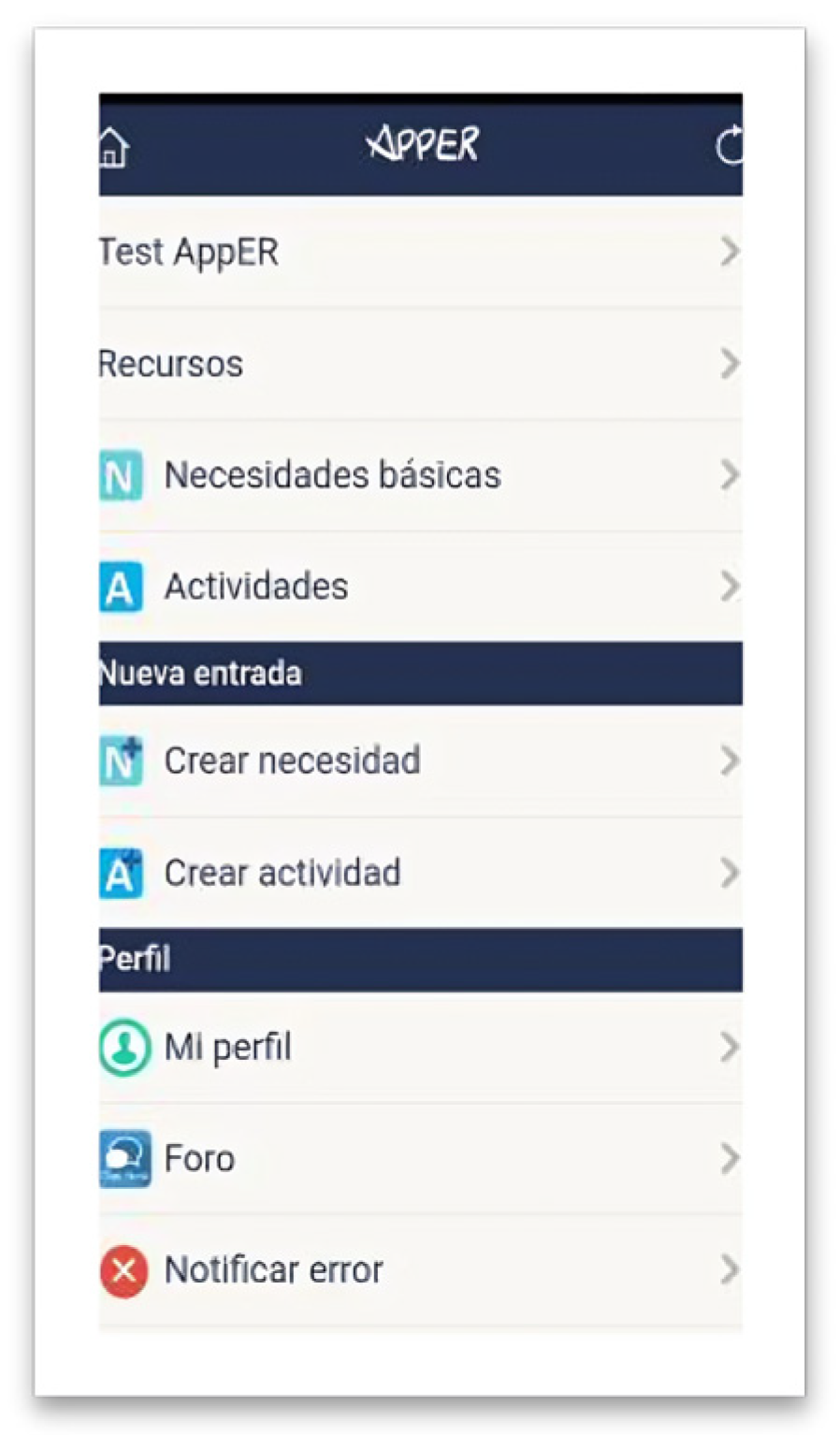
| Functionality | Description |
|---|---|
| AppER Test | Direct access to the Qualtrics platform to complete questionnaires that assess the app’s impact on quality of life. |
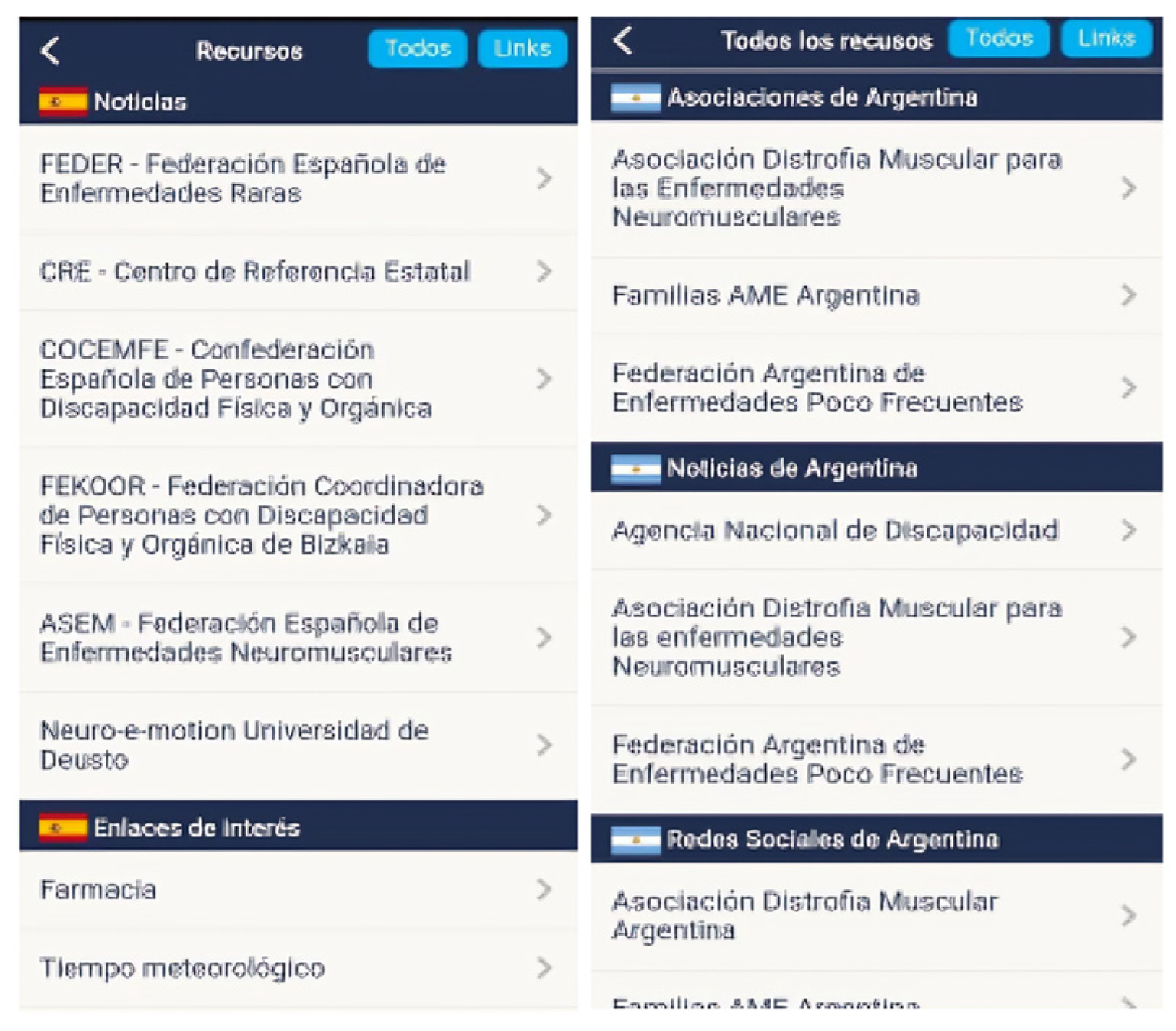
| Resources | Provides information on associations and other useful resources depending on the user’s country. |
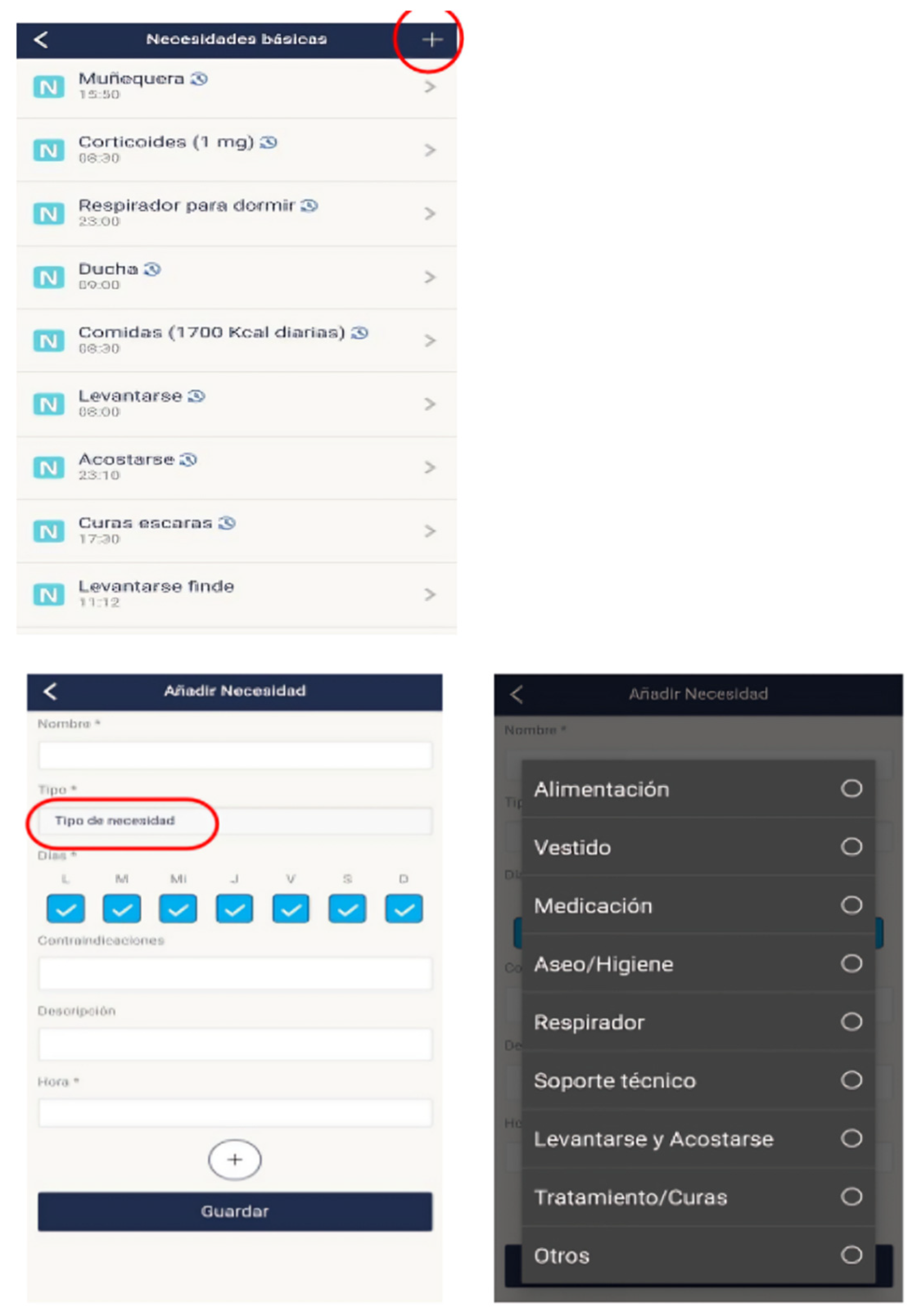
| Basic needs | Lists daily needs scheduled by the user, specifying the time for each one |
| Create need | Allows the user to customize new needs, indicating name, type, scheduled days, times, and special considerations. |
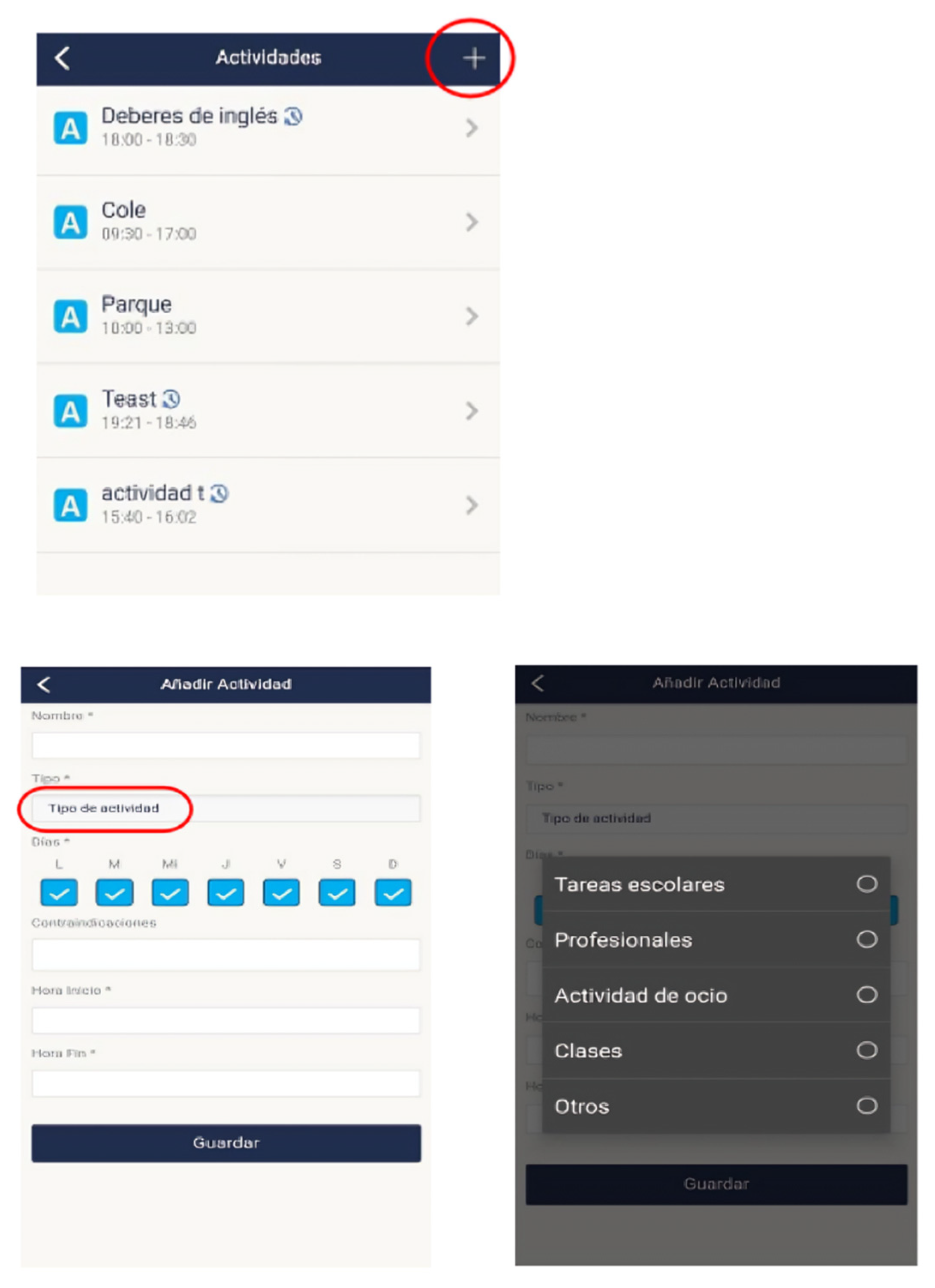
| Activities | A list of daily activities scheduled by the user, with specific times. |
| Create activities | Allows the user to add new activities, specifying name, type, scheduled days, times, and additional notes. |
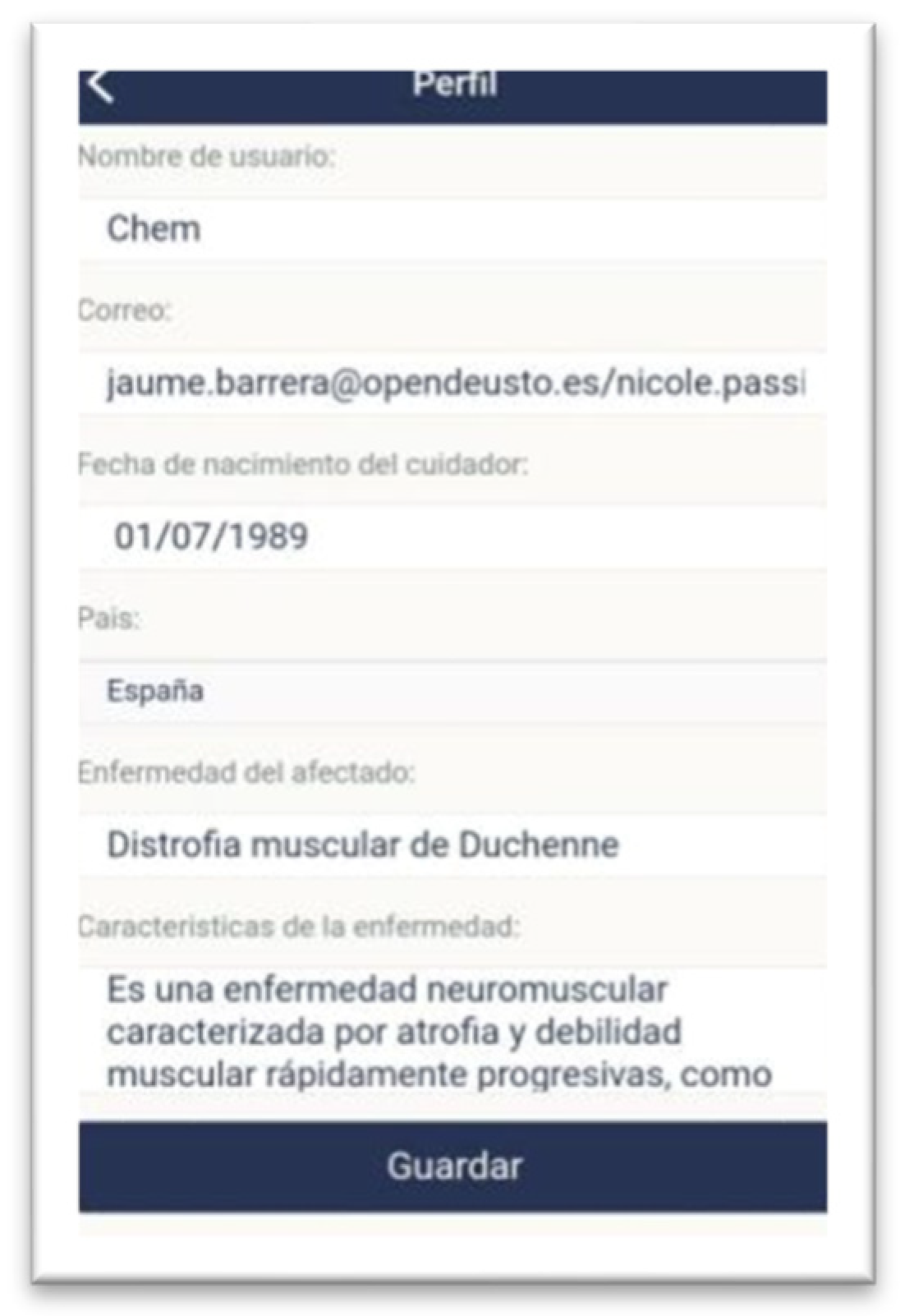
| My Profile | Contains personalized data such as name, email, patient’s birthdate, country of residence, patient’s disease, and additional disease details. |
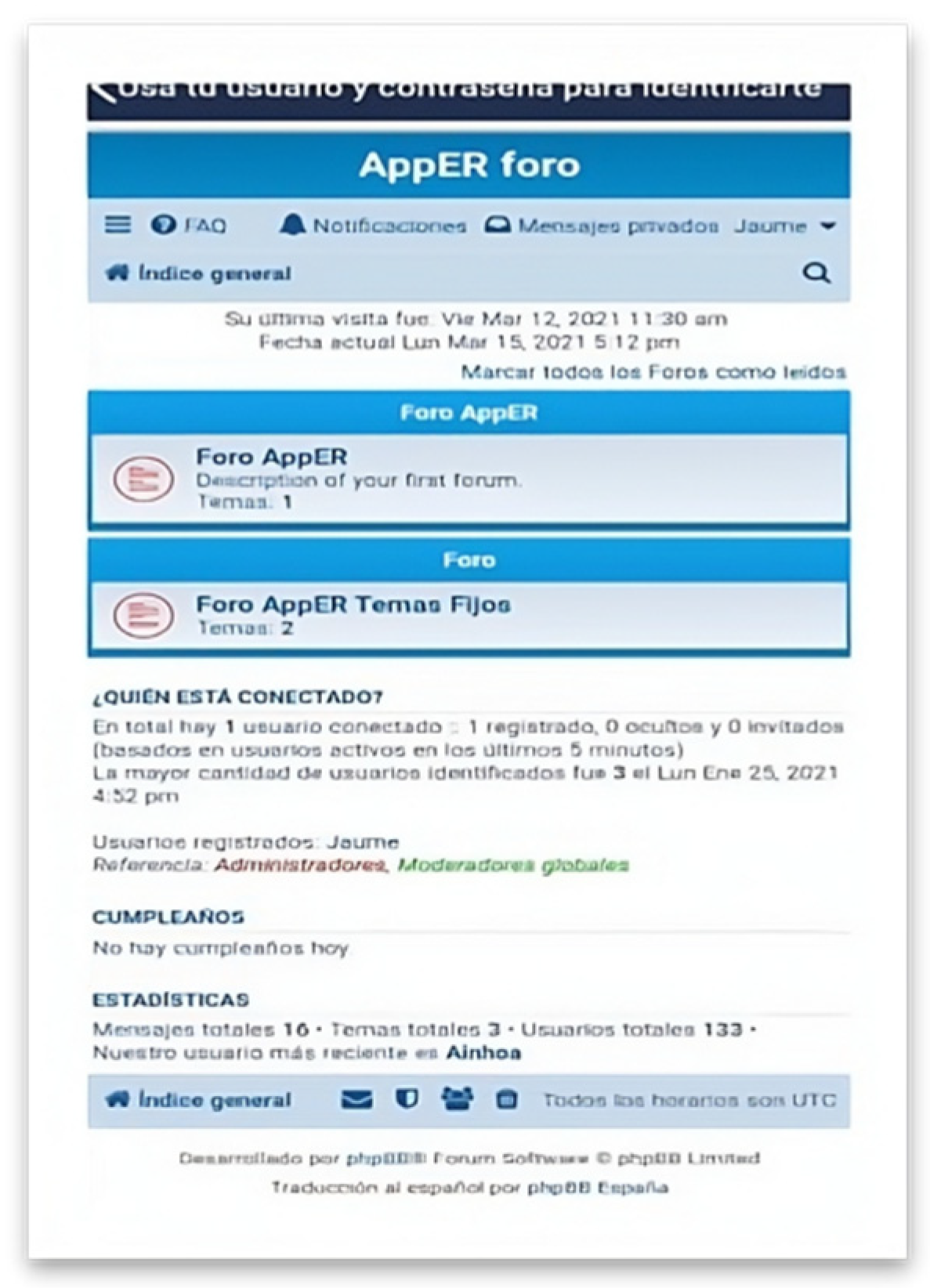
| Forum | Facilitates communication between caregivers to exchange experiences, with additional content provided by experts. |
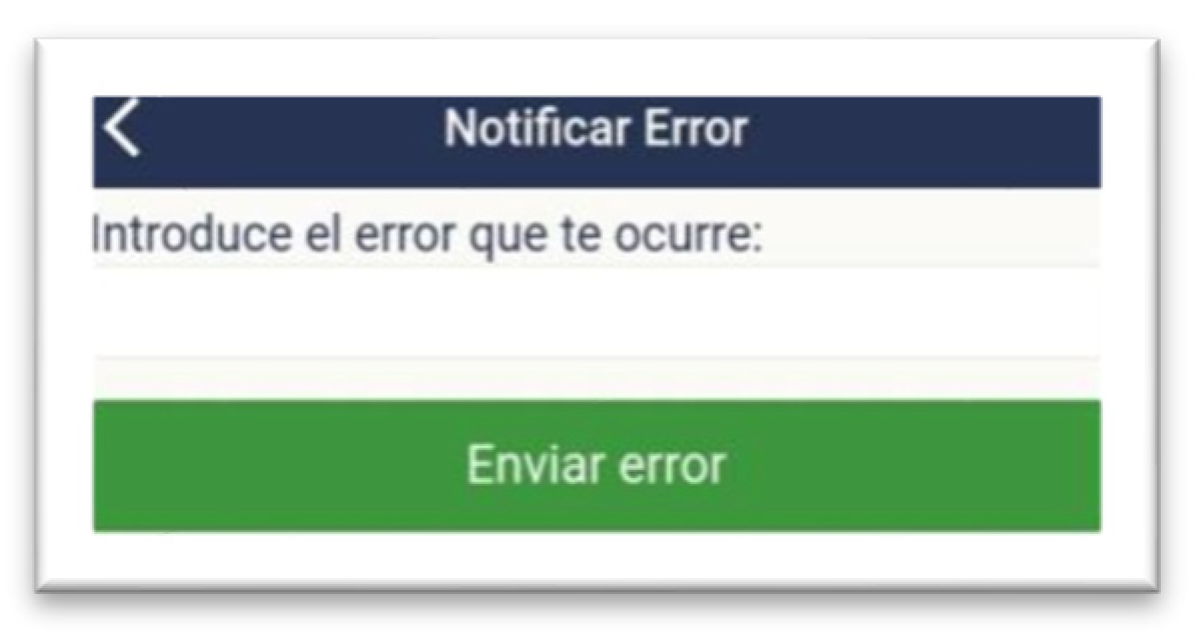
| Report error | Allows users to report potential app issues and provides a quick solution. |
Disclaimer/Publisher’s Note: The statements, opinions and data contained in all publications are solely those of the individual author(s) and contributor(s) and not of MDPI and/or the editor(s). MDPI and/or the editor(s) disclaim responsibility for any injury to people or property resulting from any ideas, methods, instructions or products referred to in the content. |
© 2025 by the authors. Licensee MDPI, Basel, Switzerland. This article is an open access article distributed under the terms and conditions of the Creative Commons Attribution (CC BY) license (https://creativecommons.org/licenses/by/4.0/).
Share and Cite
Barrera, J.; Amayra, I.; Contreras, D.; Rodríguez, A.A.; Passi, N.; Ortega, J.; Martínez, Ó. AppER: Design and Validation of a Mobile Application for Caregivers of Patients with Duchenne Muscular Dystrophy and Their Families in Spain and Latin America. Muscles 2025, 4, 43. https://doi.org/10.3390/muscles4040043
Barrera J, Amayra I, Contreras D, Rodríguez AA, Passi N, Ortega J, Martínez Ó. AppER: Design and Validation of a Mobile Application for Caregivers of Patients with Duchenne Muscular Dystrophy and Their Families in Spain and Latin America. Muscles. 2025; 4(4):43. https://doi.org/10.3390/muscles4040043
Chicago/Turabian StyleBarrera, Jaume, Imanol Amayra, David Contreras, Alicia Aurora Rodríguez, Nicole Passi, Javiera Ortega, and Óscar Martínez. 2025. "AppER: Design and Validation of a Mobile Application for Caregivers of Patients with Duchenne Muscular Dystrophy and Their Families in Spain and Latin America" Muscles 4, no. 4: 43. https://doi.org/10.3390/muscles4040043
APA StyleBarrera, J., Amayra, I., Contreras, D., Rodríguez, A. A., Passi, N., Ortega, J., & Martínez, Ó. (2025). AppER: Design and Validation of a Mobile Application for Caregivers of Patients with Duchenne Muscular Dystrophy and Their Families in Spain and Latin America. Muscles, 4(4), 43. https://doi.org/10.3390/muscles4040043