1. Introduction
The brain is responsible for cognition, sensory processing, motor control, and the regulation of vital physiological processes. It is a core component of the central nervous system (CNS), together with the spinal cord, and consists of billions of neurons and glial cells that transmit electrical and chemical signals to coordinate bodily functions [
1,
2]. Historically, its role has been interpreted through various metaphors, from mechanical devices to computational systems, reflecting shifts in scientific understanding [
3]. The term encephalon, derived from the Greek enkephalos meaning “within the head”, refers directly to the brain [
4,
5]. Early Greek scholars such as Alcmaeon of Croton and Plato recognized the brain’s central role in perception and intelligence, although others, like Aristotle, attributed primary control to the heart [
6,
7,
8,
9,
10].
In this work, we focus on three major neurological disorders—Alzheimer’s disease (AD), Parkinson’s disease (PD), and brain tumors—collectively referred to as Encephalon Diseases. These conditions cause structural and functional brain damage, severely impacting quality of life. AD is characterized by widespread neuronal death, particularly in the entorhinal cortex and hippocampus, leading to progressive memory loss and cognitive decline. PD results from the degeneration of dopamine-producing neurons in the basal ganglia, causing tremors, rigidity, and impaired motor coordination [
11]. Brain tumors encompass benign and malignant growths such as meningiomas, gliomas, and pituitary tumors, each affecting distinct brain regions and cell types [
12,
13,
14].
In our recent work [
15], we demonstrated how artificial intelligence (AI) methods can be used to diagnose a number of prevalent diseases and conditions affecting the brain. These include brain tumors, epilepsy, Parkinson’s disease, and dementia, particularly phases of Alzheimer’s disease. The most widely used dataset sources for brain research, neuropsychological testing, and brain imaging methods are then examined and separated into categories for open-access and proprietary datasets. The most popular performance metrics are discussed in the article’s conclusion.
Given the complexity of diagnosis, particularly from magnetic resonance imaging (MRI) scans, numerous studies have applied machine learning (ML) and deep learning (DL) techniques to automate classification tasks. Building upon this body of work, we propose the Encephalon Diseases Classifier, a multi-tier DL-based framework utilizing ResNet152-V2, EfficientNet-B0, DenseNet121, and VGG16 architectures. The framework performs hierarchical classification: first distinguishing normal from diseased MRI scans, then categorizing diseased cases into AD, PD, or brain tumors, and finally determining stage or subtype for AD and tumor cases. This approach aims to improve diagnostic accuracy, standardization, and scalability in medical image analysis.
2. Literature Review
Through our research, we focus on studying the use of AI techniques in the diagnosis of common brain diseases and disorders, such as dementia, especially the Alzheimer’s stage, Parkinson’s disease, and brain tumors.
2.1. Alzheimer’s Disease (AD) Studies
The study in [
16] evaluated the precision of machine learning in identifying dementia biomarkers in the Open Access Series of Imaging Studies (OASIS) database. Research on dementia is impacted by the correctness and imbalance of datasets. Unbalanced classes may be created and segmented by a neural network and reinforcement learning system. High-resolution sickness probability maps will be produced by accurately diagnosing dementia and taking into account its four stages. It expresses dementia illness risk precisely and understandably via deep reinforcement learning. To avoid imbalance, classes should be evenly represented in samples. The MRI image shows a class imbalance. Trial accuracy increased by 6%, precision by 9%, recall by 13%, and F-score by 9–10% with the Deep Reinforcement System. Diagnosis efficiency has also increased.
Effective machine learning algorithms were assessed for their capacity to diagnose dementia using OASIS, according to the authors in [
17]. Two convolutional neural network (CNN) models (AlexNet and ResNet-50) and hybrid deep learning and machine learning techniques (AlexNet+SVM and ResNet-50+SVM) were also evaluated for the identification of Alzheimer’s disease. After the OASIS dataset was balanced, the missing values were filled in, and the missing values were restored. All of the machine learning methods, including SVM, Decision Tree, Random Forest, and KNN, shown exceptional performance in diagnosing dementia. The precision, recall, and F1 scores for the Random Forest method were 93%, 98%, and 96%, respectively, with a total accuracy of 94%. The MRI image dataset, the second dataset, was examined using hybrid AlexNet+SVM and ResNet-50+SVM models, as well as AlexNet and ResNet-50 models. All models had excellent performance, but the hybrid approaches that combined deep learning and machine learning performed better overall. The hybrid AlexNet+SVM model scored 94.8%, 93%, 97.75%, and 99.70% for accuracy, recall, specificity, and AUC, respectively.
Researchers [
18] suggested utilizing a deep neural network to predict AD using MRI. Results from contemporary image classification networks with transfer learning, such as ResNet, VGG, and others, are promising. Pretrained versions of these networks perform better through transfer learning. A ResNet-based approach with many layers has been shown to perform effectively when predicting the various stages of the disease. The trials are conducted using the Kaggle dataset.
2.2. Brain Tumor Studies
In order to identify a tumor, the authors of the study reported in [
19] used brain MRI scans to build a CNN. The Softmax Fully Connected layer had a 98.67% classification accuracy. Additionally, the accuracy of the Radial Basis Function (RBF) classifier is 97.34%, whereas the Decision Tree (DT) classifier is 94.24%. Based on the data from the categorizers, the network accuracy on the picture testing showed that the Softmax classifier has the highest accuracy in CNN. This is a novel approach to brain imaging tumor identification that combines CNN with feature extraction techniques. The test’s accuracy, according to the study, was 99.12%.
In [
20], the authors proposed classifying tumors using multiple kernel-based probabilistic clustering and a deep learning classifier. The three parts of the proposed method are the segmentation, feature extraction, and classification modules. The median filter is employed in the de-noising process after the MRI image has been preprocessed to make it suitable for segmentation. Important characteristics will be selected for classification using Linear Discriminant Analysis (LDA) after feature extraction. With the highest values at 1, 0.85, and 0.94, respectively, the suggested approach yielded average recall, specificity, and accuracy values of 0.88, 0.80, and 0.83. Improved outcomes show the effectiveness of the recommended approach.
2.3. Parkinson’s Disease (PD) Studies
The authors of [
21] introduced a deep neural network-based model to classify Parkinson’s disease. Their suggested approach has a 94.87% accuracy rate in classifying people with the disease. Parkinsonism can be identified using the patient’s dataset. The following methods were also compared: Random Forest, K-Nearest Neighbor, Decision Tree, Classification and Regression Trees, Linear Discriminant Analysis, Support Vector Machine (SVM), Linear Regression, Logistic Regression, Multilayer Perceptron, and Naive Bayes.
The study by [
22] examines and contrasts computational intelligence techniques for PD detection. Classification facilitates quicker PD diagnosis and better treatment outcomes. Finding the optimal classification algorithm is challenging when dealing with local datasets. In order to ascertain which classifier is the most effective and precise for PD classification, this study evaluates Multilayer Perceptron, SVM, and K-Nearest Neighbor classifiers on the benchmark (voice) dataset. These classifiers make use of speech input datasets from the UCI machine learning library. The Levenberg–Marquardt algorithm was used by artificial neural network (ANN), which was the best classifier (95.89%).
The authors of [
23] shown that it is feasible to detect PD completely automatically from a single 1000 um area in sections that range from the frontal brain to the dorsal motor nucleus of the vagus nerve. Image processing and statistical methods are used to do this, with machine learning demonstrating improved accuracy. They demonstrated that it is feasible to do binary classification on high-resolution sections in a couple of minutes and to identify regions of interest for the pathologist to perform manual visual verification. They also demonstrated state-of-the-art PD detection (> 90% accuracy on single 1000 um regions).
Table 1 summaries the classification methods of Parkinson’s disease, brain tumors, and Alzheimer’s disease in previous studies.
3. Materials and Methods
3.1. Methodology: Encephalon Diseases Classifier
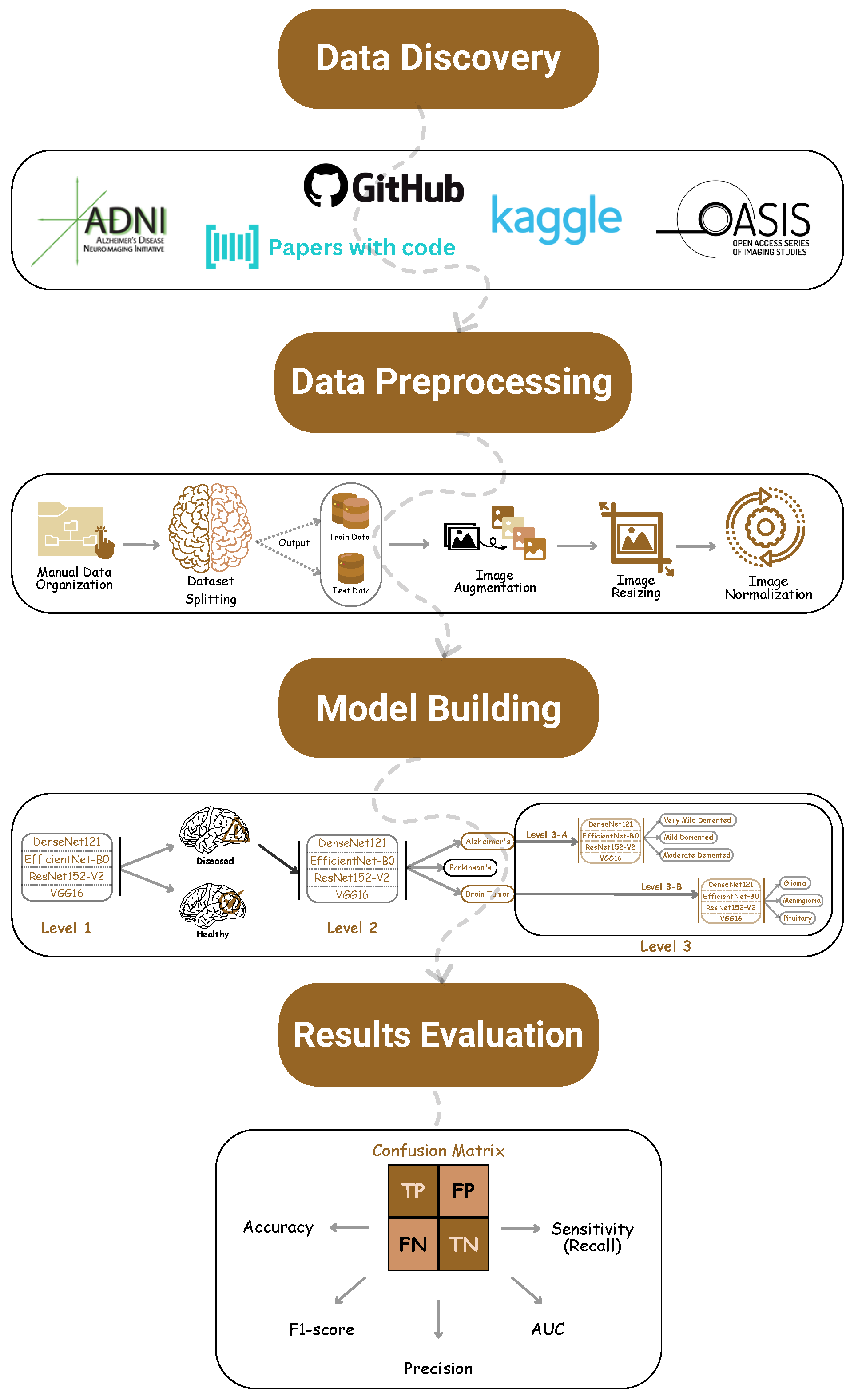
The proposed Encephalon Diseases Classifier, shown in
Figure 1, consists of four stages: (1) Data Discovery, (2) Data Preprocessing, (3) Model Building, and (4) Results Evaluation.
This method relies on training and testing four deep learning models on the Encephalon Dataset. All models were trained using the Adam optimizer and a batch size of 64 for 10, 20, 50, and 100 epochs. Categorical cross-entropy was used as the loss function. The training, testing, and evaluation were performed on Google Colab.
3.2. The Dataset Chosen
The proposed
Encephalon Dataset was constructed by merging three public MRI sources: the Augmented Alzheimer MRI Dataset [
24], which is an augmented version of the Alzheimer’s Dataset (4 classes of Images), Brain Tumor MRI Dataset [
25], and (NTUA) Parkinson’s Dataset [
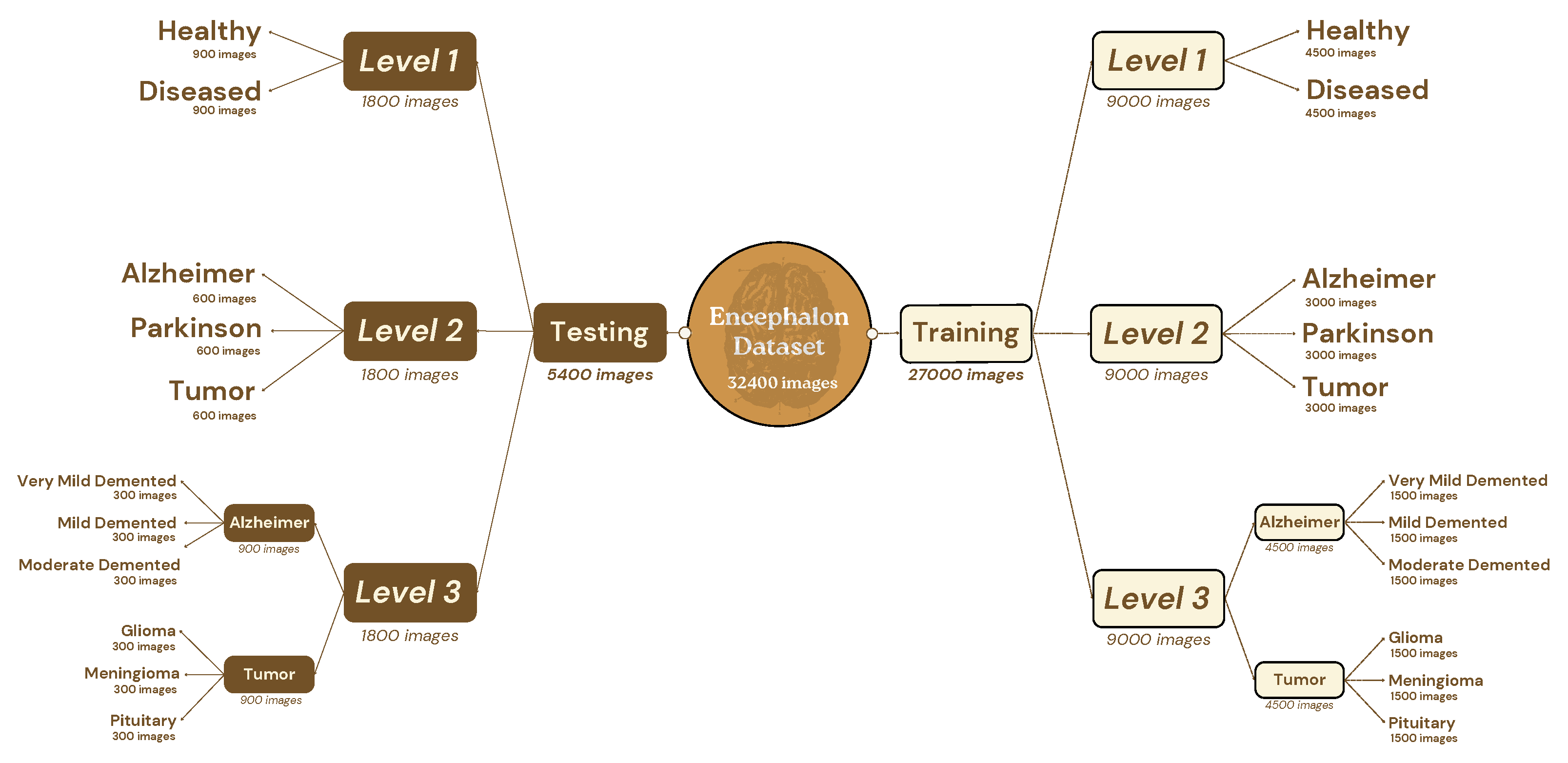
26], yielding 32,400 images split into training (83%) and testing (17%) sets. The hierarchical classification structure comprises Level 1—binary classification (healthy vs. diseased); Level 2—multi-class (Alzheimer’s, Parkinson’s, tumor); and Level 3—sub-class categorization for Alzheimer’s (
Mild_Demented,
Moderate_Demented,
Very_Mild_Demented) and tumors (
Glioma,
Meningioma,
Pituitary). Preprocessing removed irrelevant or duplicate images and enhanced balance through manual augmentation (rotation, flipping, contrast adjustment), ensuring dataset quality and consistency for model evaluation.
Figure 2 shows the hierarchical organization of this dataset and how many images are included in each class.
3.3. The Models Chosen
3.3.1. DenseNet121
DenseNet121, characterized by dense connectivity and bottleneck layers, was modified by removing the fully connected layer and adding 2D global average pooling, batch normalization, and dense and dropout layers. The final softmax layer matched the classification classes [
27]. The model was compiled with categorical cross-entropy and trained, totaling about 8.6 million parameters with 1.7 million trainable.
3.3.2. EfficientNet-B0
EfficientNet-B0, leveraging compound scaling for efficient and accurate classification, was adapted by adding global average pooling and a softmax dense output layer per classification level. Compiled with categorical cross-entropy, it was trained on the dataset, with roughly 4.2 million parameters and over 4.1 million trainable.
3.3.3. ResNet152-V2
ResNet152-V2, a deep residual network with pretrained weights, was extended by global average pooling and a softmax dense output layer matching class counts [
28]. After compilation with categorical cross-entropy, it was trained, containing about 58.3 million parameters and over 58 million trainable.
3.3.4. VGG-16
VGG-16, a 16-layer CNN with 3 × 3 convolutions and ReLU activations [
29], was customized by adding a flatten layer and a softmax dense output layer. The model was compiled with categorical cross-entropy and trained, with around 14.8 million parameters, mostly non-trainable.
3.4. Evaluation Metrics
In classification tasks, model performance is commonly evaluated using a confusion matrix, which summarizes correct and incorrect predictions for each class [
30]. For binary classification, the matrix consists of four outcomes—True Positives (TPs), True Negatives (TNs), False Positives (FPs), and False Negatives (FNs). We will use the following performance metrics to evaluate our proposed model:
Accuracy (Acc) represents the overall proportion of correctly classified samples and is computed as follows:
Precision (Pre) measures the fraction of predicted positive samples that are actually positive:
The Area Under the ROC Curve (AUC) quantifies the classifier’s ability to distinguish between classes, ranging from 0 (completely incorrect) to 1 (perfect prediction) [
31].
Recall, or sensitivity/True Positive Rate (TPR), measures the proportion of actual positives correctly identified:
The F1 score is the harmonic mean of precision and recall, providing a balanced performance metric:
4. Results
We implemented four models for the proposed multilevel brain disease classification framework and evaluated them in two scenarios: the highest validation accuracy (HVA), representing the epoch with the highest validation accuracy throughout the entire model execution process, and the last validation accuracy (LVA), specifically representing the final epoch of that process. The results are analyzed by comparing the performance metrics of the four models across all classification levels in both scenarios. This comparison helps identify the most suitable model for the framework. Notably, some models achieved high accuracy in certain levels but underperformed in others; these variations are examined to highlight strengths and weaknesses at different classification stages.
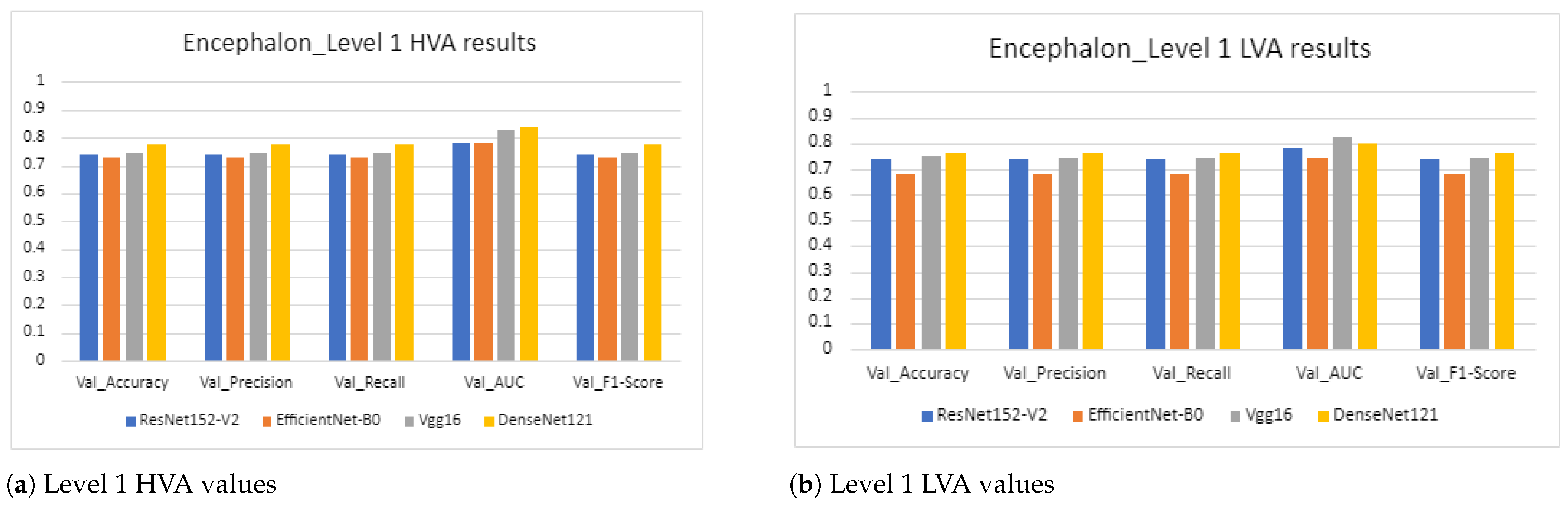
The Level 1 results are presented in
Figure 3. The bar charts indicate that DenseNet121 and VGG16 achieved the highest performance across all metrics for both HVA and LVA cases. DenseNet121 obtained the best results, with Val_Accuracy values of 77.39% in the HVA case and 75.94% in the LVA case. VGG16 ranked second, reaching 74.70% Val_Accuracy in both cases. In contrast, EfficientNet-B0 recorded the lowest performance among all models for this classification level in both scenarios.
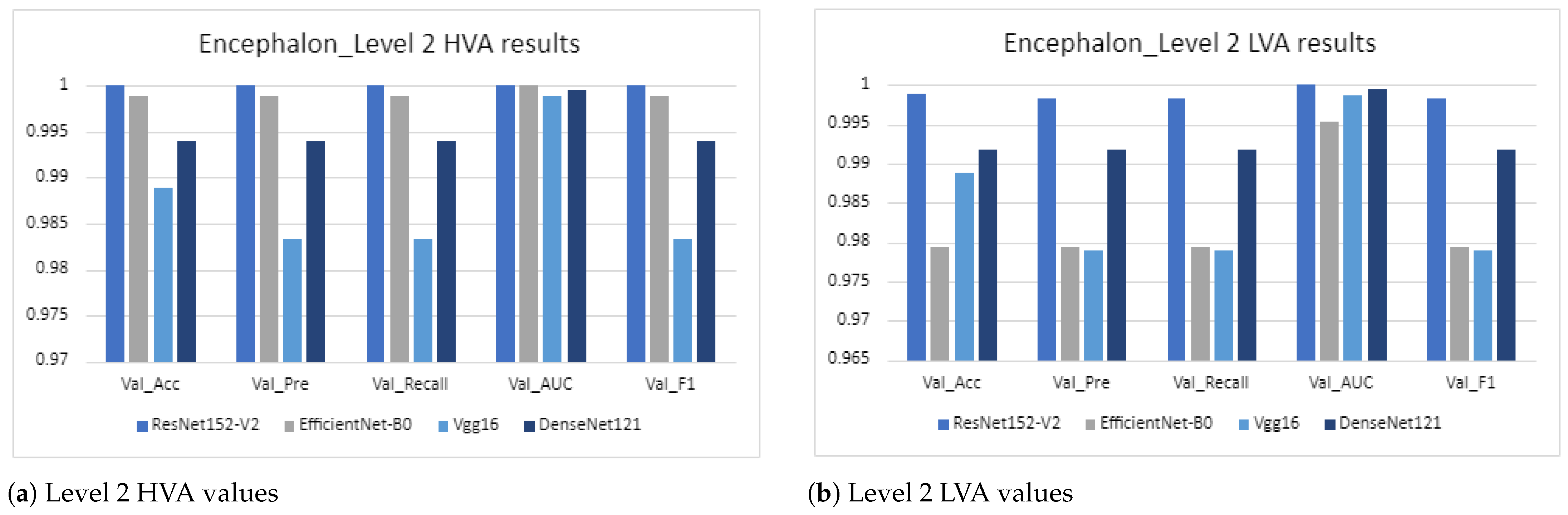
The Level 2 results are illustrated in
Figure 4. The bar charts show that ResNet152-V2 and EfficientNet-B0 achieved the highest performance across all metrics in the HVA case, while in the LVA case, DenseNet121 followed ResNet152-V2. ResNet152-V2 attained the best results for both cases, with 100% Val_Accuracy in HVA and 99.89% in LVA. In the HVA case, EfficientNet-B0 ranked second with 99.89% Val_Accuracy, whereas in the LVA case, DenseNet121 achieved second place with 99.17% Val_Accuracy. Notably, in HVA, VGG16 recorded the lowest performance, while in LVA, EfficientNet-B0 had the weakest results.
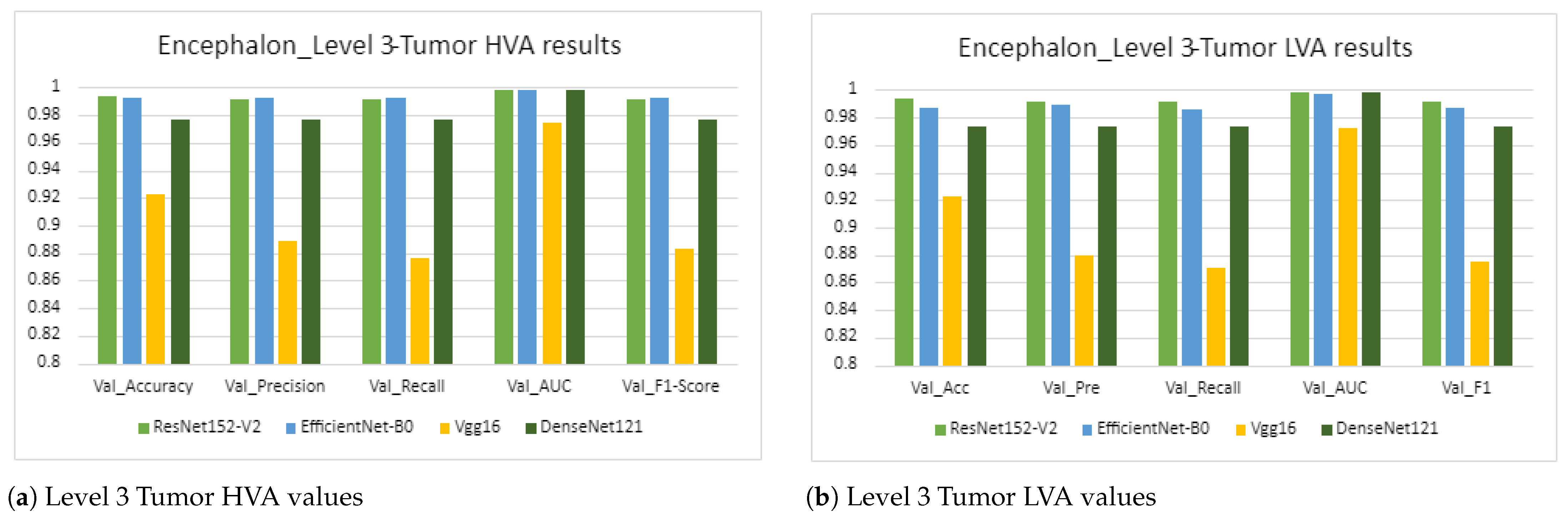
Level 3 tumor is presented in
Figure 5. For both HVA and LVA cases, ResNet152-V2 and EfficientNet-B0 achieved the highest performance across all metrics, with ResNet152-V2 obtaining 99.41% Val_Accuracy in both cases. VGG16 recorded the lowest performance at this classification level in both scenarios.
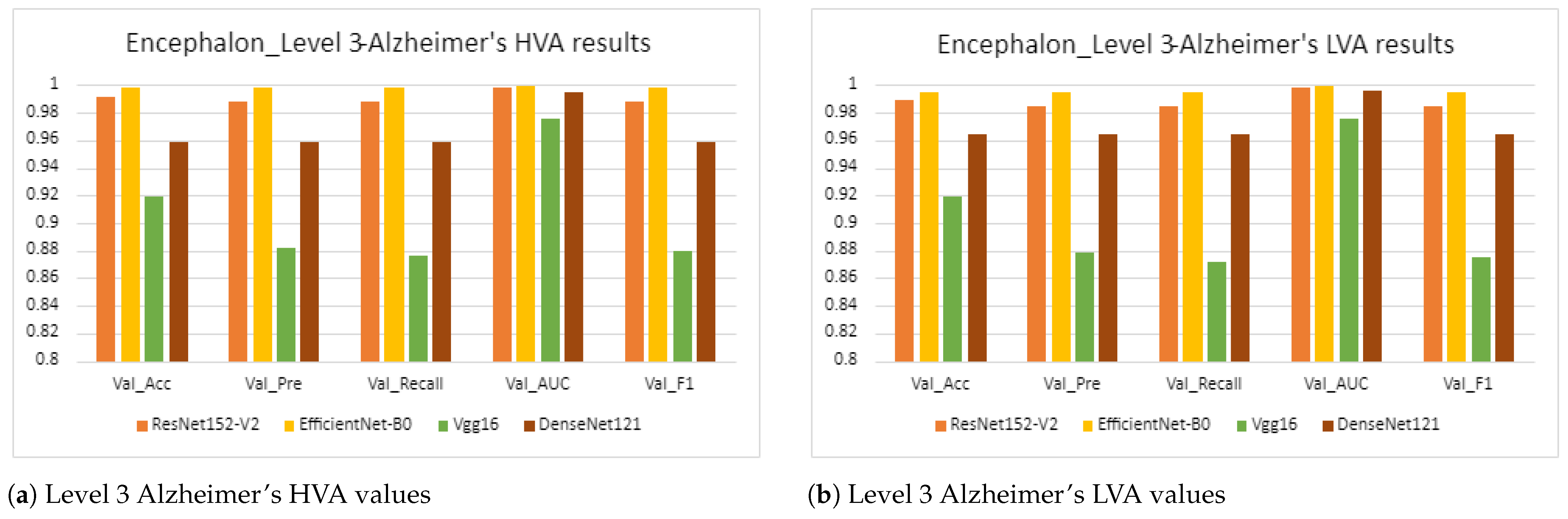
Figure 6 depicts Level 3 Alzheimer’s disease. Here, EfficientNet-B0 and ResNet152-V2 achieved the best results for both HVA and LVA cases. EfficientNet-B0 led with 99.78% Val_Accuracy in HVA and 99.44% in LVA, while VGG16, again, showed the lowest performance in both scenarios.
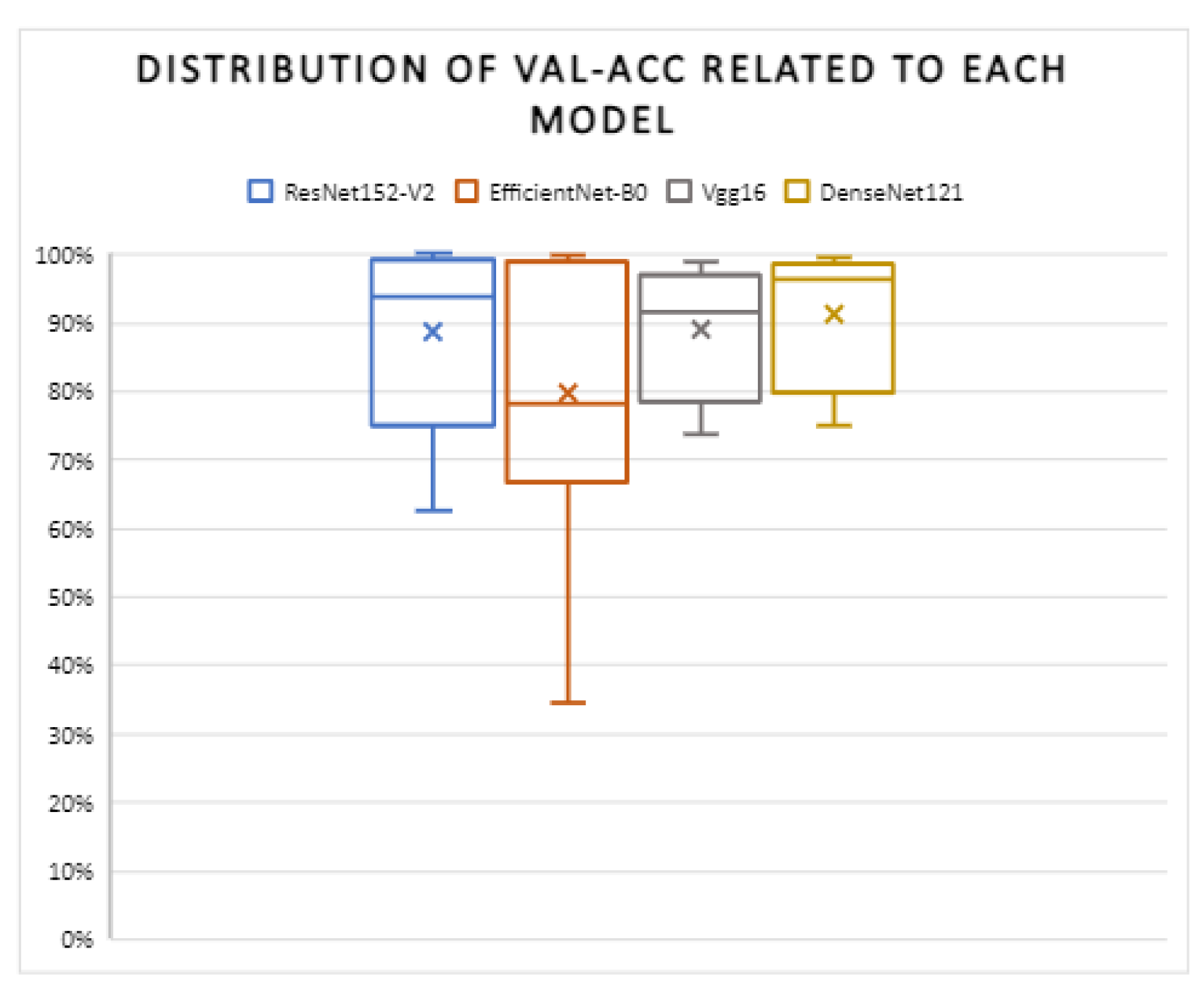
To highlight the variation in the performance among these models,
Figure 7 presents a boxplot comparing the validation accuracy of all four models.
ResNet152-V2: Highest Val_Accuracy of 100%, lowest of 75%, outlier at 63%, and a mean of approximately 89%.
EfficientNet-B0: Highest Val_Accuracy of 100%, lowest of 67%, outlier at 34%, and a mean of 80%.
VGG16: Highest Val_Accuracy of 98%, lowest of 79%, outlier at 74%, and a mean of approximately 89%.
DenseNet121: Highest Val_Accuracy of 99%, lowest of 80%, outlier at 75%, and a mean of 91%.
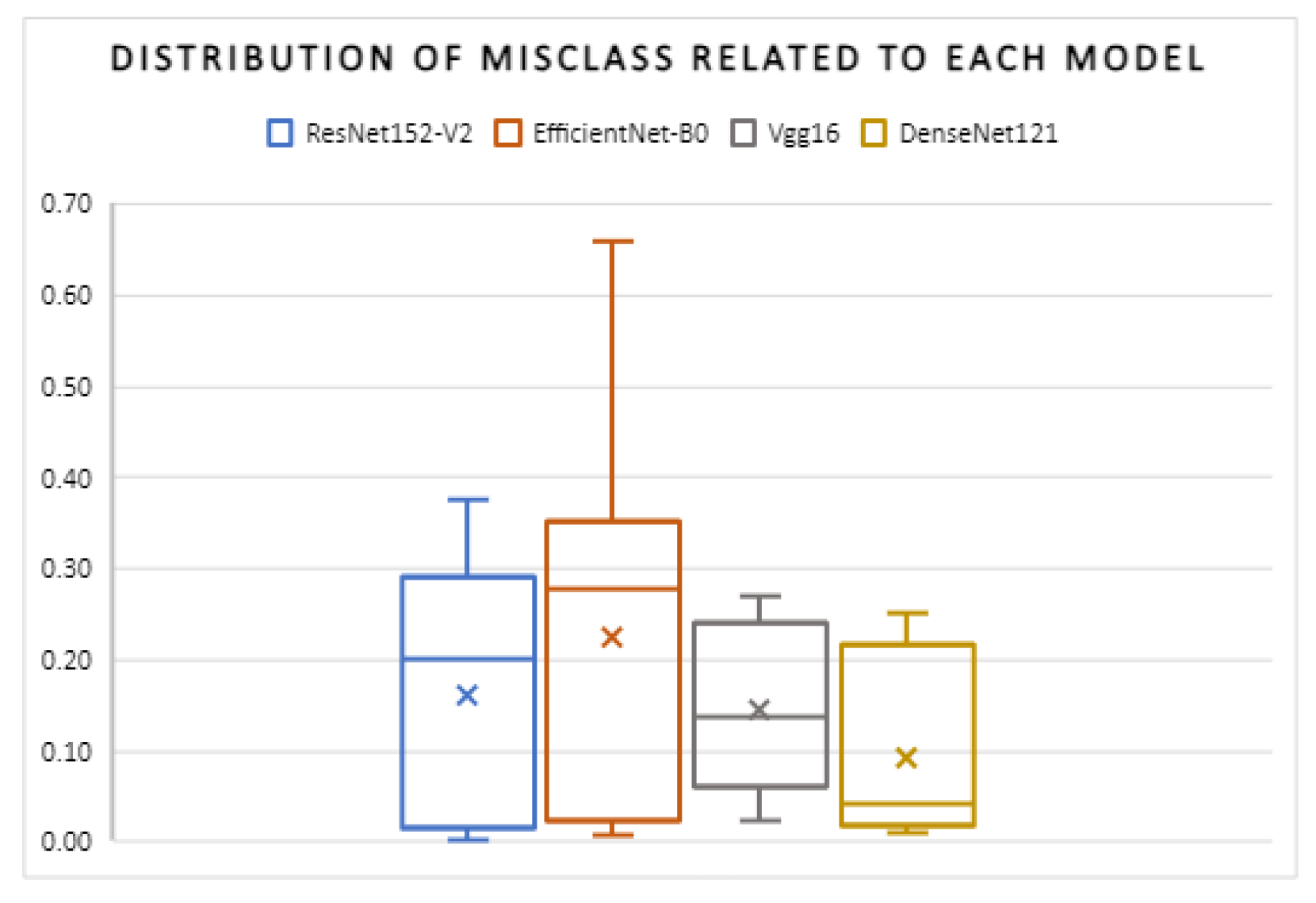
For misclassification rates,
Figure 8 shows the distribution for each model, where lower values indicate better performance.
ResNet152-V2: Lowest misclass of 0.00, highest of 0.29, outlier at 0.37, and a mean of 0.16.
EfficientNet-B0: Lowest misclass of 0.01, highest of 0.35, outlier at 0.66, and a mean of 0.22.
VGG16: Lowest misclass of 0.02, highest of 0.24, outlier at 0.27, and a mean of 0.14.
DenseNet121: Lowest misclass of 0.01, highest of 0.22, outlier at 0.25, and a mean of 0.09.
Overall, the findings indicate that ResNet152-V2 achieved the best performance across accuracy, precision, recall, AUC, and F1 score. It was followed by EfficientNet-B0, and then DenseNet121 with comparable results across the three classification levels. The VGG16 model consistently recorded the lowest performance.
All source codes for the framework models implemented in this study are available in the referenced GitHub repository [
32].
5. Discussion
In this section, a comparison is presented between the proposed work and previous studies related to the selected brain diseases, as discussed in the literature review. The comparison focuses on studies that employed the same datasets used in this work or that addressed diseases similar to those considered herein.
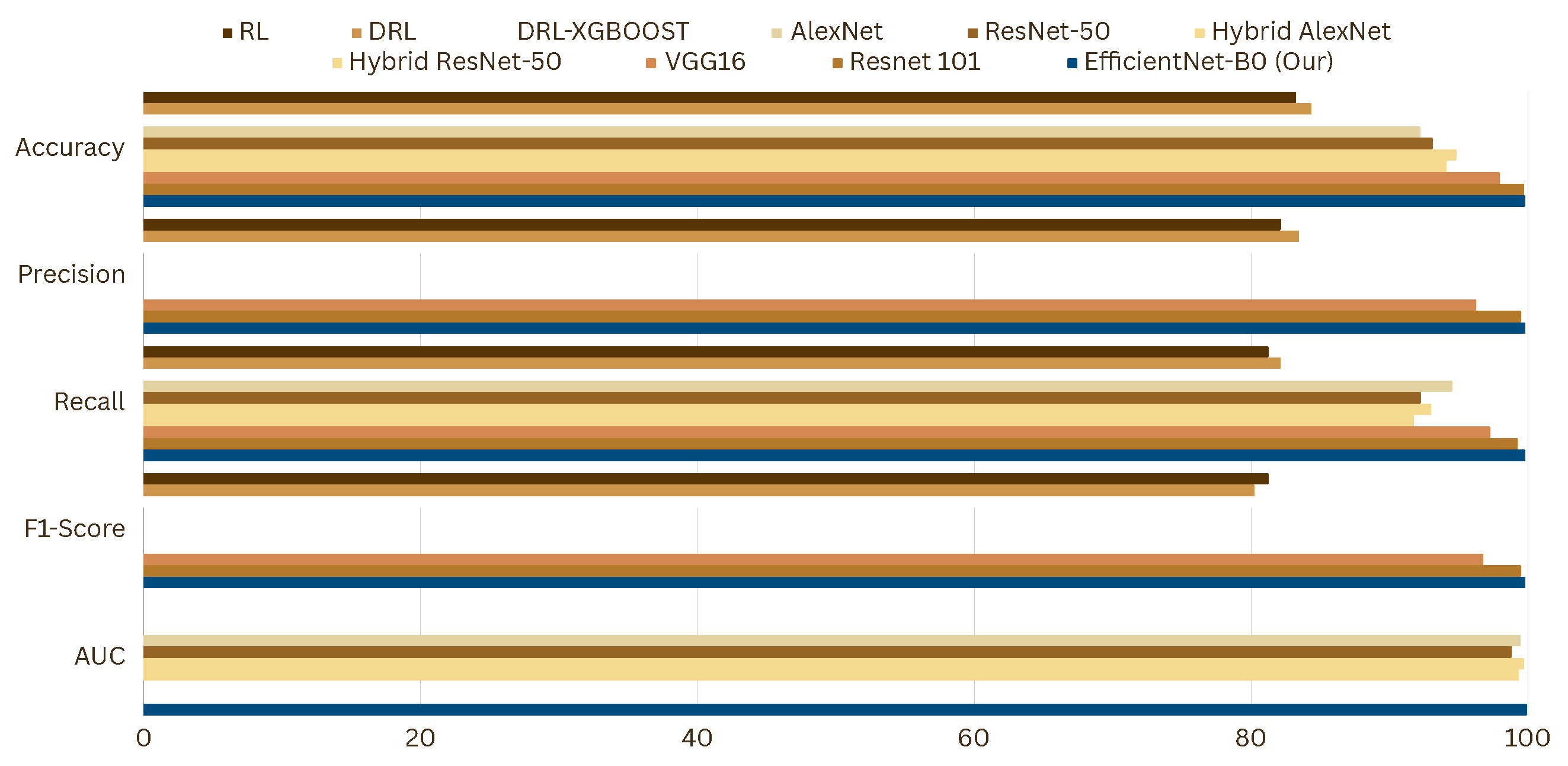
Table 2 summarizes the performance reported in several references for Alzheimer’s disease classification, alongside the best results obtained by the proposed model, EfficientNet-B0, using the same dataset,
Alzheimer’s Dataset (4 Classes of Images).
Figure 9 illustrates a bar chart comparing the performance metrics of our model with those from the referenced studies. The results demonstrate that the proposed model outperformed all prior works, achieving 99.78% in validation accuracy, precision, recall, and F1 score, along with an AUC of 99.91%.
For brain tumor classification,
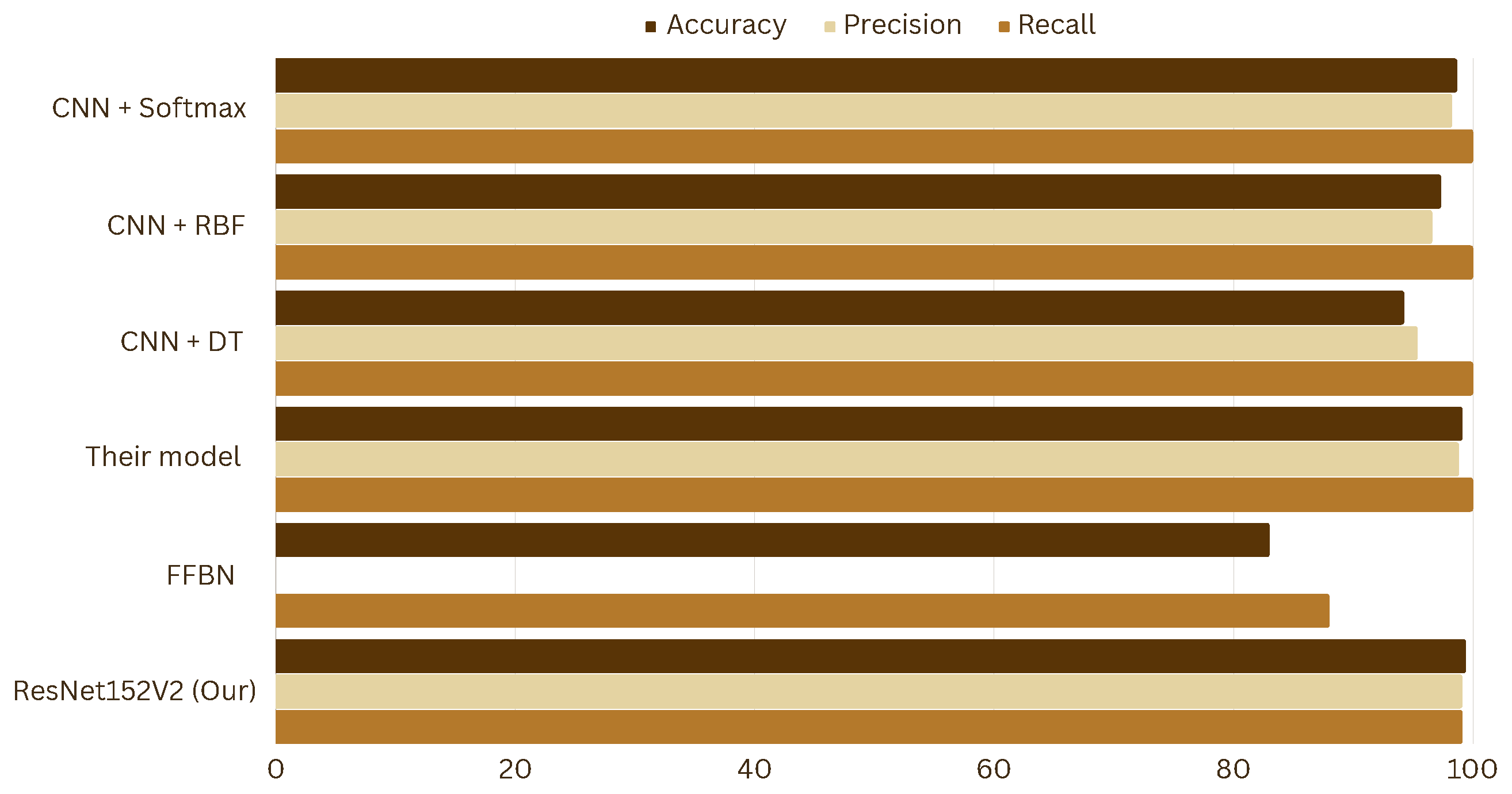
Table 3 presents a comparison between the results reported in previous studies and the best performance achieved by our model, ResNet152-V2, using the same dataset,
Brain Tumor MRI Dataset.
Figure 10 provides a bar chart illustrating the performance metrics of our model alongside those from prior works listed in
Table 3. The proposed model achieved superior accuracy (99.42%) and precision (99.11%) compared to all referenced studies. However, one prior work reported a perfect recall of 100%, which exceeded the recall obtained by our model. Since F1 score and AUC values were not reported in the earlier studies, these metrics were excluded from the comparison.
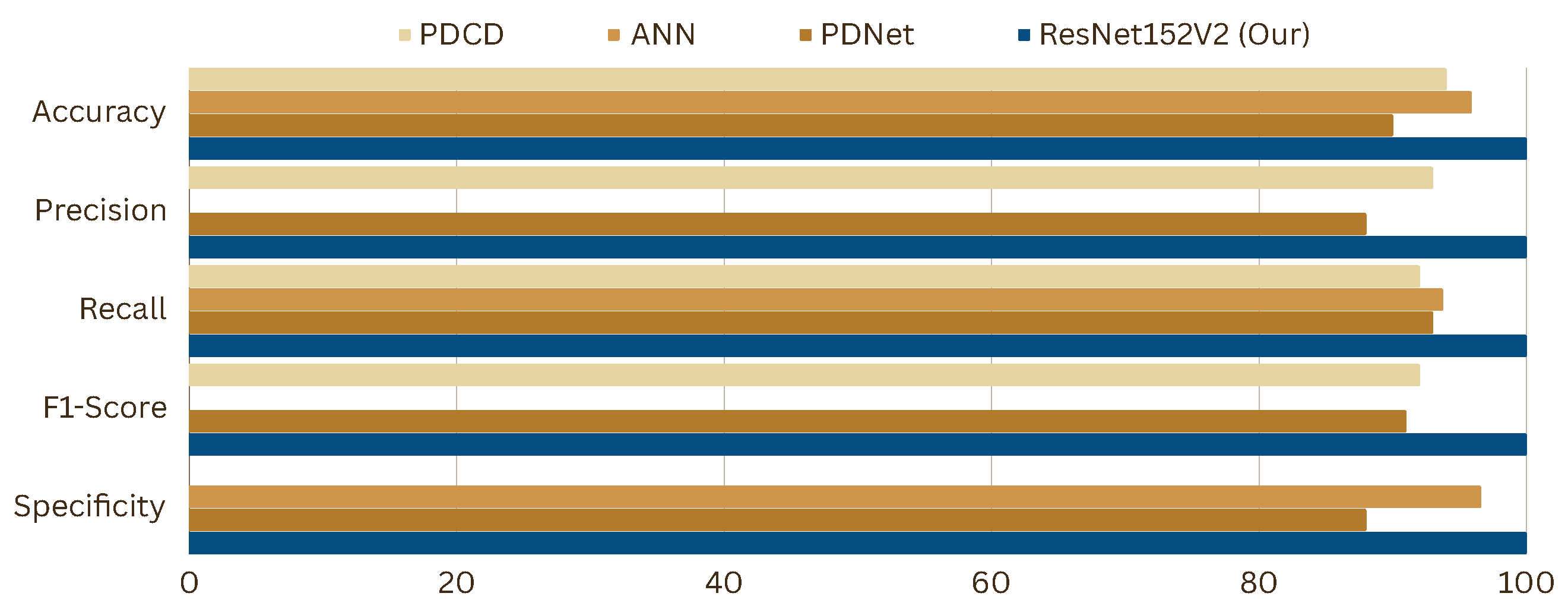
Table 4 compares Parkinson’s disease classification results from three previous studies with those obtained by our ResNet152-V2 model across multiple datasets.
Figure 11 presents a bar chart contrasting the performance metrics of our model against the prior works listed in
Table 4. The proposed model outperformed all others, achieving 100% in accuracy, precision, recall, F1 score, and specificity. Since the previous studies did not report AUC, it was excluded from this comparison.
All source codes for the framework models implemented in this study are available in the referenced GitHub repository [
32].
6. Conclusions
This study provided a comprehensive understanding of brain disorders and emphasized the importance of advanced diagnostic tools that support medical professionals in achieving accurate and early diagnoses. We proposed, implemented, and evaluated the Encephalon Diseases Classifier framework using the Encephalon Dataset, which includes cases of Alzheimer’s disease, Parkinson’s disease, and brain tumors. The framework incorporated four deep learning models—DenseNet121, EfficientNet-B0, ResNet152-V2, and VGG-16—trained and tested across multiple classification levels. In Level 2 classification, the ResNet152-V2 model achieved a 100% validation (testing) accuracy, while the EfficientNet-B0 model attained a 100% training accuracy. These results demonstrate that each model exhibits distinct strengths at different levels of disease classification, underscoring deep learning techniques’ potential to improve the precision of brain disorder diagnosis.
Author Contributions
Conceptualization, L.M.S.A. (Leidi M. Saleh Aouto), L.M.S.A. (Lin M. Saleh Aouto), R.K.F. and D.M.I.; methodology, L.M.S.A. (Leidi M. Saleh Aouto), L.M.S.A. (Lin M. Saleh Aouto) and R.K.F.; software, L.M.S.A. (Leidi M. Saleh Aouto), L.M.S.A. (Lin M. Saleh Aouto) and R.K.F.; validation, L.M.S.A. (Leidi M. Saleh Aouto), L.M.S.A. (Lin M. Saleh Aouto) and R.K.F.; formal analysis, L.M.S.A. (Leidi M. Saleh Aouto), L.M.S.A. (Lin M. Saleh Aouto) and R.K.F.; investigation, L.M.S.A. (Leidi M. Saleh Aouto), L.M.S.A. (Lin M. Saleh Aouto) and R.K.F.; resources, L.M.S.A. (Leidi M. Saleh Aouto) and L.M.S.A. (Lin M. Saleh Aouto); data curation, L.M.S.A. (Leidi M. Saleh Aouto) and L.M.S.A. (Lin M. Saleh Aouto); writing—original draft preparation, L.M.S.A. (Leidi M. Saleh Aouto), L.M.S.A. (Lin M. Saleh Aouto) and R.K.F.; writing—review and editing, D.M.I., L.M.S.A. (Leidi M. Saleh Aouto) and L.M.S.A. (Lin M. Saleh Aouto); visualization, L.M.S.A. (Leidi M. Saleh Aouto), L.M.S.A. (Lin M. Saleh Aouto), R.K.F. and D.M.I.; supervision, D.M.I.; project administration, D.M.I.; funding acquisition, none. All authors have read and agreed to the published version of the manuscript.
Funding
This research received no external funding.
Institutional Review Board Statement
Not applicable.
Informed Consent Statement
Not applicable.
Data Availability Statement
Conflicts of Interest
The authors declare no conflicts of interest.
Abbreviations
The following abbreviations are used in this manuscript:
| AD | Alzheimer’s disease |
| AI | Artificial intelligence |
| ANN | Artificial neural network |
| CNN | Convolutional neural network |
| CNS | Central nervous system |
| DL | Deep learning |
| DT | Decision tree |
| HVA | Highest validation accuracy |
| LDA | Linear discriminant analysis |
| LVA | Last validation accuracy |
| ML | Machine learning |
| MRI | Magnetic resonance imaging |
| OASIS | Open Access Series of Imaging Studies |
| PD | Parkinson’s disease |
| RBF | Radial basis function |
| SVM | Support vector machine |
References
- Brain Basics: Know Your Brain. Available online: https://www.ninds.nih.gov/health-information/public-education/brain-basics/brain-basics-know-your-brain (accessed on 16 October 2025).
- Brain Anatomy and How the Brain Works. Available online: https://www.hopkinsmedicine.org/health/conditions-and-diseases/anatomy-of-the-brain (accessed on 16 October 2025).
- Malabou, C. What Should We Do with Our Brain? Fordham Univ Press: New York, NY, USA, 2009. [Google Scholar]
- Introducing the Brain. Available online: https://www.ruf.rice.edu/~lngbrain/cglidden/ (accessed on 16 October 2025).
- Dictionary. Available online: https://www.collinsdictionary.com/dictionary/english/encephalon (accessed on 16 October 2025).
- The Works of Alcmaeon of Croton. Available online: https://www.world-medicinehistory.com/2018/09/alcmaeon-of-croton.html (accessed on 16 October 2025).
- What Is the Philosophy of Plato? Available online: https://www.languagehumanities.org/what-is-the-philosophy-of-plato.htm (accessed on 16 October 2025).
- Greek Archaeologist. Available online: https://www.nytimes.com/2016/05/27/world/europe/greece-aristotle-tomb.html (accessed on 16 October 2025).
- The History of Neorosience. Available online: https://historyofneuroscience.umwblogs.org/ (accessed on 16 October 2025).
- A History of the Brain. Available online: https://web.stanford.edu/class/history13/earlysciencelab/body/brainpages/brain.html (accessed on 16 October 2025).
- Parkinson’s Disease: Causes, Symptoms, and Treatments. Available online: https://www.nia.nih.gov/health/parkinsons-disease (accessed on 16 October 2025).
- GLIOMAS, MENINGIOMAS Locations. Available online: https://onsmd.com/condition/brain-tumors/ (accessed on 16 October 2025).
- Tariq, Z.B.; Iyengar, A.; Marcuse, L.; Su, H.; Yener, B. Patient-specific seizure prediction using single seizure electroencephalography recording. In AI for Disease Surveillance and Pandemic Intelligence; Shaban-Nejad, A., Michalowski, M., Bianco, S., Eds.; W3PHAI 2021, Studies in Computational Intelligence; Springer: Cham, Switzerland, 2022; Volume 1013, pp. 295–308. [Google Scholar]
- Zhang, Z.; Li, X.; Geng, F.; Huang, K. A Semi-Supervised Few-Shot Learning Model for Epileptic Seizure Detection. In Proceedings of the 2021 43rd Annual International Conference of the IEEE Engineering in Medicine & Biology Society (EMBC), Guadalajara, Mexico, 1–5 November 2021; pp. 600–603. [Google Scholar]
- Aouto, L.M.S.; Aouto, L.M.S.; Flifel, R.K.; Ibrahim, D.M. A comprehensive review of brain diseases classification using deep learning techniques. In International Conference on Innovation of Emerging Information and Communication Technology; Springer Nature: Cham, Switzerland, 2023; pp. 389–425. [Google Scholar]
- Hashmi, A.; Barukab, O. Dementia Classification Using Deep Reinforcement Learning for Early Diagnosis. Appl. Sci. 2023, 13, 1464. [Google Scholar] [CrossRef]
- Mohammed, B.A.; Senan, E.M.; Rassem, T.H.; Makbol, N.M.; Alanazi, A.A.; Al-Mekhlafi, Z.G.; Almurayziq, T.S.; Ghaleb, F.A. Multi-method analysis of medical records and MRI images for early diagnosis of dementia and Alzheimer’s disease based on deep learning and hybrid methods. Electronics 2021, 10, 2860. [Google Scholar] [CrossRef]
- Subramoniam, M.; Aparna, T.R.; Anurenjan, P.R.; Sreeni, K.G. Deep learning-based prediction of Alzheimer’s disease from magnetic resonance images. In Intelligent Vision in Healthcare; Springer Nature: Singapore, 2022; pp. 145–151. [Google Scholar]
- Siar, M.; Teshnehlab, M. Brain tumor detection using deep neural network and machine learning algorithm. In Proceedings of the 2019 9th International Conference on Computer and Knowledge Engineering (ICCKE), Mashhad, Iran, 24–25 October 2019; pp. 363–368. [Google Scholar]
- Rathi, V.P.G.P.; Palani, S. Brain tumor detection and classification using deep learning classifier on MRI images. Res. J. Appl. Sci. Eng. Technol. 2015, 10, 177–187. [Google Scholar]
- Jyotiyana, M.; Kesswani, N.; Kumar, M. A deep learning approach for classification and diagnosis of Parkinson’s disease. Soft Comput. 2022, 26, 9155–9165. [Google Scholar] [CrossRef]
- Pahuja, G.; Nagabhushan, T.N. A comparative study of existing machine learning approaches for Parkinson’s disease detection. IETE J. Res. 2021, 67, 4–14. [Google Scholar] [CrossRef]
- Pearce, B.; Coetzee, P.; Rowland, D.; Linfoot, S.; Dexter, D.T.; Gveric, D.; Gentleman, S. Automatic Sample Segmentation & Detection of Parkinson’s Disease Using Synthetic Staining & Deep Learning. bioRxiv 2022. [Google Scholar] [CrossRef]
- Augmented Alzheimer MRI Dataset. Available online: https://www.kaggle.com/datasets/uraninjo/augmented-alzheimer-mri-dataset (accessed on 16 October 2025).
- Brain Tumor MRI Dataset. Available online: https://www.kaggle.com/datasets/masoudnickparvar/brain-tumor-mri-dataset (accessed on 16 October 2025).
- Tagaris, A.; Kollias, D.; Stafylopatis, A.; Tagaris, G.; Kollias, S. Machine Learning for Neurodegenerative Disorder Diagnosis—Survey of Practices and Launch of Benchmark Dataset. Int. J. Artif. Intell. Tools 2018, 27, 1850011. [Google Scholar] [CrossRef]
- Implementing DenseNet-121 in PyTorch. Available online: https://medium.com/deepkapha-notes/implementing-densenet-121-in-pytorch-a-step-by-step-guide-c0c2625c2a60 (accessed on 16 October 2025).
- Softmax Activation Function with Python. Available online: https://machinelearningmastery.com/softmax-activation-function-with-python/ (accessed on 16 October 2025).
- Loukadakis, M.; Cano, J.; O’Boyle, M. Accelerating Deep Neural Networks on Low Power Heterogeneous Architectures. In Proceedings of the 11th International Workshop on Programmability and Architectures for Heterogeneous Multicores (MULTIPROG-2018), Manchester, UK, 24 January 2018. [Google Scholar]
- Confusion Matrix. Available online: https://towardsdatascience.com/confusion-matrix-for-your-multi-class-machine-learning-model-ff9aa3bf7826 (accessed on 16 October 2025).
- Classification: ROC Curve and AUC. Available online: https://developers.google.com/machine-learning/crash-course/classification/roc-and-auc (accessed on 16 October 2025).
- Encephalon-Diseases-Classification. Available online: https://github.com/LeenAouto/Encephalon-Diseases-Classification (accessed on 16 October 2025).
| Disclaimer/Publisher’s Note: The statements, opinions and data contained in all publications are solely those of the individual author(s) and contributor(s) and not of MDPI and/or the editor(s). MDPI and/or the editor(s) disclaim responsibility for any injury to people or property resulting from any ideas, methods, instructions or products referred to in the content. |
© 2026 by the authors. Licensee MDPI, Basel, Switzerland. This article is an open access article distributed under the terms and conditions of the Creative Commons Attribution (CC BY) license (https://creativecommons.org/licenses/by/4.0/).