
Proceeding Paper

Deep Learning Approaches to Chronic Venous Disease Classification †

by
Ankur Goyal
1,*,
Vikas Honmane
2,
Kumarsagar Dange
2 and
Shiv Kant
3
1
Department of Computer Science and Engineering, Symbiosis Institute of Technology, Pune Symbiosis International Deemed University, Pune 412115, India
2
Annasaheb Dange College of Engineering & Technology, Sangli 416301, India
3
Department of Computer Science and Engineering (Artificial Intelligence & Data Science), Greater Noida Institute of Technology (GNIOT), Greater Noida 201310, India
*
Author to whom correspondence should be addressed.
Presented at the First International Conference on Computational Intelligence and Soft Computing (CISCom 2025), Melaka, Malaysia, 26–27 November 2025.
Comput. Sci. Math. Forum 2025, 12(1), 7; https://doi.org/10.3390/cmsf2025012007 (registering DOI)

Published: 18 December 2025

Abstract

Millions of people suffer from chronic venous disease (CVD), a common vascular condition that frequently causes pain, edema, and skin ulcers. For treatment to be effective, its stages must be accurately and promptly classified. This study offers a deep learning-based framework for classifying CVD stages using medical images, such as limb photos or ultrasound scans. For training and assessment, convolutional neural networks (CNNs) are used in conjunction with pre-trained models like ResNet, VGG, and Efficient Net. Metrics like accuracy, precision, recall, and F1-score are used to evaluate the model’s performance. The encouraging findings suggest that deep learning tools can greatly facilitate the diagnosis of CVD and may be integrated into clinical decision support systems for quicker, more precise evaluations.

1. Introduction

Chronic venous disease (CVD) is a combination of venous disorders, both minor cosmetic concerns and severe ones such as chronic venous insufficiency, which may significantly interfere with the everyday routine of a person [1]. Typical symptoms include varicose veins, edema in the legs, discoloration of the skin, and development of venous ulcers. The optimal approach is to identify the stages of CVD as fast and as accurately as possible to organize the treatment plan and prevent complications. The CEAP (Clinical, Etiological, Anatomical, and Pathophysiological) classification system is a standard classification system that uses clinical expertise and is capable of differentiating between different observers when used to stage CVD [2]. In recent developments, deep learning has been used as a useful tool in the field of medical image processing, as it allows for automatic extracting features and complex pattern recognition, with minimum human intervention [3]. In particular, CNNs have demonstrated impressive performance in disease classification and image detection in dermatology, radiology, ophthalmology, and other areas [4]. The study aims at utilizing deep learning models to automatically label CVD stages with the use of medical imaging [5]. Its ultimate goal is to create a high-quality and dependable system that will be able to help medical practitioners with diagnosis and treatment choices. Implementing AI in vascular diagnostics can enhance reliability, decrease the clinical workload, and expand medical coverage to areas with a shortage of healthcare services. The present research aims at justifying that objective by developing and evaluating a CNN-based approach to CVD classification.

2. Literature Review

Chronic venous disease (CVD) is a commonly seen vascular disease whose prevalence is increasing in the world. Traditional diagnostic methods of usually entail a clinical examination, duplex imaging, and image analysis by a physician, usually based on the CEAP (Clinical, Etiological, Anatomical, and Pathophysiological) system [6]. Such traditional methods are, however, time-consuming, and they are subjective as well, as they depend on the experience and expertise of the healthcare provider. Over the past few years, artificial intelligence (AI) and, especially, the field of deep learning have made major advancements that present new opportunities in automating medical diagnosis and classification processes [7]. CNNs have also shown great usefulness in the analysis of medical images, such as radiographic, thermographic, and ultrasound images. This trend can be illustrated by a number of landmark studies; e.g., have proven that deep learning models could detect diabetic retinopathy with accuracy rates comparable to those of trained ophthalmologists [7]. Similarly, CNNs were able to classify skin cancer with the same performance as expert dermatologists. These findings strengthen the possibility of employing deep learning to not only match but, in some cases surpass human diagnostic capabilities [8]. Even though the field of venous disease diagnosis using AI has not gained maturity in research in relation to other medical domains, it is developing. Some studies have applied machine learning techniques to duplex ultrasound to determine venous reflux or classify particular vein segments [9]. As an example, the study adopted a machine learning method with the goal of identifying venous reflux through the intensive analysis of hemodynamic parameters [9]. However, most of these older models rely on hand-based features instead of fully automated end-to-end learning pipelines, which limits their scaled use and the extent to which they can be applied. In an attempt to surmount these constraints, newer strategies have incorporated the technique of transfer learning through pre-trained CNN models such as ResNet, VGG, and Efficient Net. These models are optimized to a particular clinical imaging task, and they provide better accuracy and less training, particularly with few data points. Regardless of these achievements, a significant difference is present in the deep learning-based automatic classification of CVD, specifically involving a classification consistent with the stages of CEAP [10]. Current systems are less automated or are not versatile enough to be applicable in different patient populations and images. This paper tries to bridge that divide by developing and testing deep learning models dedicated to CVD stage classification based on clinical images. Based on previous studies on AI-assisted medical diagnosis, the article advances the field of imaging and analyzing venous disorders.

3. Implementation

3.1. Image Collection

We collected medical/clinical images depicting varying levels of CVD according to the CEAP system (C0 to C6). Possible data sources include hospital archieves, publically available datasets or clinician-contributed image collections, ensuring all necessary ethical approvals are in place. Each image should be accurately labeled with its respective CEAP classification for effective model training.

3.2. Preprocessing the Dataset

All images were standardized (to a fixed size, say 224 × 224 pixels) to be compatible with readily available convolutional neural networks. To normalize the pixel intensity values, they were scaled to the range of 0–1 to enhance convergence in the training process. Data augmentation methods, including flipping, zooming, rotating, and adjusting brightness, were used to enhance image variability and enhance generalization. The dataset was split into training, validation, and testing subsets, at a ratio of 70:15:15. Categorical CEAP labels were scaled and converted to numbers, or one-hot encoding was employed to make use of multi-class classification.

3.3. Architecture Modeling with Selections

A fitting deep learning model was selected based on the available options. These include the following: VGG16/VGG19—the best option when working with relatively small or medium-size datasets; ResNet50—uses residual connections to more effectively learn the data; EfficientNet—high precision with a smaller amount of trainable parameters; Custom dense end layer—helps the model to automatically adopt the CEAP stage classification.

3.4. Training the Model

Model Initialization: The right optimization and initiation plans were adopted in order to come up with an effective and robust model. Loss Function: Categorical Cross-Entropy can be applied when there are more than two classes of problems. Optimizer: Adam based on an initial learning rate of 0.001 was primarily used throughout the study because it possesses an adaptive gradient change characteristic. Comparatively, Tuned learning rates of 0.001–0.01 were also tested, in addition to Stochastic Gradient Descent and momentum (0.9). Weight Extraction: Original model parameters were configured to a Normal Distribution to ensure the model would converge in a stable manner. Training Parameters: A considerable number of training environments were trialled through a number of tests: Batch Size: 16 and 32 (selected based on the computing resources and convergence); epochs: 25,100 (according to the feedback of the training and loss validation trends). Plateau learning rate scheduling: Dynamic learning rate ReduceLROnPlateau was used to prevent the stalling of the training process. Regularization Methods: The methods used to prevent overfitting were dropout (0.35–0.5) and L2 regularization. Evaluation Metrics: In order to be able to assess the performance of the model in an overall way, several measures were referred to. Primary Metric: Accuracy; Other Metrics: Recall, F1-Score, and Precision. Precision was computed individually for all the classes to make the performance balanced.

3.5. Model Assessment

The final model was tested on the test data by computing Overall accuracy, the confusion matrix by CEAP class, and precision, recall, and F1-score per class, alongside ROC-AUC curve (where applicable). The errors made by the model were examined, and areas of poor performance were analyzed to guide future developments.

3.6. Result Visualization and Reporting

Data like training and validation accuracy were visualized using graphs to assess model learning. The summary included overall evaluation results, performance statistics for each CEAP stage seperately.

4. Objectives of the Research

The key objective of this research study was to develop and evaluate a deep learning-based model of the automatic classification of chronic venous disease (CVD) based on medical images. The objectives of the study were as follows: to determine the potential of deep learning techniques, especially Convolutional Neural Networks (CNNs), in the correct classification and staging of CVD after analyzing clinical imaging images; to acquire and process a rich dataset of medical images, including photographs of legs or ultrasound images, that have been labeled based on the standards of the CEAP classification; and to design and deploy a deep learning model using the approach of transfer learning with pre-trained models, such as VGG, ResNet, or EfficientNet, that can be trained more efficiently.
To train and fine-tune the model on prepared dataset while applying optimization techniques including image augmentation, early stopping, and hyperparameter tuning to enhance model robustness. This was aimed at measuring the performance of the system in terms of key evaluation parameters like accuracy, precision, recall, F1-score, and the confusion matrix in the validation of its performance. Finally, the aim of this study was to create an effective and user-friendly interface that turns the model into a diagnostic tool to be used in real time by healthcare providers.

5. Input Parameters

5.1. Image-Based Features

These are extracted right out of the clinical or diagnostic photographs used by the model. Image Type: Incorporates clinical photographs of the affected limbs or Doppler ultrasound images. Image dimensions: Normalized to a given constant resolution (i.e., 224 × 224 pixels) to ensure homogeneity in samples. Color Channels: Color images are in RGB format, and ultrasound inputs are in grayscale format. CEAP Classification Label: A ground-truth label (ranging C0–C6) is used to label each image as defined by medical experts. Region of Interest (ROI): Areas of the leg or individual segments of the vein can be isolated to provide better classification information.

5.2. Parameters of Model Configuration

These are the technical configurations that direct model training and learning. Batch Size: Count of pictures moved every training phase (usually 16 or 32). Learning rate: Used to manipulate weights during training (e.g., Adam or Stochastic Gradient Descent). Epochs: The number of times the model processes the complete dataset (usually between 30 and 100). Optimization algorithm: Optimization algorithms are used to adjust weights in training (e.g., Adam or Stochastic Gradient Descent). Loss function: Categorical cross-entropy. Dropout Rate: This is a regularization method (typically between 0.3 and 0.5) that minimizes the risk of overfitting.
  • Data Augmentation Techniques:
  • Rotation of images;
  • Zooming in/out;
  • Horizontal and vertical inversion;
  • Obvious changes in brightness and contrast.

5.3. Hardware and Software Environment

This contains the systems and libraries used to train the deep learning models. Execution Environment: Computers like Google Colab, Kaggle, or local systems with access to GPUs capable of running implementations of CUDA. GPU Access: Registered GPUs to experience training. Libraries and Software Tools: Model development and image processing are performed using such frameworks and tools as Tensor Flow, PyTorch 3.10, Keras 2.10, and OpenCV 4.10.0.

6. Data Collection

Prepare a set of diagnostic or clinical images that represent different levels of chronic venous disease (CVD), specifically using the CEAP system (C0 to C6). This can be a set of hospital image repositories, publicly available datasets, or medical professional-annotated databases. Make sure that every picture is properly labeled and sorted supervised by an expert to ensure reliability of data.

6.1. Data Preprocessing

Image Resizing: This is to normalize all images to the same dimension (e.g., 224 × 224 pixels) to bring them in line with the model input size. Pixel Normalization: Miss is used to scale the pixel values of the image to the range of 0 to 1 and improve the performance of training. Label Transformation: Change CEAP class identifiers into numerical-coded or one-hot encoding as needed in multi-class classification. Image Augmentation: Diversity can be added with rotation, flipping (horizontal/vertical), adjustment of brightness and contrast. zooming, and cropping. Dataset Splitting: Partition the dataset into training, validation, and testing splits in a standard proportion (e.g., 70, 15 and 15).

6.2. Design and Architecture Model

Select an appropriate Convolutional Neural Network (CNN) architecture for the classification task. Apply transfer learning with pre-trained models, which can include
VGG16/VGG19;
ResNet50;
EfficientNetB0 or B3.
Tune the overall layers of the model: Add Global average pooling and John layer Happy with Dense layers using ReLU activation. Include a softMax output layer of the output to send multi-class CEAP stage predictions.

6.3. Model Training

Compile the model with
Loss Function: Multi-Class Categorical Cross-Entropy loss.
Enhance the procedure by optimizing it with dynamic learning rate change: Optimizer: Adam or Stochastic Gradient Descent (SGD).
Evaluation metrics: Accuracy, along with optional metrics such as precision, recall and F1 score.
Define training settings:
Batch size: 16 or 32.
Ecosystems: Between 25 and 100, depending on convergence and validation.
Train on GPU-based systems (such as Google Colab or machines with CUDA) to accelerate the process.

6.4. Model Evaluation

Measure performance of model on the test set using
Overall accuracy;
Confusion matrix at all stages of CEAP;
Class-precision, class-recall, and F1-score;
Training vs. validation loss and accuracy trend comparison.
Analyze poorly predicted samples in order to reveal weaknesses of the model or stage confusion.

6.5. Deployment

Create a basic web interface with tools such as Flask or Streamlit. Empower users, especially clinicians, to post images and receive a CEAP stage prediction immediately. Show more data like model confidence scores and visual indicators (e.g., highlighted regions of interest, when needed).

7. Experimental Results

7.1. Training and Validation Performance

Comparative Analysis: Different optimization settings and learning parameters were comparatively analyzed so as to determine the optimal model setting (Table 1).

7.2. Test Set Evaluation

  • Metric Value
  • Test Accuracy 90.5%
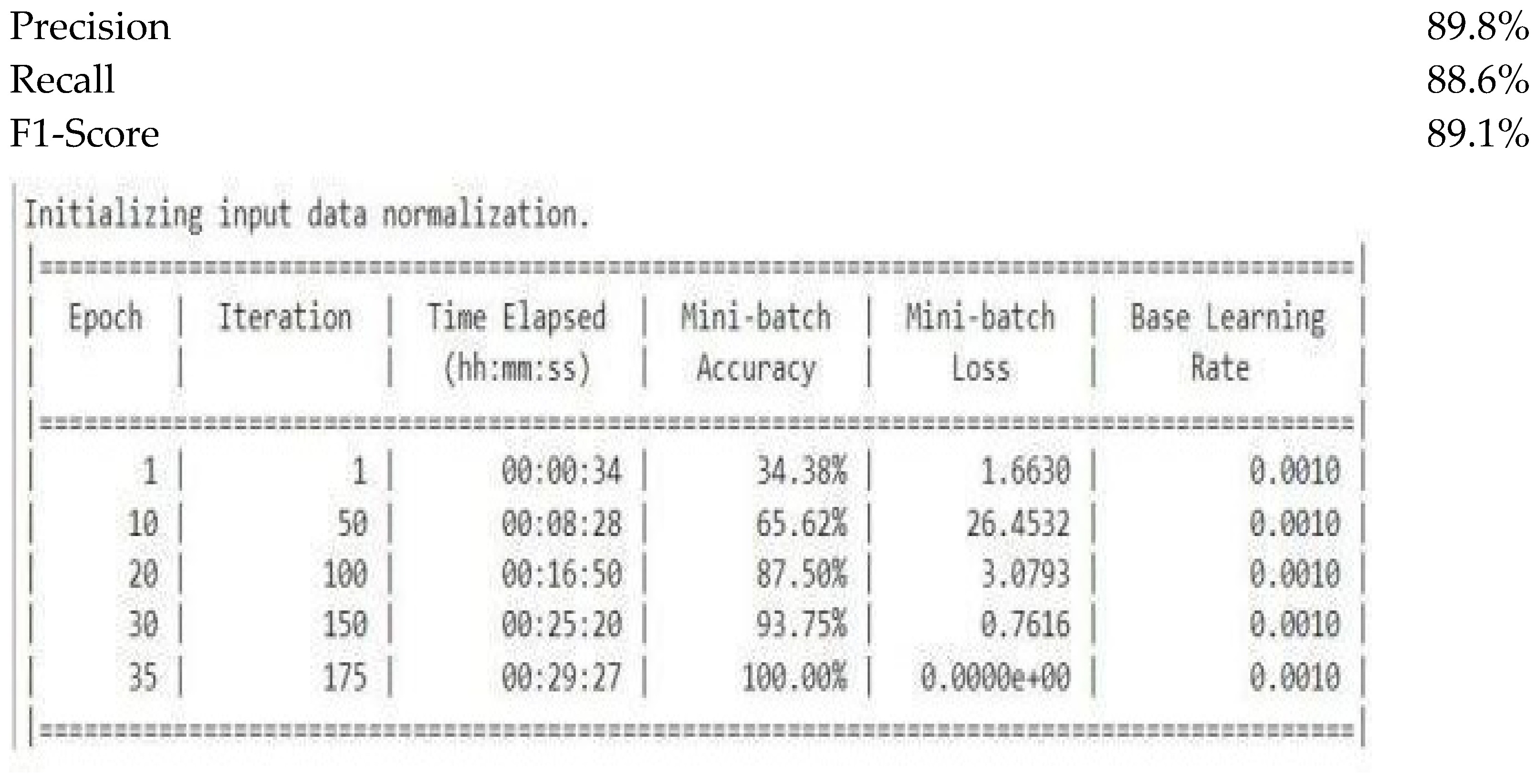
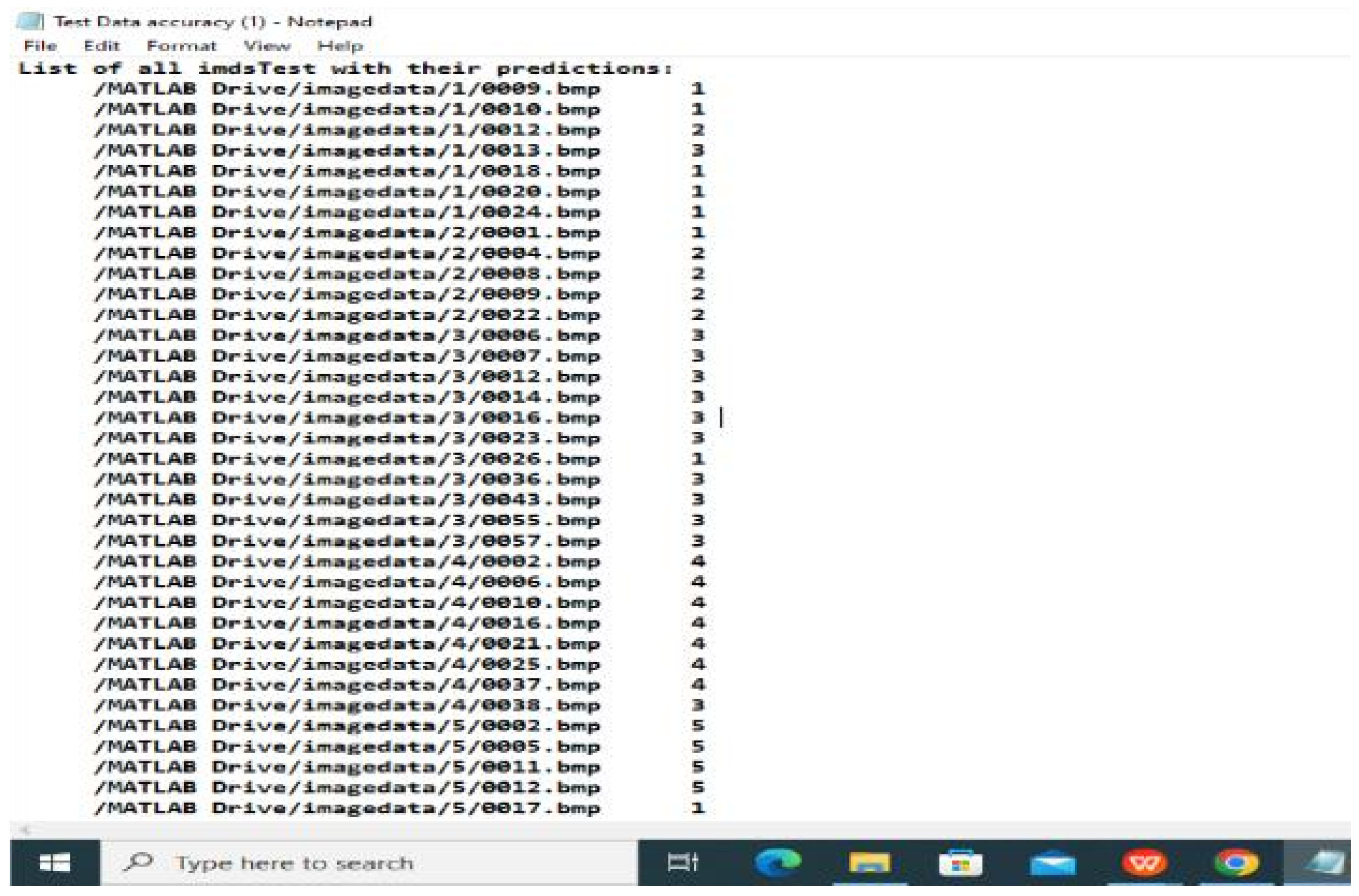
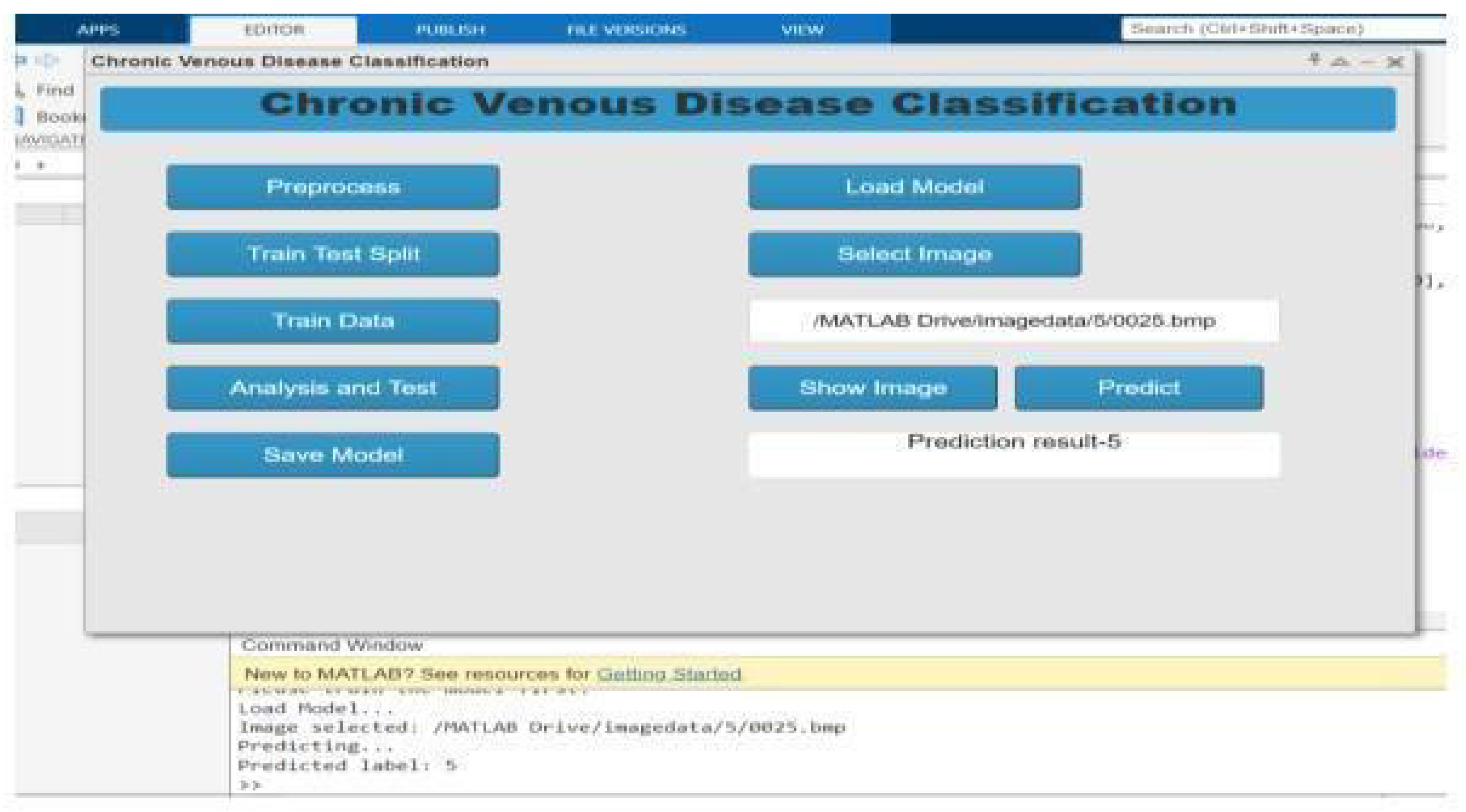
Figure 1 indicates the training process and time required to execute the program. Different accuracy measure are shown in Figure 1 with different echops. As epochs increases accuracy also increases. In Figure 2 model testing result is shown, it shows the different test images with its respective prediction. In Figure 3 GUI of the system shown, here we have provided the provision to upload the image and the model will predict the image CVD class. This model is implemented using matlab programming and will help end user to directly classify the disease with just upload of patient image.

8. Conclusions

This research paper is successful in demonstrating how deep learning (Convolutional Neural Networks or CNNs) can be applied to the automatic classification of chronic venous disease (CVD) by using medical images. The developed model could successfully identify various CEAP stages of CVD by implementing transfer learning algorithms and extensive image processing. With a test accuracy of more than 90, as well as high precision and recall rates, the model was found to be very competent in differentiating between different levels of venous insufficiency. Data augmentation, critical architecture choice such as Res-Net50, and intelligent hyperparameter optimization were the key performance improvements. All these factors enhanced the generalization capability of the model in unknown data. The suggested system has a chance to become a helpful resource for health care workers, allowing them to make accurate and timely CVD diagnoses. This is particularly useful in clinical settings where specialized expertise is unavailable. Automated tools could facilitate the decision-making process and reduce practitioner burden.

Author Contributions

Conceptualization, A.G. and V.H.; methodology, A.G.; software, A.G.; validation, A.G., V.H., K.D. and S.K.; formal analysis, A.G. and V.H.; investigation, A.G. and V.H.; data curation A.G., V.H., K.D. and S.K.; writing—review and editing, A.G., V.H., K.D. and S.K. All authors have read and agreed to the published version of the manuscript.

Funding

This research received no external funding.

Institutional Review Board Statement

Not applicable.

Informed Consent Statement

Not applicable.

Data Availability Statement

No new data were created or analyzed in this study. Data sharing is not applicable to this article.

Acknowledgments

The authors sincerely thank the Department of Artificial Intelligence and Data Science at Annasaheb Dange College of Engineering and Technology (ADCET), Ashta, Sangli, Maharashtra, and Symboisis International University, Pune, for offering the necessary academic support, computational facilities, and infrastructure that enabled the successful execution of this research work. We are especially grateful to the faculty members and laboratory staff for their technical guidance and assistance in resolving challenges during model development and testing. We also wish to acknowledge the contributions of medical professionals whose expertise in chronic venous disease was instrumental in validating image annotations and CEAP-based classifications.

Conflicts of Interest

The authors declare no conflicts of interest.

References

  1. Tiwari, A.; Cheng, K.; Morris, R. An overview of the CEAP classification system used in chronic venous disease diagnosis. J. Vasc. Surg. 2020, 72, 765–774. [Google Scholar] [CrossRef]
  2. Simonyan, K.; Zisserman, A. Very deep convolutional networks designed for large-scale image recognition tasks. arXiv 2015, arXiv:1409.1556. [Google Scholar]
  3. He, K.; Zhang, X.; Ren, S.; Sun, J. Deep residual learning framework for enhancing image recognition accuracy. In Proceedings of the IEEE Conference on Computer Vision and Pattern Recognition (CVPR), Las Vegas, NV, USA, 27–30 June 2016; pp. 770–778. [Google Scholar] [CrossRef]
  4. Mitra, D.; Goyal, A.; Gupta, S.; Kanyal, H.; Kaushik, S.; Kumar, K. Automated tomato leaf disease detection technique using deep learning. J. Theor. Appl. Inf. Technol. 2023, 101, 5734–5744. [Google Scholar]
  5. Chollet, F. Depthwise separable convolutions for efficient deep learning. In Proceedings of the IEEE Conference on Computer Vision and Pattern Recognition (CVPR), Honolulu, HI, USA, 21–26 July 2017; pp. 1251–1258. [Google Scholar] [CrossRef]
  6. Kingma, D.P.; Ba, J. Adam: A stochastic optimization method for training deep learning models. arXiv 2015, arXiv:1412.6980. [Google Scholar]
  7. Abadi, M.; Barham, P.; Chen, J.; Chen, Z.; Davis, A.; Dean, J.; Devin, M.; Ghemawat, S.; Irving, G.; Isard, M.; et al. TensorFlow: A scalable system for machine learning applications. In Proceedings of the 12th USENIX Symposium on Operating Systems Design and Implementation (OSDI), Savannah, GA, USA, 2–4 November 2016; pp. 265–283. [Google Scholar]
  8. Krizhevsky, A.; Sutskever, I.; Hinton, G.E. Deep convolutional neural networks for ImageNet classification. Adv. Neural Inf. Process. Syst. 2012, 25, 1097–1105. [Google Scholar] [CrossRef]
  9. OpenCV Documentation. Open-Source Computer Vision Library. 2023. Available online: https://docs.opencv.org/ (accessed on 15 August 2025).
  10. American Venous Forum. Overview of the CEAP Classification System. 2022. Available online: https://www.veinforum.org (accessed on 15 August 2025).
Figure 1. Training outcomes according to epoch and iteration.
Csmf 12 00007 g001
Figure 2. Model testing with prediction.
Csmf 12 00007 g002
Figure 3. GUI.
Figure 3. GUI.
Csmf 12 00007 g003
Table 1. Comparative Analysis using different optimizer and learning rate.
OptimizerLearning RateBatch SizeEpochsAccuracy (%)F1-Score
Adam0.001325095.80.94
SGD0.005327593.20.91
Adam0.00051610096.40.95
Disclaimer/Publisher’s Note: The statements, opinions and data contained in all publications are solely those of the individual author(s) and contributor(s) and not of MDPI and/or the editor(s). MDPI and/or the editor(s) disclaim responsibility for any injury to people or property resulting from any ideas, methods, instructions or products referred to in the content.