1. Introduction
Organoids are three-dimensional structures derived from stem cells that recapitulate multicellular organization and function, resembling human tissues in vitro [
1,
2]. When established directly from patient tissues, patient-derived organoids (PDOs) preserve histological architecture, genetic alterations, and functional drug responses, enabling disease modeling and personalized medicine [
3,
4,
5,
6].
Over the past decade, PDOs have reshaped basic and translational research. In oncology, they are already being integrated into clinical workflows, with prospective feasibility studies showing concordance with patient responses. Notably, they have also begun to influence therapeutic decision-making across a diverse range of malignancies, including colorectal and gastrointestinal [
7,
8,
9,
10], gastric [
11], pancreatic [
4,
12,
13,
14], breast [
15], ovarian [
16], esophageal [
17], and renal [
18]. These examples illustrate that PDOs are no longer confined to the laboratory but are beginning to deliver tangible patient benefits.
Yet the translation remains uneven. Oncology dominates the clinical landscape, while diseases such as inflammatory bowel diseases (IBD) [
19,
20,
21], chronic obstructive pulmonary diseases (COPD) [
22,
23], metabolic disorders [
6,
24,
25,
26], and reproductive conditions [
27,
28,
29] have produced rich preclinical PDO data without corresponding trials. Frontier innovations—immune-competent PDOs [
30,
31,
32], synthetic scaffolds [
33,
34,
35], complex organ-on-a-chip systems [
36,
37,
38], and AI pipelines [
39,
40,
41]—currently remain confined to experimental studies. Interestingly, transplantation has advanced to clinical trials by building on foundational research into pancreatic islets [
42] and hepatic cells [
6,
26]. However, transplantation of other tissue types, such as intestinal organoid transplantation, remains in the experimental stage [
43], with its clinical utility yet to be validated in human trials.
We aim through this review to characterize the current state of the PDO clinical trial landscape by categorizing trial activity across disease areas and study designs, thereby contrasting academic literature trends with clinical implementation. To achieve this, we provide the first systematic analysis of 139 registered PDO-based clinical trials registered between 2023 and 2025 (
Table S1). Note that registration does not confirm whether these trials are active, ongoing, or completed; rather, it represents trials that are planned, have been approved, or have reported their intent to proceed within this timeframe. We categorize trials by disease area, study design, and translational maturity, highlighting landmark outputs, contrasting trial activity with the breadth of the scientific literature, and identifying barriers to clinical adoption. Our scope is restricted to PDOs derived from adult stem cells; induced pluripotent stem cell (iPSC)-derived organoids are excluded due to distinct developmental and translational trajectories.
2. Clinical Trial Landscape
To determine where PDOs have entered clinical medicine, we mapped the distribution of diseases and functional applications across all registered PDO-related clinical trials. We searched the ClinicalTrials.gov database under Find Studies > Expert Search using the following query: (organoid OR “patient derived organoid” OR “patient-derived organoid” OR PDO OR PDOs NOT iPSC NOT “induced pluripotent”) AND (AREA[StudyFirstPostDate] RANGE[01/01/2023, 12/31/2025]), date of export 21 April 2026. To ensure temporal consistency, we queried studies based on their First Posted date, as this is recognized as the formal registration day for clinical trials.
Extracted organoid-based clinical trials (n = 184) were categorized into nine predefined disease areas based on the primary condition reported in the registry. A total of 45 records were excluded due to incorrect matches, including alternative meanings of “PDO” (23), absence of organoid-based research (10), and studies using induced pluripotent stem cells (iPSC; 12), leaving 139 eligible trials for analysis. Within these, studies were further assigned to harmonized indication categories using keyword-based (regex) mapping of condition terms and manual curation. The specific indication categories comprised 19 oncology and 10 non-oncology indications, reflecting tumor-type-based classification for cancer studies and organ system-based grouping for non-oncology conditions. Within oncology, studies involving multiple tumor types were categorized as pan-cancer, while tumors not fitting predefined groups were assigned to “solid tumors (other)”. Based on the extracted trial data, we mapped each study across several variables: “Translational Impact” and “Sub-Impact/Application” were determined by the PDOs’ intended role, while the “Immune Component” captured the integration of immune cells. Furthermore, we identified the “Therapy Tested” and defined the broader “Disease Area” (e.g., Oncology), using “Specific Indications” to provide granular detail on the targeted conditions, while the primary site of each study was recorded under “Location of Clinical Trials”.
For comparison of the scope of all clinical trials in the cancer space, we searched the ClinicalTrials.gov database under Find Studies > Expert Search using the following query: AREA[ConditionSearch](cancer OR tumor OR neoplasm OR carcinoma OR malignancy) AND AREA[StudyFirstPostDate] RANGE[01/01/2023, 12/31/2025], date of export 21 April 2026. The screening and classification process was performed independently by three researchers, with the final dataset cross-checked and validated by all authors to ensure consensus.
We received 24,825 entities after manually excluding PDO clinical trials and categorized them using the same classification framework. The oncology classification was expanded by the inclusion of six additional tumor entities to improve coverage of the broader oncology landscape. Trials were further labeled as non-oncology (1386), and these were excluded before analysis, leaving 23,439 oncology trials for downstream analysis.
2.1. Disease Distribution
Our analysis identified 139 registered clinical trials involving patient-derived organoids (
Table 1, full list
Table S1). Oncology dominates this landscape, with 112 trials (80.6%), whereas non-oncologic indications (27; 19.4%) are considerably less represented. Overall, 82 trials (59.0%) were classified as observational, while 57 trials (41.0%) were interventional.
2.2. Oncology Subtypes and Enrichment Pattern
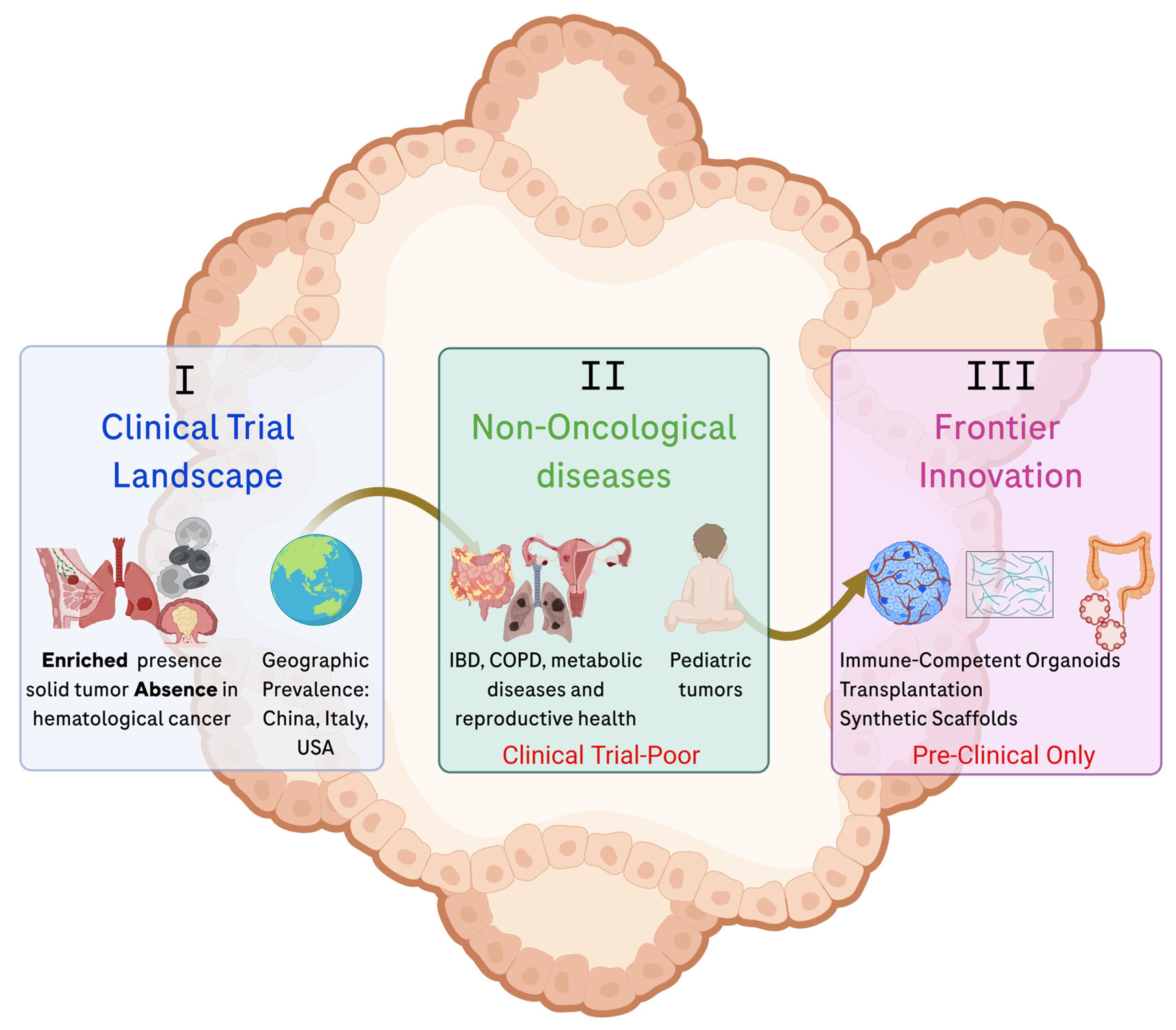
PDO oncological trials cluster within a narrow set of epithelial solid tumors. The most represented indications are breast cancer (17; 15.2% out of 112) and colorectal cancer (14; 12.5%), followed by gynecologic cancers (13; 11.6%), pancreatic cancer (11; 9.8%), and lung cancer (9; 8.0%). Additional clusters include liver cancer (8; 7.1%), pan-cancer or cross-cutting oncology studies (7; 6.3%), and brain/CNS tumors (6; 5.4%), while head and neck cancer (5; 4.5%) and prostate cancer (5; 4.5%) are less frequently represented. All remaining indications account for only small proportions of trials (each ≤ 3.6%) (
Figure 1A,
Table S3).
Compared with the overall oncology trial landscape registered from 2023 to 2025, PDO-based oncology trials are selectively enriched for certain tumor types (
Figure 1B,
Table S3), as indicated by analysis of registered clinical studies. The strongest overrepresentation is observed in gynecologic cancers (11.6% vs. 4.7%), pancreatic cancer (9.8% vs. 3.2%), colorectal cancer (12.5% vs. 6.5%), and liver cancer (7.1% vs. 3.9%). Breast cancer (15.2% vs. 12.2%) and brain/CNS tumors (5.4% vs. 2.9%) are also enriched in PDO-based studies, which correlates with the feasibility efforts to establish PDO pipelines in these settings [
3,
4,
7,
14,
15,
44,
45]. Breast, colorectal, pancreatic, gynecological, and brain/CNS cancer together make up over 60% of organoid trials, versus only ~33.3% in all cancer trials.
In contrast, several tumor entities that account for a considerable proportion of oncology trials overall are underrepresented or absent among PDO studies, most notably hematologic malignancies (0.0% vs. 12.3%) and pan-cancer studies (6.2% vs. 20.5%), as well as biliary tract cancer (0.0% vs. 1.6%) and skin cancer/melanoma (0.0% vs. 1.6%). Lung cancer shows approximately proportional representation (8.0% vs. 9.9%), while prostate cancer (4.9% vs. 4.5%) and several other indications display only minor differences. This pattern suggests that current intentions of clinical applications of PDOs are concentrated in tumor types with established organoid derivation pipelines and prior feasibility evidence, rather than reflecting the overall distribution of oncology trial activity. Thus, PDO adoption seems to reflect evidence of technical readiness and feasibility rather than overall prevalence in oncology trials.
2.3. Non-Oncology Trials
Outside oncology, PDOs are scientifically mature but clinically stalled. PDOs have demonstrated significant scientific utility beyond oncology, providing mechanistic insights into diverse non-malignant conditions such as IBD [
19,
20,
21], COPD [
22,
23], metabolic disorders [
6,
24,
25,
26], and reproductive health [
27,
28]. This extensive research showcases the technical feasibility of generating complex models that capture epithelial barrier defects, replicate disease mechanisms, and predict drug response in a wide array of human systems.
Non-oncologic indications account for 27 trials (19.4%), distributed across small and heterogeneous categories. The largest group is gastrointestinal disorders (7 trials, 5% out of the 139 PDO trials), primarily driven by IBD studies (5; 3.6%), followed by reproductive or pregnancy-related conditions (5; 3.6%) and metabolic disorders (4; 2.9%). Autoimmune/inflammatory diseases (3; 2.2%) and infectious diseases (3; 2.2%) are less frequent, while genetic diseases, including cystic fibrosis (2; 1.4%), represent a small category. Collectively, non-oncology PDO trials remain sparse and fragmented.
2.4. Geographic Distribution
Figure 1C and
Table S2 show the country-level distribution of the 139 registered PDO clinical trials, highlighting substantial geographic concentration. A small number of countries account for the majority of the stated intention to incorporate PDOs into clinical trial protocols. China contributes 47 studies (33.8%), followed by Italy (40; 28.8%), the United States (11; 12.2%), France (9; 6.5%), and Canada (4; 2.9%). All remaining countries each account for ≤2.2% of trials and are grouped as “Other.” Overall, this clustering of clinical trial registrations suggests that while PDO technology is advancing, its global adoption remains localized to specific countries.
2.5. Immune-Component Models Inclusion
While organoids are powerful models of epithelial function, they generally lack immune components required to faithfully capture epithelial–immune crosstalk, limiting their utility as biomarkers for predicting patient response or resistance to immunotherapies. Nonetheless, efforts to address this limitation have rapidly emerged through the development of experimental immune-competent PDO platforms [
30,
31,
32]. In line with these advances, 24 registered PDO clinical trials (17.3%) plan to incorporate an immune-related component, including autologous immune co-culture systems, immune profiling, or immune-modulated endpoints. Even though the relatively limited adoption of immune-competent PDO approaches in clinical trials contrasts with the rapid progress observed in experimental immune–PDO platforms, these efforts underscore the early-stage translational status of these technologies.
3. Translational Impact of PDO Clinical Trials
The potential clinical utility of PDOs on patients in clinical trials is diverse. To assess the current landscape of PDO implementation in clinical trials, we assigned each study to one of five mutually exclusive functional domains, selecting the highest-impact clinical function when trials fulfilled multiple roles. Some trials aim to incorporate PDOs prospectively into tumor board decision-making, while others are designed to assess concordance between PDO drug responses and patient clinical outcomes or to establish living biobanks for future research (
Table 1).
As shown in the Sankey diagram (
Figure 2), foundational PDO research constituted the largest category (54 of 139 PDO-related trials; 38.8%) among registered clinical trials, encompassing biobanking and biological modeling. Clinical outcome correlation accounted for 29 trials (20.9%), while drug sensitivity comprised 24 studies (17.3%). Organoid-guided decision-making accounted for 28 (20.1%) of PDO-related trials. Among all PDO trials involving drug testing (86; 61.8%), 67 intended to screen existing, clinically approved drugs, whereas the remaining 19 intend to evaluate novel therapeutics in organoids (in addition, transplantation of organoids (3; 2.2%) is also considered as novel drug testing). Nearly all planned to test agents—both approved and novel—are oncological therapeutics, with only seven studies, mainly targeting metabolic and endocrine disorders or infectious diseases.
One of the most enriched categories, organoid-guided clinical decision-making, comprises 28 trials (20%), indicating increasing interest in evaluating PDOs within clinical workflows. All registered trials within this category are within the oncology space and aim to investigate the potential of using clinically approved treatments, such as standard-of-care chemotherapies and targeted therapy. Colorectal and lung cancer emerged as the most prevalent indication, representing each of them one-fifth of the trials in this category, followed by breast (4) and pan-cancer (4). Across trials, PDO results are planned to inform—but not mandate—treatment decisions, underscoring their potential role as adjuncts to clinical judgment rather than autonomous decision-making tools.
Head and neck cancer—despite established PDO models —shows no organoid-guided decision-making trials among its 5 total studies, indicating additional barriers beyond model availability.
Notably, no organoid-guided decision-making trials were identified outside oncology, despite extensive preclinical evidence in inflammatory, metabolic, and respiratory diseases, highlighting a translational gap specific to clinical decision frameworks rather than model availability.
The potential for organoid transplantation—a frontier application—is currently being explored in three early-phase studies involving pancreatic islet, hepatocyte, and cholangiocyte organoids for the treatment of diabetes, liver failure, and bile duct repair.
4. Frontier Innovations Not Yet in Trials
Our trial-level findings suggest that PDO’s use intention in clinical applications in registered trials remains narrowly focused, primarily targeting epithelial cancers, with limited non-oncologic indications. However, as registered trials may not yet have reached active phases, this data reflects intended rather than realized clinical activity. Differentiating registered trials from active trials is critical to understanding the true extent of clinical translation. Consequently, no final assessment of the clinical benefit to patients can be made until the primary endpoints of these studies are achieved.
Recent advancements in 3D synthetic matrices and bioengineered scaffolds have facilitated a transition from Matrigel toward chemically defined and tunable hydrogels [
33,
34,
35]. Parallel work on generating organ-on-a-chip technology to develop advanced human models provides a platform to study human physiology and pathology [
36,
37,
38]. Altogether, these innovations point toward clinically scalable, physiologically relevant models.
Meanwhile, the convergence of automation, AI, and data analysis by machine learning and deep learning is transforming PDO workflows. Interfacing organoids with these technologies enables streamlined analysis of high-throughput multiscale images and multi-omics data, automated organoid monitoring, and morphological characterization [
40,
41]. Ultimately, these advances will expedite drug discovery through predicting drug response, efficacy, or side effects using organoids and using automated high-throughput screening to test thousands of compounds [
43].
Finally, PDO transplantation is progressing from concept to reality, particularly for liver and pancreatic diseases. In the hepatic field, the transplantation of hepatocyte and cholangiocyte organoids has already entered clinical trials by building upon previous functional engraftment of hepatic organoids in animal models [
6] and successful bile duct repair in healthy individuals upon organoid transplantation [
26]. Similarly, previous demonstration of in vivo insulin production from pancreatic islets [
42] has evolved into the intention to be tested in clinical trials for islet transplantation to treat diabetes. Beyond these organ systems, recent proof-of-concept studies in animal models have successfully demonstrated the functional engraftment of intestinal PDOs [
39]. Although human clinical trials for these specific organoid types have yet to be initiated, such experiments foreshadow a future where PDOs may serve as therapeutic agents across a broad spectrum of diseases.
5. Barriers to Clinical Adoption
Despite rapid progress, several barriers prevent mainstream clinical integration of PDOs. Technical variability is a central issue: while glioblastoma [
44], colorectal [
3,
46], breast [
15], bladder [
47], and endometrial [
48] cancer PDOs can be established in more than 70% of cases, success rates drop to 31% (from biopsies) and 62% (from resections) in pancreatic [
14], 50% in gastric [
11] and ovarian [
49], and as low as 15–20% in liver [
45] and prostate cancers [
5].
The variability in organoid culture conditions further complicates translation. There are not only variations in the protocols for establishing and culturing the organoids (e.g., Extracellular matrix (ECM)-free suspension culture vs. ECM-embedded), but also differences in the cell source, the genetic diversity of cells sourced from different patient donors, and the media composition that could lead to inconsistencies and a lack of reproducibility of results.
Moreover, current PDOs lack many features of the tissue microenvironment, such as ECM cues, blood flow through vasculature, and various cell types. While PDOs capture epithelial compartments, they lack stromal, vascular, and immune components essential for predicting responses to therapies such as immunotherapy. Additionally, the field of PDOs still relies heavily on Matrigel, a mouse-derived extract, which poses several issues, such as poor reproducibility, variability, and potential immunogenicity, making it unsuitable for Good Manufacturing Practice (GMP)-compliant, scalable production and transplantation. Defined synthetic matrices are promising, but standardization across centers is lacking.
From a clinical standpoint, operational feasibility remains a hurdle. The turnaround time for PDO establishment and drug testing is often long (>6 weeks), which may be incompatible with urgent therapeutic decisions. Coupled with high costs, the need for considerable resources and technical expertise, and the requirement for advanced imaging and data analysis pipelines, these raise concerns about scalability and reimbursement of organoid-based diagnostics.
Beyond these logistical constraints, the application of PDOs in personalized medicine and transplantation introduces complex ethical challenges regarding informed consent, legal compliance, and the protection of personal privacy [
50]. Thus, the clinical translation of patient-derived organoids needs a robust response to emerging ethical concerns and the establishment of clear and harmonized regulatory frameworks. While localized ethical guidelines exist, the absence of a unified global standard creates significant procedural uncertainty.
In the context of personalized medicine, obtaining comprehensive records requires tracking the link between patients and their specific organoid lines, while rigorously protecting donor privacy [
51]. Furthermore, while organoids closely mimic the organ of origin, they do not account for systemic interactions within the entire body [
52]. This limitation suggests that translating organoid-based drug responses into clinical efficacy may be problematic, fueling skepticism regarding their added clinical value. Additionally, traditional clinical trials evaluate the safety and efficacy of therapeutic agents in large patient cohorts. The shift toward personalized medicine and “
n-of-1” trials—where data is generated for a single potential user—risks overlooking broader safety signals and rare adverse events [
52]. Finally, as previously noted, the protracted timeframes for organoid generation further exacerbate issues of accessibility to large patient populations. There is also no guarantee that donors will gain equitable access to the novel therapies developed using their own organoids [
51].
The field of transplantation faces its own distinct set of hurdles. Most of the organoid transplantation research demonstrates success only in animal models, which does not guarantee a correlative benefit in humans. For transition into first-in-human trials, it is required that the benefit to patients, as well as its social value, and low risk, are already demonstrated [
51,
52]. As a result, the entrance of organoid transplantation into clinical trials is both challenging and slow. For example, in the case of pancreatic islets, it took more than 25 years until their entrance. Finally, the delivery methods for transplantable organoids are significantly more invasive and complex than those used in traditional pharmaceutical trials [
52], further complicating safety assessments and regulatory approval.
Consequently, a comprehensive framework is essential to facilitate the responsible growth of the use of organoids in the clinical space. Such a system must define rigorous standards for the characterization, validation, and qualification of organoids as well as global policies for reimbursement of laboratory tests and treatments to ensure they are “fit for purpose” for both end-users and health authorities. Together, these barriers explain why PDOs, despite their promise, remain a niche clinical tool rather than a standard of care.
6. Translation Trajectories: Overlapping Waves
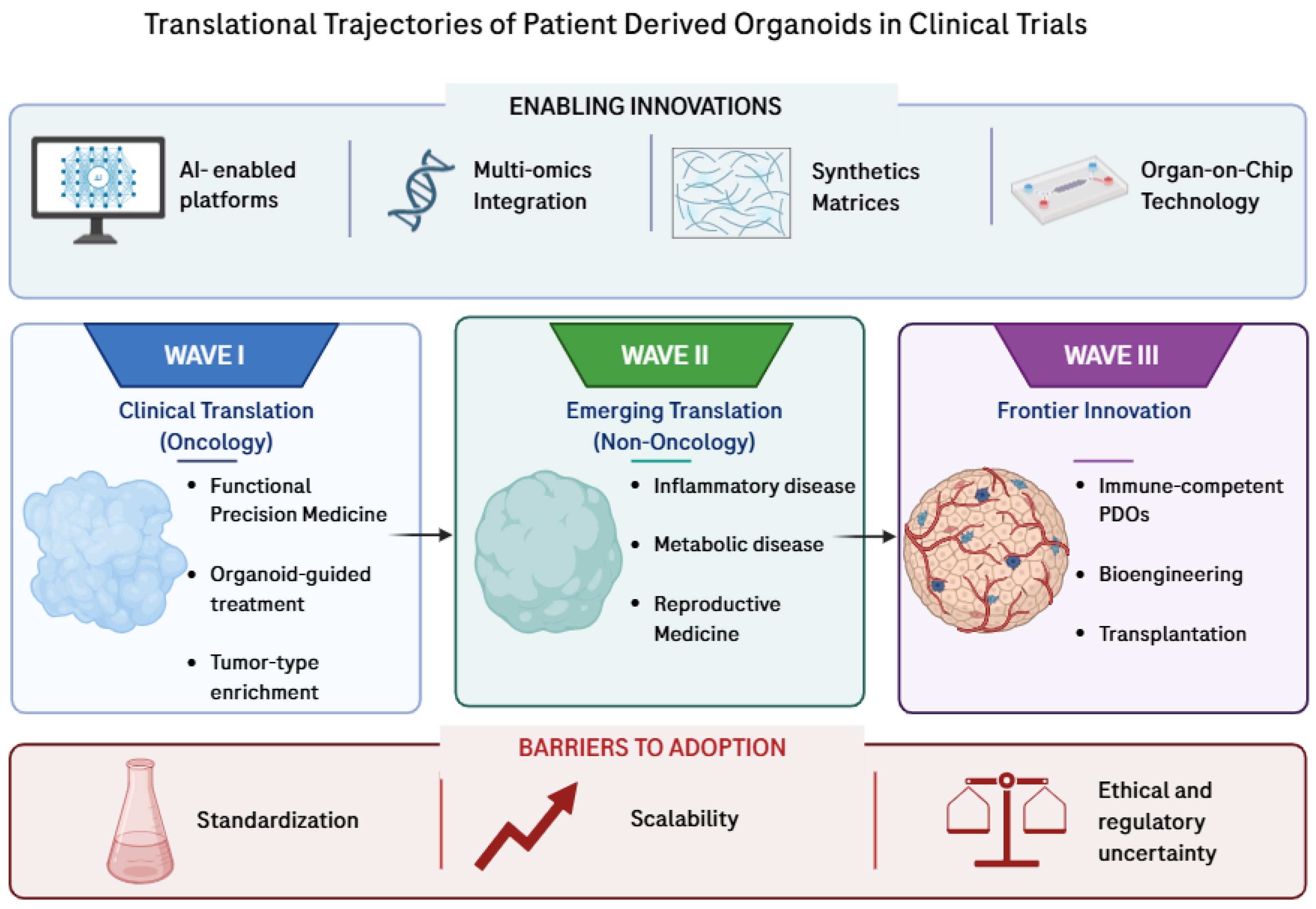
PDO translation is best understood as unfolding in overlapping waves rather than a linear sequence (
Figure 3).
The first wave, led by oncology, has already delivered measurable patient benefit. Prospective feasibility studies in colorectal [
3,
7,
8,
9,
53,
54] and pancreatic cancer [
4,
12,
13,
14] demonstrated high concordance with clinical outcomes. These trials established PDOs as clinically actionable entities beyond the confines of basic research.
The second wave is emerging in non-oncology disease areas. While intestinal PDOs predict drug response in IBD [
21], airway [
22,
23,
55,
56], and liver models [
6,
25] capture the pathogenesis of COPD, respiratory virus infection, and NAFLD, respectively. On the other hand, the derivation of endometrial [
27], trophoblast [
28], and prostate [
29] organoids allows studies of reproductive health further. However, these applications remain underrepresented in the clinical trial landscape, and this maturity gap shows a delay in transitioning robust preclinical findings to registered human studies.
The third wave comprises frontier innovations that remain preclinical but have the potential to redefine the field. Immune-competent PDOs [
36,
37,
38], synthetic matrices [
33,
34,
35], complex organ-on-a-chip systems [
36,
37,
38], and AI-enabled platforms [
40,
41,
43] demonstrate that the pace of basic science is currently outstripping the rate of clinical translation.
7. Conclusions and Future Outlook
PDOs have reached a critical inflection point. This systematic review of registered clinical trials (2023–2025) suggested their transition from niche research tools into the sphere of active clinical investigation. However, a ‘maturity paradox’ persists: while preclinical models are advancing toward immune-competent and AI-enabled platforms, clinical registration remains conservatively concentrated in oncological feasibility studies. This translational gap is further exacerbated by emerging ethical and regulatory hurdles. Addressing concerns regarding donor privacy, the implementation of “n-of-1” trials, equitable access to high-cost personalized therapies, and the unique challenges of first-in-human transplantation is essential to establishing a robust framework for routine clinical integration.
The first wave has successfully demonstrated technical feasibility and predictive value within oncology. The challenge ahead is to bridge the translational lag in the second wave, led by non-oncological fields—such as IBD and metabolic disorders—where skepticism regarding physiological fidelity remains a barrier. Current limitations, including the absence of vascular and immune compartments, as well as a comparatively immature cellular phenotype and reduced functional maturity, often impair metabolic and immunological studies. Success in the second wave is highly dependent on rigorously benchmarking PDOs against native tissues, reconstructing the tissue microenvironment, and achieving higher levels of functional maturity required to model metabolic disease.
The integration of multi-omics—encompassing genomics, epigenomics, single-cell transcriptomics, proteomics, and metabolomics—provides the high-resolution molecular blueprint necessary to address long-standing skepticism regarding the physiological fidelity of organoids, and validate them as high-fidelity “avatars”. In oncology, multi-omics is a crucial component in positioning PDOs as platforms for drug screening, biomarker identification, and therapeutic resistance modeling [
57]. Beyond oncology, this integration allows for the quantitative validation of rare cell types and metabolic pathways by benchmarking organoid-derived profiles against native tissue atlases. Recent studies have utilized these technologies to delineate metabolite sensor functions and identify novel pharmacological targets [
58]. These advances transform PDOs from purely morphological mimics into rigorous, “fit-for-purpose” diagnostic tools also for immunological and metabolic conditions, setting the stage for the second wave. When supported by emerging solutions such as organ-on-a-chip technologies, synthetic matrices, and immune-compentent inclusion, these advancements can provide the missing physiological cues and inter-organ crosstalk required to model immunological and metabolic conditions.
Another major hurdle to clinical adoption is the inherent variability of organoid cultures, which complicates the establishment of standardized protocols and limits reproducibility. To overcome barriers of geographic concentration and technical variability, the field must move toward the industrialization of organoid workflows. This transition involves the use of high-throughput robotic platforms that incorporate automated liquid handling for medium exchange and drug dispensing, enabling the rapid screening of expansive compound libraries. To extract meaningful insights from these complex 3D structures, these automated systems are increasingly integrated with high-content imaging and AI-supported quantitative analysis. Such robust data acquisition pipelines are essential for the standardization of PDO cultures and their scaling to meet the rigorous demands of large-scale drug discovery.
In summary, this review demonstrates that PDOs have evolved into clinically actionable entities, extending their utility beyond basic oncological research. Yet the task ahead remains to bridge the translational gap in non-oncological fields such as inflammatory and metabolic diseases by enhancing physiological complexity and functional maturity. This transition will be driven by the integration of multi-omics data alongside innovations in immune-competent systems, synthetic matrices, and organ-on-a-chip technologies. Ultimately, if the hurdles of scalability, standardized industrialization, and regulatory harmonization are overcome, PDOs will move beyond being specialized experimental adjuncts to become a fundamental pillar of evidence-based, personalized clinical care.
Supplementary Materials
The following supporting information can be downloaded at
https://www.mdpi.com/article/10.3390/organoids5020015/s1, Table S1. Full list of 139 trials; Table S2. Data Summary; Table S3. Number of oncological trials (N = 22,143) vs. PDO-related oncological trials (n = 112) categorized by tumor type; Figure S1. Tumor-type distribution of PDO-based oncology trials and the overall oncology trial landscape, represented as a stacked bar showing the percentage of PDO-based oncology trials and all oncology trials.
Author Contributions
Conceptualization, M.S., E.Y., J.G. and M.C.-L.; methodology, M.S.; data curation, E.Y. and M.C.-L.; writing—original draft preparation, M.S., E.Y. and M.C.-L.; writing—review and editing, M.S., E.Y., J.G. and M.C.-L.; visualization, M.S.; supervision, M.C.-L. All authors have read and agreed to the published version of the manuscript.
Funding
This research received no external funding.
Data Availability Statement
The data presented in this study are available within the article and its
Supplementary Materials. The raw dataset was compiled from public registries (e.g., ClinicalTrials.gov) using the search criteria described in
Section 2.
Acknowledgments
During the preparation of this manuscript, the authors used R version 4.5.2 using the packages ggplot2, dplyr, stringr, forcats, patchwork, ggalluvial, and readxl for the purposes of data analysis and figure generation. Tables were prepared using openxlsx, flextable, and officer. Vector and raster graphics were exported using svglite and ragg. The authors have reviewed and edited the output and take full responsibility for the content of this publication. The authors utilized [Gemini 3 Flash] for the purposes of grammatical editing, linguistic refinement, and structural suggestions. The final content was reviewed, edited, and verified by the authors, who take full responsibility for the accuracy and integrity of the work.
Conflicts of Interest
All authors are current employees of Fritz Hoffmann-La Roche Ltd. or were employed by the company while working on this study. The company provided support in the form of salaries for authors but did not have any additional role in the study design, data collection, analysis, decision to publish, or preparation of the manuscript.
Abbreviations
The following abbreviations are used in this manuscript:
| AI | Artificial intelligence |
| CNS | Central nervous system |
| COPD | Chronic obstructive pulmonary diseases |
| ECM | Extracellular matrix |
| GMP | Good manufacturing practice |
| IBD | Inflammatory bowel diseases |
| iPSCs | Induced pluripotent stem cell |
| NAFLD | Non-alcoholic fatty liver disease |
| PDO | Patient-derived organoids |
References
- Clevers, H. Modeling Development and Disease with Organoids. Cell 2016, 165, 1586–1597. [Google Scholar] [CrossRef] [Scilit]
- Wang, D.; Villenave, R.; Stokar-Regenscheit, N.; Clevers, H. Human Organoids as 3D in Vitro Platforms for Drug Discovery: Opportunities and Challenges. Nat. Rev. Drug Discov. 2026, 25, 204–226. [Google Scholar] [CrossRef] [Scilit]
- van de Wetering, M.; Francies, H.E.; Francis, J.M.; Bounova, G.; Iorio, F.; Pronk, A.; van Houdt, W.; van Gorp, J.; Taylor-Weiner, A.; Kester, L.; et al. Prospective Derivation of a Living Organoid Biobank of Colorectal Cancer Patients. Cell 2015, 161, 933–945. [Google Scholar] [CrossRef] [Scilit]
- Tiriac, H.; Belleau, P.; Engle, D.D.; Plenker, D.; Deschênes, A.; Somerville, T.D.D.; Froeling, F.E.M.; Burkhart, R.A.; Denroche, R.E.; Jang, G.-H.; et al. Organoid Profiling Identifies Common Responders to Chemotherapy in Pancreatic Cancer. Cancer Discov. 2018, 8, 1112–1129. [Google Scholar] [CrossRef] [Scilit] [PubMed]
- Gao, D.; Vela, I.; Sboner, A.; Iaquinta, P.J.; Karthaus, W.R.; Gopalan, A.; Dowling, C.; Wanjala, J.N.; Undvall, E.A.; Arora, V.K.; et al. Organoid Cultures Derived from Patients with Advanced Prostate Cancer. Cell 2014, 159, 176–187. [Google Scholar] [CrossRef] [Scilit]
- Huch, M.; Gehart, H.; van Boxtel, R.; Hamer, K.; Blokzijl, F.; Verstegen, M.M.A.; Ellis, E.; van Wenum, M.; Fuchs, S.A.; de Ligt, J.; et al. Long-Term Culture of Genome-Stable Bipotent Stem Cells from Adult Human Liver. Cell 2015, 160, 299–312. [Google Scholar] [CrossRef] [Scilit] [PubMed]
- Ooft, S.N.; Weeber, F.; Dijkstra, K.K.; McLean, C.M.; Kaing, S.; van Werkhoven, E.; Schipper, L.; Hoes, L.; Vis, D.J.; van de Haar, J.; et al. Patient-Derived Organoids Can Predict Response to Chemotherapy in Metastatic Colorectal Cancer Patients. Sci. Transl. Med. 2019, 11, eaay2574. [Google Scholar] [CrossRef] [Scilit] [PubMed]
- Ganesh, K.; Wu, C.; O’Rourke, K.P.; Szeglin, B.C.; Zheng, Y.; Sauvé, C.-E.G.; Adileh, M.; Wasserman, I.; Marco, M.R.; Kim, A.S.; et al. A Rectal Cancer Organoid Platform to Study Individual Responses to Chemoradiation. Nat. Med. 2019, 25, 1607–1614. [Google Scholar] [CrossRef] [Scilit]
- Martini, G.; Belli, V.; Napolitano, S.; Ciaramella, V.; Ciardiello, D.; Belli, A.; Izzo, F.; Avallone, A.; Selvaggi, F.; Menegon Tasselli, F.; et al. Establishment of Patient-Derived Tumor Organoids to Functionally Inform Treatment Decisions in Metastatic Colorectal Cancer. ESMO Open 2023, 8, 101198. [Google Scholar] [CrossRef] [Scilit]
- Vlachogiannis, G.; Hedayat, S.; Vatsiou, A.; Jamin, Y.; Fernández-Mateos, J.; Khan, K.; Lampis, A.; Eason, K.; Huntingford, I.; Burke, R.; et al. Patient-Derived Organoids Model Treatment Response of Metastatic Gastrointestinal Cancers. Science 2018, 359, 920–926. [Google Scholar] [CrossRef] [Scilit]
- Yan, H.H.N.; Siu, H.C.; Law, S.; Ho, S.L.; Yue, S.S.K.; Tsui, W.Y.; Chan, D.; Chan, A.S.; Ma, S.; Lam, K.O.; et al. A Comprehensive Human Gastric Cancer Organoid Biobank Captures Tumor Subtype Heterogeneity and Enables Therapeutic Screening. Cell Stem Cell 2018, 23, 882–897.e11. [Google Scholar] [CrossRef] [Scilit] [PubMed]
- Boilève, A.; Cartry, J.; Goudarzi, N.; Bedja, S.; Mathieu, J.R.R.; Bani, M.-A.; Nicolle, R.; Mouawia, A.; Bouyakoub, R.; Nicotra, C.; et al. Organoids for Functional Precision Medicine in Advanced Pancreatic Cancer. Gastroenterology 2024, 167, 961–976.e13. [Google Scholar] [CrossRef] [Scilit]
- Matsumoto, K.; Fujimori, N.; Ichihara, K.; Takeno, A.; Murakami, M.; Ohno, A.; Kakehashi, S.; Teramatsu, K.; Ueda, K.; Nakata, K.; et al. Patient-Derived Organoids of Pancreatic Ductal Adenocarcinoma for Subtype Determination and Clinical Outcome Prediction. J. Gastroenterol. 2024, 59, 629–640. [Google Scholar] [CrossRef] [Scilit]
- Driehuis, E.; van Hoeck, A.; Moore, K.; Kolders, S.; Francies, H.E.; Gulersonmez, M.C.; Stigter, E.C.A.; Burgering, B.; Geurts, V.; Gracanin, A.; et al. Pancreatic Cancer Organoids Recapitulate Disease and Allow Personalized Drug Screening. Proc. Natl. Acad. Sci. USA 2019, 116, 26580–26590. [Google Scholar] [CrossRef] [Scilit]
- Chen, P.; Zhang, X.; Ding, R.; Yang, L.; Lyu, X.; Zeng, J.; Lei, J.H.; Wang, L.; Bi, J.; Shao, N.; et al. Patient-Derived Organoids Can Guide Personalized-Therapies for Patients with Advanced Breast Cancer. Adv. Sci. 2021, 8, e2101176. [Google Scholar] [CrossRef] [Scilit]
- de Witte, C.J.; Espejo Valle-Inclan, J.; Hami, N.; Lõhmussaar, K.; Kopper, O.; Vreuls, C.P.H.; Jonges, G.N.; van Diest, P.; Nguyen, L.; Clevers, H.; et al. Patient-Derived Ovarian Cancer Organoids Mimic Clinical Response and Exhibit Heterogeneous Inter- and Intrapatient Drug Responses. Cell Rep. 2020, 31, 107762. [Google Scholar] [CrossRef] [Scilit]
- Derouet, M.F.; Allen, J.; Wilson, G.W.; Ng, C.; Radulovich, N.; Kalimuthu, S.; Tsao, M.-S.; Darling, G.E.; Yeung, J.C. Towards Personalized Induction Therapy for Esophageal Adenocarcinoma: Organoids Derived from Endoscopic Biopsy Recapitulate the Pre-Treatment Tumor. Sci. Rep. 2020, 10, 14514. [Google Scholar] [CrossRef] [Scilit]
- Li, Z.; Xu, H.; Yu, L.; Wang, J.; Meng, Q.; Mei, H.; Cai, Z.; Chen, W.; Huang, W. Patient-Derived Renal Cell Carcinoma Organoids for Personalized Cancer Therapy. Clin. Transl. Med. 2022, 12, e970. [Google Scholar] [CrossRef] [Scilit] [PubMed]
- Tindle, C.; Fonseca, A.G.; Taheri, S.; Katkar, G.D.; Lee, J.; Maity, P.; Sayed, I.M.; Ibeawuchi, S.-R.; Vidales, E.; Pranadinata, R.F.; et al. A Living Organoid Biobank of Patients with Crohn’s Disease Reveals Molecular Subtypes for Personalized Therapeutics. Cell Rep. Med. 2024, 5, 101748. [Google Scholar] [CrossRef] [Scilit]
- Nanki, K.; Fujii, M.; Shimokawa, M.; Matano, M.; Nishikori, S.; Date, S.; Takano, A.; Toshimitsu, K.; Ohta, Y.; Takahashi, S.; et al. Somatic Inflammatory Gene Mutations in Human Ulcerative Colitis Epithelium. Nature 2020, 577, 254–259. [Google Scholar] [CrossRef] [Scilit] [PubMed]
- Jang, K.K.; Hudesman, D.; Jones, D.R.; Loke, P.N.; Axelrad, J.E.; Cadwell, K.; Tofacitinib Working Group. Tofacitinib Uptake by Patient-Derived Intestinal Organoids Predicts Individual Clinical Responsiveness. Gastroenterology 2024, 167, 1453–1456.e5. [Google Scholar] [CrossRef] [Scilit]
- Chan, L.L.Y.; Anderson, D.E.; Cheng, H.S.; Ivan, F.X.; Chen, S.; Kang, A.E.Z.; Foo, R.; Gamage, A.M.; Tiew, P.Y.; Koh, M.S.; et al. The Establishment of COPD Organoids to Study Host-Pathogen Interaction Reveals Enhanced Viral Fitness of SARS-CoV-2 in Bronchi. Nat. Commun. 2022, 13, 7635. [Google Scholar] [CrossRef] [Scilit]
- Lee, W.; Lee, S.; Yoon, J.-K.; Lee, D.; Kim, Y.; Han, Y.B.; Kim, R.; Moon, S.; Park, Y.J.; Park, K.; et al. A Single-Cell Atlas of in Vitro Multiculture Systems Uncovers the in Vivo Lineage Trajectory and Cell State in the Human Lung. Exp. Mol. Med. 2023, 55, 1831–1842. [Google Scholar] [CrossRef] [Scilit]
- Wang, Z.; Xing, C.; van der Laan, L.J.W.; Verstegen, M.M.A.; Spee, B.; Masereeuw, R. Cholangiocyte Organoids to Study Drug-Induced Injury. Stem Cell Res. Ther. 2024, 15, 78. [Google Scholar] [CrossRef] [Scilit]
- Goswami, Y.; Baghel, A.; Sharma, G.; Sharma, P.K.; Biswas, S.; Yadav, R.; Garg, P.K.; Shalimar; Tandon, R. Liver Organoids From Hepatocytes of Healthy Humans and Non-Alcoholic Fatty Liver Disease (NAFLD) Patients Display Multilineage Architecture and Can Be Used to Develop an Model of Steatohepatitis. J. Clin. Exp. Hepatol. 2025, 15, 102463. [Google Scholar] [CrossRef] [Scilit]
- Sampaziotis, F.; Muraro, D.; Tysoe, O.C.; Sawiak, S.; Beach, T.E.; Godfrey, E.M.; Upponi, S.S.; Brevini, T.; Wesley, B.T.; Garcia-Bernardo, J.; et al. Cholangiocyte Organoids Can Repair Bile Ducts after Transplantation in the Human Liver. Science 2021, 371, 839–846. [Google Scholar] [CrossRef] [Scilit]
- Cindrova-Davies, T.; Zhao, X.; Elder, K.; Jones, C.J.P.; Moffett, A.; Burton, G.J.; Turco, M.Y. Menstrual Flow as a Non-Invasive Source of Endometrial Organoids. Commun. Biol. 2021, 4, 651. [Google Scholar] [CrossRef] [Scilit]
- Hori, T.; Okae, H.; Shibata, S.; Kobayashi, N.; Kobayashi, E.H.; Oike, A.; Sekiya, A.; Arima, T.; Kaji, H. Trophoblast Stem Cell-Based Organoid Models of the Human Placental Barrier. Nat. Commun. 2024, 15, 962. [Google Scholar] [CrossRef] [Scilit] [PubMed]
- Drost, J.; Karthaus, W.R.; Gao, D.; Driehuis, E.; Sawyers, C.L.; Chen, Y.; Clevers, H. Organoid Culture Systems for Prostate Epithelial and Cancer Tissue. Nat. Protoc. 2016, 11, 347–358. [Google Scholar] [CrossRef] [Scilit] [PubMed]
- Recaldin, T.; Steinacher, L.; Gjeta, B.; Harter, M.F.; Adam, L.; Kromer, K.; Mendes, M.P.; Bellavista, M.; Nikolaev, M.; Lazzaroni, G.; et al. Human Organoids with an Autologous Tissue-Resident Immune Compartment. Nature 2024, 633, 165–173. [Google Scholar] [CrossRef] [Scilit] [PubMed]
- Neal, J.T.; Li, X.; Zhu, J.; Giangarra, V.; Grzeskowiak, C.L.; Ju, J.; Liu, I.H.; Chiou, S.-H.; Salahudeen, A.A.; Smith, A.R.; et al. Organoid Modeling of the Tumor Immune Microenvironment. Cell 2018, 175, 1972–1988.e16. [Google Scholar] [CrossRef] [Scilit] [PubMed]
- Jiang, S.; Deng, T.; Cheng, H.; Liu, W.; Shi, D.; Yuan, J.; He, Z.; Wang, W.; Chen, B.; Ma, L.; et al. Macrophage-Organoid Co-Culture Model for Identifying Treatment Strategies against Macrophage-Related Gemcitabine Resistance. J. Exp. Clin. Cancer Res. 2023, 42, 199. [Google Scholar] [CrossRef] [Scilit]
- Gjorevski, N.; Nikolaev, M.; Brown, T.E.; Mitrofanova, O.; Brandenberg, N.; DelRio, F.W.; Yavitt, F.M.; Liberali, P.; Anseth, K.S.; Lutolf, M.P. Tissue Geometry Drives Deterministic Organoid Patterning. Science 2022, 375, eaaw9021. [Google Scholar] [CrossRef] [Scilit] [PubMed]
- Sorrentino, G.; Rezakhani, S.; Yildiz, E.; Nuciforo, S.; Heim, M.H.; Lutolf, M.P.; Schoonjans, K. Mechano-Modulatory Synthetic Niches for Liver Organoid Derivation. Nat. Commun. 2020, 11, 3416. [Google Scholar] [CrossRef] [Scilit]
- Hushka, E.A.; Blatchley, M.R.; Macdougall, L.J.; Yavitt, F.M.; Kirkpatrick, B.E.; Bera, K.; Dempsey, P.J.; Anseth, K.S. Fully Synthetic Hydrogels Promote Robust Crypt Formation in Intestinal Organoids. Adv. Mater. 2025, 37, e09672. [Google Scholar] [CrossRef] [Scilit]
- Mitrofanova, O.; Nikolaev, M.; Xu, Q.; Broguiere, N.; Cubela, I.; Camp, J.G.; Bscheider, M.; Lutolf, M.P. Bioengineered Human Colon Organoids with in Vivo-like Cellular Complexity and Function. Cell Stem Cell 2024, 31, 1175–1186.e7. [Google Scholar] [CrossRef] [Scilit]
- Murphy, S.V.; Rajan, S.A.P.; Lindert, K.; Young, T.; Jiao, Y.; Zhou, Y.; Khoury, O.; McSwain, M.; Sittadjody, S.; Hamid, Z.; et al. A Human Airway-on-a-Chip Microphysiological System for Modeling Chlorine Gas Toxicity. Toxicol. Sci. 2026, 209, kfaf179. [Google Scholar] [CrossRef] [Scilit] [PubMed]
- Plebani, R.; Potla, R.; Soong, M.; Bai, H.; Izadifar, Z.; Jiang, A.; Travis, R.N.; Belgur, C.; Dinis, A.; Cartwright, M.J.; et al. Modeling Pulmonary Cystic Fibrosis in a Human Lung Airway-on-a-Chip. J. Cyst. Fibros. 2022, 21, 606–615. [Google Scholar] [CrossRef] [Scilit]
- Bai, L.; Wu, Y.; Li, G.; Zhang, W.; Zhang, H.; Su, J. AI-Enabled Organoids: Construction, Analysis, and Application. Bioact. Mater. 2024, 31, 525–548. [Google Scholar] [CrossRef] [Scilit]
- Shi, H.; Kowalczewski, A.; Vu, D.; Liu, X.; Salekin, A.; Yang, H.; Ma, Z. Organoid Intelligence: Integration of Organoid Technology and Artificial Intelligence in the New Era of in Vitro Models. Med. Nov. Technol. Devices 2024, 21, 100276. [Google Scholar] [CrossRef] [Scilit]
- Zhou, L.; Chen, S.; Liu, J.; Zhou, Z.; Yan, Z.; Li, C.; Zeng, X.; Tuan, R.S.; Li, Z.A. When Artificial Intelligence (AI) Meets Organoids and Organs-on-Chips (OoCs): Game-Changer for Drug Discovery and Development? TIL 2025, 3, 100115. [Google Scholar] [CrossRef] [Scilit]
- Lebreton, F.; Lavallard, V.; Bellofatto, K.; Bonnet, R.; Wassmer, C.H.; Perez, L.; Kalandadze, V.; Follenzi, A.; Boulvain, M.; Kerr-Conte, J.; et al. Insulin-Producing Organoids Engineered from Islet and Amniotic Epithelial Cells to Treat Diabetes. Nat. Commun. 2019, 10, 4491, Correction in Nat. Commun. 2020, 11, 5159. [Google Scholar] [CrossRef] [Scilit]
- Hammerhøj, A.; Chakravarti, D.; Sato, T.; Jensen, K.B.; Nielsen, O.H. Organoids as Regenerative Medicine for Inflammatory Bowel Disease. iScience 2024, 27, 110118. [Google Scholar] [CrossRef] [Scilit]
- Jacob, F.; Salinas, R.D.; Zhang, D.Y.; Nguyen, P.T.T.; Schnoll, J.G.; Wong, S.Z.H.; Thokala, R.; Sheikh, S.; Saxena, D.; Prokop, S.; et al. A Patient-Derived Glioblastoma Organoid Model and Biobank Recapitulates Inter- and Intra-Tumoral Heterogeneity. Cell 2020, 180, 188–204.e22. [Google Scholar] [CrossRef] [Scilit]
- Nuciforo, S.; Fofana, I.; Matter, M.S.; Blumer, T.; Calabrese, D.; Boldanova, T.; Piscuoglio, S.; Wieland, S.; Ringnalda, F.; Schwank, G.; et al. Organoid Models of Human Liver Cancers Derived from Tumor Needle Biopsies. Cell Rep. 2018, 24, 1363–1376. [Google Scholar] [CrossRef] [Scilit] [PubMed]
- Weeber, F.; van de Wetering, M.; Hoogstraat, M.; Dijkstra, K.K.; Krijgsman, O.; Kuilman, T.; Gadellaa-van Hooijdonk, C.G.M.; van der Velden, D.L.; Peeper, D.S.; Cuppen, E.P.J.G.; et al. Preserved Genetic Diversity in Organoids Cultured from Biopsies of Human Colorectal Cancer Metastases. Proc. Natl. Acad. Sci. USA 2015, 112, 13308–13311. [Google Scholar] [CrossRef] [Scilit]
- Lee, S.H.; Hu, W.; Matulay, J.T.; Silva, M.V.; Owczarek, T.B.; Kim, K.; Chua, C.W.; Barlow, L.J.; Kandoth, C.; Williams, A.B.; et al. Tumor Evolution and Drug Response in Patient-Derived Organoid Models of Bladder Cancer. Cell 2018, 173, 515–528.e17. [Google Scholar] [CrossRef] [Scilit]
- Turco, M.Y.; Gardner, L.; Hughes, J.; Cindrova-Davies, T.; Gomez, M.J.; Farrell, L.; Hollinshead, M.; Marsh, S.G.E.; Brosens, J.J.; Critchley, H.O.; et al. Long-Term, Hormone-Responsive Organoid Cultures of Human Endometrium in a Chemically Defined Medium. Nat. Cell Biol. 2017, 19, 568–577. [Google Scholar] [CrossRef] [Scilit]
- Trillsch, F.; Czogalla, B.; Kraus, F.; Burges, A.; Mahner, S.; Kessler, M. Protocol to Optimize the Biobanking of Ovarian Cancer Organoids by Accommodating Patient-Specific Differences in Stemness Potential. STAR Protoc. 2023, 4, 102484. [Google Scholar] [CrossRef] [Scilit]
- de Jongh, D.; Massey, E.K.; VANGUARD consortium; Bunnik, E.M. Organoids: A Systematic Review of Ethical Issues. Stem Cell Res. Ther. 2022, 13, 337. [Google Scholar] [CrossRef] [Scilit] [PubMed]
- Sugarman, J. Reflections on Organoid Ethics: Jeremy Sugarman and Annelien Bredenoord. Cell Stem Cell 2019, 24, 849–851. [Google Scholar] [CrossRef] [Scilit]
- Boers, S.N.; van Delden, J.J.; Clevers, H.; Bredenoord, A.L. Organoid Biobanking: Identifying the Ethics: Organoids Revive Old and Raise New Ethical Challenges for Basic Research and Therapeutic Use. EMBO Rep. 2016, 17, 938–941. [Google Scholar] [CrossRef] [Scilit]
- Smabers, L.P.; Wensink, G.E.; Verissimo, C.S.; Doorn, M.; Yang, T.; Voskuilen, T.; Huismans, M.A.; Valkenburg-van Iersel, L.B.J.; Cirkel, G.A.; Gootjes, E.C.; et al. Patient-Derived Organoids Predict Treatment Response in Metastatic Colorectal Cancer. Clin. Cancer Res. 2025, 31, 5015–5026. [Google Scholar] [CrossRef] [Scilit]
- Cartry, J.; Bedja, S.; Boilève, A.; Mathieu, J.R.R.; Gontran, E.; Annereau, M.; Job, B.; Mouawia, A.; Mathias, P.; De Baère, T.; et al. Implementing Patient Derived Organoids in Functional Precision Medicine for Patients with Advanced Colorectal Cancer. J. Exp. Clin. Cancer Res. 2023, 42, 281. [Google Scholar] [CrossRef] [Scilit]
- Sachs, N.; Papaspyropoulos, A.; Zomer-van Ommen, D.D.; Heo, I.; Böttinger, L.; Klay, D.; Weeber, F.; Huelsz-Prince, G.; Iakobachvili, N.; Amatngalim, G.D.; et al. Long-Term Expanding Human Airway Organoids for Disease Modeling. EMBO J. 2019, 38, EMBJ2018100300. [Google Scholar] [CrossRef] [Scilit]
- Lin, L.; Pou Casellas, C.; Dost, A.F.M.; Begthel, H.; Korving, J.; van den Brink, S.; Dayton, T.; van Oosterhout, M.F.M.; Smakman, N.; Thomann, L.; et al. Human Airway Submucosal Gland Organoids to Study Respiratory Inflammation and Infection. Cell Stem Cell 2025, 32, 1170–1182.e7. [Google Scholar] [CrossRef] [Scilit]
- Li, Y.; Tang, S.; Wang, H.; Zhu, H.; Lu, Y.; Zhang, Y.; Guo, S.; He, J.; Li, Y.; Zhang, Y.; et al. A Pancreatic Cancer Organoid Biobank Links Multi-Omics Signatures to Therapeutic Response and Clinical Evaluation of Statin Combination Therapy. Cell Stem Cell 2025, 32, 1369–1389.e14. [Google Scholar] [CrossRef] [Scilit]
- Beumer, J.; Geurts, M.H.; Geurts, V.; Andersson-Rolf, A.; Akkerman, N.; Völlmy, F.; Krueger, D.; Busslinger, G.A.; Martínez-Silgado, A.; Boot, C.; et al. Description and Functional Validation of Human Enteroendocrine Cell Sensors. Science 2024, 386, 341–348. [Google Scholar] [CrossRef] [Scilit]
| Disclaimer/Publisher’s Note: The statements, opinions and data contained in all publications are solely those of the individual author(s) and contributor(s) and not of MDPI and/or the editor(s). MDPI and/or the editor(s) disclaim responsibility for any injury to people or property resulting from any ideas, methods, instructions or products referred to in the content. |