1. Introduction
With the evolution of intensive commercial feeding practices, the roles of certain parts of the digestive tract of chickens have been neglected. Current broiler chicken feeding practices that focus on achieving high intakes of digestible nutrients have resulted in reduced functional stimulation in the gizzard and a diminished role of the crop as a storage organ. Re-establishment of their innate feeding behavior [
1] and ancestral roles of the foregut of broiler chickens, such as longer feed retention in the crop and grinding activity in the gizzard, seems to be successful in achieving performance progress and promoting overall gut health [
2].
Inclusion of insoluble fiber (IF) sources [
3], coarse cereal particles [
4,
5,
6], or whole grains [
7] in the poultry diets has been associated with enhanced gizzard function and reduced gizzard pH, which can act as a barrier to ingested pathogens and limit their passage into the intestinal tract [
8,
9]. Among these strategies, the dietary inclusion of IF sources appears particularly advantageous for broader adoption, as it requires minimal processing and limited technical input and can be readily implemented across diverse poultry production systems.
The benefits of a well-developed gizzard on feed efficiency and nutrient utilization are well documented [
9,
10]. The gizzard can modulate the rate of starch passage to the lower gastrointestinal tract, thereby preventing starch overload and aiding efficient starch digestion. Accordingly, a positive association between gizzard weight and starch digestibility has been consistently reported [
10]. As the main energy-yielding nutrient, improved starch digestibility can enhance energy utilization and positively contribute to the performance of broiler chickens [
6,
11]. Moreover, larger gizzards and the consequent increase in gastric reflux between the gizzard and proventriculus provide more time for gastric enzyme and protease activities in the foregut, aiding protein digestion [
9]. Lower gizzard pH also enhances pepsin activity [
12], facilitating initial protein hydrolysis.
Rodrigues and Choct [
2] highlighted that a primary objective of feed additives used to replace antibiotic growth promoters (e.g., organic acids, prebiotics, and probiotics) is to lower gastrointestinal pH and thereby support a healthy gut environment. Due to the close functional interaction between the proventriculus and the gizzard, the efficiency of pepsin and hydrochloric acid activity is influenced by gizzard function, particularly contraction intensity and digesta retention time. The low pH generated in the stomach contributes to gut health through its antimicrobial effects, indicating that gizzard function plays an important role in regulating the foregut environment [
9]. In this context, improving foregut function through dietary strategies may be a practical way to support gut health while reducing reliance on feed additives [
2].
The IF was historically known as a nutrient diluent with little or no effect on nutrient utilization [
13]. However, recent findings contradict this belief by recognizing the role of IF in improving gut health, enhancing nutrient digestion, and modulating the behavior of animals [
14,
15]. Consequently, it is now recommended to include moderate amounts of coarse IF, such as wood shavings (WS) [
14,
16] and oat hulls [
17], at levels between 2 and 3% in modern low-fiber broiler chicken diets [
18].
Insoluble fiber can differ in structure, solubility, water-holding capacity, viscosity, bulking capacity, and other physicochemical properties [
19], which may influence its functional effects within the gastrointestinal tract. In the present study, three locally available and low-cost fiber sources, rice hulls (RH), lentil hulls (LH), and WS, were selected. Among them, RH are characterized by a high lignin and silica content and a rigid structure [
20], whereas WS represents a highly lignified, structurally coarse material with very low fermentability, primarily contributing to physical bulk [
21]. In contrast, LH are rich in IF and polyphenolic compounds and have been associated with potential prebiotic and antioxidant properties [
22]. Despite substantial research on lentil-based ingredients as protein substitutes for soybean meal, limited information is available on the use of LH specifically as an IF source in broiler nutrition [
23]. Conversely, more conventional IF sources, such as WS [
14,
16] and RH [
17,
24,
25], have been investigated more extensively in broiler diets. According to the authors’ knowledge, no study has comparatively evaluated RH, LH, and WS as IF sources under identical inclusion levels and dietary dilution conditions in mash broiler starter diets.
Accordingly, the objective of this study was to evaluate the effects of different IF sources, RH, LH, and WS, in which comparative evaluation under identical inclusion level and mash diet conditions remains limited, in terms of growth performance, foregut development, and the utilization of energy and nutrients in broiler chicken starter diets. It was hypothesized that different IF sources would differentially influence the development of the foregut, leading to variations in nutrient utilization and growth performance in broiler starters.
4. Discussion
Considering the proximate compositions of the fiber sources, the highest CF content in the WS can be primarily attributed to the high concentrations of lignin and cellulose typically found in timber-derived materials [
32]. The current findings are in agreement with Röhe and Zentek [
21], who reported variable CF levels among fiber sources that arise as by-products of different industrial processes. These variations can be attributed to differences in IF content, and CF is only an indicative measure that does not fully capture total dietary fiber or its internal fractions [
15].
The lower WG and FI of birds fed diets with IF, irrespective of the source, than birds fed with the control diet, may be attributed to the lower palatability of the IF-included diets. Jiménez-Moreno et al. [
33] suggested that the inclusion of IF can reduce FI in broiler chicken starter diets due to the resulting texture and mouthfeel of the feed. On the other hand, the current finding contradicts those of Amerah et al. [
16], Shakouri et al. [
34], and Svihus and Hetland [
35], who reported increased FI when diets were diluted with cellulose, consistent with the concept that broilers adjust FI to meet energy requirements [
1]. However, the present findings align with Classen [
36], indicating that FI regulation is complex and influenced by multiple factors beyond dietary energy concentration, including the physicochemical characteristics of the IF source [
24].
In this regard, the effects of IF on digesta passage rate may be particularly relevant. Passage rate is influenced by particle size, whereas finer particles accelerate digesta flow and may increase FI, and coarser particles tend to accumulate in the gizzard, reduce passage rate, and consequently lower FI [
3,
16]. Notably, studies reporting higher FI [
16,
34,
35] have typically used finely ground cellulose in powder form.
Most dietary IF passes through the chicken gut largely undigested [
14,
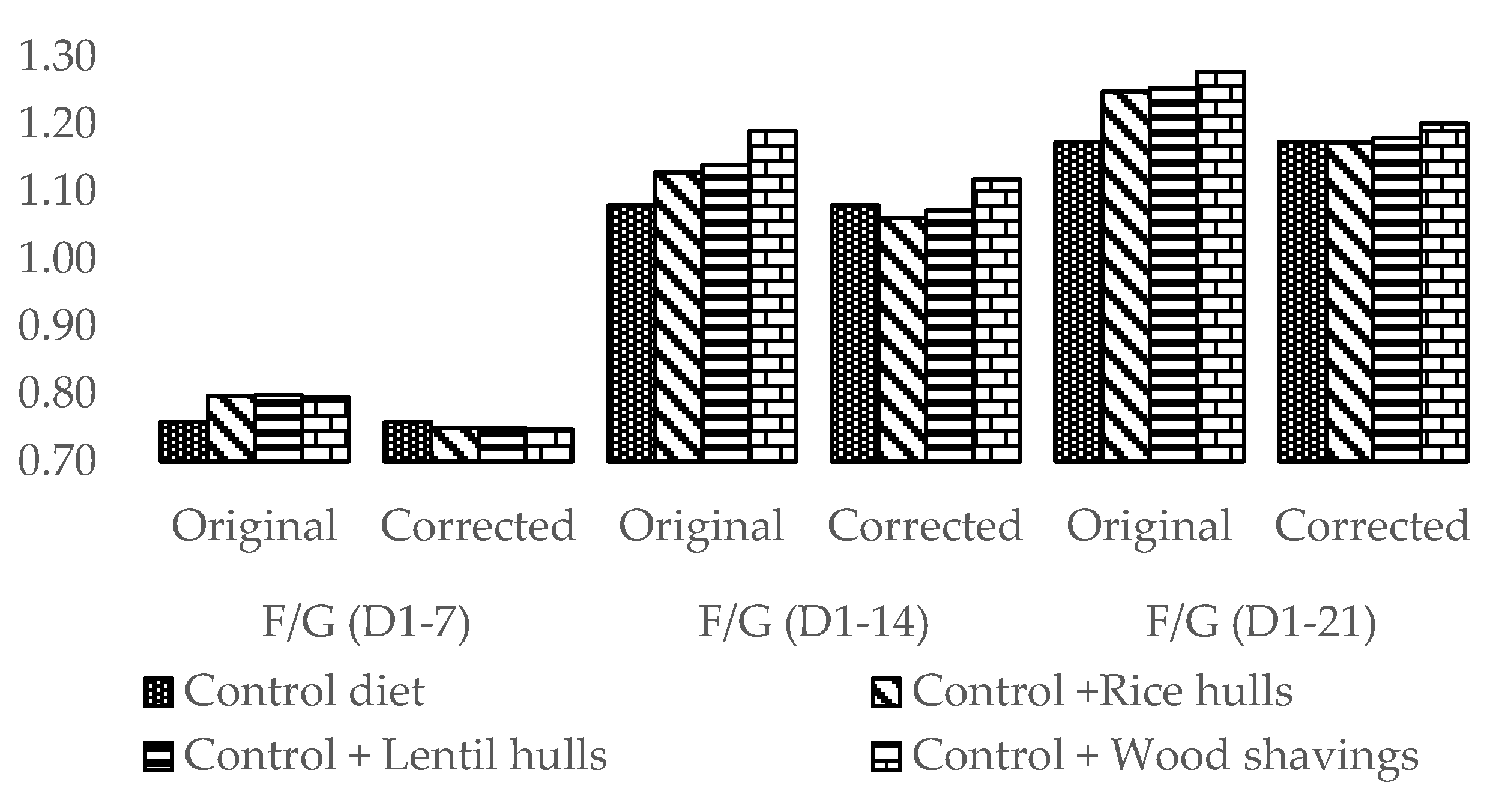
15]. Given the inclusion level of IF in the current study (60 g/kg diet) in the experimental diets, it was speculated that 6% of the diet passed through the gut undigested, while ~94% of the commercial feed was digested. Accordingly, correcting FI to obtain a fiber-corrected F/G value provides an additional approach to interpreting feed efficiency by accounting for the bulk contribution of the added indigestible fraction, thereby offering an alternative perspective for comparison [
5,
14,
16]. It should be noted that this correction does not imply that IF is nutritionally inert; rather, it is intended as an interpretative adjustment to help distinguish the physical dilution effect of added IF from the utilization of the remaining commercial diet. From a practical standpoint, F/G is a key economic indicator, particularly in commercial poultry production. Hence, the current results on fiber-corrected F/G may indicate that a 60 g/kg inclusion of tested IF does not necessarily increase feed cost per unit of gain, despite a reduction in growth rate.
Based on fiber-corrected values, 14-day-old birds fed RH diets showed lower F/G than birds fed WS diets, whereas by 21 d, F/G was unaffected by dietary treatment. This is consistent with Abdollahi et al. [
5], who reported similar fiber-corrected F/G values when comparing lignocellulose, oat hulls, and WS in broiler starter diets. However, these results contrast with those of Amerah et al. [
16] and Hetland et al. [
14], who observed improved fiber-corrected gain-to-feed ratios when wheat-based diets were diluted with oat hulls and WS, respectively. The discrepancy may primarily be due to differences in feed form: mash in the present study and Abdollahi et al. [
5], versus pellets in Hetland et al. [
14] and Amerah et al. [
16].
As indicated by the proximate composition of the experimental diets, incorporating IF increased dietary fiber content. While this contributes to the DM and GE content of the diets, a greater proportion remains undigested in the digesta due to the limited capacity of broiler chickens to hydrolyze and utilize dietary fiber [
5]. Nevertheless, the expected nutrient dilution due to increased gut fill by IF [
14,
33] was not observed in the current study. These findings are consistent with Kakhki et al. [
17], who reported no differences in AME among diets containing oat hulls, beet pulp, or RH, at 3% inclusion level in broiler diets at 22 d of age, and with Amerah et al. [
16], who observed that AMEn was not affected by the inclusion of cellulose or WS at a 6% inclusion level in broilers at 21 d of age. Amerah et al. [
16] also applied a correction for AMEn when IF was included and reported higher AMEn in response to feeding cellulose and WS. In contrast, Jimenez-Moreno et al. [
37,
38] reported increases in AMEn following the addition of IF sources, with the magnitude of the effect being fiber-type dependent. Abdollahi et al. [
5], however, reported lower AME in response to oat hulls and WS inclusion, suggesting that such discrepancies may arise from differences in fiber type and particle size, the fiber concentration in the control diet, and variations in control diet formulation (e.g., use of fillers in the diet substituted with fiber sources). Overall, the results of the current study showed that the inclusion of the tested IF sources at 60 g/kg diet did not compromise energy or nutrient utilization.
Improved gut motility and microbial fermentation, mainly by providing fermentable substrates in a diet such as IF, can promote crop development [
37]. The gizzard is the main organ responsible for the mechanical digestion of feeds within the poultry gastrointestinal tract [
9], whereas the dietary inclusion of IF stimulates gizzard development for extensive mechanical processing and an extended retention period of digesta [
5,
16]. During sampling, large amounts of IF were also observed to accumulate in the gizzard. Amerah et al. [
16] reported that the inclusion of WS increased the relative weight of the gizzard when fed to broiler starters at an inclusion level similar to the current study.
Larger gizzards and increased gastric reflux between the gizzard and proventriculus cause the gizzard pH to drop and promote gastric enzyme and protease activities, aiding protein digestion. Moreover, a lower pH in the gastrointestinal tract helps maintain a healthy digestive environment [
8,
9]. Lower pH can be achieved in the foregut by promoting prolonged retention in the gizzard [
12]. Nevertheless, without significant development in the gizzard, the birds fed LH also showed a lower gizzard pH value, and even with a higher relative weight of the gizzard, WS-fed birds showed a higher gizzard pH. While the relationship between gizzard development and gizzard pH is well established in the literature [
9,
10], exploring other factors that may contribute to a lower gizzard pH is recommended.
Despite the proposed role of lower gizzard pH in enhancing protein digestibility [
6] and lower gizzard pH in birds fed RH and LH diets compared with those fed WS, the current findings showed no effect of IF inclusion on the CAID of protein. Adibmoradi et al. [
24], who compared RH and barley hulls at 0.75 and 1.5% inclusion levels replacing wheat, reported improved CP digestibility, although no effects on gizzard weight were observed, and gizzard pH was not recorded. In contrast, Kakhki et al. [
17], who evaluated alternative fibrous ingredients to oat hulls, found no effects of fiber source (oat hulls, beet pulp, or RH) on protein digestibility or AME at 22 days of age, along with no prominent effect on gizzard development or pH changes. Overall, the discrepancies between the present findings and previous studies suggest that mechanisms beyond those associated with gizzard development and acidification may influence nutrient utilization in broiler starters fed IF-incorporated mash diets.
Although the current design had some limitations, the results nevertheless have implications for understanding the effect of the tested IF on the growth performance, nutrient digestibility, and foregut development of broiler starters. First, the relatively short experimental duration (21 days) was selected to capture early physiological and developmental responses to IF, which are most pronounced during the starter phase [
25]. However, caution is warranted when extrapolating these findings to later growth stages. Second, the use of mash diets was intentional to preserve feed structure and better reflect the physical effects of IF, although this may limit direct comparison with pelleted feeding systems. Previous studies have evaluated IF using dietary dilution [
38,
39,
40], replacement of inert fillers, or substitution of nutrient-dense ingredients such as wheat [
17]. In the present study, a dilution approach was adopted to reflect the functional role of IF when added as a nutrient diluent and to enhance the practical relevance of the findings under applied feeding conditions. Accordingly, diets were not formulated to be iso-nutrient or iso-energetic across treatments. As highlighted by Tejeda and Kim [
15], responses to dietary fiber are influenced by formulation strategy, which should be considered when interpreting the present results. Overall, the findings support the view that IF functions not merely as a nutrient diluent, but as a functional dietary component capable of modulating digestive tract development, nutrient utilization, and growth performance in broiler starters, with particular relevance to production systems in developing countries where agro-industrial by-products remain underutilized.