Article

Synbiotic Potential of Pediococcus acidilactici V202-Fermented Rice Bran: In Vitro and In Vivo Effects on Nutrient Digestibility and Cecal Microbial Populations in Aged Laying Hens


by
Manatsanun Nopparatmaitree
1,
Uangporn Sangkod
2,
Noraphat Hwanhlem
2,
Atichat Thongnum
3,
Payungsuk Intawicha
4,
Juan J. Loor
5 and
Tossaporn Incharoen
2,*
1
Faculty of Animal Science and Agricultural Technology, Silpakorn University, Phetchaburi IT Campus, Cha-Am, Phetchaburi 76120, Thailand
2
Department of Agricultural Science, Faculty of Agriculture, Natural Resources and Environment, Naresuan University, Phitsanulok 65000, Thailand
3
Department of Animal Science and Fishery, Faculty of Sciences and Agricultural Technology, Rajamangala University of Technology Lanna (Phitsanulok Campus), Phitsanulok 65000, Thailand
4
School of Agriculture and Natural Resources, University of Phayao, Phayao 56000, Thailand
5
Department of Animal Sciences, University of Illinois, Urbana, IL 61801, USA
*
Author to whom correspondence should be addressed.
Poultry 2026, 5(3), 38; https://doi.org/10.3390/poultry5030038
Submission received: 23 March 2026 / Revised: 11 May 2026 / Accepted: 18 May 2026 / Published: 21 May 2026
(This article belongs to the Collection Poultry Nutrition)

Abstract

To sustain egg production and gut health in aging flocks, the poultry industry seeks alternative synbiotic feed supplements. This study aimed to optimize Pediococcus acidilactici V202-fermented rice bran (PFR) and evaluate its effects on nutrient digestibility and cecal microbial populations in aged laying hens. In experiment 1, solid-state fermentation conditions (substrate particle size, moisture, and temperature) were optimized for viable lactic acid bacteria (LAB) counts. In experiment 2, in vitro assays were used to assess cecal fermentation kinetics. Subsequently, an in vivo trial involving twenty 80-week-old Hy-Line Brown hens evaluated the impact of PFR supplementation on nutrient digestibility and microbial profiles compared to a control diet. For experiment 1, the optimized fermentation conditions consisted of 40-mesh rice bran, a 30:70 bran-to-water ratio, incubation at 39 °C for 12 h, and drying at 40 °C, which produced the highest viable LAB counts. For experiment 2, PFR enhanced in vitro cumulative cecal gas production. In vivo, compared to the control, PFR supplementation significantly increased the apparent digestibility of dry matter (82.69% vs. 77.03%; p = 0.014), crude protein (82.75% vs. 75.38%; p = 0.016), crude fiber (36.30% vs. 23.10%; p = 0.015), ether extract (86.70% vs. 82.91%; p = 0.016), and gross energy (78.31% vs. 74.99%; p = 0.026). Furthermore, PFR beneficially modulated cecal microbial populations, increasing LAB while reducing Salmonella spp. In conclusion, these findings suggest that optimized PFR could be a promising synbiotic supplement to improve digestive efficiency and support beneficial cecal microbial populations in aged laying hens.

1. Introduction

The global egg industry is a cornerstone for meeting the rising demand for high-quality proteins. To meet this escalating demand, continuous genetic advancements have enabled modern commercial laying hens to exhibit enhanced lay persistency, demonstrating the potential to maintain efficient egg production for extended cycles of up to or beyond 100 weeks of age [1,2]. However, this extended productivity is often hindered by physiological changes that accompany aging, leading to reduced egg quality and compromised health of the animal [3]. In aged laying hens, reduced villus height and decreased enzymatic activity in the gut significantly impair nutrient absorption and negatively affect overall health and productivity [4,5]. Further, the balance of intestinal microbiota, which is essential for optimal nutrient utilization and immune function [6], is disrupted, leading to a decrease in beneficial microbial populations and an increase in pathogenic strains [7]. Several studies have demonstrated that optimizing nutrient absorption and maintaining a balanced gut microbiota can mitigate these effects [8,9,10,11,12]. For instance, feeding Bacillus subtilis or Clostridium butyricum, either alone or in probiotic mixtures, significantly enhances egg production, bone health, antioxidant capacity, and gut microflora balance in laying hens [8,9,10]. Additionally, functional dietary fibers, such as mulberry branch fiber and fermented ginger-derived fiber, can modulate lipid metabolism, improve intestinal morphology, and enhance nutrient absorption [11,12]. Clearly, optimizing gut health through targeted probiotics and dietary fibers is essential for sustaining high-quality egg production in aging flocks.
Pediococcus acidilactici is a robust probiotic that enhances growth performance and short-chain fatty acid (SCFA)-producing bacterial populations, thereby exerting beneficial effects on the gut microbiota [13]. As demonstrated by their resilience in harsh gut conditions, adherence to intestinal cells, and antimicrobial activity against pathogens, Pediococcus strains isolated from the broiler rectum exhibit strong probiotic potential [14]. This lactic acid bacterium is renowned for its ability to ferment sugars into lactic acid, which acidifies the gut environment and competitively inhibits the growth of pathogenic bacteria such as Salmonella spp. and Escherichia coli [15,16]. By promoting a healthier gut microflora, P. acidilactici contributes to enhanced nutrient absorption and improved immune responses [17]. Thus, as the poultry industry seeks to reduce antibiotic use, P. acidilactici has emerged as an effective alternative for sustainable production [18,19]. To maximize the delivery and efficacy of such probiotics, utilizing an appropriate carrier matrix is crucial. Rice bran, an economic by-product of rice milling, is increasingly recognized as a valuable source of dietary fiber and nutrients for non-ruminants such as poultry and pigs [20,21]. Its primarily insoluble fiber components play a crucial role in promoting gut motility and nutrient absorption [22]. Furthermore, phytochemicals in rice bran, such as oryzanols and tocopherols, exhibit antioxidant properties that can reduce oxidative stress in highly productive laying hens [23], while its anti-inflammatory and lipid-lowering effects further support animal health [24].
Crucially, the bioprocessing of rice bran significantly amplifies its functional value. While fermented rice bran using generic probiotics like Saccharomyces boulardii or Lactiplantibacillus plantarum has been reported to increase bioactive metabolites in poultry [25,26,27,28], the specific use of P. acidilactici V202 is a distinct advancement. Unlike conventional strains, P. acidilactici V202 is exceptionally robust, homofermentative, and highly resistant to processing and thermal stress, making it an ideal candidate for solid-state fermentation. Through structural and physicochemical transformation, rice bran serves as an effective matrix, promoting probiotic growth and yielding a potent functional product [25]. The conceptual framework of this study focuses on the synergistic application of rice bran fermented with this specific strain as a highly tailored synbiotic feed supplement. Although general synbiotic preparations using fermented rice bran have been extensively studied in broilers and young poultry, their targeted application to counteract the severe physiological and gut health declines in aged laying hens remains largely unexplored. Furthermore, what distinguishes the present work from previous literature is the precise optimization of physical parameters, such as substrate particle size and thermal conditions, designed specifically to maximize both the viability and the entrapment efficiency of the probiotic within the rice bran matrix. Therefore, the current study had two primary objectives: first, to optimize the processing conditions for developing P. acidilactici V202-fermented rice bran (PFR); and second, to systematically assess the effects of this optimized PFR on nutrient digestibility and cecal microbial populations in aged laying hens using both in vitro and in vivo approaches.

2. Materials and Methods

2.1. Experiment 1: Method Development for PFR Production

2.1.1. Biosafety Approval

This study, involving the handling of biological materials, was performed under strict biosafety regulations and was approved by the Naresuan University Institutional Biosafety Committee (Approval No. NUIBC MI 65-05-09) to ensure compliance with recognized international standards for animal welfare and laboratory safety.

2.1.2. Experimental Design

Based on the pH and viable P. acidilactici V202 counts during rice bran fermentation, the following factors were optimized using a single-factor design:
(1)
Fermented substrate: de Man, Rogosa, and Sharpe (MRS) medium (positive control), distilled water (negative control), and rice bran (unsieved, 40-mesh, 100-mesh).
(2)
Rice bran-to-water ratio (w/w): 10:90, 20:80, and 30:70.
(3)
Incubation period: 0, 6, 12, 18, and 24 h.
(4)
Incubation temperature: 25 °C and 39 °C.
Each treatment combination was replicated five times (n = 5). To evaluate the temporal changes in pH and microbial viability (CFU/mL), samples from each replicate were collected at predetermined time intervals.
To ensure a robust optimization process, the influence of critical processing parameters was evaluated. Initially, certain baseline conditions were established using a systematic screening approach. Subsequently, the effects of rice bran particle size and drying temperature on the viability and matrix entrapment efficiency (EE) of PFR were evaluated using a 3 × 5 factorial arrangement in a completely randomized design (CRD). The experimental factors included particle size (Factor A: non-sieved, 40 mesh, and 100 mesh) and drying temperature (Factor B: 40, 50, 60, 70, and 80 °C). Each treatment combination consisted of five replicates (n = 5). Samples were collected before and after drying to evaluate microbial viability, expressed as colony-forming units per milliliter (CFU/mL), and to calculate the efficiency of the rice bran acting as a natural entrapment matrix.

2.1.3. PFR Fermentation Process

The P. acidilactici V202 culture [29], stored in 30% (v/v) glycerol at −80 °C, was activated twice by inoculating 1% (v/v) into 10 mL of sterile MRS broth (Merck KGaA, Darmstadt, Germany) and incubating statically at 39 °C for 24 h using a laboratory incubator (Heratherm IMP180, Thermo Fisher Scientific, Waltham, MA, USA) [30]. Subsequently, 1% (v/v) of the active culture was transferred to 100 mL of fresh MRS broth and incubated under the same conditions for an additional 24 h [31]. Cells were harvested by centrifugation at 8500 rpm, 4 °C for 10 min using a refrigerated centrifuge (Model 5810 R, Eppendorf AG, Hamburg, Germany), washed twice with sterile 0.85% (w/v) NaCl solution, and resuspended in 10 mL of the same saline solution [32]. The suspension was stored at 4 °C and used within 24 h of preparation. PFR was prepared by mixing the active culture with the respective rice bran substrates that had been previously autoclaved (Model HVE-50; Hirayama Manufacturing Corp., Kasukabe, Japan) at 121 °C for 15 min, ensuring sterility prior to inoculation, in accordance with the experimental design described above.

2.1.4. Determination of pH, Microbial Viability, and EE

At each sampling interval, the pH of the incubation medium was measured using a calibrated digital pH meter (HI2002; Hanna Instruments, Woonsocket, RI, USA). For microbial enumeration, serial dilutions were prepared in sterile 0.85% (w/v) saline solution, and appropriate dilutions were plated on MRS agar (Merck KGaA, Darmstadt, Germany) [33]. Lactic acid bacteria (LAB) were cultured in MRS broth under aerobic conditions at 37 °C for 24 h using a laboratory incubator (Heratherm IMP180, Thermo Fisher Scientific, Waltham, MA, USA). Bacterial growth was evaluated by viable colony counting, with the results expressed as CFU/mL. Microbial count data were log10-transformed prior to statistical analysis to achieve variance homogeneity [34]. The EE (%) of the probiotic PFR was determined to assess the effectiveness of the rice bran as a natural protective matrix. The EE was calculated based on microbial viability before and after the drying process using the following equation: EE (%) = [(log10 CFU/g after drying)/(log10 CFU/g before drying)] × 100. In this context, the EE represents the proportion of P. acidilactici V202 successfully sequestered and protected within the rice bran architecture relative to the initial microbial population before thermal processing.

2.2. Experiment 2: In Vitro and In Vivo Nutrient Digestibility and Cecal Microbial Populations

2.2.1. Animal Ethics

This experimental procedure involving animals was conducted in accordance with the ethical guidelines and standards for the care and use of animals in research, as approved by the Naresuan University Animal Care and Use Committee (Approval No. NUAG 0007/2564).

2.2.2. Preparation of PFR and Experimental Diets

A functional synbiotic supplement containing P. acidilactici V202 was prepared using an optimized rice bran fermentation and natural matrix entrapment method. The active P. acidilactici V202 culture was prepared and harvested as described in Section 2.1.3. The rice bran fermentation medium (RB broth) was prepared by mixing finely ground rice bran (40 mesh) at 30% (w/v) with distilled water, followed by autoclaving at 121 °C for 15 min. After cooling, the prepared P. acidilactici V202 suspension was inoculated into the RB broth at an initial concentration of approximately 8 log CFU/mL. The mixture was incubated statically at 39 °C for 12 h to allow for probiotic colonization and entrapment within the rice bran matrix. The fermented product was air-dried at 40 °C to a constant weight, ground into a fine powder, vacuum-sealed, and stored at 4 °C until further use in the laying diets. To meticulously align with the nutritional requirements of aged laying hens, the experimental diets were based on a basal corn-soybean meal diet formulated to be strictly isonitrogenous and isocaloric. Standardized AOAC protocols [35] were employed to analyze the nutritional profiles of the PFR and experimental diets, encompassing dry matter (DM), organic matter (OM), crude protein (CP), crude fiber (CF), ether extract (EE), and gross energy (GE).

2.2.3. In Vitro Nutrient Digestibility, Cecal Fermentation, and Cecal Microbial Populations

The in vitro approach to evaluating ileal nutrient digestibility of the experimental diets (n = 30) was a three-step technique following the methods of Nopparatmaitree et al. [36] and Inchareon et al. [37]. Approximately 0.5 g of finely ground feed (1 mm) was incubated with 10 mL of pepsin solution (0.1 g pepsin; Sigma-Aldrich, St. Louis, MO, USA, in 0.2 M HCl, pH 2). After 2 h of pepsin digestion, the pH was adjusted to 6.8 using 1 M HCl or 1 M NaOH, and 1 mL of freshly prepared pancreatin solution (0.5 mg pancreatin; Sigma-Aldrich, St. Louis, MO, USA, in 10 mL of 0.2 M phosphate buffer, pH 6.8) was added to simulate intestinal digestion. The proximate composition of the diets and undigested digesta was determined according to AOAC procedures [35]. The GE was measured using a bomb calorimeter (AC-500; LECO Corporation, St. Joseph, MI, USA) with benzoic acid as the calibration standard [35]. True digestibility coefficients were calculated based on nutrient disappearance from the residue, adjusted using blank samples [38].
In vitro cecal fermentation kinetics (n = 30) were evaluated using inocula derived from the cecal contents of five 80-week-old, clinically healthy, antibiotic-free Hy-Line Brown hens sourced from the experimental farm at Naresuan University. Cecal contents were diluted 1:10 (w/w) in phosphate-buffered saline (PBS; 0.1 M, pH 7.4) under anaerobic conditions. Fermentations were performed in 100 mL serum bottles containing 0.3 g of digesta and 45 mL of sterile modified Viande Levure medium [37,39]. Each bottle was inoculated with 5 mL of the freshly prepared cecal slurry and incubated at 42 °C for 24 h under anaerobic conditions (Bactron 300; Sheldon Manufacturing Inc., Cornelius, OR, USA) [36]. Gas production was recorded continuously up to 24 h [40] and fitted to the model: Y = a + b (1 − e−ct), where Y is gas volume (mL/g DM) at time t (h), a is gas from the rapidly fermentable fraction, b is gas from the slowly fermentable fraction, c is the rate constant for fraction b, and (a + b) represents total gas potential. The parameters were estimated using nonlinear regression [41,42]. Post-incubation (24 h), 1 mL of fermentation fluid was centrifuged at 13,000× g for 10 min at 4 °C. The supernatant was acidified with 0.6 M succinic acid (Sigma-Aldrich, St. Louis, MO, USA) and filtered (0.22 µm). SCFAs and lactic acid were quantified using a GC-MS system (GCMS-QP2020 NX; Shimadzu, Kyoto, Japan) equipped with a Nukol capillary column (15 m × 0.32 mm × 0.25 µm; Supelco, Bellefonte, PA, USA). Helium was used as the carrier gas (2.5 mL/min). The oven temperature was programmed from 55 °C to 190 °C. The injector and MS interface were set at 200 °C and 250 °C, respectively, using deuterated SCFAs as internal standards [43].
Following the 24 h in vitro cecal fermentation, 5 mL of each sample was mixed with 45 mL of sterile NSS to obtain a 10−1 suspension, followed by ten-fold serial dilutions [44]. Viable microorganisms were enumerated on selective and nonselective media. Total viable counts (TVC) were determined using Plate Count Agar (30–32 °C, 24 h) [45]. LAB were cultured on MRS agar (microaerophilic/anaerobic, 37 °C, 24 h) [33]. E. coli and Salmonella spp. were enumerated on MacConkey agar and Salmonella–Shigella agar (SSA), respectively (aerobic, 37 °C, 24 h) [46,47]. Plates containing 30–150 colonies were used for the calculation of CFU/mL, and the ratios of LAB to E. coli (L:E) and LAB to Salmonella spp. (L:S) were calculated accordingly.

2.2.4. In Vivo Nutrient Digestibility, Digestible Nutrient Intake, and Cecal Microbial Populations

An in vivo experiment was conducted using twenty 80-week-old Hy-Line Brown laying hens with uniform body weights, which were commercially purchased. The birds were reared by a commercial supplier (Betagro PCL, Bangkok, Thailand) under standard intensive housing systems, following the Department of Livestock Development’s code of practice for layer farms. They were raised in colony cages with controlled lighting and nutrition before being transported to our research facility. The hens were randomly allocated to two dietary treatments (control and PFR). Each treatment consisted of 10 independent replicates, with one bird individually housed per metabolic cage (n = 10 replicates/treatment). The hens were housed in an environmentally controlled facility. The ambient room temperature was maintained at approximately 28 ± 2 °C, and the relative humidity was kept at approximately 65 ± 5%. The facility was equipped with a tunnel ventilation system to ensure continuous air exchange and maintain air quality. Additionally, a standard commercial lighting program of 16 h of light and 8 h of darkness (16L:8D) was strictly implemented throughout the experimental period. Apparent nutrient digestibility was assessed using 0.3% chromium oxide (Cr2O3; Sigma-Aldrich, St. Louis, MO, USA) as an indigestible marker [48]. Following a 28 d adaptation period, feces and feed samples were obtained and stored at −20 °C until chemical analysis [49]. The excreta samples were pooled, homogenized, and subsampled, and then oven-dried at 60–65 °C to a constant weight before being ground to pass through a 1 mm sieve [50]. Dried samples were analyzed for DM, OM, CP, CF, ether extract, and GE using AOAC methods and bomb calorimetry [35]. The in vivo nutrient intake, apparent nutrient digestibility coefficients, and digestible nutrient intake were determined. Nutrient intake was calculated based on daily feed consumption, while nutrient digestibility was determined using the marker method. Digestible nutrient intake was subsequently derived from these values according to the following formulas [48,51,52]:
Nutrient   intake   g / d   = T o t a l   f e e d   i n t a k e   g / d × N u t r i e n t   i n   f e e d   ( % ) 100
Apparent   nutrient   digestibility   ( % ) = 100 100 × %   Cr 2 O 3   i n   f e e d %   Cr 2 O 3   i n   e x c r e t a × %   nutrient i n   e x c r e t a %   nutrient i n   f e e d
Digestible   nutrient   intake   g / d = N u t r i e n t   i n t a k e   g / d × A p p a r e n t   n u t r i e n t   d i g e s t i b i l i t y   ( % ) 100
At the end of the digestibility trial, ten birds from each group were humanely euthanized. Cecal contents were aseptically collected, diluted 1:10 (w/w) in sterile PBS, and subjected to serial dilutions. Viable microbial populations (TVC, LAB, E. coli, and Salmonella spp.) and the resulting L:E and L:S ratios were enumerated using the identical media and incubation conditions described in Section 2.2.3.

2.3. Statistical Analysis

All statistical analyses were conducted following the verification of normality and homogeneity of variance assumptions. For the optimization of fermentation conditions (Experiment 1), the effects of fermented substrate, rice bran-to-water ratio, incubation period, and incubation temperature were analyzed using a Generalized Linear Model (GLM) via SAS software (Release 9.4; SAS Institute Inc., Cary, NC, USA), with Duncan’s new multiple range test used for mean comparisons. Furthermore, the effects of particle size and drying temperature were evaluated as a 3 × 5 factorial arrangement using a two-way analysis of variance (ANOVA) via R software (version 4.3.3; R Foundation for Statistical Computing, Vienna, Austria, https://www.R-project.org/) [53]. For both the in vitro gas production assay and the in vivo trial (Experiment 2), differences in all measured parameters between the control and PFR-supplemented groups were analyzed using an independent samples t-test via R software. Prior to all analyses, microbial count data were log10-transformed. Statistical significance was declared at p < 0.05, and tendencies were noted when 0.05 ≤ p < 0.10.

3. Results

3.1. Experiment 1: PFR Preparation Method

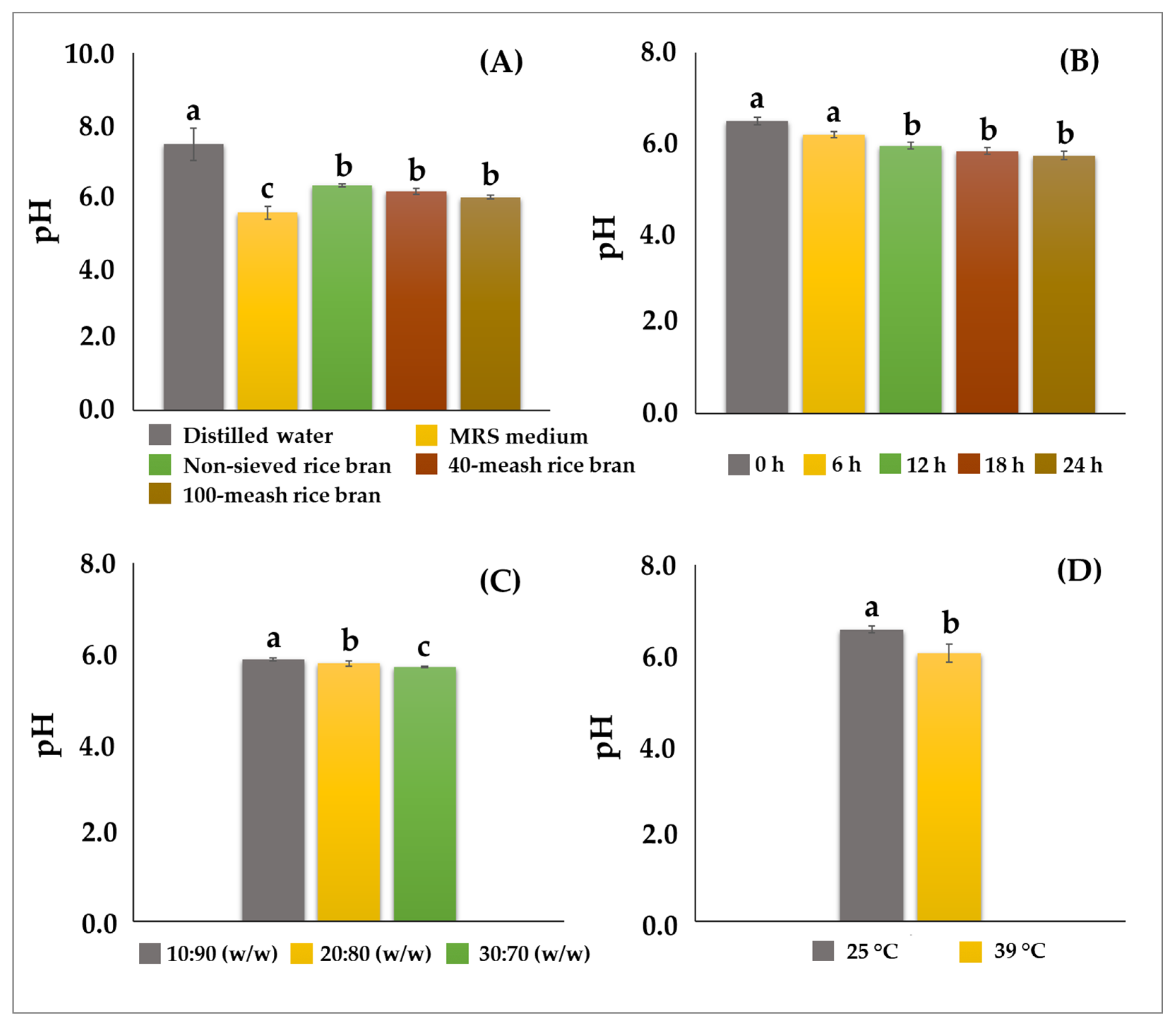
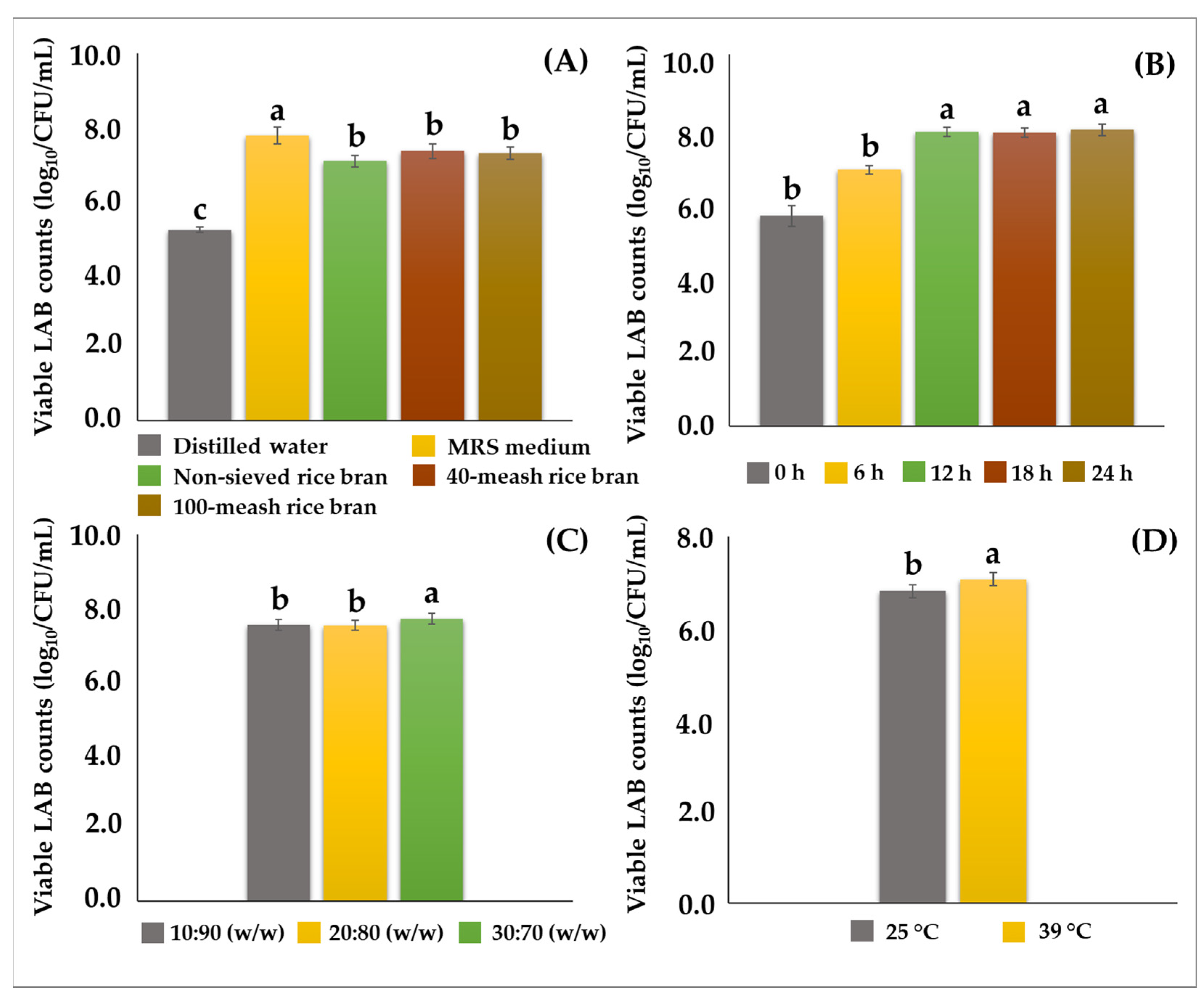
Among the evaluated substrates, the lowest pH value (5.54; p < 0.001; Figure 1A) and the greatest viable LAB counts (7.76 log10 CFU/mL; p < 0.001; Figure 2A) were observed with the MRS medium, followed by the rice bran substrates. In contrast, distilled water led to the highest pH (7.46; p < 0.001) and the lowest viable LAB counts (5.19 log10 CFU/mL; p < 0.001). When rice bran was used as the fermentation substrate, mesh size had a moderate effect compared with non-sieved rice bran; finer rice bran particles (40- and 100-mesh) led to slightly lower pH (5.97–6.14) and greater viable LAB counts (7.28–7.33 log10 CFU/mL; p < 0.001).
The rice bran-to-water ratio also affected fermentation efficiency, with the 30:70 (w/w) ratio yielding the lowest pH (5.67; p < 0.001; Figure 1C) and the greatest viable LAB count (7.70 log10 CFU/mL; p < 0.001; Figure 2C). Incubation temperature significantly influenced fermentation activity; samples incubated at 39 °C had a lower pH (6.02; Figure 1D) and greater viable LAB counts (7.06 log10 CFU/mL; Figure 2D) than those incubated at 25 °C (p < 0.001). Furthermore, fermentation time significantly influenced the process. Although the numerically highest viable LAB count (7.96 log10 CFU/mL; Figure 2B) and lowest pH (5.72; Figure 1B) were observed at 24 h, statistical analysis revealed no significant differences in either pH or viable LAB counts among the 12, 18, and 24 h incubation periods. Therefore, 12 h was selected as the optimal incubation period for subsequent experiments, as it yields maximum probiotic viability while being the most time- and cost-efficient for production. These results indicate that the optimal fermentation performance of P. acidilactici V202 using 40-mesh rice bran at a 30:70 (w/w) rice bran-to-water ratio occurs at 39 °C for 12 h.
Following fermentation, the viable LAB counts and PEE of the PFR were significantly affected by particle size, drying temperature (Table 1), and their interaction (p < 0.001). Among the main effects, 100-mesh rice bran led to the greatest initial viable LAB counts (7.83 log10 CFU/mL), whereas the 40-mesh substrate led to the greatest final viable LAB counts (6.10 log10 CFU/mL) and PEE (79.99%). In contrast, non-sieved rice bran showed a comparatively lower PEE (69.71%). Drying temperature had a marked influence on bacterial survival and EE. The greatest final viable LAB counts (6.97 log10 CFU/mL) and PEE (90.05%) were observed at 40 °C, followed by 60 °C (5.42 log10 CFU/mL and 77.12%, respectively). However, further increases in temperature resulted in significant decreases, with the lowest viable LAB counts (3.83 log10 CFU/mL) and PEE (50.52%) recorded at 80 °C (p < 0.001).
A significant interaction between particle size and drying temperature was also observed (p < 0.001). The combination of 40-mesh rice bran and 40 °C drying produced the optimal outcome, achieving the highest PEE (97.58%) and final viable LAB count (7.53 log10 CFU/mL). Conversely, 100-mesh rice bran dried at 80 °C resulted in the lowest survival (3.17 log10 CFU/mL) and PEE (40.56%). These results suggest that moderate drying temperatures (≤40 °C) and medium particle size (40 mesh) provide favorable conditions for maintaining the viability and stability of P. acidilactici V202 in the fermented rice bran matrix.

3.2. Experiment 2: In Vitro and In Vivo Assessments of Nutrient Digestibility and Cecal Microbial Populations in Response to Feeding PFR

3.2.1. In Vitro Nutrient Digestibility, Cecal Fermentation, Degradation Kinetics, and Cecal Microbial Populations

The analyzed nutrient composition of the PFR, including its proximate components and GE, is presented in Table 2. The overall nutritional profile confirms its viability as a synbiotic feed ingredient for laying hens. Table 3 details the analyzed nutrient composition and P. acidilactici V202 cell counts of the experimental diets. Proximate analyses verified that the experimental diets were strictly isocaloric and isonitrogenous, eliminating potential nutritional confounding factors. Furthermore, the targeted delivery of the probiotic was confirmed by the presence of viable P. acidilactici V202 exclusively in the PFR diet, whereas the strain remained undetected in the control formulation.
The in vitro true digestibility of DM, CP, CF, and GE was not significantly affected by PFR supplementation (p > 0.05; Table 4). However, EE digestibility was greater (p = 0.025) in the simulated digesta of hens fed the PFR diet compared with those fed the control diet. Cumulative cecal gas production increased markedly in the PFR group at all incubation times (4–24 h; p < 0.01), indicating enhanced microbial fermentation activity. Gas production kinetics demonstrated a greater potential gas production (a + b; p = 0.019) and fractional rate of gas production (c; p = 0.009) in response to feeding PFR, whereas the slowly degradable fraction (b) was lower (p = 0.024) (Table 4). These kinetic shifts imply a more rapid substrate degradation and improved fermentation efficiency.
Furthermore, PFR supplementation markedly influenced cecal fermentation metabolite levels. Lactic acid concentration was greater (p < 0.001), as were the concentrations of acetic, propionic, butyric, and valeric acids (p < 0.001), resulting in a greater total SCFA concentration compared with the control group (Table 4). In vitro microbial analysis revealed that PFR supplementation did not affect TVC (p = 0.224). However, dietary PFR led to greater LAB populations (p = 0.003), whereas Salmonella spp. (p = 0.047) and E. coli (p < 0.001) populations were lower. Consequently, both the L:S ratio (p = 0.006) and the L:E ratio (p < 0.001) were greater in the PFR treatment.

3.2.2. In Vivo Digestible Nutrient Intake, Apparent Nutrient Digestibility, and Cecal Microbial Populations

The effects of dietary supplementation with PFR on in vivo nutrient intake, apparent nutrient digestibility, and cecal microbial populations of laying hens are summarized in Table 5. Compared with that of hens fed the control diet, hens fed the PFR-supplemented diet exhibited greater apparent digestibility of DM (p = 0.014), CP (p = 0.016), CF (p = 0.015), ether extract (p = 0.016), and GE (p = 0.026). Although the total daily intake of DM, ether extract, and GE did not differ between treatments (p > 0.05), birds receiving PFR had greater CP (p = 0.003) and CF (p = 0.001) intakes.
Similarly, the digestible intakes of DM, CP, CF, ether extract, and GE were greater (p < 0.05) in laying hens fed PFR compared with the control group, demonstrating clear benefits for nutrient absorption. In vivo cecal microbial analysis aligned with the in vitro findings; PFR supplementation did not affect TVC (p = 0.835) but led to greater LAB populations (p = 0.008) while reducing Salmonella spp. (p = 0.016). Consequently, both the L:S ratio (p = 0.001) and the L:E ratio (p = 0.001) were markedly greater in the PFR group.

4. Discussion

The present study demonstrated that the fermentation efficiency and viability of P. acidilactici V202 are intricately governed by the physicochemical properties of the substrate and the applied processing parameters. Although rich laboratory media like MRS support maximal bacterial growth, rice bran proved to be a highly effective, sustainable, and economically viable alternative. Rice bran consists of nearly 90% insoluble fibers, including cellulose, hemicellulose, and arabinoxylans. Along with various carbohydrates and proteins, these components provide abundant fermentable prebiotic substrates [22]. Beyond serving as a nutrient source, rice bran functions as a critical natural matrix entrapment. Its naturally compact and porous structural organization acts as a physical barrier that entraps microbial cells, protecting them from mechanical stress and processing-induced damage [54,55]. Furthermore, the inherent presence of bioactive compounds, notably phenolic acids and γ-oryzanol, imparts antioxidant and membrane-stabilizing effects that preserve cellular integrity under thermal and oxidative stress during both fermentation and subsequent drying stages [22,56,57].
Mechanistically, optimizing the physical parameters of the substrate is paramount for maximizing probiotic entrapment efficiency. Particle size significantly affected fermentation kinetics. Finer fractions increased the surface area and substrate accessibility, which enhanced enzyme-substrate interactions and nutrient diffusion [54,58,59]. This enhanced accessibility accelerated carbohydrate hydrolysis, facilitating efficient fermentation by the lactic acid bacteria and leading to the observed rapid pH reduction [28,60]. However, while extremely fine particles of 100 mesh facilitate rapid fermentation, they render the bacterial cells highly vulnerable to dehydration and oxidative damage during the drying process [56]. Thus, an intermediate particle size of 40 mesh was identified as the optimal balance, providing sufficient surface area for metabolic activity while maintaining the structural integrity necessary for cellular protection. This was synergistically supported by an optimal rice bran-to-water ratio of 30:70 (w/w), which maintained ideal water activity and redox balance, preventing both nutrient restriction and detrimental nutrient dilution [61].
The temporal and thermal dynamics of the process further underscore the adaptive responses of P. acidilactici V202. The fermentation exhibited a characteristic biphasic pattern, driven by homofermentative lactic acid biosynthesis [62,63]. During the initial 12 h, rapid pH reduction and exponential bacterial proliferation occurred, reflecting active ATP generation and the competitive exclusion of undesirable microorganisms [64]. Subsequently, the process entered a stationary phase (18–28 h) where substrate depletion and acid accumulation shifted the bacteria toward maintenance metabolism [65,66]. Crucially, maintaining the fermentation and drying temperatures around 39–40 °C was vital. This moderately thermophilic range optimized enzymatic function and nutrient transport [67,68]. Conversely, exposure to higher temperatures, such as those between 57 and 80 °C, severely compromised membrane integrity, induced protein denaturation, and sharply reduced cell viability [69,70]. Therefore, the integration of a 40-mesh substrate size with carefully controlled moisture and mild thermal processing (≤40 °C) represents a robust strategy to maximize probiotic viability, ultimately yielding a high-quality synbiotic feed ingredient.
Supplementation with PFR profoundly modulated the cecal microbiota and fermentation dynamics in aged laying hens. The inclusion of PFR induced a pronounced bifidogenic effect, characterized by the selective stimulation of LAB and Bifidobacterium populations, alongside a concurrent reduction in pathogenic bacteria such as Salmonella spp. and E. coli [71]. These findings are highly consistent with the existing literature on fermented feeds. For instance, Sugiharto & Ranjitkar [6] highlighted that the dietary inclusion of fermented feed significantly enriches beneficial microbiota while suppressing enteric pathogens such as Salmonella and coliforms. Furthermore, Jazi et al. [72] have demonstrated that specific supplementation with P. acidilactici, either alone or in synbiotic combinations, effectively modulates the gut microbiome, significantly enriches the lactic acid bacteria population, and reduces the colonization of Salmonella and coliforms in broiler chickens. This effect is likely driven by the synergistic action of viable lactic acid bacteria and the organic acids produced during fermentation, which lower the intestinal pH and prevent pathogen colonization through competitive exclusion [6,73]. In conjunction with these probiotic actions, this microbial shift is also profoundly supported by the prebiotic components of the rice bran matrix, including oligosaccharides and undigested dietary fibers, which selectively support the proliferation of beneficial anaerobes [74]. The enhanced microbial activity was further corroborated by the in vitro fermentation kinetics. Specifically, the observed increases in cumulative cecal gas production and kinetic parameters (P and c values) reflect a more intense rate of carbohydrate metabolism, efficient substrate utilization, and improved energy conversion within the cecal ecosystem [36,37,75].
Mechanistically, the metabolic advantages of PFR stem from the establishment of an optimal carbon-to-nitrogen (C:N) ratio. The LAB-driven degradation of polysaccharides increases the availability of simple sugars, while protein hydrolysis releases essential peptides and amino acids [76]. In this nutrient-rich environment, P. acidilactici V202 effectively metabolizes carbohydrates, consistent with our in vitro findings of increased gas production and fermentation rates. This metabolic activity likely creates an acidic environment that inhibits pathogens and supports beneficial microbial cross-feeding. The generated lactic acid could serve as a primary substrate for butyrate-producing bacteria, such as Faecalibacterium prausnitzii and Butyricicoccus pullicaecorum [72]. This suggested cooperative metabolism likely contributes to the cecal SCFA concentrations, including acetic, propionic, butyric, and valeric acids. These SCFAs exert synergistic antimicrobial effects through direct acidification, membrane disruption, and competitive exclusion [77,78]. The microbiological and metabolic improvements translated directly into enhanced macroscopic physiological outcomes for the aged laying hens.
Birds fed the PFR-supplemented diet exhibited significantly greater apparent digestibility of DM, CP, CF, EE, and GE. This significant enhancement in nutrient utilization strongly aligns with several previous reports. Obeidat et al. [79] reported that comparable improvements in the apparent digestibility of nutrients, particularly CP, were observed in poultry fed diets supplemented with fermented soybean-based ingredients. Previous studies have widely demonstrated that the fermentation process efficiently degrades complex structures and reduces various anti-nutritional factors. These include phytates, complex oligosaccharides, and even trypsin inhibitors in leguminous feeds. Consequently, this degradation process releases trapped nutrients and significantly increases their bioavailability [6,72]. Specifically, the improvement in the digestibility of EE and other nutrients can be partially attributed to the structural and chemical changes occurring during solid-state fermentation. As P. acidilactici utilizes soluble carbohydrates and starch as primary carbon sources, the starch content is reduced, leading to a relative concentration of EE and CP in the fermented product. Consequently, this process reduces the starch-to-protein (S:P) ratio of the diet. The microbial pre-digestion of complex carbohydrates, combined with a lower S:P ratio, likely creates a more favorable condition for the action of endogenous digestive enzymes, thereby enhancing overall nutrient utilization, including EE. Furthermore, these improvements are intrinsically linked to the elevated SCFA production [80]. SCFAs, particularly butyrate, are widely recognized to function as major oxidative fuels for colonocytes, which could potentially stimulate epithelial cell proliferation and contribute to maintaining gut homeostasis [81]. While intestinal morphology was not directly evaluated, the increased nutrient digestibility observed in this study is likely associated with the role of SCFAs, particularly butyrate, as oxidative fuels for intestinal cells. This energy supply could support epithelial integrity and increase the absorptive surface area, thereby explaining the significantly higher apparent digestibility of DM, CP, and other nutrients in the PFR-supplemented group. In addition, previous research suggests that enhanced SCFA production may be associated with increased villus height, deeper crypts, and an improved overall VH/CD ratio, which collectively maximize the absorptive surface area [82]. Furthermore, it is hypothesized that the beneficial microbes and their metabolites might help strengthen tight junctions, protect the epithelial barrier from inflammation, and reduce toxin production [82].
These physiological improvements are further substantiated by the strong correlation between our laboratory findings and the live bird trial. The findings from the in vitro fermentation kinetics provide a strong mechanistic basis for the improvements observed in vivo. Specifically, the significant increases in gas production and fermentation rate reflect the high fermentability of the PFR matrix, indicating that the optimized PFR serves as a readily available and highly effective substrate for cecal microbiota. This enhanced fermentative activity, characterized during the in vitro phase, was successfully translated into the in vivo environment, as evidenced by the enrichment of beneficial lactic acid bacteria and the subsequent enhancement in nutrient digestibility. Thus, the in vitro results serve as a reliable predictive indicator of how PFR modulates the cecal ecosystem, ultimately enhancing the metabolic efficiency of the birds.
It is important to note that while the fermentation of rice bran with various lactic acid bacteria has been extensively documented in broilers and young poultry, the application of an optimized fermentation process using the specific P. acidilactici V202 strain to address the physiological declines in aged laying hens represents a significant advancement. Aged hens, especially those over 80 weeks, often show reduced nutrient absorption. They also have a more fragile gut microbial balance compared to younger birds. Our findings demonstrate that the synergistic effects of the optimized PFR, which was developed through precise substrate and thermal parameters, specifically counteract these age-related challenges by enhancing nutrient digestibility and restoring beneficial microbial populations. This study thus provides a targeted nutritional strategy that is uniquely tailored to sustain the late-stage productivity of the laying flock, a gap that has remained largely unaddressed in previous fermented feed research.
Despite these promising advancements, it is important to recognize certain methodological constraints within the current study. Specifically, the in vivo trial was conducted with a relatively small sample size. While this may limit the broader generalization of the findings, the experiment was strictly controlled in terms of bird age, genetic background, and environmental conditions to minimize individual variance. The significant differences observed in nutrient digestibility and microbial populations suggest that the sample size was sufficient to detect the primary effects of PFR supplementation. Nevertheless, future studies with a larger cohort are recommended to further validate these effects across diverse commercial settings. Furthermore, it is important to acknowledge that the microbial populations in this study were characterized using culture-based techniques. While these methods provide valuable insights into the viability of key functional groups such as lactic acid bacteria and specific pathogens, they offer lower taxonomic resolution compared to modern high-throughput sequencing technologies including 16S rRNA sequencing. Consequently, some non-culturable or less abundant microbial taxa may not have been captured. Future research incorporating metagenomic approaches is warranted to provide a more comprehensive understanding of the complex microbial shifts and functional dynamics within the cecal ecosystem of aged laying hens. Additionally, another limitation is that intestinal morphology and gut barrier markers were not directly measured in this study. Therefore, the discussions regarding epithelial proliferation, villus morphology, and tight junction integrity represent possible mechanistic pathways rather than definitively proven outcomes. Future studies incorporating histological evaluations are required to confirm these gut barrier benefits.
Regarding its applicability in practical farm conditions, the utilization of fermented rice bran presents a highly cost-effective and sustainable strategy to upcycle an abundant agricultural by-product. However, translating this optimized solid-state fermentation process from a controlled laboratory setting to a commercial farm scale presents logistical challenges. Feed manufacturers or farmers must ensure strict management of moisture content, aeration, and mild thermal conditions, which we identified as critical for P. acidilactici viability, to prevent opportunistic pathogenic contamination and ensure batch-to-batch consistency. Furthermore, since the current in vivo trial was conducted in a strictly controlled environmental facility, the efficacy of PFR needs to be evaluated under typical commercial stressors, such as high stocking densities and fluctuating temperatures. Future large-scale commercial trials assessing the economic feasibility, shelf-life stability of the fermented product, and its long-term impact on overall egg production parameters are essential before widespread farm-level adoption.
Ultimately, the functional efficacy of PFR operates through an integrated synbiotic mechanism. The probiotic effect arises from the successful colonization and metabolic output of P. acidilactici V202, while the prebiotic effect is derived from the fermentable rice bran components that protect the cells and selectively nourish the endogenous microbiota. This dual action promotes the proliferation of beneficial lactobacilli while suppressing specific target pathogens, enhancing energy-efficient fermentation, and improving nutrient assimilation. These findings underscore the immense potential of PFR as a highly effective, sustainable functional feed supplement. By optimizing both the substrate formulation and the fermentation process, PFR can significantly improve gut health and nutrient utilization in aged laying hens, offering a viable nutritional strategy to support flock health without the reliance on antibiotic growth promoters.

5. Conclusions

This study successfully developed a synbiotic feed supplement, optimized for high probiotic viability and entrapment efficiency. PFR supplementation favorably influenced specific cecal microbial populations by promoting beneficial LAB and reducing Salmonella spp., alongside enhancing overall microbial fermentation activity. The synbiotic supplementation significantly improved cecal gas production kinetics and the apparent digestibility of DM, CP, CF, EE, and GE, thereby maximizing overall nutrient utilization. Therefore, PFR represents a promising functional feed additive that supports gut health and nutritional efficiency in aged laying hens. These findings highlight the tremendous potential of utilizing agricultural by-products to advance sustainable and green poultry production. Further in vivo validation during extended production cycles will be essential to fully optimize its commercial application.

Author Contributions

Conceptualization, M.N., U.S. and T.I.; methodology, M.N., U.S. and T.I.; investigation, M.N., U.S., A.T., T.I. and N.H.; formal analysis, M.N., U.S., T.I. and A.T.; validation, P.I., N.H. and T.I.; resources, T.I., J.J.L. and M.N.; funding acquisition, T.I. and P.I.; writing—original draft preparation, M.N. and T.I.; writing—review and editing, J.J.L., N.H. and T.I.; supervision, T.I., N.H. and J.J.L.; project administration, T.I. All authors have read and agreed to the published version of the manuscript.

Funding

This research was funded by (1) the Graduate Research Program in Agriculture and Agro-Industry for the Fiscal Year 2022 (Grant No. HRD65050081), (2) the Reinventing University Program 2026, the Ministry of Higher Education, Science, Research and Innovation (MHESI), and Naresuan University, Thailand (Grant No. R2569A014), (3) the Frontier Research and Innovation Cluster Fund, Naresuan University (Grant No. R2569C002), and (4) the Fundamental Fund, University of Phayao and Thailand Science Research and Innovation Fund (Grant No. 2027).

Institutional Review Board Statement

All of the experimental procedures were approved by the Naresuan University Agricultural Animal Care and Use Committee (Approval No. NUAG 0007/2564, approved on 16 November 2021) and the Naresuan University Institutional Biosafety Committee (Approval No. NUIBC MI 65-05-09, approved on 9 June 2022).

Informed Consent Statement

Not applicable.

Data Availability Statement

The original contributions presented in this study are included in the article. Further inquiries can be directed to the corresponding author.

Acknowledgments

The author would like to express sincere appreciation to the Agricultural Research Development Agency (Public Organization) [ARDA], Thailand, for its financial support. Also, this work was partially supported by Reinventing University Program 2026, The Office of the Permanent Secretary of the Ministry of Higher Education, Science, Research and Innovation (MHESI), and Naresuan University, Thailand. Sincere appreciation is extended to the Frontier Research and Innovation Cluster Fund, Naresuan University, and the Fundamental Fund, University of Phayao and Thailand Science Research and Innovation Fund, for their partial support of this work.

Conflicts of Interest

The authors declare no conflicts of interest.

Abbreviations

The following abbreviations are used in this manuscript:
CFUColony-forming units
CFCrude fiber
CPCrude protein
CRDCompletely randomized design
DMDry matter
EEEntrapment efficiency
GEGross energy
LABLactic acid bacteria
L:ELactic acid bacteria to E. coli ratio
L:SLactic acid bacteria to Salmonella spp. ratio
MRSde Man, Rogosa, and Sharpe
OMOrganic matter
PFRPediococcus acidilactici V202-fermented rice bran
R2Coefficient of determination
RBRice bran
SCFAsShort-chain fatty acids
SEMStandard error of the mean
SSASalmonella-Shigella agar
TVCTotal viable counts

References

  1. Bain, M.M.; Nys, Y.; Dunn, I.C. Increasing Persistency in Lay and Stabilising Egg Quality in Longer Laying Cycles. What Are the Challenges? Br. Poult. Sci. 2016, 57, 330–338. [Google Scholar] [CrossRef]
  2. Arulnathan, V.; Turner, I.; Bamber, N.; Ferdous, J.; Grassauer, F.; Doyon, M.; Pelletier, N. Systematic Review of Potential Productivity, Egg Quality, and Animal Welfare Implications of Extended Lay Cycles in Commercial Laying Hens in Canada. Poult. Sci. 2024, 103, 103475. [Google Scholar] [CrossRef]
  3. Korver, D.R. Review: Current Challenges in Poultry Nutrition, Health, and Welfare. Animal 2023, 17, 100755. [Google Scholar] [CrossRef] [PubMed]
  4. Li, Q.; Zhang, Y.; Wang, C.; Zhang, X.; Wei, R.; Li, Y.; Li, Q.; Xu, N. Comparative Study on the Fermentation Characteristics of Selective Lactic Acid Bacteria in Shanxi Aged Vinegar: Pure Culture Versus Co-Culture. Foods 2024, 13, 3374. [Google Scholar] [CrossRef]
  5. Sharma, M.K.; Liu, G.; Choppa, V.S.R.; Rafieian-Naeini, H.R.; Mahdavi, F.S.; Marshall, B.; Gogal, R.M.; Kim, W.K. Effects of Artemisia Annua Supplementation on the Performance and Gut Health of Laying Hens Challenged with Mixed Eimeria Species. Front. Physiol. 2024, 15, 1381548. [Google Scholar] [CrossRef]
  6. Sugiharto, S.; Ranjitkar, S. Recent Advances in Fermented Feeds Towards Improved Broiler Chicken Performance, Gastrointestinal Tract Microecology and Immune Responses: A review. Anim. Nutr. 2019, 5, 1–10. [Google Scholar] [CrossRef] [PubMed]
  7. Li, Z.; Qin, B.; Chen, T.; Kong, X.; Zhu, Q.; Azad, M.A.K.; Cui, Y.; Lan, W.; He, Q. Fermented Aronia Melanocarpa Pomace Improves the Nutritive Value of Eggs, Enhances Ovarian Function, and Reshapes Microbiota Abundance in Aged Laying Hens. Front. Microbiol. 2024, 15, 1422172. [Google Scholar] [CrossRef] [PubMed]
  8. Abdelqader, A.; Irshaid, R.; Al-Fataftah, A.-R. Effects of Dietary Probiotic Inclusion on Performance, Eggshell Quality, Cecal Microflora Composition, and Tibia Traits of Laying Hens in the Late Phase of Production. Trop. Anim. Health Prod. 2013, 45, 1017–1024. [Google Scholar] [CrossRef]
  9. Xu, H.; Lu, Y.; Li, D.; Yan, C.; Jiang, Y.; Hu, Z.; Zhang, Z.; Du, R.; Zhao, X.; Zhang, Y.; et al. Probiotic Mediated Intestinal Microbiota and Improved Performance, Egg Quality and Ovarian Immune Function of Laying Hens at Different Laying Stage. Front. Microbiol. 2023, 14, 1041072. [Google Scholar] [CrossRef]
  10. Huang, J.; Cui, L.; Lin, H.; Song, M.; Sun, S. Effects of Clostridium butyricum on Production Performance and Bone Development of Laying Hens. Vet. Sci. 2024, 11, 160. [Google Scholar] [CrossRef]
  11. Hu, H.; Li, A.; Shi, C.; Chen, L.; Zhao, Z.; Yin, X.; Zhang, Q.; Huang, Y.; Pan, H. Mulberry Branch Fiber Improved Lipid Metabolism and Egg Yolk Fatty Acid Composition of Laying Hens via the Enterohepatic Axis. Microbiome 2024, 12, 73. [Google Scholar] [CrossRef]
  12. Incharoen, T.; Yamauchi, K.; Thongwittaya, N. Intestinal Villus Histological Alterations in Broilers Fed Dietary Dried Fermented Ginger: Intestinal Histology and Dried Fermented Ginger in Diets. J. Anim. Physiol. Anim. Nutr. 2010, 94, e130–e137. [Google Scholar] [CrossRef] [PubMed]
  13. Bartkiene, E.; Bartkevics, V.; Krungleviciute, V.; Juodeikiene, G.; Zadeike, D.; Baliukoniene, V.; Bakutis, B.; Zelvyte, R.; Santini, A.; Cizeikiene, D. Application of Hydrolases and Probiotic Pediococcus acidilactici BaltBio01 Strain for Cereal by-Products Conversion to Bioproduct for Food/Feed. Int. J. Food Sci. Nutr. 2018, 69, 165–175. [Google Scholar] [CrossRef]
  14. Noohi, N.; Ebrahimipour, G.; Rohani, M.; Talebi, M.; Pourshafie, M.R. Evaluation of Potential Probiotic Characteristics and Antibacterial Effects of Strains of Pediococcus Species Isolated from Broiler Chickens. Br. Poult. Sci. 2016, 57, 317–323. [Google Scholar] [CrossRef] [PubMed]
  15. Tian, C.; Wang, L.; Liu, M.; Liu, J.; Qiu, M.; Chen, Y. Isolation and Identification of Chicken-Derived Lactic Acid Bacteria: In Vitro Probiotic Properties and Antagonistic Effects Against Salmonella pullorum, Staphylococcus aureus, and Escherichia coli. Microorganisms 2024, 12, 795. [Google Scholar] [CrossRef]
  16. Adeyemi, O.D.; Nahashon, S.N. Mitigating Salmonella in Poultry Using Probiotics: Mechanisms, Challenges, and Opportunities. Microorganisms 2026, 14, 365. [Google Scholar] [CrossRef]
  17. Krysiak, K.; Konkol, D.; Korczyński, M. Overview of the Use of Probiotics in Poultry Production. Animals 2021, 11, 1620. [Google Scholar] [CrossRef] [PubMed]
  18. Abd El-Hack, M.E.; El-Saadony, M.T.; Shafi, M.E.; Qattan, S.Y.A.; Batiha, G.E.; Khafaga, A.F.; Abdel-Moneim, A.E.; Alagawany, M. Probiotics in Poultry Feed: A Comprehensive Review. Anim. Physiol. Nutr. 2020, 104, 1835–1850. [Google Scholar] [CrossRef]
  19. Alagawany, M.; Abd El-Hack, M.E.; Farag, M.R.; Sachan, S.; Karthik, K.; Dhama, K. The Use of Probiotics as Eco-Friendly Alternatives for Antibiotics in Poultry Nutrition. Environ. Sci. Pollut. Res. 2018, 25, 10611–10618. [Google Scholar] [CrossRef]
  20. Qui, N.H.; Linh, N.T. Nutritive and Therapeutic Value of Fermented Rice Bran as a Feed Additive for Enhancing Performance and Health in Chickens: A Review. Open Vet. J. 2025, 15, 3439–3447. [Google Scholar] [CrossRef]
  21. Deng, W.; Xiang, X.; Li, Z.; Daniel, S.; Liao, J.; Cao, X.; Sui, Z.; Zeng, H.; Hang, S. Effects of Fermented Rice Bran Meal on Growth Performance and Amino Acid Metabolism in Finishing Pigs. Animals 2026, 16, 527. [Google Scholar] [CrossRef]
  22. Sapwarobol, S.; Saphyakhajorn, W.; Astina, J. Biological Functions and Activities of Rice Bran as a Functional Ingredient: A Review. Nutr. Metab. Insights 2021, 14, 11786388211058559. [Google Scholar] [CrossRef]
  23. Punia, S.; Kumar, M.; Siroha, A.K.; Purewal, S.S. Rice Bran Oil: Emerging Trends in Extraction, Health Benefit, and Its Industrial Application. Rice Sci. 2021, 28, 217–232. [Google Scholar] [CrossRef]
  24. Manzoor, A.; Pandey, V.K.; Dar, A.H.; Fayaz, U.; Dash, K.K.; Shams, R.; Ahmad, S.; Bashir, I.; Fayaz, J.; Singh, P.; et al. Rice Bran: Nutritional, Phytochemical, and Pharmacological Profile and Its Contribution to Human Health Promotion. Food Chem. Adv. 2023, 2, 100296. [Google Scholar] [CrossRef]
  25. Ryan, E.P.; Heuberger, A.L.; Weir, T.L.; Barnett, B.; Broeckling, C.D.; Prenni, J.E. Rice Bran Fermented with Saccharomyces Boulardii Generates Novel Metabolite Profiles with Bioactivity. J. Agric. Food Chem. 2011, 59, 1862–1870. [Google Scholar] [CrossRef] [PubMed]
  26. Cheng, J.; Choi, B.-K.; Yang, S.H.; Suh, J.-W. Effect of Fermentation on the Antioxidant Activity of Rice Bran by Monascus pilosus KCCM60084. J. Appl. Biol. Chem. 2016, 59, 57–62. [Google Scholar] [CrossRef]
  27. Nisa, K.; Rosyida, V.T.; Nurhayati, S.; Indrianingsih, A.W.; Darsih, C.; Apriyana, W. Total Phenolic Contents and Antioxidant Activity of Rice Bran Fermented with Lactic Acid Bacteria. IOP Conf. Ser. Earth Environ. Sci. 2019, 251, 012020. [Google Scholar] [CrossRef]
  28. Moon, S.-H.; Chang, H.-C. Rice Bran Fermentation Using Lactiplantibacillus plantarum EM as a Starter and the Potential of the Fermented Rice Bran as a Functional Food. Foods 2021, 10, 978. [Google Scholar] [CrossRef]
  29. Hwanhlem, N.; Salaipeth, L.; Charoensook, R.; Kanjan, P.; Maneerat, S. Lactic Acid Bacteria from Gamecock and Goat Originating from Phitsanulok, Thailand: Isolation, Identification, Technological Properties and Probiotic Potential. J. Microbiol. Biotechnol. 2022, 32, 355–364. [Google Scholar] [CrossRef] [PubMed]
  30. Doukaki, A.; Papadopoulou, O.S.; Baraki, A.; Siapka, M.; Ntalakas, I.; Tzoumkas, I.; Papadimitriou, K.; Tassou, C.; Skandamis, P.; Nychas, G.-J.; et al. Effect of the Bioprotective Properties of Lactic Acid Bacteria Strains on Quality and Safety of Feta Cheese Stored under Different Conditions. Microorganisms 2024, 12, 1870. [Google Scholar] [CrossRef]
  31. Yao, A.O.P.; Mounir, M.; Razafindralambo, H.; Jacques, P. Probiotic Potential of Lactic Acid Bacteria Isolated from Moroccan Traditional Food Products. Microorganisms 2025, 13, 2201. [Google Scholar] [CrossRef]
  32. Musikasang, H.; Sohsomboon, N.; Tani, A.; Maneerat, S. Bacteriocin-Producing Lactic Acid Bacteria as a Probiotic Potential from Thai Indigenous Chickens. Czech. J. Anim. Sci. 2012, 57, 137–149. [Google Scholar] [CrossRef]
  33. Mitsuwan, W.; Romyasamit, C.; Kimseng, R.; Mahawan, T.; Vimon, S. Eco-Friendly Microencapsulation of Lacticaseibacillus paracasei Using Ficus pumila Seed Extract: A Novel Plant-Based Delivery System Enhancing Probiotic Stability and Gastrointestinal Tolerance. Vet. World 2025, 18, 2039–2050. [Google Scholar] [CrossRef]
  34. Lutz, K.C.; Jiang, S.; Neugent, M.L.; De Nisco, N.J.; Zhan, X.; Li, Q. A Survey of Statistical Methods for Microbiome Data Analysis. Front. Appl. Math. Stat. 2022, 8, 884810. [Google Scholar] [CrossRef]
  35. AOAC Official Methods of Analysis; Association of Official Analytical Chemists: Gaithersburg, MD, USA, 1990; p. 1298.
  36. Nopparatmaitree, M.; Hwanhlem, N.; Thongnum, A.; Loor, J.J.; Incharoen, T. In vitro Three-Step Technique Assessment of a Microencapsulated Phytosynbiotic from Yanang (Tiliacora triandra) Leaf Extract Fermented with P. Acidilactici V202 on Nutrient Digestibility, Cecal Fermentation, and Microbial Communities of Broilers. Vet. Sci. 2025, 12, 956. [Google Scholar] [CrossRef]
  37. Incharoen, T.; Nopparatmaitree, M.; Kongkeaw, A.; Soisuwan, K.; Likittrakulwong, W.; Thongnum, A.; Norbu, N.; Tenzin, J.; Supatsaraphokin, N.; Loor, J.J. Dietary Micronized Hemp Fiber Enhances in vitro Nutrient Digestibility and Cecal Fermentation, Antioxidant Enzyme, Lysosomal Activity, and Productivity in Finisher Broilers Reared under Thermal Stress. Front. Anim. Sci. 2025, 6, 1553829. [Google Scholar] [CrossRef]
  38. Jezierny, D.; Mosenthin, R.; Sauer, N.; Eklund, M. In vitro Prediction of Standardised Ileal Crude Protein and Amino Acid Digestibilities in Grain Legumes for Growing Pigs. Animal 2010, 4, 1987–1996. [Google Scholar] [CrossRef]
  39. Prayoonthien, P.; Nitisinprasert, S.; Keawsompong, S. In vitro Fermentation of Copra Meal Hydrolysate by Chicken Microbiota. 3 Biotech 2018, 8, 41. [Google Scholar] [CrossRef]
  40. Spanghero, M.; Nikulina, A.; Mason, F. Use of an in vitro Gas Production Procedure to Evaluate Rumen Slow-Release Urea Products. Anim. Feed Sci. Technol. 2018, 237, 19–26. [Google Scholar] [CrossRef]
  41. Ørskov, E.R.; McDonald, I. The Estimation of Protein Degradability in the Rumen from Incubation Measurements Weighted According to Rate of Passage. J. Agric. Sci. 1979, 92, 499–503. [Google Scholar] [CrossRef]
  42. Araiza Ponce, K.A.; Gurrola Reyes, J.N.; Martínez Estrada, S.C.; Salas Pacheco, J.M.; Palacios Torres, J.; Murillo Ortiz, M. Fermentation Patterns, Methane Production and Microbial Population under In vitro Conditions from Two Unconventional Feed Resources Incorporated in Ruminant Diets. Animals 2023, 13, 2940. [Google Scholar] [CrossRef]
  43. Rohde, J.K.; Fuh, M.M.; Evangelakos, I.; Pauly, M.J.; Schaltenberg, N.; Siracusa, F.; Gagliani, N.; Tödter, K.; Heeren, J.; Worthmann, A. A Gas Chromatography Mass Spectrometry-Based Method for the Quantification of Short Chain Fatty Acids. Metabolites 2022, 12, 170. [Google Scholar] [CrossRef] [PubMed]
  44. Xiao, T.; Li, Y.; Hu, L.; Nie, P.; Ramaswamy, H.S.; Yu, Y. Demonstration of Escherichia coli Inactivation in Sterile Physiological Saline under High Pressure (HP) Phase Transition Conditions and Analysis of Probable Contribution of HP Metastable Positions Using Model Solutions and Apple Juice. Foods 2022, 11, 1080. [Google Scholar] [CrossRef]
  45. Sanders, E.R. Aseptic Laboratory Techniques: Plating Methods. JoVE 2012, 63, e3064. [Google Scholar] [CrossRef]
  46. Crippen, T.L.; Sheffield, C.L.; Andrews, K.; Bongaerts, R.; Nisbet, D.J. Bacterial Concentration and Diversity within Repetitive Aliquots Collected from Replicate Continuous-Flow Bioreactor Cultures. Open Microbiol. J. 2008, 2, 60–65. [Google Scholar] [CrossRef][Green Version]
  47. Odjadjare, E.; Olaniran, A. Prevalence of Antimicrobial Resistant and Virulent Salmonella spp. in Treated Effluent and Receiving Aquatic Milieu of Wastewater Treatment Plants in Durban, South Africa. Int. J. Environ. Res. Public Health 2015, 12, 9692–9713. [Google Scholar] [CrossRef]
  48. Nasiri, M.; Ghasemi, H.A.; Hajkhodadadi, I.; Nazaran, M.H. Performance, Digestibility, Antioxidant Activity, Immunity, and Zinc Bioavailability Benefits of Advanced Zinc Chelate Supplementation in Broiler Diets: A Comparative Study. Poult. Sci. 2025, 104, 105972. [Google Scholar] [CrossRef]
  49. Eggink, K.M.; Pedersen, P.B.; Lund, I.; Dalsgaard, J. Chitin Digestibility and Intestinal Exochitinase Activity in Nile Tilapia and Rainbow Trout Fed Different Black Soldier Fly Larvae Meal Size Fractions. Aquac. Res. 2022, 53, 5536–5546. [Google Scholar] [CrossRef]
  50. Garcia, G.A.; Warren, J.G.; Abit, S.; Garcia, C.; Flusche Ogden, G. Sample Processing Impacts on Single Wet Sieve Aggregate Stability Analysis. Agric. Environ. Lett. 2022, 7, e20094. [Google Scholar] [CrossRef]
  51. National Research Council (Ed.) Nutrient Requirements of Poultry. In Nutrient Requirements of Domestic Animals, 9th ed.; 3. pr.; National Academy Press: Washington, DC, USA, 2000. [Google Scholar]
  52. Barekatain, R.; Romero, L.F.; Sorbara, J.O.B.; Cowieson, A.J. Balanced Nutrient Density for Broiler Chickens Using a Range of Digestible Lysine-to-Metabolizable Energy Ratios and Nutrient Density: Growth Performance, Nutrient Utilisation and Apparent Metabolizable Energy. Anim. Nutr. 2021, 7, 430–439. [Google Scholar] [CrossRef] [PubMed]
  53. R Core Team. R: A Language and Environment for Statistical Computing; R Foundation for Statistical Computing: Vienna, Austria, 2025. [Google Scholar]
  54. Li, T.; Wang, L.; Chen, Z.; Li, C.; Li, X.; Sun, D. Structural Changes and Enzymatic Hydrolysis Yield of Rice Bran Fiber under Electron Beam Irradiation. Food Bioprod. Process. 2020, 122, 62–71. [Google Scholar] [CrossRef]
  55. Vijayaram, S.; Sinha, R.; Faggio, C.; Ringø, E.; Chou, C.-C. Biopolymer Encapsulation for Improved Probiotic Delivery: Advancements and Challenges. AIMS Microbiol. 2024, 10, 986–1023. [Google Scholar] [CrossRef]
  56. Seyoum, Y.; Humblot, C.; Baxter, B.A.; Nealon, N.J.; Weber, A.M.; Ryan, E.P. Metabolomics of Rice Bran Differentially Impacted by Fermentation with Six Probiotics Demonstrates Key Nutrient Changes for Enhancing Gut Health. Front. Nutr. 2022, 8, 795334. [Google Scholar] [CrossRef] [PubMed]
  57. Yin, T.; Chen, Y.; Li, W.; Tang, T.; Li, T.; Xie, B.; Xiao, D.; He, H. Antioxidative Potential and Ameliorative Effects of Rice Bran Fermented with Lactobacillus against High-Fat Diet-Induced Oxidative Stress in Mice. Antioxidants 2024, 13, 639. [Google Scholar] [CrossRef]
  58. Yu, C.; Luo, T.; Xie, T.; Li, J.; Deng, Z. Classified Processing of Different Rice Bran Fractions According to Their Component Distributions. Int. J. Food Sci. Technol. 2022, 57, 4052–4064. [Google Scholar] [CrossRef]
  59. Yılmaz Tuncel, N. Stabilization of Rice Bran: A Review. Foods 2023, 12, 1924. [Google Scholar] [CrossRef]
  60. Ardiansyah, A. A Short Review: Bioactivity of Fermented Rice Bran. J. Oleo Sci. 2021, 70, 1565–1574. [Google Scholar] [CrossRef]
  61. Chen, J.; Mou, L.; Wang, L.; Wu, G.; Dai, X.; Chen, Q.; Zhang, J.; Luo, X.; Xu, F.; Zhang, M.; et al. Mixed Bacillus Subtilis and Lactiplantibacillus Plantarum-Fermented Feed Improves Gut Microbiota and Immunity of Bamei Piglet. Front. Microbiol. 2024, 15, 1442373. [Google Scholar] [CrossRef]
  62. Kılıç, E.E.; Halil Kılıç, İ.; Koç, B. Yoghurt Production Potential of Lactic Acid Bacteria Isolated from Leguminous Seeds and Effects of Encapsulated Lactic Acid Bacteria on Bacterial Viability and Physicochemical and Sensory Properties of Yoghurt. J. Chem. 2022, 2022, 2683126. [Google Scholar] [CrossRef]
  63. Stephen, J.M.; Saleh, A.M. Homofermentative Lactobacilli Isolated from Organic Sources Exhibit Potential Ability of Lactic Acid Production. Front. Microbiol. 2023, 14, 1297036. [Google Scholar] [CrossRef] [PubMed]
  64. Wang, M.; Buist, G.; van Dijl, J.M. Staphylococcus aureus Cell Wall Maintenance—The Multifaceted Roles of Peptidoglycan Hydrolases in Bacterial Growth, Fitness, and Virulence. FEMS Microbiol. Rev. 2022, 46, fuac025. [Google Scholar] [CrossRef] [PubMed]
  65. Wang, J.; Xie, B.; Sun, Z. Quality Parameters and Bioactive Compound Bioaccessibility Changes in Probiotics Fermented Mango Juice Using Ultraviolet-Assisted Ultrasonic Pre-Treatment during Cold Storage. LWT 2021, 137, 110438. [Google Scholar] [CrossRef]
  66. Zhang, Q.; Zhao, C.; Wang, X.; Li, X.; Zheng, Y.; Song, J.; Xia, M.; Zhang, R.; Wang, M. Bioaugmentation by Pediococcus acidilactici AAF1-5 Improves the Bacterial Activity and Diversity of Cereal Vinegar Under Solid-State Fermentation. Front. Microbiol. 2021, 11, 603721. [Google Scholar] [CrossRef]
  67. Zhang, J.; Zhang, Y.; Liu, S.; Han, Y.; Zhou, Z. Modelling Growth and Bacteriocin Production by Pediococcus acidilactici PA003 as a Function of Temperature and pH Value. Appl. Biochem. Biotechnol. 2012, 166, 1388–1400. [Google Scholar] [CrossRef]
  68. Bhagat, D.; Raina, N.; Kumar, A.; Katoch, M.; Khajuria, Y.; Slathia, P.S.; Sharma, P. Probiotic Properties of a Phytase Producing Pediococcus Acidilactici Strain SMVDUDB2 Isolated from Traditional Fermented Cheese Product, Kalarei. Sci. Rep. 2020, 10, 1926. [Google Scholar] [CrossRef]
  69. Millán, M.; Miranda, J.; Fragoso, L.R.; Esparza, J.R. Optimization of Culture Conditions for The Probiotic Bacterium Pediococcus Pentosaceus Using a Factorial Design. Microbiol. Infect. Dis. 2019, 3, 1–5. [Google Scholar] [CrossRef]
  70. D’Amico, V.; Cavaliere, M.; Ivone, M.; Lacassia, C.; Celano, G.; Vacca, M.; La Forgia, F.M.; Fontana, S.; De Angelis, M.; Denora, N.; et al. Microencapsulation of Probiotics for Enhanced Stability and Health Benefits in Dairy Functional Foods: A Focus on Pasta Filata Cheese. Pharmaceutics 2025, 17, 185. [Google Scholar] [CrossRef]
  71. Kumar, H.; Collado, M.C.; Wopereis, H.; Salminen, S.; Knol, J.; Roeselers, G. The Bifidogenic Effect Revisited—Ecology and Health Perspectives of Bifidobacterial Colonization in Early Life. Microorganisms 2020, 8, 1855. [Google Scholar] [CrossRef] [PubMed]
  72. Jazi, V.; Foroozandeh, A.D.; Toghyani, M.; Dastar, B.; Rezaie Koochaksaraie, R.; Toghyani, M. Effects of Pediococcus acidilactici, Mannan-Oligosaccharide, Butyric Acid and Their Combination on Growth Performance and Intestinal Health in Young Broiler Chickens Challenged with Salmonella Typhimurium. Poult. Sci. 2018, 97, 2034–2043. [Google Scholar] [CrossRef]
  73. Guo, L.; Lv, J.; Liu, Y.; Ma, H.; Chen, B.; Hao, K.; Feng, J.; Min, Y. Effects of Different Fermented Feeds on Production Performance, Cecal Microorganisms, and Intestinal Immunity of Laying Hens. Animals 2021, 11, 2799. [Google Scholar] [CrossRef]
  74. Rivière, A.; Selak, M.; Lantin, D.; Leroy, F.; De Vuyst, L. Bifidobacteria and Butyrate-Producing Colon Bacteria: Importance and Strategies for Their Stimulation in the Human Gut. Front. Microbiol. 2016, 7, 979. [Google Scholar] [CrossRef]
  75. Louis, P.; Duncan, S.H.; Sheridan, P.O.; Walker, A.W.; Flint, H.J. Microbial Lactate Utilisation and the Stability of the Gut Microbiome. Gut. Microb. 2022, 3, e3. [Google Scholar] [CrossRef] [PubMed]
  76. Reffai, Y.M.; Fechtali, T. A Critical Review on the Role of Lactic Acid Bacteria in Sourdough Nutritional Quality: Mechanisms, Potential, and Challenges. Appl. Microbiol. 2025, 5, 74. [Google Scholar] [CrossRef]
  77. Plaza-Diaz, J.; Ruiz-Ojeda, F.J.; Gil-Campos, M.; Gil, A. Mechanisms of Action of Probiotics. Adv. Nutr. 2019, 10, S49–S66. [Google Scholar] [CrossRef] [PubMed]
  78. Petrova, P.; Arsov, A.; Tsvetanova, F.; Parvanova-Mancheva, T.; Vasileva, E.; Tsigoriyna, L.; Petrov, K. The Complex Role of Lactic Acid Bacteria in Food Detoxification. Nutrients 2022, 14, 2038. [Google Scholar] [CrossRef] [PubMed]
  79. Obeidat, M.D.; Alzoubi, S.Q.; Nusairat, B.M.; Obeidat, B.S.; Riley, D.G. Effects of Fermented Soybean Meal Supplementation on Growth, Carcass Quality, and Intestinal Morphology in Ross 308 and Indian River Broilers. Animals 2025, 15, 2659. [Google Scholar] [CrossRef]
  80. Mahalak, K.K.; Liu, L.; Bobokalonov, J.; Narrowe, A.B.; Firrman, J.; Bittinger, K.; Hu, W.; Jones, S.M.; Moustafa, A.M. Supplementation with Soluble or Insoluble Rice-Bran Fibers Increases Short-Chain Fatty Acid Producing Bacteria in the Gut Microbiota in vitro. Front. Nutr. 2024, 11, 1304045. [Google Scholar] [CrossRef]
  81. Pearce, S.C.; Kerr, B.J.; Monson, M.S.; Ramirez, S.M. Dietary Butyrate Effects on Broiler Growth, Intestinal Morphology and Integrity, Cecal Volatile Fatty Acid Concentrations, and Colonic Bacteria in Broilers. Poult. Sci. 2025, 104, 105898. [Google Scholar] [CrossRef]
  82. Dong, J.; Xu, C.; Jin, S.; Xie, T.; Xu, Z.; Hao, D.; Dong, L. Gut Microbiota and Tryptophan Metabolism as Therapeutic Targets for Spinal Cord Injury: Insights From Probiotic Treatment. J. Inflamm. Res. 2025, 18, 7337–7355. [Google Scholar] [CrossRef]
Figure 1. Single-factor optimization of P. acidilactici V202-fermented rice bran (fermented sub-strate, (A); incubation period, (B); rice bran-to-water ratio, (C); and incubation temperature, (D)) affecting pH alterations during incubation. Data are presented as mean ± SE. Different lowercase letters on the top of bars indicate significant differences at p < 0.001.
Poultry 05 00038 g001
Figure 2. Single-factor optimization of P. acidilactici V202-fermented rice bran (fermented sub-strate, (A); incubation period, (B); rice bran-to-water ratio, (C); and incubation temperature, (D)) affecting viable LAB counts (log10 CFU/mL) during incubation. Data are presented as mean ± SE. Different lowercase letters on the top of bars indicate significant differences at p < 0.001.
Poultry 05 00038 g002
Table 1. Effects of particle size and drying temperature on viable LAB counts (log10 CFU/mL) and entrapment efficiency of P. acidilactici V202-fermented rice bran (PFR).
 Item Viable LAB Counts
 (log10 CFU/mL)
 % EE
 Initial Final
Interaction A × B
 Non-sieved rice bran × 40 °C 7.66 C 6.28 E 81.97 D
 Non-sieved rice bran × 50 °C 7.66 C 5.02 H 65.51 H
 Non-sieved rice bran × 60 °C 7.66 C 5.40 FG 70.56 F
 Non-sieved rice bran × 70 °C 7.48 D 5.47 F 73.07 E
 Non-sieved rice bran × 80 °C 7.48 D 4.30 J 57.44 J
 40 mesh rice bran × 40 °C 7.71 BC 7.53 A 97.58 A
 40 mesh rice bran × 50 °C 7.71 BC 6.92 C 89.70 BC
 40 mesh rice bran × 60 °C 7.54 D 6.67 D 88.47 C
 40 mesh rice bran × 70 °C 7.54 D 5.32 G 70.63 F
 40 mesh rice bran × 80 °C 7.54 D 4.04 K 53.55 K
 100 mesh rice bran × 40 °C 7.85 A 7.11 B 90.59 B
 100 mesh rice bran × 50 °C 7.85 A 5.37 FG 68.42 G
 100 mesh rice bran × 60 °C 7.85 A 5.48 F 69.74 FG
 100 mesh rice bran × 70 °C 7.85 AB 4.77 I 61.09 I
 100 mesh rice bran × 80 °C 7.85 AB 3.17 L 40.56 L
Factor A (Particle size)
 Not-sieved rice bran 7.59 B 5.29 B 69.71 B
 40 mesh rice bran 7.61 B 6.10 A 79.99 A
 100 mesh rice bran 7.83 A 5.18 C 66.08 C
Factor B (Drying temperature)
 40 °C 7.74 A 6.97 A 90.05 A
 50 °C 7.74 A 5.77 B 74.55 C
 60 °C 7.69 B 5.42 C 77.12 B
 70 °C 7.61 C 5.19 D 68.27 D
 80 °C 7.61 C 3.83 E 50.52 E
SEM0.0190.1531.966
p-value
 Factor A <0.001 <0.001 <0.001
 Factor B <0.001 <0.001 <0.001
 Factor A × B 0.004 <0.001 <0.001
SEM = standard error of the mean; EE = entrapment efficiency; Different superscripts in the same column indicate significant differences (p < 0.01).
Table 2. Analysed nutrient composition of the P. acidilactici V202-fermented rice bran (PFR).
Item %
Dry matter84.37
Organic matter92.40
Crude protein12.73
Crude fiber8.40
Ether extract18.25
Gross energy (kcal/kg)4924.00
Table 3. Chemical components and viable P. acidilactici V202 counts of the experimental diets 1.
Item (%)ControlPFR
Dry matter89.5589.66
Organic matter89.7989.28
Crude protein17.2117.67
Crude fiber3.914.21
Ether extract3.437.58
Gross energy (kcal/kg)3705.203727.69
P. acidilactici V202 (log10 CFU/g)ND7.18
1 The exact ingredient list is not provided, as a commercial basal diet was utilized in this study; however, the table presents the analyzed chemical composition of the final experimental diets. PFR = P. acidilactici V202-fermented rice bran; CFU = Colony-forming units; ND = Not detected.
Table 4. In vitro true nutrient digestibility, cecal fermentation, kinetics of degradation and cecal microbial content in laying hens fed a basal diet supplemented with P. acidilactici V202-fermented rice bran (PFR).
ItemDietary TreatmentsSEMp-Value
ControlPFR
In vitro true nutrient digestibility (%)
 Dry matter 73.03 73.29 0.427 0.782
 Crude protein 72.38 73.55 0.428 0.184
 Crude fiber 28.10 30.47 1.230 0.552
 Ether extract 73.12 b 76.10 a 0.703 0.025
 Gross energy 73.40 76.04 0.414 0.188
Cumulative cecal gas production (mL/g DM)
 4 h 29.20 A 34.93 A 0.453 0.008
 8 h 63.53 A 72.43 A 0.650 0.001
 12 h 94.03 A 104.80 A 0.773 0.006
 16 h 121.17 A 132.97 A 0.833 0.004
 20 h 155.30 A 157.30 A 0.850 0.005
 24 h 166.73 A 178.33 A 0.840 0.001
Kinetics of degradations *
 P (mL/g DM) 138.10 B 144.77 A 0.540 0.019
 a (mL/g DM) −9.43 −8.37 0.250 0.499
 b (mL/g DM) 363.60 A 323.10 B 3.320 0.024
 d (mL/g DM) 359.70 331.47 3.443 0.159
 c (h) 0.10 B 0.13 A 0.003 0.009
Lactic acid content (mmol/L)12,770.00 B15,120.00 A 525.00 <0.001
Short-chain fatty acid content (mmol/L)
 Acetic acid 16,830.00 B 23,760.00 A 1551.00 <0.001
 Propionic acid 4110.00 B 4610.00 A 112.00 <0.001
 Butyric acid 1470.00 B 1520.00 A 13.00 <0.001
 Valeric acid  830.00 B 940.00 A 24.00 <0.001
 Total Volatile fatty acids  22,140.00 B 29,540.00 A 1657.00 <0.001
In vitro cecal microbial content (Log CFU/mL)
 TVC  9.55 9.81 0.107 0.224
 LAB 8.64 B 9.97 A 0.245 0.003
Salmonella spp. 4.38 A 3.99 B 0.114 0.047
Escherichia coli 7.67 A 6.62 B 0.187 <0.001
 LAB: Salmonella spp. 1.97 B 2.53 A 0.116 0.006
 LAB: Escherichia coli 1.22 B 1.51 A 0.065 <0.001
* Degradation kinetics were measured as: P = gas produced at time ‘t’; a = gas production from upper gut digestible fraction; b = gas production from cecal fermentation fraction; c = gas production rate constant for cecal fermentation fraction (b), and d = (a + b) potential extent of gas production. PFR = P. acidilactici V202-fermented rice bran; SEM = standard error of the mean; TVC = total viable counts; LAB = lactic acid bacteria. a,b Different superscripts in the same row indicate significant differences (p < 0.05). A,B Different superscripts in the same row indicate significant differences (p < 0.01).
Table 5. In vivo apparent nutrient digestibility, nutrient intake, digestible nutrient intake, and cecal microbial content in laying hens fed a basal diet supplemented with P. acidilactici V202-fermented rice bran (PFR).
ItemDietary Treatments SEMp-Value
ControlPFR
In vivo apparent nutrient digestibility (%)
 Dry matter77.03 b82.69 a1.2480.014
 Crude protein75.38 b82.75 a2.1770.016
 Crude fiber23.10 b36.30 a3.3330.015
 Ether extract82.91 b86.70 a0.8460.016
 Gross energy74.99 b78.31 a0.8910.026
In vivo nutrient intake (g/d per bird)
 Dry matter101.77103.280.4990.133
 Crude protein19.43 B20.20 A0.1430.003
 Crude fiber4.41 B4.81 A0.0640.001
 Ether extract3.903.980.0200.165
 Gross energy (kcal/kg)4185.364262.5221.6710.071
In vivo nutrient intake digestible (g/d per bird)
 Dry matter78.44 b85.45 a1.6300.022
 Crude protein14.27 b16.65 a0.5270.015
 Crude fiber1.02 B1.95 A0.17730.001
 Ether extract3.23 b3.45 a0.0460.013
 Gross energy (kcal/kg/day per bird)3139.94 b3339.56 a50.5030.045
In vivo cecal microbial content (Log CFU/mL)
 TVC11.3511.410.1400.835
 LAB8.26 B9.78 A0.2480.008
Salmonella spp.9.06 A6.26 B0.6820.016
E. coli8.507.620.2380.155
 LAB: Salmonella spp.0.94 B1.58 A0.1850.001
 LAB: Escherichia coli0.99 B1.22 A0.0450.001
PFR = P. acidilactici V202-fermented rice bran; SEM = standard error of the mean; TVC = total viable counts; LAB = lactic acid bacteria. a,b Different superscripts in the same row indicate significant differences (p < 0.05). A,B Different superscripts in the same row indicate significant differences (p < 0.01).
Disclaimer/Publisher’s Note: The statements, opinions and data contained in all publications are solely those of the individual author(s) and contributor(s) and not of MDPI and/or the editor(s). MDPI and/or the editor(s) disclaim responsibility for any injury to people or property resulting from any ideas, methods, instructions or products referred to in the content.