Review

Recent Advances in Human Papillomavirus Prevention in France: Screening, Vaccination, and Lessons from International Experiences

by
Sebastien Pietri
1,
Bouchra Ladjouze
1 and
Mihayl Varbanov
2,3,*
1
Université de Lorraine, F-54000 Nancy, France
2
Université de Lorraine, CNRS, L2CM, F-54000 Nancy, France
3
Laboratoire de Virologie, Centres Hospitaliers Régionaux Universitaires (CHRU) de Nancy Brabois, 54500 Vandœuvre-lès-Nancy, France
*
Author to whom correspondence should be addressed.
Venereology 2026, 5(2), 12; https://doi.org/10.3390/venereology5020012
Submission received: 7 February 2026 / Revised: 3 April 2026 / Accepted: 3 April 2026 / Published: 10 April 2026

Abstract

Background/Objectives: Human papillomaviruses (HPVs) are the most common sexually transmitted viruses worldwide and are strongly associated with multiple cancers, including cervical cancer. In France, HPV prevention relies on a combination of organized cervical cancer screening and prophylactic vaccination; however, coverage remains below international targets. Methods: This narrative review summarizes recent advances in HPV prevention in France, with a focus on screening strategies, including the integration of high-risk HPV testing and vaginal self-sampling, as well as vaccination policies that now include both girls and boys, notably through school-based programs. Results: International comparisons, particularly with Australia and several European countries, are used to highlight successful strategies and transferable lessons that could enhance the effectiveness of French prevention efforts. The review also discusses persistent barriers to uptake, including social, organizational, and cultural factors, and considers opportunities to reduce inequalities in access to prevention. Conclusions: Overall, this work provides a comprehensive overview of the current landscape of HPV prevention in France and situates national efforts within a global public health context, offering insights for policy development and future research directions.

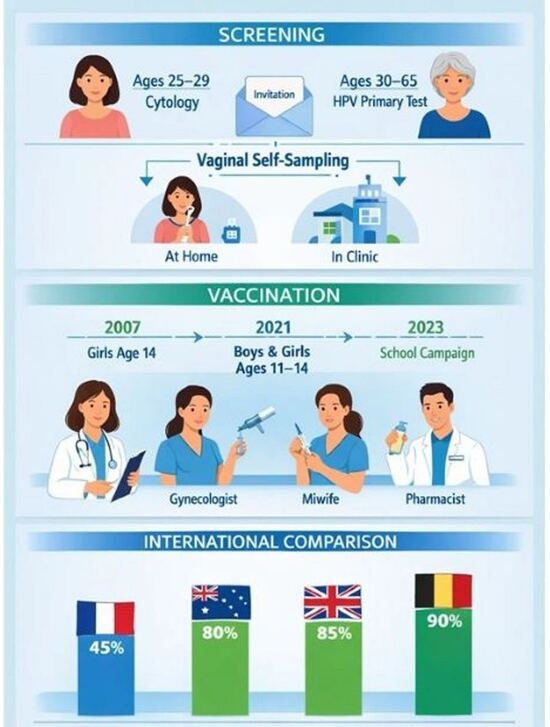
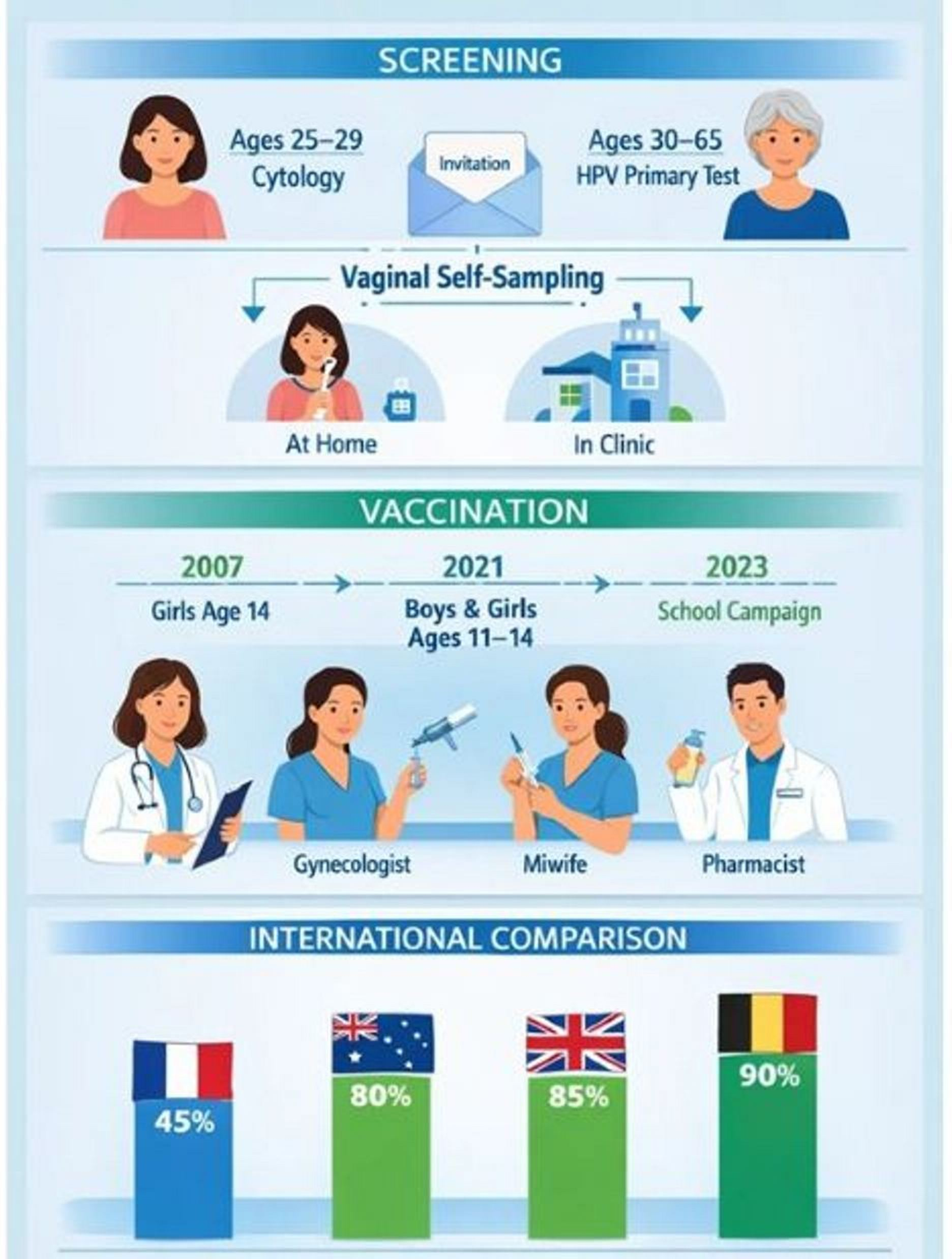
Graphical Abstract

1. Introduction

Human papillomaviruses (HPVs) are the most common sexually transmitted viruses. It is estimated that nearly 80% of sexually active individuals will be infected with at least one HPV type at some point in their lives [1].
In France, cervical cancer remains a public health concern despite decades of screening efforts. Current national data indicate approximately 3000 new cases and more than 1000 deaths from cervical cancer annually [2]. These statistics include metropolitan France as well as overseas territories such as French Polynesia, New Caledonia, and the French areas of the Caribbean and South America, where health services operate under the same national health insurance framework. Globally, cervical cancer is the fourth most common cancer in women, with an estimated 604,000 new cases and 342,000 deaths in 2020 [2]. The introduction of cytological Pap smear screening in France during the 1960s and 1970s contributed to a significant reduction in cervical cancer incidence and mortality over the following decades. Between 1980 and 2018, the incidence of cervical cancer in France fell by more than 50%, primarily attributable to opportunistic cytological screening. However, this decline has plateaued in recent years, underscoring the need for more systematic and equitable screening strategies [3,4].
Most infections are transient and often asymptomatic, but some high-risk types can persist and lead to precancerous lesions or even invasive cancers, particularly in the cervix, but also in the anus, vulva, vagina, penis, and oropharynx [2].
The strong link between high-risk HPV types—especially types 16 and 18—and cervical cancer has enabled the development of targeted prevention strategies. These strategies aim to protect the population and potentially reduce the burden of this disease [5].
Two main approaches have proven effective: screening to detect precancerous changes early and vaccination before exposure to the virus. It is important to distinguish between primary prevention (HPV vaccination), which aims to prevent infection with oncogenic HPV types, and secondary prevention (cervical cancer screening), which aims to detect and treat precancerous lesions before they progress to invasive cancer. The World Health Organization (WHO) has adopted this combination—vaccination, screening, and proper treatment—as a global strategy to eliminate cervical cancer as a public health problem [6].
In France, prevention efforts have historically fallen short of international targets. Participation in organized cervical cancer screening programs remains suboptimal and uneven, varying across regions and socio-economic groups. HPV vaccination coverage, which was limited to girls for a long time, has only recently begun to reach levels seen in pioneering countries [1,7].
To tackle these challenges, French health authorities have gradually updated their strategies. In 2018, nationwide organized cervical cancer screening was launched, with an increasing reliance on HPV testing as the primary screening method. In 2021, vaccination recommendations were extended to boys. More recently, in 2023, a school-based vaccination campaign was introduced, drawing on international programs that had proven effective [8].
This article aims to describe recent developments in HPV prevention in France, focusing on screening and vaccination, and to place these measures within an international comparative framework. Comparing France with countries such as Australia and several European nations can help highlight opportunities to strengthen the impact of French prevention policies [2,5,7].

2. Methods

This narrative review was conducted to summarize recent developments in human papillomavirus (HPV) prevention in France, with contextual comparisons to international strategies. This article is a narrative review intended to provide an updated overview of the current state of HPV prevention rather than a systematic review. Relevant literature was identified through searches of PubMed, Scopus, and Google Scholar, using combinations of the following keywords: “HPV,” “cervical cancer screening,” “HPV vaccination,” “France,” “self-sampling,” and “prevention strategies.” National guidelines, official reports from the French National Cancer Institute (INCa), Santé Publique France, and the World Health Organization (WHO) were also consulted. We included articles and reports published between 2007 and 2025 to capture the evolution of screening and vaccination policies in France. Selection criteria prioritized high-quality evidence, including systematic reviews, meta-analyses, large population-based studies, and national surveillance reports published in peer-reviewed journals. International comparisons focused on countries with well-established HPV prevention programs, such as Australia, the United Kingdom, and selected European nations, to identify successful strategies that could inform improvements in the French context.

3. Current Preventive Measures in France

Based on the literature and official reports identified in our review, we describe the main preventive strategies currently implemented in France, focusing on cervical cancer screening and HPV vaccination. The following sections summarize the organization, evolution, limitations, and emerging approaches of these measures, highlighting recent developments aimed at improving population coverage and aligning national practices with international best standards.

3.1. Cervical Cancer Screening

3.1.1. Organization of Screening in France

Cervical cancer screening in France is organized through a national program targeting women aged 25 to 65 years, implemented in 2018 to standardize practices, improve population coverage, and reduce inequalities in access to screening services (French National Cancer Institute [INCa], 2025) [5]. Prior to 2018, screening was mainly opportunistic, initiated by patients or healthcare professionals, particularly gynecologists (Table 1). Although this approach led to a substantial reduction in cervical cancer incidence and mortality, it was associated with marked disparities in screening participation across social and geographic groups [4].
Before 2018, opportunistic screening in France consisted mainly of cytological Pap smear testing every three years for women aged 25 to 65 years, generally prescribed by gynecologists or general practitioners during routine consultations. Women without a regular healthcare provider or those facing financial, geographic, or cultural barriers were significantly less likely to undergo screening, resulting in persistent inequalities [4].
France benefits from a universal healthcare system (Assurance Maladie) that provides broad access to medical care for all residents. This coverage applies throughout France, including overseas territories such as French Polynesia, New Caledonia, and the French areas of the Caribbean and South America, where health services are provided under the same national health insurance system, with minor local adaptations. Cervical cancer screening tests are reimbursed by national health insurance, with no out-of-pocket costs for eligible women. The national objective is to increase screening participation to levels consistent with the WHO elimination strategy, which targets at least 70% of women screened using a high-performance test by age 35 and again by age 45 [3,6].
To harmonize practices, the organized screening program was introduced with centralized invitations and follow-up, coordinated by the regional cancer screening coordination centers (CRCDC) under the supervision of regional health authorities (ARS) [3].

3.1.2. Integration of the HPV Test as Primary Screening

A major evolution in the primary screening strategy has been the integration of high-risk HPV (HPV-HR) testing as the primary screening test for women aged 30 years and older. This decision is based on strong evidence demonstrating the superior sensitivity of HPV-HR testing compared with conventional cytology for the detection of high-grade precancerous lesions [9]. For women aged 25–29 years, cytology remains the recommended screening method due to the high prevalence of transient HPV infections in this age group [3,9].
For women aged 30–65 years with a negative HPV-HR test, screening is recommended every five years, allowing for an extended screening interval without compromising effectiveness [3]. This approach represents a shift from detecting cytological abnormalities to identifying the causal viral infection directly.
HPV screening in France is based on validated high-risk HPV detection assays, mainly PCR-based tests approved for use in organized cervical cancer screening programs [9]. Following a positive HPV test, reflex cytology is generally performed in order to determine the need for colposcopy. Women with a positive HPV test and abnormal cytology are referred for colposcopy and histological assessment. Women with a positive HPV test but normal cytology are recommended to undergo a repeat HPV test after one year to identify persistent infections [3,9].

3.1.3. Current Limitations of Screening

Despite these improvements, screening participation in France remains insufficient. Recent estimates indicate that fewer than 60% of eligible women undergo screening within the recommended time frame [10]. Participation rates are characterized by significant social and territorial disparities, with barriers including limited healthcare access, socioeconomic vulnerability, insufficient information, fear or discomfort related to gynecological examinations, organizational constraints, and cultural perceptions of screening [10].
Social and territorial inequalities in screening participation are particularly pronounced in France. Regions with higher levels of socioeconomic deprivation, such as certain overseas territories and peri-urban areas, report significantly lower participation rates compared to wealthier urban regions. Women of lower educational attainment, those with no regular healthcare provider, and migrants or minority populations face additional barriers to participation. These disparities underscore the importance of targeted outreach strategies, including community-based interventions and mobile screening units, to reach underserved populations [10].

3.1.4. Vaginal Self-Sampling: A Promising Development

The introduction of vaginal self-sampling for HPV testing, formally integrated into national strategic frameworks and expected to be operationalized through systematic kit distribution beginning in 2025, represents a promising evolution to address barriers to screening participation [11,12]. Studies demonstrate that HPV testing on self-collected samples performs similarly to clinician-collected samples for detecting high-risk HPV types, while significantly improving acceptability among under-screened women [13]. Meta-analyses and national studies indicate that approximately 70–80% of women offered self-sampling prefer it over clinician-collected samples, especially among those who have previously declined cervical screening [14,15].
In France, vaginal self-sampling is intended primarily for women who do not participate in routine screening, aiming to overcome barriers related to pelvic exams and increase uptake among populations with lower access to healthcare [11,12,14,15].
Regarding logistics, self-sampling kits are distributed through organized screening programs, particularly to women who have not responded to screening invitations. Distribution channels include pharmacies, general practitioners, and screening coordination centers (CRCDC). Women collect the sample at home and return it by mail or in person to an accredited laboratory for HPV analysis. In the event of a positive result, women are contacted by the screening coordination center and directed toward appropriate follow-up, including reflex cytology and, if necessary, colposcopy [11,12].
This approach addresses barriers such as limited mobility, cultural reluctance, fear of pelvic exams, and geographic access, and is expected to contribute significantly to reducing social and territorial inequalities in screening participation [14,15,16].

3.2. HPV Vaccination in France

3.2.1. Evolution of Vaccination Recommendations

Prophylactic vaccination against HPV has rapidly been recognized as the primary tool for preventing persistent infections and associated cancers. In France, HPV vaccination was introduced in 2007, primarily to prevent cervical cancer. Initially, the vaccine was recommended for girls aged 14 years, with catch-up vaccination available up to 23 years under specific conditions [17]. Recent reviews highlight the effectiveness of early vaccination in reducing HPV prevalence and cervical lesions in adolescents, reinforcing the importance of school-based programs [18,19].
Scientific studies have since demonstrated the broader benefits of vaccination, not only in preventing cervical lesions but also in protecting against other HPV-related pathologies affecting both sexes. These findings led to a progressive revision of vaccination recommendations, ultimately expanding the target population. Since 1 January 2021, HPV vaccination in France is recommended for all adolescents, girls and boys, aged 11–14 years, using a two-dose schedule (Table 2). Catch-up vaccination is allowed up to age 19 and up to age 26 for men who have sex with men (MSM) [17,20]. Catch-up vaccination for older adolescents and specific high-risk groups has been shown to provide meaningful protection, emphasizing the public health rationale for these extensions [21,22].
The inclusion of boys is based on epidemiological, clinical, and ethical considerations, aiming to strengthen herd immunity, directly protect men from HPV-related diseases, and reduce inequalities in prevention. This represents a major milestone in French vaccination policy [20]. Evidence from European and international cohorts suggests that gender-neutral vaccination improves population-level HPV reduction more efficiently than female-only programs [23,24].
The international literature highlights that successful HPV vaccination programs among adolescents typically combine clear healthcare provider recommendations, school-based delivery models, and targeted public health communication strategies to improve vaccine acceptance and coverage. Several recent reviews have emphasized the importance of these integrated approaches in overcoming vaccine hesitancy and improving vaccination uptake among adolescents [25,26].

3.2.2. Vaccination Coverage and Challenges

Unfortunately, despite public health efforts, HPV vaccination coverage in France remains below the targets set by health authorities. Among adolescent girls, complete vaccination coverage by age 16 is estimated at 45–50%, while coverage among boys remains even lower [27]. Recent studies emphasize persistent coverage gaps and the need for tailored outreach strategies to improve uptake among adolescents [28,29].
Vaccine hesitancy is influenced by several factors, including insufficient information, low perceived risk of HPV, fear of side effects, and in some cases, reluctance of healthcare professionals to recommend the vaccine systematically [27,30]. Evidence suggests that clear provider recommendation, combined with school-based programs, significantly improves uptake [31,32].
Moreover, HPV vaccination has been affected by a durably weakened public image due to past controversies, widely circulated in media and social networks, despite no confirmed safety signals from large-scale pharmacovigilance studies [30]. Promotion through social media, television, radio, and digital campaigns has been shown to modestly increase coverage, especially when paired with provider recommendation [33,34].
Vaccination coverage in France contrasts sharply with levels observed in other countries that have adopted different vaccination strategies, often more proactive, particularly through school-based vaccination programs [27,30]. International reviews demonstrate that high-coverage school programs are associated with faster population-level reduction in HPV infections and precancerous lesions [35,36].
Vaccination campaigns combine school-based delivery, routine healthcare visits, and public health communication through television, radio, social media, and informational materials distributed to adolescents and parents. School campaigns are typically conducted annually, with parental consent and optional counseling provided during vaccination sessions. These strategies aim to improve accessibility, acceptance, and equity in vaccination. To address these challenges, French public health authorities have implemented several complementary strategies aimed at improving vaccine accessibility and acceptance. In addition to vaccination during routine healthcare consultations, HPV vaccination is actively promoted through national public health communication campaigns led by Santé Publique France and the Ministry of Health. These campaigns use multiple communication channels, including television, radio, social media platforms, and digital information portals, to increase public awareness of HPV-related diseases and the benefits of vaccination. Educational materials are also distributed through healthcare providers and schools in order to improve knowledge among adolescents and their parents.

3.2.3. Role of Healthcare Professionals

Several studies show that a clear recommendation from a healthcare professional is one of the strongest determinants of HPV vaccine acceptance [37]. However, in practice, HPV vaccination is often deprioritized compared to other health issues deemed more urgent.
General practitioners, pediatricians, gynecologists, midwives, and more recently, community pharmacists play a central role in promoting HPV vaccination, serving as a critical interface to inform, prescribe, and administer the vaccine (Table 3) [37,38].
Expanding vaccination to pharmacies enhances accessibility, particularly for adolescents aged 11 to 19 who are less regularly followed in the healthcare system [38].
HPV vaccination is fully reimbursed by the French national health insurance system (Assurance Maladie). For adolescents vaccinated within the school-based campaign, the vaccine is provided free of charge without any out-of-pocket payment. Outside the school-based program, the vaccine can be prescribed by a physician and administered by a physician, nurse, midwife, or pharmacist, with full reimbursement covered by national health insurance [17,39].

3.2.4. School-Based Vaccination Programs

School-based vaccination programs circumvent barriers to healthcare access, organizational constraints for families, and socioeconomic inequalities [39]. However, such programs require parental consent and willingness, necessitating clear and appropriate information.
In line with this approach, France launched a national school-based HPV vaccination campaign in the 2023 school year for fifth-grade students (approximately 11–12 years old) [39]. Although coverage data from this campaign are still limited, initial reports indicate improved access to vaccination in certain regions, particularly in areas where coverage rates had historically been lowest [39,40].

4. International Comparisons

4.1. Australia: A Global Benchmark

Australia has successfully met the challenge of HPV prevention, with robust data confirming vaccination coverage rates exceeding 80%, and reaching over 90% in some cohorts [41]. Epidemiological surveillance and national reports indicate a marked reduction in anogenital warts and high-grade cervical lesions following the school-based HPV vaccination program [41,42,43]. The country recognized HPV as a major public health issue early and prioritized systematic elimination strategies. Australia was among the first countries to implement a school-based HPV vaccination program in 2007, initially targeting girls and later extending to boys in 2013 [41,42].
Today, the benefits of this strategy are well documented. Epidemiological data demonstrate a marked reduction in anogenital warts, a significant decrease in high-grade cervical lesions among young women, and a substantial decline in HPV infections in the general population, including among unvaccinated individuals, reflecting a strong herd immunity effect [5,42]. These findings confirm that school-based vaccination programs are highly effective in achieving population-level protection [41,42,43].
As a result, Australia is on track to achieve the elimination of cervical cancer as a public health problem in the coming decades. This success illustrates the synergistic effect of integrated primary (vaccination) and secondary (screening) prevention strategies [5,6].

4.2. Selected European Countries: Screening and Vaccination Practices

Across Europe, several countries have implemented different HPV prevention strategies, but school-based vaccination programs consistently emerge as the cornerstone of success [44,45,46]. In the United Kingdom, high coverage (c.a. 85% in both girls and boys) was achieved following nationwide school-based vaccination starting in 2008 [44,45]. Scandinavian countries and Belgium also report coverage rates above 70–75%, supported by proactive vaccination campaigns and early adoption of HPV testing and self-sampling for cervical cancer screening (Table 4) [46,47,48].
France occupies an intermediate position in this European landscape. National coverage for girls is estimated at 45–50%, and for boys at around 20% [27]. Although coverage remains below leading countries, recent efforts—including the 2023 national school-based vaccination campaign and expansion of vaccination to boys—demonstrate clear political and public health commitment to improving population adherence [40,41].
In contrast, Bulgaria represents a striking example of very low coverage, with approximately 2–3% of adolescent girls vaccinated and virtually no boys included in the program [49,50]. While authorities have announced plans to extend vaccination to boys aged 10–13 by 2025–2030, current uptake remains minimal. This stark contrast highlights the role of systematic, well-resourced, and school-based approaches in achieving meaningful population protection. Bulgaria’s extremely low HPV vaccination coverage reflects multiple systemic challenges: limited political prioritization of HPV prevention, low public health funding, reliance on opportunistic vaccination, and strong cultural vaccine hesitancy [50]. These factors contrast with proactive, well-resourced, school-based programs in countries like Australia and the UK. France can learn from this by ensuring systematic national coordination, providing vaccines free of charge, combining school-based administration with healthcare professional advocacy, and addressing cultural hesitancy through targeted communication campaigns.
Overall, these international comparisons emphasize that France is progressing toward higher coverage, but still has room to improve. Lessons from Australia, the UK, Belgium, and Scandinavian countries underline the importance of proactive school-based campaigns, clear communication, and accessibility, whereas the Bulgarian example illustrates how limited organization and reliance on opportunistic vaccination can result in persistently low coverage.

5. Discussion

The effectiveness of HPV prevention tools, including vaccination and screening strategies, is now well established. In France, recent measures aimed at improving screening uptake and increasing vaccination coverage reflect a strong political and public health commitment to eliminating HPV-related diseases, while also acknowledging the limitations of previous strategies [6].
The historical impact of Pap smear screening on cervical cancer in France has been substantial. Since the introduction of cytological screening in the 1960s and 1970s, the incidence of cervical cancer has declined by more than 50% over the subsequent decades. This reduction is primarily attributable to early detection of precancerous lesions, enabling treatment before progression to invasive cancer. However, opportunistic screening has consistently failed to reach the most vulnerable populations, resulting in persistent social and geographic disparities. The transition to organized screening in 2018 represents a pivotal step toward reducing these inequalities [3,4].
The shift to HPV primary screening offers several advantages over cytology alone. High-risk HPV testing has greater sensitivity for detecting cervical intraepithelial neoplasia or worse (CIN2+), allows for extended screening intervals, allows for extended screening intervals (five years for HPV-negative women), and identifies the causal viral infection rather than downstream cytological changes. These benefits translate into better protection for screened women and improved cost-effectiveness of the screening program [9,47].
Vaginal self-sampling represents a potentially transformative tool for increasing participation among under-screened women. Meta-analyses have confirmed that HPV testing on self-collected samples performs comparably to clinician-collected samples for detecting high-risk HPV types [47]. The main benefit lies in improving access for women who face barriers to clinic-based screening, such as those with limited mobility, those with cultural or psychological reluctance to pelvic examinations, or those living in remote areas. Successful implementation will require robust logistics for kit distribution and clear communication strategies to ensure appropriate follow-up of positive results [11,12,13].
The main challenge remains population adherence to preventive measures. Low participation in screening programs and suboptimal vaccination coverage are not due to a lack of efficacy of available tools, but rather to social, organizational, and cultural barriers [2]. In this context, the introduction of vaginal self-sampling for HPV testing and the implementation of school-based vaccination programs represent promising approaches to reduce inequalities in access to prevention and improve overall uptake [48].
International comparisons highlight important lessons for France. Australia’s success in reducing cervical cancer to near-elimination levels underscores the synergistic effect of high vaccination coverage combined with systematic HPV-based screening. The United Kingdom and Scandinavian countries have similarly demonstrated that school-based vaccination programs, when implemented proactively and accompanied by clear professional recommendations, can achieve coverage rates well above 70–80%. In contrast, countries relying primarily on opportunistic strategies, such as Bulgaria, have achieved minimal protection despite vaccine availability [41,42,44,48,49,50].
Healthcare professionals play a central and underutilized role in driving vaccination uptake. Evidence consistently shows that a clear, personalized recommendation from a physician is one of the strongest predictors of vaccine acceptance among adolescents and parents [37]. To strengthen this, ongoing professional training on HPV epidemiology and vaccine safety, combined with improved communication tools and public health campaigns, is essential. Engaging general practitioners, pediatricians, midwives, and pharmacists as active vaccination advocates could substantially increase coverage rates in France [37,38].
Looking ahead, the future of HPV prevention in France will depend on the sustained implementation of newly introduced strategies and rigorous monitoring of their population-level impact. Particular attention should be given to evaluating the reach and effectiveness of the school-based vaccination campaign over the coming years, as well as the uptake and follow-up rates for vaginal self-sampling. Integrating prevention efforts into a coherent, equity-centered framework will be essential to reduce disparities and move France closer to the WHO cervical cancer elimination targets [46,48].
International comparisons underscore the importance of proactive, population-wide prevention strategies. Countries with accessible, organized programs have achieved significantly better outcomes, with Australia serving as a leading example [41]. France appears to be moving in this direction; however, the real-world impact of newly implemented strategies will need to be evaluated over the medium and long term.
Several limitations should be considered in this review, particularly the heterogeneity of available data and the limited follow-up for recently introduced strategies. Nevertheless, current advances and emerging approaches suggest substantial improvements in HPV prevention are likely in the coming years.

6. Conclusions

Prevention of human papillomavirus infection represents a major public health priority, as it provides a model for the prevention of avoidable cancers. In France, recent improvements in screening and vaccination strategies demonstrate a gradual alignment with scientific evidence and international best practices [2,6].
The implementation of school-based vaccination, together with the introduction of vaginal self-sampling and the integration of high-risk HPV testing as the primary screening tool, constitute major advances with the potential to significantly improve coverage and effectiveness of preventive measures, increase population adherence, and reduce inequalities in access to prevention [48]. Comparisons with countries such as Australia illustrate the potential impact of these strategies when deployed at scale, supporting the relevance of the current French prevention trajectory [41].

Author Contributions

Conceptualization, M.V. and S.P.; Methodology, M.V. and S.P.; Validation, M.V.; Investigation, S.P.; Data Curation, M.V. and S.P.; Writing—Original Draft Preparation, S.P., B.L. and M.V.; Writing—Review and Editing, S.P., B.L. and M.V.; Visualization, M.V.; Supervision, M.V.; Project Administration, M.V. All authors have read and agreed to the published version of the manuscript.

Funding

This research received no external funding.

Institutional Review Board Statement

Not applicable.

Informed Consent Statement

Not applicable.

Data Availability Statement

This study is a narrative review. No new data were generated or analyzed, and therefore, data sharing is not applicable.

Acknowledgments

During the preparation of this manuscript, the authors used craiyon.com for the purposes of illustrations. The authors have reviewed and edited the output and take full responsibility for the content of this publication.

Conflicts of Interest

The authors declare no conflicts of interest.

References

  1. Bruni, L.; Albero, G.; Serrano, B.; Mena, M.; Gómez, D.; Muñoz, J.; Bosch, F.X.; de Sanjosé, S. Human papillomavirus and related diseases in France. Vaccines 2020, 8, 111. [Google Scholar]
  2. Arbyn, M.; Weiderpass, E.; Bruni, L.; de Sanjosé, S.; Saraiya, M.; Ferlay, J.; Bray, F. Estimates of incidence and mortality of cervical cancer in 2018: A worldwide analysis. Int. J. Cancer 2020, 147, 1003–1015. [Google Scholar] [CrossRef] [Scilit] [PubMed]
  3. Institut National du Cancer (INCa). Le Programme National de Dépistage Organisé du Cancer du col de L’utérus; Cancer.fr: Boulogne-Billancourt, France, 2025.
  4. Ameli.fr. Dépistage Organisé du Cancer du col de L’utérus; Caisse Nationale de l’Assurance Maladie: Paris, France, 2025.
  5. Drolet, M.; Bénard, É.; Pérez, N.; Brisson, M. Population-level impact and herd effects following human papillomavirus vaccination programmes. Lancet Infect. Dis. 2019, 19, 100–112. [Google Scholar]
  6. World Health Organization. Global Strategy to Accelerate the Elimination of Cervical Cancer as a Public Health Problem; WHO: Geneva, Switzerland, 2020. [Google Scholar]
  7. Canfell, K.; Kim, J.J.; Brisson, M. Cervical cancer elimination in high-income countries: Progress and challenges. Lancet 2020, 395, 155–167. [Google Scholar]
  8. Public Health France. HPV Vaccination in Schools: Report on 2023 Campaign Outcomes; Santé Publique France: Paris, France, 2023.
  9. Santé Publique France. Updated Evidence-Based Recommendations for Cervical Cancer Screening in France; Santé Publique France: Saint-Maurice, France, 2021.
  10. Institut National du Cancer (INCa). Taux de Participation au Dépistage du Cancer du col de L’utérus en France (2020–2022); INCa: Boulogne-sur-Mer, France, 2023.
  11. Institut National du Cancer (INCa). Référentiel National—Dépistage du Cancer du col de L’utérus: Cadre et Modalités de L’auto-Prelevement Vaginal (APV); INCa: Boulogne-sur-Mer, France, 2022.
  12. Ordre National des Pharmaciens. Autoprélèvements Vaginaux: Le Référentiel National du Cancer du col de L’utérus Précise le Cadre et les Modalités; Ordre National des Pharmaciens: Paris, France, 2022. [Google Scholar]
  13. Bertucci, M.; Bonnet, E.; Satger, L.; Kreiche, A.; Chappert, J.L.; Loy-Morel, S.; Segondy, M.; Daurès, J.P.; Boulle, N. Acceptability of vaginal self-sampling with high-risk human papillomavirus testing for cervical cancer screening: A French questionnaire-based study. Women Health 2021, 61, 83–94. [Google Scholar] [CrossRef] [Scilit]
  14. Yeh, P.T.; Kennedy, C.E.; de Vuyst, H.; Narasimhan, M. Self-sampling for human papillomavirus (HPV) testing: A systematic review and meta-analysis. BMJ Glob. Health 2019, 4, e001351. [Google Scholar] [CrossRef] [Scilit] [PubMed] [PubMed Central]
  15. Pedersen, H.N.; Smith, L.W.; Racey, C.S.; Cook, D.; Krajden, M.; van Niekerk, D.; Ogilvie, G.S. Implementation considerations using HPV self-collection to reach women under-screened for cervical cancer in high-income settings. Curr. Oncol. 2018, 25, e4–e7. [Google Scholar] [CrossRef] [Scilit] [PubMed] [PubMed Central]
  16. Madhivanan, P.; Nishimura, H.; Ravi, K.; Pope, B.; Coudray, M.; Arun, A.; Krupp, K.; Jayakrishna, P.; Srinivas, V. Acceptability and Concordance of Self- Versus Clinician- Sampling for HPV Testing among Rural South Indian Women. Asian Pac. J. Cancer Prev. 2021, 22, 971–976. [Google Scholar] [CrossRef] [Scilit] [PubMed] [PubMed Central]
  17. Ministère des Solidarités et de la Santé. Recommandations Vaccinales Contre le HPV en France; Ministère de la Santé: Paris, France, 2021.
  18. Drolet, M.; Bénard, É.; Pérez, N.; Brisson, M.; HPV Vaccination Impact Study Group. Population-level impact and herd effects following the introduction of human papillomavirus vaccination programmes: Updated systematic review and meta-analysis. Lancet 2019, 394, 497–509. [Google Scholar] [CrossRef] [Scilit] [PubMed] [PubMed Central]
  19. Bruni, L.; Diaz, M.; Barrionuevo-Rosas, L.; Herrero, R.; Bray, F.; Bosch, F.X.; de Sanjosé, S.; Castellsagué, X. Global estimates of human papillomavirus vaccination coverage by region and income level: A pooled analysis. Lancet Glob. Health 2016, 4, e453-63, Erratum in Lancet Glob. Health 2017, 5, e662. https://doi.org/10.1016/S2214-109X(17)30186-9. PMID: 27340003.. [Google Scholar] [CrossRef] [Scilit]
  20. Institut National du Cancer (INCa). Extension de la Vaccination HPV aux Garçons et Adolescents: Cadre et Recommandations; INCa: Boulogne-sur-Mer, France, 2021.
  21. Hofman, R.; van Empelen, P.; Richardus, J.H.; de Kok, I.M.; de Koning, H.J.; van Ballegooijen, M.; Korfage, I.J. Predictors of HPV vaccination uptake: A longitudinal study among parents. Health Educ. Res. 2014, 29, 83–96. [Google Scholar] [CrossRef] [Scilit] [PubMed]
  22. Kaul, S.; Do, T.Q.N.; Hsu, E.; Schmeler, K.M.; Montealegre, J.R.; Rodriguez, A.M. School-based human papillomavirus vaccination program for increasing vaccine uptake in an underserved area in Texas. Papillomavirus Res. 2019, 8, 100189. [Google Scholar] [CrossRef] [Scilit] [PubMed] [PubMed Central]
  23. Ladner, J.; Besson, M.H.; Hampshire, R.; Tapert, L.; Chirenje, M.; Saba, J. Assessment of eight HPV vaccination programs implemented in lowest income countries. BMC Public Health 2012, 12, 370. [Google Scholar] [CrossRef] [Scilit] [PubMed] [PubMed Central]
  24. Flood, T.; Wilson, I.M.; Prue, G.; McLaughlin, M.; Hughes, C.M. Impact of school-based educational interventions in middle adolescent populations (15–17yrs) on human papillomavirus (HPV) vaccination uptake and perceptions/knowledge of HPV and its associated cancers: A systematic review. Prev. Med. 2020, 139, 106168. [Google Scholar] [CrossRef] [Scilit] [PubMed]
  25. Mullin, T.; Ah, D.V. Factors Influencing HPV Vaccination Uptake in Adolescents: Evidence to Guide Clinical Practice. Worldviews Evid. Based Nurs. 2026, 23, e70120. [Google Scholar] [CrossRef] [Scilit] [PubMed] [PubMed Central]
  26. Bark, J.; Kim, H.; Seo, S. Research Trends and Gaps in Human Papillomavirus Vaccination Intention in South Korea: A Scoping Review. Healthcare 2026, 14, 355. [Google Scholar] [CrossRef] [Scilit]
  27. Santé Publique France. Couverture Vaccinale Contre le HPV Chez les Adolescents en France: Données 2022; Santé Publique France: Saint-Maurice, France, 2022.
  28. Dufour, L.; Drouin, J.; Dray-Spira, R.; Le Vu, S. Uptake of HPV vaccination and associated factors in France: A nationwide study from 2007 to 2023. Vaccine 2026, 76, 128308, Erratum in Vaccine 2026, 78, 128402. https://doi.org/10.1016/j.vaccine.2026.128402. PMID: 41672032.. [Google Scholar] [CrossRef] [Scilit]
  29. Rivera, A.F.; Dussault, J.M.; Oudin Doglioni, D.; Chyderiotis, S.; Sicsic, J.; Barret, A.S.; Raude, J.; Gauchet, A.; Gagneux-Brunon, A.; Bruel, S.; et al. Sociodemographic determinants of HPV vaccine awareness, uptake, and intention among parents of adolescents in France 2021–22. Hum. Vaccin. Immunother. 2024, 20, 2381300. [Google Scholar] [CrossRef] [Scilit] [PubMed] [PubMed Central]
  30. Agence Nationale de Sécurité du Médicament (ANSM). Vaccination HPV: Sécurité et Pharmacovigilance; ANSM: Lyon, France, 2021.
  31. Dussault, J.; Gagneux-Brunon, A.; Le Duc-Banaszuk, A.S.; Bruel, S.; Michel, M.; Gauchet, A.; Oudin Doglioni, D.; Sicsic, J.; Raude, J.; Barret, A.S.; et al. Effect of a multicomponent HPV intervention on self-reported HPV vaccine uptake and intention among French adolescents and parents: Results from the national, cluster-randomised PrevHPV trial. BMJ Public Health 2025, 3, e001007. [Google Scholar] [CrossRef] [Scilit] [PubMed] [PubMed Central]
  32. Dussault, J.; Le Duc-Banaszuk, A.S.; Gagneux-Brunon, A.; Bruel, S.; Gauchet, A.; Barret, A.S.; Sicsic, J.; Thilly, N.; Mueller, J.E.; PrevHPV Consortium. Effect of school-based HPV vaccine campaigns on inequalities in uptake in France: The PrevHPV trial. Eur. J. Public Health 2023, 33, ckad160.398. [Google Scholar] [CrossRef] [Scilit] [PubMed Central]
  33. Acampora, A.; Grossi, A.; Barbara, A.; Colamesta, V.; Causio, F.A.; Calabrò, G.E.; Boccia, S.; de Waure, C. Increasing HPV Vaccination Uptake among Adolescents: A Systematic Review. Int. J. Environ. Res. Public Health 2020, 17, 7997. [Google Scholar] [CrossRef] [Scilit] [PubMed] [PubMed Central]
  34. Tron, A.; Schlegel, V.; Pinot, J.; Bruel, S.; Ecollan, M.; Bel, J.L.; Rossignol, L.; Gauchet, A.; Gagneux-Brunon, A.; Mueller, J.; et al. Barriers and facilitators to the HPV vaccine: A multicenter qualitative study of French general practitioners. Arch. Public Health 2024, 82, 2. [Google Scholar] [CrossRef] [Scilit] [PubMed] [PubMed Central]
  35. Bocquier, A.; Branchereau, M.; Gauchet, A.; Bonnay, S.; Simon, M.; Ecollan, M.; Chevreul, K.; Mueller, J.E.; Gagneux-Brunon, A.; Thilly, N.; et al. Promoting HPV vaccination at school: A mixed methods study exploring knowledge, beliefs and attitudes of French school staff. BMC Public Health 2023, 23, 486. [Google Scholar] [CrossRef] [Scilit] [PubMed] [PubMed Central]
  36. Brisson, M.; Kim, J.J.; Canfell, K.; Drolet, M.; Gingras, G.; Burger, E.A.; Martin, D.; Simms, K.T.; Bénard, É.; Boily, M.C.; et al. Impact of HPV vaccination and cervical screening on cervical cancer elimination: A comparative modelling analysis in 78 low-income and lower-middle-income countries. Lancet 2020, 395, 575–590. [Google Scholar] [CrossRef] [Scilit] [PubMed] [PubMed Central]
  37. Collange, F.; Fressard, L.; Pulcini, C.; Sebbah, R.; Peretti-Watel, P.; Verger, P. General practitioners’ attitudes and behaviors toward HPV vaccination: A French national survey. Vaccine 2016, 34, 762–768. [Google Scholar] [CrossRef] [Scilit]
  38. Institut National du Cancer (INCa). Role of Healthcare Professionals in HPV Vaccination: Guidance and Recommendations; INCa: Boulogne-Billancourt, France, 2022.
  39. Ministère des Solidarités et de la Santé. School-Based HPV Vaccination Campaign 2023: Strategy and Implementation; Ministère de la Santé: Boulogne-sur-Mer, France, 2023.
  40. Santé Publique France. Preliminary Coverage Data of the 2023 School-Based HPV Vaccination Campaign in France; Santé Publique France: Saint-Maurice, France, 2023.
  41. Hall, M.T.; Simms, K.T.; Lew, J.B.; Smith, M.A.; Brotherton, J.M.; Saville, M.; Frazer, I.H.; Canfell, K. The projected timeframe until cervical cancer elimination in Australia: A modelling study. Lancet Public Health 2019, 4, e19–e27. [Google Scholar] [CrossRef] [Scilit]
  42. Garland, S.M.; Kjaer, S.K.; Muñoz, N.; Block, S.L.; Brown, D.R.; DiNubile, M.J.; Lindsay, B.R.; Kuter, B.J.; Perez, G.; Dominiak-Felden, G.; et al. Impact and effectiveness of the quadrivalent human papillomavirus vaccine: A systematic review of 10 years of real-world experience. Clin. Infect. Dis. 2016, 63, 519–527. [Google Scholar] [CrossRef] [Scilit]
  43. Australian Institute of Health and Welfare. HPV Vaccination in Australia: 2023 Annual Report; AIHW: Sydney, NSW, Australia, 2023.
  44. Public Health England. Human Papillomavirus (HPV) Vaccination Programme: Annual Coverage Report; PHE: London, UK, 2019.
  45. Kumar, V.M.; Whynes, D.K. Explaining variation in the uptake of HPV vaccination in England. BMC Public Health 2011, 11, 172. [Google Scholar] [CrossRef] [Scilit] [PubMed] [PubMed Central]
  46. Bruni, L.; Albero, G.; Serrano, B.; Mena, M.; Collado, J.J.; Gómez, D.; Muñoz, J.; Bosch, F.X.; de Sanjosé, S. Human Papillomavirus and Related Diseases in Europe: Summary Report for 2024; ICO/IARC Information Centre on HPV and Cancer (HPV Information Centre): Barcelona, Spain, 2024. [Google Scholar]
  47. Arbyn, M.; Smith, S.B.; Temin, S.; Sultana, F.; Castle, P.; Collaboration on Self-Sampling and HPV Testing. Detecting cervical precancer and reaching underscreened women by using HPV testing on self samples: Updated meta-analyses. BMJ 2018, 363, k4823. [Google Scholar] [CrossRef] [Scilit] [PubMed] [PubMed Central]
  48. Bruni, L.; Saura-Lázaro, A.; Montoliu, A.; Brotons, M.; Alemany, L.; Diallo, M.S.; Afsar, O.Z.; LaMontagne, D.S.; Mosina, L.; Contreras, M.; et al. HPV vaccination introduction worldwide and coverage trends in the WHO European Region. Lancet Reg. Health—Eur. 2021, 2, 100042. [Google Scholar]
  49. OECD. Health at a Glance 2024: Europe; OECD Publishing: Paris, France, 2024. [Google Scholar]
  50. UNICEF. HPV Vaccination Coverage Data: Central and Eastern Europe, 2024; UNICEF: New York, NY, USA, 2024. [Google Scholar]

Table 1. Comparison of cervical cancer screening strategies.
ParameterOpportunistic ScreeningOrganized Screening (Pap Smear)HPV Primary ScreeningSelf-Sampling
Implementation YearPre-201820182021 (pilot); generalized 20252025 (systematic roll-out)
Target PopulationVariableWomen 25–65Women 30–65Under-screened women
CoordinationNoneCRCDCCRCDCCRCDC
FrequencyVariableEvery 3 yearsEvery 5 yearsAs recommended
Main AdvantageFlexibleStandardized, reduces disparitiesSensitive detectionImproves participation in hard-to-reach populations
Table 2. Overview of licensed HPV vaccines and coverage.
Vaccine TypeBrand NameHPV Types CoveredAntigen FormAdjuvantVLPs per Genotype (µg)
BivalentCervarixTM16, 18L1 virus-like particles (VLPs)AS04 (50 µg Al; 3-O-desacyl-4′-monophosphoryl lipid A + aluminum hydroxide)20 µg each
QuadrivalentGardasil®6, 11, 16, 18L1 VLPsAlum (225 µg Al; aluminum hydroxyphosphate sulfate)20 µg each
NonavalentGardasil 9®6, 11, 16, 18, 31, 33, 45, 52, 58L1 VLPsAlum (500 µg Al; aluminum hydroxyphosphate sulfate)30 µg each for 6, 11, 16, 18; 20 µg each for 31, 33, 45, 52, 58
Table 3. Summary of healthcare professional roles in HPV vaccination.
ProfessionalRoleTarget PopulationMain Impact
GPRecommendation, prescriptionAdolescents 11–18 years, catch-up for 15–18; MSM up to 26 yearsImproves acceptance
PediatricianRecommendation, vaccinationChildren/adolescents 11–14 years (routine), catch-up 15–18 yearsEarly protection
GynecologistScreening and vaccinationYoung women 15–26 years; MSM up to 26 yearsIntegrates care
MidwifeCounselingAdolescents 11–18 years; pregnant womenAddresses hesitancy
PharmacistVaccination and infoAdolescents 11–18 yearsAccessibility and coverage
Table 4. HPV vaccination coverage in France and selected comparator countries.
CountryCoverage Girls (%)Coverage Boys (%)StrategyAge Covered by Public Funding (Girls/Boys)NotesRef.
France45–5020Opportunistic and school campaigns11–14/11–14; catch-up girls 15–19, boys 15–26 (MSM)Recent national school campaign; boys included since 2021[27,39,40]
UK8585School-based12–13/12–13High coverage via proactive approach[44]
Australia80–90+80–90+School-based12–13/12–13Benchmark for elimination goals[41,42]
Belgium70–7570–75School-based12/12Strong regional campaigns[48]
Bulgaria2–30Opportunistic10–13/10–13 (planned extension for boys 2025–2030Limited coverage; planned extension to boys 2025–2030[49,50]
Disclaimer/Publisher’s Note: The statements, opinions and data contained in all publications are solely those of the individual author(s) and contributor(s) and not of MDPI and/or the editor(s). MDPI and/or the editor(s) disclaim responsibility for any injury to people or property resulting from any ideas, methods, instructions or products referred to in the content.