1. Introduction
Can microbial production systems regulate themselves? This idea is no longer purely speculative: as biotechnology moves toward autonomous, cell-based manufacturing, it increasingly depends on a cell’s innate ability to monitor and respond to its own biochemical state. A long-standing challenge in industrial bioprocessing is the absence of direct, real-time access to intracellular metabolite levels; process control has therefore relied on external measurements that provide only delayed and indirect insight. Riboswitches, naturally occurring RNA elements that detect specific small molecules, offer one compelling route to closing this gap. Acting as intracellular sensors, they can register metabolic signals as they arise and couple them directly to gene expression. This Commentary does not claim that autonomous cell factories already exist; rather, it argues that riboswitch-based intracellular biosensing provides a plausible and increasingly practical foundation for building them. Throughout, I try to separate three things that are easily conflated: established riboswitch biology, engineered riboswitch demonstrations at laboratory scale, and the still-prospective goal of fully autonomous industrial bioprocesses. The novelty here lies in the framework, not in the underlying sensing chemistry, which is well established.
2. The Biosensing Challenge in Bioprocessing
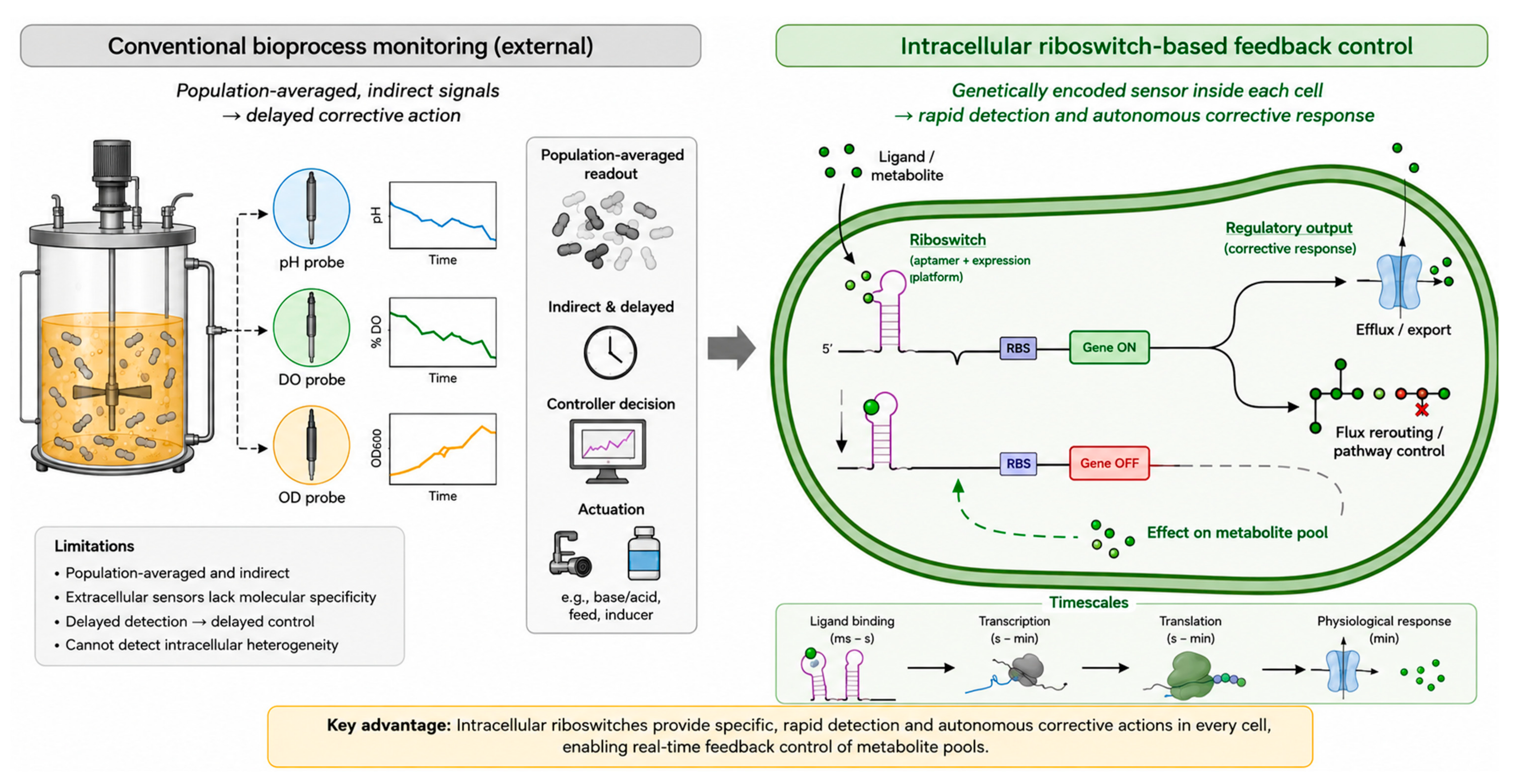
Traditional bioprocess monitoring relies on external indicators such as pH, dissolved oxygen, and cell density. These measurements are valuable, but they offer limited insight into the cell’s internal metabolic state. The limitation becomes acute when toxic by-products such as acetate or butanol accumulate intracellularly and reduce productivity before any change is detectable by external sensors [
1]. Because intracellular metabolite buildup often precedes measurable changes in the extracellular environment, corrective action is frequently delayed, by which time productivity may already have declined.
Current strategies for detecting small molecules in bioprocessing face several constraints. Extracellular sensors cannot access the intracellular compartment where key metabolic events occur. Invasive sampling compromises cell integrity and yields discrete snapshots rather than continuous data. Even high-sensitivity techniques such as mass spectrometry require extensive sample preparation, which makes them poorly suited to real-time monitoring of live cultures. This persistent sensing gap remains a significant bottleneck for bioprocesses intended to be genuinely responsive and adaptive.
3. Riboswitches: Genetically Encoded Intracellular Biosensors
Riboswitches are among the evolution’s solutions to continuous intracellular sensing. These RNA regulatory elements act as specific molecular sensors, directly binding small-molecule analytes—amino acids, nucleotides, vitamins, and metabolic intermediates—with affinities in the nanomolar-to-micromolar range [
2]. Ligand binding drives rapid conformational changes in the RNA, and in this respect riboswitches can respond more directly than protein-based sensors that depend on multi-step signal transduction [
3]. It is important, however, to distinguish binding kinetics from functional output: while ligand recognition and RNA folding can occur on short timescales, the measurable regulatory response depends on transcription, translation, and mRNA turnover, and therefore typically unfolds over seconds to minutes rather than milliseconds. This distinction is consequential for feedback control, where response delays affect loop stability and productivity.
Riboswitches sense their targets through ligand-induced conformational changes in RNA secondary structures that directly modulate gene expression. Binding of a small molecule to the aptamer domain stabilises alternative conformations of an adjacent expression platform, which can activate or repress transcription, translation, or mRNA stability. The result is a comparatively direct sensing-to-response mechanism and a proportional, reversible output that tracks intracellular analyte levels. Riboswitch engineering has extended this capability beyond natural ligands: through directed evolution and computational design, researchers have built riboswitches that respond to non-natural small molecules, including industrial chemicals, pharmaceuticals, and synthetic metabolites [
4,
5]. High-throughput screening, including droplet- and FACS-based selections, has yielded riboswitches with tuned sensitivity and improved dynamic range, making them adaptable components for custom biosensing in engineered microbes [
6].
4. Real-Time Metabolic Sensing: Laboratory Demonstrations
Riboswitches and related metabolite-responsive biosensors have begun to show concrete benefits in bioprocess-relevant settings, though most results remain at laboratory or proof-of-concept scale [
7]. Dynamic control of overflow metabolism is a representative example: metabolite-responsive biosensors that detect the redox imbalance associated with overflow metabolism [
8] can redirect carbon flux away from wasteful by-product formation, and such systems have improved product titres in engineered
E. coli [
9]. Riboswitch-specific demonstrations of dynamic pathway control are also emerging. A synthetic glycine riboswitch has been used to place lactate and serine synthesis under tuneable, ligand-responsive control in
E. coli-raising serine titres by roughly 104% while easing growth burden, and to drive directed evolution of a target enzyme [
10]. Separately, an engineered lysine riboswitch has been used to regulate aspartate kinase and homoserine dehydrogenase for improved lysine production in
Corynebacterium glutamicum [
11]. These studies show that riboswitch-based dynamic regulation can influence flux and productivity, but each represents a specific, carefully engineered circuit rather than a general purpose sensing platform.
Table 1 summarises representative examples, indicating the sensor class, host, controlled output, and reported outcome for each.
Intracellular acid sensing offers a further illustration. Riboswitch-based platforms have been used to detect the buildup of organic acids and to drive the evolution of acid-tolerant phenotypes, allowing early activation of tolerance pathways before bulk pH shifts become apparent in the medium [
12]. Sensing such changes at their intracellular origin—rather than inferring them from bulk measurements—can help maintain productivity and avoid process failure.
Multi-analyte sensing is a natural next step. Orthogonal riboswitches that respond independently to distinct ligands have been developed for tuneable co-expression in bacteria [
13] and synthetic riboswitch sets have been used to detect several analytes simultaneously without crosstalk [
14]. Integrating multiple sensors within one cell could, in principle, enable biosensor networks that monitor competing pathways at once and balance flux accordingly, although demonstrations of such multiplexed control in production strains remain limited.
Table 1.
Representative examples of riboswitch- and biosensor-based dynamic control relevant to bioprocessing. Entries using RNA-based sensors are riboswitch systems; transcription-factor and other protein-based sensors are included for context and labelled accordingly. Several entries are laboratory-scale proofs of concept or model-supported designs rather than established industrial processes.
Table 1.
Representative examples of riboswitch- and biosensor-based dynamic control relevant to bioprocessing. Entries using RNA-based sensors are riboswitch systems; transcription-factor and other protein-based sensors are included for context and labelled accordingly. Several entries are laboratory-scale proofs of concept or model-supported designs rather than established industrial processes.
| Target Signal/Metabolite | Sensor Class | Host | Controlled Output | Reported Outcome | Ref. |
|---|
| Glycine | Synthetic riboswitch (ON/OFF) | E. coli | ldhA; glyA (lactate/serine synthesis) | Tunable and dynamic pathway control; ~104% higher serine; enzyme directed evolution | [10] |
| Lysine | Engineered riboswitch (activated/repressed) | C. glutamicum | Aspartate kinase III; homoserine dehydrogenase | Dynamic control of essential pathway; improved lysine production | [11] |
| Acetate/redox overflow | Metabolite-responsive biosensor | E. coli | Redox and carbon-flux regulation | Reduced overflow; improved product (e.g., phloroglucinol) titre | [9] |
| Multiple synthetic ligands | Orthogonal/synthetic riboswitches | Bacteria; cell-free systems | Independent reporter/gene outputs | Tuneable co-expression; simultaneous multi-analyte detection | [13,14] |
| Intracellular alcohols (biofuels) | Stress/solvent-responsive biosensor | E. coli | Efflux-pump expression | Feedback balances tolerance vs. burden; improved export/yield (modelled + demonstrated pumps) | [15,16] |
| Malonyl-CoA/fatty acyl-CoA | Transcription-factor biosensor (protein-based) | E. coli | Fatty-acid pathway genes | Dynamic regulation improved fatty-acid production | [17] |
5. From Biosensing to Autonomous Bioprocesses
The greatest promise of riboswitches lies in the step from passive sensing to active bioprocess control. By linking continuous intracellular sensing to dynamic metabolic responses, such systems could form feedback loops that adjust bioprocess performance with little external input. In principle, cells carrying riboswitch biosensors could detect metabolic imbalances, trigger corrective actions, and help maintain favourable production conditions through ongoing self-monitoring (
Figure 1). It is worth emphasising that most of the specific architectures described below are proposed designs or model-supported concepts rather than established industrial systems.
A riboswitch-controlled biofuel system is illustrative. Alcohol-responsive sensing could be coupled to efflux-pump expression so that export capacity increases only as intracellular toxin levels approach harmful thresholds, an arrangement that has been modelled explicitly and that builds on demonstrated efflux-pump engineering for biofuel tolerance and export [
15,
16]. Additional sensors monitoring precursor availability could adjust pathway flux to sustain production. Because sensing and response would occur within each cell, such schemes could in principle react faster than any external control system. Related demonstrations of biosensor-driven dynamic regulation, for example, malonyl-CoA-responsive control of fatty-acid biosynthesis [
17] and quorum-sensing circuits for autonomous flux control [
18], show that closed-loop metabolic control is achievable, though these use protein-based rather than RNA-based sensors.
A frequently cited advantage of intracellular biosensing is scalability: unlike external sensor arrays, whose complexity and cost grow with scale, a genetically encoded sensor is replicated with every cell. This is conceptually attractive, but it should not be overstated. Large-scale bioreactors still exhibit gradients in oxygen, pH, substrate, and by-products, together with mixing-time limitations, and a cell-intrinsic sensor does not by itself resolve this spatial heterogeneity. Intracellular biosensing is therefore best viewed as complementary to, rather than a replacement for, external process monitoring and engineering controls.
6. Challenges and Future Directions
Several obstacles must be addressed before riboswitch-based biosensing can be widely adopted.
Specificity and dynamic range. Engineering riboswitches that pair high ligand selectivity with a wide dynamic range is still challenging, and cross-reactivity with structurally related molecules can reduce specificity in complex metabolic backgrounds. Computational and in silico design of aptamer domains is improving ligand discrimination [
5], and building orthogonal riboswitch families helps limit interference among sensors operating in the same cell [
13].
Context dependence. Riboswitch performance is often highly sensitive to genetic and physiological context-promoter strength, 5′-UTR architecture, host background, growth phase, temperature, and RNA degradation can all shift the response. Circuits therefore frequently require re-tuning when moved between constructs or organisms.
Signal leakage and calibration. Basal, ligand-independent expression limits usable dynamic range, and relating an intracellular metabolite concentration to a gene-expression output requires careful calibration. Because the observable response reflects transcription and translation as well as binding, quantitative interpretation is not straightforward.
Metabolic burden and evolutionary stability. Sensing and response circuits impose a metabolic cost, and selective pressure during prolonged cultivation can drive loss of costly functions [
19]. Strategies to preserve function include coupling circuits to essential genes and designing them to resist evolutionary erosion. An inherent trade-off between sensitivity and burden must be managed for each application.
Ligand availability. Many industrially relevant metabolites lack a known natural riboswitch, and generating new aptamers with suitable affinity and specificity for arbitrary targets remains labour-intensive.
Validation and integration. Perhaps the most practical barrier is measurement: if a riboswitch controls only an intracellular circuit, process engineers still need ways to confirm that the circuit is functioning as intended. Reporter outputs, omics-based validation, single-cell analysis to capture population heterogeneity, and offline calibration will all be needed, and autonomous regulation must ultimately be integrated with, rather than replace, conventional bioreactor monitoring.
Regulatory considerations. Deploying genetically modified microorganisms that carry engineered biosensors raises regulatory questions. The contained, intracellular nature of these systems and their resemblance to natural regulatory elements may ease approval, but demonstrating safety and genetic stability at pilot scale will be essential before commercial use.
7. Conclusions
Coupling intracellular biosensing to gene regulation points toward a meaningful shift in bioprocess control, from external monitoring to systems in which cells participate in regulating their own metabolism. By allowing cells to detect and respond to their internal state, riboswitch-based biosensors could help convert bioprocesses into more adaptive, partly self-optimising systems.
Realising this will depend on advances in riboswitch engineering tools, careful characterisation of biosensor performance under industrial conditions, and demonstration of long-term stability in production. Progress will require close collaboration among RNA and biosensor specialists, synthetic biologists, and bioprocess engineers to translate riboswitch sensing into reliable, scalable platforms. Intracellular biosensing is unlikely to replace external automation outright; rather, equipping cells with the ability to monitor and adjust their own function offers a complementary route towards more autonomous bioprocessing. Riboswitches are among the most capable intracellular biosensors available, and with continued engineering they may become a practical component of the next generation of adaptive cell factories, provided the specificity, stability, and validation challenges outlined above are addressed.