Article

Influence of Metal Wall Materials and Process Parameters on the Adhesion Behavior of Airborne Powder Particles

Mechanical Process Engineering/Particle Technology, Faculty of Process Engineering, Ohm Technische Hochschule Nürnberg, Wassertorstraße 10, 90489 Nuremberg, Germany
*
Author to whom correspondence should be addressed.
Powders 2026, 5(2), 11; https://doi.org/10.3390/powders5020011
Submission received: 22 January 2026 / Revised: 21 February 2026 / Accepted: 16 March 2026 / Published: 30 March 2026

Abstract

Caking and powder adhesion are widespread challenges in dry powder processes. The influence of process parameters such as humidity and temperature on the adhesion behavior of dry powders has been extensively studied in numerous studies. Besides that, the impact of other process characteristics, such as additional process parameters or wall materials, has received little attention so far. In addition, existing methods to characterize caking behavior do not account for powders in a fluidized state. To address phenomena based on process and material behavior, a test rig was specifically designed to investigate the adhesion of dry particles to different metal walls at varying speeds at a 90° angle, representing the main novelty of this study. The deposition area, deposition mass, and maximum deposition thickness were evaluated, and the correlations were discussed. The investigations revealed that at low velocities (<12 m/s) and for smooth surfaces (Sq < 0.3–0.4 µm), wall materials with a high ratio of dispersive to polar surface energy components (D/P: 13–15.8) exhibit minimal powder adhesion. The test rig has demonstrated its effectiveness as a straightforward method for measuring adhesion across various powder–wall material pairs and could serve as a valuable preliminary test for industrial applications.

1. Introduction

For many industries, handling fine, dry powders is unavoidable, both during production and in subsequent manufacturing processes. In the pharmaceutical industry, in particular, fine powders are used to improve the bioavailability of active ingredients as well as to control their release in the organism [1,2,3]. To enhance the solubility and dissolution rate of drugs, different milling approaches [4] or even nanosizing [5] can be applied to reduce particle size and increase the surface area.
When it comes to the food and cosmetics industries, particle size and distribution can also play a key sensory role: parameters such as visual appearance, mouthfeel, texture and tactile properties significantly influence the sensory perception of consumers and make a major contribution to product acceptance [6,7,8,9,10].
In other branches of industry, such as the paint and coating industry, the particle size is also a critical quality factor, as it has a significant influence on the properties of coatings [11,12]. When used in the construction and ceramics industries, finer particle sizes can help optimise the mechanical properties and thermal resistance of materials [13,14,15]. In a recent study by Bakil et al. [16], it was demonstrated that the use of a planetary ball mill to reduce particle size and increase the specific surface area resulted in enhanced compressive strength of coal gangue geopolymer.
Considering the widespread use of very fine powders, undesirable clumping, commonly known as caking, represents a significant disadvantage in their handling. According to Calvert et al. [17], powder caking is defined as a phenomenon in which an originally free-flowing powder aggregates into a firm, cohesive mass. The detrimental effects of caking on processing have been recognized for many decades and remain a topic of publications to this day, including studies on chemical changes in the caked material [18,19,20], blockages, reduced product yield, frequent shutdowns, and increased effort and costs due to additional cleaning requirements [21,22].
To achieve caking, both cohesion and adhesion, defined by Krupp [23] as the force separating particles of the same material and the force separating a particle from a different surface, respectively, must be facilitated.
The adhesion forces between particles and surfaces are commonly described as the result of a combination of capillary forces, van der Waals forces, and electrostatic forces. It is well-known that in the case of dry particles, where no external electric field is present, the dominant adhesion force between particles and surface is primarily the van der Waals interactions [24]. Due to their large specific surface area, fine particles exhibit numerous contact points, which leads to a substantial increase in adhesion forces.
A series of experiments to address the use of different wall materials was conducted several years ago, utilizing a spray dryer. For instance, in [18], the distribution of wall deposits was examined using skim milk, followed by the measurement of deposition on the plates located within the dryer. Both a stainless steel plate and a nylon-coated plate were evaluated. The findings indicated a reduction in the deposition rate, attributable to the non-adhesive properties of the nylon coating.
A few years prior to this [19,25], under similar experimental conditions, three different materials were tested: a non-stick food-grade material (nylon), adhesive tape, and stainless steel. In these studies, no significant effect of the wall material on the wall deposition flux was observed.
Another interesting method, which bears some resemblance to the technique described in this article, is the measurement of powder stickiness using the particle gun technique [26,27]. The tested plate materials included Teflon, silicon rubber, polyethylene foam, Centurion gasket, stainless steel covered with sticky tape, stainless steel, copper, and mild steel. It was shown that the plate material had no effect on the initiation of the stickiness point or the probability of powder sticking.
The varying trends observed in the limited studies on this topic prompted further investigation, as conducted by Woo et al. [28]. The effect of wall properties was examined at different drying rates, resulting in particles with varying surface rigidity. The materials investigated included stainless steel (γS = 40.1 mN/m, Ra = 77.69 nm) and Teflon (γS = 23.6 mN/m, Ra = 129.05 nm). The results indicated that greater surface roughness led to higher deposition fluxes for particles with high impact velocity and moisture. However, no significant effect of surface energy or roughness was observed for dry, rigid particles. In further experiments conducted in [29], an air spray rig was developed to assess the deposition strength of powders on different wall materials. In this study, surface roughness was not considered, as only smooth stainless steel and Teflon plates were used. The results showed that wall surface energy had only a limited effect on the tendency of particles to remain deposited, whereas operating temperature played a more dominant role.
The findings of various studies on the influence of wall materials on particle adhesion exhibit significant discrepancies [18,19,20,25,28,29,30]. Many of these investigations were conducted in spray dryers with a correspondingly higher moisture content, and inlet air temperatures varied between 120 and 190 °C. In several studies, the surface energy of the wall materials was either not considered or solely derived from literature. Moreover, some of the examined materials were polymers, suggesting that electrostatic charging could have influenced adhesion behavior.
There are numerous other methods to investigate the caking behavior of powders from various perspectives. These methods include flowability measurements in shear cells [31,32], the study of flow patterns using novel image-analysis techniques [33], or the blow tester [34,35]. Additionally, fluidized bed, cyclone or stirred cell sticky point testers [36,37,38,39], centrifugal and enhanced centrifugal techniques [40,41,42], uniaxial compression tests [43,44,45], tensile tests [46,47,48], creep test [49], penetration [50,51,52] and indentation tests [53,54,55], sieving [56,57,58], optical probe method [59] and nuclear magnetic resonance studies [60,61,62] have been employed.
Each of the methods mentioned above provides valuable insights into powder behavior under varying pressure, temperature, and humidity conditions. However, comparatively less attention has been given to the influence of process parameters, particularly the effects of wall materials. With regard to the adhesion behavior of airborne particles under normal environmental conditions, no existing method currently provides a satisfactory solution. Given the limitations of previous studies, a fundamental question remains unresolved: To what extent does wall material influence the particle adhesion in a fluidized state under mild and stable environmental conditions?

2. Materials and Methods

2.1. Materials

The model powder used was the ground alpha-lactose monohydrate from MEGGLE GmbH & Co. KG (Wasserburg am Inn, Germany) under the trade name of SorboLac® 400. Several measurements were performed using dicalcium phosphate dihydrate, commercially known as DI-CAFOS D 14 by Chemische Fabrik Budenheim KG (Budenheim, Germany). When selecting the two model powders, a fine particle size distribution was crucial, as van der Waals forces dominate in particles smaller than 100 µm, where gravity no longer plays a role. Furthermore, lactose is highly relevant in the pharmaceutical and food industries.
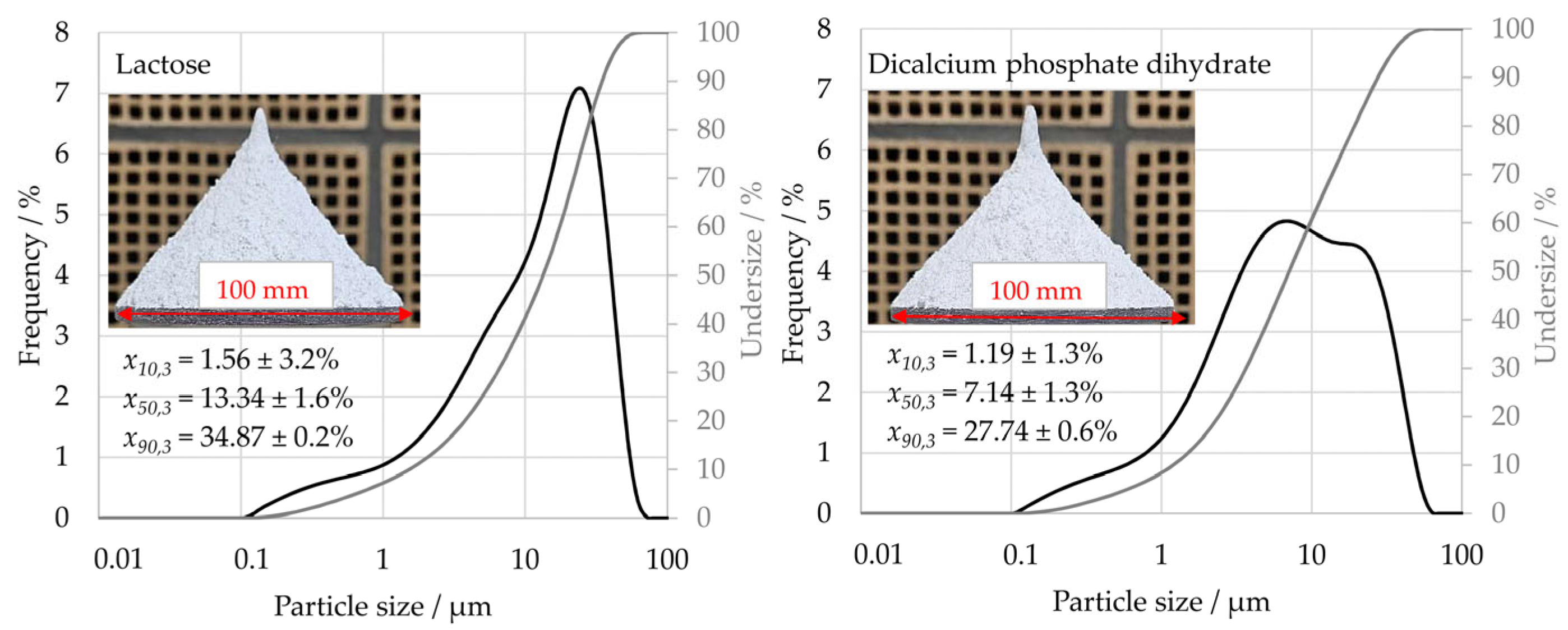
As shown in Figure 1, both materials exhibit a very fine, yet broadly distributed, particle size distribution, which is characteristic of the ground product. The bulk samples also indicate that both powders are highly cohesive.
The solid density was determinedusing a pycnometer and helium gas (Upyc 1200, QUANTACHROME CORPORATION, Boynton Beach, FL, USA) and found to be 1.51 ± 0.4% for fresh lactose and 2.30 ± 0.9% g/cm3 for dicalcium phosphate dihydrate.

2.2. Powder Preparation

The fresh lactose was loaded into a metal tray with a powder bed thickness of about 2 to 3 cm. To recrystallize the powder after the transportation process, it was moisture conditioned for approximately 3 days in a VCL 4010 climate chamber (Vötsch Industrie-technik GmbH, Balingen, Germany) at a constant temperature of 25 °C and a relative humidity of 75% [63]. It will hereafter be referred to as Lactose A. Most investigations, however, were conducted using fresh lactose that had been conditioned for approximately 16 h at 20 °C and 50% relative humidity (see also [33]). It will be referred to as Lactose B. The two conditioning approaches were pursued to clarify whether storage conditions influence powder adhesion behavior. After conditioning, the moisture content of the powder was determined using a moisture analyzer MA 30 (Sartorius, Göttingen, Germany), with a result of approximately 5.3% (wet basis). For this, the sample chamber, containing approximately 5 g of powder, was heated to 120 °C and maintained at this temperature for about 10 min to assess the moisture content.
Unlike lactose, dicalcium phosphate dihydrate was not conditioned but tested as received; according to the manufacturer, the material exhibits a crystalline structure. The measured moisture content was approximately 10.5%.

2.3. Test Rig

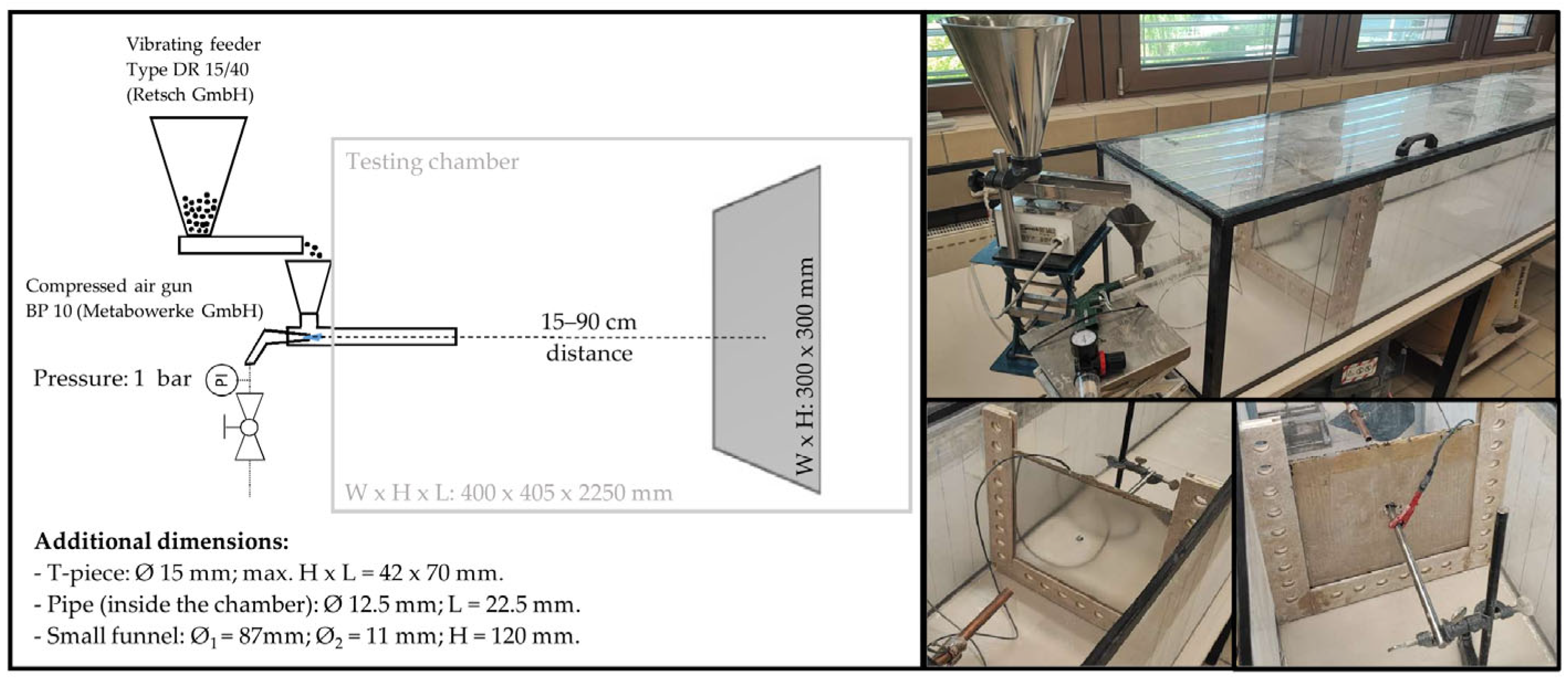
The test rig primarily comprises three components: a vibrating feeder for continuous powder conveyance; an assembly of spray gun, powder hopper, and piping for powder fluidization and transport; and an opposing test plate mounted within a frame (see Figure 2). The frame is dimensioned to fit precisely within the interior of the testing chamber and incorporates an internal recess approximately 10 mm wide to facilitate the secure mounting of the plates. It further includes 26 air-outlet perforations, each 20 mm in diameter, to promote airflow. The entire system is enclosed, with all metallic parts and the enclosure grounded.
The compressed air used in all experiments was supplied by the in-house system, which includes refrigerated air dryers (Kältetrockner TA 11, KAESER Kompressoren, Coburg, Germany) and was maintained at a constant temperature of approximately 18.5 °C with a relative humidity of 2.1%. The measurements were conducted using a PCE-555 Hygrothermometer (PCE Instruments, Meschede, Germany).

2.4. Experimental Procedure

To measure the adhesion behavior, approx. 50 g of powder was weighed and sprayed onto the metal plate positioned at a 90° angle to the tube at varying distances (see Section 2.8). The average mass flow in experiments with constant mass flow amounted to approx. 1 g/s corresponded to a loading of about 0.15 kg/m3 in the piping. The plate was then removed from the test rig. The deposited mass was collected in a radius of 11.5 cm from the center of the deposit and weighed. The area within the circle covered with powder particles was analyzed using Fiji, an open-source image processing package based on Ima-geJ, version 1.54f. [64]. The maximum deposit thickness was determined in advance using the caliper gauge.
Prior to the next measurement, the plates and the part of the box in the immediate proximity of the plate holder were cleared of powder using compressed air or a brush. They were then wiped with a wet cloth and dried.
A total of 11 metal plates were evaluated (see Table 1).

2.5. Statistical Analysis

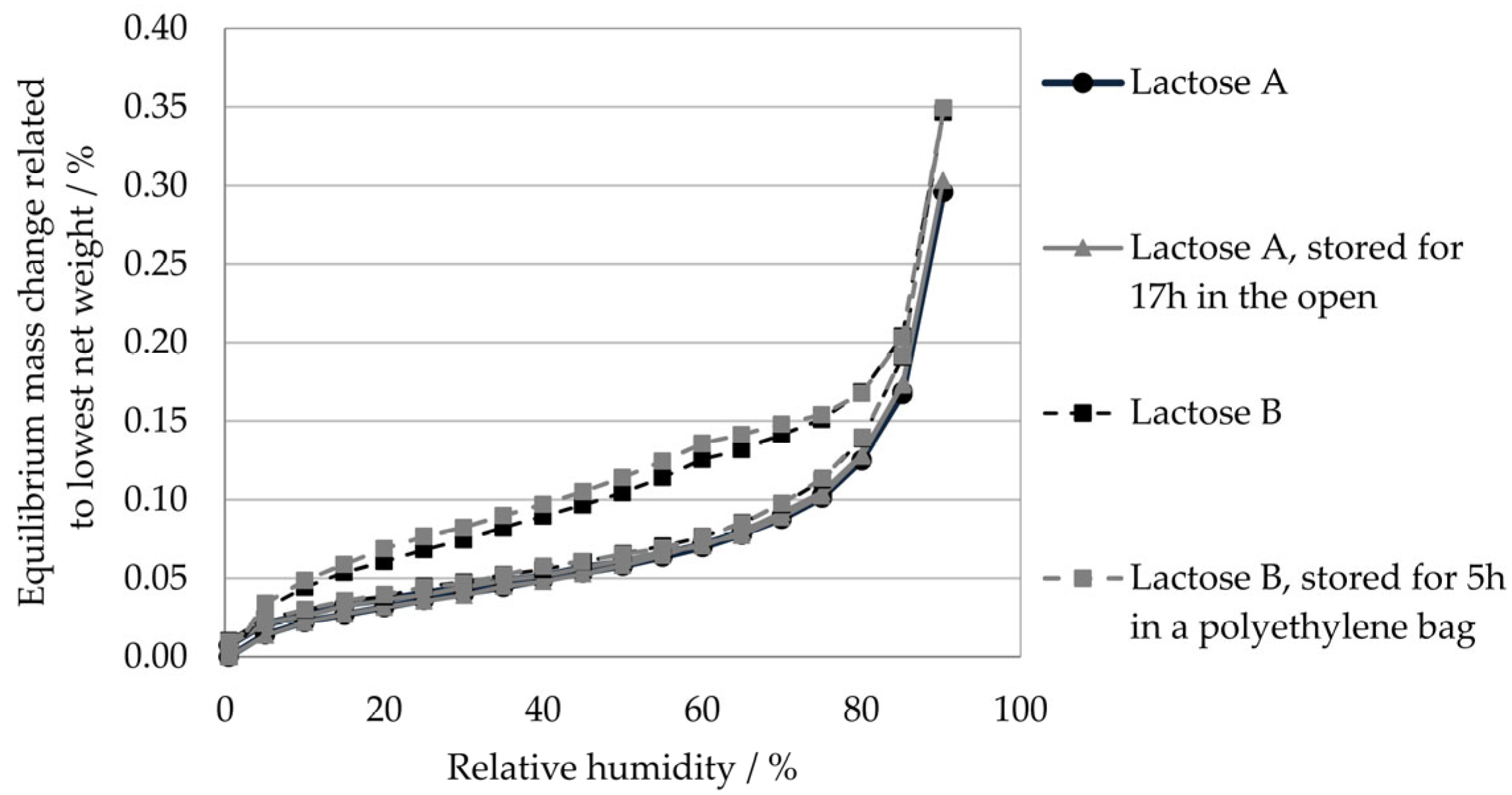
The preliminary studies have shown that the results are reproducible, provided there are no operator errors. The experimental series with lactose A or dicalcium phosphate was particularly straightforward, which is why typically duplicate measurements were performed. As a result, the sample standard deviation from the mean was kept below 10% for experiments in which no detachment occurred. However, lactose B exhibited greater fluctuations in the results. The underlying cause of this behavior was investigated through dynamic vapor sorption (DVS) measurements, kindly conducted by MEGGLE GmbH & Co. KG (see Figure 3). While lactose undergoes complete recrystallization when stored at 75% relative humidity (RH) and 25 °C, it is assumed that at 20 °C and 50% RH, the recrystallisation might not be completed up to 100%.
As soon as lactose is partially amorphous, it becomes highly sensitive to environmental conditions. This is evident from the shift in the measured sorption curves when the material is stored outside the climate chamber. For this reason, only the experiments in which the powder was freshly retrieved from the climate chamber, with no indication of alteration due to environmental conditions, were considered. Furthermore, in cases of uncertainty, experiments showing an adhesive drop were considered for the calculation, and all experiments were conducted with at least duplicate measurements.

2.6. Contact Angle

The contact angle was measured using the Drop Shape Analyzer from Krüss GmbH (Hamburg, Germany) with the software version KRÜSS ADVANCE 1.14.1.16701. The liquids used to determine the surface energy of plates, as well as their polar and disperse surface energy components, are listed in Table 2.
The surface energy of the plates, including its polar and dispersive components, was determined using the measured contact angles and the data from Table 2 for the wetting liquids, based on Young’s equation [65] and the OWRK model (Equation (1)) developed by Owens, Wendt, Rabel, and Kaelble [66].
Here, γL represents the surface tension of the liquid, with γLD and γLP representing its dispersive and polar components, respectively. γSD and γSP are the dispersive and polar components of the solid surface energy, and θ is the contact angle between the liquid droplet and the plate.
γL(cos(θ) + 1) = 2(γSD γLD)0.5 + 2(γSP γLP)0.5
Using liquids with known γLD and γLP values and by plotting 0.5γL(cos(θ) + 1)(γLD)−0.5 versus (γLP (γLD)−1)0.5, (γSD)0.5 and (γSP)0.5 can be determined from the slope and intercept of the plot. The sum of these two components gives the surface energy of the solid surface.

2.7. Roughness and Surface Acquisition

The surface properties of the analyzed plates were measured using the μscan scanning profilometer from NanoFocus AG (Oberhausen, Germany), equipped with a chromatic sensor CLA1 operating on the confocal measuring principle. This setup achieves a resolution of up to 10 nm within a height measurement range of up to 1000 µm. Areas of 480 µm × 480 µm were analyzed with a step width of 2 µm in both x- and y-directions at a measuring frequency of 1000 Hz. Surface data were processed and visualized using µsoft analysis extended, version 8.1.9286 (Digital Surf, Besançon, France).

2.8. Air and Particle Swarm Velocity

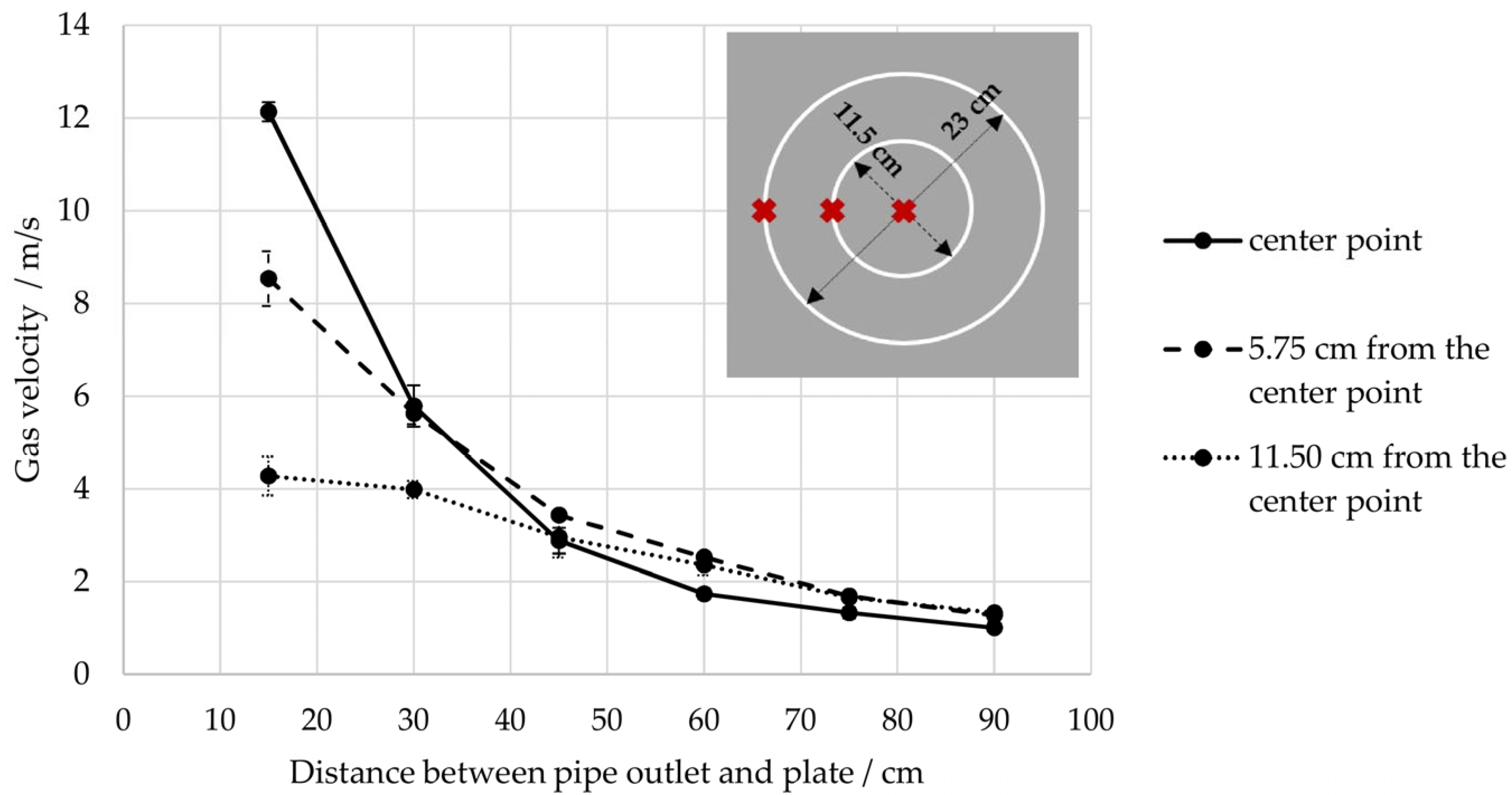
The gas velocity was measured using the PL-135 HAN hot-wire anemometer (Voltcraft, Hirschau, Germany), while the distances between the pipe outlet (see Figure 1) and the plate were varied. The results are shown in Figure 4.

3. Results

First, the results of the characterization of the different wall materials—specifically, surface roughness and surface energy—are shown. Subsequently, the influence of process parameters on adhesion behavior is investigated, and the outcomes of the deposition tests for various wall materials and powders are reported.

3.1. Roughness of the Wall Materials

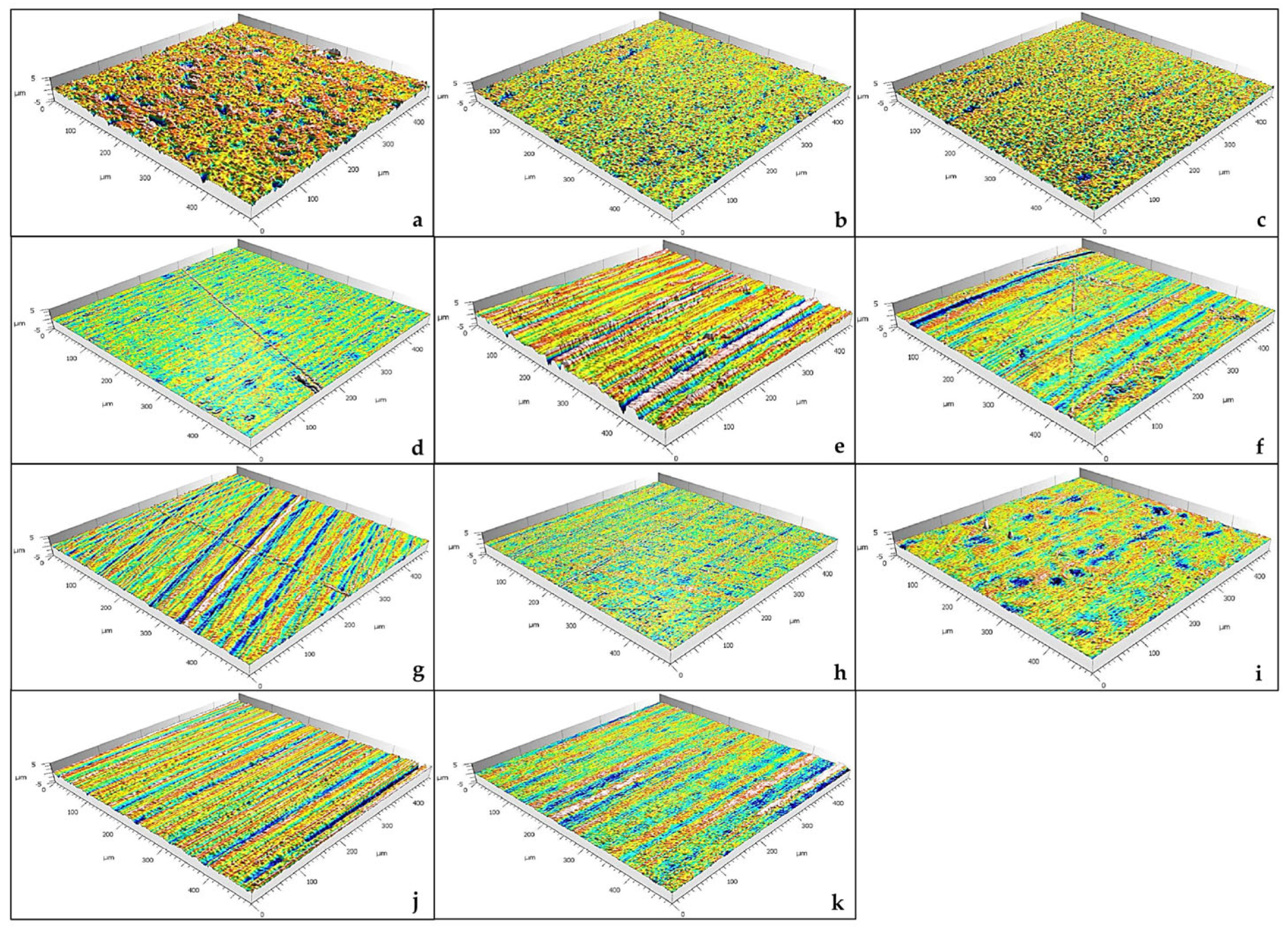
The roughness of the plates was determined according to [67]. Various surface texture parameters were measured: Sq—the root mean square height, Sz—the maximum height (the difference between the highest and lowest points on the surface), and Sa—the arithmetic mean height. The results are presented in Table 3, and the corresponding 3D-views are shown in Figure 5.
Figure 5 illustrates that stainless steels (SS) exhibit an irregular, unstructured surface morphology, characterized by macropores and uneven, rounded indentations. This feature is especially pronounced in SS 1.4301 compared to SS 1.4404 and SS 1.4571. Brass also exhibits crater-like depressions, though these are more irregularly distributed across the surface, in contrast to the more uniform pattern observed in SS 1.4301.
An analysis of the data presented in Table 3 substantiates these observations: the Sq and Sa values are high for SS 1.4301 and low for brass, while SS 1.4404 and SS 1.4571 exhibit similar values, with SS 1.4571 showing a slightly higher degree of surface porosity. For materials such as SS K240 and magnesium, and to a lesser extent, aluminum and titanium, characteristic surface lines are discernible. Cast aluminum displays a distinct surface pattern with a diagonal orientation.
SS 1.4016 displays an almost perfectly smooth surface, characteristic of high-gloss steel applications. Similarly, copper exhibits an almost flawless surface. Additionally, minor surface scratches are observable on both SS 1.4016 and aluminum, which is due to the fact that all plates were analyzed in their as-received condition.

3.2. Surface Energy of Wall Materials

The calculated surface energy—including both the polar and dispersive components of the plates—as well as the coefficient of determination R2 for the trend lines, is presented in Table 4. The measured contact angles are presented in Table A1, Table A2 and Table A3 in Appendix A.
In the case of the SS K240 and magnesium plates, which exhibit rolling or drawing lines (see Figure 4), the determination of surface energy was suboptimal. As the droplets elongate along the lines, the contact angle measurements become unreliable. To estimate the surface energy of the two plates despite this, contact angles were measured in two directions (along and perpendicular to the rolling or drawing lines), and an average value was calculated. Accordingly, the median and maximum values are further analyzed for SS K240, while this approach was not applied to magnesium, since the resulting R2 values were considered insufficient to yield meaningful results using this analytical method.
These measurements highlight the importance of directly determining surface energies rather than relying on literature values, as done in [20,28].

3.3. Influence of Process Parameters

The results in this section are based on preliminary investigations, not fully documented here, as the setup was still being optimized. Nonetheless, these insights were instrumental in defining the final experimental procedures.

3.3.1. Influence of Rolling or Drawing Lines on the Plates and the Plate Thickness

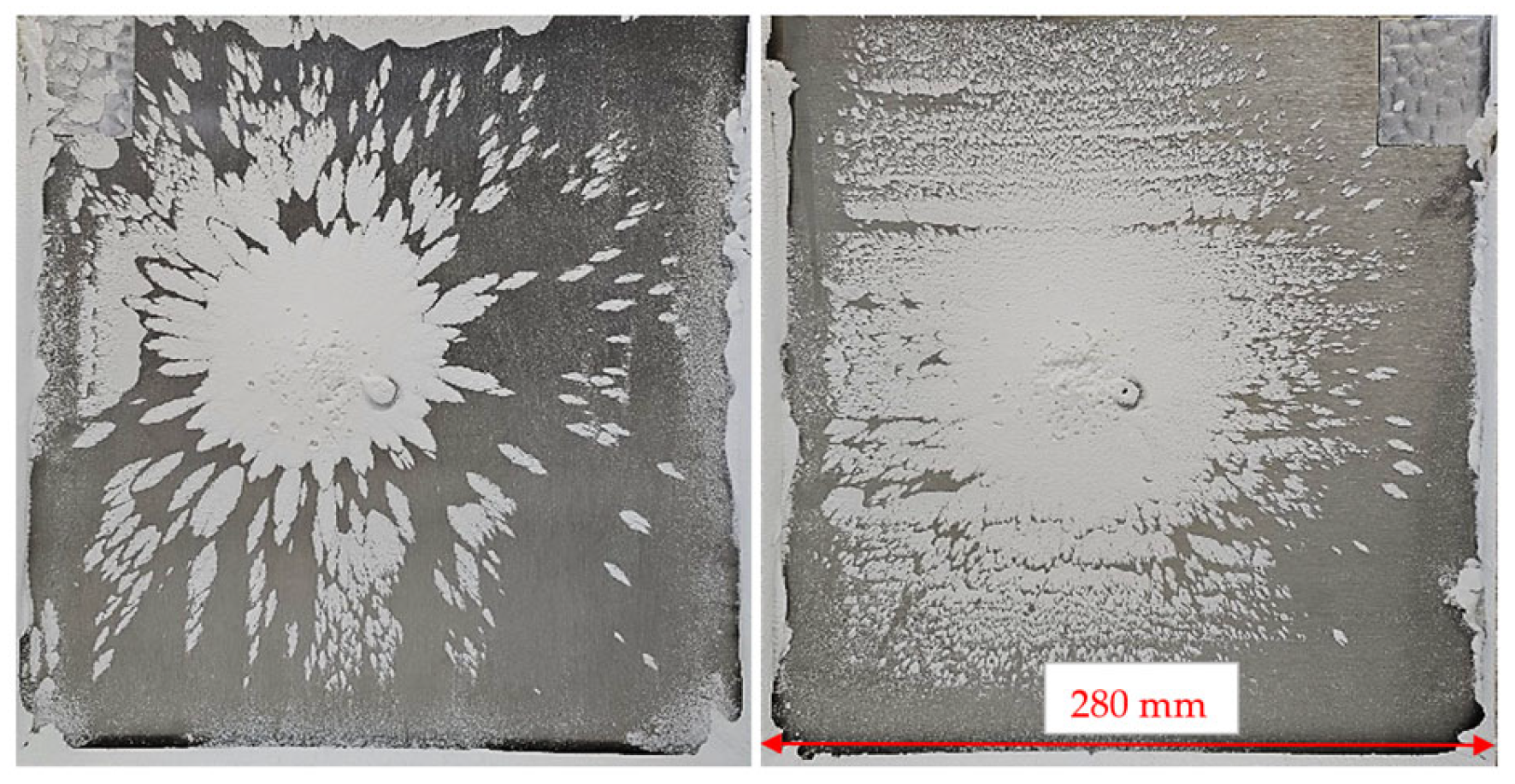
The investigation into the influence of the orientation of rolling or drawing lines on the process was conducted using an SS K240 plate as a model. The plate features well-defined lines, which arise from the manufacturing process. For the experiment, the plate was mounted in two distinct orientations. The results can be seen in Figure 6.
The results indicate that a larger deposition area forms on the plate with horizontally oriented production lines; hence, a vertical orientation was selected for subsequent experiments.
Furthermore, a minimum plate thickness of 1 mm was selected for all experiments, as initial tests indicated that thinner substrates exhibited insufficient deposit stability.

3.3.2. Effect of Grounding and the Application of the Deionizing Air Gun

Investigations were conducted to evaluate the influence of grounding on deposition behavior. In one scenario, the plates were grounded using a protective grounding device with a safety resistance of one megaohm, and the copper pipe remained ungrounded. In the second scenario, both the pipe and the plates were directly grounded through the household electrical system. The results demonstrated that scenario one generally led to a higher deposition mass on the plates, with variations in magnitude depending on the plate material.
This effect is likely attributable to electrostatic charging of the particles due to contact, particularly with the walls of the Plexiglas enclosure. To mitigate this, the enclosure was subsequently grounded using aluminum foil. The influence of the pipe, which primarily served to stabilize the airflow, was considered negligible, as it was rapidly covered by a layer of powder. Since triboelectric charging predominantly occurs through contact between dissimilar surfaces [68], the contribution of the pipe in this context is expected to be minimal.
Thereafter, experiments with the ionization spray gun Cleanflex Easy (Simco-ION (Nederland) B.V., Lochem, The Netherlands), commonly used to neutralize static charges, showed a slight reduction in deposit thickness and area. As the effect was almost within the margin of error, the method was not further pursued.

3.4. Influence of Wall Materials with Lactose B

To investigate the behavior of lactose B, plates made of SS 1.4301, SS K240, aluminum, copper, and brass were examined at distances ranging from 15 to 75 cm. The remaining plates were only tested at distances between 30 and 75 cm.
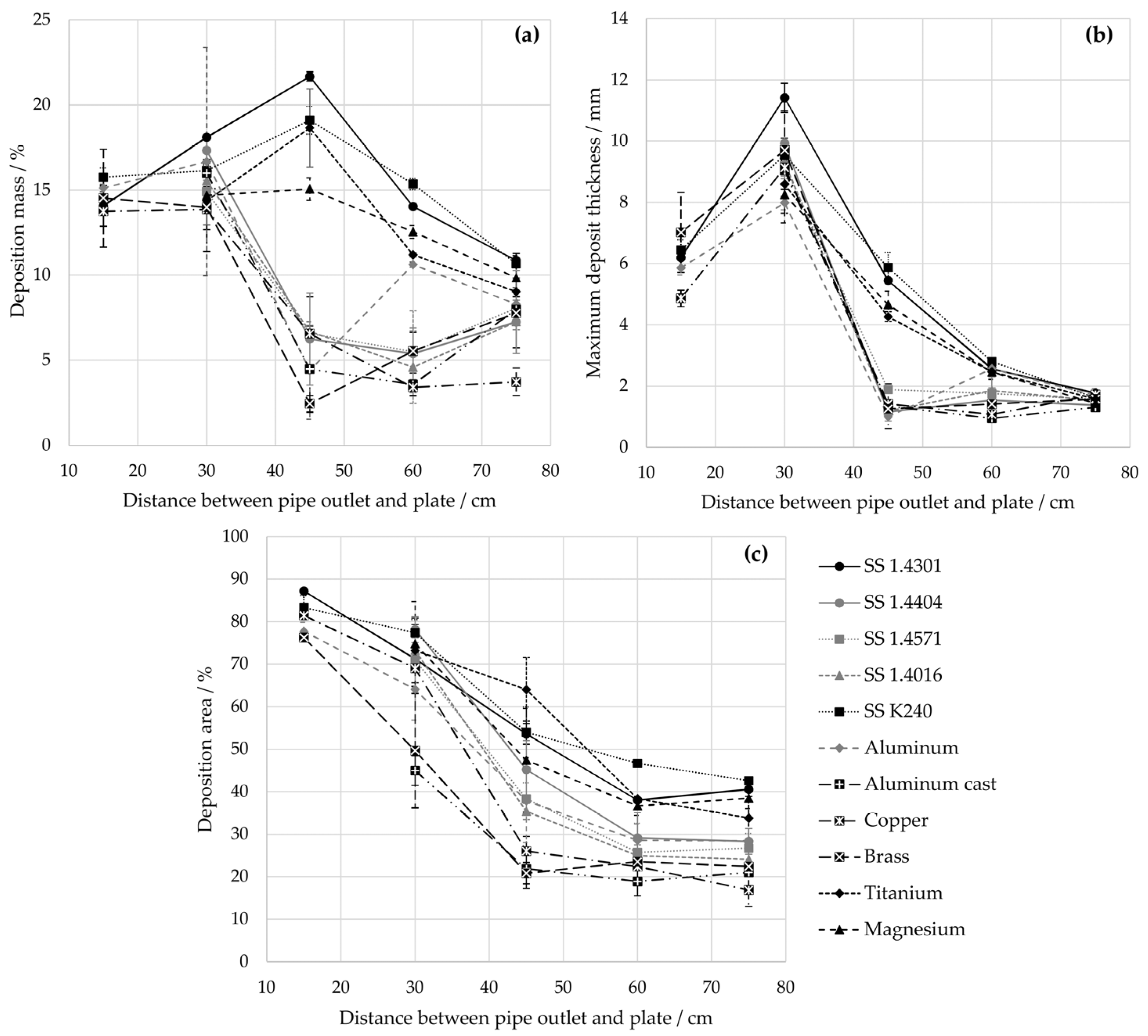
Upon reviewing Figure 7a, which illustrates the total deposition mass of powder on the surface, it is clear that the maximum deposition occurs at a distance of 45 cm, provided that no material detachment occurs. This finding aligns with the optical observations during the experiments: at distances between 15 and 45 cm, a distinct hill-like formation is observed at the center of the plate. This can be attributed to particles or powder agglomerates, which directly impact the center of the plate without being deflected by the airflow. As shown in Figure 7b, the height of this accumulation is greatest at 30 cm. At distances greater than 60 cm, the powder adheres in a more uniform, circular pattern across the plate, with the thickness of the deposits showing little variation between the center and the edges.
The greatest quantity of powder drops off at 45 cm for aluminum cast and brass, and at 60 cm for aluminum cast and copper. Beyond 60 cm, the values for aluminum cast and brass stabilize once again.
The deposition mass of powder is determined by both the thickness of the deposits and the size of the deposition area, as shown in Figure 7b,c. Figure 5b illustrates that, at 15 cm, the deposition thickness (for the five plates examined at this distance) is highest for brass and lowest for copper, with SS K240, SS 1.4301, and aluminum showing intermediate values. However, these values do not align with the trends observed at greater distances. At 30 cm, the values for all plates are quite similar, making it difficult to distinguish any clear trend, except for the highest value observed for SS 1.4301. Starting from 30 cm, however, a pattern consistent with Figure 7a is observed for the SS 1.4301, SS K240, titanium, and magnesium plates: these plates show the thickest deposits up to a distance of 75 cm. For all other plates, a rapid decrease in maximum deposition thickness is observed at 45 cm, which results from the powder drop off at this distance. All the values are very close to each other, except for a slightly higher value for SS 1.4571, suggesting that adhesive slip-off occurred just before the end of each experiment. At 60 cm, brass, copper, and aluminum cast show the smallest deposition thicknesses, while the values for all other plates are slightly higher. At 75 cm, the lines converge, and the maximum deposition thickness for all plates is below 2 mm.
The most interesting results are presented in Figure 7c, which examines the deposition area, a direct indicator of the adhesion between the plate and the powder. It is apparent that, at higher speeds (15–30 cm), the values do not consistently align with the trends observed at greater distances. However, from 30 cm onward, the profiles of the individual experiments show less variation. Beyond 60 cm, the profiles for most plates start to linearize, making the deposition area independent of the airspeed.
Moreover, Figure 7c reveals a distinct trend: certain profiles consistently exhibit higher values than others and can be conceptually grouped into three categories. The largest deposition areas are associated with metals such as SS 1.4301, SS K240, titanium, and magnesium. The intermediate group, characterized by moderate deposition area, includes stainless steel types 1.4404, 1.4571, and 1.4016, as well as aluminum. The smallest deposition quantities and areas are observed for copper, brass, and cast aluminum. The classification of the groups is further supported by visual observations: In the group with the most pronounced deposit formation, no powder loss was observed. In the intermediate group, powder loss typically occurred toward the end of the experiment, usually after a critical weight had been reached. In contrast, copper and aluminum cast plates exhibited markedly unstable behavior, with powder loss occurring at various time points during the experiment, or even multiple times within a single trial.

3.5. Influence of Wall Materials with Other Powders

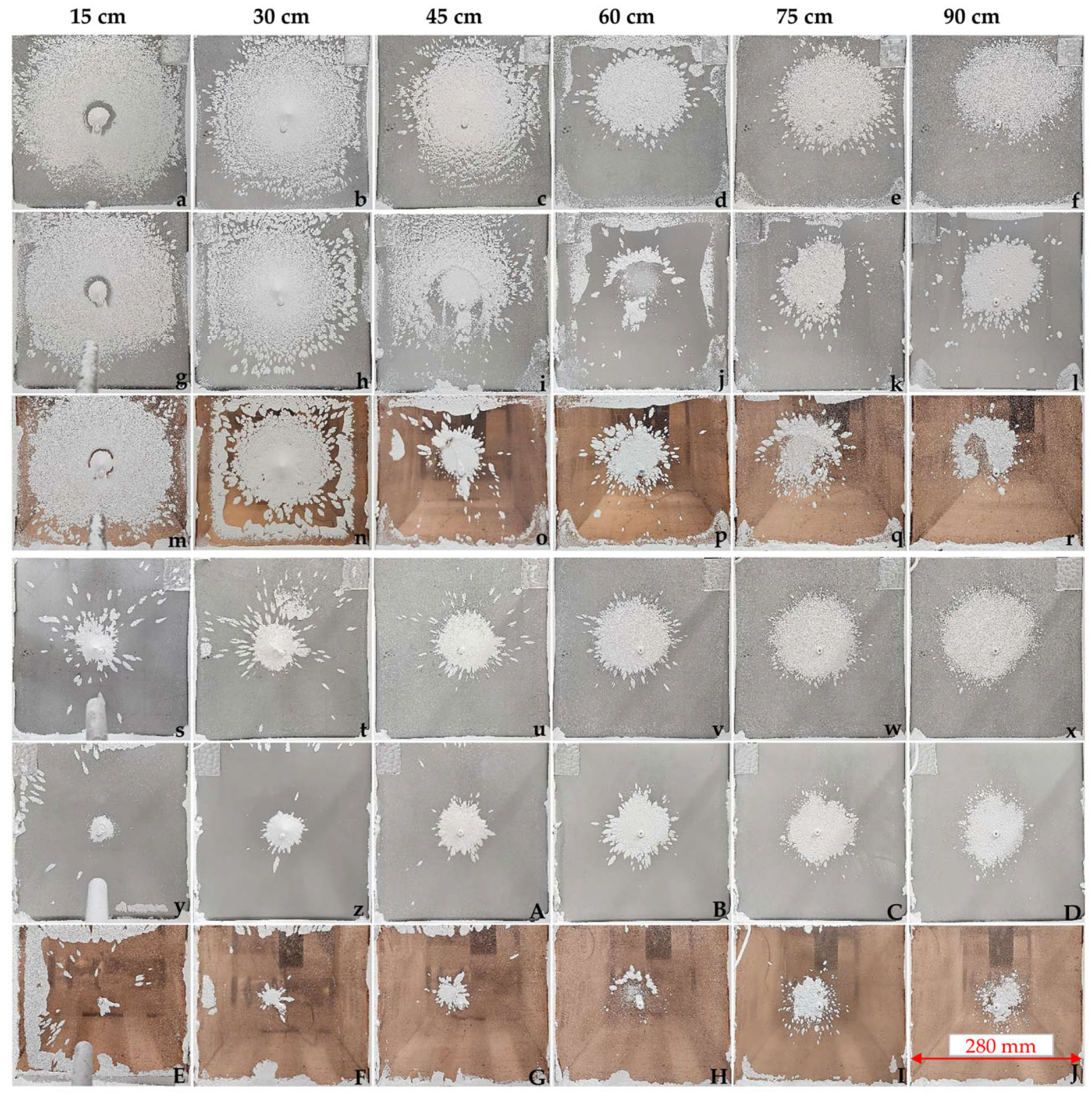
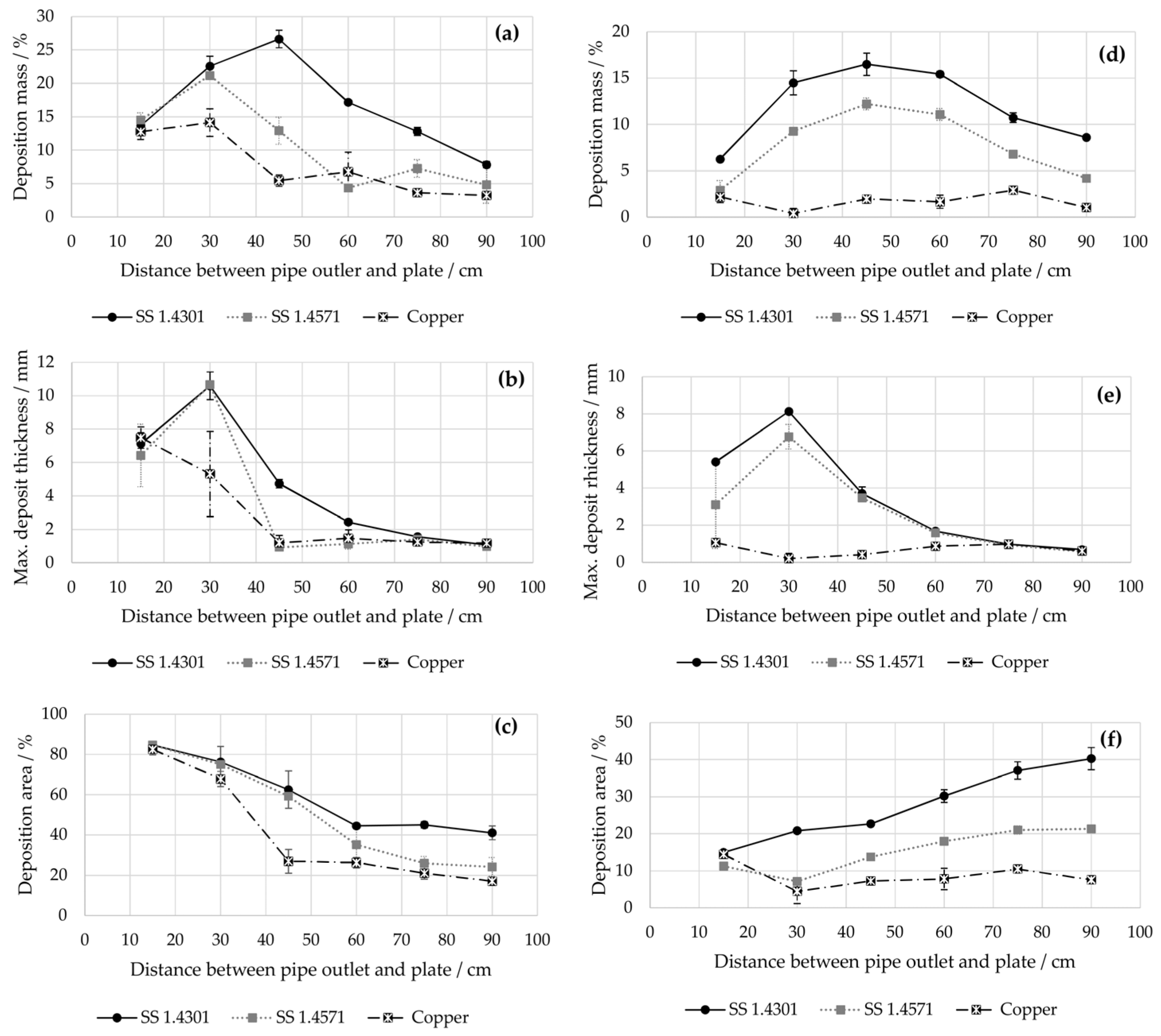
To further validate the findings from Section 3.4, three selected plates were examined with two additional powders—lactose A and dicalcium phosphate dihydrate—at distances ranging from 15 to 90 cm. The chosen plates were SS 1.4301, SS 1.4571, and copper. These plates displayed distinct deposition behaviors when in contact with powder (see Figure 7), as well as varying surface energy values and their components (see Table 4). In Figure 8, the arbitrarily selected images for each of the experiments are presented. The results can be found in Figure 9.
For lactose A, Figure 9a–c confirms that at the highest air velocity (15 cm), the plate material has no discernible influence, as all data points overlap. At a slightly lower velocity (30 cm), deposition values for SS 1.4301 and SS 1.4571 remain nearly identical, whereas copper exhibits noticeably lower values. The largest deposition area and maximum layer thickness across the entire velocity range were observed for SS 1.4301, resulting in the highest overall deposition mass.
In contrast, SS 1.4571 showed significant material detachment during the spraying process at distances of 45 cm and 60 cm, leading to a noticeable decline in the characteristic curve (Figure 9b,c). At 75 cm and 90 cm, partial detachment occurred mainly at the periphery of the deposited layer toward the end of the experiment, resulting in a slightly higher deposition mass compared to the values obtained at 45 cm and 60 cm.
The lowest deposition values across all distances—except at 60 cm—were recorded for copper. Unlike SS 1.4571, where detachment primarily occurred after exceeding a critical deposition mass during the experiment or due to minor vibrations of the test rig, copper exhibited continuous material loss throughout the spraying process. This detachment was not a singular event but rather a recurring phenomenon, occurring between one and five times within a single spraying event.
The trends observed for dicalcium phosphate dihydrate differ from those of lactose A. As shown in Figure 9d–f, at a distance of 15 cm, SS 1.4301 exhibits a higher deposition mass, which results from the greater layer thickness measured at this distance. In contrast to lactose A, the powder deposits formed by dicalcium phosphate dihydrate on SS 1.4571 and copper show lower strength. For SS 1.4571, it was observed that the peak of the mound was visibly blown off by the airflow. As for copper, the mound detached largely due to minimal vibrations of the test setup.
At greater distances (30–90 cm), no powder detachment was observed for SS 1.4571 during or after the process when using dicalcium phosphate dihydrate. However, the deposits on copper remained unstable, leading to intermittent detachment events during the spraying process at distances between 30 cm and 60 cm. Unlike lactose A, it was not possible to quantify the number of detachment events due to the higher dusting tendency of dicalcium phosphate dihydrate. Beyond 75 cm, the deposition on the copper surface remained stable.
For both lactose A and dicalcium phosphate dihydrate, a distance at which the maximum deposition occurs is observed. At greater distances, the deposition mass decreases. As shown in Figure 9b,e, the deposition thickness at 75 and 90 cm is consistent across all plates, measuring approximately 1 mm. The deposition area linearizes with increasing distance (Figure 9c,f), with the trends differing: the deposition area for lactose A tends to decrease, while for dicalcium phosphate dihydrate, it increases.

4. Discussion

4.1. Influence of Large-Scale Plate Structures and Grounding

In Section 3.3, the influence of various process parameters on the adhesion behavior of dry powder particles was examined. The analysis of line orientations in Section 3.3.1 revealed that a larger deposition area forms on plates with horizontally aligned production lines. This phenomenon can be attributed to the gravitational movement of powder agglomerates: with vertically oriented lines, the agglomerates migrate downward along the grooves, whereas with horizontal lines, they become trapped within surface structures such as ridges and depressions.
While the differences observed in this study were minor, an increased initial deposition could serve as a nucleus for further accumulation, potentially amplifying overall deposition over time. Although the dynamic instability of thinner walls could serve as an effective mechanism for reducing caking, the applicability of vibration-sensitive materials in large-scale industrial environments is limited due to their insufficient mechanical robustness.
In Section 3.3.2, the influence of grounding on deposition behavior was examined. The investigations revealed that the absence of grounding generally led to a higher deposition mass on the plates, with the extent of this difference depending on the plate material. Furthermore, the results of the deionization experiments suggest that electrostatic effects could not be entirely excluded as an influencing factor in the process, even after grounding the entire experimental setup.

4.2. Analysis of the Influence of Surface Energy and Plate Roughness

The experimental procedures were conducted in Section 3.4 and Section 3.5. The comparison of deposition masses and areas at a 15 cm distance in experiments with lactose A and dicalcium phosphate dihydrate (Section 3.5) revealed minimal differences. The larger deposition area seen in Figure 8E is likely attributed to the higher backward flow of dicalcium phosphate dihydrate from the box or frame, which also explains the slightly larger area for copper in Figure 9f. The fluctuations in the maximum deposition thickness for both products seem to be due to the removal of the top layer of the deposit by the airflow. The surface energy or roughness of the plates, and thus the plate material itself, does not appear to play a significant role at this high velocity. However, it is conceivable that higher roughness could provide better support for the formation of a thicker deposit, as seen with the higher values for SS 1.4301 compared to copper in the case of dicalcium phosphate dihydrate (Figure 9e).
The experiments with lactose B (Section 3.4) confirm that, in this series of tests (15 cm) as well, no clear correlation was found between the mass, thickness, or area of the deposits and the roughness of the wall materials. The same holds true for the surface energy and its components. It is assumed that at higher gas velocities, plastic deformation of the lactose occurs, causing the powder to be more tightly pressed onto the surface, which typically leads to an increase in adhesion and cohesion forces. These findings are consistent with those of Murti et al. [20], who also observed no significant influence of wall materials at higher speeds. Furthermore, at higher gas velocities, continuous re-entrainment of the particles takes place, resulting in a constant change in the deposition layer. A similar conclusion was drawn in [26], where it was observed that particles traveling at higher speeds may dislodge those that are loosely bound to one another.
At a distance of 30 cm, which corresponds to a flow velocity of approximately 6 m/s, no distinct correlation between the plate material and the adhesion behavior of the lactose B could be identified. The experiments with dicalcium phosphate dihydrate, on the other hand, reveal significant differences in the deposition amounts of the three materials studied at a distance of 30 cm (Figure 9d–f): the highest values were observed for SS 1.4301, while the lowest values were found for copper. This adhesion behavior could be correlated with both the surface roughness of the plates as well as their surface energy, including the polar component.
A different behavior is observed in the measurements with lactose A: in this case, the deposition amounts on SS 1.4301 and SS 1.4571 show only minimal differences. No direct correlation can be identified between the deposition mass or adhesion area and either the surface roughness—whether Sa, Sq or Sz values are considered—or the surface energy and its polar component.
This leads to the hypothesis that the forces acting on the particles at these velocities are still sufficient to press the powder onto the surface, while re-entrainment occurs only to a minimal extent. This aligns with the findings of Petean and Aguiar [40], which show that adhesion is not only influenced by the interaction of particles with surfaces but also by the compression speed. However, it should be noted that these findings primarily apply to lactose, as adhesion behavior can be significantly influenced by the specific material properties of the powder [27,40]. As demonstrated in [69,70], lactose deforms plastically more easily than dicalcium phosphate; however, since the materials used in this study differ, these findings should be considered with caution.
At increased distances (≥45 cm) and reduced gas velocities, a distinct behavior is observed. For dicalcium phosphate dihydrate, a significant variation in deposition amounts is evident, depending on the plate material. This discrepancy is primarily attributed to adhesion, as the maximum deposition thickness is consistent for both SS 1.4571 and SS 1.4301. Had the powder not detached from the copper surface, it is likely that similar deposition thicknesses to those observed with the stainless steels would have occurred. Although higher velocities generally led to a greater covered area, it is clear that at 90 cm, the adhesion area of SS 1.4301 is approximately two to four times larger than that of the other materials tested.
Material-dependent differences in adhesion behavior are also observed with lactose A samples. Detachment occurs not only with copper but also partially with SS 1.4571 (detachment between 45 and 60 cm and slippage at the edges between 75 and 90 cm). In this case, it appears that at larger distances, adhesion has a more pronounced effect on the resulting powder mass than cohesion, as the maximum powder thickness changes only marginally after 75 cm. However, it remains inconclusive whether the surface energy or surface roughness of the plates plays a decisive role in the adhesion behavior.
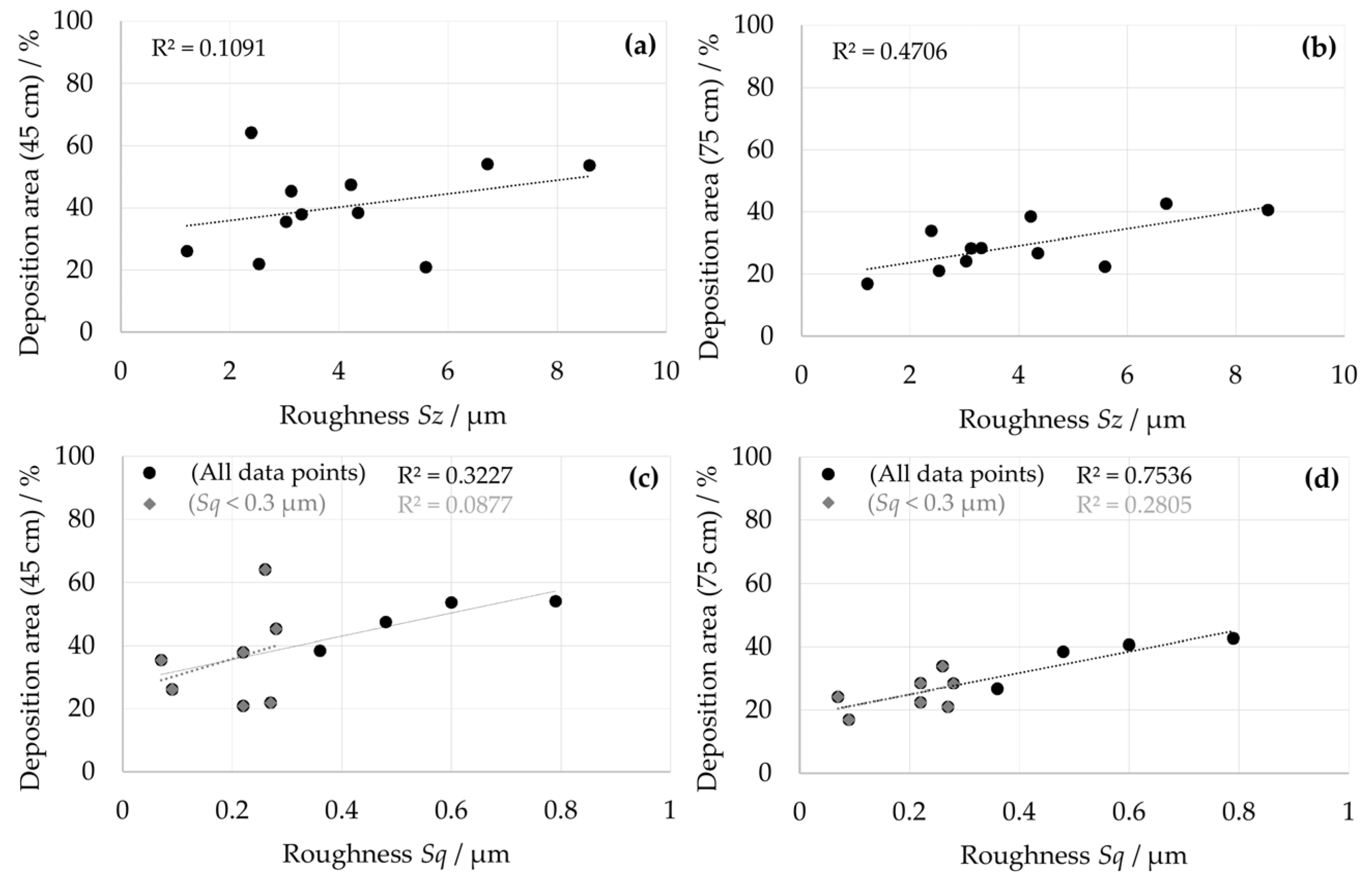
In order to investigate the influence of surface energy and surface roughness, the following discussion will focus on the results involving lactose B. Given the potentially significant influence of surface roughness on adhesion, the dependencies between deposition area and surface roughness parameters are presented in Figure 10, exemplified for distances of 45 cm and 75 cm.
As shown in Figure 10a,b, no clear correlation between the surface roughness parameter Sz and the deposition area can be observed at both distances. While the difference between the highest and lowest points on the surface may play a role in the shape of the deposition, as demonstrated in Section 3.3.1, no linear relationship can be identified. This finding is consistent with visual observations: individual scratches on the untreated surface did not exhibit an increased tendency for deposition formation.
In contrast, the surface roughness parameter Sq (Figure 10c,d) exhibits a stronger linear relationship with the deposition area at both 45 cm and 75 cm distances, as indicated by higher R2 values. However, this linearity only becomes apparent at roughness values above approximately 0.3–0.4 µm. This suggests that the influence of surface roughness on adhesion becomes significant once a certain critical threshold is exceeded. This pattern is also evident when comparing Figure 7c and Table 3: the plates with the highest deposition areas generally exhibit relatively high Sq values between 0.79 and 0.48 µm, with titanium being a notable exception at 0.26 µm. Below this threshold, the correlation weakens: plates with similar roughness values—such as copper and SS 1.4014, or cast aluminum and titanium—show differing deposition behaviors (see Section 3.4). These observations are consistent with those reported by Stevenson et al. [42], who have shown that as a perfectly smooth surface becomes rougher, surface features eventually become large enough for particles to nest within them, leading to increased adhesion compared to a smooth surface.
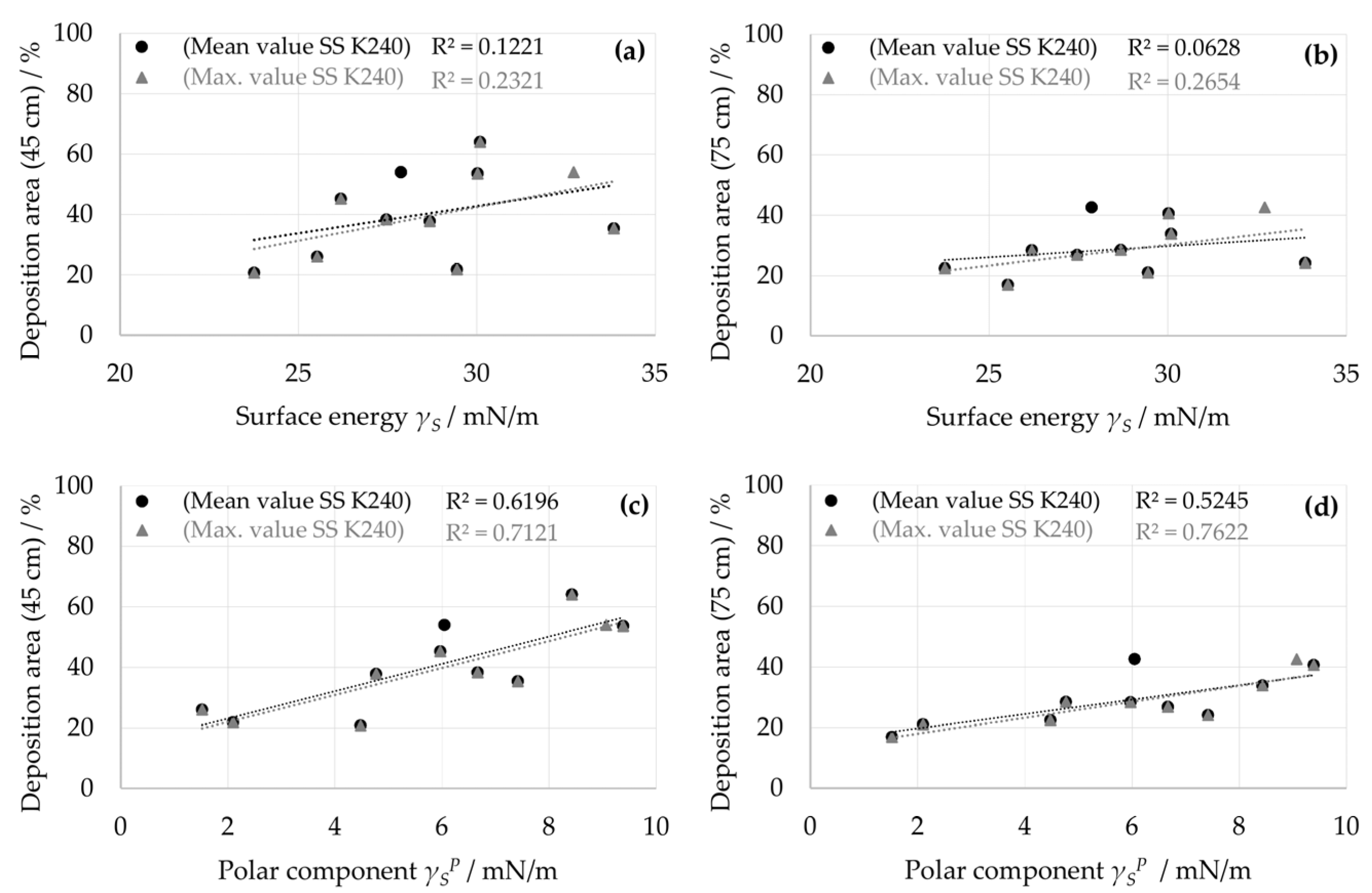
In light of previous studies [20,28], an influence of surface energy on the adhesion behavior was hypothesized. However, Figure 11a,b reveals that there is no clear correlation between the absolute values of surface energy γS and the adhesion area. Therefore, the tendency for adhesion cannot be directly attributed to surface energy, as might have been assumed based on Figure 9.
The polar component of surface energy γSP, rather than the absolute surface energy value γS (Figure 11c,d), appears to be a more reliable predictor of a material’s tendency to accumulate deposits: Surfaces with a higher polar component tend to exhibit greater deposition, while materials with a lower polar component are less prone to accumulation. Although the coefficients of determination R2 for the linear trend line are not particularly high, these values increase to 0.71 at 45 cm and to 0.76 at 75 cm when maximum values for SS K240 are used instead of the mean values (see Table 4).
To roughly estimate powder adhesion on a given material, the ratio of dispersive to polar surface energy components (D/P) can be considered (see Table 5). Plates with the highest ratios show minimal adhesion, while those with the lowest ratios exhibit the largest deposition areas and thus deposited mass. An exception is the brass plate, which, despite a high ratio of 4.3, shows the smallest deposition area (see Figure 7c). This may be due to its pronounced surface waviness (see Figure 4). Additionally, the surface energy of the powder itself may influence adhesion and should be examined in further investigations.
An additional factor that was not accounted for in this investigation could be the probability of the powder adhering to the surface without detaching. As noted in Section 2.5, when calculating the averages for the lactose B samples, trials where adhesive detachment occurred were used in cases of uncertainty. However, in the case of brass, no adhesive detachment was observed in half of the trials at distances of 45–60 cm. Had the trials without detachment been incorporated into the average calculation, the trend for brass would have been closer to that for aluminum.

5. Conclusions

This study investigates the influence of process parameters and wall materials on the adhesion behavior of lactose and dicalcium phosphate dihydrate. The key distinction from previous studies lies in the use of a test rig that allows measurements in a fluidized state and enables the investigation of the influence of different wall materials and process conditions on caking behavior. The effectiveness of the method was demonstrated using eleven wall materials across a range of gas velocities.
The results demonstrate that the roughness of the materials may play a significant role in adhesion and the subsequent stability of deposits, once a critical roughness threshold is reached (Sq > 0.4 µm). A comparison of smooth materials with similar roughness values shows that those with a higher dispersive-to-polar surface energy ratio exhibit a reduced tendency for adhesion retention, particularly at gas velocities below 6 m/s.
By employing the experimental setup, it is possible to effectively identify the most suitable powder-wall pairings, minimizing caking.

Author Contributions

Conceptualization, S.D. and S.B.; methodology, S.D.; validation, S.D.; formal analysis, S.D.; investigation, S.D.; resources, S.B.; data curation, S.D.; writing—original draft preparation, S.D.; writing—review and editing, S.D. and S.B.; visualization, S.D.; supervision, S.B.; project administration, S.B.; funding acquisition, S.B. All authors have read and agreed to the published version of the manuscript.

Funding

This research was funded by Bayerisches Staatsministerium für Wissenschaft und Kunst (StMWK), grant number H.2-F1116.NÜ/67/2.

Data Availability Statement

The original contributions presented in this study are included in the article. Further inquiries can be directed to the corresponding author.

Acknowledgments

Alex Schreiber (Ohm Technische Hochschule Nürnberg), Sebastian Wolf (Ohm Technische Hochschule Nürnberg), Roland Gross (Ohm Technische Hochschule Nürnberg), Jewgeni Roudenko (Ohm Technische Hochschule Nürnberg), Ricarda Leister (MEGGLE GmbH & Co. KG), Michael Ostendorf (Bayer AG), Hubert Müller (Evonik Industries), Johannes Khinast (Research Center Pharmaceutical Engineering (RCPE)).

Conflicts of Interest

The authors declare no conflicts of interest.

Appendix A

Table A1. Measured contact angles (CA) and corresponding standard deviations (SD) for the investigated wall materials (Part 1).
SubstanceSS 1.4301SS 1.4404SS 1.4571SS 1.4016SS K240
x-Axis
CA/°SD/°CA/°SD/°CA/°SD/°CA/°SD/°CA/°SD/°
Water76.230.5381.441.6480.830.4773.290.7190.771.33
Ethylene glycol63.850.6468.710.6771.330.2858.140.4183.811.26
Dimethyl sulfoxide50.100.3355.931.4755.070.5140.500.8662.930.41
Diiodo-methane63.820.6565.830.8765.650.4148.150.8274.560.96
Glycerol63.760.8885.991.31--69.340.7689.320.87
1-octanol19.720.3519.490.9418.031.13--12.860.79
1-decanol23.340.2719.401.3319.910.5514.440.2820.191.16
Table A2. Measured contact angles (CA) and corresponding standard deviations (SD) for the investigated wall materials (Part 2).
SubstanceSS K240
y-Axis
Aluminum
x-Axis
Aluminum y-AxisAluminum CastCopper
CA/°SD/°CA/°SD/°CA/°SD/°CA/°SD/°CA/°SD/°
Water75.011.2984.120.4484.581.1990.650.6196.340.18
Ethylene glycol57.361.3564.770.8163.030.2766.880.876.710.66
Dimethyl sulfoxide41.840.2851.941.0758.431.1354.970.6167.970.53
Diiodo-methane64.690.6857.040.6163.951.2457.080.9864.340.38
Glycerol67.650.2377.150.3573.260.7879.771.1780.091.94
1-octanol--8.100.9614.331.02--20.350.82
1-decanol--12.931.7112.660.71----
Table A3. Measured contact angles (CA) and corresponding standard deviations (SD) for the investigated wall materials (Part 3).
SubstanceBrassTitaniumMagnesium x-AxisMagnesium y-Axis
CA/°SD/°CA/°SD/°CA/°SD/°CA/°SD/°
Water87.530.8574.500.5199.521.1257.770.96
Ethylene glycol77.840.5261.501.2096.930.6165.510.33
Dimethyl sulfoxide64.020.4550.120.5072.881.2948.610.55
Diiodo-methane70.250.4456.160.4985.301.1458.590.69
Glycerol81.480.8474.421.20105.771.8480.880.31
1-octanol30.160.9616.820.17----
1-decanol31.030.5720.420.40----

References

  1. Shekunov, B.Y.; Chattopadhyay, P.; Tong, H.H.Y.; Chow, A.H.L. Particle Size Analysis in Pharmaceutics: Principles, Methods and Applications. Pharm. Res. 2007, 24, 203–227. [Google Scholar] [CrossRef] [PubMed]
  2. Ainurofiq, A.; Suryanto, A.A.; Beltiartono, B.S.; Merdekawati, N.A.; Ardiyani, N.P.; Farohma, Q.Y.C.; Budiman, A.; Wardhana, Y.W.; Nugraha, Y.P. Literature Review: The Role of Particle Size Distribution in Drug Delivery. Multidiscip. Rev. 2025, 8, 2025269. [Google Scholar] [CrossRef]
  3. Nijhu, R.S.; Khatun, A.; Hossen, M.F. A Comprehensive Review of Particle Size Analysis Techniques. Int. J. Pharm. Res. Dev. 2024, 6, 01–05. [Google Scholar] [CrossRef]
  4. Muehlenfeld, C.; Kann, B.; Windbergs, M.; Thommes, M. Solid Dispersions Prepared by Continuous Cogrinding in an Air Jet Mill. J. Pharm. Sci. 2023, 102, 4132–4139. [Google Scholar] [CrossRef]
  5. Murdande, S.B.; Shah, D.A.; Dave, R.H. Impact of Nanosizing on Solubility and Dissolution Rate of Poorly Soluble Pharmaceuticals. J. Pharm. Sci. 2015, 104, 2094–2102. [Google Scholar] [CrossRef]
  6. Silva, D.G.E.; Sarruf, F.D.; Oliveira, L.C.D.D.; Arêas, E.P.G.; Kaneko, T.M.; Consiglieri, V.O.; Velasco, M.V.R.; Baby, A.R. Influence of Particle Size on Appearance and in Vitro Efficacy of Sunscreens. Braz. J. Pharm. Sci. 2013, 49, 251–261. [Google Scholar] [CrossRef]
  7. Venkataramani, D.; Tsulaia, A.; Amin, S. Fundamentals and Applications of Particle Stabilized Emulsions in Cosmetic Formulations. Adv. Colloid. Interface Sci. 2020, 283, 102234. [Google Scholar] [CrossRef]
  8. Guinard, J.-X.; Mazzucchelli, R. The Sensory Perception of Texture and Mouthfeel. Trends Food Sci. Technol. 1996, 7, 213–219. [Google Scholar] [CrossRef]
  9. Analytical Characterization of Mouthfeel in Chocolate; White Paper; NETZSCH-Gerätebau GmbH: Selb, Germany, 2022.
  10. Emorine, M.; Septier, C.; Thomas-Danguin, T.; Salles, C. Ham Particle Size Influences Saltiness Perception in Flans. J. Food Sci. 2014, 79, S693–S696. [Google Scholar] [CrossRef]
  11. Song, J.; Qin, J.; Qu, J.; Song, Z.; Zhang, W.; Xue, X.; Shi, Y.; Zhang, T.; Ji, W.; Zhang, R.; et al. The Effects of Particle Size Distribution on the Optical Properties of Titanium Dioxide Rutile Pigments and Their Applications in Cool Non-White Coatings. Sol. Energy Mater. Sol. Cells 2014, 130, 42–50. [Google Scholar] [CrossRef]
  12. Gueli, A.M.; Bonfiglio, G.; Pasquale, S.; Troja, S.O. Effect of Particle Size on Pigments Colour. Color Res. Appl. 2017, 42, 236–243. [Google Scholar] [CrossRef]
  13. Zong, S.; Chang, C.; Rem, P.; Gebremariam, A.T.; Di Maio, F.; Lu, Y. Research on the Influence of Particle Size Distribution of High-Quality Recycled Coarse Aggregates on the Mechanical Properties of Recycled Concrete. Constr. Build. Mater. 2025, 465, 140253. [Google Scholar] [CrossRef]
  14. Ding, D.; Li, J.; Li, R.; Zhang, L.; Hou, C.; Xiao, G.; Chong, X.; Luo, J.; Deng, P. Effects of Particle Size in Silica Sol on the Mechanical and Thermal Properties of SiO2f/SiO2 Composites. Int. J. Appl. Ceram. Technol. 2023, 20, 1865–1874. [Google Scholar] [CrossRef]
  15. Rajpoot, S.; Ha, J.-H.; Kim, Y.-W. Effects of Initial Particle Size on Mechanical, Thermal, and Electrical Properties of Porous SiC Ceramics. Ceram. Int. 2021, 47, 8668–8676. [Google Scholar] [CrossRef]
  16. Bakil, S.N.A.; Dibrova, S.; Breitung-Faes, S.; Mucsi, G. Optimizing coal gangue reactivity for geopolymer applications: A comprehensive study on high-energy grinding parameters. Powder Technol. 2025, 466, 121441. [Google Scholar] [CrossRef]
  17. Calvert, G.; Lawson, S.; Bilton, M. Let Them Beat Cake. Innovations in Pharmaceutical Technology. 2013, pp. 42–45. Available online: https://www.iptonline.com/ (accessed on 15 March 2026).
  18. Kota, K.; Langrish, T.A.G. Fluxes and Patterns of Wall Deposits for Skim Milk in a Pilot-Scale Spray Dryer. Dry. Technol. 2006, 24, 993–1001. [Google Scholar] [CrossRef]
  19. Ozmen, L.; Langrish, T.A.G. An Experimental Investigation of the Wall Deposition of Milk Powder in a Pilot-Scale Spray Dryer. Dry. Technol. 2003, 21, 1253–1272. [Google Scholar] [CrossRef]
  20. Murti, R.A.; Paterson, A.T.H.J.; Pearce, D.; Bronlund, J.E. The Influence of Particle Velocity on the Stickiness of Milk Powder. Int. Dairy J. 2010, 20, 121–127. [Google Scholar] [CrossRef]
  21. Rennie, P.R.; Chen, X.D.; Mackereth, A.R. Adhesion Characteristics of Whole Milk Powder to a Stainless Steel Surface. Powder Technol. 1998, 97, 191–199. [Google Scholar] [CrossRef]
  22. Sundararajan, P.; Moser, J.; Williams, L.; Chiang, T.; Riordan, C.; Metzger, M.; Zhang-Plasket, F.; Wang, F.; Collins, J.; Williams, J. Driving Spray Drying towards Better Yield: Tackling a Problem That Sticks Around. Pharmaceutics 2023, 15, 2137. [Google Scholar] [CrossRef]
  23. Krupp, H. Particle adhesion theory and experiment. Adv. Colloid Interface Sci. 1967, 1, 111–239. [Google Scholar] [CrossRef]
  24. Salazar-Banda, G.R.; Felicetti, M.A.; Gonçalves, J.A.S.; Coury, J.R.; Aguiar, M.L. Determination of the Adhesion Force between Particles and a Flat Surface, Using the Centrifuge Technique. Powder Technol. 2007, 173, 107–117. [Google Scholar] [CrossRef]
  25. Ozmen, L.; Langrish, T.A.G. Experimental Investigation into Wall Deposition of Milk Powder in Spray Dryers. Dev. Chem. Eng. Miner. Process. 2005, 13, 91–108. [Google Scholar] [CrossRef]
  26. Zuo, J.Y.; Paterson, A.H.; Bronlund, J.E.; Chatterjee, R. Using a Particle-Gun to Measure Initiation of Stickiness of Dairy Powders. Int. Dairy J. 2007, 17, 268–273. [Google Scholar] [CrossRef]
  27. Murti, R.A.; Paterson, A.T.H.J.; Pearce, D.L.; Bronlund, J.E. Stickiness of Skim Milk Powder Using the Particle Gun Technique. Int. Dairy J. 2009, 19, 137–141. [Google Scholar] [CrossRef]
  28. Woo, M.W.; Wan Daud, W.R.; Tasirin, S.M.; Talib, M.Z.M. Effect of Wall Surface Properties at Different Drying Kinetics on the Deposition Problem in Spray Drying. Dry. Technol. 2007, 26, 15–26. [Google Scholar] [CrossRef]
  29. Woo, M.W.; Daud, W.R.W.; Tasirin, S.M.; Talib, M.Z.M. Controlling Food Powder Deposition in Spray Dryers: Wall Surface Energy Manipulation as an Alternative. J. Food Eng. 2009, 94, 192–198. [Google Scholar] [CrossRef]
  30. Bhandari, B.; Howes, T. Relating the Stickiness Property of Foods Undergoing Drying and Dried Products to Their Surface Energetics. Dry. Technol. 2005, 23, 781–797. [Google Scholar] [CrossRef]
  31. Fitzpatrick, J.J.; Barry, K.; Cerqueira, P.S.M.; Iqbal, T.; O’Neill, J.; Roos, Y.H. Effect of Composition and Storage Conditions on the Flowability of Dairy Powders. Int. Dairy J. 2007, 17, 383–392. [Google Scholar] [CrossRef]
  32. Schwedes, J. Measurement of Powder Properties for Hopper Design. J. Eng. Ind. 1973, 95, 55–59. [Google Scholar] [CrossRef]
  33. Blanco, D.; Antikainen, O.; Räikkönen, H.; Mah, P.T.; Healy, A.M.; Juppo, A.M.; Yliruusi, J. Image-Based Characterization of Powder Flow to Predict the Success of Pharmaceutical Minitablet Manufacturing. Int. J. Pharm. 2020, 581, 119280. [Google Scholar] [CrossRef]
  34. Paterson, A.H.J.; Brooks, G.F.; Bronlund, J.E.; Foster, K.D. Development of Stickiness in Amorphous Lactose at Constant T−Tg Levels. Int. Dairy J. 2005, 15, 513–519. [Google Scholar] [CrossRef]
  35. Paterson, A.H.J.; Bröckel, U. Caking Development in Lemon Juice Powder. Procedia Eng. 2015, 102, 142–149. [Google Scholar] [CrossRef]
  36. Werner, S.R.L.; Fanshawe, R.L.; Paterson, A.T.H.J.; Jones, J.R.; Pearce, D.L. Stickiness of Corn Syrup Powders by Fluidised Bed Test. Int. J. Food Eng. 2006, 2, 1. [Google Scholar] [CrossRef]
  37. Intipunya, P.; Shrestha, A.; Howes, T.; Bhandari, B. A Modified Cyclone Stickiness Test for Characterizing Food Powders. J. Food Eng. 2009, 94, 300–306. [Google Scholar] [CrossRef]
  38. Boonyai, P.; Bhandari, B.; Howes, T. Stickiness Measurement Techniques for Food Powders: A Review. Powder Technol. 2004, 145, 34–46. [Google Scholar] [CrossRef]
  39. Hennigs, C.; Kockel, T.K.; Langrish, T.A.G. New measurements of the sticky behavior of skim milk powder. Dry. Technol. 2001, 19, 471–484. [Google Scholar] [CrossRef]
  40. Petean, P.G.C.; Aguiar, M.L. Determining the Adhesion Force between Particles and Rough Surfaces. Powder Technol. 2015, 274, 67–76. [Google Scholar] [CrossRef]
  41. Stevenson, C.; Monroe, J.; Vazquez, J.M.; Jones, O.; Zhang, R.; Main, E.; Upton, J.; Cheah, W.; Park, S.; Nobbe, B.; et al. The Effects of Humidity on the Adhesion of Pharmaceutical Excipients to Steel Surfaces. Powder Technol. 2024, 435, 119160. [Google Scholar] [CrossRef]
  42. Stevenson, C.A.; Monroe, J.E.; Norris, C.G.; Roginski, A.R.; Beaudoin, S.P. The Effects of Surface and Particle Properties on van Der Waals (VdW) Adhesion Quantified by the Enhanced Centrifuge Method. Powder Technol. 2021, 392, 514–523. [Google Scholar] [CrossRef]
  43. Röck, M.; Schwedes, J. Investigations on the Caking Behaviour of Bulk Solids—Macroscale Experiments. Powder Technol. 2005, 157, 121–127. [Google Scholar] [CrossRef]
  44. Röck, M.; Ostendorf, M.; Schwedes, J. Development of an Uniaxial Caking Tester. Chem. Eng. Technol. 2006, 29, 679–685. [Google Scholar] [CrossRef]
  45. Weigl, B.; Pengiran, Y.; Feise, H.J.; Röck, M.; Janssen, R. Comparative Testing of Powder Caking. Chem. Eng. Technol. 2006, 29, 686–690. [Google Scholar] [CrossRef]
  46. Pietsch, W.; Hoffman, E.; Rumpf, H. Tensile Strength of Moist Agglomerates. Ind. Eng. Chem. Prod. Res. Dev. 1969, 8, 58–62. [Google Scholar] [CrossRef]
  47. Nikolakakis, I.; Pilpel, N. Effects of Particle Shape and Size on the Tensile Strengths of Powders. Powder Technol. 1988, 56, 95–103. [Google Scholar] [CrossRef]
  48. Pierrat, P.; Caram, H.S. Tensile Strength of Wet Granula Materials. Powder Technol. 1997, 91, 83–93. [Google Scholar] [CrossRef]
  49. Walker, G.M.; Holland, C.R.; Ahmad, M.N.; Fox, J.N.; Kells, A.G. Granular Fertilizer Agglomeration in Accelerated Caking Tests. Ind. Eng. Chem. Res. 1999, 38, 4100–4103. [Google Scholar] [CrossRef]
  50. Knight, P.C.; Johnson, S.H. Measurement of Powder Cohesive Strength with a Penetration Test. Powder Technol. 1988, 54, 279–283. [Google Scholar] [CrossRef]
  51. Özkan, N.; Walisinghe, N.; Chen, X.D. Characterization of Stickiness and Cake Formation in Whole and Skim Milk Powders. J. Food Eng. 2002, 55, 293–303. [Google Scholar] [CrossRef]
  52. Özkan, N.; Withy, B.; Dong Chen, X. Effects of Time, Temperature, and Pressure on the Cake Formation of Milk Powders. J. Food Eng. 2003, 58, 355–361. [Google Scholar] [CrossRef]
  53. Hassanpour, A.; Ghadiri, M. Characterisation of Flowability of Loosely Compacted Cohesive Powders by Indentation. Part. Part. Syst. Charact. 2007, 24, 117–123. [Google Scholar] [CrossRef]
  54. Wang, C.; Hassanpour, A.; Ghadiri, M. Characterisation of Flowability of Cohesive Powders by Testing Small Quantities of Weak Compacts. Particuology 2008, 6, 282–285. [Google Scholar] [CrossRef]
  55. Pasha, M.; Hare, C.; Hassanpour, A.; Ghadiri, M. Analysis of Ball Indentation on Cohesive Powder Beds Using Distinct Element Modelling. Powder Technol. 2013, 233, 80–90. [Google Scholar] [CrossRef]
  56. Aguilera, J.; Del Valle, J.; Karel, M. Caking Phenomena in Amorphous Food Powders. Trends Food Sci. Technol. 1995, 6, 149–155. [Google Scholar] [CrossRef]
  57. Irani, R.R.; Callis, C.F.; Liu, T. Flow Conditioning Anticaking Agents. Ind. Eng. Chem. 1959, 51, 1285–1288. [Google Scholar] [CrossRef]
  58. Cleaver, J.A.S.; Karatzas, G.; Louis, S.; Hayati, I. Moisture-Induced Caking of Boric Acid Powder. Powder Technol. 2004, 146, 93–101. [Google Scholar] [CrossRef]
  59. Lockemann, C.A. A New Laboratory Method to Characterize the Sticking Properties of Free-Flowing Solids. Chem. Eng. Process. Process Intensif. 1999, 38, 301–306. [Google Scholar] [CrossRef]
  60. Lloyd, R.J.; Dong Chen, X.; Hargreaves, J.B. Glass Transition and Caking of Spray-Dried Lactose. Int. J. Food Sci. Technol. 1996, 31, 305–311. [Google Scholar] [CrossRef]
  61. Chung, M.-S.; Ruan, R.R.; Chen, P.; Chung, S.-H.; Ahn, T.-H.; Lee, K.-H. Study of Caking in Powdered Foods Using Nuclear Magnetic Resonance Spectroscopy. J. Food Sci. 2000, 65, 134–138. [Google Scholar] [CrossRef]
  62. Chung, M.-S.; Ruan, R.; Chen, P.; Kim, J.-H.; Ahn, T.-H.; Baik, C.-K. Predicting Caking Behaviors in Powdered Foods Using a Low-Field Nuclear Magnetic Resonance (NMR) Technique. LWT-Food Sci. Technol. 2003, 36, 751–761. [Google Scholar] [CrossRef]
  63. Schmitz, S. Rekristallisation von teilamorpher und amorpher Laktose: Charakterisierung von physiko-chemischen Eigenschaften und Tablettierbarkeit. Ph.D. Thesis, Rheinische Friedrich-Wilhelms-Universität Bonn, Bonn, Germany, 2011. Available online: https://nbn-resolving.org/urn:nbn:de:hbz:5N-25683 (accessed on 24 June 2025).
  64. Schindelin, J.; Arganda-Carreras, I.; Frise, E.; Kaynig, V.; Longair, M.; Pietzsch, T.; Preibisch, S.; Rueden, C.; Saalfeld, S.; Schmid, B.; et al. Fiji: An Open-Source Platform for Biological-Image Analysis. Nat. Methods 2012, 9, 676–682. [Google Scholar] [CrossRef] [PubMed]
  65. Young, T. An Essay on the Cohesion of Fluids. Philos. Trans. R. Soc. 1805, 95, 65–87. [Google Scholar] [CrossRef]
  66. Owens, D.K.; Wendt, R.C. Estimation of the Surface Free Energy of Polymers. J. Appl. Polym. Sci. 1969, 13, 1741–1747. [Google Scholar] [CrossRef]
  67. DIN EN ISO 25178-2; Geometrische Produktspezifikation (GPS)-Oberflächenbeschaffenheit: Flächenhaft. Teil 2, Begriffe und Kenngrößen für die Oberflächenbeschaffenheit (Geometrical Product Specifications (GPS)-Surface texture: Areal. Part 2, Terms, Definitions and Surface Texture Parameters. Beuth Verlag GmbH, DIN Deutsches Institut für Normung E.V.: Berlin, Germany, 2023.
  68. Carter, P.A.; Rowley, G.; Fletcher, E.J.; Hill, E.A. An Experimental Investigation of Triboelectrification in Cohesive and Non-Cohesive Pharmaceutical Powders. Drug Dev. Ind. Pharm. 1992, 18, 1505–1526. [Google Scholar] [CrossRef]
  69. Wünsch, I.; Finke, J.H.; John, E.; Juhnke, M.; Kwade, A. A Mathematical Approach to Consider Solid Compressibility in the Compression of Pharmaceutical Powders. Pharmaceutics 2019, 11, 121. [Google Scholar] [CrossRef]
  70. Wünsch, I.; Michel, S.; Finke, J.H.; John, E.; Juhnke, M.; Kwade, A. How Can Single Particle Compression and Nanoindentation Contribute to the Understanding of Pharmaceutical Powder Compression? Eur. J. Pharm. Biopharm. 2021, 165, 203–218. [Google Scholar] [CrossRef]
Figure 1. Dry particle size distributions of lactose and dicalcium phosphate dihydrate measured using the Mastersizer 3000 (Malvern Panalytical, Worcestershire, UK) at a dispersion pressure of 4 bar. x 10,3 , x 50,3 and x 90,3   are particle diameters below which 10, 50, and 90% of the sample volume fall, respectively.
Powders 05 00011 g001
Figure 2. Schematic representation of the test setup and its practical implementation, shown from different viewpoints.
Powders 05 00011 g002
Figure 3. Mass change as a function of relative humidity in recrystallized and partially amorphized lactose powder under various storage conditions.
Powders 05 00011 g003
Figure 4. Maximal gas velocity near the plate as a function of the distance between the pipe outlet and the test plate, measured at various radii from the center point.
Powders 05 00011 g004
Figure 5. Surface roughness and waviness of plates: (a) SS 1.4301, (b) SS 1.4404, (c) SS 1.4571, (d) SS 1.4016, (e) SS K240, (f) aluminum, (g) aluminum cast, (h) copper, (i) brass, (j) magnesium, (k) titanium.
Powders 05 00011 g005
Figure 6. Deposition on a SS K240 plate as a function of the orientation of production lines: Vertically oriented lines (left) and horizontally oriented lines (right).
Powders 05 00011 g006
Figure 7. Deposition mass (a), maximum deposit thickness (b) and deposition area (c) as a function of the distance between the pipe outlet and the plate for lactose B on different wall materials.
Powders 05 00011 g007
Figure 8. Deposition of lactose A (ar) and dicalcium phosphate dihydrate (sJ) as a function of the distance between the pipe outlet and the plate for SS 1.4301 (af,sx), SS 1.4571 (gl,yD), and copper (mr,EJ).
Powders 05 00011 g008
Figure 9. Deposition mass, maximum deposit thickness, and deposit area as a function of the distance between the pipe outlet and the plate for lactose (ac) and dicalcium phosphate dihydrate (df).
Powders 05 00011 g009
Figure 10. Deposition area at distances of 45 cm and 75 cm as a function of the surface roughness parameters Sz and Sq for the lactose B (see Table 3, Figure 7c). Deposition area of lactose B at different distances as a function of surface roughness parameters: (a) at 45 cm as a function of Sz, (b) at 75 cm as a function of Sz, (c) at 45 cm as a function of Sq, (d) at 75 cm as a function of Sq, as reported in Table 3 and Figure 7c.
Powders 05 00011 g010
Figure 11. Deposition area of lactose B at different distances as a function of surface energy parameters: (a) at 45 cm as a function of γS, (b) at 75 cm as a function of γS, (c) at 45 cm as a function of γSP, (d) at 75 cm as a function of γSP, as reported in Table 4 and Figure 7c. Magnesium parameters were excluded due to the low coefficient of determination.
Powders 05 00011 g011
Table 1. Summary of the metal plates used in the study (manufacturer specifications), including abbreviated identifiers as referenced in the text.
IdentifierComposition/Material NumberManufacturer
SS 1.4301X5CrNi18-10/1.4301Hans Abraham Metallbau GmbH, Wendelstein, Germany
SS K240X5CrNi18-10/1.4301Hans Abraham Metallbau GmbH
SS 1.4016X6Cr17/1.4016Hans-Erich Gemmel & Co. GmbH, Berlin, Germany
SS 1.4404X2CrNiMo17 12 2/1.4404Hans-Erich Gemmel & Co. GmbH
SS 1.4571X6CrNiMoTi17 12 2/1.4571Hans-Erich Gemmel & Co. GmbH
TitaniumTi2/3.7035 Gr.2Hans-Erich Gemmel & Co. GmbH
MagnesiumMgAl3Zn1/AZ31BHans-Erich Gemmel & Co. GmbH
Aluminum castAlMg4, 5Mn/GEMPLAN 5083 PlusHans-Erich Gemmel & Co. GmbH
Copper-/-Modulor GmbH, Berlin, Germany
BrassCuZn37/CW508LModulor GmbH
Aluminum-/-Modulor GmbH
Table 2. Data regarding the surface tension and its polar and dispersive components for the liquids used to determine the surface energy of plates. The data were acquired from KRÜSS ADVANCE Software.
SubstanceSurface Tension γL/mN/mPolar Component
γLP/mN/m
Dispersive Component
γLD/mN/m
Water72.851.021.8
Ethylene glycol47.721.326.4
Dimethyl sulfoxide43.58.634.9
Diiodo-methane50.80.050.8
Glycerol63.426.437.0
1-octanol27.66.321.3
1-decanol28.56.322.2
Table 3. Results of surface texture measurements on plates. The reported value represents the mean calculated from 241 profiles.
Wall MaterialRoughness/µm
SqSzSa
SS 1.43010.608.590.43
SS 1.44040.283.120.21
SS 1.45710.364.350.28
SS 1.40160.073.030.04
SS K2400.796.720.58
Aluminum0.223.310.17
Aluminum cast0.272.530.21
Copper0.091.210.07
Brass0.225.590.16
Titanium0.262.390.20
Magnesium0.484.220.38
Table 4. The surface energy of the plates, including their polar and dispersive components, as well as the coefficient of determination for the corresponding trend lines.
Wall MaterialSurface Energy γS/mN/mPolar Component γSP/mN/mDispersive Component γSD/mN/mR2
SS 1.430130.029.3920.630.9025
SS 1.440426.195.9720.220.8063
SS 1.457127.466.6720.790.8884
SS 1.401633.847.4226.420.8302
SS K240
-x-axis
-y-axis
27.87
23.03
32.71
6.05
3.04
9.07
21.82
20.00
23.65
0.8173
0.6679
0.9666
Aluminum28.684.7723.910.9245
Aluminum cast29.442.1027.340.9077
Copper25.521.5224.000.8203
Brass23.764.4819.270.8666
Titanium30.098.4321.660.8431
Magnesium
-x-axis
-y-axis
24.06
14.38
33.74
9.22
2.14
16.31
14.84
12.24
17.43
0.6230
0.5266
0.7194
Table 5. The classification of adhesion tendency in relation to the dispersive-to-polar ratio (D/P) for various plates (see Table 4 and Figure 7c).
Adhesion TendencyD/P/-Material
Deposition area ↑1.1–2.6Magnesium, SS 1.4301, SS K240, titanium.
Deposition area →3.1–5.0SS 1.4404, SS 1.4571, SS 1.4016, aluminum.
Deposition area ↓13.0–15.8Aluminum cast, copper.
Disclaimer/Publisher’s Note: The statements, opinions and data contained in all publications are solely those of the individual author(s) and contributor(s) and not of MDPI and/or the editor(s). MDPI and/or the editor(s) disclaim responsibility for any injury to people or property resulting from any ideas, methods, instructions or products referred to in the content.