Article

Zeolite Synthesis from Spodumene Leach Residue and Its Application to Heavy Metal Removal from Aqueous Solutions


Department of Mining and Materials Engineering, McGill University, 3610 Rue University, Montreal, QC H3A 0C5, Canada
*
Author to whom correspondence should be addressed.
Submission received: 15 October 2025 / Revised: 15 December 2025 / Accepted: 22 December 2025 / Published: 26 December 2025

Abstract

This study presents an approach to synthesizing LTA-type zeolite from spodumene residue generated during a lithium extraction process. A residue was obtained after leaching β-spodumene with 2 mol/L phosphoric acid. After solid–liquid separation, the delithiated residue was first treated with 2 mol/L sodium hydroxide and then subjected to hydrothermal synthesis using sodium aluminate as an additional aluminum source. The resulting material was characterized by XRD, SEM-EDS, XPS, and FTIR, which collectively confirmed the formation of a crystalline material exhibiting the structural features, elemental composition, and morphological characteristics consistent with LTA-type zeolite. Additional analyses, including BET surface area, particle size distribution, and zeta potential measurements, were performed to further evaluate the physicochemical properties of the synthesized zeolite. The spodumene leach residue (SLR)-derived zeolite was further tested for its adsorption performance in heavy metal ions removal from a mixed ion solution containing Pb2+, Cu2+, Zn2+, and Ni2+ ions. The zeolite demonstrated a high selectivity for Pb2+, followed by moderate uptake of Cu2+, while Zn2+ and Ni2+ adsorption was minimal. These findings demonstrate that spodumene residue, a waste by-product of lithium processing, can be effectively upcycled into LTA zeolite suitable for heavy metal remediation in water treatment applications.

1. Introduction

Lithium is essential for the production of lightweight, high-capacity rechargeable batteries used in smartphones, laptops, electric vehicles, and renewable energy storage. Lithium is supplied from three main sources: hard-rock minerals, brines, and clays. Over half of the world’s supply comes from hard-rock pegmatite deposits, which host high grade lithium aluminosilicate minerals such as spodumene (LiAlSi2O6), lepidolite (K[Li, Al]3[Al, Si]10[F, OH]2), and petalite (LiAlSi4O10) [1]. Spodumene is the most abundant lithium-bearing mineral and has thus attracted much of the commercial and metallurgical research interest [2].
To date, sulfuric acid roasting remains the only industrially applied lithium extraction method [3,4]. In this process [5], α-spodumene is first converted into β-spodumene through calcination by heating at 1000–1100 °C. Calcination is then followed by roasting with concentrated sulfuric acid at temperatures between 225 and 300 °C. During roasting, there is ion exchange between the protons of sulfuric acid and the lithium ions of spodumene, leading to the formation of soluble lithium sulfate, which enables efficient lithium extraction after a subsequent water leaching stage. Although this method can achieve lithium recovery rates as high as 98%, it has notable drawbacks. The combined calcination, acid roasting, and water leaching stages consume significant energy and produce substantial amounts of low-value solid waste. Roasting also releases impurity ions (such as Al3+, Fe3+, Mn2+, Mg2+, and Ca2+), necessitating extensive use of purification reagents, for example: lime, sodium hydroxide, sodium carbonate, and ion exchange resins [6,7]. The waste streams are mainly composed of a hydrogen-substituted keatite-type aluminosilicate (HAlSi2O6) as a product from the roasting reaction [8], as well as sodium sulfate (Na2SO4) hydrates after precipitation with sodium salts [9]. Sodium sulfate is a problematic by-product due to its high solubility, challenges in re-covering and storing it as a stable solid or regenerating it as sulfuric acid, and its low commercial value [10,11].
Many alternative processes for lithium extraction from spodumene have been developed with the aim of reducing the energy costs and reducing generated waste [3,12,13]. The processes vary depending on the reagents used, and on the phase of the spodumene being targeted. Among these alternatives, Paris et al. [14] explored the use of dilute phosphoric acid for leaching β-spodumene, where it was hypothesized that a similar ion exchange mechanism seemed to occur between spodumene and phosphoric acid. While less effective than the sulfuric acid roasting process in terms of Li extraction efficiency, using phosphoric acid for spodumene leaching offers benefits in terms of waste generation. Using phosphoric acid removes sulfate ions from the process entirely, thereby preventing the generation of sodium sulfate waste. Furthermore, higher value phosphate by-products can be produced instead, such as sodium phosphates, calcium phosphates, and lithium phosphates [15,16]. This has prompted investigation into optimization of the process to make it a viable and sustainable alternative. One important consideration is that much like with the sulfuric acid process, the final spodumene leach residue (SLR) is still composed of keatite-HAlSi2O6 as a solid waste.
However, the SLR is rich in aluminosilicate phases, making it a potential precursor for zeolite synthesis [17]. Zeolites are crystalline aluminosilicate minerals that are often used as catalysts and adsorbents [18,19,20], and can occur naturally or be synthesized under controlled laboratory conditions using different raw materials as a source of Si and Al [21,22]. Additionally, the properties of synthetic zeolites can be controlled during the synthesis, allowing for enhanced performance in targeted applications [23,24]. In recent years, the synthesis of zeolites from various waste materials has emerged as a sustainable and cost-effective alternative to conventional methods of synthesis from chemical reagents [21,25]. This approach not only reduces the environmental impact associated with waste disposal but also adds value to industrial by-products such as coal fly ash, rice husk ash, and lithium slag among others, as these materials are rich in silica and alumina, making them ideal precursors for zeolite synthesis [21,26,27,28,29].
The focus of this work is LTA-type zeolite synthesis from spodumene residue after phosphoric acid leaching, and then to investigate its efficiency in removing heavy metal ions from aqueous solutions. LTA-type zeolite is a zeolite type with cubic structure and general chemical formula |Na12 (H2O)27|[Al12 Si12O48] [30], with typical Si/Al ratio close to 1, which provides a high cation exchange capacity [26]. Zeolite structure is defined by their framework of interconnected TO4 tetrahedra (where T is tetrahedral atom, e.g., Si or Al) and oxygen atoms bridging the tetrahedral atoms [31,32]. LTA zeolite type is often commercially used [33], but does not occur in nature, but can be obtained via the hydrothermal synthesis through the crystallization of reactive alkali metal aluminosilicate gels at low temperatures of approximately 100 °C [34]. In previous work, we successfully synthesized LTA-type zeolite from coal fly ash (CFA) and applied it for the removal of metal ions from aqueous solutions [35,36], demonstrating the potential of waste-derived zeolite as environmentally beneficial adsorbents. Converting lithium leach residue into zeolite would potentially reduce environmental impact of Li leaching and generates high value-added products that can be used in further environmental application, such as water treatment [37]. A limited number of studies investigated zeolite synthesis from spodumene leach residues, and the key findings are discussed below.
Chen et al. [27] synthesized Zeolite X from lithium slag that contained quartz and leached spodumene by hydrothermal synthesis using an alkaline fusion method. The obtained Zeolite X showed a maximum adsorption capacity for water vapor of 0.32 kg/kg, which is close to adsorption capacity of commercial zeolite X of 0.33 kg/kg. Outram et al. [38] synthesized Zeolite X with small crystal sizes of <2 µm from alkali-fused spodumene leach residue. It was found that synthesis strategies have a significant impact on the morphology of the resulting zeolite, while having a lesser effect on the overall crystalline concentration of Zeolite X.
Santos et al. [39] investigated lithium extraction from beta-spodumene using sodium salts while simultaneously synthesizing LTA-type zeolite. The results revealed that a longer crystallization time of up to 2 h resulted in well-defined pores and channels. Further characterization of the synthesized zeolite showed that it has potentially high adsorption efficiency due to its cation exchange capacity (CEC). Zeolite FAU-LTA synthesized from lithium slag using a hydrothermal method was investigated by Lin et al. [40]. The calcium and magnesium CECs of the synthesized zeolite reached 343 mg CaCO3 and 180 mg MgCO3, demonstrating a better adsorption performance compared to commercial Zeolite 4A. Jin et al. [41] synthesized NaP zeolite from lithium silica fume or lithium silica powder (mainly containing gypsum, quartz, and spodumene) to remove ammonium (NH4+-N). The zeolite synthesized under optimal conditions showed an NH4+-N adsorption capacity of 23.35 mg/g; after use as an adsorbant, this zeolite was shown to be successfully regenerated by using 1 mol/L NaCl solution. It was shown that after four cycles the adsorption capacity could still remain as high as 28.09 mg/g. Wang et al. [37] investigated Zeolites NaX, NaA, and HS synthesis by a two-step alkali fusion method from lithium slag that was previously leached by the sulfate method. Zeolites NaX, HS, and NaA were synthesized at 400 °C, 500 °C, and 800 °C. The specific surface areas were in the order of HS > NaX > NaA, achieving a high elemental conversion rate of over 90% for Si and Al. It was shown that during zeolite preparation, toxic elements were effectively immobilized within the zeolite structure, confirming that the zeolite synthesis from spodumene residue has a potential to prevent pollution and utilize hazardous waste.
Extraction of lithium from α-spodumene coupled with the synthesis of hydroxysodalite zeolite was studied by hydrothermal alkaline treatment. Xing et al. [42] investigated different sodium hydroxide (NaOH) concentration usage, and showed it to be a key factor that influenced lithium extraction. The hydrothermal conversion of α-spodumene in alkaline solution was conducted at 250 °C. Initially, at the 300 g/L NaOH concentration, the faujasite structure was formed, but an increase in NaOH concentration led to the formation of hydroxysodalite. The resulting porous materials showed increased BET surface area, pore volume, and pore size with longer treatment durations. Hao [43] applied Na2SO3 pressurized salt leaching and Na2SO3-Na2SO4 pressurized salt leaching hydrothermal treatments on β-spodumene. It was shown that Na+ and Li+ ions exchanged during the leaching process, and Na+ ions enter the aluminosilicate crystal structure to form analcime (ANA) zeolite. Finally, Necke et al. [44] mechanochemically treated silicate minerals including spodumene, lepidolite and petalite for Li leaching and zeolite synthesis. However, it was shown petalite showed the best results of 85% for substantial lithium extraction.
For zeolite synthesis from waste, the process is generally more complex than conventional synthetic routes, and often requires an activation step, such as alkali fusion, to enhance the reactivity of the raw material [38]. In this paper, zeolite was synthesized from waste residue material after Li+ leaching experiments from spodumene. The spodumene leach residue was first activated using sodium hydroxide, and then subjected to a hydrothermal synthesis method to synthesize LTA-type zeolite. The obtained zeolite was analyzed by various characterization techniques confirming its crystal structure, morphology and composition. Spodumene zeolite was then further tested for its effectiveness in heavy metal removal from a mixed ion aqueous solution containing Cu, Ni, Zn, and Pb ions, demonstrating selective adsorption of metal ions and potential as an effective adsorbent for heavy metals removal.

2. Materials and Methods

2.1. Materials

Pure spodumene mineral specimens sourced from Tin Mountain Mine (Custer, SD, USA) were purchased from Excalibur Mineral Corporation (Charlottesville, VA, USA).
To synthesize zeolites, sodium hydroxide NaOH (>99% NaOH, Thermo Fisher Scientific Inc., Waltham, MA, USA), sodium aluminate Na2O·Al2O3·3H2O (Thermo Fisher Scientific Inc., Waltham, MA, USA) and Type II reverse osmosis (RO) water sourced from a Barnstead Lab Water Purification System (Thermo Fisher Scientific, Waltham, MA, USA) were used.
Cu2+, Zn2+, Ni2+, Pb2+ solutions were prepared using copper (II) nitrate trihydrate, 99% (Thermo Fisher Scientific, Waltham, MA, USA), zinc nitrate hexahydrate (98% Thermo Fisher Scientific, USA), nickel (II) nitrate hexahydrate (99% Thermo Fisher Scientific, Waltham, MA, USA), and lead (II) nitrate (99% Thermo Fisher Scientific, Waltham, MA, USA).

2.2. Characterization Techniques

Powder samples were characterized using scanning electron microscopy with energy dispersive X-ray spectroscopy (SEM-EDS), X-ray diffraction (XRD), X-ray photoelectron spectroscopy (XPS) and Fourier-transform infrared spectroscopy (FTIR). Specific surface area was measured using the nitrogen Brunauer–Emmett–Teller (N2-BET) technique on a TriStar II Plus surface area and porosity analyzer (Micromeritics, Norcross, GA, USA). Particle size analysis (PSA) was determined using a Horiba LA-920 particle size analyzer (Horiba, Kyoto, Japan). The chemical compositions of liquid and solid samples were measured by inductively coupled plasma optical emission spectroscopy (ICP-OES).
SEM analysis was conducted using an SU3500 SEM (Hitachi, Tokyo, Japan) equipped with an 80 mm2 X-MaxN Silicon Drift energy dispersive spectrometer (EDS) detector (Oxford Instruments, Abingdon, UK). The collected data were analyzed using AZtec Version 3.0 software (Oxford Instruments, Abingdon, UK) to identify elements present in the samples.
XRD patterns were recorded using a Bruker D2 Phaser (Bruker, Mannheim, Germany) with the LYNXEYE XE-T detector, a copper (λ = 1.5418 Å) X-ray source, and operating condition of 30 kV and 10 mA. The scanned diffraction angles were 5–70°2θ.
The XPS used in this study was a Thermo Scientific K-Alpha monochromatic X-ray photoelectron spectrometer (Thermo Fisher Scientific Inc., Waltham, MA, USA). It was equipped with an Al Kα X-ray source (1486.6 eV, 0.834 nm), ultrahigh vacuum chamber (10–9 torr), and microfocused monochromator. The analysis consisted of an elemental survey from 0 to 1350 eV and high-resolution scans with a pass energy of 1 and 0.1 eV. The analyses were conducted on three target points for each sample using a spot size of 400 μm. Zeolite samples were dried overnight in an oven at ~60 °C and then were kept in a desiccator prior to analysis. Experimental results were analyzed using Avantage V6 Data System software (Thermo Fisher Scientific Inc., Waltham, MA, USA).
Fourier-transform infrared (FTIR) measurements were carried out using a Bruker Vertex 70 spectrometer (Bruker, Billerica, MA, USA). Each spectrum represents the average of 64 scans collected at a resolution of 4 cm−1, covering the wavenumber range from 4000 to 400 cm−1.
Zeta potential analyses were performed using a NanoBrook ZetaPlus electrophoretic analyzer (Brookhaven Instruments, Nashua, NH, USA). Before measurement, the zeolite samples were manually ground in a mortar and pestle to ultrafine particle sizes (≤10 μm), as ultrafine particles are required for reliable electrophoretic mobility results. For each experiment, 0.08 g of the powdered material was dispersed in 200 mL of a 1 × 10⁻³ mol/L KCl solution, yielding a slurry concentration of approximately 0.04 wt%. The suspensions were subjected to 30 s of ultrasonic dispersion using a UP400S processor (Hielscher, Ringwood, NJ, USA), followed by continuous stirring with a magnetic mixer to maintain uniform particle distribution during measurement. The slurries were then conditioned in the electrolyte solution for 30 min prior to analysis. The zeta potential was evaluated over a pH range of 3–10, within the instrument’s operational limits. At each pH, the suspension was allowed to stabilize for at least 15 min before recording electrophoretic mobility.
ICP-OES measurements were conducted using a Thermo Scientific iCAP 6000 series ICP Spectrometer (Waltham, MA, USA). To digest the solid samples for analysis, a homogeneous melt was formed by heating 0.2 g of sample with 2 g flux in a Pt-Au crucible. For analysis of Al, Si and Na, the flux consisted of 98.5% lithium metaborate and 1.5% lithium bromide (Analytichem, Baie-d’Urfé, QC, Canada). For Li analysis, the sample was fluxed with sodium tetraborate (100% Na2B4O7) and a 0.03 g ammonium iodide tablet (70% NH4I; 30% starch) that were purchased from Malvern Panalytical (Great Malvern, UK). For both cases, a programmed heating cycle was applied using a NIEKA E1 Electric Furnace (Québec, QC, Canada). The amorphous melt was then poured into 100 mL of 15% w/w nitric acid, in which a magnetic stirring bar was used to ensure complete dissolution.

2.3. Lithium Extraction from Spodumene

The mineral specimens were crushed to ~25 mm using a hammer. The crushed sample was then stage pulverized to −1.18 mm using a Labtechnics LM2 Laboratory Pulverizing Mill (Ottoway, South Australia, Australia). The sample was wet screened using a 38 µm sieve. The −38 µm material was dried and homogenized to produce the feed for the leaching experiments.
Before leaching, the material underwent heat treatment to convert the natural α-spodumene to the more reactive β-spodumene phase. The sized α-spodumene sample was heated in a rectangular alumina crucible at 1100 °C for 4 h in a Thermolyne FB1415M Compact Benchtop Muffle Furnace (Thermo Fisher Scientific, Waltham, MA, USA). The furnace was preheated to 1100 °C prior to the sample being inserted. After the sample was placed in the furnace, the heating start time was considered to begin once the furnace temperature returned to 1100 °C. After 4 h, the furnace was turned off, and the sample cooled inside the furnace to room temperature.
Leaching experiments were conducted on separate 5 g subsamples of calcined spodumene. The 40 mL of 2 mol/L phosphoric acid solution for each experiment was prepared by diluting ACS grade orthophosphoric acid containing 85% w/w H3PO4 (Thermo Fisher Scientific, Waltham, MA, USA) with RO water. Experiments were undertaken in a 100 mL jacketed beaker heated continuously at 95 °C with circulated ethylene glycol by an Isotemp 4100 R20 Refrigerated/Heated Bath Circulator (Thermo Fisher Scientific, Waltham, MA, USA). The beaker was equipped with a reflux condenser to mitigate liquid volume loss by evaporation. The solution was mixed using a magnetic stirrer at 450 rpm. After leaching for 24 h, the leach slurry was vacuum filtered in a filter flask with a ceramic Büchner funnel using Whatman Grade 3 filter paper to separate the pregnant leach solution (PLS) and the solid residue. The PLS was recovered, and then the filtered solids were washed with an additional 500 mL of RO water to displace any residual acid. The SLR from the three experiments were dried overnight. The residues were combined and homogenized, yielding 14.1 g for zeolite synthesis. The chemical composition of the SLR was measured by ICP-OES.

2.4. Zeolite Synthesis from Spodumene Leach Residue

A 2 mol/L NaOH solution was prepared by dissolving 8 g of NaOH in 100 mL of RO water under continuous stirring by a magnetic stirrer. An 8 g SLR sample was added to the prepared 2 mol/L NaOH solution and then stirred at 500 rpm and 95 °C for 2 h using a magnetic stirrer and covered with a watch glass. The solution with leached Al and Si from spodumene residue was filtered from the remained solid sample using fine porosity filter paper (Thermo Fisher Scientific Inc., Waltham, MA, USA) and named Solution 1. The remaining solid sample was dried, weighed and kept for further characterization. The recorded weight of the dried residue was 2.3 g (28.8%). This mass reduction reflects the intentional dissolution of the reactive aluminosilicate fraction required for zeolite formation.
Solution 2 was prepared by dissolving 12 g of sodium aluminate Na2O·Al2O3·3H2O in 100 mL RO water in 200 mL glass beaker. Solution 1 was then poured slowly into Solution 2, leading to the formation of a hydrogel. The glass beaker was then covered with a watch glass and subjected to thermal treatment in an oven at 95 °C for 6 h. The resulting suspension was cooled at room temperature, then filtered using fine porosity filter paper, and washed repeatedly with RO water. The wet solid product was dried overnight at ~60 °C, and then the dried product was weighed using a precision balance (Mettler AJ100 Analytical balance, Gemini, Apeldoorn, The Netherlands). The final mass of the synthesized zeolite product was recorded as 2 g (25% yield) and termed Spodumene Zeolite for further analysis.

2.5. Adsorption Experiments Using Spodumene Zeolites

Adsorption experiments were carried out to investigate adsorption capacity of the synthesized zeolites. Synthetic solutions containing Cu2+, Zn2+, Ni2+, Pb2+ ions were prepared using analytical grade reagents by preparing stock solutions which were then diluted using RO water to desired concentrations. Adsorption experiments were conducted in mixed ion solutions where all four metal ions were present. The initial metal concentration prepared was 300 mg/L for each metal in mixed ion solutions. Experiments were conducted at pH 5.5–6, at room temperature without temperature control and the stirring speed set to 400 rpm. The pH was measured before and after adsorption; no changes were observed. A control experiment was also conducted at the same pH where no zeolite was added. This resulted in no precipitation or change in metal concentration.
Adsorption experiments were conducted using 0.1 g zeolite in 100 mL of solution in 200 mL glass beakers covered with Parafilm® and positioned on a magnetic stirrer with the stirring speed set to 400 rpm. After the zeolite was introduced to the solution, periodic samples were taken from the solution using a syringe and filtered using 0.1 μm syringe filter (MilliporeSigma, Darmstadt, Germany), stopping the adsorption in the sample. Metal ion concentrations of these filtered samples were measured using ICP-OES. Each experiment was conducted in triplicate. A control experiment with no addition of zeolite in solution was performed to confirm that there is no precipitation or change in metal concentration without zeolite in the system. The results are reported as average values, with error bars denoting ±95% confidence interval.

3. Results and Discussion

3.1. Characterization of Spodumene Leach Feed and Products

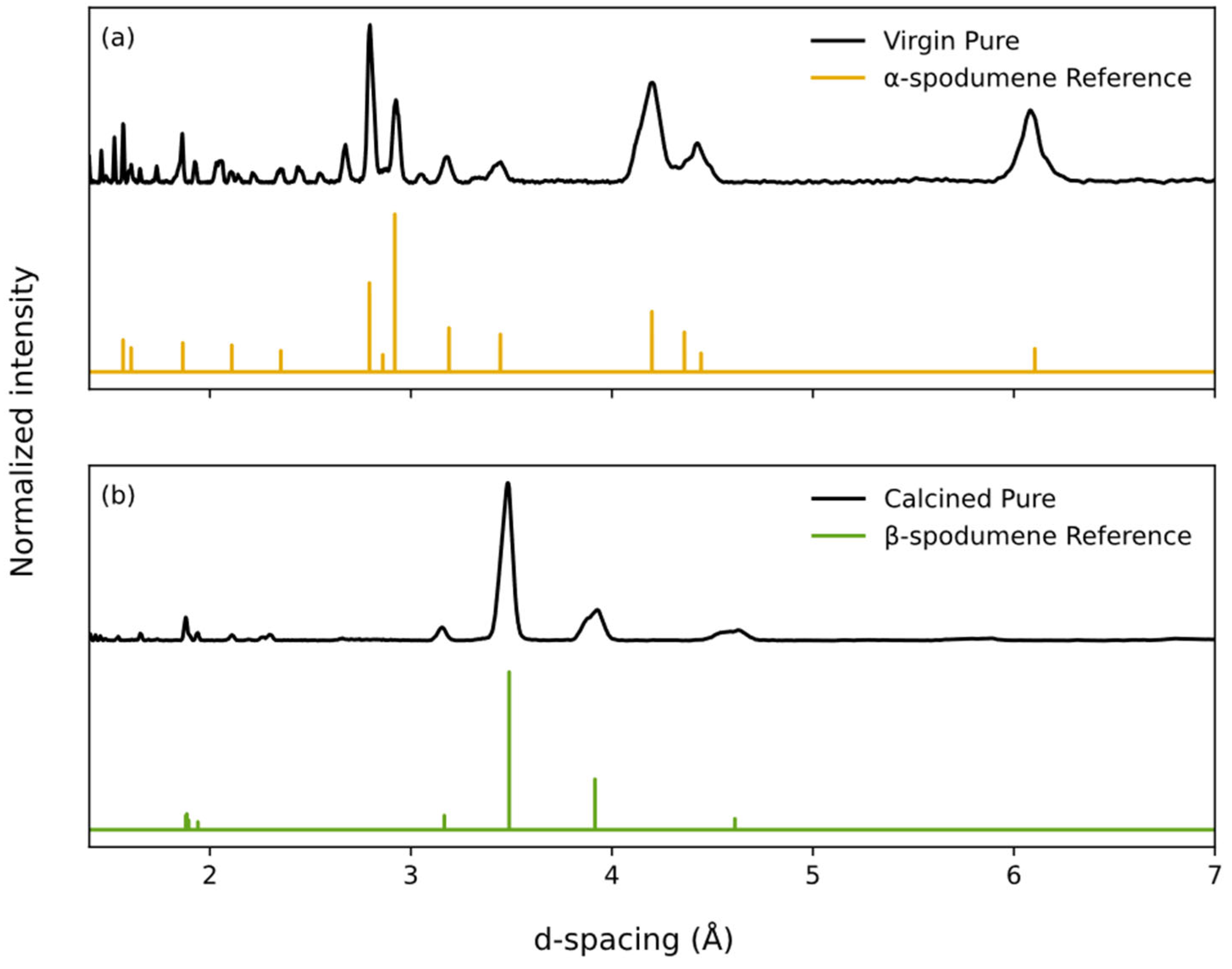
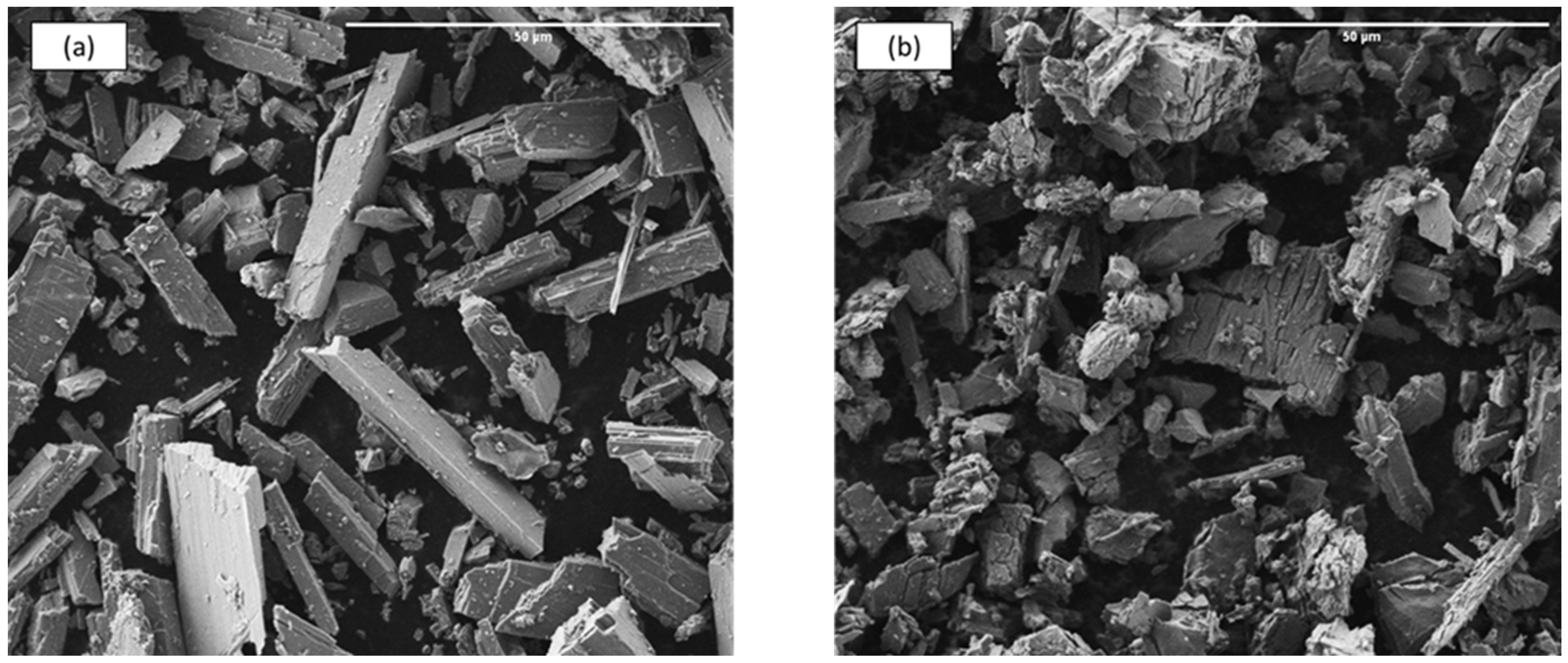
To validate the phase transformation of the spodumene sample, the sample was analyzed by XRD and SEM before and after calcination. The measured XRD spectra for the virgin sample (Figure 1a) and the calcined sample (Figure 1b) indicated the complete conversion of α-spodumene (PDF: 04-010-3996) to β-spodumene (PDF: 00-035-0797). SEM analysis of the two samples revealed that the calcined leach feed (Figure 2b) featured a higher proportion of surface cracking compared to the virgin sample (Figure 2a) as a result of the volume expansion that is characteristic of spodumene decrepitation.
Table 1 and Table 2 summarize the chemical compositions of the calcined spodumene and the samples recovered after leaching.
The cumulative mass of Li reporting to the PLS and displacement wash corresponds to a Li extraction of 65.8% of the total Li in the calcined spodumene. However, there seems to be a discrepancy in the change in Al and Si concentration between the calcined spodumene and leach residue compared to their dissolved concentrations in the liquid samples. Outram et al. [38] observed that after freeze drying their spodumene leach residue samples that the water content was 17 wt%. To account for the possible presence of water in the leach residue in this work that would have been removed during sample fusion, the leach residue composition was recalculated, assuming a water content of 17 wt%. With this correction, the residue composition (in wt%) becomes 0.93% Li, 10.85% Al, 28.65% Si, and 0.22% Na. These adjusted values are more consistent with the measured deportment of Al and Si to the PLS.

3.2. Spodumene Leach Residue

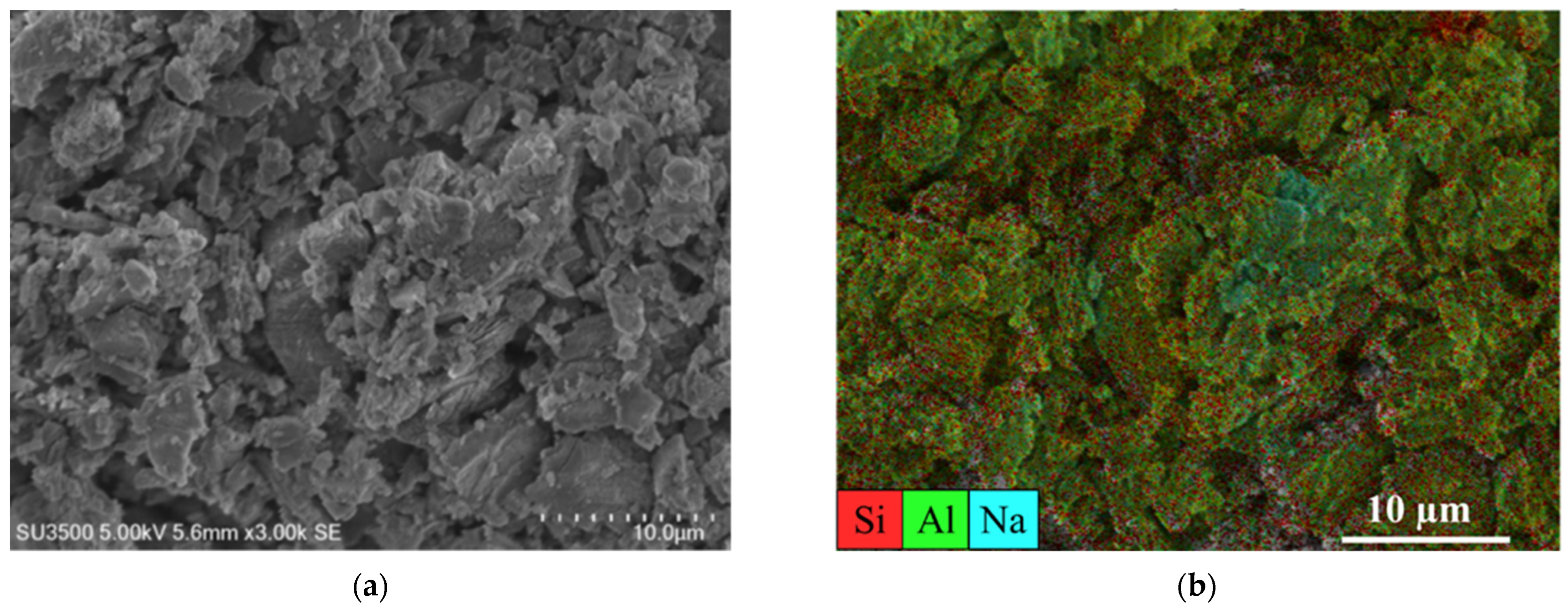
Al and Si were leached from the SLR sample by mixing with 2 mol/L NaOH at 95 °C for 2 h resulting in a solid residue yield of approximately 20% after leaching. Figure 3 represents SEM-EDS results of the dried SLR samples after alkaline treatment. The SEM image (Figure 3a) shows a significant change in surface properties compared to the original spodumene sample (Figure 2). It can be observed that the dried SLR sample has a fragmented structure and irregular edges suggesting partial dissolution of the original crystalline framework. The corresponding SEM-EDS elemental mapping (Figure 3b) confirms the presence of Si, Al, and Na across the sample. The widespread distribution of Na (light blue) indicates successful incorporation or surface adsorption of sodium species following alkaline treatment. Meanwhile, the presence of Si and Al (red and green, respectively) suggests that these framework elements were not entirely leached from the initial sample.

3.3. Synthesized Zeolite Characterization

After zeolite synthesis via the hydrothermal method described in Section 2, the dried powder was characterized using SEM-EDS, XRD, XPS, BET, PSA, FTIR, and zeta potential measurements. The results of these analyses are presented in this section. A summary of the BET and PSA results is provided in Table 3 as the average of three experiments. The full characterization results are described in this section and shown in Figure 4, Figure 5, Figure 6 and Figure 7.
The BET surface area of the synthesized zeolite was 4.4 ± 0.1 m2/g, which is lower than that of commercial Zeolite 4A, but comparable to modified or composite LTA materials synthesized from waste materials or low-cost precursors [35,38].
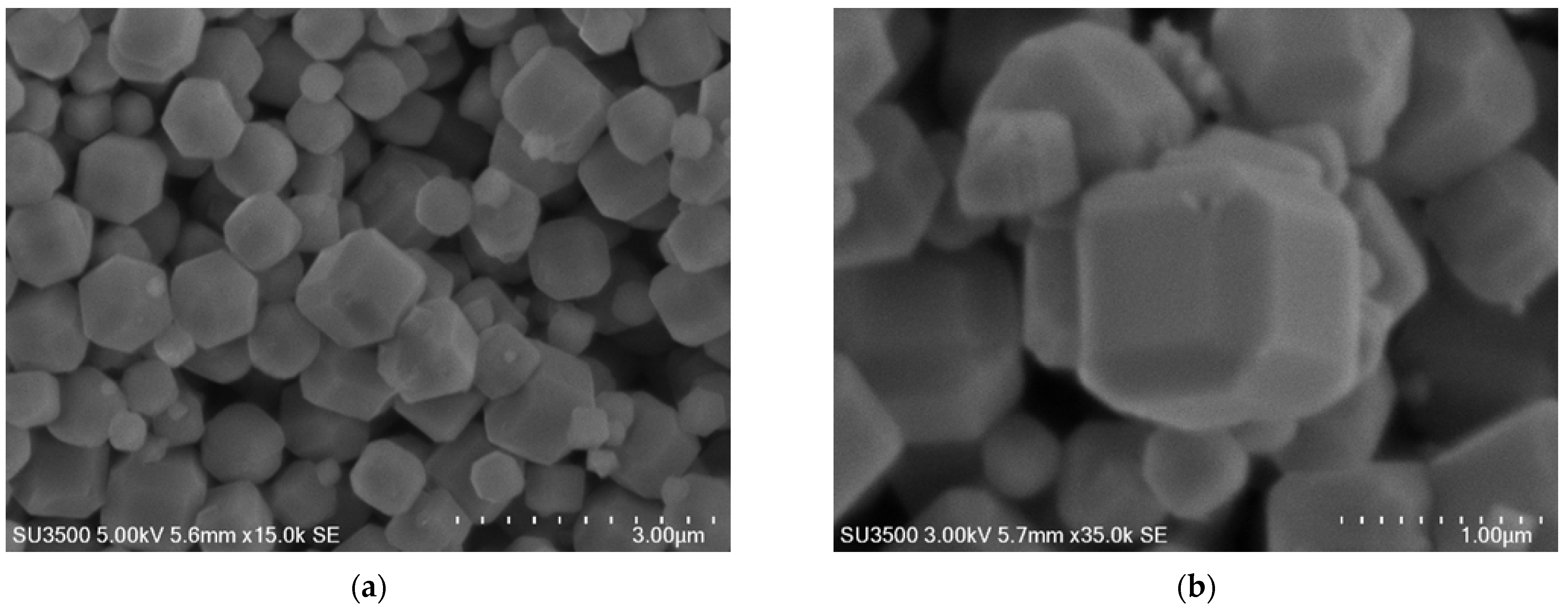
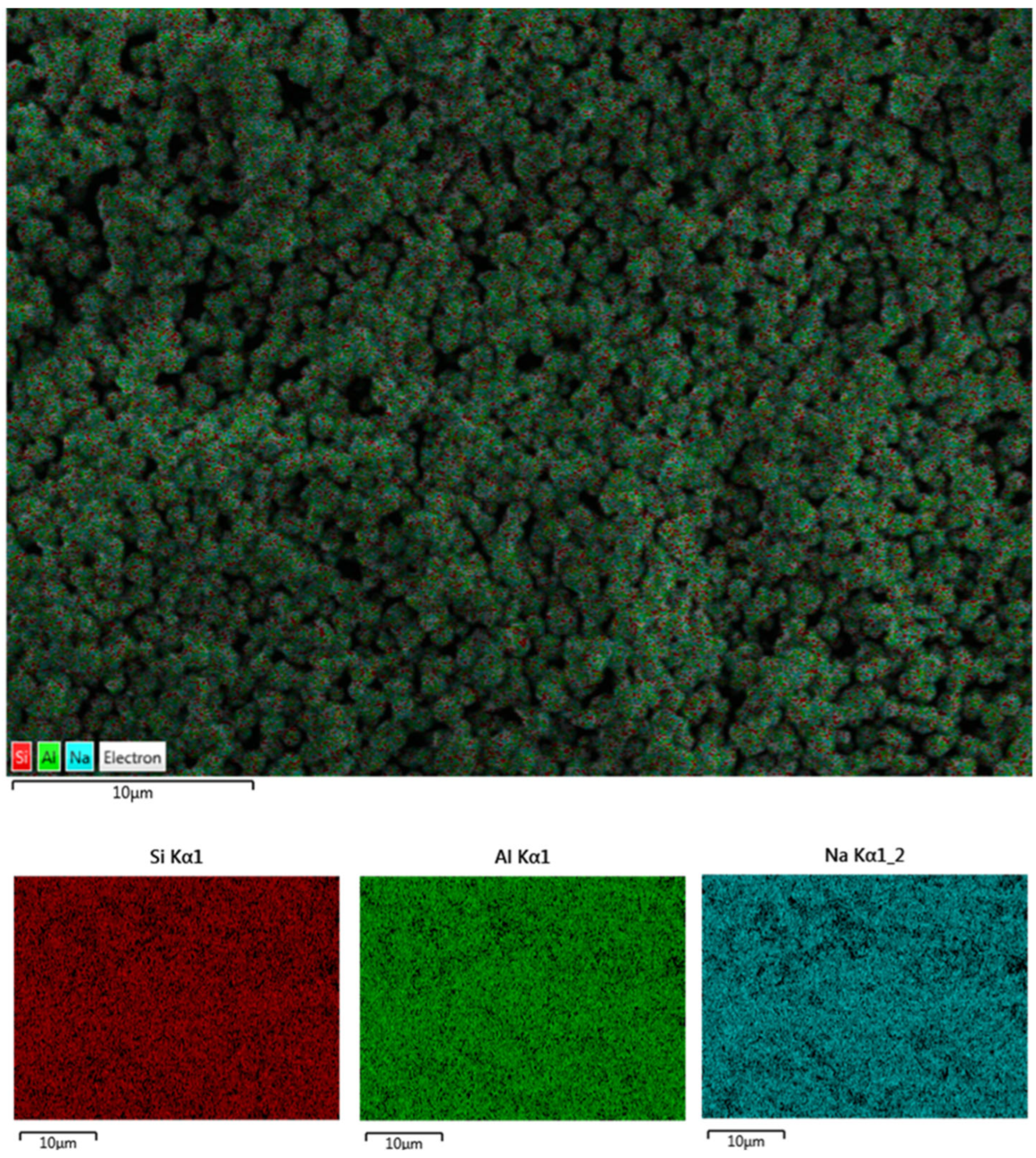
Figure 4 shows SEM images of the synthesized zeolite obtained from spodumene leach residue. They reveal well-defined crystals with a cubic morphology, consistent with the LTA-type zeolite structure [45,46]. The particles appeared to be densely packed without noticeable amorphous material on the surface, suggesting high purity. The formation of such well-faceted cubic particles indicates that the hydrothermal synthesis conditions were suitable for promoting the nucleation and growth of the LTA zeolite phase from the alkali-activated spodumene precursor. The synthesized zeolite sample was also analyzed using SEM-EDS, with results shown in Figure 5. The EDS elemental map shows homogeneous distribution of Si, Al, Na over the sample indicating successful integration of these elements in the zeolite framework.
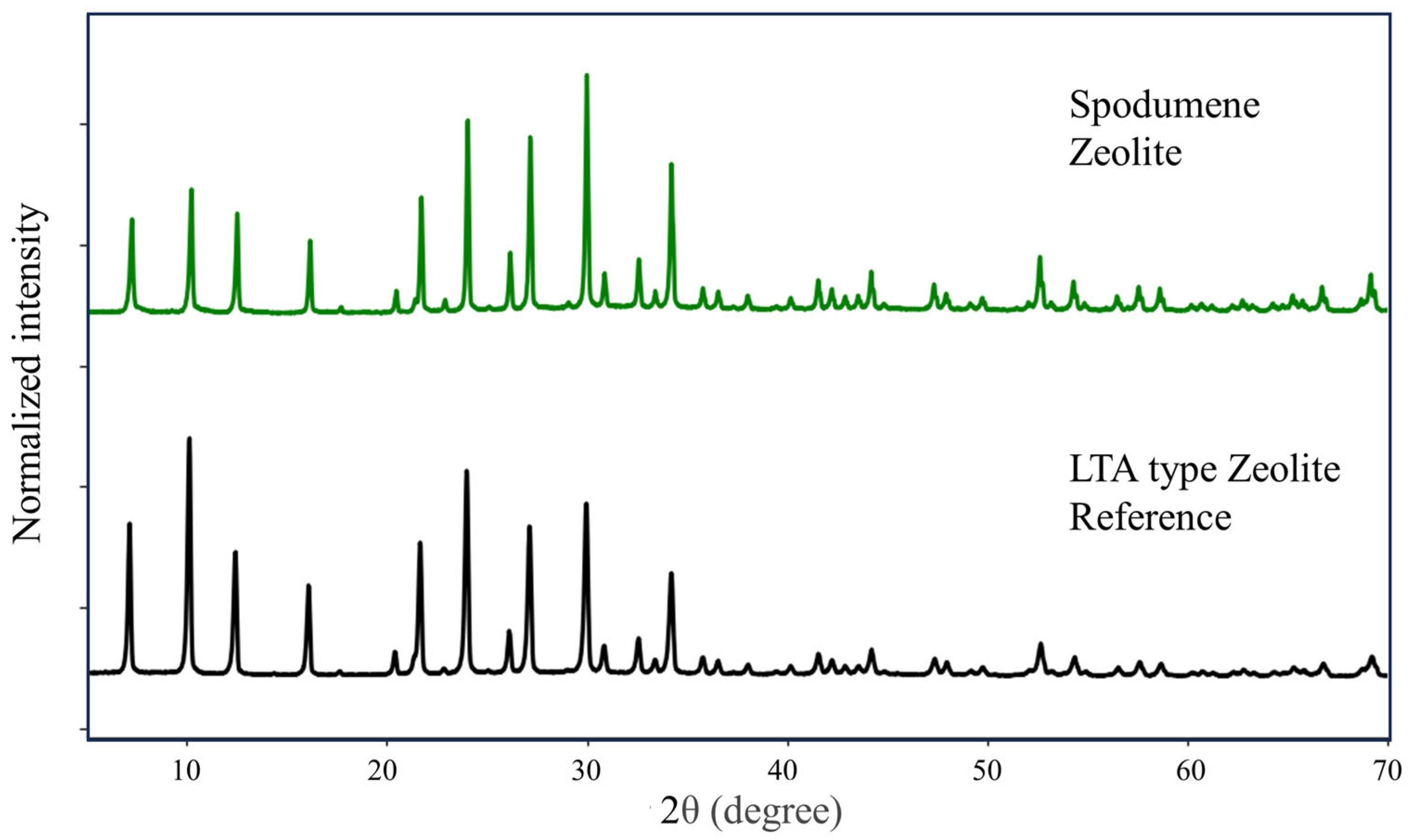
X-ray diffraction (XRD) spectra obtained from synthesized spodumene zeolite (green) sample is compared to LTA-type zeolite reference (black) in Figure 6. The reference zeolite was synthesized from analytical grade chemicals following the synthesis method described in Verified Syntheses of Zeolitic Materials [47] and repeated in our previous work [48]. The peak positions closely match those of the LTA reference, confirming the successful synthesis of LTA-type zeolite from spodumene leach residue. Minor variations in peak intensity may be attributed to differences in crystal size, degree of crystallinity, or slight compositional deviations due to the difference in the raw materials.
Figure 6. XRD comparison of synthesized spodumene zeolite to a reference LTA zeolite obtained in our previous studies [35,36,48].
Powders 05 00001 g006
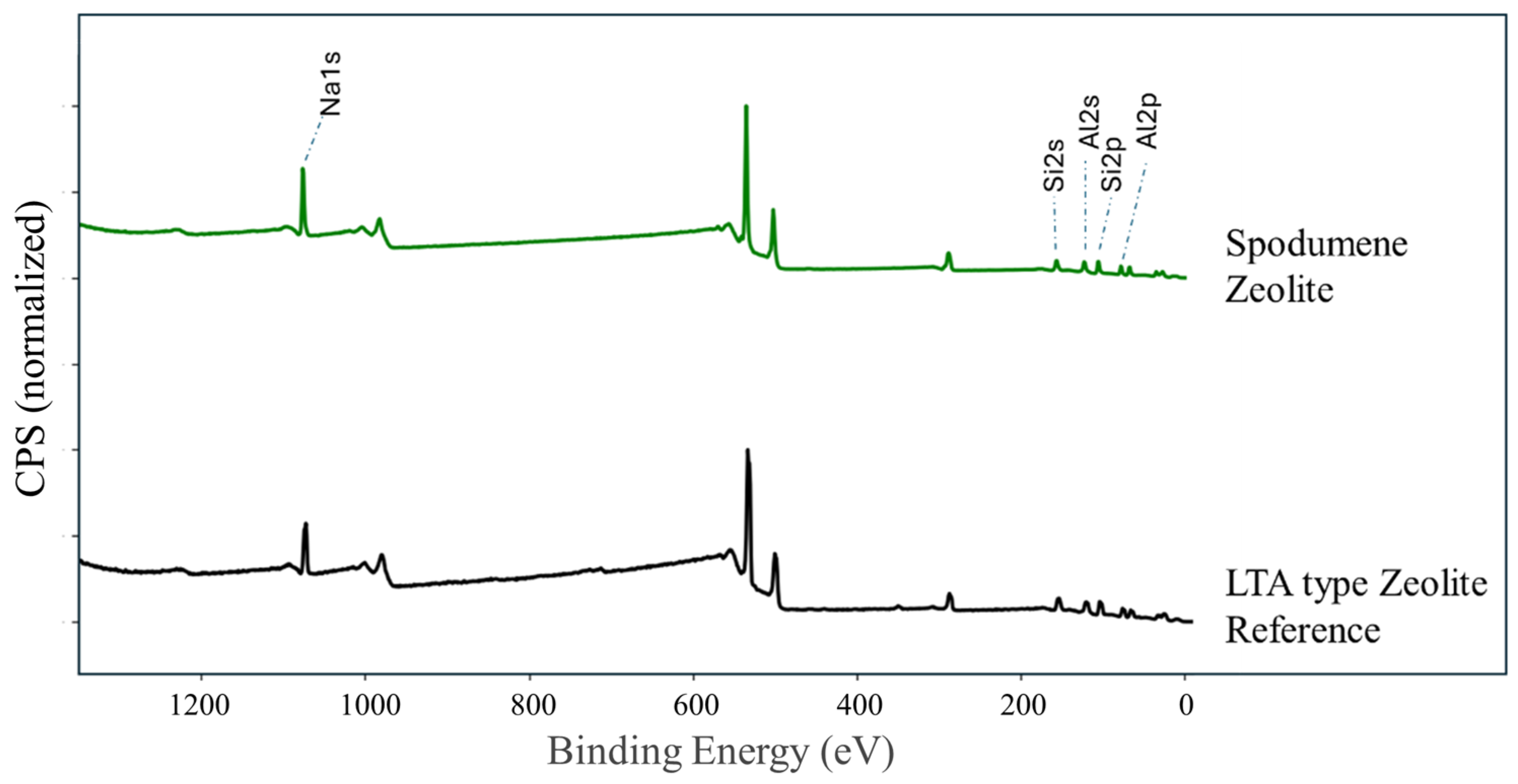
Figure 7. XPS of synthesized spodumene zeolite (green) compared to the reference spectra of LTA-type zeolite obtained in our previous study [35].
Powders 05 00001 g007
Figure 7 shows the comparison of X-ray photoelectron spectroscopy (XPS) survey spectra of spodumene zeolite (green) and reference LTA zeolite type (black) [35]. Both spectra exhibit characteristic peaks corresponding to the elements commonly found in zeolitic frameworks, including oxygen, silicon, and aluminum, confirming the presence of essential zeolite framework components [49]. The binding energy positions of these peaks are consistent between the two samples, indicating similarities in the elemental composition. Minor differences in peak intensities may be attributed to surface composition variations or residual impurities originating from the difference in precursor materials.
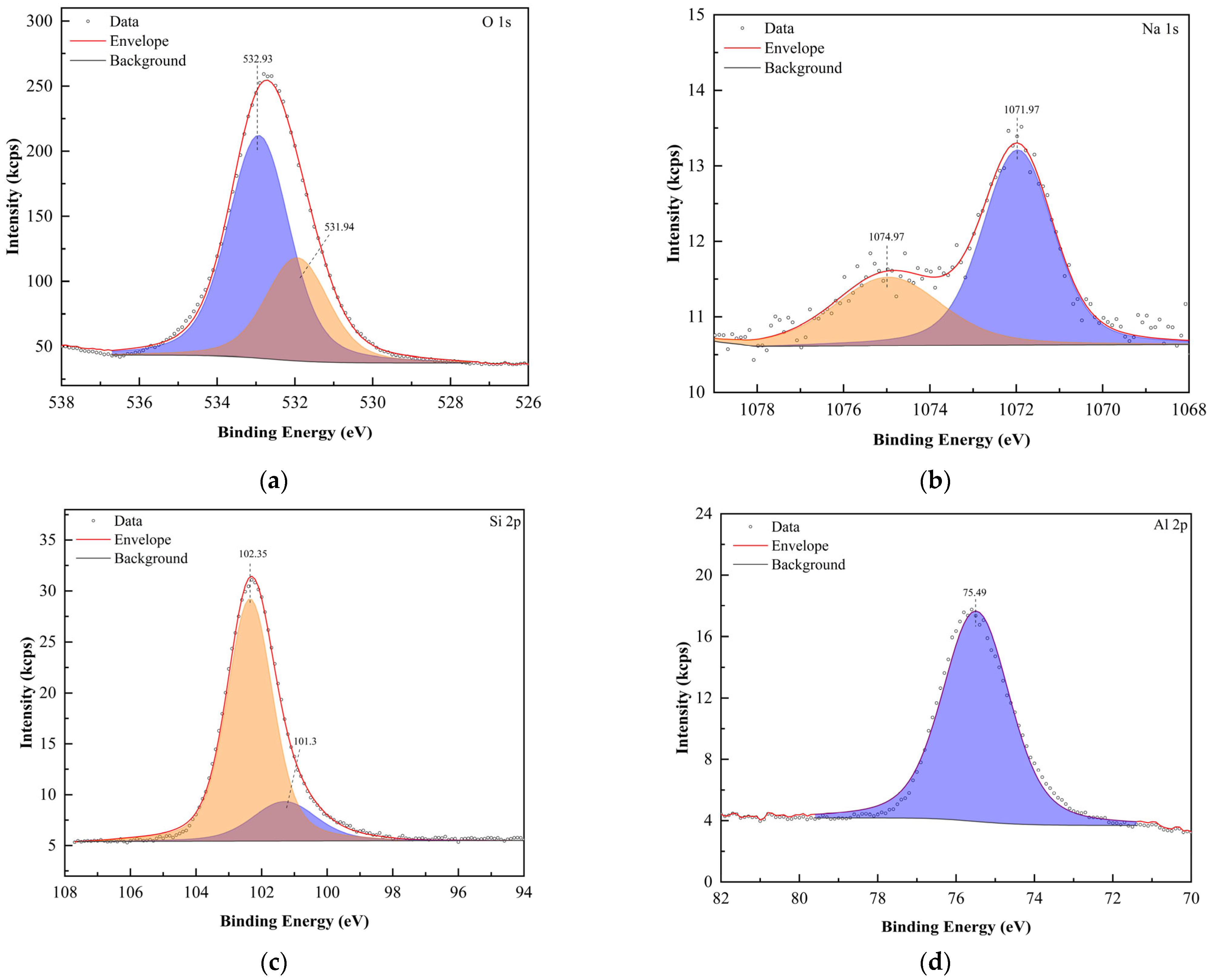
High-resolution XPS spectra of O 1s, Na 1s, Si 2p, and Al 2p are shown in Figure 8a–d, respectively. All peak fittings were performed by considering the obtained C 1s spectra as a reference by calibrating it to 284.8 eV [50]. Figure 8a shows XPS spectrum for O 1s region with a main peak at 532.93 eV corresponding to O-H bonds, and a peak at 531.94 eV that indicates C = O bond [51]. Figure 8b shows Na 1s region with two peaks at higher binding energy of 1074.97 eV and a lower binding energy of 1071.97 eV [52,53]. The Si 2p region in Figure 8c shows a peak that was fitted into two deconvoluted peaks at binding energies of 101.3 eV (Si-C) and 102.35 eV (Si-O). The higher binding energy is attributed to the framework of LTA zeolite, while the lower might be related to the Si in a lower oxidation state [54]. Figure 8d shows an Al 2p peak centered at binding energy of 75.49 eV (Al-O), which is in agreement with data reported in the literature [53].
Overall, the XPS survey data supports the successful synthesis of an LTA-type zeolite structure from spodumene residue, with surface chemistry comparable to the reference LTA zeolite.
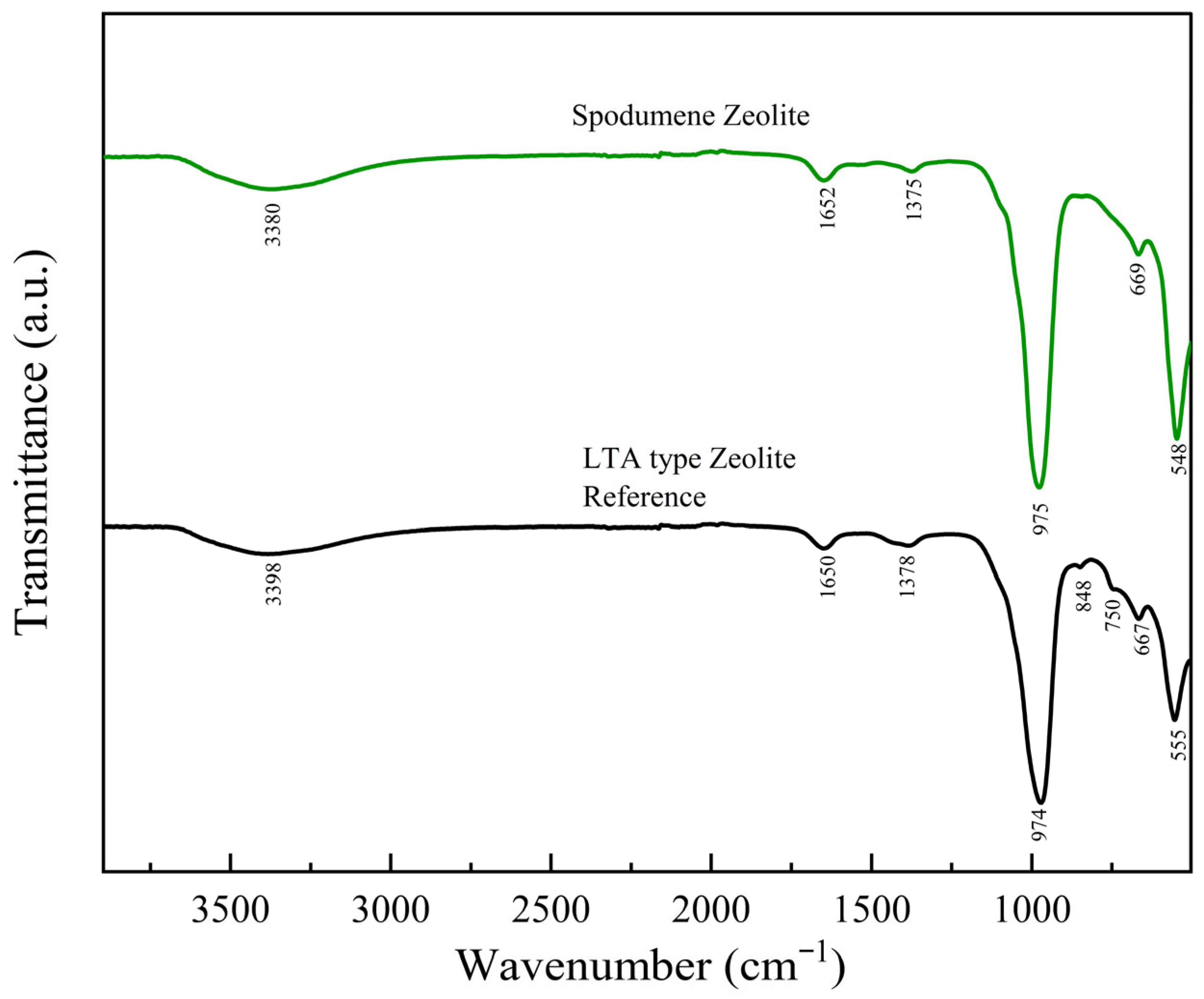
The FTIR spectra of the synthesized Spodumene Zeolite (green) and LTA-type zeolite (black) prepared from analytical grade chemicals following the synthesis method described in Verified Syntheses of Zeolitic Materials [47] and synthesized in our previous work [48] are presented in Figure 9.
Both spectra exhibit characteristic vibrational features consistent with aluminosilicate zeolite frameworks, particularly those associated with LTA-type structures. The similarity in peak positions and intensities between the two samples suggests that Spodumene Zeolite successfully retains the primary structural characteristics of the framework typical for LTA-type zeolite.
A broad band is observed at 3380 cm−1 for Spodumene Zeolite with a corresponding band of 3398 cm−1 for LTA reference zeolite. This band is attributed to the stretching vibration and structural hydroxyl groups (O-H) [55,56]. Both spectra display a band near 1650 cm−1 (1652 cm−1 for Spodumene Zeolite and 1650 cm−1 for LTA zeolite), corresponding to the O–H bending vibration of molecular water [55,57]. The nearly identical positions of these bands confirm that Spodumene Zeolite and LTA reference zeolite exhibit similar levels of intracrystalline water. Similarly, both spectra exhibit asymmetric stretching of Si-O-Si and Si-O-Al linkages, which constitute the primary fingerprint of aluminosilicate frameworks [58]. Thus, Spodumene Zeolite shows a peak at 975 cm−1 and LTA zeolite exhibits a peak at 974 cm−1 that can be attributed to the phase change from amorphous phases into a highly crystalline zeolite structure [55]. Bands observed in the lower wavenumber region correspond to double-ring modes and internal T–O bending vibrations, which further define the structural integrity of LTA-type zeolites [59]. It was shown that Spodumene Zeolite and LTA zeolite have closely matched peaks at ~850 cm−1, 669 cm−1, and 548 cm−1, and at 848 cm−1, 750 cm−1, 667 cm−1, and 555 cm−1. The strong correspondence between Spodumene Zeolite and reference LTA zeolite in this region confirms that the secondary building units (SBUs), such as double four-rings (D4R), which are essential in LTA zeolite [59,60,61], are present in Spodumene Zeolite, further confirming its structure.
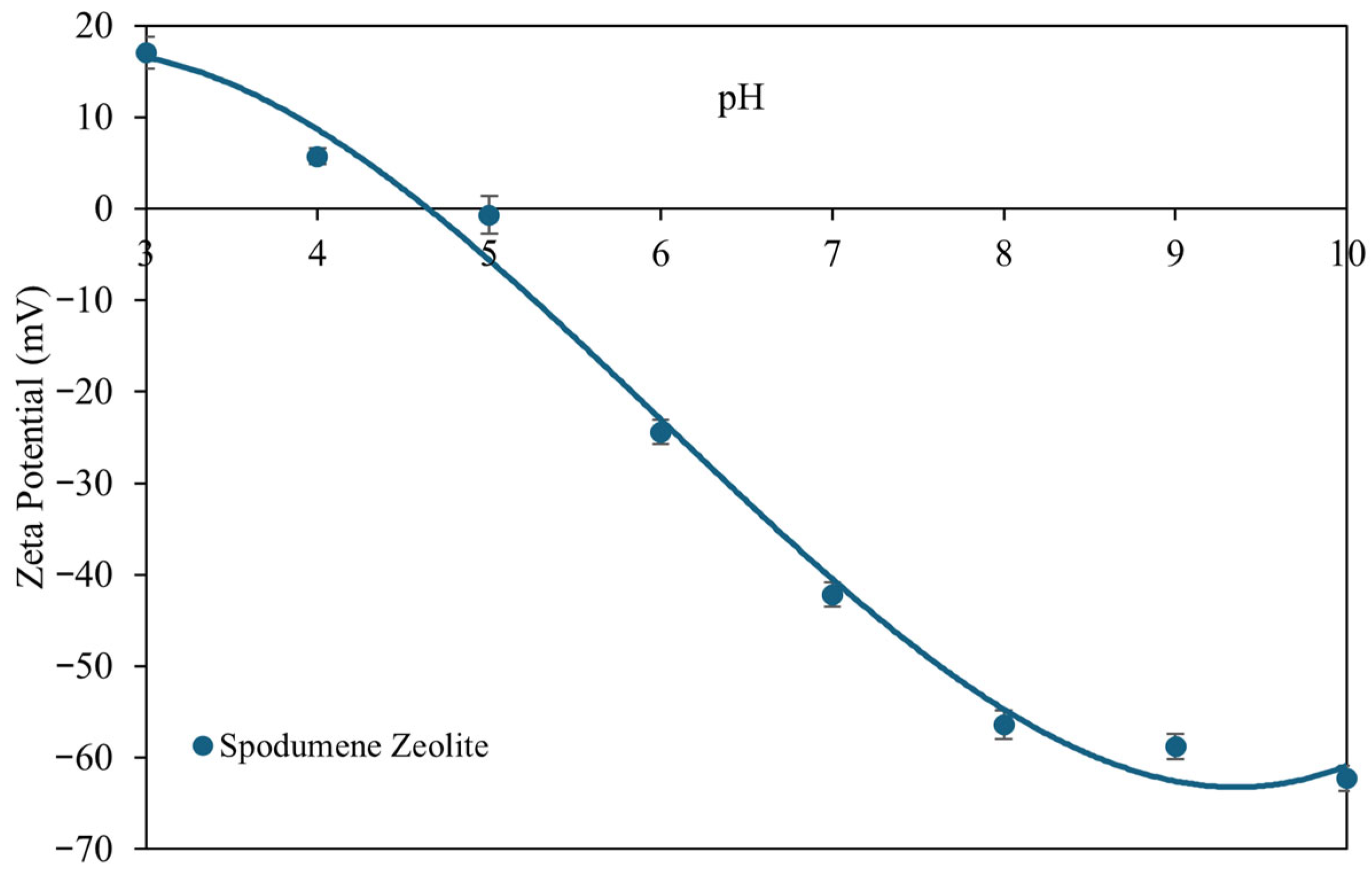
Figure 10 shows the zeta potential of spodumene zeolite against pH 3 to 10. At acidic conditions, the surface carries a positive charge, reaching approximately +18 mV at pH 3. This positive potential reflects the protonation of surface hydroxyl groups (Si–OH2+ and Al–OH2+), which dominate the mineral–solution interface at low pH [62].
As pH increases, the surface charge decreases steadily. The zeta potential approaches zero near pH 5, indicating the isoelectric point (IEP) of this sample. Beyond the IEP, the surface becomes increasingly negative due to the deprotonation of surface hydroxyl groups, forming negatively charged (Si–O- and Al–O-) sites [62]. Between pH 6 and 10, the zeta potential decreases from approximately −25 mV to nearly −60 mV, which is consistent with the progressive development of negative charge typical for aluminosilicate minerals in alkaline environments. The strong negative values at higher pH suggest enhanced electrostatic repulsion between particles and greater suspension stability, which in turn influence how zeolite interacts with cationic contaminants [63]. Electrostatic attraction becomes most effective when the solution pH exceeds the material’s IEP, which occurs in the pH range of 6–10 [63].

3.4. Adsorption of Heavy Metals by Spodumene Synthesized Zeolite

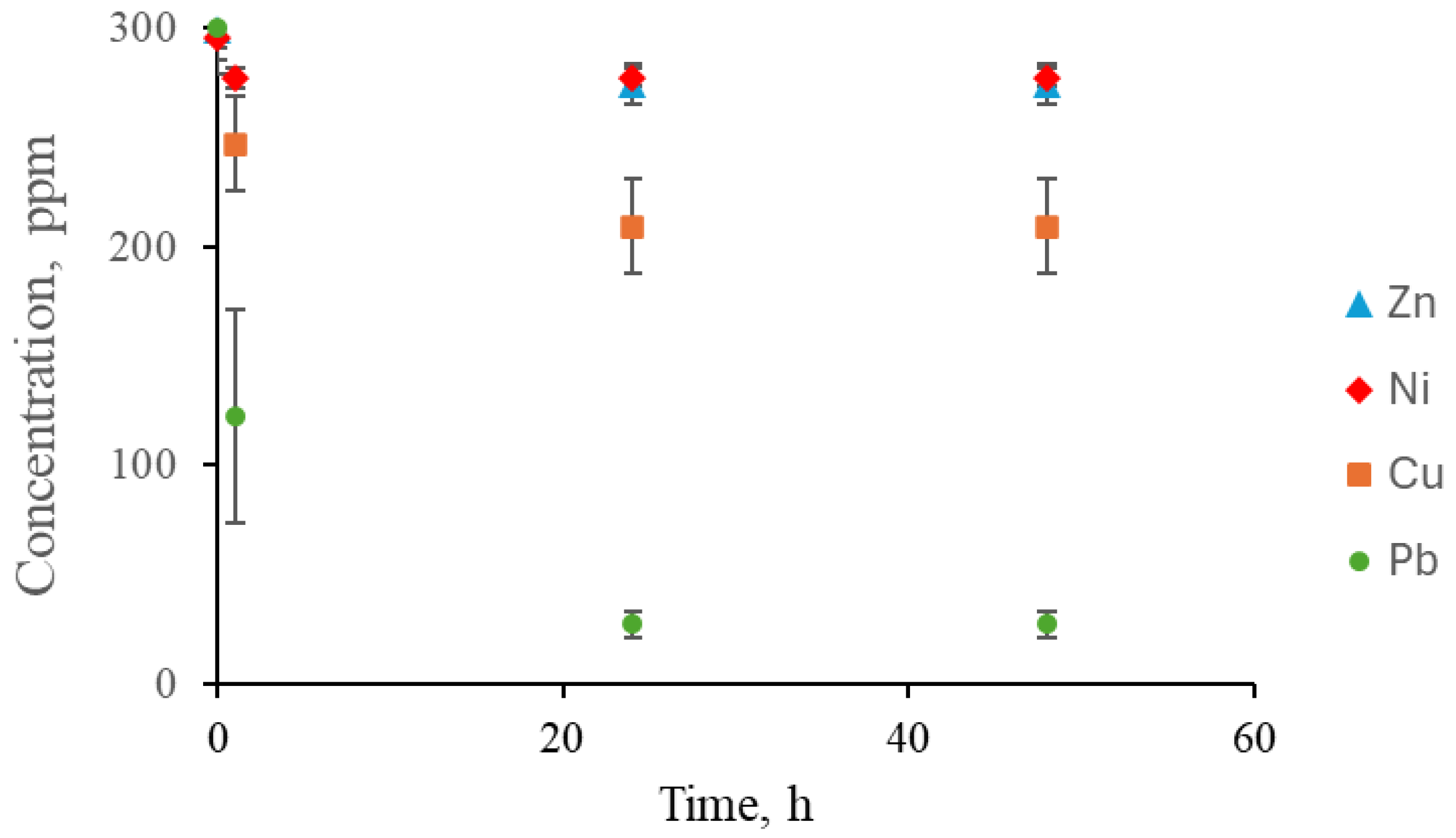
To evaluate the adsorption properties of the synthesized zeolite for heavy metal ions, a mixed ion adsorption experiment was conducted using an initial concentration of approximately 300 ppm for each of the metal ions Pb2+, Cu2+, Ni2+, and Zn2+. The decrease in metal ion concentration in solution over time was tested using ICP-OES. The results are presented in Figure 11 and summarized in Table 4.
A rapid decrease in Pb2+ ions within the first 24 h was observed, decreasing from 300 ppm to 27 ppm and remaining nearly constant thereafter, demonstrating that Pb2+ adsorption reached equilibrium during the first 24 h. Cu2+ ions showed more gradual decrease from 300 ppm to 209 ppm over the same period of time. The smaller decrease from 300 ppm to 274 ppm for Ni2+ and 278 ppm for Zn2+, indicated lower adsorption by the zeolite for these ions. Overall, the kinetic behavior demonstrated a strong and fast affinity of the synthesized spodumene-derived LTA zeolite for Pb2+, and moderate uptake of Cu2+. The selectivity order was Pb2+ > Cu2+ > Ni2+ > Zn2+, which is similar to our previous studies into LTA zeolite synthesized from waste that were tested in metal ions removal using synthetic solutions with the same metal ions composition [35,36]. The stronger affinity toward Pb2+ and Cu2+ can be attributed to the higher mobility of these relatively small ions within the zeolite’s pores and channels [64,65,66]. The selectivity order can also be related to the ionic radii of the selected metal ions (4.01 Å for Pb, 4.04 Å for Ni, 4.19 Å for Cu, and 4.30 Å for Zn) [64,67], as cations with smaller ionic or hydrated radii tend to diffuse more readily through the zeolite micropores and channels, enabling faster adsorption and higher uptake relative to larger cations [64,65]. This topic is discussed further in the Section 4.

4. Conclusions

This study demonstrated the successful synthesis of LTA zeolite from spodumene leach residue (SLR), a by-product generated during lithium extraction, offering a sustainable route for converting lithium extraction waste. The hydrothermal synthesis using NaOH activation and the addition of sodium aluminate resulted in a synthesis of a crystalline material with well-defined cubic morphology and composition consistent with LTA zeolite, as confirmed by XRD, SEM-EDS, XPS, and FTIR. Complementary characterization (BET, PSA, and zeta potential) further verified the physicochemical properties of the synthesized material.
Although several studies have explored zeolite synthesis from spodumene residues, few have investigated their adsorption properties. This work offers valuable insight into converting lithium extraction waste into functional adsorbents for heavy metal removal from water, and highlights the potential of spodumene-based zeolites as effective materials for wastewater treatment. The synthesized spodumene zeolite displayed strong selectivity toward Pb2+, moderate uptake of Cu2+, and minimal adsorption of Zn2+ and Ni2+, aligning with the behavior of LTA zeolites that is consistent with our previous studies [35,36]. The adsorption capacities were established as 273 mg/g for Pb2+, 92 mg/g for Cu2+, 26 mg/g for Ni2+, and 22 mg/g for Zn2+.
Notably, the experimentally observed selectivity order of Pb2+ > Cu2+ > Ni2+ > Zn2+ differs from what would have been predicted solely based on hydration radii (Pb2+ (4.01 Å) > Ni2+ (4.04 Å) > Cu2+ (4.19 Å) > Zn2+ (4.30 Å)) [68], underscoring the complexity of multicomponent systems. Factors beyond ionic size, such as framework affinity, competitive diffusion, and cage accessibility, significantly influence metal ion adsorption behavior. Because a relatively low zeolite dosage (1 g/L) was used to determine the maximum adsorption capacity, higher dosages would be expected to enhance both adsorption kinetics and overall removal efficiency [64,66].
The preferential uptake can be explained by the competitive adsorption dynamics in multi-ion systems and attributed to physicochemical parameters of the metal ions, such as molar weight, ionic radius, hydration enthalpies, hydration radii, and solubility of the cations [69,70]. Structural properties of the zeolite framework such as pore size, and number of exchangeable Na+ ions in zeolite framework would also play a crucial role in its adsorption efficiency [71,72].
Future work should focus on optimizing synthesis parameters for SLR-derived zeolites, including alkali concentration, temperature, crystallization time, and Si/Al ratio. Given that the composition of the spodumene residue depends on the upstream phosphoric acid leaching process, ongoing optimization of Li and Al dissolution will also influence the precursor chemistry and, ultimately, the zeolite formation pathway. Exploring alternative activation or crystallization routes may further improve both material performance and environmental benefits. In addition, adsorption studies should examine the influence of operational parameters, such as zeolite dosage, metal ion composition, pH, and temperature, tailored to practical water treatment objectives. In addition, previous research has demonstrated that zeolites can be regenerated and used in several adsorption–regeneration cycles, highlighting their potential for long-term operational use [36,73,74,75]. Therefore, future studies should investigate the regeneration behavior of SLR-derived zeolite, including desorption efficiency and structural stability after multiple cycles. Understanding the durability and reusability of the synthesized zeolite will be essential for assessing its economic feasibility and for designing practical water treatment systems, such as fixed-bed or continuous-flow reactors.
Overall, this work demonstrated that spodumene leach residue can be effectively converted into LTA-type zeolite through hydrothermal synthesis, and that the resulting material exhibits promising performance for heavy metal removal in water treatment applications. This approach supports the development of circular and sustainable strategies for managing lithium processing residues and producing functional materials for environmental remediation.

Author Contributions

Conceptualization, K.E.W. and S.B.; methodology, K.E.W., S.B. and J.P.; software, S.B. and J.P.; validation, S.B. and J.P.; formal analysis, S.B., J.P. and H.F.K.; investigation, S.B., J.P. and H.F.K.; resources, K.E.W.; data curation, S.B. and J.P.; writing—original draft preparation, S.B. and J.P.; writing—review and editing, K.E.W. and S.O.; visualization, S.B. and J.P.; supervision, K.E.W. and S.O.; project administration, K.E.W.; funding acquisition, K.E.W. All authors have read and agreed to the published version of the manuscript.

Funding

The authors are grateful for the financial support from the Natural Sciences and Engineering Research Council of Canada (NSERC) Alliance Missions Grants (Critical Minerals) (ALLRP 586721-2023). The Fonds de recherche du Québec (FRQ) are acknowledged for a Ph.D. scholarship awarded to J. Paris (Grant number 364090).

Institutional Review Board Statement

Not applicable.

Informed Consent Statement

Not applicable.

Data Availability Statement

The original contributions presented in this study are included in the article. Further inquiries can be directed to the corresponding author.

Acknowledgments

The authors acknowledge Primero Group Americas Inc. as a supporting organization for the NSERC Alliance Missions Grant (Critical Minerals), ALLRP 586721-2023.

Conflicts of Interest

The authors declare no conflicts of interest.

Abbreviations

The following abbreviations are used in this manuscript:
BETBrunauer–Emmett–Teller
CECCation Exchange Capacity
CFACoal Fly Ash
EDSEnergy Dispersive X-ray Spectroscopy
FTIRFourier-Transform Infrared Spectroscopy
ICP-OESInductively Coupled Plasma Optical Emission Spectroscopy
IEPIsoelectric Point
LTALinde Type A (Zeolite)
PLSPregnant Leach Solution
PSAParticle Size Analysis
SEMScanning Electron Microscopy
SLRSpodumene Leach Residue
XPSX-ray Photoelectron Spectroscopy
XRDX-ray Diffraction Analysis

References

  1. Alonso, E.; Brioche, A.S.; Schulte, R.; Trimmer, L.M., III; Kim, J.-E.; Gulley, A.L.; Pineault, D.G. World Minerals Outlook—Cobalt, Gallium, Helium, Lithium, Magnesium, Palladium, Platinum, and Titanium Through 2029; 2025–5021; USGS: Reston, VA, USA, 2025; p. 19.
  2. Tadesse, B.; Makuei, F.; Albijanic, B.; Dyer, L. The beneficiation of lithium minerals from hard rock ores: A review. Miner. Eng. 2019, 131, 170–184. [Google Scholar] [CrossRef]
  3. Jorjani, E.; Sauvageau, J.; Mrabet, D.; Rejeb, M. Advances in lithium extraction from spodumene: Alternatives to sulfuric acid digestion. Minerals 2025, 15, 574. [Google Scholar] [CrossRef]
  4. Lappalainen, H.; Elomaa, H.; Aromaa, J.; Lundström, M. Life cycle assessment of ore-based lithium carbonate production using sulfuric acid roasting and soda leaching: Impact of sodium sulfate electrodialysis. Hydrometallurgy 2025, 233, 106450. [Google Scholar] [CrossRef]
  5. Ellestad, R.B.; Milne, L.K. Method of Extracting Lithium Values from Spodumene Ores. U.S. Patent 2,516,109, 25 July 1950. [Google Scholar]
  6. Lajoie-Leroux, F.; Dessemond, C.; Soucy, G.; Laroche, N.; Magnan, J.-F. Impact of the impurities on lithium extraction from β-spodumene in the sulfuric acid process. Miner. Eng. 2018, 129, 1–8. [Google Scholar] [CrossRef]
  7. Welham, N.; Nosrati, A.; Setoudeh, N. Lithium Ore Processing—An Overview of the Current and New Processes; The Australasian Institute of Mining and Metallurgy: Melbourne, Australia, 2017. [Google Scholar]
  8. Vogt, T.; Paulus, H.; Fuess, H.; Müller, G. The crystal structure of HAlSi2O6 with a keatite-type framework. Z. Für Krist.—Cryst. Mater. 1990, 190, 7–18. [Google Scholar] [CrossRef]
  9. Alhadad, M.F.; Oskierski, H.C.; Chischi, J.; Senanayake, G.; Dlugogorski, B.Z. Lithium extraction from β-spodumene: A comparison of keatite and analcime processes. Hydrometallurgy 2023, 215, 105985. [Google Scholar] [CrossRef]
  10. Binnemans, K.; Jones, P.T. The twelve principles of circular hydrometallurgy. J. Sustain. Metall. 2023, 9, 1–25. [Google Scholar] [CrossRef]
  11. Kim, C.-H.; Kim, M.-J.; Jeon, K.-W.; Jeon, I.J.; Yoon, C.-M.; Gong, J.-H.; Yoon, E.-S.; Lim, J.-H.; Roh, H.-S.; Chae, S.; et al. Advancing sustainable treatment of sodium sulfate (Na2SO4)-containing wastewater: Recent advances in electrochemical technologies. Chem. Eng. J. 2025, 524, 169100. [Google Scholar] [CrossRef]
  12. Karrech, A.; Azadi, M.R.; Elchalakani, M.; Shahin, M.A.; Seibi, A.C. A review on methods for liberating lithium from pegmatities. Miner. Eng. 2020, 145, 106085. [Google Scholar] [CrossRef]
  13. Salakjani, N.K.; Singh, P.; Nikoloski, A.N. Production of lithium—A literature review. Part 2. Extraction from spodumene. Miner. Process. Extr. Metall. Rev. 2021, 42, 268–283. [Google Scholar] [CrossRef]
  14. Paris, J.; Mohammadi-Jam, S.; Li, R.; Liang, J.; Oh, H.J.; Kökkılıç, O.; Omelon, S.; Waters, K.E. Preliminary investigation into lithium extraction by phosphoric acid leaching of spodumene. Miner. Eng. 2024, 209, 108613. [Google Scholar] [CrossRef]
  15. Havelange, S.; Van Lierde, N.; Germeau, A.; Martins, E.; Theys, T.; Sonveaux, M.; Toussaint, C.; Schrödter, K.; Bettermann, G.; Staffel, T.; et al. Phosphoric acid and phosphates. In Ullmann’s Encyclopedia of Industrial Chemistry; Wiley-VCH Verlag GmbH & Co. KgaA’s: Weinheim, Germany, 2022; pp. 1–55. [Google Scholar]
  16. Mulwanda, J.; Senanayake, G.; Oskierski, H.; Altarawneh, M.; Dlugogorski, B.Z. Leaching of lepidolite and recovery of lithium hydroxide from purified alkaline pressure leach liquor by phosphate precipitation and lime addition. Hydrometallurgy 2021, 201, 105538. [Google Scholar] [CrossRef]
  17. Ibsaine, F.; Azizi, D.; Dionne, J.; Tran, L.H.; Coudert, L.; Pasquier, L.-C.; Blais, J.-F. Conversion of aluminosilicate residue generated from lithium extraction process to NaX zeolite. Minerals 2023, 13, 1467. [Google Scholar] [CrossRef]
  18. Na, K.; Jo, C.; Kim, J.; Cho, K.; Jung, J.; Seo, Y.; Messinger, R.J.; Chmelka, B.F.; Ryoo, R. Directing zeolite structures into hierarchically nanoporous architectures. Science 2011, 333, 328–332. [Google Scholar] [CrossRef]
  19. Kordala, N.; Wyszkowski, M. Zeolite properties, methods of synthesis, and selected applications. Molecules 2024, 29, 1069. [Google Scholar] [CrossRef]
  20. Silva, M.R.; Lecus, A.; Gajdardziska-Josifovska, M.; Schofield, M.; Virnoche, M.; Chang, J.; Chen, J.; Garman, D. Graphene-oxide loading on natural zeolite particles for enhancement of adsorption properties. RSC Adv. 2020, 10, 4589–4597. [Google Scholar] [CrossRef]
  21. Khaleque, A.; Alam, M.M.; Hoque, M.; Mondal, S.; Haider, J.B.; Xu, B.; Johir, M.A.H.; Karmakar, A.K.; Zhou, J.L.; Ahmed, M.B.; et al. Zeolite synthesis from low-cost materials and environmental applications: A review. Environ. Adv. 2020, 2, 100019. [Google Scholar] [CrossRef]
  22. Sommerville, R.; Blissett, R.; Rowson, N.; Blackburn, S. Producing a synthetic zeolite from improved fly ash residue. Int. J. Miner. Process. 2013, 124, 20–25. [Google Scholar] [CrossRef]
  23. Król, M. Natural vs. Synthetic Zeolites. Crystals 2020, 10, 622. [Google Scholar] [CrossRef]
  24. Barrer, R.M.; White, E.A.D. 286. The hydrothermal chemistry of silicates. Part II. Synthetic crystalline sodium aluminosilicates. J. Chem. Soc. 1952, 286, 1561–1571. [Google Scholar] [CrossRef]
  25. Jha, V.K.; Nagae, M.; Matsuda, M.; Miyake, M. Zeolite formation from coal fly ash and heavy metal ion removal characteristics of thus-obtained Zeolite X in multi-metal systems. J. Environ. Manag. 2009, 90, 2507–2514. [Google Scholar] [CrossRef]
  26. Collins, F.; Rozhkovskaya, A.; Outram, J.G.; Millar, G.J. A critical review of waste resources, synthesis, and applications for Zeolite LTA. Microporous Mesoporous Mater. 2020, 291, 109667. [Google Scholar] [CrossRef]
  27. Chen, D.; Hu, X.; Shi, L.; Cui, Q.; Wang, H.; Yao, H. Synthesis and characterization of zeolite X from lithium slag. Appl. Clay Sci. 2012, 59, 148–151. [Google Scholar] [CrossRef]
  28. Querol, X.; Moreno, N.; Umaña, J.C.; Alastuey, A.; Hernández, E.; López-Soler, A.; Plana, F. Synthesis of zeolites from coal fly ash: An overview. Int. J. Coal Geol. 2002, 50, 413–423. [Google Scholar] [CrossRef]
  29. Buzukashvili, S.; Rob, S.; Rowson, N.A.; Waters, K.E. An overview of zeolites synthesised from coal fly ash and their potential for extracting heavy metals from industrial wastewater. Can. Metall. Q. 2024, 63, 130–152. [Google Scholar] [CrossRef]
  30. Database of Zeolite Structures. Available online: https://www.iza-structure.org (accessed on 15 November 2025).
  31. Dusselier, M.; Davis, M.E. Small-pore zeolites: Synthesis and catalysis. Chem. Rev. 2018, 118, 5265–5329. [Google Scholar] [CrossRef]
  32. Barrer, R.M. Zeolites and their synthesis. Zeolites 1981, 1, 130–140. [Google Scholar] [CrossRef]
  33. Sherman, J.D. Synthetic zeolites and other microporous oxide molecular sieves. Proc. Natl. Acad. Sci. USA 1999, 96, 3471–3478. [Google Scholar] [CrossRef]
  34. Yu, J. Synthesis of zeolites. In Studies in Surface Science and Catalysis; Elsevier: Amsterdam, The Netherlands, 2007; Volume 168, pp. 39–103. [Google Scholar]
  35. Buzukashvili, S.; Sommerville, R.; Hu, W.; Brooks, O.; Kökkılıç, O.; Ouzilleau, P.; Rowson, N.A.; Waters, K.E. Zeolite synthesis from coal fly ash and its application to heavy metals remediation from water contaminated with Pb, Cu, Zn and Ni ions. Miner. Eng. 2024, 209, 108619. [Google Scholar] [CrossRef]
  36. Buzukashvili, S.; Sommerville, R.; Kökkılıç, O.; Ouzilleau, P.; Rowson, N.A.; Waters, K.E. Exploring efficiency and regeneration of magnetic zeolite synthesized from coal fly ash for water treatment applications. JCIS Open 2025, 17, 100127. [Google Scholar] [CrossRef]
  37. Wang, Z.; Luo, X.; Zheng, X.; Chen, M.; Guo, H.; Li, Q. Lithium leach residue synthesis process of high crystallinity hydroxysodalite, NaX, NaA zeolites and solidification and migration of potentially toxic elements. Arab. J. Chem. 2024, 17, 105871. [Google Scholar] [CrossRef]
  38. Outram, J.G.; Collins, F.J.; Millar, G.J.; Couperthwaite, S.J.; Beer, G. Process optimisation of low silica zeolite synthesis from spodumene leachate residue. Chem. Eng. Res. Des. 2023, 189, 358–370. [Google Scholar] [CrossRef]
  39. dos Santos, L.L.; do Nascimento, R.M.; Pergher, S.B.C. One-pot strategies for lithium recovery from beta-spodumene and LTA-type zeolite synthesis. Crystals 2025, 15, 161. [Google Scholar] [CrossRef]
  40. Lin, G.; Zhuang, Q.; Cui, Q.; Wang, H.; Yao, H. Synthesis and adsorption property of zeolite FAU/LTA from lithium slag with utilization of mother liquid. Chin. J. Chem. Eng. 2015, 23, 1768–1773. [Google Scholar] [CrossRef]
  41. Jin, Y.; Jiang, W.; Yao, L. Comprehensive experiment of zeolite prepared by industrial waste and adsorption of NH4+-N from water solution. Exp. Sci. Technol. 2021, 19, 62–69. [Google Scholar]
  42. Xing, P.; Wang, C.; Zeng, L.; Ma, B.; Wang, L.; Chen, Y.; Yang, C. Lithium extraction and hydroxysodalite zeolite synthesis by hydrothermal conversion of α-spodumene. ACS Sustain. Chem. Eng. 2019, 7, 9498–9505. [Google Scholar] [CrossRef]
  43. Hao, H. Basic Research on New Technology of Coproduction of Zeolite by β-Spodumene Pressurized Salt Soaking in Water; Fuzhou University: Fuzhou, China, 2020. (In Chinese) [Google Scholar]
  44. Necke, T.; Stein, J.; Kleebe, H.-J.; Balke-Grünewald, B. Lithium extraction and zeolite synthesis via mechanochemical treatment of the silicate minerals lepidolite, spodumene, and petalite. Minerals 2023, 13, 1030. [Google Scholar] [CrossRef]
  45. Campoverde, J.; Guaya, D. From waste to added-value product: Synthesis of highly crystalline LTA zeolite from ore mining tailings. Nanomaterials 2023, 13, 1295. [Google Scholar] [CrossRef] [PubMed]
  46. Behin, J.; Bukhari, S.S.; Dehnavi, V.; Kazemian, H.; Rohani, S. Using coal fly ash and wastewater for microwave synthesis of LTA zeolite. Chem. Eng. Technol. 2014, 37, 1532–1540. [Google Scholar] [CrossRef]
  47. Robson, H.; Lillerud, K.P. (Eds.) Chapter 55—LTA Linde Type A Si(50), Al(50). In Verified Syntheses of Zeolitic Materials; Elsevier Science: Amsterdam, The Netherlands, 2001; pp. 179–181. [Google Scholar]
  48. Buzukashvili, S.; Hu, W.; Sommerville, R.; Brooks, O.; Kökkılıç, O.; Rowson, N.A.; Ouzilleau, P.; Waters, K.E. Magnetic zeolite: Aynthesis and copper adsorption followed by magnetic separation from treated water. Crystals 2023, 13, 1369. [Google Scholar] [CrossRef]
  49. Wang, J.; Zhang, Q.; Bai, J.; North, M. Synthesis method and principle of octahedral hierarchical LTA zeolite and its application to enhance catalytic activity in styrene epoxidation. ACS Omega 2024, 9, 39673–39681. [Google Scholar] [CrossRef]
  50. Biesinger, M.C. Accessing the robustness of adventitious carbon for charge referencing (correction) purposes in XPS analysis: Insights from a multi-user facility data review. Appl. Surf. Sci. 2022, 597, 153681. [Google Scholar] [CrossRef]
  51. Liebscher, J.; Mrówczyński, R.; Scheidt, H.A.; Filip, C.; Hădade, N.D.; Turcu, R.; Bende, A.; Beck, S. Structure of Polydopamine: A Never-Ending Story? Langmuir 2013, 29, 10539–10548. [Google Scholar] [CrossRef] [PubMed]
  52. Gruenert, W.; Muhler, M.; Schroeder, K.-P.; Sauer, J.; Schloegl, R. Investigations of zeolites by photoelectron and ion scattering spectroscopy. 2. A new interpretation of XPS binding energy shifts in zeolites. J. Phys. Chem. 1994, 98, 10920–10929. [Google Scholar] [CrossRef]
  53. Moura, P.A.S.; Ferracine, E.D.S.; Rodríguez-Aguado, E.; Maia, D.A.S.; Melo, D.C.; Valencia, S.; Cardoso, D.; Rey, F.; Bastos-Neto, M.; Rodríguez-Castellón, E.; et al. Assessment of the stability of LTA zeolites under natural gas drying TSA conditions. Catal. Today 2024, 427, 114410. [Google Scholar] [CrossRef]
  54. Ahmed, A.A.; Yamani, Z.H. Synthesis and characterization of SnO2-modified ZSM-5 zeolite for hydrogen gas sensing. Mater. Chem. Phys. 2021, 259, 124181. [Google Scholar] [CrossRef]
  55. Liu, Z.; Li, S.; Li, L.; Wang, J.; Zhou, Y.; Wang, D. One-step high efficiency crystallization of zeolite A from ultra-fine circulating fluidized bed fly ash by hydrothermal synthesis method. Fuel 2019, 257, 116043. [Google Scholar] [CrossRef]
  56. Zhang, C.; Zhang, D.; Zhang, X.; Chen, X.; Chen, L.; Tian, Y.; Wang, L. Rubik’s cube-shaped Linde type A zeolite synthesized from biomass for carbon dioxide capture. Cell Rep. Phys. Sci. 2024, 5, 101889. [Google Scholar] [CrossRef]
  57. Visa, M. Synthesis and characterization of new zeolite materials obtained from fly ash for heavy metals removal in advanced wastewater treatment. Powder Technol. 2016, 294, 338–347. [Google Scholar] [CrossRef]
  58. Ginting, S.B.; Yulia, Y.; Wardono, H.; Darmansyah; Hanif, M.; Iryani, D.A. Synthesis and characterization of zeolite Lynde Type A (LTA): Effect of aging Time. J. Phys. Conf. Ser. 2019, 1376, 012041. [Google Scholar] [CrossRef]
  59. Flanigen, E.M.; Khatami, H.; Szymanski, H.A. Infrared structural studies of zeolite frameworks. In Molecular Sieve Zeolites-I; Advances in Chemistry; American Chemical Society: Washington, DC, USA, 1974; Volume 101, pp. 201–229. [Google Scholar]
  60. Derbe, T.; Temesgen, S.; Bitew, M. A short review on synthesis, characterization, and applications of zeolites. Adv. Mater. Sci. Eng. 2021, 2021, 6637898. [Google Scholar] [CrossRef]
  61. Meier, W.M. Atlas of Zeolite Structure Types; Zeolites, Special Issue; Elsevier: Amsterdam, The Netherlands, 1996; Volume 17. [Google Scholar]
  62. Kuzniatsova, T.; Kim, Y.; Shqau, K.; Dutta, P.K.; Verweij, H. Zeta potential measurements of zeolite Y: Application in homogeneous deposition of particle coatings. Microporous Mesoporous Mater. 2007, 103, 102–107. [Google Scholar] [CrossRef]
  63. Abdelkrim, S.; Mokhtar, A.; Sardi, A.; Asli, B.; Hachemaoui, M.; Boukoussa, B.; Sassi, M.; Viscusi, G.; Aloui, Z.; Abboud, M. Conversion of Natural clay into Na-A (LTA) zeolite adsorbent for efficient heavy metals adsorption from aqueous solution: Kinetic and isotherm studies. Processes 2025, 13, 3060. [Google Scholar] [CrossRef]
  64. Esaifan, M.; Warr, L.N.; Grathoff, G.; Meyer, T.; Schafmeister, M.-T.; Kruth, A.; Testrich, H. Synthesis of Hydroxy-sodalite/cancrinite zeolites from calcite-bearing kaolin for the removal of heavy metal ions in aqueous media. Minerals 2019, 9, 484. [Google Scholar] [CrossRef]
  65. Golomeova, M.; Zendelska, A.; Blažev, K.; Krstev, B.; Golomeov, B. Removal of heavy metals from aqueous solution using clinoptilolite and stilbite. Int. J. Eng. Res. Technol. 2014, 3, 1029–1035. [Google Scholar]
  66. Necke, T.; Wolf, D.M.; Bachmann, A.-L.; Berberich, K.; Kleebe, H.-J.; Weidenkaff, A. Mechanochemical lithium extraction and zeolite synthesis from end-of-life glass–ceramics. ACS Sustain. Chem. Eng. 2022, 10, 10849–10857. [Google Scholar] [CrossRef]
  67. He, K.; Chen, Y.; Tang, Z.; Hu, Y. Removal of heavy metal ions from aqueous solution by zeolite synthesized from fly ash. Environ. Sci. Pollut. Res. 2016, 23, 2778–2788. [Google Scholar] [CrossRef]
  68. Nightingale, E.R., Jr. Phenomenological theory of ion solvation. Effective radii of hydrated ions. J. Phys. Chem. 1959, 63, 1381–1387. [Google Scholar] [CrossRef]
  69. Motsi, T.; Rowson, N.A.; Simmons, M.J.H. Adsorption of heavy metals from acid mine drainage by natural zeolite. Int. J. Miner. Process. 2009, 92, 42–48. [Google Scholar] [CrossRef]
  70. Wang, C.; Li, J.; Sun, X.; Wang, L.; Sun, X. Evaluation of zeolites synthesized from fly ash as potential adsorbents for wastewater containing heavy metals. J. Environ. Sci. 2009, 21, 127–136. [Google Scholar] [CrossRef]
  71. Chang, H.-L.; Shih, W.-H. A general method for the conversion of fly ash into zeolites as Ion exchangers for cesium. Ind. Eng. Chem. Res. 1998, 37, 71–78. [Google Scholar] [CrossRef]
  72. Hong, M.; Yu, L.; Wang, Y.; Zhang, J.; Chen, Z.; Dong, L.; Zan, Q.; Li, R. Heavy metal adsorption with zeolites: The role of hierarchical pore architecture. Chem. Eng. J. 2019, 359, 363–372. [Google Scholar] [CrossRef]
  73. Zhao, Y.; Zhang, B.; Zhang, X.; Wang, J.; Liu, J.; Chen, R. Preparation of highly ordered cubic NaA zeolite from halloysite mineral for adsorption of ammonium ions. J. Hazard. Mater. 2010, 178, 658–664. [Google Scholar] [CrossRef] [PubMed]
  74. Nyankson, E.; Adjasoo, J.; Efavi, J.K.; Amedalor, R.; Yaya, A.; Manu, G.P.; Asare, K.; Amartey, N.A. Characterization and evaluation of zeolite A/Fe3O4 nanocomposite as a potential adsorbent for removal of organic molecules from wastewater. J. Chem. 2019, 2019, 8090756. [Google Scholar] [CrossRef]
  75. Mishra, S.P. Adsorption–desorption of heavy metal ions. Curr. Sci. 2014, 107, 601–612. [Google Scholar]
Figure 1. XRD patterns of (a) virgin spodumene and (b) calcined spodumene compared to α- and β-spodumene references.
Powders 05 00001 g001
Figure 2. SEM images of (a) virgin sample; (b) calcined sample. The scale bar is 50 μm.
Powders 05 00001 g002
Figure 3. Spodumene leach residue (SLR) after alkaline treatment with 2 mol/L NaOH: (a) SEM; (b) SEM-EDS.
Powders 05 00001 g003
Figure 4. SEM images of synthesized spodumene zeolite showing typical cubic shape for LTA zeolite type at (a) 15.0 kx; (b) higher magnification of 35.0 kx.
Powders 05 00001 g004
Figure 5. SEM-EDS image of synthesized spodumene zeolite indicating the presence of Si, Al, and Na in the sample.
Powders 05 00001 g005
Figure 8. High-resolution XPS spectra of (a) O 1s; (b) Na 1s; (c) Si 2p; and (d) Al 2p.
Powders 05 00001 g008
Figure 9. FTIR results of synthesized spodumene zeolite (green) compared to the reference spectra of LTA-type zeolite prepared from analytical grade chemicals in our previous study [48].
Powders 05 00001 g009
Figure 10. Zeta potential of spodumene zeolite.
Powders 05 00001 g010
Figure 11. Adsorption kinetics of a mixed ion solution comprising 300 ppm Pb2+, Cu2+, Zn2+, and Ni2+ with 0.1 g LTA-type spodumene zeolite over 48 h.
Powders 05 00001 g011
Table 1. Chemical composition measured by ICP-OES of solid samples, before and after acid leaching.
Element Concentration (wt %)
Solid SampleLiAlSiNa
Calcined spodumene3.7612.5528.660.46
Leach residue (SLR)0.748.6922.940.18
Table 2. Chemical composition measured by ICP-OES of liquid samples after acid leaching.
Element Concentration (mg/L)
Liquid SampleLiAlSiNa
Pregnant leach solution (PLS) 3761299312644
Displacement wash39106<1<1
Table 3. Specific surface area and particle size of synthesized spodumene zeolite.
Surface Area, m2/g Particle Size, µm
Spodumene zeolite4.42 ± 0.1d50d80
5.2 ± 1.327.5 ± 8.0
Table 4. Summary of adsorption performance of the synthesized spodumene zeolite for selected metal ions.
Metal IonPb2+Cu2+Ni2+Zn2+
Initial concentration, ppm300300300300
Final concentration, ppm27209274278
Removed, %913096
Adsorbed, mg/g273922622
Disclaimer/Publisher’s Note: The statements, opinions and data contained in all publications are solely those of the individual author(s) and contributor(s) and not of MDPI and/or the editor(s). MDPI and/or the editor(s) disclaim responsibility for any injury to people or property resulting from any ideas, methods, instructions or products referred to in the content.