Article

Assessment of Brazilian Type F Fly Ash: Influence of Chemical Composition and Particle Size on Alkali-Activated Materials Properties


by
Adriano G. S. Azevedo
Department of Biosystems Engineering, Research Center on Materials for Biosystems (BioSMat), University of São Paulo (USP), Pirassununga 13635-900, SP, Brazil
Powders 2026, 5(1), 2; https://doi.org/10.3390/powders5010002 (registering DOI)
Submission received: 11 August 2025 / Revised: 15 October 2025 / Accepted: 27 November 2025 / Published: 1 January 2026

Abstract

This study assesses two Brazilian Type F fly ash samples (FA-A and FA-B), collected from the same thermoelectric complex in different years, to investigate their influence on the production of alkali-activated materials (AAMs). FA-A exhibited a slightly higher SiO2/Al2O3 ratio (3.52 vs. 3.34) and a finer average particle size (D50 = 19.7 μm vs. 30.8 μm) than FA-B. X-ray diffraction revealed that FA-A presented a broad amorphous halo between 15° and 35° (2θ), indicative of phases with low atomic ordering, which are more susceptible to dissolution and capable of supplying Si- and Al-rich species for the formation of alkali activation products. These differences directly affected reactivity and mechanical performance. After 1 day of curing, FA-A-based matrices achieved 88.5 MPa in compressive strength—approximately 100% higher than FA-B (44.2 MPa). However, FA-A suffered a 19.6% strength reduction after 28 days of curing, whereas FA-B showed only a 3.8% decrease over the same period, reflecting better long-term stability. FTIR confirmed Na2CO3 formation in FA-A, associated with excess sodium (Na/Al = 2.07 after 28 days), while SEM revealed unreacted spheres persisting in FA-B, consistent with its lower dissolution rate. Water absorption was also significantly different, with FA-B matrices reaching values up to 52% lower than FA-A after 7 days of curing. These results demonstrate that even slight variations in chemical composition and atomic ordering, even for ashes from the same plant, strongly influence the reactivity, microstructure, and mechanical performance of alkali-activated binders.

1. Introduction

Ordinary Portland cement (OPC) remains the most widely used binder in the global construction industry, due to its versatility, cost-effectiveness, and well-established production technology. However, its manufacture is responsible for approximately 5–8% of total anthropogenic CO2 emissions, making it a major contributor to climate change [1]. Lanjewar et al. (2023) estimated that if the annual growth rate of cement production observed in 2008 were sustained, the industry could emit approximately 2.82 billion tons of CO2 by 2030 [2]. This scenario underscores the urgent need to develop alternative binders capable of delivering comparable or superior performance to OPC, while drastically reducing environmental impact. Ideally, such materials should combine high mechanical strength, chemical and thermal stability, rapid strength gain, resistance to acid and sulfate attack, and economic viability [2,3].
Alkali-activated materials (AAMs), also referred to as inorganic polymers or geopolymers, have emerged as one of the most promising low-carbon alternatives. They are produced by the chemical activation of aluminosilicate-rich precursors (such as Fly Ash (FA), metakaolin, blast furnace slag, or volcanic ash) using alkaline solutions [4]. The reaction pathway involves a sequence of dissolution, gelation, and polycondensation processes in a highly alkaline environment, leading to the formation of a three-dimensional aluminosilicate network [5,6]. The term “geopolymer” was first introduced by Glukhovsky in 1959 and later popularized by Davidovits in the 1970s, with the general formula Mn[-(Si–O2)z–Al–O]n·wH2O [7], where M is an alkali or alkaline earth cation (e.g., Na+, K+, Ca2+), n represents the degree of polycondensation, z (1–3) is the Si/Al molar ratio, and w corresponds to the degree of hydration.
The microstructural backbone of AAMs is typically an amorphous sodium aluminosilicate hydrate (N–A–S–H) gel, which develops from low-calcium precursors such as FA or metakaolin [8,9]. In systems with higher calcium content, such as slag-based precursors, the main binding phase is a calcium–aluminosilicate hydrate (C–A–S–H) gel, sometimes coexisting with N–A–S–H in hybrid matrices [8,9]. The interplay between these gels critically influences the density, pore structure, and durability of the binder. Even after polycondensation, physically bound water within the gel network contributes to dimensional stability, while the absence of portlandite makes AAMs inherently more resistant to acid and sulfate attack compared to OPC [10,11].
From a materials science perspective, the performance of AAMs is governed by several parameters:
  • Chemical composition of the precursor, particularly the SiO2/Al2O3 and CaO/SiO2 ratios, which affect gel chemistry and network connectivity [12,13].
  • Reactivity of the raw material, dictated by amorphous phase content, particle size distribution, and mineralogy.
  • Type and concentration of the alkali activator (e.g., NaOH, KOH, sodium silicate), which influence dissolution kinetics and gel polymerization [14].
  • Curing conditions, such as temperature, humidity, and time, which can accelerate or hinder reaction products’ crystallinity and densification [15].
For example, Andini et al. [13] demonstrated that FA with a SiO2/Al2O3 ratio of ~3 produced AAMs with superior compressive strength, lower porosity, and higher density, especially when activated with sodium silicate solutions and cured at moderate temperatures. Van Jaarsveld et al. [14] showed that variations in coal type, combustion conditions, and FA fineness substantially affect precursor reactivity and, consequently, the mechanical and durability performance of AAMs.
Despite the advances in understanding alkali activation, there is still limited knowledge about how subtle variations in precursor properties (arising from differences in raw material source, combustion technology, or collection period) impact the reaction pathway and final properties of AAMs under otherwise identical synthesis conditions [16]. This knowledge gap is particularly relevant for industrial by-products such as FA, whose availability and quality are influenced by changes in energy generation technologies and environmental regulations [17].
In this context, the present study investigates the production of AAMs using two Brazilian Type F fly ash samples (FA-A and FA-B) collected from the same thermoelectric complex but in different years (2013–2014 and 2013–2024). By analyzing the chemical composition, particle size distribution, mineralogical phases, and resulting mechanical, physical, and microstructural properties, this research aims to elucidate how small variations in precursor characteristics affect alkali activation performance. Although Brazil is traditionally reliant on hydropower, recurrent droughts have increased the reliance on coal-fired power plants, resulting in higher volumes of fly ash. In 2021, coal production exceeded 6 million tons, with Santa Catarina alone discarding about 65% of ROM coal (run-of-mine coal) as waste with no commercial value. Although Brazil is not a global leader in coal, its production is significant—ranked 15th worldwide. This atypical trend highlights the urgency of developing sustainable strategies for the valorization of coal combustion residues in the country [18].
Therefore, this study assesses two Brazilian Type F fly ash samples, collected from the same thermoelectric complex in different years, to investigate how variations in chemical composition and particle size distribution influence the physical, mechanical, and microstructural properties of alkali-activated materials. By clarifying the role of precursor variability, the findings aim to support the reliable design and application of alkali-activated binders as sustainable alternatives to Portland cement.

2. Materials and Methods

2.1. Materials

In this section, the materials used in the production of the alkali-activated inorganic binders are detailed. Two fly ash samples with distinct chemical compositions and particle characteristics were selected as precursor materials, enabling the assessment of how these differences influence the dissolution behavior, gel formation, and mechanical performance. A sodium hydroxide solution was employed as the alkaline activator, providing the necessary environment for the breakdown of the aluminosilicate phases and subsequent formation of the N–A–S–H gel, which governs the development of strength and microstructure in the hardened binders.

2.1.1. Fly Ash (FA)

Two types of F FA samples from the Jorge Lacerda thermoelectric complex and commercialized by Pozo-Fly Industry (Lima®, Capivari de Baixo, Santa Catarina, Brazil), were used as precursors for alkali activation. Prior to use, both ashes underwent beneficiation, involving coarse residue removal and ball milling.
FA-A originated from coal combustion during 2013–2014, whereas FA B was obtained between 2023–2024. Despite being sourced from the same plant, the two ashes present measurable differences in chemical composition and particle size distribution, attributed to variations in coal feedstock and combustion parameters over the years. The use of these samples allows for a direct assessment of how relatively small changes in precursor characteristics can influence the chemical, physical, and mechanical performance of alkali-activated binders.

2.1.2. Sodium Hydroxide (NaOH)

The alkaline activator was prepared using sodium hydroxide pellets (purity 98%, Sulfal Química Ltd., Belo Horizonte, Brazil).

2.2. Experimental Program

A 16 mol·L−1 NaOH solution, corresponding to approximately 17 wt.% Na2O, was prepared by dissolving NaOH pellets in distilled water. Owing to the highly exothermic dissolution, the solution was stored for at least 24 h at room temperature to ensure thermal equilibrium before use. The alkali-activated pastes were produced by mixing each FA with the NaOH solution at a constant solids-to-liquid ratio of 0.5. Mixing was carried out in a mechanical mixer (5 L capacity) for 5 min at room temperature. The fresh pastes were cast into cylindrical plastic molds (50 mm diameter × 25 mm height), vibrated for 60 s to remove entrapped air, and sealed with PVC film to prevent moisture loss.
After 24 h, the sealed samples underwent thermal curing at 90 °C for 24 h, followed by demolding and subsequent ambient curing for 1, 7, or 28 days [19]. The initial curing at 90 °C for 24 h was adopted based on previous investigations by Azevedo et al. (2019) [19], which demonstrated that elevated temperatures accelerate the dissolution of the amorphous aluminosilicate phases and enhance the polycondensation reactions responsible for the formation of the N–A–S–H gel. This procedure was chosen to obtain a rapid strength development and to clearly assess the intrinsic reactivity of the different fly ash samples under controlled conditions. Nevertheless, for large-scale production, milder curing regimes (40–60 °C) or ambient curing with controlled humidity can be employed, depending on the precursor reactivity and mixture design, to achieve similar performance while improving industrial feasibility. Samples were designated according to FA type and curing time (e.g., GP-A-7 = FA-A-based inorganic binder cured for 7 days). A total of 10 specimens were produced for each formulation and curing time investigated. It is important to note that no aggregates were used in the preparation of the specimens. The purpose of this experimental design was to assess the intrinsic reactivity and mechanical behavior of the alkali-activated pastes produced with the two distinct Brazilian fly ash samples. This approach enables isolating the influence of their chemical and mineralogical differences on the dissolution process, the formation of reaction products, and the resulting strength development, without interference from aggregate–binder interactions. Nevertheless, the binders produced in this study can serve as the matrix phase for future mortar and concrete formulations.

2.3. Characterization of Precursor Materials and Alkali-Activated Pastes

The chemical composition of the precursor fly ashes was determined by Energy Dispersive X-ray Fluorescence (EDXRF—EDX 8000Shimadzu, Kyoto, Japan), while the particle size distribution was analyzed by laser diffraction (Mastersizer 2000, Malvern, Worcestershire, UK) measurement range 0.02–2000 μm). The specific mass of each FA was obtained using helium pycnometry (AccuPyc 1340, Micromeritics, Norcross, GE, USA). Morphological features and microstructural aspects of both the FA particles and the hardened alkali-activated matrices were investigated through scanning electron microscopy (SEM—TM 300, Hitachi, Tokyo, Japan) equipped with an energy dispersive spectroscopy (EDS) system (Bruker X-Flash, Billerica, MA, USA). Phase analysis was performed via X-ray diffraction analysis, in a diffractometer Shimadzu model XRD 6000, using Cukα radiation (λ = 1.04059 Å) in the 2ϴ range of 10–55°. The crystal phases were identified by comparison with the JCPDS data base. The physical properties of the hardened alkali-activated materials, including water absorption, apparent porosity, and bulk density, were determined in accordance with BS EN ISO 10545-3 (1997) [20]. Chemical bonding characteristics and structural changes induced by alkali activation were examined using Fourier Transform Infrared Spectroscopy (FTIR—Spectrum 1000, PerkinElmer, Waltham, MA, USA). For FTIR analysis, powdered binder samples were mixed with potassium bromide in a 1:300 mass ratio, uniaxially pressed into pellets, and scanned over the range of 400–4000 cm−1 at a resolution of 4 cm−1. Mechanical performance was evaluated by uniaxial compressive strength testing following NBR 5739 [21], using a universal testing machine (AG-X Plus, Shimadzu, Kyoto, Japan) operating at a crosshead speed of 2 mm·min−1. For each curing condition, a total of ten cylindrical specimens (50 mm × 25 mm) were tested to ensure statistical reliability of the results. This comprehensive characterization protocol allowed the correlation of chemical and granulometric features of the fly ashes with the physical, mechanical, and microstructural development of the alkali-activated materials. The specific surface area (SSA) was obtained by the Brunauer–Emmett–Teller (BET) method, using an ASAP 2010 surface area analyzer (Micromeritics, Norcross, GA, USA).
Statistical analysis was carried out to compare values for physical and mechanical properties and curing periods using the Tukey test at a significance level of 5%. S.A.S 9.3 (Statistical Analysis System) software was used during this comparison.

3. Results

3.1. Characterization of FA Samples

The particle size distribution curves for fly ash samples FA-A and FA-B (Figure 1) reveal distinct granulometric profiles, with quantitative parameters summarized in Table 1. FA-A exhibited a finer distribution, with a D50 of 19.70 µm, approximately 36% smaller than FA-B (30.82 µm). The coarse fraction (D90) was also markedly lower for FA-A (75.44 µm) compared to FA-B (112.87 µm), indicating a narrower particle size range and potentially greater specific surface area available for dissolution. The specific mass of FA-A (2.38 g·cm−3) was about 7.7% higher than that of FA-B (2.21 g·cm−3), which may also influence packing density in the fresh paste. The estimated specific surface areas of the fly ash samples were 1.3 m2/g for FA-A and 0.9 m2/g for FA-B. These values are consistent with the relatively coarse particle size distribution observed for both materials (D50 = 19.7 µm for FA-A and 30.8 µm for FA-B) and fall within the lower range of fly ashes reported in the literature, where typical BET values vary between 0.5 and 5 m2/g depending on particle fineness and amorphous content [13,22]. The higher surface area of FA-A reflects its finer particles and larger amorphous fraction, as also evidenced by the diffuse halo between 10° and 35° in the XRD pattern. This feature increases the number of reactive sites available for alkaline dissolution, thereby favoring the release of Si and Al species into solution.
Chemical compositions determined by X-ray fluorescence (Table 2) confirmed that both ashes are composed primarily of SiO2, Al2O3, and Fe2O3, with minor oxides such as CaO, Na2O, and K2O. FA-A contained 6.16 wt.% Fe2O3, about 59% higher than FA-B (3.88 wt.%), whereas SiO2 content was similar (61.03 vs. 61.55 wt.%). The SiO2/Al2O3 molar ratio of FA-A (3.52) exceeded that of FA-B (3.34) by 5.4%, a difference relevant to alkali-activation chemistry, since higher Si availability generally promotes greater N–A–S–H gel formation during alkali activation [4].
According to ASTM C618 [23], both ashes classify as Type F, as the combined SiO2, Al2O3, and Fe2O3 contents exceed 70 wt.% and CaO remains below 10 wt.%. The elevated Si and Al contents reflect their origin from the inorganic fraction of coal, enriched in amorphous aluminosilicates during combustion. Organic matter in the coal is decomposed at high furnace temperatures, while the mineral residue is captured by electrostatic precipitators. The finer particle size and higher SiO2/Al2O3 ratio of FA-A suggest a potentially higher dissolution rate under alkaline conditions, enhancing the formation of a denser aluminosilicate network and improving early mechanical strength in the resulting AAMs.
Although both fly ashes were collected from the same thermoelectric complex, differences in their chemical compositions are evident. This variation is mainly related to the heterogeneity of the coal used in the plant, since its mineral content may change according to the origin of the seam or the mixture of different lots of feedstocks. In addition, changes in combustion conditions—such as fluctuations in temperature, air supply, and cooling rates—directly influence the amount of amorphous material and the relative proportions of crystalline phases such as quartz, mullite, and hematite. Operational adjustments carried out in different years, as well as maintenance of collection systems like electrostatic precipitators and milling equipment, can also contribute to shifts in the particle size distribution and oxide composition of the ashes.
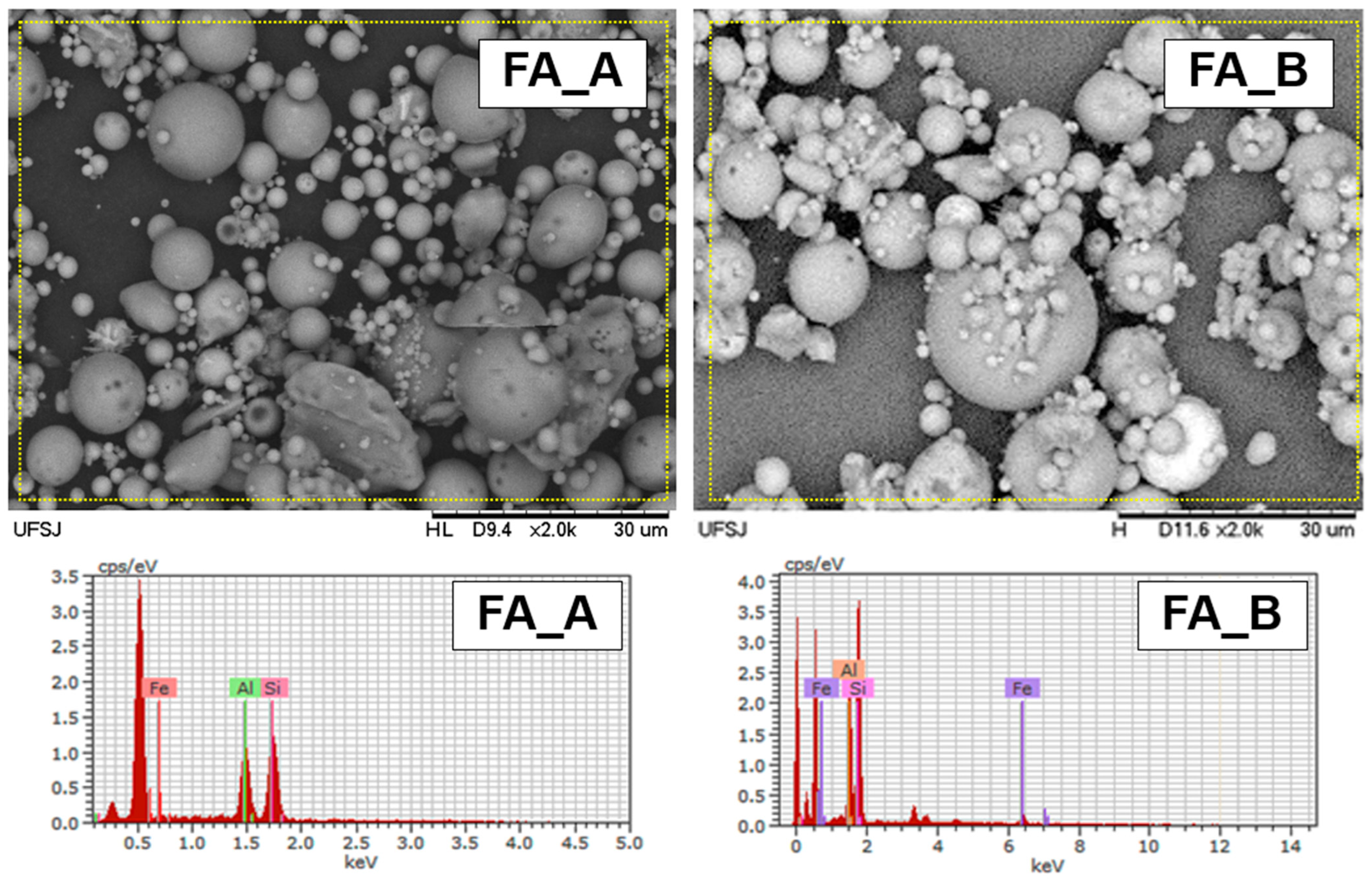
Figure 2 presents SEM micrographs of FA-A and FA-B particles used as precursors in the production of alkali-activated materials. In both cases, the powders predominantly exhibit spherical morphology, with particle diameters ranging from approximately 5 to 200 μm, in agreement with the particle size distributions determined by laser diffraction (Figure 1 and Table 1).
FA-A particles display greater morphological heterogeneity compared to FA-B, with the presence of irregular and non-spherical fragments. These angular particles are likely generated during the milling stage of the beneficiation process prior to commercial distribution, and may contribute to localized increases in surface reactivity. In contrast, FA-B exhibits a more uniform and predominantly spherical morphology, which, while beneficial for flowability, may result in a lower dissolution rate under alkaline activation due to the reduced surface irregularities.
EDS analyses (Table 3, Figure 2) confirm that the elemental composition observed on the particle surfaces is consistent with the bulk oxide contents determined by XRF (Table 2), with Si, Al, and Fe as the main constituents. However, FA-A exhibited a lower surface Fe content than FA-B, while both ashes maintained a Si-rich aluminosilicate structure typical of Class F fly ashes. This lower Fe signal on the surface of FA-A can be explained by the partitioning of Fe into discrete crystalline oxides (hematite and magnetite), which often occur as inclusions or attached satellite particles rather than being uniformly distributed in the amorphous material. If these Fe-rich crystals are not intersected by the EDS analysis spot, the measured surface Fe concentration appears lower. These morphological and compositional differences, although slight, have direct implications for dissolution kinetics and N–A–S–H gel formation during alkali activation.
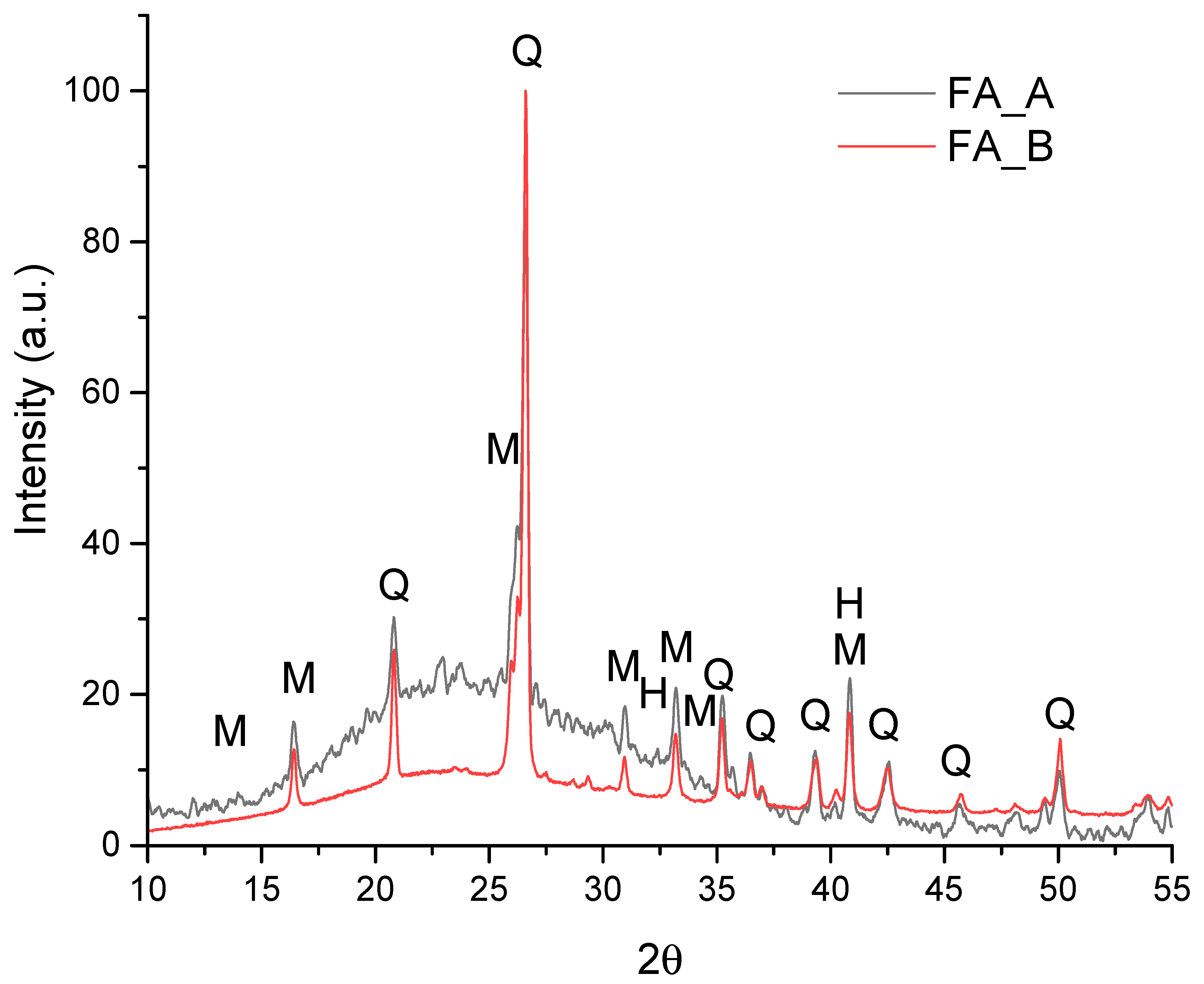
The XRD patterns of the two fly ash samples (FA-A and FA-B) are presented in Figure 3. Both materials exhibit crystalline phases commonly found in coal combustion residues, with intense peaks assigned to quartz (Q, SiO2), mullite (M, Al6Si2O13), and hematite (H, Fe2O3). Quartz is clearly identified by the strong reflection at 2θ ≈ 26.6°, while mullite is detected at characteristic peaks near 2θ ≈ 16.5°, 26.2°, 33.1°, 35.2°, and 40.8°. Hematite is observed mainly at 2θ ≈ 33.2° and 35.6°, consistent with the iron oxide content revealed by chemical analysis.
In addition to the crystalline reflections, FA-A displays a broad diffuse halo between 15° and 35° (2θ), typically associated with an amorphous aluminosilicate phase with short-range atomic ordering. This feature indicates the presence of a disordered fraction that is structurally distinct from crystalline phases and is more susceptible to dissolution under alkaline conditions. In contrast, the amorphous halo in FA-B appears less pronounced, suggesting a comparatively higher degree of crystallinity.
These results demonstrate that, although both samples can be classified as ASTM C618 Type F fly ash, FA-A contains a larger proportion of amorphous aluminosilicates, while FA-B is characterized by a stronger presence of crystalline quartz and mullite. This structural distinction highlights the variability of fly ash even when sourced from the same thermoelectric complex, with implications for its reactivity during alkali activation.

3.2. Characterization of the Alkali-Activated Materials

3.2.1. Water Absorption, Porosity, and Density

The results of water absorption, apparent porosity, and bulk density for AAMs produced with FA-A and FA-B are summarized in Table 4. In general, FA-A-based matrices exhibited higher water absorption than those synthesized with FA-B. After 1 day of curing, GP-A-1 showed an absorption of 13.2%, which was 7.3% higher than GP-B-1 (12.3%). The difference became more pronounced after 7 days, when GP-A-7 reached 13.5%—more than double the value measured for GP-B-7 (6.4%), representing a reduction of 52.6% for the FA-B-based matrix.
Apparent porosity values for both series were close to 20%, with the highest value (21.1%) recorded for GP-A-1 and the lowest (19.2%) for GP-B-7, corresponding to a 9% reduction. This reduction in porosity for FA-B between 1 and 7 days of curing was accompanied by a measurable increase in density, from 1.7 to 1.8 g·cm−3. In comparison, FA-A-based matrices-maintained densities close to 1.6 g·cm−3 throughout the curing period, suggesting less effective microstructural densification.
Overall, the hardened matrices showed densities ranging from 1.6 to 1.8 g·cm−3, lower than the specific gravity of the original fly ashes (2.21–2.38 g·cm−3), consistent with the formation of an amorphous N–A–S–H gel with an open, gel-like structure. The superior densification and lower water absorption of FA-B-based AAMs may be associated with a more optimal Na/Al ratio after curing, which could have limited excessive porosity development and contributed to greater microstructural packing efficiency.

3.2.2. Microstructural Analysis

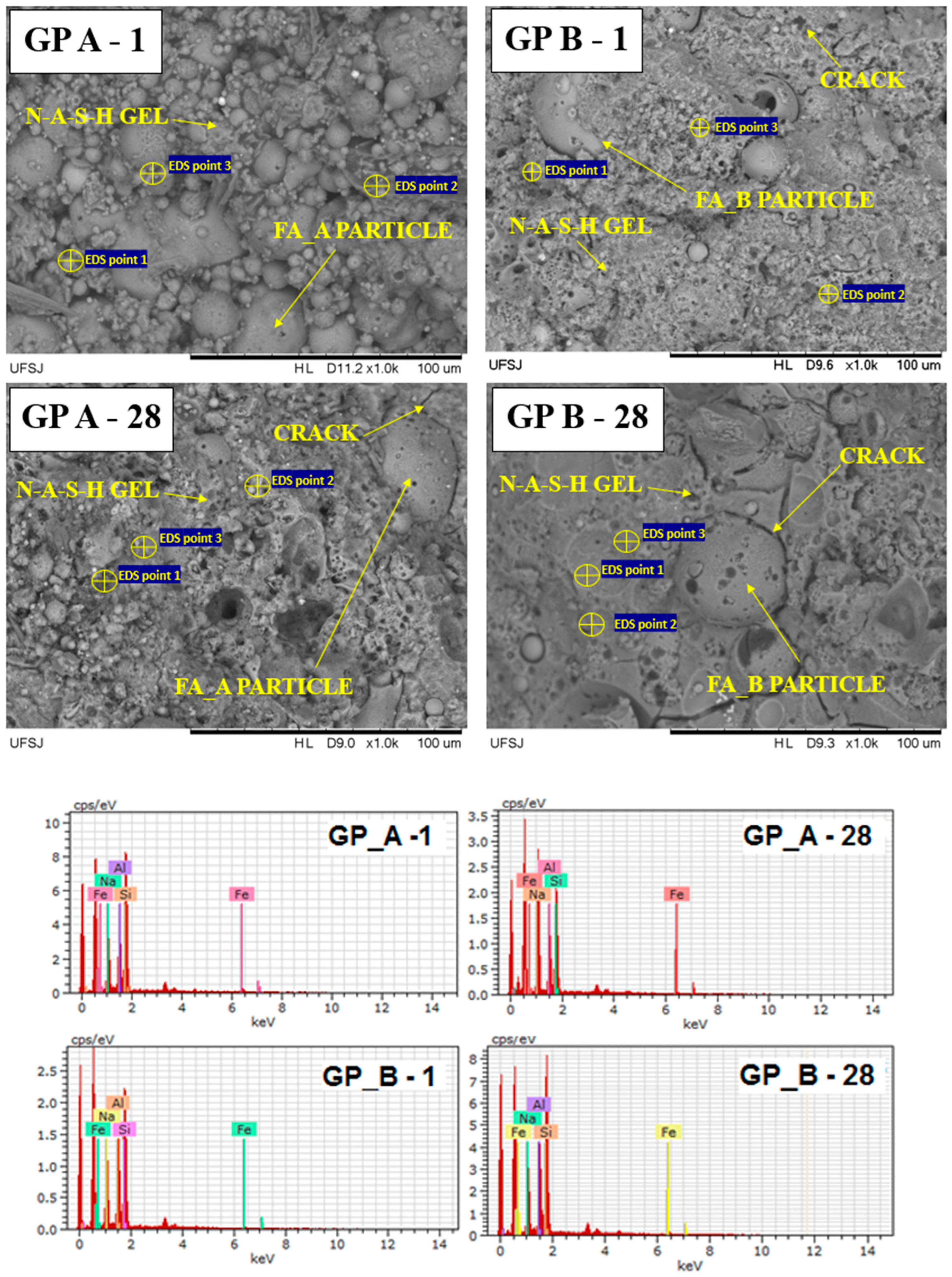
Scanning electron microscopy (SEM) images of the AAMs produced with FA-A and FA-B (Figure 4) reveal marked morphological differences between the matrices. Samples synthesized with FA-A exhibited a denser and more homogeneous surface, with minimal presence of unreacted FA particles. This observation indicates a higher dissolution efficiency for FA-A under alkaline activation, enabling the release of greater amounts of Si- and Al-rich species into the activating solution. These species subsequently participate in polycondensation reactions, generating a higher volume of N–A–S–H gel, directly contributing to the superior compressive strength observed for these matrices [4,24,25].
Conversely, the FA-B-based matrices retained visible spherical particles even after contact with the 16 mol·L−1 NaOH solution. This incomplete dissolution is consistent with their coarser particle size distribution and slightly lower SiO2/Al2O3 ratio. Similar findings were reported by Somna et al. (2011) [24], who observed partially dissolved FA spheres embedded within a continuous aluminosilicate gel. The intact external surfaces and partially dissolved interiors of these spheres may be related to differences in particle cooling rates during coal combustion, as described by Provis et al. (2014) [6]. Such cooling rate variations can yield distinct degrees of atomic ordering (short- or long-range), which strongly influence dissolution kinetics.
After 28 days of curing, FA-A-based matrices continued to display a homogeneous morphology, with only a small number of unreacted particles, corroborating the higher early-age dissolution rate. Some cracks were observed, likely originating from water release during ongoing polycondensation. In contrast, GP-B matrices retained a greater fraction of original spherical particles, suggesting a lower N–A–S–H gel yield and explaining their lower compressive strength relative to GP-A.
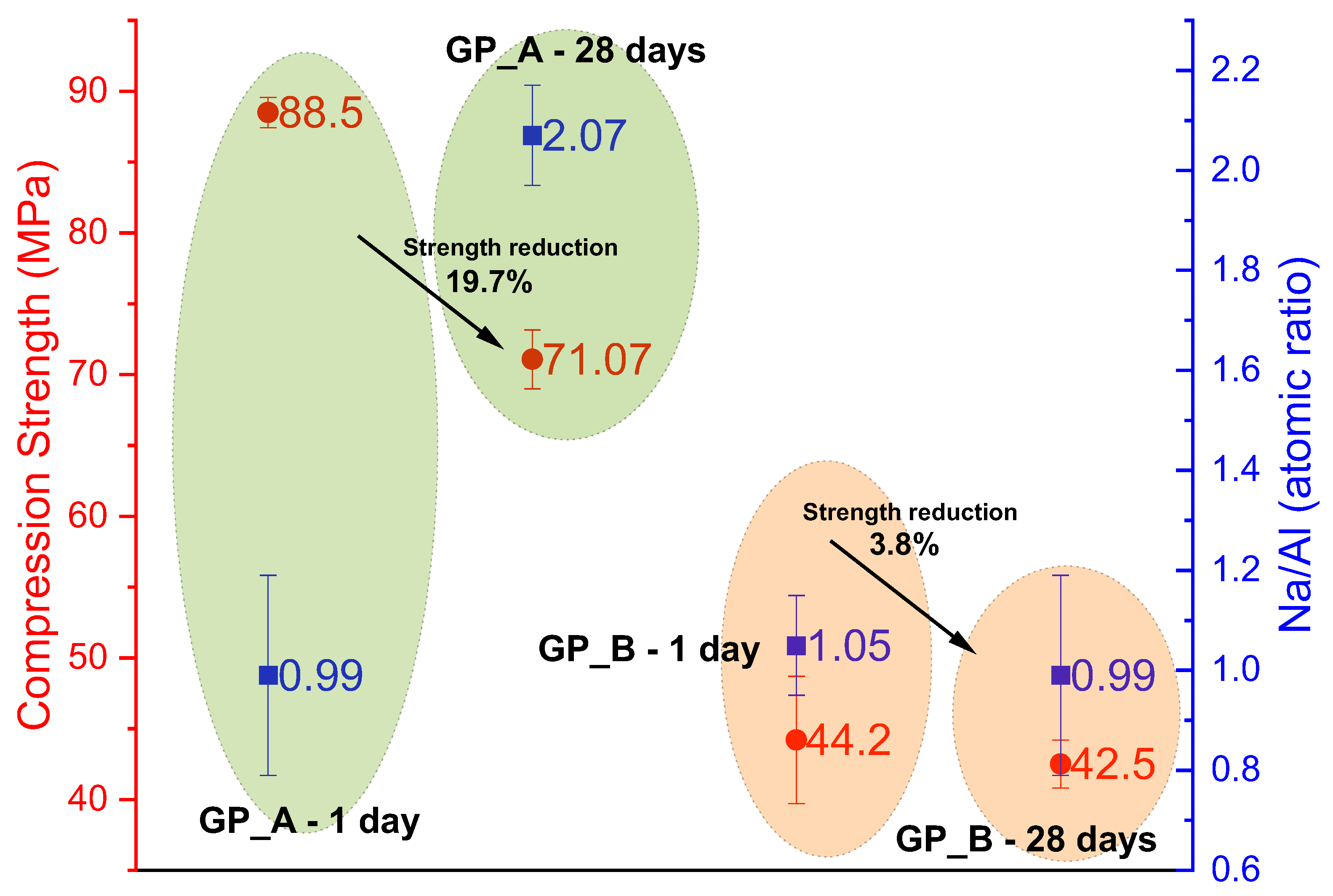
Energy-dispersive spectroscopy (EDS) confirmed the presence of a Si–Al–Na framework in both systems (Figure 4 and Table 5). The Si/Al surface ratios after alkali-activation were 2.02 for FA-A and 2.47 for FA-B, corresponding to poly(sialate-siloxy) structures in FA-A and a mixture of poly(sialate-siloxy) and poly(sialate-disiloxy) in FA-B [25]. While both matrices exhibited Na/Al atomic ratios near 1.0 after 24 h (indicating electrochemical stability), the FA-A-based AAMs showed a pronounced increase to 2.07 after 28 days. This excess sodium is linked to a 19% reduction in compressive strength over the curing period, likely due to structural destabilization and the formation of Na-rich secondary phases, as confirmed by FTIR.
In contrast, FA-B maintained a Na/Al atomic ratio of 0.99 after 28 days, remaining close to the ideal stoichiometry and resulting in only a 3.8% strength reduction. This indicates that sodium excess in FA-A led to a strength loss approximately five times greater than that of FA-B. The superior mechanical stability of FA-B over time, despite its lower initial strength, underscores the critical role of Na/Al balance in long-term alkali-activated material performance.

3.2.3. Infrared Spectroscopy (FTIR)

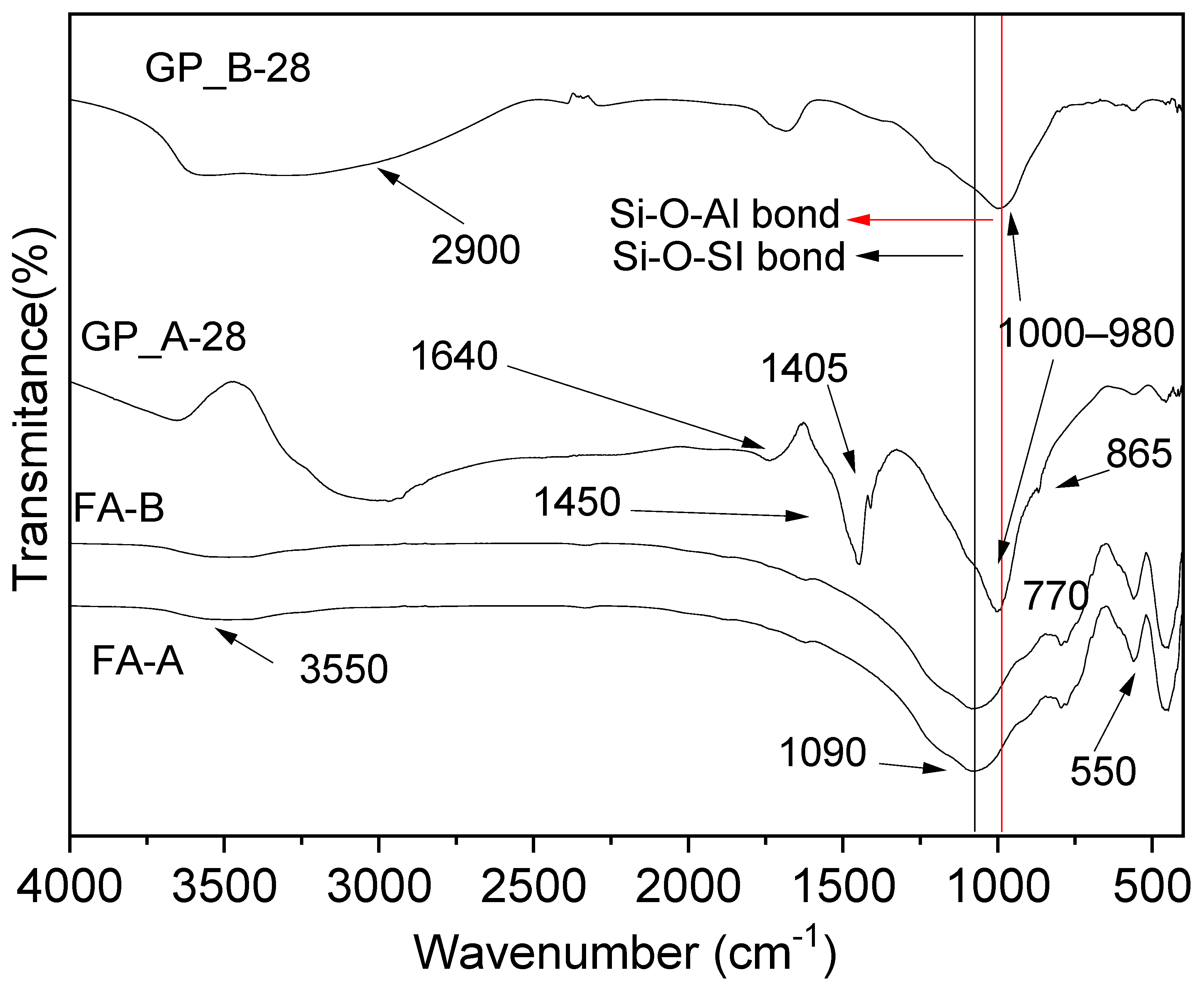
Figure 5 shows the FTIR spectra of the original FA samples and the alkali-activated materials (AAMs) after 28 days of curing. In both precursor ashes and the corresponding AAMs, absorption bands at 3667 and 1641 cm−1 correspond to the stretching and bending modes of H–O–H and O–H groups, respectively, associated with weakly bound water molecules adsorbed on particle surfaces or retained in gel pores [22]. Bands at 1090 and 458 cm−1 are attributed to Si–O and Al–O stretching and bending vibrations [26,27].
In the AAMs, the main Si–O stretching band shifted from ~1090 cm−1 in the raw ash to ~1000–990 cm−1, a change typically associated with N–A–S–H gel formation during alkali activation. This shift reflects the substitution of Si4+ by Al3+ in tetrahedral coordination, increasing the need for charge-balancing cations (Na+) and resulting in a three-dimensional aluminosilicate network [28].
Bands near 1445 and 1405 cm−1, observed predominantly in FA-A-based matrices after 28 days, correspond to sodium carbonate (Na2CO3) [29], formed by the reaction of excess Na2O with atmospheric CO2 (Equation (1)). The presence of these carbonate bands is consistent with the elevated Na/Al ratio detected by EDS in GP-A after 28 days (2.07), and supports the hypothesis that sodium accumulation and subsequent carbonation contribute to the observed 19% reduction in compressive strength [30]. In contrast, FA-B-based matrices maintained a near-ideal Na/Al ratio (0.99) and exhibited negligible carbonate formation, correlating with their minimal (3.8%) strength loss.
Na2O + H2O + CO2→Na2CO3 + H2O

3.2.4. Compressive Strength and Young’s Modulus

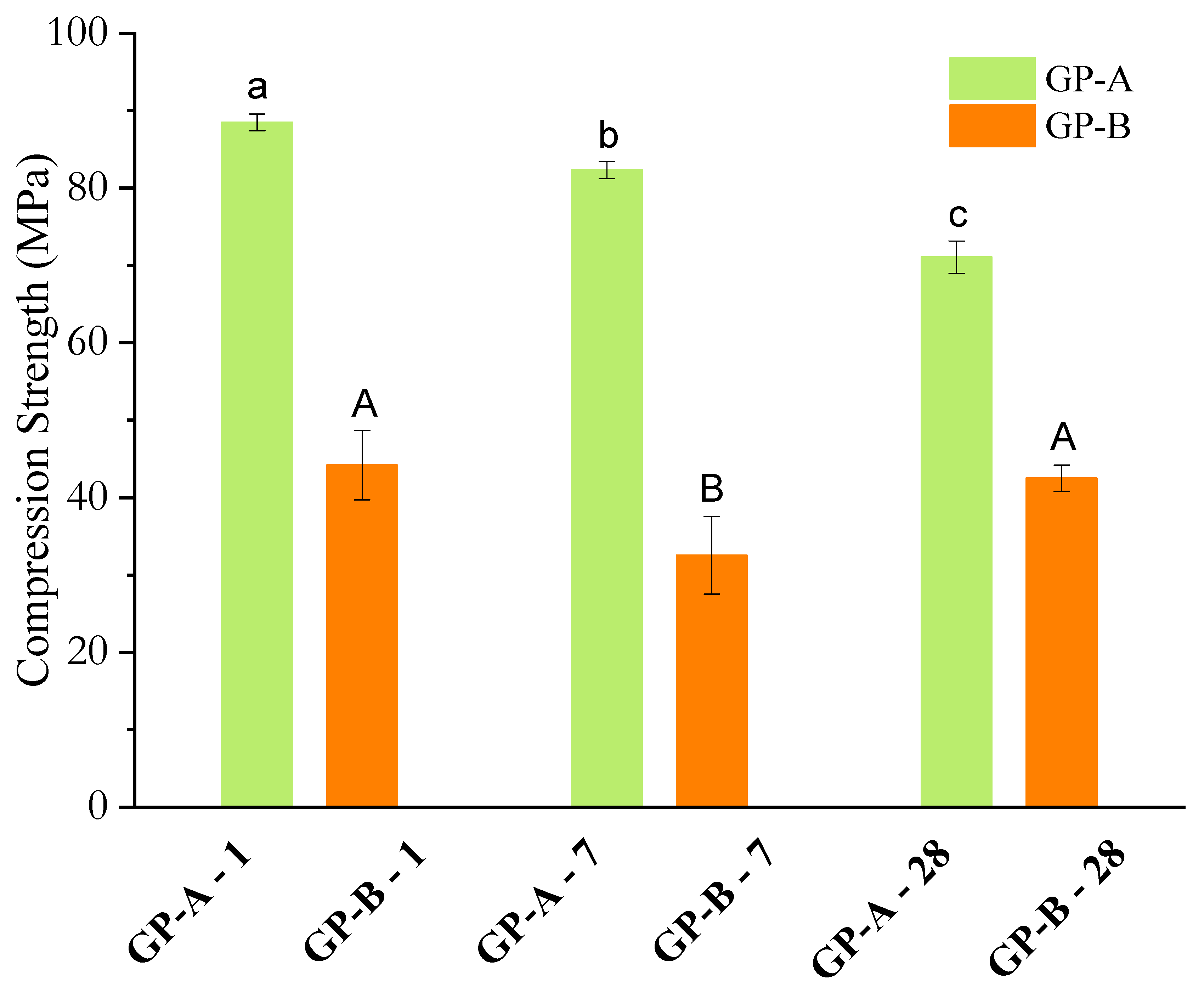
The compressive strength results (Figure 6) clearly demonstrate the influence of fly ash precursor characteristics on the mechanical performance of alkali-activated materials. After 1 day of curing, GP-A achieved 88.5 MPa, which is approximately 100% higher than GP-B (44.2 MPa). At 7 days, GP-A maintained a significant advantage, reaching 82.3 MPa compared to 32.5 MPa for GP-B, an increase of approximately 153%. Even after 28 days, GP-A still exhibited 71.1 MPa, remaining 67% higher than GP-B (42.5 MPa).
The superior early-age strength of GP-A can be directly associated with the higher proportion of amorphous aluminosilicate phases, as evidenced by the broad diffuse halo observed between 10° and 35° (2θ) in the XRD pattern. This halo indicates the presence of poorly ordered structures, which are more susceptible to alkaline dissolution and capable of releasing larger amounts of Si and Al species for N–A–S–H gel formation. This enhanced reactivity explains the higher dissolution rate of FA-A and the greater initial strength development of its corresponding matrices.
When strength evolution is analyzed relative to the initial values, GP-A showed a 19% reduction between 1 and 28 days, while GP-B exhibited only a 3.8% decrease. This indicates that although FA-A is more reactive and provides much higher early-age strength, FA-B results in improved mechanical stability over longer curing times [31].
Table 6 compares the compressive strength of the AAMs produced in this study with reference values from Portland cement, high-performance concretes, and AAMs reported in the literature. The GP-A matrices, with 88.5 MPa after 1 day, exceed the 28-day minimum requirements of EN 197-1 CEM I 42.5N and CEM I 52.5N cements [32]. Even after the 19% strength drop at 28 days, GP-A remains within the upper range of FA-based AAMs. In contrast, GP-B aligns with typical OPC values at 28 days and demonstrates greater long-term stability. These benchmarks highlight the potential of Brazilian fly ash-based AAMs to compete with and, in some cases, surpass conventional binders used in structural applications
The iron content of the fly ashes influences both reactivity and the mechanical performance of the alkali-activated materials. FA-A contained 6.2 wt.% Fe2O3, compared with 3.9 wt.% in FA-B. While crystalline iron oxides such as hematite are largely inert, Fe present in the amorphous glassy phase can partially dissolve, releasing Fe3+/Fe2+ ions. These cations may substitute Al3+ in tetrahedral coordination, giving rise to Fe-modified gels (N–A–S–F–H). Such substitution alters the short-range ordering of the network, reduces the degree of polymerization, and affects gel stability [32]. The higher Fe content of FA-A likely accelerated early gel formation, supporting its higher initial strength. However, Fe-rich domains embedded in the aluminosilicate matrix may also increase structural heterogeneity, favoring microcracking and explaining the 19.7% strength loss observed after 28 days, as presented in Figure 7. In contrast, the lower Fe content of FA-B is consistent with a less reactive but more stable matrix, with only 3.8% strength reduction over the same period. Previous studies have shown that Fe3+ can be incorporated into the silicate network of alkali-activated binders, adopting coordination environments similar to those of the precursor material [33,34,35]. In the amorphous phase of the binder, Fe3+ is typically found in tetrahedral or five-fold oxygen coordination, consistent with the average coordination observed in the amorphous fraction of AAMs. Simon et al. (2018) further suggested the coexistence of Fe3+–O–Fe3+ and Si–O–Fe3+ linkages, although the exact arrangement and connectivity of these bonds still require clarification [36].
Table 6. Benchmark comparison of compressive strength (fc) of alkali-activated materials (AAMs) and reference binders.
System/MaterialBinder/ActivatorCuring Regimefc, 1 d (MPa)fc, 7 d (MPa)fc, 28 d (MPa)Notes/Benchmark Relevance
This study—GP-A (FA-A)FA (Type F)/16 M NaOH90 °C/24 h + RT88.582.371.1Very high early strength; 19% drop to 28 d due to excess alkali.
This study—GP-B (FA-B)FA (Type F)/16 M NaOH90 °C/24 h + RT44.232.542.5Lower early strength; stable with only 3.8% drop to 28 d.
OPC mortar (CEM I 42.5N) *Portland cementRT, water cure~10~35≥42.5Strength class threshold (EN 197-1).
OPC mortar (CEM I 52.5N) *Portland cementRT, water cure~20~45≥52.5Higher class threshold (EN 197-1).
FA-based AAM (literature range) **FA/NaOH or Na2SiO3–NaOHAmbient/mild heat~20~40~60Typical values reported: 40–90 MPa (28 d).
Slag-based AAM (literature range) **GGBFS/NaOH or Na2SiO3Ambient~40~70~90Fast strength gain; often 60–120 MPa (28 d).
High-performance concrete (HPC)OPC + admixturesOptimized curing~30~60~100Reference for structural applications ≥ 80–100 MPa (28 d).
* Strength classes according to EN 197-1. ** Representative values from the international literature [19,25,26,37,38].
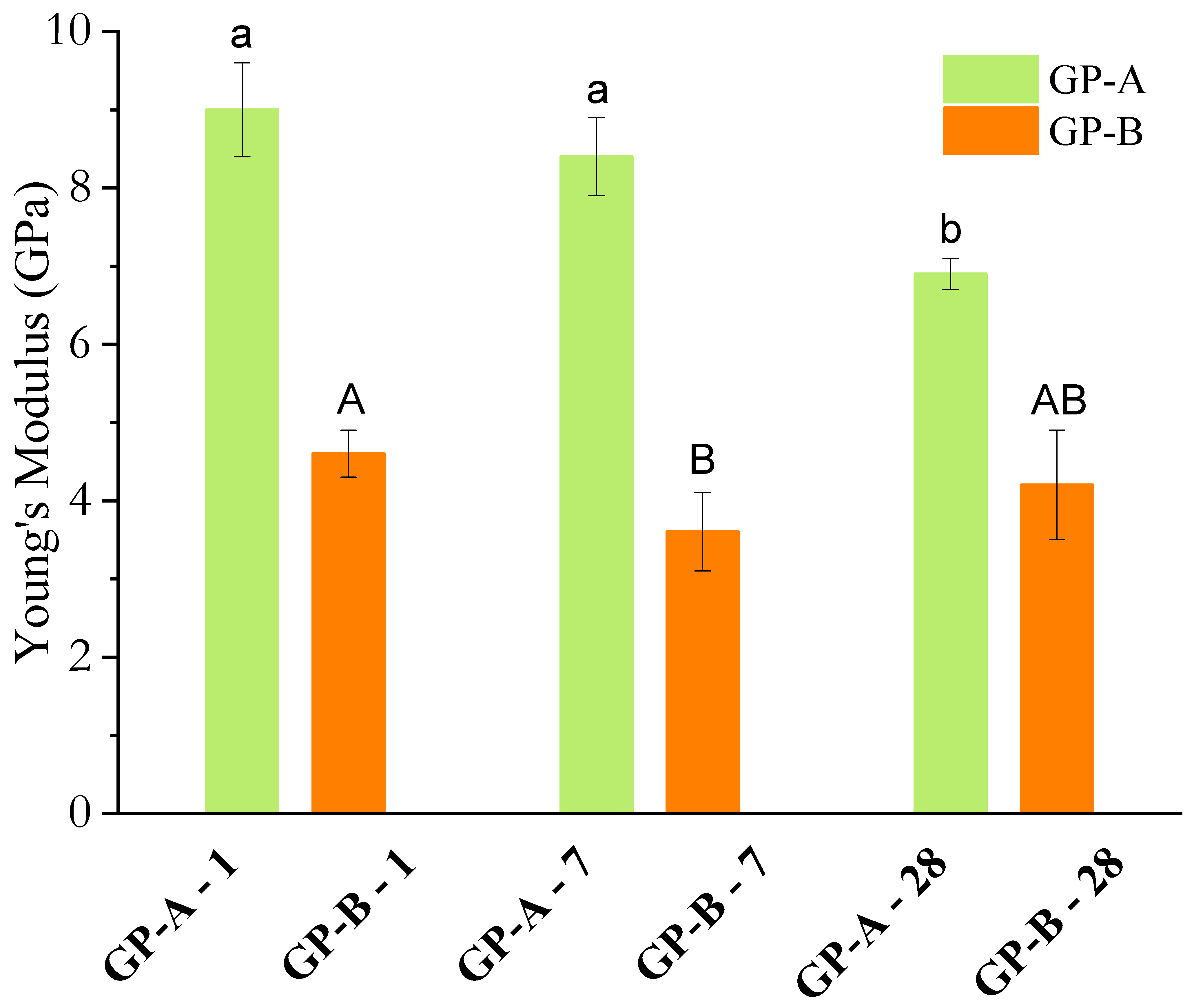
The corresponding elastic modulus values followed the same trend, with GP-A registering 9.0 GPa and GP-B 4.6 GPa at 1 day, indicating a stiffer and more compact microstructure in FA-A-based AAMs, as presented in Figure 8. This correlation between compressive strength and elastic modulus suggests that the densification of the binder matrix, observed in SEM images for GP-A, is directly reflected in its load-bearing capacity.
However, the evolution of these properties over time demonstrates that high early-age performance does not necessarily translate into superior long-term stability. Over 28 days, GP-A experienced a 19.7% decrease in compressive strength (from 88.5 to 71.1 MPa) and a corresponding reduction in modulus (from 9.0 to 6.9 GPa). In contrast, GP-B showed only a 3.8% drop in strength (from 44.2 to 42.5 MPa) and maintained its modulus within a narrower range (4.6 to 4.2 GPa).
The cause of this degradation in GP-A is strongly linked to its Na/Al ratio, which increased from 0.99 at 1 day to 2.07 at 28 days. Excess Na+ in the matrix, as confirmed by EDS and FTIR (formation of Na2CO3), indicates incomplete incorporation of sodium into the material network. This surplus of alkalis can lead to several detrimental effects:
  • Disruption of the aluminosilicate network through charge imbalance, reducing crosslink density;
  • Promotion of microcracking due to carbonation of excess Na+, with associated volumetric changes;
  • Leaching of soluble alkali phases, which can create micro voids and further weaken the matrix.
GP-B, with a stable Na/Al ratio (~1.0) over the same curing period, avoided these destabilizing processes, resulting in minimal strength loss despite its lower initial performance, as presented in Figure 7. This highlights a trade-off between early-age strength and long-term durability: GP-A excels in rapid strength development, advantageous for precast applications requiring fast demolding, while GP-B offers superior dimensional and mechanical stability, more suitable for structures subjected to long-term loading and aggressive environments.
Additionally, the interaction between particle morphology and mechanical properties should be emphasized. The SEM micrographs show that GP-A heterogeneous particle shapes, including angular fragments from milling, may enhance reactivity by increasing surface defect density and providing more active sites for dissolution. GP-B predominantly spherical morphology, while beneficial for fresh mix rheology, may limit dissolution rates, slow gel formation and delaying strength gain.
From a structural engineering perspective, the observed differences in elastic modulus are equally relevant (Figure 8). Higher modulus values, as in GP-A, improve stiffness but can also reduce deformation capacity, potentially affecting crack distribution under service loads. Conversely, the lower modulus in GP-B could allow greater strain accommodation, which may mitigate brittle failure modes.
Therefore, optimizing mechanical performance in alkali-activated systems derived from coal FA should not rely solely on maximizing early compressive strength. Instead, precursor selection and mix design should balance particle size, chemical composition, and activator dosage to achieve both rapid strength development and long-term stability. This may include strategies such as adjusting Na2O content to prevent alkali surplus, blending different ashes to moderate SiO2/Al2O3 ratio, or tailoring curing regimes to control dissolution kinetics and gel structure evolution. The results obtained confirm that alkali-activated fly ash binders can achieve high compressive strength, reaching approximately 88 MPa after only one day of curing. Such performance highlights their suitability for use in structural construction materials, including precast elements and masonry blocks. In traditional Portland cement systems, fly ash can also be incorporated as a supplementary cementitious material, where it reacts with calcium hydroxide to form additional C–S–H gel, enhancing both strength and durability. Therefore, fly ash can be effectively utilized in both alkali-activated and conventional cement-based systems, contributing to more sustainable construction practices.

4. Conclusions

From the results obtained, it can be concluded that both Brazilian Type F fly ash samples can be used as precursor materials for producing alkali-activated materials (AAMs) with high mechanical performance. However, their distinct chemical compositions, particle size distributions, and morphological characteristics resulted in significantly different reactivity, microstructural development, and mechanical behavior. The main findings are:
  • Early-age strength: FA-A-based matrices achieved compressive strength of 88.5 MPa after 1 day, approximately 100% higher than FA-B (44.2 MPa). This behavior is linked to the higher SiO2/Al2O3 ratio (3.52) and the amorphous halo observed between 10–35° (2θ) in the XRD pattern, indicating greater availability of reactive aluminosilicates;
  • Elastic modulus correlation: The higher compressive strength of FA-A was consistent with a higher elastic modulus (9.0 GPa vs. 4.6 GPa for FA-B), confirming the formation of a denser and stiffer matrix;
  • Strength evolution: Over 28 days, FA-A exhibited a 19% reduction in compressive strength, associated with an increase in the Na/Al ratio (0.99 to 2.07) and the formation of Na2CO3 detected by FTIR. FA-B showed only a 3.8% decrease, maintaining a stable Na/Al ratio (~1.0) and thus better long-term stability;
  • Microstructural differences: SEM analyses revealed that FA-A matrices were more homogeneous, with fewer unreacted particles and higher N–A–S–H gel formation, whereas FA-B retained partially unreacted spheres even after 28 days of curing;
  • Physical properties: FA-B matrices exhibited lower water absorption (up to 52% lower after 7 days) and slightly higher density (1.8 g·cm−3) compared to FA-A, suggesting improved long-term densification;
  • Chemical analysis: EDS results indicated that FA-A mainly formed poly(sialate-siloxy) networks, while FA-B presented a combination of poly(sialate-siloxy) and poly(sialate-disiloxy), influencing gel connectivity and durability.
Overall, these results demonstrate that even fly ashes sourced from the same thermoelectric complex can produce markedly different AAM performances depending on the collection period and resulting chemical/mineralogical properties. Such variations must be carefully considered in raw material selection to optimize both early-age strength and long-term durability. Alkali activation of suitably characterized fly ashes represents a viable strategy to partially replace Portland cement in various construction applications.

Funding

This research was funded by São Paulo Research Foundation (FAPESP), under grant number processes 2025/11339-6 and 2024/02445-4.

Data Availability Statement

The original contributions presented in this study are included in the article. Further inquiries can be directed to the corresponding author.

Acknowledgments

To the São Paulo Research Foundation (FAPESP)—Processes: 2025/11339-6 and 2024/02445-4.

Conflicts of Interest

The author declares no conflict of interest.

References

  1. Azevedo, A.G.S.; Strecker, K. Kaolin, Fly-Ash and Ceramic Waste Based Alkali-Activated Materials Production by the “One-Part” Method. Constr. Build. Mater. 2021, 269, 121306. [Google Scholar] [CrossRef]
  2. Lanjewar, B.A.; Chippagiri, R.; Dakwale, V.A.; Ralegaonkar, R.V. Application of Alkali-Activated Sustainable Materials: A Step Towards Net Zero Binder. Energies 2023, 16, 969. [Google Scholar] [CrossRef]
  3. Qader, D.N.; Jamil, A.S.; Bahrami, A.; Ali, M.; Arunachalam, K.P. A Systematic Review of Metakaolin-Based Alkali-Activated and Geopolymer Concrete: A Step Toward Green Concrete. Rev. Adv. Mater. Sci. 2025, 64, 20240076. [Google Scholar] [CrossRef]
  4. de Souza Azevedo, A.G.; Strecker, K. Brazilian Fly Ash Based Inorganic Polymers Production Using Different Alkali Activator Solutions. Ceram. Int. 2017, 43, 9012–9018. [Google Scholar] [CrossRef]
  5. Davidovits, J.; Comrie, D. Long Term Durability of Hazardous Toxic and Nuclear Waste Disposals. Proc. Geopolymer 1988, 1, 125–134. [Google Scholar]
  6. Provis, J.L.; Bernal, S.A. Geopolymers and Related Alkali-Activated Materials. Annu. Rev. Mater. Res. 2014, 44, 299–327. [Google Scholar] [CrossRef]
  7. Zhang, N.; Yu, H.; Gong, W.; Liu, T.; Wang, N.; Tan, Y.; Wu, C. Effects of Low- and High-Calcium Fly Ash on the Water Resistance of Magnesium Oxysulfate Cement. Constr. Build. Mater. 2020, 230, 116951. [Google Scholar] [CrossRef]
  8. Wu, Y.; Jia, Z.; Qi, X.; Wang, W.; Guo, S. Alkali-Activated Materials Without Commercial Activators: A Review. J. Mater. Sci. 2024, 59, 3780–3808. [Google Scholar] [CrossRef]
  9. Soutsos, M.; Boyle, A.P.; Vinai, R.; Hadjierakleous, A.; Barnett, S.J. Factors Influencing the Compressive Strength of Fly Ash Based Geopolymers. Constr. Build. Mater. 2016, 110, 355–368. [Google Scholar] [CrossRef]
  10. Part, W.K.; Ramli, M.; Cheah, C.B. An Overview on the Influence of Various Factors on the Properties of Geopolymer Concrete Derived from Industrial By-Products. Constr. Build. Mater. 2015, 77, 370–395. [Google Scholar] [CrossRef]
  11. Fernández-Jiménez, A.; Palomo, Á. Composition and Microstructure of Alkali Activated Fly Ash Binder: Effect of the Activator. Cem. Concr. Res. 2005, 35, 1984–1992. [Google Scholar] [CrossRef]
  12. Zhang, M.; El-Korchi, T.; Zhang, G.; Liang, J.; Tao, M. Synthesis Factors Affecting Mechanical Properties, Microstructure, and Chemical Composition of Red Mud-Fly Ash Based Geopolymers. Fuel 2014, 134, 315–325. [Google Scholar] [CrossRef]
  13. Andini, S.; Cioffi, R.; Colangelo, F.; Grieco, T.; Montagnaro, F.; Santoro, L. Coal Fly Ash as Raw Material for the Manufacture of Geopolymer-Based Products. Waste Manag. 2008, 28, 416–423. [Google Scholar] [CrossRef]
  14. He, J.; Zhang, J.; Yu, Y.; Zhang, G. The Strength and Microstructure of Two Geopolymers Derived from Metakaolin and Red Mud-Fly Ash Admixture: A Comparative Study. Constr. Build. Mater. 2012, 30, 80–91. [Google Scholar] [CrossRef]
  15. Jahromy, S.S.; Azam, M.; Huber, F.; Jordan, C.; Wesenauer, F.; Huber, C.; Naghdi, S.; Schwendtner, K.; Neuwirth, E.; Laminger, T.; et al. Comparing Fly Ash Samples from Different Types of Incinerators for Their Potential as Storage Materials for Thermochemical Energy and CO2. Materials 2019, 12, 3358. [Google Scholar] [CrossRef] [PubMed]
  16. Horan, C.; Genedy, M.; Juenger, M.; van Oort, E. Fly Ash-Based Geopolymers as Lower Carbon Footprint Alternatives to Portland Cement for Well Cementing Applications. Energies 2022, 15, 8819. [Google Scholar] [CrossRef]
  17. Hamsashree; Pandit, P.; Prashanth, S.; Katpady, D.N. Durability of Alkali-Activated Fly Ash-Slag Concrete- State of Art. Innov. Infrastruct. Solut. 2024, 9, 222. [Google Scholar] [CrossRef]
  18. Faraco, M.N.S.; Simão, L.; Acordi, J.; Olivo, E.F.; Zaccaron, A.; Montedo, O.R.K.; Ribeiro, M.J.; Bergmann, C.P.; Raupp-Pereira, F. An Overview of the Coal Circularity in Brazil: A New Sustainable Approach Based on Sampling Method, Characterization, and Waste Valorization. Resour. Policy 2025, 102, 105496. [Google Scholar] [CrossRef]
  19. Azevedo, A.G.S.; Strecker, K.; Barros, L.A.; Tonholo, L.F.; Lombardi, C.T. Effect of Curing Temperature, Activator Solution Composition and Particle Size in Brazilian Fly-Ash Based Geopolymer Production. Mater. Res. 2019, 22, e20180842. [Google Scholar] [CrossRef]
  20. ISO EN, 10545-3EN; Ceramic Tiles—Part 3: Determination of Water Absorption, Apparent Porosity, Apparent Relative Density and Bulk Density. ISO: Geneva, Switzerland, 1998.
  21. ABNT NBR—5739; Concreto—Ensaio de Compressão de Corpos-de-Prova Cilíndricos. Associação Brasileira de Normas Técnicas: Rio de Janeiro, Brazil, 2007.
  22. Görhan, G.; Kürklü, G. The Influence of the NaOH Solution on the Properties of the Fly Ash-Based Geopolymer Mortar Cured at Different Temperatures. Compos. Part B Eng. 2014, 58, 371–377. [Google Scholar] [CrossRef]
  23. ASTM C618-15; Standard Specification for Coal Fly Ash and Raw or Calcined Natural Pozzolan for Use in Concrete. ASTM International: West Conshohocken, PA, USA, 2015. [CrossRef]
  24. Somna, K.; Jaturapitakkul, C.; Kajitvichyanukul, P.; Chindaprasirt, P. NaOH-Activated Ground Fly Ash Geopolymer Cured at Ambient Temperature. Fuel 2011, 90, 2118–2124. [Google Scholar] [CrossRef]
  25. Duxson, P.; Fernández-Jiménez, A.; Provis, J.L.; Lukey, G.C.; Palomo, A.; van Deventer, J.S. Geopolymer Technology: The Current State of the Art. J. Mater. Sci. 2006, 42, 2917–2933. [Google Scholar] [CrossRef]
  26. Kovalchuk, G.; Fernández-Jiménez, A.; Palomo, A. Alkali-Activated Fly Ash: Effect of Thermal Curing Conditions on Mechanical and Microstructural Development—Part II. Fuel 2007, 86, 315–322. [Google Scholar] [CrossRef]
  27. Palomo, A.; Grutzeck, M.W.; Blanco, M.T. Alkali-Activated Fly Ashes: A Cement for the Future. Cem. Concr. Res. 1999, 29, 1323–1329. [Google Scholar] [CrossRef]
  28. Fernández-Jiménez, A.; Palomo, A. Mid-Infrared Spectroscopic Studies of Alkali-Activated Fly Ash Structure. Microporous Mesoporous Mater. 2005, 86, 207–214. [Google Scholar] [CrossRef]
  29. Temuujin, J.; Minjigmaa, A.; Davaabal, B.; Bayarzul, U.; Ankhtuya, A.; Jadambaa, T.; MacKenzie, K.J.D. Utilization of Radioactive High-Calcium Mongolian Flyash for the Preparation of Alkali-Activated Geopolymers for Safe Use as Construction Materials. Ceram. Int. 2014, 40, 16475–16483. [Google Scholar] [CrossRef]
  30. Mozgawa, W.; Deja, J. Spectroscopic Studies of Alkaline Activated Slag Geopolymers. J. Mol. Struct. 2009, 924, 434–441. [Google Scholar] [CrossRef]
  31. Shah, S.F.A.; Chen, B.; Oderji, S.Y.; Haque, M.A.; Ahmad, M.R. Improvement of Early Strength of Fly Ash-Slag Based One-Part Alkali Activated Mortar. Constr. Build. Mater. 2020, 246, 118533. [Google Scholar] [CrossRef]
  32. EN 197-1; Cement—Part 1: Composition, Specifications and Conformity Criteria for Common Cements. European Committee for Standardization (CEN): Brussels, Belgium, 2011.
  33. Azevedo, A.D.S.; Strecker, K.; Lombardi, C.T. Produção de Geopolímeros à Base de Metacaulim e Cerâmica Vermelha. Cerâmica 2018, 64, 388–396. [Google Scholar] [CrossRef]
  34. Lemougna, P.N.; MacKenzie, K.J.D.; Jameson, G.N.L.; Rahier, H.; Chinje Melo, U.F. The Role of Iron in the Formation of Inorganic Polymers (Geopolymers) from Volcanic Ash: A 57Fe Mössbauer Spectroscopy Study. J. Mater. Sci. 2013, 48, 5280–5286. [Google Scholar] [CrossRef]
  35. Peys, A.; White, C.E.; Rahier, H.; Blanpain, B.; Pontikes, Y. Alkali-Activation of CaO-FeOX-SiO2 Slag: Formation Mechanism from in-Situ X-Ray Total Scattering. Cem. Concr. Res. 2019, 122, 179–188. [Google Scholar] [CrossRef]
  36. Simon, S.; Gluth, G.J.G.; Peys, A.; Onisei, S.; Banerjee, D.; Pontikes, Y. The Fate of Iron During the Alkali-Activation of Synthetic (CaO-)FeOX-SiO2 Slags: An Fe K-Edge XANES Study. J. Am. Ceram. Soc. 2018, 101, 2107–2118. [Google Scholar] [CrossRef]
  37. Provis, J.L.; Van Deventer, J.S.J. Alkali-Activated Materials: State-of-Art Report; Springer: Melbourne, Australia, 2014; ISBN 9789400776715. [Google Scholar]
  38. Fernández-Jiménez, A.; Palomo, A.; Criado, M. Microstructure Development of Alkali-Activated Fly Ash Cement: A Descriptive Model. Cem. Concr. Res. 2005, 35, 1204–1209. [Google Scholar] [CrossRef]
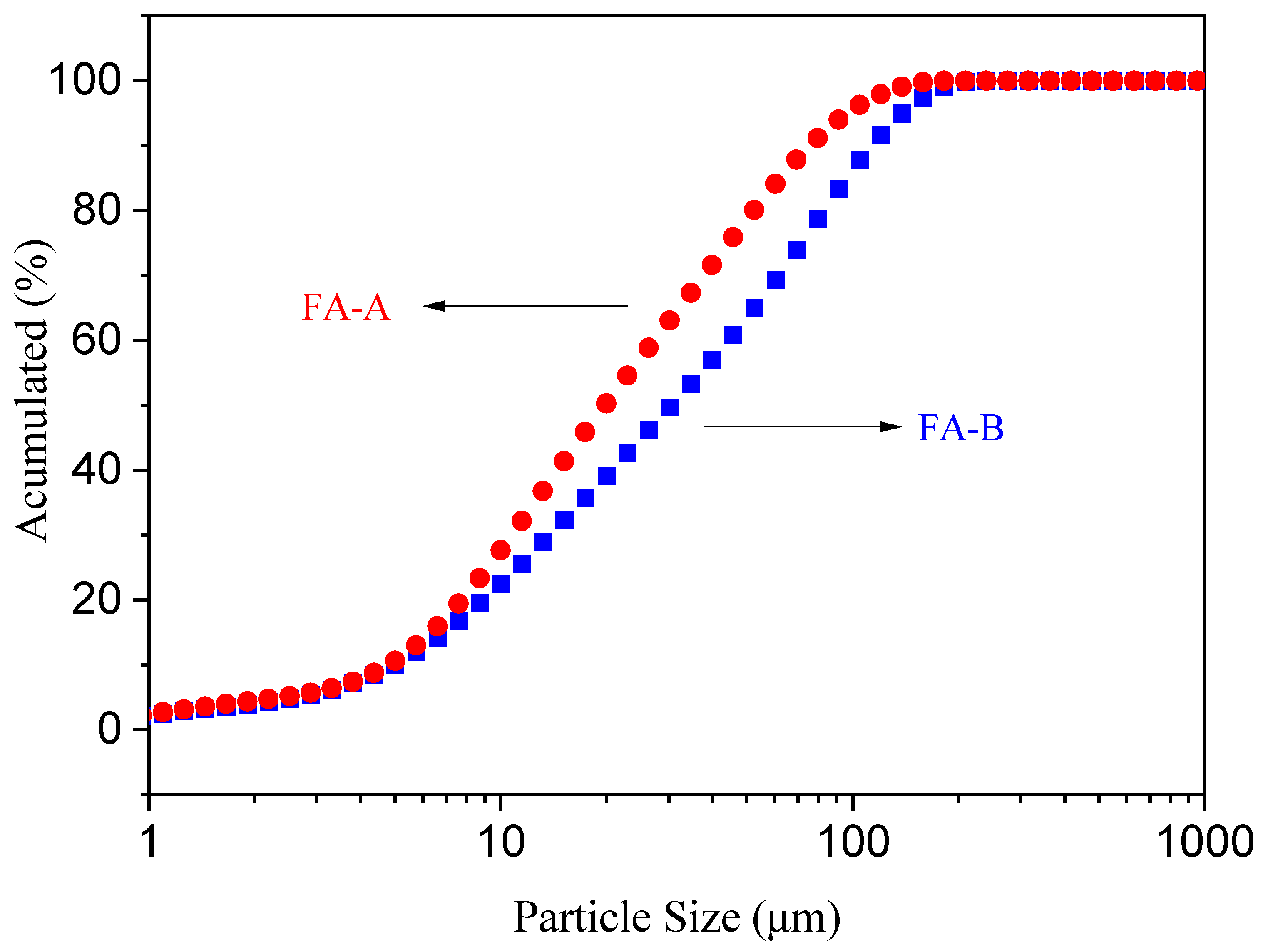
Figure 1. Particle size distribution of the fly ash samples FA-A and FA-B.
Powders 05 00002 g001
Figure 2. Scanning electron microscopy and EDS spectra of the elements present on the surface of FA_A and FA_B.
Powders 05 00002 g002
Figure 3. XRD patterns of the FA samples used as raw material in alkali activation materials production. Q—Quartz—SiO2; M—Mullite—Al6Si2O3 and H—Hematite—Fe2O3.
Powders 05 00002 g003
Figure 4. SEM images of the alkali-activated and EDS spectra of the elements present on the surface of the alkali-activated samples produced with the different FA samples after 1 (GP-A-1 and GP-B-1), and 28 days (GP-A-28 and GP-B-28), respectively.
Powders 05 00002 g004
Figure 5. FTIR spectra of hardened samples produced with different FA samples after 28 days.
Powders 05 00002 g005
Figure 6. Compressive strength of the alkali-activated materials produced with different fly-ash samples after 1, 7 and 28 days. The same letters in different bars represent no statistical difference from the Tukey test (p < 0.05, n = 10). Lowercase letters: Comparison between samples produced with fly ash A (FA-A); Uppercase letters: Comparison between samples produced with fly ash B (FA-B).
Powders 05 00002 g006
Figure 7. Correlation between mechanical strength and the variation in the Na/Al atomic ratio in alkali-activated materials produced with different FA samples. Red Y-axis: Compressive strength; Blue Y-axis: Variation in the Na/Al atomic ratio in the binders after 1 and 28 days of curing.
Powders 05 00002 g007
Figure 8. Young’s modulus of the alkali-activated materials produced with different fly-ash samples after 1, 7 and 28 days. The same letters in different bars represent no statistical difference from the Tukey test (p < 0.05, n = 10). Lowercase letters: Comparison between samples produced with fly ash A (FA-A); Uppercase letters: Comparison between samples produced with fly ash B (FA-B).
Powders 05 00002 g008
Table 1. D10, D50 and D90 equivalent sizes and specific mass of FA samples.
SampleD10D50D90Specific Mass
(g/cm3)
Specific Surface Area
(m2/g)
(µm)(µm)(µm)
FA-A4.8119.70 75.442.38 1.3
FA-B4.9730.82112.872.210.9
Table 2. The chemical composition of FA samples used in the production of the alkali-activated materials.
SampleSiO2
(wt.%)
Al2O3
(wt.%)
Fe2O3
(wt.%)
CaO
(wt.%)
Other Oxides *
(wt.%)
SiO2/Al2O3 **LOI ***
(%)
FA-A61.02529.4066.1550.652.7643.521.87
FA-B61.54631.2343.8840.982.3563.342.23
* (ZnO, Na2O, K2O, MnO, Cr2O3, SrO, CuO, Rb2O, Y2O3, PbO, Ga2O3, GeO2, NiO, and NbO). ** Molar ratio. *** LOI (Loss on Ignition (LOI)—1200 °C for 2 h).
Table 3. EDS analysis of FA-A and FA-B.
Element[at. %]
FA-ASi72.09
Al25.50
Fe2.41
FA-BSi66.56
Al29.62
Fe3.82
Table 4. Water absorption, apparent porosity and density of the alkali-activated materials produced with FA-A and FA-B after 1, 7 and 28 days of cure.
SampleWater Absorption
(%)
Apparent Porosity
(%)
Density
(g/cm3)
GP-A-113.2 ± 0.5 a21.1 ± 0.9 a1.6 ± 0.1 a
GP-A-713.5 ± 0.5 a20.7 ± 0.7 a1.6 ± 0.1 a
GP-A-2812.4 ± 0.1 b20.0 ± 0.2 a1.6 ± 0.2 a
GP-B-112.3 ± 0.4 A20.6± 0.5 A1.7± 0.1 A
GP-B-76.4 ± 0.5 C19.2 ± 0.5 B1.8 ± 0.1 A
GP-B-289.7 ± 0.3 B20.2 ± 1.5 AB1.7 ± 0.2 A
The same letters in different columns represent no statistical difference from the Tukey test (p < 0.05, n = 10). Lowercase letters: Comparison between samples produced with fly ash A (FA-A); Uppercase letters: Comparison between samples produced with fly ash B (FA-B).
Table 5. Chemical composition of the alkali-activated materials produced with the different FA samples.
Sample—
Curing Time (Days)
Element[at. %]Si/Al
(Atomic Ratio)
Na/Al
(Atomic Ratio)
GP-A–1Si49.77 ± 0.12.02 ± 0.20.99 ± 0.2
Al24.61 ± 0.2
Na24.30 ± 0.2
Fe1.32 ± 0.4
GP-A–28Si38.97 ± 0.22.01 ± 0.22.07 ± 0.1
Al19.37 ± 0.4
Na40.24 ± 0.5
Fe1.43 ± 0.4
GP-B–1Si52.76 ± 0.12.47 ± 0.11.05 ± 0.1
Al21.39 ± 0.5
Na22.42 ± 0.2
Fe3.43 ± 0.1
GP-B–28Si55.57 ± 0.12.62 ± 0.20.99 ± 0.2
Al21.18 ± 0.1
Na21.17 ± 0.5
Fe2.08 ± 0.4
Disclaimer/Publisher’s Note: The statements, opinions and data contained in all publications are solely those of the individual author(s) and contributor(s) and not of MDPI and/or the editor(s). MDPI and/or the editor(s) disclaim responsibility for any injury to people or property resulting from any ideas, methods, instructions or products referred to in the content.