1. Introduction
Methane attracts considerable attention nowadays in planetary science, atmospheric physics, and spectroscopy. It is a key component of the atmosphere of Titan, explored by the Cassini–Huygens mission [
1,
2] and targeted by the planned Dragonfly mission [
3], and of the ice-giant atmospheres considered for future in situ exploration [
4]. Accurate knowledge of the methane spectrum, including transitions between excited vibrational states, is necessary for the reliable detection of CH
4 in planetary and exoplanet atmospheres [
5,
6,
7], and the interpretation of the observed emission depends on the non-equilibrium populations of the vibrational states [
8,
9]. Non-equilibrium spectra of methane are also studied in laboratory hypersonic flows [
10]. Vibrational relaxation directly affects the laser-based photoacoustic detection of atmospheric methane [
11]. In the Earth atmosphere, methane is the second most important anthropogenic greenhouse gas after carbon dioxide [
12,
13]. In all these fields, vibrational energy transitions play an important role. However, the description of the methane vibrational kinetics remains rather limited.
Vibrational relaxation times in methane and its mixtures were measured in numerous experimental studies [
14,
15,
16,
17,
18,
19,
20,
21,
22,
23]. Early measurements showed that, despite the four distinct vibrational modes of the CH
4 molecule, the gas can be attributed with a single relaxation time, commonly interpreted as an indication of rapid mutual equilibration of the bending modes [
14,
15]. Later state-selective experiments [
24,
25,
26,
27,
28,
29] resolved individual channels of VT and VV energy exchange, established the staged character of the relaxation with the slow deactivation of the bending modes, and provided elementary rate coefficients for several transitions between the lowest vibrational levels. Nevertheless, the data remain rather scattered: the relaxation times reported near room temperature disagree by almost a factor of two, the state-resolved rates are available only near room temperature, and the low- and high-temperature ranges are covered sparsely.
Theoretical modeling of the methane vibrational kinetics is much less developed than that of other polyatomic gases, such as carbon dioxide [
30,
31,
32,
33,
34,
35]. In plasma chemistry, detailed kinetic models of methane conversion were constructed [
36,
37], and vibrationally excited CH
4 states were explicitly included in [
38], following the level schemes developed for CO
2 plasmas [
39,
40]. In such models, the vibrational kinetics is reduced to a small number of effective levels, and the rate coefficients of vibrational transitions are evaluated from approximate scaling relations. Growing attention is also paid to flows of methane–nitrogen mixtures associated with entry into the Titan atmosphere. Thermochemical kinetic models of such flows were proposed in [
41,
42], new shock-tube benchmarks have been reported recently [
43,
44], and continuum and direct simulation Monte Carlo studies of the entry conditions were performed [
45]. Recently, the multi-temperature and state-to-state descriptions were applied to the Titan atmospheric entry [
46]. In the fluid-dynamic models, vibrational relaxation is described by phenomenological correlations [
21,
47] fitted to a limited set of data. In our previous work [
48], a self-consistent one-temperature model of methane flows was developed and applied to the shock-wave structure, with the vibrational relaxation time evaluated from the correlation [
21]. Thus, the existing descriptions either treat the vibrational energy reservoir as a whole or are restricted to transitions between the lowest vibrational states. To the authors’ knowledge, a kinetic scheme following from the experimentally observed transitions, supplemented with a consistent set of state-resolved rate coefficients, has not yet been developed for methane.
Constructing such a scheme requires theoretical models of the rate coefficients since higher vibrational states become populated with increasing temperature and degree of non-equilibrium, whereas the experiments mostly probe small perturbations of the equilibrium state and transitions between the first excited levels. The observed processes therefore have to be generalized to higher vibrational levels, and the complete set of state-to-state (STS) rate coefficients has to be reconstructed from the limited measured data. For polyatomic molecules, two semiclassical models are commonly employed, the Schwartz–Slawsky–Herzfeld (SSH) model [
49] and the forced harmonic oscillator model [
50,
51]. In the first-order SSH formulation, only single-quantum transitions are allowed, and the computed probabilities may exceed unity at high temperatures. The corresponding perturbation integrals were evaluated for methane already in the early studies [
52,
53], and the SSH-type calculations were later extended to polyatomic gases [
54].
The FHO model is based on the exact solution for a harmonic oscillator forced by a classical trajectory [
55,
56], extended to two oscillators exchanging quanta [
57]. It allows for multi-quantum transitions within a single collision, employs the symmetrized collision velocity consistent with detailed balance, and accounts for the non-collinear collision geometry through empirical steric factors [
50]. A three-dimensional extension free of empirical steric factors was also developed (FHO-FR) [
51]. For polyatomic molecules, the FHO model was applied to CO
2 and its mixtures, with the mode parameters obtained from the normal-mode analysis and the intermolecular exchanges taken into account [
32,
58,
59,
60].
For methane, the applicability of the SSH-type models is known to be limited: the comparison with the measured deactivation rates showed disagreement by orders of magnitude [
61]. The FHO model, which avoids the single-quantum and unbounded-probability limitations of the first-order treatment, has not yet been applied, to the authors’ knowledge, to CH
4–CH
4 collisions. Developing the FHO-based description of vibrational energy transitions in pure methane is the main goal of the present study. Such a description closes the kinetic scheme constructed from the experimentally observed transitions, for which state-resolved rate coefficients have not been available so far. It thereby extends the modeling of methane flows beyond the one-temperature approach of our previous work and makes it possible to formulate the state-to-state and multi-temperature fluid-dynamic models on a consistent kinetic basis.
The objectives of the present study are the following: (1) to analyze the available experimental data on vibrational energy transitions in CH4–CH4 collisions and to construct a new kinetic scheme of VT and VV processes; (2) to extend the FHO model to CH4–CH4 collisions in a unified formulation covering intermolecular and intramolecular energy exchanges; (3) to calibrate the model parameters against the measured bending relaxation times; (4) to develop advanced closed fluid-dynamic models of methane flows with vibrational relaxation in the state-to-state, three-temperature, and two-temperature approximations, taking into account different kinetic scaling; (5) to assess the reduced models against the state-resolved solution of the isothermal bath problem; and (6) to identify the roles of individual processes in the relaxation of the bending modes.
The paper is organized as follows. In
Section 2, we carry out a critical analysis of the experimental data on vibrational energy transfer in CH
4–CH
4 collisions and select the processes governing the relaxation of the bending modes. The experimental data on the VV exchanges and the complete kinetic scheme are written in
Appendix A and
Appendix B, respectively.
Section 3 presents the closed systems of governing equations in the state-to-state and two multi-temperature approaches. In
Section 4, the FHO model is applied to CH
4–CH
4 collisions, and the calculated VV rate coefficients are compared with the measured ones.
Section 5 presents the calibration of the model parameters and the assessment of the STS and MT in the isothermal bath problem. Concluding remarks are provided in
Section 6.
2. Vibrational Energy Transfer in CH4–CH4 Collisions
In this section, we analyze the available experimental data on vibrational energy transitions in methane, identifying the main channels of vibrational energy relaxation. The data are then used to construct a kinetic scheme that reflects the processes observed in the experiments, generalized to higher vibrational levels of the methane molecule. The scheme itself is presented in
Appendix B.
2.1. Vibrational Spectrum of Methane Molecule
Before discussing the experimental data in detail, let us first summarize the main features of the methane molecule and the assumptions on its spectrum adopted in the present work. Methane is a nonlinear five-atom molecule possessing three rotational and nine vibrational degrees of freedom. In this study, a quasi-classical description is adopted: the translational motion is treated classically, whereas the rotational and vibrational degrees of freedom are assumed to be quantized.
The rotational energy is assumed to be independent of the vibrational state and is evaluated in the rigid-rotor approximation. Since CH
4 is a spherical-top molecule belonging to the
point group, all three principal moments of inertia are equal, which leads to a comparatively simple structure of rotational levels [
62].
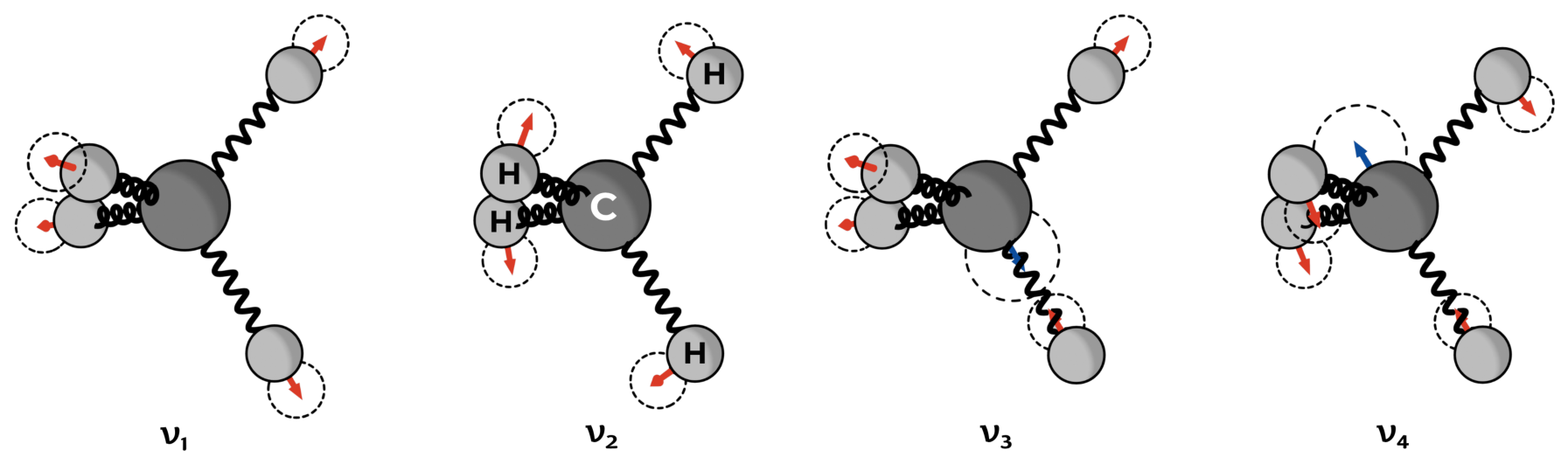
The methane molecule has four normal vibrational modes that differ in symmetry and degeneracy as illustrated in
Figure 1 and summarized in
Table 1. Modes
and
correspond to the symmetric and antisymmetric C–H stretching vibrations, whereas modes
and
represent the bending deformations. The lowest-frequency mode is
, followed by
, while both stretching modes are characterized by considerably higher vibrational quanta. This frequency ordering indicates that the bending subsystem is expected to dominate the direct vibration–translation relaxation, whereas the stretching modes relax primarily through vibration–vibration energy redistribution.
Within the harmonic-oscillator approximation, the vibrational energy of a methane molecule in the vibrational state
is written as [
62]
where
h is the Planck constant,
c is the speed of light,
is the spectroscopic constant of mode
m related to its frequency,
is the degeneracy of the
mth mode, and
is the corresponding vibrational quantum number. For the dissociation energy
J, this model yields 1935 vibrational states below the dissociation threshold [
48].
Due to the degeneracy of the bending (
,
) and antisymmetric stretching (
) modes, each vibrational state
has a statistical weight [
48]
which accounts for the number of degenerate sub-states sharing the same vibrational energy (
1).
The harmonic-oscillator approximation (
1) is adopted in the present work. Second-order perturbative approaches to vibrational anharmonicity have been developed for polyatomic molecules, including analytical formulations for linear and symmetric-top molecules [
64] and perturb-then-diagonalize treatments applicable to spherical tops such as methane [
65,
66]. Their application to the present vibrational-energy model would require the determination of the corresponding molecule-specific parameters and an additional treatment of degeneracy and resonance effects. The inclusion of anharmonicity is therefore left for future work, where both the calculation of anharmonic constants and the use of vibrational energies available from variational or spectroscopic studies [
6,
67,
68] may be considered.
2.2. Vibrational Energy Transitions in Methane Collisions
We now specify the types of vibrational energy transitions considered in this work. Since pure single-component methane is studied, all collisions are those of two CH
4 molecules. In a binary collision,
and
denote the vibrational states of the colliding molecules, and the primed symbols denote the post-collision values. In the VT transitions, the partner state does not change, and the exchange occurs for the specific mode only, e.g.,
In the VV exchanges, either both partners change their vibrational states, or energy exchange occurs between different modes of a polyatomic molecule. The VV transitions are written as
The energy excess in the transition is transferred to the translational motion.
2.3. Experimental Data on VT Relaxation
Most of the available experimental data for pure methane are related to VT relaxation. The measurements were obtained by a variety of techniques, such as ultrasonic absorption and velocity-dispersion measurements [
14,
15,
16,
17,
18,
19,
20,
69], shock-tube vacuum-ultraviolet absorption [
21], laser-induced vibrational fluorescence [
24,
61], photoacoustic and spectrophone phase-shift techniques [
22,
23,
27,
70], and time-resolved pump–probe double-resonance measurements [
28,
29].
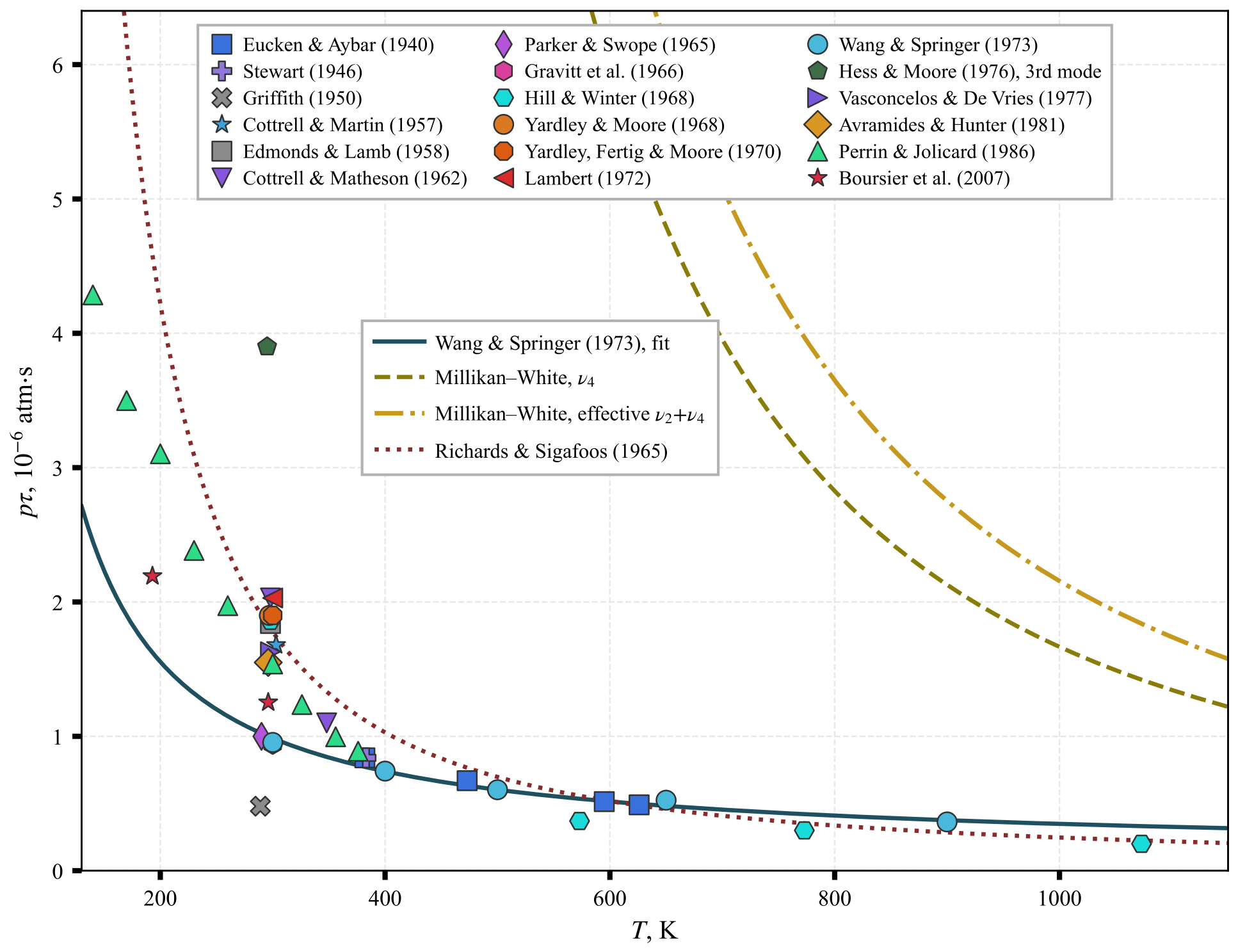
Figure 2 summarizes the experimental data on the pressure-normalized vibrational relaxation time
in pure methane gas [
14,
15,
16,
17,
18,
19,
20,
22,
23,
24,
25,
27,
28,
29,
61,
69,
70,
71,
72,
73].
At moderate temperatures, the data obtained by different techniques follow a common trend, although the values reported near room temperature can still disagree by almost a factor of two. At low and high temperatures the data are much sparser and the uncertainty is correspondingly higher. In the same figure we also show the phenomenological model of Millikan–White [
47], in which the relaxation time is evaluated from the characteristic vibrational temperature of the mode with the lowest frequency, together with the model of Richards and Sigafoos [
21] adopted in our previous work [
48]. The Millikan–White model overestimates the relaxation time by more than an order of magnitude. The Richards–Sigafoos formula was fitted to shock-tube data and agrees with the data near and above room temperature, overestimating
only at low temperatures.
In most experiments, the reported VT relaxation time corresponds to the relaxation of the bending subsystem rather than of an isolated mode since the modes
and
have similar frequencies and are efficiently coupled by VV redistribution [
24,
26,
27,
28,
29]. Following common notation, the symbol
is used throughout the paper for the mode
m. Therefore, the observed VT relaxation is usually interpreted as the effective relaxation of the combined bending subsystem [
23,
24]:
where
is the VT relaxation time of mode
m, and
is the equilibrium population of the first excited level of mode
m at the translational–rotational temperature
T [
23,
24] so that for the Boltzmann distribution,
Here,
is the Boltzmann constant. In
Figure 2, we assume that the experimental data correspond to this effective case, the only exception being the times reported for the third mode [
25]. To further illustrate the inaccuracy of the Millikan–White formula, we also show its effective relaxation time calculated from Equation (
5), which also deviates substantially from the measurements.
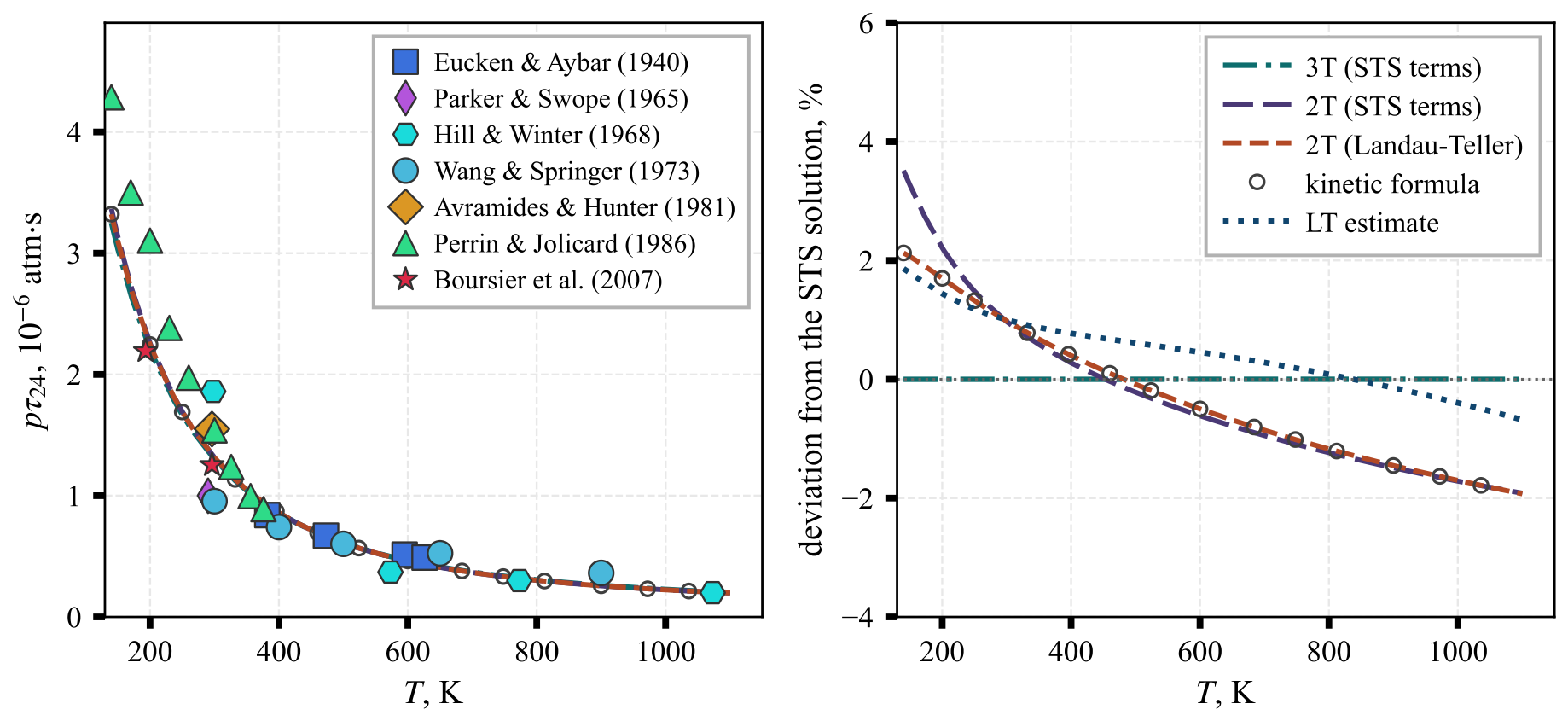
For the calibration of the FHO model parameters (
Section 5), we will employ the bending-relaxation times of Boursier et al. [
28,
29], Hill and Winter [
19], Wang and Springer [
20], Parker and Swope [
72], Avramides and Hunter [
27], Eucken and Aybar [
14], and Perrin et al. [
22,
23]. These works cover the whole temperature range 140–1100 K while avoiding duplicated data sets.
2.4. Experimental Data on VV Energy Exchanges
Experimental studies on VV exchanges in pure methane are much less common than those on VT transitions. The VV relaxation times were measured by Yardley and Moore [
24], Vasconcelos and De Vries [
70], Hess, Kung and Moore [
26], Avramides and Hunter [
27], and Boursier et al. [
28,
29]. Some of them were revised in Ref. [
9]. Most of the measurements were performed near room temperature, so their conclusions apply mainly to the low- and moderate-temperature kinetics. The time values are summarized in
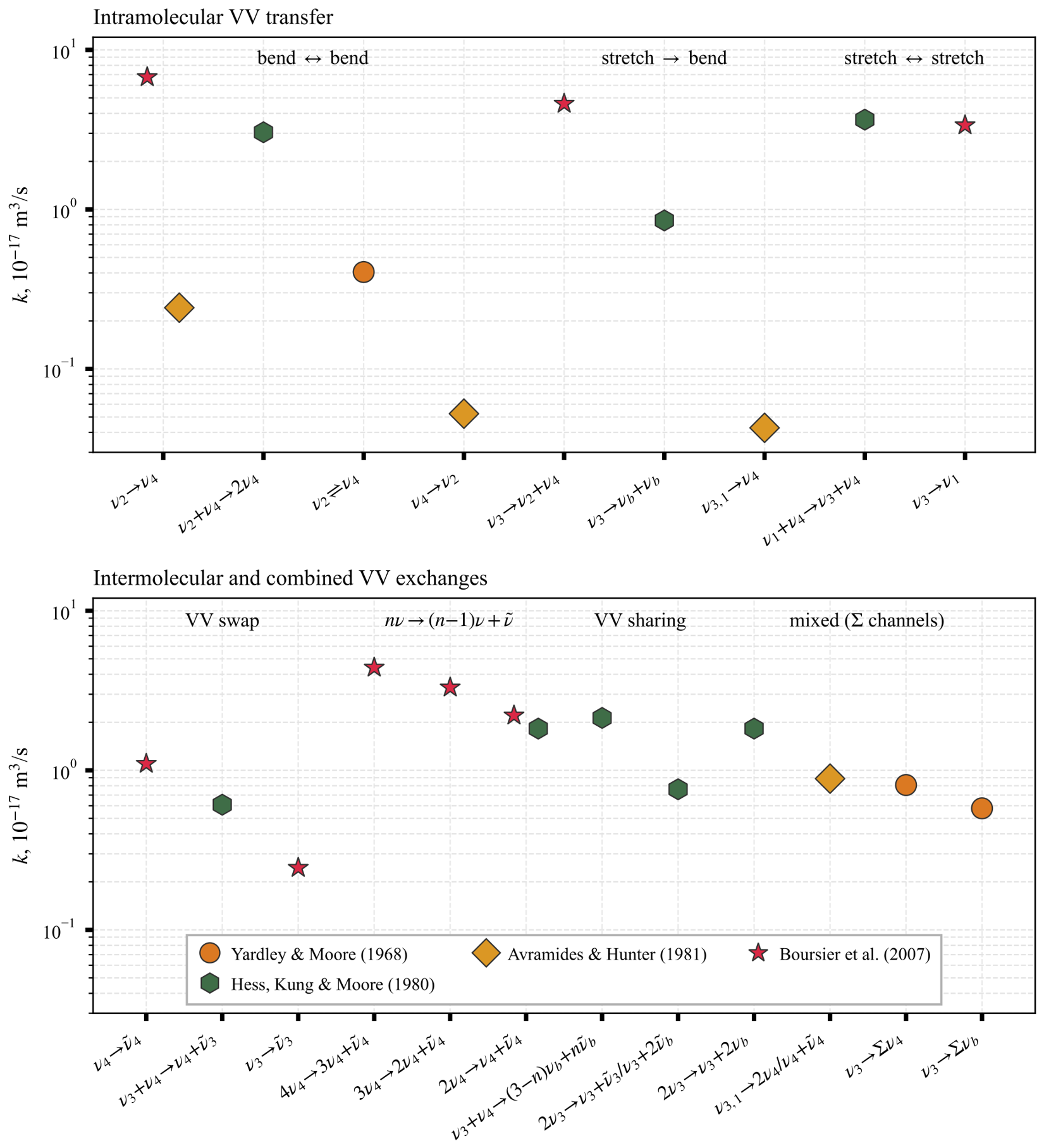
Appendix A and are collected in
Figure 3, grouped according to the type of process and the number of exchanged quanta.
In the compact notations of the processes, is the kth vibrational level of mode , and the tilde marks the modes of the collision partner. Thus, denotes the intermolecular exchange of the bending quanta, and the intramolecular one. Additionally, denotes an unresolved bending quantum ( or ), and marks totals over unresolved channels. Unless indicated otherwise, the transitions proceed mostly from the first excited level of the initial mode to the first excited levels of the resulting modes. Here, we mostly review the direct reactions (→) as reported in experiments, unless written otherwise.
The names of the processes in
Figure 3 are adopted from the experimental works. The resonant transfer of a vibrational quantum to the same mode of the collision partner,
, reported for the
and
modes, was denoted as “swap” in [
28,
29], and this designation is used throughout the paper. The term “sharing” refers to the transitions distributing the vibrational energy of the excited molecule between both collision partners. The label “mixed” marks the summary rates over unresolved channels.
The most rapid exchanges (see
Figure 3) are those responsible for the intra-manifold equilibration, that is, the
redistribution within the stretching subsystem and the
redistribution within the bending subsystem. The values reported for the stretch–stretch energy exchange agree well and show that the two stretching modes can be treated as mutually equilibrated on the timescale of the slower channels. The
data show larger scatter. Still, the small energy gap between the two bending modes and recent pump–probe measurements [
28,
29] indicate that this exchange is also rapid.
The resonant intermolecular exchange within the mode (the -ladder processes ) also has comparatively large rates that scale almost linearly with the level number. This shows that, once the energy enters the bending manifold, it is redistributed rapidly over the ladder of the levels.
The most important result of the analysis of VV measurements is the identification of the dominant stretch-to-bend energy transition channels. The direct single-quantum transition is slow because of its large energy release. The near-resonant double-quantum and combination pathways, such as or , are much more efficient and are expected to be the main channels towards the redistribution of energy between stretching and bending modes.
Overall, the analysis of experimental data shows that vibrational relaxation in methane proceeds in several distinct stages, consistently reported in [
24,
25,
28,
29]: (i) the rapid resonant and near-resonant exchanges first establish quasi-equilibrium within the stretching and within the bending manifolds; (ii) the stretch-to-bend transition channels then transfer energy between the manifolds on a distinctly longer timescale; and (iii) finally, the vibrational energy accumulated in the bending manifold is deactivated to translation through the slow VT processes. During the intermediate stages, the two manifolds may therefore have different vibrational temperatures.
Based on the above observations, we construct the kinetic scheme presented in
Appendix B. The scheme includes the reactions observed in the experiments, generalized to higher vibrational levels, together with several additional processes. The next step is to identify the rate coefficients for the processes of the scheme.
In the present work, due to the large number of vibrational exchanges in methane, we start with a perturbation of the
mode, following the conditions of most experiments. Five processes are considered: the VT relaxation of the two bending modes, VT
2 (
A2) and VT
4 (
A3); the intramolecular and intermolecular
exchanges,
and
(
A7); and the resonant quantum swap within the
mode,
(
A8). The kinetic scheme contains an explicit swap for the
mode only since no experimental rate is available for the
analogue. The subsets of these processes retained in each fluid-dynamic model are specified in the next section, where the corresponding systems of governing equations are constructed.
4. FHO Model Application for Methane Molecules
In this section, the forced harmonic oscillator (FHO) model [
50,
51,
53,
57] is extended to CH
4–CH
4 collisions to provide the state-to-state rate coefficients of vibrational energy transitions. The extension to methane is based on the structure of the model itself. The FHO probabilities are derived for an abstract harmonic oscillator driven by a classical trajectory. The molecule enters the model only through the mode frequency, the reduced oscillator mass, and the mass parameter, together with the interaction parameters and steric factors of the collision pair. Within the harmonic approximation adopted here, the vibrational motion of CH
4 is represented by independent normal oscillators so that every mode can be treated as a forced harmonic oscillator to which the model applies directly. For methane, this mapping was introduced by Cottrell and Ream [
53]. The remaining three-dimensional effects of the collision geometry are absorbed into the steric factors. These corrective factors were introduced for noncollinear collisions in Ref. [
50] and are calibrated against rate data in the polyatomic applications [
32,
58] and in the present work. The main limitations of the resulting description should be kept in mind: the vibration–rotation Coriolis coupling, which is not negligible for the
modes of a light and fast-rotating molecule, is not taken into account.
In the present work, both formulations of the FHO probabilities for polyatomic methane collisions are employed: the original Zelechow-type expressions, as in Ref. [
58], and the simplified Bessel-function expressions of Adamovich et al. [
50]. The choice between them for the VT and VV transitions is justified by direct comparison in
Section 4.3.
4.1. Rate Coefficients from Integral Cross Sections
Consider a binary collision of two methane molecules, in which the vibrational states of the partners change in a VT (
3) or VV (
4) transition. The general state-to-state rate coefficient is given by [
30,
59,
74]
where
is the reduced mass of the collision pair,
g is the relative velocity, and
is its dimensionless counterpart. The integral scattering cross section is factored into the elastic and the inelastic parts [
32,
59]:
where
is the elastic collision cross section of the pair and
is the probability of the corresponding transition.
4.2. Elastic Collision Cross Section
The elastic collision cross section is calculated using the variable hard sphere (VHS) model [
76]:
where the diffusion and viscosity cross sections are
The model parameters
,
,
, and
for CH
4–CH
4 interactions are obtained by fitting the VHS cross sections to the collision integrals computed from the Lennard–Jones potential with the methane parameters
Å and
K [
77]. Their values are reported in
Table 2. The fit is performed over the temperature interval 500–2000 K, so at the lower temperatures of the present study, down to 140 K, the power-law correlation is extrapolated beyond its fitting range.
4.3. FHO Transition Probabilities
Here, we present the FHO expressions for the inelastic transition probabilities entering the factorization (
34), first for the VT and then for the VV exchanges.
4.3.1. VT Transition Probability
For a VT-type transition (
3), in which only the vibrational state of methane changes, the exact FHO probability follows from the closed-form solution for a harmonic oscillator forced by a classical trajectory [
55,
56]. For a transition
within a single active mode
m, it reads [
58]
where the dimensionless FHO parameter
represents the first-order perturbation theory (FOPT) probability of the fundamental single-quantum transition:
where
and
are the Morse potential parameters (the repulsion range parameter and the well depth),
is the reduced oscillator mass for the active mode,
is the mass parameter of the vibrational mode, and
is the steric factor. The angle parameter
is
The average oscillator frequency
is computed from the vibrational energy change:
Here,
s is the total number of exchanged vibrational quanta,
The symmetrized collision velocity is [
50]
The original expression (
37) was simplified by Adamovich et al. [
50] into the Bessel-function form
where the combinatorial factor
accounts for the multi-mode structure of methane [
32]:
For the single-quantum VT transitions retained in the kinetic scheme, the two expressions give practically identical results: in our calculations, the rate coefficients computed from Equations (
37) and (
43) agree within
over 140–1100 K for all retained transitions. The simplifiedform (
43) is therefore used for the VT transitions.
4.3.2. VV Transition Probability
For a VV-type exchange (
4), the original factorial probability was derived by Zelechow et al. [
57] for two collinear harmonic oscillators carried by the colliding molecules. In this intermolecular form it was applied to the CO
2–CO
2 exchanges by Vargas et al. [
58]. For the intramolecular transitions of CO
2, in which one molecule changes several of its own modes while the partner only provides the perturbation, Kravchenko et al. [
32] employed the single-oscillator VT expressions instead. Here, the two-oscillator construction is applied in a unified form to both configurations. The two exchanging oscillators are either the active modes of the two colliding molecules (intermolecular exchanges) or two effective oscillators of one molecule (intramolecular transitions).
Let the two exchanging oscillators change their states as
(the oscillator losing quanta) and
(the oscillator gaining quanta), and denote
,
. The probability reads
where
,
,
, and
are the orthogonal transformation matrices [
57], which connect the product basis of the two oscillators with the normal-mode basis of the collision system. The parameter
is given by Equation (
38). The VV coupling parameter
is
Here,
is the VV steric factor. The symmetrized velocity
in the VV case is evaluated by Equation (
42), where the energy change is replaced by the net vibrational energy variation of the collision system
.
The two configurations differ only in the assignment of the oscillators. In the intermolecular exchanges, the oscillators are the active modes of the two molecules, and
is evaluated at the frequency of the mode losing quanta. In the intramolecular channels, the mode losing quanta forms the first oscillator. The resulting modes are combined into one effective oscillator, which carries their summed quanta and the oscillator mass of the mode gaining the most. The frequencies follow from the energy changes per exchanged quantum, in line with Equation (
40), and
is evaluated with the mass of the first oscillator at the frequency of the net energy variation
, the energy actually exchanged with the translational motion. In both configurations, the steric factor applied to the
-dependent (translational) factors is denoted
and the one applied to
is denoted
.
In the regime
, when the quantum exchange decouples from the translational motion, the sum reduces to the simplified expression [
50]
with
and
being the combinatorial factors (
44) computed for the two colliding molecules from their initial and final quantum numbers. Each factor is evaluated with the number of quanta
exchanged by the corresponding molecule, and the exponent in Equation (
47) is
. The parameter
accounts for near-resonant energy exchange:
For strictly resonant exchange (), and , so that the probability depends only on the parameter .
The two formulations are not equivalent for the VV exchanges. For the resonant intra-mode processes, the condition
holds, and with the calibrated parameters of
Section 5 the two formulations agree within
. For the non-resonant inter-mode channels, the energy variation must be accommodated by the translational motion, the condition breaks down, and the predictions of the two formulations diverge by up to three orders of magnitude. The inaccuracy of the compact expressions for non-resonant multi-quantum VV transitions was noted already in Ref. [
50]. Accordingly, the simplified formulation (
47) is used for the resonant intra-mode exchanges, and the original construction for the non-resonant inter-mode channels.
4.4. Molecular Parameters for CH4–CH4 Collisions
The FHO model requires the following molecular parameters for each collision pair: the Morse interaction potential parameters (
,
), the reduced oscillator masses (
), the mass parameters (
), the oscillator frequencies (
), and the steric factors (
,
). The mode frequencies are evaluated from the harmonic wave numbers
listed in
Table 1, which are the spectroscopic constants derived from the anharmonic force-field analysis of the measured vibration–rotation spectra of methane [
63]. The values of the mass parameters
and of the reduced masses
can be calculated theoretically from the normal-mode analysis. The steric factors and Morse potential parameters require a fitting procedure since their values for the methane modes are not reported in the literature. The Morse parameters and the VT steric factors are fitted to the measured bending relaxation times in
Section 5.2, and the VV steric factors are calibrated to the measured room-temperature rate coefficients in
Section 4.5 and
Section 5.4.
The reduced oscillator mass
is the normal-mode reduced mass computed in the harmonic approximation [
62,
78]. For the
(
) and
(
E) modes, the central carbon atom remains stationary by symmetry, and
equals the hydrogen-atom mass exactly, whereas for the
modes, the carbon atom displacement makes it slightly larger. For the latter modes, the reduced mass depends on the harmonic force field through the mixing of the two normal modes of the same symmetry, and closed-form expressions in terms of the atomic masses alone are only approximate. The values listed in
Table 3 are therefore taken from the normal-mode calculation of the NIST database [
79] (the harmonic normal-mode analysis at the Hartree–Fock/6-31G* level).
The mass parameter
, evaluated theoretically from the normal-mode displacements, characterizes the fraction of the vibrational displacement carried by the atoms facing the collision partner. In methane, the vibrational displacement is carried almost entirely by the hydrogen atoms, and its projection onto the oscillation axis, averaged over the molecular orientations and the degenerate components of the mode, is close to
for every mode: the value is exact for the
and
modes, in which the carbon atom is stationary, and deviates by less than
for the
modes. The value
is therefore adopted for every mode as an effective orientation-averaged convention. The same value was used for all modes of CO
2 in Refs. [
32,
58].
4.5. Calculated VV Rate Coefficients
Before employing the FHO model within the kinetic scheme, we illustrate that it yields VV rate coefficients of the correct magnitude and scaling for methane.
The calculations use the Morse parameters obtained in
Section 5. The steric factors are calibrated per channel at the room-temperature reference rates. The processes accounted for include
,
, together with
. The calibrated factors are collected in
Table 4.
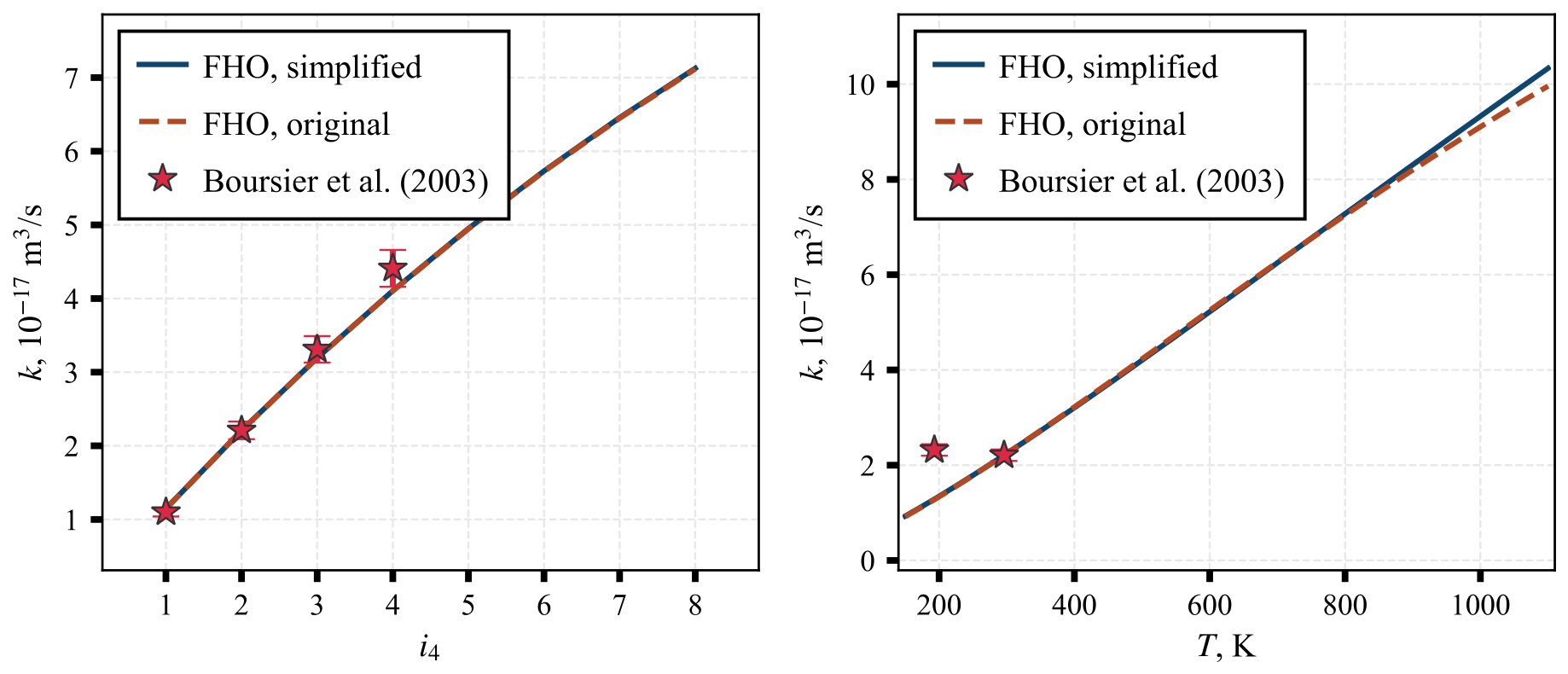
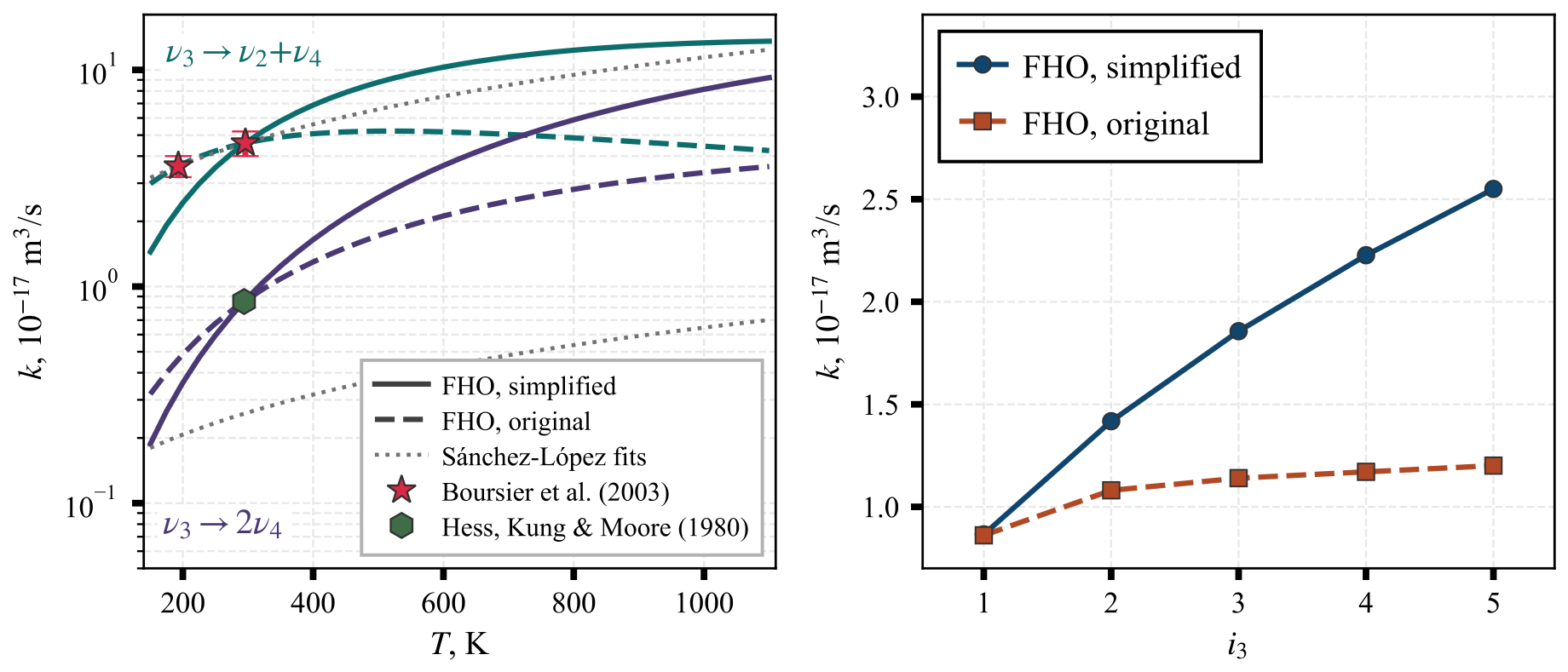
Figure 4 shows the resonant quantum exchange within the
mode,
. For this resonant channel the two formulations coincide within one percent. The computed rates grow almost linearly with the level, reproducing the experimental scaling within the measurement uncertainty, and depend weakly on temperature. The measured rate at 193 K, however, exceeds the room-temperature value, whereas the model predicts a monotonic decrease and underestimates this point by almost a factor of two. A possible interpretation is that at low temperatures the resonant transfer becomes governed by the long-range attractive interaction, not described by the short-range repulsive FHO mechanism. A similar underestimation was reported for CO
2 mixtures [
32]. The FHO ladder rates should therefore be used with caution below 250 K.
The non-resonant stretch-to-bend channels (
Figure 5) are sensitive to the choice of the formulation. For
, the original expression reproduces both measured temperatures, whereas the simplified one underestimates the 193 K rate by about
and rises more steeply towards high temperatures. For
, both formulations pass through the measured point by construction. The right panel shows the scaling with the stretching level, for which no measurements exist: the simplified expression grows roughly proportionally to
, whereas the original one is almost independent of the level, and this difference remains the main open uncertainty of the extrapolation to highly excited states.
The simplified formulation remains accurate as long as the parameter
is not too large, the underlying conditions being
and
[
50]. For the VT transitions, they can be written as
with
With the methane parameters,
K for the
mode and
K for
, so the conditions are satisfied. For the VV exchanges, however, the two formulations are equivalent only in the resonant channels (
Section 4.3).
6. Conclusions
In this study, detailed models of non-equilibrium vibrational relaxation in pure methane were developed. The available experimental data on vibrational energy transitions in CH4–CH4 collisions were analyzed, and the observed VT and VV energy exchanges were classified according to the process type and the characteristic timescales. Based on this analysis, a general kinetic scheme was constructed by generalizing the observed transitions to arbitrary vibrational levels.
The state-to-state rate coefficients of the vibrational transitions were calculated using the FHO model, applied for the first time to CH4–CH4 collisions. We derived the required molecular parameters theoretically from the normal-mode analysis for methane–methane collisions. Two formulations of the transition probabilities were compared. It was shown that the simplified expressions can be applied to the VT transitions and to the resonant VV exchanges, whereas the non-resonant inter-mode channels require the original formulation. This distinction follows from the applicability conditions of the simplified formulation. For the VT transitions and the resonant exchanges, the two formulations practically coincide within the considered temperature range, whereas for the non-resonant channels, in which the energy variation has to be accommodated by the translational motion, the simplified expressions lose their accuracy, and the predictions of the two formulations differ by orders of magnitude. The model reproduces both the measured level dependence of the resonant exchange within the mode and the temperature dependence of the stretch-to-bend transitions. The unknown model parameters were calibrated by comparing the relaxation times obtained from the solution of the isothermal bath problem within the STS approach with the measured bending relaxation times, and the calibrated model reproduces the experimental data with satisfactory accuracy over a wide temperature range.
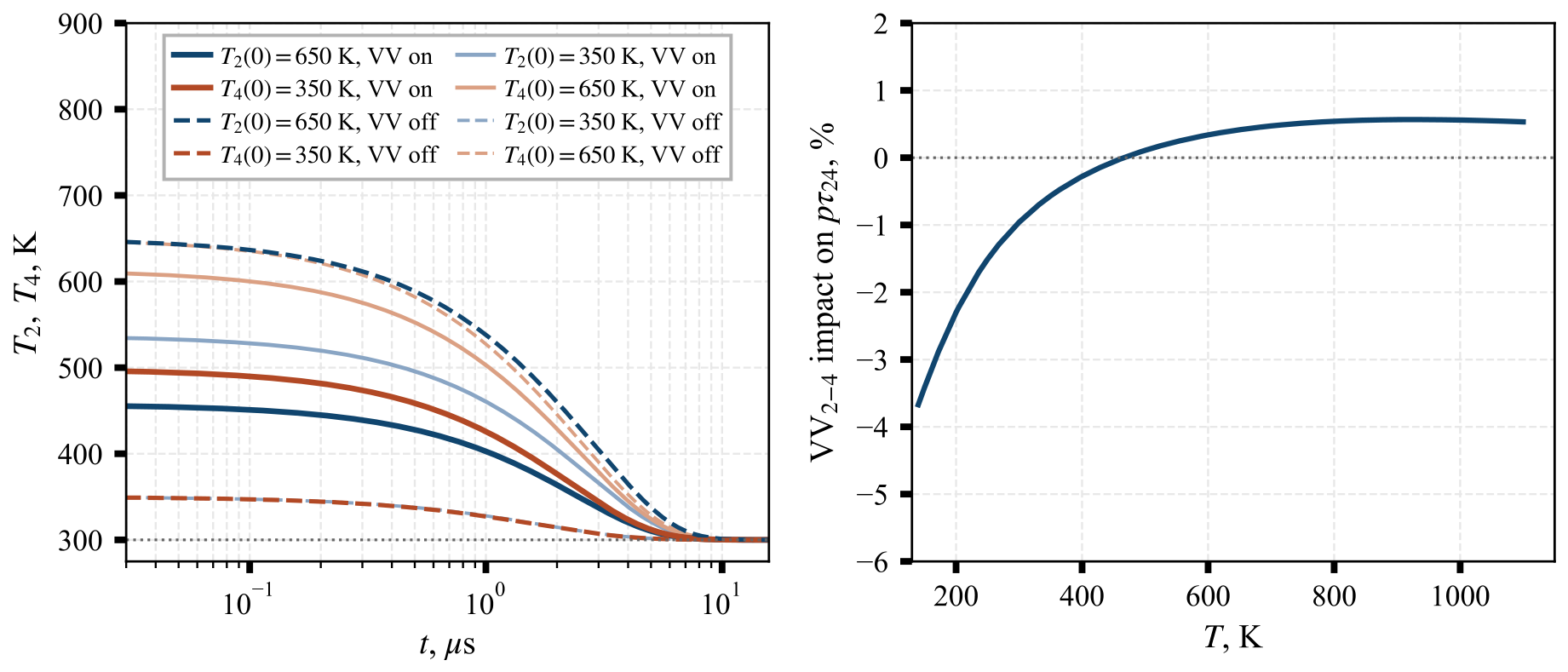
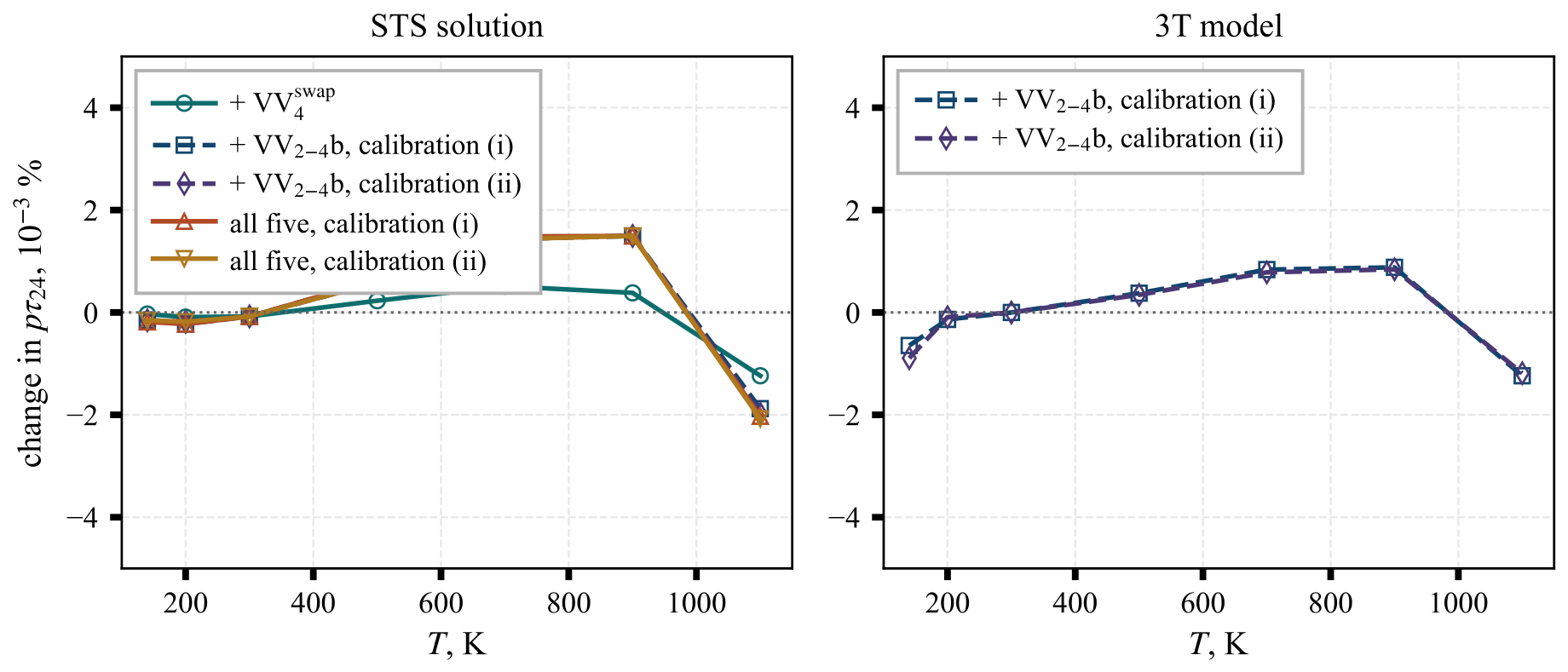
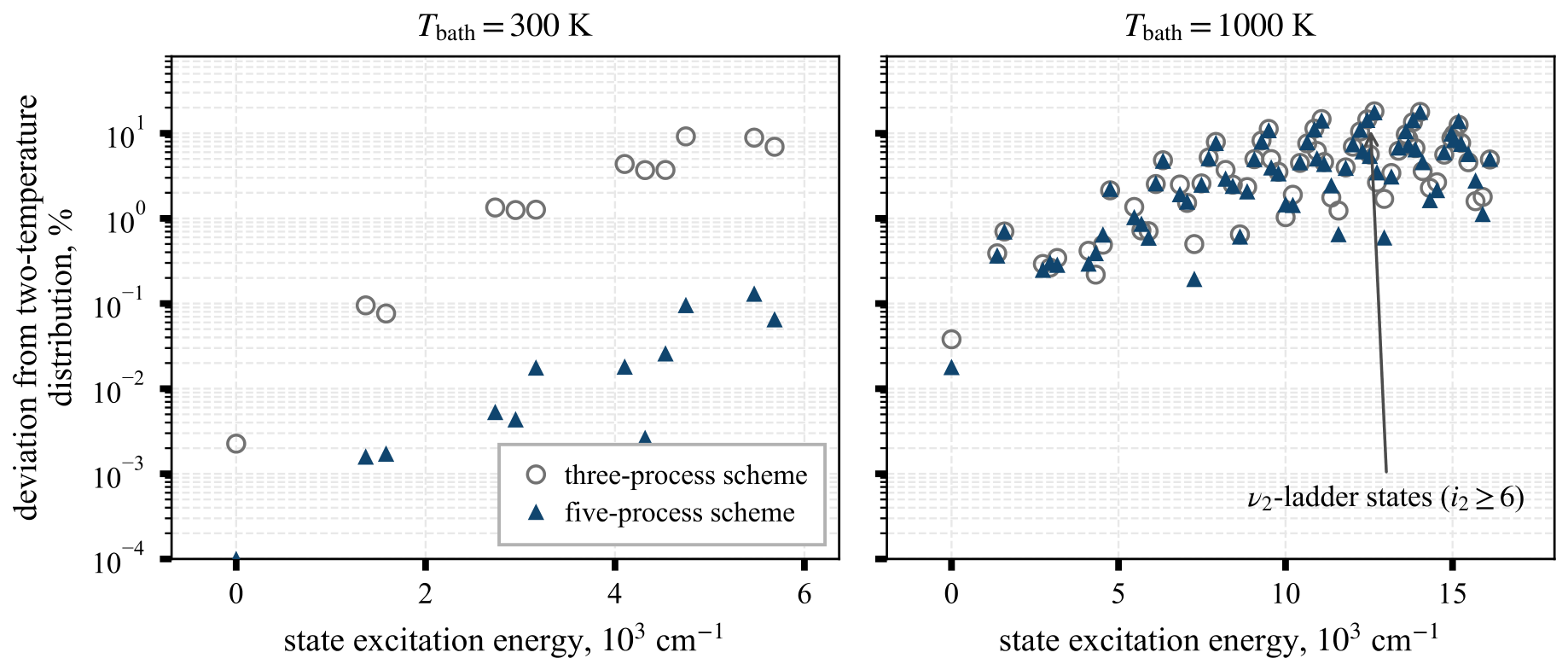
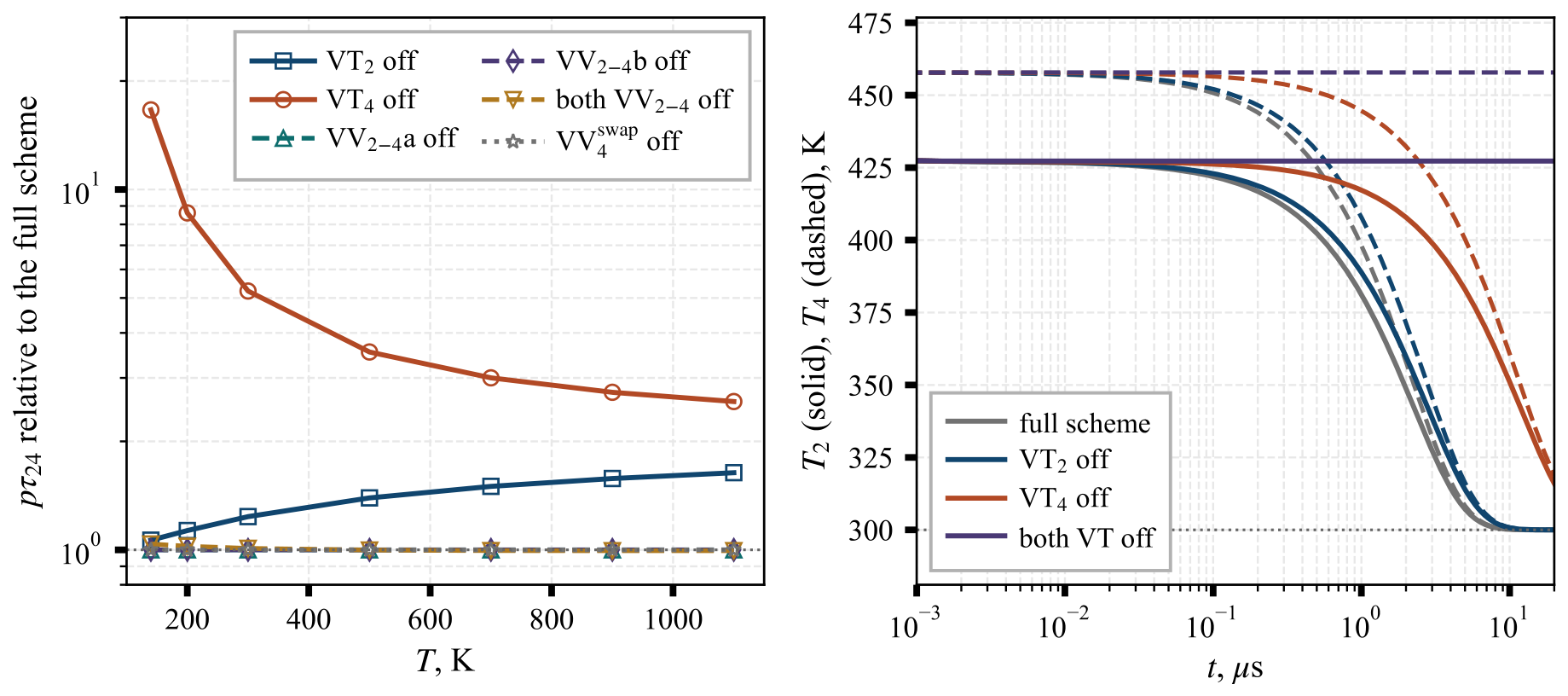
The closed systems of governing equations for non-equilibrium methane flows with excited bending manifold were presented in the state-to-state, three-temperature, and two-temperature approaches, continuing our previous one-temperature description. We assessed the reduced models with different closures of the relaxation terms against the state-resolved solution of the isothermal bath problem. It was shown that the three-temperature model yields excellent agreement with the state-resolved solution for the relaxation time. For the full system of vibrational states, the mode-temperature description with the additional stretching temperature is roughly an order of magnitude computationally cheaper than the state-resolved one, whereas for the bending manifold the costs of the two descriptions are comparable. The two-temperature model together with the Landau–Teller closure also provides good accuracy, with the largest deviations observed at low temperatures. The state-resolved populations remain close to the quasi-equilibrium 3T distribution, although noticeable deviations are found at the highly excited states of the mode. We also demonstrated that the VT deactivation of the mode dominates the relaxation, whereas the rapid VV exchanges affect the relaxation time only weakly. To summarize, the obtained results indicate that the bending-mode relaxation can be described with a common vibrational temperature of the bending modes.
Future work may include several directions. The next step is the modeling of the stretch-to-bend relaxation, which requires the calibration of the stretch-mode channels of the kinetic scheme. We also plan to extend the developed approach to methane-containing mixtures common in applications of methane flows, in particular CH4/N2, which is of interest for the planned missions to Titan. Refining the model at low temperatures and accounting for the vibration–rotation coupling and for the anharmonicity of the vibrational states are among other promising directions.