Article

Interspecific Variation in Methane Emissions Under Wind Exposure from Two Cultivated Species of Brassicaceae

Department of Biology, Mount Saint Vincent University, 166 Bedford Highway, Halifax, NS B3M 2J6, Canada
*
Author to whom correspondence should be addressed.
Methane 2026, 5(1), 3; https://doi.org/10.3390/methane5010003 (registering DOI)
Submission received: 25 October 2025 / Revised: 24 December 2025 / Accepted: 25 December 2025 / Published: 1 January 2026

Abstract

Aerobically produced methane (CH4) from plants is influenced by several environmental factors, but wind velocity has yet to be investigated for its potential role in plant-derived CH4 emissions. We tested three wind velocities (0, 6, and 12 km h−1) on a wind-susceptible, Raphanus sativus (radish), and a wind-tolerant, Brassica oleracea var. sabellica (kale) plant species to investigate the effects of wind on plant-derived CH4, and to compare how varying tolerances to wind affect CH4 emissions. We found that wind exposure resulted in a decrease in leaf surface area, root and total dry mass, and an increase in leaf water potential for radish plants, while kale plants were affected minimally by wind. Radish plants emitted more CH4 than kale plants, although the effect of wind velocity on CH4 emissions and several of the measured traits was insignificant. Our study revealed that short-term exposure to lower wind velocities is generally insufficient to induce significant changes in plant growth and functioning. However, we showed that radish plants were more stressed by exposure to wind compared to kale plants, as indicated by lower plant growth and higher CH4 emissions.

1. Introduction

The atmospheric concentrations of greenhouse gases have increased dramatically since the Industrial Revolution, with the second-most important among them being methane (CH4) [1]. The largest contributors of CH4 to the global methane budget are anthropogenic sources, especially from industries, such as agriculture and fossil fuel extraction; however, natural CH4 sources, such as wetlands and termites, also contribute substantial quantities of CH4 to the atmosphere, accounting for approximately 40% of the global CH4 budget [1,2,3,4]. Until recent decades, it was generally thought that organically produced CH4 was emitted solely by anaerobic archaea; however, Keppler et al. [5] subverted this understanding when they detected CH4 emissions from plants under aerobic conditions. This finding was initially challenged by other researchers who reported that they were unable to detect significant amounts of CH4 being produced by plants [6,7]. Nonetheless, with the use of isotope labelling studies, Keppler et al. [5] and others were able to demonstrate that the measured CH4 emission in their plant samples was produced directly by vegetation and not by other sources, such as methanogens living on the plant or in the soil [5,8,9,10,11,12]. Several studies have since shown that plants produce more CH4 when exposed to stress factors, such as high temperatures [5,13,14,15], ultraviolet-B radiation [13,14,15,16,17,18], water stress [14], light quality [19] and quantity [20], photoperiod [21], and physical injury [12,22,23]. The quantity of CH4 produced also varies among different plant organs [24], developmental stages [25], and plant species [14,21,22,26]. CH4 emissions from plants belonging to different morphotypes can vary, with some morphotypes exhibiting a higher likelihood of emitting CH4 [22]; however, even closely related species, such as wheat and barley or pea and faba bean, have been reported to emit greatly differing quantities of CH4 [14,26]. Additionally, responses of species to stressors can vary; for example, wheat plants grown under higher temperature, enhanced UV-B radiation, and water stress emitted more CH4 [14] compared to wheat plants grown under higher temperature, water stress, and elevated CO2 [26]. In addition to the extensive investigation into the conditions that influence CH4 emissions, several precursors to plant-derived CH4 have been suggested. Leaf surface wax [18], amino acids, such as methionine [12], and structural components, such as pectin [8,13,15,16,17,22], lignin [13,22], and cellulose [13], have been established as potential sources from which CH4 gas is produced by plants. Recently, Schroll et al. [27] have also confirmed dimethyl sulfoxide (DMSO) as a potential precursor to CH4 in plants.
The precise mechanism that allows plants to emit CH4 is not yet known, although since the initial study by Keppler et al. [5], aerobically produced CH4 has been detected from fungi [28], algae [29], cyanobacteria [30], and animals [31], including humans [32]. It is believed by some researchers that plant-derived CH4 is not the product of a metabolic process, as with anaerobic methanogens [33], though that possibility has not been entirely dismissed [34]. Instead, researchers have investigated the role of reactive oxygen species (ROS) and oxidative stress in the formation of aerobic CH4 emissions [16,35,36]. Since CH4 emissions increase when plants are exposed to stressors, it is thought that the ROS produced during stress are responsible for cleaving methoxyl groups from the precursors, making it available to be released as gaseous CH4 [32,37]. Interestingly, recent studies have reported that CH4 has a more active role in plant functioning than simply being a byproduct of stress; there is evidence that CH4 reduces oxidative stress in plants [37,38] and has protective properties against abiotic stressors, such as water stress [39] and metal toxicity [40,41,42]. Moreover, beneficial effects of CH4 on several aspects of plant development, such as improved seed germination and seedling growth [39,40,42], and root development [41,43], have been described.
Many environmental stressors that are associated with global climate change (e.g., rising temperature, drought, and elevated CO2 concentration) have been studied for their influence on CH4 emissions from plants. The task of estimating plants’ contribution to the global CH4 budget is challenging due to the complexity of the environmental conditions to which plants are exposed. Attempts to estimate the quantity of plant-derived CH4 released into the atmosphere vary, with the initial estimation by Keppler et al. [5] indicating that vegetation could contribute 10–30% of the global methane budget each year; however, subsequent studies [44,45,46,47,48] found their estimations to be much lower than that of Keppler’s team [5]. Even now, an exact quantity has not been agreed upon by experts as more information is uncovered about the conditions that influence plant-derived CH4.
Wind is an environmental condition to which plants are frequently exposed, yet the impact of wind velocity on plant-derived CH4 is unknown. The effects of wind on plant morphology, coined as ‘thigmomorphogenesis’ by Jaffe [49], have been long-studied. Plants exposed to wind tend to decrease in height while the stem diameter increases, the number and surface area of leaves are reduced, and more biomass is allocated to the roots [50,51,52]. Wind is also known to affect plant physiology, as plants will generally exhibit lower photosynthetic rates [53], decreased transpiration [54,55,56], and increased water-use efficiency (WUE, [56]) in response to wind exposure.
As a mechanical force, wind impacts plant growth by way of stem bending and leaf surface abrasion, fluttering, or tearing [52]. Wind also disrupts the leaf boundary layer, which influences heat and water loss regulation in plants [57,58]; therefore, it indirectly impacts processes that rely on water and gas exchange or are temperature-dependent, such as photosynthesis [56,59]. Earlier studies report that wind exposure is often accompanied by a decrease in photosynthetic rates [53,60,61]; however, responses of plants to wind can vary depending on influences from other environmental factors [53,56,59,62]. Despite the continuous presence of wind in natural environments, it is a comparatively overlooked topic in research compared to other stressors, such as temperature and water stress.
In this pilot study, we investigated the effects of wind velocity on plant-derived CH4 emissions using two species of plants—kale (Brassica oleracea L. var. sabellica), a wind-tolerant species, and radish (Raphanus sativus L.), a wind-susceptible species. Our aim was to test the hypothesis that higher wind velocity increases stress on plants; therefore, CH4 emissions from plants exposed to higher wind velocities will be greater. Additionally, we hypothesized that radish, being more susceptible to wind, emits more CH4 compared to the wind-tolerant kale plants.

2. Results

2.1. Methane Emission

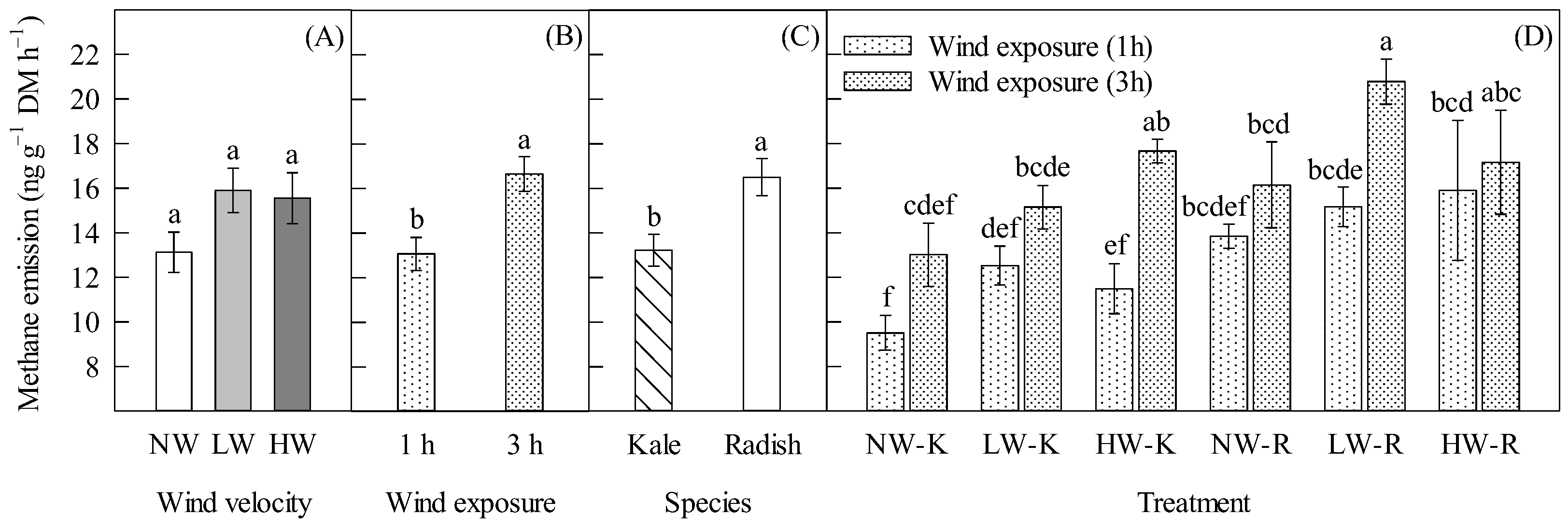
Overall, wind velocity significantly increased CH4 emissions from plants (three-way ANOVA; Table 1); however, one-way ANOVA revealed no significant effects of wind velocity on CH4 production (Fisher’s LSD test; Figure 1A). The wind exposure duration and species had significant effects on CH4 emissions (three-way ANOVA; Table 1 and Figure 1). Plants exposed to wind for three hours emitted more CH4 than plants exposed to wind for one hour (Figure 1B), especially in kale at higher wind velocity and in radish at lower wind velocity (Figure 1D). We found that radish plants produced more CH4 than kale plants (Figure 1C) and that after one and three hours of wind exposure, radish plants that were exposed to lower wind velocity emitted significantly more CH4 than kale plants that were not exposed to wind (Figure 1D). The interactions of species, wind velocity, and exposure duration did not significantly influence CH4 emissions (Table 1).

2.2. Plant Growth

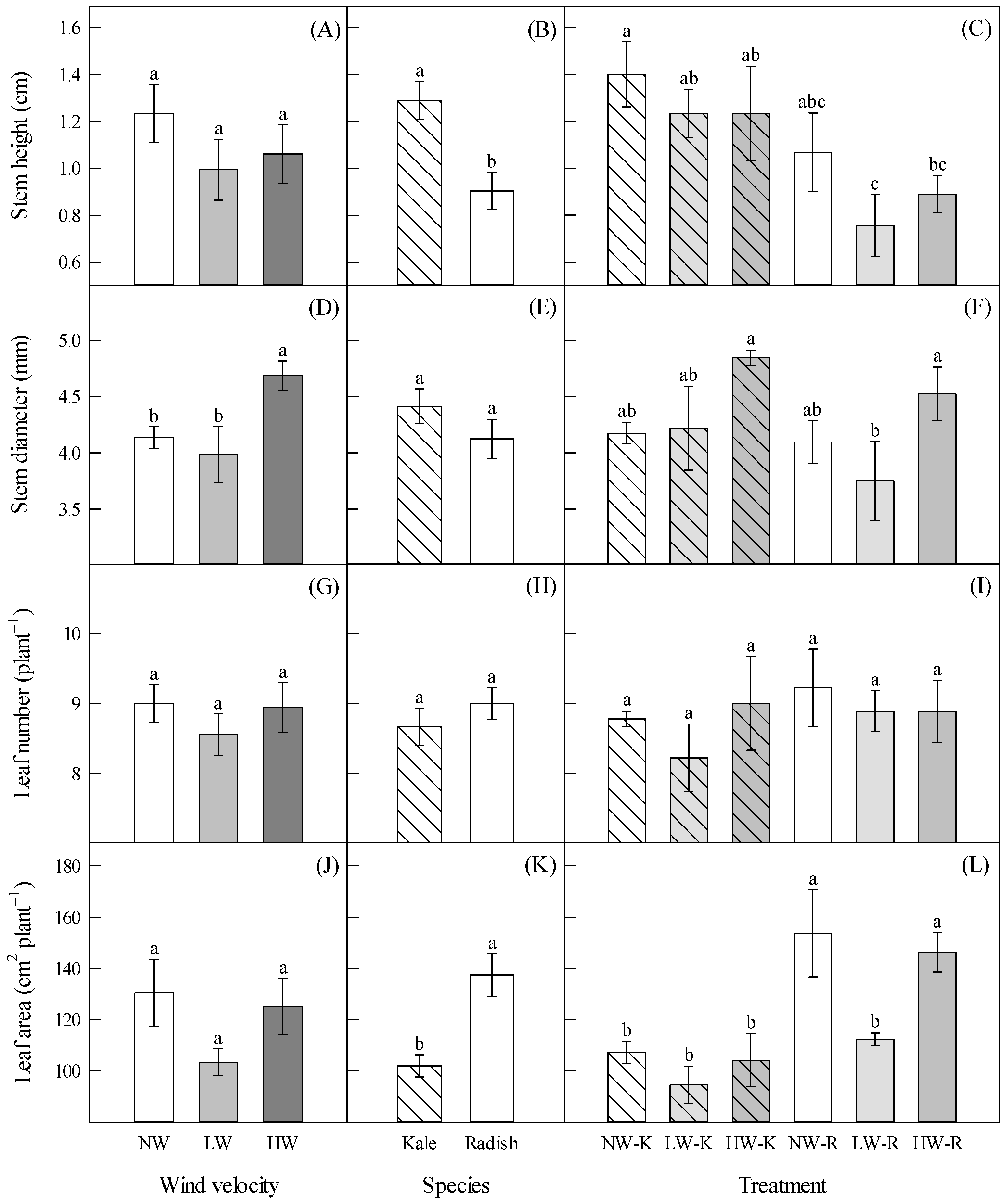
Wind significantly affected stem diameter and leaf area (two-way ANOVA; Table 2), revealing that plants exposed to higher wind had thicker stems than plants exposed to no wind or lower wind velocity (Fisher’s LSD test; Figure 2D). Radish plants were significantly shorter and had larger leaves compared to kale plants (Figure 2B,K). In radish, plants that were exposed to lower wind velocity had the smallest leaves (Figure 2L).

2.3. Plant Dry Mass

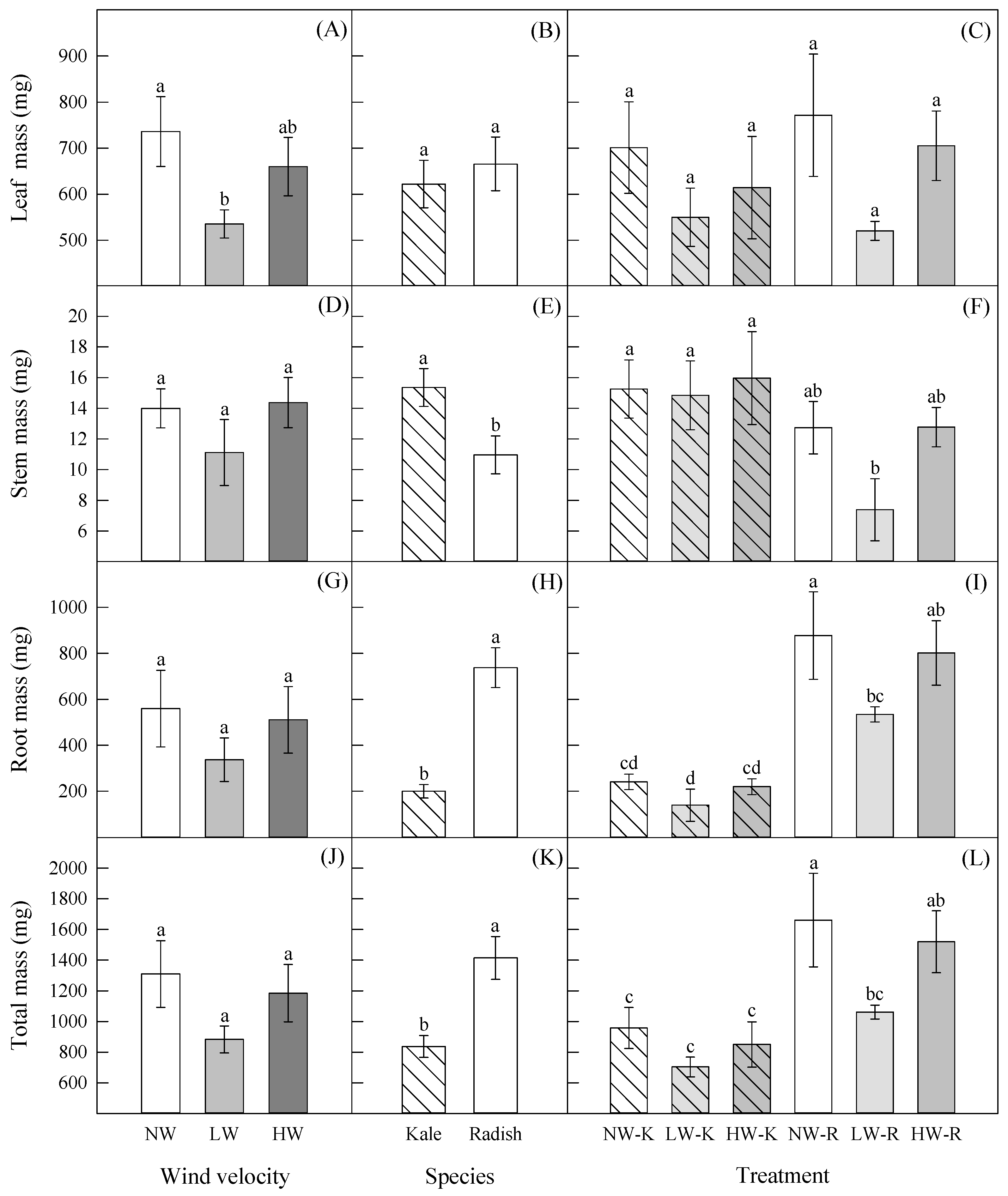
Leaf dry mass of plants exposed to lower wind velocity was significantly lower compared to plants exposed to no wind (Fisher’s LSD test; Figure 3). No other significant changes were found in dry mass accumulation because of wind exposure. Between plant species, significant differences were found in stem, root, and total dry mass (two-way ANOVA; Table 2). Radish plants had lower stem dry mass but higher root and total dry mass when compared to kale plants (Figure 3E,H,K).
Differences between radish and kale plants are likely due to anatomical differences between the species, rather than any effect caused by treatment. Radish allocates a large portion of its biomass towards a swollen taproot, whereas kale grows mostly above ground, with large, thick, waxy leaves accounting for a large portion of the total biomass.

2.4. Growth Index

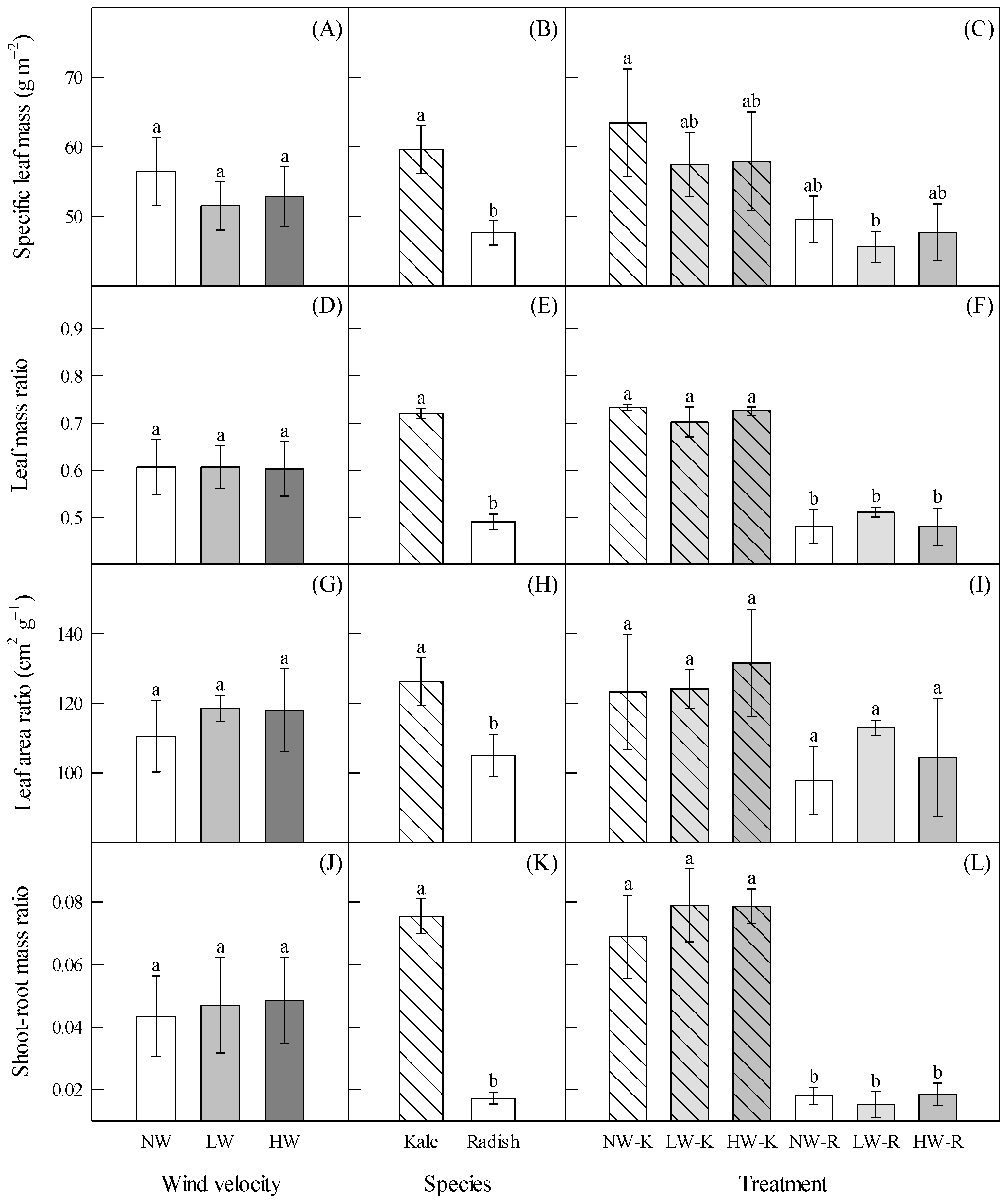
Neither wind velocity nor the two-way interaction of species and wind velocity significantly affected growth indices (Table 2). Nevertheless, significant differences between radish and kale were found for SLM, LMR, LAR, and SRR, with all traits being lower in radish compared to kale (Figure 4B,E,H,K). Like dry mass, these differences may be related to the anatomical variation between radish and kale.

2.5. Chlorophyll Fluorescence

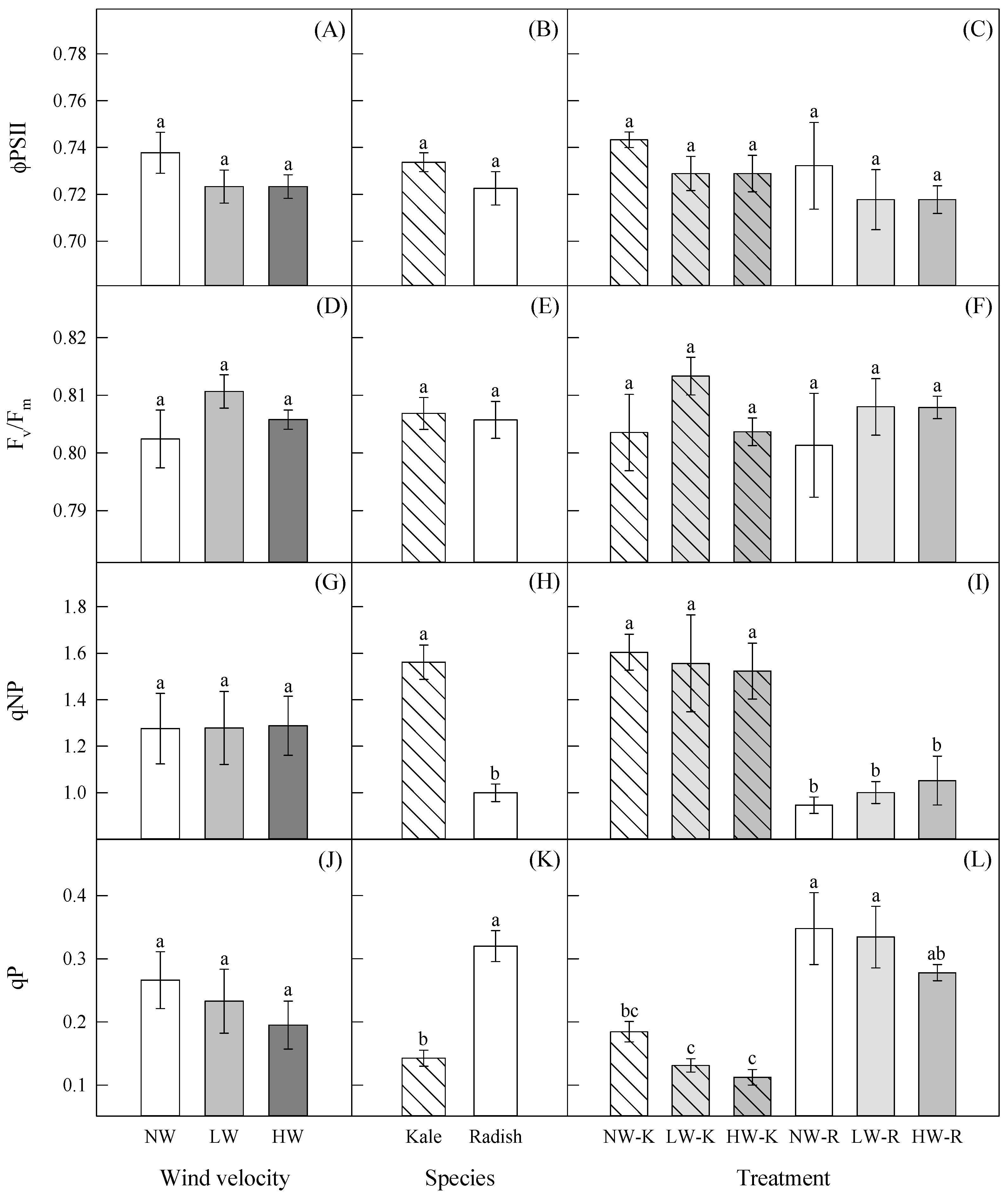
Wind velocity and the two-way interaction of species and wind velocity had no significant effect on chlorophyll fluorescence (Table 2); however, a significant difference was found between species for qNP and qP (Table 2). qNP was lower in radish plants compared to kale plants, whereas qP was higher in radish plants than in kale plants (Figure 5H,K).

2.6. Nitrogen Balance Index, Chlorophyll, and Flavonoids

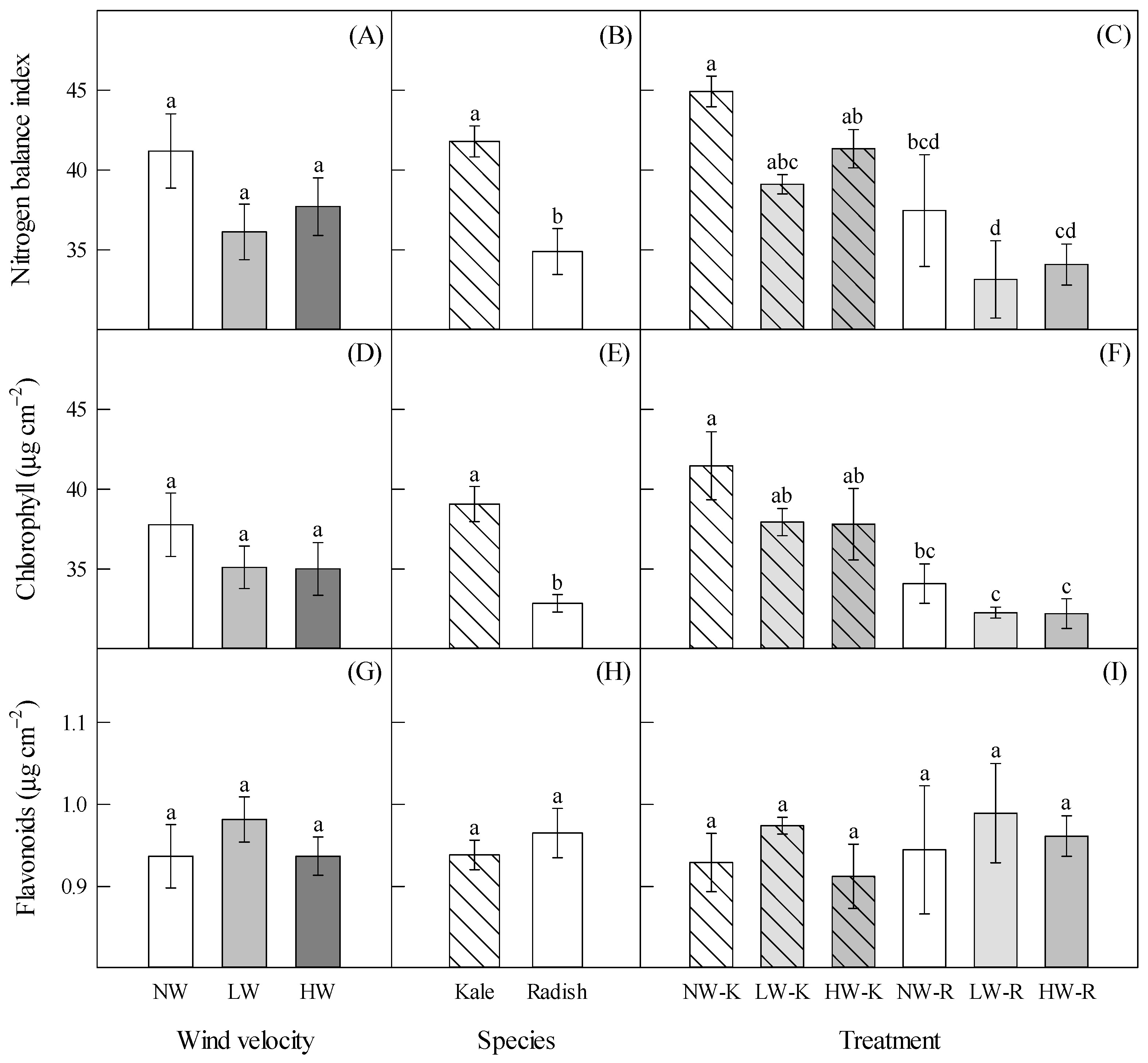
Wind velocity did not significantly affect NBI, chlorophyll content, or flavonoid content (Table 2). Significant differences were found between radish and kale plants for NBI and chlorophyll content (Table 2), with both traits being lower in radish plants compared to kale plants (Figure 6B,E). However, flavonoid content showed virtually no change across wind velocity and plant species (Figure 6G–I); the interaction of species and wind velocity had no significant effects on NBI, chlorophyll content, or flavonoid content (Table 2).

2.7. Leaf Water Potential and Moisture Content

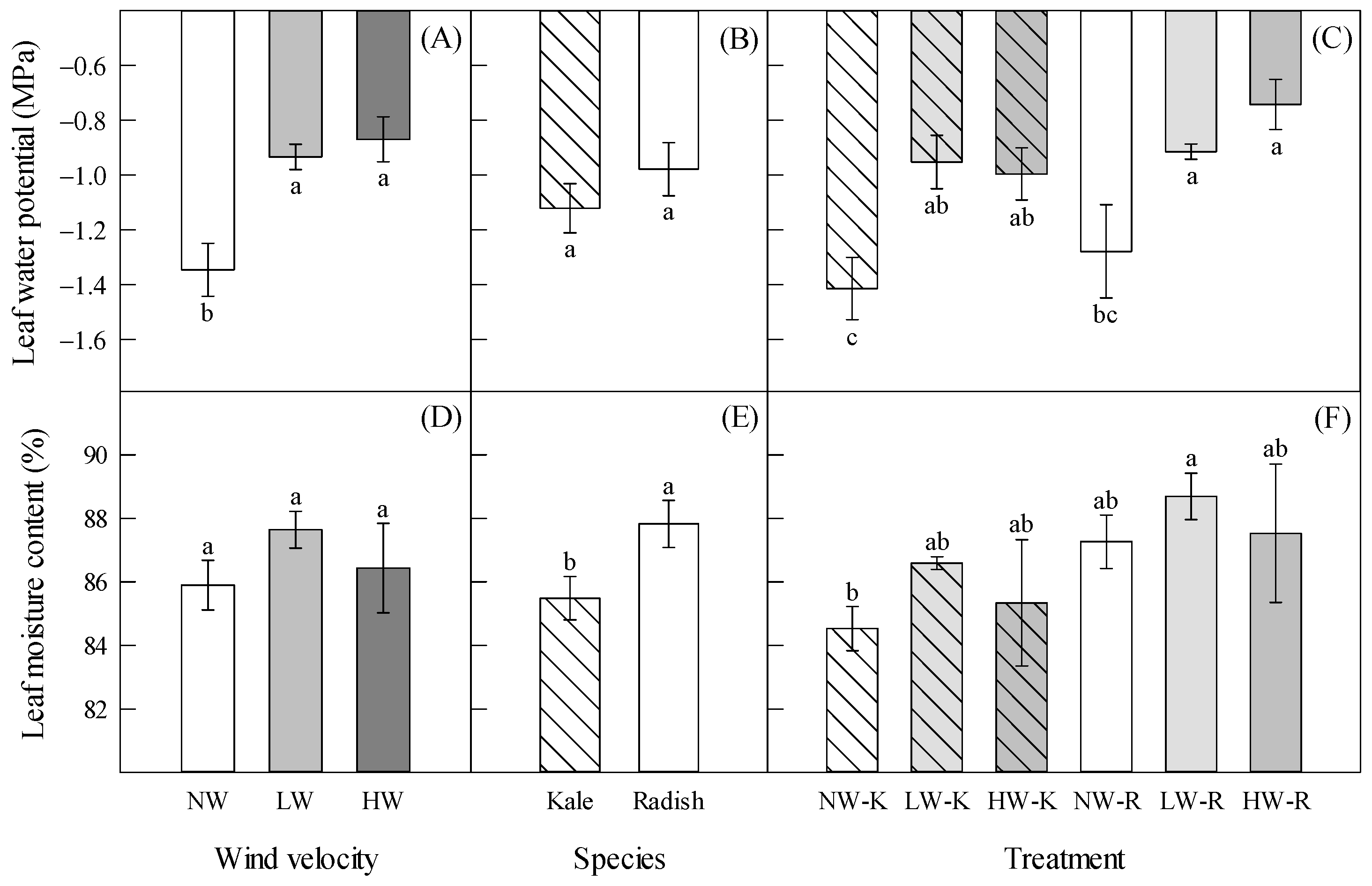
Leaf water potential was significantly affected by wind exposure (two-way ANOVA; Table 2). Higher and lower wind velocities resulted in increased leaf water potential (Figure 7A), a trend that was observed in both radish and kale (Figure 7C). Species did not have a significant effect on leaf water potential (Table 2).
LMC was not significantly affected by wind velocity (Table 2), but was significantly higher in radish plants compared to kale plants (Figure 7E).
Interaction between species and wind velocity did not significantly affect either leaf water potential or leaf moisture content (Table 2).

2.8. Relationships Between Methane Emission and Other Plant Traits

A significant positive correlation was found between plant-derived CH4 and leaf moisture content, and significant negative correlations were found between CH4 emission and stem height, SLM, LMR, SRR, ϕPSII, qNP, NBI, and chlorophyll content (Table 3).

3. Discussion

In this pilot study, we investigated the effects of wind velocity, exposure duration, and plant species on aerobic CH4 emissions from radish and kale plants. The two plant species exhibited several differences, including growth, biomass accumulation, chlorophyll content, and CH4 emissions. Wind velocity had less effect on CH4 emission and other plant traits compared to species (Table 1 and Table 2).

3.1. Effects of Species on Plant Traits

Many of the differences that we found between radish and kale plants, such as stem height (Figure 2), stem and root dry mass (Figure 3), and SRR (Figure 4), are likely the result of differences in growth rates between the two plant species. The variety of radish used in this study is recommended to be harvested after 3–4 weeks, while the variety of kale used requires double that time before being considered ready for harvest. Despite this, radish plants showed decreases in growth when exposed to wind, and to a higher degree when compared to kale plants (Figure 2 and Figure 3). Earlier studies have shown that abiotic stressors can have negative effects on plant growth [14,40,53,63,64]; therefore, the decrease found in traits characterizing plant growth for the radish plants (e.g., stem height, stem mass, SRR, SLM, LMR, and LAR; Figure 2, Figure 3 and Figure 4) could be the result of a stronger response to stress in these plants compared to kale. However, given the dissimilar anatomy of radish and kale plants, it is more likely that the differences can be attributed to variation in anatomy rather than interpreted as an indicator of stress.
In addition to morphological dissimilarities, we found several physiological differences between radish and kale. Radish plants had significantly lower qNP, NBI, and chlorophyll content, but higher qP and LMC, than kale plants (Figure 5, Figure 6 and Figure 7). Lower qNP in radish plants could be an indication that this species allocates fewer resources to defenses against stressors that may contribute to its susceptibility to wind stress. It could also be a sign that photosystem II had sustained damage and that these plants were more stressed than kale plants [65,66]. This is partially supported by a negative relationship between CH4 emissions and qNP (Table 3). However, ϕPSII and Fv/Fm were virtually the same in both species (Figure 5), suggesting that photosystem II was functioning the same in radish as in kale, despite having a lower qNP. Unexpectedly, while qNP was lower, we found that qP was higher in radish plants compared to kale plants (Figure 5). We expected that if qNP and qP were affected, they would be affected in the same direction, indicating damage to photosystem II; however, similar results have been found in previous studies [67,68]. As qNP serves to protect photosystem II, its increase displayed by kale could indicate that protection against stress was being prioritized by the plants. Meanwhile, the decrease in qNP and increase in qP observed in radish point to the possibility that this plant species had prioritized photochemistry over protection from wind. We found NBI and chlorophyll content to be significantly lower in radish plants, and previous studies have reported that low NBI and total chlorophyll are indicators of plant stress [66,67]. Additionally, this study revealed a negative correlation between CH4 emissions and chlorophyll content, as well as NBI (Table 3), which is further indication of higher stress in radish compared to kale.
Radish plants had significantly higher LMC compared to kale plants (Figure 7). It was reported by Schymanski and Or [56] that wind exposure decreases transpiration and increases WUE in plants, potentially increasing the water content in plants. Therefore, the variation between the two species observed in this study is a possible indication that the radish plants were significantly more affected by wind exposure than the kale plants.
All indications that the radish plants experienced higher levels of stress compared to the kale plants are supported by higher CH4 emissions detected from radish plants compared to kale plants (Figure 1). It is well established that abiotic stressors increase CH4 production in plants [5,13,14,16,22]. As a wind-susceptible species, it follows that radish would be more strongly affected by wind exposure than kale, a wind-tolerant species. The changes in physiological and morphological traits suggest that the radish plants were more stressed by wind exposure compared to the kale plants under the same experimental conditions.

3.2. Effects of Wind Velocity on Plant Traits

Wind has several known effects on plants, including morphological (e.g., shorter and thicker stems, smaller and fewer leaves) and physiological (e.g., stomatal conductance, transpiration, photosynthesis) traits [52,61,62]. Some studies have reported that even small amounts of mechanical stimuli can evoke changes in plants [49,50,51]; however, some other studies have found that short periods of wind exposure do not result in significant effects [60]. It has been shown that plants can be highly sensitive to variation in certain environmental factors, such as water availability and temperature [59], and plant species can vary in physiological response [53], which makes it difficult to assess whether changes in plants are caused solely by wind or by the interaction of multiple environmental factors. In our study, we found a few instances of significant change in plant growth due to exposure to wind, which suggests that the plants were either exposed to wind velocities that were not strong enough, the duration of exposure was too brief to result in significant changes, or a combination thereof. Despite the lack of significant results, many of the measured traits mirrored the trends described in the literature. Notably, we found that wind generally caused a decrease in stem height and an increase in SRR, as well as significant increases in stem diameter, leaf water potential, and decreased leaf area (Figure 2, Figure 4 and Figure 7).
Leaf, root, and total dry mass decreased due to wind exposure, while stem dry mass increased in plants exposed to higher wind (Figure 3). These morphological changes were expected and supported by previous studies. Additionally, we found a significant negative relationship between CH4 emission and stem height, as well as negative relationships with leaf and stem dry mass, although these were not significant (Table 3). This indicates that the plants were under stress while exposed to wind, which negatively impacted plant growth as a result, similar to previous studies [14,40,53,64]. Earlier studies, which reported negative correlations between CH4 emissions and plant growth, have suggested that decreased growth under stress is primarily due to a decline in CO2 assimilation [64,67]. Alternatively, it was suggested that plant biomass could be directly converted into CH4 [69], although there is currently no evidence to support this claim. It is generally accepted that ROS plays a major role in CH4 production by cleaving methyl groups from chemical compounds, such as pectin, lignin, and methionine [37], despite the synthesis pathways of plant-derived CH4 are poorly understood. It would be worthwhile for future studies to investigate the effects of wind on the composition of plant cells and determine whether a link exists between wind stress and CH4 emissions derived from lignin and pectin. While CH4 production has been associated with these structural compounds, and it is interesting to consider the possibility that CH4 production could be related to decreases in plant growth, no pathway has been described to directly tie biomass loss to increased CH4 emissions.
Wind velocity significantly influenced leaf water potential, which increased in plants exposed to lower and higher wind velocities (Figure 7). Initially, this result was unexpected, as we expected that wind exposure would lead to increased water loss from plants [52,54,62]. However, some studies have found that higher wind velocities can decrease transpiration [54,55] and increase WUE [56]. We found a positive relationship between CH4 emission and LMC, as well as between plant-derived CH4 and leaf water potential, indicating the effects of wind on other plant traits that were not measured as part of this study, such as stomatal conductance and CO2 assimilation, which might have played a role in leaf water content.
Methane emission was not significantly affected by different wind velocities; however, a small increase was observed in plants that were exposed to lower and higher wind velocities (Figure 1). Nonetheless, we observed that the plants exposed to 3 h of wind produced greater quantities of CH4 than those exposed to only 1 h of wind, although when comparing the different treatment groups, the difference was significant only between kale plants exposed to higher wind velocity and radish plants exposed to lower wind velocity (Figure 1). This suggests that although the wind velocities that the plants were exposed to were not strong enough to produce significant results, stronger wind velocities or longer exposure time (such as plants would be exposed to in a natural environment) could lead to significant increases in CH4 emissions. When considering other studies investigating the effects of wind on plants, it is evident that the stress that our plants were exposed to was lower. For example, Anten et al. [57] reported that total dry mass and leaf area decreased by 45% and 25%, respectively; however, in our study, we found only a 10–32% decrease in total dry mass and a 4–21% decrease in leaf area. Our results were also lower compared to studies investigating the effects of other environmental stressors on canola. For instance, one study revealed that higher temperature decreased total dry mass and leaf area by 42% and 45%, respectively [70], and another study showed that water stress decreased leaf area by 53% [71]. Previous studies have established that abiotic stress increases CH4 emissions from plants [5,13,14,15,16,17,18,19,20,21,22,23]; therefore, the insignificant increase in the quantities of plant-derived CH4 observed in our study was due to the relatively lower levels of stress caused by the wind velocities.
A lack of significant changes in plant morphological and physiological features strongly implies that the wind velocities and/or exposure period used for our study were not sufficient and resulted in only lower levels of stress.

3.3. Interactive Effects of Species and Wind Velocity on Plant Traits

The two-way interaction of plant species and wind velocity had no significant effect on plant traits. However, differences in several plant traits were found among treatments, including CH4 emission, stem height, stem diameter, leaf area, stem dry mass, root dry mass, total dry mass, SLM, LMR, SRR, qNP, qP, NBI, chlorophyll content, leaf water potential, and LMC (Figure 1, Figure 2, Figure 3, Figure 4, Figure 5, Figure 6 and Figure 7).
There were subtle differences between the responses of radish and kale plants to wind exposure. Radish plants seemed to exhibit a higher sensitivity to increasing wind velocities than kale plants, as they emitted slightly more CH4 when exposed to wind (Figure 1).
As previously stated, radish and kale plants varied in qNP due to wind velocity; this may simply be a species-specific response to stress [20], as earlier studies have found that qNP can increase [72] or decrease [66,67] in response to various stress factors.

4. Materials and Methods

4.1. Plant Material and Growth Conditions

The seeds of two plant species from the family Brassicaceae—kale (Brassica oleracea L. var. sabellica, Veseys Seeds Ltd., York, PE, Canada) and radish (Raphanus sativus L. Halifax Seed, Halifax, NS, Canada)—were germinated in Petri dishes lined with a single layer of blue filter paper (Anchor Paper Co., St. Paul, MN, USA), supplied with 10 mL of distilled water. The seeds were germinated for seven days, then 34 seedlings of each species were transferred to 1.5 L pots filled with a potting mixture of peat moss, Vermiculite, and Perlite (2:1:1, ratio by volume) and approximately 35 pellets of slow-release fertilizer (NPK, 14-14-13, Type 100, Chisso-Asahi Fertilizer Co., Tokyo, Japan). From germination until the conclusion of the experiment, the plants were kept in the environment-controlled growth chambers under a temperature regime of 22/18 °C and a photoperiod of 16 h light (photosynthetic photon flux density of 300 μmol photons m−2 s−1) and 8 h dark, except for the time when plants were removed for exposure to wind. The pots were watered to field capacity every other day, and were given additional fertilizer (NPK, 20-20-20, Miracle-Gro Water Soluble Plant Food, Scotts Canada Ltd., Mississauga, ON, Canada) 7 and 21 days after transferring the seedlings to pots. The plants were grown under control conditions (22/18 °C, 16/8 h day/night) for 20 days before being exposed to experimental conditions. From each species, 27 similarly sized seedlings were selected and placed under experimental conditions.
Experimental wind exposure was achieved by placing the plants in front of an oscillating electric desk fan (model F1DBAA20AW, Airworks, Gracious Living Co., Woodbridge, ON, Canada). Wind velocity was determined using a handheld anemometer (Traceable® Vane Anemometer Pen, model 3651-233, Control Company, Friendswood, TX, USA) and adjusting the distance of the pots from the fan. Nine plants of each species were randomly assigned to be exposed to one of three wind velocities: (1) no wind (control), (2) lower wind (6 km h−1), and (3) higher wind (12 km h−1). This resulted in a total of six treatment groups: (1) kale under no wind, (2) kale under lower wind, (3) kale under higher wind, (4) radish under no wind, (5) radish under lower wind, and (6) radish under higher wind. The plants were exposed to wind for 1 h each day over a period of 10 days. An additional experiment was run, during which the plants were exposed to the same wind velocities for 3 h a day over a period of 10 days to determine whether extending the exposure time would lead to more dramatic results. Experiments were conducted three times (three independent trials) to ensure the accuracy of the results.

4.2. Measurement of Methane Emissions

Methane was measured essentially as described in Martel and Qaderi [20]. Three leaf samples, each from an individual plant, were carefully excised from each treatment group immediately following the conclusion of wind exposure on the tenth day and incubated for 2 h under growing conditions in 3 mL syringes flushed with methane-free air. After incubation, 1 mL of gas was collected from each syringe and injected into a gas chromatograph–flame ionization detector system (model 7820A GC System, Agilent Technologies Inc., Santa Clara, CA, USA) equipped with a capillary column (Carboxen 1006 PLOT, 30 m × 0.53 mm ID, Supelco, Bellefonte, PA, USA). The injector temperature was set at 200 °C and the detector at 230 °C. Helium was the carrier gas at a rate of 10 mL min−1. Methane was eluted with the following temperature gradient: 1 min isothermal heating at 35 °C, followed by a 24 °C min−1 oven ramp to 225 °C until the end of a 15 min run. Methane was identified based on retention time (⁓2.6 min) and quantified using injections of a known volume of methane gas (Air Liquide, Dartmouth, NS, Canada). Methane emission is expressed in ng g−1 DM (dry mass) h−1, based on the dry mass of the leaf sample after drying in an oven at 60 °C for a minimum of 72 h.

4.3. Measurement of Plant Growth and Dry Mass Accumulation

Three whole plants from each treatment group were harvested to assess stem height, stem diameter, leaf number, leaf area, stem dry mass, leaf dry mass, root dry mass, and total dry mass. From these measurements, the shoot–root mass ratio (SRR, shoot DM (dry mass):root DM), leaf area ratio (LAR, cm2 g−1; leaf area:plant DM), leaf mass ratio (LMR, leaf DM:plant DM), and specific leaf mass (SLM, gm−2; leaf DM:leaf area) were calculated [20]. Stem height was determined using a ruler, and stem diameter was measured using a pair of Digimatic calipers (Mituyo Corp., Kanagawa, Japan). The plants were separated into leaves, stem and roots, then the leaves and stems were dried at 60 °C for a minimum of 72 h while the roots were dried for a minimum of 168 h. Dry mass was determined using an analytical balance (model ED224s, Satorius, Goettingen, Germany). Leaf area was measured with an area meter (Delta-T Devices, Cambridge, UK) after drying [20].

4.4. Measurement of Nitrogen Balance Index, Chlorophyll, and Flavonoids

A Dualex Scientific® optical sensor (Dualex Scientific, Force-A, Orsay Cedex, France) was used to measure the nitrogen balance index (NBI), chlorophyll content, and flavonoid content of three leaves of similar size from three plants of each treatment group. Chlorophyll and flavonoid content are determined by a device measuring light absorbance through the leaf. NBI represents the ratio of chlorophyll to flavonoids [66].

4.5. Measurement of Chlorophyll Fluorescence

Using a portable fluorometer (Fluorpen FP 100, Photon Systems Instruments, Drasov, Czech Republic), chlorophyll fluorescence was measured from three plants of each treatment group. The effective quantum yield of photosystem II (ϕPSII) was first determined from light-adapted leaves. Fluorometer clips were then placed on the leaves for 30 min until they became dark-adapted, at which point, the maximum quantum yield of photosystem II (Fv/Fm), non-photochemical quenching (qNP), and photochemical quenching (qP) were measured [66].

4.6. Measurement of Leaf Water Potential and Moisture Content

Leaf water potential (LWP) was assessed using a Dew Point PotentiaMeter (WP4C Dew Point PotentiaMeter, Decagon Devices Inc., Pullman, WA, USA). Leaf samples were collected from three plants of each treatment group. The leaves were carefully trimmed to fit the plastic sample cup, and then the samples were immediately covered and refrigerated for 30 min [63]. Then, the LWP was measured.
Leaf moisture content (LMC) was measured by obtaining the fresh leaf mass from three plants of each treatment group, then drying the leaves at 60 °C for 72 h. The dry mass of the leaves was measured, then LMC (%) was determined as follows: [(leaf fresh mass − leaf dry mass)/leaf fresh mass] × 100 [73].

4.7. Data Analysis

The effects of wind velocity, wind exposure duration, and plant species on aerobic CH4 emissions were determined using three-way and one-way analysis of variance (ANOVA), whereas the effects of wind velocity and species on other plant traits were determined using two-way and one-way ANOVA with Minitab 21 software [74]. Differences between treatment groups were calculated using Fisher’s least significant difference (LSD) test at the 5% level. Data are reported as mean ± standard error of the mean (SEM). The relationship between plant traits and CH4 emissions was determined by Pearson’s correlation coefficient (p < 0.05).

5. Conclusions

In this study, although the effects of wind velocity were largely insignificant, we found that wind increases stress in plants, resulting in increased aerobic CH4 emissions. Additionally, the wind-sensitive radish plants exhibited greater signs of stress when compared to kale plants, the wind-tolerant counterpart of this study. The results reported here clearly indicate that the wind velocities used, as well as the exposure duration, did not suffice to produce significant changes. As such, future studies should focus on testing stronger wind velocities, as well as exposing plants for longer durations. Time-course experiments could provide useful insight into the minimum number of days of experimental exposure needed to obtain significant results. Moreover, testing the effects of wind velocity on multiple wind-susceptible and wind-tolerant plant species would allow for greater comparison of plant-derived CH4 among species and provide more understanding of the interactions of wind velocity and plant species.

Author Contributions

E.J.D., writing—original draft, writing—review and editing, formal analysis, and investigation; M.M.Q., conceptualization, methodology, resources, formal analysis, investigation, writing—original draft, writing—review and editing, supervision, project administration, and funding acquisition. All authors have read and agreed to the published version of the manuscript.

Funding

This work was financially supported by the Natural Sciences and Engineering Research Council (NSERC) of Canada through a Discovery grant to MMQ, the Leaders Opportunity Fund from the Canadian Foundation for Innovation (CFI), Nova Scotia Research and Innovation Trust (NSRIT), and Mount Saint Vincent University to MMQ.

Institutional Review Board Statement

Not applicable.

Informed Consent Statement

Not applicable.

Data Availability Statement

The data presented in this study are available from the corresponding author on request.

Acknowledgments

We thank Mount Saint Vincent University for the logistic support. We appreciate useful comments on the manuscript from three anonymous referees.

Conflicts of Interest

The authors declare no conflicts of interest.

References

  1. Masson-Delmotte, V.; Zhai, P.; Pirani, A.; Connors, S.L.; Péan, C.; Berger, S.; Caud, N.; Chen, Y.; Goldfarb, L.; Gomis, M.I.; et al. (Eds.) Climate Change 2021: The Physical Science Basis. Contribution of Working Group I to the Sixth Assessment Report of the Intergovernmental Panel on Climate Change; Cambridge University Press: Cambridge, UK; New York, NY, USA, 2021; 2391p. [Google Scholar]
  2. Reay, D.; Smith, P.; van Amstel, A. (Eds.) Methane and Climate Change; Earthscan Ltd.: London, UK, 2010; 261p. [Google Scholar]
  3. Karakurt, I.; Aydin, G.; Aydiner, K. Sources and Mitigation of Methane Emissions by Sectors: A Critical Review. Renew. Energy 2012, 39, 40–48. [Google Scholar] [CrossRef]
  4. Jackson, R.B.; Saunois, M.; Bousquet, P.; Canadell, J.G.; Poulter, B.; Stavert, A.R.; Bergamaschi, P.; Niwa, Y.; Segers, A.; Tsurusta, A. Increasing Anthropogenic Methane Emissions Arise Equally from Agricultural and Fossil Fuel Sources. Environ. Res. Lett. 2020, 15, 071002. [Google Scholar] [CrossRef]
  5. Keppler, F.; Hamilton, J.T.G.; Braß, M.; Röckmann, T. Methane Emissions from Terrestrial Plants under Aerobic Conditions. Nature 2006, 439, 187–191. [Google Scholar] [CrossRef]
  6. Dueck, T.A.; de Visser, R.; Poorter, H.; Persijn, S.; Gorissen, A.; de Visser, W.; Schapendonk, A.; Verhagen, J.; Snel, J.; Harren, F.J.M.; et al. No Evidence for Substantial Aerobic Methane Emission by Terrestrial Plants: A 13C-Labelling Approach. New Phytol. 2007, 175, 29–35. [Google Scholar] [CrossRef]
  7. Beerling, D.J.; Gardiner, T.; Leggett, G.; McLeod, A.; Quick, W.P. Missing Methane Emissions from Leaves of Terrestrial Plants. Glob. Change Biol. 2008, 14, 1821–1826. [Google Scholar] [CrossRef]
  8. Kepper, F.; Hamilton, J.T.G.; McRoberts, W.C.; Vigano, I.; Braß, M.; Röckmann, T. Methoxyl Groups of Plant Pectin as a Precursor of Atmospheric Methane: Evidence from Deuterium Labelling Studies. New Phytol. 2008, 178, 808–814. [Google Scholar] [CrossRef] [PubMed]
  9. Brüggemann, N.; Meier, R.; Steigner, D.; Zimmer, I.; Louis, S.; Schnitzler, J.-P. Nonmicrobial Aerobic Methane Emission from Poplar Shoot Cultures under Low-Light Conditions. New Phytol. 2009, 182, 912–918. [Google Scholar] [CrossRef] [PubMed]
  10. Vigano, I.; Röckmann, T.; Holzinger, R.; Van Dijk, A.; Keppler, F.; Greule, M.; Brand, W.A.; Geilmann, H.; Van Weelden, H. The Stable Isotope Signature of Methane Emitted from Plant Material under UV Irradiation. Atmos. Environ. 2009, 43, 5637–5646. [Google Scholar] [CrossRef]
  11. Wishkerman, A.; Greiner, S.; Ghyczy, M.; Boros, M.; Rausch, T.; Lenhart, K.; Kepper, F. Enhanced Formation of Methane in Plant Cell Cultures by Inhibition of Cytochrome c Oxidase. Plant Cell Environ. 2010, 34, 457–464. [Google Scholar] [CrossRef]
  12. Lenhart, K.; Althoff, F.; Greule, M.; Keppler, F. Technical Note: Methionine, a Precursor of Methane in Living Plants. Biogeosciences 2015, 12, 1907–1914. [Google Scholar] [CrossRef]
  13. Vigano, I.; van Weelden, H.; Holzinger, R.; Keppler, F.; McLeod, A.; Röckmann, T. Effect of UV Radiation and Temperature on the Emission of Methane from Plant Biomass and Structural Components. Biogeosciences 2008, 5, 937–947. [Google Scholar] [CrossRef]
  14. Qaderi, M.M.; Reid, D.M. Methane Emissions from Six Crop Species Exposed to Three Components of Global Climate Change: Temperature, Ultraviolet-B Radiation and Water Stress. Physiol. Plant. 2009, 137, 139–147. [Google Scholar] [CrossRef]
  15. Bruhn, D.; Mikkelsen, T.N.; Øbro, J.; Willats, W.G.T.; Ambus, P. Effects of Temperature, Ultraviolet Radiation and Pectin Methyl Esterase on Aerobic Methane Release from Plant Material. Plant Biol. 2009, 11, 43–48. [Google Scholar] [CrossRef]
  16. McLeod, A.R.; Fry, S.C.; Loake, G.J.; Messenger, D.J.; Reay, D.S.; Smith, K.A.; Yun, B.-W. Ultraviolet Radiation Drives Methane Emissions from Terrestrial Plant Pectins. New Phytol. 2008, 180, 124–132. [Google Scholar] [CrossRef] [PubMed]
  17. Messenger, D.J.; McLeod, A.R.; Fry, S.C. The Role of Ultraviolet Radiation, Photosensitizers, Reactive Oxygen Species and Ester Groups in Mechanisms of Methane Formation from Pectin. Plant Cell Environ. 2009, 32, 1–9. [Google Scholar] [CrossRef] [PubMed]
  18. Bruhn, D.; Mikkelsen, T.N.; Rolsted, M.M.M.; Egsgaard, H.; Ambus, P. Leaf Surface Wax is a Source of Plant Methane Formation under UV Radiation and in the Presence of Oxygen. Plant Biol. 2014, 16, 512–516. [Google Scholar] [CrossRef]
  19. Dauphinee, B.T.; Qaderi, M.M. Individual and Interactive Effects of Temperature and Blue Light on Canola Growth, Lignin Biosynthesis and Methane Emissions. J. Plant Physiol. 2025, 304, 154402. [Google Scholar] [CrossRef] [PubMed]
  20. Martel, A.B.; Qaderi, M.M. Light Quality and Quantity Regulate Aerobic Methane Emissions from Plants. Physiol. Plant. 2017, 159, 313–328. [Google Scholar] [CrossRef]
  21. Qaderi, M.M.; Burton, K. Photoperiod Regulates Aerobic Methane Emissions by Altering Plant Growth and Physiological Processes. Methane 2024, 3, 380–396. [Google Scholar] [CrossRef]
  22. Wang, Z.-P.; Gulledge, J.; Zheng, J.-Q.; Liu, W.; Li, L.-H.; Han, X.-G. Physical Injury Stimulates Aerobic Methane Emissions from Terrestrial Plants. Biogeosciences 2009, 6, 615–621. [Google Scholar] [CrossRef]
  23. Wang, Z.-P.; Keppler, F.; Greule, M.; Hamilton, J.T.G. Non-Microbial Methane Emissions from Fresh Leaves: Effects of Physical Wounding and Anoxia. Atmos. Environ. 2011, 45, 4915–4921. [Google Scholar] [CrossRef]
  24. Abdul Majeed, A.M.; Derby, S.R.; Strickland, S.K.; Qaderi, M.M. Interactive Effects of Temperature and UVB Radiation on Methane Emissions from Different Organs of Pea Plants Grown in Hydroponic System. J. Photochem. Photobiol. B Biol. 2017, 166, 193–201. [Google Scholar] [CrossRef]
  25. Qaderi, M.M.; Reid, D.M. Aerobic Methane Emissions from Stinkweed (Thlaspi arvense) Capsules. Plant Signal. Behav. 2014, 9, e970095. [Google Scholar] [CrossRef] [PubMed]
  26. Qaderi, M.M.; Reid, D.M. Stressed Crops Emit More Methane Despite Mitigating Effects of Elevated Carbon Dioxide. Funct. Plant Biol. 2011, 38, 97–105. [Google Scholar] [CrossRef]
  27. Schroll, M.; Lenhart, K.; Greiner, S.; Keppler, F. Making Plant Methane Formation Visible–Insights from Application of 13C-Labeled Dimethyl Sulfoxide. Plant-Environ. Interact. 2022, 3, 104–117. [Google Scholar] [CrossRef]
  28. Lenhart, K.; Bunge, M.; Ratering, S.; Neu, T.R.; Schüttmann, I.; Greule, M.; Kammann, C.; Schnell, S.; Müller, C.; Zorn, H.; et al. Evidence for Methane Production by Saprotrophic Fungi. Nat. Commun. 2012, 3, 1046. [Google Scholar] [CrossRef] [PubMed]
  29. Klintzsch, T.; Langer, G.; Nehrke, G.; Wieland, A.; Lenhart, K.; Keppler, F. Methane Production by Three Widespread Marine Phytoplankton Species: Release Rates, Precursor Compounds, and Potential Relevance for the Environment. Biogeosciences 2019, 16, 4129–4144. [Google Scholar] [CrossRef]
  30. Bižić, M.; Klintzsch, T.; Ionescu, D.; Hindiyeh, M.Y.; Günthel, M.; Muro-Pastor, A.M.; Eckert, W.; Urich, T.; Keppler, F.; Grossart, H.-P. Aquatic and Terrestrial Cyanobacteria Produce Methane. Sci. Adv. 2020, 6, eaax5343. [Google Scholar] [CrossRef] [PubMed]
  31. Tuboly, E.; Szabó, A.; Garab, D.; Bartha, G.; Janovszky, A.; Erős, G.; Szabó, A.; Mohácsi, Á.; Szabó, G.; Kaszaki, J.; et al. Methane Biogenesis during Sodium Azide-Induced Chemical Hypoxia in Rats. Am. J. Physiol. Cell Physiol. 2013, 304, C207–C214. [Google Scholar] [CrossRef]
  32. Keppler, F.; Boros, M.; Polag, D. Radical-Driven Methane Formation in Humans Evidenced by Exogenous Isotope-Labeled DMSO and Methionine. Antioxidants 2023, 12, 1381. [Google Scholar] [CrossRef]
  33. Nisbet, R.E.R.; Fisher, R.; Nimmo, R.H.; Bendall, D.S.; Crill, P.M.; Gallego-Sala, A.V.; Hornibrook, E.R.C.; López-Juez, E.; Lowry, D.; Nisbet, P.B.R.; et al. Emission of Methane from Plants. Proc. R. Soc. Lond. B Biol. Sci. 2009, 276, 1347–1354. [Google Scholar] [CrossRef]
  34. Kohl, L.; Tenhovirta, S.A.M.; Koskinen, M.; Putkinen, A.; Haikarainen, I.; Polvinen, T.; Galeotti, L.; Mammarella, I.; Siljanen, H.M.P.; Robson, T.M.; et al. Radiation and Temperature Drive Diurnal Variation of Aerobic Methane Emissions from Scots Pine Canopy. Proc. Natl. Acad. Sci. USA 2023, 120, e2308516120. [Google Scholar] [CrossRef]
  35. Wang, Z.-P.; Xie, Z.-Q.; Zhang, B.-C.; Hou, L.-Y.; Zhou, Y.-H.; Li, L.-H.; Han, X.-G. Aerobic and Anaerobic Nonmicrobial Methane Emissions from Plant Material. Environ. Sci. Technol. 2011, 45, 9531–9537. [Google Scholar] [CrossRef]
  36. Tenhovirta, S.A.M.; Kohl, L.; Koskinen, M.; Polvinen, T.; Salmon, Y.; Paljakka, T.; Pihlatie, M. Aerobic Methane Production in Scots Pine Shoots is Independent of Drought or Photosynthesis. New Phytol. 2024, 242, 2440–2452. [Google Scholar] [CrossRef]
  37. Li, L.; Wei, S.; Shen, W. The Role of Methane in Plant Physiology: A Review. Plant Cell Rep. 2020, 39, 171–179. [Google Scholar] [CrossRef]
  38. Wang, N.; Huang, D.; Li, C.; Deng, Y.; Li, W.; Yao, Y.; Liao, W. Regulatory Roles of Methane in Plants. Sci. Hortic. 2020, 272, 109492. [Google Scholar] [CrossRef]
  39. Han, B.; Duan, X.; Wang, Y.; Zhu, K.; Zhang, J.; Wang, R.; Hu, H.; Qi, F.; Pan, J.; Yan, Y.; et al. Methane Protects Against Polyethylene Glycol-Induced Osmotic Stress in Maize by Improving Sugar and Ascorbic Acid Metabolism. Sci. Rep. 2017, 7, 46185. [Google Scholar] [CrossRef]
  40. Samma, M.K.; Zhou, H.; Cui, W.; Zhu, K.; Zhang, J.; Shen, W. Methane Alleviates Copper-Induced Seed Germination Inhibition and Oxidative Stress in Medicago sativa. Biometals 2017, 30, 97–111. [Google Scholar] [CrossRef] [PubMed]
  41. Cui, W.; Cao, H.; Yao, P.; Pan, J.; Gu, Q.; Xu, S.; Wang, R.; Ouyang, Z.; Wang, Q.; Shen, W. Methane Enhances Aluminum Resistance in Alfalfa Seedlings by Reducing Aluminum Accumulation and Reestablishing Redox Homeostasis. Biometals 2017, 30, 719–732. [Google Scholar] [CrossRef] [PubMed]
  42. Gu, Q.; Chen, Z.; Cui, W.; Zhang, Y.; Hu, H.; Yu, X.; Wang, Q.; Shen, W. Methane Alleviates Alfalfa Cadmium Toxicity via Decreasing Cadmium Accumulation and Reestablishing Glutathione Homeostasis. Ecotoxicol. Environ. Saf. 2018, 147, 861–871. [Google Scholar] [CrossRef] [PubMed]
  43. Cui, W.; Qi, F.; Zhang, Y.; Cao, H.; Zhang, J.; Wang, R.; Shen, W. Methane-Rich Water Induces Cucumber Adventitious Rooting Through Heme Oxygenase1/Carbon Monoxide and Ca2+ Pathways. Plant Cell Rep. 2015, 34, 435–445. [Google Scholar] [CrossRef]
  44. Kirschbaum, M.U.F.; Bruhn, D.; Etheridge, D.M.; Evans, J.R.; Farquhar, G.D.; Gifford, R.M.; Paul, K.I.; Winters, A.J. A Comment on the Quantitative Significance of Aerobic Methane Release by Plants. Funct. Plant Biol. 2006, 33, 521–530. [Google Scholar] [CrossRef]
  45. Houweling, S.; Röckmann, T.; Aben, I.; Keppler, F.; Krol, M.; Meirink, J.F.; Dlugokencky, E.J.; Frankenberg, C. Atmospheric Constraints on Global Emissions of Methane from Plants. Geophys. Res. Lett. 2006, 33, L15821. [Google Scholar] [CrossRef]
  46. Parsons, A.J.; Newton, P.C.D.; Clark, H.; Kelliher, F.M. Scaling Methane Emissions from Vegetation. Trends Ecol. Evol. 2006, 21, 423–424. [Google Scholar] [CrossRef]
  47. Megonigal, J.P.; Guenther, A.B. Methane Emissions from Upland Forest Soils and Vegetation. Tree Physiol. 2008, 28, 491–498. [Google Scholar] [CrossRef] [PubMed]
  48. Bloom, A.A.; Lee-Taylor, J.; Madronich, S.; Messenger, D.J.; Palmer, P.I.; Reay, D.S.; McLeod, A.R. Global Methane Emission Estimates from Ultraviolet Irradiation of Terrestrial Plant Foliage. New Phytol. 2010, 187, 417–425. [Google Scholar] [CrossRef] [PubMed]
  49. Jaffe, M.J. Thigmomorphogenesis: The Response of Plant Growth and Development to Mechanical Stimulation. Planta 1973, 114, 143–157. [Google Scholar] [CrossRef]
  50. Russell, G.; Grace, J. The Effect of Windspeed on the Growth of Grasses. J. Appl. Ecol. 1978, 16, 507–514. [Google Scholar] [CrossRef]
  51. Hunt, E.R., Jr.; Jaffe, M.J. Thigmomorphogenesis: The Interaction of Wind and Temperature in the Field on the Growth of Phaseolus vulgaris L. Ann. Bot. 1980, 45, 665–672. [Google Scholar] [CrossRef]
  52. Cleugh, H.A.; Miller, J.M.; Böhm, M. Direct Mechanical Effects of Wind on Crops. Agrofor. Syst. 1998, 41, 85–112. [Google Scholar] [CrossRef]
  53. Zhang, S.; Lui, G.; Huang, Z.; Ye, X.; Cornelissen, J.H.C. New Field Wind Manipulation Methodology Reveals Adaptive Responses of Steppe Plants to Increased and Reduced Wind Speed. Plant Methods 2021, 17, 5. [Google Scholar] [CrossRef] [PubMed]
  54. Whitehead, F.H. Experimental Studies of the Effect of Wind on Plant Growth and Anatomy. II. Helianthus annuus. New Phytol. 1962, 61, 59–62. [Google Scholar] [CrossRef]
  55. Schymanski, S.J.; Or, D. Wind Effects on Leaf Transpiration Challenge the Concept of “Potential Evaporation”. Proc. Int. Assoc. Hydrol. Sci. 2015, 371, 99–107. [Google Scholar] [CrossRef]
  56. Schymanski, S.J.; Or, D. Wind Increases Leaf Water Use Efficiency. Plant Cell Environ. 2016, 39, 1448–1459. [Google Scholar] [CrossRef] [PubMed]
  57. Anten, N.P.R.; Alcalá-Herrera, R.; Schieving, F.; Onoda, Y. Wind and Mechanical Stimuli Differentially Affect Leaf Traits in Plantago major. New Phytol. 2010, 188, 554–564. [Google Scholar] [CrossRef]
  58. Onoda, Y.; Anten, N.P.R. Challenges to Understand Plant Responses to Wind. Plant Signal. Behav. 2011, 6, 1057–1059. [Google Scholar] [CrossRef]
  59. Huang, C.-W.; Chu, C.-R.; Hsieh, C.-I.; Palmroth, S.; Katul, G.G. Wind-Induced Leaf Transpiration. Adv. Water Resour. 2015, 86, 240–255. [Google Scholar] [CrossRef]
  60. Precheur, R.; Greig, J.K.; Armbrust, D.V. The Effects of Wind and Wind-Plus-Sand on Tomato Plants. J. Amer. Soc. Hort. Sci. 1978, 103, 351–355. [Google Scholar] [CrossRef]
  61. de Langre, E. Effects of Wind on Plants. Annu. Rev. Fluid Mech. 2008, 40, 141–168. [Google Scholar] [CrossRef]
  62. Gardiner, B.; Berry, P.; Moulia, B. Review: Wind Impacts on Plant Growth, Mechanic and Damage. Plant Sci. 2016, 245, 94–118. [Google Scholar] [CrossRef]
  63. Abo Gamar, M.I.; Kisiala, A.; Emery, R.J.N.; Yeung, E.C.; Stone, S.L.; Qaderi, M.M. Elevated Carbon Dioxide Decreases the Adverse Effects of Higher Temperature and Drought Stress by Mitigating Oxidative Stress and Improving Water Status in Arabidopsis thaliana. Planta 2019, 250, 1191–1214. [Google Scholar] [CrossRef] [PubMed]
  64. Martel, A.B.; Qaderi, M.M. Unravelling the Effects of Blue Light on Aerobic Methane Emissions from Canola. J. Plant Physiol. 2019, 233, 12–19. [Google Scholar] [CrossRef]
  65. Hussain, M.I.; Reigosa, M.J. Allelochemical Stress Inhibits Growth, Leaf Water Relations, PSII Photochemistry, Non-Photochemical Fluorescence Quenching, and Heat Energy Dissipation in three C3 Perennial Species. J. Exp. Bot. 2011, 62, 4533–4545. [Google Scholar] [CrossRef] [PubMed]
  66. Martel, A.B.; Qaderi, M.M. Exogenous Ethylene Increases Methane Emissions from Canola by Adversely Affecting Plant Growth and Physiological Processes. Botany 2021, 99, 421–431. [Google Scholar] [CrossRef]
  67. Abdulmajeed, A.M.; Abo Gamar, M.I.; Qaderi, M.M. Inter- and Intra-Varietal Variation in Aerobic Methane Emissions from Environmentally Stressed Pea Plants. Botany 2018, 96, 837–850. [Google Scholar] [CrossRef]
  68. Abdulmajeed, A.M.; Qaderi, M.M. Differential Effects of Environmental Stressors on Physiological Processes and Methane Emissions in Pea (Pisum sativum) Plants at Various Growth Stages. Plant Physiol. Biochem. 2019, 139, 715–723. [Google Scholar] [CrossRef]
  69. Creelman, C.-R.L.; Qaderi, M.M. Independent Effects of Blue Light and Abscisic Acid on Methane Emissions from Canola Plants Grown under Sterile Conditions. Theor. Exp. Plant Physiol. 2021, 33, 271–280. [Google Scholar] [CrossRef]
  70. Dixon, S.L.; Qaderi, M.M. Canola Responds Differently to Nitrogen Forms under Temperature and Carbon Dioxide Conditions. Theor. Exp. Plant Physiol. 2025, 37, 12. [Google Scholar] [CrossRef]
  71. McDormand, E.D.; Qaderi, M.M. Individual and Interactive Effects of Temperature and Watering Regime on Canola Growth and Physiological Characteristics. Plant-Environ. Interact. 2025, 6, e70030. [Google Scholar] [CrossRef]
  72. Abdulmajeed, A.M.; Qaderi, M.M. Intrashoot Variation in Aerobic Methane Emissions from Pea Plants Exposed to Multiple Abiotic Stresses. Acta Physiol. Plant. 2017, 39, 124. [Google Scholar] [CrossRef]
  73. Qaderi, M.M.; Cavers, P.B.; Hamill, A.S.; Bernards, M.A. Effects of Collection Time and After-Ripening on Chemical Constituents and Germinability of Scotch Thistle (Onopordum acanthium) Cypselas. Botany 2012, 90, 755–762. [Google Scholar] [CrossRef]
  74. Minitab Inc. Minitab® Release 21: Statistical Software for Windows®; Minitab Inc.: State College, PA, USA, 2023. [Google Scholar]
Figure 1. Aerobically produced methane emissions of thirty-day-old Brassica oleracea var. sabellica (K, kale) and Raphanus sativus (R, radish). (A) Wind velocity, (B) wind exposure, (C) species, and (D) treatment. Plants were grown under a temperature regime of 22/18 °C (16 h light/8 h dark) and a light intensity of 300 μmol photons m−2 s−1, and exposed to wind velocities (NW, no wind; LW, lower wind: 6 km h−1; or HW, higher wind: 12 km h−1) for one hour or three hours for ten days, after twenty days of initial growth under control conditions. Data are means ± SEM of three replicated experiments. Bars surmounted by different letters within each panel are significantly different (Fisher’s LSD test, p < 0.05).
Methane 05 00003 g001
Figure 2. Plant growth of thirty-day-old Brassica oleracea var. sabellica (K, kale) and Raphanus sativus (R, radish). (AC) stem height, (DF) stem diameter, (GI) leaf number, and (JL) leaf area. Plants were grown under a temperature regime of 22/18 °C (16 h light/8 h dark) and a light intensity of 300 μmol photons m−2 s−1, and exposed to one hour of three wind velocities (NW, no wind; LW (lower wind), 6 km h−1; or HW (higher wind), 12 km h−1) for ten days, after twenty days of initial growth under control conditions. Data are means ± SEM of three replicated experiments. Bars surmounted by different letters within each panel are significantly different (Fisher’s LSD test, p < 0.05).
Methane 05 00003 g002
Figure 3. Dry mass of thirty-day-old Brassica oleracea var. sabellica (K, kale) and Raphanus sativus (R, radish). (AC) leaf mass, (DF) stem mass, (GI) root mass, and (JL) total mass. Plants were grown under a temperature regime of 22/18 °C (16 h light/8 h dark) and a light intensity of 300 μmol photons m−2 s−1, and exposed to one hour of three wind velocities (NW, no wind; LW (lower wind), 6 km h−1; or HW (higher wind), 12 km h−1) for ten days, after twenty days of initial growth under control conditions. Data are means ± SEM of three replicated experiments. Bars surmounted by different letters within each panel are significantly different (Fisher’s LSD test, p < 0.05).
Methane 05 00003 g003
Figure 4. Growth indices of thirty-day-old Brassica oleracea var. sabellica (K, kale) and Raphanus sativus (R, radish). (AC) specific leaf mass, (DF) leaf mass ratio, (GI) leaf area ratio, and (JL) shoot–root mass ratio. Plants were grown under a temperature regime of 22/18 °C (16 h light/8 h dark) and a light intensity of 300 μmol photons m−2 s−1, and exposed to one hour of three wind velocities (NW, no wind; LW (lower wind), 6 km h−1; or HW (higher wind), 12 km h−1) for ten days, after twenty days of initial growth under control conditions. Data are means ± SEM of three replicated experiments. Bars surmounted by different letters within each panel are significantly different (Fisher’s LSD test, p < 0.05).
Methane 05 00003 g004
Figure 5. Chlorophyll fluorescence of thirty-day-old Brassica oleracea var. sabellica (K, kale) and Raphanus sativus (R, radish). (AC) effective quantum yield of photosystem II (ϕPSII), (DF) maximum quantum yield of photosystem II (Fv/Fm), (GI) nonphotochemical quenching (qNP), and (JL) photochemical quenching (qP). Plants were grown under a temperature regime of 22/18 °C (16 h light/8 h dark) and a light intensity of 300 μmol photons m−2 s−1, and exposed to one hour of three wind velocities (NW, no wind; LW (lower wind), 6 km h−1; or HW (higher wind), 12 km h−1) for ten days, after twenty days of initial growth under control conditions. Data are means ± SEM of three replicated experiments. Bars surmounted by different letters within each panel are significantly different (Fisher’s LSD test, p < 0.05).
Methane 05 00003 g005
Figure 6. Nitrogen balance index, chlorophyll and flavonoid content of thirty-day-old Brassica oleracea var. sabellica (K, kale) and Raphanus sativus (R, radish). (AC) nitrogen balance index, (DF) chlorophyll, and (GI) flavonoids. Plants were grown under a temperature regime of 22/18 °C (16 h light/8 h dark) and a light intensity of 300 μmol photons m−2 s−1, and exposed to one hour of three wind velocities (NW, no wind; LW (lower wind), 6 km h−1; or HW (higher wind), 12 km h−1) for ten days, after twenty days of initial growth under control conditions. Data are means ± SEM of three replicated experiments. Bars surmounted by different letters within each panel are significantly different (Fisher’s LSD test, p < 0.05).
Methane 05 00003 g006
Figure 7. Leaf water potential and moisture content of thirty-day-old Brassica oleracea var. sabellica (K, kale) and Raphanus sativus (R, radish). (AC) leaf water potential and (DF) leaf moisture content. Plants were grown under a temperature regime of 22/18 °C (16 h light/8 h dark) and a light intensity of 300 μmol photons m−2 s−1, and exposed to one hour of three wind velocities (NW, no wind; LW (lower wind), 6 km h−1; or HW (higher wind), 12 km h−1) for ten days, after twenty days of initial growth under control conditions. Data are means ± SEM of three replicated experiments. Bars surmounted by different letters within each panel are significantly different (Fisher’s LSD test, p < 0.05).
Methane 05 00003 g007
Table 1. Summary of analysis of variance (F value) for effects of wind and species on aerobic methane emissions for a wind-tolerant (kale, Brassica oleracea var. sabellica) and a wind-susceptible (radish, Raphanus sativus) plant species.
Sourced.f.Methane Emission
Wind (W)24.06 *
Duration (D)117.09 ***
Species (S)114.26 **
W × D20.17
W × S20.60
D × S10.36
W × D × S21.73
Plants were grown under a temperature regime of 22/18 °C (16 h light/8 h dark) and a light intensity of 300 μmol photons m−2 s−1, and exposed to one hour or three hours of three wind velocities (no wind; lower wind, 6 km h−1; or higher wind, 12 km h−1) for ten days, after twenty days of initial growth under control conditions. Significance values: * p < 0.05, ** p < 0.01, and *** p < 0.001.
Table 2. Summary of analysis of variance (F value) for effects of wind and species on plant growth and physiological traits for a wind-tolerant (kale, Brassica oleracea var. sabellica) and a wind-susceptible (radish, Raphanus sativus) plant species.
Sourced.f.Plant GrowthWater Status
Stem HeightStem DiameterLeaf NumberLeaf AreaLWPLMC
Wind (W)21.504.42 *0.554.61 *11.54 **0.91
Species (S)110.97 **2.050.7821.23 **2.624.71
W × S20.160.320.381.340.500.03
Sourced.f.Dry massGrowth index
LeafStemRootTotalSLMLMRLARSRR
Wind (W)22.481.442.563.210.490.010.260.22
Species (S)10.346.57 *40.60 ***16.70 **7.86 *115.43 ***4.3980.30 ***
W × S20.250.810.750.610.060.810.250.34
Sourced.f.Chlorophyll fluorescenceGrowth and protective indicator
ϕPSIIFv/FmqNPqPNBIChlorophyllFlavonoids
Wind (W)21.251.210.012.403.592.320.61
Species (S)11.670.0736.16 ***44.78 ***19.03 **27.20 ***0.48
W × S20.000.420.330.240.090.240.08
Plants were grown under a temperature regime of 22/18 °C (16 h light/8 h dark) and a light intensity of 300 μmol photons m−2 s−1, and exposed to one hour of three wind velocities (no wind; lower wind, 6 km h−1; or higher wind, 12 km h−1) for ten days, after twenty days of initial growth under control conditions. Significance values: * p < 0.05, ** p < 0.01, and *** p < 0.001; LWP, leaf water potential; LMC, leaf moisture content; SLM, specific leaf mass; LMR, leaf mass ratio; LAR, leaf area ratio; SRR, shoot to root mass ratio; ϕPSII, effective quantum yield of photosystem II; Fv/Fm, maximum quantum yield of photosystem II; qNP, nonphotochemical quenching; qP, photochemical quenching; NBI, nitrogen balance index.
Table 3. Pearson’s correlation coefficient for relationships between CH4 emission and plant growth and physiological traits of a wind-tolerant (kale, Brassica oleracea var. sabellica) and a wind-susceptible (radish, Raphanus sativus) plant.
ParameterMethaneParameterMethane
Leaf area0.211Stem height−0.939 **
Leaf number0.583Stem diameter−0.233
Root dry mass0.733Leaf dry mass−0.079
Total dry mass0.584Stem dry mass−0.707
Fv/Fm0.277SLM−0.964 **
qP0.691LMR−0.890 *
Flavonoids0.675LAR−0.702
LWP0.719SRR−0.822 *
LMC0.932 **ϕPSII−0.902 *
qNP0.858 *
NBI−0.984 ***
Chlorophyll−0.980 **
Plants were grown under a temperature regime of 22/18 °C (16 h light/8 h dark) and a light intensity of 300 μmol photons m−2 s−1, and exposed to one hour or three hours of three wind velocities (no wind; lower wind, 6 km h−1; or higher wind, 12 km h−1) for ten days, after twenty days of initial growth under control conditions. Significance values: * p < 0.05, ** p < 0.01, and *** p < 0.001; SLM, specific leaf mass; LMR, leaf mass ratio; LAR, leaf area ratio; SRR, shoot to root mass ratio; NBI, nitrogen balance index; ϕPSII, effective quantum yield of photosystem II; Fv/Fm, maximum quantum yield of photosystem II; qNP, nonphotochemical quenching; qP, photochemical quenching; LWP, leaf water potential; LMC, leaf moisture content.
Disclaimer/Publisher’s Note: The statements, opinions and data contained in all publications are solely those of the individual author(s) and contributor(s) and not of MDPI and/or the editor(s). MDPI and/or the editor(s) disclaim responsibility for any injury to people or property resulting from any ideas, methods, instructions or products referred to in the content.