Article

Substrate Composition Shapes Methanogenesis, Microbial Ecology, and Digestate Dewaterability in Microbial Electrolysis Cell-Assisted Anaerobic Digestion of Food Waste


1
School of Ecology, Shenzhen Campus of Sun Yat-Sen University, Shenzhen 518107, China
2
School of Architectural Engineering, Guangzhou Institute of Science and Technology, Guangzhou 510540, China
3
Research Center for Eco-Environmental Engineering, Dongguan University of Technology, Dongguan 523808, China
*
Author to whom correspondence should be addressed.
Submission received: 18 November 2025 / Revised: 22 December 2025 / Accepted: 24 December 2025 / Published: 25 December 2025
(This article belongs to the Special Issue Innovations in Methane Production from Anaerobic Digestion)

Abstract

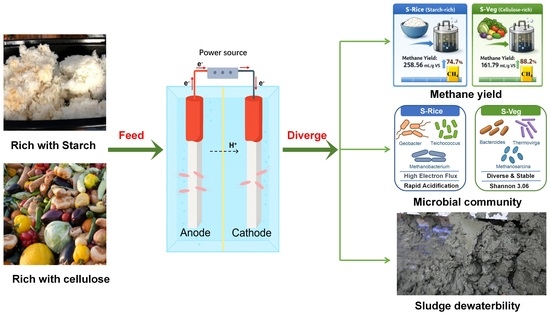
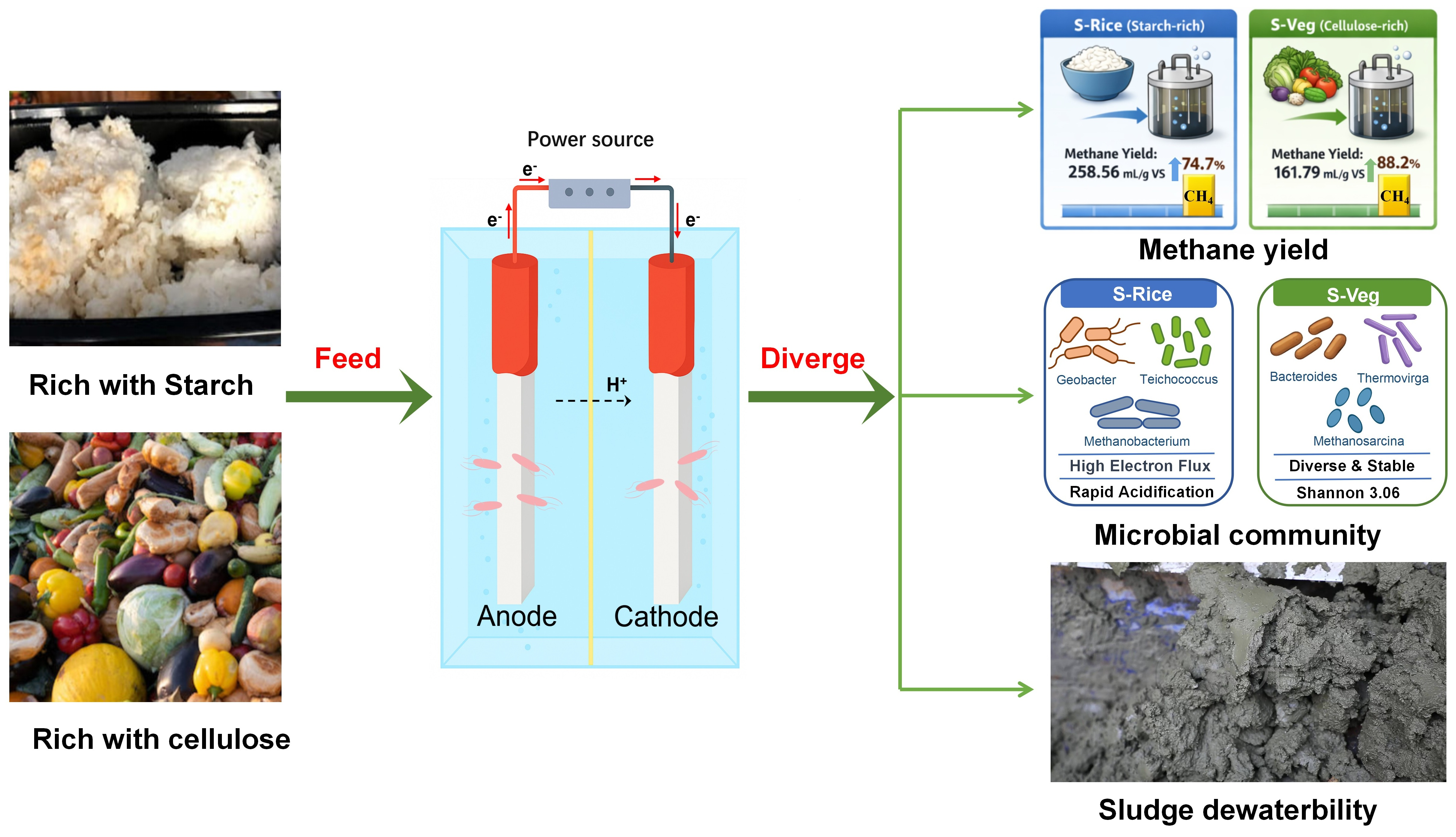
The compositional heterogeneity of food waste greatly influences its bioconversion in microbial electrolysis cell (MEC)-assisted anaerobic digestion (AD), but the underlying mechanism remains unclear. Therefore, this study assessed two typical food wastes, i.e., starch-rich rice and cellulose-rich vegetables, on methane production, microbial constituents, and digestate dewaterability in single-chamber MECs. The results demonstrated that, while the rice-fed MEC (258.56 mL/g VS) achieved a higher methane yield compared to the vegetable-fed MEC (161.79 mL/g VS), the latter achieved higher methane purity. Temporal profiles of volatile fatty acids (VFAs) revealed rapid acidification and consumption in rice-fed systems, whereas vegetable-fed MEC exhibited delayed degradation. Additionally, the substrate type greatly influenced digestate dewaterability, since digestate from the vegetable-fed MEC exhibited lower specific resistance to filtration (3.25 × 10¹² m/kg vs. 12.46 × 10¹² m/kg) and capillary suction time (8.16 s·L/g vs. 19.14 s·L/g) compared to that from the rice-fed MEC. This improvement was likely attributed to high polysaccharides in extracellular polymeric substances (EPS) and cellulose’s structural properties, which promoted the formation of a porous, less compressible sludge cake that facilitated sludge dewaterability. Microbial community analysis revealed a substrate-driven specialization, as the rice-fed MECs enriched exoelectrogens (e.g., Geobacter, Trichococcus) and hydrogenotrophic methanogens (i.e., Methanobacterium), while the vegetables enriched Bacteroides and Methanosarcina. Collectively, these results suggest substrate composition profoundly influences methane yield, metabolic pathways, microbial ecology, and digestate properties in MEC-assisted AD. This work provides key insights into the role of feedstock characteristics in shaping MEC-assisted AD systems.

1. Introduction

The global push toward sustainable waste management and renewable energy production has increasingly intensified interest in technologies that convert organic waste into valuable resources [1,2]. Among these, anaerobic digestion (AD) is widely recognized as an effective method for converting organic waste into bioenergy [3,4]. However, conventional AD processes often face challenges such as slow reaction kinetics, process instability due to volatile fatty acids (VFAs) accumulation, and suboptimal methane yields, particularly when treating complex substrates such as food waste [5,6]. Food waste, a major component of municipal solid waste, is highly variable in composition, with starch-rich residues (e.g., rice) and cellulose-rich materials (e.g., vegetables) exhibiting distinct biodegradability and metabolic pathways, which in turn may greatly influence the efficiency of methane production [7].
To overcome these limitations, microbial electrochemical systems (MECs) have emerged as a promising enhancement strategy by integrating electrochemical principles with biological processes [8]. In MEC-assisted AD, electroactive bacteria at the anode oxidize organic matter, transferring electrons through an external circuit to the cathode, where protons are reduced to form hydrogen or directly participate in methanogenesis [9,10]. This electron transfer not only accelerates the oxidation of intermediate metabolites such as VFAs, but also thermodynamically favors syntrophic reactions, thereby preventing acidification and enhancing process stability [10]. Moreover, the applied potential can stimulate direct electron transfer (DET) among microbial communities, which further improves substrate degradation and methane conversion efficiency [11].
While previous studies have explored the effects of substrate concentration [12], polymerization degree [13], and applied voltage [14] on MEC performance, little attention has been paid to the impact of the nature of food waste on methanogenic performance. For instance, rice, as a starch-dominant substrate, is readily fermentable but may lead to rapid acidification due to swift hydrolysis and VFA generation [15]. In contrast, vegetable waste, rich in fibrous cellulose, poses challenges in hydrolysis and slower degradation kinetics, potentially resulting in incomplete digestion and poor digestate quality [16]. Additionally, these differences may affect electron generation, microbial community dynamics, VFA transformation pathways, and ultimately methane output in MEC systems.
Furthermore, the characteristics of the post-digestion residue, particularly its dewaterability, are critical for practical applications, as poor dewatering performance increases sludge volume, handling costs, and disposal burdens. The substrate composition can influence extracellular polymeric substances (EPSs) and microbial structure in digestate, which are key factors affecting dewaterability [17]. Therefore, the constituents of food waste may also greatly influence the dewaterability. However, the role of different food waste types in shaping digestate properties within MEC systems remains largely unexplored.
Therefore, this study investigates the influence of two representative food waste types, rice and vegetables, on methane production in MEC systems. The objectives are to: (1) compare the methane yield and production profile of rice vs. vegetable waste under identical operational conditions; (2) track temporal VFA profiles to evaluate metabolic behavior and process stability; (3) evaluate the impact of different food waste types on the dewaterability of the resultant digestate, including specific EPS constituents and resistance to filtration (SRF); and (4) characterize shifts in microbial communities that related with the differential responses to starchy rich-rice and cellulose rich-vegetables. The findings aim to provide practical insights for optimizing MEC applications in urban organic waste treatment and renewable energy recovery.

2. Results and Discussion

2.1. Methanogenic Performance in Different Reactors

The dynamics of gas composition were monitored throughout the operational period in microbial electrolysis cells (MECs) fed with rice substrate (S-Rice) and vegetable substrate (S-Veg.). Observations revealed that methane (CH4) purity was generally higher in S-Veg-fed MECs, whereas methane yield exhibited an opposite trend. As shown in Figure 1, after a 6-day digestion period, the final CH4 purity reached 74.72 vol% in S-Rice and 88.21 vol% in S-Veg. In contrast, the methane yield from S-Rice was approximately 1.7 times higher than that from S-Veg—258.56 mL/g VS versus 161.79 mL/g VS, respectively. This difference stems from the substantially greater cumulative gas production in S-Rice (1057.49 mL) compared to S-Veg (562.79 mL). These contrasting trends can be attributed to differences in substrate degradability. Specifically, cellulose which is predominant in vegetable waste contains glucose monomers linked by β-1,4-glycosidic bonds, which are more recalcitrant to hydrolysis and thus less readily degraded by microorganisms compared to the starch-rich rice substrate [18]. This structural resistance limits the overall methane production efficiency in S-Veg systems.
In both MEC configurations, trace amounts of hydrogen (H2) were detected initially but declined rapidly as the reaction progressed. This H2 accumulation is likely attributable to the high hydrogen evolution reaction (HER) activity of the nickel foam cathode, which promotes H2 generation at its surface. The produced H2 was subsequently consumed by hydrogenotrophic methanogens, which converted it to CH4 via CO2 reduction.

2.2. Intermediate VFAs Production and Transformation

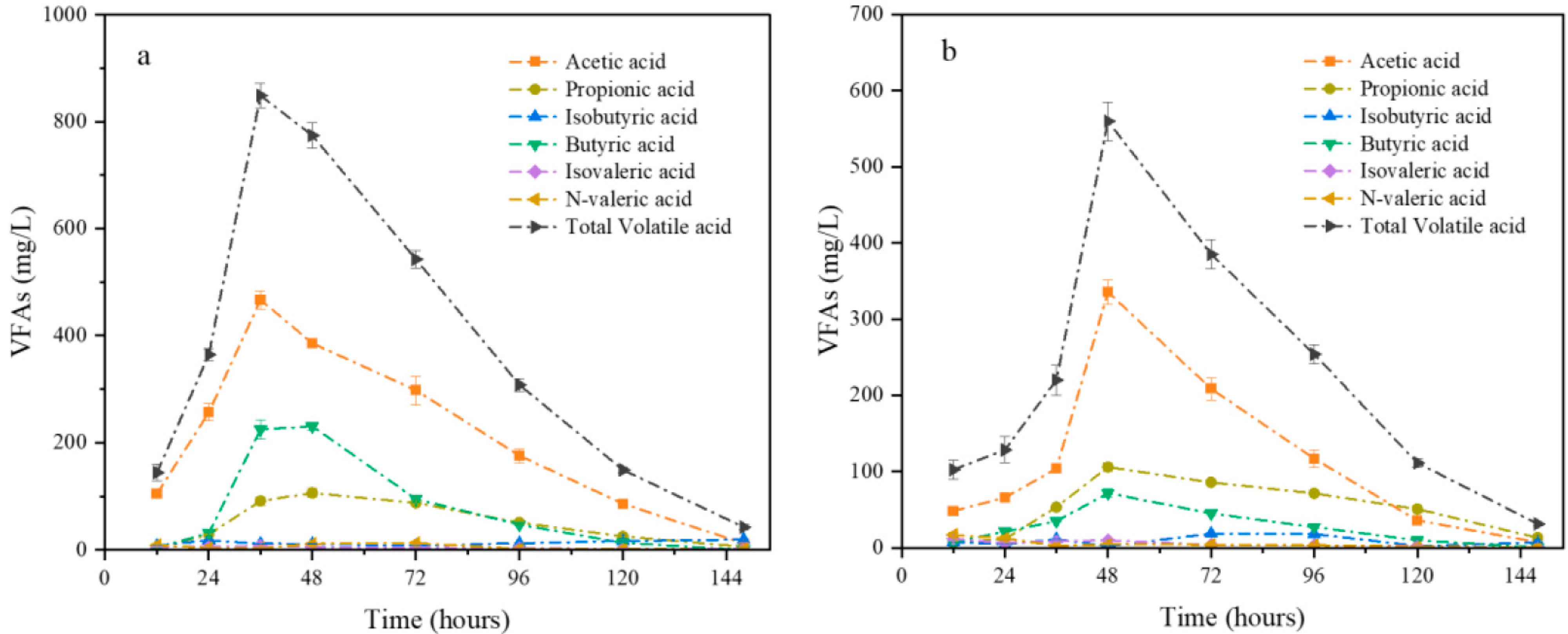
VFAs serve as key intermediates in anaerobic digestion. Their accumulation at high concentrations can inhibit methanogenic activity, disrupt microbial community structure, and potentially lead to reactor failure. Therefore, VFA levels are commonly used as a critical indicator to assess the metabolic status of methanogens in reactors. In this study, VFA accumulation was monitored throughout the operation of the MEC reactors. As shown in Figure 2, total VFAs in S-Rice accumulated rapidly and reached 849.21 mg/L within 36 h. Concurrently, acetic, propionic, and butyric acids reached concentrations of 467.16 mg/L, 91.37 mg/L, and 225.18 mg/L, which accounted for 55.01%, 10.76%, and 26.51% of the total VFAs, respectively. This rapid accumulation reflects that the initial hydrolysis and acidogenesis process exceeded the methanogenesis process. In contrast, the S-Veg. exhibited a delayed VFAs peak, reaching a maximum concentration of 559.89 mg/L at 48 h. This is likely because the starch-rich food waste in S-Rice was easier to be degraded than the cellulose-rich waste in S-Veg.
As the reactions proceeded, VFA concentrations in both groups gradually declined, which indicated effective consumption of these intermediates for methane production. Among the VFAs, acetic and isobutyric acids were degraded more readily. In contrast, propionic acid was consumed more slowly due to its thermodynamically unfavorable oxidation, which requires a low hydrogen partial pressure and higher Gibbs free energy input. Notably, no accumulation of n-butyric acid was observed in either group, and only minimal levels of n-valeric and isovaleric acids were detected. This was due to the unfavorable thermodynamic reaction, and unsuitable pH for the growth of the microbial involved in the metabolic pathway [19]. Notably, the VFA profiles, including both composition and transformation trends, were highly similar between the two groups, suggesting that the difference in substrates did not substantially influence the types of acidogenesis or the underlying digestion pathways. This similarity is likely attributable to the comparable operational conditions (such as pH and oxidation-reduction potential) employed in both setups, which were widely reported as the critical factors governing VFA composition in food waste digestion [20,21].

2.3. EPS Constituents in MECs Fed with Different Substrates

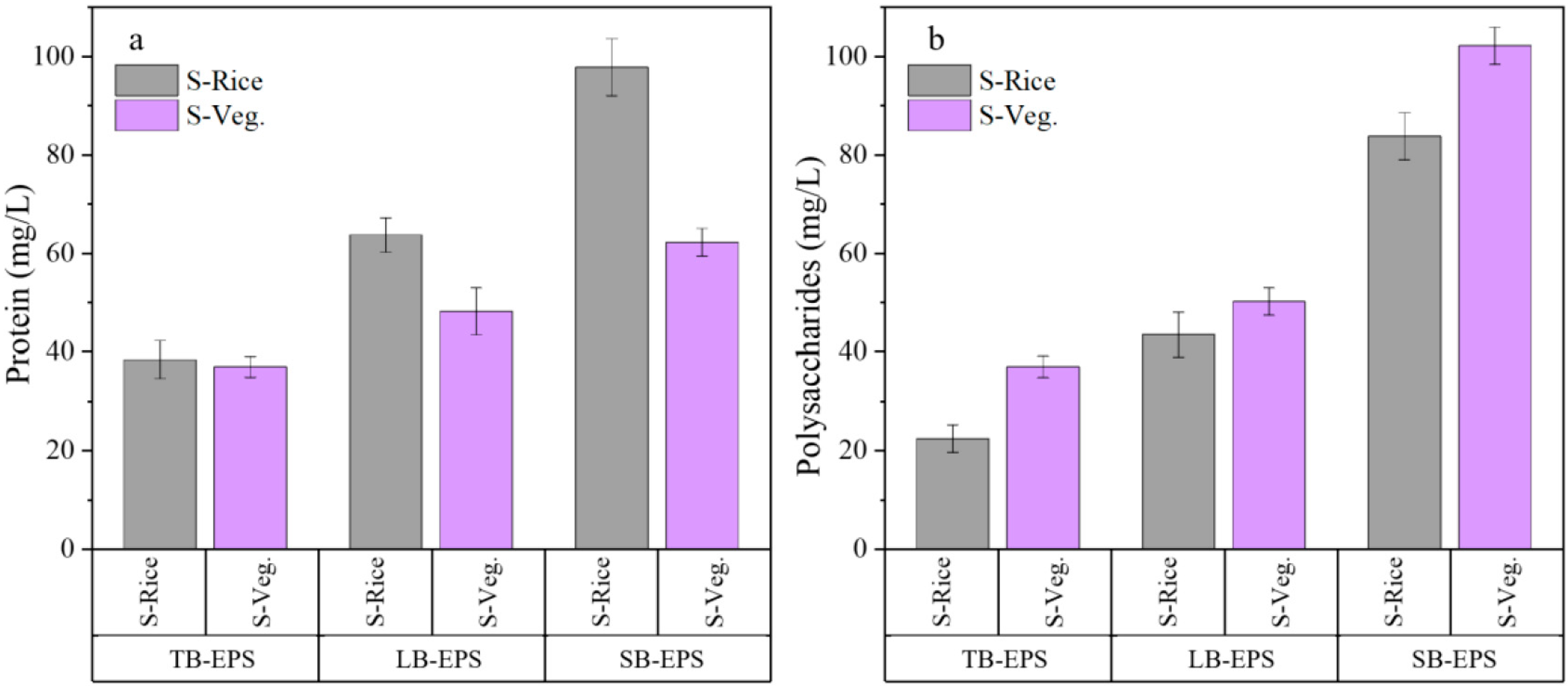
EPS were extracted to investigate the effects of different substrates on extracellular polymeric substance (EPS) secretion. As shown in Figure 3a, the protein content in EPS fractions was higher in the S-Rice group than in the S-Veg group, and this difference was particularly evident in the LB-EPS fraction. Specifically, protein concentrations in LB-EPS were 63.60 mg/L in S-Rice group and 48.06 mg/L in S-Veg group. In the soluble (SB-) EPS fraction, proteins measured 97.75 mg/L and 62.12 mg/L for the S-Rice and S-Veg groups, respectively. This trend may be attributed to the readily degradable starch in rich, which induces the secretion of extracellular digesting enzymes that are predominantly present in the LB-EPS and the soluble fraction. However, for TB-EPS, no difference in protein content was observed between the S-Rice and S-Veg groups.
In contrast, as illustrated in Figure 3b, the presence of polysaccharides in EPS differed from that of protein between the S-Rice and S-Veg groups. Higher polysaccharide levels were detected in the S-Veg. at both the TB-EPS and SB-EPS levels. In TB-EPS, polysaccharide contents were 22.33 mg/L and 36.89 mg/L for the S-Rice and S-Veg groups, respectively. Similarly, in SB-EPS, concentrations were 83.71 mg/L in the S-Rice group and 102.12 mg/L in the S-Veg group. This difference between the two groups is likely attributed to the slowly degradable nature of cellulose, a key component of the vegetable substrate. Compared to starch, the structural complexity of cellulose can lead to slower substrate release and prolonged microbial adaptation. This can promote microbial secretion of higher levels of structural polysaccharides within TB-EPS to strengthen cell attachment and enhance syntrophic interactions. As for the higher polysaccharide content in the SB-EPS fraction of S-Veg. group, it is likely due to the residues of recalcitrant produces which are generated from cellulose hydrolysis.

2.4. Dewatering Performance of Digestate from Reactors Fed with Different Substrates

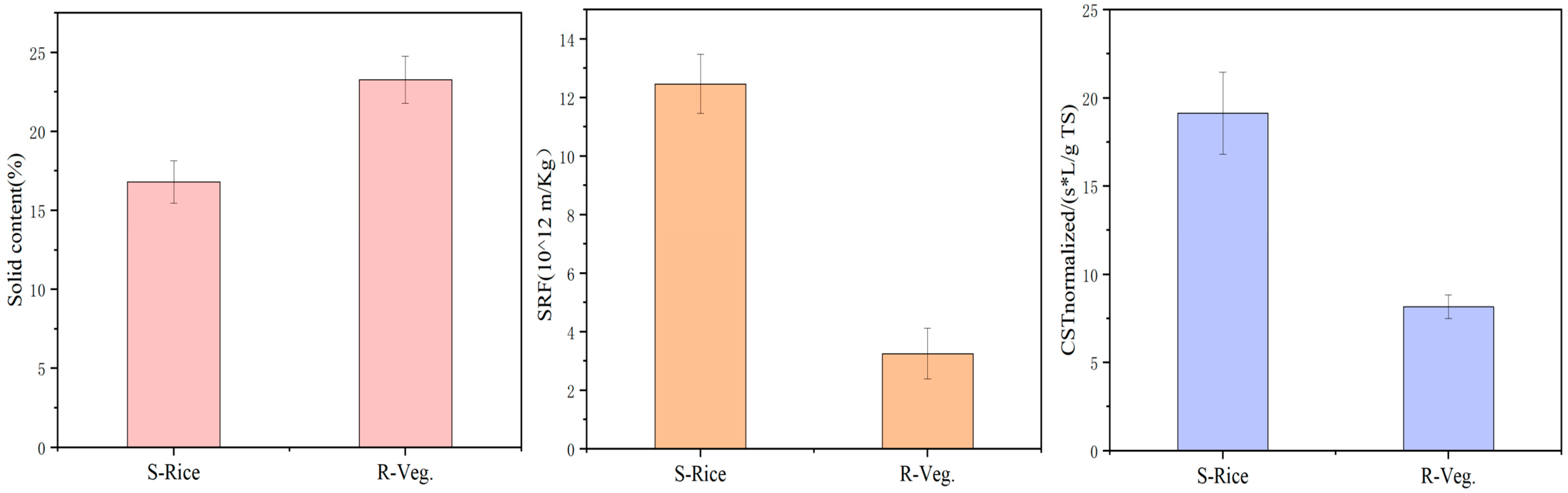
Efficient sludge dewatering is critical for minimizing downstream processing and disposal costs. The dewaterability of digestate from reactors fed with different types of food waste is summarized in Figure 4. Notably, the digestate from the vegetable-fed reactor exhibited better dewatering performance compared to that from the rice-fed reactor. Specifically, the solid content of the residual sludge from S-Veg. was 23.27 wt%, which was substantially higher than that of 16.81 wt% observed for S-Rice. This improved dewatering was further confirmed by filtration characteristics, as the specific resistance to filtration (SRF) was 3.25 × 10¹² m/kg for S-Veg compared to 12.46 × 10¹² m/kg for S-Rice. Similarly, the capillary Suction Time (CST) was lower for S-Veg (8.16 s·L/g TS) compared with S-Rice (19.14 s·L/g TS). These differences can be attributed to the distinct biochemical compositions of the substrates and their induced EPS section. Specifically, rice is rich in starch and undergoes rapid fermentation, which can promote the production of protein-rich EPS [22], particularly in the soluble (SB-EPS) and loosely bound (LB-EPS) fractions, as shown in Figure 3. This gel-like EPS matrix enhances water retention and increases sludge viscosity, thereby elevating SRF and impeding water release during dewatering.
In contrast, the vegetables are rich with cellulose fibers, which are recalcitrant to digestion and remain in the digestate. These residual cellulose fibers within the digestate matrix could promote the formation of porous, less compressible sludge cakes that facilitate dewaterability [23]. These findings are consistent with previous findings that the addition of cellulose fibers greatly enhances sludge dewatering [24,25].

2.5. Microbial Community Constituents in Reactors Fed with Different Substrates

2.5.1. Microbial Constituents

Alpha diversity analysis revealed distinct microbial community structures between reactors fed with rice (S-Rice) and vegetable waste (S-Veg.). As shown in Table 1, the anode of the rice-fed reactor exhibited lower microbial richness (OTU = 201) and diversity (Shannon index = 2.96) relative to that of the vegetable-fed reactor (OTU = 264; Shannon = 3.06), indicating that the cellulose-rich vegetable substrate fostered a more diverse bacterial consortium. A consistent pattern was observed at the cathode, where the S-Rice cathode displayed reduced richness (OTU = 115) and diversity (Shannon = 1.89) compared to the S-Veg cathode (OTU = 142; Shannon = 2.51). These results reflect strong substrate-driven selection of microbial communities: the recalcitrant nature of vegetable-derived organics likely necessitated a broader enzymatic repertoire, promoting higher taxonomic diversity, whereas the readily fermentable starch in rice selected for a less diverse but potentially more specialized electroactive microbiome—an observation consistent with prior studies [26,27].

2.5.2. Microbial Communities on the Anode

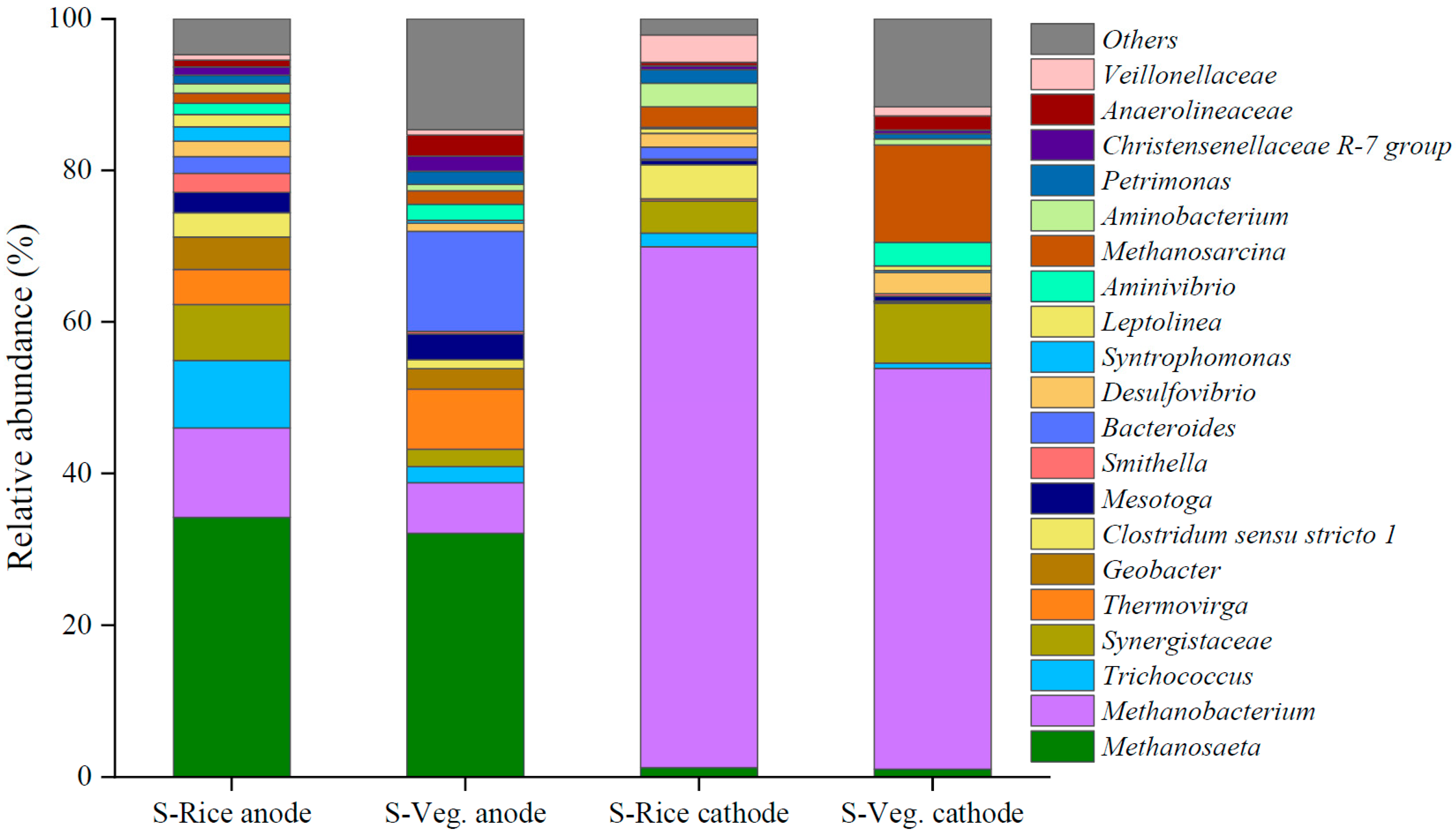
Figure 5 presents the microbial community structure at the genus level on the anode and cathode of the reactor under different substrate conditions. In the anode communities, dominant bacterial genera following substrate acclimation included Trichococcus, Synergistaceae, Thermovirga, Geobacter, and Bacteroides. Among these, Trichococcus and Geobacter are both acidogenic and well-known exoelectrogenic bacteria [28]. They may play a role in digesting various carbohydrates with the generation of VFAs and can transfer electrons extracellularly, thereby promoting methanogenesis with syntrophic methanogens such as Methanosaeta. In this study, both Trichococcus and Geobacter were more abundant in the S-Rice anode community (8.92% and 2.14%) compared to S-Veg (4.31% and 2.76%), indicating that rice-based food waste promotes the enrichment of electroactive bacteria. This enhanced exoelectrogenic population likely accelerates electron flow in the MECs, shortening the biogas production cycle and increasing methane yield. In contrast, Thermovirga, an microorganism that performs hydrolysis and generates low-molecular-weight organics [29], shows greater enrichment in the vegetable waste-fed reactor, with a relative abundance of 7.93% in the S-Veg anode and 4.61% in the S-Rice anode. Synergistaceae, a hydrogen-producing acetogenic bacterium capable of converting VFAs into hydrogen, showed a relative abundance of 7.42% in the S-Rice anode much higher than that of the S-Veg anode (2.37%). This is consistent with more VFA accumulation in the rice-fed reactor. Bacteroides, a specialized anaerobic fermentative bacterium known for degrading complex organic matter [30] was more abundant in the S-Veg anode community. Its relative abundance increased by 4.03 times compared to S-Rice (from 2.63% to approximately 13.24%), likely due to the higher recalcitrant cellulose present in the S-Veg. The discrepancy between the two types of food waste fed MECs underscores the substrate-driven specialization of microbial communities.
Among archaeal populations, Methanosaeta and Methanobacterium were dominant in both anode samples. Methanosaeta, a primary acetoclastic methanogen, accounted for 34.25% (S-Rice) and 32.11% (S-Veg) of the anode archaeal community. Notably, although Methanosaeta cannot utilize hydrogen, it can accept electrons to reduce CO2 and produce methane. The high abundance of exoelectrogenic bacteria such as Geobacter and Trichococcus on the anode likely supports this electron transfer pathway. Methanobacterium, a hydrogenotrophic methanogen, was more abundant in S-Rice (11.80%) than in S-Veg (6.73%). This correlates with the higher abundance of exoelectrogens and hydrogen-producing bacteria (e.g., Synergistaceae_uncultured) in the S-Rice anode, which are able to generate more H2 and H+—substrates essential for hydrogenotrophic methanogenesis.

2.5.3. Microbial Communities on the Cathode

In the cathode communities, the dominant bacterial genera included Synergistaceae, Clostridium sensu stricto 1, and AUTHM297. The relative abundance of Synergistaceae_ was 4.21% in the S-Rice cathode and 7.94% in the S-Veg cathode. In comparision, Clostridium sensu stricto 1 accounted for 3.81% in S-Rice but only 0.04% in S-Veg. AUTHM297 was present at 0.02% in S-Rice and 7.93% in S-Veg. Despite their relative dominance among bacterial taxa, the overall abundance of bacteria in the cathode communities remained low.
In contrast, methanogenic archaea were highly enriched on the cathode, with Methanobacterium and Methanosarcina as the dominant genera. Together, the two genera constituted 71.47% of the cathode community in S-Rice and 65.92% in S-Veg, underscoring the selective role of the cathode in enriching electron-accepting methanogens for methane generation. Notably, Methanobacterium, a hydrogenotrophic methanogen, was more abundant in the S-Rice cathode (68.72%) compared to S-Veg (52.86%). This enrichment is likely driven by the higher hydrogen availability resulting from the rapid hydrolytic acidification of starch-rich rice waste, which favors hydrogen-dependent methanogenesis. Conversely, Methanosarcina was markedly more abundant in the S-Veg cathode (13.06%) than in S-Rice (2.75%). Methanosarcina is a metabolically versatile methanogen capable of utilizing acetate, hydrogen/CO2, and carbon dioxide. Its enrichment in the vegetable waste-fed reactor may be attributed to the lower hydrogen yield and the recalcitrant nature of vegetable substrates, which can lead to nutrient-limited or fluctuating availability of biodegradable substrates. Under such conditions, the metabolic versatility of Methanosarcina enables more efficient methane production, providing a competitive advantage for growth and persistence in the reactors. Collectively, these phenomena show that substrate composition profoundly shapes both anodic and cathodic microbial communities in MEC systems, thereby influencing substrate degradation kinetics, methanogenic pathways, and the composition of the resulting biogas.

3. Materials and Methods

3.1. Materials

Two representative cooked food waste types (i.e., rice and vegetables) were selected as substrates. Vegetables consisted of a mixture of commonly discarded cooked leafy greens and root vegetables (e.g., cabbage, bok choy, and carrot). After being ground in a blender for 5 min, the samples were stored for subsequent use. The total solid contents of the rice slurry and vegetable slurry were 4.15% and 3.37%, respectively.

3.2. Experimental Setup and Operation

The experiments were conducted in single-chamber MEC reactors (Pomex, Jiangsu, China), each with an inner diameter of 5 cm, a height of 20 cm, and a working volume of 400 mL(total reactor volume: 500 mL). Each condition (S-Rice and S-Veg) was run in triplicate. The reactor top was equipped with three electrodes: a reference electrode (saturated Ag/AgCl), a cathode made of nickel foam (6 cm × 2 cm), and an anode composed of a carbon brush (Φ 3 cm × 2 cm). The cathode was connected to a DC power supply via wires at both ends, and a 1 Ω resistor was installed in series within the external circuit to monitor current. A data acquisition module was connected across the resistor to record the voltage drop continuously for real-time current calculation. A gas collection port located at the top of the reactor was linked by a rubber tube to an inverted, water-filled collection bottle. The water inside was adjusted to pH ≈ 2 to minimize CO2 dissolution and allowed daily measurement of gas production via the water displacement method. Additionally, a 1 cm diameter opening at the reactor top accommodated a sampling needle with a 1 mL disposable syringe positioned below the liquid surface, enabling periodic collection of liquid-phase samples for analysis.
Pre-treated food waste was served as the substrate. In the following content, the reactors fed with substrates rice and vegetables are named as S-Rice and R-Veg., respectively. Aanaerobic sludge collected from a lab-scale reactor was used as the inoculum, and micro-nutrients were added to achieve a total working volume of 400 mL. The final total solids (TS) and volatile solids (VS) of the substrate were 10.00 g/L and 7.64 g/L, respectively, while those of the inoculum were 9.25 g/L and 6.51 g/L. Prior to operation, the reactor headspace was purged with high-purity argon for 10 min to eliminate oxygen, and the reactor was then placed in a temperature-controlled water bath maintained at 35 °C. A constant voltage of 0.4 V was applied across the electrodes. The system was operated in batch mode with digested substrate replaced by fresh substrate after each cycle to facilitate microbial incubation. A cycle was defined as a fixed 6-day batch period, after which the entire reactor content was replaced except for 10% (v/v) of the sludge to retain microbial consortia. This process was repeated until gas production stabilized, indicating successful microbial enrichment. Once the methane production profile was found to be consistent across successive feeding cycles, key parameters such as daily gas production, gas composition, and VFA concentrations were monitored over three consecutive cycles to ensure data consistency and minimize measurement errors. The average values of cumulative gas production, VFAs, EPS, and dewaterability from the last three feeding cycles were calculated and are presented in the following text.

3.3. Analytical Methods

3.3.1. Physicochemical Analysis

The determination of total solids (TS) and volatile solids (VS) was performed according to the Municipal Wastewater Treatment Plant Sludge Test Method (CJ/T 221-2005). Gas volume was measured using the water displacement method. The composition of gaseous products was analyzed by gas chromatography (GC-1690J, Kexiao, Hangzhou, China), equipped with a packed column consisting of TDX-01 and 5A molecular sieve, using high-purity argon (99.999%) as the carrier gas and a thermal conductivity detector (TCD). For liquid-phase analysis, VFAs were quantified using a different gas chromatograph (GC-6890N, Agilent, Santa Clara, CA, USA ) fitted with a capillary column (AT-FFAP, 30 m × 0.32 mm × 0.5 μm), high-purity nitrogen (99.999%) as the carrier gas, and a flame ionization detector.

3.3.2. EPS Extraction

The soluble (SB-EPS), loosely bound (LB-EPS), and tightly bound (TB-EPS) fractions were sequentially extracted using a thermal method. In brief, a 20 mL sludge sample was first centrifuged (4000 rpm, 30 min, 4 °C) to collect the S-EPS supernatant. The pellet was then resuspended in 0.05% NaCl pre-heated to 70 °C to reach 50 °C, vortexed for 1 min, and centrifuged (4000 rpm, 10 min) to obtain the LB-EPS supernatant. Finally, the remaining pellet was resuspended in 0.05% NaCl, heated at 60 °C for 30 min, and centrifuged (4000 rpm, 15 min) to collect the TB-EPS supernatant. All extracts were stored at 4 °C until analysis [31].

3.3.3. Methane Yield Calculation

The methane yield is an effective indicator of substances conversion efficiency. It represents the volume of methane produced per unit of substances and is calculated as follows.
υ = V × r W
where υ is cumulative methane yield (mL/g VS), V is the total volume of methane yield (mL), W is the volatile solids (VS) of the substances (g), and r is the volume ratio of methane (vol %).

3.3.4. Community Structure Analysis

The microbial communities colonizing the anode and cathode materials of the reactor were analyzed using high-throughput sequencing. After the experiments, representative samples were collected, placed in centrifuge tubes, immediately frozen, and stored at −80 °C until further DNA extraction. Polymerase chain reaction (PCR) amplification was performed using the primer pair 515F (ArBa515F: 5′-GTGCCAGCMGCCGCGGTAA-3′) and 806R (Arch806R: 5′-GGACTACVSGGGTATCTAAT-3′), which target the V4 region of the 16S rRNA gene in archaea and bacteria. The amplified fragments had an expected length of approximately 291 bp, and sequencing was conducted on the Illumina MiSeq platform (MiSeq v3.1) with a paired-end 300 (PE300) configuration.

4. Conclusions

This study demonstrates that substrate composition is associated with in shaping the performance and microbial ecology of food waste in MEC system. Specifically, starch-rich substrates, such as rice, exhibited faster hydrolysis and higher methane production rates which is attributed to their rapid acidogenesis and efficient syntrophic interactions. In contrast, cellulose-rich vegetables resulted in slower but more stable degradation dynamics due to their recalcitrant nature. The S-Rice systems promoted exoelectrogenic bacteria and hydrogenotrophic methanogens, favoring microbial partnerships potentially involving DIET and high electron flux, while the S-Veg. group benefited growth of fermentative bacteria and methanogens that were capable of utilizing diverse substrates. Furthermore, substrate characteristics greatly impacted downstream sludge management. The S-Veg. group enriched with cellulose residues from vegetables digestion, greatly enhanced digestate dewaterability by contributing to a more porous and less compressible sludge structure, whereas protein-rich EPS within S-Rice digestate impaired dewatering performance. This study compared only two extreme substrate types under a single applied voltage and lacked a conventional AD control. Future studies should include diverse food waste mixtures and AD controls to better isolate MEC-specific effects.

Author Contributions

Conceptualization, J.Y. and W.Y.; methodology, B.C. and X.X.; writing—original draft preparation, J.Y.; writing—review and editing, Y.I. All authors have read and agreed to the published version of the manuscript.

Funding

This research was founded by the Shenzhen Science and Technology Program, grant number JCYJ20220530145613031, Guangdong Basic and Applied Basic Research Foundation grant number 2023A1515110434, National Natural Science Foundation of China grant number 42407095.

Data Availability Statement

The data presented in this study are available on request from the corresponding author.

Conflicts of Interest

The authors declare no conflict of interest.

References

  1. Tsui, T.-H.; Wong, J.W. A critical review: Emerging bioeconomy and waste-to-energy technologies for sustainable municipal solid waste management. Waste Dispos. Sustain. Energy 2019, 1, 151–167. [Google Scholar] [CrossRef]
  2. Sharma, P.; Bano, A.; Singh, S.P.; Varjani, S.; Tong, Y.W. Sustainable organic waste management and future directions for environmental protection and techno-economic perspectives. Curr. Pollut. Rep. 2024, 10, 459–477. [Google Scholar] [CrossRef]
  3. De Clercq, D.; Wen, Z.; Gottfried, O.; Schmidt, F.; Fei, F. A review of global strategies promoting the conversion of food waste to bioenergy via anaerobic digestion. Renew. Sustain. Energy Rev. 2017, 79, 204–221. [Google Scholar] [CrossRef]
  4. Uddin, M.M.; Wright, M.M. Anaerobic digestion fundamentals, challenges, and technological advances. Phys. Sci. Rev. 2023, 8, 2819–2837. [Google Scholar] [CrossRef]
  5. Yan, W.; Vadivelu, V.; Maspolim, Y.; Zhou, Y. In-situ alkaline enhanced two-stage anaerobic digestion system for waste cooking oil and sewage sludge co-digestion. Waste Manag. 2021, 120, 221–229. [Google Scholar] [CrossRef] [PubMed]
  6. Cui, B.; Meng, S.; Wang, Z.; Zhu, X.; Chen, S.; Liu, W.; Lin, C.; Yan, W. Mechanism underlying the sustained stimulatory effects of energization on biomethane recovery from food waste post-energization cessation. Environ. Res. 2024, 261, 119725. [Google Scholar] [CrossRef] [PubMed]
  7. Liu, Y.; Watanabe, R.; Li, Q.; Luo, Y.; Tsuzuki, N.; Ren, Y.; Qin, Y.; Li, Y.-Y. Enhanced biomethane production by thermophilic high-solid anaerobic co-digestion of rice straw and food waste: Cellulose degradation and microbial structure. Chem. Eng. J. 2025, 503, 158088. [Google Scholar] [CrossRef]
  8. Guo, H.; Hua, J.; Cheng, J.; Yue, L.; Zhou, J. Microbial electrochemistry enhanced electron transfer in lactic acid anaerobic digestion for methane production. J. Clean. Prod. 2022, 358, 131983. [Google Scholar] [CrossRef]
  9. Yu, Z.; Leng, X.; Zhao, S.; Ji, J.; Zhou, T.; Khan, A.; Kakde, A.; Liu, P.; Li, X. A review on the applications of microbial electrolysis cells in anaerobic digestion. Bioresour. Technol. 2018, 255, 340–348. [Google Scholar] [CrossRef]
  10. Cerrillo, M.; Viñas, M.; Bonmatí, A. Anaerobic digestion and electromethanogenic microbial electrolysis cell integrated system: Increased stability and recovery of ammonia and methane. Renew. Energy 2018, 120, 178–189. [Google Scholar] [CrossRef]
  11. Joshi, J.; Bhatt, P.; Kandel, P.; Khadka, M.; Kathariya, S.; Thapa, S.; Jha, S.; Phaiju, S.; Bajracharya, S.; Yadav, A.P. Integrating microbial electrochemical cell in anaerobic digestion of vegetable wastes to enhance biogas production. Bioresour. Technol. Rep. 2024, 27, 101940. [Google Scholar] [CrossRef]
  12. Lee, M.; Reddy, C.N.; Min, B. In situ integration of microbial electrochemical systems into anaerobic digestion to improve methane fermentation at different substrate concentrations. Int. J. Hydrogen Energy 2019, 44, 2380–2389. [Google Scholar] [CrossRef]
  13. Liu, C.; Liu, W.; Meng, S.; Han, D.; Pan, Z.; Chen, J.; Lin, C. Optimization of in-situ synthesis of methane in microbial electrochemical systems: Influence of substrate concentration, polymerization degree, and applied voltage. Chem. Eng. J. 2025, 514, 163195. [Google Scholar] [CrossRef]
  14. Ding, A.; Yang, Y.; Sun, G.; Wu, D. Impact of applied voltage on methane generation and microbial activities in an anaerobic microbial electrolysis cell (MEC). Chem. Eng. J. 2016, 283, 260–265. [Google Scholar] [CrossRef]
  15. Al-Lawati, I.M.H.D. Enhancing Biogas Generation With Conductive Material And Enzymes in Thermophilic Digestion; Sultan Qaboos University: Muscat, Oman, 2023. [Google Scholar]
  16. Agregán, R.; Lorenzo, J.M.; Kumar, M.; Shariati, M.A.; Khan, M.U.; Sarwar, A.; Sultan, M.; Rebezov, M.; Usman, M. Anaerobic digestion of lignocellulose components: Challenges and novel approaches. Energies 2022, 15, 8413. [Google Scholar] [CrossRef]
  17. Zhu, L.; Tao, H.; Dai, X.; Dong, B.; Zhang, W. Impact of hydrophilic functional groups of macromolecular organic fractions on food waste digestate dewaterability. J. Environ. Manag. 2023, 326, 116722. [Google Scholar] [CrossRef]
  18. Zong, P.; Jiang, Y.; Tian, Y.; Li, J.; Yuan, M.; Ji, Y.; Chen, M.; Li, D.; Qiao, Y. Pyrolysis behavior and product distributions of biomass six group components: Starch, cellulose, hemicellulose, lignin, protein and oil. Energy Convers. Manag. 2020, 216, 112777. [Google Scholar] [CrossRef]
  19. Liu, W.; Cheng, S.; Sun, D.; Huang, H.; Chen, J.; Cen, K. Inhibition of microbial growth on air cathodes of single chamber microbial fuel cells by incorporating enrofloxacin into the catalyst layer. Biosens. Bioelectron. 2015, 72, 44–50. [Google Scholar] [CrossRef]
  20. Yin, J.; Yu, X.; Zhang, Y.; Shen, D.; Wang, M.; Long, Y.; Chen, T. Enhancement of acidogenic fermentation for volatile fatty acid production from food waste: Effect of redox potential and inoculum. Bioresour. Technol. 2016, 216, 996–1003. [Google Scholar] [CrossRef]
  21. Yuan, Y.Y.; Hu, X.Y.; Chen, H.B.; Zhou, Y.Y.; Zhou, Y.F.; Wang, D.B. Advances in enhanced volatile fatty acid production from anaerobic fermentation of waste activated sludge. Sci. Total. Environ. 2019, 694, 133741. [Google Scholar] [CrossRef] [PubMed]
  22. Zang, J.; Lin, T.; Shi, Y.; Lin, Y.; Xu, C.; Ma, K.; Zhang, C.; Rui, X.; Gan, D.; Li, W. Recent Advances in Exopolysaccharide–Protein Interactions in Fermented Dairy-and Plant-Based Yogurts: Mechanisms, Influencing Factors, Health Benefits, Analytical Techniques, and Future Directions. Compr. Rev. Food Sci. Food Saf. 2025, 24, e70219. [Google Scholar] [CrossRef]
  23. Tochioka, E.; Yamashita, M.; Usui, J.; Miyake, H.; Terada, A.; Hosomi, M. Enhancing the dewaterability of anaerobically digested sludge using fibrous materials recovered from primary sludge: Demonstration from a field study. Clean Technol. Environ. Policy 2019, 21, 1131–1141. [Google Scholar] [CrossRef]
  24. Zhang, W.-H.; Wu, J.; Weng, L.; Zhang, H.; Zhang, J.; Wu, A. Understanding the role of cellulose fiber on the dewaterability of simulated pulp and paper mill sludge. Sci. Total Environ. 2020, 702, 134376. [Google Scholar] [CrossRef]
  25. Nittami, T.; Uematsu, K.; Nabatame, R.; Kondo, K.; Takeda, M.; Matsumoto, K. Effect of compressibility of synthetic fibers as conditioning materials on dewatering of activated sludge. Chem. Eng. J. 2015, 268, 86–91. [Google Scholar] [CrossRef]
  26. Wang, S.; Zou, C.; Lou, C.; Yang, H.; Mei, M.; Jing, H.; Cheng, S. Effects of hemicellulose, cellulose and lignin on the ignition behaviors of biomass in a drop tube furnace. Bioresour. Technol. 2020, 310, 123456. [Google Scholar] [CrossRef] [PubMed]
  27. Do, J.-M.; Jo, S.-W.; Yeo, H.-T.; Hong, J.W.; Yoon, H.-S. Substrate-Driven Microbial Dynamics and Digestate Traits in Microalgal Co-Digestion. Waste Biomass Valorization 2025. [Google Scholar] [CrossRef]
  28. Wang, J.-F.; Zhu, C.-Y.; Li, Q.-S.; Yan, D.-M.; Wang, L.-L.; He, T.; Cai, Z.-X.; Zhou, H.-Z.; Song, X.-S. Anaerobic granular sludge coupled with artificial aeration or Fe-based substrate enhanced nitrogen conversion dynamic based on CW-MFCs. J. Water Process Eng. 2022, 45, 102483. [Google Scholar] [CrossRef]
  29. Yang, S.; Chen, Z.; Wen, Q. Impacts of biochar on anaerobic digestion of swine manure: Methanogenesis and antibiotic resistance genes dissemination. Bioresour. Technol. 2021, 324, 124679. [Google Scholar] [CrossRef] [PubMed]
  30. Wang, A.; Liu, L.; Sun, D.; Ren, N.; Lee, D.-J. Isolation of Fe(III)-reducing fermentative bacterium Bacteroides sp. W7 in the anode suspension of a microbial electrolysis cell (MEC). Int. J. Hydrogen Energy 2010, 35, 3178–3182. [Google Scholar] [CrossRef]
  31. Xu, H. Synergistic effect of extracellular polymeric substances and carbon layer on electron utilization of Fe@C during anaerobic treatment of refractory wastewater. Water Res. 2023, 231, 119609. [Google Scholar] [CrossRef]
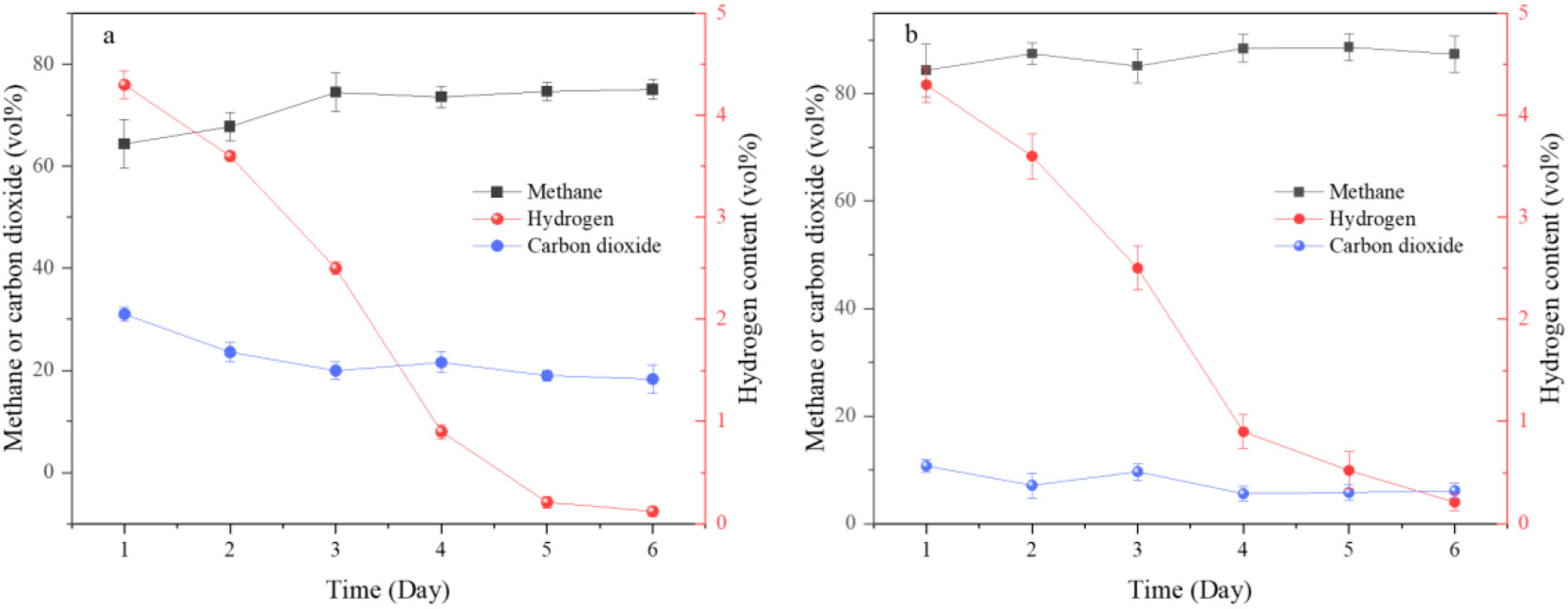
Figure 1. Gas constituents in MEC fed with rice (a) and vegetables (b).
Methane 05 00002 g001
Figure 2. Volatile fatty acid (VFA) transformation in MEC fed with rice (a) and vegetables (b).
Methane 05 00002 g002
Figure 3. The abundance of protein (a) and polysaccharides (b) in different extracellular polymeric substances levels.
Methane 05 00002 g003
Figure 4. The dewaterability of sludge fed with different substances.
Methane 05 00002 g004
Figure 5. Microbial constituents at genus level under different substrates fed conditions.
Methane 05 00002 g005
Table 1. Microbial alpha diversity in different MECs.
Sample IDOTUChaoCoverageShannonSimpson
S-Rice anode2012750.990362.960.1533
S-Rice cathode1151490.994391.890.2888
K-Veg. anode2643490.987333.060.1586
K-Veg. cathode1421850.993382.510.1726
Disclaimer/Publisher’s Note: The statements, opinions and data contained in all publications are solely those of the individual author(s) and contributor(s) and not of MDPI and/or the editor(s). MDPI and/or the editor(s) disclaim responsibility for any injury to people or property resulting from any ideas, methods, instructions or products referred to in the content.