Article

Optimization of Hybrid Energy Storage for Split-Shaft Wind Systems


by
Rasoul Akbari
and
Afshin Izadian
*
Electrical Engineering Technology, Purdue University, West Lafayette, IN 47907, USA
*
Author to whom correspondence should be addressed.
Submission received: 16 April 2026 / Revised: 26 May 2026 / Accepted: 2 June 2026 / Published: 9 June 2026

Abstract

This paper introduces a new combination of hybrid energy storage in a split-shaft wind energy conversion system based on a hydraulic transmission system. In the hybrid energy storage, a flywheel, supercapacitor, and battery are integrated into the wind energy conversion system with minimal additional supporting hardware. The split-shaft configuration allows the direct connection of the flywheel to the doubly fed induction generator (DFIG) shaft without a power electronic converter. The principal operation and minimization of this hybrid storage, as well as the energy management strategy, are explained. The goal is to smooth out output power fluctuations using the response surface method. A 1.5 MW hydraulic wind turbine is simulated in Matlab 23, and the hybrid storage is configured and optimized. The direct connection of the flywheel facilitates reaching a suitable level of smoothness at a reasonable cost. The proposed configuration is compared with conventional storage, and the results demonstrate that the integrated hybrid energy storage reduces the annualized storage cost by 71%.

1. Introduction

Due to the increase in energy demand (4.3% in 2024) and problems with the conventional methods of energy generation, distributed generation (DGs) and renewable energy sources (RESs) like wind and solar have become more popular worldwide and reached ~4448 GW in 2024, with a record annual addition of 585 GW (15.1% growth) [1,2,3,4]. However, the deep penetration of RESs poses several challenges for the power grid, primarily due to their intermittent nature. These challenges include weak power grid stability, voltage deviation, frequency fluctuation, and flicker [5,6]. To mitigate these challenges, energy storage systems have been utilized. Conventional storage units are battery ESS (BESS) [7], superconducting magnetic ESS (SMESS) [7,8,9], supercapacitor ESS (SCESS) [10,11], flywheel ESS (FESS) [12], compressed air ESS (CAESS) [13], pumped hydro ESS (PHESS) [14], and thermal ESS (TESS) [15]. These systems exhibit different characteristics, making them more favorable for various applications. ESSs are characterized by their round-trip efficiency, response time, energy and power density, life cycles, self-discharge rate, investment cost, and environmental impacts [16,17]. For example, FESS and SCESS have high energy conversion efficiency, low environmental impact, high specific power and power density, long life cycles, fast charging and discharging response times, and low maintenance costs. However, the primary drawbacks of these ESSs are high investment costs and low energy densities [18,19].
Furthermore, FESSs have a high self-discharge rate and are not suitable for long-term energy storage [19,20]. On the other hand, BESSs, such as lithium-ion batteries, have high energy density, fast response, and low investment costs, but suffer from limited cycle life. This could be more problematic in applications that require frequent charging and discharging, dramatically reducing the lifetime of the BESS.
Hybrid ESSs (HESSs), with high power density (~1–20 kW/kg), turn out to be one of the promising solutions to take full advantage of various characteristics of different types of ESSs and improve the performance of the ESS [21,22]. For example, by directing the short-term power fluctuations to another form of energy storage, such as SCESS [23,24] or FESS [25,26], the lifetime of the BESS with high energy density (~100–250 Wh/kg) can be prolonged. These HESSs have the advantage of the high-power density of the SCESS and FESS and the high energy density of the BESS. Different combinations of HESSs, such as BESS-SCESS, BESS-SMESS, and BESS-FESS, have been utilized in various applications [22]. One of the main applications of HESSs in sustainable power grids with RESs is to smooth power fluctuations and reduce the uncertainties of RESs [27].
To this end, two aspects of HESS should be considered: (1) the power allocation or energy management methods, and (2) optimal sizing [28]. The available power allocation can be categorized broadly into two main groups [22]: (1) classical methods such as low-pass filter decomposition [28] and rule-based control [29], and (2) intelligent methods such as fuzzy control [30,31,32], an artificial neural network (ANN) [33], and model predictive control (MPC) [34,35], which has demonstrated exemplary performance [36,37]. Another aspect of the HESS is to determine the appropriate storage capacity. Various methods have been proposed to determine the HESS capacity, such as analytical and statistical methods considering the total cost, reliability, and performance [22].
On the other hand, split-shaft wind turbines can independently control the speed of the turbine shaft and the generator shaft [38,39]. Utilizing a doubly fed induction generator (DFIG) in this structure can enhance the system performance and reduce the system components and sizes [40]. Alternatively, fluid power technology can be an adequate solution to overcome the challenges of conventional WECSs to decrease their Levelized Cost of Energy (LCOE) [41,42]. Many researchers have demonstrated the advantages of this drivetrain. The result of [41] demonstrates the reduction of 35.5% in mass of the nacelle due to employing a hydraulic drivetrain, and an average installed cost saving of 5.36–24.0% can occur for offshore wind. Despite the lower efficiency of the hydraulic transmission system (HTS), which is about 85–88% [43,44], the HTS could reduce the overall cost of the system and lower the Levelized Cost of Energy (LCOE) by 3.92–18.8% [41], and improve the Capacity Factor (CF) of the wind turbine [45]. Given a tower structure, the rotor speed of a wind turbine with HTS could be restricted to higher speeds that harvest about 17% more energy and compensate for its losses [46]. A wind turbine powertrain that relies on hydraulic machinery could provide a decoupled transmission system [38,39,40].
In our previous work [47], a new configuration of a split-shaft wind turbine is introduced, utilizing a new generator excitation with incorporated storage. In this paper, the optimal size of the HESS, a compound of FESS, BESS, and SCESS, is calculated using the response surface method (RSM) to attenuate the output power fluctuations. Furthermore, with the same level of smoothness (LOS), storage cost analysis compares the proposed HESS with its counterpart. The main contributions of this paper are as follows:
  • Attenuation of wind-induced power fluctuations with minimal hardware overhead. This integrated hybrid energy storage configuration effectively mitigates the inherent power fluctuations of wind energy conversion systems (WECSs). The system dynamically separates and compensates for different frequency components of the power variations. The key innovation lies in embedding these storage elements within the existing drivetrain and converter structure, and eliminating extensive additional hardware such as dedicated converters or auxiliary subsystems.
  • Elimination of the grid-side converter (GSC) through optimized excitation design. Unlike conventional DFIG-based wind turbines that require both rotor-side and grid-side converters for power regulation and control, the proposed configuration introduces an optimized excitation strategy that eliminates the need for the grid-side converter (GSC). Integration of energy storage directly into the rotor-side circuit, along with the flexibility of the split-shaft hydraulic drivetrain, enables the independent control of the generator speed and power flow using only the Rotor-Side Converter (RSC). This significantly reduces system complexity, cost, and conversion losses, simplifies the control architecture, and improves reliability.
  • Cost-effective achievement of desired smoothness levels using hybrid energy storage. An optimized Hybrid Energy Storage System (HESS) can achieve the required output power smoothness at a fraction of the cost of conventional standalone storage solutions. The size of the battery, supercapacitor, and flywheel are jointly tuned to minimize the annualized cost while meeting a predefined smoothness constraint. The results show that the desired performance can be achieved at approximately 30% of the cost of traditional storage configurations.
The rest of the paper is organized as follows: principles of split-shaft drivetrains based on hydraulic transmission systems are described in Section 2. Section 3 proposes a DFIG-based hydraulic wind energy conversion system with integrated hybrid energy storage. The principles of the control strategy and energy management strategy for the proposed configuration are explained. The optimization approach of the HESS is elaborated in Section 4. Finally, detailed simulations and discussions are presented in Section 5.

2. Split-Shaft Wind Turbine

In a hydraulic transmission system (HTS), as a typical split-shaft transmission, the wind power captured by the turbine rotor is converted to a high-pressure fluid by a hydraulic pump. Then this power is transferred to the generator through a hydraulic motor at the ground level. The hydraulic motor on the ground can provide the torque to rotate the generator and generate electricity. The governing equations of the HTS that illustrate the flow and torque balance are as follows [48]:
Q p = D p ω p η v p
J r ( d ω p / d t ) =   τ r D p P f / η t p
Q m = D m ω m / η v m
J m ( d ω m / d t ) = D m P f η t p τ e
d P f / d t = β f / V f   Q p Q m
The operating pressure dynamic follows the laws of fluid compressibility. Based on the principles of mass conservation and the definition of bulk modulus, the fluid compressibility within the system boundaries can be written as (5). Considering the proper pipe diameter, the line’s pressure losses can be negligible [29]. In an HTS-based split-shaft wind turbine, the speed of the wind turbine can be controlled independently of the speed control of the generator. In such a transmission, the required high transmission ratio can easily be achieved by adjusting the displacement ratio between the pump and motor. Therefore, a variable-displacement pump or motor (or both) can achieve continuously variable transmission (CVT). In other words, in a steady state, d P f / d t in (5) becomes zero, and by neglecting the losses, the speed–displacement of the hydraulic transmission is obtained as ω m / ω p = D p / D m .

2.1. Energy Conversion Efficiency and Power Flow

Hydraulic machinery used in the hydraulic drivetrain has two types of losses: volumetric and torque. The volumetric loss of hydraulic pumps and motors reflects fluid leakage through the clearances between the mechanical parts of the hydraulic machinery. The volumetric efficiency of the hydraulic pump and motor is obtained [38,39] as follows:
η v p = 1 C s p / A p    
η v m = 1 / ( 1 + C s m / A m )
where A p = μ ω p / P f and A m = μ ω m / P f . Moreover, the torque efficiency of the pump and motor is achieved as follows:
η t p = 1 / ( 1 + C f p + C v p A p )
η t m = 1 C f m C v m   A m
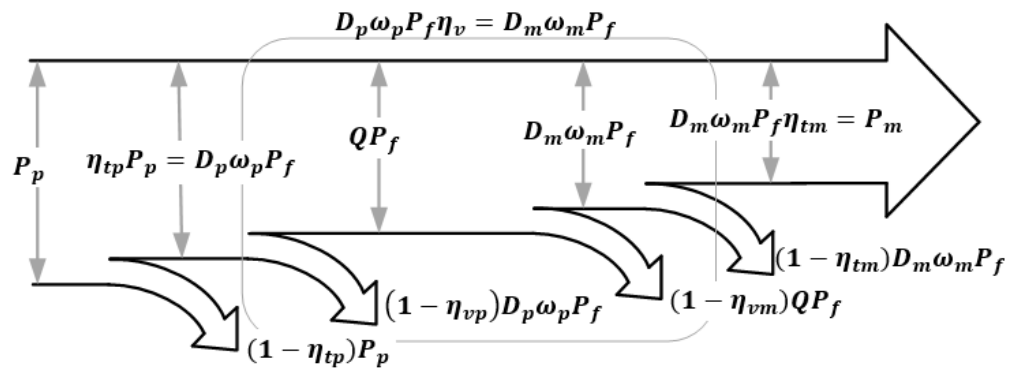
In Equations (8) and (9), C f p and C f m represent the opposing friction torque of the pump and motor, respectively, and are proportional to the displacement and hydraulic pressure. Viscous damping coefficients C v p and C v m represent the viscous torque required to shear fluid in the small clearance of hydraulic machinery. The power flow diagram of the hydraulic drivetrain is shown in Figure 1. System losses occur in the pump, pipes, and motor. Mechanical power from the wind turbine rotor enters the hydraulic pump, where it is converted into hydraulic energy as pressurized fluid. This fluid transfers energy through the pipeline to the hydraulic motor, which converts it back to mechanical power to drive the generator. Losses appear at each stage due to leakage, viscous effects, and friction. The split-shaft configuration allows for the independent control of turbine and generator speeds and enables the integration of energy storage.

2.2. Maximum Power Point Tracking (MPPT) in HTS-Based Split-Shaft WECS

Various hydraulic transmission systems have been investigated in the literature [49]. Depending on the displacement controllability of hydraulic machinery, three configurations are possible: variable-displacement pump/fixed-displacement motor, fixed-displacement pump/variable-displacement motor, or variable-displacement pump/variable-displacement motor. The optimal power production of a wind turbine is achieved by optimizing the drivetrain operating points to maximize efficiency over a range of speeds and pressures. The tip speed ratio must be optimum ( λ o ) to obtain the maximum harvested power from the wind. In the case of a fixed-displacement pump/variable-displacement motor, the optimum motor displacement [47] is obtained as follows:
D m = η v ω m 2 D p λ o 3 η m p ρ a i r π R 5   C m a x   P f
In the case of variable-displacement pump/fixed-displacement motors, the pump speed is controlled through the pump displacement to obtain the maximum power coefficient ( C m a x ). The optimum pump displacement is obtained as follows [38]:
D p o   =   1 2 λ o 3   P f η m ρ π R 5 C m a x ω p 2
In such a system, the wind turbine angular velocity and the generator speed are decoupled by a hydraulic power transmission system.

3. The Proposed Configuration

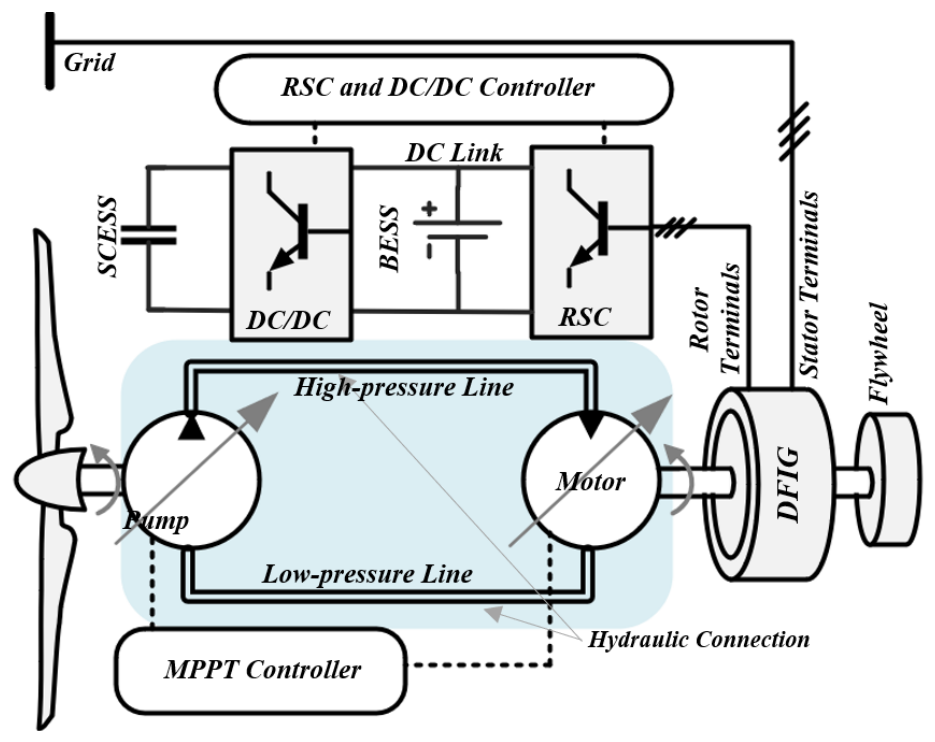
Unlike conventional gearbox-driven DFIG-based WECSs, in which the DFIG shaft is mechanically coupled to the wind turbine shaft, the hydraulic drivetrain can control the generator speed by decoupling the shafts of the wind turbine and the generator. As a result, the power flowing through the RSC can be controlled independently of the wind speed and the turbine’s angular velocity by controlling the generator speed [38]. As a result, the generator’s speed and power passing through the generator rotor windings can be controlled independently of the wind speed. Consequently, the GSC can be eliminated, and only the RSC can supply the rotor terminals in conjunction with storage, as shown in Figure 2. In this configuration, the RSC can independently control the generator’s speed to attenuate output power fluctuations.

3.1. Hybrid Energy Storage System (HESS)

Three energy storage types seemed suitable to incorporate energy storage into the proposed configuration while keeping the minimal size of supporting components, namely FESS, SCESS, and BESS. BESS and SCESS could be directly integrated into the RSC DC-link. Also, FESS could be coupled directly to the generator shaft. The combination of BESS and SCESS has been investigated in many studies. Employing the supercapacitor alongside BESS is a suitable option to decrease the maximum power of BESS at the DC link. In this case, the configuration allows for the use of the supercapacitor’s capacity. Meanwhile, the DC-link voltage is stable due to the existence of the BESS, which allows for a smaller inverter size [50,51,52].

3.1.1. BESS Model and Energy Management

To create a baseline for some of the characteristics observed in a storage unit, a reduced-order model of the battery energy storage system is used, consisting of a voltage source and series resistance. The BESS state of charge (SoC) can be calculated based on Coulomb counting [53]. The SoC of the storage and the dynamics of storage are calculated as follows:
S o C t = S o C t 0 + η e s E e s h t 0 t P e s d t                                       P S 0 S o C t 0 + 1 E e s h η e s t 0 t P e s d t                               P S < 0  
Δ S o C t = η e s P e s E e s h         P e s 0 P e s E e s h   η e s         P e s < 0
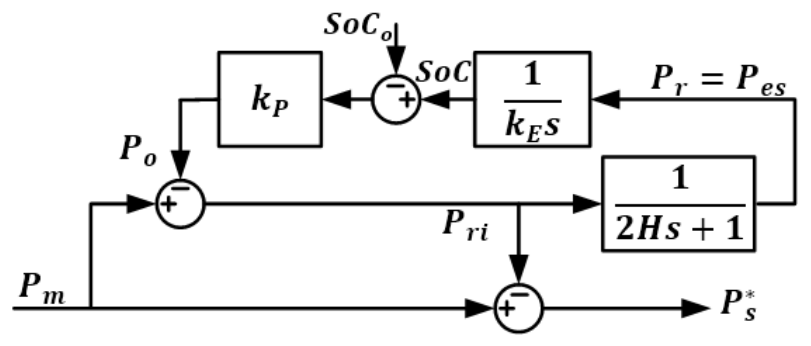
SoC feedback control is employed to maintain the BESS SoC within its limits. In this method, the mechanical power ( P m ) that reaches the hydraulic motor fluctuates with the variation in wind speed. An offset power, P o   is defined to attenuate these fluctuations. In other words, the mechanical power fluctuates widely, and the output power is desired to be smooth. The power difference is the amount of exchange power between the storage unit and the system. Using the block diagram, shown in Figure 3, the power injected into the grid and storage power are obtained as follows:
P e s = T f s T f s ( 2 H s + 1 ) + 1 P m + k P   S o C o
P s = 1 T f s ( 2 H s + 1 ) + 1 P m k E s   S o C o
where T f = k E k P . This strategy is modeled as a first-order low-pass filter with a time constant of T f . The time constant is dependent on the storage capacity. The larger the capacity of the BESS, the larger the time constant T f . The value of T f is identified by determining the k P such that the storage SoC remains within predefined limits. Therefore, k P can be adjusted as follows:
k P = P m , m a x P m , m i n S o C m a x S o C m i n = P n S o C u s e
Meanwhile, given a time constant, the size of storage capacity can be determined as follows:
E e s = P m , m a x P m , m i n h S o C m a x S o C m i n T f = k P T f h
In (17), h converts the unit of E e s to k W h .   The offset of SoC, S o C o , is chosen as S o C m i n .

3.1.2. Super Capacitor Energy Storage System (SCESS)

The supercapacitor can provide ample charging and discharging current (high power), but has a lower energy-to-power ratio than battery energy storage [54,55]. In other words, a supercapacitor has a quick charge and discharge time. However, hybrid energy storage, a combination of battery and supercapacitor, can provide a better power and energy requirement because of their complementary characteristics [56]. Supercapacitors can deliver and store significant power with fast dynamics. They are characterized by their high power capability due to their low internal resistance and low voltage [57].
In SCESS, energy is stored as static electrical charge rather than through the electrochemical process that occurs in BESS. The SCESS is modeled as a large capacitor in series with a resistor. The SoC of the SCESS is calculated similarly to that of a BESS. A low-pass filter is employed to filter out the high-frequency component of the rotor power. This control strategy with control gains of k e   and k p   is shown in Figure 3. The overall control approach for defining the power allocation of a supercapacitor employs a low-pass filter alongside a rule-based control strategy to ensure the proper and safe operation of the SCESS. The energy of the supercapacitor is calculated based on the following equations:
E s = 1 2 C V s 2
where C and V s are the capacitance and the voltage of the supercapacitor. The DC link voltage is stable, with slight variations, due to the BESS. The minimum voltage of the supercapacitor ( V s m i n ) is limited to limit the range of the power converter gain. Thus, the energy of SCESS is calculated as follows:
E s = 1 2 C ( V s 2 V s m i n 2 )
At a minimal supercapacitor voltage, the supercapacitor capacity is utilized to a greater extent. However, the DC-DC converter should have a wider voltage-gain range. A reasonable choice is that the minimum voltage is limited to half of the maximum voltage that the supercapacitor ( V s m a x ) can handle. In this case, three-quarters of the supercapacitor’s total capacity is available for use.
Δ E s = 3 4 ( 1 2 C V s m a x 2 )

3.1.3. Flywheel Energy Storage System (FESS)

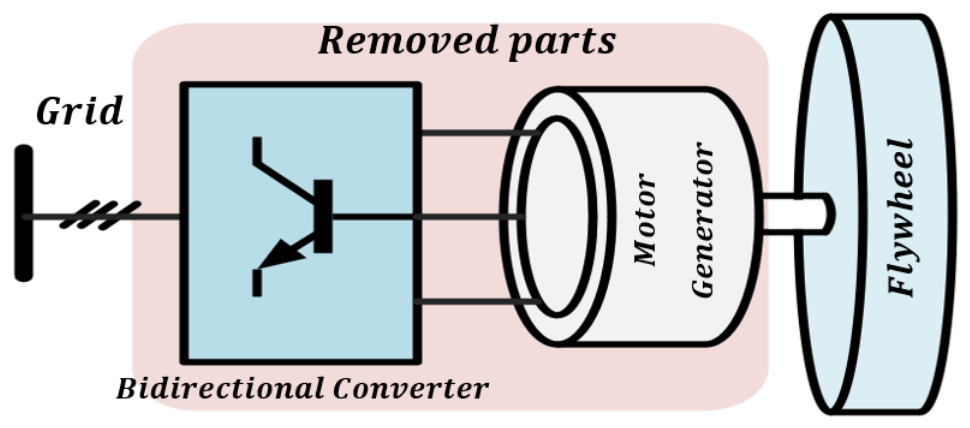
The combined inertia of the generator and hydraulic motor could slow the generator’s acceleration and deceleration. This demonstrates that increasing the system inertia through an FESS on the generator shaft could reduce the maximum storage power and require a low-power, high-energy storage type, e.g., a battery. In general, the main components of an FESS include the rotor, motor/generator, power electronic converter, bearing, and housing [19]. The cost of the high-speed flywheel could be five times more than the low-speed FESS. In high-speed FESS, the composite material is used for the rotor, and electromagnetic bearings are used to reduce bearing friction losses. Unlike the high-speed FESS, the rotor is commonly built with steel with a mechanical bearing in the low-speed FESS [19,20]. Also, the housing compartment should be strong enough to withstand a high-speed rotor’s burst. In low-speed FESS, the motor/generator and power electronics can account for a large portion of the overall storage system cost. To further reduce storage costs, the split-shaft WECS can be employed with DFIG. Compared to the conventional FESS shown in Figure 4, the proposed configuration in Figure 2 eliminates the motor/generator and dedicated power electronics by directly connecting the flywheel to the shaft of the wind turbine generator. The added flywheel is hard-coupled to the rotor of the generator and serves as the intrinsic inertia of the generator. Therefore, it does not need any control strategy. Therefore, the control system is more straightforward, and the configuration is less expensive.

3.2. Control Method

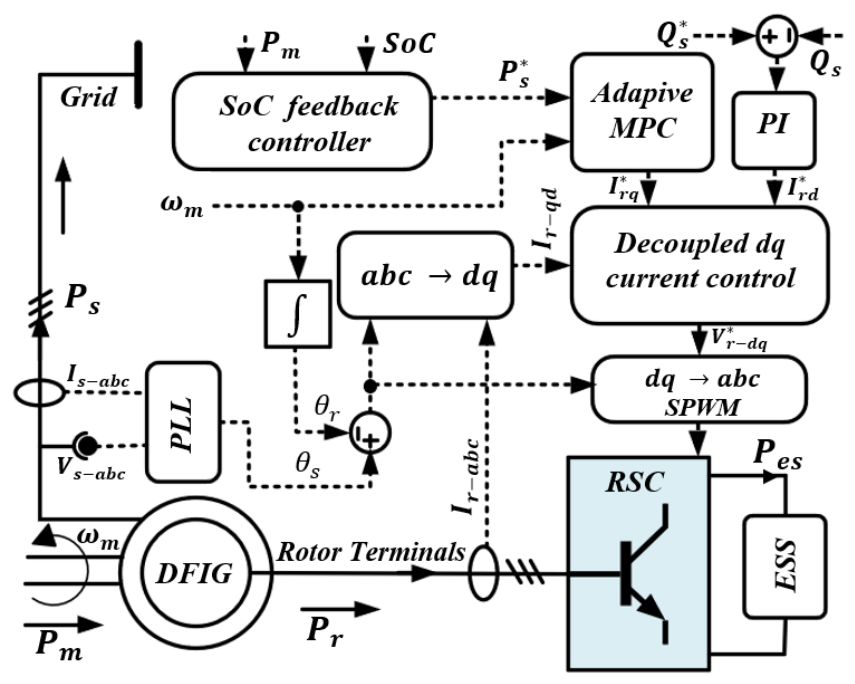
In the proposed configuration, the RSC controls the output power and simultaneously manages storage, charging, and discharging. In other words, the low-frequency part of the mechanical power, P s is injected into the power grid, and the energy storage at the rotor side absorbs the high-frequency component. SoC feedback control shown in Figure 3 defines the reference output power and maintains the SoC of the BESS and SCESS within its limits. This control strategy is shown in Figure 5.
In the stator-flux orientated (SFO) frame, when the quadrature stator flux is zero, λ q s = 0 and λ d s = L m I m 0 . The rotor and stator power equations are expressed as follows:
P r = 3 2 s g ω s L 0 i m 0 I q r
P s = 3 2 ω s L 0 i m 0 I q r
Q s = 3 2 ω s L m i m 0 I d s
In this framework, the active and reactive powers are controlled by the quadrature and direct components of the rotor current, respectively. Since the power of the rotor of DFIG is proportional to the generator’s slip, the power rating of RSC is defined by the maximum slip of the generator. Therefore, the generator speed should be controlled to remain within the maximum slip range. For example, if the converter size is chosen to be 10 % of the wind power, the slip of the generator must be within ± 10 % . To this end, the Model-based Predictive Controller (MPC) block in Figure 5 prevents the generator speed violation in case of sudden significant wind speed variations.
The MPC controller in the control strategy shown in Figure 5 is employed to control only the generator speed to reduce the computational burden of the MPC and make it suitable for real-time implementation. Furthermore, the SoC of storage is controlled by the proposed SoC feedback controller, and the reactive power is controlled in a decoupled d q vector control. Therefore, the only states considered in the MPC are the rotor speed and the converter current. Using the equations stated in (21) and substituting them into (4), the system model of these two states is rewritten as follows:
ω m ˙ I q r ˙ = 1 J m ω m   ( P m + 3 2 ω s L 0 i m 0 1 s I q r ) 1   T c I q r I q r
Since (24) presents a nonlinear system, the adaptive MPC controller is employed. The output of the system is P s which is controlled to follow the reference power, P s , is defined through the SoC feedback controller. Therefore, the objective function of the system is considered as follows:
C = i = 1 n p α p P s ( i + k | k ) P s ( i + k | k ) 2 + ρ ϵ ε k 2  
Such that:
P s m i n P s P s m a x
ω m m i n ω m ω m m a x  
ϵ P s k + 1 k P s k k 1 ϵ
where ε k is the slack variable at control interval k (dimensionless) and ρ ε is the constraint violation penalty weight (dimensionless), respectively. These parameters are utilized to soften the constraints and ensure MPC convergence. ϵ is defined as the limit of the power fluctuation rate in each time sample. Accordingly, the minute-by-minute power fluctuation of the power injected into the power grid is limited by system operators [58,59]. Herein, the maximum of this rate is considered γ m i n = 2 % . However, the amount of ϵ should be calculated based on γ m i n and sample time, T d , as follows:
ϵ = γ m i n 60   T d
Generally, the MPC controller follows the reference power calculated by the SoC feedback control and keeps speed and power fluctuations within the range. However, when the generator’s speed exceeds its constraints, the controller might not keep the power fluctuations within their limits and may instead seek an optimal solution. The controller must keep the generator speed in range, otherwise, power fluctuations increase.

4. Optimization of HESS

Optimizing the size of the HESS employed in the proposed configuration, which comprises three types of energy storage, is essential. Since each energy storage has a different lifetime, it is more logical to optimize the annualized cost of the storage. The annualized cost of storage is considered the objective function, which is defined as follows:
C = i 3 C i i n v + t C O & M i t 1 + r t N i
where i is an index for each energy storage, and t indicates the year. N i and C i i n v are the lifetime and investment cost of each storage, respectively. C O & M i t is the operation cost of the ith energy storage at year t. The objective function for HESS sizing is well-defined mathematically. On the other hand, the purpose of the optimization is to find the optimal size of the HESS, such that the smoothness level (defined as the probability of the minute-by-minute output power fluctuation less than 2%) is greater than 95% over the simulation time. This can be expressed as follows:
ζ ^ = f ζ E b , H , S g > 0.95
The smoothness level, ζ , depends on the parameters of the HESS and the maximum slip of the generator, and it is a statistical function. The cost of each storage unit is based on 2018 and expressed in US dollars.

4.1. Cost of the Energy Storage Systems

4.1.1. Battery Energy Storage System (BESS)

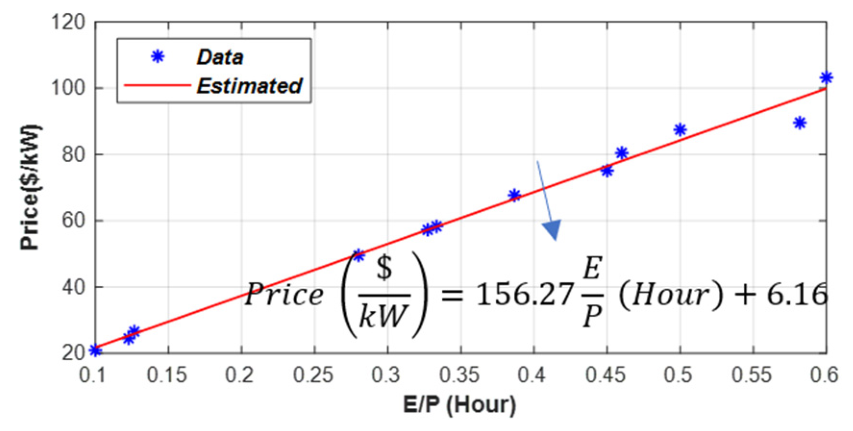
The capital cost of the Lithium-ion battery is reported to be 271 $/kWh in 2018 for a 4 h battery [16,17]. However, in this paper, the ratio of the battery capacity to the battery power is not necessarily 4 h. To obtain the cost coefficient of the BESS, the battery pack data for the electric vehicle have been used [60]. Then, the estimated cost is obtained as follows:
C b i n v P b $ k W   = α b + β b E b / P b
The maintenance and operation costs of the battery are considered negligible at a rate of 10 $/kW/year. The cost of the power conversion system is obtained in subsection C. The battery is expected to last ten years [16,17]. Figure 6 shows the cost estimation of a battery.

4.1.2. Optimization of Super Capacitor Energy Storage System (SCESS)

Ultracapacitors can use multiple modules to scale the necessary power and energy capacity. Given the low energy density of ultracapacitors, their cost is not competitive with batteries on a $/kWh basis. However, on a $/kW basis, they are more competitive than batteries due to their high-power density. Therefore, they are suitable for short-term storage. Herein, the ultracapacitor is employed to smooth the battery power. The capital cost of the ultracapacitor is reported to be $32,500/kWh in [16,17] and 10,000 $/kWh in [61]. Herein, the capital cost of $ 10,000/kWh is considered. The lifetime of the ultracapacitor exceeds 1,000,000 cycles, or 16 years. The ultracapacitor’s fixed operation and maintenance cost is about 1 $/kW-year [16,17].

4.1.3. Optimization of Flywheel Energy Storage System (FESS)

Obtaining the cost of FESS is challenging due to the lack of data in the literature. In [16,17], the capital cost of the FESS, including the power conversion system, is reported in a wide range of 600–2400 $/kW for a 0.25 h duration of storage, which is equivalent to 2400–9600 $/kWh. In these references, the overall cost of the FESS is estimated to be 4320–11,520 $/kWh. The lower cost estimate is for low-speed FESS. The overall cost of the FESS is estimated to be in the range of 1000–8800 $/kWh in [19]. However, the low-speed flywheels, which rotate at less than 10,000 revolutions per minute (rpm), are usually made out of steel and can provide power in thousands of kilowatts for a short time [62]. These reports include the capital cost of the power electronic converters and the motor. However, our proposed configuration does not need the motor/generator and the dedicated power electronic converter. In [62], the capital cost of the rotor is calculated to be 523–573 $/kWh for a high-speed FESS in which the two-rim rotor is made of two composite materials. In [63], the estimated capital cost of the rotor is about 2 $/kWh.
Since the capital cost of the flywheel rotor is estimated to range from 2 to 11,520 $/kWh in the reports, a new approach is taken to estimate the capital cost of the FESS and of the rotor, bearing, and housing. Herein, a low-speed rotor is considered to be directly connected to the shaft of the DFIG. A solid disc of steel or aluminum is chosen for the rotor [64]. Therefore, the inertia and mass of a solid disc can be obtained as follows:
J f = π h 2 ρ r f 4
M f = π h ρ r f 2
where r f and h are the radius and thickness of the solid disc, respectively. ρ is the density of stainless steel. J f and M f are the inertia and mass of the disc. According to these equations, the energy content and specific energy (energy per unit mass) can be obtained as follows:
E f = π h 4 ρ r f 4 ω m 2
E f / M s = 1 4 r f 2 ω m 2
The cost of the rotor can be calculated based on these equations as follows:
C r ( $ / k W h ) = M r C s λ E r = 4 C s λ r f 2 ω m 2
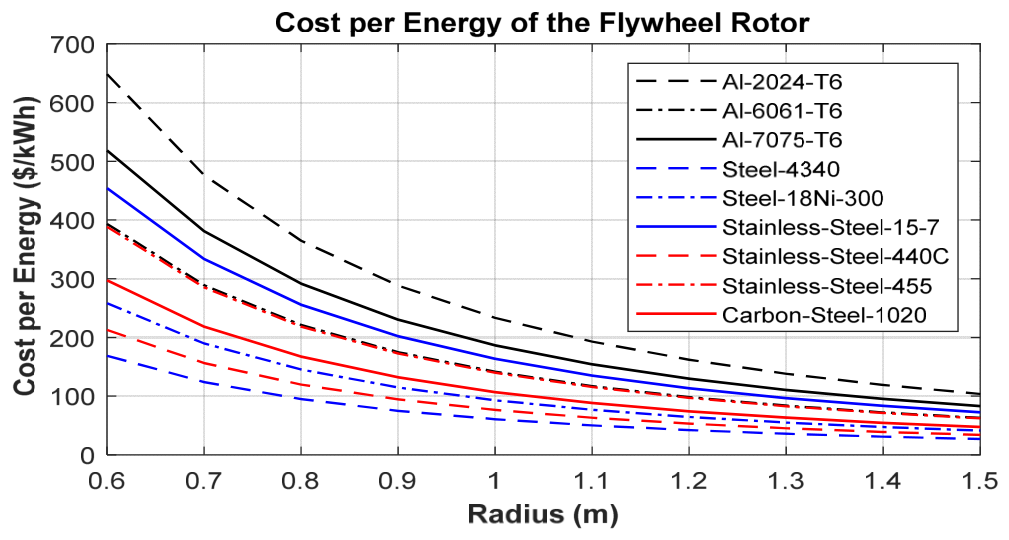
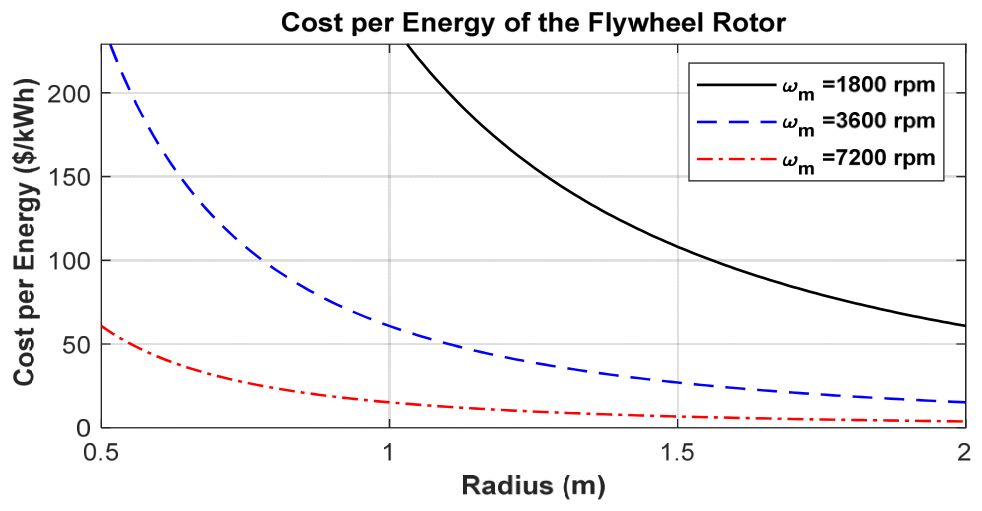
where C s and C r are the cost per kilogram of the rotor’s material and the rotor’s cost per kWh. The coefficient λ turns the unit of energy to kWh ( λ = 2.77778 e 7 ). Based on the relative cost of different materials in [64], the cost of storage per unit of energy for a generator speed of 3600 rpm can be obtained as shown in Figure 7. Accordingly, the cost of the rotor for steel 4340 is minimal due to the lower material cost. According to (37), the larger the disc radius, the lower the rotor cost. The cost of the rotor made out of steel-4340 for various generator speeds is calculated and shown in Figure 8. The material used in the rotor decreases as rotor speed increases to maintain the same energy content. At a 1 m radius, the cost of the rotor is 15, 60, and 240 $/kWh for 7200, 3600, and 1800 rpm, respectively.
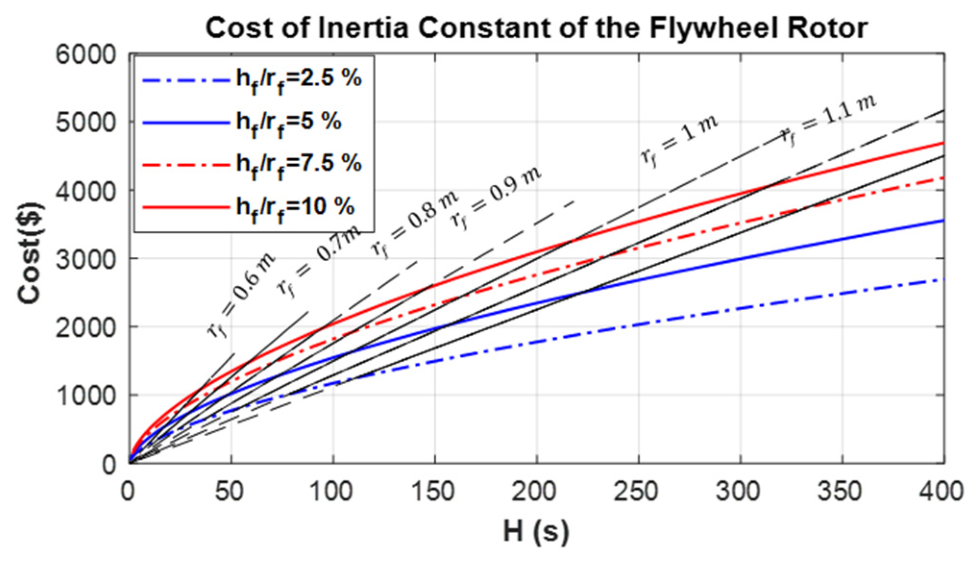
The rotor’s thickness does not affect its cost per kWh. Since the rotor speed is low, radial tensile stress is not an issue. Therefore, the rotor thickness is expressed as a percentage of the rotor radius. For a 3600 rpm rotor and 1.5-MW DFIG, the cost of inertia constant (H) can be obtained for different thickness ratios to the rotor’s radius, as shown in Figure 9. At 3600 rpm, the rotor cost is calculated at 60 $/kWh. The flywheel’s cost is three times the estimated value, $240/kWh, due to housing and bearings. Since there is no power electronic converter or motor-generator, the operation and maintenance of the system are considered negligible. The storage life is considered 20 years.

4.2. Power Conversion System Cost

The power conversion system in the proposed configuration comprises a DC/AC inverter, RSC, to control the DFIG and charge and discharge the battery, and a DC/DC converter to control the supercapacitor power. The cost of a power converter is considered 288 $/kW for a lithium-ion battery [16,17]. These power converters commonly consist of DC/DC and AC/DC stages. Since the RSC is a single-stage power converter, the combined cost of the RSC and DC/DC converter is 144 $/kW.

4.3. Optimization Method

The HESS in the proposed configuration consists of three types of storage: flywheel, battery, and supercapacitor. These storage systems seem suitable because the battery can be connected to the RSC without additional power converters, and the flywheel can be directly connected to the DFIG rotor. The purpose of the optimization is to minimize the annualized cost of the storage such that the smoothness level is greater than 0.95%, ζ > 0.95 . The objective function is expressed in (30), but the constraints of such optimization are stochastic variables and cannot simply be stated in mathematical equations. Therefore, HESS sizing in such a system involves interactions among many variables in a nonlinear, complex system. Using classical methods to optimize the HESS is not entirely practical, as it requires many simulation runs and is time-consuming. A statistical–experimental method, such as the response surface method (RSM), could be a better option to overcome these limitations [65,66].

4.3.1. Response Surface Method (RSM)

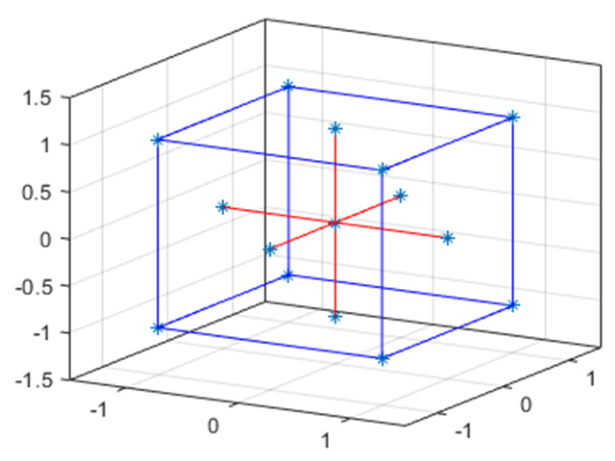
RSM combines statistical and mathematical approaches to optimize stochastic processes. Commonly, this approach is employed to estimate a stochastic cost function by a low-order polynomial, mostly second order, on a small subregion of the domain. The cost function and coefficient of the polynomial are estimated for several observation points using the least square approach. Then, the suboptimal point is obtained mathematically using the formulized cost function. This optimal point is used as the center of a new subregion of interest to converge to the optimal point. In this approach, the subregion should be chosen to be small enough to estimate the response surface with a low-order polynomial. At the same time, the subregion should be large enough to prevent many simulation (or experimental) runs. Choosing the number of points depends on the order of the polynomial and the number of variables of interest. For example, in this paper, the level of smoothness is estimated as a quadratic function of three factors: battery capacity, inertia time constant, and the maximum slip of the generator. Each factor can be defined at three or five levels to calibrate the quadratic function effectively. Herein, the three-level central composite designs (CDDs), also known as Box–Wilson designs, are employed. The face-pictured CDDs are shown in Figure 10. Each design consists of a factorial design (the corners of a cube) with the center and star points, which allow an estimation of the quadratic function. The center point is repeated several times to better estimate the quadratic function. These points are enough to estimate the ( n + 1 ) ( n + 2 ) / 2 coefficients of a quadratic function with n factors.

4.3.2. Overview of the Optimization Approach

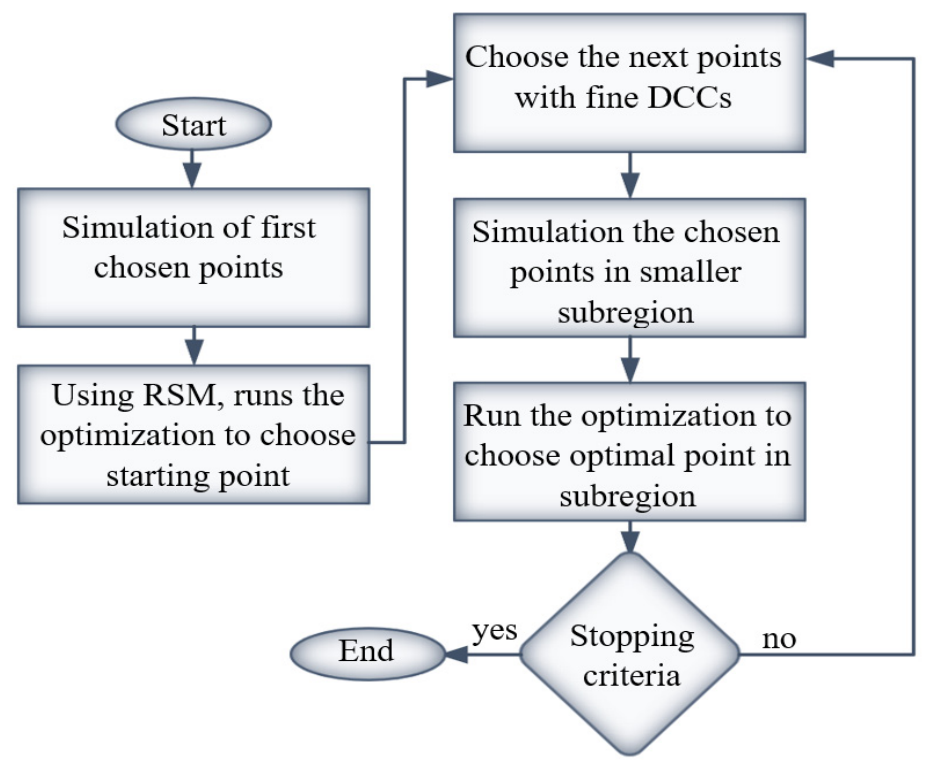
The overall flowchart of the optimization is shown in Figure 11. Since the optimization region is large, randomly choosing the start point can increase the number of steps of the optimization process. Thus, as a starting point, the centers of CDDs with more nuanced points are chosen using a simulation; 15 points have an extensive DCC network over the whole region. They are considered to have a battery capacity of 60–140 kWh, an inertia constant of 50–500 s, and a maximum generator slip of 5–30%. The surface response of the configuration is complicated, and estimating a complex surface with a quadratic function can have a significant error. Still, the optimal point on this surface can be a good starting point (the center point of the CDDs).
Based on the first starting point, the CDD points are defined in a smaller subregion. Then, the simulation data for these points are gathered, and the optimal point in the subregion is identified. Then this point is chosen as the center of the new CDDs, and this center point, as the optimal point of the subregions, moves toward the optimal point in the whole region. When the stopping criteria are satisfied, the optimization process ends. The stopping criteria are chosen as follows, as recommended in [67]: (1) the estimated optimal response does not change significantly, (2) the cost of the optimal response does not change significantly and continues to decrease, (3) the real ζ (not estimated one) remains above the predefined amount (herein 0.95).

5. Results and Discussion

The proposed configuration is modeled to evaluate its feasibility. Accordingly, a detailed model of each element is obtained in MATLAB, with the initial parameters [40]. A 1.5 MW hydraulic wind turbine is considered to optimize the HESS.
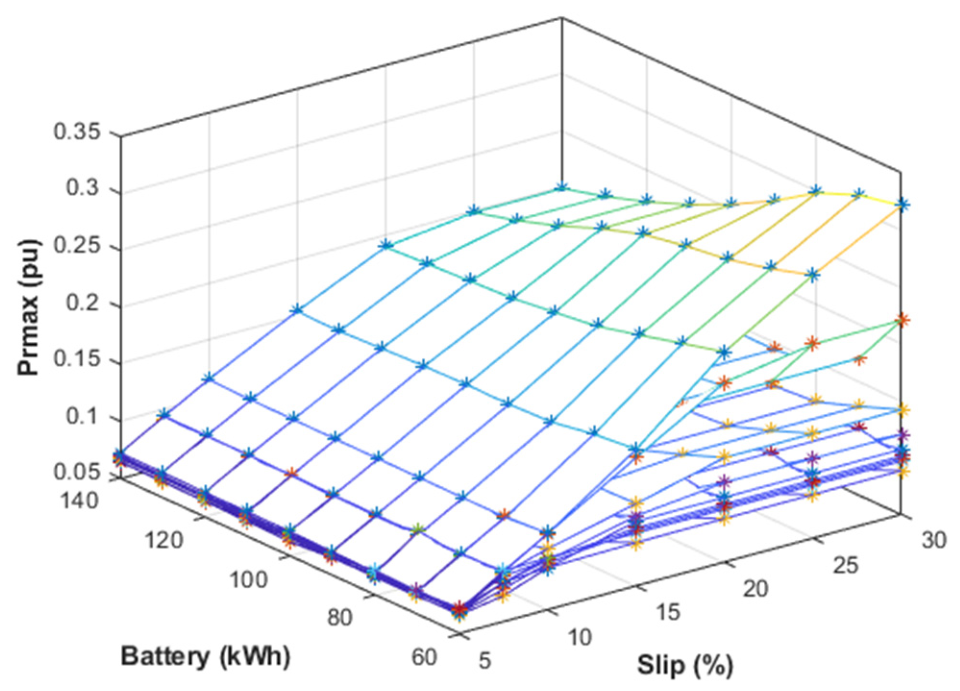
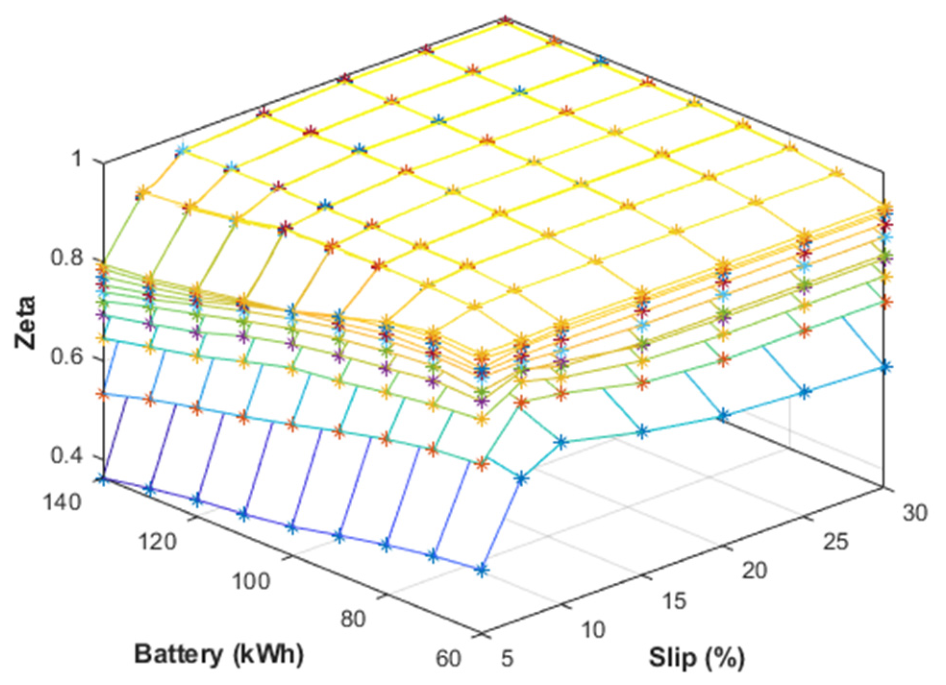
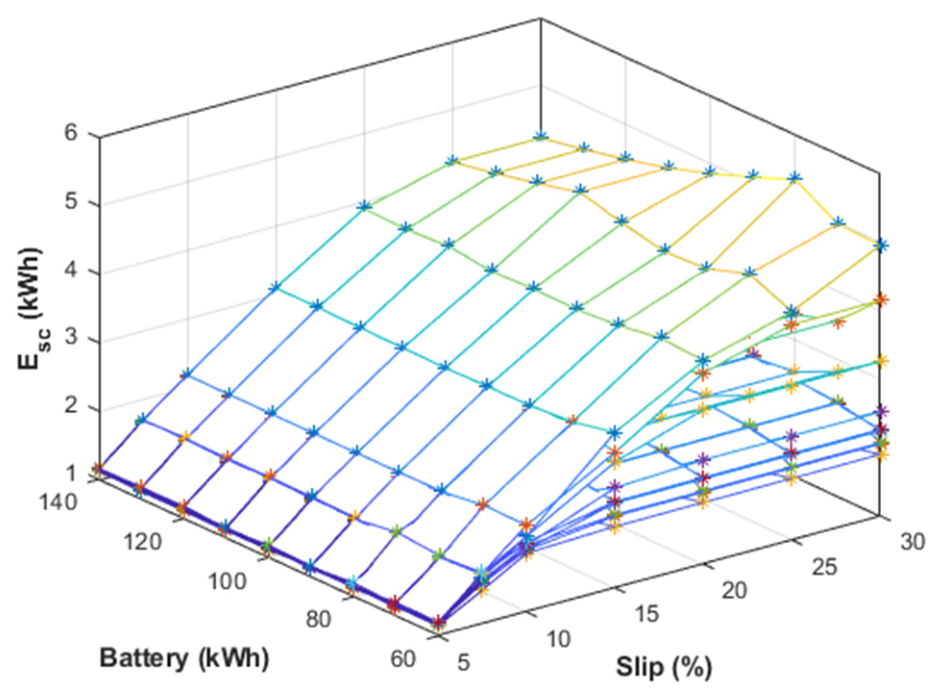
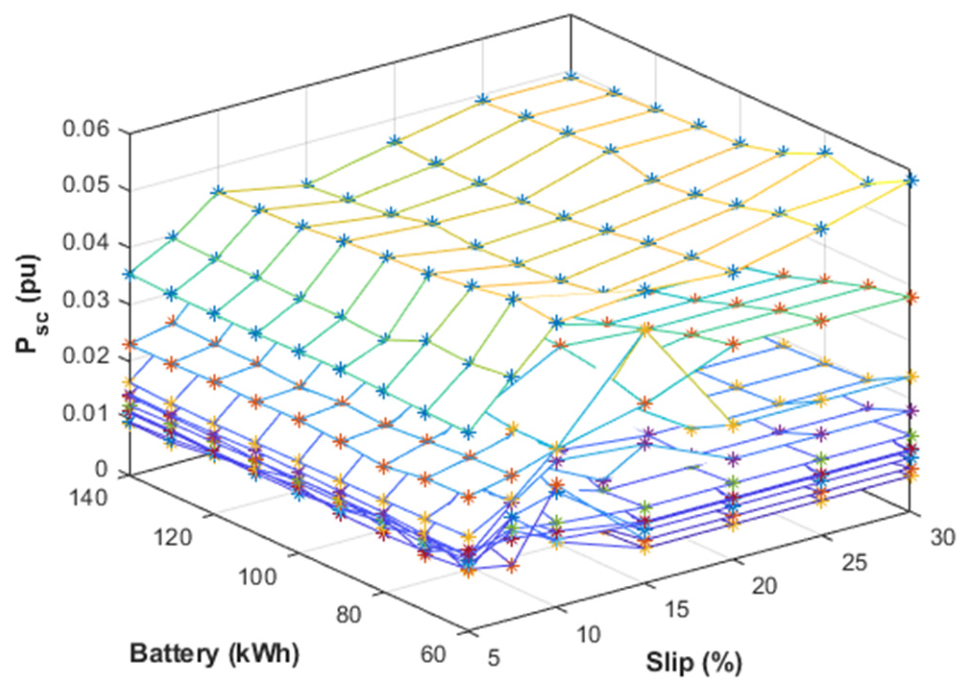
In general, there are six parameters to be defined: battery power ( P b ), battery capacity ( E b ), inertia constant ( H ), supercapacitor power ( P s ), supercapacitor capacity ( E s ), and the maximum slip of the generator ( S m a x ). Among these six parameters, the inertia (H), battery size, and the generator maximum slip are considered independent parameters. First, using the supercomputer, we simulate split-shaft wind energy conversion systems at different operating points by sweeping inertia (H), battery size, and the generator’s maximum slip. Figure 12 demonstrates the smoothness level ζ = p ( Δ P < 2 % ) for the simulation points, shown by stars on each surface. To absorb power, the rotor rpm must drop. The amount of power swing determines the extent of power available for generation and absorption and directly affects smoothness. Hence, there is a strong relationship between these two parameters. Figure 13 shows the maximum power passing through the rotor of the DFIG, which is the sum of the power from the battery and supercapacitor. Figure 14 and Figure 15 demonstrate the supercapacitor capacity and power, respectively.
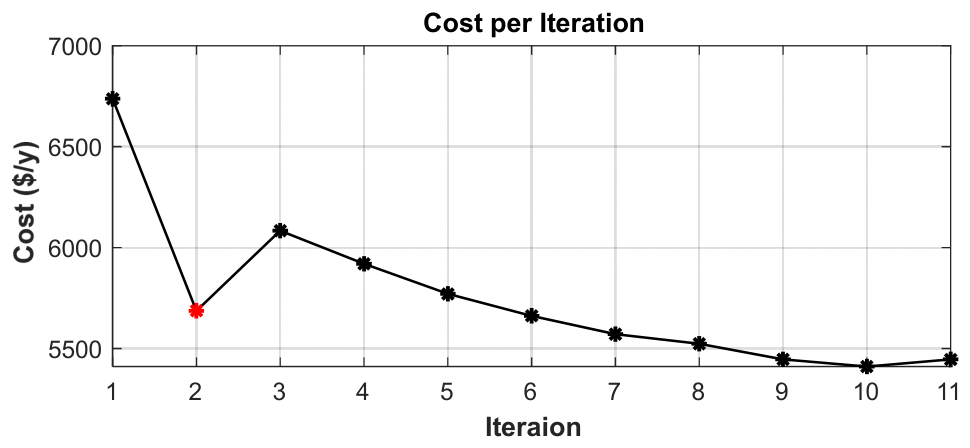
Using the optimization method explained in Figure 11, the components of HESS are optimized to sustain the power required and minimize the storage cost. The results are tabulated in Table 1. According to the table, the optimal annualized storage cost is $5411/year. Also, the iteration of the optimization is shown in Table 2. This optimization method helps to reach the optimal point with fewer iterations. The trajectory of the overall cost of the storage in each optimization iteration is shown in Figure 16. This figure demonstrates a rapid convergence rate. The red point at iteration 2 shows that the real ζ is less than 0.95. Thus, the third stopping criterion is not satisfied, and the optimization process continues until it reaches the optimal point at iteration 10.
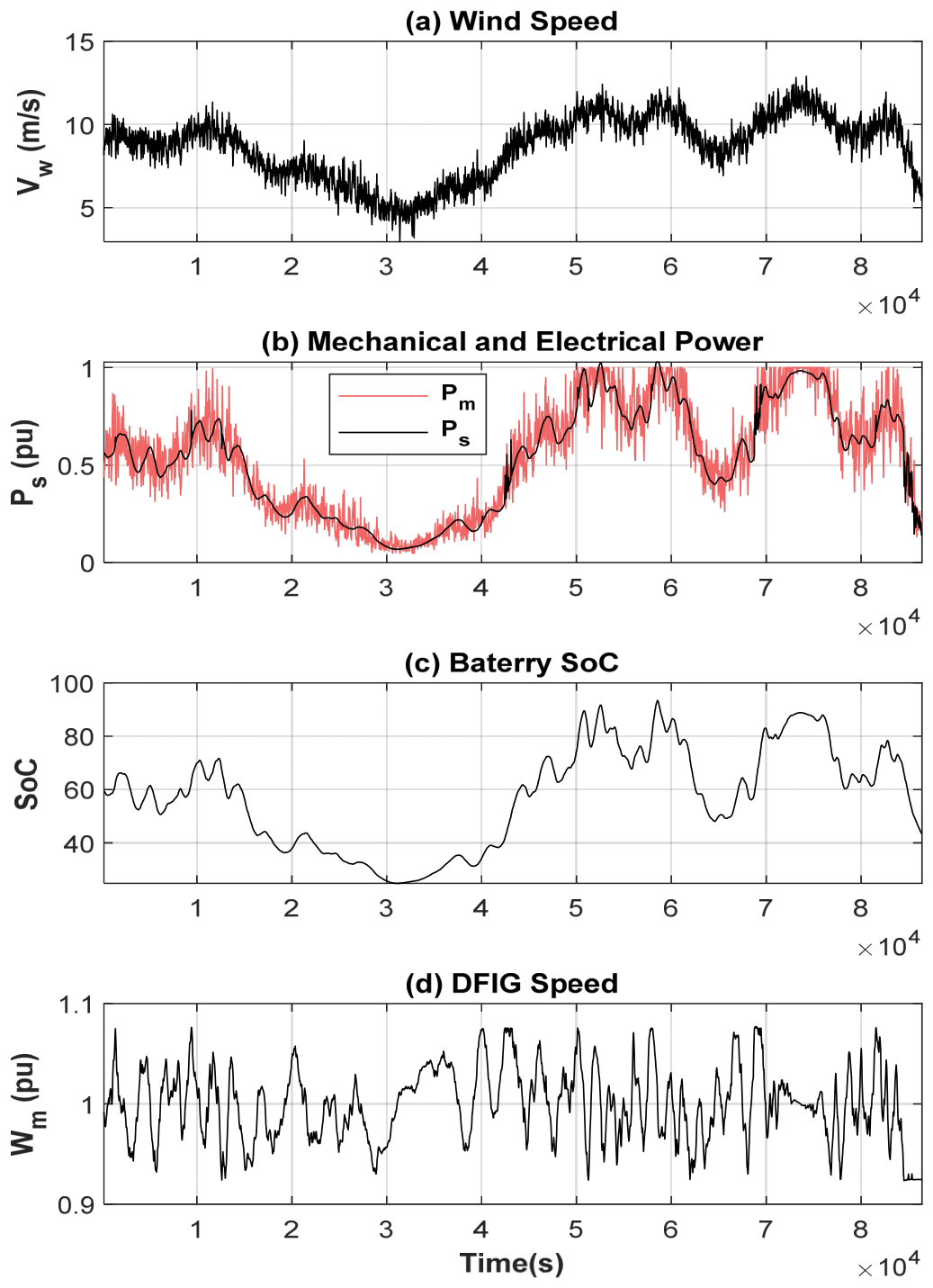
For the optimized size of storage obtained in iteration 10 and listed in Table 1, a wind speed profile of Figure 17a is applied to measure the wind turbine performance. The generated mechanical and electrical powers are shown in Figure 17b, and it is shown that fluctuations in electric output power have been noticeably attenuated. Also, the battery SoC and generator speed are shown in Figure 17c,d, respectively. The flywheel’s inertia considerably attenuates the generator’s speed variation, and the controller was able to maintain the speed within its limits (less than 7.94%).

5.1. The Effect of the Smoothness Level on HESS Size and Cost

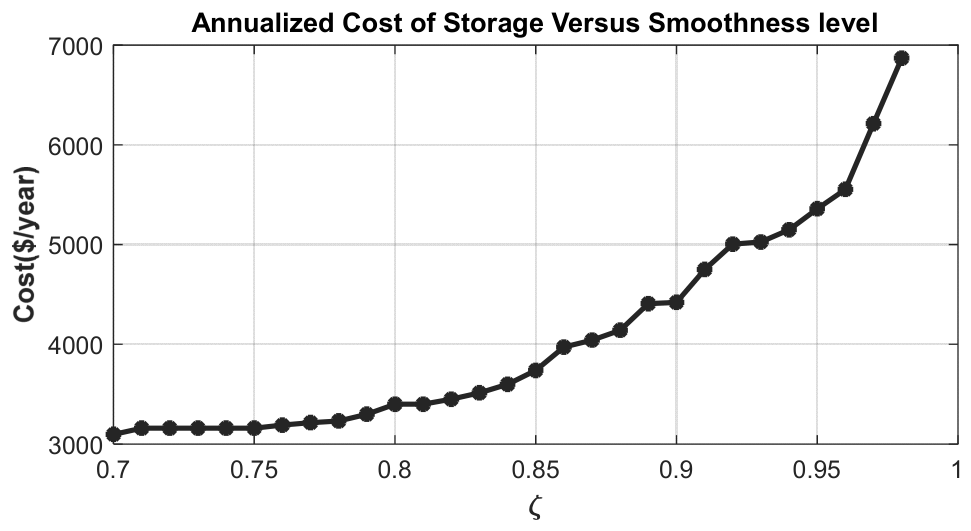
The annualized storage cost is shown in Figure 18 for a different level of smoothness. It is shown that storage cost increases exponentially with smoothness. It can be inferred that the smoothness level one, ζ = 1 ,   is not a practical approach.

5.2. The Comparison of HESS Cost of the Proposed Configuration and the Conventional HESS

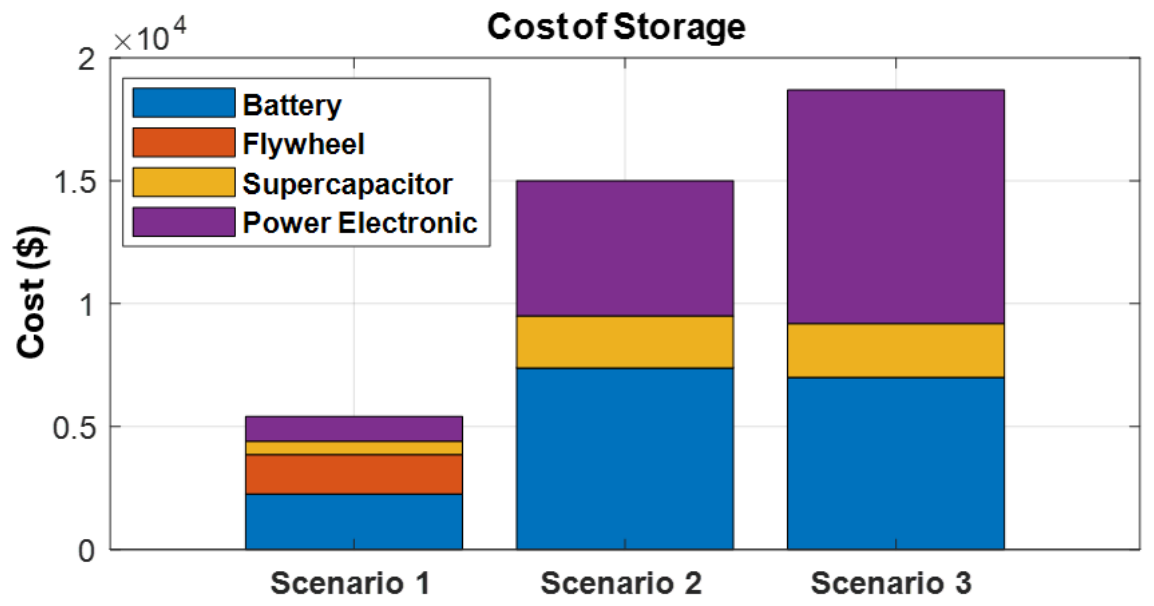
To benchmark the result of the HESS optimization, the proposed configuration is compared with three different HESS configurations. In the first scenario, the proposed storage configuration consists of a flywheel, battery, and supercapacitor. In the second scenario, the flywheel is removed, and only the battery and supercapacitor are employed. In the third configuration, a battery–supercapacitor in hybrid storage is installed at the Point of Common Coupling (PCC). Thus, the power electronic converter required for the battery consists of AC/DC and DC/DC units, which cost twice as much as the converter employed in the proposed configuration.
The cost associated with these three scenarios is shown in Figure 19. Accordingly, the storage costs are $54,111, $15,001, and $18,693 per year for scenarios 1, 2, and 3, respectively. The breakdown cost of each unit in each scenario is shown in Figure 19 and tabulated in Table 3. The relative costs of HESS are 29%, 80%, and 100% for scenarios 1,2, and 3, respectively. Note that the annual storage cost ($/y) listed in Table 2 is the normalized cost of the storage over its life.
The flywheel cost is only 29.7% of the overall annualized storage cost in the first scenario. However, it has a noticeable effect on the performance of hybrid storage and reduces storage costs to 29% of conventional storage costs. In the second scenario, there is no flywheel, and the HESS consists of a supercapacitor and a battery, which are integrated with the split-shaft WECS, take advantage of the RSC, and do not require an additional dedicated power converter. The cost of the HESS in scenario 2 is about 80% of the cost of the HESS in scenario 3, and this cost-saving is mainly because of the reduction in the cost of a power electronic converter. The cost of the power electronic converters in the third scenario accounts for 50% of the hybrid storage cost and is higher than in scenario 2. The battery and supercapacitor costs in scenario 3 are slightly lower than those in scenario 2. This is because the storage performance is not limited by the generator’s speed (slip limitation) in the third scenario. Since there is no flywheel in scenarios 2 and 3, these configurations require a larger HESS capacity to achieve the desired level of smoothness. The simulation and optimization results demonstrated that the proposed configuration could smooth the output power by an HESS with 29% of the cost of a conventional standalone HESS.

6. Conclusions

This paper presented a novel method for integrating multiple storage types into a configuration tailored to split-shaft WECSs. In the configuration, three energy storage units have been employed. These energy storage systems were SCESS, BESS, and flywheel. The flywheel was connected directly to the generator’s shaft, did not need any controller, and behaved like the intrinsic inertia of the DFIG. A SoC feedback controller was adopted to maintain the battery’s SoC.
Furthermore, the MPC controller was responsible for controlling DFIG speed and optimizing the smoothness level. The supercapacitor and battery costs were calculated using data from the literature. However, due to a lack of data on the flywheel’s cost, this paper employs a methodology to estimate it based on its material. The flywheel increased system inertia by about 3 to 6 times, which reduced oscillations. Results over a 24 h profile show that fluctuations above 20% drop to less than 2%. The generator remained within ±7.94% slip, which ensured stable operation. The supercapacitor handled fast changes, while the battery supported medium-term energy needs.
The cost of each storage was formulated based on its specific properties. The response surface optimization technique was used to determine the optimal hybrid storage size. The proposed optimization technique enabled optimization across various system configuration scenarios. The annualized cost was 71% lower than that of conventional systems. The flywheel accounts for 29.7% of the cost but reduces battery size by 10 to 15% and supercapacitor rating by 15 to 25%. A smoothness level near 95% strikes a good balance, since higher levels lead to a sharp increase in cost. Overall, the system achieves more than 95% smoothing, keeps fluctuations below 2%, and reduces costs by over 70%, making it a practical solution for split-shaft wind systems. The comparison between the proposed method and conventional storage showed that storage cost could be reduced by 29%.

Author Contributions

Conceptualization, methodology, R.A. and A.I.; software, R.A.; validation, R.A. and A.I.; writing—original draft preparation, R.A. and A.I.; writing—review and editing, A.I.; supervision, A.I.; project administration, A.I. All authors have read and agreed to the published version of the manuscript.

Funding

This research was funded by the Departments of Electrical Engineering Technology and Electrical Engineering at Purdue University.

Institutional Review Board Statement

Not applicable.

Informed Consent Statement

Not applicable.

Data Availability Statement

The datasets presented in this article are not readily available because the data are part of an ongoing study. Requests to access the datasets should be directed to Dr. Afshin Izadian aizadian@purdue.edu.

Acknowledgments

This paper was part of the doctoral dissertation of Rasoul Akbari, DFIG-Based Split-Shaft Wind Energy Conversion Systems, Purdue University, West Lafayette, USA, 2022.

Conflicts of Interest

The authors declare no conflicts of interest.

Abbreviations

The following abbreviations are used in this manuscript:
ρ Air density
R Radius of the rotor of the wind turbine
v Wind velocity
C m a x Maximum power capacity of the wind turbine
λ o Optimal tip speed ratio
β f Bulk modulus of the fluid
V f Volume of the fluid
μ Dynamic viscosity of the fluid
J r Wind rotor-hydraulic pump inertia
  J m Generator-hydraulic motor inertia
P f Pressure of the fluid
D p ,   D m Hydraulic pump and motor displacements
C v p ,   C v m   Hydraulic pump and motor viscous drag coefficients
C s p ,   C s m Hydraulic pump and motor slippage coefficients
ω p ,   ω m Pump and motor angular speeds
ω s Synchronous angular velocity of the generator
η t m Torque efficiency of the hydraulic motor
η v m Volumetric efficiency of the hydraulic motor
η t p Torque efficiency of the hydraulic pump
η v p Volumetric efficiency of the hydraulic pump
η v Volumetric efficiency of the hydraulic drivetrain
L s ,   L r , L m Stator, rotor, and magnetizing inductances
R s ,   R r Stator and rotor resistances
I d r , I q r Direct and quadrature components of rotor current
I d s , I q s Direct and quadrature components of stator current
V d r , V q r Direct and quadrature components of rotor voltage
V d r , V q r Direct and quadrature components of stator voltage
τ e ,   τ r Electrical and wind turbine torques
P n Nominal power of the wind turbine
P m Mechanical power at the hydraulic motor
P p Mechanical power at the hydraulic pump
P m , m a x Maximum hydraulic motor power
P m , m i n Minimum hydraulic motor power
P e s Energy storage power
P s Electrical power injected into the grid
η e s Round-trip efficiency of the energy storage
E e s Capacity of the energy storage system
H Inertia constant of the generator-hydraulic motor
s g ,   s m a x Generator slip and maximum slip
s Laplace variable
S o C m i n Minimum state of charge of the energy storage
S o C m a x Maximum state of charge of the energy storage
S o C u s e Usable state of charge of the energy storage
S o C o Offset state of charge of the energy storage
T d Sampling time
T c Time constant of the RSC current control loop
Q s Stator reactive power
H Inertia constant
DGsDistributed Generations
RESsRenewable Energy Sources
ESSEnergy Storage System
ESSsEnergy Storage Systems
BESSBattery Energy Storage System
SMESSSuperconducting Magnetic Energy Storage System
SCESSSupercapacitor Energy Storage System
FESSFlywheel Energy Storage System
CAESSCompressed Air Energy Storage System
PHESSPumped Hydro Energy Storage System
TESSThermal Energy Storage System
HESSHybrid Energy Storage System
DFIGDoubly-Fed Induction Generator
WECSWind Energy Conversion System
HTSHydraulic Transmission System
LCOELevelized Cost of Energy
CFCapacity Factor
LOSLevel of Smoothness
RSCRotor-Side Converter
GSCGrid-Side Converter
ANNArtificial Neural Network
MPCModel Predictive Control
RSMResponse Surface Method
CVTContinuously Variable Transmission
MPPTMaximum Power Point Tracking
SFOStator-Flux Oriented Frame
SoCState of Charge
PCCPoint of Common Coupling
PCSPower Conversion System
UPSUninterruptible Power Supply
RAPSRemote Area Power Supply
PVPhotovoltaic

References

  1. Calautit, K.; Nasir, D.S.; Hughes, B.R. Low power energy harvesting systems: State of the art and future challenges. Renew. Sustain. Energy Rev. 2021, 147, 111230. [Google Scholar] [CrossRef]
  2. Ralon, P.; Taylor, M.; Ilas, A.; Diaz-Bone, H.; Kairies, K. Electricity storage and renewables: Costs and markets to 2030. Int. Renew. Energy Agency Abu Dhabi UAE 2017, 164, 154. [Google Scholar]
  3. Eladl, A.A.; El-Afifi, M.I.; Saeed, M.A.; El-Saadawi, M.M. Optimal operation of energy hubs integrated with renewable energy sources and storage devices considering CO2 emissions. Int. J. Electr. Power Energy Syst. 2020, 117, 105719. [Google Scholar] [CrossRef]
  4. IEA. Global Energy Review 2025; IEA: Paris, France, 2025; Available online: https://www.iea.org/reports/global-energy-review-2025 (accessed on 1 May 2026).
  5. Shim, J.W.; Verbič, G.; Hur, K.; Hill, D.J. Impact analysis of variable generation on small signal stability. In Proceedings of the 2014 Australasian Universities Power Engineering Conference (AUPEC); IEEE: New York, NY, USA, 2014; pp. 1–6. [Google Scholar]
  6. Makarov, Y.V.; Lu, S.; Samaan, N.; Huang, Z.; Subbarao, K.; Etingov, P.V.; Ma, J.; Hafen, R.P.; Diao, R.; Lu, N. Integration of uncertainty information into power system operations. In Proceedings of the 2011 IEEE Power and Energy Society General Meeting; IEEE: New York, NY, USA, 2011; pp. 1–13. [Google Scholar]
  7. Rezaee Jordehi, A. An improved particle swarm optimisation for unit commitment in microgrids with battery energy storage systems considering battery degradation and uncertainties. Int. J. Energy Res. 2021, 45, 727–744. [Google Scholar] [CrossRef]
  8. Hasanien, H.M. A set-membership affine projection algorithm-based adaptive-controlled SMES units for wind farms output power smoothing. IEEE Trans. Sustain. Energy 2014, 5, 1226–1233. [Google Scholar] [CrossRef]
  9. Penthia, T.; Panda, A.K.; Mohanty, P.R.; Patnaik, N. Superconducting magnetic energy storage system with an improved nonlinear control approach for pulsed power applications. Int. Trans. Electr. Energy Syst. 2020, 30, e12464. [Google Scholar] [CrossRef]
  10. Pegueroles-Queralt, J.; Bianchi, F.D.; Gomis-Bellmunt, O. A power smoothing system based on supercapacitors for renewable distributed generation. IEEE Trans. Ind. Electron. 2014, 62, 343–350. [Google Scholar] [CrossRef]
  11. Choudhury, S.; Dash, T.P.; Bhowmik, P.; Rout, P.K. A novel control approach based on hybrid Fuzzy Logic and Seeker Optimization for optimal energy management between micro-sources and supercapacitor in an islanded Microgrid. J. King Saud Univ.-Eng. Sci. 2020, 32, 27–41. [Google Scholar] [CrossRef]
  12. Suvire, G.; Mercado, P. Active power control of a flywheel energy storage system for wind energy applications. IET Renew. Power Gener. 2012, 6, 9–16. [Google Scholar] [CrossRef]
  13. Olabi, A.; Wilberforce, T.; Ramadan, M.; Abdelkareem, M.A.; Alami, A.H. Compressed air energy storage systems: Components and operating parameters–A review. J. Energy Storage 2021, 34, 102000. [Google Scholar] [CrossRef]
  14. Blakers, A.; Stocks, M.; Lu, B.; Cheng, C. A review of pumped hydro energy storage. Prog. Energy 2021, 3, 022003. [Google Scholar] [CrossRef]
  15. Cabeza, L.F. Advances in thermal energy storage systems: Methods and applications. In Advances in Thermal Energy Storage Systems; Elsevier: Amsterdam, The Netherlands, 2021; pp. 37–54. [Google Scholar]
  16. Mongird, K.; Viswanathan, V.V.; Balducci, P.J.; Alam, M.J.E.; Fotedar, V.; Koritarov, V.S.; Hadjerioua, B. Energy Storage Technology and Cost Characterization Report; Pacific Northwest National Lab.(PNNL): Richland, WA, USA, 2019. [Google Scholar]
  17. Mongird, K.; Viswanathan, V.; Balducci, P.; Alam, J.; Fotedar, V.; Koritarov, V.; Hadjerioua, B. An evaluation of energy storage cost and performance characteristics. Energies 2020, 13, 3307. [Google Scholar] [CrossRef]
  18. Wang, Y.; Zhang, L.; Hou, H.; Xu, W.; Duan, G.; He, S.; Liu, K.; Jiang, S. Recent progress in carbon-based materials for supercapacitor electrodes: A review. J. Mater. Sci. 2021, 56, 173–200. [Google Scholar] [CrossRef]
  19. Choudhury, S. Flywheel energy storage systems: A critical review on technologies, applications, and future prospects. Int. Trans. Electr. Energy Syst. 2021, 31, e13024. [Google Scholar] [CrossRef]
  20. Olabi, A.G.; Wilberforce, T.; Abdelkareem, M.A.; Ramadan, M. Critical Review of Flywheel Energy Storage System. Energies 2021, 14, 2159. [Google Scholar] [CrossRef]
  21. Jing, W.; Lai, C.H.; Wong, S.H.W.; Wong, M.L.D. Battery-supercapacitor hybrid energy storage system in standalone DC microgrids: Areview. IET Renew. Power Gener. 2017, 11, 461–469. [Google Scholar]
  22. Hajiaghasi, S.; Salemnia, A.; Hamzeh, M. Hybrid energy storage system for microgrids applications: A review. J. Energy Storage 2019, 21, 543–570. [Google Scholar] [CrossRef]
  23. Li, F.; Xie, K.; Yang, J. Optimization and analysis of a hybrid energy storage system in a small-scale standalone microgrid for remote area power supply (RAPS). Energies 2015, 8, 4802–4826. [Google Scholar] [CrossRef]
  24. Cabrane, Z.; Ouassaid, M.; Maaroufi, M. Analysis and evaluation of battery-supercapacitor hybrid energy storage system for photovoltaic installation. Int. J. Hydrog. Energy 2016, 41, 20897–20907. [Google Scholar] [CrossRef]
  25. Barelli, L.; Bidini, G.; Bonucci, F.; Castellini, L.; Fratini, A.; Gallorini, F.; Zuccari, A. Flywheel hybridization to improve battery life in energy storage systems coupled to RES plants. Energy 2019, 173, 937–950. [Google Scholar] [CrossRef]
  26. Glücker, P.; Kivekäs, K.; Vepsäläinen, J.; Mouratidis, P.; Schneider, M.; Rinderknecht, S.; Tammi, K. Prolongation of Battery Lifetime for Electric Buses through Flywheel Integration. Energies 2021, 14, 899. [Google Scholar] [CrossRef]
  27. Barra, P.; de Carvalho, W.; Menezes, T.; Fernandes, R.; Coury, D. A review on wind power smoothing using high-power energy storage systems. Renew. Sustain. Energy Rev. 2021, 137, 110455. [Google Scholar] [CrossRef]
  28. Li, W.; Joós, G.; Bélanger, J. Real-time simulation of a wind turbine generator coupled with a battery supercapacitor energy storage system. IEEE Trans. Ind. Electron. 2009, 57, 1137–1145. [Google Scholar] [CrossRef]
  29. Nasri, S.; Sami, B.S.; Cherif, A. Power management strategy for hybrid autonomous power system using hydrogen storage. Int. J. Hydrog. Energy 2016, 41, 857–865. [Google Scholar] [CrossRef]
  30. Cabrane, Z.; Ouassaid, M.; Maaroufi, M. Battery and supercapacitor for photovoltaic energy storage: A fuzzy logic management. IET Renew. Power Gener. 2017, 11, 1157–1165. [Google Scholar] [CrossRef]
  31. Cohen, I.J.; Wetz, D.A.; McRee, B.J.; Dong, Q.; Heinzel, J.M. Fuzzy logic control of a hybrid energy storage module for use as a high rate prime power supply. IEEE Trans. Dielectr. Electr. Insul. 2017, 24, 3887–3893. [Google Scholar] [CrossRef]
  32. Feng, X.; Gooi, H.; Chen, S. Hybrid energy storage with multimode fuzzy power allocator for PV systems. IEEE Trans. Sustain. Energy 2014, 5, 389–397. [Google Scholar] [CrossRef]
  33. Chettibi, N.; Mellit, A.; Sulligoi, G.; Pavan, A.M. Adaptive neural network-based control of a hybrid AC/DC microgrid. IEEE Trans. Smart Grid 2016, 9, 1667–1679. [Google Scholar]
  34. Garcia-Torres, F.; Valverde, L.; Bordons, C. Optimal load sharing of hydrogen-based microgrids with hybrid storage using model-predictive control. IEEE Trans. Ind. Electron. 2016, 63, 4919–4928. [Google Scholar] [CrossRef]
  35. Hredzak, B.; Agelidis, V.G.; Jang, M. A model predictive control system for a hybrid battery-ultracapacitor power source. IEEE Trans. Power Electron. 2013, 29, 1469–1479. [Google Scholar] [CrossRef]
  36. Sabri, M.; Danapalasingam, K.A.; Rahmat, M.F. A review on hybrid electric vehicles architecture and energy management strategies. Renew. Sustain. Energy Rev. 2016, 53, 1433–1442. [Google Scholar] [CrossRef]
  37. Li, T.; Huang, L.; Liu, H. Energy management and economic analysis for a fuel cell supercapacitor excavator. Energy 2019, 172, 840–851. [Google Scholar] [CrossRef]
  38. Akbari, R.; Izadian, A.; Weissbach, R. An Approach in Torque Control of Hydraulic Wind Turbine Powertrains. In Proceedings of the 2019 IEEE Energy Conversion Congress and Exposition (ECCE), Baltimore, MD, USA; IEEE: New York, NY, USA, 2019; pp. 979–982. [Google Scholar] [CrossRef]
  39. Akbari, R.; Izadian, A. Reduced-Size Converter in DFIG-Based Wind Energy Conversion System. In Proceedings of the 2020 IEEE Energy Conversion Congress and Exposition (ECCE), Detroit, MI, USA; IEEE: New York, NY, USA, 2020; pp. 4217–4223. [Google Scholar] [CrossRef]
  40. Akbari, R.; Izadian, A.; Weissbach, R. Quasi Self-Excited DFIG-Based Wind Energy Conversion System. IEEE Trans. Ind. Appl. 2021, 57, 2816–2824. [Google Scholar] [CrossRef]
  41. Roggenburg, M.; Esquivel-Puentes, H.A.; Vacca, A.; Bocanegra Evans, H.; Garcia-Bravo, J.M.; Warsinger, D.M.; Ivantysynova, M.; Castillo, L. Techno-economic analysis of a hydraulic transmission for floating offshore wind turbines. Renew. Energy 2020, 153, 1194–1204. [Google Scholar] [CrossRef]
  42. Qin, C.; Innes-Wimsatt, E.; Loth, E. Hydraulic-electric hybrid wind turbines: Tower mass saving and energy storage capacity. Renew. Energy 2016, 99, 69–79. [Google Scholar] [CrossRef]
  43. Schmitz, J.; Vukovic, M.; Murrenhoff, H. Hydrostatic Transmission for Wind Turbines: An Old Concept, New Dynamics. In Proceedings of the ASME/BATH 2013 Symposium on Fluid Power and Motion Control, Sarasota, FL, USA, 6–9 October 2013. [Google Scholar]
  44. Deldar, M.; Izadian, A.; Anwar, S. A decentralized multivariable controller for hydrostatic wind turbine drivetrain. Asian J. Control. 2019, 22, 1038–1051. [Google Scholar] [CrossRef]
  45. Deldar, M.; Izadian, A.; Anwar, S. Reconfiguration of a wind turbine with hydrostatic drivetrain to improve annual energy production. In Proceedings of the 2015 IEEE Energy Conversion Congress and Exposition (ECCE), Montreal, QC, Canada; IEEE: New York, NY, USA, 2015; pp. 6660–6666. [Google Scholar] [CrossRef]
  46. Jarquin Laguna, A. Steady-State Performance of the Delft Offshore Turbine. Doctoral Dissertation, Delft University of Technology, Delft, The Nederland, 2010. [Google Scholar]
  47. Akbari, R.; Izadian, A. Hybrid energy storage characterization for power profile enhancement in split-shaft wind energy conversion systems. Int. J. Energy Res. 2022, 46, 18573–18587. [Google Scholar] [CrossRef]
  48. Herbert, E.M. Hydraulic Control Systems; John Willy and Sons Inc: Hoboken, NJ, USA, 1967. [Google Scholar]
  49. Taherian-Fard, E.; Sahebi, R.; Niknam, T.; Izadian, A.; Shasadeghi, M. Wind Turbine Drivetrain Technologies. IEEE Trans. Ind. Appl. 2020, 56, 1729–1741. [Google Scholar] [CrossRef]
  50. Wang, Y.; Wang, L.; Li, M.; Chen, Z. A review of key issues for control and management in battery and ultra-capacitor hybrid energy storage systems. eTransportation 2020, 4, 100064. [Google Scholar] [CrossRef]
  51. Mahmoud, M.; Ramadan, M.; Olabi, A.-G.; Pullen, K.; Naher, S. A review of mechanical energy storage systems combined with wind and solar applications. Energy Convers. Manag. 2020, 210, 112670. [Google Scholar] [CrossRef]
  52. Jing, W.; Lai, C.H.; Wong, W.S.; Wong, M.D. A comprehensive study of battery-supercapacitor hybrid energy storage system for standalone PV power system in rural electrification. Appl. Energy 2018, 224, 340–356. [Google Scholar] [CrossRef]
  53. Fotouhi, A.; Auger, D.J.; Propp, K.; Longo, S.; Wild, M. A review on electric vehicle battery modelling: From Lithium-ion toward Lithium–Sulphur. Renew. Sustain. Energy Rev. 2016, 56, 1008–1021. [Google Scholar] [CrossRef]
  54. Mendis, N.; Muttaqi, K.; Perera, S. Management of low-and high-frequency power components in demand-generation fluctuations of a DFIG-based wind-dominated RAPS system using hybrid energy storage. IEEE Trans. Ind. Appl. 2013, 50, 2258–2268. [Google Scholar]
  55. Krishna, C. Managing battery and supercapacitor resources for real-time sporadic workloads. IEEE Embed. Syst. Lett. 2010, 3, 32–36. [Google Scholar] [CrossRef]
  56. Jayasinghe, S.G.; Vilathgamuwa, D.M.; Madawala, U.K. Diode-clamped three-level inverter-based battery/supercapacitor direct integration scheme for renewable energy systems. IEEE Trans. Power Electron. 2011, 26, 3720–3729. [Google Scholar] [CrossRef]
  57. Lahyani, A.; Venet, P.; Guermazi, A.; Troudi, A. Battery/supercapacitors combination in uninterruptible power supply (UPS). IEEE Trans. Power Electron. 2012, 28, 1509–1522. [Google Scholar] [CrossRef]
  58. Nguyen, C.-L.; Lee, H.-H. Power management approach to minimize battery capacity in wind energy conversion systems. IEEE Trans. Ind. Appl. 2017, 53, 4843–4854. [Google Scholar] [CrossRef]
  59. Jiang, Q.; Wang, H. Two-time-scale coordination control for a battery energy storage system to mitigate wind power fluctuations. IEEE Trans. Energy Convers. 2012, 28, 52–61. [Google Scholar]
  60. Lutsey, N.; Nicholas, M. Update on electric vehicle costs in the United States through 2030. Int. Counc. Clean Transp. 2019, 2. [Google Scholar] [CrossRef]
  61. Kim, K.; An, J.; Park, K.; Roh, G.; Chun, K. Analysis of a supercapacitor/battery hybrid power system for a bulk carrier. Appl. Sci. 2019, 9, 1547. [Google Scholar] [CrossRef]
  62. Rupp, A.; Baier, H.; Mertiny, P.; Secanell, M. Analysis of a flywheel energy storage system for light rail transit. Energy 2016, 107, 625–638. [Google Scholar] [CrossRef]
  63. Okou, R.; Sebitosi, A.; Pillay, P. Flywheel rotor manufacture for rural energy storage in sub-Saharan Africa. Energy 2011, 36, 6138–6145. [Google Scholar] [CrossRef]
  64. Kale, V.; Secanell, M. A comparative study between optimal metal and composite rotors for flywheel energy storage systems. Energy Rep. 2018, 4, 576–585. [Google Scholar] [CrossRef]
  65. Kemper, P.; Muller, D.; Thummler, A. Combining response surface methodology with numerical methods for optimization of Markovian models. IEEE Trans. Dependable Secur. Comput. 2006, 3, 259–269. [Google Scholar] [CrossRef]
  66. García-Beleño, J.; Rodríguez de San Miguel, E. Integration of Response Surface Methodology (RSM) and Principal Component Analysis (PCA) as an Optimization Tool for Polymer Inclusion Membrane Based-Optodes Designed for Hg (II), Cd (II), and Pb (II). Membranes 2021, 11, 288. [Google Scholar] [CrossRef]
  67. Neddermeijer, H.G.; Van Oortmarssen, G.J.; Piersma, N.; Dekker, R. A framework for response surface methodology for simulation optimization. In Proceedings of the 2000 Winter Simulation Conference Proceedings (Cat. No. 00CH37165); IEEE: New York, NY, USA, 2000; Volume 1, pp. 129–136. [Google Scholar]
Figure 1. Power Flow of Hydraulic Drivetrain.
Wind 06 00029 g001
Figure 2. Configuration of the split-shaft wind energy conversion.
Wind 06 00029 g002
Figure 3. SoC feedback control strategy incorporated generator inertia.
Wind 06 00029 g003
Figure 4. Conventional flywheel energy storage system.
Wind 06 00029 g004
Figure 5. The overall view of the system controller.
Wind 06 00029 g005
Figure 6. Cost estimation of a battery based on the data. The arrow shows the line equation.
Wind 06 00029 g006
Figure 7. Cost per kWh for different materials at 3600 rpm speed.
Wind 06 00029 g007
Figure 8. Cost per kWh of steel-4340 for various speeds.
Wind 06 00029 g008
Figure 9. Inertia constant cost of the rotor for various h f / r f .
Wind 06 00029 g009
Figure 10. CDDs for a 3-factor quadratic function.
Wind 06 00029 g010
Figure 11. Optimization diagram.
Wind 06 00029 g011
Figure 12. The smoothness level ( ζ ) for different operating points. Each surface belongs to a set of points with a defined inertia constant.
Wind 06 00029 g012
Figure 13. The power at the rotor of DFIG at different operating points. Each surface belongs to a system with a defined inertia constant.
Wind 06 00029 g013
Figure 14. The supercapacitor capacity for different operating points. Each surface belongs to a set of points with a defined inertia constant.
Wind 06 00029 g014
Figure 15. The power of a supercapacitor for different operating points. Each surface belongs to a set of points with a defined inertia constant.
Wind 06 00029 g015
Figure 16. The overall cost function per iteration.
Wind 06 00029 g016
Figure 17. (a) The wind speeds over 24 h, (b) the mechanical power of the DFIG and electrical power injected into the grid, (c) the SoC of the battery, and (d) the speed of the DFIG.
Wind 06 00029 g017
Figure 18. The annualized storage cost for different levels of smoothness.
Wind 06 00029 g018
Figure 19. Storage costs for various scenarios.
Wind 06 00029 g019
Table 1. Optimal energy storage.
Eb (kWh) H (s) Smax (%) Pb (kW) Ecap (kWh) Pcap (kW)
90.25325.6481070.8821.44
Table 2. Iteration of the optimization. Bold line shows the optimum solution.
IterationEb (kWh) H (s) Smax (%) Cost ($/y)
110027517.56737.36
283.31322.3313.535687.12
388.28312.3312.536083.85
490.95302.3311.535919.71
591.29304.8710.535770.81
692.72310.429.535662.25
797.72306.78.535571.42
8100.24316.77.735524.02
995.25311.637.915446.54
1090.25321.637.945411.12
1189.99325.648.055446.08
Table 3. Optimal energy storage.
SenarioCost ($)Battery Cost
(%)
H Cost
(%)
SC Cost
(%)
PCS Cost
(%)
Relative Cost
154,11141.629.710 18.70.29
215,00149.2014.1 36.70.8
318,69337.4011.850.81
Disclaimer/Publisher’s Note: The statements, opinions and data contained in all publications are solely those of the individual author(s) and contributor(s) and not of MDPI and/or the editor(s). MDPI and/or the editor(s) disclaim responsibility for any injury to people or property resulting from any ideas, methods, instructions or products referred to in the content.