Article

Exploring the Prospects for Wind Energy Development as Sustainable Energy Production in Tafila, Jordan


by
Mohammad Ahmad Al Zubi
1 and
Mohamad Najib Ibrahim
2,*
1
Mechanical Engineering Department, Yarmouk University, P.O. Box 566, Irbid 21163, Jordan
2
Department of Civil Engineering, Tafila Technical University, P.O. Box 179, Tafila 66110, Jordan
*
Author to whom correspondence should be addressed.
Wind 2026, 6(2), 27; https://doi.org/10.3390/wind6020027 (registering DOI)
Submission received: 8 April 2026 / Revised: 24 May 2026 / Accepted: 4 June 2026 / Published: 8 June 2026

Abstract

Energy plays an essential role in economic advancement for any nation. However, escalating worldwide energy demands coupled with environmental and climate change issues resulting from the excessive consumption of conventional energy sources highlight the importance of identifying sustainable energy resource alternatives. Jordan, with its very limited fossil-fuel resources, is actively expanding its energy mix by investing in renewable sources, particularly wind energy. Therefore, the current work provides an evaluation of the wind power potential of Gharandal town within Tafila governorate, in southern Jordan, using hourly wind data recorded at 90 m elevation within a one-year monitoring period. The investigation reveals that the Weibull distribution more accurately models the wind speed in Tafila compared to the Rayleigh distribution based on parameters estimated through the maximum likelihood approach. The investigation at 90 m also shows that the annual wind power is 296 W/m2, indicating that Tafila has marginal suitability for wind potential (Class 2) under the Pacific Northwest Laboratory classification system and has fairly good and suitable conditions for installing a wind farm per the European Wind Energy Association classification system. Most of the time, the prevailing winds at Tafila originate from the west direction (i.e., 270°), accounting for 23% of all occurrences. Finaly, the Tafila region contains promising areas for wind energy generation, particularly with the implementation of modern wind turbine technologies.

1. Introduction

Energy plays a fundamental role in economic advancement and continues to attract considerable attention from many researchers worldwide as evidenced by numerous studies related to environmental and engineering applications of renewable energy [1,2,3,4]. The global demand for energy is increasing continuously, driven by rapid population growth, accelerated industrialization and improved living standards [5,6,7]. However, conventional energy sources, primarily fossil fuels, are limited and may be depleted within a few decades, potentially causing a global energy shortage [6,8,9,10]. Furthermore, the reliance on fossil fuels significantly impacts the environment through increasing soil, water, and atmospheric pollution rates, in addition to exacerbating global warming resulting from greenhouse gases emissions [11,12,13]. Hence, it is essential to identify sustainable energy resource alternatives to address both escalating worldwide energy demands and environmental issues. In recent decades, renewable energy resources including wind power, solar power, geothermal power, hydropower, biopower and ocean thermal power have been a viable alternative to address current challenges through balancing global energy needs with preservation of the environment [14,15].
Worldwide, wind energy currently constitutes a significant renewable energy source and is used extensively for electricity generation [16,17,18,19]. Also, total global wind power capacity expanded rapidly from 6100 MW in 1996 to a value that exceeded 1 TW (1017 GW) in 2023 [20], while installed capacity has almost tripled globally since 2014 [21]. Therefore, wind energy has become the third-largest contributor to renewable capacity after solar energy (1419 GW) and hydropower (1268 GW). In terms of expansion, the worldwide addition of wind capacity was 116 GW in 2023, representing 12.9% of total net renewable additions from the prior year [20]. This expansion ranked wind energy as the second-largest contributor to renewable capacity expansion after solar energy in 2023 [20]. Several factors contribute to the rapid adoption of wind energy worldwide, besides the demand for a transition to renewable energy sources (as mentioned earlier in the preceding paragraph). These include the technological advancements of wind turbines, increasing investment in this sector, political and economic conditions and social acceptance [14,21,22,23].
The fossil-fuel resources (i.e., primarily oil and natural gas) in Jordan are very limited. Consequently, a significant portion of Jordan’s energy requirements are satisfied through imported oil and natural gas. In 2023, Jordan imported 76% (was 90% in 2019 [24]) of its energy needs with a total cost of consumed energy of 2.419 billion JD which accounts for 7.8% of its gross domestic product (GDP) [25]. To overcome its energy challenges, Jordan is actively working to expand its sources of energy by encouraging investments in renewable energy [26]. Wind energy is an attractive investment opportunity with some sites in Jordan possessing high average wind speeds which indicate significant potential for wind farm projects [27]. In this context, Jordan has successfully increased the proportion of renewable electricity generation, from approximately 1% in 2015 to about 26.7% of the energy mix in 2023, with wind energy contributing about 10.25% (621 MW) of the overall energy produced (6060 MW, 4443 MW traditional and 1617 MW renewable) [28]. The operational wind farms in Jordan are mostly located in the southern regions, particularly in Tafila and Ma’an. Major operational projects include the Tafila Wind Farm (117 MW), Maan Wind Farm (80 MW), Al Rajef Wind Farm (82 MW), and Fujeij Wind Farm (89.1 MW) [29].
So far, extensive research efforts pertaining to the assessment of wind power potential have been conducted globally [1,5,6,7,13,16,17,18,30,31,32,33,34,35,36]. Traditionally, statistical methods have been constantly applied to evaluate and assess wind energy potential at designated locations. These methods utilize a probability distribution function to represent variations in wind speed over time.
In this context, various possible probability distributions have been utilized or proposed so far in the literature to assess wind power worldwide such as exponential distribution, normal distribution, lognormal distribution, inverse Gaussian distribution, gamma distribution, Pearson type III distribution, generalized gamma distribution, generalized extreme value distribution, Weibull distribution, Log-Logistic distribution, Rayleigh distribution, Birnbaum–Saunders distribution, kappa distribution, and Wakeby distribution [37,38,39,40,41,42]. The Weibull and Rayleigh distributions are widely utilized in statistical analyses pertaining to wind energy [9,12,13,33,34,43,44,45,46,47,48,49,50].
Numerous classic statistical approaches have been utilized in the literature for estimating the distribution parameters for wind energy studies and other disciplines such as the maximum likelihood method (MLM), method of moments (MoM), L-moments method, and least squares approach [8,12,35,39,42,43,51,52,53,54,55,56,57,58,59]. Nevertheless, the maximum likelihood method is widely used, and is the most efficient and recommended method to estimate the Weibull probability distribution parameters [32,43,60,61,62,63,64,65], especially with large datasets [57]. Therefore, within this work, the MLM is applied to estimate the parameters for the considered probability distributions.
Jordan’s capacity to produce wind energy is dependent on the availability of wind resources. This availability varies by location. Therefore, conducting a comprehensive evaluation of wind potential across the country is crucial for successful wind farm installation. The Tafila region is increasingly becoming important in terms of the renewable energy sector in Jordan with operational large-scale wind farms in the region. However, there is a lack of studies investigating the statistical wind characteristics of the region. Therefore, there is a need for reliable comprehensive research on Weibull parameter estimation, wind power density evaluation, optimum wind speed evaluation, and wind directional behavior for the Tafila region. Accordingly, this paper aims at evaluating the wind energy resources in Tafila, Jordan, based on an extensive analysis of recorded wind data. Particular emphasis is placed on identifying which distribution among the Weibull and Rayleigh distributions reliably represents the data series. This selection is evaluated through the application of statistical goodness-of-fit tests. Moreover, this article investigates the wind characteristics by focusing on diurnal and monthly variations, determining the most probable and optimum wind speeds, and performing wind rose analysis to determine prevailing wind directions. The outcomes of this study will provide various governmental policymakers and private entities in the energy sector in Jordan with useful insight and information for promoting more future investment in wind power projects in the region.

2. Data and Methodology

2.1. Site Description and Wind Data

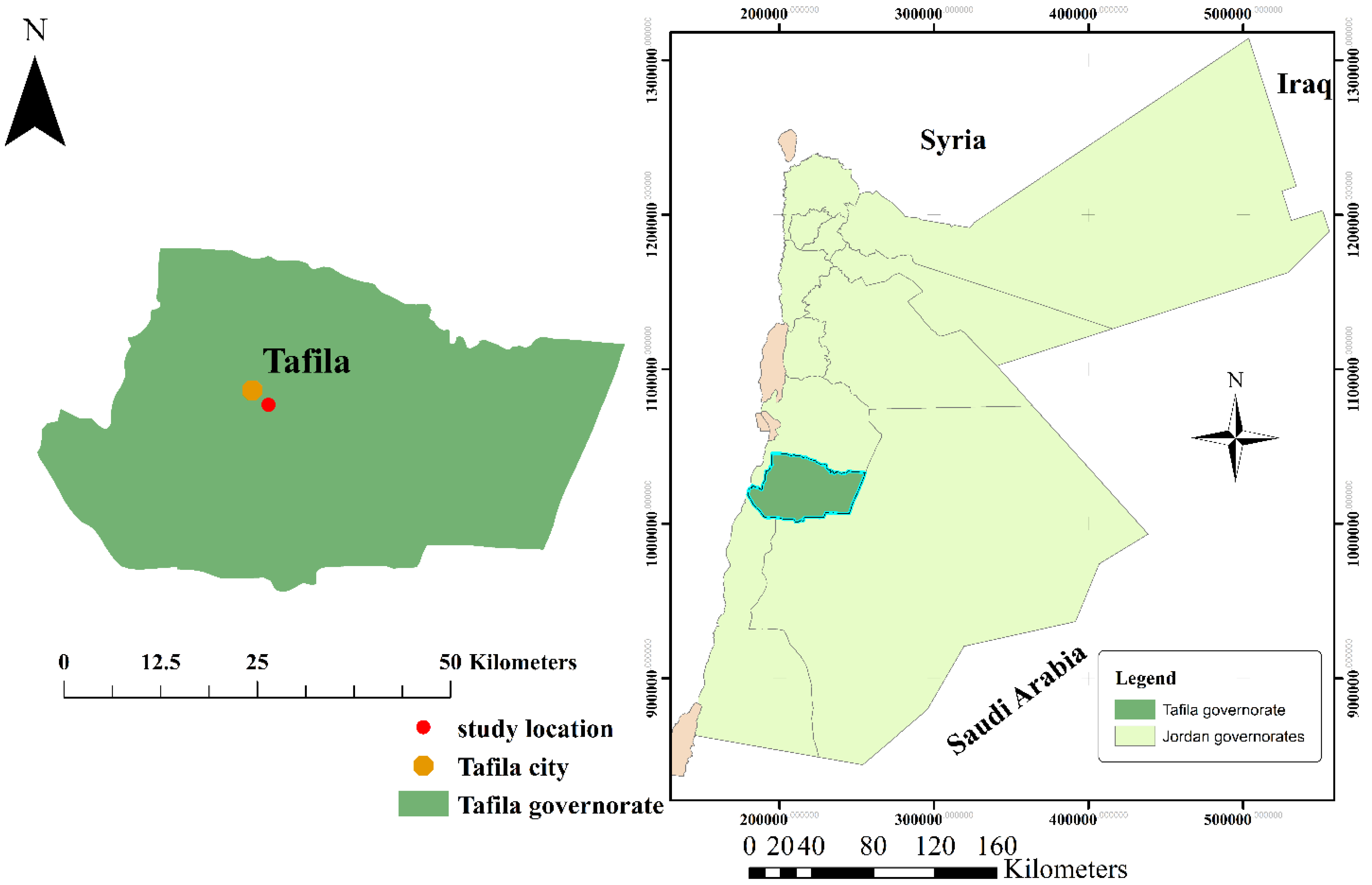
The study location is located within Tafila governorate in Gharandal town, near Tafila city, in the southern part of Jordan, about 180 km from the capital, Amman (Figure 1). Table 1 shows the geographic information of the chosen location. The Tafila region is selected for investigation due to its favorable conditions (i.e., advantageous topography and strategic geographical position) for wind energy production in Jordan. The Tafila region is an open area with excellent elevations in many locations like Qadesyya, Rashadeyah and Gharandal. On the other hand, the region is not densely populated relative to other regions which means more land is available for a large-scale project that has been started in Tafila. Wind data for this site, based on hourly recordings for wind speed within one year of monitoring from January to the end of December 2019 at a height of 90 m, are obtained from Jordan Wind Project Company (JWPC). There are no missing values in the dataset. According to the IEC 61400-12-1 standard [66], the measurement period should cover at least one year for wind resource evaluation. The measurements were obtained from a meteorological mast using a cup anemometer (Vector/A100M model) which was calibrated according to the requirements of IEC 61400-12-1:2017 [67].

2.2. Wind Speed Distribution Models

The Weibull and Rayleigh probability distributions are adopted in this paper to identify which distribution best fits the Tafila hourly wind speed series. The Weibull distribution is often chosen for its simplicity (i.e., easy to estimate its parameters), flexibility (i.e., its ability to demonstrate good agreement with observed wind speed and energy data), and adequacy in predicting wind energy potential and turbine performance [12,30,31,68,69,70,71]. In addition, many known commercial software applications including WAsP (Wind Atlas Analysis and Application Program) typically use the Weibull probability distribution as their default option for estimations of the annual energy production [8,36]. However, it recognizes that the Weibull model has limitations, especially when estimating extremely low or zero wind speed probabilities [30,35]. Consequently, the Rayleigh distribution, a specific version of the Weibull distribution, is considered a viable alternative.
The probability density functions (PDFs) and cumulative density functions (CDFs) of Weibull and Rayleigh probability distributions are outlined below. In these distributions, the random variable v denotes the hourly wind speed value. For the site of interest, the wind speed PDF represents how frequently a specific wind speed (v) occurs, while the wind speed CDF, derived as the integral of the PDF, represents the fraction of time during which the wind speed is less than or equal to a specific speed value (v). Through the application of the CDF, the operational duration of a turbine installed in the specified location can be accurately estimated for the wind speed which equal to or less than a particular wind speed value [72].
The PDF of the Weibull distribution is expressed by the following formula (e.g., [16,31,56]):
f v = k c v c k 1 e x p v c k
where k and c represent the dimensionless shape parameter and scale parameter (m/s), respectively, while v denotes the wind speed. These parameters describe the wind speed distribution at the study location. The k parameter characterizes the distribution’s flatness, so higher k values result in a narrower distribution with a higher peak value. The c parameter indicates the long-term average wind speed, and thus reflects site windiness, with higher values indicating windier locations.
The corresponding CDF of the Weibull distribution is given by the following formula (e.g., [16,31,56]):
F v = 1 e x p v c k
The Rayleigh distribution (i.e., the Weibull distribution when k is 2) has the following PDF (e.g., [37,49]):
f v = v c 2 e x p 1 2 v 2 c 2
and the corresponding CDF is given by the following formula (e.g., [34,37]):
F v = 1 e x p 1 2 v 2 c 2
Fitting the considered distributions to the recorded hourly wind speed data requires estimating their respective parameters. To obtain these estimates, this paper applies the MLM.

2.3. Maximum Likelihood Method (MLM) for Parameter Estimation

The MLM is used to estimate the parameters of the Weibull and Rayleigh probability distributions in this study. A brief description of this method is presented herein. The MLM identifies the distribution parameters through maximization of the likelihood function or, alternatively, its logarithmic form. The likelihood function is formulated according to the assumed probability distribution of the observed data. Regarding the Weibull distribution, consider a sample of n independent wind speed data points v 1 ,   v 2 ,   v 3 , ,   v n taken from the Weibull distribution. The likelihood function, denoted as L v 1 ,   v 2 ,   v 3 , ,   v n ; c ,   k , is the product of the Weibull probability density function with the c and k parameters evaluated at each data point and is given by
L v i ; c , k = i = 1 n k c v i c k 1 e x p v i c k
For computational simplicity, the logarithm of the likelihood function L v 1 ,   v 2 ,   v 3 , ,   v n ; c ,   k given in Equation (6) is maximized:
ln L v i ; c , k = n ( ln k k ln c ) + ( k 1 ) i = 1 n ln v i i = 1 n v i c k
The maximum value of ln L v 1 ,   v 2 ,   v 3 , ,   v n ; c ,   k occurs when solving the partial derivative equations k ( ln L ) = 0 and c ( ln L ) = 0 . The solution to these partial derivative equations is given by the following two expressions that lead to the estimation of k and c (e.g., [31,48,61]):
i = 1 n v i k ^ ln v i i = 1 n v i k ^ 1 k ^ 1 n i = 1 n ln v i = 0
c ^ = 1 n i = 1 n v i k ^ 1 k ^
where c ^ and k ^ represent the estimated values of the c and k parameters, respectively. The k ^ parameter is firstly found by iteratively solving Equation (7) and then the c ^ parameter is found using Equation (8). For the first iteration, the starting value of k ^ is given by k ^ =   σ v ¯ 1.086 , where v ¯ and σ represent the wind speed series average and standard deviation values, respectively, and are calculated by v ¯ = 1 n i = 1 n v i and σ = 1 n 1 i = 1 n v i v ¯ 2 [6,30], where n represents the data size and v i denotes the wind speed value.
Regarding the Rayleigh distribution, consider a set of n independent wind speed data points v 1 ,   v 2 ,   v 3 , ,   v n taken from the Rayleigh distribution with the c parameter. The likelihood function and its logarithmic form are given by Equation (9) and Equation (10), respectively:
L v i ; c = i = 1 n v i c 2 e x p 1 2 v i 2 c 2
ln L v i ; c = n ln c + i = 1 n ln v i i = 1 n v i 2 2 c 2
The c parameter of the Rayleigh distribution is estimated through maximizing ln L v 1 ,   v 2 ,   v 3 , ,   v n ; c with respect to the parameter c (i.e., c ( ln L ) = 0 ) yielding the following equation (e.g., [37]):
c ^ = 1 2 n i = 1 n v i 2
where c ^ denotes the estimate of the c parameter, n represents the data size and v i denotes the wind speed value.

2.4. Goodness-of-Fit Tests

The goodness-of-fit test assesses how well a certain distribution fits a given dataset. This ensures that predictions made using this distribution are reliable. The following four goodness-of-fit measures, along with a brief description of their statistical basis, are applied in this paper to identify the best-fitting distribution (i.e., Weibull or Rayleigh) for the hourly wind speed series at Tafila:
(1) The Kolmogorov–Smirnov (KS) test evaluates the difference between the empirical ( F E v ) and theoretical ( F ( v ) ) cumulative distribution functions. The F E v is obtained from the wind speed series using Equation (12) when the speed values are organized in ascending order, while the F ( v ) is given by Equation (2) and Equation (4) for the Weibull and Rayleigh distributions, respectively.
F E v = 0 ,   v < v 1 i n ,   v i < x < v i + 1 1 ,   v > v n
where n represents the data size and i denotes the rank assigned to each wind speed value in the ordered (ascending) data series.
In this test, the largest absolute vertical difference between F E v and F ( v ) across all values of v denoted as D and given by D = m a x F E v F ( v ) is used to quantify the difference.
(2) The Anderson–Darling (AD) test [73] is analogous to the KS test. In this test, the distribution’s tails are given more weight as compared to the KS statistics when assessing the goodness of fit between the empirical and theoretical cumulative distributions. The following formula defines the AD test statistic (A2):
A 2 = n i = 1 n 2 i 1 n ln F v i + ln 1 F v n i + 1
where n represents the data size, i denotes the rank assigned to each wind speed value in the ordered (ascending) data series, v i is the ith ordered (ascending) wind speed value, v n i + 1 is the (ni + 1)th ordered wind speed value and F v i and F v n i + 1 represent the theoretical cumulative distribution function (Weibull or Rayleigh) evaluated at v i and v n i + 1 , respectively.
(3) Coefficient of determination (R2) is a statistical metric that assesses the strength of the linear correlation between empirical and theoretical cumulative distributions. The R2 is expressed as follows (e.g., [38,40]):
R 2 = i = 1 n F v i F ¯ 2 i = 1 n F v i F ¯ 2 + i = 1 n F E W v i F v i 2
where F v i denotes the theoretical cumulative probabilities estimated from either the Weibull (Equation (2)) or Rayleigh (Equation (4)) distribution corresponding to the ith observed wind speed value based on the obtained parameter estimates by the MLM for each distribution. Meanwhile, F E W v i denotes the empirical cumulative probabilities corresponding to the ith observed wind speed value estimated using F E W v i = i n + 1 (i.e., Weibull plotting formula), with i denoting the rank assigned to each wind speed value in the ordered (ascending) data series. The parameter n indicates the data size. F ¯ is the average of F v i and is calculated as F ¯ = 1 n i = 1 n F v i .
(4) Root mean square error (RMSE) measures the average magnitude of error between empirical and theoretical cumulative distribution functions. The RMSE is provided by the following equation (all terms have been defined previously; e.g., [7,61,74]):
R M S E = 1 n i = 1 n F E W v i F v i 2
The distribution providing the best representation of the hourly wind speed series for Tafila, selected between the Weibull and Rayleigh options, is identified as the one exhibiting the lowest Dn, lowest A2, lowest RMSE, or highest R2.

2.5. Wind Power and Wind Energy Densities

Wind power density shows the potential for producing wind energy at a specific location. Therefore, to achieve the primary goal of this research, the wind power density at the study location is used to categorize its potential for wind generation as poor, marginal, moderate, good, or excellent. Higher wind power density values imply better suitability for wind turbine installations. The wind power P(v) is a function of the air density (ρ), the turbine’s swept area (A) and the cube of the wind speed, and can be computed using Equation (16).
P v = 1 2 ρ A v 3
Computed power is measured in terms of the power per unit area, P v A , commonly known as the wind power density, which represents the ratio of the wind power, P(v), to the turbine’s swept area, A, and can be calculated by rewriting Equation (16) as follows:
P v A = 1 2 ρ v 3
here, P(v), P v A , ρ, A and v are expressed in units of W (Watt), W/m2 (Watt per square meter), kg/m3, m2, and m/s, respectively. The swept area A can be calculated by simply knowing the turbine’s blade diameter. Notably, the power increases by factors of 8 or more with doubled wind speed.
In calculating wind power density, as reported in the literature [1,6,30,70,75], the cube wind speed average ( v 3 ¯ = 1 n i = 1 n v i 3 ) is commonly adopted to represent the cube wind speed. Therefore, the average P(v) and the corresponding average P v A are calculated using Equation (18) and Equation (19), respectively:
P v ¯ = 1 2 ρ A v 3 ¯ = 1 2 n ρ A i = 1 n v i 3
and
P v A ¯ = 1 2 ρ v 3 ¯ = 1 2 n ρ i = 1 n v i 3
where n represents the data size and vi represents the wind speed value.
Also, the wind power density may be estimated from the wind speed probability distribution (i.e., f v ). Thus, the wind power and the wind power density can be calculated as
P v = 0 1 2 ρ A v 3 f v d v
and
P v A = 0 1 2 ρ v 3 f v d v
Once the Weibull and Rayleigh parameters are estimated, the wind power density can be computed using these parameters. Therefore, the formulas representing the P v A ¯ according to the Weibull and Rayleigh distributions are given by Equation (22) (e.g., [5,17,18,31,56]) and Equation (23) (e.g., [49,69]), respectively:
P v A ¯ = 1 2 ρ c 3 Γ 1 + 3 k
where Γ is the gamma function;
P v A ¯ = 3 π ρ c 3 π 4 3 / 2 = 3 π ρ v ¯ 3
where v ¯ denotes the average wind speed.
The air density ( ρ ) for this study is determined using the law of ideal gas, expressed as ρ =   P ¯ R   T ¯ , based on the actual measurements at the study site. Here, P ¯ denote the yearly average atmospheric air pressure (kPa), T ¯ is the yearly average air temperature (Kelvin (K)), and R is the specific gas constant (0.287 kJ/kg-K). Under study site conditions, at an altitude of 90 m, the ρ is calculated as 1.0423 kg/m3.
On the other hand, wind energy represents the kinetic energy possessed by moving air. Thus, the wind energy density measures the total energy per unit area available from the wind over a specified time interval such as an hour, day, month, or year. Mathematically, it is calculated by integrating the wind power density over a specified time interval and is generally written as
E v A = 0 T 1 2 ρ v 3 d t = P v A T
The wind energy density estimated directly from the observed wind speed series is obtained by
E v A = 1 2 ρ v 3 ¯ T = 1 2 n ρ i = 1 n v i 3 T
For a given time interval T, the wind energy density per unit area is calculated by Equation (26) and Equation (27) for the Weibull and Rayleigh distributions, respectively.
E v A = 1 2 ρ c 3 Γ 1 + 3 k T
E v A = 3 π ρ c 3 π 4 3 / 2 T = 3 π ρ v ¯ 3 T
where T is the desired time interval, which can be taken as 720 h or 8760 h for estimating the one-month or one-year wind energy density, respectively.

2.6. Wind Speed Variation with Altitude

In general, as altitude increases, both wind speed and its associated power density increase. Measurements of wind data are often recorded at various heights. However, measurements at the turbine hub height are essential for estimating energy production potential. Thus, recorded speeds at the original level are adjusted to speeds at the turbine hub height or at another desired height. The wind power law presented in Equation (28), e.g., [75,76,77], has been widely considered as a useful and accurate tool for estimating wind speeds at various heights.
v z 2 = v z 0 z 2 z 0 α
In this equation, v z 2 indicates the estimated wind speed at the desired height z 2 , and v z 0 denotes the recorded wind speed at the original height z 0 . The coefficient α, known as the wind shear exponent, is influenced by the surface topology roughness and atmospheric characteristics of the location and is typically assumed in many studies and practical applications to be 0.143 (or 1/7) in standard cases which is adopted in the current study.

2.7. Useful Wind Speed Metrics

In wind energy potential assessment, two essential metrics are commonly considered, namely the most probable (vmp) and the optimum (vop) wind speeds [13]. Both metrics are derived from the fitted probability distribution of wind speed data based on its estimated parameters. The vmp represents the wind speed with the highest likelihood of occurrence over a given time period (i.e., the peak of the probability density function). The vmp is calculated as v m p = c 1 1 k 1 k and v m p = c 1 2 , for the Weibull and Rayleigh distributions, respectively. The vop (also called the wind speed carrying maximum energy) is the wind speed contributing the most energy. For the Weibull and Rayleigh distributions, the vop is calculated as v o p = c 1 + 2 k 1 k and v o p = c 3 2 , respectively. The vop is used for considering an adequate wind turbine or calculating the rated wind speed for a location. According to previous research, wind turbine systems function most efficiently at their rated wind speed. Therefore, to maximize energy output, wind turbines whose rated wind speed is consistent with the v o p are recommended [16,17,30,36,43,74,78].

2.8. Wind Direction

Besides its variable speed, the wind exhibits a variable direction that fluctuates continuously over time. Thus, the orientation of wind turbines during installation in the wind farm is determined according to the wind direction for maximum energy generation. The estimated wind directions are displayed through the graphical demonstration known as the wind rose diagram. This circular diagram provides a simple geometrical relation of wind speed distribution and direction for a specific site within a defined time period [5,17]. This diagram consists of radial lines (spokes) representing wind direction with their length representing the frequency of wind originating from that direction (i.e., the proportion of time the wind originates from a specific direction). Each spoke is segmented into various thicknesses or colors, denoting distinct wind speed ranges. The openair package [79] within the r scripting language is utilized to generate the wind rose diagrams.

3. Results and Discussion

3.1. Wind Speed Analysis

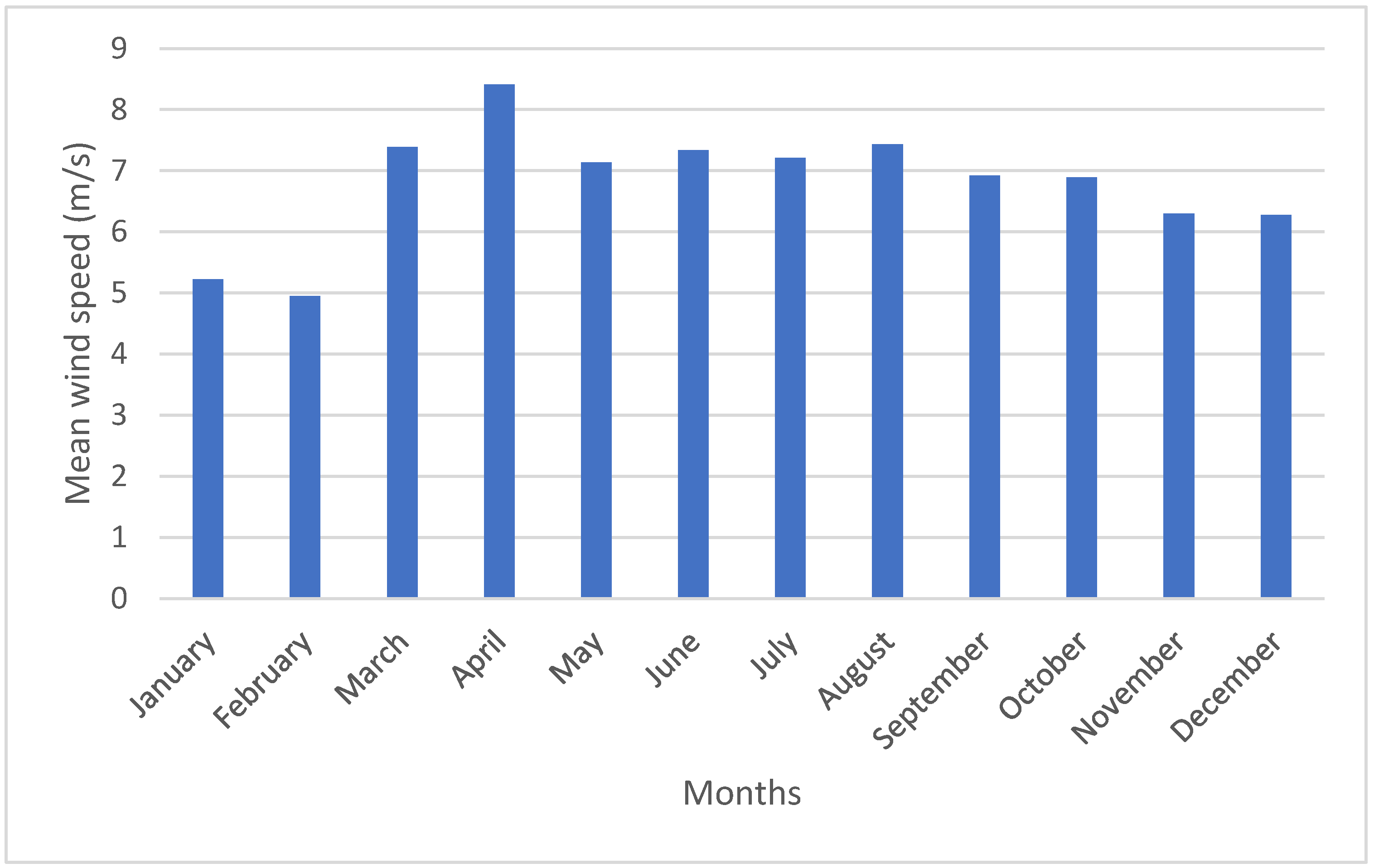
Table 2 demonstrates the summary statistics on a monthly and yearly basis including the average wind speed ( v ¯ ) (also see Figure 2 for v ¯ ), the standard deviation ( σ ), and the coefficient of variation (CV) calculated from the available wind speed time series data for the study location in Tafila, Jordan. The elevation at which wind speed was measured is 90 m, which gives more accurate data since the wind turbine tower may have this elevation [18,80].
The highest v ¯ is observed in April at 8.41 m/s followed by March (7.39 m/s) and August (7.43 m/s), whereas the lowest occurs in February (4.95 m/s). For most months (from March through October), the monthly average speed is above the yearly average speed (6.80 m/s). From these results, the wind speed is promising for harvesting energy as power estimation involves cubing the wind speed value. According to σ, a statistic measuring the spread of the data around the average (i.e., evaluating the absolute variability), the highest and lowest σ are also observed in April and February (i.e., 5.16 m/s and 2.16 m/s, respectively) (Table 2). Additionally, the yearly standard deviation of wind speeds is 3.38 m/s.
The CV, obtained by C V = σ v ¯   and reflecting the relative variability within the dataset, is also presented in Table 2 to analyze the relative variability of wind speed within a specific month (i.e., intra-month variability). This coefficient varies from one month to another in the range from 0.37 to 0.61. April shows the highest CV (0.61) followed by May (0.58), which indicates high fluctuations in wind speed despite its high average values in these two months. In contrast, December (0.37), November (0.39), and October (0.39) have the lowest CVs, reflecting more consistent wind speed patterns despite moderate wind speeds of these three months. Moreover, the yearly coefficient of variation is 0.50.
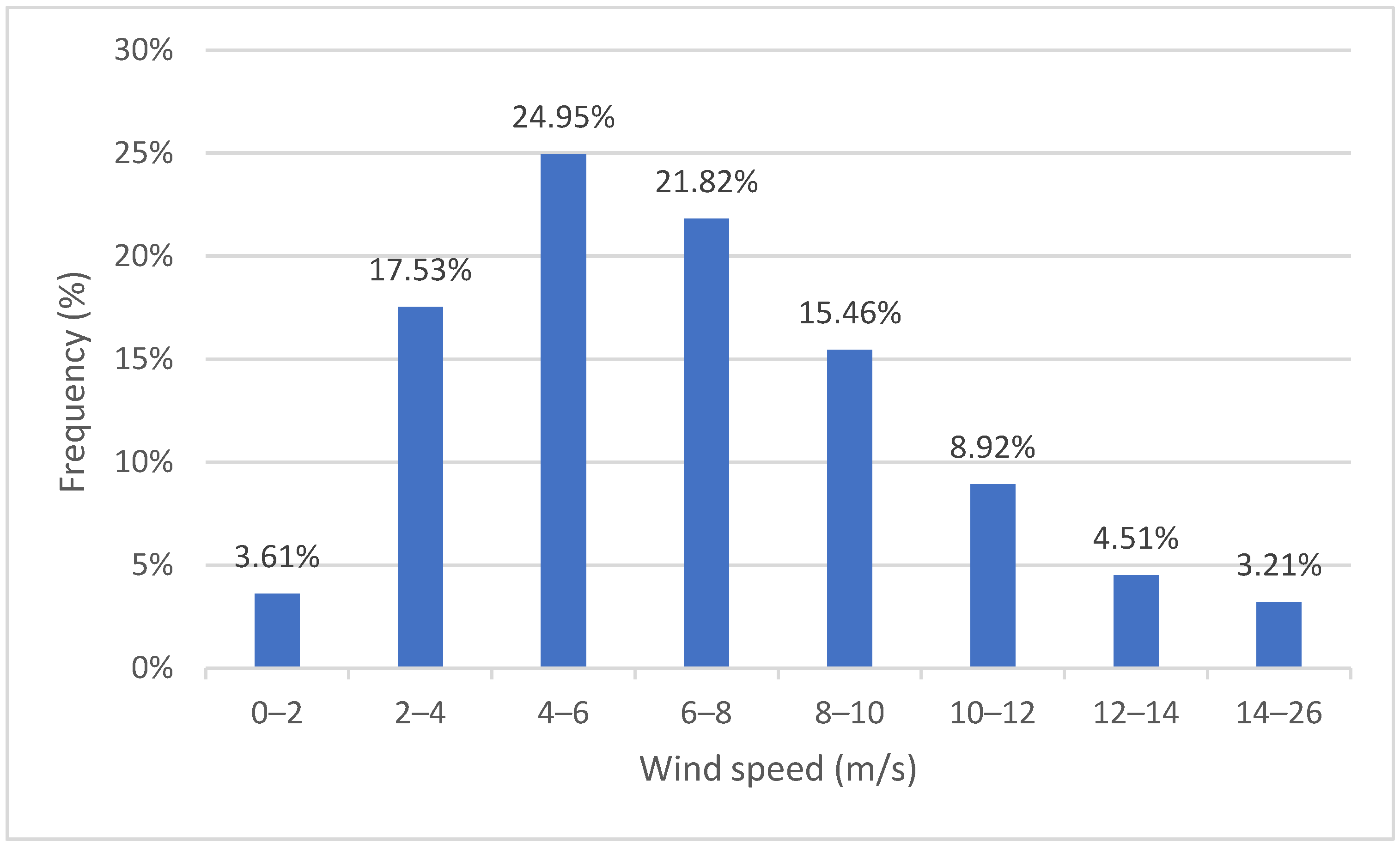
The available wind speed values are additionally illustrated in a percentage frequency distribution format, which assists in statistical interpretation, as shown in Figure 3. This format shows the frequency in percentage that the wind speed falls in a particular predefined speed interval. Figure 3 shows that most wind speed data are concentrated in the 4 to 6 m/s range accounting for approximately 25% of the total data. The remaining wind speed data are distributed across or in different ranges as follows, listed from highest to lowest frequency: 6–8 m/s (22%), 2–4 m/s (18%), 8–10 m/s (15%), 12–14 m/s (5%), 0–2 m/s (3.6%), and 14–26 m/s (3.2%). Figure 3 also highlights that wind speeds exceeding 4 m/s account for about 79% of the data. Considering that commercial wind turbines usually operate at cut-in speeds that exceed 4 m/s [74], the observed 79% availability of wind speed above this speed of 4 m/s suggests that the Tafila region is a promising candidate for wind farm development.
Also, with the aim of calculating seasonal wind speed statistics, the months are categorized into the cold season (November to April) and warm season (May to October). The average wind speed is 6.44 m/s during the cold season and increases to 7.16 m/s in the warm season, as reported in Table 3. Additionally, Table 3 shows that the warm season standard deviation of 3.31 m/s is relatively similar to the cold season value of 3.40 m/s. Moreover, the coefficient of variation for both seasons is comparable with 0.46 for the warm season and 0.53 for the cold season. The availability of higher wind speeds during both seasons with relatively lower variability enhances the reliability of wind power as a complementary energy source to partially cover peak load requirements especially in the cold season. Tafila experiences severe weather conditions in winter (due to its high elevation of approximately 1200 m in many locations) and the heating demand is maximum in this interval. Therefore, wind power can be an added value by reducing reliance on the current conventional heating source systems on fossil fuels during this critical period.
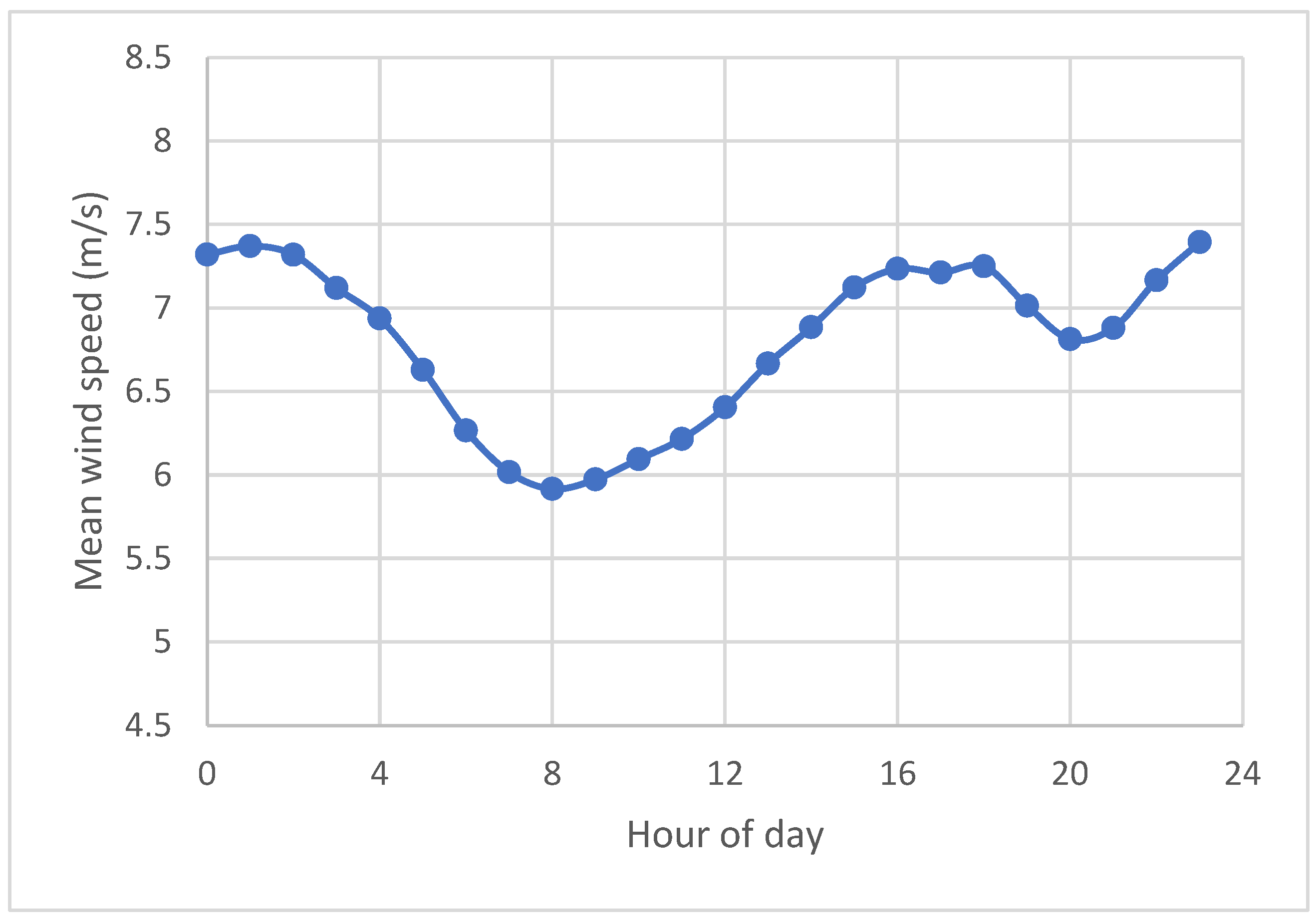
Figure 4 illustrates the average wind speed throughout a 24 h period. As seen in Figure 4, the hourly average wind speeds exhibit a clear diurnal pattern. The hourly average wind speed gradually increases from early morning around 8:00 and reaches its peak around the afternoon hours, particularly between 16:00 and 18:00, with values approaching 7.25 m/s. Interestingly, after this peak, a noticeable small decrease in the hourly average wind speed occurs between 18:00 and 20:00 to a value near 6.8 m/s and then rises again (i.e., between 20:00 and 1:00) and reaches another peak around midnight with a value approaching 7.37 m/s. After midnight, wind speed gradually declines, reaching its minimum during the early morning hours around 8:00. These results coincide with the typical diurnal wind behavior of semi-arid environments which indicates that wind is more turbulent in the daytime due to temperature differences and stabilizes overnight.
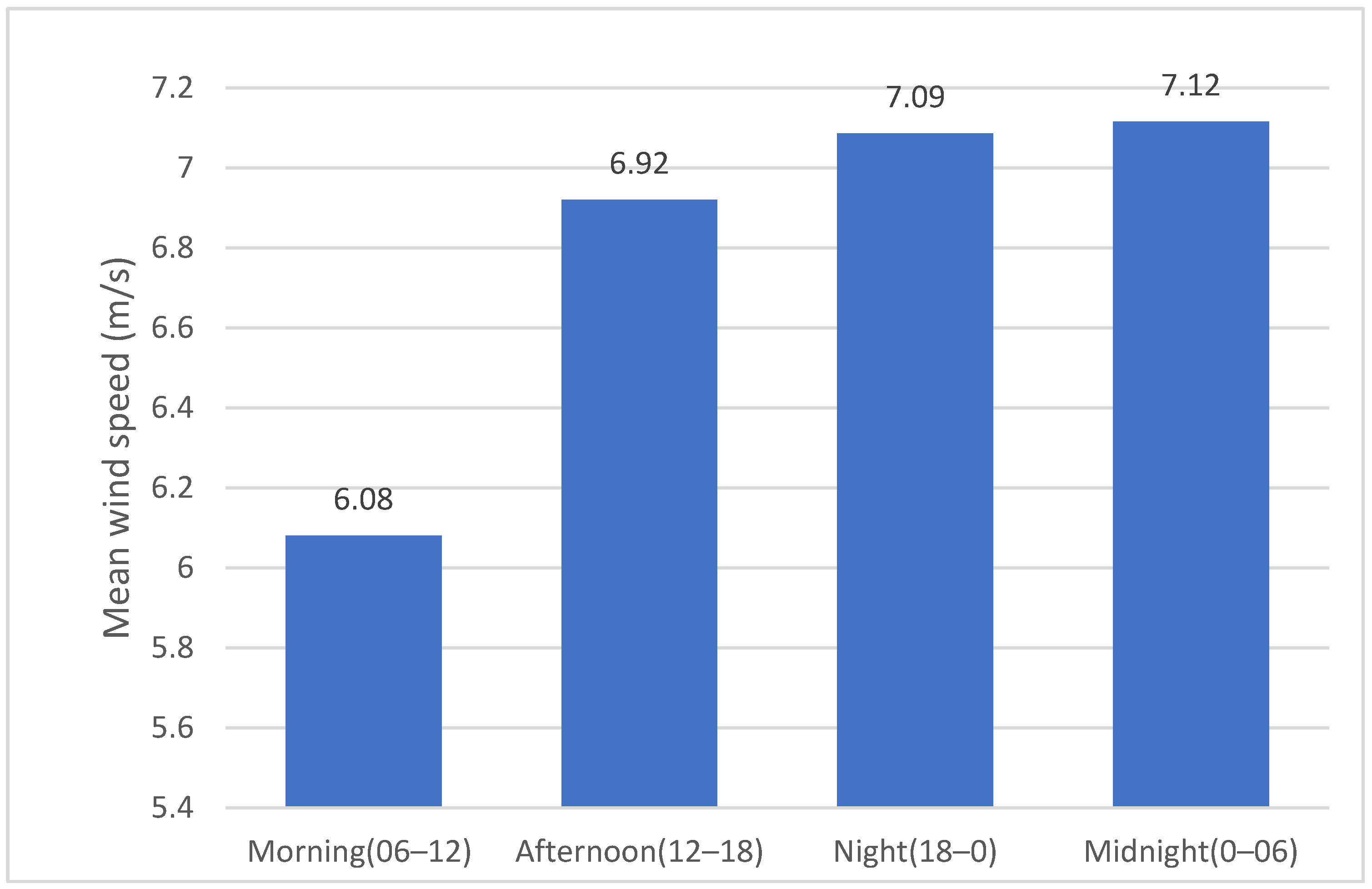
Moreover, Figure 5 demonstrates the average wind speed when the whole day is divided into four distinct time periods as follows: morning (06:00–12:00), afternoon (12:00–18:00), night (18:00–00:00), and midnight (00:00–06:00). It is interesting to note that, as shown in Figure 5, the midnight period exhibits the maximum average wind speed (7.12 m/s) with the night period showing a close value of 7.08 m/s. The afternoon period shows a slightly lower average of 6.92 m/s, while the minimum average of 6.08 m/s is recorded in the morning period. For a hub height of 90 m, the average wind speed mostly exceeds 6 m/s during the day with variation over the four periods within a relatively small range of about 1 m/s indicating stable high-wind conditions throughout the day on average. This pattern is an advantage to Tafial for energy generation as a result of the availability of higher wind speeds during the entire year. Also, understanding this pattern is essential for optimizing wind turbine operation schedules and efficiently integrating wind energy into power grid systems.

3.2. Weibull and Rayleigh Distributions

The Weibull distribution k and c parameters along with the c parameter of the Rayleigh distribution are estimated from the measured hourly wind data in Gharandal, Tafila (i.e., 8760 wind speed hourly records for 2019) using the MLM and are presented in Table 4. As illustrated in Table 4, the Weibull distribution scale parameter (7.7 m/s) exceeds that of the Rayleigh distribution (5.37 m/s). Additionally, the Weibull shape parameter is 2.14, which, while slightly higher, remains relatively close to the fixed shape parameter value of 2 assumed in the Rayleigh distribution.
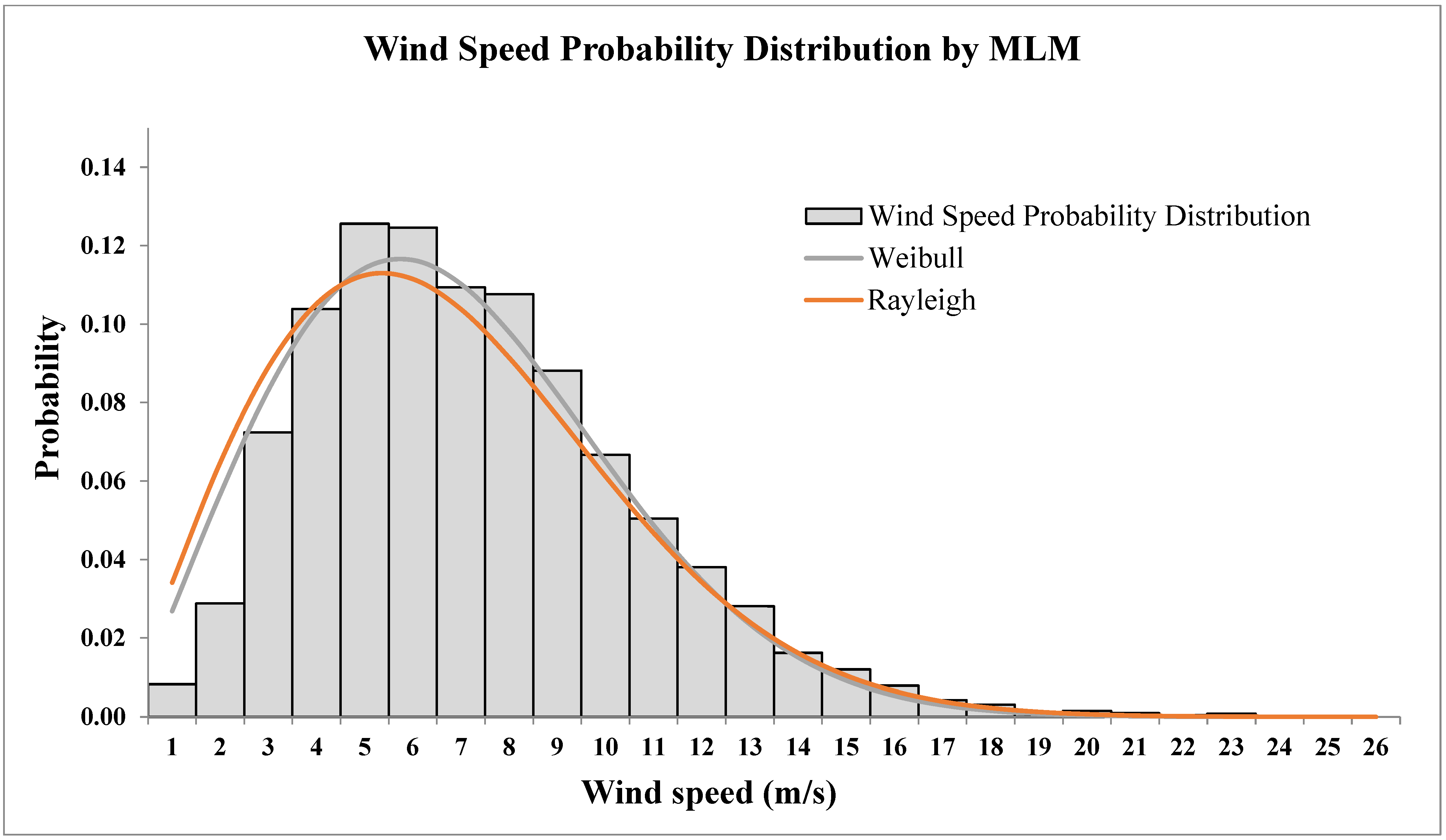
Figure 6 illustrates a comparison between the actual wind speed frequency histogram and the distributions of speed obtained from Weibull and Rayleigh probability distributions. There is a clear indication that both distributions align well with the actual wind speed frequency histogram which is also confirmed by the coefficient of determination values (i.e., R2 = 0.99 in each case) shown in Table 5.
Table 5 lists the goodness-of-fit results, evaluated using several statistical tests (KS test, AD test, R2 and RMSE), to assess the Weibull and Rayleigh probability distribution performance in approximating the observed wind speed series. As indicated in Table 5, the Weibull distribution records low KS, AD and RMSE values (i.e., 0.0184, 6.2771 and 0.0131, respectively) compared to the Rayleigh distribution which gives higher corresponding values (0.0311, 20.2146 and 0.01770, respectively). The smaller the KS, AD and RMSE values, the more accurately the probability distribution fits the actual data series. Therefore, these results indicate that the Weibull distribution provides a statistically more accurate fit to the Tafila wind speeds relative to the Rayleigh distribution. Moreover, Table 5 demonstrates a significantly lower AD value for the Weibull distribution compared to the Rayleigh distribution. This difference indicates that the Weibull distribution more accurately captures both low and high wind speed extremes (i.e., the distribution tails).
After identifying the optimal distribution for modeling the Tafila wind speed and its parameter estimation, the vmp and the vop are determined according to equations reported earlier in Section 2.7 and presented in Table 4. At 90 m height, the yearly vmp is 5.73 m/s representing the wind speed that occurs at the highest frequency within the one-year study period. The yearly vop is 10.48 m/s which corresponds to the wind speed possessing maximum energy. Therefore, to maximize energy output at the Tafila study location, wind turbines with rated wind speeds close to vop of 10.48 m/s are recommended. Also, the predicted yearly average wind speed from the best-fit distribution (i.e., the Weibull distribution) is 6.82 m/s as shown in Table 4, which aligns well with the observed yearly average of 6.80 m/s (Table 2). These findings demonstrate that the Tafila wind regime exhibits favorable wind characteristics when considering the yearly v ¯ , vmp and vop.

3.3. Wind Power and Energy Density

The wind power density ( P v / A ¯ ) and wind energy density ( E v / A ) estimated based on the optimum distribution (i.e., the Weibull distribution) with Equation (22) and Equation (26), respectively, are also summarized in Table 4 for Tafila. The annual ( P v / A ¯ ) is 296 W/m2, while the annual ( E v / A ) is 2590 kWh/m2.
Wind generation potential can be assessed using the Pacific Northwest Laboratory (PNL) classification system (Table 6). This classification system, originally developed by Elliott and Schwartz [81], has been used in the United States since 1993. This classification system categorizes wind resources at 10 m and 50 m elevations into seven classes according to average wind speed and power density. Within this classification system, Classes 4 or higher are generally recommended for wind farm deployment, Class 3 is identified as feasible for wind power generation with tall towers, Class 2 is marginally suitable, and Class 1 is considered unsuitable for wind power generation [81]. Also, another common categorization of each wind power classification class [15,82] (i.e., poor, marginal, moderate, good, excellent) is illustrated in column two of Table 6. The PNL classification system can be used as a classification system for wind generation potential for the Tafila study location.
The wind speeds for Tafila are recorded at 90 m elevation. To address this, a modified table (Table 7) is created by the authors based on the same extrapolation principle used by Elliott and Schwartz (i.e., the extrapolation of wind speed along with its corresponding power density with elevation is obtained from Equation (28)). The average wind speed with its corresponding power values (i.e., 6.82 m/s and 296 W/m2/year, respectively in Table 4) indicate that Tafila falls within Class 2 of the PNL classification system (Table 7), which represents marginal suitability for wind development.
In addition to the PNL system, the European Wind Energy Association (EWEA) classifies wind resources of a region into three categories according to wind characteristics (wind speed and wind power): fairly good (6.5 m/s, 300–400 W/m2), good (7.5 m/s, 500–600 W/m2) and very good (8.5 m/s, 700–800 W/m2) [83]. Based on this categorization, Tafila can be considered fairly good and it is suitable for installing a wind farm despite being marginal under the PNL classification.
This apparent contradiction is mainly due to the fact that the two classification systems use different threshold values, categorization criteria and terminology for the classification of wind resources (i.e., wind speeds and wind power density). Moreover, modern wind turbines are designed for much higher hub heights and larger rotor swept areas, allowing for more efficient energy extraction under moderate wind conditions. Thus, sites that were previously considered marginal based on PNL classification or fairly good based on EWEA classification can still be technically and economically suitable for modern wind energy development. This is further supported by the successful operation of the 117 MW wind farm in the Tafila region [84].
Ambrosini and co-workers [85] proposed another classification on the basis of power density. According to this classification, the wind resources of the region are divided into four categories: fair (P/A < 100 W/m2), fairly good (100 W/m2P/A < 300 W/m2), good (300 W/m2P/A < 700 W/m2) and very good (P/A ≥ 700 W/m2). Thus, Tafila is categorized as a fairly good-to-good site for wind generation which further supports its potential for wind energy development.

3.4. Wind Direction

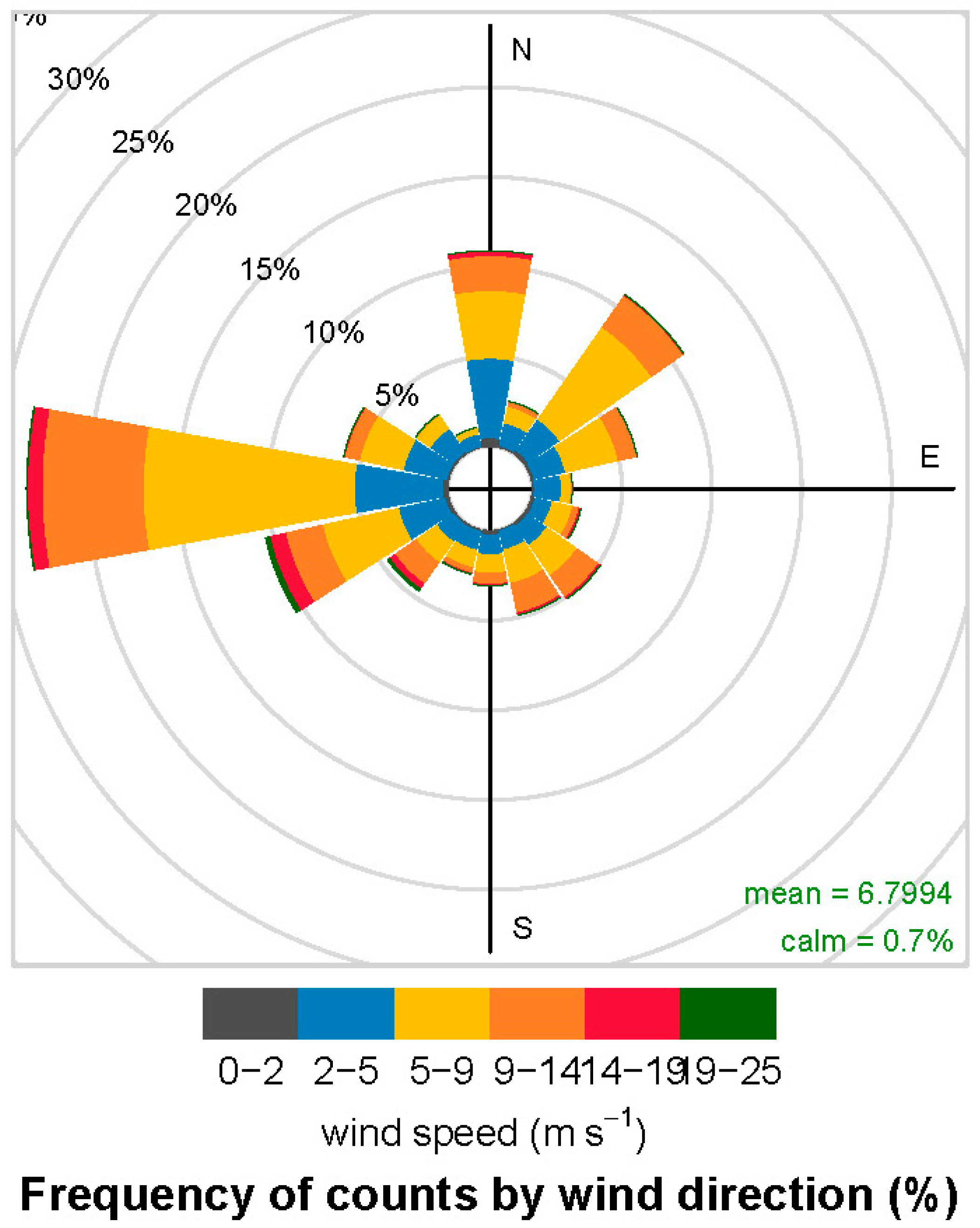
The wind rose diagram is employed to analyze the wind directional characteristics at the study location. This is necessary to align the orientation of wind turbines in the Tafila region with the dominant wind directions to maximize the overall energy generation on the turbine level, and to reduce the impact of the wind energy losses due to wake effects. Wake effects occur when upstream turbines extract kinetic energy from the wind, resulting in reduced wind speeds and increased turbulence intensity experienced by downstream turbines [23]. Figure 7 shows the wind rose diagram of the Tafila study location for the study period of one year. As can be seen in Figure 7, the prevailing winds at Tafila originate from the west direction (i.e., 270°) with approximately 23% frequency. Other notable prevailing wind directions with frequencies around 10% include north (N), northeast (NE), and west-southwest (WSW). As illustrated in Figure 7, a large proportion of wind in these prevailing directions exceeds 5 m/s. This dominance of westerly winds may be driven by combined effects of regional synoptic-scale circulation patterns and local topographic channeling associated with the mountainous terrain of the Tafila region.
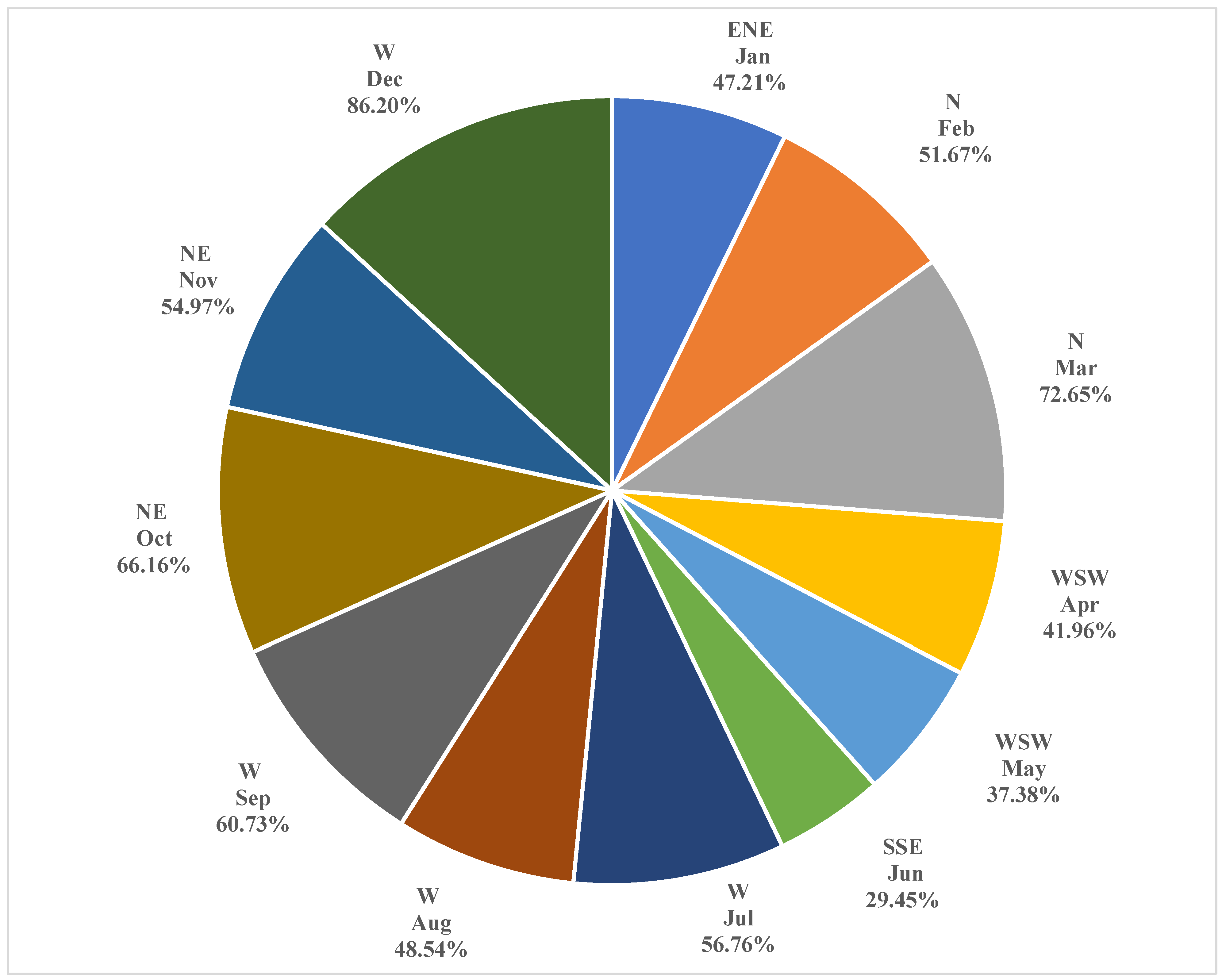
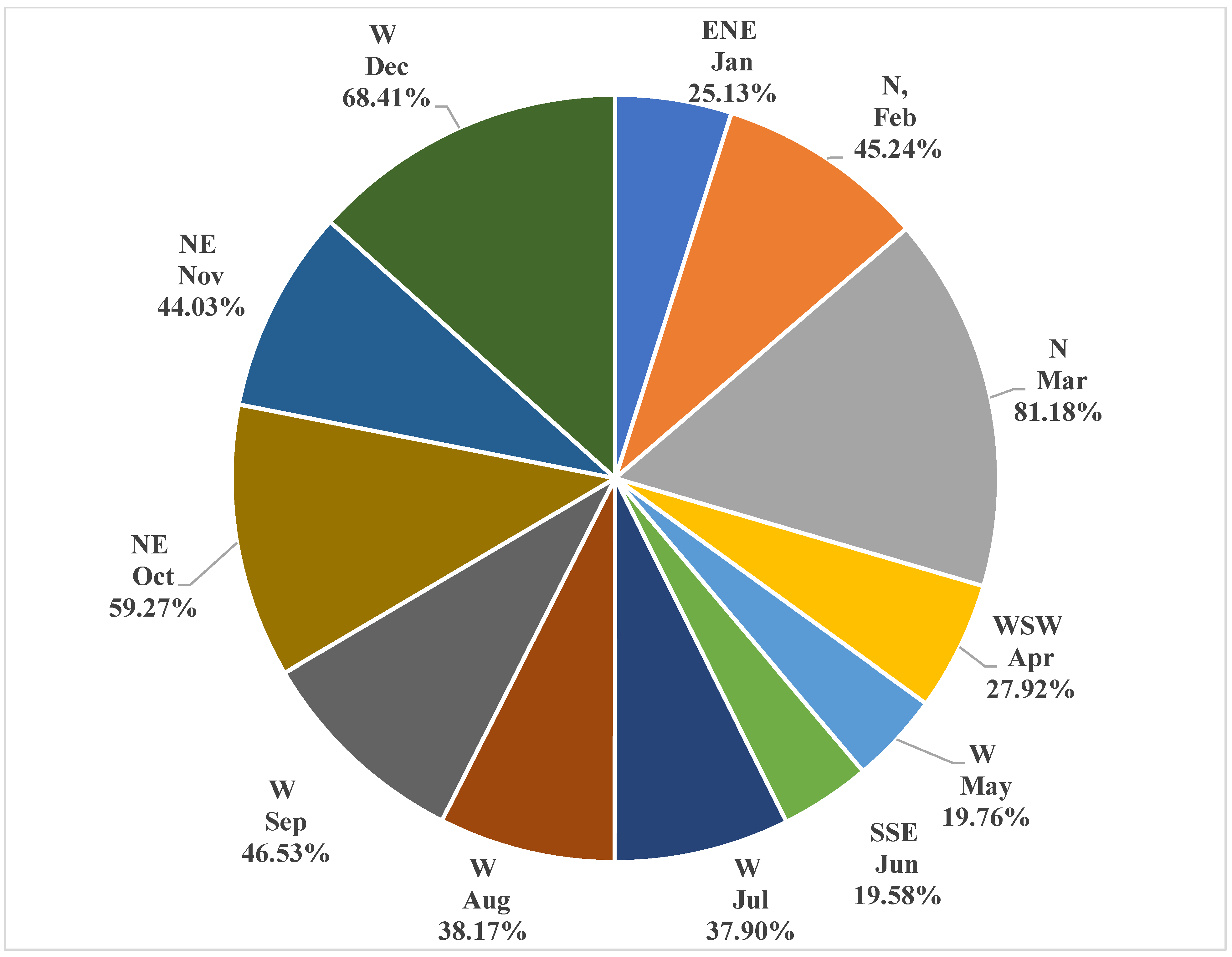
For further analysis, Figure 8 and Figure 9 illustrate the monthly dominant prevailing wind directions based on time (i.e., percentages of time) and based on available wind energy, respectively. When comparing Figure 8 and Figure 9 for the Tafila study location, it is observed that for each month the dominant direction based on time is the same as the dominant direction based on the available wind energy except May. Additionally, Figure 8 indicates that the maximum percentage of wind originating from a designated direction in a specific month is 81.18%, and it is recorded in March from the north direction. On the other hand, it can be noted from Figure 9 that the maximum percentage of available wind energy from a designated direction in a specific month is 86.20% and it is obtained in December from the west direction. These variations in percentages for each month, despite similar dominant directions, are expected given that the wind blowing from one direction for a long time may not reach speeds sufficient to produce maximum energy.

4. Conclusions

The wind speed characteristics and corresponding energy potential of Gharandal town, within the Tafila governorate in the southern part of Jordan, are investigated in the present research. Hourly wind data records at an elevation of 90 m within a one-year monitoring period are used. Both Weibull and Rayleigh distributions are used, with their parameters estimated using the MLM. The conclusions drawn from this investigation are outlined below:
  • The estimated yearly average wind speed is 6.80 m/s. The windiest months are April (8.41 m/s), March (7.39 m/s) and August (7.43 m/s), whereas February represents the calmest month (4.95 m/s).
  • Higher wind speeds occurred during the late afternoon (between 16:00 and 18:00) and around midnight (between 20:00 and 1:00) as indicated by the diurnal wind speed variation analysis.
  • Based on the KS, AD, R2 and RMSE tests, the Weibull distribution is statistically more accurate and reliable in representing the Tafila wind speed than the Rayleigh distribution.
  • Weibull parameters k and c are 2.14 and 7.70 m/s, respectively.
  • The yearly most probable and the optimum wind speeds are 5.73 m/s and 10.48 m/s, respectively.
  • The annual power density is 296 W/m2 which indicates that Tafila falls into Class 2 of the PNL classification system which represents marginal suitability for wind development. However, this value also indicates that Tafila can be considered fairly good and it is suitable for installing a wind farm based on the EWEA classification system.
  • Most of the time, the prevailing winds at Tafila originate from the west direction (i.e., 270°) with approximately 23% frequency.
In terms of application, the findings of this study suggest that in the Tafila region, there are appropriate and promising areas for wind energy generation, especially with the implementation of modern wind turbine technologies with higher hub heights and larger rotor diameters. Furthermore, these findings can be used to provide theoretical support to promote future investment in wind power projects in the Tafila region.

Author Contributions

Conceptualization, M.A.A.Z. and M.N.I.; methodology, M.A.A.Z. and M.N.I.; formal analysis, M.N.I.; data curation, M.A.A.Z. and M.N.I.; writing—original draft preparation, M.A.A.Z. and M.N.I.; writing—review and editing, M.A.A.Z. and M.N.I.; supervision, M.N.I. All authors have read and agreed to the published version of the manuscript.

Funding

This research received no external funding.

Institutional Review Board Statement

Not applicable.

Informed Consent Statement

Not applicable.

Data Availability Statement

The datasets generated during and/or analyzed during the current study are available from the corresponding author on reasonable request.

Acknowledgments

The author would like to thank the Jordan Wind Project Company (JWPC) in Jordan for providing the required wind speed data.

Conflicts of Interest

The authors declare no conflicts of interest.

References

  1. Irwanto, M.; Gomesh, N.; Mamat, M.R.; Yusoff, Y.M. Assessment of wind power generation potential in Perlis, Malaysia. Renew. Sustain. Energy Rev. 2014, 38, 296–308. [Google Scholar] [CrossRef]
  2. Islam, M.R.; Mekhilef, S.; Saidur, R. Progress and recent trends of wind energy technology. Renew. Sustain. Energy Rev. 2013, 21, 456–468. [Google Scholar] [CrossRef]
  3. Mostafaeipour, A. Feasibility study of harnessing wind energy for turbine installation in province of Yazd in Iran. Renew. Sustain. Energy Rev. 2010, 14, 93–111. [Google Scholar] [CrossRef]
  4. Li, M.; Li, X. Investigation of wind characteristics and assessment of wind energy potential for Waterloo region, Canada. Energy Convers. Manag. 2005, 46, 3014–3033. [Google Scholar] [CrossRef]
  5. Allouhi, A.; Zamzoum, O.; Islam, M.R.; Saidur, R.; Kousksou, T.; Jamil, A.; Derouich, A. Evaluation of wind energy potential in Morocco’s coastal regions. Renew. Sustain. Energy Rev. 2017, 72, 311–324. [Google Scholar] [CrossRef]
  6. Alliche, M.; Rebhi, R.; Kaid, N.; Menni, Y.; Ameur, H.; Inc, M.; Ahmad, H.; Lorenzini, G.; Aly, A.A.; Elagan, S.K.; et al. Estimation of the wind energy potential in various north algerian regions. Energies 2021, 14, 7564. [Google Scholar] [CrossRef]
  7. Tasnim, M.; Rifa, T.I.; Shahriar, T.; Habib, M.A. Wind energy deployment in Bangladesh: Investigating feasible locations and their characteristics. Energy Rep. 2024, 11, 4338–4355. [Google Scholar] [CrossRef]
  8. Akdağ, S.A.; Güler, Ö. A novel energy pattern factor method for wind speed distribution parameter estimation. Energy Convers. Manag. 2015, 106, 1124–1133. [Google Scholar] [CrossRef]
  9. Nouri, A.; Ait Babram, M.; Elwarraki, E.; Enzili, M. Moroccan wind farm potential feasibility. Case study. Energy Convers. Manag. 2016, 122, 39–51. [Google Scholar] [CrossRef]
  10. Oyedepo, S.O.; Adaramola, M.S.; Paul, S.S. Analysis of wind speed data and wind energy potential in three selected locations in South-East Nigeria. Int. J. Energy Environ. Eng. 2012, 3, 7. [Google Scholar] [CrossRef]
  11. Jung, C.; Schindler, D.; Laible, J. National and global wind resource assessment under six wind turbine installation scenarios. Energy Convers. Manag. 2018, 156, 403–415. [Google Scholar] [CrossRef]
  12. Mohammadi, K.; Alavi, O.; Mostafaeipour, A.; Goudarzi, N.; Jalilvand, M. Assessing different parameters estimation methods of Weibull distribution to compute wind power density. Energy Convers. Manag. 2016, 108, 322–335. [Google Scholar] [CrossRef]
  13. Soulouknga, M.H.; Doka, S.Y.; Revanna, N.; Djongyang, N.; Kofane, T.C. Analysis of wind speed data and wind energy potential in Faya-Largeau, Chad, using Weibull distribution. Renew. Energy 2018, 121, 1–8. [Google Scholar] [CrossRef]
  14. Qamruzzaman, M.; Karim, S. Green energy, green innovation, and political stability led to green growth in OECD nations. Energy Strat. Rev. 2024, 55, 101519. [Google Scholar] [CrossRef]
  15. Yu, X.; Qu, H. Wind power in China—Opportunity goes with challenge. Renew. Sustain. Energy Rev. 2010, 14, 2232–2237. [Google Scholar] [CrossRef]
  16. Shu, Z.R.; Li, Q.S.; Chan, P.W. Statistical analysis of wind characteristics and wind energy potential in Hong Kong. Energy Convers. Manag. 2015, 101, 644–657. [Google Scholar] [CrossRef]
  17. Abdallah, R.; Çamur, H. Assessing the Potential of Wind Energy as Sustainable Energy Production in Ramallah, Palestine. Sustainability 2022, 14, 9352. [Google Scholar] [CrossRef]
  18. Alkhalidi, M.A.; Al-Dabbous, S.K.; Neelamani, S.; Aldashti, H.A. Wind energy potential at coastal and offshore locations in the state of Kuwait. Renew. Energy 2019, 135, 529–539. [Google Scholar] [CrossRef]
  19. Eskin, N.; Artar, H.; Tolun, S. Wind energy potential of Gökçeada Island in Turkey. Renew. Sustain. Energy Rev. 2008, 12, 839–851. [Google Scholar] [CrossRef]
  20. IRENA. Renewable Capacity Statistics 2024; International Renewable Energy Agency: Masdar City, Abu Dhabi, 2024. [Google Scholar]
  21. Jung, C. Recent Development and Future Perspective of Wind Power Generation. Energies 2024, 17, 5391. [Google Scholar] [CrossRef]
  22. Al-Abbadi, N.M. Wind energy resource assessment for five locations in Saudi Arabia. Renew. Energy 2005, 30, 1489–1499. [Google Scholar] [CrossRef]
  23. McKenna, R.; Pfenninger, S.; Heinrichs, H.; Schmidt, J.; Staffell, I.; Bauer, C.; Gruber, K.; Hahmann, A.N.; Jansen, M.; Klingler, M.; et al. High-resolution large-scale onshore wind energy assessments: A review of potential definitions, methodologies and future research needs. Renew. Energy 2022, 182, 659–684. [Google Scholar] [CrossRef]
  24. Ministry of Energy and Mineral Resources (MEMR). Energy Balance Data 2019; Ministry of Energy and Mineral Resources (MEMR): Amman, Jordan, 2019.
  25. Ministry of Energy and Mineral Resources (MEMR). Energy Balance Data 2023; Ministry of Energy and Mineral Resources (MEMR): Amman, Jordan, 2023.
  26. IRENA. Renewable Readiness Assessment: The Hashemite Kingdom of Jordan; International Renewable Energy Agency (IRENA): Masdar City, Abu Dhabi, 2011. [Google Scholar]
  27. Salah, A.A.; Shalby, M.M.; Basim Ismail, F. The status and potential of renewable energy development in Jordan: Exploring challenges and opportunities. Sustain. Sci. Pract. Policy 2023, 19, 2212517. [Google Scholar] [CrossRef]
  28. National Electric Power Company. Annual Report; National Electric Power Company: Amman, Jordan, 2023. [Google Scholar]
  29. Jarrah, A.M.A.L.; Dwairi, R.A.A.L. Energy for Sustainable Development Jordan wind energy potential and suggested areas for large-scale wind turbines investment. Energy Sustain. Dev. 2024, 80, 101452. [Google Scholar] [CrossRef]
  30. Keyhani, A.; Ghasemi-Varnamkhasti, M.; Khanali, M.; Abbaszadeh, R. An assessment of wind energy potential as a power generation source in the capital of Iran, Tehran. Energy 2010, 35, 188–201. [Google Scholar] [CrossRef]
  31. Shoaib, M.; Siddiqui, I.; Amir, Y.M.; Rehman, S.U. Evaluation of wind power potential in Baburband (Pakistan) using Weibull distribution function. Renew. Sustain. Energy Rev. 2017, 70, 1343–1351. [Google Scholar] [CrossRef]
  32. Katinas, V.; Marčiukaitis, M.; Gecevičius, G.; Markevičius, A. Statistical analysis of wind characteristics based on Weibull methods for estimation of power generation in Lithuania. Renew. Energy 2017, 113, 190–201. [Google Scholar] [CrossRef]
  33. Gökçek, M.; Bayülken, A.; Bekdemir, Ş. Investigation of wind characteristics and wind energy potential in Kirklareli, Turkey. Renew. Energy 2007, 32, 1739–1752. [Google Scholar] [CrossRef]
  34. Ongaki, N.L.; Maghanga, C.M.; Kerongo, J. Evaluation of the Technical Wind Energy Potential of Kisii Region Based on the Weibull and Rayleigh Distribution Models. J. Energy 2021, 2021, 6627509. [Google Scholar] [CrossRef]
  35. Deep, S.; Sarkar, A.; Ghawat, M.; Rajak, M.K. Estimation of the wind energy potential for coastal locations in India using the Weibull model. Renew. Energy 2020, 161, 319–339. [Google Scholar] [CrossRef]
  36. Boudia, S.M.; Guerri, O. Investigation of wind power potential at Oran, northwest of Algeria. Energy Convers. Manag. 2015, 105, 81–92. [Google Scholar] [CrossRef]
  37. Morgan, E.C.; Lackner, M.; Vogel, R.M.; Baise, L.G. Probability distributions for offshore wind speeds. Energy Convers. Manag. 2011, 52, 15–26. [Google Scholar] [CrossRef]
  38. Ouarda, T.B.M.J.; Charron, C.; Chebana, F. Review of criteria for the selection of probability distributions for wind speed data and introduction of the moment and L-moment ratio diagram methods, with a case study. Energy Convers. Manag. 2016, 124, 247–265. [Google Scholar] [CrossRef]
  39. Ouarda, T.B.M.J.; Charron, C.; Shin, J.Y.; Marpu, P.R.; Al-Mandoos, A.H.; Al-Tamimi, M.H.; Ghedira, H.; Al Hosary, T.N. Probability distributions of wind speed in the UAE. Energy Convers. Manag. 2015, 93, 414–434. [Google Scholar] [CrossRef]
  40. Mohammadi, K.; Alavi, O.; McGowan, J.G. Use of Birnbaum-Saunders distribution for estimating wind speed and wind power probability distributions: A review. Energy Convers. Manag. 2017, 143, 109–122. [Google Scholar] [CrossRef]
  41. Alavi, O.; Mohammadi, K.; Mostafaeipour, A. Evaluating the suitability of wind speed probability distribution models: A case of study of east and southeast parts of Iran. Energy Convers. Manag. 2016, 119, 101–108. [Google Scholar] [CrossRef]
  42. Carta, J.A.; Ramírez, P.; Velázquez, S. A review of wind speed probability distributions used in wind energy analysis. Case studies in the Canary Islands. Renew. Sustain. Energy Rev. 2009, 13, 933–955. [Google Scholar] [CrossRef]
  43. Katinas, V.; Gecevicius, G.; Marciukaitis, M. An investigation of wind power density distribution at location with low and high wind speeds using statistical model. Appl. Energy 2018, 218, 442–451. [Google Scholar] [CrossRef]
  44. Wais, P. A review of Weibull functions in wind sector. Renew. Sustain. Energy Rev. 2017, 70, 1099–1107. [Google Scholar] [CrossRef]
  45. Kwon, S.D. Uncertainty analysis of wind energy potential assessment. Appl. Energy 2010, 87, 856–865. [Google Scholar] [CrossRef]
  46. El Khchine, Y.; Sriti, M. Performance evaluation of wind turbines for energy production in Morocco’s coastal regions. Results Eng. 2021, 10, 100215. [Google Scholar] [CrossRef]
  47. Tuller, S.E.; Brett, A.C. The goodness of fit of the weibull and rayleigh distributions to the distributions of observed wind speeds in a topographically diverse area. J. Climatol. 1985, 5, 79–94. [Google Scholar] [CrossRef]
  48. Safari, B.; Gasore, J. A statistical investigation of wind characteristics and wind energy potential based on the Weibull and Rayleigh models in Rwanda. Renew. Energy 2010, 35, 2874–2880. [Google Scholar] [CrossRef]
  49. Akpinar, E.K.; Akpinar, S. Statistical analysis of wind energy potential on the basis of the Weibull and Rayleigh distributions for Agin-Elazig, Turkey. Proc. Inst. Mech. Eng. Part A J. Power Energy 2004, 218, 557–565. [Google Scholar] [CrossRef]
  50. Fyrippis, I.; Axaopoulos, P.J.; Panayiotou, G. Wind energy potential assessment in Naxos Island, Greece. Appl. Energy 2010, 87, 577–586. [Google Scholar] [CrossRef]
  51. Ibrahim, M.N. Assessment of the Uncertainty Associated with Statistical Modeling of Precipitation Extremes for Hydrologic Engineering Applications in Amman, Jordan. Sustainability 2022, 14, 17052. [Google Scholar] [CrossRef]
  52. Ibrahim, M.N. Four-parameter kappa distribution for modeling precipitation extremes: A practical simplified method for parameter estimation in light of the L-moment. Theor. Appl. Climatol. 2022, 150, 567–591. [Google Scholar] [CrossRef]
  53. Ibrahim, M.N. Generalized distributions for modeling precipitation extremes based on the L moment approach for the Amman Zara Basin, Jordan. Theor. Appl. Climatol. 2019, 138, 1075–1093. [Google Scholar] [CrossRef]
  54. Hosking, J.R.M.; Wallis, J.R. Regional Frequency Analysis: An Approach Based on L-Moments; Cambridge University Press: Cambridge, UK, 1997. [Google Scholar]
  55. Alavi, O.; Sedaghat, A.; Mostafaeipour, A. Sensitivity analysis of different wind speed distribution models with actual and truncated wind data: A case study for Kerman, Iran. Energy Convers. Manag. 2016, 120, 51–61. [Google Scholar] [CrossRef]
  56. Bilir, L.; Imir, M.; Devrim, Y.; Albostan, A. Seasonal and yearly wind speed distribution and wind power density analysis based on Weibull distribution function. Int. J. Hydrogen Energy 2015, 40, 15301–15310. [Google Scholar] [CrossRef]
  57. Seguro, J.V.; Lambert, T.W. Modern estimation of the parameters of the Weibull wind speed distribution for wind energy analysis. J. Wind Eng. Ind. Aerodyn. 2000, 85, 75–84. [Google Scholar] [CrossRef]
  58. Li, D.; Miao, S. Fitting the wind speed probability distribution with Maxwell and power Maxwell distributions: A case study of North Dakota sites. Sustain. Energy Technol. Assess. 2021, 47, 101446. [Google Scholar] [CrossRef]
  59. Patidar, H.; Shende, V.; Baredar, P.; Soni, A. Comparative evaluation of optimal Weibull parameters for wind power predictions using numerical and metaheuristic optimization methods for different Indian terrains. Environ. Sci. Pollut. Res. 2023, 30, 30874–30891. [Google Scholar] [CrossRef]
  60. Kantar, Y.M.; Şenoğlu, B. A comparative study for the location and scale parameters of the Weibull distribution with given shape parameter. Comput. Geosci. 2008, 34, 1900–1909. [Google Scholar] [CrossRef]
  61. Chang, T.P. Performance comparison of six numerical methods in estimating Weibull parameters for wind energy application. Appl. Energy 2011, 88, 272–282. [Google Scholar] [CrossRef]
  62. De Andrade, C.F.; Maia Neto, H.F.; Costa Rocha, P.A.; Vieira Da Silva, M.E. An efficiency comparison of numerical methods for determining Weibull parameters for wind energy applications: A new approach applied to the northeast region of Brazil. Energy Convers. Manag. 2014, 86, 801–808. [Google Scholar] [CrossRef]
  63. Weisser, D. A wind energy analysis of Grenada: An estimation using the ‘Weibull’ density function. Renew. Energy 2003, 28, 1803–1812. [Google Scholar] [CrossRef]
  64. Saleh, H.; Abou El-Azm Aly, A.; Abdel-Hady, S. Assessment of different methods used to estimate Weibull distribution parameters for wind speed in Zafarana wind farm, Suez Gulf, Egypt. Energy 2012, 44, 710–719. [Google Scholar] [CrossRef]
  65. Ramírez, P.; Carta, J.A. Influence of the data sampling interval in the estimation of the parameters of the Weibull wind speed probability density distribution: A case study. Energy Convers. Manag. 2005, 46, 2419–2438. [Google Scholar] [CrossRef]
  66. IEC 61400-12-1:2022; Wind Energy Generation Systems—Part 12-1: Power Performance Measurements of Electricity Producing Wind Turbines, 3rd ed. International Electrotechnical Commission: Geneva, Switzerland, 2022.
  67. IEC 61400-12-1:2017; Wind Energy Generation Systems—Part 12-1: Power Performance Measurements of Electricity Producing Wind Turbines, 2nd ed. International Electrotechnical Commission: Geneva, Switzerland, 2017.
  68. Bagiorgas, H.S.; Mihalakakou, G.; Rehman, S.; Al-Hadhrami, L.M. Wind power potential assessment for seven buoys data collection stations in Aegean Sea using Weibull distribution function. J. Renew. Sustain. Energy 2012, 4, 13119. [Google Scholar] [CrossRef]
  69. Celik, A.N. A statistical analysis of wind power density based on the Weibull and Rayleigh models at the southern region of Turkey. Renew. Energy 2004, 29, 593–604. [Google Scholar] [CrossRef]
  70. Fazelpour, F.; Soltani, N.; Rosen, M.A. Wind resource assessment and wind power potential for the city of Ardabil, Iran. Int. J. Energy Environ. Eng. 2015, 6, 431–438. [Google Scholar] [CrossRef]
  71. Aljeddani, S.M.; Mohammed, M.A. An extensive mathematical approach for wind speed evaluation using inverse Weibull distribution. Alex. Eng. J. 2023, 76, 775–786. [Google Scholar] [CrossRef]
  72. Islam, M.R.; Saidur, R.; Rahim, N.A. Assessment of wind energy potentiality at Kudat and Labuan, Malaysia using Weibull distribution function. Energy 2011, 36, 985–992. [Google Scholar] [CrossRef]
  73. Anderson, T.; Darling, D.A. Asymptotic Theory of Certain “Goodness of Fit” Criteria Based on Stochastic Processes. Ann. Math. Stat. 1952, 23, 193–212. [Google Scholar] [CrossRef]
  74. Khalid Saeed, M.; Salam, A.; Rehman, A.U.; Abid Saeed, M. Comparison of six different methods of Weibull distribution for wind power assessment: A case study for a site in the Northern region of Pakistan. Sustain. Energy Technol. Assess. 2019, 36, 100541. [Google Scholar] [CrossRef]
  75. Hasan, W.S.A.; Hassan, A.S.M.; Shukri, M.A. Assessing the performance of several numerical methods for estimating Weibull parameters for Wind Energy Applications: A case study of Al-Hodeidah in Yemen. Energy Rep. 2023, 10, 2725–2739. [Google Scholar] [CrossRef]
  76. Kamau, J.N.; Kinyua, R.; Gathua, J.K. 6 years of wind data for Marsabit, Kenya average over 14m/s at 100m hub height; An analysis of the wind energy potential. Renew. Energy 2010, 35, 1298–1302. [Google Scholar] [CrossRef]
  77. Belu, R.; Koracin, D. Wind characteristics and wind energy potential in western Nevada. Renew. Energy 2009, 34, 2246–2251. [Google Scholar] [CrossRef]
  78. Lu, L.; Yang, H.; Burnett, J. Investigation on wind power potential on Hong Kong islands—An analysis of wind power and wind turbine characteristics. Renew. Energy 2002, 27, 1–12. [Google Scholar] [CrossRef]
  79. Carslaw, D.C.; Ropkins, K. Openair—An R package for air quality data analysis. Environ. Model. Softw. 2012, 27–28, 52–61. [Google Scholar] [CrossRef]
  80. Gugliani, G.K.; Sarkar, A.; Ley, C.; Mandal, S. New methods to assess wind resources in terms of wind speed, load, power and direction. Renew. Energy 2018, 129, 168–182. [Google Scholar] [CrossRef]
  81. Elliott, D.L.; Schwartz, M.N. Wind Energy Potential in the United States; Pacific Northwest National Laboratory (PNNL): Richland, WA, USA, 1993. [Google Scholar]
  82. Mohammadi, K.; Mostafaeipour, A. Using different methods for comprehensive study of wind turbine utilization in Zarrineh, Iran. Energy Convers. Manag. 2013, 65, 463–470. [Google Scholar] [CrossRef]
  83. Garrad, A. Wind Energy in Europe: A Plan of Action; Summary Report of Wind Energy in Europe Time for Action; European Wind Energy Association (EWEA): Brussels, Belgium, 1991. [Google Scholar]
  84. JWPC Jordan Wind Project Company. Available online: https://jordanwind.com/ (accessed on 23 May 2026).
  85. Ambrosini, G.; Benato, B.; Garavaso, C.; Botta, G.; Cenerini, M.; Comand, D.; Stork, C. Wind energy potential in Emilia Romagna, Italy. J. Wind Eng. Ind. Aerodyn. 1992, 39, 211–220. [Google Scholar] [CrossRef]
Figure 1. Map of Jordan, Tafila governorate and location of study site.
Wind 06 00027 g001
Figure 2. Monthly average wind speed in Tafila.
Wind 06 00027 g002
Figure 3. Distribution of wind speed classes.
Wind 06 00027 g003
Figure 4. Diurnal variation in wind speed.
Wind 06 00027 g004
Figure 5. Daily variation in wind speed.
Wind 06 00027 g005
Figure 6. Wind speed probability distribution.
Wind 06 00027 g006
Figure 7. Wind rose diagram.
Wind 06 00027 g007
Figure 8. Monthly dominant wind directions based on time. Note: Wind direction (clockwise in degrees): N 0°, NNE 22.5°, NE 45°, ENE 67.5°, E 90°, ESE 112.5°, SE 135°, SSE 157.5°, S 180°, SSW 202.5°, SW 225°, WSW 247.5°, W 270°, WNW 292.5°, NW 315°, NNW 337.5°.
Wind 06 00027 g008
Figure 9. Monthly dominant wind directions based on available wind energy.
Wind 06 00027 g009
Table 1. Study site information.
Geographical Coordinates
Latitude (°N)30.7
Longitude (°E)35.667
Altitude (m)1500
Table 2. Monthly and annual wind speed summary statistics of Tafila.
MonthsAverage
( v ¯ )
Standard
Deviation (σ)
Coefficient of
Variation (CV)
January5.222.450.47
February4.952.160.44
March7.393.530.48
April8.415.160.61
May7.144.170.58
June7.333.240.44
July7.213.400.47
August7.433.190.43
September6.922.940.43
October6.892.680.39
November6.302.430.39
December6.272.320.37
Annual6.803.380.50
Table 3. The cold and warm seasons wind speed summary statistics of Tafila.
SeasonAverageStandard
Deviation (σ)
Coefficient of
Variation (CV)
Cold season6.443.400.53
Warm season7.163.310.46
Table 4. Annual Rayleigh and Weibull parameters and characteristic speeds (at 90 m height) and wind power density and energy.
ValueUnit
Air density ρ 1.0423kg/m3
Rayleigh scale parameterc5.37m/s
Weibull shape parameterk2.14dimensionless
Weibull scale parameterc7.70m/s
Most probable wind speedvmp5.73m/s
Optimal wind speedvop10.48m/s
Weibull predicted average wind speed v ¯ predicted6.82m/s
Wind power densityP/A296W/m2/year
Wind energyE/A2590KW h/m2/year
Table 5. Summary of goodness-of-fit (GOF) test.
GOF TestWeilbullRayleigh
KS Test0.01840.0311
AD Test6.277120.2146
R20.99790.9959
RMSE0.01310.0177
Table 6. Pacific Northwest Laboratory (PNL) wind power classification at 10 m and 50 m elevation [81].
Power ClassPotentialElevation: 10 mElevation: 50 m
Wind Speed
(m/s)
Power Density (W/m2)Wind Speed
m/s
Power Density (W/m2)
1Poor0–4.40–1000–5.60–200
2Marginal4.4–5.1100–1505.6–6.4200–300
3Moderate5.1–5.6150–2006.4–7.0300–400
4Good5.6–6.0200–2507.0–7.5400–500
5Excellent6.0–6.4250–3007.5–8.0500–600
6Excellent6.4–7.0300–4008.0–8.8600–800
7Excellent7.0–9.4400–10008.8–11.9800–2000
Table 7. Wind power classifications by the authors for 90 m elevation.
Power
Class
PotentialWind Speed (m/s)Power Density (W/m2)
1Poor0.0–6.00–250
2Marginal6.0–7.0250–400
3Moderate7.0–7.7400–550
4Good7.7–8.2550–650
5Excellent8.2–8.8650–800
6Excellent8.8–9.6800–1050
7Excellent9.6–13.01050–2550
Disclaimer/Publisher’s Note: The statements, opinions and data contained in all publications are solely those of the individual author(s) and contributor(s) and not of MDPI and/or the editor(s). MDPI and/or the editor(s) disclaim responsibility for any injury to people or property resulting from any ideas, methods, instructions or products referred to in the content.