Brief Report

Does the Short-Term Use of Continuous Glucose Monitoring Detect Favorable Effects of Vinegar Ingestion at Mealtime in Adults with Prediabetes? A Pilot Trial


by
Novia Shin Ying Chiew
,
Emily Dow
,
Hassan Ghasemzadeh
and
Carol S. Johnston
*
College of Health Solutions, Arizona State University, Phoenix, AZ 85004, USA
*
Author to whom correspondence should be addressed.
Dietetics 2026, 5(2), 31; https://doi.org/10.3390/dietetics5020031
Submission received: 13 December 2025 / Revised: 27 January 2026 / Accepted: 18 May 2026 / Published: 21 May 2026

Abstract

Clinical trials suggest that daily vinegar ingestion improves fasting blood glucose concentrations, postprandial glucose excursions, and hemoglobin A1c levels in patients with prediabetes and type 2 diabetes. With the recent commercialization of continuous glucose monitoring (CGM) technologies, diabetes patients as well as other health-conscious individuals can evaluate the impact of food choices in real-time and make data-driven decisions to improve dietary behaviors. This 9-day, randomized crossover study documented CGM-derived glycemic patterns during vinegar ingestion in adults with prediabetes. Participants consumed two tablespoons of vinegar twice daily with meals for four days or a control tablet each morning for four days in random order. For each phase, fasting blood glucose on day four, average blood glucose across three days, and peak glucose excursion across three days were calculated. Fasting glucose concentrations of participants (n = 10 women; 36.6 ± 15.6 y; 33.9 ± 6.5 kg/m2) averaged 105.8 ± 20.6 mg/dL at baseline. Vinegar ingestion was associated with significant reductions in the mean glucose concentration (−4.4 mg/dL) and the frequency of blood glucose excursions > 140 mg/dL (−10%) in comparison to the control treatment, but fasting glucose concentrations were unaffected. These data suggest that vinegar-induced improvements in blood glucose can be observed in real-time using a CGM device in adults with prediabetes.

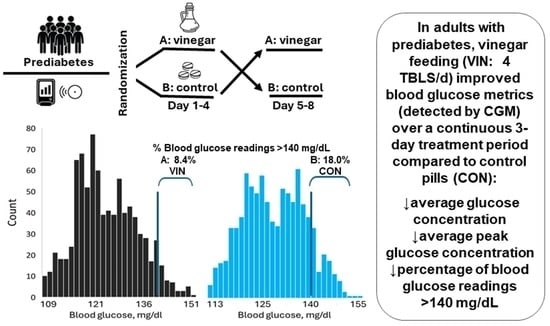
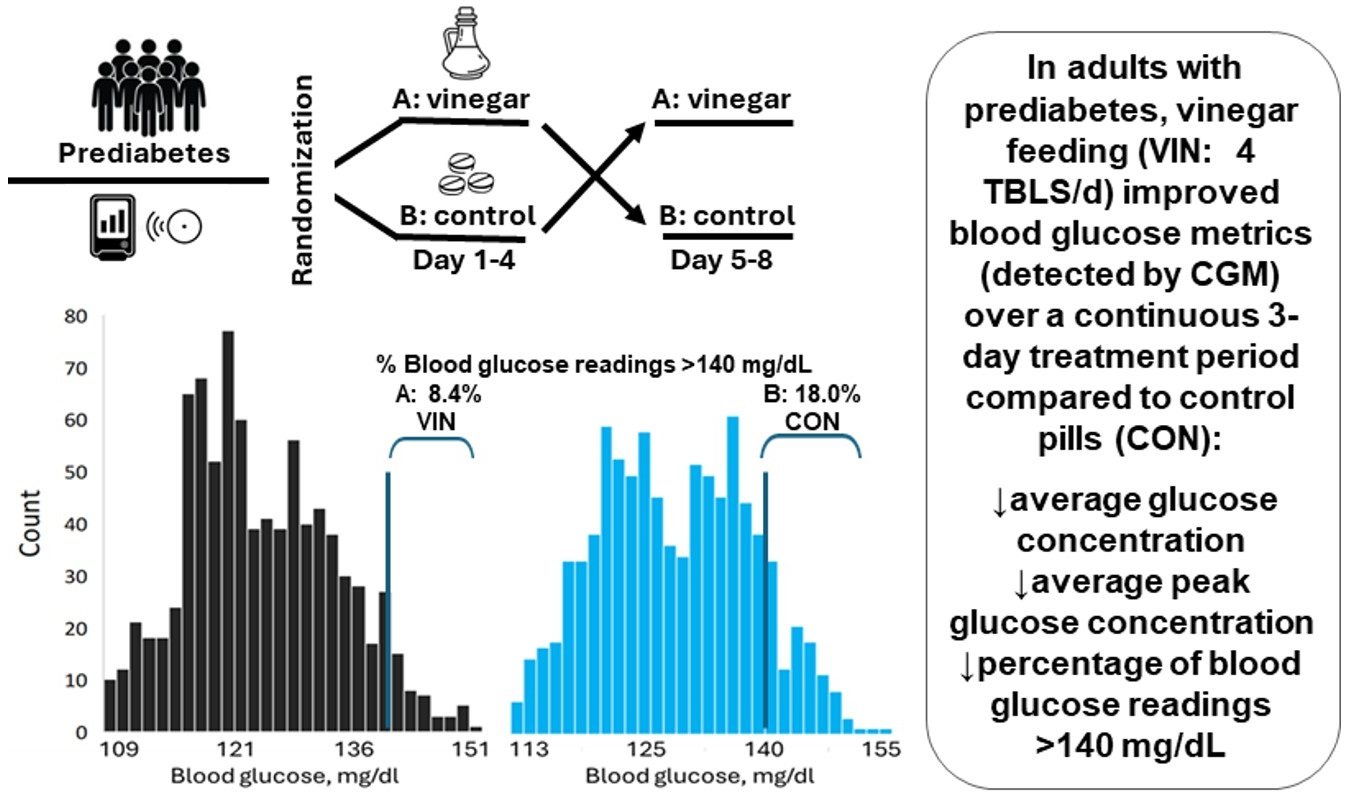
Graphical Abstract

1. Introduction

Continuous glucose monitoring (CGM) technologies are advancing precision nutrition by enabling individualized, data-driven decision-making by patients with diabetes to manage blood glucose and promote healthy outcomes [1]. Parsons et al. demonstrated that CGM improved diabetes self-management behavior, quality of life, and hemoglobin A1c (HbA1c) concentrations to a greater degree than routine diabetes care did [2]. Liu et al. compared the efficacy of CGM technology versus a glucometer device for tracking blood glucose and adjusting behaviors to achieve improved glucose control in pregnant women with gestational diabetes and demonstrated that scores for average blood glucose and hyperglycemia episodes were significantly lower for the CGM users versus those using glucometers [3].
In March 2024, CGM devices were cleared by the U.S. Federal Drug Administration for over-the-counter marketing, thereby allowing the technology to be accessed by individuals without medical oversight [4]. Similar to what has been observed for patients with diabetes, it is highly possible that CGM data could be used by healthy individuals to improve diet behaviors by observing how food choices impacted their glycemic excursions [5]. Postprandial glycemia is directly related to risk for diabetes and risk for cardiovascular disease [6,7], and over 50% of U.S. adults have diagnosed diabetes (~14%) and/or cardiovascular disease (~48%) [8]. Hence, given the demonstrated behavioral change efficacy for the diabetic condition, CGM technologies could have a much broader impact on chronic disease risk in the U.S.
Emerging evidence suggests that daily vinegar ingestion at mealtimes improves fasting blood glucose concentrations, postprandial glucose excursions, and HbA1c levels in patients with prediabetes and type 2 diabetes [9,10,11,12]. Acetic acid, the active (and defining) ingredient of vinegars, has been demonstrated to alter glucose metabolism in the small intestine and at the organ level. In the human intestinal cell line Caco-2, acetic acid was the only organic acid to inhibit disaccharidase activity, suggesting a possible mechanism for the antiglycemic effect of vinegar post-meal [13]. The interference of starch digestion by acetic acid is supported by clinical trials demonstrating an antiglycemic effect for vinegar following starch consumption [14,15] but not following the consumption of glucose as a monosaccharide [16,17]. In adults with glucose intolerance or type 2 diabetes, acetic acid ingestion also promoted glucose uptake into skeletal muscle, indicating a beneficial systemic effect of acetic acid [18,19].
Vinegar has been an inexpensive staple in cuisines worldwide for thousands of years and is easily incorporated into meal plans as a vinegarette dressing, condiment, or ingredient. To date, it is not known whether CGM technology can detect changes in postprandial glucose fluxes following vinegar ingestion, and our aim was to describe CGM-derived glycemic patterns during the acute administration of vinegar over a 3-day period in adults at risk for prediabetes. Documentation that CGM technology can register beneficial effects of mealtime vinegar ingestion would facilitate the translation of laboratory findings to individual application.

2. Materials and Methods

2.1. Participants

Ten adults with diagnosed prediabetes, or those that registered a fasting glucose concentration >99 mg/dL, were recruited from a campus population. Exclusion criteria included diagnosed diabetes, special diets and insulin prescription, acute illness, high-intensity physical activity, smoking, and pregnancy. Medication was required to be stable and in place for at least 3 months. All participants provided written consent, and the study was approved by the Arizona State University Institutional Review Board (STUDY00019235) and registered at clinicaltrials.gov (NCT06319443).

2.2. Study Design and Protocol

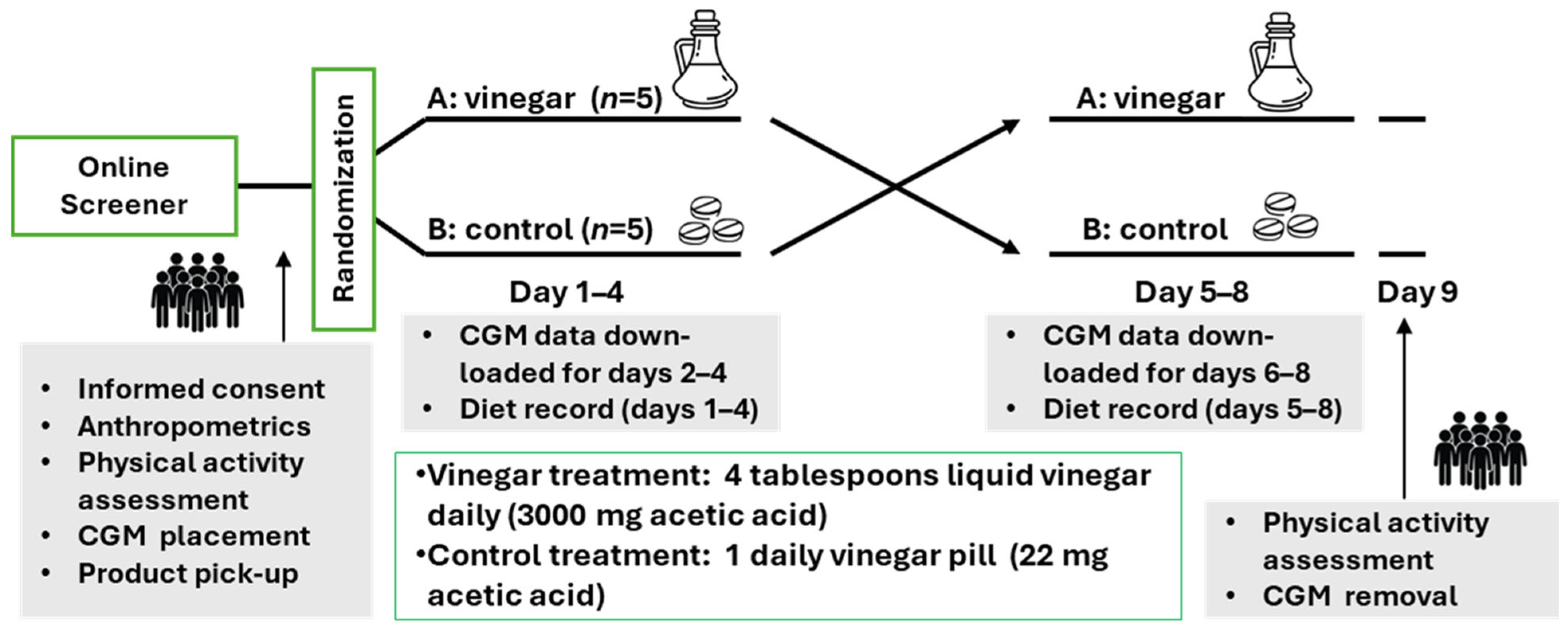
A randomized crossover study design was used (Figure 1), and all participants ingested the liquid vinegar or control tablet in random order for four days (days 1–4 and 5–8). Data were not compiled for days 1 and 5 to allow for device warm-up (day 1) and a one-day washout period (day 5). A one-day washout was considered adequate since the effect of vinegar on postprandial glycemia is transient [16]. Treatment A was red wine vinegar (VIN; four tablespoons daily containing 3.00 g of acetic acid: Pompeian Inc., Baltimore, MD, USA), and treatment B was the vinegar tablet control (CON; one vinegar tablet daily containing 0.023 g of acetic acid: Spring Valley, Walmart Inc., Bentonville, AR, USA). The reported range of the antiglycemic effect of supplemented acetic acid on postprandial glycemia is, at minimum, 0.5–1.7 g [20]. Participants were instructed to consume two tablespoons of vinegar twice daily with meals during phase A and one vinegar tablet each morning during phase B. The study was not blinded, but participants were unaware that the tablet was a control treatment. The CGM device (Dexcom G6 Pro; Dexcom Inc., San Diego, CA, USA) was placed on the upper arm of each participant at baseline (day 1) and was removed on day 9.
At baseline, demographic and anthropometric data were gathered from participants following a 10 h fast, including sex, age, height, weight, and physical activity (Godin Leisure-Time Exercise Questionnaire) [21]. Additionally, capillary blood from a finger prick was tested for fasting glucose concentrations using a point-of-care glucometer (Freestyle Libre; Abbot Laboratories, Chicago, IL, USA). The CGM device was placed on the back of the upper arm. The sensor was paired to the Dexcom G6 application permitting investigator access, but participant access was blocked. Participants remained at the test site for 30 min to ensure the device was functioning properly. Blood glucose was measured every minute by the CGM device and stored at 15 min intervals in the data management software. Dietary intake was recorded by participants daily during the study using the free diet tracker app (version 23.22.5, MyFitnessPal Inc., Austin, TX, USA).

2.3. Statistical Analysis

Although this was a pilot study to assess whether CGM technology registered changes in post-meal glucose responses induced by vinegar ingestion, a power analysis using 0.9 as the effect size [14,15], a 0.05 alpha value, and a 0.80 power value suggested a sample size of 10. For the statistical analysis, 72 h glucose data were extracted from the Dexcom G6 application software (days 2–4 and days 6–8). Day 1 of the treatment period was for device stabilization, and treatment washout took place on day 5. Acetic acid is rapidly absorbed in the small intestine and cleared from the bloodstream within two hours [22]; furthermore, the ingestion of vinegar five hours prior to mealtime did not elicit an antiglycemic effect on postprandial glycemia [16]. In post-study analyses, no carryover effect was detected (e.g., participants in the A/B [VIN/CON, n = 5] sequence did not experience a phase A carryover treatment effect during phase B; mean average 3-day glucose = 124.4 ± 18.0 and 134.5 ± 9.3 mg/dL for phases A and B, respectively).
Data are presented as the means ± SDs (n = 10). Three CGM-derived glycemic patterns were assessed for each 3-day treatment period: fasting blood glucose following the 3-day treatment period (average of first five values at 5 am); average blood glucose across the 3-day treatment period; and peak glucose excursion across the 3-day treatment period (mean of top five values). p values < 0.05 were considered significant (Wilcoxon signed-ranks test and chi-square analyses), and effect sizes are presented (partial eta squared [η2p] with values >0.06 or >0.14 representing medium and large effect sizes, respectively).

3. Results

All participants enrolled in the study completed both A and B trial phases (n = 10) and reported 100% adherence to the treatment protocol. All participants were female (36.6 ± 15.6 y; 33.9 ± 6.5 kg/m2) (Table 1), and participants either self-reported a diagnosis of prediabetes or presented with a fasting capillary glucose reading >99 mg/dL. Physical activity and diet, factors known to influence blood glucose concentrations, were stable during the study period (Table 1).
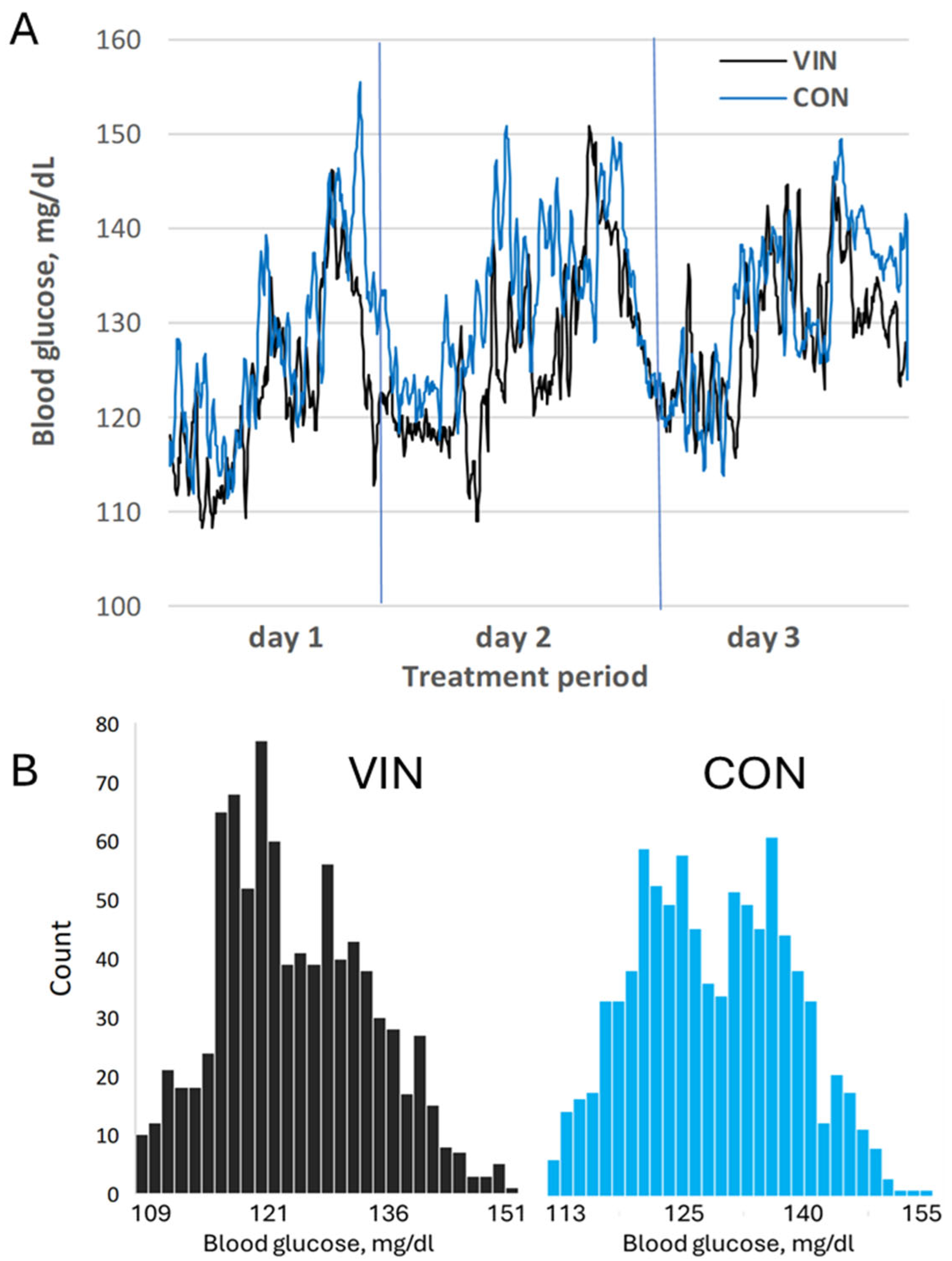
The average peak glucose concentration was lowered 8% during the 3-day vinegar treatment period versus the control (−15 mg/dL; p = 0.066; η2p = 0.384) (Table 2). A significant difference with a strong effect size was noted for the reduction in average blood glucose concentration during the vinegar treatment period versus the control (−4.4 mg/dL; p < 0.001; η2p = 0.253) (Table 2). Fasting blood glucose concentrations did not differ between the two treatment periods. Blood glucose data recorded and averaged at 15 min intervals over the 3-day treatment periods using CGM are displayed in Figure 2A. Histograms displaying blood glucose concentrations over the 3-day treatment periods are shown in Figure 2B. The percentage of blood glucose readings that exceeded 140 mg/dL were 8.4% and 18.0% for the VIN and CON phases, respectively (p < 0.001).

4. Discussion

We believe this is the first report to examine under randomized, controlled conditions the effects of daily vinegar ingestion on continuous blood glucose fluctuations over time using CGM technology. These data suggest that vinegar-induced improvements in blood glucose, particularly reductions in postprandial glucose excursions, can be observed using a CGM device in adults with prediabetes. CGM technology is now available without prescription and can be used by a variety of patients and health-conscious individuals to track blood glucose concentrations and provide positive reinforcement of beneficial diet behaviors [23]. The prevalence of prediabetes is estimated to be as high as 30% among American adults, but over 80% of cases are undiagnosed [24,25]. CGM can identify trends in blood glucose that may indicate prediabetes risk and provide real-time feedback on the efficacy of diet behaviors for moderating postprandial glycemia [26,27].
Due to their real-time biofeedback capabilities, CGM devices are emerging as a successful technology to promote behavior change among users and improve blood glucose metrics. In patients with diabetes who had experience using CGM devices (n = 40), 87% stated that their food choices changed after using CGM [28]. A similar percentage reported that they noticed how food choices impacted their blood glucose with CGM use, and 90% felt that CGM use improved their overall health [28]. In a recent meta-analysis encompassing 25 randomized controlled trials (median n per study = 100), CGM use was demonstrated to reduce HbA1c (HbA1) by 0.28% relative to the comparison arms (p < 0.001) [29]. In the studies that examined time in range (n = 10), this metric improved by 7.4% for the CGM arms versus the comparison arms (p < 0.008) [29]. Lind et al. conducted a 16-month study to evaluate the effects of CGM use versus conventional therapy on glucose management in individuals with type 1 diabetes (mean glucose, 187 mg/dL) and reported a 6.6 mg/dL decrease in mean glucose values and a 0.43% reduction in A1c for CGM users versus those using conventional therapy [30]. Based on these reports, CGM technology was effective at eliciting behavior change by providing real-time blood glucose feedback to motivate healthier food choices and lifestyles.
In the present study, there was a significant 4.4 mg/dL decrease in mean glucose (130.8 to 126.4 mg/dL), and the frequency of values over 140 mg/dL fell nearly 10% during the vinegar phase in comparison to the control. Using the American Diabetes Association (ADA)’s online HbA1c calculator [31], the 4.4 mg/dL reduction would equate to a 0.2% decrease in A1c, which is similar to the changes noted for longer-term GCM investigations [29]. Hence, CGM use registered a meaningful improvement in glucose metrics that were linked to vinegar ingestion at mealtimes. These data align with the evidence supporting the antiglycemic properties of vinegar [9,10,11,12], but, importantly, the data demonstrate that this information is immediately available to the individual user to inform their dietary decisions.
Vinegar’s antiglycemic effect is not as potent as those of the pharmaceuticals acarbose and metformin, but its effect is clinically relevant. For example, in type 2 diabetes, reductions in fasting glucose levels following daily medication use for 24 weeks or longer were in the range of 20 to 30 mg/dL for acarbose and metformin [32,33,34] compared to reductions ranging from 14 to 25 mg/dL for vinegar [35,36]. Importantly, 15 mg/dL reductions in fasting glucose have been linked to reductions in risk of cardiovascular diseases [37]. Vinegar is an inexpensive dietary staple worldwide. It is commonly used as a pickling agent and flavor enhancer across cultures; moreover, it has been added to water or tea as a health elixir for centuries [38]. However, many find the taste of vinegar unpalatable, and drinking several tablespoons of diluted vinegar at mealtimes may prove unsustainable. Incorporating the vinegar into meals as homemade dressing or marinade may be a more acceptable diet strategy.
This study was conducted as a pilot trial to examine whether the beneficial effects of vinegar ingestion could be detected by CGM devices, and data interpretation is limited by numerous factors as well as the possibility of random variation. Given the characteristic taste of vinegar, participants were not blinded to the treatments. An open-label process was followed, and participants were provided with commercial products in their original packaging (liquid vinegar and vinegar tablets). It is possible that participants were aware that the tablets were the control treatment. Furthermore, the tablets were not true placebos as they contained trace amounts of acetic acid. Data were only collected over a short, 3-day treatment period. The trial had a small sample size (n = 10) and was conducted only in women, factors which greatly limit the generalizability of the data. Also, participants were prediabetic, so these results cannot be generalized to healthy individuals or patients with diabetes. The crossover study design minimized intersubject variation, as each person was their own control, and a single CGM was used for data collection from each participant, which reduced the known variability between devices due to placement site and system precision [39]. However, long-term trials are needed to evaluate whether use of CGM devices promotes lasting change in dietary behaviors to benefit the diabetic condition, such as daily vinegar ingestion.

5. Conclusions

In summary, strategies to identify and combat prediabetes are urgently needed. Individual glucose monitoring devices, now available over the counter, provide users with real-time information on blood glucose responses that can reinforce behavioral change. This study suggests that the effects of vinegar ingestion at mealtimes on glycemia can be tracked using CGM technology.

Author Contributions

Conceptualization, N.S.Y.C. and C.S.J.; methodology, N.S.Y.C., H.G. and C.S.J.; formal analysis, N.S.Y.C. and C.S.J.; investigation, N.S.Y.C. and E.D.; writing—original draft preparation, N.S.Y.C. and C.S.J.; writing—review and editing, N.S.Y.C., E.D., H.G. and C.S.J.; supervision, C.S.J. and H.G.; project administration, C.S.J. All authors have read and agreed to the published version of the manuscript.

Funding

This research received no external funding.

Institutional Review Board Statement

The study was conducted in accordance with the Declaration of Helsinki and approved by the Institutional Review Board of Arizona State University (STUDY00019235 on 27 December 2023).

Informed Consent Statement

Informed consent was obtained from all subjects involved in the study.

Data Availability Statement

The data presented in this study are available upon request from the corresponding author.

Conflicts of Interest

The authors declare no conflicts of interest.

Abbreviations

The following abbreviations are used in this manuscript:
CGMContinuous glucose monitoring
ADAAmerican Diabetes Association
HbA1cHemoglobin A1c

References

  1. Zhang, D.; Huang, J.; Zhang, Y.; Wei, Z.; Long, T.; Guo, X.; Li, M. Effects of continuous glucose monitoring on dietary behavior and physical activity: A systematic review and meta-analysis. Diabetes Res. Clin. Pract. 2025, 229, 112907. [Google Scholar] [CrossRef]
  2. Parsons, S.N.; Luzio, S.D.; Dowrick, S.C.; Dunseath, G.J.; Cheung, W.Y.; Gibbs, S.L.; Owens, D.R.; Stephens, J.W. Does the short-term use of continuous glucose monitoring enhance diabetes self-management behaviour in type 2 diabetes? The DISCO GM Study: A randomised, controlled cross-over study. Diabetes Metab. Syndr. 2025, 19, 103283. [Google Scholar] [CrossRef]
  3. Liu, M.; Chen, T.; Wang, S.; Li, N.; Liu, D. To assess the impact of individualized strategy and continuous glucose monitoring on glycemic control and mental health in pregnant women with diabetes. Front. Endocrinol. 2025, 16, 1470473. [Google Scholar] [CrossRef] [PubMed]
  4. The United States Food and Drug Administration. Available online: https://www.fda.gov/news-events/press-announcements/fda-clears-first-over-counter-continuous-glucose-monitor (accessed on 12 December 2025).
  5. Klonoff, D.C.; Nguyen, K.T.; Xu, N.Y.; Gutierrez, A.; Espinoza, J.C.; Vidmar, A.P. Use of Continuous Glucose Monitors by People Without Diabetes: An Idea Whose Time Has Come? J. Diabetes Sci. Technol. 2023, 17, 1686–1697. [Google Scholar] [CrossRef]
  6. Dickinson, S.; Brand-Miller, J. Glycemic index, postprandial glycemia and cardiovascular disease. Curr. Opin. Lipidol. 2005, 16, 69–75. [Google Scholar] [CrossRef]
  7. Brand-Miller, J.; McMillan-Price, J.; Steinbeck, K.; Caterson, I. Dietary glycemic index: Health implications. J. Am. Coll. Nutr. 2009, 28, 446S–449S. [Google Scholar] [CrossRef] [PubMed]
  8. Benjamin, E.J.; Muntner, P.; Alonso, A.; Bittencourt, M.S.; Callaway, C.W.; Carson, A.P.; Chamberlain, A.M.; Chang, A.R.; Cheng, S.; Das, S.R.; et al. Heart Disease and Stroke Statistics-2019 Update: A Report from the American Heart Association. Circulation 2019, 139, e56–e528. [Google Scholar] [CrossRef]
  9. Johnston, C.S.; Kim, C.M.; Buller, A.J. Vinegar improves insulin sensitivity to a high-carbohydrate meal in subjects with insulin resistance or type 2 diabetes. Diabetes Care 2004, 27, 281–282. [Google Scholar] [CrossRef] [PubMed]
  10. Cheng, L.J.; Jiang, Y.; Wu, V.X.; Wang, W. A systematic review and meta-analysis: Vinegar consumption on glycaemic control in adults with type 2 diabetes mellitus. J. Adv. Nurs. 2020, 76, 459–474. [Google Scholar] [CrossRef]
  11. Hadi, A.; Pourmasoumi, M.; Najafgholizadeh, A.; Clark, C.C.T.; Esmaillzadeh, A. The effect of apple cider vinegar on lipid profiles and glycemic parameters: A systematic review and meta-analysis of randomized clinical trials. BMC Complement. Med. Ther. 2021, 21, 179. [Google Scholar] [CrossRef]
  12. Arjmandfard, D.; Behzadi, M.; Sohrabi, Z.; Mohammadi Sartang, M. Effects of apple cider vinegar on glycemic control and insulin sensitivity in patients with type 2 diabetes: A GRADE-assessed systematic review and dose-response meta-analysis of controlled clinical trials. Front. Nutr. 2025, 12, 1528383. [Google Scholar] [CrossRef]
  13. Ogawa, N.; Satsu, H.; Watanabe, H.; Fukaya, M.; Tsukamoto, Y.; Miyamoto, Y.; Shimizu, M. Acetic acid suppresses the increase in disaccharidase activity that occurs during culture of caco-2 cells. J. Nutr. 2000, 130, 507–513. [Google Scholar] [CrossRef]
  14. Liatis, S.; Grammatikou, S.; Poulia, K.A.; Perrea, D.; Makrilakis, K.; Diakoumopoulou, E.; Katsilambros, N. Vinegar reduces postprandial hyperglycaemia in patients with type II diabetes when added to a high, but not to a low, glycaemic index meal. Eur. J. Clin. Nutr. 2010, 64, 727–732. [Google Scholar] [CrossRef]
  15. Östman, E.; Granfeldt, Y.; Persson, L.; Björck, I. Vinegar supplementation lowers glucose and insulin responses and increases satiety after a bread meal in healthy subjects. Eur. J. Clin. Nutr. 2005, 59, 983–988. [Google Scholar] [CrossRef] [PubMed]
  16. Johnston, C.S.; Steplewska, I.; Long, C.A.; Harris, L.N.; Ryals, R.H. Examination of the antiglycemic properties of vinegar in healthy adults. Ann. Nutr. Metab. 2010, 56, 74–79. [Google Scholar] [CrossRef] [PubMed]
  17. van Dijk, J.W.; Tummers, K.; Hamer, H.M.; van Loon, L.J. Vinegar co-ingestion does not improve oral glucose tolerance in patients with type 2 diabetes. J. Diabetes Complicat. 2012, 26, 460–461. [Google Scholar] [CrossRef] [PubMed]
  18. Mitrou, P.; Petsiou, E.; Papakonstantinou, E.; Maratou, E.; Lambadiari, V.; Dimitriadis, P.; Spanoudi, F.; A Raptis, S.; Dimitriadis, G. The role of acetic acid on glucose uptake and blood flow rates in the skeletal muscle in humans with impaired glucose tolerance. Eur. J. Clin. Nutr. 2015, 69, 734–739. [Google Scholar] [CrossRef]
  19. Mitrou, P.; Petsiou, E.; Papakonstantinou, E.; Maratou, E.; Lambadiari, V.; Dimitriadis, P.; Spanoudi, F.; Raptis, S.A.; Dimitriadis, G. Vinegar Consumption Increases Insulin-Stimulated Glucose Uptake by the Forearm Muscle in Humans with Type 2 Diabetes. J. Diabetes Res. 2015, 2015, 175204. [Google Scholar] [CrossRef]
  20. Feise, N.K.; Johnston, C.S. Commercial Vinegar Tablets Do Not Display the Same Physiological Benefits for Managing Postprandial Glucose Concentrations as Liquid Vinegar. J. Nutr. Metab. 2020, 2020, 9098739. [Google Scholar] [CrossRef]
  21. Godin, G.; Shephard, R.J. A simple method to assess exercise behavior in the community. Can. J. Appl. Sport Sci. 1985, 10, 141–146. [Google Scholar]
  22. Sugiyama, S.; Fushimi, T.; Kishi, M.; Irie, S.; Tsuji, S.; Hosokawa, N.; Kaga, T. Bioavailability of acetate from two vinegar supplements: Capsule and drink. J. Nutr. Sci. Vitaminol. 2010, 56, 266–269. [Google Scholar] [CrossRef][Green Version]
  23. Fechner, E.; Op ’t Eyndt, C.; Mulder, T.; Mensink, R.P. Diet-induced differences in estimated plasma glucose concentrations in healthy, non-diabetic adults are detected by continuous glucose monitoring-a randomized crossover trial. Nutr. Res. 2020, 80, 36–43. [Google Scholar] [CrossRef] [PubMed]
  24. Wang, L.; Weng, X.; Kraschnewski, J.L.; Pichardo-Lowden, A.R. Prediabetes Awareness Barriers and Enablers: National Health and Nutrition Examination Survey 2011–2020. AJPM Focus 2025, 4, 100378. [Google Scholar] [CrossRef] [PubMed]
  25. The United States Center for Disease Control and Prevention. Available online: https://www.cdc.gov/diabetes/php/data-research/index.html (accessed on 12 December 2025).
  26. Basiri, R.; Cheskin, L.J. Enhancing the Impact of Individualized Nutrition Therapy with Real-Time Continuous Glucose Monitoring Feedback in Overweight and Obese Individuals with Prediabetes. Nutrients 2024, 16, 4005. [Google Scholar] [CrossRef]
  27. Basiri, R.; Cheskin, L.J. Personalized Nutrition Therapy without Weight Loss Counseling Produces Weight Loss in Individuals with Prediabetes Who Are Overweight/Obese: A Randomized Controlled Trial. Nutrients 2024, 16, 2218. [Google Scholar] [CrossRef] [PubMed]
  28. Ehrhardt, N.; Al Zaghal, E. Continuous Glucose Monitoring as a Behavior Modification Tool. Clin. Diabetes 2020, 38, 126–131. [Google Scholar] [CrossRef]
  29. Richardson, K.M.; Jospe, M.R.; Bohlen, L.C.; Crawshaw, J.; Saleh, A.A.; Schembre, S.M. The efficacy of using continuous glucose monitoring as a behaviour change tool in populations with and without diabetes: A systematic review and meta-analysis of randomised controlled trials. Int. J. Behav. Nutr. Phys. Act. 2024, 21, 145. [Google Scholar] [CrossRef]
  30. Lind, M.; Polonsky, W.; Hirsch, I.B.; Heise, T.; Bolinder, J.; Dahlqvist, S.; Schwarz, E.; Ólafsdóttir, A.F.; Frid, A.; Wedel, H.; et al. Continuous Glucose Monitoring vs Conventional Therapy for Glycemic Control in Adults With Type 1 Diabetes Treated With Multiple Daily Insulin Injections: The GOLD Randomized Clinical Trial. JAMA 2017, 317, 379–387. [Google Scholar] [CrossRef]
  31. The American Diabetes Association. Available online: https://professional.diabetes.org/glucose_calc (accessed on 19 January 2026).
  32. Wang, G.; Liu, J.; Yang, N.; Gao, X.; Fan, H.; Xu, Y.; Yang, W. MARCH2: Comparative assessment of therapeutic effects of acarbose and metformin in newly diagnosed type 2 diabetes patients. PLoS ONE 2014, 9, e105698. [Google Scholar] [CrossRef]
  33. Zhang, F.; Xu, S.; Tang, L.; Pan, X.; Tong, N. Acarbose with Comparable Glucose-Lowering but Superior Weight-Loss Efficacy to Dipeptidyl Peptidase-4 Inhibitors: A Systematic Review and Network Meta-Analysis of Randomized Controlled Trials. Front. Endocrinol. 2020, 11, 288. [Google Scholar] [CrossRef]
  34. Yang, W.; Liu, J.; Shan, Z.; Tian, H.; Zhou, Z.; Ji, Q.; Weng, J.; Jia, W.; Lu, J.; Liu, J.; et al. Acarbose compared with metformin as initial therapy in patients with newly diagnosed type 2 diabetes: An open-label, non-inferiority randomised trial. Lancet Diabetes Endocrinol. 2014, 2, 46–55. [Google Scholar] [CrossRef] [PubMed]
  35. Johnston, C.S.; Quagliano, S.; White, S. Vinegar ingestion at mealtime reduced fasting blood glucose concentrations in healthy adults at risk for type 2 diabetes. J. Funct. Foods 2013, 5, 2007–2011. [Google Scholar] [CrossRef]
  36. Valdes, D.S.; So, D.; Gill, P.A.; Kellow, N.J. Effect of Dietary Acetic Acid Supplementation on Plasma Glucose, Lipid Profiles, and Body Mass Index in Human Adults: A Systematic Review and Meta-analysis. J. Acad. Nutr. Diet. 2021, 121, 895–914. [Google Scholar] [CrossRef] [PubMed]
  37. Park, C.; Guallar, E.; Linton, J.A.; Lee, D.C.; Jang, Y.; Son, D.K.; Han, E.J.; Baek, S.J.; Yun, Y.D.; Jee, S.H.; et al. Fasting glucose level and the risk of incident atherosclerotic cardiovascular diseases. Diabetes Care 2013, 36, 1988–1993. [Google Scholar] [CrossRef]
  38. Conne, H.A.; Allgeier, R.J. Vinegar: Its History and Development. In Advances in Applied Microbiology; Perlman, D., Ed.; Academic Press: Cambridge, MA, USA, 1976; Volume 20, pp. 81–133. [Google Scholar]
  39. Kim, N.; Pham, K.; Shek, A.; Lim, J.; Liu, X.; Shah, S.A. Differences in glucose level between right arm and left arm using continuous glucose monitors. Digit. Health 2020, 6, 2055207620970342. [Google Scholar] [CrossRef] [PubMed]
Figure 1. Study flow chart.
Dietetics 05 00031 g001
Figure 2. Blood glucose data recorded and averaged at 15 min intervals over the 3-day treatment periods using CGM (n = 10): VIN, vinegar treatment; CON, control treatment. (A): Blood glucose concentrations at 5 min intervals during the 3-day treatment periods. (B): Histograms displaying blood glucose concentrations during the 3-day treatment periods. Percent of values > 140 mg/dL: 8.4% and 18.0% for VIN and CON, respectively (p < 0.001; chi-square analyses).
Dietetics 05 00031 g002
Table 1. Participant characteristics at baseline and during the trial (n = 10) 1.
Mean ± SDp Value
Age, y36.6 ± 15.6
Body mass index, kg/m233.9 ± 6.5
Fasting blood glucose, mg/dL105.8 ± 20.6
Physical activity, score
  Week prior to trial19.0 ± 12.6
  Week of trial15.7 ± 11.00.342
Daily average energy intake, kcal
  VIN treatment1733 ± 483
  CON treatment1829 ± 3530.508
Daily average carbohydrate intake, g
  VIN treatment200.7 ± 73.1
  CON treatment205.8 ± 44.60.241
1 Age, body mass index, and fasting blood glucose (capillary blood) were measured at baseline (day 1 of study); remaining measures were recorded at stated trial phases. p values represent Wilcoxon signed-ranks test values.
Table 2. CGM-derived blood glucose measures during 3-day vinegar (VIN) or control (CON) treatments (n = 10) 1.
Mean ± SDp Valueη2p
Fasting blood glucose, mg/dL
   VIN treatment121.6 ± 19.0
   CON treatment131.4 ± 37.30.2850.132
Peak glucose concentration, mg/dL
   VIN treatment187.0 ± 28.9
   CON treatment202.2 ± 35.10.0660.384
Average blood glucose, mg/dL
   VIN treatment126.4 ± 8.6
   CON treatment130.8 ± 9.0<0.0010.253
1 Fasting blood glucose the morning after the final day of treatment (average of first five values at 5 am); peak glucose excursion across three days (mean of top five values); and average blood glucose across three treatment days. p value for Wilcoxon signed-ranks test; η2p is partial eta squared (>0.06 or >0.14 representing medium and large effect sizes, respectively).
Disclaimer/Publisher’s Note: The statements, opinions and data contained in all publications are solely those of the individual author(s) and contributor(s) and not of MDPI and/or the editor(s). MDPI and/or the editor(s) disclaim responsibility for any injury to people or property resulting from any ideas, methods, instructions or products referred to in the content.