
Proceeding Paper

Magnetohydrodynamic Equilibrium Reconstruction with Consistent Uncertainties †

by
Robert Köberl
1,2,*,
Robert Babin
1,3 and
Christopher G. Albert
3
1
Max-Planck-Institute for Plasma Physics, 85748 Garching, Germany
2
School of Computation, Information and Technology (CIT), Technical University of Munich (TUM), 85748 Garching, Germany
3
Fusion@ÖAW, Institut für Theoretische Physik Computational Physics (ITPcp), Technische Universität Graz (TU Graz), 8010 Graz, Austria
*
Author to whom correspondence should be addressed.
Presented at the 42nd International Workshop on Bayesian Inference and Maximum Entropy Methods in Science and Engineering, Garching, Germany, 3–7 July 2023.
Phys. Sci. Forum 2023, 9(1), 6; https://doi.org/10.3390/psf2023009006
Published: 27 November 2023

Abstract

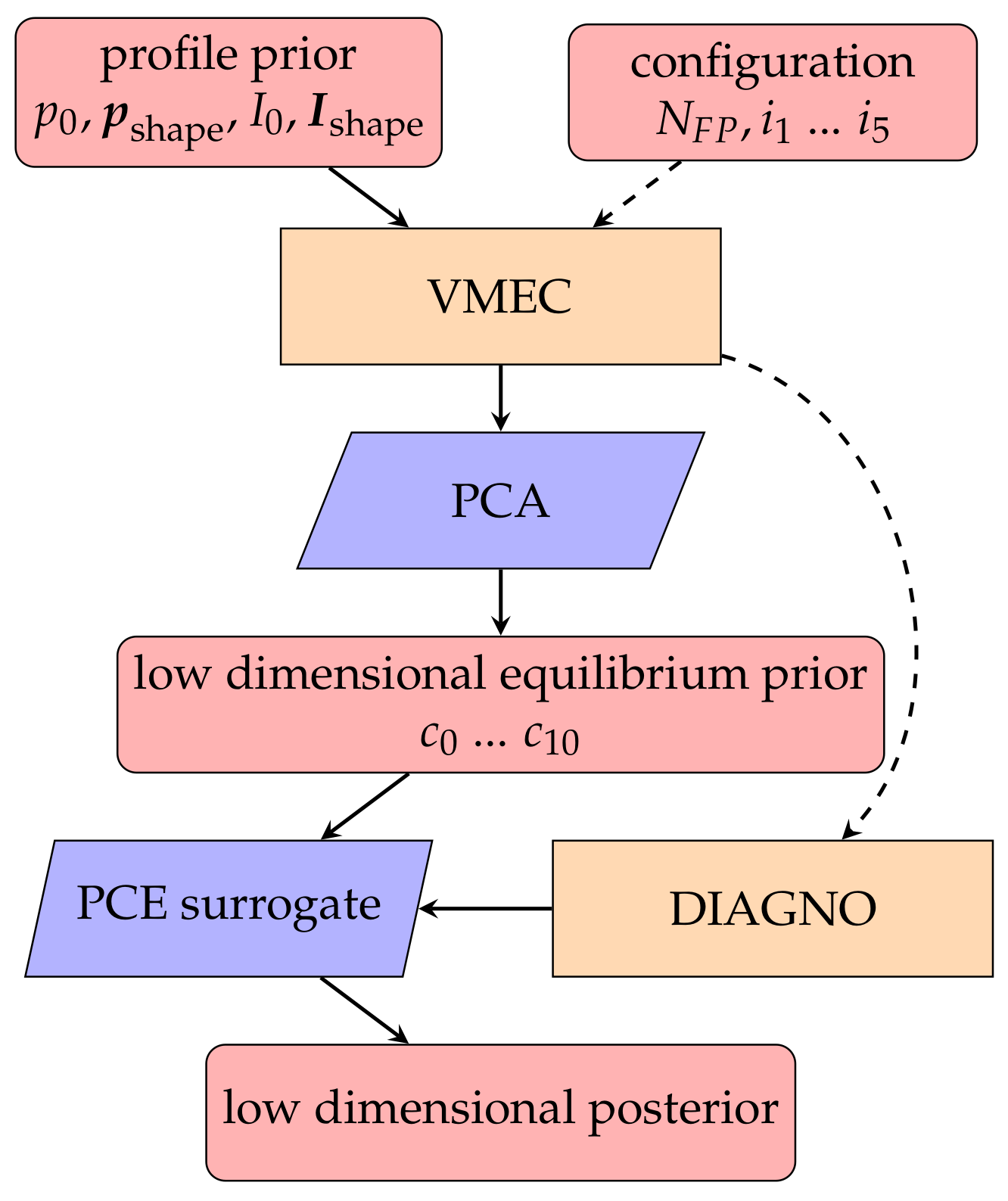
We report on progress towards a probabilistic framework for consistent uncertainty quantification and propagation in the analysis and numerical modeling of physics in magnetically confined plasmas in the stellarator configuration. A frequent starting point in this process is the calculation of a magnetohydrodynamic equilibrium from plasma profiles. Profiles, and thus the equilibrium, are typically reconstructed from experimental data. What sets equilibrium reconstruction apart from usual inverse problems is that profiles are given as functions over a magnetic flux derived from the magnetic field, rather than spatial coordinates. This makes it a fixed-point problem that is traditionally left inconsistent or solved iteratively in a least-squares sense. The aim here is progressing towards a straightforward and transparent process to quantify and propagate uncertainties and their correlations for function-valued fields and profiles in this setting. We propose a framework that utilizes a low-dimensional prior distribution of equilibria, constructed with principal component analysis. A surrogate of the forward model is trained to enable faster sampling.
Keywords: inverse problem; fixed-point problem; Bayesian analysis; dimensionality reduction; polynomial chaos expansion; uncertainty quantification; application inverse problem; fixed-point problem; Bayesian analysis; dimensionality reduction; polynomial chaos expansion; uncertainty quantification; application