Proceeding Paper

Evaluation of the Postharvest Performance of Kiwifruit Under the Application of a Glycine-Betaine-Based Biostimulant During the Growing Season †

by
Vasileios Papantzikos
Department of Agriculture, Arta Campus, University of Ioannina, 47100 Arta, Greece
Presented at the 5th International Electronic Conference on Agronomy (IECAG 2025), 15–18 December 2025; Available online: https://sciforum.net/event/IECAG2025.
Biol. Life Sci. Forum 2026, 57(1), 1; https://doi.org/10.3390/blsf2026057001
Published: 28 January 2026
(This article belongs to the Proceedings of The 5th International Electronic Conference on Agronomy (IECAG 2025))

Abstract

The demand for high-quality agricultural products is increasing; however, this requirement is becoming increasingly challenging due to the effects of climate change, which can cause abiotic stress. In this research, we studied the performance of kiwifruit (Actinidia deliciosa var. ‘Hayward’) 60 days after storage for two different cultivation periods, in which a glycine betaine biostimulant (GB) was applied to the kiwi trees via irrigation under field conditions. Postharvest analysis was performed by measuring the fresh and dry weight of the kiwifruit, the soluble solids content, and titratable acidity. To assess the antioxidant traits of the kiwifruit, DPPH and ascorbic acid contents were recorded. Data analysis revealed that the GB treatment proved beneficial for kiwifruit during storage, enhancing their antioxidant capacity as indicated by their higher ascorbic acid content (vitamin C) compared to the control. This qualitative difference may benefit the commercial requirements of kiwifruit cultivation under the abiotic conditions of climate change, which prompts us to further investigate the application of amino acid biostimulants. This research complements the existing literature on the implementation of biostimulants, as reports regarding their application in kiwifruit cultivation are limited, and provides an optional solution for meeting the commercial needs of kiwifruit cultivation and improving the adaptability of kiwifruit cultivation under abiotic stress conditions.

1. Introduction

Greece is one of the top kiwifruit exporters on the global market, with 307.44 Kt of kiwifruit exported annually [1]. Nevertheless, kiwifruit cultivation faces several challenges attributable to climate change, such as high temperatures and drought, combined with prolonged periods of rainfall deficiency [2,3,4]. Kiwi orchard irrigation in Greece relies not only on drip irrigation systems but also, to some extent, on precipitation [5], the frequency of which has decreased in recent years [6], while drought and high temperatures are increasing [7]. Optimal irrigation frequency is essential in kiwi cultivation [8], which, if not implemented correctly, affects the kiwi tree’s physiological responses and the quality of the kiwifruit [9]. Abiotic stress due to irrigation deficit or rising temperatures can potentially be reduced by the use of certain biostimulants containing compounds such as glycine betaine and proline (GBP), which induce metabolic responses in plants [4]. GBP biostimulants potentially enhance plant growth and kiwifruit production by promoting photosynthesis [10]; these compounds generally improve crops by acting as osmolytes, scavenging reactive oxygen species (ROS) [11] under irrigation-deficit conditions [12]. This beneficial process activates certain metabolic pathways in plant physiology—such as Jasmonic acid and ethylene, which are obtained by the accumulation of salicylic acid—to induce systemic resistance [13]. This raises the question of how GBP biostimulants could enhance the quality of kiwifruit production. In this work, the quality traits of kiwifruit from the most marketable cultivar in Greece, “Hayward”, were studied 60 days after harvest, following the application of GB during the growing season.

2. Methods

2.1. Experimental Design

The experiment was carried out for two consecutive years in a kiwi orchard (Actinidia deliciosa var. “Hayward”) that was owned by a kiwi production company (Koliou Group Co., S.A., Arta, Greece). The aim was for the experimental conditions to simulate the commercial specifications of kiwifruit cultivation as closely as possible. The orchard was irrigated at regular intervals, and the drip irrigation system program determined the amount and timing of irrigation, based on meteorological data from rainfall, temperature, and humidity sensors, aiming at rational irrigation. The experiment was carried out on a completely randomized design with two treatments: either (i) containing GB (glycine–betaine 80%, proline 10%, antioxidants, bioflavonoids, and ellagic acid 0.5% w/w) (Fitomaat, Futureco Bioscience Co., S.A., Barcelona, Spain) (GB) or (ii) the control biostimulant-free treatment (C). Each treatment consisted of twelve trees arranged in blocks of three. For the GB treatment, the biostimulant was applied via the drip irrigation system in both cultivation seasons, starting from the bud break point. The ratio between the number of applications and intervals between the repetitions was 3:20, based on the recommendations given on the products’ label (2 L m−3 ha−1). The first season’s kiwifruit bud break started at the beginning of April, and the second at the end of March. The kiwifruit harvest took place at the end of October–beginning of November. The cold storage of kiwifruits and the examination of their postharvest quality traits was carried out in the Department of Agriculture of the University of Ioannina.

2.2. Postharvest Kiwifruit Analysis

For each cultivation season, the fresh and dry weight (g) of cold-stored kiwifruits was measured 60 days after harvest, followed by postharvest performance analysis.
The soluble solids content (SSC) was measured using the method detailed by Abbate et al. 2021 [14]. Kiwi juice was extracted from two homogenized 10 mm slices from the calyx end of the fruit and the stem. Then, two drops of the juice were entered into a hand-held refractometer (ATC, Atago Co, Ltd., Tokyo, Japan), and the result was measured in Brix° (%).
Titratable acidity (TA) was recorded according to the protocol detailed by Fattahi, 2010 [15]. A total of 5 mL of kiwifruit juice (V) was diluted in 25 mL of diH2O. Then, the mixture was titrated with 0.1 N NaOH (N), adding 2 drops of 1% C20H14O4 (phenolphthalein) until the juice turned endpoint pink in color (pH 8.2). The total acidity was recorded as a percentage of citric acid (64 = citric acid coefficient), according to the consumed volume of 0.1 N NaOH (n), and the following equation was used:
T A = N × n × 100 V × 1000 × 64
In order to analyze the antioxidant capacity of the kiwifruit, the radical scavenging method for the determination of antioxidant activity using the 2,2-Diphenyl-1-picrylhydrazyl (DPPH) was used according to the protocol detailed by Wang et al., 2018 [16], with modifications. A total of 20 mL of 70% ethanol was used as an extraction solvent for 0.1 g of stored freeze-dried kiwifruit. The extraction took place overnight in a glass tube (4 °C in the dark), and the sample was centrifuged at 4.000× g (20 min at 4 °C). Next, 2 mL of the 100 mM DPPH work solution and 200 μL of the supernatant were placed into a new test tube, followed by vortexing (15 s). The sample was placed in the dark for 30 min, and the absorbance was measured at 515 nm using a spectrophotometer (Jasco-V630 UV-VIS, Jasco International Co., Ltd., Tokyo, Japan). The radical scavenging activity was calculated in terms of percentage of DPPH discoloration using the following equation:
DPPH radical scavenging (%) = [(Acontrol − Asample)/Acontrol] × 100
where Asample is the absorbance of the solution when the extract/reference has been added at a particular level, and Acontrol is the absorbance of the DPPH solution without the addition of the extract.
The ascorbic acid content (vitamin C) was recorded using the method detailed by Nielsen et al. 2010 [17]. A total of 0.5 g of freeze-dried kiwifruit was added to a glass tube with 5 mL diH2O. The sample was diluted to a volume of 10 mL. A second dilution took place in a 100 mL flask filled with C2H2O4 0.4% w/v. Next, 10 mL from the previous step was added to a new conical flask containing 15 mL C2H2O4 0.4% w/v. Then, the sample was titrated with 50 mg vitamin C solution, which was prepared with NaHCO3 0.02% w/v and 2.6-dichloroindophenol (DCPI) 0.03% w/v. The titration was completed when the color of the samples changed to pale pink for 10–20 s. The results were reported as vitamin C equivalents and recorded in mg AA g DW−1.

2.3. Statistical Analysis

To statistically compare the means of the treatments, SPSS v. 25 (IBM-SPSS Statistics, Armonk, NY, USA) and Bonferroni’s post hoc test (p ≤ 0.05) were utilized for one-way ANOVA.

3. Results and Discussion

3.1. Fresh and Dry Weight

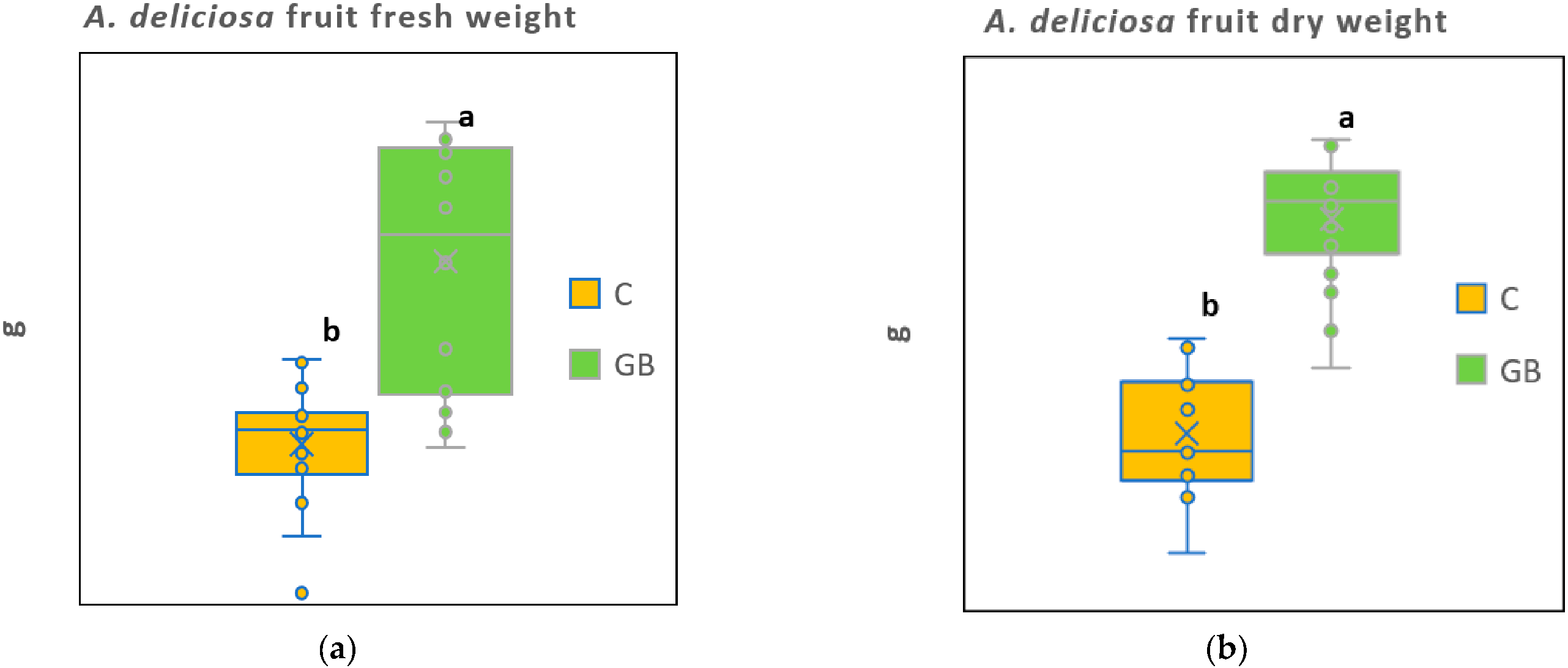
Most of the studies concerning biostimulant applications in kiwi orchards usually relate to the use of organic-based biostimulants to promote bud break [18] or the use of plant-based biostimulants derived from agro-industrial waste to enhance growth or metabolism [19]. In this experiment, the fresh and dry weight of the kiwifruits appeared to be enhanced at 60 days following harvest. Fresh weight was higher in kiwifruit treated with GB (100.57 ± 5.45 g) compared to the control (92.2 ± 2.69 g), with a statistically significant difference (p ≤ 0.05) (Figure 1a); the same findings applied to the dry weight of kiwifruit treated with GB (22.05 ± 1.99 g) compared to the control (15.44 ± 1.89 g) (Figure 1b).

3.2. Kiwifruit SSC and TA

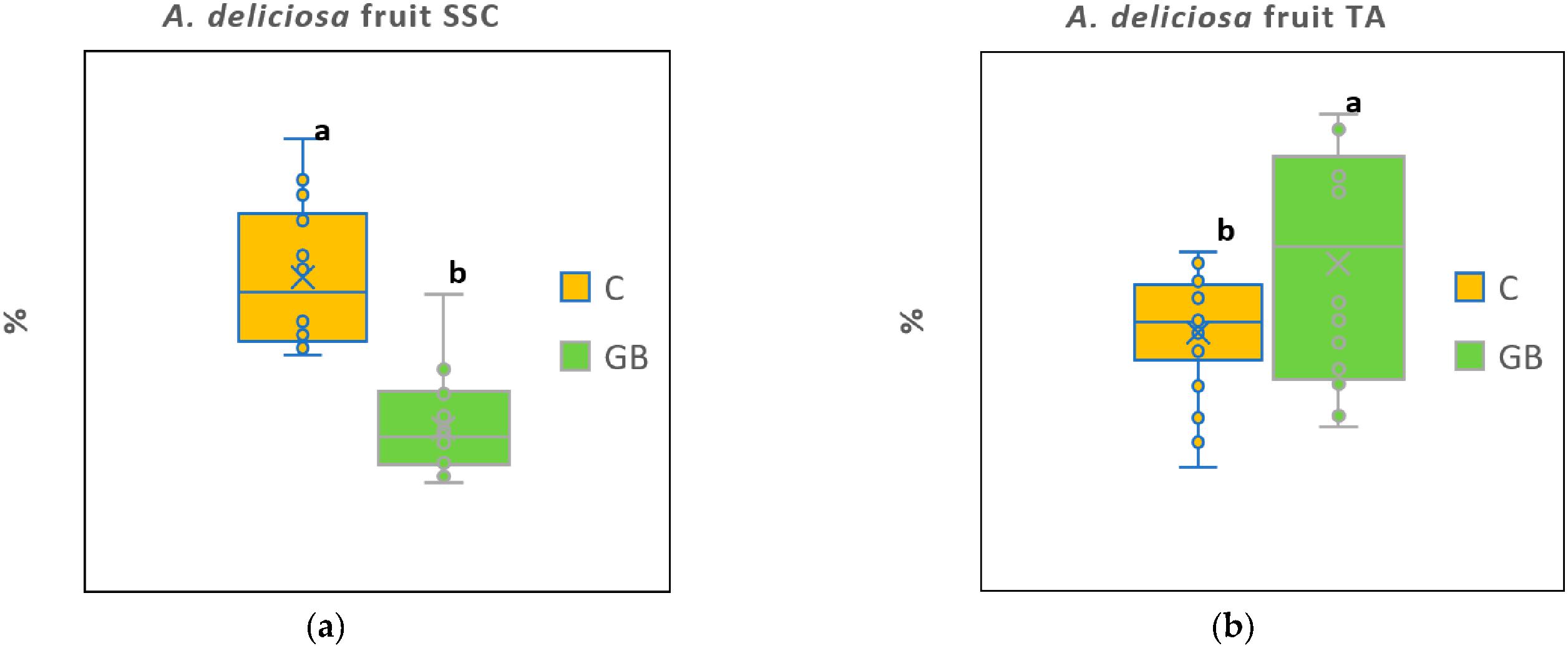
SSC is an important parameter for kiwifruit harvest and maturity [20]; when it increases, it may also signify fruit senescence and decreased shelf life [21]. Adak et al. (2019) mentioned that exogenous GBP application was found to have a positive impact on the total soluble solids content of strawberries (Fragaria ananassa) [22,23]. This finding is in agreement with the results of this research, as the SSC was lower for GB treatment (10.41 ± 0.72%) compared with C (12.65 ± 1.03%), with a statistically significant difference (p ≤ 0.05) (Figure 2a). Moreover, TA was higher in the case of GB (1.16 ± 0.13%) compared to C (1.09 ± 0.07%), with a statistically significant difference (p ≤ 0.05) (Figure 2b).

3.3. Antioxidant Content in Terms of DPPH and Ascorbic Acid

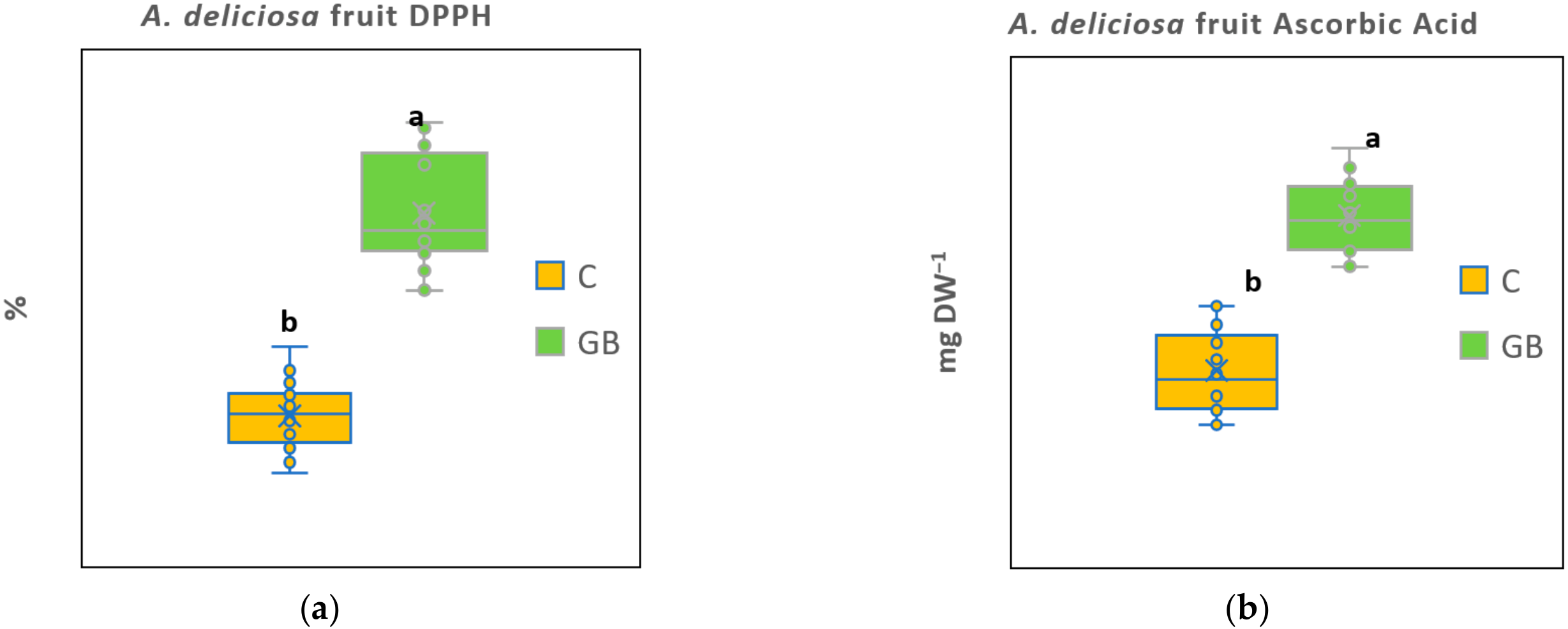
GBP biostimulants are frequently reported due to their high osmoprotection ability and antioxidant potential [24], both of which prevent cellular damage and reinforce plant metabolism against various environmental stresses [25]. Antioxidant indicators were found to be enriched in kiwifruit during cold storage in the treatments where the biostimulant was applied. In both seasons, DPPH content was found to be higher in kiwifruit treated with GB (75.71 ± 3.23%) at 60 days after harvest compared to C (63.76 ± 1.99%) (p ≤ 0.05) (Figure 3a). Ascorbic acid content was also found to be higher 60 days after harvest in the case of GB (0.37 ± 0.02 mg DW−1) compared to C (0.30 ± 0.02 mg DW−1) (p ≤ 0.05) (Figure 3b). An analogous antioxidant performance of plants under GB treatment was mentioned by Shafiq et al. (2021), who noted that ascorbic acid content increased in Z. mays L. [26]. Adak’s 2017 study on the strawberry variant Fragaria ananassa ‘Albion’ reported that exogenous GB application led to greater ascorbic acid concentration [22]. Further insights emerging from the postharvest application of GB relate to improvements in fruit-chilling tolerance. In the study by Shan et al., 2016, the application of GBP to peaches resulted in enhanced chilling tolerance that was attributable to the induction of endogenous proline, GB, and γ-aminobutyric acid (GABA) content, while also maintaining membrane stability [27]. Similar effects following the postharvest application of GB formulations have been found in other studies on fruits such as banana (Musa acuminata) [28], sweet pepper (Capsicum annuum L.) [29], and loquat (Eriobotrya japonica) [30].

4. Conclusions

Improving the quality of kiwifruit is a challenging operation, given environmental stress factors. The implementation of environmentally friendly methods to enhance plant metabolism and fruit quality that can be applied to integrated management programs may offer potential solutions for crop stress relief. GBs classified within this group of substances and in this study revealed significant effects following their use over two consecutive years of kiwi cultivation. Both DPPH and ascorbic acid content were examined in kiwifruit that had been treated with GB, 60 days after harvest. The postharvest performance of kiwifruit was found to be enhanced in terms of weight, ripening characteristics, and antioxidant potential. This study paves the way for further research on the effects of GBs on kiwifruit; it is important to carry out in-depth studies on their specific mode of action on the kiwi metabolism in order to obtain more targeted answers, so long as the literature on this topic remains limited.

Funding

This research received no external funding.

Institutional Review Board Statement

Not applicable.

Informed Consent Statement

Not applicable.

Data Availability Statement

The data presented in this study are available on request from the corresponding author, V.P.

Acknowledgments

The author gratefully acknowledges the Department of Agriculture, Arta Campus, University of Ioannina, 47100 Arta, Greece, for providing the facilities to carry out the sample analysis, and the Koliou Group Co., S.A., Arta, Greece, for providing a kiwifruit orchard in which to conduct the experiment.

Conflicts of Interest

The author declares no conflicts of interest.

References

  1. Sharma, K.; Kumar, R.; Kumar, A. Himalayan Horticulture Produce Supply Chain Disruptions and Sustainable Business Solution—A Case Study on Kiwi Fruit in Uttarakhand. Horticulturae 2022, 8, 1018. [Google Scholar] [CrossRef]
  2. He, Z.; Lu, X.; Cui, N.; Jiang, S.; Zheng, S.; Chen, F.; Qiu, R.; Liu, C.; Fan, J.; Wang, Y.; et al. Effect of Soil Water Content Threshold on Kiwifruit Quality at Different Growth Stages with Drip Irrigation in the Humid Area of Southern China. Sci. Hortic. 2023, 307, 111477. [Google Scholar] [CrossRef]
  3. Vanneste, J.L. The Scientific, Economic, and Social Impacts of the New Zealand Outbreak of Bacterial Canker of Kiwifruit (Pseudomonas syringae pv. actinidiae). Annu. Rev. Phytopathol. 2017, 55, 377–399. [Google Scholar] [CrossRef] [PubMed]
  4. Lötter, J.d.V. Ecological Factors Influencing the Commercial Production of Kiwifruit (Actinidia deliciosa). Acta Hortic. 1990, 282, 65–78. [Google Scholar] [CrossRef]
  5. Kokkora, M.; Koukouli, P.; Karpouzos, D.; Georgiou, P. Model Application for Estimation of Agri-Environmental Indicators of Kiwi Production: A Case Study in Northern Greece. Environments 2023, 10, 69. [Google Scholar] [CrossRef]
  6. Varlas, G.; Stefanidis, K.; Papaioannou, G.; Panagopoulos, Y.; Pytharoulis, I.; Katsafados, P.; Papadopoulos, A.; Dimitriou, E. Unravelling Precipitation Trends in Greece since 1950s Using ERA5 Climate Reanalysis Data. Climate 2022, 10, 12. [Google Scholar] [CrossRef]
  7. Georgoulias, A.K.; Akritidis, D.; Kalisoras, A.; Kapsomenakis, J.; Melas, D.; Zerefos, C.S.; Zanis, P. Climate Change Projections for Greece in the 21st Century from High-Resolution EURO-CORDEX RCM Simulations. Atmos. Res. 2022, 271, 106049. [Google Scholar] [CrossRef]
  8. Chartzoulakis, K.; Michelakis, N. Effects of Different Irrigation Systems on Root Growth and Yield of Greenhouse Cucumber. Acta Hortic. 1990, 278, 237–244. [Google Scholar] [CrossRef]
  9. Li, Z.; Bai, D.; Zhong, Y.; Abid, M.; Qi, X.; Hu, C.; Fang, J. Physiological Responses of Two Contrasting Kiwifruit (Actinidia spp.) Rootstocks against Waterlogging Stress. Plants 2021, 10, 2586. [Google Scholar] [CrossRef]
  10. Liu, D.; Qi, Y.; Zhao, N.; Cao, Y.; Xu, J.; Fan, M. Multivariate Analysis Reveals Effect of Glutathione-Enriched Inactive Dry Yeast on Amino Acids and Volatile Components of Kiwi Wine. Food Chem. 2020, 329, 127086. [Google Scholar] [CrossRef]
  11. Bulgari, R.; Franzoni, G.; Ferrante, A. Biostimulants Application in Horticultural Crops under Abiotic Stress Conditions. Agronomy 2019, 9, 306. [Google Scholar] [CrossRef]
  12. Dikilitas, M.; Simsek, E.; Roychoudhury, A. Role of Proline and Glycine Betaine in Overcoming Abiotic Stresses. In Protective Chemical Agents in the Amelioration of Plant Abiotic Stress; John Wiley & Sons Ltd.: Hoboken, NJ, USA, 2020; pp. 1–23. [Google Scholar] [CrossRef]
  13. Monteiro, E.; Gonçalves, B.; Cortez, I.; Castro, I. The Role of Biostimulants as Alleviators of Biotic and Abiotic Stresses in Grapevine: A Review. Plants 2022, 11, 396. [Google Scholar] [CrossRef] [PubMed]
  14. Abbate, A.P.; Campbell, J.W.; Vinson, E.L.; Williams, G.R. The Pollination and Fruit Quality of Two Kiwifruit Cultivars (Actinidia chinensis var. chinensis ‘AU Golden Sunshine’ and ‘AU Gulf Coast Gold’) (Ericales: Actinidiaceae) Grown in the Southeastern United States. J. Econ. Entomol. 2021, 114, 1234–1241. [Google Scholar] [CrossRef] [PubMed]
  15. Fattahi, J.; Fifaii, R.; Babri, M. Postharvest Quality of Kiwifruit (Actinidia deliciosa cv. Hayward) Affected by Pre-Storage Application of Salicylic Acid. South West. J. 2010, 1, 175–186. [Google Scholar]
  16. Wang, Y.; Li, L.; Liu, H.; Zhao, T.; Meng, C.; Liu, Z.; Liu, X. Bioactive Compounds and in Vitro Antioxidant Activities of Peel, Flesh and Seed Powder of Kiwi Fruit. Int. J. Food Sci. Technol. 2018, 53, 2239–2245. [Google Scholar] [CrossRef]
  17. Nielsen, S.S. Vitamin C Determination by Indophenol Method. In Food Analysis Laboratory Manual; Food Science Texts Series; Springer: New York, NY, USA, 2010; pp. 55–60. [Google Scholar] [CrossRef]
  18. Tavares, D.F.; Rodrigues, S.I.A.; Oliveira, C.M.M.S. Biostimulants to Promote Budbreak in Kiwifruit (Actinidia chinensis var. deliciosa ‘Hayward’). Acta Hortic. 2018, 1218, 367–372. [Google Scholar] [CrossRef]
  19. Donno, D.; Beccaro, G.L.; Mellano, M.G.; Canterino, S.; Cerutti, A.K.; Bounous, G. Improving the Nutritional Value of Kiwifruit with the Application of Agroindustry Waste Extracts. J. Appl. Bot. Food Qual. 2016, 86, 11–15. [Google Scholar] [CrossRef]
  20. Burdon, J.; Pidakala, P.; Martin, P.; Billing, D.; Boldingh, H. Fruit Maturation and the Soluble Solids Harvest Index for ‘Hayward’ Kiwifruit. Sci. Hortic. 2016, 213, 193–198. [Google Scholar] [CrossRef]
  21. Xu, J.; Li, X.L.; Luo, L. Effects of Engineered Sinorhizobium Meliloti on Cytokinin Synthesis and Tolerance of Alfalfa to Extreme Drought Stress. Appl. Environ. Microbiol. 2012, 78, 8056–8061. [Google Scholar] [CrossRef]
  22. Adak, N. Effects of Glycine Betaine Concentrations on the Agronomic Characteristics of Strawberry Grown under Deficit Irrigation Conditions. Appl. Ecol. Environ. Res. 2019, 17, 3753–3767. [Google Scholar] [CrossRef]
  23. Adak, N.; Tozlu, I. The Effects of Glycine Betaine on Pomology, Yield and Biochemical Characteristics of Strawberry Plants under Soilless Culture. Acta Hortic. 2020, 1273, 45–51. [Google Scholar] [CrossRef]
  24. Hasanuzzaman, M.; Alam, M.M.; Rahman, A.; Hasanuzzaman, M.; Nahar, K.; Fujita, M. Exogenous Proline and Glycine Betaine Mediated Upregulation of Antioxidant Defense and Glyoxalase Systems Provides Better Protection against Salt-Induced Oxidative Stress in Two Rice (Oryza sativa L.) Varieties. Biomed. Res. Int. 2014, 2014, 757219. [Google Scholar] [CrossRef]
  25. Jarin, A.; Ghosh, U.K.; Hossain, M.S.; Mahmud, A.; Khan, M.A.R. Glycine Betaine in Plant Responses and Tolerance to Abiotic Stresses. Discov. Agric. 2024, 2, 127. [Google Scholar] [CrossRef]
  26. Shafiq, S.; Akram, N.A.; Ashraf, M.; García-Caparrós, P.; Ali, O.M.; Abdel Latef, A.A.H. Influence of Glycine Betaine (Natural and Synthetic) on Growth, Metabolism and Yield Production of Drought-Stressed Maize (Zea mays L.) Plants. Plants 2021, 10, 2540. [Google Scholar] [CrossRef] [PubMed]
  27. Shan, T.; Jin, P.; Zhang, Y.; Huang, Y.; Wang, X.; Zheng, Y. Exogenous Glycine Betaine Treatment Enhances Chilling Tolerance of Peach Fruit during Cold Storage. Postharvest Biol. Technol. 2016, 114, 104–110. [Google Scholar] [CrossRef]
  28. Rodríguez-Zapata, L.C.; Espadas y Gil, F.L.; Cruz-Martínez, S.; Talavera-May, C.R.; Contreras-Marin, F.; Fuentes, G.; Sauri-Duch, E.; Santamaría, J.M. Preharvest Foliar Applications of Glycine-Betaine Protects Banana Fruits from Chilling Injury during the Postharvest Stage. Chem. Biol. Technol. Agric. 2015, 2, 8. [Google Scholar] [CrossRef]
  29. Wang, Q.; Ding, T.; Zuo, J.; Gao, L.; Fan, L. Amelioration of Postharvest Chilling Injury in Sweet Pepper by Glycine Betaine. Postharvest Biol. Technol. 2016, 112, 114–120. [Google Scholar] [CrossRef]
  30. Sun, Y.; Chauhan, A.; Sukumaran, P.; Sharma, J.; Singh, B.B.; Mishra, B.B. Inhibition of Store-Operated Calcium Entry in Microglia by Helminth Factors: Implications for Immune Suppression in Neurocysticercosis. J. Neuroinflamm. 2014, 11, 210. [Google Scholar] [CrossRef]
Figure 1. Variation in fresh (a) and dry weight (b) of A. deliciosa fruit 60 days after harvest (g ± SD). Definition of treatments: (GB) Glycine-betaine-based biostimulant and (C) control. Different letters between treatments indicate significant differences according to the Bonferroni test (p ≤ 0.05).
Blsf 57 00001 g001
Figure 2. Variation in the SSC (a) and TA (b) of A. deliciosa fruit 60 days after harvest (% ± SD). Definition of treatments: (GB) Glycine-betaine-based biostimulant and (C) control. Different letters between treatments indicate significant differences according to the Bonferroni test (p ≤ 0.05).
Blsf 57 00001 g002
Figure 3. Variation in DPPH (%± SD) (a) and ascorbic acid content (mg DW−1 ± SD) (b) of A. deliciosa fruit 60 days after harvest. Definition of treatments: (GB) Glycine-betaine-based biostimulant and (C) control. Different letters between treatments indicate significant differences according to the Bonferroni test (p ≤ 0.05).
Blsf 57 00001 g003
Disclaimer/Publisher’s Note: The statements, opinions and data contained in all publications are solely those of the individual author(s) and contributor(s) and not of MDPI and/or the editor(s). MDPI and/or the editor(s) disclaim responsibility for any injury to people or property resulting from any ideas, methods, instructions or products referred to in the content.