Proceeding Paper

Environmental Assessment of Meat and Milk Production of Sedentary Dual-Purpose Cattle Farms in Two Vegetation Zones of Benin Using the GLEAM-i Model †

by
Pénéloppe G. T. Gnavo
1,
Rodrigue V. Cao. Diogo
1,2,* and
Luc H. Dossa
3
1
Integrated Production Systems Innovation Lab and Sustainable Land Management (InSPIREs-SLM), Faculty of Agronomy, University of Parakou, Parakou P.O. Box 123, Benin
2
Département des Sciences et Techniques de Productions Animale et Halieutique, Faculté d’Agronomie, University of Parakou, Parakou P.O. Box 123, Benin
3
Laboratoire des Sciences Animales (LaSA), Faculté des Sciences Agronomiques, Université d’Abomey-Calavi, Cotonou Jéricho 03 BP 2819, Benin
*
Author to whom correspondence should be addressed.
Presented at the 3rd International Online Conference on Agriculture (IOCAG 2025), 22–24 October 2025; Available online: https://sciforum.net/event/IOCAG2025.
Biol. Life Sci. Forum 2025, 54(1), 25; https://doi.org/10.3390/blsf2025054025
Published: 14 February 2026
(This article belongs to the Proceedings of The 3rd International Online Conference on Agriculture)

Abstract

To comply with new pastoral regulations in Benin, herders are increasingly adopting sedentary cattle systems, which may pose environmental risks if poorly managed. This study assessed greenhouse gas (GHG) emissions from three sedentary cattle farm types: zebu (SZF), taurine (STF), and crossbreed (SCF), across two vegetation zones: Sudanian (SZ) and Guineo-Congolian (GCZ) using the GLEAM-i model, online version. Irrespective of the farm type, the animals were exclusively fed on natural pasture. A total of 12 cattle herds were surveyed to collect input data (herd structure, demographic parameters, milk production and composition, and weight data) for the GLEAM-i. The fat and protein content of the milk (determined using a milkotester device), the live weight, and weight at slaughter of animals were entered into the GLEAM-i, which automatically determines the emission intensity values per kg of protein produced. The results revealed that CH4 was the main GHG emitted (88%), followed by CO2 (6–7%) and N2O (6%). The highest and lowest total GHG emissions (kgCO2-eq/year) were recorded in SZF (188,497) and STF (52,003) farms, respectively. With regard to emission intensity (kgCO2-eq/kg protein), this varied from 506.59 to 3043.73 for meat and from 588.86 to 3043.73 for milk. Overall, preliminary trends suggest lower emission intensities for taurine in the GCZ and for zebu in the SZ. However, these results would be more meaningful and more accurate if emission values were directly measured from individual animals using the GreenFeed Technology under current production conditions, using various pasture resources and controlled allocation. These would allow us to make firm recommendations for breeding strategies to reduce GHG emissions in Benin’s extensive livestock production system.

1. Introduction

In Benin, the predominant livestock are ruminants, with cattle being the most prevalent among them. They constitute the largest portion of the livestock population in the country. According to the Benin Agricultural Directorate’s statistics (DSA), meat production increased by 11.0% and 33.3%, respectively, compared to last year and the average for the last five years, with 39.8% of cattle contribution [1]. A report by [2] on the situation of livestock farming and ruminants’ breeding in Benin revealed that cattle farming, which is mainly practiced in the Sudano-Sahelian and Sudanian climate in the north of Benin, is gradually expanding towards the Sudano-Guinean areas and the south of the country. Livestock farming is also undergoing a revolution, with a trend towards sedentarization that is further encouraged by the political context in Benin [3,4,5,6,7]. Livestock farming in Benin is therefore essentially cattle farming and is expanding rapidly.
Nevertheless, cattle farming is widely criticized for its environmental implications [8], with bovine production being one of the highest emitters of pollutants [9], placing beef production systems at the core of sustainability debates [8]. Emissions from beef and dairy cattle constitute 35% and 30% of the total livestock emissions globally, respectively [10]. The surge in human demand for animal products, particularly meat and milk, contributes to a rise in greenhouse gas (GHG) emissions from both enteric fermentation and manure management [11]. In Benin, cattle emission account for approximately 57% of national emissions [12]. Nowadays, there is growing concern about environmental and climate change, which drive the world towards cleaner production and green technologies [13]. Livestock production systems should therefore be as eco-friendly as possible, which implies improving production efficiencies and reducing GHG pollution per unit of product or service [14]. This principle also applies to livestock farming, which will face long-term challenges in supplying meat and milk products while ensuring economic, social and environmental performance [8].
The main GHG emissions from producing meat and milk in livestock systems usually include CH4, N2O, and CO2 [15]. Several studies have assessed the emissions of CH4, N2O, and CO2 in Benin—[16,17]—with various practices to adapt to climate change in cattle production. Different breeds’ methane emission factors from Beninese cattle production were investigated [11] and GHG emissions estimated in the Wari Maro forest reserve and its periphery [18]
Despite the fact that these studies have narrowed down the gap in Benin’s quantitative data on GHG emissions from the livestock sector, substantial gaps still exist on breeds’ contributions to GHG emissions in the country. The current study intends to quantify CH4, N2O, and CO2 emissions from different sedentary cattle farming systems: zebu, taurine, and crossbreed, across both the Sudanian (north) and Guineo-Congolian (south) zones of Benin. It aimed to compare emission levels among farm types and vegetation zones in order to (1) identify low-emitting farm types, and to (2) highlight potential mitigation hotspots. By relying on primary field data, rather than default estimates, the study provides emission values that closely reflect actual conditions, thereby contributing to a more accurate understanding of the GHG emissions and their dynamics in Benin’s cattle breeding sector, hence, offering robust benchmarks for future policy and management recommendations, especially in the context of livestock sedentarization.

2. Materials and Methods

2.1. Study Area

The study was conducted in the two most contrasted vegetation zones of the country: the Sudanian (Cobly: between 10°15′ and 10°31′ north latitude and between 0°25′ and 1°15′ east longitude) and the Guineo-Congolian (Zè: between 6°32′ and 6°87′ north latitude and between 2°13 and 2°26 east longitude) zones. These localities were selected based on the prevalence of cattle breeding practices, their proximity to transhumance areas, and the diversity of cattle breeds. In the Sudanian zone, these included Somba; White Fulani, referred to as Yakana by pastoralists [19]; and their crossbreeds, while in the Guineo-Congolian zone, shorthorn taurine Lagunaire, known as Bobodji, and Yakana were present.
Cobly has a humid tropical climate with a unimodal rainfall regime (900–1300 mm/year). The dry season extends from November to April, while the rainy season occurs from July to September. The mean annual temperature is about 27 °C, ranging from 17 °C to 35 °C, with marked fluctuations during the harmattan period [20].
In contrast, Zè has a sub-equatorial climate characterized by higher rainfall (≈1217 mm/year) and a mean temperature of 27.4 °C with low annual thermal amplitude. The area experiences four distinct seasons: two rainy (April–July and September–November) and two dry seasons (December–March and August) [21].

2.2. Sampling and Data Collection

A preliminary sampling, including 406 cattle herds using the snowball method [22] in the Sudanian and Guineo-Congolian zones, allowed us to identify three distinct types of sedentary farms, characterized by [3] as sedentary zebu (SZF), taurine (STF) and crossbred (taurine x zebu) farms (SCF). All three farm types were present in Cobly municipality (STF: Somba breed, SZF: Yakana breed, SCF: Somba x Yakana breed), whereas only the Yakana breed (SZF) and Bobodji breed (STF) were present in Zè municipality.
The investigated farms relied solely on natural grazing as the main feeding strategy. A supplementation with salt was occasionally added. Six (6) herds per commune were monitored for three months for a total of 12 cattle herds and quantitative data (weight gain, milk production and demographic parameters) were collected.

2.2.1. Weight Estimation

Herds were evaluated at the beginning of the study to reflect the breed composition and the varying physiological conditions of the animals. Then, 2 to 5 animals were selected from each group, formed by breed and physiological state, to evaluate their zootechnical performance. The weights of young animals (calves) were determined using a portable scale of 100 kg ± 0.5 kg. The weights of adult animals were obtained using the barometric method and regression equations developed by [23,24,25] for Azawak zebu, Somba and Borgou taurine, respectively.

2.2.2. Determining Milk Production

The milk production of suckler cows was quantified from each herd monitored according to breed, using a 5 kg ± 1 g scale, and the value was recorded with the animal’s characteristics (breed, number and stage of lactation). The milk was quantified on three successive days and repeated every three weeks for three months. Milk consumption by calves at three months of age was determined using the formula of [26] and added to the amount of milk weighted to estimate the total quantity of milk produced.
The quality of milk produced was assessed by analyzing the milk produced after one month’s lactation for cows that had calved during the survey period. The milk was analyzed using a milkotester device (Milkotester, Bulgary) to determine their fat and protein content.

2.2.3. Demographic Parameters

Data on the numerical productivity of the herds were collected using the 12 months method (12 MO) developed by [27].

2.3. Data Analysis

The various data collected were entered into the Gleam-i platform (Gleam interactive tool): STF, SZF and SCF in the Sudanian zone and STF and SZF in the Guineo-Congolian zone to obtain the various emissions for each farm type and to make comparisons. The GLEAM-i model [15] calculates greenhouse gas emissions using IPCC Tier 2 methods and uses 3 types of data: those from field measurements, the literature, and intermediate calculations. Parameters not collected in the field were filled using values from the literature. The impact assessed here is the climate change behavior through the emissions of GHG quantification.

3. Results

3.1. Input Parameters for Estimating GHG Emissions per Farm Type

The mean values for the parameters needed to estimate GHGs from each farm are presented in Table 1.

3.2. GHG Emissions per Farm Type

Table 2 shows the GHG emissions (in kg CO2 equivalent/year), protein production (kg protein/year) and feed intake (kg dry matter (DM/year) per farm type, calculated using the Gleam-i tool.
The protein production was higher in SZ compared to the GCZ for all farm types. SZF produced more protein than STF in SZ in contrast to GCZ. The SCF production was slightly higher than the STF protein production, but well below the SZF protein production.
Table 3 reports the relative contribution of each gas to total GHG emissions.
In all vegetation zones and farm types, CH4 emissions were dominant, followed by N2O and CO2 emissions (Table 3).
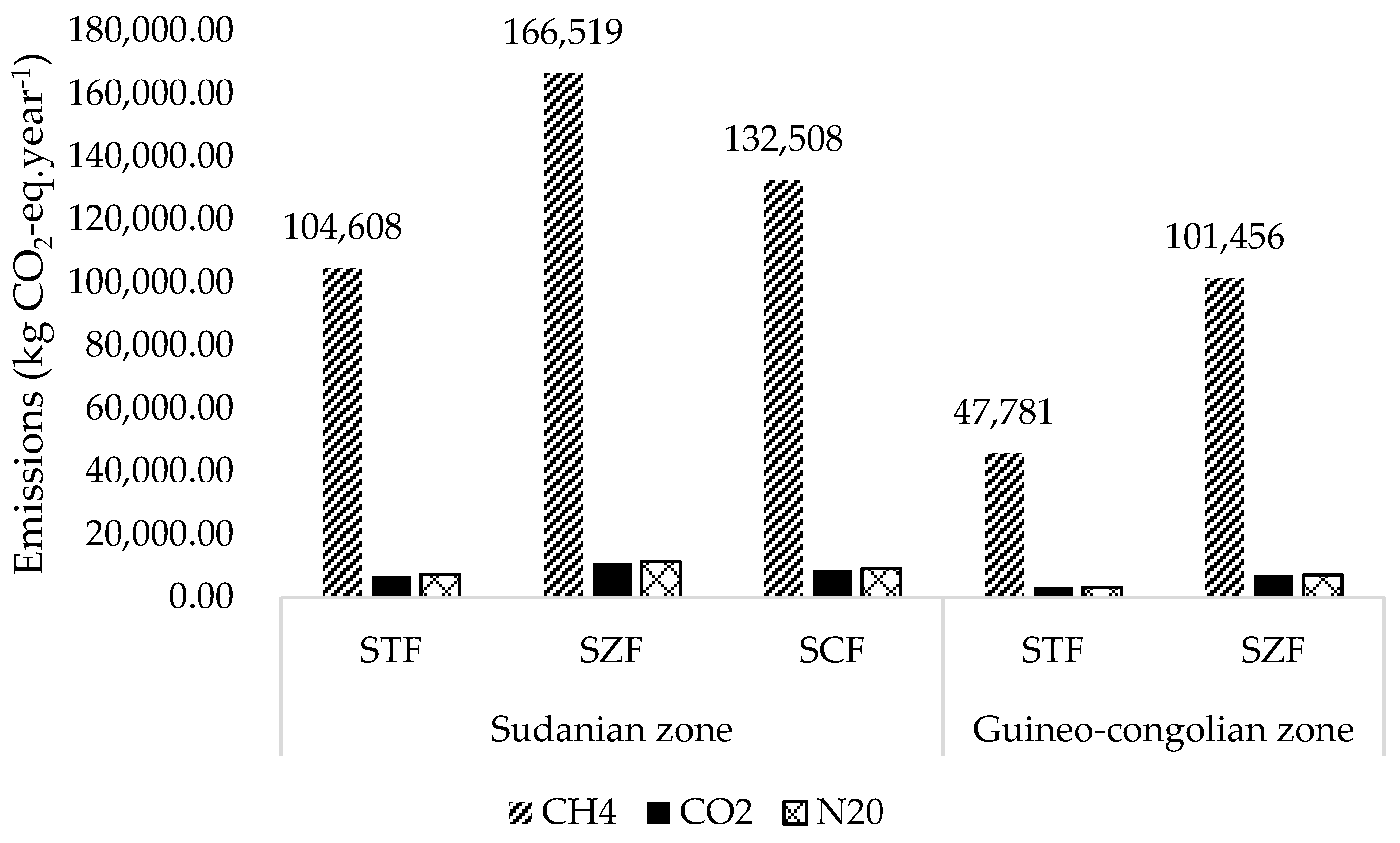
The emissions of CH4, CO2 and N2O per farm type are presented in Figure 1.
With regard to the emissions per farm, the STF in GCZ exhibited the lowest emission values. Considering each vegetation zone, it is shown that in SZ, the SCF appeared to have an intermediate emission level. SZF have the highest emissions in both zones (Figure 1).
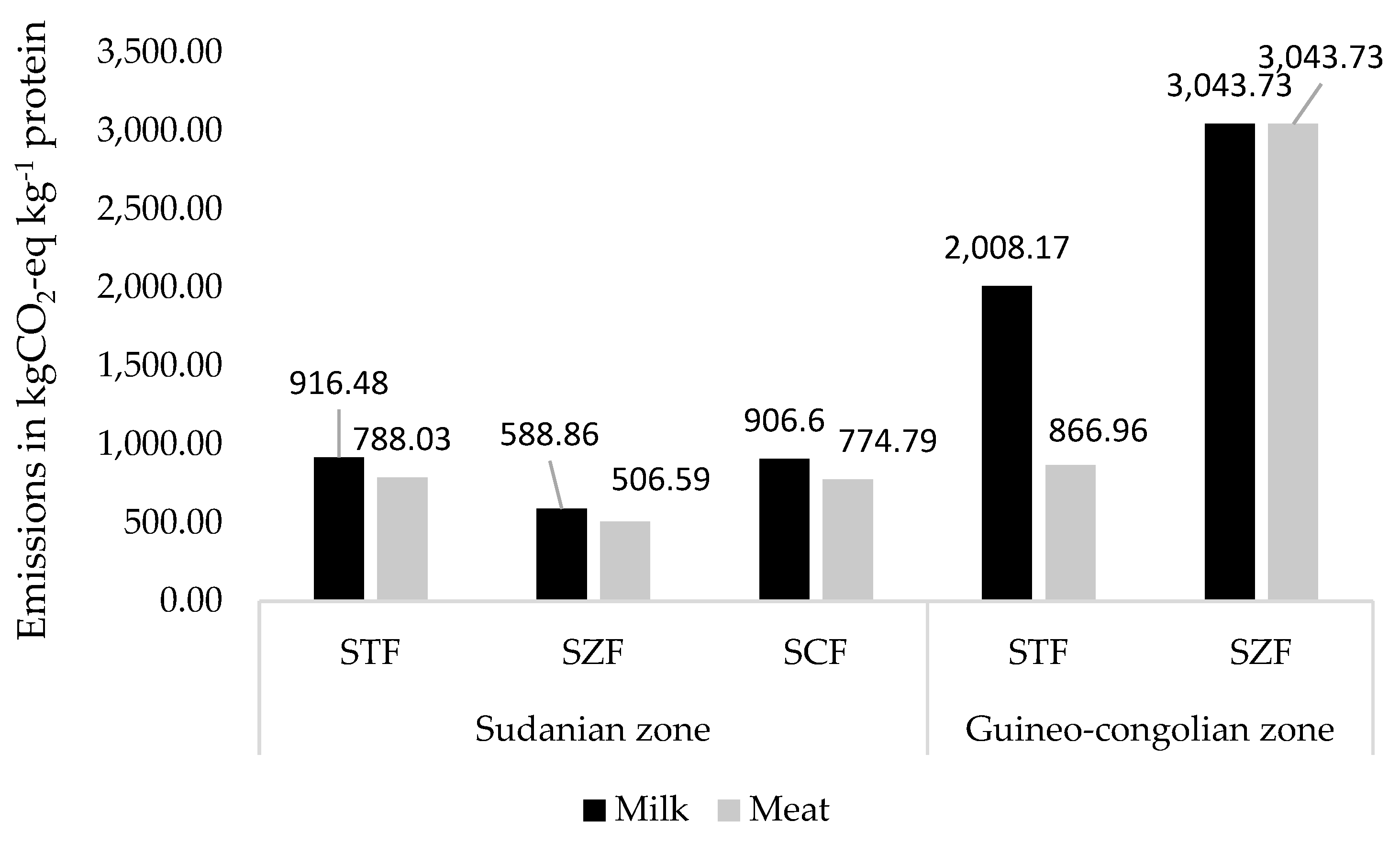
The greenhouse gas emission intensity per kilogram of protein produced at the farm level (kg CO2-eq. kg−1 protein) is shown in Figure 2. The results highlight markedly higher total emissions per kilogram of protein in SZF located in the Guineo-Congolian zone, whereas values were substantially lower in the Sudanian zone for the same farm type and breed.

4. Discussion

This study aims to compare sedentary taurine, zebu and crossbreed farms and to quantify their greenhouse gas (GHG) emission impact. It is designed to provide appropriate recommendation domains for mitigating emissions in the two vegetation zones of Benin: namely, the Sudanian and Guineo-Congolian zones. All three farm types were found in the Sudanian region, while only sedentary zebu and taurine farms were identified in the Guineo-Congolian zone.
The impact of livestock farming on climate change is assessed using global warming potential. Methane (CH4) emissions resulting from enteric fermentation constitute the most significant source of agricultural GHG emissions in Africa, which is primarily attributed to the extensive grazing land available on the continent [28]. In fact, the proportion of methane emitted was around 88% in our study, a result closely linked to cattle herd diets, which relied exclusively on natural pasture of a poor-quality diet without supplementation [29]. Reference [16], reached the same conclusions in the dry and subhumid tropical zones of Benin. Across cattle farming systems with varying feeding and management practices, methane (CH4) was the dominant gas emitted, followed by nitrous oxide (N2O). In fact, in several of the farming systems examined, animal feed consisted mainly of low-quality fodders, which requires a prolonged retention time in the rumen and consequently led to a higher production of enteric CH4 [30]. The inclusion of a high proportion of forage in ruminant diets is associated with substantial CH4 emissions [29]. The results of [31] in two distinct grassland systems in Brazil consolidate this logic: emissions were 9.16 kg CO2-eq per unit of body weight gain per year with improved pasture, compared to 22.52 kg CO2-eq per unit of body weight gain per year with natural grass. Reference [32] reported 19.3 and 21.0 kg CO2-eq for producing 1 kg of beef from the initial stage to the farm-gate in an intensive and extensive system, respectively. In that study, global emissions of CH4 from enteric fermentation in the extensive system were 34% higher than in the intensive system (14.5 versus 9.59 kg CO2-eq per kg meat, respectively), which is associated with the poor quality of pastures in the extensive system and a greater time spent by the livestock in the production stage. Reference [11] estimated the annual average CH4 emissions from enteric fermentation at 2849.59 Gg CO2 -eq for the Gudali, Azawak, White fulani, Borgou, Somba and Lagune cattle herds in Benin.
Overall, zebu breed had a higher GHG emission rate than the taurine breeds in both vegetation zones studied. This trend was also demonstrated by [11], with the highest (73.74 kg CH4 head−1 year−1) values reported for Azawak (zebu) herds and the lowest (34.90 kg CH4 head−1 year−1) in Lagune cattle (taurine).
As for our results, the largest contributor to GHG emissions in the farming systems studied was CH4, followed by N2O and CO2 production. In Benin, the highest values found by [16] were of 17.1 Gg CO2-eq year−1, 62.28% of the total emission; CH4, N2O and CO2 contributed 65.49%, 33.75%, and 0.76%, respectively. These proportions of the contribution of different GHG types follow the same trend as our results: CO2 emission was less than 2% versus 5.59 to 6.96% in our study, regardless of cattle farming type [16]. Farms practicing pastoral mobility were the major emitters of GHGs, as their feeding strategy relied primarily on natural pasture, whose composition may be affected by shifted seasonal patterns, changes in optimal growth rate, and water availability. Elevated CO2 levels might diminish forage quality, but reduce transpiration, improving water-use efficiency of forages [9]. Reference [17] estimated the emission intensities in north and central Benin at 60.21–67.52 kgCO2 kg−1 for milk protein and 178.68–200.6 kg CO2 kg−1 for meat protein.
The difference between our results and those found by these authors could be explained by the quality of the animals’ diet, which was essentially composed of poorly digestible forage grasses without supplementation during the period of the data collection.
These GHG emissions should then be analyzed based on the proportion of each breed type present in the herd and, to a larger extent, in Benin, for further studies to reflect the actual production and therefore the impact of each breed in the country. The overall accurate size of each breed is important in this type of analysis and should be considered in future studies. This will enable more realistic simulations to be carried out and more country-specific results to be obtained.
Further recommendations should target specific diet formulation and also evaluate emission potential of various feedstuffs to reduce their incorporation in dual-purpose livestock feeding in Benin, especially in the context of animal sedentarization. There is a critical scarcity of in situ data and region-specific investigations into GHG emission estimations in Africa. Reference [33] and most estimates currently rely on IPCC Tier 1, which often fails to capture the diversity of local management practices and overestimates emissions in African livestock production systems [34,35]. Nevertheless, to reduce GHG emissions, more extensive investigations across African countries are urgently needed [28]. Developing mitigation strategies such as genetic improvement and feed optimization must be tailored to the continent’s unique agro-ecological constraints, rather than applying generic global models. Adopting best management practices in developing countries can, depending on the technologies adopted, improve non-CO2 emissions (CH4 and NO2) by 1.6 to 20% by 2060 [36]. Emissions can be reduced by 27 to 41% through improvements in feed digestibility, animal health, farming systems and techniques, and pasture management [37]. Efforts to improve accurate measurement and solid data collection per breed type and feed range available throughout the year in various production contexts in West Africa would allow for a more appropriate recommendation and target more precise actions.

5. Conclusions

This study highlights the GHG emissions from sedentary zebu farms in Benin (188,497 kg CO2-eq year−1 in the Sudanian zone, while sedentary taurine farms recorded lowest values of 52,003 kg CO2-eq year−1 in the Guineo-Congolian zone). However, despite these high emission values, zebu farms demonstrate comparatively lower emission intensity per unit of protein produced in the Sudanian zone (506.59 kgCO2-eq kg−1 protein for meat and 588.86 kgCO2-eq kg−1 protein for milk), underscoring their potential for sustainable mitigation. Emission patterns vary across vegetation zones and genotypes, indicating that breeding and management strategies must be context-specific. Prioritizing emission-reduction measures in sedentary zebu farms and promoting adaptive cross-breeding strategies appear to offer the greatest potential for climate-smart cattle production in Benin.

Author Contributions

Conceptualization, R.V.C.D. and L.H.D.; methodology, R.V.C.D. and P.G.T.G.; software, P.G.T.G.; validation, R.V.C.D. and L.H.D.; formal analysis, P.G.T.G.; investigation, P.G.T.G.; resources, R.V.C.D. and P.G.T.G.; data curation, P.G.T.G.; writing—original draft preparation, P.G.T.G.; writing—review and editing, R.V.C.D., L.H.D.; visualization, R.V.C.D. and P.G.T.G.; supervision, R.V.C.D.; project administration, R.V.C.D.; funding acquisition, R.V.C.D. and P.G.T.G. All authors have read and agreed to the published version of the manuscript.

Funding

This research was funded by [Volkswagen Stiftung, Hannover, Germany] grant number [Az 94828]; funding was obtained by: R.V.C.D. and the CGIAR Research Program on Climate Change, Agriculture and Food Security (CCAFS) and the Global Research Alliance on Agricultural Greenhouse Gases (GRA) through their CLIFF-GRADS program; funding was obtained by P.G.T.G.

Institutional Review Board Statement

Not applicable.

Informed Consent Statement

Not applicable.

Data Availability Statement

The original data presented in this study are openly available in the Figshare repository at the following DOI: https://doi.org/10.6084/m9.figshare.30903272 (accessed on 17 December 2025).

Acknowledgments

The authors express their sincere gratitude to all participating herders for their valuable help and cooperation during the field work. This article is derived from the doctoral thesis currently being written by P.G.T.G., entitled “Life cycle assessment of sedentary cattle farms in the Sudanian and Guineo-Congolian zones of Benin” at the University of Parakou, Benin. We thank the government of Benin for supporting us through the Doctoral Support Program.

Conflicts of Interest

The authors declare no conflicts of interest.

References

  1. FAO Statistical Yearbook 2013. Available online: https://www.fao.org/4/i3107e/i3107e00.htm (accessed on 21 October 2025).
  2. ANOPER, La Situation Actuelle de L’élevage et des éleveurs de Ruminants au Bénin: Analyse et Perspectives. Annexe du Document D’orientation Stratégique. 2014. Available online: https://www.inter-reseaux.org/wp-content/uploads/DOS_ANNEXE_ANOPER-1.pdf (accessed on 17 November 2023).
  3. Houessou, S.O.; Dossa, L.H.; Diogo, R.V.; Houinato, M.; Buerkert, A.; Schlecht, E. Change and continuity in traditional cattle farming systems of West African Coast countries: A case study from Benin. Agric. Syst. 2019, 168, 112–122. [Google Scholar] [CrossRef]
  4. Diogo, R.V.C.; Adjassin, J.S.; Dossa, L.H.; Traoré, I.A. Feeding and spatial behaviours of transhumant cattle in southern Benin: Implications for the sustainable management of rangelands. Afr. J. Range Forage Sci. 2020, 37, 268–277. [Google Scholar] [CrossRef]
  5. Diogo, R.V.C.; Dossa, L.H.; Vanvanhossou, S.F.U.; Abdoulaye, B.D.; Dosseh, K.H.; Houinato, M.; Schlecht, E.; Buerkert, A. Farmers’ and Herders’ Perceptions on Rangeland Management in Two Agroecological Zones of Benin. Land 2021, 10, 425. [Google Scholar] [CrossRef]
  6. Ellison, J.; Brinkmann, K.; Diogo, R.V.C.; Buerkert, A. Land cover transitions and effects of transhumance on available forage biomass of rangelands in Benin. Environ. Dev. Sustain. 2021, 24, 12276–12310. [Google Scholar] [CrossRef]
  7. Adedigba, S.; Diogo, R.V.C.; Dossa, L.H.; Paul, B. Elevages des bovins face aux insuffisances alimentaires et à la sédentarisation des troupeaux au Nord-Bénin. Bull. Rech. Agron. Bénin 2023, 33, 43–63. [Google Scholar]
  8. Dollé, J.-B.; Gac, A. Impacts environnementaux et services écosystémiques, quelles méthodes d’évaluation pour l’élevage bovin viande en France ? Environmental impacts and ecosystem services, methodologies inventories to assess French beef livestock systems. Viandes Prod. Carnés 2016, 32, 1–12. [Google Scholar]
  9. Rojas-Downing, M.M.; Nejadhashemi, A.P.; Harrigan, T.; Woznicki, S.A. Climate change and livestock: Impacts, adaptation, and mitigation. Clim. Risk Manag. 2017, 16, 145–163. [Google Scholar] [CrossRef]
  10. Haque, M.N. Dietary manipulation: A sustainable way to mitigate methane emissions from ruminants. J. Anim. Sci. Technol. 2018, 60, 15. [Google Scholar] [CrossRef]
  11. Agossou, D.J.; Koluman, N. Developing new methane emission factors and quantifying methane emission from Beninese cattle production. Sci. Total Environ. 2022, 848, 157545. [Google Scholar] [CrossRef]
  12. Agossou, D.J.; Toukourou, Y.; Koluman, N. Sustainable Development of Livestock and Meat Production in Republic of Benin: Strategies and Perspectives. J. Anim. Health Prod. 2018, 6, 35–40. [Google Scholar] [CrossRef]
  13. Akinsemolu, A.A. The role of microorganisms in achieving the sustainable development goals. J. Clean. Prod. 2018, 182, 139–155. [Google Scholar] [CrossRef]
  14. Lovins, L.H. Rethinking production. In State of the World. Innovations for a Sustainable Economy; World watch Institute: Washington, DC, USA, 2008; pp. 32–44. [Google Scholar]
  15. FAO. Global Livestock Environment Assessment Model. vol. Revision 5. July 2018. 2017. Available online: https://www.fao.org/gleam/resources/en/ (accessed on 30 January 2026).
  16. Idrissou, Y.; Vall, E.; Assouma, M.H.; Lecomte, P.; Traoré, T.A. Estimation of Greenhouse Gas Emissions from Cattle Farming in the Dry and Subhumid Tropical Zones of Benin. In Handbook of Nature-Based Solutions to Mitigation and Adaptation to Climate Change; Filho, W.L., Nagy, G.J., Ayal, D., Eds.; Springer International Publishing: Cham, Switzerland, 2023; pp. 1–18. [Google Scholar] [CrossRef]
  17. Hessa, C.C.; Idrissou, Y.; Assani, A.S.; Worogo, H.S.S.; Traoré, I.A. Emissions de Gaz à Effet de Serre des Systèmes Agro-Sylvopastoraux et Sylvopastoraux de deux Zones Agroécologiques du Bénin. Eur. Sci. J. ESJ 2024, 20, 221. [Google Scholar] [CrossRef]
  18. Amadou, O.I.; Arouna, O. Estimation of Greenhouse Gas Emissions from Remote Sensing and Field Data in the Wari-Maro Forest Reserve and Its Periphery (Benin). Int. J. Environ. Geoinform. 2022, 9, 73–83. [Google Scholar] [CrossRef]
  19. Houessou, S.O.; Dossa, L.H.; Diogo, R.V.C.; Ahozonlin, M.C.; Dahouda, M.; Schlecht, E. Confronting pastoralists’ knowledge of cattle breeds raised in the extensive production systems of Benin with multivariate analyses of morphological traits. PLoS ONE 2019, 14, e0222756. [Google Scholar] [CrossRef] [PubMed]
  20. Akoègninou, A.; van der Burg, W.J.; van der Maesen, L.J.G.; Akoegninou, A. (Eds.) Flore Analytique du Benin; (Wageningen Agricultural University papers; No. 06.2); Backhuys: Cotonou, Benin, 2006. [Google Scholar]
  21. Fahala, A.A. Monographie de la Commune de Zè; Afrique Conseil: Cotonou, Benin, 2016; p. 27. [Google Scholar]
  22. Goodman, L.A. Snowball Sampling. Ann. Math. Stat. 1961, 32, 148–170. [Google Scholar] [CrossRef]
  23. Dodo, K.; Pandey, V.S.; Illiassou, M.S. Utilisation de la barymétrie pour l’estimation du poids chez le zébu Azawak au Niger. Rev. D’élevage Médecine Vétérinaire Pays Trop. 2001, 54, 63–68. [Google Scholar] [CrossRef]
  24. Vanvanhossou, S.F.U.; Diogo, R.V.C.; Dossa, L.H. Estimation of live bodyweight from linear body measurements and body condition score in the West African Savannah Shorthorn cattle in North-West Benin. Cogent Food Agric. 2018, 4. [Google Scholar] [CrossRef]
  25. Youssao, I.A.K.; Glèlè Kakaï, R.; Djagoun, A.; Dossa, L.H.S.; Afanou, G.Y. Modeling Live Weight Growth in Borgou Cattle Raised on Natural Pasture in Benin. Livest. Res. Rural Dev. 2013, 25. Available online: http://www.lrrd.org/lrrd25/10/yous25186.htm (accessed on 14 December 2025).
  26. Lhoste, P.; Dollé, V.; Rousseau, J.; Soltner, D. Manuel de Zootechnie des Régions Chaudes. Les Systèmes d’Élevage; Ministère de la Coopération: Paris, France, 1993; Available online: https://agritrop.cirad.fr/321615/ (accessed on 14 December 2025).
  27. Lesnoff, M. Méthodes d’enquête pour l’estimation des taux démographiques des cheptels de ruminants domestiques tropicaux. Synthèse, limites et perspectives. Rev. D’élevage Médecine Vétérinaire Pays Trop. 2013, 66, 57–67. [Google Scholar] [CrossRef]
  28. Tongwane, M.I.; Moeletsi, M.E. A review of greenhouse gas emissions from the agriculture sector in Africa. Agric. Syst. 2018, 166, 124–134. [Google Scholar] [CrossRef]
  29. Gbenou, G.X.; Dossa, L.H.; Bastianelli, D.; Sib, O.; Bonnal, L.; Martin, C.; Assouma, M.H. Nutrients utilization and enteric methane emission in zebu cattle fed low quality forages. Veter-Anim. Sci. 2025, 30, 100511. [Google Scholar] [CrossRef] [PubMed]
  30. Korir, D.; Eckard, R.; Goopy, J.; Arndt, C.; Merbold, L.; Marquardt, S. Effects of replacing Brachiaria hay with either Desmodium intortum or dairy concentrate on animal performance and enteric methane emissions of low-yielding dairy cows. Front. Anim. Sci. 2022, 3, 963323. [Google Scholar] [CrossRef]
  31. Dick, M.; da Silva, M.A.; Dewes, H. Life cycle assessment of beef cattle production in two typical grassland systems of southern Brazil. J. Clean. Prod. 2015, 96, 426–434. [Google Scholar] [CrossRef]
  32. Huerta, A.R.; Güereca, L.P.; Lozano, M.d.l.S.R. Environmental impact of beef production in Mexico through life cycle assessment. Resour. Conserv. Recycl. 2016, 109, 44–53. [Google Scholar] [CrossRef]
  33. Balehegn, M.; Kebreab, E.; Tolera, A.; Hunt, S.; Erickson, P.; A Crane, T.; Adesogan, A.T. Livestock sustainability research in Africa with a focus on the environment. Anim. Front. 2021, 11, 47–56. [Google Scholar] [CrossRef]
  34. Goopy, J.; Onyango, A.; Dickhoefer, U.; Butterbach-Bahl, K. A new approach for improving emission factors for enteric methane emissions of cattle in smallholder systems of East Africa—Results for Nyando, Western Kenya. Agric. Syst. 2018, 161, 72–80. [Google Scholar] [CrossRef]
  35. Ndung’u, P.W.; Bebe, B.O.; Ondiek, J.O.; Butterbach-Bahl, K.; Merbold, L.; Goopy, J.P. Improved region-specific emission factors for enteric methane emissions from cattle in smallholder mixed crop: Livestock systems of Nandi County, Kenya. Anim. Prod. Sci. 2018, 59, 1136–1146. [Google Scholar] [CrossRef]
  36. Zheng, L.; Zhang, Q.; Chen, J.; Gu, B.; Zhan, X.; Yu, B.; Shi, Y.; Hussain, H.A.; Jing, X. Livestock rearing as a key component of mitigation efforts for non-CO2 greenhouse gas emissions in global crop-livestock system. Resour. Environ. Sustain. 2025, 21. [Google Scholar] [CrossRef]
  37. Djohy, G.L.; Bouko, B.S.; Dossou, P.J.; Yabi, J.A. Productivité des Pâturages Naturels et Pratiques de Mobilité Pastorale dans un Contexte de Changements Climatiques en Afrique de l’Ouest. Rev. Mar. Sci. Agron. Vet. 2022, 10. Available online: https://www.agrimaroc.org/index.php/Actes_IAVH2/article/view/1077 (accessed on 14 December 2025).
Figure 1. CH4, CO2 and N2O emissions (kg CO2-equivalent year−1) per farm type in the Sudanian (SZ) and Guineo-Congolian zones (GCZ) of Benin. SCF = Sedentary crossbreed farm; STF = sedentary taurine farm; SZF = sedentary zebu farm.
Blsf 54 00025 g001
Figure 2. Amount of GHG emission per kilogram of protein produced for sedentary taurine (STF), zebu (SZF) and cross-breed zebu x taurine (SCF) farm (in kg CO2-eq/kg protein) from Sudanian and Guineo-Congolian zones of Benin.
Blsf 54 00025 g002
Table 1. Herds’ structure and input parameters for estimating GHG emissions per farm type in the Sudanian (SZ) and Guineo-Congolian zones (GCZ) of Benin.
ZoneSudanianGuineo-Congolian
Parameter STFSZFSCFSTFSZFSource
Breed SombaYakanaCross-breedBobodjiYakana
Male calves (n) 818111520Field
Female calves (n) 810171014Field
Heifers (n) 2221282636Field
Young bulls (n) 0197837Field
Bulls (n) 253028511Field
Cows (n) 3133315996Field
Birth rate (%) 56.7279.145584.2583.81Field
Abortion rate (%) 5.886.339.5805.8Field
Pre-weaning mortality rate (%) 4.165.9637.521.8220.23Field
Global mortality rate (%) 4.351.5510.4913.9415.01Field
Fertility rate 56.7274.6651.6679.6527.33Field
Milk yield (kg) 1.422.41.991.062.14Field
Milk fat content (%) 4.175.15.284.888.34Field
Milk protein content (%) 3.423.513.233.163.14Field
Weight at birth (kg) 18.2419.3717.5918.6713.77Field
Live weight cows (kg) 190.05266.58176.37142.41287.26Field
Live weight bulls (kg) 193.08298.04179.18144.93291.65Field
LW slaughter female (kg) 200200200200200Literature
LW slaughter male (kg) 200200200200200Literature
Age first parturition (months) 6054394054Literature
Replacement rate cow (%) 77777Literature
Death rate heifer (%) 19.2519.2519.2514.298.33Field
Death rate young bulls (%) 19.2519.2519.2514.298.33Field
Death rate adults (%) 4.351.5510.4913.9415.01Field
SCF = sedentary cross-breed farm; STF = sedentary taurine farm; and SZF = sedentary zebu farm.
Table 2. Greenhouse gas emissions, protein production and feed intake per farm type in the Sudanian (SZ) and Guineo-Congolian zones (GCZ) of Benin.
ZoneParametersTotal GHG Emissions
(kgCO2-eq/year)
Protein Production
(kg/year)
Feed Intake
(kg DM/year)
SudanianSTF118,427149173,007
SZF188,497369275,402
SCF150,175181219,189
Guineo-CongolianSTF52,0035875,751
SZF115,26637167,874
SCF = Sedentary crossbreed farm; STF = sedentary taurine farm; and SZF = sedentary zebu farm.
Table 3. Contributions of methane (CH4), nitrous oxide (N2O), and carbon dioxide (CO2) emissions to the total greenhouse gas emissions per farm type in the Sudanian (SZ) and Guineo-Congolian zones (GCZ) of Benin.
Sudanian ZoneGuineo-Congolian Zone
GHGSZFSCFSTFSZFSTF
CH4 (%)88.3388.3488.2388.0388.02
N2O (%)6.086.046.016.016.03
CO2 (%)5.595.625.765.965.95
Total100100100100100
SCF = Sedentary crossbreed farm; STF = sedentary taurine farm; and SZF = sedentary zebu farm.
Disclaimer/Publisher’s Note: The statements, opinions and data contained in all publications are solely those of the individual author(s) and contributor(s) and not of MDPI and/or the editor(s). MDPI and/or the editor(s) disclaim responsibility for any injury to people or property resulting from any ideas, methods, instructions or products referred to in the content.