1. Introduction
In the spring of 2023, then-New Brunswick Premier Blaine Higgs and Education Minister Bill Hogan altered Policy 713, instituting a rule that prohibits students under 16 from using their pronouns and names in schools without parental approval. This change embodies transphobia, effectively allowing teachers to misgender queer students and fostering a divisive “us vs. them” atmosphere between trans, nonbinary, and queer students and educators, schools, and families. Throughout this article, we use the terms queer and trans to encompass “diverse non-normative sexual and gender experiences, including trans identities, while recognising that trans youth face particular pressures in educational contexts” (
Burkholder et al., 2025, p. 128; see also
Ahmed, 2006;
Slovin, 2024). Following trans scholars such as
Stryker (
2004) and
Bettcher (
2014), we understand trans identities and experiences as distinct from, rather than subsumed within, “queer” as an umbrella category, while recognising that these terms and communities may overlap. This distinction is particularly important in the context of escalating anti-trans policies and violence, which requires us to name and attend specifically to trans and nonbinary experiences rather than relying on “queer” as a catch-all term. Although highlighting these oppressions is critical, it is just as important to challenge tragic narratives that position queer communities as always bereft of pleasure, joy, and promise (
Shuster & Westbrook, 2024), and queer people as always at risk. At the same time, we recognise that anti-trans policies and attacks specifically target trans and nonbinary people in ways that cannot be subsumed under broader accounts of queer oppression; therefore, our discussion of queer joy attends to the distinct experiences of trans and nonbinary youth alongside, rather than under, broader queer frameworks (
Amin, 2016;
Namaste, 1999). We also engage the acronym 2SLGBTQIA+ in our study. 2SLGBTQ+ refers to the identities Two Spirit, lesbian, gay, bisexual, transgender, and/or queer, and the plus refers to the identities that are not captured in the existing acronym (e.g., intersex, asexual, etc.) (
Women and Gender Equality Canada, 2023). Here, we do not wish to subsume trans and nonbinary experiences in the larger acronym, as a reviewer of the article brought to our attention. When we refer to all queer, trans, and nonbinary folks, we will use the acronym. If we are writing about a specific subsection of the larger acronym, we aim to be specific in the manuscript. What is more, we offer queering as an epistemological, pedagogical, and methodological orientation rather than solely an identity category (
Ahmed, 2006).
Former Premier Higgs and Minister Hogan consistently framed their decision around the concept of “parental rights” (
Ibrahim, 2023), where parents were positioned uniformly as fearful of the recognition of sexual and gender diversity in schools. Then-Minister Hogan, in an interview with CBC News, explained that the policy revisions aim to prevent “keeping things hidden” from parents (
Ibrahim, 2023, para. 11). Former Premier Higgs similarly remarked that many parents were unaware that the policy allowed teachers to withhold information about their child’s school activities (
Higgs, 2024). This politically charged backlash to trans, nonbinary, and queer visibility and protections is particularly concentrated in sexuality education.
The state of school-based sexuality education for 2SLGBTQ+ youth across Canada is severely inadequate—their experiences, identities, and sexual health needs are frequently overlooked in most classrooms and curricula (
Byers et al., 2024;
Cense et al., 2020;
Lapointe, 2014;
McKay, 2010), including in New Brunswick—a rural province in Atlantic Canada (
Burkholder & Keehn, 2023,
2024). In response to this exclusion, three community-based organisations in New Brunswick collaborated in early 2020 to establish SEQuYN (Sex Education Queer Youth Need): a queer-focused, feminist, and collaborative arts-based project centred on youth sexuality education—both existing and desired. SEQuYN (pronounced sequin—a name chosen by community member Al Cusack, and which queers the project name in a way that responds to and represents community) was designed to fill the gaps in school-based sex education for 2SLGBTQ+ youth in New Brunswick by creating educational online resources. We thank a reviewer of this manuscript for offering that “there is something to be said about the name [SEQuYN] and how it is connected to queer and trans affect, relationality, and performance, specifically within the space of sexual education for queer and trans youth.” We agree. SEQuYN was launched by AIDS-New Brunswick, Imprint Youth Association (a 2SLGBTQ+ youth group in Fredericton), and the Fredericton Feminist Film Collective, and was later joined by SexualityNB (a research study aimed at identifying supports and barriers to pleasure-focused and queer-inclusive sexuality education in New Brunswick; see:
https://sexualitynb.org, accessed on 1 March 2026).
As we look back on this collaboration a few years into the future, we wonder: How might researchers mobilise queer youth perspectives and needs within participatory and creative research processes? We describe how we sought to elicit queer youth (aged 18–29) feedback on what was missing in sexuality education, and how cellphilms (cellphone + film production + intention; see
MacEntee & Flicker, 2023) and zines (do-it-yourself print productions) offer a creative mode of producing and analysing data as well as a mechanism of knowledge mobilisation of sexual health information to larger publics on social media, primarily on YouTube, Facebook and Instagram
1. Our paper foregrounds processes of working with data to disseminate findings. We discuss the opportunities of engaging cellphilms as prompts for online engagement—where cellphilms were created and circulated to invite initial youth responses. We also explore cellphilms as creative tools for mobilisation—where these media became active sites for youth interpretation, remixing, and meaning-making. We highlight the affordances of zine-making as collective synthesis and expression—where youth contributions were further translated into material, shareable forms of knowledge. Our work together exploring the spaces where trans, non-binary, and queer-centred sexuality education could (and should!) occur is a kind of act of repair to our younger queer selves. The three of us, as queer people, received no sexuality education that spoke to our queer experiences or sexual lives in our own schooling experiences in the 1990s in Alberta (white, cis, bi femme Casey) and in the 1990s (white cis femme lesbian Melissa) and 2010s (white disabled nonbinary queer Megan).
It is from this space of repair that we draw on ten cellphilms that captured the SEQuYN youth responses co-produced by Casey and Megan in 2020, as well as zines that were co-produced in July 2024 by five white youth participants (19–30), as well as Casey, Melissa, and another white nonbinary research collaborator, Arlo Beaumont, during a virtual SexualityNB workshop that sought to explore how the notion of queer joy might be included in sexuality education in New Brunswick. In theorising with queer joy, we draw from the work of
Duran and Coloma (
2023), who offer queer joy as an affective framework to foreground joy and as a way to resist deficit narratives about queer students of colour in educational spaces. Queer joy is a form of refusal, resistance, relationality, and possibility-making rather than simply a positive emotional state.
Our conception of queer joy also leans on the theorising of
Orozco and Williams (
2025, p. 5), who offer “queer joy as personal affirmation, cultural resistance, and community building, shifting queer [Latinx/a/o] narratives from the tragic trope toward a space of “loving fiercely … and experiencing great joy and pleasure—shamelessly” … (
Revilla, 2021, p. 43).” This conceptualising builds from Jose Esteban Muñoz’s (
Muñoz, 2019) theorising of queer utopia—as something imperfect, something becoming, something on the horizon—gesturing to joyful queer futures in the past/present/future, even in sexuality education spaces. Through our analysis and through queer joy as a conceptual framework (
Burkholder et al., 2025;
Wright & Falek, 2024), we argue that cellphilms and zines are an effective tool for mobilising sexual health information broadly, inside and outside of school spaces, and for centring youth voice and queer joy in sexuality education. Cellphilms and zines as methods of knowledge production and knowledge mobilisation offer creative and accessible opportunities to foreground queer joy, repair against state-sanctioned, settler colonial violence, and foster queer and trans sexual liberation. However, we question the extent to which in-service teachers in New Brunswick schools—and Canadian schools more broadly—are likely to integrate youth-produced queer-focused cellphilms, zines, pedagogies, practices, and content, given that the current curricula and policy environment neglects and diminishes the perceived urgency or need for such materials.
We also take up the possibilities for sharing community feedback through cellphilms and zines when engaging in participatory inquiry with 2SLGBTQ+ youth to unsettle the erasure of desire-based and queer-positive sexuality education in New Brunswick. With the ongoing structural oppression of 2SLGBTQ+ youth in Canadian society—and through the example of schools—the past experiences, present concerns, and imagined futures of 2SLGBTQ+ youth matter for our inquiry (see also
Burkholder et al., 2021). New Brunswick also offers an important context for this study. We propose that responding to the erasure of young people’s queer and trans identities in schools through participatory visual research, specifically cellphilm and zine production, offers a type of DIY (do it yourself) practice within a research for social change framework (
C. Mitchell & Burkholder, 2015;
C. Mitchell et al., 2017) because of its explicitly iterative and process-oriented nature. Rather than treating research as a linear sequence of data collection and analysis, research for social change emphasises cycles of action, reflection, and refinement, where understanding develops through ongoing engagement with practice. This makes it especially well suited to “non-traditional” approaches to research that prioritise responsiveness, context, and collaboration over detached observation. In this sense, knowledge production is not only about understanding a situation but also about actively contributing to its improvement in partnership with those involved (
C. Mitchell et al., 2017). Working within this framework, we seek to find ways to not just study existing and missing sexuality education for queer and trans youth but also to actively transform erasures and build joyful queer worlds through cellphilm and zine production.
We write together as three white and queer early career female scholars—one PhD student (Megan) and two professors (Casey and Melissa)—who have been working together to think through the ways in which educational and academic systems and structures reflect homophobic and transphobic conditions that have long been in place in New Brunswick—unceded and unsurrendered Wolastokiyik, Mi’kmaq, and Peskotomuhkati territory. We approach this work through ongoing critical reflexivity, attending to how our social locations, institutional positions, and relationships to place shape the questions we ask, the knowledges we produce, and the limits of our perspectives (
Finlay, 2002;
Pillow, 2003). Rather than treating reflexivity as a means of resolving power inequities, we understand it as an ongoing ethical practice of interrogating our complicity within the colonial, heteronormative, and academic structures we seek to challenge (
Pillow, 2003). Our larger community-based art practice through the Fredericton Feminist Film Collective and Sexuality NB focuses on how DIY and community filmmaking (including cellphilm and zine production) might be harnessed to explore intersections between various forms of injustice across categories of race, gender, ability, reproductive health, and environment.
2. Establishing the Context
Comprehensive sexuality education (CSE) leads to positive sexual health outcomes for young people (
Goldfarb & Lieberman, 2021;
Leung et al., 2019;
Proulx et al., 2019). The Benchmarks for Effective Comprehensive Sexual Health Education—a document that guides recommendations for the teaching of sexuality education—defines CSE as accessible, inclusive, and evidence-based (
SIECCAN, 2024). CSE promotes gender expansiveness, sexual diversity, and centres the “identities and lived experiences of lesbian, gay, bisexual, transgender, queer, intersex, Two Spirit (LGBTQI2S+) and asexual people” (p. 3). However,
Cense et al. (
2020) suggest that existing sexuality education curricula and classrooms do not presently serve queer and trans youth. They argue that “the higher rates of dissatisfaction with sexuality education amongst young people who differ from cultural ‘normalcy’, for instance, by being non-heterosexual, can be explained by the link between sexuality education and the dominant sexual culture” (p. 2). We place their work in the existing North American political context (
ACLU, 2026), which has seen queer and trans youth rights attacked through legislation (e.g., Florida’s Don’t Say Gay Bill; Arizona’s Forced Outing in School Bill; Idaho’s Curriculum Censorship; Alberta’s Bill 27; New Brunswick’s revisions to Policy 713), and through the meteoric rise of anti-trans legislation in the US at the site of banning gender affirming care and policing students’ transitions within schools (
ACLU, 2026;
Branigin & Kirkpatrick, 2022). Across Canada, homophobic and transphobic micro and macro aggressions are rife in schools (see
Peter et al., 2015;
Burkholder et al., 2021). We know from youth studies scholars like
Dyer (
2017) and
Stockton (
2009) that so-called youth protection, constructions of innocence, and representations of youth as un-agentic, passive recipients of adult fears and anxieties are culturally and historically situated and deeply queerphobic. Queerphobic aggressions are currently being amplified by transphobic organisations looking to do the work of ‘protecting’ young people from ‘gender ideology’ in schools, like Campaign Life Coalition, who mailed three anti-trans flyers via Canada Post into New Brunswick homes in Fall 2024, attacking gender and sexuality education (
Awde, 2024). This prompts reflection on schools as institutions and spaces that can both enable and constrain youth needs through tensions between rights and protection discourses, policy, curriculum, and school norms.
In New Brunswick, we see school-based microaggressions against queer and trans youth through curricular erasures, a lack of queer and trans affirming physical spaces in schools, and examples of gender-based violence (see
Burkholder et al., 2021). In 2021, we saw the closure of Clinic 554—a space where gender affirming care was provided—in Fredericton, New Brunswick, due to purposeful defunding by the provincial government (
Burkholder & Thorpe, 2022). Drawing on the work of
Quinlivan (
2018) and
Renold (
2019),
Ollis et al. (
2022) argue that the sexuality education youth need must emphasise desire and the co-construction of knowledge, rather than focusing on “negative discourses of risk and harm” (p. 2). In their work exploring sexuality education with Norwegian youth,
Cense et al. (
2020) noticed that participants particularly missed education about presently relevant subjects such as knowledge about feelings, relationships, dating, sexual harassment, communication, and online and offline sexual behaviour, rather than a curriculum oriented towards the future.
What is more, sexuality education is largely cisnormative, endonormative, heteronormative and supportive of dominant cultural ideologies (
Burkholder & Keehn, 2023;
Cense et al., 2020). As
Ollis et al. (
2022) argue, sexuality education has an intersectionality problem “that often ignores and marginalizes diversity of sexuality, gender, race, colour, ability, religion, etc.” (p. 2).
Cense et al. (
2020) affirm this notion, suggesting that “sexuality education may easily reproduce existing sexist, racist, and classist notions of sexuality” (p. 2). In the New Brunswick context, the main focus, as it currently stands, is to teach about sexually transmitted diseases and anatomy from a scientific and abstinence-based perspective. Queer and trans sexuality education outcomes only appear twice across a K-12 framework—seeking to “affirm the diversity” of sexual orientation (
Personal Wellness/Grade 9, 2024) and “discuss gender identity, gender expression, and sexual orientation” under an anti-discrimination framework (
Personal Wellness/Grade 6, 2024)—and the possibility of queer and trans sex existing as a joyful and pleasurable experience across a multitude of bodies and identities is completely erased. Our own work seeks to resist not only cisnormativity and heteronormativity but also the persistent problem of classism and racism in sexuality education through the production of the ten cellphilms and youth co-produced zines, described in depth below.
3. Queer Joy as Repair
In this article, we centre the notion of queer joy in response to New Brunswick’s joyless and deficit sexuality education programming (
Burkholder & Keehn, 2023,
2024). Building knowledge from queer of Colour joy (
Tristano, 2024), Indigiqueer joy (
Whitehead, 2020), and Black queer joy (
R. P. Mitchell, 2022), queer joy is a resistive speak back to normalised (and currently imploding) cisnormative and heteronormative violence experienced incessantly by queer and trans communities, including in sexuality education classrooms in New Brunswick (
Burkholder & Keehn, 2024). Queer joy emerges not only through experiences of pleasure and flourishing but also through queer of colour critiques that challenge the racialised norms shaping whose lives are understood as joyful, safe, or possible (
R. P. Mitchell, 2022;
Tristano, 2024). Because our participants were all white, we critically consider how whiteness and racialisation shape the conditions under which queer joy is articulated and experienced in New Brunswick, including the ways that accounts of queer joy can reproduce or resist predominantly white understandings of queer flourishing—a failure! We call on queer joy to foreground “practices and imaginaries that support flourishing across these intersecting experiences without reducing them to risk or inclusion frameworks” (
Burkholder et al., 2025, p. 128). We follow queer and trans scholars like
Ashley (
2023), who centres transness and queer sex as desirable and explains that “sex is messy … it is pleasure and pain; it is ambivalent, ambiguous. It is human” (p. 12). It is joyful and queer. We are guided by
Wright and Falek (
2024), who, in their participatory visual arts-based study with 2SLGBTQIA+ young adults, found that queer joy is often used as a strategy by queer, nonbinary, and trans communities to break normative expectations about sex (e.g., what sex looks like, and what sex feels like) and to imagine more authentic and queer sexual experiences through creativity, community, play, and intimacy outside of hegemonic scripts.
Wright and Falek (
2024) suggest, “Focusing on joy allows us to see the ways that sexual joy is diminished by various barriers in society but also how joy can be transformative, and particularly queer joy, as it creates space for seeing the world anew through new pleasures and its contagious quality” (p. 14). And we centre the queer and trans youth (
Burkholder et al., 2021) and teachers (
Burkholder & Keehn, 2023) themselves across New Brunswick who continuously resist state and school-based violence by foregrounding joy and queer desires in a sex-negative, deficit-focused world (
Dyer, 2017;
Stockton, 2009). For us, we gesture toward queer joy as a mode of repair against this violence—including the current fear-mongering tactics of New Brunswick’s Conservative government to scale back comprehensive sexual health education for youth—to foreground queerer futures, queerer sex, and a queerer sexuality education that resists and joys and heals through art-based, community-based praxis. And we do this work in practice through engaging participatory visual research methods, including cellphilm and zine production.
4. Cellphilm Method
The cellphilm method is a participatory visual research methodology that aims to work with participants to co-produce knowledge through visual inquiry (
C. Mitchell et al., 2017). Cellphilming has been used extensively in sexuality research (
Burkholder & Thorpe, 2022;
Burkholder & Keehn, 2023;
De Lange et al., 2015;
MacEntee, 2020;
MacEntee & Flicker, 2023;
MacEntee et al., 2022;
Ngidi et al., 2021;
Sadati, 2018;
Starr & Mitchell, 2020). The cellphilm method works with research participants’ technologies to reframe everyday media-making practices toward issues of concern and to produce films to be shown to audiences in order to make some type of social change (
MacEntee et al., 2016). As
C. Mitchell and De Lange (
2013) suggest in their work on cellphilm production with sexuality educators in the context of South Africa:
… the strength of visual technology is that it ‘puts out there’ the issues in ways that are open to debate, discussion, and contestation. Visual production lays bare some of the dominant representations of youth sexuality and the ways in which children and youth are positioned as innocent and in need of protection, an approach that often deprives young people of access to information about sexuality and HIV and AIDS ….
(p. 4)
Through the production and knowledge mobilisation of ten cellphilms and a co-produced zine, we offer modes of making data analysis visible to multiple communities and offer spaces for digital audiences to comment about the sexuality education queer youth desire in New Brunswick. However, MacEntee, drawing on
Shaw (
2015), highlights, “The public display of creative productions, especially when dealing with sensitive topics such as gender-based violence (GBV) and HIV-related stigma, heightens concerns around personal disclosure and anonymity (
Shaw, 2015). Thus, the emancipatory potential of PVM [Participatory Visual Methodologies] in education is exciting, but brings with it concern” (
MacEntee, 2020, p. 318). We suggest that the practice of representing youth responses to our online questions and prompts broadly is exciting, but offers concerns around how publics who are not insider community members take up the videos and zines—a focus of our inquiry.
Cellphilms are regularly analysed—and often co-analysed with participants—in relation to video content, as well as visuals and aesthetics (
C. Mitchell et al., 2017). However, the mobilisation of cellphilms as research findings themselves has been largely ignored within the methodological literature (with the exception of
C. Mitchell et al., 2024). Our work together to analyse public responses to the questions, co-creating a script and then sharing these pieces in larger public digital spaces, acts as a mode of disrupting the ways in which research findings may be analysed and offers a way to think through how findings might best be shared with communities in ways that matter to them. We theorise this kind of knowledge production and mobilisation as a form of participatory cultures (
Jenkins, 2006). We argue that cellphilms themselves are a form of knowledge production and analysis and simultaneously an opportunity to share knowledge with larger publics. The creation of these cellphilms offered a mode of both analysis and knowledge mobilisation.
8. Working with Youth Responses
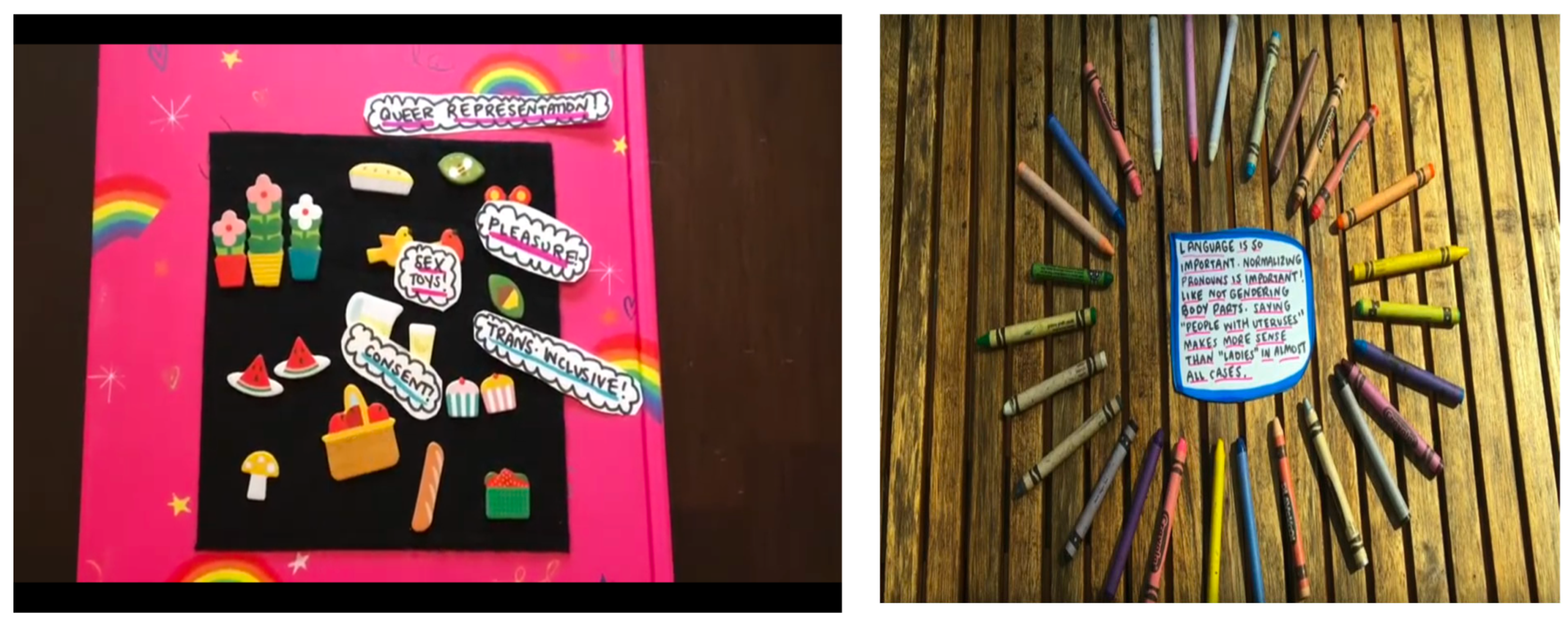
The first cellphilm that Casey and Megan produced, “What was missing from school based sex education” (See
Figure 1, above), highlighted comments about pleasure, masturbation, consent, and the importance of teaching diverse types of sex, relationships, bodies, and conception that are not taught within binary categories of good/bad or female/male. This prompt had high levels of engagement on social media and representing this community feedback was a practice of condensing personal stories and pulling out common themes through inductive coding (
Charmaz & Thornberg, 2021). While the texts in the cellphilms appear as if young people were speaking to one another, the script featured a compilation of community responses from a variety of sources that we put into conversation with one another. When we created this cellphilm, we used toys with imagery such as flowers, bees, and rainbows, creating a queer twist on the common imagery of “the birds and the bees”, making the conversation occur between different characters throughout.
“How can we reflect trans experiences in sex education” (see
Figure 1) featured some important findings about trans-inclusive education from the community feedback. Youth stressed the care and attention that educators must bring to the language used in a sexuality education setting, such as avoiding gendering bodies and reproductive organs and emphasising the lesson of “your body, your rules!” Rather than othering trans experiences as a separate module from “regular” sexuality education, young people shared the urgency in including all genders and sexualities in sex education, and teaching how bodies, genitalia, and sex look different for everyone. We represented these findings creatively in our cellphilm by arranging crayons in a circle, in the order of various pride flags, including the trans flag and the progress flag. Throughout the film, the crayons act as characters outside of a circle to bring these trans experiences to the centre (see
Figure 1).
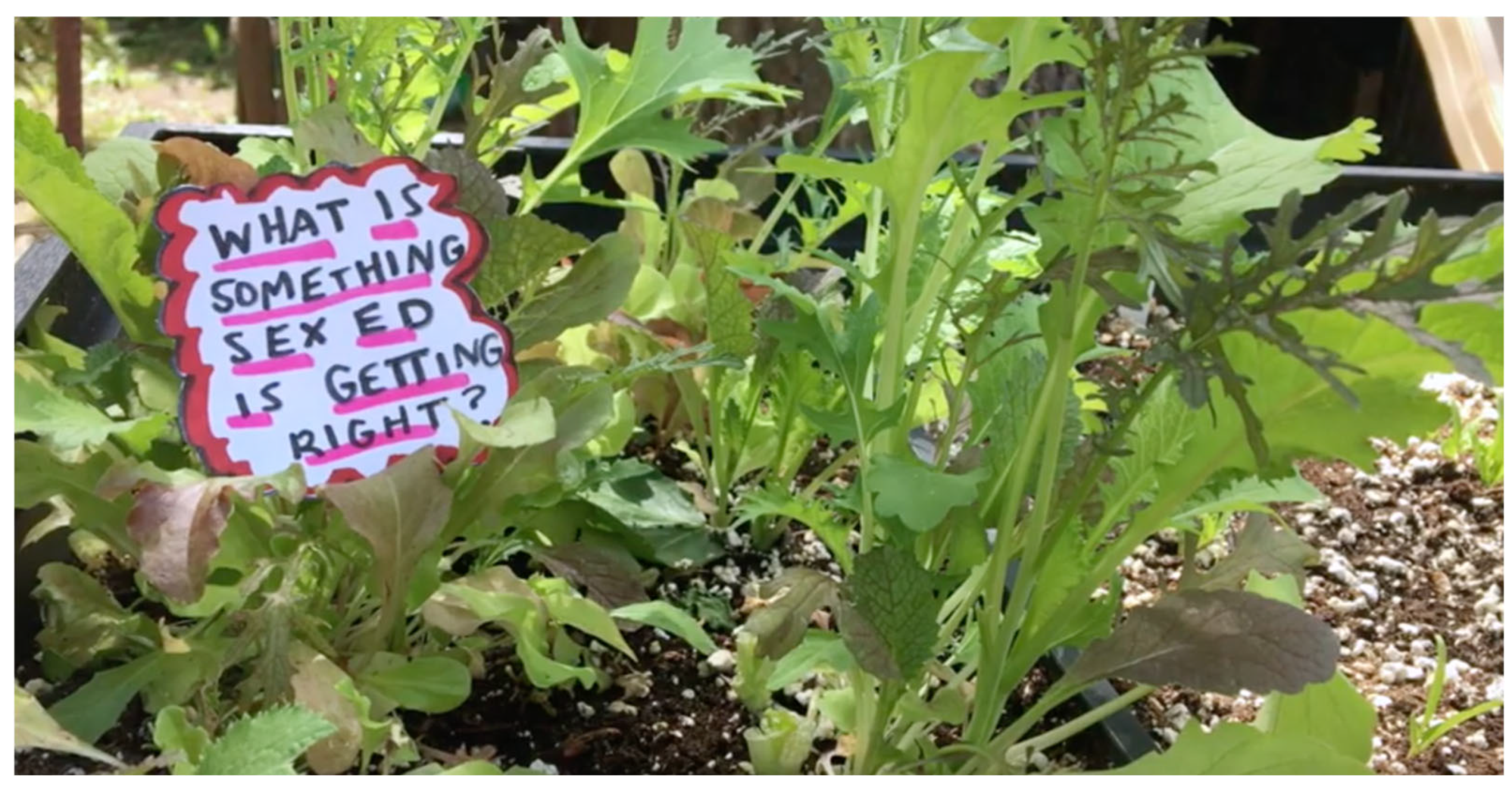
Interestingly, when we posed the question “What is sex ed getting right?” (See
Figure 2), we received no responses from community members. This non-response is, of course, also data in and of itself. We played with this idea in our cellphilm, with ellipses moving around the frame highlighting the silence from youth by animating ellipses around Casey’s garden.
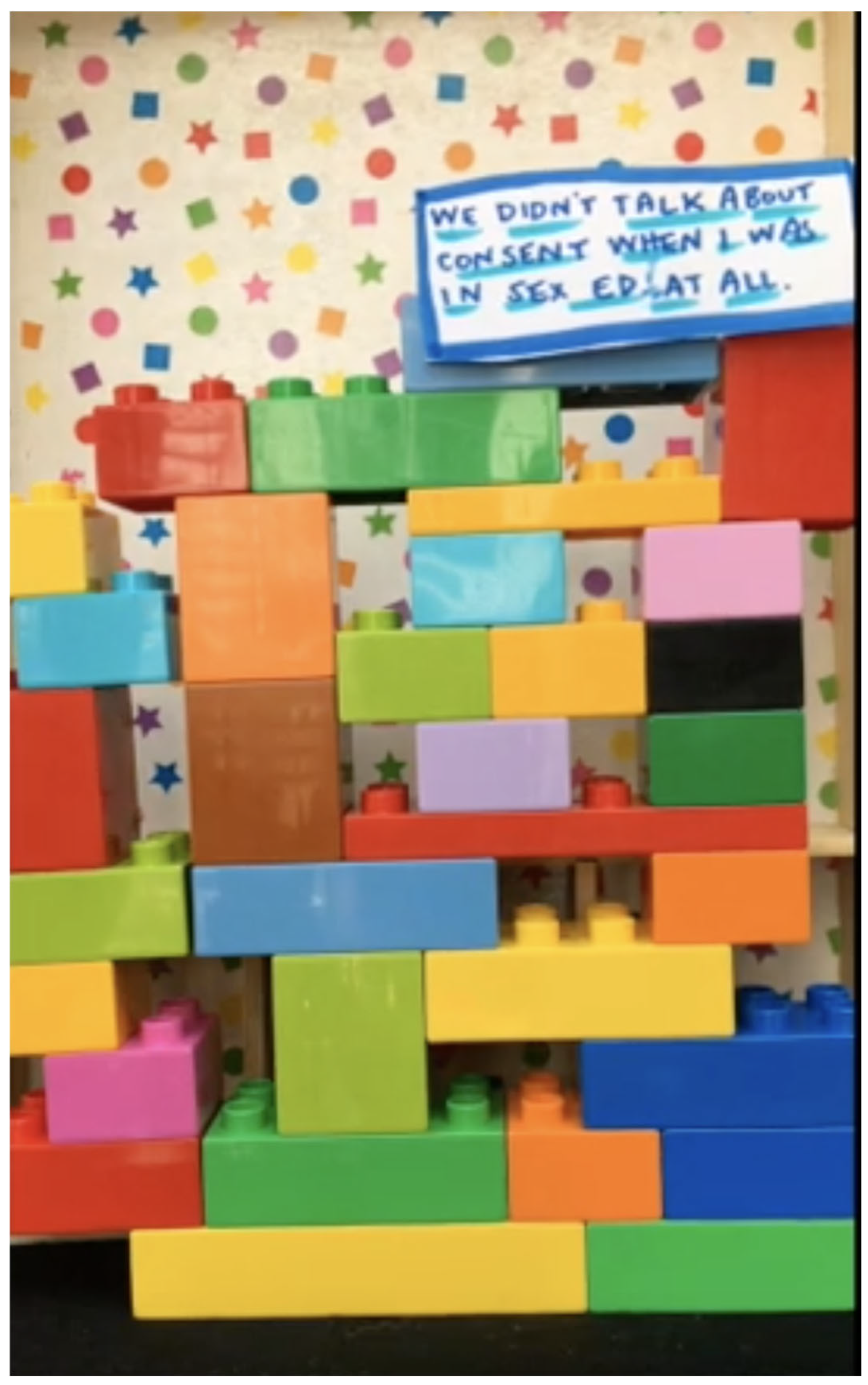
There were, however, plenty of examples of things that sexuality education had gotten wrong! Community members shared stories about misinformation they picked up from their sexuality education, such as virginity as a sign of virtue, that sex before marriage is sinful, heteronormative messaging that sex could only occur between men and women, and that too much sex would change the shape of your genitalia. We represented these findings in our cellphilm with building blocks to represent the building of myths learnt in young people’s previous sexual educational experiences and breaking them down with comprehensive sexuality education, as can be seen in
Figure 3.
The SEQuYN project shaped our practice in a number of ways. As we continued our study, we brought the themes and examples brought forth by young people to an audience of New Brunswick teachers. We used the cellphilms to share with teachers who were teaching sexuality education in New Brunswick, and as a prompt for their inquiry about the supports and barriers to teaching sexuality education in New Brunswick.
10. Aesthetics and Representations to Mobilise Youth Perspectives
Over the course of the Spring and Summer of 2020, we co-created ten cellphilms, seven of which were framed around the aforementioned prompts and online responses from youth, and three of which were educational short films about topics suggested by youth that were geared towards educators (See
Table 1).
The cellphilms range in length from just under a minute to over four minutes. Although the SEQuYN cellphilms were different in setting and content, there are some aesthetic commonalities that we carried throughout, both intentionally and unintentionally. There is an overarching DIY aesthetic to the cellphilms, due to the use of the art production techniques of stop motion animation and collaging. This DIY aesthetic is reflected in the found objects used throughout all ten cellphilms, the socio-cultural context of the early months of the COVID-19 pandemic, as well as the representational choices made by the research team. In doing so, we creatively analysed the data from social media and offered pathways for young people’s experiences to be seen and understood.
Our personal lives and experiences impacted every step of the process, including the items found in the cellphilms. Throughout all the cellphilms, the materials were objects found around our houses. Given the context of the COVID-19 pandemic at the time of creation, we had a low amount of time, energy, and money to put into our creations. Casey, for example, was parenting a toddler without childcare while we created the cellphilms. For simplicity and ease, we used found objects such as old magazines, toys, books, crayons, a vegetable garden, and a diorama to create characters, movement, and backgrounds in the films. For example, Casey’s young child’s building blocks were used in the cellphilm “What is a story about sexual health you learned wasn’t true?” and Megan’s ex-partner’s diorama was featured in the cellphilm “Where do you look when you have questions about sex and sexuality?”.
Another aesthetic similarity between all the cellphilms was that they were all shot outdoors. This can be seen in the moving light and shadows throughout the films, bugs moving in and out of frame, and the flowers and greenery seen moving in some of the backgrounds. At the time of creation, we were all limiting our social circles to our immediate families to reduce the transmission of COVID-19. As a way to find safe(r) artistic and community practice during this time, we met in Casey’s backyard where we could spread out from one another and had fresh air circulating between us. These afternoon sessions became a beacon of queer joy and repair in a dark time where we could collaborate in community without screens between us. This outdoor art-making acted as a manifestation of queer joy. As Casey, colleague JJ Wright and Melissa wrote in 2025:
Queer joy as a form of resistance has materialised in our collaborative teaching, shared writing, researching, raging, laughing, killjoying (
Ahmed, 2017), and in how we hold space. We see queer joy as both a strategy of resistance and a generative feeling (
Tristano, 2024). Queer joy can be just as much of a political tool as it is an affective experience (
Copeland, 2023;
Duran & Coloma, 2023). It is our activism and our slow-burn, long-distance queer yearning.
Whitehead (
2020) asks: If we “search out romance at a pipeline protest—can we have intimacy at doomsday?” (p. 10). The answer, of course, is yes—even when we fail to embody joy ourselves (
Burkholder & Keehn, 2024;
Keehn & Burkholder, 2025) (p. 102).
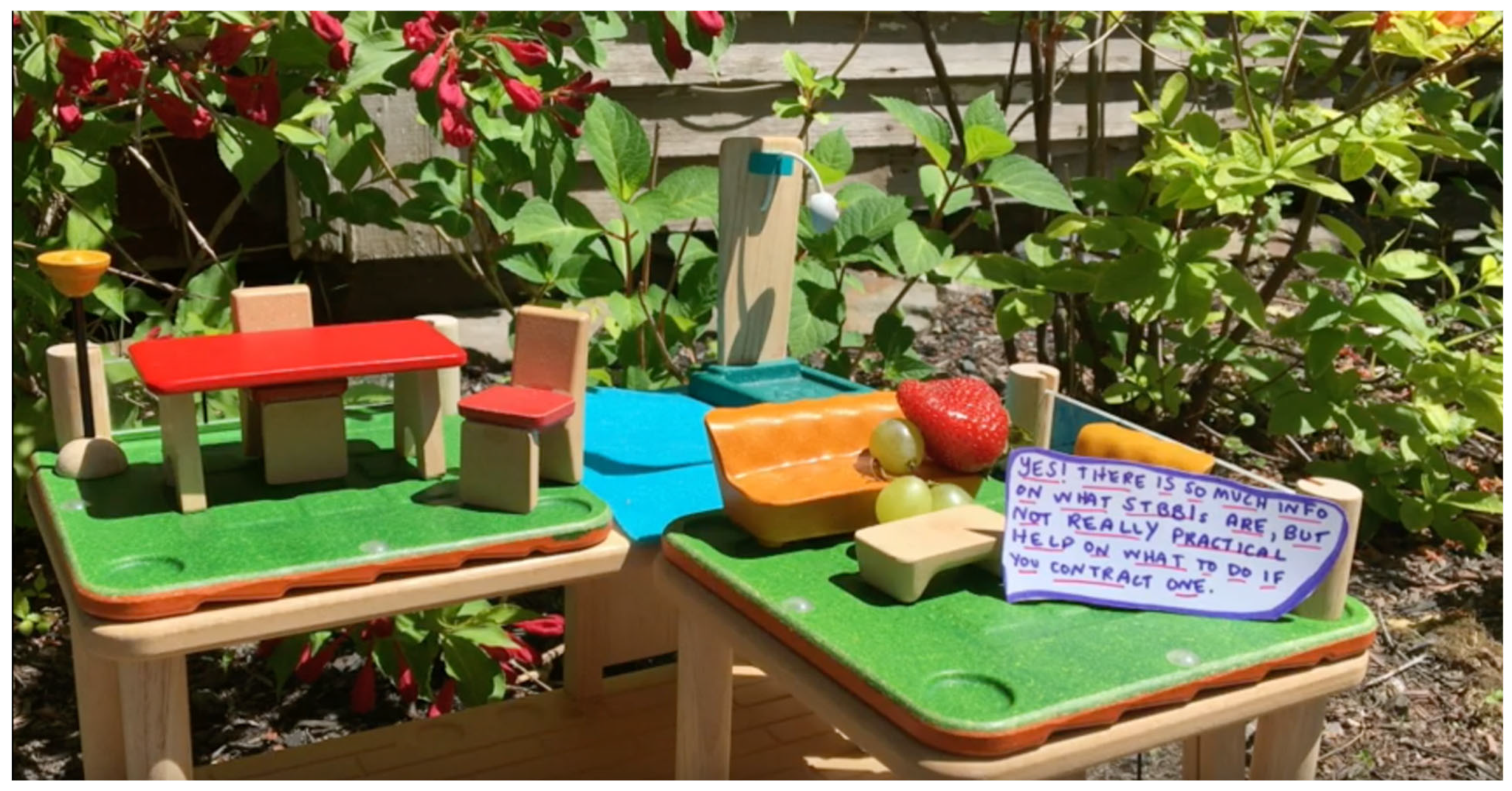
We see queer joy, pleasure, reciprocity and connectedness reflected in the aesthetics of the cellphilms. For example, the strawberry–grape stop motion (
Figure 5) stands out as a playful example of how tactile, frame-by-frame stop-motion animation can be used to construct a simple but engaging narrative from everyday objects. Through stop motion, we highlight how the unfolding story and hands-on decision-making contributed to a sense of creativity and joy during filming. But the film is also full of life. At various points throughout the film, there is a bug moving around within the frame (see 2:40), shadows cast from the plants move along the props, and the wind moves some of the text (see 3:05), despite our best efforts. These imperfect and uncontrollable circumstances made their way into the cellphilms, reminding viewers of the real people and environment that created them. We reflect on these imperfections as an engagement with queer joy in practice.
One intentional aesthetic choice made in the creation of the cellphilms was limiting the use of our own hands and bodies in the visual components of the cellphilms. Though we recognise the ways that our whiteness and queerness shaped the content and creation of these cellphilms, we wanted all 2SLGBTQ+ youth to see themselves represented in the content created. We are well aware of and seek to problematise the overrepresentation of whiteness in media and in sexuality education (
Mulholland, 2021). These choices to foreground objects instead of bodies in response to the literature are also an example of queer joy—thinking intentionally and representing a DIY approach to creating the sex education queer youth desire.
11. Online Zine-Making to Respond to Youth Perspectives
In the summer of 2024, members of the Sexuality NB research team (including Casey, Melissa and collaborator Arlo Beaumont) facilitated an online sexuality education workshop for 2SLGBTQ+ folks during Fredericton’s Pride Week. Sexuality NB was created in response to a province-wide study conducted by Sandra Byers, Lucia O’Sullivan and Casey Burkholder that sought to understand the supports and barriers to teaching sexuality education in New Brunswick. This project highlighted teachers’ experiences and desired supports, which we co-created and widely disseminated on a public website (
https://sexualitynb.org, accessed on 24 August 2026) (see
Byers et al., 2024;
Burkholder & Keehn, 2023,
2024). This online workshop sought to provide community members with the opportunity to reflect on the sex education they experienced and the one that they desired. Throughout the workshop, we centred the notion of queer joy as a form of praxis and repair in sexuality education—centring queerness as desirable, rather than highlighting risk (See
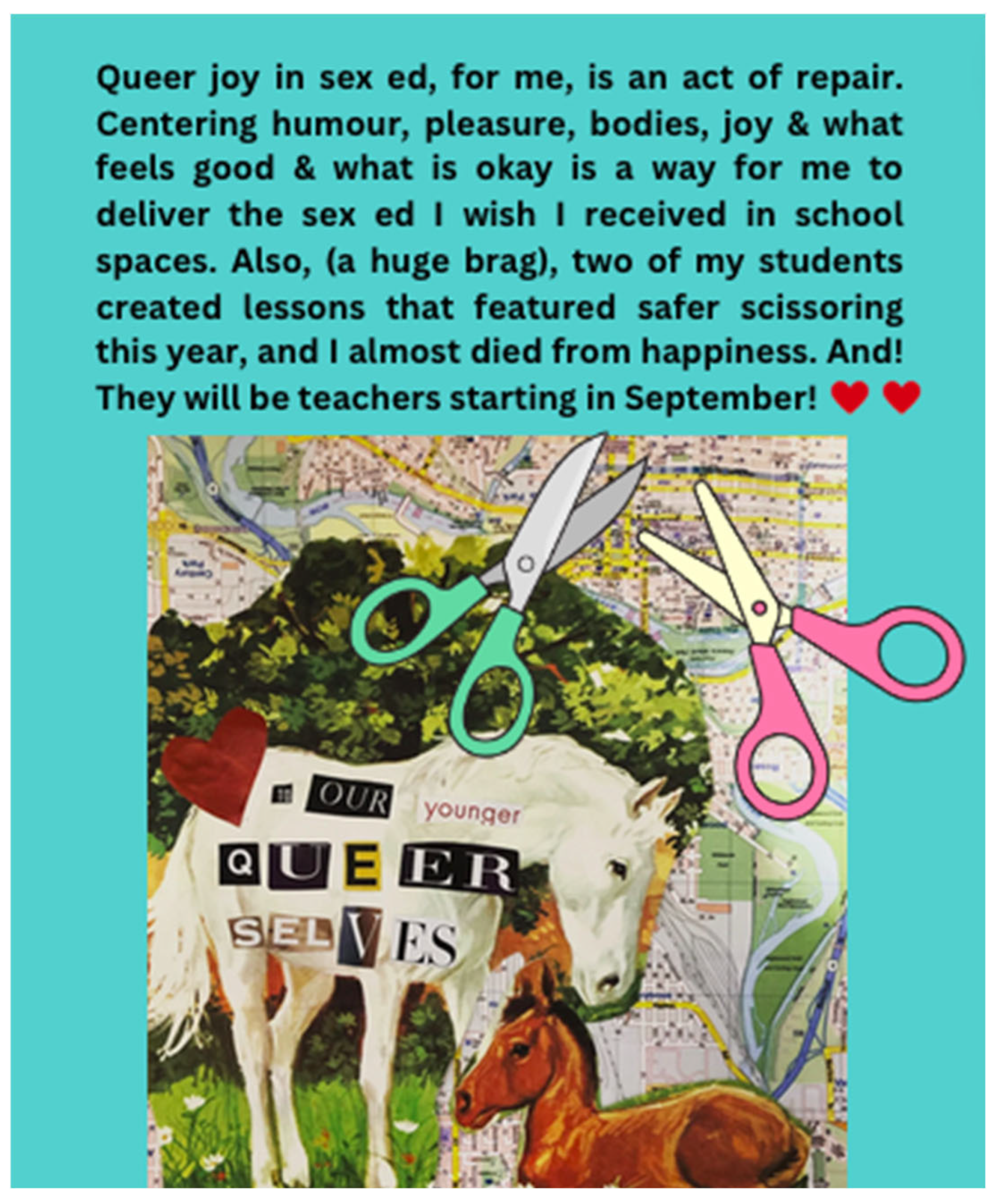
Wright & Falek, 2024). We asked workshop participants to imagine what queer joy might offer to sex education. Specifically, we provided the prompt, “create a zine page about disrupting cis heteronormativity in sex ed. How might we bring more queer joy into these spaces?” Casey used an image that she had collaged in another project that originally responded to the prompt, “what would we like to share with our younger queer selves?” The zine page upcycled this collage, and Casey added two images of scissors (See
Figure 6). She explained the image in the zine’s text, “queer joy in sex ed, for me, is an act of repair. Centering humour, pleasure, bodies, joy & what feels good & what is okay is a way for me to deliver the sex ed I wish I received in school spaces. Also, (a huge brag), two of my students created lessons that featured safer scissoring this year, and I almost died from happiness. And! They will be teachers starting in September! <3 <3”.
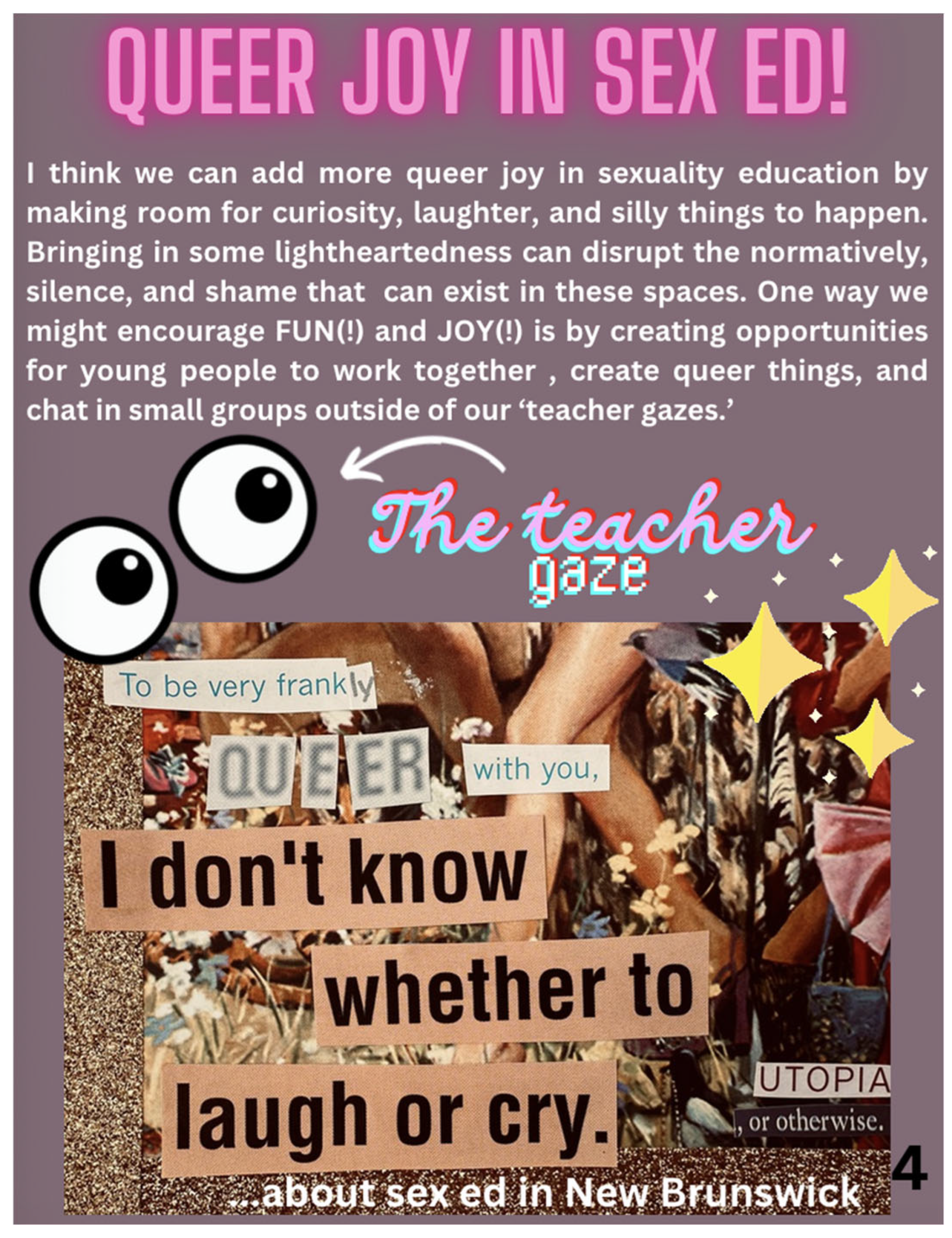
Melissa also created a zine page in response to the prompt, which she titled, “Queer Joy in Sex Ed!” She suggested, “I think we can add more queer joy in sexuality education by making room for curiosity, laughter, and silly things to happen. Bringing in some lightheartedness can disrupt the normativity, silence, and shame that can exist in these spaces. One way we might encourage FUN(!) and JOY(!) is by creating opportunities for young people to work together, create queer things, and chat in small groups outside of our ‘teacher gazes’ (See
Figure 7).”
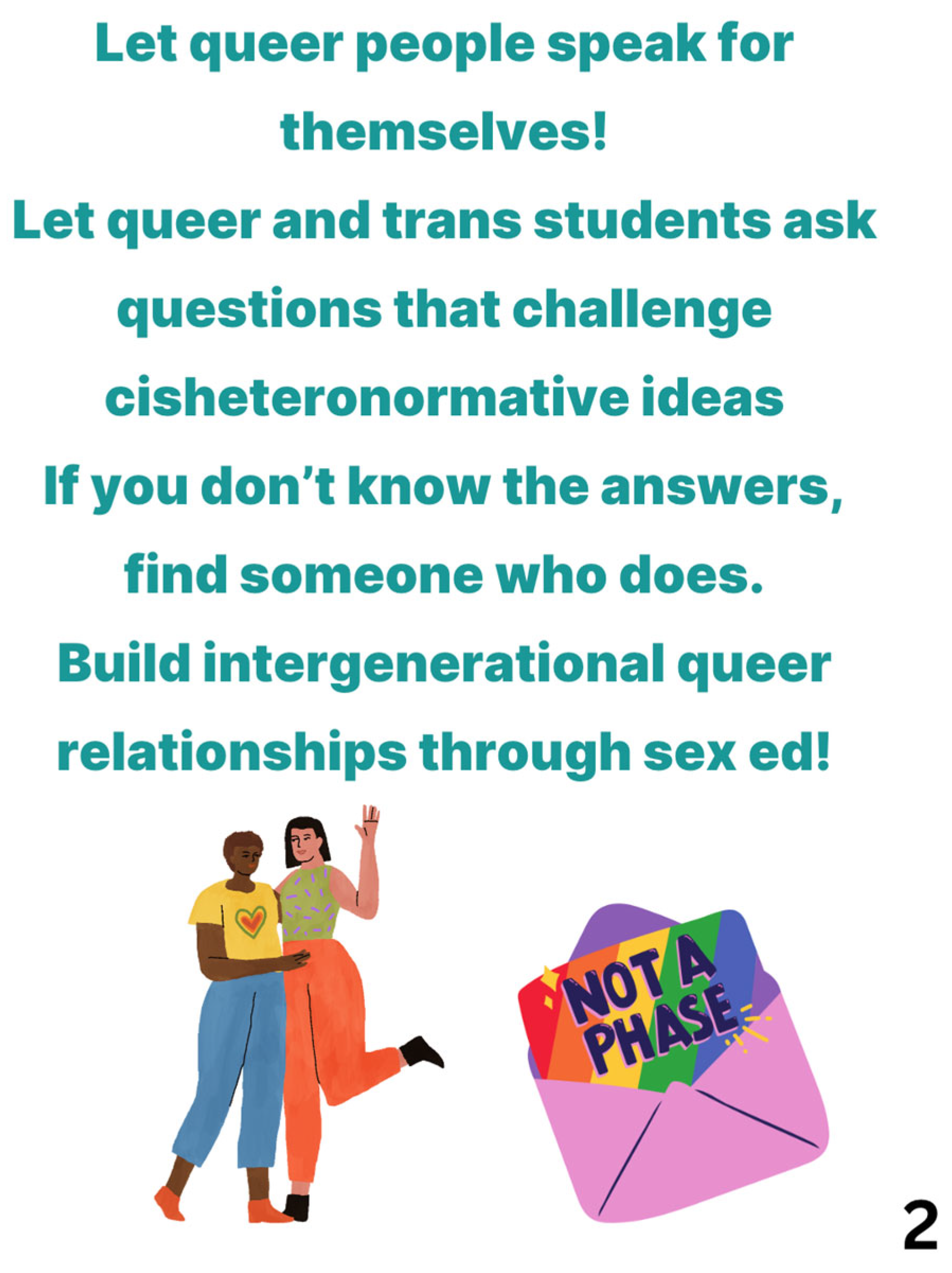
One participant created a zine page and offered this perspective: “Let queer people speak for themselves! Let queer and trans students ask questions that challenge cisheteronormative ideas. If you don’t know the answers, find someone who does. Build intergenerational queer relationships through sex ed!” (see
Figure 8). We see this response as a speak back to the casual effacing of queer and trans sexualities and desires from New Brunswick’s curriculum, but also as a decentring of the teacher-as-expert in the sexuality education classroom, and as a way to share knowledge and resources about sex and sexuality between young people, as a kind of informal but necessary curriculum.
Taken together, the three zine pages describe a kind of sex education that participants and researchers wished we had received as youth. After we produced it, we shared it on Instagram; see:
https://www.instagram.com/p/C9hvSJmOFzt, accessed on 24 August 2026. In this, we see the production of these art pieces as a dreaming forward of a practice that we wish could have existed for ourselves as queer youth. Our positioning is another affordance here; our investment and perspective are central to this work (of representing, of positioning, of mobilising) and that makes this work possible.
12. Tensions and Concluding Thoughts
Our conceptualisation of queer joy situates our analysis within emerging conversations on affect, resistance, and queer futurity (see also
Muñoz, 2019). Our collaboration sought to create short films that could be used in sexuality education within and beyond schools, drawn from youth feedback shared on Facebook, as well as zines co-produced online during a sexuality education workshop. We wanted to share the findings from the cellphilms broadly by using social media—spaces where we know participants are seeking answers in relation to sex and sexuality. We also created the cellphilms and zines so that sexuality education teachers might be able to view them, take in the critiques of 2SLGBTQ+ youth, and perhaps even respond by bringing some of these cellphilms and zines into their own classrooms. Participation was enabled, constrained, and reconfigured across the different stages of the project (through online engagement, cellphilming, and zine-making). From these offerings, we believe that queering sexuality education can involve transformations at multiple levels, including pedagogy, methodology, researcher-participant relationships, power dynamics, and knowledge production and mobilisation.
The knowledge mobilisation process contributes to youth participation, leadership, and agency by creating structured yet flexible spaces where young people can move from being participants to co-creators of knowledge, practice, and action. Rather than treating youth as passive recipients of programming, mobilisation here frames them as active political and cultural agents whose lived experience is a form of expertise. We think this opens possibilities for leadership development that is relational, emergent, and contextually grounded, rather than strictly hierarchical or credential-based. Here too, we acknowledge how we were moved (as researchers, as sex educators) by the young people’s thoughts and production; as researchers, we were transformed through our engagement with young people’s knowledge, experiences, and creative expressions.
At the same time, these possibilities are shaped by significant constraints. Institutional schooling contexts (and transphobic and queerphobic policymaking) often limit youth participation through rigid timelines, risk-averse policies, assessment logics, and uneven access to decision-making power. Even well-intentioned participatory initiatives can reproduce tokenism if youth input is symbolic rather than materially influential (
C. Mitchell et al., 2017). There are also tensions around sustainability and labour in this work—youth participation is frequently dependent on adult facilitation, funding cycles, and institutional priorities that may shift or disappear.
For 2SLGBTQ+ youth specifically, especially in New Brunswick when we were engaging in this work, participation was further shaped by heightened political consciousness. These youth often engage from lived experience of marginalisation and of joy, making participation not only an educational practice but also a form of abundance, care, survival, resistance, and identity-making. However, this also raises ethical tensions around exposure, representation, and emotional labour: whose stories are shared, under what conditions, and for what institutional benefit. Ensuring safety, confidentiality, and meaningful consent becomes central, particularly in school and online contexts where visibility can carry risk.
The structural and institutional context of schooling both enables and constrains this work. Schools can provide access to stable spaces, adult allies, and institutional legitimacy, but they also impose regulatory boundaries that can narrow the scope of youth-led action. Participation is often shaped by what is deemed “appropriate” or “educational,” which can limit more radical or transformative expressions of youth agency. The creative dimension of the cellphilms and zines pushes participation into new directions by opening alternative modes of expression. These approaches can redistribute authority over knowledge production and encourage youth (and broader publics) to engage in ways that are not solely discursive or institutional. However, creativity also introduces complexity: it can be co-opted into institutional narratives of inclusion without altering underlying power relations. We think our collaboration here sits in a productive but unresolved tension between agency and governance, authenticity and mediation, creativity and constraint. Youth participation is not a fixed outcome but an ongoing negotiation shaped by intersecting ethical, institutional, and political dynamics. And we sought to address some of these tensions by mobilising youth knowledge through cellphilms and zines.
But we wonder about the extent to which we may reach teachers in the work. We want to create joyful sexuality education, centring what youth are calling for, and using DIY methods, but recognise that without the curricular space, queer sexualities remain largely absent from New Brunswick classrooms, even when we create resources that respond to 2SLGBTQ+ community members’ own experiences of erasure (See
Burkholder et al., 2023;
Burkholder & Wright, 2024). The growing transphobic, queerphobic, and anti-sex education rhetoric in New Brunswick—fueled by the former Conservative government’s complete panic at any mention of gender and sexuality in classrooms (
Higgs, 2024)—has further complicated efforts for teachers, youth, and researchers to centre queer joy loudly within school-based sexuality education contexts or beyond (see:
Keehn & Burkholder, 2025). We know that teachers have always DIY-ed sexuality education pedagogies amidst all kinds of political contexts, and we think that teachers could absolutely engage their own students in cellphilm and zine production in order to inquire about bodies, relationships, sexual health, and even pleasure. But we also highlight the ways that participants in the zine-making workshop pointed to the possibility of queer joy to offer a sense of repair for the unqueer sex ed that we received in our school-based experiences (including us three authors). And the act of imagining, designing, and putting together the 10 cellphilms in the isolating throes of the Pandemic lockdowns, and the artmaking, too, became a space of queer joy—a “kind of sanctuary” (
Whitehead, 2020, p. 12)—for the research team.
And still, while we acknowledge that the creation of these cellphilms and zines does not ‘solve’ the problem of the sexuality education queer youth need, we do see that the creation of these artworks that centre the experiences of 2SLGBTQ+ youth offer methodological advances. Rather than encapsulating stories and placing them in spaces that are not normally available to youth, we create work for “people who aren’t necessarily essay readers, and people who aren’t necessarily in academic institutions, but who are, or have the potential to be ‘organic intellectuals,’ people who critically think and engage in dialogical exchange wherever they are” (
hooks & Mesa-Bains, 2018, p. xii). There is an opportunity in using cellphilms and zines as a mode of creative data production, analysis, and knowledge mobilisation—creating space for people’s ways of knowing to be understood and shared broadly, in queer and creative ways. Of course, sharing this kind of work in online spaces can also be a challenge because of the ways in which the digital realm provides space for homophobic and transphobic discourses to proliferate (See
Burkholder, 2024), but in our work, and for our audiences, we have found affirming and joyful responses to these cellphilms and the online zine-making workshop, where participants and researchers digitally co-created queer art productions in community during emboldened Conservative aversion to 2SLGBTQ+ youth in schools. Here, we understand knowledge mobilisation not as a linear transfer of knowledge but as an iterative, situated, and relational process. This framing reflects how research knowledge was adapted, translated, and reworked across different audiences, platforms, and contexts. Here too, we highlight the need for anonymity in online youth participation, the affective and interpretive labour undertaken by the research team, constraints within institutional contexts such as schools, and ethical questions surrounding uptake, listening, and institutional readiness to respond to youth needs. In this way, we position our inquiry as contributing to scholarship on youth knowledge mobilisation as a situated practice of “putting knowledge into use,” rather than as a unidirectional dissemination strategy, with knowledge mobilisation as an iterative and multi-directional process serving research as social change with youth. Thinking forward as we live out this increase in parents’ rights discourses and anti-trans panic, we see the critical importance of carving out intentional space for queer and trans youth to come together to share joy and find community through artmaking and collective resistance—creating a kind of queer space where we (queer and trans folks) can chat, share knowledge across generations and to broader publics, and find the sexuality education that we desire and deserve.