
Article

Food Insecurity and Associated Factors Among University Students in Northwest Mexico: Cross-Sectional Surveys Conducted During and After the COVID-19 Pandemic
by
Jorge Luis García-Sarmiento
1,
Verónica López-Teros
1,
Rolando Giovanni Diaz-Zavala
1,
Karla Denisse Murillo-Castillo
1,
Dena María Jesús Camarena-Gómez
2,
Alejandro Monserrat García-Alegría
1 and
Trinidad Quizán-Plata
1,*
1
Department of Chemical and Biological Sciences, University of Sonora, Hermosillo 83000, Sonora, Mexico
2
Accounting Department, University of Sonora, Hermosillo 83000, Sonora, Mexico
*
Author to whom correspondence should be addressed.
Youth 2026, 6(3), 100; https://doi.org/10.3390/youth6030100
Submission received: 1 April 2026 / Revised: 3 July 2026 / Accepted: 3 July 2026 / Published: 24 July 2026

Abstract

Food insecurity is a major public health concern among university students. This cross-sectional study examined factors associated with food insecurity during and after the COVID-19 pandemic among 1864 students (mean age: 20.6 ± 2.9 years) from selected public universities in Northwest Mexico. Data were collected in two cross-sectional survey waves: during the COVID-19 pandemic (n = 1188) and after the pandemic (n = 676). Data were collected through online surveys during the pandemic and face-to-face interviews in the post-pandemic period. Food insecurity was assessed using the Food Insecurity Experience Scale (FIES). Multiple linear regression models were used to identify factors associated with food insecurity and to examine its association with body mass index, perceived stress, sleep quality, and academic performance. Overall, 62.2% of students experienced food insecurity. Food insecurity was higher among students surveyed after the COVID-19 pandemic than among those surveyed during the pandemic (73.7% vs. 55.7%, p < 0.001). During the pandemic, higher food insecurity scores were associated with older age, female sex, indigenous self-identification, living alone, academic discipline, study hours, educational financing, and poorer nutritional behaviors. In the post-pandemic period, indigenous self-identification, living arrangements, academic discipline, and poor nutritional behaviors remained associated with food insecurity. In both periods, food insecurity was associated with higher perceived stress, poorer sleep quality, and lower academic performance (p < 0.05). These findings suggest that food insecurity remains a major concern among university students and indicate the importance of developing culturally appropriate strategies to support vulnerable student populations.

1. Introduction

Food insecurity, defined as limited or uncertain access to sufficient, safe, and nutritious food necessary for healthy growth and well-being, has become an important public health concern among university students (Food and Agriculture Organization of the United Nations [FAO], 2025; Nava-Amante et al., 2021). Although food insecurity was already increasing in higher education settings before the COVID-19 pandemic, the health emergency further intensified this problem and exposed the economic and social vulnerabilities faced by many students (Kötzsche et al., 2023). During and after the pandemic, many university students experienced difficulties accessing adequate food due to rising living costs, disruptions in food supply systems, and reductions in personal or family income (Harper et al., 2023).
Globally, approximately 42% of college students experience some degree of food insecurity. The prevalence is even higher among Latino students, with 85% reporting food insecurity during their college years, while the prevalence reaches 63% among Latino students from single-parent households (Rojas et al., 2023; UNIDOS US, 2024). In Mexico, food insecurity has also emerged as a major concern among university populations. Previous studies have reported that 48% of university students in the eastern region of the country experienced food insecurity, and this prevalence increased to 84% among indigenous students in the southwest region (Sánchez et al., 2025; Cardoso-Sánchez et al., 2018). This situation is associated with a wide range of adverse health and academic outcomes among students, including chronic diseases, poorer self-reported health, higher levels of stress, depression, anxiety, unhealthy eating habits, less balanced diets, and poorer academic performance (Oh et al., 2022; Marshall et al., 2023; Batchelder et al., 2023; Alexiuk et al., 2023; Weaver et al., 2020).
Additionally, food insecurity is associated with behavioral and lifestyle factors, contributing to unhealthy dietary patterns, poorer sleep quality, and consequently lower academic performance (Marshall et al., 2023; Batchelder et al., 2023; Weaver et al., 2020). The factors associated with food insecurity may vary considerably across regions, as they are influenced by cultural, socioeconomic, and contextual conditions (Loofbourrow & Scherr, 2023).
According to the conceptual framework proposed by Habicht et al. (2004), food insecurity can be understood both as a condition influenced by social, economic, and demographic determinants and as a factor associated with health, nutritional, and behavioral outcomes. This framework provides a useful perspective for examining food insecurity among university students, a population that may be particularly vulnerable to economic constraints, academic demands, and lifestyle factors that influence both food access and overall well-being.
Therefore, this study aimed to examine factors associated with food insecurity and its relationship with selected health, psychological, and academic indicators among university students in Northwest Mexico during and after the COVID-19 pandemic, a region where demographic and economic conditions may contribute to greater vulnerability to food insecurity.

2. Materials and Methods

2.1. Study Design

This cross-sectional study employed a sample size calculation for finite population, based on a total population of 51,047 students. Using a 95% confidence level, a 5% margin of error, and an expected prevalence of 42% (Aguilar-Barojas, 2005). The initial sample size of 1428 was structured by 30% to 1864 to improve balance across regions, academic disciplines and sex groups.
To obtain a structured sample, a data collection plan was developed to determine the number of students to be interviewed per undergraduate program. First, the total sample size was distributed across two study regions in Northwest Mexico: Sonora and Sinaloa. Second, six academic disciplines were considered, encompassing 66 undergraduate programs in Sonora and 36 in Sinaloa across 12 public universities, to estimate the number of participants required for each program. Finally, a target sample size was established for each undergraduate program to achieve the predefined overall sample size.
Based on student enrollment lists, a simple randomization procedure was initially performed to select participants from each undergraduate program. However, this approach yielded a response rate of only 9.6%, leading to the implementation of broader recruitment strategies, including dissemination of digital invitations through social media platforms and institutional websites. Because this sampling strategy did not initially achieve comparable participation across academic disciplines or sex, a second targeted recruitment phase was conducted focusing on the underrepresented academic disciplines and sex groups. This strategy improved sample balance across these characteristics and strengthened the representativeness and generalizability of the study findings. Ultimately, a total of 1864 university students were surveyed.
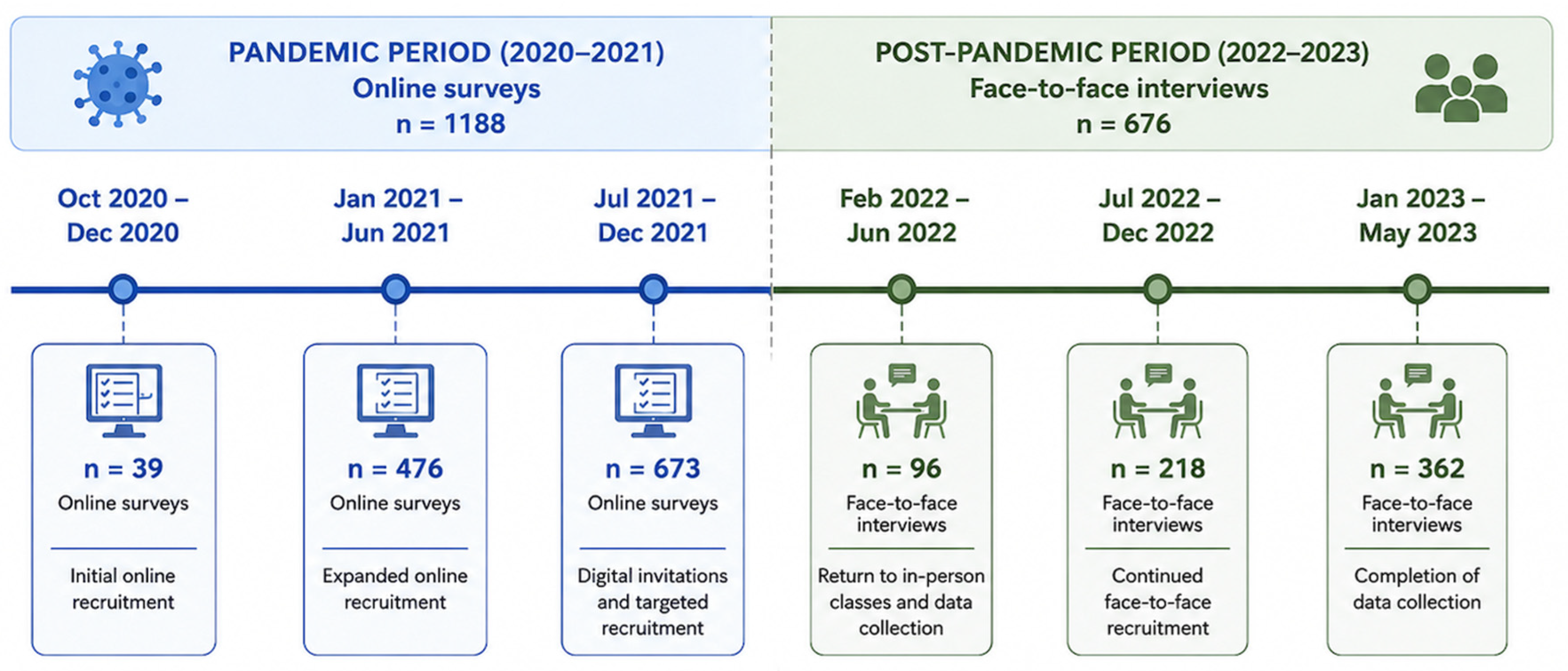
Given that the study began in October 2020 during the peak of the COVID-19 health emergency in Mexico, when all educational activities were being conducted online, the research protocol was adapted for digital implementation. Participants were recruited from selected universities across six academic disciplines: humanities and fine arts, economic and administrative sciences, social sciences, engineering, exact and natural sciences, and biological and health sciences. Once educational activities resumed in person in February 2022, following national provisions for the reactivation of educational activities in Mexico, particularly within universities in Northwest Mexico (Diario Oficial de la Federación, 2021; Universidad de Sonora, 2022), data collection was conducted through face-to-face interviews until the target sample size was reached. During this stage, the same instruments, interview procedures, and scoring protocols previously implemented through online data collection during the pandemic period were maintained for in-person interviews. This approach ensured methodological continuity and scientific rigor throughout the study, which employed a mixed-mode data collection strategy. The sampling strategy ensured representation of all educational programs offered by the participating institutions (Figure 1).
The study was conducted in accordance with the Declaration of Helsinki, and the protocol was approved by the Ethics Committee of the University of Sonora, Mexico (CEI-UNISON 06/2021). Written informed consent was obtained from all participants before they completed either the online survey or the face-to-face interview. The students did not receive any kind of incentive to take part in the study.

2.2. Data Collection

2.2.1. Food Insecurity Experience Scale (FIES)

To assess food insecurity, the Food Insecurity Experience Scale (FIES) was used. This scale is based on 8 dichotomous (yes/no) questions, with each affirmative response assigned a value of one point. The total score ranges from 0 to 8 and is used to classify individuals according to their level of food insecurity. A score of 0 indicates food security; scores from 1 to 3 indicate mild food insecurity; scores from 4 to 6 indicate moderate food insecurity; and scores of 7 or 8 indicate severe food insecurity (Food and Agriculture Organization of the United Nations, 2018).
This scale has been previously validated in three Spanish-speaking countries, including Mexico, through psychometric comparison using the Rasch model to calculate the relative severity of each item (INFIT = 0.7–1.3). No c-DIF values above 1.0 logit were observed in the comparison between men vs. women and 87% of the items showed c-DIF below 0.5 logit. These assessments showed that the scale meets the required attributes and is a valid statistical instrument for food security measurement in Spanish-speaking populations (Garzón-Orjuela et al., 2018). The FIES demonstrated good internal consistency in the present sample (Cronbach’s α = 0.87).

2.2.2. Socioeconomic, Demographic and Nutritional Survey

This study employed a 22-item instrument to evaluate socioeconomic and demographic characteristics. Nutritional knowledge and practices were assessed using a 29-item adapted tool based on FAO guidelines, measuring knowledge of nutrition topics and behavioral factors, including attitudes toward nutritional risk, perceived benefits, and barriers to optimal practices. The 29-item instrument is divided into two dimensions: knowledge and behaviors. Responses were dichotomized as adequate or inadequate, with cumulative scores reflecting overall competency (higher scores indicating better knowledge or behaviors) (Fautsch & Glasauer, 2014).

2.2.3. Perceived Stress Scale

The Perceived Stress Scale (PSS) was administered to evaluate participants’ subjective assessment of stressful life situations. This 14-item instrument utilizes a 5-point Likert scale (ranging from “never” to “very often”), yielding total scores from 0 to 56, where higher scores indicate greater stress perception. Based on established cut-offs, scores were categorized as: no perceived stress (<19), mild stress (19 to 28), moderate stress (29 to 38), and severe stress (39 to 56) (Cohen et al., 1983).
The Spanish version of the PSS was culturally adapted and validated in a Mexican population by Ramírez and Hernández (2007) using a random sample of university students in Mexico. The scale showed satisfactory internal reliability (Cronbach’s α = 0.83), while confirmatory factor analysis confirmed the adequacy of the original two-factor structure. Factor 1 accounted for 42.8% of the explained variance and Factor 2 for 53.2%, with fit indices supporting adequate construct validity of the instrument. The PSS demonstrated good internal consistency in the present sample (Cronbach’s α = 0.83).

2.2.4. Pittsburgh Sleep Quality Index (PSQI)

The Pittsburgh Sleep Quality Index (PSQI) was employed to evaluate sleep quality and disturbances during the previous month. This 19-item self-report instrument utilizes a 0–3 scoring scale for each item, generating a global score ranging from 0 to 21, where higher scores reflect poorer sleep quality. For analytical purposes, sleep quality was dichotomized into low sleep disturbance (scores ≤ 5) and high sleep disturbance (scores > 5) (Buysse et al., 1989).
The PSQI has been validated in Mexican populations, demonstrating satisfactory psychometric properties, including adequate internal consistency (Cronbach’s α = 0.78) and significant correlations between component scores and the global score (r = 0.53–0.77) (Jiménez-Genchi et al., 2008). In the original validation study, the instrument demonstrated Cronbach’s α = 0.83, test–retest reliability of r = 0.85, sensitivity of 89.6%, and specificity of 86.5% for distinguishing between poor and good sleepers (Buysse et al., 1989). The PSQI demonstrated acceptable internal consistency in the present sample (Cronbach’s α = 0.68).

2.2.5. Academic Score

Through a semi-structured survey, students were asked about their official cumulative average grade at the time of the survey. Following the Mexican higher education grading system, academic achievement was measured on a 0–100 scale, where scores ≥ 60 represent passing grades.

2.2.6. Nutritional Status

Nutritional status was evaluated using self-reported weight and height measurements to calculate body mass index. To validate self-report accuracy, a randomly selected subsample (18% of participants) underwent anthropometric measurements by trained researchers. Body mass index classifications followed World Health Organization standard cut-off points (World Health Organization, 2021).

2.3. Statistical Analysis

Analysis began with exploratory descriptive statistics, presenting continuous variables as means ± standard deviations and categorical variables as frequencies (percentages). Multiple linear regression models were used to assess factors associated with food insecurity during and after the COVID-19 pandemic. Regression coefficients (β) and their corresponding 95% confidence intervals (95% CI) were estimated. Demographic, socioeconomic, educational, academic, and nutritional behavior variables were considered as potential factors associated with food insecurity based on theoretical relevance and evidence from previous studies.
The analytical strategy was guided by the conceptual framework proposed by Habicht et al. (2004), which conceptualizes food insecurity as both a consequence of socioeconomic determinants and a predictor of health-related outcomes. Accordingly, ten multiple regression models were developed and stratified by study period, with five models corresponding to the pandemic period and five to the post-pandemic period.
Within each period, one model examined factors associated with food insecurity, using the FIES score as the dependent variable. Four additional models assessed the association between food insecurity and body mass index, perceived stress, sleep quality, and academic performance, with the FIES score included as the primary explanatory variable. All models were adjusted for potential confounding variables identified through the literature review and the conceptual framework.
Model diagnostics included assessment of multicollinearity using the variance inflation factor (VIF < 10) and evaluation of potential interaction effects. The assumptions of linear regression were evaluated using residual diagnostic plots, including histograms, normal Q–Q plots, and residual-versus-fitted value plots. Although the FIES score distribution was positively skewed, with a greater concentration of observations at lower food insecurity scores, residuals were acceptable across both pandemic and post-pandemic models. Diagnostic analyses indicated adequate linearity, approximate normality of residuals, homoscedasticity, and independence of errors, with no substantial violations of model assumptions, supporting the suitability of the analytical approach.
Because the FIES score reflects the severity of food insecurity along a continuum established through the Rasch measurement model, it was analyzed as a quantitative indicator of food insecurity severity. This approach enabled the examination of gradations in food insecurity experiences across participants and maximized the use of information captured by the scale, rather than restricting the analysis to categorical classifications. Missing data accounted for 2.2% of the dataset and were handled through complete-case analysis. All analyses were performed using SPSS software version 27.

3. Results

3.1. Food Insecurity and General Characteristics

Of the total sample of 1864 students, 97.8% (n = 1824) completed all sections of the surveys. Overall, 1188 students participated in the study during the pandemic, and 676 participated in the post-pandemic period. The mean age was 20.6 ± 2.9 years. The overall prevalence of food insecurity was 62.2% (n = 1160) of participants, distributed across severity levels: mild (29.2%, n = 545), moderate (21.9%, n = 408), and severe (11.1%, n = 207), while females represented 63% (n = 639) of students experiencing food insecurity (Table 1).
Food insecurity was reported by 55.7% of students surveyed during the pandemic period and by 73.7% of those surveyed during the post-pandemic period. The difference in prevalence between the two study periods was statistically significant (χ2 = 59.02, p < 0.001).

3.2. Anthropometric and Health Indicators

To evaluate the validity of self-reported anthropometric data, body mass index (BMI) values calculated from self-reported weight and height were compared with BMI values obtained through direct anthropometric measurements in a subsample representing 18% of the study population. A Mann–Whitney U test was conducted to assess differences in BMI values derived from the two measurement methods. No statistically significant differences were found between the two methods (p = 0.610).
The mean body mass index (BMI) of the students was 24.8 ± 4.8 kg/m2. Mean BMI was 24.7 ± 4.9 kg/m2 among females and 25.0 ± 4.9 kg/m2 among males. Overall, 27.7% (n = 517) of students were classified as overweight, 13.8% (n = 258) as obese, and 6.5% (n = 122) as underweight. Elevated stress levels were reported by 84.6% (n = 1577) of students, while 33.5% (n = 624) met the criteria for poor sleep quality.

3.3. Characteristics Associated with Food Insecurity

During the pandemic period, food insecurity was positively associated with age (β = 0.104, p < 0.001), female sex (β = 0.439, p = 0.005), indigenous self-identification (β = 0.865, p = 0.006), and living alone (β = 0.862, p = 0.042). In addition, enrollment in programs related to Humanities and Fine Arts (β = 0.718, p = 0.047), Social Sciences (β = 0.539, p = 0.022), or Biological and Health Sciences (β = 0.613, p = 0.015) was associated with higher food insecurity scores. Likewise, a higher number of study hours per week (β = 0.010, p = 0.004), financing studies through employment (β = 1.085, p < 0.001) or loans (β = 1.841, p = 0.010) were associated with higher food insecurity scores. Conversely, higher nutritional behavior scores were associated with lower levels of food insecurity (β = −0.191, p < 0.001). During the post-pandemic period, indigenous self-identification and enrollment in the previously identified academic programs showed significant associations with food insecurity. In addition, living with a roommate (β = 1.377, p < 0.001), living in a student residence (β = 2.012, p < 0.001), and living alone (β = 2.026, p < 0.001) were associated with an increase in food insecurity scores (Table 2).
During the pandemic, food insecurity showed positive association with perceived stress (β = 0.887, p < 0.001), indicating that students with higher food insecurity reported substantially greater stress levels. Similarly, food insecurity was significantly associated with poorer sleep quality (β = 0.318, p < 0.001). Academic performance showed a significant inverse association with food insecurity (β = −0.059, p < 0.001). However, no significant association was observed between food insecurity and body mass index during the pandemic period. This lack of association persisted during the post-pandemic period (Table 3).

4. Discussion

Food insecurity constituted a significant concern among university students in Northwest Mexico, as more than half of the participants experienced some degree of food insecurity. A higher prevalence of food insecurity was observed among students surveyed during the post-pandemic period compared with those surveyed during the pandemic period. Although the cross-sectional design and the use of independent samples do not allow conclusions regarding temporal changes, this difference may reflect the different social and economic contexts in which data were collected. During the post-pandemic period, students may have faced additional challenges related to the rising cost of living, food inflation, increased housing expenses, transportation costs, and the return to face-to-face academic activities, particularly among those living away from their families. Nevertheless, the findings emphasize that food insecurity remained highly prevalent across both study contexts and continued to affect a substantial proportion of university students (FAO et al., 2023; Mialki et al., 2021).
Several sociodemographic characteristics were associated with food insecurity. Indigenous self-identification was consistently associated with higher food insecurity scores during both study periods. The increased risk of food insecurity observed among students who self-identified as Indigenous may be explained, in part, by structural conditions that disproportionately affect this population. Many Indigenous students must relocate from rural and geographically isolated communities to urban centers to pursue higher education, which often entails separation from family support networks and additional expenses related to housing, food, transportation, tuition, and educational materials. These financial demands may place considerable pressure on limited household resources and increase the likelihood that food expenditures are reduced in order to meet other essential academic and living costs. Furthermore, longstanding social and economic inequalities, barriers to educational opportunities, unequal access to financial support programs, and experiences of social exclusion may further exacerbate food insecurity among Indigenous university students (Centro de Investigación en Alimentación y Desarrollo, 2022; Instituto Nacional de los Pueblos Indígenas, 2017). Likewise, students living away from their families—including those living alone, with roommates, or in student residences—showed greater food insecurity. Family support may represent an important source of economic assistance for university students, particularly in relation to food access and daily living expenses. In this context, food insecurity should not be viewed solely as an individual-level condition but rather as the result of broader structural disadvantages that shape access to economic, educational, and food resources. This interpretation is consistent with broader evidence suggesting that food insecurity should be understood not only as limited access to food but also as a reflection of structural inequalities that restrict access to educational opportunities, economic resources, and social support. In marginalized populations, food insecurity is often intertwined with broader experiences of social exclusion and limited opportunities, reinforcing the need to address its underlying social determinants rather than focusing exclusively on food access (Khofi et al., 2024).
To our knowledge, few studies have examined food insecurity across academic disciplines among university students. The results show that Humanities and Fine Arts, Social Sciences, and Biological and Health Sciences were found to be positively associated with food insecurity when compared to economic and administrative sciences. Further research is needed to better understand the factors that may explain differences in food insecurity across academic disciplines.
During the pandemic period, spending more hours studying was associated with higher food insecurity scores. Although the reasons underlying this association cannot be determined from the present study, it may reflect the academic and economic demands faced by university students during this period. In addition, food insecurity was associated with lower academic performance, a finding that is consistent with previous studies reporting a relationship between food insecurity and academic achievement among university students (Royer et al., 2021; Weaver et al., 2020). Although causal relationships cannot be established, these findings suggest that food insecurity and academic challenges frequently coexist within the university setting.
Among the surveyed students, 15.4% relied primarily on employment to finance their studies, and this characteristic was associated with higher food insecurity scores. Students who finance their education through paid employment may face additional economic pressures related to tuition, housing, transportation, and other living expenses, potentially reducing the resources available for food purchases (O’Mahony et al., 2024). Similarly, students who relied on loans or credit also exhibited greater vulnerability to food insecurity. Although financial aid programs and scholarships are available within the Mexican higher education system, these forms of support may not fully cover students’ basic needs, particularly among those without family support. Therefore, strengthening financial assistance programs that incorporate living and food expenses may represent an important strategy to support food security and academic continuity among economically vulnerable students.
Higher nutritional behavior scores were associated with lower food insecurity scores. Similar findings have been reported in previous studies, where greater nutrition knowledge and healthier dietary practices were associated with lower levels of food insecurity (Rivera et al., 2019). In our study, only 6.7% of students reported receiving a food scholarship, suggesting limited institutional support for meeting students’ nutritional needs. Although causal relationships cannot be inferred, these findings underscore the importance of nutrition education and the promotion of healthy eating behaviors as part of broader strategies aimed at improving food security among university students. Access to food scholarships, among other forms of institutional support, may represent an important component in promoting healthier nutritional behaviors by reducing financial barriers to adequate food intake and facilitating healthier food choices. Given that healthier nutritional behaviors were associated with lower levels of food insecurity, strengthening these initiatives may contribute to improving food security and, ultimately, support students’ academic performance and overall well-being.
Finally, food insecurity was associated with higher perceived stress and poorer sleep quality, findings that are consistent with previous studies conducted among university students (Oh et al., 2022; Batchelder et al., 2023). According to the conceptual framework proposed by Habicht et al. (2004), food insecurity may be examined in relation to health and psychological indicators, including stress and sleep quality. In the present study, students with higher food insecurity scores also reported higher stress levels and poorer sleep quality, suggesting the coexistence of these conditions within the university population.
This study has certain limitations that should be considered in future research. First, due to its cross-sectional design, causal relationships cannot be established between food insecurity and the sociodemographic, economic, nutritional, psychological, and health-related characteristics evaluated. Second, although a representative sample size was estimated, probability sampling could not be fully achieved because of the public health restrictions in place during part of the study period. Therefore, the findings should be interpreted with caution and may not be generalizable to all university student populations. Third, the use of different data collection modes (online surveys during the pandemic period and face-to-face interviews during the post-pandemic period) may have introduced response-related differences due to the possible effect of the mode of survey administration. Therefore, comparisons between study periods should be interpreted with caution. Finally, although the prevalence of food insecurity was higher during the post-pandemic period, comparisons between study periods should be interpreted with caution because the repeated cross-sectional design does not allow changes over time to be assessed at the individual level. In addition, because data were collected between 2020 and 2023, the findings should be interpreted in light of the socioeconomic context during that period.
Despite these limitations, this study provides valuable evidence on the factors associated with food insecurity among university students in Northwest Mexico. The findings contribute to a better understanding of the social, academic, economic, nutritional, and psychological characteristics associated with food insecurity in this population. These results may help inform the development of prevention and intervention strategies aimed at reducing food insecurity and supporting student well-being.

5. Conclusions

Food insecurity was prevalent among university students in Northwest Mexico and was associated with sociodemographic, academic, economic, and nutritional characteristics across the study periods. In addition, food insecurity was associated with higher perceived stress, poorer sleep quality, and lower academic performance. Overall, the findings suggest the need for universities and policymakers to develop comprehensive strategies that address the economic, nutritional, and psychosocial needs of students, particularly those in vulnerable circumstances.
Institutional actions should be strengthened through the expansion of food scholarships, food voucher programs, campus food pantries, nutrition support services, and targeted assistance for Indigenous students and those studying away from their place of origin. Addressing food insecurity within the university setting may contribute not only to safeguarding the right to food but also to promoting better health, well-being, and academic retention among university students.

Author Contributions

T.Q.-P. and J.L.G.-S. conceptualization; V.L.-T., K.D.M.-C., R.G.D.-Z., D.M.J.C.-G. and A.M.G.-A. methodology and investigation; Data curation and formal analysis, J.L.G.-S. and T.Q.-P.; Writing—original draft, J.L.G.-S. and T.Q.-P.; Writing—review & editing, All authors. All authors have read and agreed to the published version of the manuscript.

Funding

This work was supported by the Interdisciplinary Faculty of Biological Sciences and Health, the Department of Chemical-Biological Sciences and the General Academic Secretariat of the University of Sonora. Also by the National Council of Humanities, Sciences and Technologies (CONAHCyT) through a scholarship received by the first author for postgraduate studies (scholarship 775984).

Institutional Review Board Statement

The study was conducted according to the guidelines established in the Declaration of Helsinki, and all procedures involving human subjects were approved by the Ethics Committee of the University of Sonora, Mexico (CEI-UNISON 06/2021). This study does not have any harmful effect on the environment, or on animal or human species.

Informed Consent Statement

Written informed consent was obtained from all participants.

Data Availability Statement

Data are available from the corresponding author upon reasonable request due to ethical restrictions.

Acknowledgments

We would like to thank the Interdisciplinary Faculty of Biological Sciences and Health and the Department of Chemical-Biological Sciences of the University of Sonora for technical assistance, and all the universities and students who participated in this work.

Conflicts of Interest

The authors declared no potential conflicts of interest with respect to the research, authorship, and/or publication of this article.

References

  1. Aguilar-Barojas, S. (2005). Fórmulas para el cálculo de la muestra en investigaciones de salud [Formulas for sample size calculation in health research]. Salud en Tabasco, 11(1–2), 333–338. [Google Scholar]
  2. Alexiuk, T., Pilli, B., Hinds, A., Urquia, M., & Slater, J. (2023). Food insecurity, nutrition insecurity, and self-reported health among newcomer Manitoba youth: A cross-sectional study. Ecology of Food and Nutrition, 62(1–2), 3–20. [Google Scholar] [CrossRef] [Scilit] [PubMed]
  3. Batchelder, H. R., Drake, C., Johnson, T., Alfaro, J. M., Phillips, R. G., Szigethy, T., DelVecchio, M., Zhang, K., & Snyderman, R. (2023). Risk factors of food insecurity among students at diverse post-secondary education institutions: A cross-sectional examination. Journal of American College Health, 73(3), 1222–1231. [Google Scholar] [CrossRef] [Scilit] [PubMed]
  4. Buysse, D. J., Reynolds, C. F., Monk, T. H., Berman, S. R., & Kupfer, D. J. (1989). The Pittsburgh sleep quality index: A new instrument for psychiatric practice and research. Psychiatry Research, 28(2), 193–213. [Google Scholar] [CrossRef] [Scilit] [PubMed]
  5. Cardoso-Sánchez, L. I., Vaquero-Vera, A., Gutiérrez-Moguel, N. V., & Acosta-Chí, Z. A. (2018). Sobrepeso y obesidad, anemia e inseguridad alimentaria en estudiantes de la Universidad de la Cañada: Un estudio descriptivo [Overweight and obesity, anemia, and food insecurity among students at Universidad de la Cañada: A descriptive study]. Salud y Administración, 5(15), 3–13. [Google Scholar]
  6. Centro de Investigación en Alimentación y Desarrollo. (2022). Dieta, inseguridad alimentaria y estado de nutrición en la población indígena de Sonora. Available online: https://www.ciad.mx/dieta-inseguridad-alimentaria-y-estado-de-nutricion-en-la-poblacion-indigena-de-sonora/ (accessed on 16 June 2026).
  7. Cohen, S., Kamarck, T., & Mermelstein, R. (1983). A global measure of perceived stress. Journal of Health and Social Behavior, 24(4), 385–396. [Google Scholar] [CrossRef] [Scilit]
  8. Diario Oficial de la Federación. (2021). ACUERDO número 23/08/21 por el que se establecen diversas disposiciones para el desarrollo del ciclo escolar 2021–2022 y reanudar las actividades del servicio público educativo de forma presencial, responsable y ordenada [Agreement No. 23/08/21, which establishes various provisions for the development of the 2021–2022 academic cycle and for the resumption of public educational activities through an in-person, responsible, and orderly modality]. Available online: https://www.dof.gob.mx/nota_detalle_popup.php?codigo=5627244 (accessed on 27 May 2026).
  9. FAO, IFAD, UNICEF, WFP & WHO. (2023). The state of food security and nutrition in the world 2023. Available online: https://openknowledge.fao.org/items/445c9d27-b396-4126-96c9-50b335364d01 (accessed on 28 May 2026).
  10. Fautsch, Y., & Glasauer, P. (2014). Guidelines for assessing nutrition-related knowledge, attitudes and practices. Available online: https://www.fao.org/4/i3545e/i3545e00.htm (accessed on 20 September 2020).
  11. Food and Agriculture Organization of the United Nations. (2018). Food insecurity experience scale (FIES). Available online: https://www.fao.org/measuring-hunger/access-to-food/about-the-food-insecurity-experience-scale-(fies)/en (accessed on 15 September 2020).
  12. Food and Agriculture Organization of the United Nations (FAO). (2025). Hunger and food security. Available online: https://www.fao.org/hunger/en (accessed on 7 April 2025).
  13. Garzón-Orjuela, N., Melgar-Quiñónez, H., & Eslava-Schmalbach, J. (2018). Escala basada en la experiencia de inseguridad alimentaria (FIES) en Colombia, Guatemala y México. Salud Pública de México, 60(5), 510–519. [Google Scholar] [CrossRef] [Scilit] [PubMed]
  14. Habicht, J. P., Pelto, G., Frongillo, E., & Rose, D. (2004). Conceptualization and instrumentation of food insecurity. In Workshop on the measurement of food insecurity and hunger (Vol. 15). National Academy Press. [Google Scholar]
  15. Harper, K., Bode, B., Gupta, K., Terhaar, A., Baltaci, A., Asada, Y., & Lane, H. (2023). Challenges and opportunities for equity in US school meal programs: A scoping review. Nutrients, 15(17), 3738. [Google Scholar] [CrossRef] [Scilit] [PubMed]
  16. Instituto Nacional de los Pueblos Indígenas. (2017). Etnografía del pueblo seri (konkaak/comca’ac) de Sonora. Available online: https://www.gob.mx/inpi/articulos/seris-konkaak (accessed on 16 June 2026).
  17. Jiménez-Genchi, A., Monteverde-Maldonado, E., Nenclares-Portocarrero, A., Esquivel-Adame, G., & Vega-Pacheco, A. (2008). Confiabilidad y análisis factorial de la versión en español del índice de calidad de sueño de Pittsburgh en pacientes psiquiátricos. Gaceta Médica de México, 144(6), 491–496. [Google Scholar] [PubMed]
  18. Khofi, L., Manderson, L., & Moyer, E. (2024). Speaking of hunger: Food shortages, poverty and community assistance in urban South Africa. Ecology of Food and Nutrition, 63(4), 323–342. [Google Scholar] [CrossRef] [Scilit] [PubMed]
  19. Kötzsche, M., Teuber, R., Jordan, I., Heil, E., Torheim, L. E., & Arroyo-Izaga, M. (2023). Prevalence and predictors of food insecurity among university students—Results from the Justus Liebig University Giessen, Germany. Preventive Medicine Reports, 36, 102526. [Google Scholar] [CrossRef] [Scilit] [PubMed]
  20. Loofbourrow, B. M., & Scherr, R. E. (2023). Food insecurity in higher education: A contemporary review of impacts and explorations of solutions. International Journal of Environmental Research and Public Health, 20(10), 5884. [Google Scholar] [CrossRef] [Scilit] [PubMed]
  21. Marshall, T. A., Laurence, B., Qian, F., Robinson-Warner, G., Handoo, N., & Anderson, C. (2023). Food insecurity is associated with lower diet quality among dental students. Journal of Dental Education, 87(11), 1574–1584. [Google Scholar] [CrossRef] [Scilit] [PubMed]
  22. Mialki, K., House, L. A., Mathews, A. E., & Shelnutt, K. P. (2021). COVID-19 and college students: Food security status before and after the onset of a pandemic. Nutrients, 13(2), 628. [Google Scholar] [CrossRef] [Scilit] [PubMed]
  23. Nava-Amante, P. A., Betancourt-Núñez, A., Vizmanos, B., Salas-García, M. A., Bernal-Orozco, M. F., Vargas-García, E. J., & Díaz-López, A. (2021). Prevalence and risk factors of food insecurity among Mexican university students’ households. Nutrients, 13(10), 3426. [Google Scholar] [CrossRef] [Scilit] [PubMed]
  24. Oh, H., Smith, L., Jacob, L., Du, J., Shin, J. I., Zhou, S., & Koyanagi, A. (2022). Food insecurity and mental health among young adult college students in the United States. Journal of Affective Disorders, 315, 359–363. [Google Scholar] [CrossRef] [Scilit] [PubMed]
  25. O’Mahony, S., Douglas, H., & Achilleos, J. (2024). Food for thought: Young people and youth workers’ perceptions of food insecurity and the youth work response. Youth, 4, 1453–1468. [Google Scholar] [CrossRef] [Scilit]
  26. Ramírez, M. T. G., & Hernández, R. L. (2007). Factor structure of the Perceived Stress Scale (PSS) in a sample from Mexico. The Spanish Journal of Psychology, 10(1), 199–206. [Google Scholar] [CrossRef] [Scilit] [PubMed]
  27. Rivera, R. L., Maulding, M. K., & Eicher-Miller, H. A. (2019). Effect of Supplemental Nutrition Assistance Program–Education (SNAP-Ed) on food security and dietary outcomes. Nutrition Reviews, 77, 903–921. [Google Scholar] [CrossRef] [Scilit] [PubMed]
  28. Rojas, D. E., Espinoza, P. G., Vásquez, F. D., & Rodríguez-Osiac, L. (2023). Food insecurity in Chilean university students during the COVID-19 pandemic. Revista Médica de Chile, 151(3), 296–305. [Google Scholar] [CrossRef] [Scilit] [PubMed]
  29. Royer, M. F., Guerithault, N., Braden, B. B., Laska, M. N., & Bruening, M. (2021). Food insecurity is associated with cognitive function: A systematic review of findings across the life course. International Journal of Translational Medicine, 1(3), 205–222. [Google Scholar] [CrossRef] [Scilit]
  30. Sánchez, S., Orozco González, C. N., & González Fajardo, K. D. (2025). Social determinants related to food insecurity among nutrition students at a Mexican university. Horizonte Sanitario, 23(3), 622–630. Available online: https://revistahorizonte.ujat.mx/horizonte/es/article/view/5883 (accessed on 27 May 2026).
  31. UNIDOS US. (2024). Survey of Latinos in higher education unveiling barriers, celebrating persistence and identifying opportunities for tomorrow. Available online: https://unidosus.org/publications/latinos-and-higher-education-survey/ (accessed on 3 April 2025).
  32. Universidad de Sonora. (2022). Lineamientos para el regreso a actividades presenciales durante la pandemia por COVID-19 [Guidelines for the return to in-person activities during the COVID-19 pandemic]. Available online: https://www.unison.mx/avisos/RegresoActividadesPresenciales.pdf (accessed on 27 May 2026).
  33. Weaver, R. R., Vaughn, N. A., Hendricks, S. P., McPherson-Myers, P. E., Jia, Q., Willis, S. L., & Rescigno, K. P. (2020). University student food insecurity and academic performance. Journal of American College Health, 68(7), 727–733. [Google Scholar] [CrossRef] [Scilit] [PubMed]
  34. World Health Organization. (2021). Overweight and obesity. Available online: https://www.who.int/news-room/fact-sheets/detail/obesity-and-overweight (accessed on 14 August 2021).
Figure 1. Timeline of participant recruitment and data collection during and after the COVID-19 pandemic in Northwest Mexico.
Youth 06 00100 g001
Table 1. General characteristics of university students from Northwest Mexico.
CharacteristicsMean± or n (%) *
Sociodemographic characteristics
Age, years20.6 ± 2.9
Sex
 Male845 (45.3)
 Female1015 (54.4)
 Other4 (0.3)
Marital status
 Single1742 (93.5)
 Married65 (3.5)
 Cohabitation50 (2.7)
 Divorced4 (0.2)
 Widowed2 (0.1)
Indigenous self-identification
 No1536 (82.4)
 Yes328 (17.6)
Employment status
 No1335 (71.6)
 Yes528 (28.3)
Parental status
 No1743 (93.5)
 Yes120 (6.4)
Current companions at home
 Family1598 (85.7)
 Roommate64 (3.4)
 Student residence29 (1.6)
 Partner61 (3.3)
 Alone81 (4.3)
Region
 Sonora959 (51.4)
 Sinaloa904 (48.5)
Foreign status
 From town1087 (58.3)
 Out of town776 (41.6)
Academic characteristics
Educational Programs
 Humanities and Fine Arts192 (10.3)
 Economic and Administrative Sciences291 (15.6)
 Social Sciences512 (27.5)
 Engineering265 (14.2)
 Exact and Natural Sciences214 (11.5)
 Biological and Health Sciences389 (20.9)
Total semesters8.4 ± 0.6
Current semester4.1 ± 2.3
Study hours per week23.7 ± 19.2
Academic performance, average8.9 ± 0.8
Study financing
 Family1391 (74.6)
 Employment287 (15.4)
 Scholarship170 (9.1)
 Loan or credit15 (0.8)
Nutritional characteristics
Food scholarship
 No1739 (93.3)
 Yes124 (6.7)
Body mass index24.8 ± 4.8
Nutritional knowledge
 Adequate1077 (57.8)
 Inadequate782 (42.0)
Nutritional behaviors
 Adequate834 (44.7)
 Inadequate1025 (55.0)
Psychological characteristics
Stress level
 No perceived stress281 (15.1)
 Mild perceived stress867 (46.5)
 Moderate perceived stress576 (30.9)
 Severe perceived stress134 (7.2)
Health characteristics
Poor sleep quality
 Low level713 (38.3)
 High level1151 (61.7)
n = 1864, * Values are expressed as mean and standard deviation (±) or as a number (n) and a percentage (%).
Table 2. Multiple linear regression model of characteristics associated with food insecurity among university students from Northwest Mexico during (n = 1188) and post (n = 676) COVID-19.
Food Insecurity Score *,
During the Pandemic
Food Insecurity Score *,
Post-Pandemic
β (95% CI)p-Valueβ (95% CI)p-Value
Sociodemographic
Age0.104 (0.048, 0.159)<0.0010.053 (−0.006, 0.111)0.077
Sex (Reference: Male and other)
 Female0.439 (0.133, 0.746)0.0050.327 (−0.170, 0.824)0.197
Indigenous self-identification
(Reference: No)
 Yes0.865 (0.250, 1.481)0.0061.156 (0.618, 1.695)<0.001
Current companions at home
 Roommate1.005 (−0.749, 2.758)0.2611.377 (0.700, 2.053)<0.001
 Student residence NE 2.012 (1.059, 2.964)<0.001
 Partner 0.117 (−0.711, 0.945)0.7820.496 (−0.462, 1.453)0.310
 Alone 0.862 (0.032, 1.692)0.0422.026 (1.296, 2.756)<0.001
Academic
Educational Programs (Reference: Economic and Administrative Sciences)
 Humanities and Fine Arts 0.718 (0.008, 1.427)0.0470.671 (0.039, 1.304)0.038
 Social Sciences0.539 (0.079, 0.999)0.0220.919 (0.073, 1.766)0.033
 Engineering0.397 (−0.125, 0.918)0.1360.423 (−0.510, 1.356)0.373
 Exact and Natural Sciences0.470 (−0.504, 1.443)0.344−0.051 (−0.584, 0.483)0.852
 Biological and Health Sciences0.613 (0.118, 1.109)0.0150.773(0.124, 1.422)0.020
Study per week, hours0.010 (0.003, 0.017)0.0040.003 (−0.007, 0.014)0.500
Economic
Study financing (Reference: Family)
 Employment1.085 (0.684, 1.486)<0.0010.308 (−0.216, 0.831)0.249
 Scholarship0.414 (−0.159, 0.988)0.156−0.027 (−0.603, 0.550)0.927
 Loan/credit1.841 (0.436, 3.246)0.0100.819 (−1.596, 3.235)0.506
Nutritional
Nutritional behaviors (score)−0.191 (−0.255, −0.128)<0.001−0.303 (−0.405, −0.201)<0.001
* Food insecurity score provided on a scale of 0–8, with higher scores indicating greater food insecurity, β = regression coefficient, CI = confidence interval, NE = Not estimable due to absence of cases in the category.
Table 3. Multiple linear regression models of the associations between food insecurity and nutritional, psychological, health, and academic characteristics in university students from Northwest Mexico during and post COVID-19.
During the PandemicPost-Pandemic
Dependent Variablesβ (95% CI)p-Valueβ (95% CI)p-Value
Body mass index0.091 a (−0.021, 0.203)0.110−0.128 e (−0.272, 0.016)0.080
Stress, score0.887 b (0.716, 1.058)<0.0010.911 f (0.692, 1.129)<0.001
Poor sleep quality, score0.318 c (0.250, 0.385)<0.0010.327 g (0.246, 0.408)<0.001
Academic performance, average−0.059 d (−0.077, −0.041)<0.001−0.049 h (−0.072, −0.026)<0.001
β = regression coefficient, CI = confidence interval. a n = 1180. Age, sex, nutritional knowledge and nutritional behaviors were all considered. b n = 1187. On a scale of 0–56, a higher score indicates a higher level of stress. Sex, marital status, and student origin were all considered. In the model, all variables had p < 0.05. c n = 1187. On a scale of 0–21, higher scores indicate poor sleep quality. Adjusted for age, sex, marital status, and student origin. In the model, all variables had p < 0.05. d n = 1174. Sex, region, number of hours studied per week, total semesters, and current semester were all considered. In the model, all variables had p < 0.05. e n = 642. Age, sex, nutritional knowledge and nutritional behaviors were all considered. f n = 668. On a scale of 0–56, a higher score indicates a higher level of stress. Sex, marital status, and student origin were all considered. In the model, all variables had p < 0.05. g n = 668. On a scale of 0–21, higher scores indicate poor sleep quality. Adjusted for age, sex, marital status, and student origin. In the model, all variables had p < 0.05. h n = 662. Sex, region, number of hours studied per week, total semesters, current semester, and study financing were all considered. In the model, all variables had p < 0.05.
Disclaimer/Publisher’s Note: The statements, opinions and data contained in all publications are solely those of the individual author(s) and contributor(s) and not of MDPI and/or the editor(s). MDPI and/or the editor(s) disclaim responsibility for any injury to people or property resulting from any ideas, methods, instructions or products referred to in the content.