1. Introduction
Parallel to the publication of various scientific reports on climate change, such as those of the IPCC (Intergovernmental Panel on Climate Change), a youth movement emerged in Europe in 2018 and has rapidly become international, as evidenced by the recent climate march held in Paris in 2022 under the slogan “Generation without a future”. This reflects strong youth engagement on environmental issues (
European Commission, 2019), exemplified by the Young Greens of England and Wales, now the largest youth and student wing of any British political party (
Pickard, 2019). Nevertheless, the IPCC’s 6th Assessment Report (
IPCC [Intergovernmental Panel on Climate Change], 2023) shows that despite growing familiarity with climate change consequences, lifestyles must change significantly to achieve carbon neutrality by 2050. While the environment is personally relevant to young people, concern does not automatically lead to action. Surveys indicate that although two-thirds of young people feel concerned according to the Report of Generation Unlimited and UNICEF (
Generation Unlimited & UNICEF, 2025), only 9% in France are active in associations, and 14% participate in climate initiatives according to
ADEME (
2023). Higher eco-anxiety among youth may also interact with other factors to shape engagement (
Generation Unlimited & UNICEF, 2025).
Eco-anxiety, perceived competence, and opportunities for participation interact in complex ways, as highlighted by PISA (Programme for International Student Assessment), and the literature continues to debate the factors that most strongly shape meaningful engagement, with increasing evidence pointing to the central role of affective dimensions such as environmental concern.
As part of the mobilization of French educational institutions to support the ecological transition (
Jouzel, 2020;
Jouzel & Abbadie, 2020), TEDS modules have been introduced across French universities as both teaching and awareness-raising initiatives. The TEDS module is structured around five thematic areas: energy, climate change, biodiversity loss, planetary boundaries, and emerging socio-economic models. These areas provide the foundation for emerging forms of climate literacy, which the programme seeks to develop among students in order to address the challenges of the ecological transition (
Ministère de l’Enseignement Supérieur, de la Recherche et de l’Espace, 2023).
The aim is not to evaluate TEDS as a training module, but rather to identify emerging patterns that may shed light on the dynamics of sustainability learning in higher education, particularly in relation to climate literacy. Without adopting an evaluative perspective, the findings suggest that students display a disposition toward engagement, despite only a partial systemic understanding of the issues at stake. This disposition appears more strongly associated with affective dimensions of concern than with knowledge alone. The contribution of this study therefore lies not in assessing students’ level of understanding, but in exploring how engagement can take shape even in the absence of a fully developed systemic perspective, and how affective orientations may structure this process. Within this perspective, familiarity and understanding are conceptualised as distinct but interrelated dimensions of sustainability learning. Familiarity refers to exposure to and recognition of socio-ecological issues, while understanding refers to the conceptual comprehension of sustainability-related concepts. Concern, in turn, is understood as the degree of preoccupation regarding environmental issues and constitutes an affective dimension potentially associated with engagement, understood here as self-reported engagement based on students’ responses, rather than observed behavioral engagement. Taken together, these dimensions offer a conceptual lens for examining the cognitive and affective foundations of students’ sustainability-related dispositions.
The main objectives of the present study are threefold:
To provide an epistemological analysis of TEDS content, highlighting its potential as a pedagogical approach to support Education for Sustainability (EfS), with particular emphasis on climate literacy. Implemented for the first time across all first-year undergraduate students, the module provides a unique context for critically exploring its content and structure as a conceptual and analytical lens, rather than for evaluating its effectiveness.
To examine students’ self-reported familiarity, understanding, concern, competencies, and dispositions to engage with environmental and climate issues, and to explore patterns and associations among these constructs.
To examine the relationships between environmental concern and students’ familiarity and understanding of socio-ecological issues and their self-reported engagement with environmental and climate issues, in order to assess the alignment—or asymmetry—between affective, cognitive, and action-oriented dimensions of engagement in EfS.
2. Theoretical Background
2.1. TEDS as an Education for Sustainability: From Normative Ambition to Empirical Focus
The TEDS university modules can be approached as an instance of EfS, understood here as a normative educational framework designed to equip students with learning outcomes and dispositions relevant to sustainability; these are necessary to address socio-ecological challenges. They align with ministerial frameworks (
Ministère de l’Enseignement Supérieur, de la Recherche et de l’Espace, 2023) as well as international and national referential documents: Conférence des Présidents d’Université et Conférence des Grandes Écoles (
CPU & CGE, 2021); United Nations Educational, Scientific and Cultural Organization (
UNESCO, 2019), which collectively define a set of expectations regarding what sustainability education should offer in higher education contexts.
However, rather than considering TEDS primarily through its stated objectives or institutional positioning, this study focuses on TEDS as an empirical object: an innovative curriculum whose effects on students’ relationships with sustainability issues can be examined. From this perspective, TEDS is not approached as a prescriptive model to be evaluated against its ambitions, but as a pedagogical configuration whose effects may be observable in students’ learning outcomes and dispositions relevant to sustainability.
TEDS, viewed through the lens of EfS, emphasizes the interdependence between societal and biophysical limits. It also promotes multidisciplinary approaches structured around five key sustainability issues. This normative framing provides heuristic entry points for analysis but is not used as a basis for evaluating TEDS’ effectiveness.
Instead, it serves to identify a set of dimensions that can be empirically investigated, focusing on students’ self-reported relationships with socio-ecological issues, i.e., their familiarity, understanding, concern, and engagement with key concepts. These dimensions provide a lens through which to explore the conditions that may support the emergence of student engagement.
Building on this distinction, the analysis focuses on a limited number of constructs derived from the EfS literature but operationalized in a way that allows empirical investigation. While EfS frameworks often include transformative learning, critical reflexivity, or collective action, these dimensions are not directly investigated here, either because they are not captured by the data or because they fall outside the scope of this study. The objective is therefore not to assess TEDS as an EfS initiative, but rather to provide a comprehensive analysis of specific relationships across measurable dimensions of students’ familiarity, understanding, concern, and engagement with sustainability.
Moreover, as a national curriculum, TEDS allows for flexible implementation across universities, under the scientific oversight of collectives of academic staff and researchers (
Brossard Børhaug & Dansholm, 2025;
Renouard et al., 2020,
2023). This variability in implementation further supports the choice of an empirical approach, as it suggests that the effects of TEDS cannot be assumed but must be investigated in situated contexts. In this study, the focus is placed on a cohort of first-year undergraduate students (L1), and the analysis seeks to identify patterns and correlations between selected variables rather than to attribute causal effects to the curriculum itself.
This study does not aim to assess the full transformative potential of TEDS, nor to directly measure students’ competencies in climate literacy or engagement. Rather, it focus on students’ self-reported knowledge, perceptions, experiences, and dispositions toward socio-ecological issues.
By shifting from normative ambition to an empirical focus, this approach enables an investigation of how—and to what extent—EfS principles are mirrored in students’ reported understanding, concern, and engagement. These observable dimensions form the basis for examining the conditions under which engagement may be better understood in empirical terms.
2.2. Climate Emergency and Scientific Climate Literacy (SCL)
The persistent gap between increasing concern about climate change and its limited translation into concrete action remains a key challenge for both research and education (
Gibert, 2020).
This tension raises an important question regarding how engagement emerges. While the issue is often framed in terms of mastery of a core set of knowledge and competencies assumed to support engagement and the dispositions needed to address the challenges of the ecological transition (
Ministère de l’Enseignement Supérieur, de la Recherche et de l’Espace, 2023), research has so far found no evidence of a direct causal relationship between these facets (
Kalali, 2017).
Within this context, SCL provides a useful analytical framework. SCL is commonly understood as a multidimensional construct that encompasses:
Similarly, research in science education highlights the central role of socio-scientific issues (SSI)—supported by processes such as socio-scientific issues reasoning (SSIR) and socio-scientific issues discussion (SSID)—as key components in fostering the critical understanding required for informed action (
Kalali, 2023). It should be noted that this study does not aim to directly assess SCL, but rather to use it as an analytical framework to guide the selection and interpretation of empirically observable dimensions.
In this perspective, large-scale assessments such as PISA similarly conceptualize climate literacy as a multidimensional construct, offering empirically grounded insights into the relationships between knowledge, attitudes, and engagement. Such assessments also highlight the persistent gap between environmental knowledge and action, a key dimension of climate literacy. The OECD (Organisation for Economic Co-operation and Development) report Green at Fifteen? (
OECD, 2009), based on PISA 2006 data, shows that only a minority of students reach the highest levels of proficiency in environmental science. At the same time, it points to a positive association between students’ familiarity with environmental issues and their level of scientific proficiency. While this relationship does not establish causality, it suggests that greater familiarity with complex environmental phenomena is associated with higher levels of understanding (
OECD, 2009, p. 10).
More recent analyses based on PISA 2015 and 2018 data (
OECD, 2015,
2019) further refine these results.
Borgonovi et al. (
2022a,
2022b) identify several dimensions associated with environmentally literate students, including awareness of environmental issues, care for the environment, science self-efficacy, environmental optimism, and the reported capacity to engage in environment-related activities. These findings indicate that environmental literacy extends beyond knowledge alone, encompassing a combination of cognitive, affective, and motivational dimensions. They also suggest that students’ perceived competencies and attitudes may be related to their potential for engagement, without implying a direct causal relationship.
Drawing on this framework, the study examines self-reported questionnaire items capturing core dimensions of SCL, including students’ familiarity with, understanding of, and concern regarding climate and sustainability concepts, as well as their engagement, as self-reported. The subsequent section provides a closer look at students’ engagement.
2.3. Engagement and Youth Concern
The concept of engagement has Francophone origins and should be seen as a multidimensional construct rather than a simple measure of participation. We use the term engagement rather than commitment, as it better reflects the active, multidimensional involvement of students in sustainability issues, encompassing familiarity and understanding, concern, and self-reported engagement, rather than mere attachment or loyalty. It is understood in this study as a self-reported disposition toward engaging with socio-ecological issues and action-oriented orientations.
It spans cognitive (familiarity and understanding), affective (emotions, values, and concerns), behavioural (self-reported action-oriented orientations), and social (collective involvement-related indicators) dimensions, reflecting the depth of involvement, sense of responsibility, and meaningful contribution to collective goals (
Ardoin et al., 2020;
Maulana & Milanti, 2023;
Sauvé, 2014). In this study, engagement is conceptualized as a self-reported disposition to engage in socio-ecological actions, while actionable knowledge refers to the ability to mobilize relevant knowledge for addressing environmental issues, and perceived agency refers to students’ perceived capacity to act within given structural and contextual constraints.
2.3.1. Towards Link to SCL
Engagement is understood as a set of self-reported attitudes, learning dispositions, and action-related orientations. In this perspective, engagement goes beyond simply attending lectures or expressing concern. This involves actively integrating sustainability understanding to address environmental issues and inform pathways that foster both individual responsibility and meaningful action. This approach to engagement is consistent with studies showing that youth concern about environmental issues does not automatically lead to action, as factors such as eco-anxiety, perceived competence, and available opportunities interact to shape engagement (
ADEME, 2023;
Generation Unlimited & UNICEF, 2025).
Research also emphasizes that access to environmental engagement is shaped by social, educational, and territorial inequalities. Highly visible mobilizations, such as school climate strikes, often involve youth from privileged contexts, particularly in the Global North, which limits the generalizability of existing analyses (
Neas et al., 2022). These dimensions are not directly operationalized in the present analysis and are therefore considered here only at a conceptual level. Moreover, recent research has identified several levers for action in support of the ecological transition, including the deconstruction and reconstruction of transition narratives and rationalities, strengthening connections with nature and living systems to foster new human–nature relationships, and supporting individual and collective decision-making processes (
Renouard et al., 2020). In the present study, engagement is examined through self-reported variables capturing familiarity with key socio-ecological concepts, understanding, levels of concern, and self-reported engagement intention.
2.3.2. From Participation, to Agency and Activism
Participation is defined as the active and meaningful involvement of young people in environmental, social, or political processes, beyond mere presence or passive observation (
Hart, 1997). Youth participation combines individual responsibility, collective mobilization, and advocacy for systemic change, positioning students as agents of ecological and social transformation (
O’Brien et al., 2018).
When students perceive that their contributions are recognized and valued, they are more likely to engage consistently and meaningfully. Conversely, negative participatory experiences are often attributed not to individual deficits but to a lack of recognition or structural barriers (
Feldman, 2021;
Thew, 2018). By positioning students as active agents of change contributing to environmental causes, social justice, and democratic processes, critical citizen science approaches, as highlighted by
Khazem and Reiss (
2025), provide a conceptual framework for fostering youth engagement.
The capacity to act or agency can, in extremis, lead to activism. The pathway, however, is far from systematic. Youth activism can thus be conceptualised as the behavioural and social expression of engagement, encompassing both individual actions (e.g., recycling, adopting sustainable lifestyles) and collective initiatives (e.g., climate strikes, advocacy campaigns, community projects) (
Neas et al., 2022). Integrating activism within the broader framework of participation and agency highlights how awareness, values, social networks, and perceived efficacy shape the translation of knowledge and concern into action (
Orman, 2025). This dimension of activism will not be directly investigated in our study, but will instead provide a conceptual lens for interpretation.
To address the research question, the analysis draws on self-reported items capturing facets related to SCL and engagement, exploring how elements aligned with EfS principles are associated with students’ knowledge, concerns, and reported engagement.
These dimensions are summarized in the table below.
Table 1 summarizes the operationalization of the study’s theoretical constructs into empirical questionnaire dimensions. The following section provides a detailed presentation of each dimension and its associated measures.
3. Materials and Methods: Survey of French First-Year Bachelor’s Students
3.1. TEDS Module Intervention and Study Context
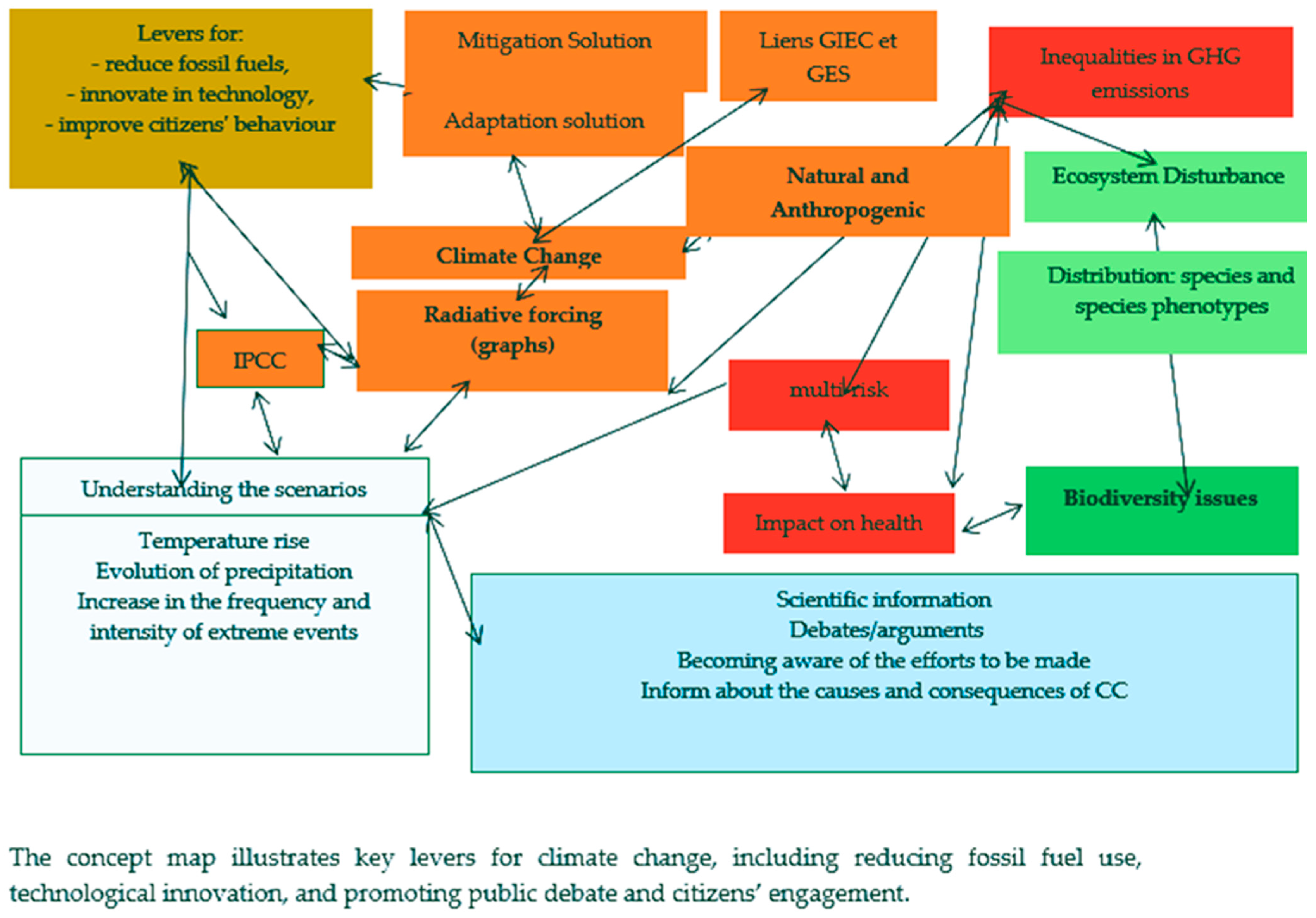
The present study adopts a cross-sectional and exploratory design to investigate first-year undergraduate students’ sustainability-related dispositions across cognitive, affective, and dispositional dimensions. In this design, data were collected to provide a snapshot of students’ self-reported knowledge, concerns, and readiness, without assessing changes over time. The study does not aim to estimate the pedagogical effectiveness or causal impact of the TEDS module. Instead, it exploits a specific institutional setting in which a first-year undergraduate student cohort was, for the first time, exposed to a structured curriculum fully dedicated to the ecological transition. For illustrative purposes,
Appendix A (p. 20) presents a conceptual diagram of the climate change topic.
The TEDS module is a 12-h course on ecological and social transition, focusing on scientific knowledge and causal reasoning, as well as argumentative and social skills. It was developed and implemented by the T-URN (the Institute for Socio-Ecological Transitions at the University of Rouen Normandie, a multidisciplinary mission-oriented service responsible for supporting the university’s transition strategy and for the national DD&RS label).
Because the TEDS module was implemented across the entire cohort, no comparison group was available, and no pre-test was conducted. Prior to its implementation, similar content already existed but was dispersed across certain undergraduate programmes, particularly within biology and ecology UFR (Unité de Formation et de Recherche). The UFR variable is expected to be particularly informative in explaining differences between students. In this respect, the cross-sectional design captures a moment of curricular transformation rather than a before–after comparison, although TEDS is considered an EfS initiative, which does not allow for any evaluation of its effects over time.
3.2. Measures/Questionnaire
3.2.1. Background Information
Students’ contextual data were collected, including sex/gender, UFR, and high school specialization. These are all nominal variables used solely for descriptive and comparative analyses of group differences; no continuous variables (e.g., age) were collected.
3.2.2. Development and Structure
Eighteen questions were developed by the authors, comprising a total of 143 items designed to capture students’ self-reported dispositions across key sustainability dimensions, including issues and challenges, actors and institutions, knowledge and skills, and information exposure. The questionnaire was specifically designed for this study and is not based on a single validated instrument. Items were developed through an iterative process combining (i) the content and learning objectives of the TEDS module, (ii) established constructs from the sustainability education literature (familiarity, understanding, concern, engagement), and (iii) relevant institutional and policy frameworks on socio-ecological transition. Although no formal pilot testing was conducted due to the full-cohort implementation context, the instrument was refined through expert content review to ensure internal coherence and conceptual alignment across constructs. Additional module-specific items contributed by T-URN (e.g., learning resources and course experience) were not included in the present analysis.
The 18 questions retained for analysis were organized into three main sections:
Part A: Contextual data, prior background, and training experience—6 questions and 35 items covering faculty affiliation, high school specialization, exposure to sustainability themes, and perceived learning gains in specific courses.
Part C: Knowledge, priorities, and competencies—8 questions and 97 items on familiarity with sustainability concepts, perceived importance of issues, preferred learning topics, and relevant skills and knowledge for future engagement.
Part D: Engagement—4 questions and 11 items on readiness to participate in socio-ecological actions, preferred forms of engagement, and facilitators and barriers to engagement.
Part B, consisting of evaluation items related to the TEDS training experience, was not included in the present analysis.
The questionnaire distinguishes four main constructs: familiarity, understanding, concern, and engagement. Familiarity refers to students’ exposure to socio-ecological issues and their ability to recognize them in scientific and public discourse, based on repeated exposure rather than conceptual mastery. Understanding refers to the conceptual comprehension of key sustainability concepts and frameworks. Concern reflects students’ affective evaluation and level of preoccupation regarding socio-ecological issues and sustainability challenges. Engagement is defined exclusively as students’ self-reported intention to engage in socio-ecological actions, measured through a single Likert-type item (D1), and is treated as an attitudinal and dispositional indicator rather than a behavioural measure.
Familiarity and understanding are treated as related but conceptually distinct constructs, analyzed separately when examining construct-specific patterns, and aggregated into a higher-order cognitive construct (knowledge) when examining correlations with concern and engagement.
3.2.3. Item Types and Examples
Closed-ended single- or multiple-choice items allowed students to indicate their UFR affiliation (A1), high school specialization (A2), courses that contributed to their acquisition of new knowledge on key sustainability issues (A6), main channels through which students were exposed to sustainability concepts (C2), sustainability-related themes students would like to further explore during their undergraduate studies (C4), skills perceived as necessary to understand socio-ecological transition issues (C5), familiarity with organizations and their sustainability-related actions (C6), preferred partners for future engagement in socio-ecological actions (C7), and disciplinary domains of knowledge needed for socio-ecological action, such as anthropology, sociology, economics, philosophy… (C8).
Closed-ended Likert-scale items (1 = not at all, 5 = very much) were used in four questions. A distinction was made between conceptual understanding and issue-based familiarity: A5 captures students’ understanding of key sustainability concepts (e.g., climate change, biodiversity, planetary boundaries), while C1 assesses their familiarity with sustainability-related issues as framed in public and scientific discourse (e.g., energy sufficiency, biodiversity loss, resource scarcity, the Anthropocene, the Sustainable Development Goals (SDGs), and the circular economy). In C3, students assessed their level of concern regarding key socio-ecological issues and related sustainability responses, while in D1 they rated their self-reported engagement intention in sustainability-related actions.
Open-ended items invited students to identify factors facilitating or hindering engagement (D3–D4).
Together, these items capture a structured analytical continuum linking conceptual understanding of sustainability concepts (A5), issue-based familiarity and framing of socio-ecological challenges (C1), affective responses in terms of concern (C3), and finally self-reported engagement intention in sustainability-related actions (D1). This design distinguishes between conceptual, issue-based, and action-oriented dimensions of sustainability learning.
The questionnaire is a theory-informed and curriculum-embedded exploratory instrument designed to provide conceptually coherent and internally consistent measures. Constructs were developed through structured item construction and iterative expert content review. Each construct was measured using separate item sets and analyzed independently, allowing their empirical differentiation to be assessed through internal consistency and inter-variable associations. Although the constructs show positive associations, these indicate relatedness rather than redundancy and do not call into question their conceptual distinctiveness. Together, these elements support the content validity of the measured dimensions.
3.3. Setting and Participants
The study was conducted with a cohort of first-year undergraduate students at a large urban university. All students enrolled in the Semester 1 TEDS module were invited to take part in the study (n = 600). The module was part of the standard curriculum; the researchers had no teaching responsibility for it. Data were collected online via LimeSurvey, with an average completion time of approximately 20 min. A total of 209 complete responses were received (response rate = 35%), indicating a potential self-selection bias (discussed further below).
3.4. Variable Construction and Data Analysis
Building on the variable construction procedures described in
Section 3.2, the familiarity, understanding, concern, engagement, and knowledge variables were used in subsequent analyses. Familiarity, understanding, and concern were derived from multi-item Likert scales, whereas engagement was measured using a single-item Likert scale. Knowledge represents a higher-order cognitive construct combining familiarity and understanding.
For analytical purposes, familiarity, understanding, concern, and knowledge scores were treated as continuous variables, allowing the calculation of means, standard deviations, and Cronbach’s alpha coefficients for reliability assessment. Although engagement was measured using a single Likert-type item and is ordinal in nature, it was also treated as continuous in subsequent analyses, consistent with common practice in survey research.
Data analysis was conducted using IBM SPSS Statistics (version 31.0.2.0, IBM Corp., Armonk, NY, USA). Descriptive statistics included means, standard deviations, and percentages for categorical variables. Pearson correlation analyses were used to examine associations between knowledge, concern, and engagement. Independent-samples t-tests assessed gender differences, while one-way ANOVA examined differences across disciplinary backgrounds (UFR). Linear regression models were additionally used to explore multivariate associations among the key constructs. Results are reported using statistical indicators appropriate to each analysis. Correlation analyses are presented using correlation coefficients (r). Group comparisons are reported using effect sizes (Cohen’s d for t-tests and eta-squared [η2] for ANOVA). Where relevant, 95% confidence intervals (CIs) are provided to support interpretation of effect estimates. Statistical significance was assessed using conventional thresholds (p < 0.05), and all tests were two-tailed.
3.5. Ethical Considerations
The study followed standard ethical principles for research involving human participants. Participation was voluntary and anonymous. Participants were informed about the purpose of the study and the use of the data. Completion of the questionnaire was considered to constitute informed consent. No personally identifiable data were collected, and all responses were treated confidentially.
4. Results: Patterns of Knowledge, Competencies, and Engagement
In this study, familiarity, understanding, and knowledge are treated as distinct but related cognitive constructs, while engagement refers specifically to students’ self-reported engagement intention.
4.1. Familiarity, Concern, and the Resulting New and Desired Knowledge Across Selected Issues (Table 2, Table 3 and Table 4)
Among first-year undergraduate students, climate change shows the highest levels of familiarity and understanding (M = 4.12–4.18; SD = 0.92–0.98) and also ranks high in concern. Standard deviations are substantial across all three measures. Biodiversity loss shows slightly higher concern despite lower familiarity. Energy and the Anthropocene show moderate levels across measures. Planetary boundaries, new socio-economic models, and the SDGs show comparatively lower levels (e.g., familiarity with new socio-economic models: M = 2.81, SD = 1.25; SDGs: M = 3.53, SD = 1.06; concern for new socio-economic models: M = 2.89, SD = 1.34).
Table 2.
Students’ understanding, familiarity, and concern regarding selected issues.
Table 2.
Students’ understanding, familiarity, and concern regarding selected issues.
| Issue | Mean (SD)
Understanding | Mean (SD)
Familiarity | Mean (SD)
Concern |
|---|
| Energy | 3.88 (1.026) | 3.44 (1.22) | 3.37 (1.27) |
| Climate change | 4.18 (0.98) | 4.12 (0.92) | 4.12 (0.92) |
| Biodiversity loss | 3.62 (1.26) | 3.88 (1.06) | 4.19 (1.12) |
| Planetary boundaries/finite resources | 3.76 (1.21) | 3.69 (1.10) | 3.87 (1.18) |
| New socio-economic models | 3.24 (1.26) | 2.81 (1.25) | 2.89 (1.34) |
| Anthropocene | — | 2.94 (1.14) | 3.92 (1.20) |
| SDGs | — | 3.53 (1.06) | 3.4 (1.30) |
Students report new knowledge most frequently for new socio-economic models (50.92%), followed by energy (41.72%), finite resources and planetary limits (39.88%), global warming (38.65%), and biodiversity loss (37.42%) (
Table 3).
Table 3.
Percentage of students reporting new knowledge in selected issues (N = 209).
Table 3.
Percentage of students reporting new knowledge in selected issues (N = 209).
| Issue | Percentage |
|---|
| Energy | 41.72% |
| Global warming | 38.65% |
| Biodiversity loss | 37.42% |
| Finite resources and planetary limits | 39.88% |
| New socio-economic models | 50.92% |
Students’ preferences for topics to be further explored during their bachelor’s degree show higher selection rates for climate change (38.3%) and biodiversity (40.2%), followed by planetary boundaries (29.2%), social and scientific controversies (27.3%), and natural resources (26.3%). Lower percentages are observed for the Anthropocene (17.7%), ecosystem/agrosystem (17.2%), and circular economy (16.7%) (
Table 4).
Table 4.
Knowledge that students wish to deepen in their bachelor’s degree (N = 209).
Table 4.
Knowledge that students wish to deepen in their bachelor’s degree (N = 209).
| Knowledge to be Deepened | Percentage Values |
|---|
| Anthropocene | 17.7% |
| Ecosystem/agrosystem | 17.2% |
| Planetary boundaries | 29.2% |
| Social and scientific controversies | 27.3% |
| Climate Change | 38.3% |
| Biodiversity | 40.2% |
| Circular economy | 16.7% |
| Natural Resources | 26.3% |
| Energy sobriety | 20.1% |
| SDGs | 24.9% |
Variations are observed across topics for concern, familiarity, reported new knowledge, and desired knowledge.
4.2. Distribution of Knowledge Domains and Skills Related to Environmental Action
When asked about the domains of knowledge required to engage in environmental and climate action (
Table 5), students most frequently select green practices (56%), followed by economics and management (35.4%), science and technology (34%), and history and geography (28.2%). Lower proportions are reported for psychology (19.1%), languages (16.7%), anthropology/philosophy (16.3%), and law (16.7%).
Table 6 presents students’ perceptions of the skills needed to understand environmental and climate issues. The most frequently reported skill is identifying problems and solutions (59.8%). Other reported skills include debating and managing contradictions (36.4%), argumentation (35.4%), and analyzing discourse (30.6%). Lower proportions are observed for systems thinking (26.8%), identifying controversies (25.4%), and mastering causal chains (19.6%).
4.3. Sources of Exposure and Reported Familiarity Across Environmental Issues (Table 2 and Table 7)
Students’ reported exposure to environmental and climate issues varies across topics and sources (
Table 7). School is a frequently reported source for several topics, including the Anthropocene (60.8%), biodiversity (55.5%), natural resources (55.5%), SDGs (52.6%), and circular economy (46%). Lower levels are reported for climate change (32.5%) and energy sobriety (33.5%).
Table 7.
Sources of knowledge on environmental and climate issues (N = 209).
Table 7.
Sources of knowledge on environmental and climate issues (N = 209).
| Topic/Sources of Knowledge | School | Media | Social Media | Television | Family |
|---|
| Anthropocene | 60.8% | 3.8% | 1% | 1.9% | 0% |
| Ecosystem/agrosystem | 56.9% | 8.6% | 1.4% | 3.8% | 3.3% |
| Biodiversity | 55.5% | 11.5% | 4.3% | 4.8% | 5.7% |
| Natural Resources | 55.5% | 10.5% | 3.8% | 4.3% | 6.7% |
| SDGs | 52.6% | 13.4% | 5.3% | 5.3% | 2.4% |
| Climate Change | 32.5% | 27.3% | 6.2% | 8.1% | 7.2% |
| Circular economy | 46% | 7.7% | 2.9% | 2.4% | 3.3% |
| Energy sobriety | 33.5% | 20.1% | 6.2% | 5.7% | 8.1% |
| Planetary boundaries | 45% | 16% | 7.2% | 7.7% | 3.3% |
Media exposure shows greater variability across topics, with higher reported exposure for climate change (27.3%), energy sobriety (20.1%), and planetary boundaries (16%), and lower levels for the Anthropocene (3.8%).
The Anthropocene is primarily reported as encountered in school contexts (60.8%), with limited exposure through other sources (≤3.8%), and lower reported familiarity (M = 2.94; SD = 1.43;
Table 2). Climate change is associated with multiple reported sources, including school (32.5%), media (27.3%), television (8.1%), social media (6.2%), and family (7.2%;
Table 7), and with higher reported levels of understanding, familiarity, and concern (
Table 2), with variability across respondents.
4.4. Engagement and Identified Contexts of Action
When asked about their willingness to engage in actions in favour of the environment and climate change (D1), students report a mean score of 3.13 (SD = 1.15). After weighting, 41.8% of female students and 32.7% of male students report higher willingness to engage (scores 4–5). Female students show a slightly higher mean score (M = 3.18, SD = 1.12) than male students (M = 2.93, SD = 1.23).
Across academic components, 48.3% of students in science programmes report willingness to engage (M = 3.30, SD = 1.03), compared with 39% in Humanities (M = 3.07, SD = 1.39) and 36.8% in Social Sciences (M = 3.13, SD = 1.18). Additionally, 36.8% of students report being unable to identify any concrete framework for action.
4.5. Construction and Treatment of Composite Variables
4.5.1. Composite Indices: Descriptive Statistics and Reliability
Composite indices were constructed from the Likert-scale items described in
Section 3.2 to summarize key dimensions of students’ responses. All items were measured on a 1–5 scale, with higher scores indicating higher levels of the measured construct. The following composite indices were used in the analysis: an understanding index, a familiarity index, and a concern index. Self-reported engagement intention was measured using a single-item scale (D1). In addition, several explanatory variables were considered, including gender and disciplinary affiliation (UFR). Internal consistency (Cronbach’s alpha) was calculated for all multi-item scales: familiarity, understanding/knowledge, concern, self-reported engagement intention (α values reported below).
Table 8 presents the descriptive statistics and reliability of the composite constructs. The understanding index shows a mean score of 3.74 (SD = 0.97), with a Cronbach’s alpha of 0.901. The familiarity score reports a mean of 3.53 (SD = 0.90) and a Cronbach’s alpha of 0.913. The combined knowledge index presents a mean score of 3.64 (SD = 0.85) and a Cronbach’s alpha of 0.932. The concern index shows a mean of 3.67 (SD = 1.01), with a Cronbach’s alpha of 0.921. Engagement self-reported, measured using a single-item scale, reports a mean of 3.13 (SD = 1.15).
Building on these descriptive statistics and reliability estimates, additional analyses were conducted to examine differences across gender and disciplinary affiliation (UFR), as well as associations between composite constructs and key explanatory variables.
4.5.2. Group Differences in Composite Variables
Gender (
t-test + Cohen’s d): Independent-samples
t-tests were conducted to examine gender differences across the three composite dimensions (knowledge, concern, and self-reported engagement intention) (see
Table 9).
For the knowledge score, male students reported higher mean values (M = 3.93, SD = 0.89) than female students (M = 3.54, SD = 0.79). The difference was non-significant (t = 3.07, p = 0.002, Cohen’s d = 0.473). For the concern index, mean scores were similar between male (M = 3.72, SD = 1.01) and female students (M = 3.67, SD = 1.02). This difference was not statistically significant (t = 0.311, p = 0.756, Cohen’s d = 0.049). For the self-reported engagement intention (D1), female students reported slightly higher mean values (M = 3.18, SD = 1.13) compared to male students (M = 2.93, SD = 1.24). This difference was not statistically significant (t = −1.341, p = 0.182, Cohen’s d = −0.214).
One-way ANOVAs were conducted to examine differences in knowledge, concern, and engagement across UFR groups. The corresponding results are presented in
Table 10.
For the knowledge score, the analysis did not reveal a statistically significant effect of UFR (F (8, 200) = 1.411, p = 0.194, η2 = 0.053). Similarly, no statistically significant differences were observed for the concern index (F (8, 194) = 1.742, p = 0.091, η2 = 0.067). Finally, no statistically significant effect of UFR was found on self-reported engagement intention (F (8, 184) = 0.685, p = 0.705, η2 = 0.029). Effect sizes indicated small associations across all models.
4.5.3. Relationships Between Composite Variables
Spearman’s rank-order correlations were computed to examine the associations between knowledge, concern, and self-reported engagement intention.
The correlations indicated positive associations among all three variables (
Table 11). Knowledge expressed a moderate positive correlation with concern (ρ = 0.494,
p < 0.001) and a weak positive correlation with self-reported engagement intention (ρ = 0.284,
p < 0.001). Concern showed a stronger association with self-reported engagement intention (ρ = 0.614,
p < 0.001).
4.5.4. Multiple Linear Regression Analysis
A multiple linear regression was conducted to assess whether knowledge and concern predict self-reported engagement intention. The results are reported in
Table 12.
A multiple linear regression analysis was conducted to examine the extent to which knowledge and concern predict self-reported engagement intention. The model included knowledge and concern as independent variables, with self-reported engagement intention as the dependent variable. The results showed that concern was a significant predictor (B = 0.786, SE = 0.078, β = 0.652, t = 10.033, p < 0.001), whereas knowledge was not a significant predictor (B = −0.052, SE = 0.091, β = −0.037, t = −0.570, p = 0.569).
5. Discussion
This study aimed to examine a cohort of first-year undergraduate students and how they relate to familiarity, understanding, concern, and self-reported engagement intention regarding environmental issues. The findings indicate differentiated relationships between familiarity, understanding, concern, and engagement intentions, rather than a straightforward linear progression from knowledge to action. Beyond descriptive frequencies, composite scores were constructed for familiarity/understanding (combined into a knowledge score) and concern in order to capture more stable underlying constructs. Internal consistency and inter-item correlations indicate satisfactory coherence across these dimensions. Given the cross-sectional design of the study, all observed relationships are interpreted as associations and do not allow for causal inference.
5.1. A Fragmented Knowledge–Concern Landscape of Sustainability Issues
The results show that students’ familiarity, understanding, and concern regarding environmental issues are organized in a differentiated and partly hierarchical pattern. Highly visible and publicly discussed issues such as climate change occupy a central position, while others such as the Anthropocene, planetary boundaries, or alternative economic models remain more peripheral and are mainly associated with formal education and specialized knowledge. Climate change is associated with higher levels of familiarity, understanding, and concern, as well as more diverse sources of exposure. By contrast, the Anthropocene and the circular economy are primarily encountered in educational settings and are associated with lower reported levels of familiarity and understanding.
Public and media attention plays an important role in shaping these patterns. Consistent with research on public problems in the sociology of public action (
Mauz & Granjou, 2010), and with agenda-setting theory (
McCombs, 2014), issues that are more visible in media and institutional discourse tend to be more salient in students’ perceptions. This contributes to the formation of cognitive hierarchies in which some forms of knowledge appear more accessible or legitimate than others.
However, this visibility does not consistently translate into students’ cognitive and affective responses. For example, biodiversity loss combines relatively low familiarity with relatively high levels of concern. A similar pattern is observed for the Anthropocene. These cases suggest that familiarity and concern do not systematically align across environmental issues. Overall, exposure, reported learning, and priorities for further learning only partially overlap, indicating that cognitive and affective dimensions of engagement develop through partly independent pathways.
The case of the circular economy further illustrates this gap. Although students report relatively high gains in understanding this topic (50.92%, the highest value), this is not associated with a stronger intention to further explore it, despite its identification by 35.4% of respondents as relevant for environmental action in economics and management fields. This points to a gap between learning, interest, and intentions for further engagement, particularly when topics are not strongly connected to the disciplinary frameworks students use to think about action.
The transition to higher education adds an additional layer to this pattern. First-year students are exposed to disciplinary fields that are often absent from secondary education (e.g., economics, psychology, anthropology, law, linguistics). This represents a shift in how environmental issues are approached academically. However, while students recognize certain scientific skills as important in principle, these do not always translate into more systemic or structural ways of reasoning about environmental problems. This suggests a tension between problem-oriented understandings of action and the cognitive tools needed to engage with complex causal systems (
Kalali, 2017).
Taken together, these results challenge a linear model linking issue visibility, knowledge acquisition, and engagement. Although environmental issues are highly visible in public and media spaces, this visibility does not automatically lead to aligned cognitive and affective engagement. Similarly, exposure to disciplinary knowledge does not necessarily translate into more systemic understandings of environmental action. Instead, the findings point to a fragmented configuration in which issue salience, knowledge, affective concern, and action-related competencies are only partially connected.
Finally, the results confirm the central role of school in students’ initial exposure to environmental issues. They also suggest a gap between developing familiarity and understanding on the one hand, and developing action-oriented capacities on the other. This highlights the importance of strengthening links between systemic understanding of environmental issues and solution-oriented approaches, in order to make knowledge more meaningful and usable in practice (
Kalali, 2023). Such an articulation may also support forms of thinking that foster civic engagement, democratic participation, and social justice (
Rivers & Lovin, 2023). More broadly, this suggests that higher education plays an important role in creating conditions that allow students to translate environmental knowledge into meaningful capacities for action.
5.2. Engagement as a Concern-Driven and Context-Dependent Process
Beyond the distribution of knowledge-related variables, the findings provide insights into the factors associated with self-reported engagement intention. While familiarity and understanding are moderately correlated with concern, their association with engagement remains limited. By contrast, concern is the variable most strongly associated with engagement intention (ρ = 0.614, p < 0.001) and emerges as the strongest explanatory variable in the regression model, indicating a robust association between affective dispositions and engagement.
This pattern is consistent with large-scale assessment frameworks such as PISA and
Borgonovi et al. (
2022a,
2022b), which conceptualize environmental literacy as a multidimensional construct encompassing awareness of environmental issues, science self-efficacy, perceived capacity to engage in environmentally relevant activities, and affective dispositions. In this perspective, environmental literacy integrates cognitive, affective, and dispositional dimensions associated with engagement intentions, without implying a linear or causal sequence. Our findings align with this interpretation, with concern emerging as the most strongly associated dimension of self-reported engagement in this sample. These results underscore the relevance of affective and dispositional dimensions alongside familiarity and understanding when examining student engagement in sustainability-related issues.
In addition, a substantial proportion of students (36.8%) reported being unable to identify concrete frameworks for action, suggesting a mismatch between willingness to engage and perceived opportunities for action. This indicates that engagement may depend not only on individual dispositions, but also on the extent to which students perceive available and identifiable pathways for action (
Borgonovi et al., 2022a,
2022b). From this perspective, engagement appears to be associated with both concern and perceived opportunities for action, as well as to a lesser extent with knowledge.
Overall, these findings align with broader approaches to sustainability education that conceptualize engagement as emerging from the interaction between cognitive, affective, and contextual dimensions (
Ardoin et al., 2020;
UNESCO, 2019). They suggest a shift in analytical focus from individual-level explanations of engagement toward the role of perceived opportunities for action. Engagement therefore appears not only as a function of individual dispositions, but also as being shaped by students’ ability to identify concrete and meaningful pathways for action within their educational context.
5.3. A Convergent Pattern Across Gender and Disciplinary Groups
Finally, the results show limited differentiation across gender and disciplinary affiliations. Although some variations are observed—such as slightly higher knowledge among male students and marginally higher self-reported engagement intention among female students—these differences remain statistically non-significant. Similarly, no significant variation is found across academic disciplines. This relative homogeneity may reflect cohort and institutional effects associated with the first-year university context.
Taken together, these findings suggest that environmental perceptions and engagement dispositions are more closely associated with shared educational and generational contexts than with individual or disciplinary characteristics. This may also reflect broader generational patterns in familiarity with environmental issues. These elements provide a useful context for interpreting potential self-selection and self-reporting effects.
The limited differences observed across gender and disciplinary groups thus indicates a relatively uniform distribution of environmental perceptions within this cohort. This homogeneity is consistent with research on youth environmental engagement, which highlights a relative convergence of environmental attitudes among younger generations, alongside persistent constraints linked to perceived agency and structural opportunities (
Ojala, 2012;
Stevenson et al., 2019).
Rather than indicating neutrality or uniform engagement, this convergence suggests that awareness of environmental issues is already widely shared among students. The key challenge therefore lies less in individual differences than in the educational conditions that shape the translation of this awareness into perceived capacity for action and diversified forms of engagement.
5.4. Limitations
These findings should be interpreted in light of several limitations.
First, the study is based on a single institutional context and a specific first-year module (TEDS). This limits the generalisability of the findings to other higher education institutions, programmes, and student populations.
Second, the response rate (209 out of approximately 600 invited students) suggests a potential self-selection bias, as participation was voluntary. Students with a stronger interest in environmental issues may therefore be overrepresented in the sample, which may have influenced the reported levels of familiarity, understanding, concern, and self-reported engagement intention.
Third, the study relies on self-reported measures, which may be subject to social desirability effects and common method bias. Reported intentions to engage may not necessarily translate into actual behaviour.
Finally, the cross-sectional design does not allow for causal inference or the analysis of change over time. The relationships observed between familiarity, understanding, concern, and engagement should therefore be interpreted as associative and context-dependent.
5.5. Implications
This study carries several targeted implications for higher education in the context of sustainability transitions. These findings suggest the potential relevance of affective and dispositional dimensions alongside familiarity and understanding in shaping student engagement in sustainability-related issues. In particular, the observed association between familiarity, concern, and engagement highlights the relevance of pedagogical approaches that more explicitly integrate environmental content with systems thinking, causal reasoning, and problem-structuring skills.
For higher education institutions, this may be seen as supporting reflection on a shift from content exposure toward problem-based learning situations that enable students to interpret and engage with complex environmental issues.
Although several sustainability frameworks already exist, they are often formulated within strategic and policy-oriented logics, with operational targets that do not directly translate into pedagogical objectives. It may therefore be useful to consider how these frameworks could be reinterpreted or translated into educational terms in order to better support teaching and learning practices.
Second, the results indicate that engagement is more closely associated with concern than with knowledge alone. This suggests that engagement is likely to be more strongly fostered in learning environments where opportunities for action are structured, such as field experiences, internships, participation in associations, local, national or international collaborative projects, or involvement in living labs. Within this perspective, university student life units (BVE) may also represent relevant spaces for experiential learning through student associations, project-based funding schemes, and support structures designed to foster initiative, participation, and the development of competencies beyond academic learning. In this framework, engagement is not only considered an extracurricular activity, but also a dimension of students’ personal development, civic learning, and acquisition of transferable skills within the university context.
Third, the study highlights differences between the development of disciplinary understanding and students’ understanding of action-oriented knowledge. Higher education can provide a context not only for transmitting disciplinary content, but also for making explicit how different epistemic frameworks contribute to addressing environmental challenges. Strengthening this translation function may support students in better integrating scientific, social, and applied knowledge into coherent strategies for action, thereby reinforcing the role of universities in sustainability transitions.
Thus, pedagogical initiatives in sustainability education may be considered as potential spaces for exploring how action-oriented knowledge is constructed within higher education. These initiatives could be progressively consolidated and integrated into other disciplinary programmes, with differentiated entry points depending on the field of study. For instance, in economics programmes, the economic dimension of sustainability issues could be further developed to potentially provide students with more structured foundations that support both academic orientation and future professional pathways.
5.6. Future Research
Several avenues for future research emerge from this study. First, longitudinal designs would help better understand how students’ familiarity, understanding, concern, and engagement evolve over time in sustainability-oriented educational contexts such as the TEDS module. This would allow the analysis of intra-individual change and long-term learning trajectories.
In addition, future research could explore differences across academic levels (L1, L2, L3) in relation to exposure to sustainability education. This would provide insight into how institutional learning frameworks are reflected in sustainability-related learning outcomes across study stages.
Second, further research should examine the mechanisms through which concern relates to engagement. In particular, it is important to identify the conditions under which concern is more likely to be associated with engagement in higher education contexts. Future studies could investigate the potential role of pedagogical formats such as project-based learning, living labs, and field experiences, as well as institutional settings such as student services, associations, and funding schemes that support student initiatives.
Third, more research is needed on how students appropriate complex systemic concepts such as the Anthropocene, planetary boundaries, or socio-economic transition models. Comparative studies across disciplines could help clarify whether these difficulties are mainly cognitive, pedagogical, or structural, and how they may be addressed through alternative teaching approaches.
Finally, international comparative research would help better understand how different institutional and pedagogical contexts shape students’ familiarity, understanding, concern, and engagement with sustainability issues. This would help identify both transferable practices and context-specific mechanisms supporting sustainability learning.