Article

Evolving Socioemotional Needs in Emerging Adulthood: A Twelve-Year Study of University Students’ Reflections


by
Martins Veide
Management Studies Department, RISEBA University of Applied Science, LV-1048 Riga, Latvia
Youth 2026, 6(2), 65; https://doi.org/10.3390/youth6020065
Submission received: 30 March 2026 / Revised: 6 May 2026 / Accepted: 14 May 2026 / Published: 20 May 2026

Abstract

Understanding how socioemotional concerns evolve during emerging adulthood is central to research on young people’s psychological adaptation. This study examines temporal shifts in university students’ communication-related concerns across twelve consecutive cohorts (2014–2025) at a European university. Using a repeated cross-sectional mixed-method design, the study analyses nearly 800 student-generated questions from 543 first- and second-year students collected at the beginning of a communication psychology course. Inductive thematic coding, combined with χ2 tests and trend analyses, identified temporal patterns in thematic frequencies. Results show a significant increase in concerns related to emotion regulation, stress management, and conflict resolution, alongside a decline in abstract self-development and understanding others. These findings suggest a shift from exploratory, cognitively oriented priorities toward more pragmatic, emotionally grounded coping concerns among emerging adults. From a developmental perspective, early university adaptation increasingly centers on self-regulation and interpersonal boundary management. The study demonstrates how reflective data can serve as indicators of changing socioemotional needs, contributing to research on young people’s adaptation, wellbeing, and developmental processes during the transition to adulthood.

1. Introduction

Emerging adulthood is a critical developmental period during which young people navigate identity formation, emotional regulation challenges, and evolving interpersonal roles (Arnett, 2000, 2024). During this transition to adulthood, individuals face increasing autonomy alongside academic and social expectations, making socioemotional adaptation a central psychological task. Recent research indicates rising levels of stress and anxiety among university students, highlighting growing emotional demands within higher education contexts (Cui et al., 2023; Liu et al., 2023; Li & Zheng, 2025).
Within university contexts, communication-related learning environments often become spaces where these developmental tensions surface explicitly. Contemporary higher education is shaped by shifting modes of engagement, belonging, and participation (Bovill, 2020; Kahu & Nelson, 2018), while institutional and social transformations influence how students interpret their learning roles and interpersonal responsibilities (Brankovic & Cantwell, 2022). In such contexts, courses addressing communication processes provide structured opportunities for students to reflect on interpersonal behavior, emotion regulation, and self-understanding. Reflective practices are widely recognized as meaningful tools for articulating learning needs and psycho-social concerns (Cook-Sather, 2020; Matthews & Dollinger, 2023; Alt et al., 2022).
Long-term classroom observation of a communication psychology course at a public European university revealed noticeable shifts in the types of questions students raise about communication and self-development. What earlier cohorts formulated primarily as abstract curiosity about understanding others increasingly appears as a search for concrete strategies to manage stress, regulate emotions, and navigate inter-personal conflict. These shifts resonate with broader findings indicating that emotion regulation plays a mediating role in students’ stress experiences and adaptation processes (Li & Zheng, 2025).
At the same time, students’ socioemotional concerns do not emerge in isolation but are shaped by broader relational and societal contexts, including prior interpersonal experiences and evolving social conditions. The present study addresses these complexities through the analysis of anonymized, naturally occurring reflective data collected within routine educational practice, allowing insight into cohort-level patterns while maintaining minimal intrusion into students’ learning environment.
The present study aims to examine how students’ self-expressed communication concerns evolved across twelve consecutive cohorts (2014–2025). Specifically, the study (1) identifies key thematic categories present in student-generated questions and (2) analyses temporal changes in their frequency. By situating these shifts within a developmental psychology framework, the study contributes to understanding evolving socioemotional needs in emerging adulthood and offers empirical insight into how psychological adaptation priorities change over time in higher education contexts.

2. Theoretical Background: Socioemotional Development in Emerging Adulthood

The present study integrates three complementary theoretical perspectives relevant to understanding development in emerging adulthood: (1) socioemotional development and wellbeing as core dimensions of adaptive functioning, (2) communication psychology as a context in which emotional and relational competencies are enacted and refined, and (3) reflective practice as a mechanism through which individuals articulate and reorganize developmental concerns. Together, these perspectives frame student-generated reflections as psychologically meaningful expressions of evolving socioemotional priorities within contemporary university contexts.

2.1. Socioemotional Development and Wellbeing in Emerging Adulthood

Emerging adulthood is widely conceptualized as a distinct developmental phase characterized by identity exploration, instability, increasing autonomy, and intensified emotional experience (Arnett, 2000). During this period, individuals consolidate self-concept, develop relational agency, and strengthen emotion regulation capacities. Socioemotional adaptation therefore represents a central developmental task rather than a peripheral outcome of academic participation.
Established student development frameworks further support this interpretation. Chickering and Reisser (1993) conceptualize university years as a period of negotiating competence, managing emotions, and developing mature interpersonal relationships. These vectors highlight that emotional expression, relational patterns, and sense of self are deeply intertwined developmental domains. Similarly, Patton et al. (2016) emphasize intrapersonal awareness and interpersonal competence as core dimensions of holistic student growth, underscoring the importance of attending to psychosocial and emotional processes alongside cognitive development.
Contemporary empirical research suggests that these developmental tasks are becoming increasingly demanding. University students report elevated stress, anxiety, and uncertainty related to academic performance and future prospects (Cui et al., 2023; Liu et al., 2023). Emotion regulation has been identified as a key mechanism linking academic adaptation and wellbeing (Iuga & David, 2024; Li & Zheng, 2025). Extending this line of research, Öztekin et al. (2025) demonstrate that psychological flexibility and emotion regulation mediate the relationship between future-related concerns and stress or depressive symptoms, underscoring the developmental importance of socioemotional coping skills.
In parallel, affective resources such as gratitude and positive emotional orientation have been shown to buffer stress and enhance wellbeing (Demichelis et al., 2024). These findings align with what has been described as an “affective turn” in higher education research, which recognizes emotions not as peripheral experiences but as integral components of learning identity and engagement.
From this perspective, socioemotional learning is not ancillary to academic development; rather, it is foundational to how students cultivate competence, purpose, belonging, and self-authorship (Baxter Magolda, 2008). Analyzing how students articulate concerns about communication, emotional control, and conflict thus provides insight into evolving developmental priorities within emerging adulthood.

2.2. Communication Psychology as a Context for Development

Communication psychology offers a structured context in which socioemotional developmental processes become visible and reflexively examined. As a psychological process, communication directly engages individuals’ sense of self, emotional expression, and relational patterns—domains central to developmental frameworks such as Chickering’s vectors (Chickering & Reisser, 1993).
Courses addressing communication processes create opportunities for students to connect theoretical knowledge with lived interpersonal experience. Reflective engagement with communication often surfaces concerns related to emotional regulation, assertiveness, boundary setting, and conflict navigation. These themes correspond to the developmental processes described by Patton et al. (2016), who emphasize that growth during the university years involves integrating internal self-awareness with external relational competence.
Research suggests that reflective and experiential communication tasks strengthen self-awareness and interpersonal competence (Mohamed et al., 2022). Communication-focused learning environments often surface latent developmental tensions—such as fear of evaluation, difficulties in assertiveness, or uncertainty in conflict situations—that might otherwise remain implicit. In this way, communication psychology operates not only as a knowledge domain but also as a developmental arena in which emotion regulation, boundary setting, and relational agency are negotiated.
Understanding communication psychology as a developmental context shifts analytical attention from curriculum content to the psychological processes activated within the learning environment. This perspective positions student-generated reflections as data that capture evolving socioemotional priorities rather than solely educational preferences.

2.3. Reflective Learning as a Developmental Lens

Reflective practices—such as journaling, self-assessment, and open-ended question generation—are widely recognized as mechanisms that promote metacognitive awareness and developmental growth. Within the student voice tradition, reflective tasks are valued as authentic expressions of learners’ perspectives (Cook-Sather, 2020; Matthews & Dollinger, 2023). However, beyond pedagogical utility, such reflections may also function as developmental data.
Open-ended questions allow students to externalize uncertainties, aspirations, and perceived deficits in emotional or relational functioning. These reflections align with Patton et al.’s (2016) emphasis on understanding the “whole student,” encompassing psychosocial, cognitive, and emotional dimensions of development. In this regard, student-generated reflections can reveal how individuals understand themselves, how they relate to others, and what forms of support they implicitly seek while navigating university transitions.
Research further suggests that reflective engagement makes visible not only cognitive learning needs but also emotional and motivational concerns (Alt et al., 2022; Chan & Lee, 2021; Nanda et al., 2025). When collected across successive cohorts, such reflections provide a unique opportunity to trace how socioemotional orientations evolve in response to changing academic and social contexts.
By integrating socioemotional development theory, communication psychology, and reflective learning scholarship, the present study conceptualizes student-generated questions as developmentally meaningful artefacts. Rather than merely indicating topical interests, they illuminate how emerging adults negotiate emotion regulation, interpersonal competence, and identity-related challenges within contemporary university environments.
The integration of these perspectives provides the conceptual framework through which the empirical findings are interpreted. Table 1 summarizes the theoretical foundations and their analytical contribution to the study.
Taken together, these perspectives can be integrated within a broader developmental adaptation framework, which assumes that socioemotional development in emerging adulthood is not only driven by age-related psychological processes but also shaped by changing sociohistorical conditions. From this perspective, shifts in students’ reflective questions can be understood as cohort-level expressions of adaptive responses to evolving environmental demands, including increased uncertainty, academic pressures, and changing modes of social interaction. This integrative lens provides a conceptual basis for interpreting temporal changes in socioemotional priorities not merely as individual variation, but as context-sensitive developmental patterns.

3. Materials and Methods

To examine how undergraduates’ communication-related priorities and socioemotional orientations evolve across cohorts, this study employed a repeated cross-sectional mixed-method design. This approach is particularly suitable for developmental research because it enables the identification of cohort-level shifts without tracking individuals longitudinally, thereby illuminating how successive groups of students negotiate socioemotional tasks, wellbeing-related pressures, and transitional challenges within comparable institutional contexts. Student-generated reflections—widely recognized in educational and developmental psychology as valuable indicators of self-perceived needs, coping orientations, and interpersonal concerns—served as the primary data source. The following subsections describe the research context, participants, data collection procedures, and analytic strategy.

3.1. Research Context and Participants

The study was conducted within the Psychology of Communication course offered annually at a public European university. This first-year and second-year undergraduate course introduces students to interpersonal and intrapersonal communication processes from a psychological perspective. Over twelve consecutive years (2014–2025), the course instructor—who is also the author of this study—systematically collected student-generated questions as part of an ongoing effort to understand how learners articulate their socioemotional concerns and developmental priorities.
A total of 543 students participated (63% female; comparable to the national proportion of approximately 59% female students during the same period; Official Statistics Portal, n.d.). Students represented three study programs—Optometry, Mathematics, and Graphic Design—and were aged 19 to 23. The instructor had no prior contact with these student groups, and all reflections were produced anonymously during regular class sessions. Participation was voluntary and had no impact on course grades.
The study was deemed exempt from institutional ethical review because it analyzed anonymized materials generated as part of routine educational practice without any intervention.

3.2. Data Collection

Data were obtained through a brief written reflection task administered at the beginning of each course cycle. Students were invited to write one or more questions they wished to have addressed during the Psychology of Communication course. Questions were written on small paper slips (approximately 5 × 10 cm) and collected within 3–5 min. They were introduced with the following instructions: “At each stage of life, one may have a personal question related to communication. The very act of identifying and formulating it already brings you closer to a solution. The more specific your question, the more specific the answer you may expect.”
Although the data were collected within a classroom setting by the course instructor, several measures were taken to minimize potential power-related influences. Participation in the reflection task was voluntary, anonymous, and explicitly unrelated to course assessment. Students were informed that their responses would be used in aggregated form and that non-participation would have no academic consequences. The task itself was integrated as a standard pedagogical activity aimed at aligning course content with students’ interests and concerns, and was conducted consistently across cohorts prior to the formulation of the present research aims. Importantly, the data used in this study were analysed retrospectively in anonymized form, further reducing any potential risk to participants.
Approximately 3% of slips were excluded because they lacked a substantive question or expressed only an instrumental interest in course credit.
Although the activity was originally introduced as a course reflection exercise, it also produced a large corpus of student-authored questions suitable for research analysis. Across twelve cohorts, nearly eight hundred questions were collected. Because each cohort was independent, the dataset enables the examination of cohort-level variation—an approach commonly used in developmental and educational psychology to explore shifts in socioemotional priorities across time.
In addition, the dual role of instructor–researcher was considered throughout the study design and analysis. Although the activity formed part of routine teaching practice, care was taken to ensure that students’ participation remained genuinely voluntary and that their contributions could not be linked to their academic identity. The retrospective use of anonymized data further minimized potential ethical risks and aligned the study with established principles for the use of naturally occurring educational data in research.

3.3. Data Analysis

The student-generated questions were analysed using an inductive qualitative content analysis approach, which is well suited for systematically identifying patterns in large corpora of brief textual data while remaining grounded in participants’ own expressions (Elo & Kyngäs, 2008; Hsieh & Shannon, 2005). The analytic process followed a stepwise procedure, moving from initial familiarization with the dataset to category development and iterative refinement. Categories were constructed to balance empirical grounding and conceptual clarity, ensuring that each captured a distinct aspect of students’ socioemotional concerns.
The analysis proceeded in several stages. First, all responses were read multiple times to achieve familiarity with the dataset. During this phase, initial open coding was conducted, whereby each question was assigned one or more descriptive codes capturing its central meaning. These codes remained close to the original wording of the data in order to preserve participants’ perspectives.
In the second stage, codes were compared and grouped according to semantic similarity, resulting in the development of broader categories representing recurring types of socioemotional and communication-related concerns. Categories were iteratively refined through constant comparison across the dataset to ensure internal coherence and conceptual distinctiveness. This process resulted in a stable set of categories reflecting key domains such as emotion regulation, stress-related concerns, interpersonal understanding, and conflict resolution.
A distinct analytical decision concerned questions related to communication with strangers. In these cases (approximately 10% of responses), students’ questions simultaneously reflected elements of both emotional coping (e.g., anxiety, discomfort) and interpersonal understanding. Rather than assigning such responses to multiple categories, they were grouped into a separate category (“communication with strangers”) to preserve their conceptual coherence as a specific type of socioemotional situation characteristic of early university transitions. This category was therefore treated as analytically distinct, while its conceptual links to both emotion-related and interpersonal domains were acknowledged in the interpretation.
For temporal analysis, category frequencies were calculated for each cohort year (2014–2025). This repeated cross-sectional approach enabled the identification of cohort-level shifts in the salience of different categories over time. Categories were treated as nominal variables, and differences in frequencies were examined using nonparametric χ2 tests. Reported p-values correspond to the α-level at which the χ2 statistic reached the critical threshold. Temporal trends were further assessed using the Cochran–Armitage trend test and logistic regression models with year as the independent variable. Quantitative results were interpreted in conjunction with qualitative evidence, with particular attention to categories displaying consistent upward or downward trajectories. To enhance interpretability, key findings are reported not only through statistical coefficients but also as approximate percentage changes over time.
Throughout the analysis, attention was paid to preserving the cognitive framing and emotional tone of student questions. Representative examples were selected to illustrate each category and to support interpretation of broader patterns.
The analysis was conducted by a single researcher who also served as the course instructor in the context where the data were collected. This dual role provided sustained access to the dataset across twelve cohorts, but also required careful consideration of potential interpretive bias. In line with qualitative research standards, a reflexive approach was integrated throughout the analytic process (Braun & Clarke, 2019).
The study was initially motivated by the author’s observation of changing patterns in student questions over time. To mitigate the risk that these prior observations would shape the analysis, coding was conducted through systematic, dataset-wide engagement, focusing on recurring meanings across all responses rather than on expected temporal trends. Categories were developed inductively from the data and refined iteratively, with attention to disconfirming cases and alternative interpretations.
Rather than treating subjectivity as a limitation to be eliminated, the analysis acknowledges the researcher’s interpretive role while seeking transparency and analytic rigor. This perspective is consistent with interpretive and phenomenological traditions, which emphasize understanding experience as it is articulated and made meaningful by participants, rather than reducing it to purely objective or predefined categories (Smith et al., 2021). The consistency of coding procedures across cohorts and the use of clearly defined category criteria aimed to support the credibility of the findings. At the same time, the absence of a second coder is recognized as a limitation, and this is addressed in the limitations Section 5.5.
The multi-year structure of the dataset required ongoing reflexive awareness of how familiarity with the research context might shape interpretation over time. It is important to note that the repeated cross-sectional design captures cohort-level variation rather than individual developmental trajectories. Accordingly, the findings should be interpreted as reflecting shifts in the salience of socioemotional concerns across successive student cohorts, rather than changes within individuals over time.
This reflexive stance also included consideration of the dual role of the researcher as course instructor, with attention given to how classroom dynamics and perceived authority might influence student participation and expression.

4. Results

4.1. Main Categories of Questions

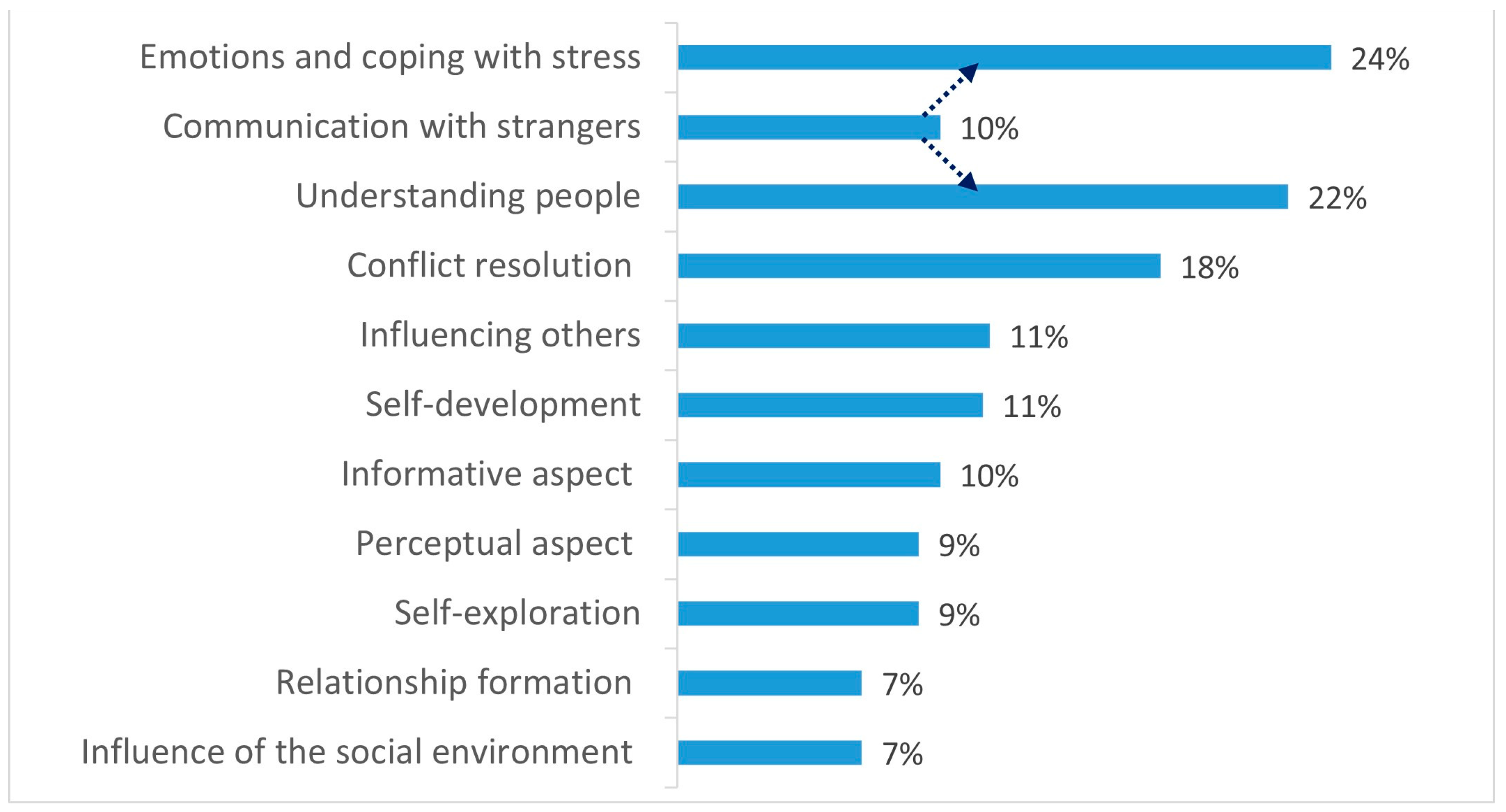
The qualitative content analysis identified eleven recurrent categories through which students articulated their developmental needs, communication challenges, and emerging adult identities (see Figure 1. Statistically significant differences between the frequencies, according to the χ2 test with p < 0.001). These categories capture the breadth of psychosocial tasks undergraduates confront—emotional regulation, relational negotiation, identity exploration, and professional readiness. An additional 5% of reflections contained general or unspecific questions (e.g., “How can one communicate better with people?”, “How does communication work from a psychological perspective?”) and were not classified further. A small number expressed curiosity about the course itself (e.g., “How will this course help me in life after my studies?”).

4.1.1. Emotions and Coping with Stress

The most frequent theme (24%) involved Emotions and coping with stress, a domain closely aligned with early adult developmental tasks involving self-regulation and wellbeing management. Only a minority of questions sought to understand emotions or their origins (e.g., “What factors make a person anxious in public?” or “Why does one sometimes feel nervous when starting a conversation?”). Far more often, students expressed a strong desire to control emotions: “How can I control my emotions?”, “How to ‘switch off’ emotions when they should not be expressed?”, or “How to restrain emotions when I feel overwhelmed?”.
Roughly two-thirds of these questions addressed stressors related to academic pressure or everyday functioning, including public speaking, time pressure, and everyday frustrations (e.g., “How to stay calm and not get angry about small mistakes or failures?”, “Where to find the strength for studying?”).
Students frequently externalized stress as part of navigating adult responsibilities (“How to calm down quickly in stressful situations?”). Some also expressed concern about others’ emotions (“How to block negative emotions from others?”, “How to control empathy?”). These patterns highlight growing anxiety and the need for coping strategies, which are central aspects of students’ socioemotional development during the transition to adulthood.

4.1.2. Communication with Strangers

A distinct category (10%) involved Communication with strangers, explicitly named by one in ten students. These reflections reveal challenges associated with social transition, including forming new peer networks, integrating into unfamiliar environments, and initiating interaction (skills many described as essential for their future profession): “How to overcome fear of initiating contact with a stranger?”, “How to overcome shyness when communicating with strangers?”.
The theme overlapped with both Emotions and coping with stress (fear, shyness) and Understanding people (“How can I understand the other person’s problems if I am a stranger to them?”). This category captures early-university adaptation processes, where students negotiate belonging, relational confidence, and social identity.
This category is presented separately in Figure 1 to reflect its hybrid nature, linking emotion-related and interpersonal concerns.

4.1.3. Understanding People and Conflict Resolution

Understanding people (22%) was the second most common theme and reflected students’ interest in interpreting motives, attitudes, and behaviours: “How can I better understand people?”, “Why do people sometimes act in illogical ways that hurt others?”.
Many students approached understanding others through typologizing (personality traits, behaviour patterns), suggesting a desire for predictability in complex social encounters—a characteristic feature of early cognitive development in young adulthood. Behind the desire to understand others can also hide a need to resolve disagreements with them; however, questions whose wordings have clear indications of this are classified in the next category.
Conflict resolution (18%) covered explicit requests to learn how to manage disagreements: “How to better express my opinion when it differs from others’?”, “What is the proper way to behave to resolve disagreements?” These questions point to students’ struggle with boundary setting, negotiation, and interpersonal agency—key developmental vectors linked to autonomy and mature interpersonal relationships. Many described frustrations with “intolerable” or “unwilling to listen” peers, revealing tensions around power, voice, and relational confidence.

4.1.4. Influencing Others

The theme Influencing others (11%) captured reflections on persuasion, manipulation, leadership, and social impact: “How to make people do what I want?”, “How to steer conversations in a way that benefits me?”, or “How to inspire trust?”.
While many framed influences in self-serving terms, a smaller subset (2%) focused on prosocial intent (“How can I help children learn better?”, “How to help people overcome stress or alcoholism?”). These reflections reveal emerging ethical awareness—students grappling with the dual possibilities of communication as both constructive and coercive.

4.1.5. Self-Development and Related Aspects

Approximately 11% of reflections were categorized as Self-development, focusing on personal improvement, professional competence, and experiential learning: “How can I learn to communicate more confidently with clients?”, “How to integrate ideas from self-help books into real life?” These reflections were typically framed in practical terms (“so that I can later use the knowledge in practice”) and were often linked with willingness to engage in experiential learning activities during the course (p = 0.002).
Smaller but conceptually related categories included:
  • Informative aspects of communication (10%): listening, lie detection, clarity in conveying information (“How to know when someone is lying or telling the truth?”, “How to make sure others understand my opinion correctly?”);
  • Perceptual aspects of communication (9%), emphasizing impression management (“How to create a good impression?”, “How do others perceive me when I speak?”);
  • Self-exploration (9%), where questions probed identity, authenticity, introspection (“Who am I and what am I pretending to be?”, “How to live with myself—should I change or accept who I am?”);
  • Relationship formation (7%): establishing and maintaining meaningful ties (“How to maintain good relations with friends, family, or lecturers?”);
  • Influence of the social environment (7%): societal expectations, peer pressure, group roles (“How not to be affected by others’ opinions when making life choices?”).

4.2. Search for “Right” Behavior

Nearly one in five students (18%) sought definitive rules for “correct” behaviour, asking for universal solutions rather than reflective guidance. This instrumental mindset contrasts with developmental models that emphasize self-authorship and complexity, indicating that many students remain at earlier developmental stages where certainty and clear prescriptions feel safer than open-ended growth.
A comparison across study programs (Optometry, Mathematics, and Graphic Design) revealed no statistically significant differences in the distribution of categories. This finding suggests that the patterns reflect general developmental tasks common across diverse undergraduate populations rather than programme-specific orientations.
The next section examines how these categories evolved across twelve cohorts, highlighting temporal shifts in students’ socioemotional and developmental concerns.

4.3. Temporal Trends

Analysis across cohorts revealed statistically significant shifts in four thematic categories, signalling changes in students’ developmental tasks and socioemotional orientations over time. The subsections below detail these patterns and highlight their relevance for student development practice.

4.3.1. Shifts in Emotional and Stress-Related Reflections

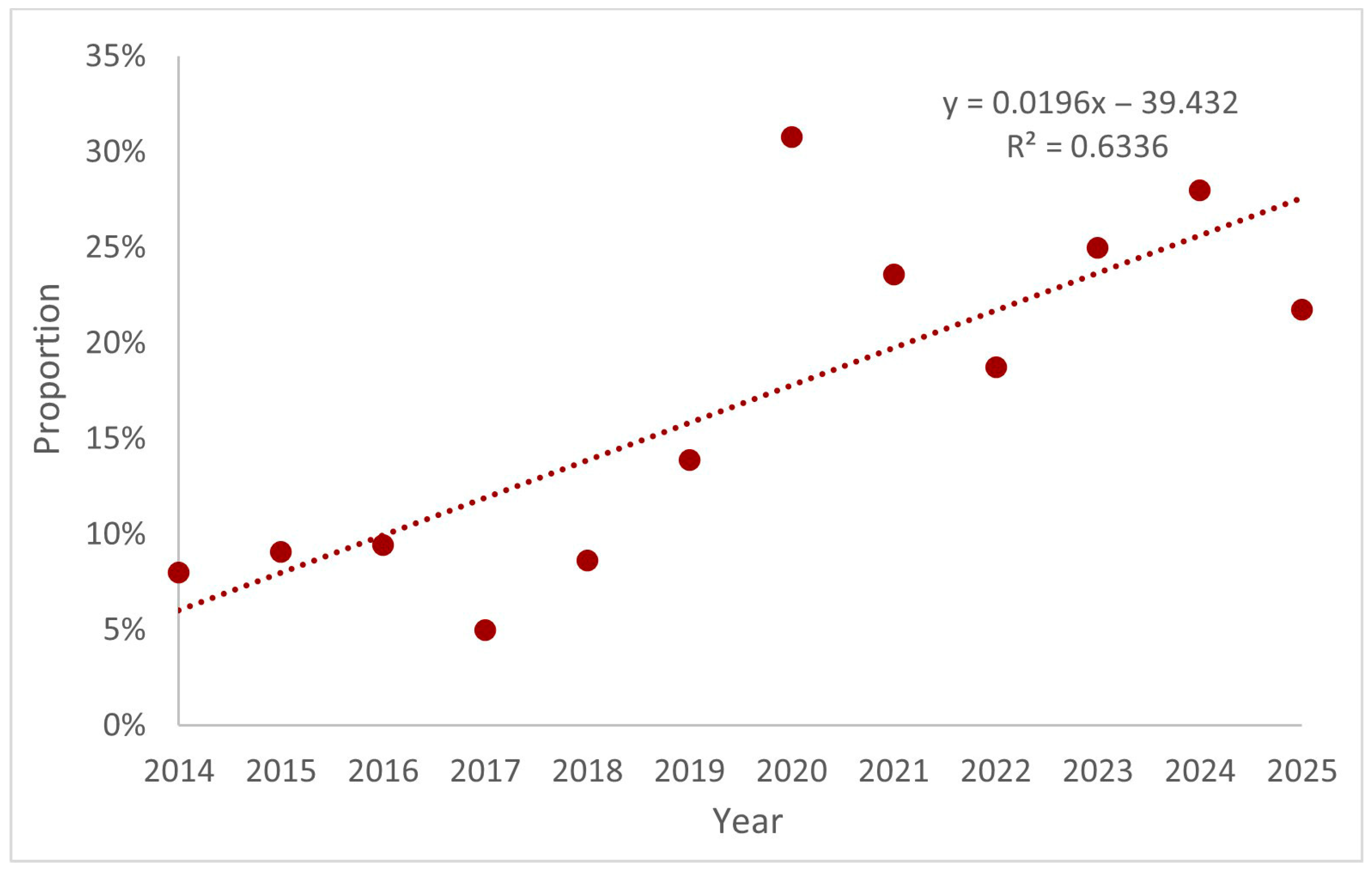
The category Emotions and coping with stress showed a strong upward trend (p = 0.002). Until 2018, fewer than 10% of questions addressed emotional regulation, while by 2020 the proportion had risen to 31% (see Figure 2). This pattern coincides with the period following the COVID-19 pandemic and may reflect broader shifts in students’ socioemotional experiences during this time. However, given the design of the study, no causal inference can be made regarding the specific impact of the pandemic. Since 2020, the proportion of questions explicitly mentioning emotional control has more than doubled (p = 0.01). However, the proportion of questions on Communication with strangers remained stable over time.
The proportion of questions related to Emotions and coping with stress showed a consistent upward trend over time, increasing by approximately 1.96 percentage points per year (R2 = 0.63), indicating a substantial growth in the salience of emotion-related concerns across cohorts.
This increase may reflect heightened salience of emotional strain and wellbeing concerns in students’ self-perceptions, alongside a growing emphasis on coping and regulatory processes within academic contexts. Such patterns align with literature emphasizing emotion regulation as a core driver of academic adjustment and developmental resilience (Iuga & David, 2024; Li & Zheng, 2025).

4.3.2. Growing Attention to Conflict Resolution

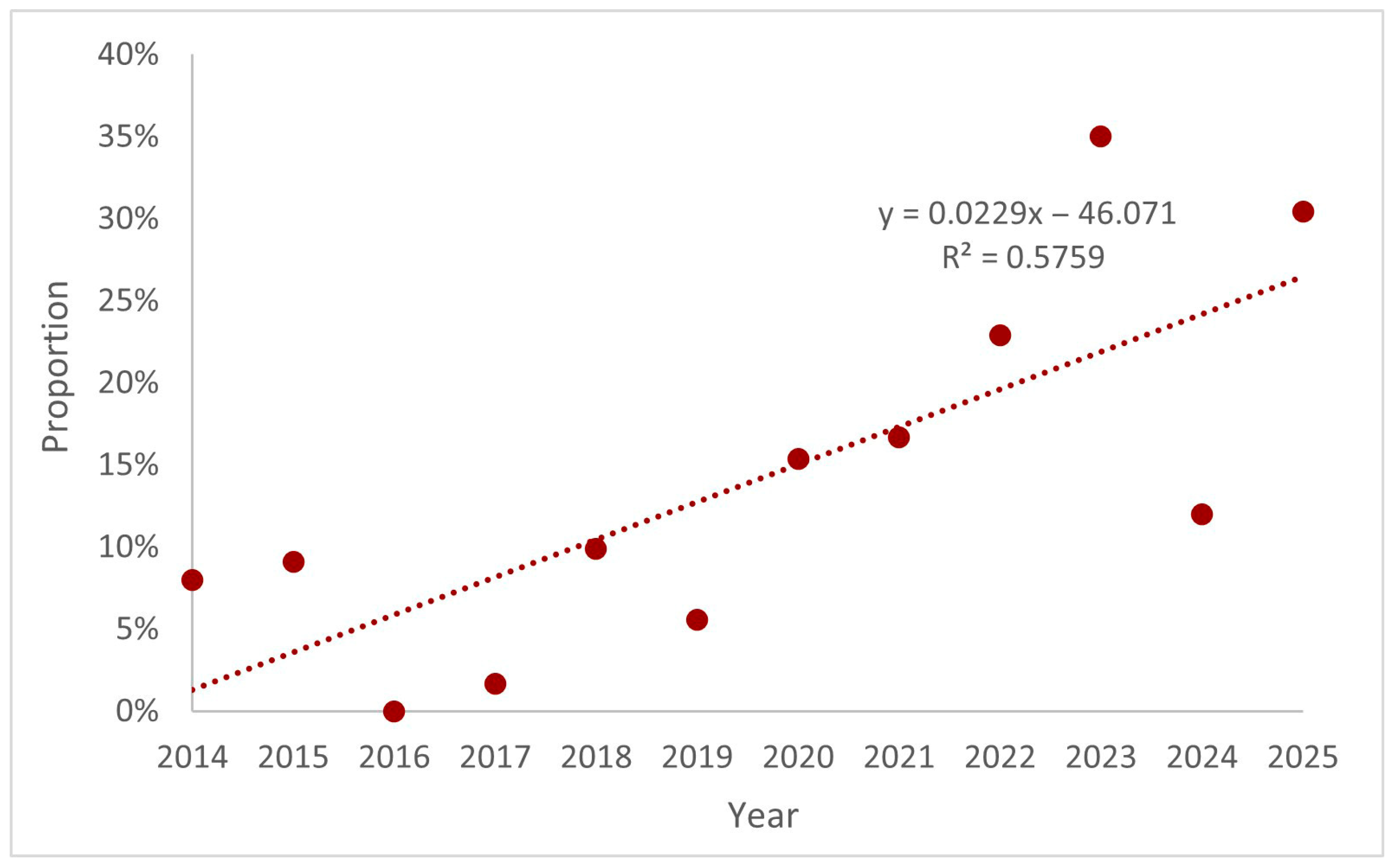
A similar upward trajectory was observed for Conflict resolution (p = 0.004). Until 2019, fewer than 10% of student reflections referred to this theme, but its frequency peaked at 35% in 2023 (see Figure 3). Students’ reflections became more concrete, shifting from abstract interpersonal curiosity to practical concerns about negotiation, disagreement, and relational boundaries.
The Conflict resolution category increased by approximately 2.29 percentage points per year (R2 = 0.58), suggesting a growing emphasis on managing interpersonal challenges in university contexts.
The increased attention to conflict resolution may indicate heightened awareness of relational boundaries, agency, and interpersonal regulation—processes that are developmentally salient during emerging adulthood. This interpretation aligns with engagement scholarship emphasizing the reciprocal relationship between relational quality, belonging, and academic adaptation (Kahu & Nelson, 2018).

4.3.3. Decreasing Focus on Understanding People

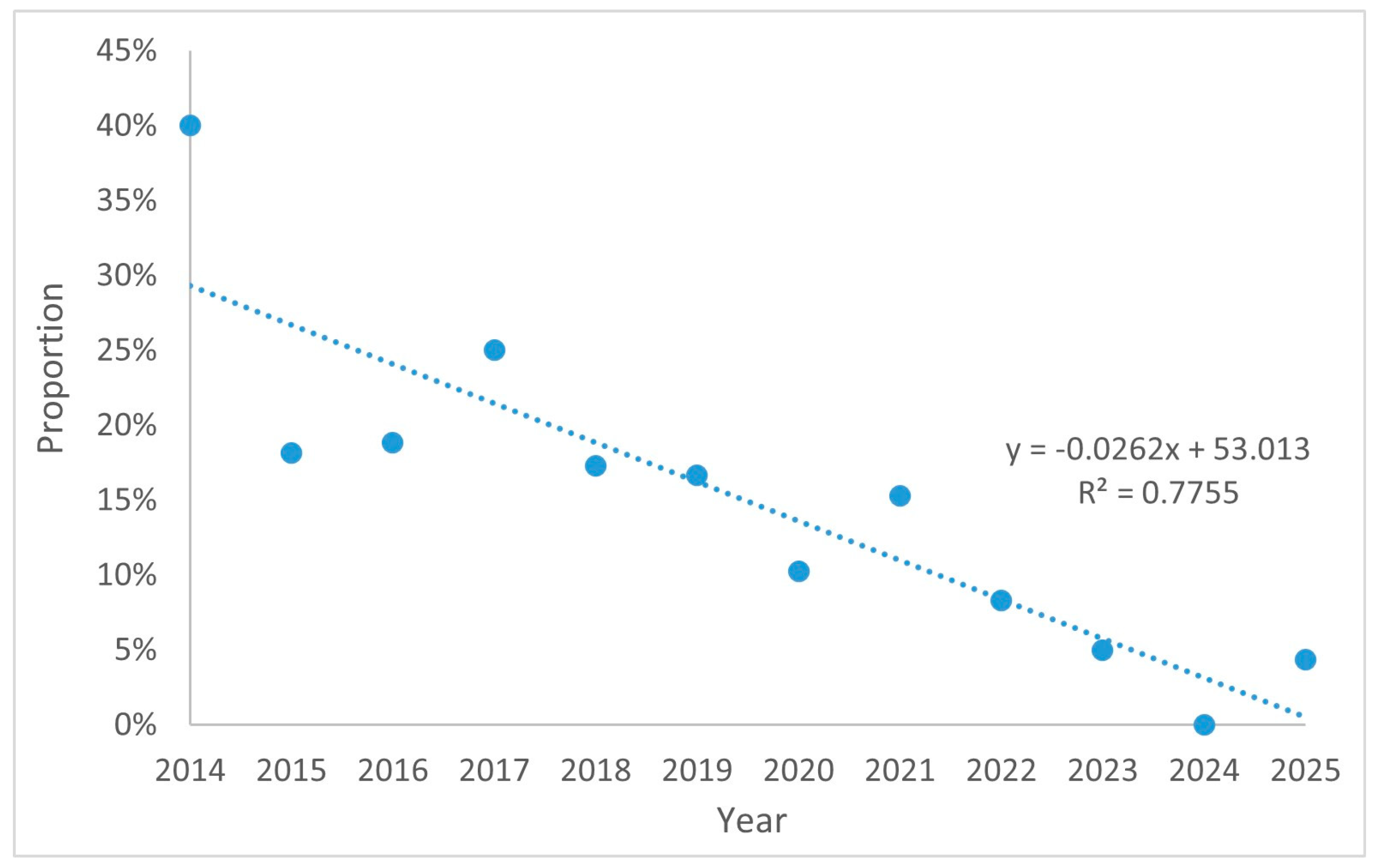
The theme Understanding people showed a consistent decreasing trend (p < 0.001), with up to 78% of the variation in frequency explained by temporal change (see Figure 4). Students in earlier cohorts tended to focus on internal psychological factors, motivation, and behavioural differences. Later cohorts appeared less focused on analysing others and more preoccupied with managing their own emotional responses.
The proportion of questions related to Understanding people decreased by approximately 2.62 percentage points per year (R2 = 0.78), reflecting a notable decline in more abstract interpersonal curiosity over time. This shift signals a movement from cognitive–analytical interest to affective–experiential concerns—a trend consistent with increased wellbeing pressures and changing university expectations.

4.3.4. Decline in Abstract Self-Development Category

The Self-development category also showed a declining trend, though less pronounced, decreasing by approximately 1.22 percentage points per year (R2 = 0.38), indicating a gradual reduction in explicitly articulated personal growth concerns. This decline is statistically significant (p = 0.032), with approximately 38% of its variance explained by temporal factors. Earlier cohorts more frequently posed broad, introspective questions, whereas later cohorts emphasized concrete coping strategies and emotional regulation. Rather than indicating a simple shift, this pattern may reflect changing developmental priorities, with greater salience attributed to adaptive regulation processes in contexts marked by heightened uncertainty. While practical application remained central, the number of students willing to engage in practical tasks decreased over time, with a more pronounced decline observed in cohorts following 2020 (p = 0.002). While this pattern temporally coincides with the period of COVID-19 restrictions, no causal inference can be drawn.
This shift may indicate a move away from individualistic, theory-oriented reflection toward more pragmatic understandings of personal growth. Such patterns suggest that students’ developmental energy has moved from abstract self-knowledge toward navigating immediate emotional, academic, and relational pressures. The decline also coincides with an increased emphasis on coping and emotional regulation, suggesting a developmental reorientation from exploratory self-knowledge toward regulatory competence and adaptive socioemotional functioning in response to heightened environmental demands (Benítez-Agudelo et al., 2025).

5. Discussion

The findings of this twelve-year analysis illustrate how student-authored questions can serve as indicators of cohort-level shifts in developmental priorities and socioemotional concerns. While the design does not track individual trajectories, it captures how successive groups of students articulate their adaptation challenges within a shared institutional context. Interpreted through established student development frameworks, these reflections point to shifting orientations that correspond to broader changes in emotional, cognitive, and interpersonal functioning during the undergraduate years (Chickering & Reisser, 1993; Patton et al., 2016).

5.1. Shifts in Socioemotional Regulation and Developmental Priorities

One of the most pronounced trends was the increased salience of the category related to emotion regulation and stress management. Cohorts entering university after 2020 more frequently articulated concerns about coping with anxiety, regulating emotional responses, and navigating internal pressure—patterns consistent with wellbeing research documenting heightened emotional strain among students globally (Cui et al., 2023; Liu et al., 2023; Li & Zheng, 2025). Students’ recurring emphasis on stress, anxiety, and interpersonal conflict in the present study may indicate that socioemotional adaptation has become a particularly visible dimension of the contemporary learning context (Benítez-Agudelo et al., 2025; Rotaru et al., 2024). Within student development theory, these concerns resonate with Chickering’s vectors of developing competence and managing emotions, which conceptualize the early-university period as a phase of balancing internal affective demands with new academic and relational expectations (Chickering & Reisser, 1993).
At the same time, the decline in abstract self-development questions suggests a reduced emphasis on broad identity exploration and a greater focus on immediately applicable coping and regulatory strategies. This pattern can be interpreted in light of Baxter Magolda’s (2008) theory of self-authorship, which highlights the developmental tension between external guidance and internal meaning-making during emerging adulthood. Rather than indicating diminished developmental depth, the findings may reflect a contextual reorientation in which students seek tools that help stabilize emotional and interpersonal functioning within demanding academic environments. These patterns suggest a developmental reorientation in how emerging adults engage with learning, where communication-related knowledge is increasingly mobilized as a resource for managing socioemotional demands and maintaining psychological functioning in complex transition contexts.
The observed decline in questions related to identity exploration and personal growth invites reconsideration of how developmental priorities are expressed in contemporary cohorts of emerging adults. Arnett’s (2000) conceptualization of emerging adulthood emphasizes identity exploration as a central developmental task, particularly in domains such as self-understanding and future orientation. However, the present findings suggest that, in current university contexts, this exploratory focus may be less explicitly articulated in students’ reflections.
Rather than indicating a disappearance of identity-related processes, this shift may reflect a reconfiguration of developmental priorities under conditions of increased uncertainty, performance pressure, and socioemotional demands. Contemporary students appear to engage less in abstract self-exploration and more in addressing immediate challenges related to emotional regulation, stress, and interpersonal functioning. In this sense, identity work may be becoming more situated and pragmatic, embedded in everyday coping and relational experiences rather than expressed as a distinct domain of inquiry.
This interpretation aligns with more recent perspectives on emerging adulthood that emphasize variability, contextual sensitivity, and the influence of sociohistorical conditions on developmental trajectories (Arnett, 2024; Shanahan, 2000). The findings therefore do not contradict the theoretical framework of emerging adulthood, but rather suggest that its core developmental tasks may be manifesting differently in contemporary higher education environments.

5.2. Changing Interpersonal Orientations in Emerging Adulthood

The growing prominence of conflict resolution category may reflect evolving interpersonal demands characteristic of emerging adulthood. As young adults increasingly engage in collaborative academic tasks and peer-based interactions, they may encounter more frequent situations requiring negotiation, boundary-setting, and constructive disagreement management. Rather than viewing conflict solely as a situational challenge, students’ reflections suggest that interpersonal regulation is experienced as a developmental competency linked to relational stability and psychological adjustment. This interpretation is consistent with Kahu and Nelson’s (2018) engagement framework, which highlights the centrality of relational quality and belonging in shaping academic persistence and wellbeing.
In contrast, the declining emphasis on understanding others as an abstract goal may indicate a relative shift away from interpersonal analysis toward self-protective and regulatory concerns. Instead of focusing primarily on decoding others’ motives, students increasingly referenced managing emotional boundaries, preserving wellbeing, and navigating affectively intense interactions. Such patterns align with broader psychological findings documenting heightened future-oriented anxiety and sensitivity to uncertainty among young adults. Empirical evidence suggesting that emotion regulation mediates the relationship between future anxiety and stress or depressive symptoms (Öztekin et al., 2025) provides one plausible developmental mechanism underlying these shifts.
Beyond immediate interpersonal contexts, the observed shifts in students’ concerns may also reflect broader sociohistorical changes shaping the experience of emerging adulthood. Increasing exposure to social media, the rapid development of artificial intelligence, growing awareness of climate change, and heightened global uncertainty may contribute to elevated stress levels and a greater emphasis on emotional regulation and coping strategies among contemporary students.
Socioemotional experiences are also embedded within relational contexts, including family structure, sibling relationships, and caregiving responsibilities, which have been shown to influence stress and emotional adjustment in emerging adulthood (Alon, 2025, 2026). While these factors were not directly assessed in the present study, acknowledging both macro-level societal shifts and micro-level relational influences helps situate the findings within a broader developmental ecology. This perspective suggests that cohort-level changes in students’ reflective concerns emerge from the interaction of individual, relational, and societal processes rather than from isolated developmental trends. Such influences are typically examined within developmental research designs that incorporate demographic, relational, or longitudinal individual-level data (Bronfenbrenner & Morris, 2006; Overton, 2015), which differs from the cohort-level, anonymized reflective approach employed in the present study.

5.3. Reflective Questions as Indicators of Socioemotional Development

Reflective questions provide a unique form of access to students’ meaning-making processes, capturing how students articulate concerns, uncertainties, and expectations at a given point in time. As such, they can be understood as indirect indicators of socioemotional development, revealing which developmental tasks are most salient or consciously experienced by students within a particular cohort. Rather than measuring development as a linear progression, this approach conceptualizes development as changing patterns of concern and adaptation that emerge in response to evolving contextual demands.
Unlike structured surveys administered after course completion, open-ended prompts capture concerns at the outset of learning, before formal instruction shapes students’ responses. As such, they provide access to spontaneously articulated developmental priorities, including themes of competence, autonomy, emotional regulation, and interpersonal functioning (Patton et al., 2016). Across cohorts, these reflections collectively map how young adults negotiate shifting academic, relational, and affective demands during a formative developmental period.
Furthermore, the stable salience of communication with strangers suggests that adaptation to unfamiliar interpersonal contexts remains a consistent developmental task. Entering new social environments requires emotion regulation, boundary negotiation, and social confidence—capacities closely tied to wellbeing in emerging adulthood. This observation aligns with research emphasizing that transitions into new relational contexts are central to developmental progression and psychological adjustment (Bovill, 2020; Brankovic & Cantwell, 2022).

5.4. Implications for Supporting Socioemotional Development in Higher Education

The findings of this study carry several implications for how higher education contexts may support socioemotional development in emerging adulthood:
  • First, the growing emphasis on stress, anxiety, and emotional regulation suggests that structured opportunities for developing coping skills and emotional awareness remain highly relevant. Educational environments that integrate socioemotional skill-building—through curricular design, guided reflection, or facilitated dialogue—may better align with students’ expressed developmental priorities. Such efforts can foster psychological flexibility and resilience, capacities shown to support adaptation during periods of academic and social transition.
  • Second, the increasing attention to conflict resolution underscores the importance of explicitly cultivating interpersonal competence. As collaborative learning and peer interaction are central features of contemporary higher education, students benefit from structured opportunities to practice boundary negotiation, perspective-taking, and constructive disagreement. Supporting these capacities may enhance not only academic collaboration but also broader socioemotional adjustment.
  • Third, the present study illustrates the developmental value of low-stakes reflective prompts. When systematically collected over time, student-authored reflections can serve as a sensitive monitoring tool for identifying cohort-level shifts in developmental concerns. Incorporating similar reflective practices into educational settings may provide educators and institutional leaders with nuanced insight into evolving student needs.
Overall, the results suggest that socioemotional development is not peripheral to academic learning but embedded within it. Recognizing and responding to students’ articulated concerns may therefore strengthen both educational effectiveness and psychological wellbeing in higher education contexts.

5.5. Limitations and Directions for Future Research

This study offers insight into how undergraduate students articulate socioemotional and developmental priorities through communication-related reflections; however, several limitations warrant consideration. First, the data were collected within a single European university and embedded in one course context. Although the sample included students from three disciplinary programmes, institutional culture and curricular structure may have shaped how students framed their reflections. At the same time, the developmental processes observed—such as increasing emphasis on emotion regulation and interpersonal coping—are consistent with broader international trends in emerging adulthood and student wellbeing research. Future studies could replicate this design across multiple institutions or national contexts to examine the cross-cultural robustness of these patterns.
Second, the reflections represent self-authored written statements rather than observed behaviours or longitudinal psychological measures. Reflective prompts capture articulated concerns and perceived challenges, but may not fully encompass implicit processes or unexpressed difficulties. Integrating reflective data with interviews, behavioural indicators, or validated wellbeing instruments could provide a more comprehensive account of socioemotional development in university settings.
Third, although the study draws on repeated cross-sectional cohorts across twelve years, it does not track individual developmental trajectories. Longitudinal or mixed-method designs following the same students over time would allow researchers to examine how emotion regulation, conflict navigation, and interpersonal competence evolve within individuals during early university years.
A further limitation concerns the analytic process, which was conducted by a single researcher. While this approach is consistent with interpretive qualitative traditions, it may introduce the possibility that prior familiarity with the dataset and initial observations influenced category construction. Although reflexive strategies were employed throughout the analysis to mitigate this risk, including systematic engagement with the full dataset and attention to disconfirming cases, the absence of an independent coder limits the ability to assess coding reliability in a formal sense. Future research could strengthen methodological rigor by incorporating multiple coders or blinded coding procedures.
An additional limitation relates to the data collection context. As the reflections were collected within a course taught by the researcher, it is possible that perceived power dynamics may have influenced students’ willingness to participate or the way they formulated their responses. Although participation was voluntary, anonymous, and unrelated to assessment, and the task was embedded in routine pedagogical practice, such contextual factors cannot be fully excluded. Future research could address this limitation by collecting comparable data in settings where the researcher is not directly involved in instruction.
In addition, the study does not include detailed demographic or relational background variables (e.g., family structure, caregiving roles, or sibling relationships), which may shape how socioemotional concerns are experienced and articulated. Future research could integrate such variables to better contextualize students’ reflective expressions within their broader developmental environments.
Finally, cultural context may influence how students conceptualize emotional control, conflict, or communication with unfamiliar others. Comparative research across diverse educational systems would deepen understanding of how socioemotional development unfolds within varying social and cultural environments.

6. Conclusions

This study provides longitudinal insight into socioemotional development in emerging adulthood within a European university context by tracing how undergraduates’ self-expressed priorities evolved across twelve cohorts. Analysis of nearly eight hundred student-generated questions revealed a gradual reorientation from abstract curiosity about communication toward more immediate concerns related to emotion regulation, stress management, and conflict navigation. Interpreted through developmental frameworks, these patterns reflect central tasks of emerging adulthood, including the integration of emotional competence, interpersonal functioning, and adaptive coping within academic environments.
These findings are particularly relevant for understanding how young people navigate the transition to adulthood under conditions of increasing social complexity and uncertainty.
Beyond its empirical contribution, the study conceptualizes student-authored reflections as a form of developmental data that captures how young people articulate emerging socioemotional challenges during the transition to adulthood. When collected systematically over time, such reflections provide a longitudinal lens on developmental change that complements conventional cross-sectional approaches. The persistent salience of stress regulation and relational challenges suggests that socioemotional development remains closely intertwined with academic engagement. Recognizing reflective student narratives as developmental data may therefore enrich both psychological research and educational practice aimed at supporting wellbeing in higher education.

Funding

This research received no external funding.

Institutional Review Board Statement

Ethical review and approval were waived for this study, as it analysed anonymised educational materials generated within normal teaching practice and without intervention.

Informed Consent Statement

Informed consent was waived because the study analysed fully anonymized data generated within routine educational practice, without any intervention or collection of personally identifiable information. Participation in the original classroom activity was voluntary and unrelated to course assessment. In accordance with the General Data Protection Regulation (GDPR, Recital 26), anonymized data does not constitute personal data.

Data Availability Statement

The data presented in this study are available on reasonable request from the corresponding author. The data are not publicly available due to ethical considerations related to the use of anonymized classroom-generated materials.

Conflicts of Interest

The author declares no conflicts of interest.

References

  1. Alon, R. (2025). Psychosocial stress among siblings of individuals with disabilities: The interplay of religiosity, gender, and cultural background. Religions, 16(9), 1155. [Google Scholar] [CrossRef]
  2. Alon, R. (2026). Siblings with ASD as the “central axis” in the lives of their typically developing emerging adult siblings. Discover Psychology. Advance online publication. [Google Scholar] [CrossRef]
  3. Alt, D., Raichel, N., & Naamati-Schneider, L. (2022). Higher education students’ reflective journal writing and lifelong learning skills: Insights from an exploratory sequential study. Frontiers in Psychology, 12, 707168. [Google Scholar] [CrossRef] [PubMed]
  4. Arnett, J. J. (2000). Emerging adulthood: A theory of development from the late teens through the twenties. American Psychologist, 55(5), 469–480. [Google Scholar] [CrossRef]
  5. Arnett, J. J. (2024). Emerging adulthood: The winding road from the late teens through the twenties (3rd ed.). Oxford University Press. [Google Scholar]
  6. Baxter Magolda, M. B. (2008). Three elements of self-authorship. Journal of College Student Development, 49(4), 269–284. [Google Scholar] [CrossRef]
  7. Benítez-Agudelo, J. C., Restrepo, D., Navarro-Jimenez, E., & Clemente-Suárez, V. J. (2025). Longitudinal effects of stress in an academic context on psychological well-being, physiological markers, health behaviours, and academic performance in university students. BMC Psychology, 13(1), 753. [Google Scholar] [CrossRef]
  8. Bovill, C. (2020). Co-creation in learning and teaching: The case for a whole-class approach in higher education. Higher Education, 79, 1023–1037. [Google Scholar] [CrossRef]
  9. Brankovic, J., & Cantwell, B. (2022). Making sense of change in higher education research: Exploring the intersection of science and policy. Higher Education, 84, 1207–1226. [Google Scholar] [CrossRef]
  10. Braun, V., & Clarke, V. (2019). Reflecting on reflexive thematic analysis. Qualitative Research in Sport, Exercise and Health, 11(4), 589–597. [Google Scholar] [CrossRef]
  11. Bronfenbrenner, U., & Morris, P. A. (2006). The bioecological model of human development. In R. M. Lerner, & W. Damon (Eds.), Handbook of child psychology: Theoretical models of human development (6th ed., pp. 793–828). John Wiley & Sons. [Google Scholar]
  12. Chan, C. K. Y., & Lee, K. K. W. (2021). Reflection literacy: A multilevel perspective on the challenges of using reflections in higher education through a comprehensive literature review. Educational Research Review, 32, 100376. [Google Scholar] [CrossRef]
  13. Chickering, A. W., & Reisser, L. (1993). Education and identity (2nd ed.). Jossey-Bass. [Google Scholar]
  14. Cook-Sather, A. (2020). Student voice across contexts: Fostering student agency in today’s schools. Theory Into Practice, 59(2), 182–191. [Google Scholar] [CrossRef]
  15. Cui, J., Wang, Y., Liu, D., & Yang, H. (2023). Depression and stress are associated with latent profiles of problematic social media use among college students. Frontiers in Psychiatry, 14, 1306152. [Google Scholar] [CrossRef]
  16. Demichelis, O. P., Fowler, J. A., & Young, T. (2024). Better emotion regulation mediates gratitude and increased stress in undergraduate students across a university semester. Stress and Health, 40(5), e3417. [Google Scholar] [CrossRef] [PubMed]
  17. Elo, S., & Kyngäs, H. (2008). The qualitative content analysis process. Journal of Advanced Nursing, 62(1), 107–115. [Google Scholar] [CrossRef]
  18. Hsieh, H.-F., & Shannon, S. E. (2005). Three approaches to qualitative content analysis. Qualitative Health Research, 15(9), 1277–1288. [Google Scholar] [CrossRef]
  19. Iuga, I. A., & David, O. A. (2024). Emotion regulation and academic burnout among youth: A quantitative meta-analysis. Educational Psychology Review, 36(4), 106. [Google Scholar] [CrossRef]
  20. Kahu, E. R., & Nelson, K. (2018). Student engagement in the educational interface: Understanding the mechanisms of student success. Higher Education Research & Development, 37(1), 58–71. [Google Scholar] [CrossRef]
  21. Li, Y., & Zheng, P. (2025). Trait resilience protects against social anxiety in college students through emotion regulation and coping strategies. Scientific Reports, 15, 28143. [Google Scholar] [CrossRef]
  22. Liu, X., Zhang, Y., Gao, W., & Cao, X. (2023). Developmental trajectories of depression, anxiety, and stress among college students: A piecewise growth mixture model analysis. Humanities and Social Sciences Communications, 10, 736. [Google Scholar] [CrossRef]
  23. Matthews, K. E., & Dollinger, M. (2023). Student voice in higher education: The importance of distinguishing student representation and student partnership. Higher Education, 85, 555–570. [Google Scholar] [CrossRef]
  24. Mohamed, M., Rashid, R. A., & Alqaryouti, M. H. (2022). Conceptualizing the complexity of reflective practice in education. Frontiers in Psychology, 13, 1008234. [Google Scholar] [CrossRef] [PubMed]
  25. Nanda, S. B., Satapathy, D., Panda, G., & Pradhan, D. K. (2025). Socio-emotional learning and competencies in 21st-century education: A systematic review of teacher and student perspectives. Discover Education, 4, 338. [Google Scholar] [CrossRef]
  26. Official Statistics Portal. (n.d.). Statistical database. Official statistics. Available online: https://data.stat.gov.lv/pxweb/en/OSP_PUB/ (accessed on 24 February 2026).
  27. Overton, W. F. (2015). Processes, relations, and relational-developmental-systems. In W. F. Overton, P. C. M. Molenaar, & R. M. Lerner (Eds.), Handbook of child psychology and developmental science: Theory and method (7th ed., pp. 9–62). John Wiley & Sons. [Google Scholar] [CrossRef]
  28. Öztekin, G. G., Gómez-Salgado, J., & Yıldırım, M. (2025). Future anxiety, depression and stress among undergraduate students: Psychological flexibility and emotion regulation as mediators. Frontiers in Psychology, 16, 1517441. [Google Scholar] [CrossRef] [PubMed]
  29. Patton, L. D., Renn, K. A., Guido, F. M., Quaye, S. J., & Evans, N. J. (2016). Student development in college: Theory, research, and practice (3rd ed.). Jossey-Bass. [Google Scholar]
  30. Rotaru, D. I., Chisnoiu, R. M., Bolboacă, S. D., Gileru, E. A., Chisnoiu, A. M., & Delean, A. G. (2024). Insights into self-evaluated stress, anxiety, and depression among dental students. Scientific Reports, 14, 30352. [Google Scholar] [CrossRef] [PubMed]
  31. Shanahan, M. J. (2000). Pathways to adulthood in changing societies: Variability and mechanisms in life course perspective. Annual Review of Sociology, 26, 667–692. [Google Scholar] [CrossRef]
  32. Smith, J. A., Flowers, P., & Larkin, M. (2021). Interpretative phenomenological analysis (2nd ed.). SAGE Publications Ltd. [Google Scholar]
Figure 1. Categories of students’ communication-related questions.
Youth 06 00065 g001
Figure 2. Changes in the proportion of the Emotions and coping with stress category by year.
Youth 06 00065 g002
Figure 3. Changes in the proportion of the Conflict resolution category by year.
Youth 06 00065 g003
Figure 4. Changes in the proportion of the Understanding people category by year.
Youth 06 00065 g004
Table 1. Conceptual integration of theoretical perspectives guiding the study.
Theoretical
Perspective
Core
Psychological
Constructs
Developmental
Focus in Emerging
Adulthood
Analytical
Contribution to the Study
Socioemotional DevelopmentEmotion regulation; psychological flexibility; stress coping; identity consolidation; adaptive functioningManaging instability, negotiating autonomy and interdependence, developing regulatory competenceInterprets increased stress- and emotion-related reflections as indicators of heightened socioemotional regulation demands across cohorts
Communication Psychology as Developmental ContextInterpersonal competence, relational agency, assertiveness, conflict negotiationEnacting socioemotional skills through interaction and academic collaborationExplains the rise in conflict-resolution concerns and the shift toward applied relational strategies
Reflective
Practice as
Developmental Lens
Metacognition, self-awareness, meaning-making, articulation of developmental concernsExternalizing and organizing internal developmental challengesPositions student-authored questions as cohort-level indicators of evolving psychosocial priorities
Disclaimer/Publisher’s Note: The statements, opinions and data contained in all publications are solely those of the individual author(s) and contributor(s) and not of MDPI and/or the editor(s). MDPI and/or the editor(s) disclaim responsibility for any injury to people or property resulting from any ideas, methods, instructions or products referred to in the content.