
Evolving Socioemotional Needs in Emerging Adulthood: A Twelve-Year Study of University Students’ Reflections


Abstract
1. Introduction
2. Theoretical Background: Socioemotional Development in Emerging Adulthood
2.1. Socioemotional Development and Wellbeing in Emerging Adulthood
2.2. Communication Psychology as a Context for Development
2.3. Reflective Learning as a Developmental Lens
3. Materials and Methods
3.1. Research Context and Participants
3.2. Data Collection
3.3. Data Analysis
4. Results
4.1. Main Categories of Questions
4.1.1. Emotions and Coping with Stress
4.1.2. Communication with Strangers
4.1.3. Understanding People and Conflict Resolution
4.1.4. Influencing Others
4.1.5. Self-Development and Related Aspects
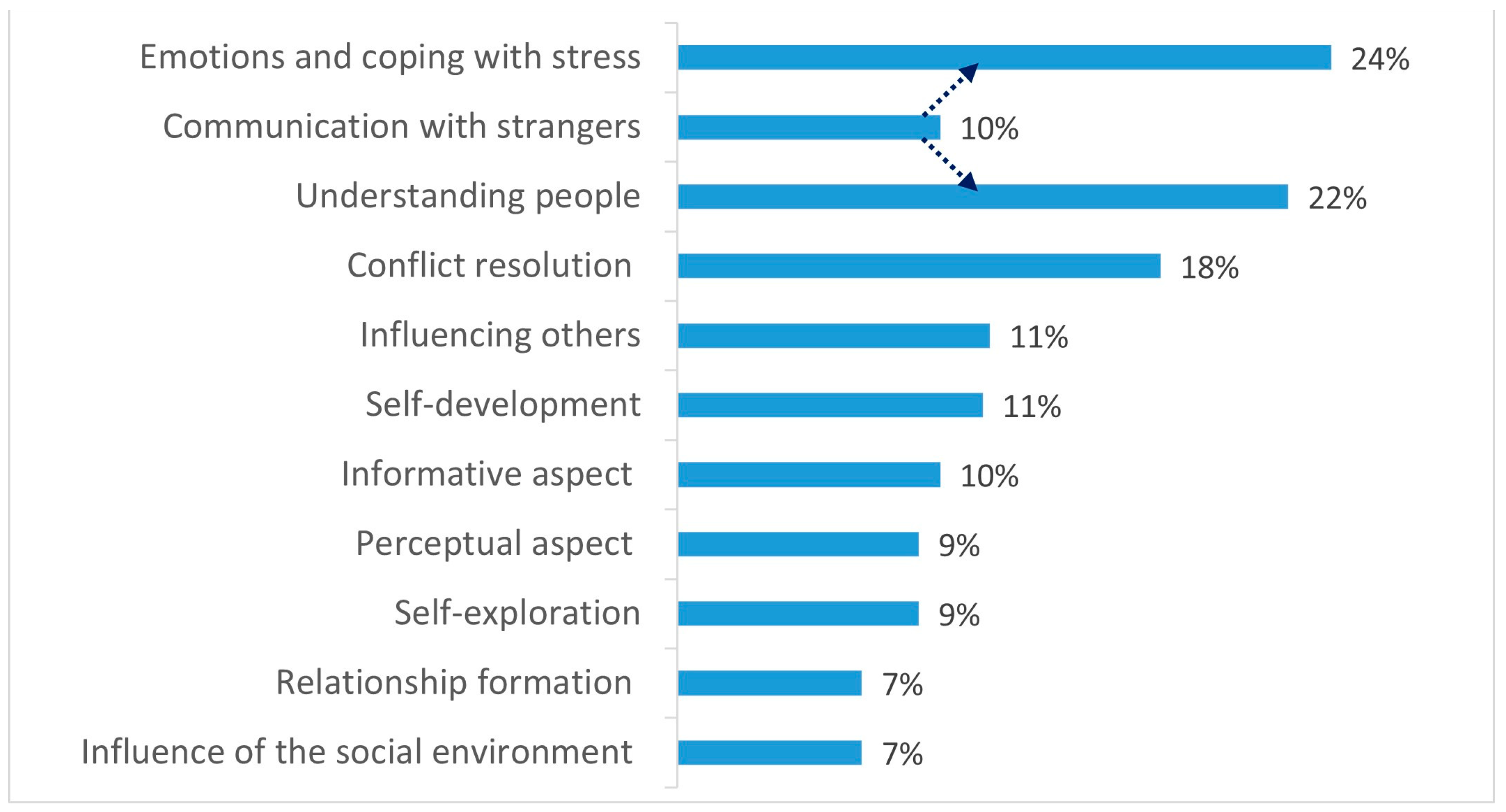
- Informative aspects of communication (10%): listening, lie detection, clarity in conveying information (“How to know when someone is lying or telling the truth?”, “How to make sure others understand my opinion correctly?”);
- Perceptual aspects of communication (9%), emphasizing impression management (“How to create a good impression?”, “How do others perceive me when I speak?”);
- Self-exploration (9%), where questions probed identity, authenticity, introspection (“Who am I and what am I pretending to be?”, “How to live with myself—should I change or accept who I am?”);
- Relationship formation (7%): establishing and maintaining meaningful ties (“How to maintain good relations with friends, family, or lecturers?”);
- Influence of the social environment (7%): societal expectations, peer pressure, group roles (“How not to be affected by others’ opinions when making life choices?”).
4.2. Search for “Right” Behavior
4.3. Temporal Trends
4.3.1. Shifts in Emotional and Stress-Related Reflections
4.3.2. Growing Attention to Conflict Resolution
4.3.3. Decreasing Focus on Understanding People
4.3.4. Decline in Abstract Self-Development Category
5. Discussion
5.1. Shifts in Socioemotional Regulation and Developmental Priorities
5.2. Changing Interpersonal Orientations in Emerging Adulthood
5.3. Reflective Questions as Indicators of Socioemotional Development
5.4. Implications for Supporting Socioemotional Development in Higher Education
- First, the growing emphasis on stress, anxiety, and emotional regulation suggests that structured opportunities for developing coping skills and emotional awareness remain highly relevant. Educational environments that integrate socioemotional skill-building—through curricular design, guided reflection, or facilitated dialogue—may better align with students’ expressed developmental priorities. Such efforts can foster psychological flexibility and resilience, capacities shown to support adaptation during periods of academic and social transition.
- Second, the increasing attention to conflict resolution underscores the importance of explicitly cultivating interpersonal competence. As collaborative learning and peer interaction are central features of contemporary higher education, students benefit from structured opportunities to practice boundary negotiation, perspective-taking, and constructive disagreement. Supporting these capacities may enhance not only academic collaboration but also broader socioemotional adjustment.
- Third, the present study illustrates the developmental value of low-stakes reflective prompts. When systematically collected over time, student-authored reflections can serve as a sensitive monitoring tool for identifying cohort-level shifts in developmental concerns. Incorporating similar reflective practices into educational settings may provide educators and institutional leaders with nuanced insight into evolving student needs.
5.5. Limitations and Directions for Future Research
6. Conclusions
Funding
Institutional Review Board Statement
Informed Consent Statement
Data Availability Statement
Conflicts of Interest
References
- Alon, R. (2025). Psychosocial stress among siblings of individuals with disabilities: The interplay of religiosity, gender, and cultural background. Religions, 16(9), 1155. [Google Scholar] [CrossRef]
- Alon, R. (2026). Siblings with ASD as the “central axis” in the lives of their typically developing emerging adult siblings. Discover Psychology. Advance online publication. [Google Scholar] [CrossRef]
- Alt, D., Raichel, N., & Naamati-Schneider, L. (2022). Higher education students’ reflective journal writing and lifelong learning skills: Insights from an exploratory sequential study. Frontiers in Psychology, 12, 707168. [Google Scholar] [CrossRef] [PubMed]
- Arnett, J. J. (2000). Emerging adulthood: A theory of development from the late teens through the twenties. American Psychologist, 55(5), 469–480. [Google Scholar] [CrossRef]
- Arnett, J. J. (2024). Emerging adulthood: The winding road from the late teens through the twenties (3rd ed.). Oxford University Press. [Google Scholar]
- Baxter Magolda, M. B. (2008). Three elements of self-authorship. Journal of College Student Development, 49(4), 269–284. [Google Scholar] [CrossRef]
- Benítez-Agudelo, J. C., Restrepo, D., Navarro-Jimenez, E., & Clemente-Suárez, V. J. (2025). Longitudinal effects of stress in an academic context on psychological well-being, physiological markers, health behaviours, and academic performance in university students. BMC Psychology, 13(1), 753. [Google Scholar] [CrossRef]
- Bovill, C. (2020). Co-creation in learning and teaching: The case for a whole-class approach in higher education. Higher Education, 79, 1023–1037. [Google Scholar] [CrossRef]
- Brankovic, J., & Cantwell, B. (2022). Making sense of change in higher education research: Exploring the intersection of science and policy. Higher Education, 84, 1207–1226. [Google Scholar] [CrossRef]
- Braun, V., & Clarke, V. (2019). Reflecting on reflexive thematic analysis. Qualitative Research in Sport, Exercise and Health, 11(4), 589–597. [Google Scholar] [CrossRef]
- Bronfenbrenner, U., & Morris, P. A. (2006). The bioecological model of human development. In R. M. Lerner, & W. Damon (Eds.), Handbook of child psychology: Theoretical models of human development (6th ed., pp. 793–828). John Wiley & Sons. [Google Scholar]
- Chan, C. K. Y., & Lee, K. K. W. (2021). Reflection literacy: A multilevel perspective on the challenges of using reflections in higher education through a comprehensive literature review. Educational Research Review, 32, 100376. [Google Scholar] [CrossRef]
- Chickering, A. W., & Reisser, L. (1993). Education and identity (2nd ed.). Jossey-Bass. [Google Scholar]
- Cook-Sather, A. (2020). Student voice across contexts: Fostering student agency in today’s schools. Theory Into Practice, 59(2), 182–191. [Google Scholar] [CrossRef]
- Cui, J., Wang, Y., Liu, D., & Yang, H. (2023). Depression and stress are associated with latent profiles of problematic social media use among college students. Frontiers in Psychiatry, 14, 1306152. [Google Scholar] [CrossRef]
- Demichelis, O. P., Fowler, J. A., & Young, T. (2024). Better emotion regulation mediates gratitude and increased stress in undergraduate students across a university semester. Stress and Health, 40(5), e3417. [Google Scholar] [CrossRef] [PubMed]
- Elo, S., & Kyngäs, H. (2008). The qualitative content analysis process. Journal of Advanced Nursing, 62(1), 107–115. [Google Scholar] [CrossRef]
- Hsieh, H.-F., & Shannon, S. E. (2005). Three approaches to qualitative content analysis. Qualitative Health Research, 15(9), 1277–1288. [Google Scholar] [CrossRef]
- Iuga, I. A., & David, O. A. (2024). Emotion regulation and academic burnout among youth: A quantitative meta-analysis. Educational Psychology Review, 36(4), 106. [Google Scholar] [CrossRef]
- Kahu, E. R., & Nelson, K. (2018). Student engagement in the educational interface: Understanding the mechanisms of student success. Higher Education Research & Development, 37(1), 58–71. [Google Scholar] [CrossRef]
- Li, Y., & Zheng, P. (2025). Trait resilience protects against social anxiety in college students through emotion regulation and coping strategies. Scientific Reports, 15, 28143. [Google Scholar] [CrossRef]
- Liu, X., Zhang, Y., Gao, W., & Cao, X. (2023). Developmental trajectories of depression, anxiety, and stress among college students: A piecewise growth mixture model analysis. Humanities and Social Sciences Communications, 10, 736. [Google Scholar] [CrossRef]
- Matthews, K. E., & Dollinger, M. (2023). Student voice in higher education: The importance of distinguishing student representation and student partnership. Higher Education, 85, 555–570. [Google Scholar] [CrossRef]
- Mohamed, M., Rashid, R. A., & Alqaryouti, M. H. (2022). Conceptualizing the complexity of reflective practice in education. Frontiers in Psychology, 13, 1008234. [Google Scholar] [CrossRef] [PubMed]
- Nanda, S. B., Satapathy, D., Panda, G., & Pradhan, D. K. (2025). Socio-emotional learning and competencies in 21st-century education: A systematic review of teacher and student perspectives. Discover Education, 4, 338. [Google Scholar] [CrossRef]
- Official Statistics Portal. (n.d.). Statistical database. Official statistics. Available online: https://data.stat.gov.lv/pxweb/en/OSP_PUB/ (accessed on 24 February 2026).
- Overton, W. F. (2015). Processes, relations, and relational-developmental-systems. In W. F. Overton, P. C. M. Molenaar, & R. M. Lerner (Eds.), Handbook of child psychology and developmental science: Theory and method (7th ed., pp. 9–62). John Wiley & Sons. [Google Scholar] [CrossRef]
- Öztekin, G. G., Gómez-Salgado, J., & Yıldırım, M. (2025). Future anxiety, depression and stress among undergraduate students: Psychological flexibility and emotion regulation as mediators. Frontiers in Psychology, 16, 1517441. [Google Scholar] [CrossRef] [PubMed]
- Patton, L. D., Renn, K. A., Guido, F. M., Quaye, S. J., & Evans, N. J. (2016). Student development in college: Theory, research, and practice (3rd ed.). Jossey-Bass. [Google Scholar]
- Rotaru, D. I., Chisnoiu, R. M., Bolboacă, S. D., Gileru, E. A., Chisnoiu, A. M., & Delean, A. G. (2024). Insights into self-evaluated stress, anxiety, and depression among dental students. Scientific Reports, 14, 30352. [Google Scholar] [CrossRef] [PubMed]
- Shanahan, M. J. (2000). Pathways to adulthood in changing societies: Variability and mechanisms in life course perspective. Annual Review of Sociology, 26, 667–692. [Google Scholar] [CrossRef]
- Smith, J. A., Flowers, P., & Larkin, M. (2021). Interpretative phenomenological analysis (2nd ed.). SAGE Publications Ltd. [Google Scholar]



| Theoretical Perspective | Core Psychological Constructs | Developmental Focus in Emerging Adulthood | Analytical Contribution to the Study |
|---|---|---|---|
| Socioemotional Development | Emotion regulation; psychological flexibility; stress coping; identity consolidation; adaptive functioning | Managing instability, negotiating autonomy and interdependence, developing regulatory competence | Interprets increased stress- and emotion-related reflections as indicators of heightened socioemotional regulation demands across cohorts |
| Communication Psychology as Developmental Context | Interpersonal competence, relational agency, assertiveness, conflict negotiation | Enacting socioemotional skills through interaction and academic collaboration | Explains the rise in conflict-resolution concerns and the shift toward applied relational strategies |
| Reflective Practice as Developmental Lens | Metacognition, self-awareness, meaning-making, articulation of developmental concerns | Externalizing and organizing internal developmental challenges | Positions student-authored questions as cohort-level indicators of evolving psychosocial priorities |
Disclaimer/Publisher’s Note: The statements, opinions and data contained in all publications are solely those of the individual author(s) and contributor(s) and not of MDPI and/or the editor(s). MDPI and/or the editor(s) disclaim responsibility for any injury to people or property resulting from any ideas, methods, instructions or products referred to in the content. |
© 2026 by the author. Licensee MDPI, Basel, Switzerland. This article is an open access article distributed under the terms and conditions of the Creative Commons Attribution (CC BY) license.
Share and Cite
Veide, M. Evolving Socioemotional Needs in Emerging Adulthood: A Twelve-Year Study of University Students’ Reflections. Youth 2026, 6, 65. https://doi.org/10.3390/youth6020065
Veide M. Evolving Socioemotional Needs in Emerging Adulthood: A Twelve-Year Study of University Students’ Reflections. Youth. 2026; 6(2):65. https://doi.org/10.3390/youth6020065
Chicago/Turabian StyleVeide, Martins. 2026. "Evolving Socioemotional Needs in Emerging Adulthood: A Twelve-Year Study of University Students’ Reflections" Youth 6, no. 2: 65. https://doi.org/10.3390/youth6020065
APA StyleVeide, M. (2026). Evolving Socioemotional Needs in Emerging Adulthood: A Twelve-Year Study of University Students’ Reflections. Youth, 6(2), 65. https://doi.org/10.3390/youth6020065