
The Indignant Generation: Black Male Counternarratives of School Disaffection, Carceral Discipline, and Racial Threat Theory

Abstract
1. Introduction
2. Historical Overview: Paralleled Histories Between Indignant Generations
3. Literature Review
3.1. Black Male Discourse, in Context
Fixing “the Negro problem” is a problematic research perspective to expose (Barba, 2022), progressive intentions notwithstanding. In contrast, there is a growing need to explore Black student experiences in relation to classroom instruction, learning environments, discipline, engagement, and student-teacher relationships. Additionally, it is important to understand the experiences of Black males, from the perspective of Black male participants. Harper (2009) cautions:The images created of Black men in our society often confine them to environments shaped by drugs, crime, athletics, and academic failure. In education, we have contributed to this negative portrait by the disproportionate amount of research that emphasizes remediation and disadvantage (p. 65)
Yet, for the last several decades, academics and practitioners have sought to understand the “achievement gap” in racial terms (Ogbu, 2004). Resultantly, Harris (2006) notes, “the theory that Black [people] resist schooling has been embraced by educators and the general public and is practically regarded as common sense” (p. 799). Ogbu and Simons (1998) problematically argue that the education system works well for middle-class White students and favors the dominant White culture. Yet, the perpetuation of “achievement gap” research, without a thorough interrogation of observable opportunity and resource disparities is important to note (Carter & Welner, 2013). This glaring oversight is research malpractice, as it standardizes educational inequity as a byproduct of functionalism. Thus, it is an indisputable fact that today’s educational systems are framed in White cultural ethos, which tend to undermine and marginalize minority group perspectives (Perry et al., 2003). This sort of hegemony, or the standardization of one dominant perspective, permeates to nearly every facet of schooling–including curricula, school discipline disparities, teacher preparation, and the overrepresentation of minority students in special education (King, 2005; King et al., 2014; Schott Foundation, 2012). As such, Black male perspectives should be explored independently.Anyone who takes time to read about them could confidently conclude that Black male [students] are troubled, their future is bleak, they all do poorly and there is little that can be done to reverse longstanding outcomes disparities that render them among the least likely to succeed in college (pp. 699–700)
3.2. Classroom Disparities
4. Theoretical Framework
5. Method
5.1. Participant Selection
5.2. Positionality Statement
5.3. Data Collection
5.4. Data Analysis
6. Findings
6.1. Theme #1: Counterproductive Discipline
Whereas Hasaan describes the derelict nature of student discipline, Jonathan describes the carceral nature of punishments. He asserts:Often in detention, kids don’t really have to do nothing. You can just sit there and chill. I feel like I don’t know if detention really works, but I think it would work good if kids had to do community service. Suspensions, I think it depends on the case… there’s a lot of race stuff that goes on with stuff like that [and] kids don’t deserve that.
Another participant, Braxton, cautions that the consequences of carceral discipline are counterintuitive.Punishment is so, in a lot of places, so arbitrary. And it’s very indicative to like this idea of you have to like suffer. If I make you suffer, then it will all be worth it. These kids aren’t suffering when they’re suspended. They’re going home. They’ll be in Instagram. They’re just having a good time. They ain’t learning nothing. And then they come back and they literally wear the laurel of glory because they beat the shit out of [someone] and they got day off from school for it.
He continues:They call it punishment, [but] at the same time the child already probably doesn’t want to go to school. So if you’re kicking them out, you know, they’re going to assume “I guess I don’t need to be here,” or “They don’t want me here” type of situation. That’s how I felt when I was being suspended.
As displayed, Hassan, Jonathan, and Braxton all describe punitive school discipline. Additionally within this theme of Counterproductive Discipline, the influence of school discipline on student identity formation is important to note. Another participant, Langston, describes the role of labeling theory within the realm of carceral discipline. In a description of in-school suspension [ISS] or school detention, he cautions:And what would those kids be doing? What do they do when they’re not in school? Nothing, sitting at home. I know that personally, because I had a lot of friends that used to get suspended, including me. I mean, we didn’t really do anything, because your parents at work or out doing whatever, you know, most of the time. So they’re not really doing anything productive when they’re not in school.
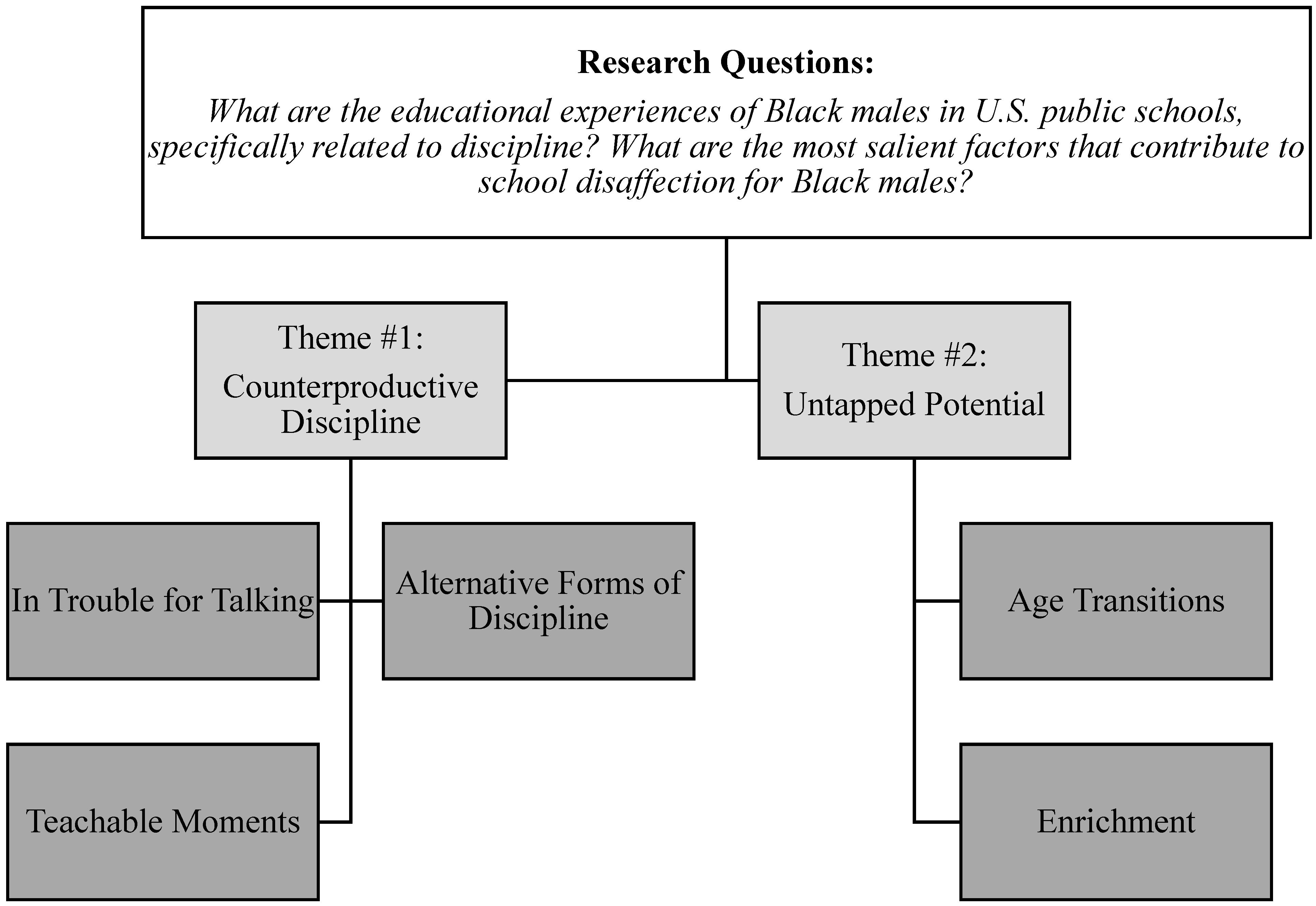
As Langston expresses, the overall aim of school discipline is counterproductive for students who eventually–through recidivism, labeling, and repeat offenses–treat suspension like “a vacation spot.” As saliently described above, counterproductive nature of school discipline surfaced throughout the participants’ interviews. Within this theme, the following subthemes were evident: In Trouble for Talking, Teachable Moments, and Alternative Forms of Discipline. The first subtheme, In Trouble for Talking is presented in the following section.Kids are so used to being there, and once a kid has been in trouble like once or twice, you’re labeled a troublemaker. So it’s like the odds of recidivism is pretty high. And then after a while the kids start looking at it like a vacation spot.
6.1.1. In Trouble for Talking
While Langston’s experience left him surprised, others were less stunned. Marcus reflects:There was like one moment at school that changed my whole education experience. My English teacher, ninth grade, said “What is this an example of on the board?” She didn’t ask for hands or anything, and I said, “alliteration.” In fact, alliteration was the answer. She turned around, she threw a book at the door and said get the hell out of my room, opened the door, and threw a desk out and kicked me out of class. I’m still confused about why I got kicked out that day.
Others, such as Hasaan, Sean, and William, also reflected on the numerous times punitive discipline would derive from talking out of turn. Hasaan notes, “Yeah, you know, like we in line for lunch, and I’m just talking. You know, so that’s when a lot of my suspensions happened was I would get in trouble for talking at school. I got in some serious trouble in middle school.” Additionally, Sean also describes how talking was the source of many disciplinary infractions. He mentions “I was a talker. I still am a talker. So it wasn’t like I was disrespectful, I would just be talking.” Additionally, William mentions how excessive talking was the source of his disciplinary problems. He notes:I would be like talking out of turn, holding side conversations or really being disruptive when I was in the classroom with teachers that I didn’t like. When you feel like the teacher doesn’t respect you—you’re automatically guilty.
While several participants described points of contention related to disruptive talking, other participants recalled Teachable Moments, which is the second subtheme. This is further explained in the section to follow.I got in trouble. I got written up… I got called to the principal maybe five or six times in elementary school. I got in trouble in class quite a bit by my second-grade teacher especially for talking too much in class… I got a lot of notes home from second grade.”
6.1.2. Teachable Moments
He continues:One time, I set some tissue paper on fire at the school. And so I got suspended for a couple of days. And it was on some just boys being boys, like let’s see something burn. And I was the one that said, sure, I’ll do it. And everybody snitched on me. So, when I lit the fire on school, they threatened me with like expulsion and everything. And the principal said, well, we could suspend you for the year and you’d be done. But what would that do? You’re a good kid. You made a bad decision. So I had to do this full book report on arson, had to visit the fire department. Like it was this big deal. And I think I got like two days of ISS, in school suspension for it, kind of, you know. But I learned from it. So I think there are moments where there needs to be real consequences, but it needs to be a teachable consequence.
While Sean described an experience of his principal using his misbehavior as a teachable moment, other participants describe the opposite effect. Many participants described missed opportunities for “teachable moments,” especially concerning discipline. In the overall misunderstanding of Black student behavior, many teachers prescribed punishments without apprehending the underlying causes of students’ misbehavior. To explicate this point, Jonathan provides the following reflection:Yeah, you know, so sometimes some of the incidents where I see kids getting suspended for, it’s like, well what did you get suspended for? Well, I cussed at the teacher. Well, you know, what were you trying to do? Well, I was trying to tell her, like I didn’t know the damn math problem. But what they heard, what the school heard was damn, and you’re suspended. But really the real issue was he don’t know the math problem. Yeah, and he’s frustrated. And so I think in those incidents, yes, there should not be a suspension, like there needs to be a deeper intervention or strategies to really address behaviors and the root of the behavior.
In addition to the dialectical nature of teachable moments, Marcus further problematizes teachers’ and administrator’s use of punitive discipline without recourse. In doing so, this eradicates opportunities for “teachable moments.” He asserts:Honestly, I’m not trying to be funny. I do believe in the work of restorative justice practices. Allowing the person who has caused the harm to repair it… I think that there’s a place and space for kids to repair the harm they caused. Why should the custodian clean up the graffiti that you painted? No, you roll up your sleeves, for all the kids, roll up your sleeves and clean it up. We’ve detached ourselves from what it means to give kids responsibility.
As demonstrated in Marcus’s reflection, “teachable moments” are two-fold. Often punitive discipline sends both explicit and implicit messages to students about behavior and respectability. As such, this unavoidably impacts student identity formation. This is addressed in greater detail in the second theme.So are we disciplining our children in the schools to help them to feel that they are a problem? I mean, children are not gonna be 100% in line with everything that an adult instructs them. But it’s like slavery, man. You know, how you gonna take an 8-year-old and punish them so severely—when they’re just being a [typical] 8-year old? They don’t have the understanding to be totally in line and upright about every single thing. How do you have such a lack of love and compassion for a child to where your first thought is to remove them? You’re teaching them that they’re a problem. You’re teaching them that they can’t do anything right.
6.1.3. Alternative Forms of Discipline
Jonathan, an educator, describes his frustrations–both as a former student and current school administrator. He mentions, “sometimes we have to just think differently about how we think about the punitive measures we do to kids.” He continues:I think suspension and all types of suspensions should be like last resorts…So if the kid gets kicked out of the classroom, because there could be other issues that you just got to—that they’re dealing with. Or it could just be a specific teacher, you know?
Similar to Jonathan, Theo also describes alternative forms of discipline that are helpful for students. He describes the importance of incorporating mental health components. Theo states:Obviously, suspensions aren’t working. Expulsions aren’t. Like all these punitive things that we’ve come up with, these consequential structures that are antiquated and old and not working, they are not working. So, I’m a big proponent of restorative justice, restorative practices. I see their place… I do believe like it’s a huge mind shift to say, you know, we’re not gonna suspend him. What we’re gonna do is, we’re gonna talk to him.
William similarly notes how student discipline and appropriate consequences are often incongruent. He notes:I think that is amazing. I think with my little ADD self I think learning how to like mindful meditation, you know, I think that would have been excellent… Elementary, middle and high school—I was either kicked out or suspended out of all those schools… But suspension don’t do nothing but make me miss work.
Throughout participant interviews, the discussion of alternative forms of discipline surfaced in response to the counterintuitive nature of school suspensions and expulsion. Considering that Counterproductive Discipline was the primary theme for the first research question, participants provided recommendations for reform that encompassed more restorative practices. Participants recommend for suspensions and expulsions to be “the last resort,” and caution against students being removed from the learning environment. In this regard, restorative justice practices are seen as a replacement for extractive discipline. The next section details the data from the second research question.I think that there are consequences to actions and that the consequences have to fit the infraction. I think sometimes removing a child from a situation is something that has to be done, but when they’re not in school we know also that they’re not learning. And that increases their opportunity to get into more trouble. I feel like a lot of folks are proponents of removing children from learning opportunities. But the question is, how do you balance that? I do know that removing them is not the optimal answer.
6.2. Theme #2: Untapped Potential
Specific to school disaffection, Sean describes feelings of disinterest that stemmed from feeling overlooked and undervalued by his teacher. He notes:So just knowing that that teacher didn’t like me, didn’t think much about me. And I know the way I appeared, like back then I had like cornrows, I had big clothes, so maybe I was being judged or whatever based on how I looked… But the teachers I knew that cared about me, I never got kicked out. I always wanted to be in class, you know? The teachers that I got kicked out, they despised me from the day I walked in class. The teachers, I felt like they were always trying to find a reason for me to be out… That’s controlling.
Like Sean, Langston similarly shares memories of being disliked by his teachers. He even describes how this led to observable disaffection, which eventually caused him to be suspended from school. Langston describes:So the very first time I could think I was like legit disinterested in school was in the second grade. So in my school you did these academically gifted testing and what not. And my second-grade teacher… kind of moved kids in the classroom based on who she wanted to work with kind of thing. And I remember sitting in class being like, “Well why I can’t get to play with the Legos”? And it was like this experiential activity, you know, whatever to kind of help prepare the smarter kids or whatever. And once I wasn’t selected for this group, I was like, “What? Man, forget it.” And so that was the first time I remember feeling like that… I was just like, I don’t care what this lady [the teacher] say to me anymore. So yeah, that was my first experience, and I remember that vividly in class. She wouldn’t let us play with the Legos.
Specific to feelings of disaffection, Hasaan mentions that, for him, this started in middle school. He recalls:I was removed from class a lot. Several times a month. You know, I think it was mainly not because I was a clown, but because the teachers, the relationship, like my teachers didn’t like me. So if my teachers didn’t like me, I’m not gonna always do what they want me to do, or I’m not gonna be so kind.
Similarly, Jonathan mentions that his entry to high school was fraught with feelings of disaffection and notes:I know in middle school my disinterest kind of started because like being cool started coming around, you know, and I was kind of like never had no girlfriends and stuff like that. So I started, you know, trying to imitate these guys that did have girlfriends. And that’s pretty much all it was, was like the girls, just trying to be cool for the girls.
For Hasaan and Jonathan, school disaffection stemmed from external factors which remained unrecognized by teachers and administrators in school. To that end, one subtheme within the larger theme of Untapped Potential discusses a specific age range where participants felt most vulnerable: middle and high school. As such, Age Transitions surfaced as its own subtheme, which is discussed in the subsection to follow.So I think back to 9th grade and what caused me to be disinterested. I think it might have been just the awkwardness of teenage years. Just like the sense of not belonging, if you will. I missed like well over 60 days of my 9th grade year. The way my brother was in and out of juvenile halls, in and out of prison, as long as the principal, nobody called my house, my father was like, oh praise God. And as long as I brought home good grades.
6.2.1. Age Transitions
Unlike William, Jonathan explains his experience in a school that was not academically challenging. Notwithstanding, high school was a pivotal moment in his career. Jonathan mentions:I would say that high school was quite awkward because of the development stages that children go through, learning to navigate the different kind of social climate in exercising in learning people skills. School was not difficult. I enjoyed that part of it. It was academically challenging. I was often the only minority in my classes, because I was in a lot of advanced classes, so I was often the only minority in those classrooms… But it was a time of finding myself, I think.
Like Jonathan, Marcus also described an awareness of his substandard education in middle school, and thus an overall disinterest in school. He recalls:So 9th grade was just like the typical “I don’t want to be there” kind of teenage attitude—I just felt very different. I felt very, very different. And granted, I didn’t go to the best high school in the world… very tough, very low performing, low achieving school, a lot of at-risk kids at that school. But I just did not feel I belonged in that school at all. I felt very detached, very, very detached.
Aside from structural issues mentioned by William, Jonathan, and Marcus, participants also described the culminating factors of pubescence, hormones, and maturity–all of which are typically experienced during middle and high school years. William describes:I think it became apparent that my education was subpar sometime in middle school, to be honest. It’s interesting because often times young people you can’t articulate with our words how we feel. But in retrospect, when I think about why it was that at a certain point I became totally disinterested in school, it’s like that was what was going on.
Similarly, Braxton notes, “I did get suspended in middle school a lot. Basically hanging out with the wrong people and getting disconnected from what I needed to focus on in school.” Overall, participants described an important developmental milestone in their academic years related to school disaffection and the overall theme of Untapped Potential.I wanted to be cool. I wanted to fit in. Not because I didn’t have the aptitude, but because I didn’t want to do it. And there was just a lot going on. I was still developing as a child, these new hormones and stuff also contributed to that. But I really had that fit-in stage.
6.2.2. Enrichment
Braxton continues:Giving [students] opportunities, like as simple as after school programs… Because a lot of times, as a kid, they just don’t know what to do. And they have that 18-year-old that didn’t go to college that’s still at home leading them into the wrong direction.
William also describes his experiences in afterschool activities and how transformative they were to his academic career. He mentions:We didn’t have like Boys and Girls Clubs and different after school programs where kids can go and, you know, be mentored and learn different things outside of school. So, you know, that’s what—it’s a lot of killing and all that stuff, [and] that’s the reason a lot of it’s happening. And a lot of them are so young, everybody that’s dying or shooting somebody is like 18 to 25 or 30, so they don’t have options.
In response to why this enrichment program is important, William explains the importance of positive gender and racial representation. He asserts:I was in a group of boys, we had this like mentoring group, and we—I forgot the name of it. But some guys at the local college, Black men, had a group of Black boys and we would go there I think once a week, and we would eat and, you know, we would study. They would do different things with us, like different programming. One in particular I remember was self-defense. We did a self-defense. We would do basketball and stuff like that.
In the participants’ narratives, Enrichment–through the role of mentoring, extracurriculars, and various programming–is a mediating factor for Black male students. As Braxton and William mention, the positive effects of enrichment prove useful both inside and outside of the classroom. This warrants further exploration in future research.I think surrounding Black boys with Black men is very important—that generational mentorship, especially older Black men to young Black men, it seems to be very important. I think that if you infuse children, especially boys, with affirmation, you’ve got to tell them that there’s life after survival mode, and that if they can stay the course, then good things will happen. It’s easy to see it from someone who’s been on the road, from people that are just trying to all navigate it together. I think also acknowledging that you don’t have to be perfect to be successful.
7. Discussion
As earlier mentioned, the above sentiments are confirmed in existing discourse on racial bias in school discipline, which suggests that Black males are 3.6 times more likely to be suspended or expelled than their White counterparts (Darling-Hammond & Ho, 2024) and sixteen times more likely to be suspended than their White female counterparts (U.S. Department of Education, 2014). Research suggests that these discrepancies in suspensions are often due to subjective discipline proceedings, not inherent racial differences in student deviance or criminality (Skiba et al., 1997, 2002; Skiba & Williams, 2014). This is important to note, as explicit and implicit bias are still embedded within school discipline processes–six decades after Stern’s (2023) and Hinton’s (2016) research on the history of surveillance in schools and communities of color.It gives teachers an escape route for not really building those relationships or building what they need to make sure a kid is going to be successful. So it’s kind of like, okay, go, go ahead and go to ISS. I’m gonna write you up to get you suspended, so I won’t have to deal with you… So it’s kind of like creating again those two different worlds in school to where, you know, the winners or the people that are really prospering from the education are the kids that don’t look like you or me. And I don’t like that.
Marcus’s reflections on the dissonance between schooling and the lived experiences of Black males is a compelling argument for educational reform. Throughout his narrative, he speaks to larger issues of relevance and placemaking. Whereas current discourse projects societal factors as inhibitors for learning, Marcus instead reorients the discussion to instead focus on how schooling served as a distraction–due to its irrelevance. This perspective is illuminating as misperceptions about student priorities and disaffection are often filtered through racial and socioeconomic bias (Harris, 2006; Robinson et al., 2015). Marcus instead provides a counternarrative that details evident disconnects between archaic systems of learning and the everyday experiences of Black male students. Whereas this topic has been addressed, in part, through research on culturally responsive pedagogy (Emdin, 2016; Ladson-Billings, 2006), student perspectives are still largely missing in its justification.Now people would tell you, you need this, this, that and the other for your future. You’ve got to make sure you get good grades because if you get good grades then you can get a scholarship, and if you get a scholarship then that will be your way into college. And if you go to college, then you can get a degree. And if you get a degree, you can get a good job, start a family and live happily ever after. That’s what they’d say, but I mean, when you’re 13 years old, you’re trying to figure out yourself, I guess it’s puberty. You’re trying to learn yourself socially. You’re trying to figure out not only how you fit with the student body, but you’re also trying to figure out your place, your parents’ place, your family’s place in society. Now, you’re not gonna sit a 12-year-old down and articulate that very directly, but I think that’s what’s going on. But then you spend all this time in school, and it’s not addressing any of these things at any time. And so how do you become attracted to something you can’t see yourself in?
8. Limitations
9. Conclusions
Funding
Institutional Review Board Statement
Informed Consent Statement
Data Availability Statement
Conflicts of Interest
Appendix A. Student Interview Questions (Part 1)
- Tell me about yourself. What is the highest level of education that you completed?
- Think back to your experiences in school (K-12), describe a typical school day. What do you remember about school?
- What was your favorite subject in school? Why?
- What was your least favorite subject in school? Why?
- Think back to your experiences in school (K-12), describe your most memorable academic experience. Why do you think you remember it?
- Think back to your experiences in school (K-12), describe your most memorable social experience. Why do you think you remember it?
- Who or what motivated you to go to school as a child? If that motivation were not there, how do you think your life would have been different?
- Think back to your K-12 experiences, what caused you to be disinterested in school (if ever)?
- In your opinion, what makes a great teacher?
- In your opinion, what makes a great class lesson?
- What makes you want to learn? What makes you want to pay attention in class?
- If you could have a dream school, what would it include? What would students learn?
- If you could change anything about school today, what would it be? Why do future generations need this change?
- Do you think education is linked to social mobility? Meaning, do you see the value in education in securing a more prosperous/successful future? Why or why not?
- Why do you think schools are not doing well today? Why is the education system “broken” (in some regards)?
- Name an influential person in your life who helped to turn your life around. Why was this person a positive influence?
- Did you decide to go to college? Why or why not?
- Do you feel like college is for everyone? Why or why not?
Appendix B. Student Interview Questions (Part 2)
- How many disciplinary actions do you think you received over the course of your K-12 schooling career (i.e., suspensions, expulsions, ISS, detentions, alternative school placements, etc.)? When [meaning, what grade(s)] did you receive the most?
- Explain the reasons why you do (or do not) believe disciplinary actions (i.e., suspensions, expulsions, ISS, detentions, alternative school placements, etc.) are good options for students.
- What made you persevere through schooling? Meaning, why did you not “quit”?
- Based on your decision to stay in (or discontinue) school, do you think your life is better because of your decision?
- Do you feel like you received a good education (in your public K-12 experience)? Why or why not?
- Has schooling made you a better person? Why or why not?
- Where do you see yourself in five or ten years?
- What are your future goals and aspirations? Meaning, what are some future career development goals do you have?
- Do you believe anyone could succeed if they try really hard in school? Why or why not?
- How would you describe yourself to someone who did not know you? What adjectives would you use to describe yourself?
- When you reflect back on your schooling experiences and being labeled “at-risk,” what choices did you make to reverse your behavior?
- If the education system here in the U.S. were given a large sum of money–where would you suggest for this money to go? Meaning, what area of education do you feel needs the most help?
- If you could start school over again (as a kindergartener), what would you do differently? If you could start high school over again, what would you do differently?
- Do you believe there is a connection between schools and jail/prison? Why or not?
- What is a critical social problem that children from your neighborhood/community encounter that often gets ignored in schools?
- What is the most critical change that needs to happen in your community? How should schools help to fix it?
- What is one thing that you wish your past teachers knew about you? What is one way you were misunderstood in school?
| 1 | Due to the U.S. contextualization of this paper, the terms African American and Black are used interchangeably. I acknowledge the potential ethnic inconsistencies between (and within) these two terms. |
| 2 | In this study, the terms counternarratives and counter-storytelling are used interchangeably. |
| 3 | Participants’ age at the time of data collection. |
References
- Balfanz, R., Byrnes, V., & Fox, J. (2014). Sent home and put off-track: The antecedents, disproportionalities, and consequences of being suspended in the ninth grade. Journal of Applied Research on Children: Informing Policy for Children at Risk, 5(2), 1–19. [Google Scholar] [CrossRef] [Scilit]
- Balfanz, R., Herzog, L., & Mac Iver, D. J. (2007). Preventing student disengagement and keeping students on the graduation path in urban middle-grades schools: Early identification and effective interventions. Educational Psychologist, 42(4), 223–235. [Google Scholar] [CrossRef] [Scilit]
- Barba, M. A. M. (2022). To move forward, we must look back: White supremacy at the base of urban studies. Urban Studies, 60(5), 791–810. [Google Scholar] [CrossRef] [Scilit]
- Bei, Z., & Knowler, H. (2023). Disrupting unlawful exclusion from school of minoritised children and young people racialized as Black: Using Critical Race Theory composite counter-storytelling. Behavioural Difficulties, 27(3), 231–242. [Google Scholar] [CrossRef] [Scilit]
- Bell, C. (2020). “Maybe if they let us tell the story I wouldn’t have gotten suspended”: Understanding Black students’ and parents’ perceptions of school discipline. Children and Youth Services Review, 110, 104757. [Google Scholar] [CrossRef] [Scilit]
- Bell, C. (2021). Suspended: Punishment, violence, and the failure of school safety. Johns Hopkins University Press. [Google Scholar]
- Bergen, J. K., Hantke, S. U., & St. Denis, V. (2023). Contemporary challenges and approaches in anti-racist teacher education. In R. J. Tierney, F. Rizvi, & K. Ercikan (Eds.), International encyclopedia of education (pp. 414–426). Elsevier. [Google Scholar]
- Birk, M. (2023). Critical race composite counter storytelling as appropriate methodology to “Wrestle the White Beast”. Journal of Critical Race Inquiry, 10(1), 27–42. [Google Scholar] [CrossRef] [Scilit]
- Bradshaw, C. P., Mitchell, M. M., O’Brennan, L. M., & Leaf, P. J. (2010). Multilevel exploration of factors contributing to the overrepresentation of Black students in office disciplinary referrals. Journal of Educational Psychology, 102(2), 508–520. [Google Scholar] [CrossRef] [Scilit]
- Bridgeland, J. M., DiIulio, J. J., Jr., & Morison, K. B. (2006, March). The silent epidemic: Perspectives of high school dropouts. Civic Enterprises; Peter D. Hart Research Associates; Bill & Melinda Gates Foundation. Available online: https://docs.gatesfoundation.org/Documents/thesilentepidemic3-06final.pdf (accessed on 15 October 2025).
- Brislin, S. J., Choi, M., Perkins, E. R., Ahonen, L., McCoy, H., Boxer, P., Clark, D. B., Jackson, D. B., & Hicks, B. M. (2024). Racial bias in school discipline and police contact: Evidence from the Adolescent Brain Cognitive Development Social Development (ABCD-SD) Study. Journal of the American Academy of Child and Adolescent Psychiatry, 63(12), 1225–1238. [Google Scholar] [CrossRef] [Scilit]
- Brooms, D. R. (2014). Mapping pathways to affirmative identities among black males: Instilling the value and importance of education in K-12 and college classrooms. Journal of African American Males in Education, 5(2), 196–214. [Google Scholar]
- Bryan, N. (2017). White teachers’ role in sustaining the school-to-prison pipeline: Recommendations for teacher education. The Urban Review, 49(2), 326–345. [Google Scholar] [CrossRef] [Scilit]
- Bryant, A. C., Triplett, N., Watson, M. J., & Lewis, C. W. (2017). The browning of American public schools: Evidence of increasing racial diversity and the implications for policy, practice, and student outcomes. The Urban Review, 49(2), 263–278. [Google Scholar] [CrossRef] [Scilit]
- Cabral-Gouveia, C., Menezes, I., & Neves, T. (2023). Educational strategies to reduce the achievement gap: A systematic review. Frontiers in Education, 8, 115574. [Google Scholar] [CrossRef] [Scilit]
- Carter, P. L., & Welner, K. G. (2013). Closing the opportunity gap: What America must do to give every child an even chance. Oxford University Press. [Google Scholar]
- Chenoweth, K. (2007). It’s being done. Harvard Education Press. [Google Scholar]
- Chenoweth, K. (2009). How it’s being done. Harvard Education Press. [Google Scholar]
- Collins, P. H. (2000). Black feminist thought: Knowledge, consciousness, and the politics of empowerment. Routledge. [Google Scholar]
- Crenshaw, K. (1993). Mapping the margins: Intersectionality, identity politics and violence against women of color. Stanford Law Review, 43, 1241–1299. [Google Scholar] [CrossRef] [Scilit]
- Creswell, J. W. (2013). Qualitative inquiry and research design: Choosing among five traditions. SAGE. [Google Scholar]
- Darling-Hammond, S., & Ho, E. (2024). No matter how you slice it, black students are punished more: The persistence and pervasiveness of discipline disparities. AERA Open, 10(1), 1–21. [Google Scholar] [CrossRef] [Scilit]
- Dee, T. S. (2003). Teachers, race, and student achievement in a randomized experiment. The Review of Economics and Statistics, 86(1), 195–210. [Google Scholar] [CrossRef] [Scilit]
- Douglas, B. B., Lewis, C. W., Douglas, A. H., Scott, M. E., & Garrison-Wade, D. F. (2008). The impact of white teachers on the academic achievement of black students: An exploratory qualitative analysis. Educational Foundations, 22, 47–62. [Google Scholar]
- Dubois, A., & Gadde, L. E. (2002). Systematic combining: An abductive approach to case research. Journal of Business Research, 55, 553–560. [Google Scholar] [CrossRef] [Scilit]
- Durrheim, K. (2024). The psychology of social change—30 years post-apartheid: What went wrong and how to fix it? South African Journal of Psychology, 54(4), 451–462. [Google Scholar] [CrossRef] [Scilit]
- Education Trust. (2021, December). Getting black students better access to non-novice teachers. Education Trust. Available online: https://edtrust.org/wp-content/uploads/2014/09/Getting-Black-Students-Better-Access-to-Non-Novice-Teachers-December-2021.pdf (accessed on 15 October 2025).
- Emdin, C. (2016). For white folks who teach in the hood… and the rest of y’all too: Reality pedagogy and urban education. Beacon Press. [Google Scholar]
- Fenwick, L. T. (2022). Jim Crow’s pink slip: The untold story of black principal and teacher leadership. Harvard Education Press. [Google Scholar]
- First Five Years Fund. (2026). Funding for key early learning programs, FY2026. Available online: https://www.ffyf.org/resources/2026/01/funding-for-key-early-learning-programs-fy2026/ (accessed on 2 January 2026).
- Ford, A. C., & Sassi, K. (2014). Authority in cross-racial teaching and learning (re)considering the white transferability of warm demander approaches. Urban Education, 49(1), 39–74. [Google Scholar] [CrossRef] [Scilit]
- Fordham, S., & Ogbu, J. U. (1986). Black students’ school success: Coping with the burdenof ‘acting White’. The Urban Review, 18(3), 176–206. [Google Scholar] [CrossRef] [Scilit]
- Fries-Britt, S. L. (1997). Identifying and supporting gifted African American men. In M. J. Cuyjet (Ed.), Helping African-American men succeed in college. New directions for student services (pp. 65–78). Jossey-Bass. [Google Scholar]
- Gilliam, W. S., Maupin, A. N., Reyes, C. R., Accavitti, M., & Shic, F. (2016). Do early educators’ implicit biases regarding sex and race relate to behavior expectations and recommendations of preschool expulsions and suspensions? Yale Child Study Center. [Google Scholar]
- Glense, C. (2011). Becoming qualitative researchers: An introduction (4th ed.). Pearson. [Google Scholar]
- Goff, P. A., Eberhardt, J. L., Williams, M. J., & Jackson, M. C. (2008). Not yet human: Implicit knowledge, historical dehumanization, and contemporary consequences. Journal of Personality and Social Psychology, 94(2), 292–306. [Google Scholar] [CrossRef] [Scilit] [PubMed]
- Harper, S. R. (2009). Niggers no more: A critical race counternarrative on Black male student achievement at predominantly white colleges and universities. International Journal of Qualitative Studies in Education, 22(6), 697–712. [Google Scholar] [CrossRef] [Scilit]
- Harper, S. R. (2017). Disproportionate impact of K-12 school suspension and expulsion on black students in southern states. Center for the Study of Race and Equity in Education, University of Pennsylvania. [Google Scholar]
- Harper, S. R., & Davis, C. H. F., III. (2012). They (don’t) care about education: A counternarrative on black male students’ responses to inequitable schooling. Educational Foundations, 26(1–2), 103–120. [Google Scholar]
- Harris, A. L. (2006). I (don’t) hate school: Revisiting oppositional culture theory of Blacks’ resistance to schooling. Social Forces, 85(2), 797–833. [Google Scholar] [CrossRef] [Scilit]
- Hilberth, M., & Slate, J. R. (2014). Middle school black and white student assignment to discipline consequences: A clear lack of equity. Education and Urban Society, 46(3), 312–328. [Google Scholar] [CrossRef] [Scilit]
- Hines, E. M., Ford, D. Y., Fletcher, E. C., Jr., & Moore, J. L., III. (2022). All eyez on me: Disproportionality, disciplined, and disregarded while Black. Theory into Practice, 61(3), 288–299. [Google Scholar] [CrossRef] [Scilit]
- Hinton, E. K. (2016). From the war on poverty to the war on crime: The making of mass incarceration in America. Harvard University Press. [Google Scholar]
- Homana, G., McNulty, M., & CampbellJones, F. (2018). Voices of Baltimore [Documentary]. Towson University. [Google Scholar]
- Hopkins, R. (1997). Educating black males: Critical lessons in schooling, community, and power. State University of New York Press. [Google Scholar]
- Ighodaro, E., & Wiggan, G. (2011). Curriculum violence: America’s new civil rights issue. Nova Science Publishers. [Google Scholar]
- Irvine, J. J. (1990). Black students and school failure: Policies, practices, and prescriptions. Preager. [Google Scholar]
- Jackson, L. P. (2013). The indignant generation: A narrative history of African American writers and critics, 1934–1960. Princeton University Press. [Google Scholar]
- Justia U.S. Supreme Court. (1954). Brown v. Board of Education of Topeka, 347 U.S. 483 (1954). Available online: https://supreme.justia.com/cases/federal/us/347/483/ (accessed on 15 October 2025).
- Kim, C. Y., Losen, D. J., & Hewitt, D. T. (2010). The school-to-prison pipeline. New York University Press. [Google Scholar]
- King, J. E. (2005). Black education: A transformative research and action agenda for the new century. Lawrence Erlbaum. [Google Scholar]
- King, J. E., Swartz, E. E., Campbell, L., Lemons-Smith, S., & López, E. (2014). Re-membering history in student and teacher learning: An afrocentric culturally informed praxis. Routledge. [Google Scholar]
- Konold, T., Cornell, D., Jia, Y., & Malone, M. (2018). School climate, student engagement, and academic achievement: A latent variable, multilevel multi-informant examination. AERA Open, 4(4), 1–17. [Google Scholar] [CrossRef] [Scilit]
- Kozol, J. (2005). The shame of the nation: Apartheid schooling in America. Random House. [Google Scholar]
- Kunjufu, J. (2002). Black students middle class teachers. African American Images. [Google Scholar]
- Kupchik, A., & Ward, G. (2014). Race, poverty, and exclusionary school security: An empirical analysis of U.S. elementary, middle, and high schools. Youth Violence and Juvenile Justice, 12(4), 332–354. [Google Scholar] [CrossRef] [Scilit]
- Ladson-Billings, G. (1994). The dreamkeepers: Successful teachers of African American children. Jossey-Bass. [Google Scholar]
- Ladson-Billings, G. (2006). It’s not the culture of poverty, it’s the poverty of culture: The problem with teacher education. Anthropology and Education Quarterly, 37(2), 104–109. [Google Scholar] [CrossRef] [Scilit]
- Lee, J. (2023). Potential racial threat on student in-school suspensions in segregated U.S. neighborhoods. Education and Urban Society, 55(1), 3–33. [Google Scholar] [CrossRef] [Scilit]
- Lewis, C. W., Butler, B. R., Bonner, F. A., & Joubert, M. (2010). African American male discipline patterns and school district responses resulting impact on academic achievement: Implications for urban educators and policy makers. Journal of African American Males in Education, 1(1), 1–19. [Google Scholar]
- Losen, D. J., & Gillespie, J. (2012). Opportunities suspended: The disparate impact of disciplinary exclusion from school. University of California. [Google Scholar]
- Losen, D. J., Sun, W., & Keith, M. A., III. (2017). Suspended: Education in Massachusetts. Center for Civil Rights Remedies, Schott Foundation. [Google Scholar]
- Mance, A. (2021). School enrichment activities. Available online: https://www.ebsco.com/research-starters/education/school-enrichment-activities#full-article (accessed on 15 October 2025).
- Mathias, C. E. (2013). Check yo’self before you wreck yo’self and our kids: Counterstories from Culturally responsive white teachers?… to culturally responsive white teachers! Interdisciplinary Journal of Teaching and Learning, 3(2), 68–81. [Google Scholar]
- McGrady, P. B., & Reynolds, J. R. (2013). Racial mismatch in the classroom: Beyond black-white differences. Sociology of Education, 86(1), 3–17. [Google Scholar] [CrossRef] [Scilit]
- Merriweather Hunn, L. R. M., Guy, T. C., & Manglitz, E. (2006, September 27–30). Who can speak for whom? using counter-storytelling to challenge racial hegemony. Adult Education Research Conference, Minneapolis, MN, USA. Available online: https://newprairiepress.org/aerc/2006/papers/32 (accessed on 15 October 2025).
- Mickelson, R. A. (2001). Subverting Swann: First- and second-generation segregation in the Charlotte-Mecklenburg schools. American Educational Research Journal, 38(2), 215–252. [Google Scholar] [CrossRef] [Scilit]
- Miller, H. R., IV, Liu, K., & Ball, A. F. (2020). Critical counter-narrative as transformative methodology for educational equity. Review of Research in Education, 44(1), 269–300. [Google Scholar] [CrossRef] [Scilit]
- Milner, H. R., IV. (2007). African-American males in urban schools: No excuses—Teach and empower. Theory Into Practice, 46(3), 239–246. [Google Scholar] [CrossRef] [Scilit]
- Milner, H. R., IV, & Hoy, A. N. (2003). A case study of an African American teacher’s self-efficacy, stereotype threat, and persistence. Teaching and Teacher Education, 19, 263–276. [Google Scholar] [CrossRef] [Scilit]
- National Assessment of Educational Progress [NAEP]. (2022a). National association for education progress report card mathematics. Available online: https://www.nationsreportcard.gov/mathematics/nation/achievement/?grade=8 (accessed on 10 July 2024).
- National Assessment of Educational Progress [NAEP]. (2022b). National association for education progress report card reading. Available online: https://www.nationsreportcard.gov/reading/nation/achievement/?grade=8 (accessed on 10 July 2024).
- National Center for Education Statistics [NCES]. (2023). Characteristics of public school teachers. Condition of education. U.S. Department of Education, Institute of Education Sciences. Available online: https://nces.ed.gov/programs/coe/indicator/clr (accessed on 10 July 2024).
- National Center for Education Statistics [NCES]. (2024). High school graduation rates. Available online: https://nces.ed.gov/programs/coe/indicator/coi/high-school-graduation-rates (accessed on 15 October 2025).
- Noltemeyer, A. L., Ward, R. M., & Mcloughlin, C. (2015). Relationship between school suspension and student outcomes: A meta-analysis. School Psychology Review, 44(2), 224–240. [Google Scholar] [CrossRef] [Scilit]
- Ogbu, J. U. (1978). Minority education and caste: The American system in cross-cultural perspective. Academic Press. [Google Scholar]
- Ogbu, J. U. (2004). Collective identity and the burden of “acting White” in Black history, community, and education. The Urban Review, 36(1), 1–35. [Google Scholar] [CrossRef] [Scilit]
- Ogbu, J. U., & Simons, H. (1998). Voluntary and involuntary minorities: A cultural-ecological theory of school performance with some implications for education. Anthropology and Education Quarterly, 29, 155–158. [Google Scholar] [CrossRef] [Scilit]
- Okonofua, J. A., & Eberhardt, J. L. (2015). Two strikes: Race and the disciplining of young students. Psychological Science, 26(5), 617–624. [Google Scholar] [CrossRef] [Scilit] [PubMed]
- Parker, R. (2010). Doing the lynch tango: White women, black men, and racial privilege. Reflections: Narratives of Professional Helping, 16, 126–132. [Google Scholar]
- Payne, R. (1998/2005). A Framework for understanding poverty (4th ed.). RFT Publishing. [Google Scholar]
- Perry, T., Steele, C., & Hilliard, A. (2003). Young, gifted and black. Beacon Press. [Google Scholar]
- Ransby, B. (2003). Ella Baker and the black freedom movement: A radical democratic vision. The University of North Carolina Press. [Google Scholar]
- Robinson, D., Watson, M. J., & Adams, T. R. (2015). I don’t do school: Correlations of school culture, power, fairness, and behavior perceptions. International Journal on School Disaffection, 11(2), 19–43. [Google Scholar] [CrossRef] [Scilit]
- Schott Foundation. (2012). The urgency of now: The Schott 50 state report on public education and black males. Schott Foundation. Available online: http://www.schottfoundation.org/urgency-of-now.pdf (accessed on 10 July 2024).
- Singer, J. D., & Braun, H. I. (2018). Testing international assessments. Science, 360(6384), 38–40. [Google Scholar] [CrossRef] [Scilit]
- Skiba, R. J., Michael, R. S., Nardo, A. C., & Peterson, R. L. (2002). The color of discipline: Sources of racial and gender disproportionality in school punishment. The Urban Review, 24(4), 317–342. [Google Scholar] [CrossRef] [Scilit]
- Skiba, R. J., Peterson, R. L., & Williams, T. (1997). Office referrals and suspension: Disciplinary intervention in middle schools. Education and Treatment of Children, 20(3), 295–315. [Google Scholar]
- Skiba, R. J., & Williams, N. T. (2014). Are black kids worse? Myths and facts about racial differences in behavior. The Equity Project. Available online: http://www.indiana.edu/~atlantic/wp-content/uploads/2014/03/African-American-Differential-Behavior_031214.pdf (accessed on 10 July 2024).
- Solórzano, D. G., & Yosso, T. J. (2002). Critical race methodology: Counter-storytelling as an analytical framework for education research. Qualitative Inquiry, 8(1), 23–44. [Google Scholar] [CrossRef] [Scilit]
- Stern, W. C. (2023). School violence and the carceral state in the 1970s: Desegregation and the new educational inequality in Louisiana. Journal of Southern History, 89(3), 483–534. [Google Scholar] [CrossRef] [Scilit]
- Tavory, I., & Timmermans, S. (2014). Abductive analysis: Theorizing qualitative research. University of Chicago Press. [Google Scholar]
- Thompson, P. I. (2008). The anatomy of a teachable moment: Implications for teacher educators. Journal of Inquiry and Action in Education, 1(2), 19–34. [Google Scholar]
- Toldson, I., & Lewis, C. (2012). Challenging the status quo: Academic success among school-age African-American males. Congressional Black Caucus Foundation, Inc. [Google Scholar]
- Torney-Purta, J., & Amadeo, J. (2013). International large-scale assessments: Challenges reporting and potentials for secondary analysis. Comparative and International Education, 8(3), 248–258. [Google Scholar] [CrossRef] [Scilit]
- Tuck, E. (2009). Suspending damage: A letter to communities. Harvard Educational Review, 79(3), 409–428. [Google Scholar] [CrossRef] [Scilit]
- U.S. Census Bureau. (2020). Demographic turning points for the United States: Population projections for 2020 to 2060. U.S. Census Bureau. Available online: https://www.census.gov/library/publications/2020/demo/p25-1144.html (accessed on 10 July 2024).
- U.S. Department of Education. (2014). Data snapshot: School discipline. Civil rights data collection. Available online: https://www.ed.gov/sites/ed/files/about/offices/list/ocr/docs/2013-14-first-look.pdf (accessed on 10 July 2024).
- van Manen, M. (2017). Phenomenology in its original sense. Qualitative Health Research, 27(6), 810–825. [Google Scholar] [CrossRef] [Scilit]
- Wegmann, K. M., & Smith, B. (2019). Examining racial/ethnic disparities in school discipline in the context of student-reported behavior infractions. Children and Youth Services Review, 103, 18–27. [Google Scholar] [CrossRef] [Scilit]
- Welch, K., & Payne, A. A. (2010). Racial threat and punitive school discipline. Social Problems, 57(1), 25–48. [Google Scholar] [CrossRef] [Scilit]
- Welch, K., & Payne, A. A. (2018). Latino/a student threat and school disciplinary policies and practices. Sociology of Education, 91(2), 91–110. [Google Scholar] [CrossRef] [Scilit]
- Welsh, R. O., Rodriguez, L. A., & Joseph, B. (2025). Racial threat, schools, and exclusionary discipline: Evidence from New York City. Sociology of Education, 98(2), 87–109. [Google Scholar] [CrossRef] [Scilit]
- Whitley, G. (2024). School-to-prison pipeline: The importance of teachers’ and administrators’ perceptions of their social bonds with students [Doctoral dissertation, Arkansas State University]. [Google Scholar]
- Wiggan, G., Smith, D., & Watson-Vandiver, M. J. (2020). The national teacher shortage, urban education and the cognitive sociology of labor. The Urban Review, 53(1), 43–75. [Google Scholar] [CrossRef] [Scilit]
- Wood, J. L., Harris, F., III, Howard, T. C., Qas, M., Essien, I., & King, T. M. (2021). Suspending our future: How inequitable disciplinary practices disenfranchise Black kids in California’s public schools. Community College Equity Assessment Lab. [Google Scholar]
- Wu, H., & Shen, J. (2025). A review of research on achievement gap, 1934 to 2023. (EdWorkingPaper: 24-1094). Annenberg Institute at Brown University. [Google Scholar] [CrossRef]


| Pseudonym | Age | Educational Attainment | Occupation | City |
|---|---|---|---|---|
| Braxton | 25 | Bachelor’s | Musician | Chicago |
| Daniel | 27 | J.D. | Lawyer | Dallas |
| Hasaan | 35 | Some college | Artist | Boston |
| Jonathan | 34 | Ph.D. | Educational Administrator | Baltimore |
| Langston | 29 | Ph.D. | Professor | Charlotte |
| Sean | 30 | Bachelor’s | Non-Profit Manager | Charlotte |
| Theo | 28 | Master’s | Pastor | Baltimore |
| William | 29 | Ph.D. | Pastor | New York |
| Marcus | 30 | Some college | Community Activist | Atlanta |
Disclaimer/Publisher’s Note: The statements, opinions and data contained in all publications are solely those of the individual author(s) and contributor(s) and not of MDPI and/or the editor(s). MDPI and/or the editor(s) disclaim responsibility for any injury to people or property resulting from any ideas, methods, instructions or products referred to in the content. |
© 2026 by the author. Licensee MDPI, Basel, Switzerland. This article is an open access article distributed under the terms and conditions of the Creative Commons Attribution (CC BY) license.
Share and Cite
Watson-Vandiver, M.J. The Indignant Generation: Black Male Counternarratives of School Disaffection, Carceral Discipline, and Racial Threat Theory. Youth 2026, 6, 25. https://doi.org/10.3390/youth6010025
Watson-Vandiver MJ. The Indignant Generation: Black Male Counternarratives of School Disaffection, Carceral Discipline, and Racial Threat Theory. Youth. 2026; 6(1):25. https://doi.org/10.3390/youth6010025
Chicago/Turabian StyleWatson-Vandiver, Marcia J. 2026. "The Indignant Generation: Black Male Counternarratives of School Disaffection, Carceral Discipline, and Racial Threat Theory" Youth 6, no. 1: 25. https://doi.org/10.3390/youth6010025
APA StyleWatson-Vandiver, M. J. (2026). The Indignant Generation: Black Male Counternarratives of School Disaffection, Carceral Discipline, and Racial Threat Theory. Youth, 6(1), 25. https://doi.org/10.3390/youth6010025