Article

Optimum Cr Content in Cr, Nd: YAG Transparent Ceramic Laser Rods for Compact Solar-Pumped Lasers


by
Tomoyoshi Motohiro
1,2,* and
Kazuo Hasegawa
2
1
Institutes of Innovation for Future Society, Nagoya University, Furo-cho, Chikusa-ku, Nagoya 464-8603, Aichi, Japan
2
The Graduate School for the Creation of New Photonic Industries, 1955-1, Kurematsu-cho, Chuo-ku, Hamamatsu 431-1202, Shizuoka, Japan
*
Author to whom correspondence should be addressed.
Solar 2025, 5(4), 51; https://doi.org/10.3390/solar5040051
Submission received: 9 August 2025 / Revised: 2 October 2025 / Accepted: 22 October 2025 / Published: 1 November 2025

Abstract

Cr content χ of 0.4 at% for a Cr doped Nd (1 at%): YAG laser rod (LR) gave a higher laser output (Ioutput) than that of 0.0, 0.7, and 1.0 at% in a specially designed compact solar-pumped laser (SPL) outdoors. Ioutputs were measured as a function of an 808 nm pumping laser’s power indoors, changing the transmittance of the output coupler. From the obtained slope efficiencies, round-trip resonator losses Ls for the four χs were estimated, and the best-fit function L(χ) was derived. From the experimentally estimated Cr-to-Nd effective energy transfer efficiency ηCr→Nd at the four χs, the best-fit function ηCr→Nd(χ) was derived. Using L(χ), ηCr→Nd(χ), and a wavelength λ- and χ-dependent absorption coefficient α(λ, χ), inferred from the literature, the power conversion efficiency ηpower(χ) under 1 Sun was estimated. The estimated ηpower(0.4) and ηpower(0.7) were reproduced in experimentally deduced factors at the mode-matching efficiency ηmode = 0.19. The estimated maximum ηpower(χ) appeared around χ = 0.2 at%, being 20% higher than that at χ = 0.4 at%. In addition to this, a composite LR (Cr, Nd: YAG core/Gd: YAG cladding) was found to achieve ηmode = 0.68 and ηpower = 0.064, ranking among the highest-class SPL ηpowers.

1. Introduction

Solar-pumped lasers (SPLs) are means to convert sunlight into lasers and were first reported in the 1960s [1,2,3], soon after the discovery of the laser [4]. Those initial works on SPLs mainly employed laser mediums of Nd-doped yttrium aluminum garnet (Nd: YAG) single crystals. Since then, more than 600 papers have been published on SPLs. Iodine or iodides were once major laser mediums [5,6,7]. Then, transparent Nd: YAG ceramic laser rods (LRs) were successfully fabricated and used as one of the major laser mediums [8,9]. Furthermore, Cr, Nd-doped YAG ceramic LRs have been intensively studied in connection with applications of SPLs to space solar power systems [10]. Nd-doped ZrF4–BaF2–LaF3–AlF3–NaF glasses were also studied as laser mediums for solar-pumped fiber lasers [11]. More recently, transverse excitation was introduced into a solar-pumped fiber laser system to decrease the threshold excitation power for oscillation at sunlight concentration as low as 1/15 [12]. A thin disk-shaped medium for SPL has also been proposed [13]. In addition to these, R&Ds of SPLs have been actively going on through various approaches [14,15,16,17].
SPLs can be used to transmit collected solar energy across large distances. Some examples include power transmission between an orbiting or lunar power station and the ground [10], between deep-sea and sea-level, or for powering mobile objects such as drones, robots, or electric vehicles [18]. Photo-thermal and photo-chemical applications of SPLs have also been investigated to promote a reduction of MgO in the Mg energy cycle [19]. The output laser beam was focused onto MgO, typically at an optical power density of 105 W/cm2 to attain a temperature of 4000 K, at which MgO is thermally decomposed to yield metallic Mg. The resultant metallic Mg was to be utilized in the “Mg–H2 cycle”, where lightweight metallic Mg grains are transported as an energy carrier and H2 is produced by pouring water onto the metallic Mg grains at the required location [20,21]. The resulting MgO produced by the reduction in water is then thermally decomposed again under the focused laser light from the SPL.
In applications in space solar power systems, a solar cell–laser system can be used in place of a SPL system. Solar energy can be converted into electricity by solar cells, and electricity can be used to excite a laser to transport energy from an orbiting station to the ground. In this case, the electricity-to-laser energy conversion efficiency is practically lower than 50%. In applications in space solar power systems, SPLs can compete with the above solar cell–laser system only when the sunlight-to-laser energy conversion efficiency exceeds 50% of the solar cell energy conversion efficiency. Although the theoretical detailed balance limit of the power conversion efficiency of solar-pumped Nd3+: YAG-like sensitized lasers was estimated to be ~31% [22], experimentally realized power conversion efficiencies are around 5% or lower, providing a fair comparison to those of solar cells [23].
Therefore, improvement of SPL energy conversion efficiency is an important and challenging topic for many researchers. To achieve a low laser oscillation threshold while maintaining a high slope efficiency, there are many issues that must be addressed, some of which are in a trade-off relationship: the laser rod-pumping configuration and laser cavity structure, as well as the selection of suitable pumping and oscillation wavelengths. Difficulties in addressing these issues in SPLs originate from two features of sunlight: (1) the energy density is low, and (2) the spectral range is widespread, from the UV to IR spectra. To overcome issue (1), a focusing optical system with high magnification is necessary to achieve a sufficiently high pumping energy density. As for issue (2), the absorption range of the rod material should cover the spectral range of sunlight; this is referred to as the “spectrum matching problem”. Therefore, many researchers have considered that an SPL using a single rare-earth element such as Nd cannot be efficiently driven because of the extremely narrow absorption bands of rare-earth elements. To solve the “spectrum matching problem”, it is promising to introduce a sensitizer of another element that extends the absorption range considerably. It has been found that Cr3+ is a promising sensitizer, which has broadband absorption characteristics and transfers the absorbed energy to Nd3+ [13,17,20,24,25,26,27,28,29,30,31].
We have been developing compact solar-pumped lasers (μSPLs) that utilize an off-axis parabolic mirror (OAP) with diameters of ⌀50.8 mm or ⌀76.2 mm as solar concentrators, achieving a concentration ratio of 0.0001, as shown in Figure 1a [18,31,32,33,34,35,36,37,38,39,40]. In these μSPLs, we use micro laser rods that are either cylindrical with a diameter of ⌀1 mm and length of l mm, or regular tetragonal prismatic (RTP) with dimensions 1 × 1 × l mm (where l = 10 or 20), made of Cr3+ and Nd3+-co-doped YAG transparent ceramic. Compared to thick, large LRs, we can produce many more micro-LRs from single bulk transparent ceramic, making the process more cost-effective. The micro LRs are easy to cool because of their large surface area per volume. The array of μSPLs can produce the same total laser intensity as a large single SPL but with a smaller overall volume of the laser medium. We discussed the advantages of μSPLs in detail in the subsection “10.2.6. 2. 6. Merits of Miniaturization of SPLs” [32] (pp. 427–429). These LRs were manufactured by World-Lab Co., Ltd., Atsuta, Nagoya, Japan, under A. Ikesue’s supervision [8]. According to the report by Wisniewsky and Koepke (2002) [41], the existence of Cr4+ ions can be clearly distinguished from Cr3+ ions in absorption spectra. We observed no feature of existence of Cr4+ but only of Cr3+ in the absorption spectra shown in our previous report [39]. This evidence eliminates the possibility of the occurrence of self-Q-switching caused by Cr4+. It is believed that the UV component of sunlight can generate defects in LRs. These defects, called “color centers”, absorb light from a specific wavelength and degrade the performance of the LRs temporarily or permanently, depending on the composition and process conditions of the LRs. The detailed mechanisms of this degradation, called solarization [42,43], are still under investigation, and explorations of optimal composition and process conditions are key to long-term device reliability and the practical application of SPLs. To reduce UV degradation (solarization) of the LR, a UV-cut filter is attached to the entrance aperture of the OAP, although it might provide a somewhat less-than-perfect reduction in solarization. In this μSPL, an end-pumping configuration is used, where a bundle of direct solar radiation, captured by an OAP, is focused on the front end (HR-end) surface of an LR and introduced into it. The HR-end surface is coated with an optical multilayer filter (HR: high-reflectance) that transmits 95% of light between 440 nm and 850 nm and reflects 99.95% at the laser emission wavelength: λL = 1064 nm. An output coupler (OC) with a curvature radius of 100 mm and a diameter of 25 mm is placed 50 mm from the HR-end, forming a confocal resonator together with the HR on the HR-end. The other end of the LR, called the BBAR (broadband antireflection)-end, is coated with an optical multilayer filter that transmits 95% of light across the solar spectrum and nearly 100% at λL. Even under concentrated sunlight, this thin LR can be effectively cooled by natural air convection. The μSPL can operate continuously, tracking the sun for over 6.5 h from 11:00 to 17:30 on a clear summer day [37]. This duration is the longest record of continuous solar-pumped laser emission outdoors. The temperature difference between the side surface and the center region in this thin LR under concentrated sunlight was estimated to be no more than 4 degrees K assuming the coefficient of thermal diffusivity: 4.2 × 10⁻⁶ [m2/s], specific heat 602 [J/(kg∙K)], and density: 4.55 [g/cm2]. Therefore, it is considered that the effect of thermal lensing is not significant in this system. It demonstrates the potential for μSPLs to operate all day for terrestrial solar energy utilization [18]. The OAP used in a single μSPL can harvest only a limited amount of sunlight. To harvest a significant amount of solar energy, coordinated solar tracking from an array of μSPLs has been proposed [35].
Using direct natural sunlight as a pumping light for the μSPL system, outdoor oscillation experiments were conducted to examine how Cr content χ in the LR affects laser oscillation performance. RTP LRs of 1 × 1 × 10 mm (or 20 mm) with χ values of 0.0, 0.4, 0.7, or 1.0 at% and a fixed Nd content of 1.0 at% were tested. The output laser power (Ioutput) of the μSPL increased significantly from χ = 0.0 to 0.4 at% and then gradually decreased beyond 0.4 at% [38]. This experiment demonstrated that Cr doping effectively enhances μSPL power conversion efficiency, ηpower, which is the ratio of Ioutput to the global solar radiation harvested by the OAP. The value of ηpower represents a key performance of the SPL, irrespective of the absolute size of the SPL system. Although we know there is an optimal χ between 0.0 at% and 0.7 at%, it remains unclear whether χ = 0.4 at% is the absolute optimum.
For this μSPL in terrestrial operation, a simple analytical expression to calculate ηpower from sunlight to Ioutput was derived based on the fundamental physics of laser oscillation [44] (2023). In this paper, we search the optimum χ using this analytical expression, taking into consideration the related experimentally obtained parameters, such as the dependence of χ on Cr3+ to Nd3+ effective energy transfer quantum efficiency, ηCr→Nd (χ), and the dependence of χ on round-trip resonator loss, L(χ), together with a wavelength λ- and χ-dependent absorption coefficient, α(λ, χ), deduced from the data in the previously reported literature. When the light emitted from the excited Nd3+ ions in the LR makes a round-trip between the resonator mirrors (HR and OC in Figure 1), its intensity increases by stimulated emissions but decreases by absorption and scattering. The former is the round-trip gain, and the latter is the round-trip loss. When the gain exceeds the loss, the laser oscillation takes place. Therefore, L(χ) should be reduced as far as possible.

2. Calculation Method

2.1. Analytical Expression of ηpower for μSPL

Figure 1b schematically displays the essential portion of μSPL. The analytical expression of power conversion efficiency, ηpower, for this μSPL employing a Crχat% doped Nd (1 at%): YAG (yttrium aluminum garnet) transparent ceramic LR (laser rod) is [44]
η p o w e r = h c λ L 1 I p G ( λ ) h c λ d λ t O C L + t O C × η N d η mod e η O A P 0 λ a α N d , 1 a t % λ + η C r η N d η C r N d α C r , χ a t % λ 1 exp α λ t α λ I p λ d λ t C L + t O C 2 l σ τ s p
In this relation (1), the propagations of both solar intensity and laser signal intensity along the cavity axis in LR are taken into consideration. Table 1 summarizes the definitions of variables and constants in relation (1). The first term in the square bracket is related to the slope efficiency ηslope, and the second term in the square bracket is associated with the threshold power Ith.
Although relation (1) stands on a simple laser oscillation model in contrast to detailed numerical analytical approaches such as by LASCADTM (e.g., [32,37]), this approach gives an intuitive perspective and suggestions to experimentalists on contributions of fundamental factors such as l, L, α(λ), χ, tOC, C, ηCr Nd, ηCr→Nd, ηmode, (cf. Table 1) and cavity configurations to ηpower. Here, ηmode stands for the ratio of the volume in which laser oscillation takes place to the volume in which absorption of the pumping light takes place in LR. It is preferred to design the laser resonator configuration so that ηmode increases and approaches unity as far as possible.
Solar concentrators employed in SPLs cannot converge diffuse solar radiation, such as that scattered from clouds or the blue sky, on LRs. Thus, SPLs can only utilize direct solar radiation. Therefore, the ratio of Ioutput to the power of the direct solar radiation captured by the solar concentrator stands for the ηpower of an SPL, usually. On the other hand, the ratio of electric output power to the sum of direct and diffuse solar radiation on solar cells usually stands for the ηpower of solar cells. This difference in the definition of ηpower between SPLs and solar cells is confusing when they are compared with each other as means for solar energy utilization. Therefore, we use the direct solar radiation Ip(λ) in the numerator and the global (the direct + the diffuse) solar radiation IpG(λ) in the denominator in relation (1). According to the reference solar spectra, ASTM G173-03 (https://www.nrel.gov/grid/solar-resource/spectra-am1.5, accessed on 17 May 2025, the total direct solar radiation in the wavelength region between 280 nm and 4000 nm is 900.2 W/m2. If we also consider the contribution of diffuse solar radiation, it increases up to 1000.4 W/m2. Therefore, relation (1) gives 90% smaller ηpower than the usually reported ηpowers under the conventional definition of SPLs.
In the case of the present μSPL, there is a loss factor: ηOAP of the concentrated solar radiation. It is partly caused by a UV cut filter located at the entrance aperture of the OAP. Another contribution to ηOAP is the reflectance of the OAP surface. In the present system, ηOAP is around 0.78.

2.2. Dependence of Spectral Absorption Coefficient on Cr Content χ: α(λ, χ)

The χ dependence of the spectral absorption coefficient α(λ, χ) for Cr (χ at%), Nd (1.0 at%)-co-doped transparent ceramic YAG (yttrium aluminum garnet) rod, such as at χ = 0.4, 0.7, and 1.0, for example, were numerically synthesized [44] from the experimentally obtained α(λ, 3.0) for Cr (3.0 at%), Nd (1.0 at%)-co-doped transparent ceramic YAG rod by Saiki et al. [45].

2.3. Laser Oscillation Mode-Matching Efficiency ηmode

In the configuration of a confocal resonator [46] indicated in Figure 1b, the beam waist of a radius ω0: 0.130 mm is at the HR (high-reflection) end of the LR (laser rod). Defining z as the distance from the position of the beam waist (the HR-end of the LR) towards the OC (output coupler), the beam spot size ω(z) increases with z. The beam spot radius is as follows:
The ω (20 mm) on the BBAR (broadband antireflection)-end surface of the LR is 0.152 mm, and the ω (50 mm) on the OC is 0.184 mm. Here, we neglect the effect of the refractive index of the LR because the beam crosses the BBAR-end surface of the LR almost perpendicularly. If we model the laser modal domain as a truncated cone defined by the beam waist radius on the HR-end surface of the LR as ω0 for an upper base circle, the beam spot radius at the BBAR-end surface of the LR as ω (l) for a lower base circle, and the length of the LR as l as a height, ηmode is calculated to be 0.063 in the case of a homogeneously excited 1 × 1 × l (=20 mm) LR. If we take 2ω0 as the radius of the beam spot on the HR-end surface of the LR and 2ω (20 mm) as the radius of the beam spot on the BBAR-end surface of the LR, ηmode is 0.250 in a 1 × 1 × l (=20 mm) LR. If we take 3ω0 as the radius of the beam spot on the HR-end surface of the LR and 3·ω (l = 20 mm) as the radius of the beam spot on the BBAR-end surface of the LR, ηmode is 0.564 in a 1 × 1 × l (=20 mm) LR. In the actual experimental procedure, the location of the OC is adjusted manually from the exact confocal configuration to give the maximum Ioutput. We do this adjustment because the actual distribution of absorbed input sunlight power is not monotonic and not axisymmetric in the LR due to the geometry of the OAP, as shown in [32,37]. To obtain the χ dependence of ηpower by relation (1), ηmode should be surveyed to give the best fit to the several previously experimentally obtained ηpowers. The concept of estimations described here was explained with an inserted figure in “Table 1” in our previous report [44].

2.4. Dependence of Effective Energy Transfer Efficiency from Cr3+ to Nd3+ in the LR on Cr Content χ: ηCr→Nd (χ)

The values for Cr3+ to Nd3+ energy transfer quantum efficiency in Cr (χ at%), Nd (1 at%): YAG (yttrium aluminum garnet) transparent ceramic laser mediums have been measured by several methods and reported in the literature: [31,47,48,49,50,51,52]. These values shall be collectively expressed as ςCr→Nd here. Related to the effective energy transfer quantum efficiency, ηCr→Nd in an LR during laser oscillation, values corresponding to (ηCr/ηNdηCr→Nd have been obtained by Kato et al. (2020) [39] to be 0.448, 0.213, and 0.166 for χ = 0.4, 0.7, and 1.0 at%, respectively, in solar-pumped laser emission experiments outdoors using the μSPL system shown in Figure 1 [39]. Here, ηCr and ηNd are the quantum efficiencies forming a Cr3+ ion excited to 2F3/2 level by a photon absorbed by a Cr3+ ion, and the quantum efficiency to form a Nd3+ ion excited to 4F3/2 level by a photon absorbed by a Nd3+ ion, respectively. Substituting a collective lens for the OC (output coupler) in the same μSPL system shown in Figure 1b and collecting fluorescence from the solar-pumped LR (laser rod) with the lens outdoors, values corresponding to (ηCr/ηNdηCr→Nd have also been experimentally obtained to be 0.675, 0.623, and 0.625 for χ = 0.4, 0.7, and 1.0 at%, respectively, in the same work by Kato et al. [39]. In this latter case, we express the value corresponding to ηCr→Nd as ξCr→Nd to distinguish it from ηCr→Nd.
The ratio ηCr/ηNd is not known. For the first-order approximation, it can be unity, because both ηCr and ηNd represent similar properties of the isolated metal ions doped in YAG ceramics. For the second-order approximation, the ratio can be a value slightly less than unity. In contrast to transition metal ions such as Cr3+, the energy levels of rare-earth ions, such as Nd3+, are not significantly influenced by the surrounding electronic structure of YAG matrix atoms. The very narrow absorption peaks of Nd3+ ions and the broad absorption peaks of Cr3+ ions [45] support this idea. Therefore, the efficiency of relaxation of the excited Nd3+ ions in higher energy levels than the metastable 4F3/2 levels, ηNd, will be higher than that of the excited transition metal ions, such as Cr3+ ions, to their 4T2 or 2E levels, ηCr. As a value for ηCr/ηN slightly less than unity, 0.7 and 0.9 were tested in the previous work [44]. In this work, we performed the calculations supposing ηCr/ηNd = 0.9.
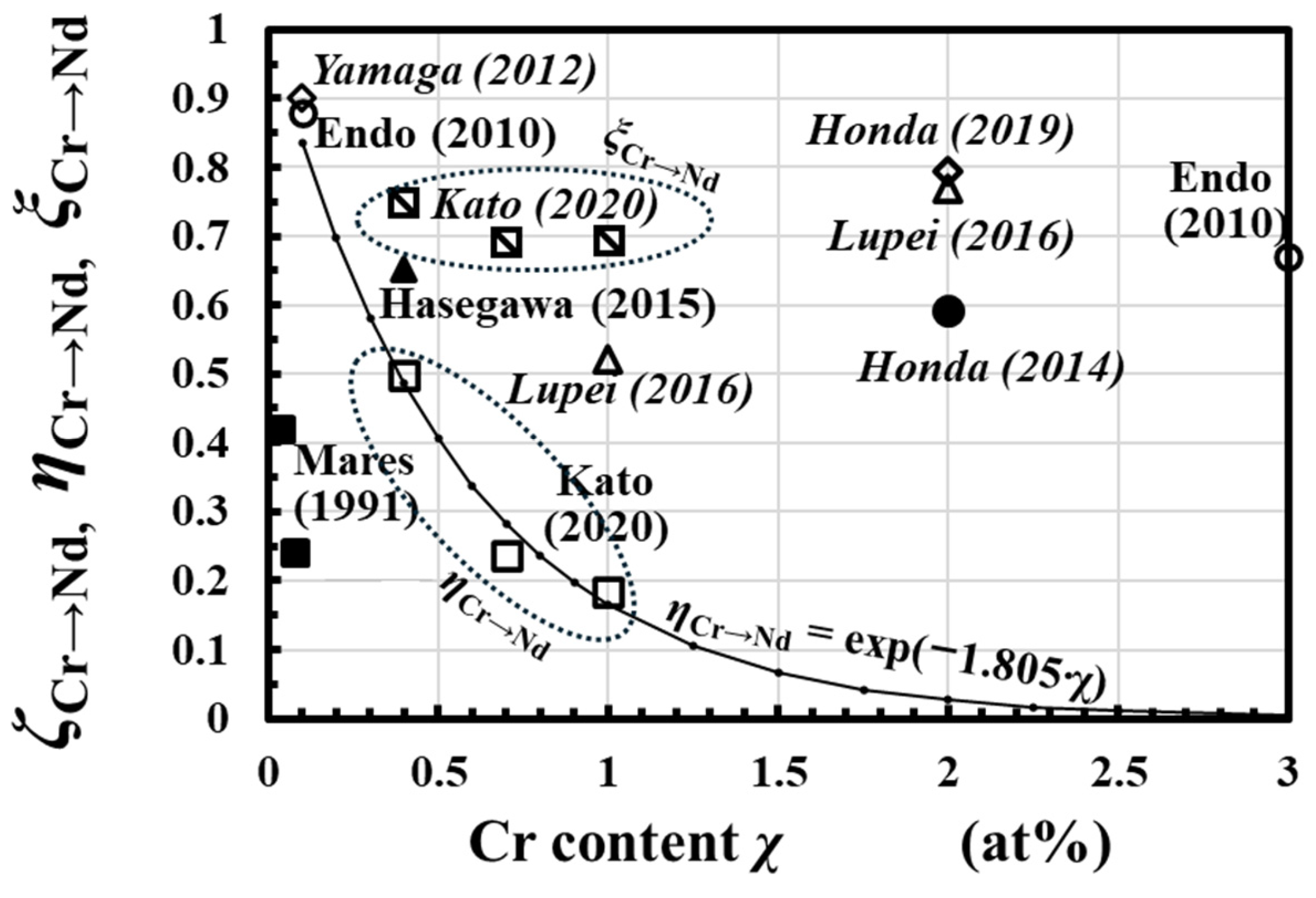
Figure 2 shows the plots of the values for ηCr→Nd, ξCr→Nd, and ςCr→Nd against the Cr content χ. In Figure 2, the data points with the first author’s name in Italic type represent the values obtained by fluorescence measurements in spontaneous emission. Those with the first author’s name in Roman type represent the values obtained in stimulated emission under the laser oscillation. Figure 2 shows that the values for ξCr→Nd are larger than the values for ηCr→Nd. This phenomenon might come from (a) a phenomenon that Nd3+ ions in an unexcited state decrease and it becomes difficult for excited Cr3+ ions to find Nd3+ ions in an unexcited state to transfer their energy in the case of ηCr→Nd, while there may be a sufficient amount of Nd3+ ions in the unexcited state in the case of ξCr→Nd, or (b) a phenomenon that only Nd3+ ions in a laser oscillation mode in LR contribute ηCr→Nd while there is no limitation to the laser oscillation mode in the case of ξCr→Nd. As for the data points of ςCr→Nd with Italic authors’ names, the spontaneous fluorescent emissions from the laser media have been measured more efficiently by employing integrating spheres than collective lenses. Therefore, ςCr→Nd can be larger than ξCr→Nd. In Figure 2, however, the values for ξCr→Nd indicated by Italic Kato (2020) [39] are almost at the same level as the values for ςCr→Nd.
Figure 2 shows that ηCr→Nd decreases significantly with an increase in χ. This result might come from (c) a phenomenon wherein the probability for an excited Cr3+ ion to find an unexcited Nd3+ ion to which the Cr3+ ion transfers its energy decreases with an increase in χ under an inverted population condition in laser emission when the Nd3+ content is constant at 1 at% as in the present work, or (d) a phenomenon wherein the probability of energy transfers from excited Cr3+ ions to unexcited Cr3+ ions increases with an increase in χ, and consequently ηCr→Nd decreases with an increase in χ. However, (d) seems to be unlikely because ξCr→Nd does not decrease as significantly with an increase in χ as ηCr→Nd. Supposing that ηCr→Nd takes the simplest form, exp(−β·χ), the least-square-fit (LSF) of the three experimentally obtained data points, 0.448/(ηCr/ηNd) at χ = 0.4 at%, 0.213/(ηCr/ηNd) at χ = 0.7 at%, and 0.166/(ηCr/ηNd) at χ = 1.0 at% gives β·of 1.805 (1/at%) assuming ηCr/ηNd = 0.9. In Figure 2, the curve ηCr→Nd (χ) = exp(−1.805∙χ) is also drawn. In Figure 2, the values obtained in the condition of laser oscillation, such as those by Endo et al. (2010) [48] at χ = 0.1 and by Hasegawa et al. (2015) [31] at χ = 0.4 appear near the LSF curve, ηCr→Nd (χ) = exp(−1.805∙χ). The values by Mares et al. (1991) [47] appear significantly lower than the LSF curve. Judging from the very low χ of 0.04 or 0.08, Mares et al. might have used single-crystal YAG laser media, in which it is difficult to dope Cr in high concentrations. Therefore, it may not be appropriate to compare their data with the others in Figure 2. The value by Endo et al. (2010) [48] at χ = 3.0 appears at a much higher ηCr→Nd than the LSF curve. The laser medium of χ = 3.0 showed much higher αL than the laser medium of χ = 0.1. In the summary of Endo et al. [48], only the ςCr→Nd of the laser medium at χ = 0.1 was mentioned, but not at χ = 0.3. Therefore, it may not be appropriate to compare the value at χ = 3.0, with a much higher αL, with the others in Figure 2. Considering these facts, it should be reasonable to use ηCr→Nd (χ) = exp(−1.805∙χ) in the present calculation of ηpower by relation (1).

2.5. Dependence of Round-Trip Resonator Loss on Cr Content χ: L(χ)

As indicated in relation (1), L can be derived using either the slope efficiency, ηslope or the threshold power, Ith. We often describe the method to derive L using the threshold power, Ith, as ‘Findlay–Clay analysis’ [53] and that used to derive L using slope efficiencies ηslope as ‘Caird analysis’ [54]. Hereafter, Ls derived by Findlay–Clay analysis and Caird analysis are expressed as LFindlay-Clays and as LCairds, respectively, for convenience.
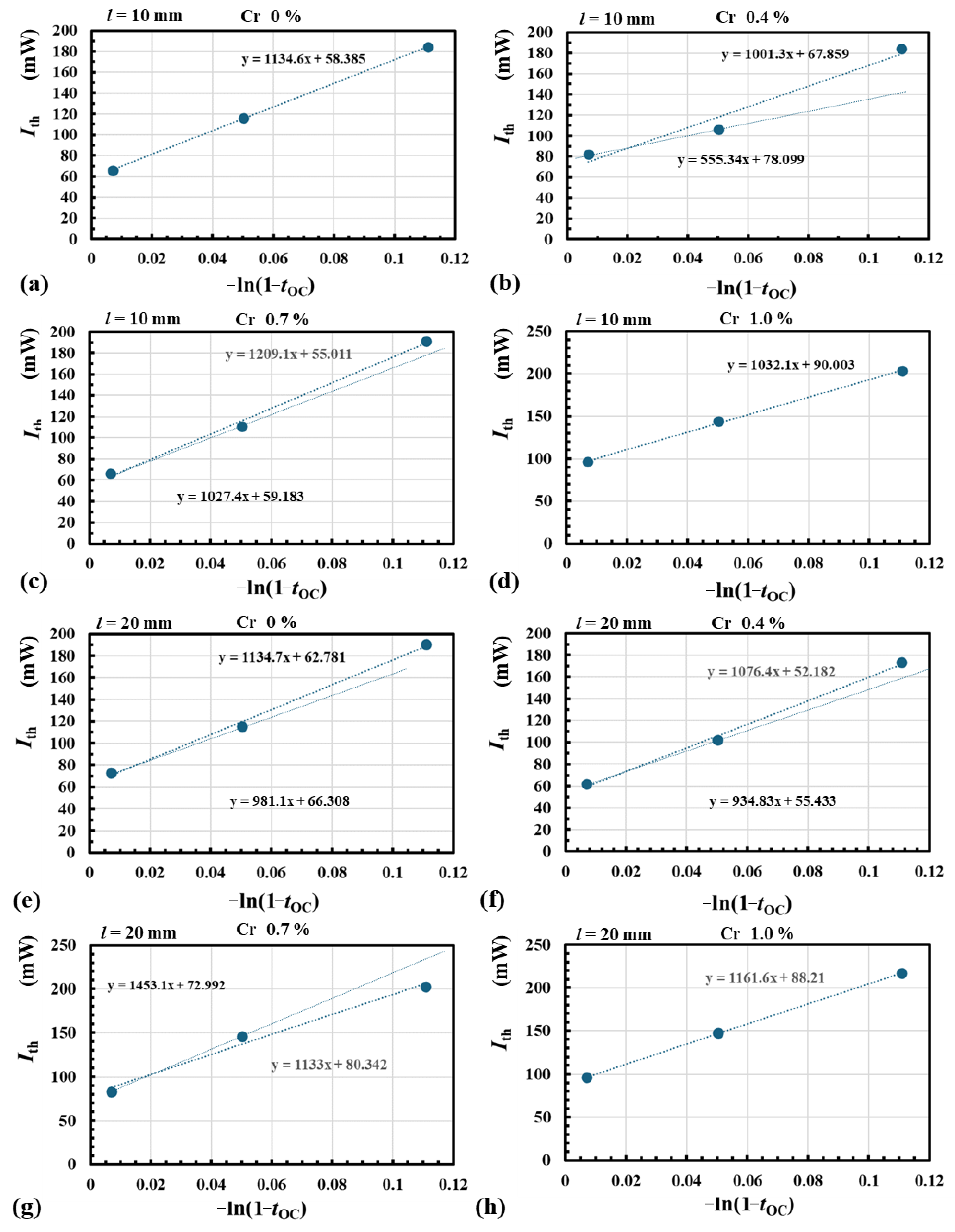
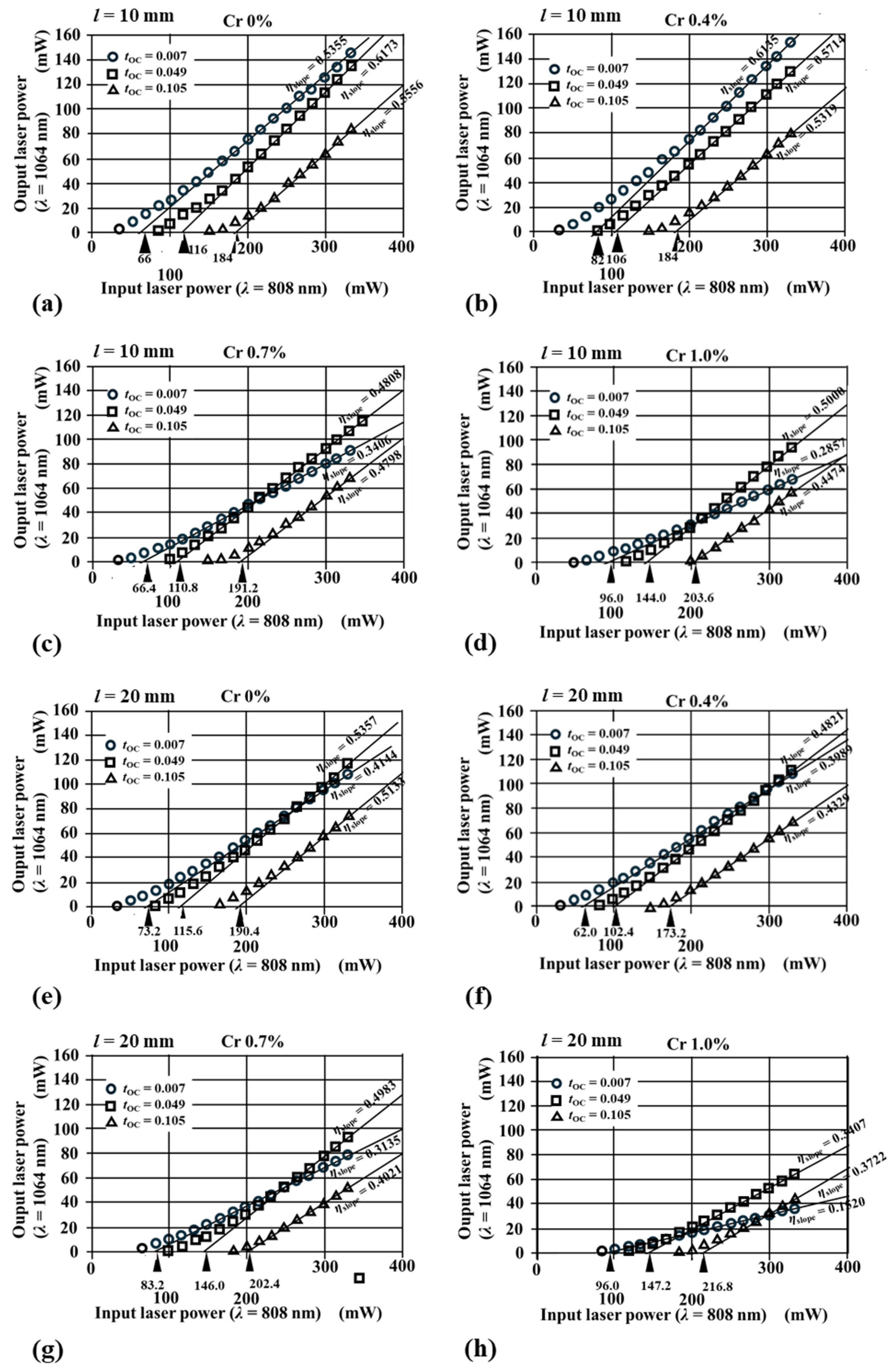
The output power, Ioutputs, of μSPLs employing Cr (χ at%), Nd (1 at%): YAG (yttrium aluminum garnet) transparent ceramic RTP (regular tetragonal prismatic) rods of 1 × 1 × 10 mm and 1 × 1 × 20 mm with for different χ: 0, 0.4, 0.7, and 1.0 were measured by pumping Nd3+ directly using an 808 nm (λa) laser diode in the three different configurations of OCs (output couplers) of the measured tOCs: 0.007, 0.049, 0.105. The experimental configuration was essentially the same one as reported in a figure by Hasegawa et al. [36]. Figure 3a–h show the results. In each figure, we obtained ηslopes from portions of the linear increase in the output power Ioutput with the input laser power Ip(λa). We indicated the obtained values of the slope efficiency, ηslope, in the figures for each line. We derived the threshold laser powers, Iths, from the intercepts of the extended lines of the linear portions and the abscissa axis, where Ioutput = 0. The obtained values of Ith are indicated with filled triangles, together with corresponding figures in mW.
From relation (1), we derived the following relation:
I t h = G × L F i n d l e y C l a y ln 1 t O C
Here, G is a constant value, and tOC is a transmittance of OC at λL. If Ith (1) is measured using an OC of tOC = tOC (1), and Ith (2) is measured using an OC of tOC = tOC (2), LFindley-Clay is
L F i n d l e y C l a y = I t h ( 1 ) × ln 1 t O C 2 + I t h ( 2 ) × ln 1 t O C 1 I t h ( 2 ) I t h ( 1 )
Although we can obtain LFindlay-Clay using relation (3), we often obtain LFindlay-Clay from the −ln(1 − tOC) axis-intercept of the LSF (least-square-fit) line defined by more than three values of Ith plotted against −ln(1 − tOC) to minimize the effect of measurement errors. Figure 4 shows Findlay-Clay plots made from Figure 3 based on relation (2).
From relation (1), we can derive the following relation:
1 t O C η s l o p e = 1 η 0 × exp L C a i r d 1 t O C + 1
If we measure ηslope (1) using an OC of tOC = tOC (1) and ηslope (2) using an OC of tOC = tOC (2), LCaird is
L C a i r d = ln 1 t O C 2 × η s l o p e 2 × t O C 1 × 1 t O C 1 t O C 1 × η s l o p e 1 × t O C 2 × 1 t O C 2 η s l o p e 2 × t O C 1 × 1 t O C 1 η s l o p e 1 × t O C 2 × 1 t O C 2
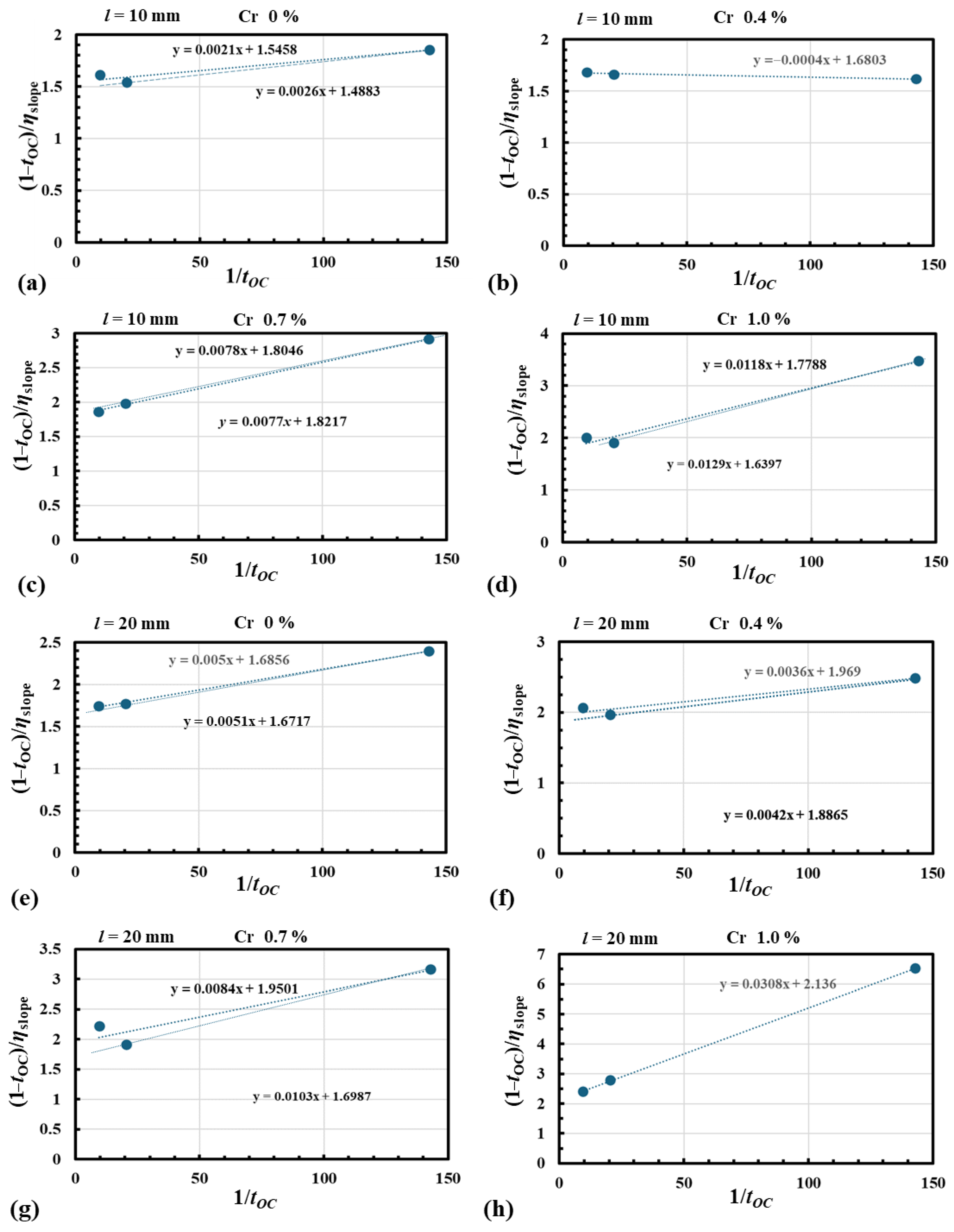
Although we can obtain LCaird using relation (5), we often obtain LCaird from the slope (exp (LCaird) − 1)/η0 of the LSF line defined by more than three values of (1 − tOC)/ηslope plotted against 1/tOC to minimize the effect of measurement errors. In this process, we obtain 1/η0 from the (1 − tOC)/ηslope axis-intercept of the LSF line. Figure 5 shows Caird plots made from Figure 3 based on relation (4).
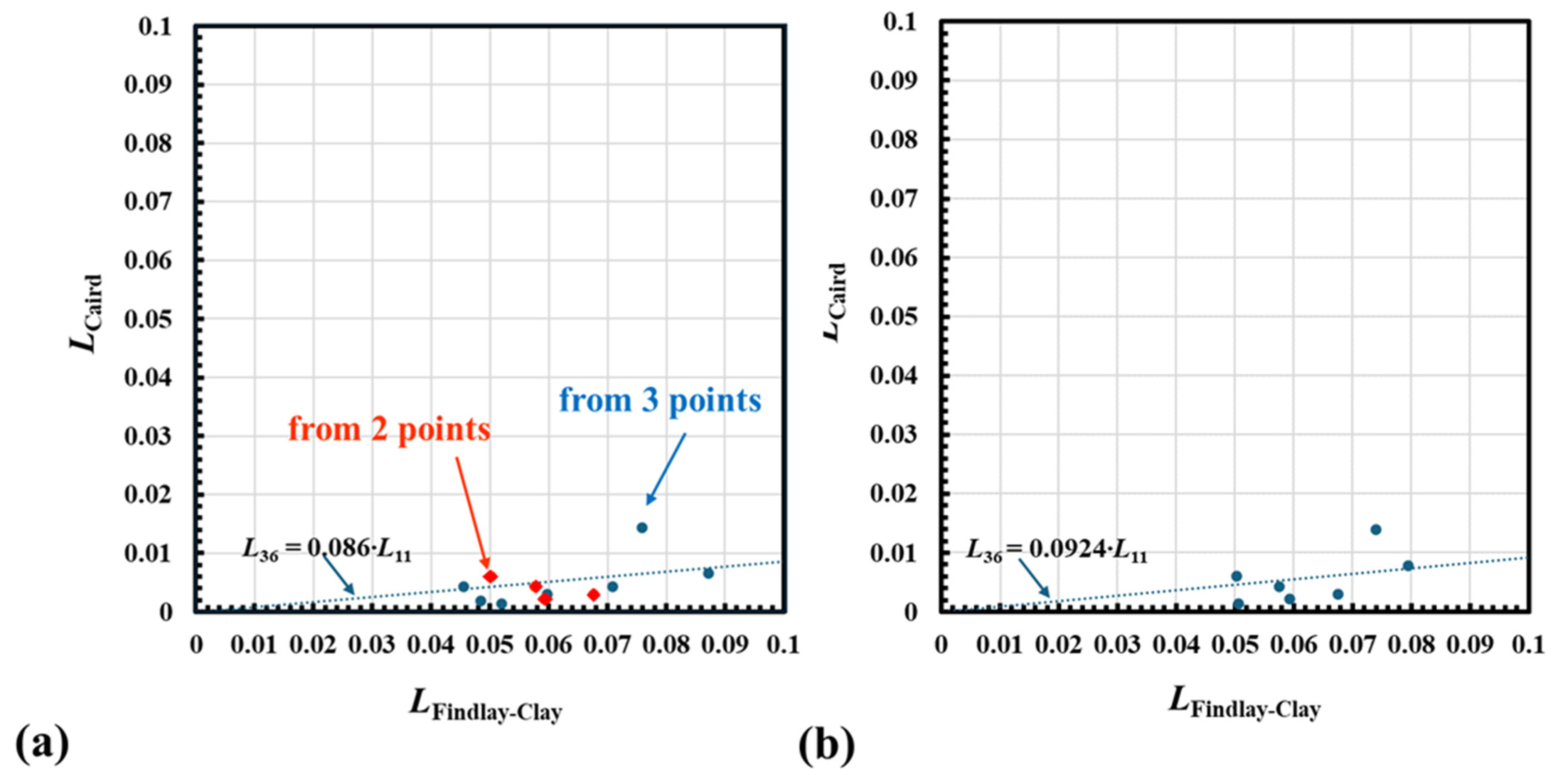
As for Findlay-Clay plots, the three points in Figure 4a,d,h are approximately on the LSF line obtained from the three values of Ith plotted against −ln(1 − tOC). However, the three points in Figure 4b,c,g are well deviated from the LSF line. In such cases, Iths were obtained from lines connecting two points for tOC = 0.007 and 0.049, omitting the largest tOC. The relation (4) indicates that (1 − tOC)/ηslope increases with 1/tOC in Caird plots, as Figure 5a,c–h. However, (1 − tOC)/ηslope slightly decreases with 1/tOC in Figure 5b. The Cr 0.4 at% doped LR (laser rod) was used most frequently for outdoor experiments tracking the sun in our laboratory [37] because it yielded the highest Ioutput among the four Cr (χ at%), Nd (1 at%): YAG transparent ceramic LRs in the μSPL system [38]. Therefore, accumulated damage in this LR by solarization may have been predominant in comparison with the other LRs, even with the UV cut filter. This accumulated damage may have caused the unreasonable negative slope in Figure 5b. Only in Figure 5h, the three points appear near the LSF line. L cannot be obtained using relation (5) because (1 − tOC)/ηslope at tOC = 0.049 is less than that at tOC = 0.105 in Figure 5b,d,f,g, resulting in negative slopes. Therefore, L was calculated from relation (5) using (1 − tOC)/ηslope at tOC = 0.049 and 0.005, omitting the largest tOC. Table 2 summarizes LFindlay-Clays and LCairds obtained from the LSF lines, from relation (3), and relation (5) using two points at tOC = 0.007 and 0.049. Figure 6a shows the correlation of LFindlay-Clays and LCairds thus obtained. The LCairds are one order of magnitude smaller than LFindlay-Clays.
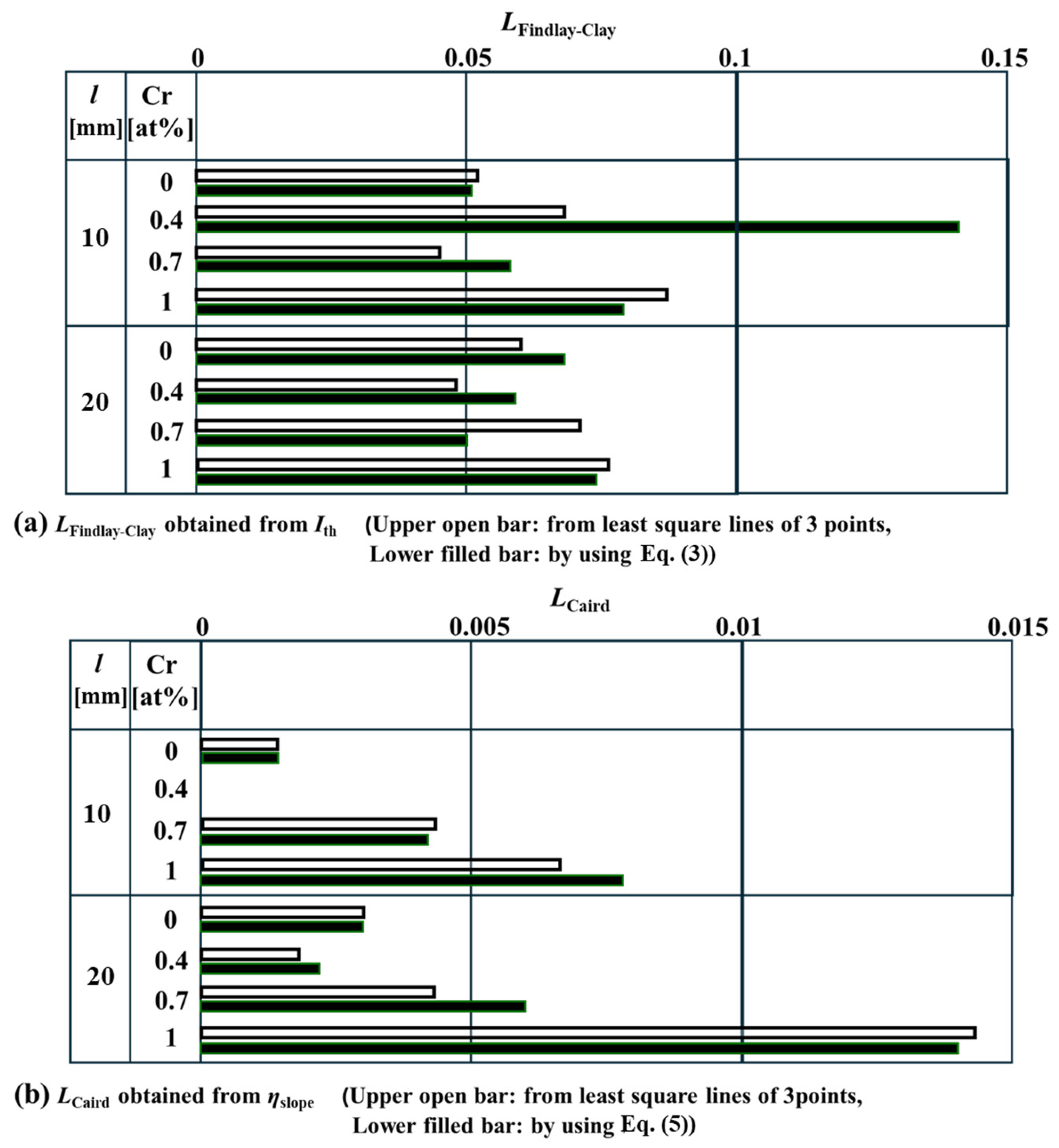
Table 3 shows LFindlay-Clays obtained from relation (3) and LCairds obtained from relation (5), using two cases out of three tOCs: 0.007, 0.049, and 0.105. The “average” stands for the average of the three Ls obtained from three combinations of tOC: (0.007, 0.049), (0.049, 0.105), and (0.105, 0.007). The “corrected average” stands for the average of the two Ls obtained from two combinations of tOC, (0.007, 0.049) and (0.105, 0.007), or L obtained from the combination of tOC, (0.007, 0.049), depending on the cases. Slopes obtained from the combination of tOC (0.049, 0.105) are often considerably different from the slopes obtained from the other combinations of tOC, (0.007, 0.049) and (0.105, 0.007), as shown in Figure 4 and Figure 5. Therefore, we do not use them for the derivation of the average value. Figure 7b shows the correlation of LFindlay-Clays and LCairds in the columns of “corrected average” in Table 3, except for the case of χ = 0.4 and l = 10 mm in which the calculated LCaird is negative. Figure 7b also shows that LCaird is one order of magnitude less than LFindlay-Clay. Figure 8a,b show bar charts representing the obtained LFindlay-Clay and LCaird for each LR (rod rength l = 10 or 20 mm) of different Cr content χ, respectively. Here, the open bars represent the values in the column, “3 points”, in Table 2, and the filled bars represent the values in the column, “corrected average”, in Table 3. It should be noted that the scales of the bar length are one order of magnitude different between Figure 7a,b.
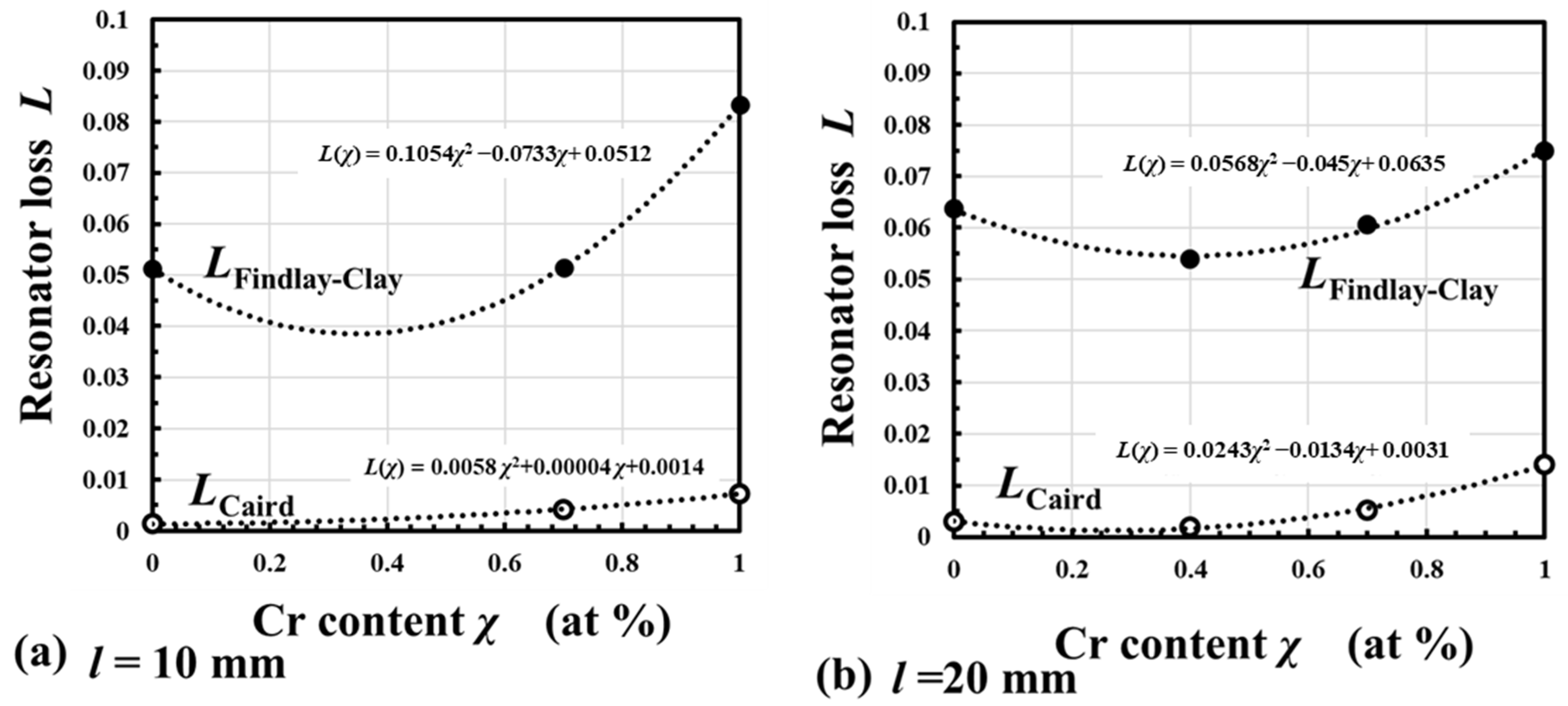
LFindlay-Clay for l = 10 mm and χ = 0.4 at% in Figure 7a obtained using relation (3) is unusually large compared to LFindlay-Clays for the other l and χ. This inconsistency may also originate from accumulated damage caused by solarization in the LR with l = 10 mm and χ = 0.4 at%. Ignoring the data at l = 10 mm and χ = 0.4 at%, the average of the open bar and the filled bar at each χ appears to decrease from χ = 0.0 at% to 0.4 at% and then increase from χ = 0.4 at% to 1.0 at%, although this trend is not very pronounced. In contrast, LCairds in Figure 7b show clear increases with χ from 0.4 to 1, except for χ = 0.4 at l = 10 mm. This behavior of LCaird is reasonable because Cr3+ dopants can cause scattering loss. It is also logical that LCairds for l = 20 mm generally show larger values than those for l = 10 mm. Excluding LFindlay-Clay and LCaird for (l = 10 and χ = 0.4), the average of the open bar and the filled bar at each χ is plotted against χ for each l, as shown in Figure 8. We also provided LSF as a quadratic function for each LFindlay-Clays and LCairds and each l. The quadratic functions Lquad.(χ)s are downward convex. Lquad.(χ)s for l = 10 mm may be of lower accuracy because of the lack of data at χ = 0.4 near the lowest value in comparison with those defined by four data points, with that being at χ = 0.4. Therefore, ηpowers shall be calculated only for l = 20 mm in the following sections.
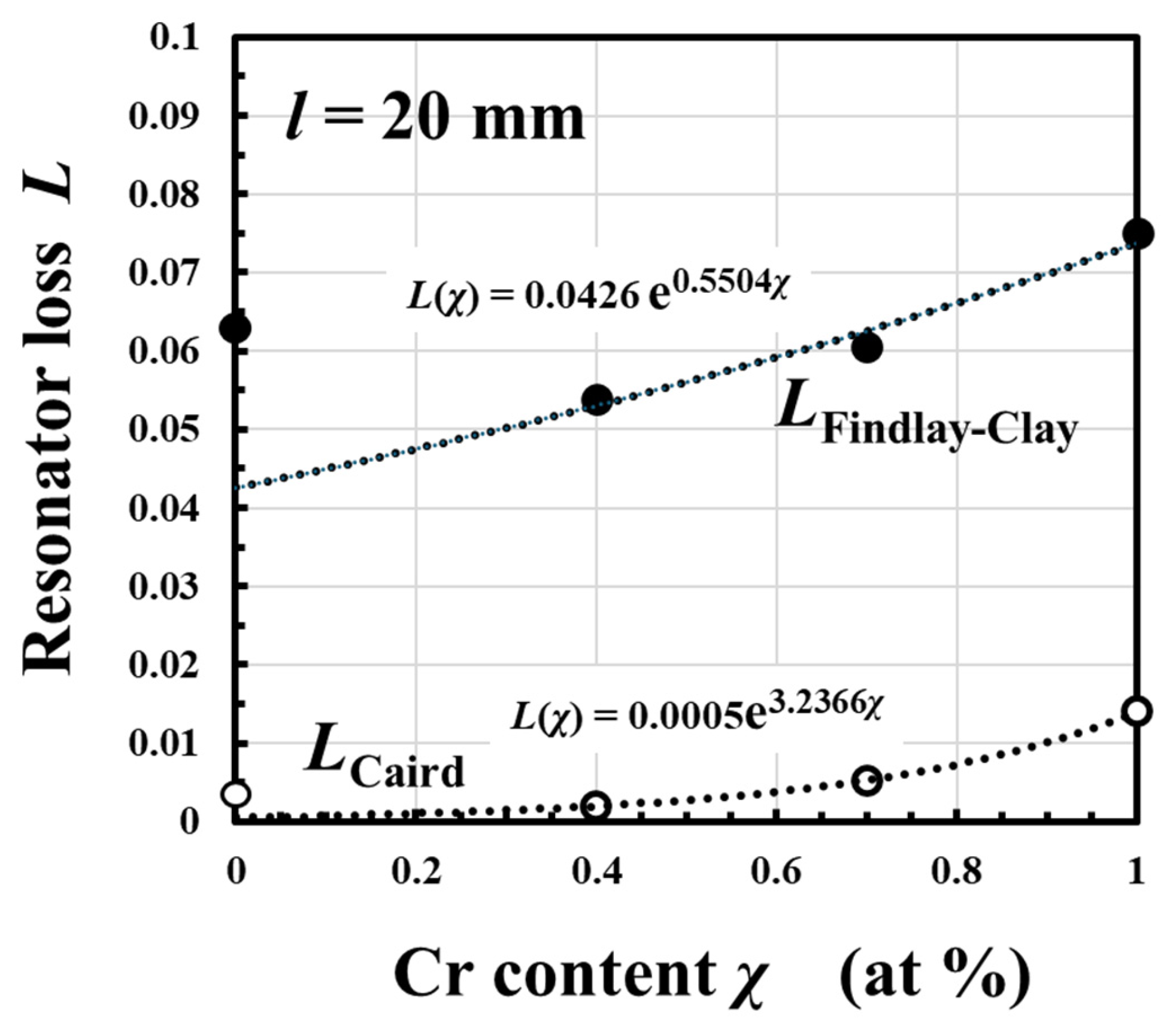
It is reasonable that LCaird and LFindlay-Clay increase with χ, as shown in the experimental data at χ = 0.4, 0.7, and 1.0 in Figure 8 because an increase in χ should increase optical scattering sites in the LR (laser rod). Viewed in this light, however, it is not reasonable that the experimentally obtained LCaird and LFindlay-Clay at χ = 0 are larger than those at χ = 0.4. Although the detailed process of the LRs, including combinations of hot isostatic pressing and thermal annealing, has not been disclosed because of the know-how involved [8], the process of the LR of χ = 0 without Cr may be different from those of the Cr-doped LRs of χ = 0.4, 0.7, and 1.0 because of the difference in the segregation coefficients between Cr and Nd [9]. Then it may be better to consider that the χ dependence of LCaird or LFindlay-Clay: L(χ) exhibits a monotonic increase with χ except at χ = 0, in contrast to Lquad.(χ)s being convex downward, as shown in Figure 8. Exponential functions Lexp.(χ)s obtained by LSF to the experimental LCaird or LFindlay-Clay at χ = 0.4, 0.7, and 1.0 in the case of l = 20 mm are shown in Figure 9. Lexp.(χ)s were not obtained in the case of l = 10 mm because there were only two data points for χ = 0.7 and 1.0.

3. Results of Calculations of ηpower

3.1. The Mode-Matching Efficiency ηmode to Give the Best Fit to the Experimental Power-Conversion Efficiency ηpower

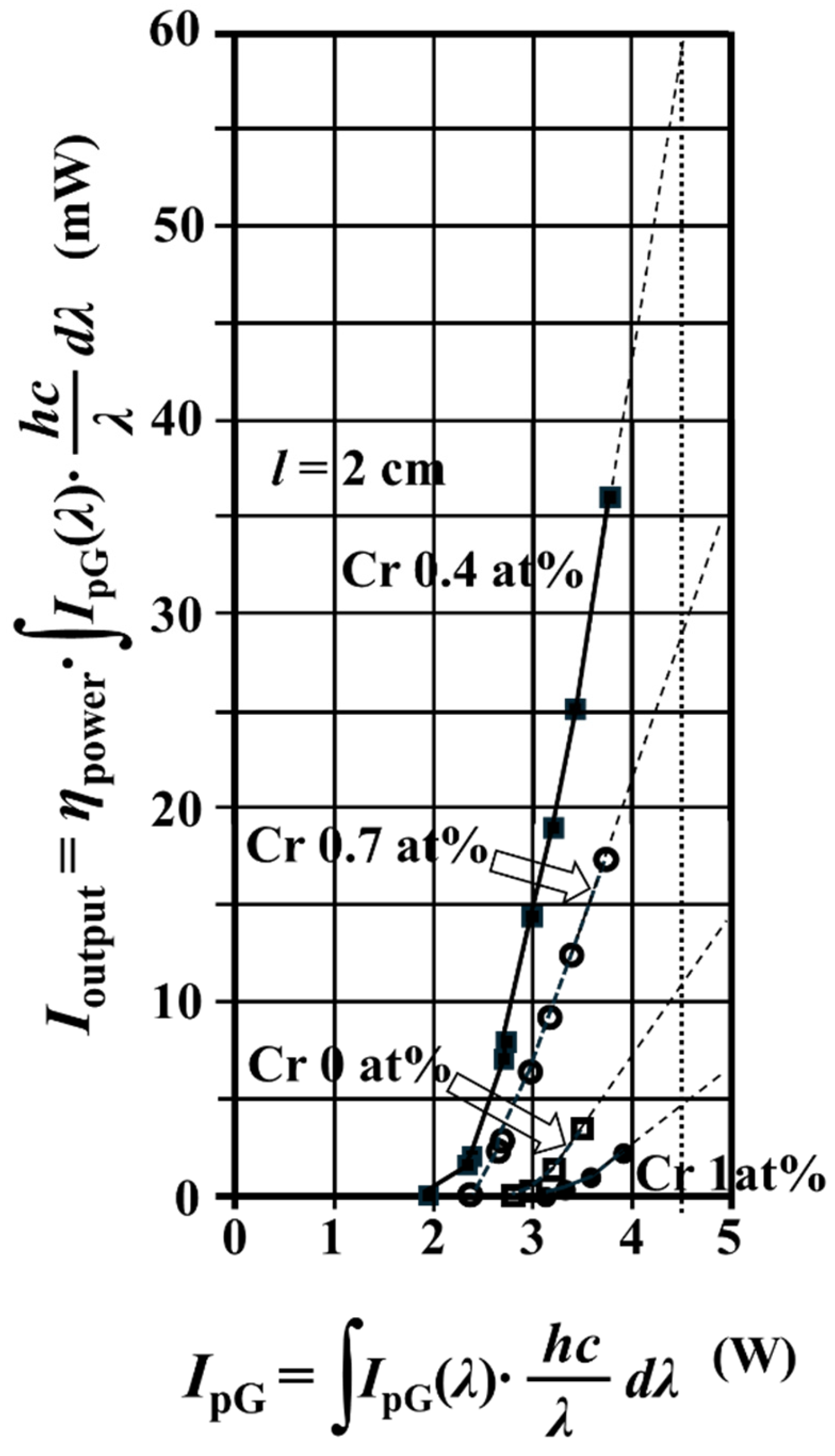
Figure 10 shows the measured laser output powers, Ioutputs, as a function of the incident sunlight power into the OAP (off-axis parabolic mirror), IpG, at different Cr contents, χ = 0, 0.4, 0.7, and 1 at%, in the case of the transmittance of OC at λL, tOC = 0.01, and rod length, l = 20 mm, redrawn from Figure 3 in Ref. [39]. The maximum IpG in all the measured points in Figure 10 is 3.9 W. The maximum IpG should be 4.5 W in ideal experimental conditions at 1 Sun (100 mW/cm2) because the aperture radius of the OAP is 38 mm. Figure 10 shows four extended dashed lines connecting two measured points of the maximum and the second maximum Ioutputs for each. The four intersections of these dashed lines and the perpendicular lines IpG = 4.5 W give Ioutput as 11.0, 29.0, 59.3, and 4.8 mW for each χ: 0, 0.4, 0.7, and 1.0, respectively.

3.2. Estimated ηpowe as a Function of the Cr Content χ

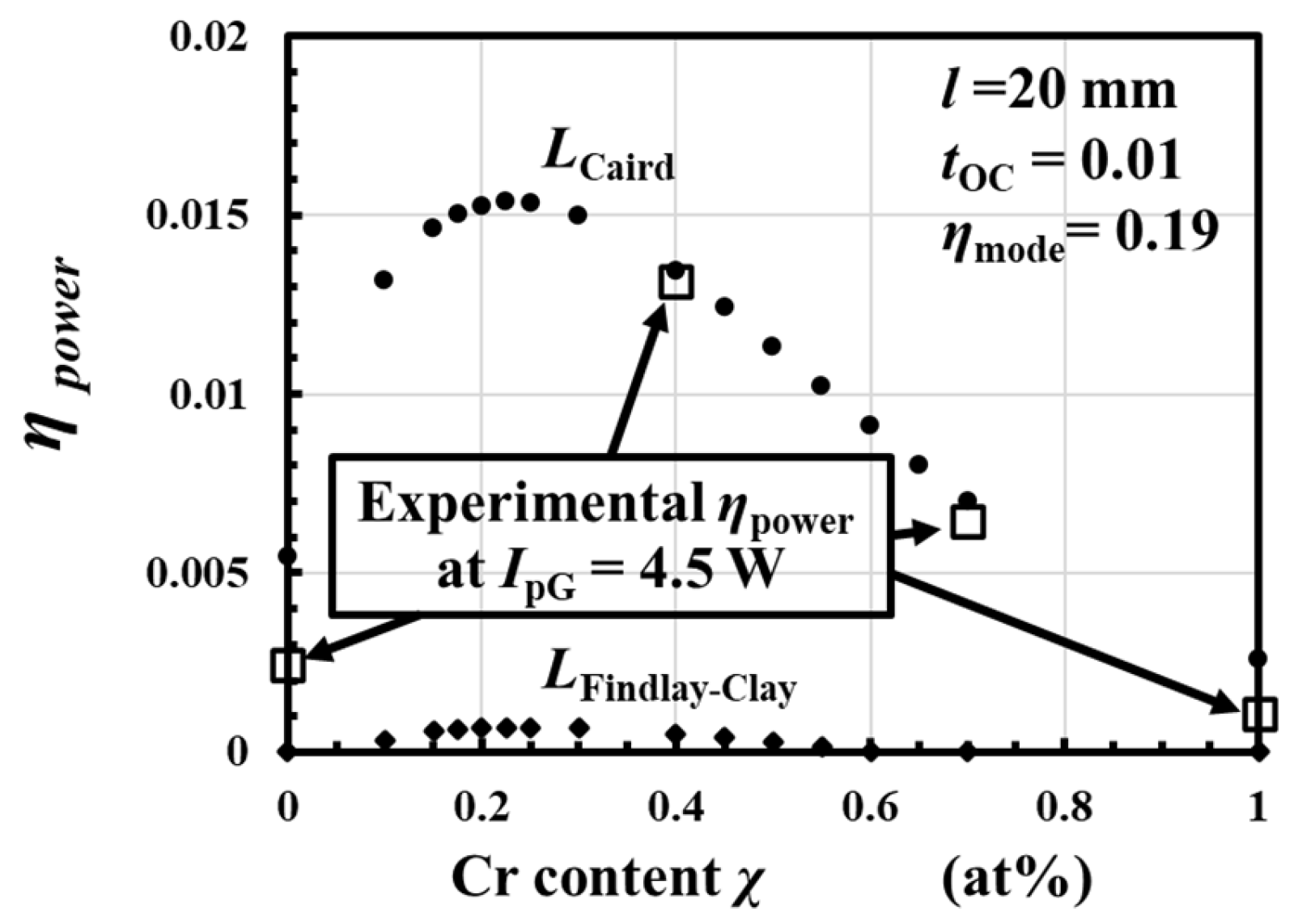
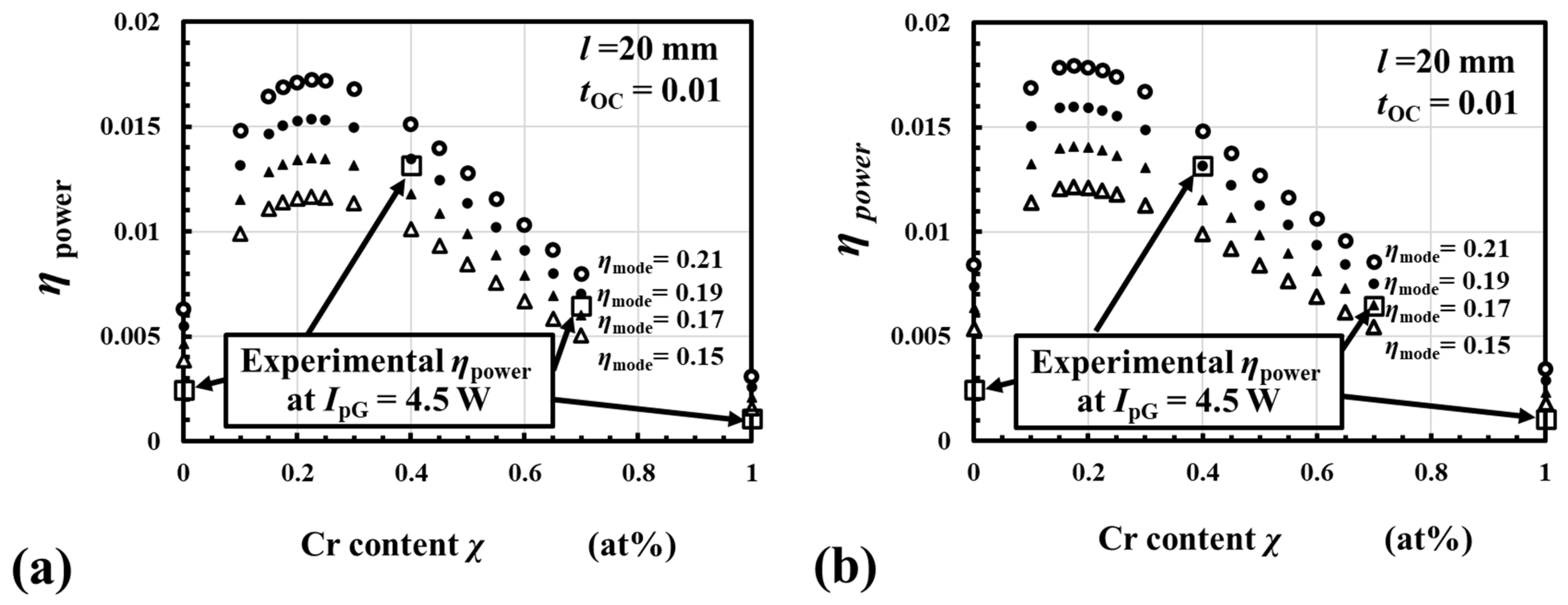
Figure 11 compares ηpowers calculated for ηmode = 0.19 and l = 20 mm using the Lquad.(χ)s for LFindley-Clays and LCairds shown in Figure 8b, with ηpowers experimentally deduced at 1 Sun. The ηpowers calculated using the Lquad.(χ) for LFindley-Clay are far below the experimentally deduced ηpowers. In contrast, ηpowers calculated using the Lquad.(χ) for LCairds are in good agreement with the experimentally deduced ηpowers. This result shows that LCairds give ηpowers closer to the truth than LFindley-Clays. Figure 12 shows comparisons of Cr content χ dependencies of ηpowers, ηpower(χ) for ηmode = 0.15, 0.17, 0.19, and 0.21, calculated using (a) Lquad.(χ) for LCaird, (b) using Lexp.(χ) for LCaird with those experimentally deduced for 1 Sun. It is shown that ηmode = 0.15 and 0.17 give lower ηpowers and ηmode = 0.21 gives higher ηpowers than those experimentally deduced. The ηmode = 0.19 gives ηpowers in good agreement with those experimentally deduced. As for agreement with experimentally deduced ηpowers, Lquad.(χ) seems to be more successful than Lexp.(χ). However, the difference is not significant. ηpower reaches its maximum at 0.0154 at around χ = 0.23 in the case of Lquad.(χ), and 0.0160 at around χ = 0.18 in the case of Lexp.(χ). Experimentally deduced ηpowers for χ = 0 and 1 at% are obviously below the calculated ηpowers for ηmode = 0.19. These discrepancies may arise from the fact that we measured the maximum Ioutput for χ = 0 and 1 at% at IpG = 3.5 W and IpG = 3.9 W, respectively, not far from the threshold IpG located at around 3 W. The slopes of the extended dashed lines connecting two measured points of the maximum and the second maximum Ioutputs for χ = 0 and 1 could be larger if we had measured Ioutputs at IpG = 4.5 W. Then the experimentally deduced ηpowers for χ = 0 and 1 at% would be much closer to the calculated ηpowers for ηmode = 0.19.
In our previous experiment [39], the LR of χ = 0.4 at% gave a higher Ioutput than the LRs of χ = 0, 0.7, and 1.0 at%. The calculations shown in Figure 12 reproduce this tendency. In addition to this, the calculations show that the highest ηpower, as high as 0.0154–0.0160, appears around χ = 0.2.

4. Discussion

4.1. Contribution of Cr Content, χ, Dependence of Energy-Transfer Efficiency, ηCr→Nd, and Resonator Loss, L, to χ Dependence of Energy Conversion Efficiency, ηpower

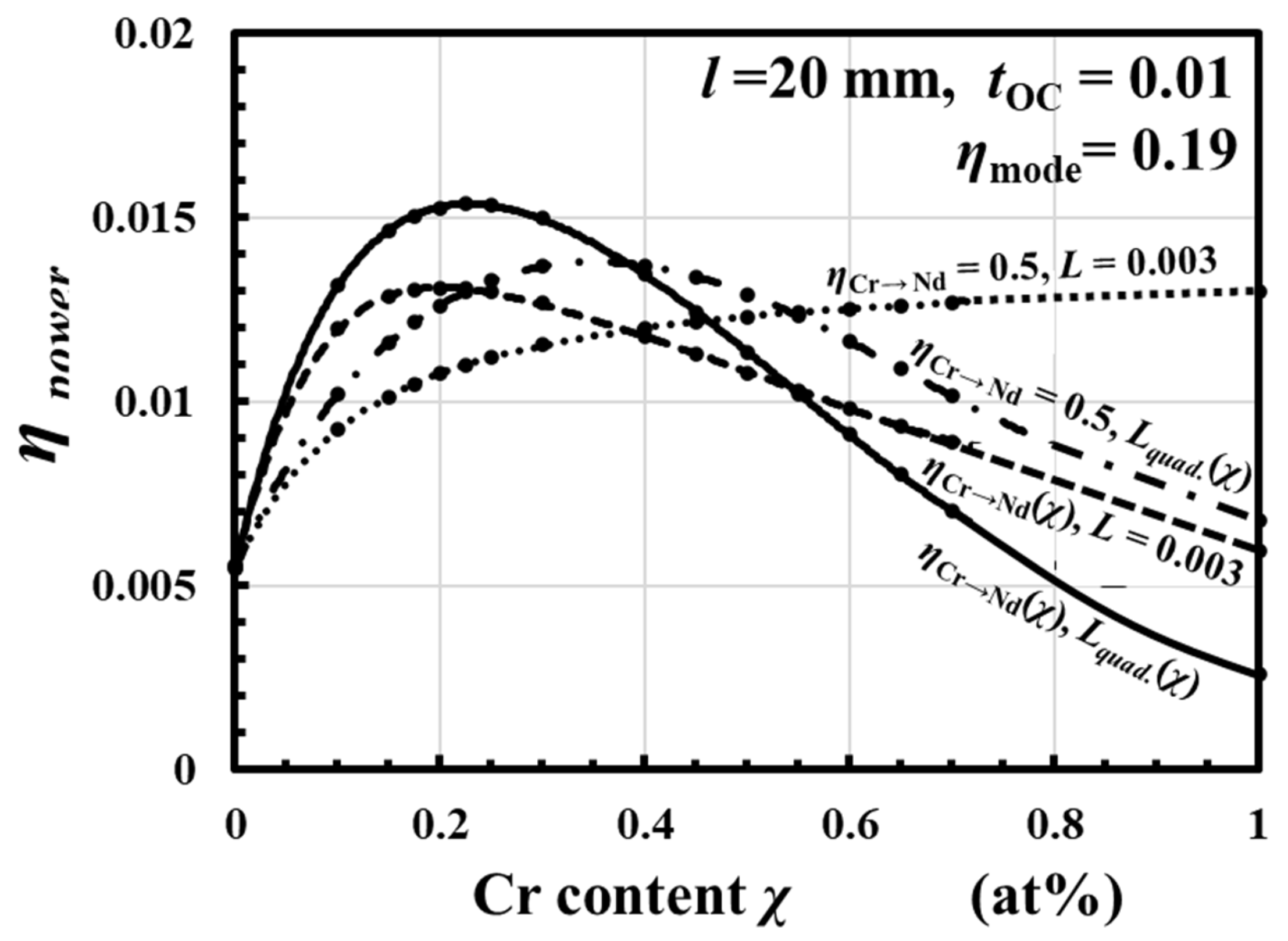
The contributions of ηCr→Nd(χ) as shown in Figure 2 and Lquad.(χ) as shown in Figure 8b to ηpower(χ) can be explained by either ηCr→Nd(χ) or Lquad.(χ) being held constant, or both being constant in the calculations of ηpower(χ)s. Figure 13 presents four cases of ηpower(χ) calculations where L is constant, 0.003 in the two cases, and ηCr→Nd is constant, 0.5 in the two cases. In the case where both L and ηCr→Nd are constant, the calculated ηpower increases with χ. When we use Lquad.(χ) and ηCr→Nd is constant, ηpower(χ) has a peak at around χ = 0.35. When we use ηCr→Nd (χ) and keep L constant, ηpower(χ) has a peak at χ = 0.19. With both contributions, Lquad.(χ) and ηCr→Nd (χ), ηpower has a peak at around χ = 0.23.

4.2. Comparison of LFindlay-Clay and LCaird

Both relation (2) and relation (4) are derived from the fundamental relation of laser oscillation (1). Therefore, LCaird should be equal to LFindlay-Clay. However, LFindlay-Clays are almost ten times larger than LCairds in the present work. According to Figure 11, the values of LCairds are appropriate for actual laser emission from the μSPL pumped by natural sunlight. In contrast, the values of LFindlay-Clays are too large for measurable laser emission from the μSPL under natural sunlight pumping.
The discrepancy between LFindlay-Clay and LCaird has been reported in the previous literature. Cornacchia et al. (2007) [55] reported laser oscillations at 640.2, 721.5, 607.2, and 522.8 nm in Czochralski-grown Pr doped LiLuF4 single crystals under 479.5 nm laser pumping. They obtained LFindlay-Clay and LCaird for each laser oscillation wavelength. The values for LCaird/LFindlay-Clay were 1.14, 1.26, 0.26, and 1.02 for 640.2, 721.5, 607.2, and 522.8 nm, respectively. Therefore, LCaird was nearly equal to LFindlay-Clay in the cases of 640.2, 721.5, and 522.8 nm. However, LFindlay-Clay was approximately five times larger than LCaird in the case of 607.2 nm. In their report, they described that the possible reason was still under investigation. To the best of our knowledge, “the possible reason” has not been reported by them since 2007.
We found similar examples in several other previous reports. Values for LCaird/LFindlay-Clay: (a) 0.42, (b) 0.12, (c) 0.14, (d) 0.02, (e) 0.092, (f) 0.068, (g) 0.139, and (h) 0.391 can be obtained from the laser emission properties in the following reports: (a) Shoji et al. (2000) [56], (b) and (c) Liang and Almeida (2011) [43], (d) Nasser at al. (2019) [57], and (e)–(h) Saiki et al. (2022) [58], respectively. In six out of eight examples (a)–(h), LFindlay is nearly ten times larger than LCaird. On the other hand, values of (i) 5.61, (j) 3.65, (k) 1.04 for LCaird/LFindlay-Clay had been reported in Weksler and Shwartz (1988) [59] ((i) and (j)), and in Sanghera et al. (2011) [60] ((k)), respectively. Although the possible cause for this discrepancy has not been reported yet, we should check both LFindlay-Clay and LCaird as Cornacchia et al. (2007) [55] did.

4.3. Recipes to Improve the Power Conversion Efficiency, ηpower

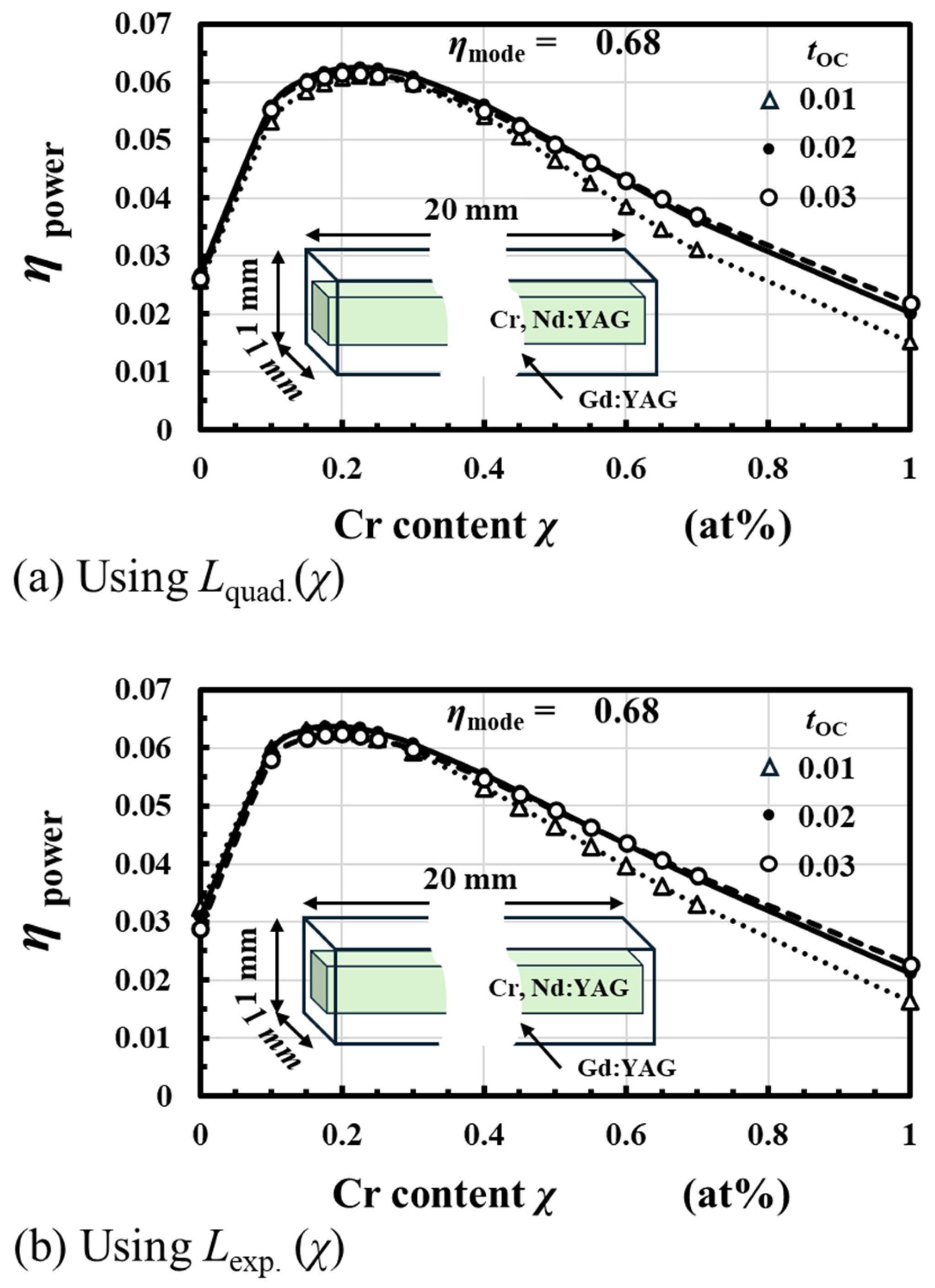
As mentioned in Section 3.2, decreasing Cr content from χ = 0.4 at% to 0.2 at% is one route to improving ηpower. In addition to this, improvement of the mode-matching efficiency ηmode is key to increasing ηpower because it is evident that the present ηmode is as small as 0.19, as shown in Figure 12. A truncated cone with a circular area of 0.226 mm (1.74 times the beam waist radius 0.130 mm) in radius on the HR (high reflectance)-end of the LR (laser rod) and a circular area of 0.264 mm in radius on the BBAR (broadband antireflection)-end (1.74 times larger than the beam radius when the beam radius on the HR-end is 130 nm) reproduces the mode volume of ηmode = 0.19 in the 1 × 1 × 20 mm RTP-LR (regular tetragonal prismatic-laser rod) in the present μSPL configuration. If a composite LR with a 0.53 × 0.53 × 20 mm RTP-core of Crχat%, Nd1at%: YAG (yttrium aluminum garnet) transparent ceramic and a refractive-index-matched cladding of Gd5at %: YAG transparent ceramic [36] as shown in the inserted figure in Figure 14 is employed, the mode-matching efficiency: ηmode increases up to 0.68. In this configuration, the calculated ηpower (χ) is shown in Figure 14. The calculated ηpower(χ) takes a maximum as high as 0.063 at around χ = 0.225 at% at the transmittance of OC at λL: tOC = 0.02 using Lquad.(χ), and 0.064 at around χ = 0.2 at% at tOC = 0.02 using Lexp.(χ).

5. Conclusions

For a 1 × 1 × 20 mm Cr co-doped Nd1at%: YAG (yttrium aluminum garnet) transparent ceramic laser rod employed in a specially designed μSPL,
(a)
We derived Cr content χ dependence of the resonator loss L(χ) from experimentally obtained output-laser-power as a function of an 808 nm pumping laser power.
(b)
We obtained χ dependence of Cr3+ to Nd3+ effective energy transfer efficiency ηCr→Nd(χ) in our previous outdoor μSPL experiment.
(c)
We deduced a spectral absorption coefficient as a function of χ, α (λ, χ), from the data in the previous literature.
Using L(χ), ηCr→Nd(χ), and α (λ, χ), a numerical expression of ηpower(χ) for the μSPL was established. The ηpower(χ) reproduces the experimentally deduced ηpower (0.4) at 1 Sun around 0.013 and ηpower(0.7) around 0.0064. The ηpower(χ) indicated that maximum ηpower(χ) = 0.0154–0.0160 will be attained at around χ = 0.2. The reproduction of the experimental data also elucidated that the mode-matching efficiency ηmode was as low as 0.19. To improve this low ηmode, a composite laser rod with a 0.53 × 0.53 × 20 mm Cr and Nd-doped core and a peripheral cladding in which Gd was doped in YAG to match the refractive index with that of the core was proposed. By employing this composite laser rod, the analytical estimation indicates that ηmode increases to 0.68. Then, ηpower increases to 0.063–0.064 (0.07–0.071 in the conventional SPL definition, cf. Section 2.1). This four times or higher ηpower than the present one ranks in the highest class of ηpower for SPLs [23] and encourages further improvement of the μSPL.

Author Contributions

T.M.: Conceptualization, Methodology, Validation, Formal analysis, Investigation, Resources, Data Curation, Writing—Original Draft, Writing—Review and Editing, Visualization, Supervision, Project administration, Funding acquisition. K.H.: Investigation, Data Curation, Resources, Writing—Review and Editing, Validation. All authors have read and agreed to the published version of the manuscript.

Funding

This work was partially supported by the Advanced Low Carbon Technology Research and Development Program (ALCA) No.119466, Japan Science and Technology Agency.

Data Availability Statement

The data that support the findings of this study are available from the corresponding author upon reasonable request.

Acknowledgments

TM would like to thank M. Kawasumi, T. Hioki, and S. Towata of the Institutes of Innovation for Future Society, Nagoya University, Japan, for their valuable discussion. TM would also like to thank his former collaborator, H. Ito, for laying the groundwork for the present μSPL systems.

Conflicts of Interest

The authors declare no conflicts of interest.

Abbreviations

The following abbreviations are used in this manuscript:
LRLaser rod
SPLSolar-pumped laser
OAPOff-axis parabolic mirror
RTPRegular tetragonal prismatic
UVUltraviolet
YAGYttrium aluminum garnet
HRHigh reflectance
OCOptical coupler
BBARBroadband antireflection coating
ASTMthe American Society for Testing and Materials
LSFLeast-square-fit

References

  1. Kiss, Z.J.; Lewis, H.R.; Duncan, R.C. Sun pumped continuous optical maser. Appl. Phys. Lett. 1963, 2, 93–94. [Google Scholar] [CrossRef]
  2. Simpson, G.R. Continuous sun-pumped room temperature glass laser operation. Appl. Opt. 1964, 3, 783–784. [Google Scholar] [CrossRef]
  3. Young, C.G. A sun-pumped cw one-watt laser. Appl. Opt. 1966, 5, 993–997. [Google Scholar] [CrossRef]
  4. Maiman, T.H. Stimulated optical radiation in ruby. Nature 1960, 187, 493–494. [Google Scholar] [CrossRef]
  5. Lee, J.H.; Weaver, W.R. A solar simulator-pumped atomic iodine laser. Appl. Phys. Lett. 1981, 39, 137–139. [Google Scholar] [CrossRef]
  6. Terry, C.K.; Peterson, J.E.; Goswami, D.Y. Terrestrial solar-pumped iodine gas laser with minimum threshold concentration requirements. J. Thermophys. Heat Transf. 1996, 10, 54–59. [Google Scholar] [CrossRef]
  7. Belousova, I.M.; Danilov, O.B.; Mak, A.A.; Belousov, V.P.; Zalesslii, V.Y.; Grigor’ev, V.A.; Kris’ko, A.V.; Sosnov, E.N. Feasibility of the solar-pumped fullerene–oxygen–iodine laser (Sun-light FOIL). Opt. Spectrosc. 2001, 90, 773–777. [Google Scholar] [CrossRef]
  8. Ikesue, A.; Aung, Y.L. Ceramic laser materials. Nat. Photon. 2008, 2, 721–727. [Google Scholar] [CrossRef]
  9. Ikesue, A.; Aung, Y.L.; Lupei, V. Ceramic Lasers; Cambridge University Press: New York, NY, USA, 2013; p. 121. [Google Scholar] [CrossRef]
  10. Mori, M.; Nagayama, H.; Saito, Y.; Matsumoto, H. Summary of studies on space solar power systems of the National Space Development Agency of Japan. Acta Astronaut. 2004, 54, 337–345. [Google Scholar] [CrossRef]
  11. Suzuki, T.; Kawai, H.; Nasu, H.; Hughes, M.; Ohishi, Y.; Mizuno, S.; Ito, H.; Hasegawa, K. Quantum efficiency of Nd3+-doped glasses under sunlight excitation. Opt. Mater. 2011, 33, 1952–1957. [Google Scholar] [CrossRef]
  12. Masuda, T.; Iyoda, M.; Yasumatsu, Y.; Endo, M. Low-concentrated solar-pumped laser via transverse excitation fiber-laser geometry. Opt. Lett. 2017, 42, 3427–3430. [Google Scholar] [CrossRef]
  13. Endo, M. Feasibility study of a conical-toroidal mirror resonator for solar-pumped thin-disk lasers. Opt. Express 2007, 15, 5482–5493. [Google Scholar] [CrossRef]
  14. Payziyev, S.; Makhmudov, K. Solar pumped Nd:YAG laser efficiency enhancement using Cr:LiCAF frequency down-shifter. Opt. Commun. 2016, 380, 57–60. [Google Scholar] [CrossRef]
  15. Pe’er, I.; Vishnevitsky, I.; Naftali, N.; Yogev, A. Broadband laser amplifier based on gas-phase dimer molecules pumped by the Sun. Opt. Lett. 2001, 26, 1332–1334. [Google Scholar] [CrossRef]
  16. Almeida, J.; Liang, D.; Vistas, C.R.; Bouadjemine, R.; Guillot, E. 5.5W continuous wave TEM00-mode Nd:YAG solar laser by a light-guide/2 V shaped pump cavity. Appl. Phys. B Laser Opt. 2015, 121, 473–482. [Google Scholar] [CrossRef]
  17. Liang, D.; Almeida, J.; Vistas, C.R.; Guillot, E. Solar-pumped Nd:YAG laser with 31.5 W/m2 multimode and 7.9 W/m2 TEM00-mode collection efficiencies. Sol. Energy Mater. Sol. Cells 2017, 159, 435–439. [Google Scholar] [CrossRef]
  18. Motohiro, T.; Takeda, Y.; Ito, H.; Hasegawa, K.; Ikesue, A.; Ichikawa, T.; Higuchi, K.; Ichiki, A.; Mizuno, S.; Ito, T.; et al. Concept of the solar-pumped laser-photovoltaics combined system and its application to laser beam power feeding to electric vehicles. Jpn. J. Appl. Phys. 2017, 56, 08MA07. [Google Scholar] [CrossRef]
  19. Ohkubo, T.; Yabe, T.; Yoshida, K.; Uchida, S.; Funatsu, T.; Bagheri, B.; Oishi, T.; Daito, K.; Ishioka, M.; Nakayama, Y.; et al. Solar-pumped 80 W laser irradiated by a Fresnel lens. Opt. Lett. 2009, 34, 175–177. [Google Scholar] [CrossRef]
  20. Yabe, T.; Bagheri, B.; Ohkubo, T.; Uchida, S.; Yoshida, K.; Funatsu, T.; Oishi, T.; Daito, K.; Ishioka, M.; Yasunaga, N.; et al. 100 W-class solar pumped laser for sustainable magnesium-hydrogen energy cycle. J. Appl. Phys. 2008, 104, 083104. [Google Scholar] [CrossRef]
  21. Yabe, T.; Ohkubo, T.; Uchida, S.; Yoshida, K.; Nakatsuka, M.; Funatsu, T.; Mabuti, A.; Oyama, A.; Kakagawa, K.; Oishi, T.; et al. High-efficiency and economical solar-energy-pumped laser with Fresnel lens and chromium codoped laser medium. Appl. Phys. Lett. 2007, 90, 261120. [Google Scholar] [CrossRef]
  22. Nechayev, S.; Rotschild, C. Detailed Balance Limit of Efficiency of Broadband-Pumped Lasers. Sci. Rep. 2017, 7, 11497. [Google Scholar] [CrossRef]
  23. Costa, H.; Liang, D.; Almeida, J.; Tiburcio, B.D.; Vistas, R. Four-Ce:Nd:YAG-rod solar laser with 4.49% conversion efficiency through Fresnel lens. Sci. Rep. 2025, 15, 13354. [Google Scholar] [CrossRef] [PubMed]
  24. Arashi, H.; Oka, Y.; Sasahara, N.; Kaimai, A.; Ishigame, M. A Solar-Pumped cw 18 W Nd:YAG Laser. Jpn. J. Appl. Phys. 1984, 23, 1051. [Google Scholar] [CrossRef]
  25. Dinh, T.H.; Ohkubo, T.; Yabe, T.; Kuboyama, H. 120 watt continuous wave solar-pumped laser with a liquid light-guide lens and an Nd:YAG rod. Opt. Lett. 2012, 37, 2670. [Google Scholar] [CrossRef] [PubMed]
  26. Liang, D.; Almeida, J. Solar-Pumped TEM00 Mode Nd:YAG laser. J. Opt. Express 2013, 21, 25107. [Google Scholar] [CrossRef] [PubMed]
  27. Saiki, T.; Fujiwara, N.; Matsuoka, N.; Nakatuka, M.; Fujioka, K.; Iida, Y. Amplification properties of KW Nd/Cr:YAG ceramic multi-stage active-mirror laser using white-light pump source at high temperatures. Opt. Commun. 2017, 387, 316–321. [Google Scholar] [CrossRef]
  28. Ogawa, T.; Wada, S.; Higuchi, M. Development of Nd,Cr co-doped laser materials for solar-pumped lasers. Jpn. J. Appl. Phys. 2014, 53, 08MG03. [Google Scholar] [CrossRef]
  29. Honda, Y.; Motokoshi, S.; Jitsuno, T.; Miyanaga, N.; Fujioka, K.; Nakatsuka, M.; Yoshida, M. Temperature dependence of optical properties in Nd/Cr:YAG materials. J. Lumin. 2014, 148, 342–346. [Google Scholar] [CrossRef]
  30. Yamaga, M.; Oda, Y.; Uno, H.; Hasegawa, K.; Ito, H.; Mizuno, S. Formation probability of Cr-Nd pair and energy transfer from Cr to Nd in Y3Al5O12 ceramics codoped with Nd and Cr. J. Appl. Phys. 2012, 112, 063508. [Google Scholar] [CrossRef]
  31. Hasegawa, K.; Ichikawa, T.; Mizuno, S.; Takeda, Y.; Ito, H.; Ikesue, A.; Motohiro, T.; Yamaga, M. Energy transfer efficiency from Cr3+ to Nd3+ in solar-pumped laser using transparent Nd/Cr: Y3Al5O12 ceramics. Opt. Express 2015, 23, A519–A524. [Google Scholar] [CrossRef]
  32. Ito, H.; Hasegawa, K.; Mizuno, S.; Takeda, Y.; Motohiro, T. Compact Solar-pumped Lasers, In Advances in Optics: Reviews; Yurish, S.Y., Ed.; IFSA Publishing S. L.: Barcelona, Spain, 2021. [Google Scholar]
  33. Mizuno, S.; Ito, H.; Hasegawa, K.; Suzuki, T.; Ohishi, Y. Laser emission from a solar-pumped fiber. Opt. Express 2012, 20, 5891–5895. [Google Scholar] [CrossRef]
  34. Heber, J. Solar fibre lasers. research highlights. Nat. Mater. 2012, 11, 266. [Google Scholar] [CrossRef]
  35. Motohiro, T.; Ichiki, A.; Ichikawa, T.; Ito, H.; Hasegawa, K.; Mizuno, S.; Ito, T.; Kajino, T.; Takeda, Y.; Higuchi, K. Consideration of coordinated solar tracking of an array of compact solar-pumped lasers combined with photovoltaic cells for electricity generation. Jpn. J. Appl. Phys. 2015, 54, 08KE04. [Google Scholar] [CrossRef]
  36. Hasegawa, K.; Ichikawa, T.; Takeda, Y.; Ikesue, A.; Ito, H.; Motohiro, T. Lasing characteristics of refractive-index-matched composite Y3Al5O12 rods. Jpn. J. Appl. Phys. 2018, 57, 042701. [Google Scholar] [CrossRef]
  37. Suzuki, Y.; Ito, H.; Kato, T.; Phuc, L.T.A.; Watanabe, K.; Terazawa, H.; Hasegawa, K.; Ichikawa, T.; Mizuno, S.; Ichiki, A.; et al. Continuous oscillation of a compact solar-pumped Cr, Nd-doped YAG ceramic rod laser for more than 6.5 h tracking the sun. Sol. Energy 2019, 177, 440–447. [Google Scholar] [CrossRef]
  38. Kato, T.; Ito, H.; Hasegawa, K.; Ichikawa, T.; Ikesue, A.; Mizuno, S.; Takeda, Y.; Ichiki, A.; Motohiro, T. Effect of Cr content on the output of a solar-pumped laser employing a Cr-doped Nd: YAG ceramic laser medium operating in sunlight. Jpn. J. Appl. Phys. 2019, 58, 062007. [Google Scholar] [CrossRef]
  39. Kato, T.; Ito, H.; Hasegawa, K.; Ichikawa, T.; Ikesue, A.; Mizuno, S.; Takeda, Y.; Ichiki, A.; Motohiro, T. Energy transfer efficiency from Cr3+ to Nd3+ in Cr, Nd YAG ceramics laser media in a solar-pumped laser in operation outdoors. Opt. Mater. 2020, 110, 110481. [Google Scholar] [CrossRef]
  40. Kublbock, M.; Will, J.; Fattahi, H. Solar lasers: Why not? APL Photon. 2024, 9, 050903. [Google Scholar] [CrossRef]
  41. Wisniewsky, K.; Koepke, C. Excited state absorption on materials containing Cr3+ and Cr4+ ions. J. Alloys Compd. 2002, 341, 349–352. [Google Scholar] [CrossRef]
  42. Yagi, H.; Yanagitani, T.; Yoshida, H.; Nakatsuka, M.; Ueda, K. The optical properties and laser characteristics of Cr3+ and Nd3+ co-doped Y3Al5O12 ceramics. Opt. Laser Technol. 2007, 39, 1295–1300. [Google Scholar] [CrossRef]
  43. Liang, D.; Almeida, J. Highly efficient solar-pumped Nd:YAG laser. Opt. Express 2011, 19, 26399–26405. [Google Scholar] [CrossRef]
  44. Motohiro, T.; Hasegawa, K. Assessment of possible performance of compact solar-pumped lasers using transparent Cr3+, Nd3+-co-doped YAG ceramics micro rods. Optik 2023, 284, 170942. [Google Scholar] [CrossRef]
  45. Saiki, T.; Motokoshi, S.; Imasaki, K.; Fujioka, K.; Yoshida, H.; Fujita, H.; Nakatsuka, M.; Yamanaka, C. Laser pulses amplified by Nd/Cr:YAG ceramic amplifier using lamp and solar light sources. Opt. Commun. 2009, 282, 1358–1362. [Google Scholar] [CrossRef]
  46. Svelto, O. Chapter 5, Spot sizes for symmetric resonators. In Principles of Lasers, 5th ed.; Springer: New York, NY, USA, 2010; p. 179. ISBN 978-1-4419-1301-2/978-1-4419-1302-9. [Google Scholar] [CrossRef]
  47. Mares, J.A.; Khas, Z.; Nie, W.; Boulon, G. Nonradiative energy transfer between Cr3+ and Nd3+ multisites in Y3Al5O12 laser crystals. J. Phys. 1991, 1, 881–899. [Google Scholar] [CrossRef]
  48. Endo, M. Optical characteristics of Cr3+ and Nd3+ codoped Y3Al5O15 ceramics. Opt. Laser. Technol. 2010, 42, 610–616. [Google Scholar] [CrossRef]
  49. Mizuno, S.; Ito, H.; Hasegawa, K.; Nasu, H.; Hughes, M.; Suzuki, T.; Ohishi, Y. The efficiencies of energy transfer from Cr to Nd ions in silicate glasses. In Proceedings of the SPIE OPTO 2010, San Francisco, CA, USA, 23–28 January 2010; Volume 7598, p. 75980. [Google Scholar] [CrossRef]
  50. Lupei, V.; Lupei, A.; Gheorghe, C.; Ikesue, A. Spectroscopic and de-excitation properties of (Cr,Nd):YAG transparent ceramics. Opt. Mater. Express 2016, 6, 552–557. [Google Scholar] [CrossRef]
  51. Yamaga, M.; Han, T.P.J.; Sawada, O.; Villorac, E.G.; Shimamura, K.; Hasegawa, K.; Mizuno, S.; Takeda, Y. Laser oscillation of Nd via energy transfer process from Cr to Nd in substitutional disordered garnet crystals codoped with Nd and Cr. J. Lumin. 2018, 202, 393–402. [Google Scholar] [CrossRef]
  52. Honda, Y.; Motokoshi, S.; Jitsuno, T.; Fujioka, K.; Nakatsuka, M.; Yoshida, M.; Yamada, T.; Kawanaka, J.; Miyanaga, N. Temperature-dependent fluorescence decay and energy transfer in Nd/Cr:YAG ceramics. Opt. Mater. 2019, 90, 215–219. [Google Scholar] [CrossRef]
  53. Findlay, D.; Clay, R.A. The Measurement of Internal Losses in 4-Level Lasers. Phys. Lett. 1966, 20, 277–278. [Google Scholar] [CrossRef]
  54. Caird, J.A.; Payne, S.A.; Staber, P.R.; Ramponi, A.J.; Chase, L.L.; Krupke, W.F. Quantum electronic properties of the Na3Ga2Li3F12:Cr3+ laser. IEEE J. Quantum Electron. 1988, 24, 1077–1099. [Google Scholar] [CrossRef]
  55. Cornacchia, F.; Richter, A.; Heumann, E.; Huber, G.; Parisi, D.; Tonelli, M. Visible laser emission of solid state pumped LiLuF4:Pr3+. Opt. Express 2007, 15, 992–1002. [Google Scholar] [CrossRef] [PubMed]
  56. Shoji, I.; Kuriyama, S.; Sato, Y.; Taira, T.; Ikesue, A.; Yoshida, K. Optical properties and laser characteristics of highly Nd3+-doped Y3Al5O12 ceramics. Appl. Phys. Lett. 2000, 77, 939–941. [Google Scholar] [CrossRef]
  57. Nasser, K.; Aseev, V.; Ivanov, S.; Ignatiev, A.; Nikonorov, N. Optical, spectroscopic properties and Judd–Ofelt analysis of Nd3+-doped photo-thermo- refractive glass. J. Lumin. 2019, 213, 255–262. [Google Scholar] [CrossRef]
  58. Saiki, T.; Iwashita, T.; Sakamoto, J.; Hayashi, T.; Nakamachi, T.; Fujimoto, Y.; Iida, Y.; Nakatsuka, M. Rod-Type Ce/Cr/Nd: YAG Ceramic Lasers with White-Light Pump Source. Int. J. Opt. 2022, 2022, 8480676. [Google Scholar] [CrossRef]
  59. Weksler, M.; Shwartz, J. Solar-Pumped Solid-State Lasers. IEEE J. Quantum Electron. 1988, 34, 1222–1228. [Google Scholar] [CrossRef]
  60. Sanghera, J.; Bayya, S.; Villalobos, G.; Kim, W.; Frantz, J.; Shaw, B.; Sadowski, B.; Miklos, R.; Baker, C.; Hunt, M.; et al. Transparent ceramics for high-energy laser systems. Opt. Mater. 2011, 33, 511–518. [Google Scholar] [CrossRef]
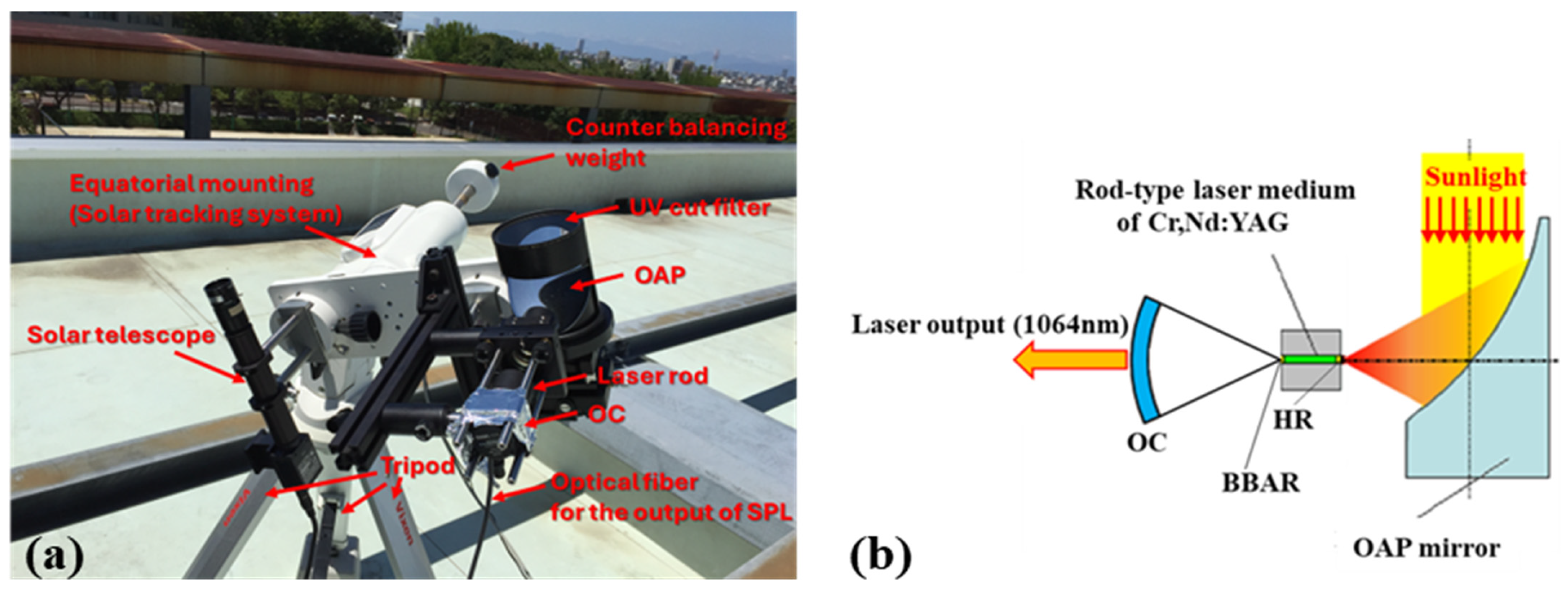
Figure 1. (a) Compact solar-pumped laser (μSPL) tracking the sun automatically on an equatorial mount (VIXEN SXD2). (b) Schematic diagram of the essential portion of μSPL.
Solar 05 00051 g001
Figure 2. Plots of ηCrNd, ξCrNd circled with dotted lines, and ζCrNd out of the dotted circles against χ. The data points with the first author’s name in Italic type represent the values obtained by fluorescence measurements in spontaneous emission. The data points with the first author’s name in Roman type represent the values obtained in stimulated emission under the laser oscillation. The reference number corresponding to each researcher name is as follows: Mares (1991): [47], Yamaga (2012): [30], Endo (2010): [48], Kato (2020): [39], Hasegawa (2015): [31], Lupei (2016): [50], Honda (2019): [52], Honda (2014): [29].
Solar 05 00051 g002
Figure 3. Dependence of the output laser power of the μSPL on the input laser power of the wavelength of 808 nm in the different cases of tOC for micro laser rods of different Cr content χ in two cases of the rod length l.
Solar 05 00051 g003
Figure 4. Findlay-Clay plots: Ith against −ln(1 − tOC) obtained from the dependencies of the output laser power of the μSPL on the input laser power of the wavelength of 808 nm in the different cases of tOC for micro laser rods of four different Cr contents χ in two cases of the rod length l.
Solar 05 00051 g004
Figure 5. Caird plots: (1 − tOC)/ηslope against 1/tOC obtained from the dependencies of the output laser power of the μSPL on the input laser power of the wavelength of 808 nm in the different cases of tOC for micro laser rods of four different Cr contents χ in two cases of the rod length l.
Solar 05 00051 g005
Figure 6. Relation between LCaird and LFindlay and Clay plotted using the data in (a) Table 2 and (b) Table 3.
Solar 05 00051 g006
Figure 7. Dependence of (a) LFindlay-Clay and (b) LCaird on Cr content for the two different rod lengths l.
Solar 05 00051 g007
Figure 8. LFindlay-Clay and LCaird as a function of χ for (a) l = 10 mm and (b) l = 20 mm. Quadratic functions Lquad.(χ)s obtained by LSF are also indicated in the figures.
Solar 05 00051 g008
Figure 9. LFindlay-Clay and LCaird as a function of χ for l = 20 mm. Exponential functions Lexp.(χ)s obtained by LSF to the three points at χ = 0.4, 0.7, and 1.0 are also drawn with dotted lines in the figure.
Solar 05 00051 g009
Figure 10. Output laser powers of the μSPL, Ioutput, as a function of the incident sunlight power into the OAP, IpG, at different Cr contents, χ = 0, 0.4, 0.7, and 1 at%, obtained by outdoor measurements [39].
Solar 05 00051 g010
Figure 11. Comparison of ηpower(χ)s for ηmode = 0.19 calculated using Lquad.(χ)s for LFindlay-Clay or LCaird with those experimentally deduced for 1 Sun.
Solar 05 00051 g011
Figure 12. Dependencies of ηpowers on Cr content χ. Comparisons of ηpowers for ηmode = 0.15, 0.17, 0.19, 0.21 calculated using (a) Lquad.(χ) for LCaird, (b) using Lexp.(χ) for LCaird with those experimentally deduced for 1 Sun.
Solar 05 00051 g012
Figure 13. Calculated ηpowers as a function of χ using ηCr→Nd(χ) and Lquad.(χ) drawn with a bold line, using ηCr→Nd(χ) and L = 0.003 (fixed) drawn with a dashed line, using ηCr→Nd = 0.5 (fixed) and Lquad.(χ) drawn with a dashed–dotted line, using ηCr→Nd = 0.5 (fixed) and L = 0.003 (fixed) drawn with a dotted line, respectively.
Solar 05 00051 g013
Figure 14. χ dependence of ηpower calculated for a composite rod indicated in the inserted figure, in which ηmode is as high as 0.68 with a 0.53 × 0.53 × 20 mm RTP-core of Crχat%, Nd1at%: YAG transparent ceramic and a refractive-index-matched cladding of Gd5at%: YAG transparent ceramic. (a) using Lquad.(χ), (b) using Lexp.(χ).
Solar 05 00051 g014
Table 1. Definitions of variables and constants in relation (1).
λWavelength
cVelocity of light in a vacuum
hPlanck’s constant
IpG(λ)Spectral power of the global solar radiation harvested by the OAP
ηpowerPower conversion efficiency: the ratio of Ioutput to the global solar radiation
harvested by the OAP (the λ-integrated IpG(λ))
λLLaser emission wavelength
λaAbsorption edge wavelength: the longest sunlight wavelength
absorbed in the laser medium, which contributes to laser emission
ηNdQuantum efficiency to form a Nd3+ ion excited to 4F3/2 level
by a photon absorbed by a Nd3+ ion.
αNd,1at%(λ)Portion of the spectral absorption constant in the laser medium
contributed by 1 at% Nd3+ ions.
ηCrQuantum efficiency to form a Cr3+ ion excited to 2F3/2 level
by a photon absorbed by a Cr3+ ion.
ηCr→NdEffective energy transfer quantum efficiency from an optically excited Cr3+ ion at the 2E level to an Nd3+ ion to make an Nd3+ ion excited to the 4F3/2 level in LR during laser oscillation,
which contributes to Ioutput.
αCr,χat% (λ)Portion of the spectral absorption constant in the laser medium
contributed by χ at% doped Cr3+ ions.
α(λ)αNd,1at%(λ) + αCr,χ at%(λ)
tLength of the laser medium along the propagation direction of the pumping light
ηmodeThe ratio of the volume in which laser oscillation takes place to the volume
in which absorption of the pumping light takes place in the laser medium
Ip(λ)Spectral direct solar radiation harvested by the OAP
ηOAPThe ratio of the direct solar irradiation power focused on the front end
of the laser medium to the direct solar power harvested by the OAP.
CThe concentration ratio of the direct solar radiation harvested by the OAP
NtNumber of Nd3+ ions excited up to 4F3/2 level per second per unit volume
τspSpontaneous emission lifetime of a Nd3+ ion at 4F3/2 level,
which is ideally equal to the inverse of the decay rate
σEmission cross-section of the laser medium at λL
lLength of the laser medium along the laser resonator
LRound-trip resonator loss at λL, i.e., 2αLl + d, where αL is the distributed loss constant in the LR and d is the diffraction loss between the BBAR-end of the LR and the OC. In the μSPL, d is negligibly small because the radius of the OC is sufficiently large.
tOCTransmittance of OC at λL
Table 2. LFindlay-Clay obtained by Findlay-Clay plots from Figure 4 and LCaird obtained by Caird plots from Figure 5.
LFindlay-ClayLCaird
3 Points2 Points3 Points2 Points
(a) Cr 0 at%0.0519 0.0014 0.0017
(b) Cr 0.4 at%0.0678 0.1406 −0.0002
(c) Cr 0.7 at%0.0455 0.0576 0.0043 0.0042
(d) Cr 1.0 at%0.0872 0.0066 0.0078
(e) Cr 0 at%0.0597 0.0676 0.0030 0.0030
(f) Cr 0.4 at%0.0485 0.0593 0.0018 0.0022
(g) Cr 0.7 at%0.0709 0.0502 0.0043 0.0060
(h) Cr 1.0 at%0.0759 0.0143
Table 3. LFindlay-Clay via Ith by using relation (3) and LCaird via ηslope by using relation (5).
LFindlay-Clay via Ith by Using Relation (3)LCaird via ηslope by Using Relation (5)
tOCaveragecorrected
average
tOCaveragecorrected
average
0.007
0.049
0.049
0.105
0.105
0.007
0.007
0.049
0.049
0.1
0.1
0.007
(a)0.0500 0.0533 0.0511 0.0515 0.0506 0.0017 −0.0039 0.0011 −0.0003 0.0014
(b)0.1406 0.0322 0.0765 0.0831 0.1406 −0.0002 −0.0010 −0.0003 −0.0005 −0.0002
(c)0.0576 0.0334 0.0483 0.0464 0.0576 0.0042 0.0058 0.0044 0.0048 0.0042
(d)0.0794 0.0964 0.0857 0.0872 0.0794 0.0078 −0.0043 0.0058 0.0068 0.0078
(e)0.0676 0.0436 0.0579 0.0563 0.0676 0.0030 0.0017 0.0029 0.0025 0.0030
(f)0.0593 0.0375 0.0509 0.0492 0.0593 0.0022 −0.0041 0.0016 −0.0001 0.0022
(g)0.0502 0.1069 0.0655 0.0742 0.0502 0.0060 −0.0117 0.0033 −0.0008 0.0060
(h)0.0740 0.0781 0.0756 0.0759 0.0740 0.0140 0.0170 0.0146 0.0152 0.0140
Disclaimer/Publisher’s Note: The statements, opinions and data contained in all publications are solely those of the individual author(s) and contributor(s) and not of MDPI and/or the editor(s). MDPI and/or the editor(s) disclaim responsibility for any injury to people or property resulting from any ideas, methods, instructions or products referred to in the content.