Article

An Analytical Approximation of Warrant Prices via GARCH Models

Department of Mathematics, Faculty of Science, King Mongkut’s University of Technology Thonburi, Bangkok 10140, Thailand
*
Author to whom correspondence should be addressed.
AppliedMath 2026, 6(5), 72; https://doi.org/10.3390/appliedmath6050072
Submission received: 24 March 2026 / Revised: 29 April 2026 / Accepted: 30 April 2026 / Published: 7 May 2026
(This article belongs to the Section Probabilistic & Statistical Mathematics)

Abstract

A warrant is a financial derivative that grants the holder the right to purchase company shares at a predetermined price within a specified period. Generally, upon exercise, the total number of outstanding shares increases because of the issuance of new shares, reducing the stock price. In this study, an analytical formula for warrant valuation is developed without relying on the restrictive assumptions of log-normal asset return distributions or constant volatility. The model incorporates key financial variables, including the current asset price, the strike price, the risk-free interest rate, the time to maturity, and the dilution factor. To capture dynamic market conditions, asset return volatility is estimated using GARCH-type models. The performance of this analytical approach is evaluated by comparing its numerical results with those obtained using alternative methods, such as Monte Carlo simulations and the conventional warrant valuation framework. An empirical analysis based on data from the Stock Exchange of Thailand indicates that the proposed method yields improved pricing accuracy with lower estimation errors than existing benchmarks.

1. Introduction

Investment has attracted growing attention among individuals seeking wealth accumulation. To achieve this objective, investors must strategically identify appropriate assets to construct and optimize their portfolios. Regardless of the investment strategy, risk management is a central consideration.
A warrant is a financial derivative issued by a firm that grants the holder the right to purchase shares in the firm at a predetermined price within a specified period. Upon exercise, the issuance of new shares increases the total number of shares outstanding, resulting in a dilution effect on the stock price. Although warrants can yield substantial returns if the underlying stock performs favorably, they expire worthless if the stock price fails to reach the strike price before maturity. Furthermore, warrants typically exhibit higher volatility than other securities, entailing greater risk. Consequently, a precise evaluation of warrant prices is essential for informed investment decision-making.
One prominent approach to warrant pricing is based on the underlying firm’s value and return volatility, as established by Schulz and Trautmann [1] and Ukhov [2]. However, these models often assume that the issuing firm is financed solely by equity, which limits their applicability. To address this, Crouhy and Galai [3] developed a more realistic model that incorporates debt financing.
In 2003, Veld [4] introduced a warrant valuation framework incorporating the notion that the value of a warrant is intrinsically linked to the overall firm value. Let t and T represent the current time and the maturity date, respectively. The warrant price is defined as follows:
w t = 1 N + k M [ k V t Φ ( d 1 ) e r ( T t ) N X Φ ( d 2 ) ] ,
where w t denotes the warrant price, N is the number of shares outstanding before exercise, M is the number of warrants, and k is the number of shares purchasable per warrant. The firm value at time t is denoted by V t , X is the strike price, r is the risk-free interest rate, and  Φ ( · ) is the cumulative distribution function of the standard normal distribution. Finally, d 1 = log ( k V t / N X ) + ( r + σ V 2 / 2 ) ( T t ) σ V T t , d 2 = d 1 σ V T t , and  σ V represents the volatility of the firm value. This model is built upon the foundational assumptions of the Black–Scholes framework.
Abizano and Navas [5] extended prior models by relaxing assumptions regarding debt maturity to echance their empirical relevance. More recently, Zhou and Zhang [6] proposed a framework for valuing warrants issued by debt-financed firms under a jump–diffusion process. Nonetheless, these frameworks still rely on restrictive Black–Scholes assumptions, such as constant volatility and log-normal asset dynamics. In reality, volatility is time-varying and exhibits clustering.
To address these limitations, several more flexible modelling approaches have been proposed. Jarrow and Rudd [7] introduced a method based on series expansion techniques to account for skewness and kurtosis in asset returns. Duan et al. [8] extended this approach by employing the Edgeworth expansion and integrating GARCH models into a locally risk-neutral valuation framework. Subsequent studies by Harding [9] and Hsieh and Ritchken [10] further developed these methodologies using NGARCH and HN-GARCH models, respectively. More recently, Hongwiengjan and Thongtha [11] applied TGARCH models to approximate option prices.
In this paper, we propose a novel analytical approximation framework for warrant pricing that relaxes the constraints of constant volatility and log-normality by integrating GARCH-type models. Its performance is evaluated through numerical experiments; the results are compared with Monte Carlo (MC) simulations and the classical warrant valuation (CWV) formula proposed by Veld [4].
The remainder of this paper is organized as follows: Section 2 presents the warrant pricing models. Section 3 develops the analytical approximation. Section 4 reports and discusses the numerical results. Section 5 concludes the paper.

2. Warrant Pricing Models

A warrant is a financial derivative issued by a firm that grants the holder the right to purchase equity at a predetermined price within a specified period. The valuation of warrant is contingent upon several factors, most notably the underlying firm’s value and return volatility. Various approaches to warrant valuation have been proposed in the literature, such as those of Schulz and Trautmann [1], Ukhov [2], and Crouhy and Galai [3].
In this section, we describe two established valuation frameworks, the CWV model and the MC simulation method, which will later serve as benchmarks for evaluating our proposed approach.

2.1. Classical Warrant Valuation

The CWV model was proposed by Veld [4]. The payoff of a warrant at maturity T is defined as
w T = 1 N + k M max ( k V T N X , 0 ) .
where V T denotes the firm value at maturity, N is the number of shares outstanding before exercise, M is the number of warrants, k is the number of shares purchasable per warrant, and X is the strike price.
Assuming that the firm value follows a geometric Brownian motion with constant volatility, the warrant price at time t can be expressed in closed form as
w t = 1 N + k M [ k V t Φ ( d 1 ) e r ( T t ) N X Φ ( d 2 ) ] ,
where d 1 = log ( k V t / N X ) + ( r + σ V 2 / 2 ) ( T t ) σ V T t and d 2 = d 1 σ V T t ; r is the risk-free interest rate. σ V is the volatility of the firm value.
In practice, the volatility is estimated from historical data. For  t + 1 daily observations, it can be computed as
σ V = s 2 t n ,
where s = 1 t 1 i = 1 t ( u i u ¯ ) 2 , u i = log V i V i 1 , u ¯ is the sample mean of u i , i = 1 , 2 , , t , and n is the number of trading days per year. In this study, we assume that V t = N S t , which implies ln V i V i 1 = ln S i S i 1 . Although the CWV model has a convenient closed-form solution, its practical utility is often constrained by the restrictive assumption of constant volatility. To address this limitation and incorporate more dynamic volatility structures, the MC simulation approach is introduced in the following subsection.

2.2. Monte Carlo Simulation

MC simulation is a robust numerical technique used to approximate the expected value of a function of random variables. This approach is particularly advantageous in scenarios without tractable analytical solutions. The fundamental principle is generating a large number of stochastic realizations for the underlying random variables to compute the corresponding values of the target function. The expected value is subsequently estimated by calculating the sample mean across all simulated trials.
In this study, the MC approach is employed to estimate the warrant price from the terminal payoff defined in Equation (1). Specifically, the warrant price at time t is expressed as
w t = e r ( T t ) N + k M E k V T N X +
where
V T = V 0 e ( r 1 2 σ V 2 ) T + σ V T Z .
Following Galai and Schneller [12], Z is assumed to be a standard normal random variable for maintaining consistency with the CWV framework. The expectation E k V T N X + can be approximated using the following simulation procedure:
for i = 1 , , n
generate Z i
set V T ( i ) = V 0 ( i ) e ( r 1 2 σ V 2 ) T + σ V T Z
set w t ( i ) = e r ( T t ) N + k M k V T ( i ) N X +
set w ¯ t ( n ) = ( w t ( 1 ) + + w t ( i ) ) / n .
In financial markets, the assumption of constant volatility is frequently violated, as empirical evidence suggests that volatility is inherently time-varying. Consequently, it has become standard practice to employ statistical models to capture these dynamic fluctuations. In this study, we utilize both GARCH(1,1) and TGARCH(1,1) frameworks to effectively characterize the volatility dynamics of asset returns. The generalized autoregressive conditional heteroskedasticity ( G A R C H ( p , q ) ) model, introduced by Bollerslev [13], is defined by the following conditional variance equation:
h t = α 0 + i = 1 q α i ε t i 2 + j = 1 p β j h t j , for t 1 ,
where h t denotes the conditional variance, α 0 > 0 , α i and β j 0 . To account for asymmetric effects of positive and negative shocks, the TGARCH(p, q) model proposed by Zakoian [14] is also considered. It is defined as
h t = α 0 + i = 1 q α i α i + ε t i + α i ε t i + j = 1 p β j h t j , for t 1 ,
where ε t = h t z t , with  z t being a sequence of independent and identically distributed random variables with zero mean and unit variance. The terms
ε t + = max ε t , 0 , ε t = min ε t , 0
represent the positive and negative components of the innovation, respectively.

3. An Analytical Approximation of Warrant Price

In this section, we derive a novel analytical approximation for warrant pricing that relaxes the conventional assumption of log-normally distributed firm values. For structural clarity, the derivation is organized into two subsections. Section 3.1 presents the mathematical formulation of the analytical pricing formula, whereas Section 3.2 details the determination of the first four moments of the standardized log-returns of the firm value.

3.1. Analytical Formula for Warrant Price

The theoretical price of a warrant at time t is determined by the discounted present value of its expected payoff at maturity T. Building upon the payoff structure defined in Equation (1), the discounted warrant price at time t under the risk-neutral valuation framework is expressed as;
w t = e r ( T t ) E Q w T ϕ t = e r ( T t ) E Q 1 N + k M max ( k V T N X , 0 ) ϕ t
where ϕ t is the information up to time t, and Q is a pricing measure that satisfies the locally risk-neutral valuation relationship proposed by Duan [15]. This choice is motivated by the necessity to price warrants in a risk-neutral world, where the expected return on the underlying asset equals the risk-free rate, thereby ensuring a no-arbitrage condition. A key theoretical advantage of the LRNVR is the variance-invariance property, which dictates that the conditional variance remains identical under both the physical and pricing measures. Consequently, this allows for the seamless integration of GARCH parameters, estimated directly from empirical market data, into the pricing model while maintaining the structural integrity of the volatility process.
To derive the analytical formula for the warrant price, we define
Π t , T = log V T V t
and
Z T = Π t , T μ Π t , T σ Π t , T
where μ Π t , T = E Q Π t , T ϕ t , σ Π t , T = V a r Π t , T ϕ t , E Q · ϕ t and V a r · ϕ t are the conditional expectation and conditional variance on the σ—algebra generated by information up to the current time t, respectively. By Equations (5)–(7), the warrant price can be computed using
w t = 1 N + k M e r ( T t ) E Q k V t e μ Π t , T + σ Π t , T Z T N X + ϕ t = 1 N + k M e r ( T t ) R k V t e μ Π t , T + σ Π t , T z T N X + g ( z T ) d z T = 1 N + k M e r ( T t ) d 1 * k V t e μ Π t , T + σ Π t , T z T N X g ( z T ) d z T ,
where g ( · ) denotes the probability density function (PDF) of Z T conditional on the information set ϕ t , and  d 1 * represents a critical threshold defined as d 1 * = log ( N X / k V t ) μ Π t , T σ Π t , T . In this study, we relax the traditional assumption of a log-normal distribution for the firm value V T . Consequently, the standardized log-return Z T does not necessarily follow a standard normal distribution. To account for this non-normality, we employ an Edgeworth expansion around the standard normal PDF to approximate the density function g. Following the approach established by Li and Chen [16], the logarithm of the characteristic function φ Z T of Z T can be expressed in terms of its cumulants as follows:
log φ Z T ( s ) = j = 1 κ ˜ j ( Z T ) ( i s ) j j ! ,
when the cumulant κ ˜ j ( Z T ) exists for j 1 . Therefore, the difference between the logarithms of the characteristic functions of Z T and the standard normal distribution η is as follows:
log φ Z T ( s ) φ η ( s ) = j = 1 κ ˜ j ( Z T ) κ ˜ j ( η ) ( i s ) j j ! .
Using a Taylor series, the ratio of characteristic functions can be written as
φ Z T ( s ) φ η ( s ) = exp j = 1 κ ˜ j ( Z T ) κ ˜ j ( η ) ( i s ) j j ! = j = 0 κ j ( i s ) j j ! ,
where κ 0 = 1 and
κ j = n = 1 j j ! m 1 + m 2 + + m n = j m 1 , m 2 , , m n 1 j = 1 n κ ˜ m j ( Z T ) κ ˜ m j ( η ) m j ! ,
for j 1 . For  k N , if the ith moment of Z T exists for i = 1 , 2 , , K + 1 , the ratio can also be rewritten as
φ Z T ( s ) φ η ( s ) = j = 0 K κ j ( i s ) j j ! + r K ( Z T , η ) ( i s ) K + 1 ( K + 1 ) ! ,
where the second term on the right-hand side is the remainder term. Taking the inverse Fourier transform of
φ Z T ( s ) = j = 0 K κ j ( i s ) j j ! φ η ( s ) + r K ( Z T , η ) ( i s ) K + 1 ( K + 1 ) ! φ η ( s ) ,
we obtain the Edgeworth series expansion of PDF g of Z T as
g ( z T ) = n ( z T ) + j = 1 K κ j ( 1 ) j j ! d j n ( z T ) d z T j + 1 + r K ( Z T , η ) ( 1 ) K + 1 ( K + 1 ) ! d K + 1 n ( z T ) d z T K + 1 ,
where n ( z T ) = e z T 2 2 2 π . Taking derivatives of n ( z ) yields terms of the form
( 1 ) r d r d z r n ( z ) = n ( z ) H r ( z ) ,
where H r ( z ) = ( 1 ) r e z 2 2 d r d z r e z 2 2 . The function H r is known as the rth probabilist’s Hermite polynomial. Note that κ ˜ 1 ( Z T ) = 0 , κ ˜ 2 ( Z T ) = 1 , κ ˜ 1 ( η ) = 0 , κ ˜ 2 ( η ) = 1 , and  κ ˜ j ( η ) = 0 for j > 2 . Using these facts and Equation (10), we can rewrite the Edgeworth expansion of g as follows:
g ( z T ) = n ( z T ) 1 + κ 3 3 ! H 3 ( z T ) + κ 4 4 ! H 4 ( z T ) + + κ K K ! H K ( z T ) + r K ( Z T , η ) ( 1 ) K + 1 ( K + 1 ) ! d K + 1 n ( z T ) d z T K + 1 ,
where κ j is defined in Equation (9). Therefore, the warrant price in Equation (8) becomes
w t = e r ( T t ) N + k M d 1 * k V t e μ Π t , T + σ Π t , T z T N X n ( z T ) d z T + κ 3 3 ! d 1 * k V t e μ Π t , T + σ Π t , T z T N X H 3 ( z T ) n ( z T ) d z T + κ 4 4 ! d 1 * k V t e μ Π t , T + σ Π t , T z T N X H 4 ( z T ) n ( z T ) d z T + + κ K K ! d 1 * k V t e μ Π t , T + σ Π t , T z T N X H K ( z T ) n ( z T ) d z T ] + r K ( Z T , η ) e r ( T t ) ( 1 ) K + 1 ( N + k M ) ( K + 1 ) ! d 1 * k V t e μ Π t , T + σ Π t , T z T N X d K + 1 n ( z T ) d z T K + 1 d z T .
To derive the analytical formula for the warrant price, we need the following Lemma:
Lemma 1.
Let j = 1 , 2 , 3 , , and let H j be the jth probabilist’s Hermite polynomial. Then,
d 1 * e μ Π t , T + σ Π t , T z T H j ( z T ) n ( z T ) d z T = N X k V t n d 1 * l = 0 j 1 σ Π t , T l H j l 1 d 1 * + σ Π t , T j e μ Π t , T + 1 2 σ Π t , T 2 Φ ( d 1 * + σ Π t , T )
.
Proof. 
This lemma can be proved by using mathematical induction. For base step, by using integration by parts, we have
d 1 * e μ Π t , T + σ Π t , T z T H 1 ( z T ) n ( z T ) d z T = e μ Π t , T + σ Π t , T z T n ( z T ) | z T = d 1 * + σ Π t , T d 1 * e μ Π t , T + σ Π t , T z T n ( z T ) d z T = N X k V t n ( d 1 * ) + σ Π t , T e μ Π t , T + 1 2 σ Π t , T 2 Φ ( d 1 * + σ Π t , T ) .
Similarly, for the inductive step, by using the fact that lim x H i ( x ) n ( x a ) = 0 , for  a 0 , we have
d 1 * e μ Π t , T + σ Π t , T z T H i + 1 ( z T ) n ( z T ) d z T = d 1 * e μ Π t , T + σ Π t , T z T d d z T H i ( z T ) n ( z T ) d z T = e μ Π t , T + σ Π t , T z T H i ( z T ) n ( z T ) | z T = d 1 * + σ Π t , T d 1 * e μ Π t , T + σ Π t , T z T H i ( z T ) n ( z T ) d z T = N X k V t H i ( d 1 * ) n ( d 1 * ) + σ Π t , T N X k V t n d 1 * l = 0 i 1 σ Π t , T l H i l 1 d 1 * + σ Π t , T i e μ Π t , T + 1 2 σ Π t , T 2 Φ ( d 1 * + σ Π t , T ) ] = N X k V t n ( d 1 * ) l = 0 i σ Π t , T l H i l d 1 * + σ Π t , T i + 1 e μ Π t , T + 1 2 σ Π t , T 2 Φ ( d 1 * + σ Π t , T ) .
 □
Next, we are ready to prove our main result. In the following theorem, the constants may have different values in different places.
Theorem 1.
Assume that the warrants are exercised if and only if X < k V T N . Then, for  t > 0 and K = 3 , 4 , 5 , , an analytical formula for the warrant price w t at time t, given ϕ t , is
w t = 1 N + k M { k V t e δ σ Π t , T Φ d 1 * + σ Π t , T N X e r ( T t ) Φ d 1 * + k V t e δ σ Π t , T j = 3 K l = 0 j 2 κ j j ! σ Π t , T l + 1 H j l 2 d 1 * n d 1 * + σ Π t , T + σ Π t , T j Φ ( d 1 * + σ Π t , T ) } + R K ( t ) ,
where d 1 * = log N X / k V t μ Π t , T σ Π t , T , δ = μ Π t , T r ( T t ) + 1 2 σ Π t , T 2 σ Π t , T , κ j is defined in Equation (9), and  H j is the jth probabilist’s Hermite polynomial. The remainder term R K ( t ) can be bounded as
| R K ( t ) | C · e r ( T t ) ( K + 1 ) ! n ( d 1 * σ Π t , T ) | d 1 * | K 1 | d 1 * | 1 + σ Π t , T K 1 + σ Π t , T K , i f d 1 * 1
and
| R K ( t ) | C · K e r ( T t ) ( K + 1 ) ! n ( d 1 * σ Π t , T ) ( 1 + σ Π t , T K 1 ) + σ Π t , T K , i f d 1 * = 1
where C is a positive constant depending on μ Π t , T , σ Π t , T , k , V t , N , and M.
Proof. 
Note that the first term in the square brackets in Equation (11) can be derived as
d 1 * k V t e μ Π t , T + σ Π t , T z T N X n ( z T ) d z T = k V t e μ Π t , T + 1 2 σ Π t , T 2 Φ d 1 * + σ Π t , T N X Φ d 1 * .
To compute the summation of the terms involving κ 3 to κ K in Equation (11), by using an integration by parts, Lemma 1, and the fact that lim x n ( x a ) H i ( x ) = 0 for i = 1 , 2 , 3 , and a 0 , we have
j = 3 K κ j j ! d 1 * k V t e μ Π t , T + σ Π t , T z T N X H j ( z T ) n ( z T ) d z T = j = 3 K κ j j ! d 1 * k V t e μ Π t , T + σ Π t , T z T N X H j 1 ( z T ) n ( z T ) | z T = d 1 * + σ Π t , T k V t d 1 * e μ Π t , T + σ Π t , T z T H j 1 ( z T ) n ( z T ) d z T = j = 3 K κ j j ! σ Π t , T k V t d 1 * e μ Π t , T + σ Π t , T z T H j 1 ( z T ) n ( z T ) d z T = j = 3 K κ j j ! σ Π t , T k V t N X k V t n d 1 * l = 0 j 2 σ Π t , T l H j l 2 d 1 * + σ Π t , T j 1 e μ Π t , T + 1 2 σ Π t , T 2 Φ ( d 1 * + σ Π t , T ) = k V t e δ σ Π t , T j = 3 K l = 0 j 2 κ j j ! σ Π t , T l + 1 H j l 2 d 1 * n d 1 * + σ Π t , T + σ Π t , T j Φ ( d 1 * + σ Π t , T ) ,
where we have used the fact that
N X n d 1 * = k V t n ( d 1 * + σ Π t , T ) e μ Π t , T + 1 2 σ Π t , T 2
in the last equality. Next, we will estimate the remainder term R K ( t ) in Equation (11). By using an integration by parts, mathematical induction, and the triangle inequality, we have
| R K ( t ) | = r K ( Z T , η ) · σ Π t , T k V t e r ( T t ) μ Π t , T ( N + k M ) ( K + 1 ) ! d 1 * e σ Π t , T z T d d ( K 1 ) d z T K 1 e z T 2 / 2 2 π = r K ( Z T , η ) · σ Π t , T k V t e r ( T t ) μ Π t , T ( N + k M ) ( K + 1 ) ! ( 1 ) K 2 e σ Π t , T 2 / 2 n ( d 1 * σ Π t , T ) j = 1 K 1 σ Π t , T K 1 j H j ( d 1 * ) + ( 1 ) K e σ Π t , T 2 / 2 σ Π t , T K 1 n ( d 1 * σ Π t , T ) + σ Π t , T K Φ ( σ Π t , T d 1 * ) ] | C · e r ( T t ) ( K + 1 ) ! n ( d 1 * σ Π t , T ) j = 1 K 1 σ Π t , T K 1 j H j ( d 1 * ) + σ Π t , T K 1 n ( d 1 * σ Π t , T ) + σ Π t , T K Φ ( σ Π t , T d 1 * ) = C · e r ( T t ) ( K + 1 ) ! n ( d 1 * σ Π t , T ) j = 1 K 1 P j ( d 1 * , σ Π t , T ) + σ Π T K 1 n ( d 1 * σ Π t , T ) + σ Π t , T K Φ ( σ Π t , T d 1 * )
where P j ( x , σ Π t , T ) is a polynomial of degree j. If  d 1 * 1 , by the geometric series, we find that
j = 1 K 1 P j ( d 1 * , σ Π t , T ) C | d 1 * | K 1 | d 1 * | 1 .
From this equation, the remainder term of w t can be estimated by
| R K ( t ) | C · e r ( T t ) ( K + 1 ) ! n ( d 1 * σ Π t , T ) | d 1 * | K 1 | d 1 * | 1 + σ Π t , T K 1 + σ Π t , T K .
If d 1 * = 1 , we have
j = 1 K 1 P j ( 1 , σ Π t , T ) C K ,
for some positive constant C. Therefore,
| R K ( t ) | C · K e r ( T t ) ( K + 1 ) ! n ( d 1 * σ Π t , T ) ( 1 + σ Π t , T K 1 ) + σ Π t , T K .
 □
Remark 1.
Using Equation (12) and the Taylor series of e x , we note that
n ( d 1 * σ Π t , T ) | d 1 * | K 1 | d 1 * | 1 = 1 2 π e ( d 1 * σ Π t , T ) 2 / 2 | d 1 * | K 1 | d 1 * | 1 = 1 2 π n = 1 ( d 1 * σ Π t , T ) n n ! | d 1 * | K 1 | d 1 * | 1
which can be bounded by a positive constant and similarly for the term n ( d 1 * σ Π T ) ( 1 + σ Π T K 1 ) . Therefore, if  σ Π T < 1 , the bound of the remainder term tends to zero as K approaches ∞. That is,
lim K | R K ( t ) | = 0 ,
for all t R + .
In the following corollary, we derive an approximate formula from the result given in Theorem 1 when K = 4 . The truncation at K = 4 is chosen to capture the stylized facts of financial returns, namely skewness and kurtosis, which are critical for accurate warrant pricing, as demonstrated by Corrado and Su [17]. As noted by Cont [18], financial time series consistently exhibit heavy tails and asymmetry, making K = 4 a robust practical choice. Furthermore, although higher-order terms could theoretically be included, Ansejo Barra [19] demonstrates that expansions beyond the fourth order often lead to numerical instability. In practical settings, our empirical error bound analysis confirms that this truncation is highly accurate, with the remainder term making a negligible contribution to the final price.
Corollary 1.
Assume that the warrants are exercised if and only if X < k V T N . Then, for  t > 0 , the warrant price formula w t at time t can be approximated by
w t a p p r o x = 1 N + k M W + κ 3 A 3 6 + κ 4 A 4 24 + R 4 ,
where
W = k V t e δ σ Π t , T Φ ( d ˜ ) N X e r ( T t ) Φ d ˜ σ Π t , T , κ 3 = E Q Z T 3 ϕ t , κ 4 = E Q Z T 4 ϕ t 3 V a r Z T ϕ t 2 , A 3 = k V t σ Π t , T e δ σ Π t , T 2 σ Π t , T d ˜ n ( d ˜ ) + σ Π t , T 2 Φ ( d ˜ ) , A 4 = k V t σ Π t , T e δ σ Π t , T d ˜ 2 1 3 σ Π t , T d ˜ σ Π t , T n ( d ˜ ) + σ Π t , T 3 Φ ( d ˜ ) , d ˜ = d + δ , d = log k V t / N X + r ( T t ) + 1 2 σ Π t , T 2 σ Π t , T , δ = μ Π t , T r ( T t ) + 1 2 σ Π t , T 2 σ Π t , T ,
and R 4 is the remainder term. The approximation error is bounded as follows:
| R 4 ( t ) | C · e r ( T t ) 5 ! n ( d 1 * σ Π t , T ) | d 1 * | 4 1 | d 1 * | 1 + σ Π t , T 3 + σ Π t , T 4 , f o r d 1 * 1 | R 4 ( t ) | 4 C · e r ( T t ) 5 ! n ( 1 σ Π t , T ) ( 1 + σ Π t , T 3 ) + σ Π t , T 4 , f o r d 1 * = 1
where C is a constant.
Proof. 
Note that the third and fourth cumulants are κ 3 = E Z T 3 ϕ t and κ 4 = E Z T 4 ϕ t 3 V a r Z T ϕ t 2 . By considering the terms j = 3 and 4 in the result of Theorem 1 and by using the first three probabilist’s Hermite polynomials, H 0 ( z ) = 1 , H 1 ( z ) = z and, H 2 ( z ) = z 2 1 , we have
k V t e δ σ Π t , T l = 0 1 σ Π t , T l + 1 H 1 l d 1 * n d 1 * + σ Π t , T + σ Π t , T 3 Φ ( d 1 * + σ Π t , T ) = k V t σ Π t , T e δ σ Π t , T 2 σ Π t , T d ˜ n ( d ˜ ) + σ Π t , T 2 Φ ( d ˜ ) = : A 3 ,
and
k V t e δ σ Π t , T l = 0 2 σ Π t , T l + 1 H 2 l d 1 * n d 1 * + σ Π t , T + σ Π t , T 4 Φ ( d 1 * + σ Π t , T ) = k V t σ Π t , T e δ σ Π t , T d ˜ 2 1 3 σ Π t , T d ˜ σ Π t , T n ( d ˜ ) + σ Π t , T 3 Φ ( d ˜ ) = : A 4 .
Combining the above equations, we have Corollary 1. □

3.2. Four Moments of Standardized Log Return of Firm Value

From Corollary 1, to approximate warrant prices, we need to compute μ Π T , σ Π T 2 , κ 3 , and  κ 4 , which are
μ Π t , T = E Q Π t , T ϕ t , σ Π t , T 2 = V a r Π t , T ϕ t , κ 3 = E Q Z T 3 ϕ t , and κ 4 = E Q Z T 4 ϕ t 3 V a r Z T ϕ t 2 .
These values can be computed directly from the kth moments, for  k = 1 , 2 , 3 , 4 , of Π T defined in Equation (6). In this subsection, we derive the formulae for computing the values of μ Π t , T , σ Π t , T 2 , κ 3 , and  κ 4 . These formulae are stated in the following proposition.
Proposition 1.
Assume that V t = N S t for t [ 0 , T ) and V T = ( N + k M ) S T . Then
(i) 
μ Π t , T = Δ + E Q log S T S t ϕ t ,
(ii) 
σ Π t , T 2 = E Q log S T S t 2 ϕ t E Q log S T S t ϕ t 2 ,
(iii) 
κ 3 = 1 σ Π t , T 3 Δ 3 3 μ Π t , T Δ 2 + 2 μ Π t , T 2 + ( 3 Δ 2 6 μ Π t , T Δ ) E Q log S T S t ϕ t
+ 3 ( Δ μ Π t , T ) E Q log S T S t 2 ϕ t + E Q log S T S t 3 ϕ t ,
(iv) 
κ 4 = 1 σ Π t , T 4 Δ 4 4 μ Π t , T Δ 3 + 6 μ Π t , T 2 + μ Π t , T 2 + 4 Δ 4 μ Π t , T E Q log S T S t 3 ϕ t
+ 4 Δ 3 12 μ Π t , T Δ 2 + 12 μ Π t , T 2 E Q log S T S t ϕ t + E Q log S T S t 4 ϕ t
+ 6 Δ 2 12 μ Π t , T Δ + 6 μ Π t , T 2 E Q log S T S t 2 ϕ t 3
where = log N + k M N .
Duan et al. [8] derived the expression for the kth moment of the log-return log ( S T / S t ) under the LRNVR framework as follows:
E Q log S T S t k ϕ t = E Q r ( T t ) 1 2 i = t + 1 T h i + i = t + 1 T h i ϵ i k ϕ t ,
for 1 t < T , where h t denotes the asset price volatility at time t, and  ϵ i is a standard normal random variable under the LRNVR measure. Furthermore, Duan et al. [8] rearranged the expressions for the first four moments of cumulative asset returns into the following generalized form:
γ i = t + 1 T j = t + 1 T k = t + 1 T m = t + 1 T E Q h i p 1 ϵ i q 1 h j p 2 ϵ j q 2 h k p 3 ϵ k q 3 h m p 4 ϵ m q 4 ϕ t ,
where γ is a constant, p 1 , , p 4 { 0 , 0.5 , 1 , 1.5 , 2 , 2.5 , 3 , 3.5 , 4 } , and  q 1 , , q 4 { 0 , 1 , 2 , 3 , 4 } . This summation can be efficiently restructured as
γ i = t + 1 T j = t + 1 T i k = t + 1 T i j m = t + 1 T i j k E Q h i p 1 ϵ i q 1 h j p 2 ϵ j + j q 2 h i + j + k p 3 ϵ i + j + k q 3 h i + j + k + m p 4 ϵ i + j + k + m q 4 ϕ t .
Certain terms in this equation can be derived analytically using GARCH models under the LRNVR framework. However, other terms are analytically intractable and must be approximated using a Taylor series expansion. In this study, we evaluate these terms by expressing h t in the GARCH(1,1) specification under LRNVR, as formulated by Duan [15]:
h t = α 0 + h t 1 α 1 + α 2 ϵ t 1 λ 2 ,
where α 0 , α 1 , and α 2 are the parameters of the fitted GARCH model, and  λ denotes the unit risk premium. Furthermore, to better capture the asymmetric dynamics of asset price volatility, we also use the TGARCH model under LRNVR, as established by Hongwiengjan and Thongtha [11]:
h t = β 0 + h t 1 β 1 + β 2 | ϵ t 1 λ | β 2 γ 1 ( ϵ t 1 λ ) ,
where β 0 , β 1 , β 2 , and γ 1 are the parameters of the fitted TGARCH model.

4. Numerical Results and Discussion

This section presents the results of numerical experiments conducted to evaluate the performance and accuracy of the proposed analytical approximation for warrant valuation. The performance of our proposed model is benchmarked against the CWV framework, as formulated by Veld [4], and the MC simulation method.
The empirical analysis uses daily price data from twelve distinct warrant contracts listed on the Stock Exchange of Thailand (SET), namely B-W5, BANPU-W4, CGD-W4, CHAYO-W1, ITEL-W2, J-W1, JMART-W3, SAAM-W1, SINGER-W1, JMART-W2, MINT-W6, and BROOK-W5, along with their corresponding underlying asset prices. The fundamental characteristics of these warrants, specifically the shares outstanding N, the number of warrants M, the conversion ratio k, and the strike price X, are summarized in Table 1.
In this study, the risk-free interest rate is fixed at 1.99 % per annum, which is based on the Thai government bond rate. The time to maturity, T t , is evaluated across four scenarios: 15, 30, 45, and 60 days.
For the CWV method, historical asset prices over the period T t are used to estimate the firm value volatility according to Equation (2), assuming n = 252 trading days. For the MC simulation, warrant prices are estimated using 100,000 paths, following the procedure outlined in Section 2.2. In this framework, return volatility dynamics are modelled using both GARCH(1,1) and TGARCH(1,1) processes.
To estimate the parameters of the volatility models, a rolling window of 330 daily asset prices is used. The models are fitted via maximum likelihood estimation using the arch package in Python 3.9. The estimated parameters are then employed to compute the first four conditional moments required in the proposed analytical formula.
For the proposed method, warrant prices are calculated using Corollary 1. This requires the estimation of the conditional moments μ Π T , σ Π T , κ 3 , and κ 4 , which are derived from the GARCH and TGARCH models. The computation of these moments follows the approaches developed by Duan [15] and Hongwiengjan and Thongtha [11]. For clarity of comparison, the computational procedures and volatility specifications used in each pricing method are summarized in Table 2.
The resulting values of the first four moments used in the proposed method are reported in Table 3.
To evaluate the accuracy of each method, we compare the estimated warrant prices with observed market prices obtained from the SET database. The performance is assessed using a comprehensive set of metrics, namely the absolute percentage error (APE), the mean absolute percentage error (MAPE), the root mean square error (RMSE), and the correlation coefficient (CORR), defined as follows:
A P E = | y i x i | y i × 100 % , M A P E = 100 % n × i = 1 n | y i x i | y i
R M S E = 1 n i = 1 n ( y i x i ) 2 and C O R R = i = 1 n ( x i x ¯ ) ( y i y ¯ ) i = 1 n ( x i x ¯ ) 2 i = 1 n ( y i y ¯ ) 2
where y i denotes the observed warrant price (retrieved from SETSMART at www.setsmart.com, accessed on 15 June 2022), x i represents the estimated price from each method, and n is the number of observations. Additionally, y ¯ and x ¯ correspond to the sample means of the observed and estimated prices, respectively.
The empirical results for in-the-money cases presented in Table 4 show that the proposed method yields lower MAPE and RMSE values than the CWV and MC approaches, demonstrating an improvement in pricing accuracy. Notably, the proposed method integrated with TGARCH achieves the highest correlation coefficient ( C O R R = 0.9988 ), indicating its strong capability to track market price movements. Furthermore, the analytical approximation produces results that are highly consistent with those obtained from MC simulations. To examine the theoretical precision, the error bound R 4 ( t ) defined in Corollary 1 was computed for all cases. The resulting average approximation errors are 0.001949 C and 0.003115 C under the GARCH and TGARCH frameworks, respectively, where C is the proportionality constant specified in Corollary 1. The alignment between these computed error bounds and the observed statistical performance suggest that the fourth-order Edgeworth expansion provides a reliable analytical alternative to more computationally intensive methods.
To further validate the statistical significance of these findings, paired t-tests were performed on the pricing differences between the models, with the results detailed in Table 5.
The statistical significance of the performance differences from this dataset is further validated by the paired t-test results presented in Table 5. First, in Pairs 1 and 2, the proposed method (under both GARCH and TGARCH specifications) shows a highly significant difference from the CWV model at the 1% significance level ( p < 0.01 ). This suggests that incorporating GARCH-type volatility and the Edgeworth expansion leads to a statistically significant improvement in pricing accuracy over the traditional constant volatility approach. Second, for the comparisons between the proposed analytical approximation and the MC simulation (Pairs 3 and 4), the p-values are notably higher. In particular, the comparison under the TGARCH framework (Pair 4) yields a p-value of 0.1719. This indicates that there is no statistically significant difference between the proposed analytical formula and the MC method.
However, despite its high precision in most scenarios, the model encounters inherent challenges in out-of-the-money cases. In several instances, particularly for deep out-of-the-money contracts, the model may produce price estimates that approach zero or become negative. In this study, such negative estimates are truncated to zero to reflect the financial reality that these warrants have no intrinsic value and are effectively worthless under current market conditions. These results demonstrate the difficulty in pricing such contracts and reflect the theoretical limitations of expansion-based models, particularly when the Edgeworth-expanded density becomes non-positive in the tails.
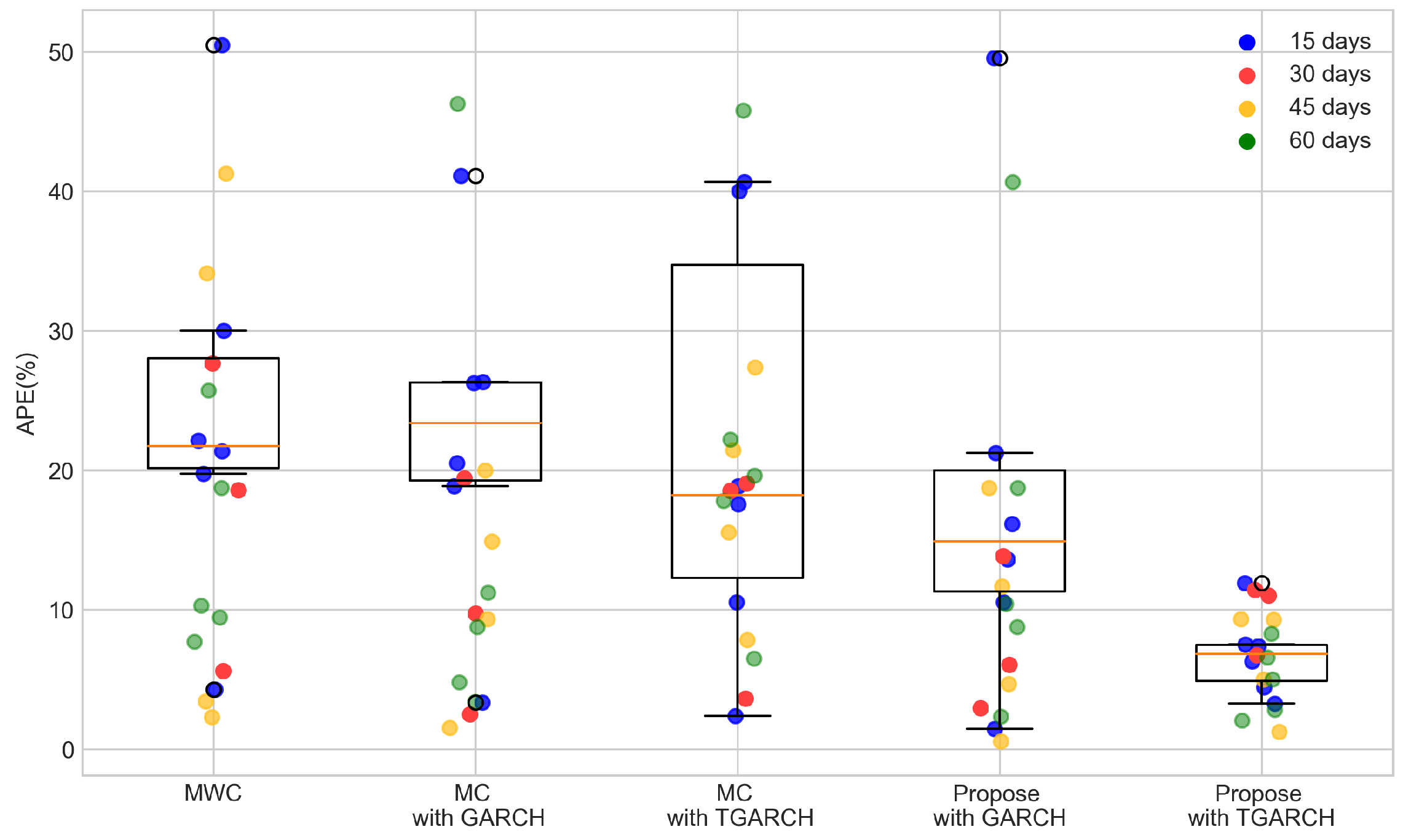
Figure 1 illustrates the distribution of APE across the different pricing methods. It is evident that the proposed method with TGARCH exhibits the most stable performance, characterized by the lowest median APE and the narrowest interquartile range, which indicate a lower error volatility across various warrant contracts.
The box plot results in Figure 1 show that the proposed method consistently outperforms both the CWV and MC approaches across different maturity horizons. Moreover, the TGARCH-based approach provides better performance than the standard GARCH model, as evidenced by the significantly lower error dispersion. This suggests that incorporating asymmetric effects of positive and negative shocks improves pricing accuracy in the SET market.
Overall, the results demonstrate that the proposed analytical approximation provides a reliable and computationally efficient alternative to simulation-based methods. Furthermore, it offers greater flexibility than classical models by incorporating time-varying and asymmetric volatility structures.

5. Conclusions

This study proposes an analytical approximation formula for warrant pricing that relaxes the traditional log-normality assumption of asset returns. By using the fourth-order Edgeworth expansion, the model effectively incorporates skewness and kurtosis, allowing for greater flexibility in capturing empirical deviations from normality.
Numerical analysis using data from the SET demonstrates that the proposed method consistently outperforms both CMV and MC simulations. Notably, the TGARCH-based framework exhibits superior performance to the standard GARCH model, demonstrating the importance of asymmetric volatility shocks in financial markets. These improvements are supported by statistical evidence; paired t-tests confirm that the proposed method provides a systematic enhancement in pricing accuracy over the CWV benchmark that is significant at the 1% level.
The method developed in this work provides an efficient alternative for financial practitioners by achieving high numerical precision without the heavy computational burden of simulations. It is highly reliable for in-the-money cases, but theoretical estimates for deep out-of-the-money scenarios are less accurate. Although all models are fitted using maximum likelihood estimation, future research could explore Bayesian methodologies to investigate whether prior information can further refine pricing accuracy during periods of extreme market volatility.

Author Contributions

Conceptualization, N.T. and D.T.; methodology, N.T. and D.T.; software, N.T.; validation, N.T. and D.T.; formal analysis, N.T. and D.T.; investigation, N.T. and D.T.; resources, N.T. and D.T.; data curation, N.T.; writing—original draft preparation, N.T.; writing—review and editing, D.T.; visualization, N.T.; supervision, D.T. All authors have read and agreed to the published version of the manuscript.

Funding

This work was supported financially by the Petchra Pra Jom Klao Master’s Degree Research Scholarship (No. 16/2564).

Data Availability Statement

The data presented in this study are available on request from the corresponding author. The financial data were obtained from the SETSMART database (https://www.setsmart.com, accessed on 23 March 2026).

Acknowledgments

The authors would like to thank the referees for their careful reading and helpful comments.

Conflicts of Interest

The authors declare no conflicts of interest.

References

  1. Schulz, G.U.; Trautmann, S. Robustness of option-like warrant valuation. J. Bank. Financ. 1994, 18, 841–859. [Google Scholar] [CrossRef]
  2. Ukhov, A.D. Warrant pricing using observable variables. J. Financ. Res. 2004, 27, 329–339. [Google Scholar] [CrossRef]
  3. Crouhy, M.; Galai, D. Common errors in the valuation of warrants and options on firms with warrants. Financ. Anal. J. 1991, 47, 89–90. [Google Scholar] [CrossRef]
  4. Veld, C. Warrant pricing: A review of empirical research. Eur. J. Financ. 2003, 9, 61–91. [Google Scholar] [CrossRef]
  5. Abínzano, I.; Navas, J.F. Pricing levered warrants with dilution using observable variables. Quant. Financ. 2013, 13, 1199–1209. [Google Scholar] [CrossRef]
  6. Zhou, Q.; Zhang, X. Pricing equity warrants in Merton jump–diffusion model with credit risk. Phys. A Stat. Mech. Its Appl. 2020, 557, 124883. [Google Scholar] [CrossRef]
  7. Jarrow, R.; Rudd, A. Approximate option valuation for arbitrary stochastic processes. J. Financ. Econ. 1982, 10, 347–369. [Google Scholar] [CrossRef]
  8. Duan, J.-C.; Gauthier, G.; Simonato, J.-G. An analytical approximation for the GARCH option pricing model. J. Comput. Financ. 1999, 2, 75–116. [Google Scholar] [CrossRef]
  9. Harding, D. The Performance of GARCH Option Pricing Models: An Empirical Study on Swedish OMXS30 Call Options. Unpublished Master’s Thesis, Jönköping International Business School, Jönköping, Sweden, 2013. Available online: https://ju.diva-portal.org/smash/record.jsf?pid=diva2:637395 (accessed on 29 April 2026).
  10. Hsieh, K.C.; Ritchken, P. An empirical comparison of GARCH option pricing models. Rev. Deriv. Res. 2005, 8, 129–150. [Google Scholar] [CrossRef]
  11. Hongwiengjan, W.; Thongtha, D. An analytical approximation of option prices via TGARCH model. Econ. Res.-Istraž. 2021, 34, 948–969. [Google Scholar] [CrossRef]
  12. Galai, D.; Schneller, M.I. Pricing of warrants and the value of the firm. J. Financ. 1978, 33, 1333–1342. [Google Scholar] [CrossRef]
  13. Bollerslev, T. Generalized autoregressive conditional heteroskedasticity. J. Econom. 1986, 31, 307–327. [Google Scholar] [CrossRef]
  14. Zakoian, J.-M. Threshold heteroskedastic models. J. Econ. Dyn. Control 1994, 18, 931–955. [Google Scholar] [CrossRef]
  15. Duan, J.-C. The GARCH option pricing model. Math. Financ. 1995, 5, 13–32. [Google Scholar] [CrossRef]
  16. Li, W.; Chen, S. Pricing and hedging of arithmetic Asian options via the Edgeworth series expansion approach. J. Financ. Data Sci. 2016, 2, 1–25. [Google Scholar] [CrossRef]
  17. Corrado, C.J.; Su, T. Skewness and kurtosis in option pricing. J. Financ. Res. 1996, 19, 299–309. [Google Scholar]
  18. Cont, R. Empirical properties of asset returns: Stylized facts and statistical issues. Quant. Financ. 2001, 1, 223–236. [Google Scholar] [CrossRef]
  19. Ansejo Barra, U. Conditional Value at Risk and the Cornish–Fisher Expansion. Doctoral Dissertation, University of Valencia, Valencia, Spain, 2002. Available online: https://www.uv.es/qfinan/Tesis_Doctorales/PDF/tes_unai_ansejo.pdf (accessed on 29 April 2026).
Figure 1. Box plots of the APE of estimated warrant prices for each method in the in-the-money case. The black boxes represent the interquartile range (IQR), and the horizontal lines within the boxes indicate the median values. The colored dots (blue, red, yellow, and green) illustrate the individual error distributions for 15, 30, 45, and 60 days to maturity, respectively.
Appliedmath 06 00072 g001
Table 1. Details of SET warrants used in the numerical experiment.
ContractNMkX
J-W1936,716,32313,571,0911.025041.95114
BANPU-W46,766,108,6861,691,527,17115
JMART-W31,444,064,49920,439,3391.128939.7439
TEL-W21,148,683,357218,669,23813
CHAYO-W11,084,805,90037,540,5601.2115.365
CGD-W48,266,127,9541,652,865,65412.75
B-W53,460,259,199290,555,12910.35
SAAM-W1300,011,63029,978,28717.5
SINGER-W1822,341,97865,752,61717
JMART-W21,457,317,522163,161,186115
MINT-W65,275,014,831230,749,8431.02741.878
BROOK-W59,403,076,04971,479,1421.2910.194
Table 2. Method used to compute warrant prices in the numerical experiments.
Methods for ComputingMethod for Computing
Volatility V T w T
CWVHistorical volatility-CWV
MCGARCH, TGARCHMonte Carlo method
Proposed methodGARCH, TGARCH
under LRNVR
Using parameters from
GARCH/TGARCH models
w t a p p r o x
Table 3. The values of μ Π T , σ Π T , κ 3 , and κ 4 used in the proposed method.
Contract No. T t GARCHTGARCH
μ Π T σ Π T κ 3 κ 4 μ Π T σ Π T κ 3 κ 4
J-W115−0.08150.5025−0.284313.5034−0.09250.5125−0.274212.4024
60−0.19320.9315−0.3863−0.4739−0.18440.8247−0.3977−0.5173
BANPU-W4150.17640.3688−0.2665−0.78410.21230.3712−0.2784−0.6687
300.12930.6068−0.2359−1.93210.13750.6712−0.2462−1.8764
600.16070.9075−0.6154−1.07480.19770.8071−0.7129−1.0092
JMART-W330−0.08950.6306−0.2307−1.9467−0.08710.6271−0.2171−1.9325
45−0.09060.7871−0.3754−1.5437−0.08670.8072−0.4150−1.5437
60−0.04970.9124−0.6090−0.9645−0.05610.8912−0.5718−0.6721
ITEL-W2150.10530.4325−0.2777−1.00030.11540.4198−0.2112−1.1243
450.02050.8691−0.3195−0.87450.02140.8742−0.4595−0.7254
600.01110.9636−0.4900−0.54210.03110.7137−0.4900−0.4759
CHAYO-W115−0.02260.4179−0.2227−0.7924−0.01260.3989−0.1996−0.7812
30−0.09470.6917−0.18031.8298−0.08910.7019−0.19711.9618
45−0.11460.8723−0.2907−1.8473−0.13290.9164−0.3014−1.9423
60−0.09510.9219−0.4909−1.8745−0.08910.9313−0.5126−1.9543
SINGER-W115−0.03700.5446−0.23709.4555−0.04100.6036−0.32558.9565
45−0.13300.9635−0.22372.6830−0.14550.9635−0.22372.6830
60−0.15340.7658−0.39035.9981−0.17670.7120−0.40126.0801
BROOK-W5150.64770.2009−0.2348−0.85090.71010.2128−0.5842−0.7901
451.41780.0909−1.15840.80231.49610.0812−1.16910.8182
60−0.59940.7293−0.18140.5690−0.60320.7175−0.18320.6671
Table 4. Performance of warrant prices in the in-the-money case.
Contract T t ObservedMethod
CWVMC with
GARCH
MC with
TGARCH
Proposed Method
with GARCH
Proposed Method
with TGARCH
J-W1152.143.223.023.222.082.07
602.141.923.133.012.042.08
BANPU-W4158.756.887.107.569.529.57
308.756.337.057.549.579.64
608.756.508.337.849.639.12
JMART-W33050.5059.8855.4253.5645.2445.87
4550.5048.7855.2152.8743.8746.27
6050.5052.2151.6751.7242.7846.97
ITEL-W3150.801.041.010.970.920.93
450.801.130.960.950.970.94
600.800.650.870.950.930.91
CHAYO-W11510.5010.9610.1510.359.279.25
3010.509.9110.7610.819.349.30
4510.5010.2610.6610.449.479.52
6010.5011.319.329.589.579.63
SINGER-W11533.0026.4926.2327.6731.5631.54
4533.0021.7428.0929.1531.0432.59
6033.0017.2029.1029.5631.3232.64
BROOK-W5150.951.161.200.850.910.97
450.951.161.010.890.820.91
600.981.031.110.910.981.15
MAPE20.03%15.22%12.85%9.80%8.52%
RMSE5.11644.76051.93272.64341.6979
CORR0.96130.96550.99420.99780.9988
Table 5. Results of a paired two-tailed t-test of APE comparing the proposed method with benchmark models.
PairComparisont-Statisticp-Value
1CWV vs. proposed (GARCH)2.96550.0076 **
2CWV vs. proposed (TGARCH)3.18260.0047 **
3MC (GARCH) vs. proposed (GARCH)2.21290.0387 *
4MC (TGARCH) vs. proposed (TGARCH)1.41680.1719
Note: ** and * indicate statistical significance at the 1% and 5% levels, respectively. All paired t-tests were conducted with 21 paired observations ( d f = 20 ).
Disclaimer/Publisher’s Note: The statements, opinions and data contained in all publications are solely those of the individual author(s) and contributor(s) and not of MDPI and/or the editor(s). MDPI and/or the editor(s) disclaim responsibility for any injury to people or property resulting from any ideas, methods, instructions or products referred to in the content.