Article

Space-Time from the Perspective of Feynman Graphon Models

Independent Researcher, Marzdaran Blvd., Tehran 1461863596, Iran
AppliedMath 2026, 6(5), 66; https://doi.org/10.3390/appliedmath6050066
Submission received: 2 February 2026 / Revised: 18 April 2026 / Accepted: 23 April 2026 / Published: 29 April 2026

Abstract

The article applies the working platform of topological Hopf algebra of renormalization to address a new construction program for the fabric of space-time from the perspective of Feynman graphon models.

1. Introduction

Pseudo-Riemannian manifolds are the main mathematical tools for the presentation of something that is generally accepted as macro-scale space-time [1]. Understanding or decoding the fabric of space-time is one of the most difficult unsolved problems in physics, both theoretical and mathematical physics. The fabric of space-time encodes any possible consistency between quantum field theories (QFTs), as space-time background-dependent physical theories, and a quantum theory of gravity as a space-time background independent physical theory. On the one hand, fundamental concepts such as Poincare invariance, vacuum, and elementary particles in QFTs are understandable under a non-dynamical model for space-time. In the model of curved space-time, different observers might measure different numbers of particles where it is not possible to define the vacuum in a unique way. In other words, QFTs are not generally covariant [2,3,4,5]. On the other hand, the designed mathematical models for the fabric of space-time can be classified into two general settings. The one setting aims to describe macro-scale space-time from a more fundamental theory for micro-scale space-time formulated in terms of basic elements such as strings, loops, spin foams, or simplicials. The other setting aims to construct a theory for micro-scale space-time which cannot derive from a quantizing metric or connection forms because they are meaningful concepts only at macro scale. Several mathematical platforms/techniques have been introduced and developed to support these two general settings and [6,7,8,9,10,11,12,13,14,15,16,17,18,19,20] are only a small number of those efforts.
Penrose introduced a theory of spin networks to mathematically formulate building blocks of space-time in terms of a certain class of spin foams. In this regard, the superposition law in quantum theory can be described simultaneously from combinatorial principles such that continuous concepts emerge as limiting situations. The main consequence is to address the possibility of formulating a new fundamental theory, on the basis of low-energy physics, to recover general relativity and quantum mechanics as limiting situations [16,21,22,23,24,25,26].
The method of Feynman graphon models has been introduced and developed to deal with the asymptotics of non-perturbative structures in QFTs in terms of topological enrichments of the Connes–Kreimer renormalization Hopf algebra and its Hopf subalgebras by using infinite combinatorial tools together with Hochschild cohomology theory. In this regard, non-perturbative structures in a gauge field theory originated from solutions of fixed-point equations of 1PI Green’s functions, represented by combinatorial Dyson–Schwinger equations (cDSEs), under strong coupling constants can be described in terms of a certain class of infinite direct sums of stretched Feynman graphons defined on a suitable σ -finite measure space. This particular topological treatment led us to formulate a non-perturbative extension of the BPHZ renormalization to deal with divergent perturbative series of higher-loop-order Feynman diagrams. It has been shown that these Feynman graphon representations of solutions of cDSEs recover non-trivial correlations between entangled particles in distinct regions of space-time. In this regard, commutative von Neumann subalgebras of bounded operators on the Hilbert space of states of the physical theory are replaced by a certain class of topological Hopf subalgebras as new decorations for (bounded) regions of space-time. The consequence of this new decoration system is the mathematical modeling of quantum entanglement in gauge field theories in terms of lattices of towers of topological Hopf subalgebras [27,28,29,30,31,32,33,34,35,36,37,38,39]. The present article deals with the challenge of extracting information from micro-scale space-time in terms of Feynman graphon representations of non-perturbative aspects of QFTs. In this regard, the method of Feynman graphon models will be applied to introduce a new theory of spin networks and spin foams in the space of solutions of cDSEs of the physical theory. The resulting spin foam models describe space-time at energy scales close enough to micro-macro interface. Then this new construction program will be lifted onto the level of stretched graphons defined on the Lebesgue measure space [ 0 , ) × [ 0 , ) to obtain a universal model, with respect to the Hochschild cohomology theory, for the fabric of space-time independent of the perspective of the chosen gauge field theories as those local QFTs whose Feynman diagrams can be organized in a Connes–Kreimer-type Hopf algebraic renormalization. This new setting builds up dynamic space-time background of physical theories in terms of the geometry of the metric space of spin foams of stretched (Feynman) graphons corresponding to towers of coupled cDSEs. In this setting, the discrete space-time can be recognized when running coupling constants are small enough 1 and the physical theory has only perturbative behavior. The continuous space-time can be recognized when running coupling constants are strong 1 and the physical theory has non-perturbative behavior. In this context, the Landau pole of QCD [28,40] determines the interface between the discrete and continuous nature of micro-scale space-time. For energies larger than Λ QCD , QCD Λ QCD , as a perturbative physical theory, detects the discrete nature of micro-scale space-time. For energies smaller than Λ QCD , QCD < Λ QCD , as a non-perturbative physical theory, detects the continuous nature of micro-scale space-time.

1.1. From Renormalization Hopf Algebra to Its Topological Enrichment via Feynman Graphon Models

The dimension of space-time background and momentum parameter, which varies between zero and infinity, are primary factors for determining whether or not Feynman integrals in the structure of Green’s functions have IR or UV subdivergences. These subdivergences are represented in terms of nested loops in the structure of their corresponding Feynman diagrams. In ϕ 4 theory, Feynman diagrams with two or four external edges could have (sub)divergences. Dimensional regularization replaces divergent Feynman integrals with some Laurent series with finite pole parts. Minimal subtraction projects these Laurent series onto their pole parts to extract some finite values. The combinatorics of this renormalization program, known as the BPHZ method, are based on the recursive removal of nested loops in terms of the Zimmermann’s forest formula [41,42].
The renormalization Hopf algebra of Feynman diagrams H FG ( Φ ) = n = 0 H ( n ) of a physical theory such as a gauge field theory Φ on the commutative space-time background is a connected graded associative coassociative commutative non-cocommutative Hopf algebra over the field Q . It is freely generated by 1PI Feynman diagrams such that the vector space H ( 0 ) is generated by the empty graph I and for each n 1 , H ( n ) is the vector space of 1PI n-loop Feynman diagrams and products of Feynman diagrams with the overall loop number n. The renormalization coproduct is given by
Δ FG ( Γ ) = Γ I + I Γ + γ γ Γ / γ
such that the sum is taken over disjoint unions of superficially divergent 1PI subgraphs, called Feynman subdiagrams, of Γ . The quotient graph Γ / γ is given by shrinking all internal edges of γ to a point in Γ . The graduation parameter is applied to get a recursive formula for the antipode derived from the renormalization coproduct. It is given by
S ( Γ ) = Γ γ Γ S ( γ ) Γ / γ .
refs. [43,44,45,46].
The renormalization Hopf algebra is applied to encapsulate the algebraic combinatorics of the BPHZ perturbation renormalization underlying the Riemann–Hilbert problem and theory of Rota–Baxter algebras [47,48,49]. Feynman diagrams are represented by a certain class of non-planar rooted trees decorated by basic information of the physical theory. The renormalization coproduct is lifted onto the polynomial algebra of non-planar rooted tress to formulate the combinatorial Connes–Kreimer Hopf algebra H CK . Using a decoration system, such as the collection of all (1PI) primitive Feynman diagrams of the physical theory, enables us to embed H FG ( Φ ) into the decorated version H CK ( Φ ) in the context of Hochschild cohomology theory. The pair ( H CK , B + ) recovers a universal Hopf algebraic formulation of the the BPHZ renormalization [46,49]. In addition, the Hochschild cohomology of H FG ( Φ ) encodes quantum motions in the physical theory in terms of cDSEs [44,45,50]. Solutions of cDSEs are presented by perturbative series of increasing powers of running coupling constants together with higher-loop-order Feynman diagrams as their coefficients. Under strong running coupling constants, these perturbation series are divergent. Feynman diagrams which contribute to the solution of an equation DSE form a graded free commutative Hopf subalgebra H DSE of H FG ( Φ ) [50,51,52].
For the Lebesgue measure space ( [ 0 , 1 ] , m ) , a bounded symmetric Lebesgue measurable function W : [ 0 , 1 ] × [ 0 , 1 ] [ 0 , 1 ] is called a graphon. The space of graphons topologically completes the space of finite weighted graphs with respect to the cut-distance topology. Generalized versions of graphons, defined on suitable σ -finite measure spaces, are known as stretched graphons. Stretched graphons, which can be described as re-scaled or re-weighted versions of graphons, are useful tools for the presentation of the graph limits of sequences of finite weighted dense or sparse graphs in terms of some measure-theoretic tools. Any sequence of finite weighted graphs with increasing vertex numbers has at least a subsequence which converges to a graph limit represented by a (stretched) graphon [34,38,53,54,55,56].
Thanks to the combinatorics of Feynman diagrams, there exists a certain subspace S graphon Φ in the space W ( [ 0 , ) , m ) ( R ) of real-valued stretched graphons to recover graph limits of Cauchy sequences of (finite perturbations) of higher-loop-order Feynman diagrams with respect to the cut-distance topology or its L p -modifications for 1 p < . In other words, elements in S graphon Φ , called stretched Feynman graphons, represent graph limits of the space of Feynman diagrams, called large Feynman diagrams, to topologically complete the renormalization Hopf algebra. The resulting topological Hopf algebra H FG cut ( Φ ) , which includes large Feynman diagrams, recovers solutions of quantum motions in the physical theory. In this regard, the solution X DSE = n 0 c λ n X n of an equation DSE , as a large Feynman diagram in H FG cut ( Φ ) , is describable as the graph limit of the sequence { Y m } m 0 of partial sums Y m = k = 0 m c λ k X k . This graph limit can be represented in terms of some stretched Feynman graphon W DSE S graphon Φ . In other words, up to the weakly isomorphic relation,
X DSE = lim m Y m W DSE = lim m W Y m
with respect to the cut-distance topology. The stretched Feynman graphon W DSE is an infinite direct sum of stretched Feynman graphons W X k defined on subintervals J k [ 0 , ) with m ( J k ) = c λ k such that J k 1 J k 2 = for k 1 k 2 [29,30,31,34,36,37].
The working platform of Feynman graphon models was built and developed to formulate a non-perturbative renormalization program for solutions of cDSEs on the basis of the topological Hopf algebra of renormalization, Manin’s renormalization Hopf algebra of the Halting problem, random graph processes, and the theory of computation. This working platform equips the space of all cDSEs of the physical theory with the bare coupling constant g with a separable Banach space S Φ , g up to the weakly isomorphic relation ≈ on W ( [ 0 , ) , m ) ( R ) . The geometry of this Banach space together with homomorphism densities of stretched Feynman graphons, as continuous functionals on S Φ , g , is rich enough to recover the analytic behavior of quantum motions and the dynamics of intermediate phases in non-perturbative regimes of the physical theory. Furthermore, the categorical foundations of QFT have already been developed by replacing von Neumann subalgebras A ( O ) of bounded operators on the Hilbert space of states of the physical theory by a certain family of topological Hopf subalgebras H DSE O cut of H FG cut ( Φ ) associated with cDSEs. This setting led us to define non-perturbative topoi to provide the background-constructive logics of physical theories beyond quantum theories in terms of their corresponding Heyting algebras [27,28,29,30,31,32,34,35,36,37,38].
Remark 1.
If the physical theory Φ has multiple bare coupling constants g : = ( g 1 , , g ) , then the Banach space S Φ , g as a subspace of S graphon , Φ is given by the Cartesian product S Φ , g = S Φ , g 1 × × S Φ , g . For DSE 1 ( c λ 1 ( 1 ) ) , , DSE ( c λ ( ) ) S Φ , g , we have
W DSE 1 ( c λ 1 ( 1 ) ) , , W DSE ( c λ ( ) ) S graphon , Φ × × S graphon , Φ .
It is represented by the stretched Feynman graphon W ( 1 , 2 , , ) S graphon , Φ as a finite direct sum of stretched Feynman graphons W DSE k ( c λ k ( k ) ) S graphon , Φ defined on subintervals L k [ 0 , ) with m ( L k ) = 1 and L k 1 L k 2 = for k 1 k 2 .
Towers of these topological Hopf subalgebras, which encode the interactions of particles, provide a new decoration system for open bounded regions of space-time to report non-trivial correlations between distinct space-like regions that recover quantum entanglement between particles in entangled states [7,20,33,57].
If a theory for micro-scale space-time is formulated on the basis of a macro-setting independent of a quantizing metric or connection forms, then the most difficult challenge is to find rigorous mathematical tools for the recovery of lost information. If macro-scale space-time is described in terms of a more fundamental theory, then space-time is an emergent entity such that non-perturbative QCD and General Relativity can be interpreted as effective field theories at low energies emergent from “a more fundamental theory at high energies” [12,40]. The present work applies the method of Feynman graphon models for gauge field theories as those local QFTs on the commutative space-time whose Feynman diagrams admit a Connes–Kreimer-type renormalization structure to introduce a new candidate for a “more fundamental theory at high energies”. In this regard, a new construction program for the fabric of space-time will be explained in terms of a new class of general spin foams of spin networks in the space of stretched (Feynman) graphons. The resulting new candidate theory describes space-time from two different views. The one view is from the perspective of a background-dependent physical theory. The other view is a universal perspective with respect to the Hochschild cohomology theory, at least, across all local QFTs whose Feynman diagrams admit a Connes–Kreimer-type renormalization structure. In both scenarios, the abstract computability-based foundations are encapsulated by the Manin’s renormalization Hopf algebra of the Halting problem at the level of stretched Feynman graphons [34,35,38].

1.2. Conceptual Advantages of Using Feynman Graphon Models

This part addresses conceptual benefits resulting from this new theory of spin foams in the space of cDSEs and its corresponding space of (stretched Feynman) graphons.
  • “Space-time=correlations“ is asserted. This new theory of general spin foams of spin networks in the space of stretched Feynman graphons asserts the structure of space-time when there exists a given background-dependent physical theory such as a gauge field theory. In other words, in this setting, space-time, as a preassumed entity, can be described/analyzed from the perspective of a physical theory by general spin foams in the space of cDSEs of the physical theory or the space of their Feynman graphon representations. The metric space of general spin foams provides a discrete model for the Banach manifold of quantum motions of the physical theory which leads us to achieve a dynamical model of space-time. This procedure is explained with full details in Section 3.
  • “Space-time=correlations“ is derived. Space-time is derived from this new theory of general spin foams when the construction program is lifted onto a universal setting formulated on the basis of non-decorated spin foams of (stretched) graphons governed by an abstract combinatorial topological Hopf algebra. At this level, no physical theory is pre-assumed and space-time is built in terms of evolutions of spin networks in the space of stretched graphons and a certain class of non-trivial correlations extracted from (stretched) graphon representations of solutions of a particular class of recursive Hochschild equations in the topological Hopf algebra of non-planar rooted trees. This procedure is explained in full detail in Section 4.
  • Linking to physical space-time. The Connes–Kreimer Hopf algebraic renormalization has already been developed to abelian and non-abelian gauge field theories where quantum gauge symmetries are encoded by a certain class of Hopf ideals [58,59,60]. This led to extend this Hopf algebraic framework to Standard Model of particles minimally coupled with Einstein–Hilbert action [61]. It shows that the Connes–Kreimer renormalization Hopf algebra and its topological enriched version are tied to the physical space-time. This fact guarantees that the asserted and derived space-time, as correlations, from this new theory of general spin foams, formulated in Section 3 and Section 4, are tied to physical space-time.
  • Abstract space-time. The non-decorated Connes–Kreimer Hopf algebra of non-planar rooted trees is defined as an abstract mathematical object in terms of the concept of admissible cuts and grafting operator. This particular combinatorial Hopf algebra and its topological enriched version have no connection with any physical theory. Applying decoration systems ties this abstract object to physical theories. Therefore the derived space-time from non-decorated spin foams of (stretched) graphons, explained in Section 4, is an abstract model.
  • Formulating a well-defined path integral over spin-foam trajectories and spin-foam volume. The existence of a metric structure on the space of general spin foams of stretched Feynman graphons of a physical theory enables us to define the path integral over all trajectories between entangled qft-states at any region of space-time. It is given by the sum over all possible general or primary spin foams related to that region which are decorated by group representations of those complex Lie subgroups whose associated cDSEs contribute to entanglement of qft-states. This process is explained in Theorems 2–5. This path integral setting recovers lengths shorter than the Planck scale to bring a new solution to the challenge of “zero point length problem” from the perspective of physical theories independent of T-duality. This new achievement is explained in Corollaries 4 and 6.
  • The universal construction as an organizational device. The foundations of the universal setting of the spin foams of (stretched) graphons relies on a pure mathematical entity namely, the non-decorated Hopf algebra of non-planar rooted trees enriched by cut-distance topology or its L p -modifications. While this particular topological Hopf algebra is motivated from the combinatorics of the Zimmermann’s forest formula, its definition is based on admissible cuts in trees without any link to physical information. It makes this new framework of spin foams of (stretched) graphons universal with respect to the Hochschild cohomology theory, at least, across all local QFTs whose Feynman diagrams admit a Connes–Kreimer-type renormalization structure. In addition, the universal setting of the spin foams of (stretched) graphons delivers a new calculable machinery for the boundary of the strength of entanglement between quantum states, given by Remark 7, that can be applied bridging combinatorial-analytic capabilities of stretched graphons to theory of quantum computation. In this regard, the Manin’s renormalization Hopf algebra of the Halting problem, the theory of graph languages in the construction of divergent perturbative series of higher-loop-order Feynman diagrams and the generalized version of Kolmogorov complexity of cDSEs are key mathematical tools to adapt least and greatest strength values of entangled states for different quantum systems in gauge field theories [31,34,35,38,62,63,64,65,66,67,68].
  • Formulating a new double nature model. On the one hand, the “zero charge problem” and the appearance of Landau poles in physical theories have been studied in terms of a certain class of discrete Markov chains of random operators on suitable spaces of (stretched) graphons [28]. On the other hand, because of the analytic extension of renormalization machinery on the space of stretched graphons [69] and the existence of a metric structure on the space of general spin foams of stretched (Feynman) graphons (i.e., Theorems 5 and 6), the path integrals, at this level, are well-defined to recover lengths shorter than the Planck scale (i.e., Corollaries 4 and 6). This setting leads to a new solution to the “zero path length problem”. Linking these fundamental properties underlying the method Feynman graphon models is the key point to realize the double nature of the fabric of space-time (i.e., Corollary 5 and Remark 6). In this setting, the interaction between formal objectivity and real objectivity is observed by linking this new spin foam model to the physical space-time underlying the topological Hopf algebraic renormalization.
  • A new constructive formalism. On the one hand, the toposification of QFT is formulated in terms of assigning a topos of presheaves on a base category of topological Hopf subalgebras associated to cDSEs to each gauge field theory [27]. The Heyting algebra of the resulting topos provides required truth values for the background logic of the physical theory. On the other hand, the renormalization coproduct and its core extension together with topological Hopf algebra of renormalization have produced a certain bi-Heyting algebra structure on the space of Feynman diagrams of the physical theory which provides the foundations of a new constructive analysis to deal with the asymptotics of 1PI Green’s functions and related corrections in the context of the theory of differential calculi for Heyting algebras [30,31]. Thanks to this background, the Heyting algebra of the toposification setting, which is not Boolean, governs the logical foundation of the construction program of this new spin foam model. In the present paper, using the set of real numbers is artificial to simplify the presentation. Replacing Lebesgue measure space by another σ -finite measure space and working on stretched (Feynman) graphons allow us to shift this model to a constructive mathematical setting where the full axiom of choice is not needed. In addition, the bi-Heyting algebra of Feynman diagrams and its associated Heyting space provide (i) new topological tools to study the asymptotic behavior of general spin foams in the space of cDSEs of the physical theory, (ii) the topological foundations of resolving the “zero path length problem” in the structure of micro-scale space-time in terms of this new spin foam model.

1.3. Road Map

  • The renormalization Hopf algebra of a physical theory topologically enriched by stretched Feynman graphons is studied to explain a non-perturbative extension of the BPHZ method that handle the renormalization of solutions of cDSEs of the physical theory. See Theorem 1 and Corollaries 1 and 2.
  • The topological Hopf algebraic machinery for the description of quantum entanglement in QFT is discussed to explain how non-trivial correlations between particles at entangled qft-states in distinct regions of space-time can be recognized in terms of towers of topological Hopf subalgebras associated to towers of combinatorial Dyson–Schwinger equations. In more details, each primitive Feynman diagram γ determines a basic qft-state s γ occupied with a finite number of particles such that their interactions happen in a bounded open region O γ of space-time. The equation DSE γ = < B γ + > generates a tower of coupled cDSEs which encode interactions of particles at mixed qft-states entangled with s γ . The solution spaces of these towers determine a subspace U O γ with γ U O γ H FG cut ( Φ ) to provide correlations between U O γ and other distinct regions of space-time decorated by some subspace V H FG cut ( Φ ) . These correlations explain quantum entanglement of particles in γ in the space-time region O γ and particles at entangled qft-states in other distinct region O V of space-time. Then it will be shown how the Banach space S Φ , g of cDSEs recovers entanglement depth of qft-states with multi particles in the physical theory. See Theorem 2 and Corollary 3.
  • The topological Hopf algebraic description of quantum entanglement leads us to describe the fabric of space-time from the perspective of the physical theory in terms of general spin foams in the space of cDSEs or in the space of corresponding stretched Feynman graphons. In this regard, these general spin foams, which are defined in terms of a recursive step by step process governed by primary and primary grafting spin foams, can be described as histories of spin networks in the space of cDSEs of the physical theory. See Definitions 4–6.
  • The metric space ( SF gr , Φ , d ) of general spin foams in the space of stretched Feynman graphons which contribute to solutions of cDSEs provides a discrete model for the Banach manifold of cDSEs of the physical theory. This discrete model is actually the foundation of a new dynamical model for the fabric of space-time from the perspective of the physical theory. See Theorems 3–5 and Corollary 4.
  • Building the fabric of space-time from the perspective of the physical theory underlying this new spin foam framework provides a new solution for the “zero path length problem” in terms of formulating a well-defined path integral over trajectories between general spin foams in the space of stretched Feynman graphons which contribute to solutions of cDSEs. This path integral, which includes lengths shorter than the Planck scale, clarifies the double nature of the fabric of space-time. In this setting, it is discussed how discrete or continuous behavior of space-time is linked to perturbation or non-perturbation behavior of the physical theory at different energy scales. In addition, space-time distortion is given by the distortion of general spin foams via mass and energy encoded by deformation of the geometrical structure of these general spin foams. See Theorem 5 and Corollary 5.
  • The universal property of the Connes–Kreimer Hopf algebra of non-planar rooted trees and its cut-distance type topological enrichment with respect to Hochschild cohomology theory is the main mathematical structure to lift this new spin foam model onto the level of stretched graphons. This allows us to derive the fabric of space-time independent of physical theories in terms of the path integral machinery over trajectories between general spin foams of stretched graphons in the metric space ( SF gr , Sh cut ( H gr , rt ) , d ) . In this regard, a topological shuffle Hopf algebra Sh cut ( H gr , rt ) on the space of words in S graphon , Φ is formulated. The collection of cDSEs in this new shuffle type Hopf algebra determines towers of topological Hopf subalgebras which recover required non-trivial correlations for the construction of a universal dynamical model of space-time. This dynamical model is describable in terms of moving along faces of spin foams in SF gr , Sh ( H gr , rt ) . See Theorem 6 and Corollary 6.

2. Combinatorial Gauge Field Theory via Feynman Graphon Models

Gauge field theories are models of QFT for the study of quantum systems with infinite degrees of freedom of elementary particles and their interactions underlying special relativity such that the number of particles could change. A gauge field theory Φ on the background D + 1 -dimensional space-time is defined by the action functional
S [ ϕ ] = L Φ [ ϕ ] d D x d t
with respect to the Lagrangian density L Φ = L Φ , 0 + L Φ , int such that the interaction part is given by L Φ , int = k 2 I k with I k = O ( c g N ) , N > 0 , c g : = ( c g 1 , , c g ) , for almost all k. Functional integral representation of the partition function together with the method of Feynman path integral generates N-point correlation functions known as Green’s functions. For the partition function Z : = exp ( S [ ϕ ( x ) ] ) D ϕ ( x ) , with respect to the functional integration D ϕ ( x ) = N x d ϕ ( x ) , the N-point correlation functions are given by
G N ( x 1 , , x N ) = 1 Z exp ( S [ ϕ ( x ) ] ) ϕ ( x 1 ) ϕ ( x N ) D ϕ ( x )
which are convergent perturbative expressions under small enough running coupling constants. In other words,
G N ( x 1 , , x N ) = j = 1 ( 1 ) j j ! d 4 y 1 d 4 y j < 0 | T ϕ in ( x 1 ) ϕ in ( x N ) L Φ , int ( y 1 ) L Φ , int ( y j ) | 0 >
such that ϕ in is the initial state of ϕ in infinite past. Green’s functions are polynomials in powers of the running coupling constants such that (sums of) iterated integrals with respect to the momentum parameter are their coefficients. The number of these integrals, called Feynman integrals, rapidly grows in terms of increasing the order in perturbation expansion. Feynman rules of the physical theory are applied to formulate a combinatorial representation of these formal expansions where under strong running coupling constants, divergent tails of these series should be handled by non-perturbative techniques. Feynman integrals, which might have some subdivergences in terms of the domain of momentum variables, are represented by a particular class of space-time decorated weighted graphs known as Feynman diagrams. Methods of regularization are applied to replace these UV/IR divergent integrals by some analytic series to extract definite renormalized values together with some counterterms added to the Lagrangian of the physical theory. The calculation of connected Green’s functions leads us to solve the field equations for ϕ and compute vacuum expectation values < 0 | T { ϕ ( x 1 ) ϕ ( x N ) } | 0 > of time-ordered products of ϕ [41].
Remark 2.
  • The speed of light c has a dimension the same as the ratio of length L and time T. If c = = 1 , then
    [ c ] = [ L T ] = [ L ] [ T ] = 0 [ L ] = [ T ] .
    In this setting, the dimension of the energy E is given by
    [ E ] = [ m c 2 ] = [ m ] + 2 [ c ] = [ m ] , [ E ] = [ ω ] = [ ] + [ ω ] = 0 + [ 1 T ] = [ T ] [ m ] = [ T ] .
  • Let the dimension of mass be 1. Then
    [ Lagrangian ] = [ E Kinetic V Potential ] = [ E ] = [ T ] = [ m ] = 1 ,
    while the dimension of the angular momentum is [ l n ] = [ x j ] + [ p k ] = 1 + 1 = 0 . This means that the action functional is dimensionless, same as the angular momentum and ℏ such that
    [ d D x d t ] = ( D + 1 ) , [ L Φ ] = D + 1 , [ ϕ ] = D + 1 2 2 .
  • Let L Φ , int = n 3 λ n n ! ϕ n for some coupling constants λ n . Then dimensions of the coupling constants are given by
    [ λ n ] + n [ ϕ ] = D + 1 [ λ n ] = ( D + 1 ) n ( D + 1 2 ) 2 .
  • Let D + 1 = 4 . Then [ ϕ ] = 1 and for [ λ 3 ] = 1 , λ 3 / E is dimensionless. Therefore λ 3 ϕ 3 / 3 ! E is a small perturbation at high energies E > > λ 3 and a large perturbation or non-perturbation at low energies E < < λ 3 . In a relativistic theory, E > m , the perturbation is small when λ 3 < < m .
  • Let D + 1 = 4 . For [ λ 4 ] = 0 , λ 4 ϕ 4 / 4 ! is a small perturbation when λ 4 < < 1 ; otherwise, large perturbation or non-perturbation do happen.
  • Let D + 1 = 4 . For [ λ n ] < 0 with n 5 , λ n E n 4 is dimensionless. Therefore λ n E n 4 ϕ n / n ! is a small perturbation at low energies and it is a large perturbation or non-perturbation at high energies [41].

2.1. Topological Hopf Algebra of Renormalization

Consider the renormalization Hopf algebra H FG ( Φ ) = n = 0 H ( n ) of the physical theory Φ . For each Feynman diagram Γ H ( n ) , its combinatorial representation is given by a (forest of) non-planar rooted tree t Γ with n vertices such that each vertex is a symbol for a nested loop in Γ . The positions of nested loops in Γ determine edges of t Γ . The renormalization coproduct is combinatorially lifted onto the coproduct
Δ CK ( t Γ ) = t Γ 1 + 1 t Γ + c P c ( t Γ ) R c ( t Γ )
such that the sum is taken over all admissible cuts in t Γ where P c ( t Γ ) is a forest of rooted subtress of t Γ generated by the cut c and R c ( t Γ ) is the remaining rooted subtree which contains the root of t Γ . This coproduct determines a free commutative non-cocommutative connected graded combinatorial Hopf algebra structure on the polynomial algebra of non-planar rooted trees. It is called the Connes–Kreimer renormalization Hopf algebra and presented by H CK . This coproduct can be recursively rewritten in terms of the grafting operator B + as a linear homogeneous operator which sends a forest of rooted trees to a new rooted tree by adding a new vertex, as the root, together with a collection of edges which connect this new root to the roots of trees in the forest. In addition, the opposite coproduct Δ CK op is defined by applying the flip operator where terms P c ( t Γ ) R c ( t Γ ) are replaced by terms R c ( t Γ ) P c ( t Γ ) . The commutativity of H CK and its graded structure allow us to define an isomorphism of Hopf algebras between H CK and H CK op . Therefore we can use each of these Hopf algebras as the definition of the Connes–Kreimer Hopf algebra of non-planar rooted trees. Thanks to this grafting operator, there exists an injective homomorphism of Hopf algebras from H FG ( Φ ) to H CK ( Φ ) such that rooted tress are decorated by (1PI) primitive Feynman diagrams in H FG ( Φ ) . In addition, the pair ( H CK , B + ) has a universal property, with respect to the Hochschild cohomology theory, in a certain category of (commutative Hopf algebras, Hochschild 1-cocycles). This particular pair recovers the Zimmermann forest formula and the BPHZ renormalization independent of physical theories [43,44,45,46].
Quantum gauge symmetries determine fundamental identities between Feynman diagrams which can be encoded by some Hopf ideals of the renormalization Hopf algebra of the physical theory. The BPHZ perturbative renormalization in an abelian gauge field theory such as QED is encapsulated by the quotient Hopf algebra H FG ( QED ) / I WT such that the Hopf ideal I WT is generated by Ward–Takahashi elements. The BPHZ perturbative renormalization in a non-abelian gauge field theory such as QCD is encapsulated by the quotient Hopf algebra H FG ( QCD ) / I ST such that the Hopf ideal I ST is generated by Slavnov–Taylor elements [58,59,60].
The method of Feynman graphon models recasts combinatorial Hopf-algebraic structures of Feynman diagrams into the language of symmetric measurable graph functions where functional-analytic techniques can be applied to combinatorial challenges. In this regard, stretched Feynman graphons describe graph limits of sequences of increasing higher-loop-order Feynman diagrams to make possible the renormalization of divergent perturbative series which contribute to solutions of cDSEs [35,36,39,69].
Definition 1.
Consider the Lebesgue measure space ( [ 0 , 1 ] , m ) .
  • A bounded symmetric Lebesgue measurable function W : [ 0 , 1 ] × [ 0 , 1 ] [ 0 , 1 ] is called graphon. For any invertible Lebesgue measure preserving transformation ρ on [ 0 , 1 ] , the graph function W ρ ( x , y ) = W ( ρ ( x ) , ρ ( y ) ) is called labeled graphon.
  • The collection W ( [ 0 , 1 ] , m ) ( [ 0 , 1 ] ) of labeled graphons is equipped with the norm
    | | W ρ | | cut = sup A , B [ 0 , 1 ] | A × B W ρ ( x , y ) d x d y |
    such that A , B are Lebesgue measurable subsets of [ 0 , 1 ] . It defines a pseudo-metric structure.
  • Graphons W 1 , W 2 are called weakly isomorphic iff there exists a graphon U together with Lebesgue measure preserving transformations ρ 1 , ρ 2 on [ 0 , 1 ] such that
    W 1 = U ρ 1 , W 2 = U ρ 2 , almost everywhere .
ref. [56].
The quotient space W ( [ 0 , 1 ] , m ) ( [ 0 , 1 ] ) with respect to the equivalence relation (15) is a complete compact Hausdorff topological space with respect to the metric
d cut ( W 1 , W 2 ) = inf ρ 1 , ρ 2 | | W 1 ρ 1 W 2 ρ 2 | | cut
such that the infimum is taken over all Lebesgue measure preserving transformations on [ 0 , 1 ] . In addition, the quotient space W ( [ 0 , 1 ] , m ) ( [ 0 , 1 ] ) is a complete Hausdorff metric space with respect to the L p -metric
d p , cut ( W 1 , W 2 ) : = inf ρ 1 , ρ 2 | | W 1 ρ 1 W 2 ρ 2 | | p = inf ρ 1 , ρ 2 [ 0 , 1 ] × [ 0 , 1 ] | ( W 1 ρ 1 W 2 ρ 2 ) | p d x d y 1 / p
for 1 p < [54,55].
Remark 3.
  • For any graphon W : [ 0 , 1 ] × [ 0 , 1 ] [ 0 , 1 ] , W ( x , y ) can be interpreted as the probability of the existence of an edge between x and y such that subgraph densities, edges, and triangles are determined by
    W ( x , y ) d x d y , W ( x , y ) W ( y , z ) W ( z , x ) d x d y d z ,
    respectively. Homomorphism density t ( F , W ) is defined as the density of a finite graph F in W [56].
  • Metrics d cut and L 1 are not equivalent but thanks to the theory of graph convergence for dense graphs, two graphons have distance zero with respect to d cut is equivalent to the same statement in the L 1 metric. This fact is also valid for an invariant version of the L p metric [53,56].
  • For any σ-finite measure space ( Ω , μ Ω ) , any symmetric μ Ω -integrable function (or bounded μ Ω -measurable function) W : Ω × Ω R is called stretched graphon. The quotient space W ( Ω , μ Ω ) ( R ) with respect to the equivalence relation (15) is a complete Hausdorff topological space with respect to the metrics (16) and (17) [53].
Feynman graphons are the adaption of the graphon concept to the combinatorics of Feynman diagrams and their formal expansions. They represent large or infinite formal expansions of Feynman diagrams as some Lebesgue measurable symmetric functions on suitable σ -finite measure spaces. This setting is used to translate Connes–Kreimer Hopf algebraic renormalization and cDSEs into an analytic/Banach-space framework where homomorphism densities and functional/analytic tools are applicable for the study of solutions and renormalization of diagrammatic divergent perturbative series [36,37]. In this regard, the combinatorial Hopf algebra H CK ( Φ ) decorated by primitive (1PI) Feynman diagrams of the physical theory is considered. For a Feynman diagram Γ with the rooted tree (or forest) representation t Γ such that each vertex v k has the weight w ( k ) , the pixel picture presentation  P t Γ σ is defined by a partition σ = { I 1 , , I n } of [ 0 , 1 ) such that | t Γ | = n is a loop number and m ( I k ) = | w ( k ) | k = 1 n | w ( k ) | . Define
[ W Γ ] : = U W ( [ 0 , 1 ) , m ) ( R ) : U P t Γ σ
such that U P t Γ σ means that there exist Lebesgue measure preserving transformations τ 1 , τ 2 on [ 0 , 1 ) and a stretched graphon W such that
W τ 1 = P t Γ σ , W τ 2 = U
almost everywhere. The equivalence class [ W Γ ] is called the unlabeled Feynman graphon associated to the Feynman diagram Γ .
Stretched Feynman graphons generalize Feynman graphons by placing the graph function on an arbitrary σ -finite measure space such as [ 0 , ) where stretching refers to allowing unbounded domains or unbounded values. This technique enables us to model sparse Feynman-diagram families whose combinatorial weights grow and therefore cannot be captured by Feynman graphons as bounded graphons on a probability space. This extension is necessary when we want to carry renormalization and Hopf-algebraic assignments to unbounded or divergent perturbative series which contribute to non-perturbative solutions of DSEs. In other words, the Feynman graphon method topologically enriches the Hopf algebraic structure that organizes subdivergences and renormalization of large Feynman diagrams by replacing discrete graphs with graphon representatives. In this setting, cDSEs become integral/functional equations on spaces of (stretched) graphons, enabling analytic existence/uniqueness and limit arguments. Weak convergence, L p -modifications, and operator and stretching techniques applied to Feynman graphons allow us to treat infinite divergent perturbative series of higher-loop-order Feynman diagrams and in their renormalization in a controlled functional setting. So Feynman graphons, as bounded or L -type graph functions on a probability space, are used when Feynman-diagram families are naturally dense or we can place the indexing/feature on a probability space and keep functions bounded. Stretched Feynman graphons, as integrable graph functions on σ -finite spaces or belong to L p frameworks for sparse limits, are used when unbounded growth, sparse/exchangable models on [ 0 , ) are appeared, or when renormalization must treat unbounded graph functions such that it is expected to work with σ -finite measures and L p -limits [29,30,31,32,34,35,38,69].
Theorem 1.
The metric space W ( [ 0 , 1 ) , m ) ( R ) recovers a non-perturbative extension of the BPHZ renormalization.
Proof. 
Thanks to (16), for Feynman diagrams Γ 1 , Γ 2 , define
d cut ( Γ 1 , Γ 2 ) : = d cut ( W Γ 1 , W Γ 2 ) = inf ρ 1 , ρ 2 sup A , B | A × B W Γ 1 ρ 1 ( x , y ) W Γ 2 ρ 2 ( x , y ) d x d y |
such that ρ 1 , ρ 2 are Lebesgue measure preserving transformations on [ 0 , 1 ) and A , B are Lebesgue measurable subsets of [ 0 , 1 ) . The labeled stretched Feynman graphon W Γ 1 ρ 1 W Γ 2 ρ 2 is defined on [ 0 , 1 ) × [ 0 , 1 ) as a direct sum of W Γ 1 ρ 1 defined on I 1 × I 1 [ 0 , 1 ) × [ 0 , 1 ) and W Γ 2 ρ 2 defined on I 2 × I 2 [ 0 , 1 ) × [ 0 , 1 ) such that I 1 I 2 = and [ 0 , 1 ) = I 1 I 2 . Then
W Γ 1 ρ 1 ( x , y ) W Γ 2 ρ 2 ( x , y ) = { W Γ 2 ρ 2 ( x , y ) , ( x , y ) I 2 × I 2 W Γ 1 ρ 1 ( x , y ) , ( x , y ) I 1 × I 1
and it has the value 0 outside the mentioned domains. Therefore
| [ 0 , 1 ) × [ 0 , 1 ) W Γ 1 ρ 1 ( x , y ) W Γ 2 ρ 2 ( x , y ) d x d y | = | I 1 × I 1 W Γ 1 ρ 1 ( x , y ) d x d y I 2 × I 2 W Γ 2 ρ 2 ( x , y ) d x d y | .
The space of Feynman diagrams of the physical theory is equipped with the weakly isomorphic equivalence relation.
Γ 1 Γ 2 W Γ 1 [ W Γ 2 ] , W Γ 2 [ W Γ 1 ] d cut ( Γ 1 , Γ 2 ) = 0 .
The quotient subspace S graphon , Φ W ( [ 0 , 1 ) , m ) ( R ) of (stretched) Feynman graphons topologically completes the space of Feynman diagrams of the physical theory. The notation W Γ is used instead of [ W Γ ] for objects of S graphon , Φ to simplify the presentation.
A sequence { Γ n } n 1 of higher-loop-order Feynman diagrams with increasing loop numbers is convergent when n tends to infinity, if the corresponding sequence
{ W Γ n } n 1 = { W ˜ Γ n | | W ˜ Γ n | | cut } n 1
of stretched Feynman graphons is convergent to some W X S graphon , Φ . The infinite graph X is called the large Feynman diagram associated with the sequence { Γ n } n 1 . In addition,
Δ FG ( X ) = lim n Δ FG ( Γ n ) Δ ( W X ) = lim n Δ ( W Γ n ) ,
lim n | | W ˜ Γ n | | cut = | | W ˜ X | | cut , W X = W ˜ X | | W ˜ X | | cut ,
where
Δ FG ( Γ n ) = I Γ n + Γ n I + γ k n γ k n Γ n / γ k n
such that γ k n is any disjoint union of 1PI superficially divergent subgraphs of Γ n . We topologically complete the renormalization Hopf algebra by elements of S graphon , Φ which represent large Feynman diagrams as graph limits of the physical theory. The resulting topological Hopf algebra of renormalization H FG cut ( Φ ) recovers the renormalization of large Feynman diagrams.
Consider the insertion operator ∘ on the space of Feynman diagrams. The renormalized integrand R ( X ) of X, as the limit of the sequence { R ( Γ n ) } n 1 , is given by
R ( X ) = lim n R ( Γ n ) U = i U ( i ) Z ( U ) X / U = lim n γ n = i γ n ( i ) Z ( γ n ) Γ n / γ n
such that
Z ( U ) = U ( i ) Z ( U ( i ) ) , Z ( γ n ) = γ n ( i ) Z ( γ n ( i ) ) , Z ( I ) = 1 .
The first sum is taken over all disjoint unions U = i U ( i ) of UV-divergent 1PI subgraphs of X and X / U is defined by shrinking each U ( i ) into a vertex in X. The sum is taken over all disjoint unions γ n = i γ n ( i ) of UV-divergent 1PI subgraphs of Γ n and Γ n / γ n is defined by shrinking each γ n ( i ) to a vertex in Γ n . In addition,
Z ( X ) = lim n Z ( Γ n ) K U = i U ( i ) U ( i ) Z ( U ( i ) ) X / U = lim n K γ n = i γ n ( i ) γ n ( i ) Z ( γ n ( i ) ) Γ n / γ n .
The term Z ( γ n ( i ) ) is a homogeneous polynomial in the external momenta and masses whose degree equals the superficial degree of divergence of γ n . It is the local UV counterterm associated to γ n ( i ) . The operation K isolates the singular part of its argument. The operator ∘ inserts Z ( γ n ( i ) ) into the vertex in which γ n ( i ) is shrunk in Γ n / γ n . The recursive nature of the R-operation [42,43,44] leads to the generalized Zimmermann’s forest formula.
R ( X ) = lim n R ( Γ n )
with
R ( Γ n ) = γ n = i γ n ( i ) γ n ( i ) K γ n ( i ) Γ n , K γ n ( i ) Γ n = K ( γ n ( i ) ) Γ n / γ n ( i )
such that the sum is taken over all disjoint unions γ n = i γ n ( i ) of UV-divergent 1PI subgraphs of Γ n . For the minimal subtraction R ms , which maps each Feynman diagram to the proper pole part of regularized integral as the renormalization scheme, we have
Z ( X ) = lim n R ms ( Γ n ) γ n R ms ( Z ( γ n ) Γ n / γ n )
such that the sum is taken over all proper subgraphs of Γ n . If γ n ( i ) has no subdivergences, then Z ( γ n ( i ) ) = R ms ( γ n ( i ) ) . In addition, Z ( X X ) = Z ( X ) Z ( X ) . Therefore the generalized Zimmermann’s forest formula is encapsulated by the equation
Δ FG ( R ms ( X ) ) = ( id R ms ) Δ FG ( X )
lim n Δ FG ( R ms ( Γ n ) ) = lim n ( id R ms ) Δ FG ( Γ n ) .
Remark 4.
  • The renormalization Hopf algebra is built in terms of a pre-Lie algebra structure on the space of Feynman diagrams with respect to the insertion operator. It is possible to lift this pre-Lie algebra onto large Feynman diagrams. For large Feynman diagrams X 1 , X 2 as the graph limits of Cauchy sequences { Γ n } n 1 , { Γ n } n 1 , X 1 X 2 is well-defined as the graph limit of the sequence { Γ n Γ n } n 1 such that
    Γ n Γ n = Γ n ( Γ n , Γ n , Γ ) Γ
    with n ( Γ n , Γ n , Γ ) as the number of possible ways of shrinking Γ n to its residue in Γ such that Γ n is resulted.
  • Consider the space S graphon , Φ W ( [ 0 , 1 ) , m ) ( [ 0 , 1 ] ) and a sequence { Γ n } n 1 of finite Feynman diagrams with | Γ n | which is convergent to a large Feynman diagram X. Up to the weakly isomorphism, there exists a unique W X S graphon , Φ which represents the graph limit X. For any finite rooted forest u, the sequence { t ( u , W Γ n ) } n 1 of homomorphism densities, which encode embeddings of u into t Γ n , converges to t ( u , W X ) where
    t ( u , W Γ n ) = [ 0 , 1 ] | V ( u ) | e i e j E ( u ) W Γ n ( x e i , x e j ) e i e j E ( u ) ( 1 W Γ n ( x e i , x e j ) ) k V ( u ) d x k .
From the view of integrability and topology, while Feynman graphons live in spaces where homomorphism densities are well behaved; stretched Feynman graphons require L p or other integrability conditions and different topologies to control convergence [29,33,36,37]. From the view of renormalization, extending the Connes–Kreimer Hopf algebraic setting to stretched graphons enables us to assign renormalized values to divergent/unbounded graph functions where additional technical machinery such as core Hopf algebra is needed to be applied [34,35,38,69]. From the view of modeling sparse physics/combinatorics, stretched Feynman graphons provide the appropriate limit objects for infinite formal expansions of Feynman diagrams with many low-density or heavy-tailed contributions [31,38]. In this regard, let I Φ be the Hopf ideal of the renormalization Hopf algebra which represent gauge symmetries of the physical theory [58,59,60]. The quotient Hopf algebra H FG ( Φ ) / I Φ recovers a factorization program of Feynman diagrams of the physical theory [45]. The compatibility of the BPHZ Hopf algebraic renormalization and gauge symmetries of the physical theory are encoded by the renormalization program in the quotient Hopf algebra H FG ( Φ ) / I Φ [60] and its topological completion H FG cut ( Φ ) / I Φ cut [36].

2.2. Banach Space of Quantum Motions of a Local QFT

The differentiation of the functional integral for the partition function Z [ J ] of the physical theory generates integral equations as the result of fixed-point equations of the connected Green’s functions, namely DSEs. Simulation of the physical theory on a discrete version of space-time is applied to extract some non-perturbative information by tending number of nodes to infinity underlying the continuum limit. In other words, these equations under running coupling constants form infinite towers of coupled equations where the continuum limit of lattice space-time is applied to study solutions of these equations on the continuous space-time background. Because of the translational invariance of the Feynman path integral, solutions of DSEs recover equations of motion in the physical theory at all energy scales from perturbation domain to non-perturbation domain. Monte Carlo lattice simulations, Resummation treatment and O ( N ) sigma-models are mathematical techniques to generate some numerical approximations from solutions of strongly coupled quantum motions via lattice framework. Limitations on the size of the chosen lattice is the reason for possible inaccurate information [40,41,42]. Topological enrichment of the renormalization Hopf algebra together with Hochschild cohomology theory has already provided an alternative approach to deal with solutions of DSEs and their non-perturbative renormalization [27,30,31,34,36,44,51,52].
Corollary 1.
The subspace S graphon , Φ of stretched Feynman graphons of the physical theory recovers renormalized values assigned to the renormalization of solutions of quantum motions of the physical theory under different running coupling constants.
Proof. 
The full 1PI Green’s functions of the physical theory are given by
G r = 1 ± res ( Γ ) = r Γ Sym ( Γ ) , r { v i , e j } , n 1 ,
with the partial expansions
G n r = 1 ± res ( Γ ) = r , | Γ | = n Γ Sym ( Γ ) .
We have
lim n G n r = G r lim n W G n r = W G r
with respect to the cut distance topology. The stretched Feynman graphon W G r S graphon , Φ is an infinite direct sum of stretched Feynman graphons W G n r of weights res ( Γ ) = r , | Γ | = n 1 Sym ( Γ ) defined on [ 0 , ) . Thanks to Theorem 1, the renormalization of G r is well-defined as the limit of the BPHZ perturbative renormalization of finite partial sums G n r with respect to the cut-distance topology (or its L p -modifications) when n tends to infinity [30,31,36,37,38,50].
It is plan to lift the Hochschild cohomology of the renormalization Hopf algebra [45,50] onto the topological Hopf algebra of renormalization H FG cut ( Φ ) . For each n 0 , let B n Φ be the vector space generated by linear maps from H FG cut ( Φ ) to H FG cut , n ( Φ ) . Define a coboundary operator
b : B n Φ B n + 1 Φ , b ( A ) = ( Id A ) Δ FG + k = 1 n ( 1 ) k Δ ( k ) T + ( 1 ) n + 1 A I .
The operator Δ ( k ) is the symbol for the application of Δ FG on the k-th component in H FG cut , n ( Φ ) . The symbol Id B n Φ is the identity operator and A I ( Γ ) = A ( Γ ) I such that I is the counit in H FG cut ( Φ ) . For any large Feynman diagram X, as the graph limit of a Cauchy sequence { Γ n } n 1 of finite Feynman diagrams, b ( A ) ( X ) is defined as the limit of the sequence { b ( A ) ( Γ n ) } n 1 with respect to the cut-distance topology when n tends to infinity.
Thanks to [46], for any primitive Feynman diagram γ Prim ( H FG cut ( Φ ) ) , B γ + is a linear homogeneous endomorphism of degree one such that for each Feynman diagram Γ , B γ + ( Γ ) replaces a vertex v γ with Γ in terms of types of external edges of Γ and type of the vertex v. In other words, Γ = B γ , G Γ + ( Γ ) such that γ is a primitive Feynman diagram, Γ is a collection of subdivergences of Γ where if we shrink them all to a point in Γ , then γ remains. The gluing information G Γ determines positions of inserting these subdivergences. The grafting operator B γ + is a generator of the first rank Hochschild cohomology H H 1 ( H FG cut ( Φ ) ) with respect to the chain complex ( { B n Φ } n 0 , b ) .
Thanks to [45,46,50], for each n 1 , we have
Δ FG ( B γ + ( Γ n ) ) = ( id B γ + ) Δ FG ( Γ n ) + ( B γ + I ) ( Γ n ) .
Since Δ FG is continuous, B γ + can be extended as an operator on large Feynman diagrams where we can get the recursive formula
Δ FG ( B γ + ( X ) ) = ( id B γ + ) Δ FG ( X ) + ( B γ + I ) ( X )
to compute Δ FG ( X ) .
For any forest t 1 t n , B r t + ( t 1 t n ) is a new rooted tree t built by adding a new vertex r t , as the root of t, together with adding n new edges between r t and roots of t n . There exists an injective Hopf algebra homomorphism Ξ Φ from H FG ( Φ ) to the Connes–Kreimer Hopf algebra H CK ( Φ ) of non-planar rooted trees decorated by 1PI primitive Feynman diagrams of the physical theory [45]. The homomorphism Ξ Φ can be extended to an injective homomorphism Ξ ˜ Φ : H FG cut ( Φ ) H CK cut ( Φ ) between topological Hopf algebras.
Thanks to [50,51,52], the fixed-point equations of the Green’s functions (39) are represented by combinatorial recursive equations generated by Hochschild one cocycles of the renormalization Hopf algebra such as
X = I + n 1 u ( n , g ) B γ n + ( X n + 1 )
in H FG cut ( Φ ) [ [ g ] ] with respect to a family { γ n } n 1 of primitive (1PI) Feynman diagrams in H FG cut ( Φ ) . It is called combinatorial Dyson–Schwinger equation (cDSE). The term u ( n , g ) is a monomial of degree at most n with respect to the (running) coupling constant g, and B γ n + is the Hochschild one-cocycle associated with γ n . Set u ( n , g ) = ( λ g ) n w n for some scalars w n . The Equation (45) has a unique solution X = n = 0 ( λ g ) n X n such that X 0 is the empty graph and for each n 1 ,
X n = j = 1 n w j B γ j + k 1 + + k j + 1 = n j , k j 0 X k 1 X k j + 1 .
The collection { X n , X n H FG cut ( Φ ) , n 0 } of components of X provides the generators of a commutative non-cocommutative topological Hopf subalgebra H DSE cut of H FG cut ( Φ ) .
Suppose
A Φ , g = DSE e i ( c g r ) , DSE v j ( c g r ) : { e i , v j } , g = ( g 1 , , g l )
is the collection of cDSEs associated with 1PI Green’s functions under running coupling constants c g r with respect to bare coupling constants g r . Equations in A Φ , g encode all possible types of particles e i and interactions v j in the physical theory. For each equation DSE A Φ , g , its solution X DSE = n 0 c g r n X n can be interpreted as the graph limit (i.e., large Feynman diagram) of the sequence { Y m } m 1 of partial sums Y m = k = 0 m c g r k X k with respect to the cut-distance topology. In other words,
X DSE = lim m Y m W DSE = lim m W Y m ,
such that W Y m is the Feynman graphon representation of the partial sum Y m for each m. Therefore the Feynman graphon representation W DSE of X DSE is given in terms of an infinite direct sum of elements in the sequence { W Y m } m 1 [31,36,37,38].
Thanks to Theorem 1, for any equation DSE, the renormalization of its solution is well-defined as the graph limit of the BPHZ perturbation renormalization of its partial sums Y m with respect to the cut-distance topology when m tends to infinity. We have
R ( X DSE ) = lim m R ( Y m ) S R ms ϕ ( X DSE ) = lim m S R ms ϕ ( Y m ) , S R ms ϕ ϕ ( X DSE ) = lim m S R ms ϕ ϕ ( Y m )
such that ϕ is the Feynman rules character in the topological Hopf algebra of renormalization, S R ms ϕ is the twisted antipode given by
S R ms ϕ ( Y m ) = i = 1 m ( λ g ) i R ms ( ϕ ( X i ) ) R ms γ ( i ) S R ms ϕ ( γ ( i ) ) ϕ ( X i / γ ( i ) ) ,
and S R ms ϕ ϕ ( X DSE ) is the corresponding renormalized value [34,35,38,39]. □
Corollary 2.
Consider the Lebesgue measure space ( Ω [ 0 , ) , m ) . The space of stretched Feynman graphons characterizes intermediate phases corresponding to the variation of the strength of running coupling constants at different energy scales in the physical theory.
Proof. 
Thanks to [28,37,56], each Feynman graphon W DSE is the kernel of a functional
T DSE : L 2 ( [ 0 , ) , m ) L 2 ( [ 0 , ) , m ) , ( T DSE f ) ( x ) = [ 0 , ) W DSE ( x , y ) f ( y ) d m ( y ) ,
which has countable real spectrum
θ 1 θ 2 0 θ 2 θ 1
such that θ n 0 and θ n 0 . In this context, for each m 1 , each partial sum Y m of the solution X DSE has finite real spectrum
θ 1 ( m ) θ 2 ( m ) 0 θ 2 ( m ) θ 1 ( m )
such that θ k ( m ) θ k and θ k ( m ) θ k when m tends to infinity.
Equations DSE 1 , DSE 2 A Φ , g are called weakly isomorphic (i.e., DSE 1 DSE 2 ) iff
X DSE 1 X DSE 2 W DSE 1 W DSE 2 .
It means that there exists a stretched Feynman graphon W S graphon , Φ and measure preserving transformations ρ 1 , ρ 2 on Ω such that
W DSE 1 = W ρ 1 , W DSE 2 = W ρ 2 , almost everywhere .
The weakly isomorphic relation defines an equivalence relation on A Φ , g given by
DSE 1 DSE 2 d cut ( DSE 1 , DSE 2 ) : = d cut ( X DSE 1 , X DSE 2 ) = 0 ,
such that
d cut ( X DSE 1 , X DSE 2 ) = d cut ( W DSE 1 , W DSE 2 ) = lim m d cut ( W Y m ( 1 ) , W Y m ( 2 ) ) .
Therefore
DSE 1 DSE 2 W DSE 1 [ W DSE 2 ] , W DSE 2 [ W DSE 1 ] .
Thanks to [37], for equations DSE 1 , DSE 2 with the corresponding Feynman graphon representations W DSE 1 , W DSE 2 , the homomorphism density
t ( X DSE 1 , W DSE 2 ) = lim m t ( Y m ( 1 ) , W DSE 2 )
is well-defined as the inverse limit of the homomorphism densities
t ( Y m ( 1 ) , W DSE 2 ) = [ 0 , 1 ] | t Y m | e i j E ( t Y m ) W DSE 2 ( x i , x j ) e i j E ( t Y m ) 1 W DSE 2 ( x i , x j ) d x 1 d x | t Y m | .
Equations DSE 1 , DSE 2 belong to the same phase in the physical theory, if
t ( X DSE 1 , W DSE 2 ) = t ( X DSE 2 , W DSE 1 ) .
Up to the weakly isomorphic relation, the collection [ X DSE ] : DSE A Φ , g is equipped with a separable Banach structure with respect to the cut-distance topology or its L p -modifications. This new space is presented by S Φ , g . The map DSE [ W DSE ] , which represents a large Feynman diagram X DSE via an element in S graphon , Φ , produces the Feynman graphon model of S Φ , g given by
S Φ , g [ W DSE ] S graphon , Φ : DSE A Φ , g , DSE = < { B γ n + } n 1 , γ n Prim ( H FG cut ( Φ ) ) > .
Therefore homomorphism densities, as continuous functionals on S Φ , g , classify solutions of quantum motions of the physical theory in terms of the strength of running coupling constants. Thanks to Remark 1 and [36], the tangent bundle of the Banach space S Φ , g gives a geometric interpretation of phase transitions such that a certain class of geodesics in S Φ , g govern the optimal transition between intermediate phases in the interface between perturbation and non-perturbation domains. □

3. The Fabric of Space-Time from the Perspective of the Physical Theory

This section explains the transition from Reeh–Schlieder entanglement in algebraic QFT to a topological Hopf algebraic setting to provide the building blocks of a new theory of spin networks-foams in S Φ , g . In this regard, the resulting space of spin foams provides a new dynamic model for the fabric of space-time from the perspective of the physical theory.

3.1. Physical Motivation: Non-Locality and Entanglement in QFT

The axiomatic local QFT underlying the Haag–Kastler algebraic setting decorates open bounded regions O of Minkowski space-time by von Neumann subalgebras A ( O ) of bounded operators on the Hilbert space of states of the physical theory. Each A ( O ) , which has the identity operator and it is closed with respect to the weak operator topology, recovers all measurable local observables in O . For any pair ( O 1 , O 2 ) of (spacelike) distinct regions, the relativistic causality is interpreted via the equation
[ A ( O 1 ) , A ( O 2 ) ] = 0 .
The Reeh–Schlieder theorem describes the existence of non-zero correlations between separated spacelike regions of space-time to entail non-local effects such as quantum entanglement. The challenge of compatibility between the Reeh–Schlieder theorem and relativistic causality is considered in terms of introducing the notions of micro-causality and local primitive causality. In this regard, the spacelike separation between two different events means that there exists a reference frame such that these events occur simultaneously but in different positions while light cannot travel between them. Timelike separation between two different events means that there exists a reference frame such that these events occur at the same position but at different times. Lightlike separation between two different events means that the light can travel between these events. While from the view of QFT, because of the relation between causality and unitarity, spacelike separation between two different events makes impossible a causal relation between those events, the Reeh–Schlieder theorem addresses the existence of non-trivial correlations in the vacuum between spacelike distinct operators [7,20,57].
For a given (strongly coupled) gauge field theory Φ with the corresponding Hilbert space of states H ( Φ ) , bounded regions of space-time are decorated by commutative von Neumann subalgebras of B ( H ( Φ ) ) . For distinct spacelike regions A , B with von Neumann subalgebras U A , U B and an event e which occurs in B, define an operator f e U B to have expectation values 0 in states which do not contain e , and 1 in states which contain e . While
| f e | = 0 ,
according to the Reeh–Schlieder theorem, there exists an operator g U A such that g approximates the state in which U B recovers e . In other words,
g | f e | g = | g f e g | = 1
such that g U A . Since g and f e commutes, one gets
| f e g g | = 1 .
If g is a unitary operator, then g g = 1 leads a contradiction between (64) and (66). The Reeh–Schlieder theorem shows the existence of some operators in U A in the correlation with the event e . It means that there are correlations in the vacuum between spacelike separated regions of space-time which guarantee quantum entanglement in QFT [7,57].
Replacing von Neumann subalgebras by topological Hopf-algebraic structures associated to cDSEs makes a new bridge between the platform of QFT and quantum information theory. In this regard, (i) the renormalization coproduct naturally encodes Feynman subdiagram structures which contribute to solutions of cDSEs. Then using topological Hopf subalgebras and bi-Heying algebras associated to cDSEs allow us to analyze quantum entanglement across subsystems at different scales, (ii) Feynman graphon completion of Hopf subalgebras of cDSEs allows us to make sense of divergent perturbative series of higher-loop-order Feynman diagrams and their continuum limits, offering new mathematical tools for the computation of non-perturbative data, (iii) Replacing density operators by continuous characters on topological Hopf subalgebras opens a new route to define Fisher metrics and models of statistical manifolds for gauge field theories. The renormalization coproduct spectra, homomorphism densities of Feynman graphons and Fisher-type metrics are novel invariants not tied to Hilbert-space spectral data. This setting develops the impact of information geometry in dealing with quantum entanglement and computability of quantum corrections in gauge field theories, (iv) Topological Hopf algebras and quantum groups already underpin many constructions in low-dimensional QFT and topological QFT. Finite dimensional Hopf algebras and quantum groups produce rigid tensor categories of representations. These categories equipped with additional structures furnish the required categorical data for the construction of two- and three-dimensional topological QFTs. A topological Hopf-based QFT description bridges combinatorial renormalization with these geometric/topological frameworks [30,31,32,33,34,35,38,62,63,64,68,70,71,72].
The next part provides more details on the nature of these new non-trivial correlations clarified in terms of foundational replacement of von Neumann subalgebras by topological Hopf subalgebras associated to cDSEs.

3.2. Algebraic Encoding: Replacing Von Neumann Subalgebras with Topological Hopf Subalgebras

Each Feynman diagram, as a sum over all time-ordered space-time diagrams, encodes the sum of an exchanged particle going backwards or forwards in time. In other words, it is a space-time graph that encodes some interactions of a finite number of particles, which contains annihilation and creation of particles, at definite states in a bounded duration of time. In a mathematical setting, a Feynman diagram Γ is represented by the equation Γ = B γ , G X + ( X ) such that γ is a primitive (1PI) Feynman diagram as a bidegree one graph, X = Γ 1 Γ n is a forest of subdivergences of Γ where by shrinking them to a point in Γ , γ remains. The gluing information G X encodes the insertion places of Γ 1 , , Γ n in γ . The linear homogeneous operator B γ , G X + , as a closed Hochschild one-cocycle, guarantees locality of counterterms and finiteness of renormalized Green’s functions [45,46,49].
Definition 2 (basic/general qft-states).
  • For any primitive Feynman diagram γ H FG ( Φ ) , the basic qft-state s γ is a quantum state occupied with a definite number n γ : = | γ [ 1 ] | of field excitations.
  • For a finite connected Feynman diagram Γ built by primitive components γ 1 , , γ s , the notation [ s γ 1 n γ 1 ; ; s γ s n γ s ] presents a general qft-state where each basic qft-state s γ i is occupied by n γ i particles.
  • For any (1PI) primitive Feynman diagram γ, the grafting operator B γ + adds the basic qft-state to any general qft-state.
  • For any (1PI) primitive Feynman diagram γ, the deleting operator B γ removes the basic qft-state from any general qft-state.
Each general qft-state s Γ : = [ s γ 1 n γ 1 ; ; s γ s n γ s ] determines a region O Γ of space-time where interactions encoded by Γ occur as an event in O Γ . Here, the main idea is to associate correlated subspaces of H FG cut ( Φ ) to distinct regions of space-time. These correlations are determined by towers of cDSEs which encode particles and their interactions at basic/general qft-states in those space-time regions.
Theorem 2.
The space S graphon , Φ W ( [ 0 , ) , m ) ( R ) of stretched Feynman graphons encodes non-trivial correlations from the perspective of the physical theory between distinct regions of space-time.
Proof. 
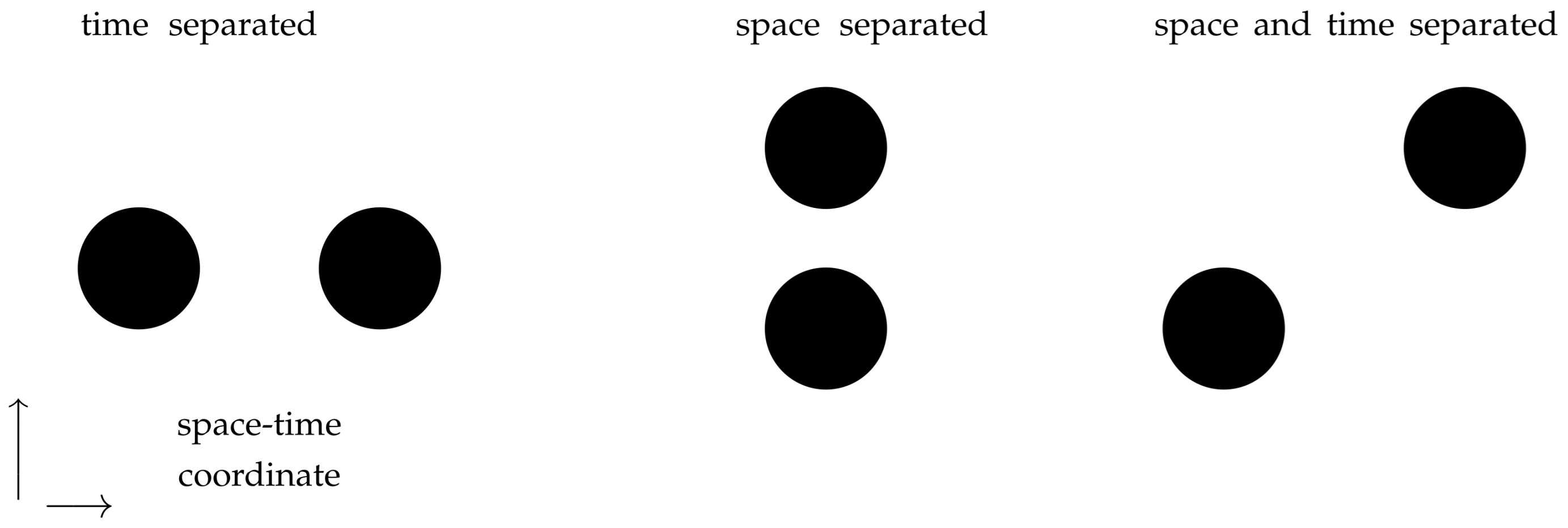
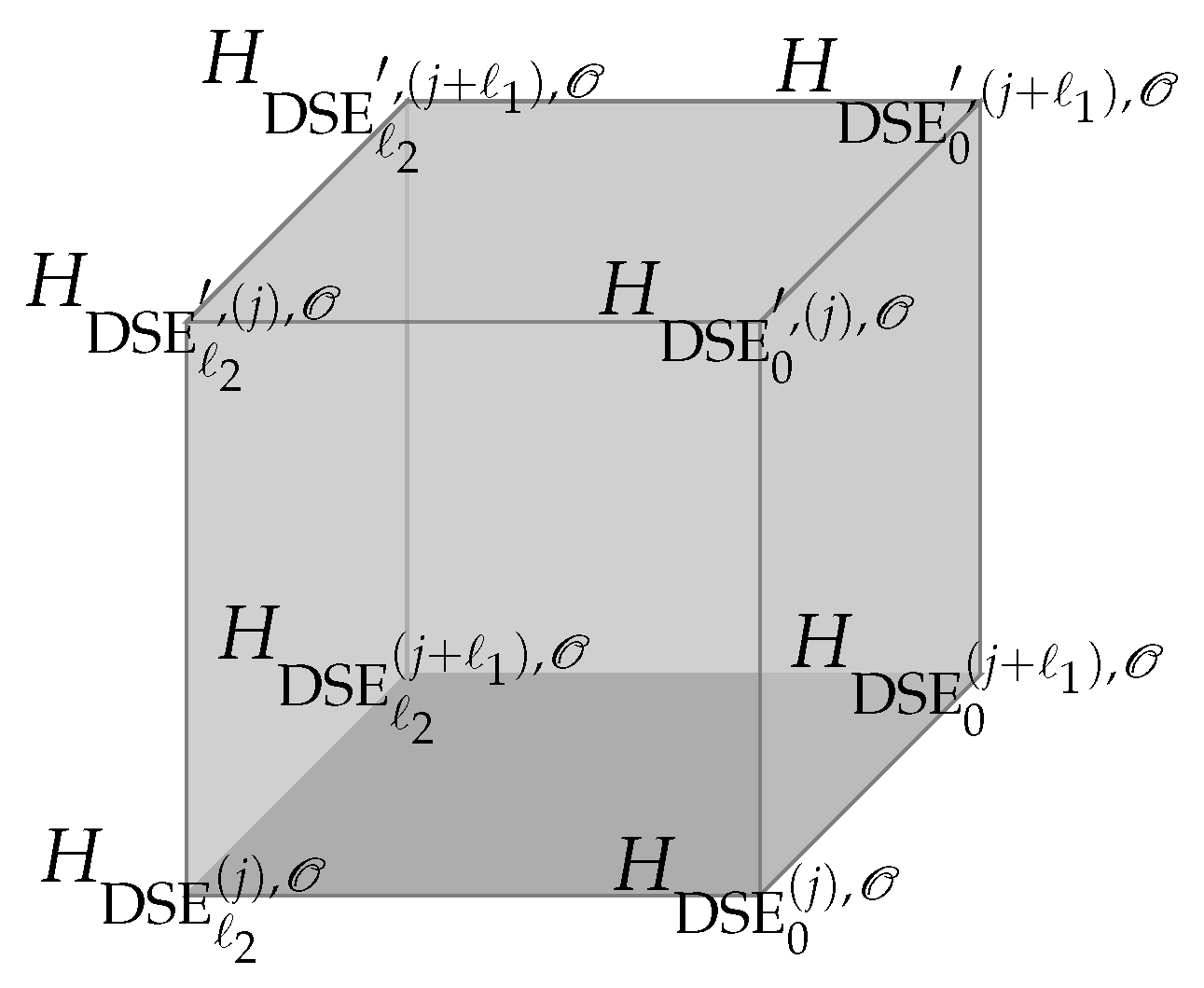
From left to right in Figure 1, the first picture encodes the situation of particles and their interactions in distinct regions with the same space coordinate but different time coordinate. The second picture encodes the situation of particles and their interactions in distinct regions with the same time coordinate but different coordinates of spaces. The third picture encodes the situation of particles and their interactions in distinct regions with different space and time coordinates.
Consider particles p , q at different basic qft-states s γ p , s γ q which occur in different regions O γ p , O γ q of space-time together with cDSEs DSE p = < B γ p + > and DSE q = < B γ q + > . Define topological subspaces
U ˜ p : = X DSE : DSE = < { B γ n + } n 1 > , γ p { γ n } n 1 , O X DSE O γ p H FG cut ( Φ ) U p : = W DSE : X DSE U ˜ p S graphon , Φ ,
and
U ˜ q : = X DSE : DSE = < { B γ n + } n 1 > , γ q { γ n } n 1 , O X DSE O γ q H FG cut ( Φ ) U q : = W DSE : X DSE U ˜ q S graphon , Φ ,
equipped by the metric
d cut ( W DSE 1 , W DSE 2 ) = lim m d cut ( W Y m ( 1 ) , W Y m ( 2 ) )
such that Y m ( i ) is the partial sum of the solution X DSE i of the equation DSE i for i = 1 , 2 .
If there exists some cDSEs such as DSE with X DSE U ˜ p U ˜ q , then X DSE generates some mixed qft-states entangled with the initial basic qft-states γ p and γ q . These mixed qft-states are occupied with particles p , q and some other (virtual) particles entangled with p , q . For U ˜ p q : = U ˜ p U ˜ q , the topological subspace
U p q : = W DSE : X DSE U ˜ p q
in S graphon , Φ recovers some non-trivial correlations between particles p , q at space-time regions O γ p and O γ q . These non-trivial correlations are given in terms of lattices of topological Hopf subalgebras of H DSE cut and its topological Hopf sub-subalgebras together with injective homomorphisms between them. The structures of these lattices are studied in [33].
Now the case U ˜ p U ˜ q = needs to be considered. For any r > 0 , define
B r ( X DSE p ) = Γ : O Γ O X DSE p , d cut ( X DSE p , Γ ) < r H FG cut ( Φ ) B r ( W DSE p ) = W Γ : Γ B r ( X DSE p ) , d cut ( W DSE p , W Γ ) < r S graphon , Φ ,
and
B r ( X DSE q ) = Γ : O Γ O X DSE q , d cut ( X DSE q , Γ ) < r H FG cut ( Φ ) B r ( W DSE q ) = W Γ : Γ B r ( X DSE q ) , d cut ( W DSE q , W Γ ) < r S graphon , Φ ,
as the open neighborhoods which include mixed qft-states entangled with s γ p , s γ q and are occupied with some (virtual) particles which interact with p , q . For an increasing sequence { r n } n 1 of positive real numbers which tends to infinity, and
B ( X DSE p ) : = n 1 B r n ( X DSE p ) , B ( X DSE q ) : = n 1 B r n ( X DSE q ) ,
one gets B ( X DSE p ) B ( X DSE q ) . Consider Γ B ( X DSE p ) B ( X DSE q ) and virtual particles such as c, as the result of the vacuum energy, which interact with some particles in Γ . Let γ be a primitive component of Γ and γ c be a primitive Feynman diagram which contains c. Let DSE c be a cDSE generated by B γ + and B γ c + . The solution X DSE c generates some mixed qft-states entangled with the qft-states determined by X DSE p , X DSE q . The topological subspace
U p q c : = W DSE c : O X DSE c O X DSE p , O X DSE c O X DSE q
in S graphon , Φ recovers some non-trivial correlations between particles p , q at space-time regions O γ p and O γ q in terms of virtual particles, as the result of the vacuum energy, at states entangled with s γ p and s γ q via towers of cDSEs coupled to DSE c , DSE p and DSE q . These non-trivial correlations are given in terms of some lattices generated by topological Hopf subalgebras of H DSE c cut , H DSE p cut , H DSE q cut and their topological Hopf sub-subalgebras together with injective homomorphisms between them. The structure of these lattices are studied in [33]. □
As it is shown, replacing von Neumann subalgebras by topological Hopf subalgebras associated to solutions of cDSEs clarifies the existence of a new class of non-trivial correlations, encoded by towers of coupled cDSEs, between separated (spacelike) regions of space-time as the result of interactions of virtual particles generated by vacuum energy. This setting enables us to generalize the idea behind the Reeh–Schlieder theorem to non-perturbative physical theories where quantum entanglement can be linked to the theory of computation underlying the Manin’s renormalization Hopf algebra of the Halting problem [33]. However here it is necessary to address some of key challenges of this foundational replacement of von Neumann subalgebras by topological Hopf subalgebras to open new research directions in this regard. (i) While von Neumann subalgebras come with a built-in notion of positive operators and trace states; constructing an analogue (positive, normalized characters with operational meaning) in the setting of the topological Hopf algebra of renormalization is still a non-trivial and in progress task. (ii) While algebraic QFT ties algebras to space-time regions, Theorem 2 addresses the existence of a robust map from space-time localization to topological Hopf subalgebras associated to cDSEs. Checking the computability of the robust map between these two decorations of space-time regions could provide more advanced mathematical tools for the study of quantum entanglement in gauge field theories. (iii) Another in-progress task is to analyze the possibility of reproducing von Neumann entropy in appropriate limits from this topological Hopf algebraic approach to quantum entanglement.

3.3. Asymptotic Completion: Embedding in the Banach Space of Stretched Feynman Graphons

As we have discussed, the method of Feynman graphon models addresses a deep interrelationship between understanding quantum entanglement via non-perturbative information and the Riemann–Hilbert correspondence underlying the topological Hopf algebra of renormalization [33,35,36,38,69]. It is now possible to discuss basic properties of quantum entanglement from the view of the Banach space of cDSEs.
For each particle p at the basic qft-state s γ p in the space-time region O p , the solution space of the equation DSE p = < B γ p + > determines the topological Hopf subalgebra H DSE p cut . Towers of cDSEs coupled with DSE p provide non-trivial correlations between p and other particles at mixed entangled qft-states at some infinitesimal regions of space-time. Thanks to Theorem 2, this setting determines non-trivial correlations between distinct regions O p and O q of space-time corresponding to any particle q which contribute to X DSE p .
Definition 3 (Entanglement Dept).
  • A qft-state s Γ corresponding to a Feynman diagram Γ = ( γ 1 , , γ n ) has an entanglement dept k if each of the intermediate states s γ i , 1 i n , is occupied by at most k particles.
  • For an equation DSE , let { Y m } m 1 be the sequence of the partial sums of its solution X DSE . The entanglement dept at order m of the qft-state s DSE is given by the entanglement dept of the qft-state s Y m corresponding to the partial sum Y m .
  • qft-states s DSE 1 , s DSE 2 corresponding to equations DSE 1 , DSE 2 are entanglement dept equivalent if there exists a finite order N such that for any m N , qft-states s Y m ( 1 ) and s Y m ( 2 ) have the same entanglement dept.
Lemma 1.
Weakly isomorphic cDSEs generate qft-states with equivalent entanglement dept.
Proof. 
For equations DSE 1 and DSE 2 , consider the corresponding states s 1 and s 2 generated by large Feynman diagrams X DSE 1 and X DSE 2 . If DSE 1 and DSE 2 are weakly isomorphic, then stretched Feynman graphons W DSE 1 and W DSE 2 are weakly isomorphic. We have
DSE 1 DSE 2 d cut ( X DSE 1 , X DSE 2 ) = 0 lim m d cut ( Y m ( 1 ) , Y m ( 2 ) ) = lim m d cut ( W Y m ( 1 ) , W Y m ( 2 ) ) = d cut ( W DSE 1 , W DSE 2 ) = 0 .
Therefore, for each ϵ > 0 , there exists some order M ϵ such that for any m M ϵ ,
d cut ( W Y m ( 1 ) , W Y m ( 2 ) ) = | | W Y m ( 1 ) W Y m ( 2 ) | | cut < ϵ sup A , B [ 0 , ) | A × B W Y m ( 1 ) W Y m ( 2 ) d x d y | < ϵ | [ 0 , ) × [ 0 , ) W Y m ( 1 ) W Y m ( 2 ) d x d y | < ϵ .
refs. [36,37].
The stretched Feynman graphon W Y m ( 1 ) is a finite direct sum of stretched Feynman graphon W X i ( 1 ) defined on subintervals I i [ 0 , ) with I i I j = , i j , m ( I i ) = c λ 1 i . The stretched Feynman graphon W Y m ( 2 ) is a finite direct sum of stretched Feynman graphon W X i ( 2 ) defined on subintervals J i [ 0 , ) with J i J j = for i j , m ( J i ) = c λ 2 i and { I i } i 1 { J i } i 1 = . Therefore the inequality (76) means that, for any m M ϵ ,
| W X m ( 1 ) ( x , y ) W X m ( 2 ) ( x , y ) | < ϵ c λ m , c λ : = min { c λ 1 , c λ 2 } , ( x , y ) [ 0 , ) × [ 0 , ) ,
which leads us to
lim m W Y m ( 1 ) = lim m W Y m ( 2 ) .
As a result, qft-states s DSE 1 and s DSE 2 are entanglement dept equivalent. □
Remark 5.
For entanglement dept equivalent qft-states s DSE 1 and s DSE 2 , equations DSE 1 and DSE 2 might not be weakly isomorphic.
Corollary 3.
S Φ , g encodes the entanglement depth of qft-states with multi particles in the physical theory.
Proof. 
Let p , q be entangled particles at different basic qft-states s γ p , s γ q which occur in distinct regions O γ p , O γ q of space-time. Consider a subspace S γ p in S Φ , g which contains DSE p = < B γ p + > and another subspace S γ q in S Φ , g which contains DSE q = < B γ q + > . Let EnD m ( s γ p ) and EnD m ( s γ q ) be entanglement dept at order m of qft-states s DSE p and s DSE q .
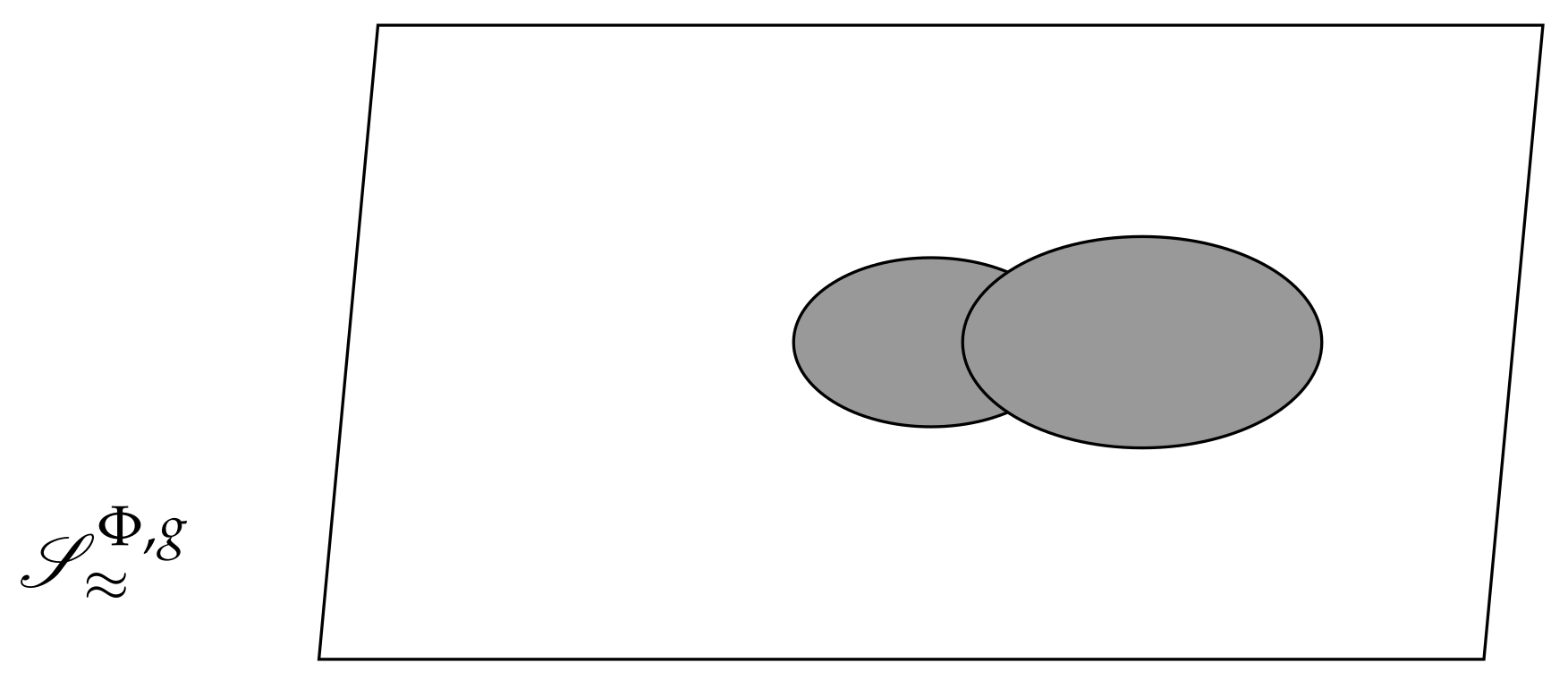
Let S γ p S γ q as it is shown in Figure 2. The intersection region determines some correlations between stretched Feynman graphons which contribute to the solution spaces of towers of cDSEs derived from the equation DSE c : = < B γ c + > S γ p S γ q . The particle c is entangled with p , q by towers of cDSEs derived from DSE p : = < B γ p + > and DSE q : = < B γ q + > in the space-time region O p O q .
Define
EnD m ( O p O q ) : = inf EnD m ( s γ p ) , EnD m ( s γ q ) , EnD m ( s γ c ) : DSE c S γ p S γ q
as the entanglement dept of order m of the entangled system S γ p S γ q at qft-states with multi particles in the space-time region O p O q .
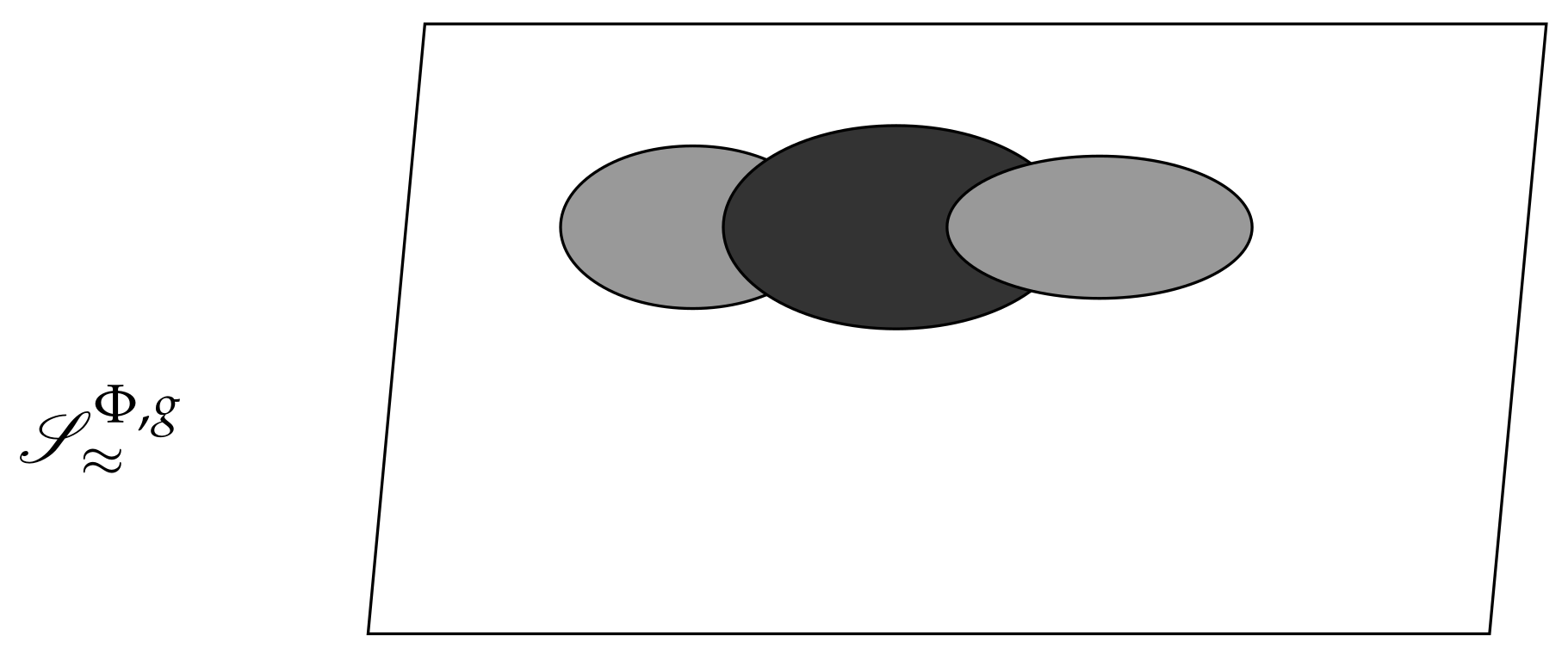
Let S γ p S γ q = . Using vacuum energy leads us to determine a certain class of cDSEs in an overlapped region S γ p , γ q , vacuum presented in Figure 3. The region S γ p , γ q , vacuum determines some correlations between stretched Feynman graphons which contribute to the solution spaces of towers of cDSEs derived from the equations DSE p : = < B γ p + > , DSE q : = < B γ q + > and DSE c : = < B γ c + > S γ p , γ q , vacuum . The particle c, as the result of the vacuum energy, occupies the state s γ c entangled with s γ p and s γ q in the space-time region O p O q O vacuum .
Define
EnD m ( O p O q O vacuum ) : = inf EnD m ( s γ p ) , EnD m ( s γ q ) , EnD m ( s γ c ) : DSE c S γ p , γ q , vacuum
as the entanglement dept of order m of the entangled system S γ p , γ q , vacuum at qft-states with multi particles in the space-time region O p O q O vacuum . □

3.4. Discrete Emergence: Constructing Spin Networks from Towers of cDSEs

Spin networks, as a particular class of labeled graphs, have been introduced and developed for the study of quantum theory of geometries [22]. The original Penrose spin networks are trivalent graphs labeled by spins such that at each vertex, we have
j 1 + j 2 + j 3 Z , | j 1 j 2 | j 3 j 1 + j 2 .
They generate a discrete model of the three-dimensional spaces for the construction of a consistent model which encapsulates passing from classical to continuum geometry [24,25]. Spin networks are interpreted as states of quantum geometry in a theory of quantum gravity where each edge of a spin network is labeled by a spin value and the parallel transportation of particles are encoded in terms of the total spin along each edge. More general spin networks are defined in terms of vertices with any valences. For a given group G, a spin network is defined as a triple ( H G , ρ G , u G ) such that (i) H G is a finite oriented decorated graph, (ii) each edge e E ( H G ) is decorated by an irreducible representation ρ e G of G, and (iii) each vertex v V ( H G ) is decorated by an intertwining operator u v G from ρ e 1 G ρ e n G , as incoming edges, to ρ e 1 G ρ e m G as outgoing edges. The evolution of each spin network is called a spin foam. The geometry of space is built in the context of lattice gauge theory [21,23,26,73,74].
If G is the Poincare’s group, then spin networks on Feynman diagrams can be formulated. Loops in Feynman diagrams generate infinities in the evolution of their corresponding spin networks where this problem can be resolved by working on a suitable quantum group (compact group) or working on the topological Hopf algebra of stretched Feynman graphons. Since non-trivial correlations between distinct regions in S Φ , g , generated by towers of coupled cDSEs, report non-local effects, it will be discussed how these non-trivial correlations are the main skeleton of a discrete model for S Φ , g in terms of a new class of spin networks. In this regard, the topological Hopf algebra of renormalization and its Hopf subalgebras associated to cDSEs of the physical theory are main tools to formulate spin networks/foams in this new framework. It will be discussed how the metric space of the resulting spin foams provides a new model for the fabric of space-time from the perspective of a local QFT whose Feynman diagrams admit a Connes–Kreimer-type renormalization structure.
Definition 4 (Spin Network).
For any particle p, let γ p be a primitive 1PI Feynman diagram in H FG ( Φ ) which contains p, and F γ p = { γ n } n 0 be a family of primitive 1PI Feynman diagrams with γ 0 = γ p . For j 1 , define
Γ n ( j ) = Γ 1 ( j 1 ) + + Γ n ( j 1 ) , Γ n ( 0 ) = γ n
as a new family of primitive Feynman diagrams. They determine qft-states s Γ n ( j ) entangled with the initial basic qft-state s γ p . For each fixed j 0 , set DSE ( j 0 ) as the cDSE generated by the family { B Γ n ( j 0 ) + } n 1 which is coupled to the initial equation DSE ( 0 ) generated by the family { γ n } n 0 .
A spin network associated to the basic qft-state s γ p is an oriented labeled finite one dimensional graph S F γ p with the following properties.
  • The vertex set of S F γ p is a subset of { Γ n ( j ) } n , j . The valence of each vertex in S F γ p , as the number of edges connecting to it, is at most four.
  • There exists an oriented edge e n 1 n 2 ( j 1 ) ( j 2 ) from Γ n 1 ( j 1 ) to Γ n 2 ( j 2 ) in S F γ p iff j 1 j 2 or n 1 n 2 .
  • Any edge e n 1 n 2 ( j 1 ) ( j 2 ) in S F γ p corresponds to an injective homomorphism of Hopf algebras from H DSE ( j 1 ) , DSE ( j 1 ) = < { B Γ n 1 ( j 1 ) + } n 1 1 > , to H DSE ( j 2 ) , DSE ( j 2 ) = < { B Γ n 2 ( j 2 ) + } n 2 1 > .
  • Any edge e n 1 n 2 ( j 1 ) ( j 2 ) in S F γ p is decorated by an irreducible finite dimensional representation ρ e n 1 n 2 ( j 1 ) ( j 2 ) G Φ ( C ) of the complex Lie group G Φ ( C ) = Hom ( H FG ( Φ ) , C ) .
  • Any vertex v in S F γ p is decorated by an intertwining operator
    u v G Φ ( C ) : ρ e 1 , n 1 n 2 ( j 1 ) ( j 2 ) G Φ ( C ) ρ e m , n 1 n 2 ( j 1 ) ( j 2 ) G Φ ( C ) ρ e 1 , n 1 n 2 , ( j 1 ) ( j 2 ) G Φ ( C ) ρ e m , n 1 n 2 , ( j 1 ) ( j 2 ) G Φ ( C ) .
  • Let sp ( Γ n ( j ) ) be the sum of spin values of particles which contribute to Γ n ( j ) . Any edge e n 1 n 2 ( j 1 ) ( j 2 ) in S F γ p is labeled by the positive value
    p n 1 n 2 ( j 1 ) ( j 2 ) : = | sp ( Γ n 1 ( j 1 ) ) sp ( Γ n 2 ( j 2 ) ) |
    as the total spin along the edge.
For 1 , 2 0 , j 0 and n 1 , Figure 4 presents building blocks of the spin network S F γ p .
Definition 5 (Evolution of spin networks).
Let F γ p = { γ n } n 0 be another family of primitive 1PI Feynman diagrams in H FG ( Φ ) with γ 0 = γ p such that there exists an injective homomorphism ϕ F γ p F γ p of Hopf algebra from H DSE ( 0 ) to H DSE ( 0 ) which maps each γ n { γ n } n 0 to some γ k n { γ n } n 0 . The evolution of the spin network S F γ p along F γ p is a two dimensional lattice S F γ p F γ p with the following properties.
  • The vertex set of S F γ p F γ p is a subset of { Γ n ( j ) , Γ n , ( j ) } n , j . The valence of each vertex is at most four.
  • There exists an oriented edge e n 1 n 2 ( j 1 ) ( j 2 ) from Γ n 1 ( j 1 ) to Γ n 2 ( j 2 ) in S F γ p F γ p iff j 1 j 2 or n 1 n 2 .
  • Any edge e n 1 n 2 ( j 1 ) ( j 2 ) in S F γ p F γ p corresponds to an injective homomorphism of Hopf algebras from H DSE ( j 1 ) , DSE ( j 1 ) = < { B Γ n 1 ( j 1 ) + } n 1 1 > , to H DSE ( j 2 ) , DSE ( j 2 ) = < { B Γ n 2 ( j 2 ) + } n 2 1 > .
  • There exists an oriented edge e n 1 n 2 , ( j 1 ) ( j 2 ) from Γ n 1 , ( j 1 ) to Γ n 2 , ( j 2 ) in S F γ p F γ p iff j 1 j 2 or n 1 n 2 .
  • Any edge e n 1 n 2 , ( j 1 ) ( j 2 ) in S F γ p F γ p corresponds to an injective homomorphism of Hopf algebras from H DSE , ( j 1 ) , DSE , ( j 1 ) = < { B Γ n 1 , ( j 1 ) + } n 1 1 > , to H DSE , ( j 2 ) , DSE , ( j 2 ) = < { B Γ n 2 , ( j 2 ) + } n 2 1 > .
  • For 1 , 2 0 , there exists an oriented edge e n + 2 ( j + 1 ) from Γ n + 2 ( j + 1 ) to Γ n + 2 , ( j + 1 ) in S F γ p F γ p corresponding to the morphism ϕ F γ p F γ p .
For 1 , 2 0 , j 0 and n 1 , Figure 5 presents the evolution S F γ p F γ p . A certain class of the evolution of spin networks in the space of Feynman diagrams leads us to a new theory of spin foams of spin networks in S Φ , g to formulate the fabric of space-time.

3.5. Defining Spin Foams as Histories of Spin Networks

This part introduces a new class of spin foams of spin networks in the space of Feynman diagrams which can be lifted onto the space of cDSEs of the physical theory.
Definition 6 (Primary Spin Foam).
Define simplicial sets with the following: (i) 0-cells: primitive Feynman diagrams of the type Γ n ( j ) given by (82) in Definition 4, (ii) 1-cells: oriented edges e n 1 n 2 ( j 1 ) ( j 2 ) from Γ n 1 ( j 1 ) to Γ n 2 ( j 2 ) given by Definitions 4 and 5, and (iii) 2-cells: two-dimensional simplicial complexes with eight vertices, twelve edges and six faces such as the one presented by Figure 6. It is called primary spin foam SF ( F γ p , F γ p , j + 1 , n + 2 ) generated by the evolution S F γ p F γ p .
For any bounded open region O of space-time, the topological subspace A O H FG cut ( Φ ) of Feynman diagrams is considered to present interactions of particles, their creation and annihilation happened in O . For each primitive 1PI Feynman diagram γ O in A O , the grafting operator B γ O + generates some entangled qft-states. Let F O = { γ n } n 0 and F O = { γ n } n 0 be families of (1PI) primitive Feynman diagrams in A O with γ 0 = γ 0 = γ O . For a fixed j 1 , define
Γ n ( j ) , O = Γ 1 ( j 1 ) , O + + Γ n ( j 1 ) , O , Γ n ( 0 ) , O = γ n ,
Γ n , ( j ) , O = Γ 1 , ( j 1 ) , O + + Γ n , ( j 1 ) , O , Γ n , ( 0 ) , O = γ n
as new families of primitive Feynman diagrams. They determine a certain class of qft-states entangled with s γ O . For some values j 1 , 1 , 2 0 , let
DSE 2 ( j + 1 ) , O = < B Γ n + 2 ( j + 1 ) , O + n 0 > , DSE 2 , ( j + 1 ) , O = < B Γ n + 2 , ( j + 1 ) , O + n 0 >
be the cDSEs generated by families { Γ n + 2 ( j + 1 ) , O } n 0 and { Γ n + 2 , ( j + 1 ) , O } n 0 . Consider the solutions X DSE 2 ( j + 1 ) , O and X DSE 2 , ( j + 1 ) , O of these equations with their corresponding partial sums { Y m , 2 ( j + 1 ) , O } m 1 and { Y m , 2 , ( j + 1 ) , O } m 1 .
Definition 7 (General/Primary Grafting Spin Foam).
Define simplicial sets with: (i) 0-cells: grafting operators B Γ n ( j ) + corresponding to primitive Feynman diagrams of the type Γ n ( j ) given by (82) in Definition 4, (ii) 1-cells: oriented edges from B Γ n 1 ( j 1 ) + to B Γ n 2 ( j 2 ) + determined by oriented edges e n 1 n 2 ( j 1 ) ( j 2 ) from Γ n 1 ( j 1 ) to Γ n 2 ( j 2 ) given by Definitions 4 and 5. Define the following two-dimensional simplicial complexes with eight vertices, twelve edges and six faces.
  • Given the evolution S F O F O of the spin network S F O along F O generates a 2-cell SF ( F O , F O , j + 1 , n + 2 ) such as the one presented by Figure 7. It can be extended to a 2-cell SF ( F O , F O , j + 1 , n + 2 , B + ) such as the one presented by Figure 8 and called primary grafting spin foam.
  • Any simple grafting spin foam can be extended to a new 2-cell SF ( F O , F O , j + 1 , 2 , m ) with respect to the partial sums Y m , 2 ( j + 1 ) , O and Y m , 2 , ( j + 1 ) , O such as the one presented by Figure 9. This 2-cell is called general grafting spin foam.
Lemma 2.
Each primary spin foam SF ( F γ p , F γ p , j + 1 , n + 2 ) is a metrizable space.
Proof. 
Faces are recovered by superpositions
λ n 1 n 2 j 1 j 2 Γ n 1 ( j 1 ) + ( 1 λ n 1 n 2 j 1 j 2 ) Γ n 2 ( j 2 ) , λ n 1 n 2 j 1 j 2 Γ n 1 , ( j 1 ) + ( 1 λ n 1 n 2 j 1 j 2 ) Γ n 2 , ( j 2 ) , μ n 1 n 2 j 1 j 2 Γ n 1 ( j 1 ) + ( 1 μ n 1 n 2 j 1 j 2 ) Γ n 2 , ( j 2 ) ,
for 0 λ n 1 n 2 j 1 j 2 , λ n 1 n 2 j 1 j 2 , μ n 1 n 2 j 1 j 2 1 , n 1 , n 2 { n , n + 2 } and j 1 , j 2 { j , j + 1 } . Their corresponding stretched Feynman graphons
λ W Γ n 1 ( j 1 ) + ( 1 λ ) W Γ n 2 ( j 2 ) , λ W Γ n 1 , ( j 1 ) + ( 1 λ ) W Γ n 2 , ( j 2 ) , λ W Γ n 1 ( j 1 ) + ( 1 λ ) W Γ n 2 , ( j 2 )
determine a two dimensional simplicial complex in the metric space S graphon , Φ W ( [ 0 , ) , m ) ( R ) . Therefore the distance function on the spin foam is given by
d cut ( λ n 1 n 2 j 1 j 2 Γ n 1 ( j 1 ) + ( 1 λ n 1 n 2 j 1 j 2 ) Γ n 2 ( j 2 ) , λ n 1 n 2 j 1 j 2 Γ n 1 , ( j 1 ) + ( 1 λ n 1 n 2 j 1 j 2 ) Γ n 2 , ( j 2 ) ) : = d cut ( λ n 1 n 2 j 1 j 2 W Γ n 1 ( j 1 ) + ( 1 λ n 1 n 2 j 1 j 2 ) W Γ n 2 ( j 2 ) , λ n 1 n 2 j 1 j 2 W Γ n 1 , ( j 1 ) + ( 1 λ n 1 n 2 j 1 j 2 ) W Γ n 2 , ( j 2 ) ) .
Lemma 2 enables us to define general spin foams.
Definition 8 (General Spin Foam).
Consider simplicial sets with: 0-cells: solutions X DSE of cDSEs, and 1-cells: injective Hopf algebra homomorphisms between Hopf subalgebras associated to solutions cDSEs. These homomorphisms are governed by oriented edges from B Γ n 1 ( j 1 ) + to B Γ n 2 ( j 2 ) + given in Definition 7. Thanks to Lemma 2, when m tends to infinity, the sequence
SF ( F O , F O , j + 1 , 2 , m ) m 1
of primary spin foams assigns a new 2-cell SF ( F O , F O , DSE 2 ( j + 1 ) , O , DSE 2 , ( j + 1 ) , O ) for j 1 , 1 , 2 0 such as the one presented by Figure 10. It is called a general spin foam.

3.6. Dynamical Spin Foam Model

This part shows that the built general spin foams provide a discrete model of the Banach space S Φ , g . This step will enable us to formulate a new dynamical model for the fabric of space-time from the perspective of the physical theory such that deformation or distortion of these general spin foams depend on the strength of running coupling constants.
The graphon representation of a general spin foam, such as the one given by Figure 11, is a 2-cell defined in terms of replacing cDSEs or their solutions in the structure of the spin foam by their corresponding stretched Feynman graphons. In this setting, stretched Feynman graphons corresponding to cDSEs are 0-cells. Functions between these 0-cells, determined by injective Hopf algebra homomorphisms in general spin foams, are 1-cells. It is important to note that changing the ground σ -finite measure space allows us to determine another graphon representation for a general spin foam, while the representation is unique up to the weakly isomorphic relation. However, up to the weakly isomorphic relation, it is possible to assign a canonical graphon representation to each general spin foam because stretched (Feynman) graphons on any arbitrary σ -finite measure space can be mapped or projected to some graphons on the Lebesgue measure space [ 0 , 1 ) .
Theorem 3.
General spin foams provide a discrete model for S Φ , g .
Proof. 
Thanks to Feynman graphon representations of cDSEs, one gets
X DSE 2 ( j + 1 ) , O = lim m Y m , 2 ( j + 1 ) , O W DSE 2 ( j + 1 ) , O = lim m W Y m , 2 ( j + 1 ) , O ,
X DSE 2 , ( j + 1 ) , O = lim m Y m , 2 , ( j + 1 ) , O W DSE 2 , ( j + 1 ) , O = lim m W Y m , 2 , ( j + 1 ) , O ,
with respect to the cut-distance topology or its L p -modifications with 1 p < .
Thanks to Lemma 2, when m tends to infinity, the sequence
SF ( F O , F O , j + 1 , 2 , m ) m 1
assigns a general spin foam SF ( F O , F O , DSE 2 ( j + 1 ) , O , DSE 2 , ( j + 1 ) , O ) for j 1 , 1 , 2 0 in the space of cDSEs which encode some of interactions of particles entangled with p, their creation and annihilation in the space-time region O . Feynman graphon representations of the solutions of these cDSEs are applied to lift general spin foams in the space of cDSEs onto general spin foams SF gr , ( F O , F O , W DSE 2 ( j + 1 ) , O , W DSE 2 , ( j + 1 ) , O ) , such as the one presented by Figure 11, in the space of stretched Feynman graphons. In this setting, general spin foams
SF ( F O , F O , DSE 1 , 2 ( j + 1 ) , O , DSE 1 , 2 , ( j + 1 ) , O ) , SF ( G O , G O , DSE 2 , 2 ( j + 1 ) , O , DSE 2 , 2 , ( j + 1 ) , O )
are called weakly equivalent or weakly isomorphic iff
W DSE 1 , 2 ( j + 1 ) , O W DSE 2 , 2 ( j + 1 ) , O , W DSE 1 , 2 , ( j + 1 ) , O W DSE 2 , 2 , ( j + 1 ) , O .
Thanks to [33], superpositions generated by general spin foams in the subspace
A ˜ O : = DSE 2 ( j + 1 ) , O : j 1 , 1 , 2 0 W DSE 2 ( j + 1 ) , O : j 1 , 1 , 2 0
recover quantum entanglement of particles at entangled states in the space-time region O . Therefore, up to the weakly isomorphic relation, the collection of general spin foams in the space of stretched Feynman graphons given by
S F gr , Φ : = SF gr , ( F O , F O , W DSE 2 ( j + 1 ) , O , W DSE 2 , ( j + 1 ) , O ) : O R D + 1 , F O , F O , j 1 , 1 , 2 0
provides a discrete model for S Φ , g . Figure 12 summarizes the process of assigning spin foam models to regions of the background space-time of a physical theory in terms of the geometry of the Banach space of cDSEs of the physical theory and the path integration in the metric space of general spin foams. □
Theorem 4.
There exists a certain class of complex Lie subgroups of G Φ ( C ) which decorates those general spin foams that contribute in the discrete model of S Φ , g .
Proof. 
Consider those general spin foams in S F gr , Φ which include cDSEs in A ˜ O . These cDSEs determine a certain class of connected graded free commutative Hopf subalgebras of the renormalization Hopf algebra. Thanks to Milnor–Moore theorem, for an equation DSE with the corresponding Hopf subalgebra H DSE , consider the complex Lie subgroup
G Φ , DSE ( C ) : = Hom ( H FG ( Φ ) H DSE , C )
of characters on the quotient Hopf algebra H FG ( Φ ) H DSE [33,47,48,75]. The vertex set of each general spin foam is decorated by these locally compact Lie groups. In other words, vertices, edges and faces of each general spin foam SF ( F O , F O , DSE 2 ( j + 1 ) , O , DSE 2 , ( j + 1 ) , O ) is decorated in terms of the representations of these Lie subgroups associated to cDSEs which contribute in the structure of the general spin foam.
For fixed j 1 , 1 , 2 0 , the injective homomorphisms
Ψ 2 , j : H DSE 2 ( j ) , O H DSE 2 ( j + 1 ) , O , Ψ 2 , j : H DSE 2 , ( j ) , O H DSE 2 , ( j + 1 ) , O ,
determine injective homomorphisms
Ψ ¯ 2 , j : H FG ( Φ ) H DSE 2 ( j + 1 ) , O H FG ( Φ ) H DSE 2 ( j ) , O , Ψ ¯ 2 , j : H FG ( Φ ) H DSE 2 , ( j + 1 ) , O H FG ( Φ ) H DSE 2 , ( j ) , O ,
which can be lifted onto surjective homomorphisms
Ψ ˜ 2 , j : G Φ , 2 ( j ) , O G Φ , 2 ( j + 1 ) , O , Ψ ˜ 2 , j : G Φ , 2 , ( j ) , O G Φ , 2 , ( j + 1 ) , O
of the corresponding complex Lie groups of characters
G 2 ( j + 1 ) , O ( C ) = Hom ( H FG ( Φ ) H DSE 2 ( j + 1 ) , O , C ) , G 2 , ( j + 1 ) , O ( C ) = Hom ( H FG ( Φ ) H DSE 2 , ( j + 1 ) , O , C )
of the quotient Hopf algebras with respect to the convolution product derived from the renormalization coproduct and the topology of pointwise convergence. Lift general spin foams decorated by Hopf subalgebras of cDSEs, such as the one presented by Figure 13, onto new simplicial sets with the following: (i) 0-cells: complex Lie subgroups of G Φ ( C ) corresponding to those Hopf subalgebras, (ii) 1-cells: surjective homomorphisms between these Lie subgroups, and (iii) 2-cells: two-dimensional simplicial complexes such as the one presented by Figure 14. These 2-cells can be projected as a decoration system onto the initial general spin foam. □

3.7. Dynamical Space-Time

Theorems 2–4 and Definitions 4–6 are applied to formulate the fabric of space-time from the perspective of the physical theory.
Theorem 5.
The discrete model of S Φ , g given by the space S F gr , Φ of general spin foams (98) encodes a dynamical model of space-time.
Proof. 
The space S F gr , Φ is equipped with the metric
d SF gr , ( F O , F O , DSE 1 , 2 ( j + 1 ) , O , DSE 1 , 2 , ( j + 1 ) , O ) , SF gr , ( H U , H U , DSE 2 , 2 ( j + 1 ) , U , DSE 2 , 2 , ( j + 1 ) , U ) : = sup d cut ( [ W DSE 1 , 2 ( j + 1 ) , O ] , [ W DSE 2 , 2 ( j + 1 ) , U ] ) , d cut ( [ W DSE 1 , 2 , ( j + 1 ) , O ] , [ W DSE 2 , 2 , ( j + 1 ) , U ] ) .
Thanks to Theorems 2–4 and [33], while the metric space ( S F gr , Φ , d ) recovers correlations between spin foams in S Φ , g , the Borel measure space corresponding to the metric d determines a well-defined path integral over the space of all trajectories between qft-states. In other words, the path integral over all trajectories between entangled qft-states at the space-time region O in the physical theory is given by the sum over all possible general spin foams
SF gr , ( F O , F O , DSE 2 ( j + 1 ) , O , DSE 2 , ( j + 1 ) , O ) ( S F gr , Φ , d )
decorated by group representations of the complex Lie groups G 2 ( j + 1 ) , O ( C ) and G 2 , ( j + 1 ) , O ( C ) of characters of Hopf subalgebras H DSE 2 ( j + 1 ) , O and H DSE 2 , ( j + 1 ) , O . In addition, the path integral over all trajectories between entangled qft-states s O , s U at distinct space-time regions O , U is given by the sum over all general spin foams
SF gr , ( F O U , F O U , DSE 2 ( j + 1 ) , O U , DSE 2 , ( j + 1 ) , O U ) ( S F gr , Φ , d )
decorated by group representations of the complex Lie groups G 2 ( j + 1 ) , O U ( C ) and G 2 , ( j + 1 ) , O U ( C ) of characters of Hopf subalgebras H DSE 2 ( j + 1 ) , O U and H DSE 2 , ( j + 1 ) , O U .
From the perspective of the physical theory, qft-states s γ p O , s γ q U in distinct open bounded regions O , U of space-time are
  • entangled with the least strength
    l strength ( s γ p O s γ q U ) : = 1 u sup O U
    such that
    u sup O U : = sup j , j 1 , 1 , 2 , 1 , 2 0 d SF gr , ( F O , F O , DSE 1 , 2 ( j + 1 ) , O , DSE 1 , 2 , ( j + 1 ) , O ) , SF gr , ( H U , H U , DSE 2 , 2 ( j + 1 ) , U , DSE 2 , 2 , ( j + 1 ) , U ) ,
  • entangled with the greatest strength
    g strength ( s γ p O s γ q U ) : = 1 u inf O U
    u inf O U : = inf j , j 1 , 1 , 2 , 1 , 2 0 d SF gr , ( F O , F O , DSE 1 , 2 ( j + 1 ) , O , DSE 1 , 2 , ( j + 1 ) , O ) , SF gr , ( H U , H U , DSE 2 , 2 ( j + 1 ) , U , DSE 2 , 2 , ( j + 1 ) , U ) ,
The bundle H FG cut ( Φ ) , S Φ , g , π Φ , g Hopf presents the dynamics of entangled spin foams in S F gr , Φ . Therefore the metric space ( S F gr , Φ , d ) of spin foams associated to O A ˜ O describes a dynamical model for space-time. □
From the perspective of quantum gravity, macro-scale space-time is interpreted as the large distance limit of micro-scale space-time which fluctuates. Therefore, because of quantum uncertainty, the length of paths never vanish and a zero point length L 0 0 should be considered in the structure of the path integral to forbid paths shorter than L 0 . String theory addresses T-duality as a symmetry between the world with paths larger than L 0 and the world with paths shorter than L 0 to find a reasonable process of passing from micro to macro scales of space-time. T-duality is extended to the path integral of quantum gravity [76]. Thanks to the method of Feynman graphon models, micro-scale space-time is accessible in terms of the path integral over trajectories between spin foams in the metric space ( SF gr , Φ , d ) which represent trajectories between entangled qft-states of the physical theory at some distinct regions of space-time (i.e., Theorem 5).
Corollary 4.
The path integrals in the space S F gr , Φ recover lengths shorter than the Planck scale from the perspective of the physical theory independent of T-duality.
Proof. 
Thanks to Lemma 2, there exists a metric structure on each general spin foam SF S F gr , Φ . So its volume vol ( SF ) is well-defined. An arbitrary infinitesimal neighborhood O smaller than the Planck scale, around a point in space-time, which is decorated by a subspace U O H FG cut ( Φ ) , is constructed by a family of general spin foams { SF i U O } i in S F gr , Φ . Therefore from the perspective of the physical theory Φ , micro-scale space-time is constructed in terms of the path integral over trajectories between general spin foams in the metric space ( S F gr , Φ , d ) with lengths larger than ˜ st Φ with
˜ st Φ : = inf vol ( SF ) : SF SF gr , Φ .
The immediate consequence of this new spin foam model is to recognize the double nature of the fabric of space-time.
Corollary 5.
Micro-scale space-time is discrete–continuous.
Proof. 
The method of perturbation describes physical theories in terms of convergent series of powers of coupling constants together with higher-loop-order Feynman diagrams as the coefficients in these discrete expansions. It means that the space-time background of perturbation approach is assumed to be discrete. The method of non-perturbation describes physical theories in terms of continuum limits of lattice models of space-time. It means that the space-time background of non-perturbation approach is assumed to be continuum. Thanks to the Feynman graphon approach to non-perturbative solutions of quantum motions and this new spin foam model, the distance between general spin foams in S F gr , Φ is applied to classify physical theories in terms of their space-time background. In this regard, consider new parameters
α l , st Φ : = inf l strength ( s γ O 1 s γ O 2 ) : γ H FG cut ( Φ ) ,
α g , st Φ : = sup g strength ( s γ O 1 s γ O 2 ) : γ H FG cut ( Φ ) .
QED is a weakly coupled physical theory with the coupling constant g QED < 1 and a positive beta function. It means that the coupling constant grows to infinity by increasing energy level to the landau pole Λ QED where QED becomes a strongly coupled physical theory. Triviality of QED is equivalent to say that QED is a perturbative theory and it becomes a non-interacting theory at energies larger than its landau pole [77]. Therefore solutions of DSEs in QED, as the fixed-point equations of 1PI Green’s functions G ph , G el of photon and electron fields, generates convergent perturbation series.
  • For energies Λ QED , we have g QED which leads us to some possible non-perturbative effects of the physical theory. Therefore from the perspective of QED Λ QED , space-time is continuum and the physical theory detects the continuous nature of space-time. Thanks to the method of Feynman graphon models, in this situation, it is possible to check that α l , st QED Λ QED = 0 .
  • For energies Λ QED , we have g QED 0 which leads us to the perturbative nature of the physical theory. Therefore from the perspective of QED Λ QED , space-time is discrete. Thanks to the method of Feynman graphon models, in this situation, it is possible to check that α g , st QED Λ QED = .
However, because of the triviality of QED [28,77], it is expected to recognize only the discrete nature of space-time from the perspective of QED.
The beta function of QCD is negative which means that its coupling constant g QCD > 1 logarithmically decreases by increasing energy levels. Therefore QCD is asymptotically free. But its coupling constant grows to infinity by decreasing energy level where QCD becomes a non-perturbative physical theory at energies lower than its landau pole Λ QCD . DSEs in QCD, as the fixed-point equations of 1PI Green’s functions G gl , G qu corresponding to quarks and gluons, generate divergent perturbation series under strong running coupling constants [40,42].
  • For energies Λ QCD , we have g QCD 0 which leads us to the perturbative nature of the physical theory. Therefore from the perspective of QCD Λ QCD , space-time is discrete. Thanks to the method of Feynman graphon models, in this situation, it is expected to check that α g , st QCD Λ QCD = .
  • For energies Λ QCD , we have g QCD which leads us to the non-perturbative effects of the physical theory. Therefore from the perspective of QCD Λ QCD , space-time is continuum and the physical theory detects the continuous nature of space-time. Thanks to the method of Feynman graphon models, in this situation, it can be seen that α l , st QCD Λ QCD = 0 .
Remark 6.
Consider the proof of Corollary 5.
  • If α l , st Φ = 0 or α g , st Φ = 0 , then space-time from the perspective of the physical theory Φ is continuum and the physical theory detects the continuous nature of space-time.
  • If α g , st Φ = or α g , st Φ = , then space-time from the perspective of the physical theory Φ is discrete.
  • If α l , st Φ = 0 and α g , st Φ = , then the physical theory Φ detects the double nature of space-time. This means that space-time from the perspective of the physical theory Φ is discrete–continuous.
  • If α l , st Φ and α g , st Φ be some non-zero finite values, then space-time from the perspective of the physical theory Φ is discrete and the physical theory has no non-perturbative effects.
Therefore QCD recovers the double nature of micro-scale space-time such that its landau pole Λ QCD determines the interface between discrete and continuous domains.

4. A Universal Graphon Model for the Fabric of Space-Time

The renormalization Hopf algebra is recovered in terms of the combinatorial Connes–Kreimer Hopf algebra H CK of non-planar rooted trees [46,49]. Applying decoration systems on these combinatorial objects, such as labeling vertices by primitive (1PI) Feynman diagrams of a physical theory, allow us to modify H CK in terms of the information of that physical theory where an injective homomorphism of Hopf algebras from H FG ( Φ ) to H CK ( Φ ) can be defined [45]. The universality of ( H CK , B + ) is the motivation for lifting the metric space of general spin foams of cDSEs of the physical theory onto the metric space of general spin foams of some abstract Hochschild equations in the topological Hopf algebra H CK cut . The resulting spin foam model is independent of physical theories and it can be adapted for different physical theories only by applying appropriate decoration systems. However, this extension does not recover the double nature of the fabric of space-time and for this purpose, it is necessary to work on a shuffle type Hopf algebra structure on the space of stretched graphons.
For the Lebesgue measure space ( [ 0 , ) , m ) , the embedding S graphon , Φ W ( [ 0 , ) , m ) ( R ) is applied to lift general spin foams in S Φ , g onto a new class of spin foam models defined in the space of cDSEs in the shuffle Hopf algebra of words in W ( [ 0 , ) , m ) ( R ) .
Theorem 6.
General spin foams defined on stretched graphons in W ( [ 0 , ) , m ) ( R ) provides a spin foam model which universally recovers the fabric of space-time and its double nature, at least, across all local QFTs whose Feynman diagrams admit a Connes–Kreimer-type renormalization structure.
Proof. 
Let t be a non-planar rooted tree with vertices v 1 , , v n weighted by α i > 0 and edges v i v j weighted by β i j . For the partition P : = ( I 1 , , I n ) of a subinterval in [ 0 , ) with m ( I i ) = α i , define the stretched graphon
W t P : [ 0 , ) × [ 0 , ) R , W t P ( x , y ) = { 0 , otherwise β i j , ( x , y ) I i × I j , v i v j E ( t )
For any Lebesgue measure preserving transformation ρ on [ 0 , ) and the partition P ρ , W t P ρ is called labeled stretched graphon corresponding to t. Up to the weakly isomorphic relation, W t P ρ [ W t ] W ( [ 0 , ) , m ) ( R ) is the unique unlabeled stretched graphon corresponding to t. In the rest of the proof, the notation W t is used instead of [ W t ] for the presentation of unlabeled stretched graphon classes in W ( [ 0 , ) , m ) ( R ) .
Let H gr , rt be the vector space over the field Q generated by unlabeled stretched graphons W t . It is graded by the vertex number such that H gr , rt ( n ) is defined as the vector space of those unlabeled stretched graphons W t W ( [ 0 , ) , m ) ( R ) with | t | = n . In the Q -module.
T ( H gr , rt ) : = Q H gr , rt H gr , rt 2 H gr , rt 3 ,
each element W t 1 W t r H gr , rt r of degree r is represented with the word ( W t 1 , , W t r ) . Each word ( W t 1 , , W t r ) determines a stretched graphon W t 1 t r in H gr , rt which is weakly isomorphic to a direct sum of stretched graphons W t i : I i × I i R H gr , rt with m ( I i ) = 1 and I i I j = for i j .
For elements W 1 H gr , rt r and W 2 H gr , rt s , the new word W 1 W 2 H gr , rt ( r + s ) of degree r + s is defined by the concatenation of their letters. In other words,
W 1 = ( W t 1 , , W t r ) , W 2 = ( W t r + 1 , , W t r + s ) W 1 W 2 = ( W t 1 , , W t r , W t r + 1 , , W t r + s ) .
The shuffle algebra Sh ( H gr , rt ) is the commutative graded connected algebra with respect to the shuffle product ⨀ on T ( H gr , rt ) given by
( W t 1 , , W t r ) ( W t r + 1 , , W t r + s ) = ( W t i 1 , , W t i r + s )
such that the sum is taken over all permutations ( i 1 , , i r + s ) of ( 1 , , r + s ) . The empty word e is the unit element. For any W t H gr , rt , define the new operator B W t + on Sh ( H gr , rt ) given by
( W t 1 , , W t r ) H gr , rt r ( W t 1 , , W t r , W t ) H gr , rt ( r + 1 ) .
B W t + ( W t 1 , , W t r ) is a direct sum of stretched graphons W t i : I i × I i R H gr , rt and W t : J t × J t R H gr , rt with m ( I i ) = m ( J t ) = 1 , such that I i I j = for i j and J t I i = for 1 i n . For any U , V Sh ( H gr , rt ) and W t , W z H gr , rt , one gets
B W t + ( U ) B W z + ( V ) = B W t + ( U B W z + ( V ) ) + B W z + ( V B W t + ( U ) ) .
Therefore the map
B + : H gr , rt Sh ( H gr , rt ) Sh ( H gr , rt ) + , B + ( W t U ) = B W t + ( U )
is an isomorphism of graded Q -modules where Sh ( H gr , rt ) + is the free Q -module over the set of non-empty words. The shuffle algebra Sh ( H gr , rt ) is equipped with a coalgebra structure with the counit
ε : Sh ( H gr , rt ) Q , ε ( e ) = 1 , ε ( U ) = 0 , U Sh ( H gr , rt ) + .
For any word Z Sh ( H gr , rt ) of degree m, its coproduct is given by
Δ Sh ( Z ) = e Z + Z e + l = 1 m 1 ( W t 1 , , W t l ) ( W t l + 1 , , W t m ) .
It can be seen that
Δ Sh B W t + = B W t + e + ( id B W t + ) Δ Sh .
The grading structure with respect to the degree of words leads us to formulate the antipode recursively given by
S Sh ( Z ) = Z l = 1 m 1 S Sh ( ( W t 1 , , W t l ) ) ( W t l + 1 , , W t m ) .
Therefore ( Sh ( H gr , rt ) , , Δ Sh , e , ε , S Sh ) is a graded connected commutative non-cocommutative Hopf algebra which can be topologically completed with respect to the cut-distance topology. The norm structure on the tensor space Sh ( H gr , rt ) Sh ( H gr , rt ) is given by
| | θ | | : = inf | | K | | cut | | L | | cut : K , L Sh ( H gr , rt ) , K L = θ
for any
θ = l = 1 m 1 ( W t 1 , , W t l ) ( W t l + 1 , , W t m ) Sh ( H gr , rt ) Sh ( H gr , rt ) .
Let ( W t ) be a word of degree one and F ( W t ) = { ( W t n ) } n 0 be a family of primitive elements in the Hopf algebra Sh ( H gr , rt ) with ( W t 0 ) = ( W t ) . For j 1 , define
U n ( j ) = U 1 ( j 1 ) + + U n ( j 1 ) , U n ( 0 ) = ( W t n )
as a new family of primitive words of degree one. For each fixed j 0 , define DSE ( j 0 ) as the cDSE
X = e + n 1 ω n B U n ( j 0 ) + ( X ( n + 1 ) )
generated by the family { B U n ( j 0 ) + } n 1 which is coupled to the initial equation DSE ( 0 ) generated by { B ( W t n ) + } n 0 . For F ( W t ) = { ( W t n ) } n 0 as other family of primitive elements in the Hopf algebra Sh ( H gr , rt ) with ( W t 0 ) = ( W t ) , let there exists an injective homomorphism ϕ F ( W t ) F ( W t ) which maps ( W t n ) { ( W t n ) } n 0 to some ( W t k n ) { ( W t n ) } n 0 . Thanks to Definitions 4–6, consider the spin networks in the space S ( Sh ( H gr , rt ) ) of all cDSEs in Sh ( H gr , rt ) . The evolution S F ( W t ) F ( W t ) of the spin network S F ( W t ) along F ( W t ) generates general spin foams
SF gr , ( F ( W t ) , F ( W t ) , j + 1 , 2 , DSE 2 W t , ( j + 1 ) , DSE 2 W t , , ( j + 1 ) )
in S ( Sh ( H gr , rt ) ) for j 1 , 1 , 2 0 . It is enough to adapt the proof of Theorems 3 and 4 for the topological shuffle Hopf algebra Sh cut ( H gr , rt ) to show that the metric space ( SF gr , Sh cut ( H gr , rt ) , d ) of these general spin foams provides a discrete model for S ( Sh ( H gr , rt ) ) . In addition, by modifying the proof of Theorem 5, it is observed that this metric space encodes a dynamical model of space-time while the bundle Sh cut ( H gr , rt ) , S ( Sh ( H gr , rt ) ) , π shuffle Hopf presents the dynamics of entangled general spin foams in SF gr , Sh cut ( H gr , rt ) .
Let C SF be a category with the metric spaces SF gr , Φ for physical theories as its objects. Morphisms of this category are functions between these metric spaces. The metric space SF gr , Sh cut ( H gr , rt ) is the universal object of C SF . For any physical theory Φ , let Sh cut ( H gr , rt ( Φ ) ) be the topological shuffle Hopf algebra of words on stretched Feynman graphons in S graphon , Φ . The embedding S graphon , Φ W ( [ 0 , ) , m ) determines a one to one function from SF gr , Φ to SF gr , Sh cut ( H gr , rt ( Φ ) ) . □
Corollary 6.
The path integrals in the space S F gr , Sh cut ( H gr , rt ) universally recover lengths shorter than the Planck scale independent of T-duality, at least, across all local QFTs whose Feynman diagrams admit a Connes–Kreimer-type renormalization structure.
Proof. 
This is a result of the proofs of Theorems 5 and 6. Thanks to Lemma 2 and Corollary 4, there exists a metric structure on each general spin foam SF in S F gr , Sh cut ( H gr , rt ) . Therefore its volume vol ( SF ) is well-defined. Any arbitrary infinitesimal neighborhood O smaller than the Planck scale, around a point in space-time, which is decorated by a subspace V O Sh cut ( H gr , rt ) , is constructed by a family of general spin foams { SF i V O } i in S F gr , Sh cut ( H gr , rt ) . Therefore micro-scale space-time is constructed in terms of the path integral over trajectories between general spin foams in the metric space ( S F gr , Sh cut ( H gr , rt ) , d ) with lengths larger than ˜ st with
˜ st : = inf vol ( SF ) : SF S F gr , Sh cut ( H gr , rt ) .
Remark 7.
Consider states s ( W t 1 ) , s ( W t 2 ) corresponding to primitive elements ( W t 1 ) , ( W t 2 ) in the shuffle Hopf algebra Sh ( H gr , rt ) which are entangled by towers of cDSEs given by (127) and (128). Let O 1 , O 2 be arbitrary infinitesimal regions of space-time occupied by states s ( W t 1 ) , s ( W t 2 ) .
  • States s ( W t 1 ) , s ( W t 2 ) are entangled with the least strength
    l strength ( s ( W t 1 ) O 1 s ( W t 2 ) O 2 ) : = 1 u sup O 1 O 2
    such that
    u sup O 1 O 2 : = sup j , j 1 , 1 , 2 , 1 , 2 0 { d ( SF gr , ( F ( W t 1 ) , F ( W t 1 ) , j + 1 , 2 , DSE 2 W t 1 , ( j + 1 ) , DSE 2 W t 1 , , ( j + 1 ) ) , SF gr , ( F ( W t 2 ) , F ( W t 2 ) , j + 1 , 2 , DSE 2 W t 2 , ( j + 1 ) , DSE 2 W t 2 , , ( j + 1 ) ) ) } .
  • States s ( W t 1 ) , s ( W t 2 ) are entangled with the greatest strength
    g strength ( s ( W t 1 ) O 1 s ( W t 2 ) O 2 ) : = 1 u inf O 1 O 2
    such that
    u inf O U : = inf j , j 1 , 1 , 2 , 1 , 2 0 { d ( SF gr , ( F ( W t 1 ) , F ( W t 1 ) , j + 1 , 2 , DSE 2 W t 1 , ( j + 1 ) , DSE 2 W t 1 , , ( j + 1 ) ) , SF gr , ( F ( W t 2 ) , F ( W t 2 ) , j + 1 , 2 , DSE 2 W t 2 , ( j + 1 ) , DSE 2 W t 2 , , ( j + 1 ) ) ) } .

5. Comparison with Other Mainstream Theories

Here we compare the fundamental differences of this new theory of spin foams in the space of stretched (Feynman) graphons with other mainstream theories about the fabric of space-time
  • Comparison with the model of noncommutative space-time. The measurement at the Planck scale generates a gravitational collapse such that space-time looses its operational meaning. Turning space-time into quantum space-time can be encoded in terms of some uncertainty or non-commutative relations between coordinates [4,8,9,13,78]. This informs the impossibility of experimentally determining space-time coordinates of an event with arbitrary accuracy. The construction of fully Poincare’s covariant free field theory is considered in terms of Wightman fields on quantum space-time or Poincare covariant nets of von Neumann algebras which determine a certain class of topological regions in quantum space-time [7,78]. This setting replaces coordinates of space and time by operators on a suitable Hilbert space to build QFTs on noncommutative versions of space-time [78,79]. Pointwise structures are replaced by their deformed versions such that the classical space-time can be recovered by tending the deformation parameter to zero. Ribbon graphs, as the noncommutative generalization of Feynman diagrams, are applied to combinatorially formulate 1PI Green’s functions in QFTs on non-commutative versions of space-time [70]. This operator algebraic platform handles the violation of causality but its extension to interacting QFTs violates Lorentz invariance and causality [4,8,9,10,13,78]. In contrast with the noncommutative space-time model, the construction of space-time on the basis of general spin foams in the space of stretched (Feynman) graphons enables us to project the quantum scale space-time in terms of the quantum geometry of the Banach space of cDSEs of the physical theory. Entangled general spin foams which contribute in the discretization of the Banach space of cDSEs build space-time. In addition, the Connes–Kreimer renormalization Hopf algebra machinery and also its topological enrichment are valid at the level of those gauge field theories which build the Standard Model of particles minimally coupled to gravity [34,36,58,59,60,61]. Therefore, while no violation of Lorentz invariance happens in this new spin foam model, the resulting space-time model has more consistency with the physical space-time rather than the model of noncommutative space-time.
  • Comparison with string theory. String theory is formulated on the basis of a ten dimensional model of space-time which requires the existence of supersymmetry. Strings are fundamental objects where branes vibrate and gravity can be extracted from excitations of closed strings. Space-time from the perspective of string theory, which can be constructed by the method of holography, has some extra dimensions than its classical version. There are symmetries which geometrically identify different models of space-time. In this regard, the AdS/CFT correspondence enables us to study non-perturbative effects of QFTs in terms of perturbative string theories [41,80]. In contrast to string theory, no extra dimensions is needed for the construction of space-time on the basis of general spin foams in the space of stretched (Feynman) graphons. A quantum theory for gravity is a background independent theory formulated on the basis of models of spin foams or canonical loop quantization. The discretized path integral for gravity considers a sum over histories which represent quantum space-time. This sum generates divergent quantum corrections which make it impossible to predict the resulting theory by knowing a finite number of experimental parameters at a certain scale. Quantum gravity introduces a dynamical model of quantized four dimensional space-time in terms of a theory of spin networks and spin foams without supersymmetry. In this scenario, macro-scale space-time can be emerged from a more fundamental theory for micro-scale space-time with a discrete nature such that the smallest length and time have limitations around the Planck scales 10 35 meter and 10 43 seconds. The quantum geometry of space is interpreted in terms of spin networks and the quantum geometry of space-time is interpreted in terms of spin foams as the evolution of spin networks. The discrete space-time gives rise to continuous space-time through two dimensional sheets that connect spin networks to generate spin foams. Then gravity, interpreted as a space-time distortion by mass and energy, can be encoded by distortion of spin networks. Because of the discrete nature of quantum geometry in this setting, quantum operators find some discrete spectra and a theory free of UV divergences can be achieved. This setting leads us to a physical mechanism for the cut-off of UV degrees of freedom around the Planck scale. The consistency with general relativity is one important challenge of this framework. In addition, various modifications of spin networks, such as the one which includes graphs with higher valence vertices, have been introduced to formulate the path integral of geometries for the interpretation of quantum space-time as a superposition of quantum geometric building blocks without any reference to the background geometry. The computational complexity of amplitudes in the structure of the resulting path integral, regularized by triangulation, is another important challenge of this framework [6,16,17,19,21,22,73,74,81,82,83,84]. In contrast with quantum gravity, this new spin foam model opens an alternative route to the consistency with general relativity. In other words, the Connes–Kreimer renormalization Hopf algebra machinery is valid at the level of the Standard Model of particles minimally coupled to gravity where because of non-renormalizability of perturbative quantum gravity (Einstein–Hilbert action), the renormalization Hopf algebra generates infinite towers of divergent perturbative series of Feynman diagrams encapsulated by cDSEs. Spin foams in the space of stretched Feynman graphons corresponding to these divergent perturbative series are new mathematical tools to deal with this non-renormalizability issue.
  • UV finiteness and recovering general relativity in a low-energy limit. While canonical Loop Quantum Gravity constructs spin network states from SU ( 2 ) holonomies on graphs [17,82], this new spin foam model derives Feynman graph limit structures from the Hochschild cohomology of the topological Hopf algebra of renormalization. Both yield discrete spectra for geometric operators, but this new setting ties discreteness to perturbative regimes of QFTs rather than quantized area gaps. In addition, UV finiteness are guaranteed by (i) the completeness or even compactness of the space of stretched Feynman graphons, which encode IR/UV non-perturbative structures of divergent perturbative series, and (ii) the existence of analytic extension for the renormalization coproducts of Feynman graph limits [28,30,31,34,35,36,37].
    The Connes–Kreimer renormalization Hopf algebra machinery is valid at the level of the Standard Model of particles minimally coupled to gravity where because of non-renormalizability of perturbative quantum gravity (Einstein–Hilbert action), the renormalization Hopf algebra generates infinite towers of divergent Feynman diagrams encapsulated by cDSEs. The machinery of the topological Hopf algebra of renormalization provides a certain class of bounded measurable graph functions as new mathematical tools to deal with this non-renormalizability issue in terms of assigning stretched Feynman graphons to divergent perturbative series of 1PI Green’s functions and solutions of their fixed-point equations. Since perturbative quantization of the Einstein–Hilbert action coupled to matter reproduce General Relativity at low-energy regimes, and non-calculable quantum corrections are available by the Manin’s renormalization Hopf algebra of the Halting problem, this new spin foam model recovers General Relativity at low-energy regimes [28,30,58,59,60,61,62,63].

6. Conclusions

This research work presented some new applications of infinite combinatorics, in the context of Feynman graphon models, to relate the asymptotics of QFTs, originated from non-perturbative solutions of quantum motions, to micro structure of space-time. In this regard, it has been discussed how the interface between perturbative and non-perturbative domains in physical theories, with respect to the strength of running coupling constants, have fundamental correlations with the double nature of space-time.
  • Thanks to the method of Feynman graphon models, the space S Φ , g of all cDSEs of the physical theory Φ on the commutative space-time is equipped with a separable Banach structure. This space recovers correlations between entangled particles at qft-states in separated regions of space-time in terms of towers of coupled cDSEs. Topological subspaces of S Φ , g are new tools to characterize the entanglement depth of qft-states with multi particles in the physical theory.
  • A new theory of spin foams in S Φ , g has been introduced in terms of the evolutions of spin networks associated to basic qft-states in the space of Feynman diagrams of the physical theory. The geometry of the metric space ( SF gr , Φ , d ) of general spin foams in S Φ , g provides a well-defined path integral to formulate a new dynamical model for the fabric of space-time from the perspective of the physical theory. In this new framework, two-dimensional simplicial complexes of stretched Feynman garphons, which contribute to solutions of towers of coupled cDSEs under running coupling constants of the physical theory, are building blocks of a description of the fabric of space-time from the perspective of the physical theory. The appearance of correlations between elements of ( SF gr , Φ , d ) describes quantum entanglement in the physical theory.
  • The space of (stretched) Feynman graphons S graphon , Φ of the physical theory can be embedded into the space of real-valued stretched graphons W ( [ 0 , ) , m ) ( R ) . It led us to lift this framework onto a universal level where thanks to the combinatorial Connes–Kreimer renormalization Hopf algebra of non-planar rooted trees, the metric space SF gr , Sh cut ( H gr , rt ) of general spin foams of spin networks in the space of cDSEs in the shuffle Hopf algebra Sh ( H gr , rt ) was constructed. Solutions of these equations are encoded by word limits in the topological shuffle Hopf algebra Sh cut ( H gr , rt ) . The geometry of SF gr , Sh cut ( H gr , rt ) provides a universal dynamical model for space-time, at least, across all local QFTs whose Feynman diagrams admit a Connes–Kreimer-type renormalization structure. The Manin’s renormalization Hopf algebra of the Halting problem guarantees abstract computability-based foundations of this new model.
  • Homomorphism densities, as continuous functionals on the Banach space S Φ , g , the Hopf-Banach bundle ( H FG cut ( Φ ) , S Φ , g , π Φ , g Hopf ) and the geometry of the metric space ( SF gr , Φ , d ) are new tools for the study of intermediate phases of the physical theory in the interface between discrete and continuous domains of space-time.
  • This new spin foam model shows that the fabric of space-time has a double nature which can be detected by physical theories at different energy scales. This research suggests that the fabric of space-time is like a “stretched pizza cheese” such that its stretchings are encoded by general spin foams of spin networks of stretched (Feynman) graphons which contribute to solutions of quantum motions of the physical theory under different running coupling constants. There exist fundamental correlations between the strength of this stretching and the strength of running coupling constants of the physical theory at different energy scales.

Funding

This research received no external funding.

Data Availability Statement

No new data were created or analyzed in this study. Data sharing is not applicable to this article.

Conflicts of Interest

The author declares no conflicts of interest.

References

  1. Griffiths, J.B.; Podolsky, J. Exact Space-Times in Einstein’s General Relativity; Cambridge University Press: Cambridge, UK, 2009. [Google Scholar] [CrossRef]
  2. Fredenhagen, K.; Haag, R. Generally covariant quantum field theory and scaling limits. Comm. Math. Phys. 1987, 108, 91–115. [Google Scholar] [CrossRef]
  3. Martin, J.L. Covariant quantum field theories with indefinite metric, and the Lorentz covariant Lee model. Proc. Royal Soc. Lond. Ser. Math. Phys. Sci. 1963, 272, 231–240. [Google Scholar] [CrossRef]
  4. Sasakura, N. Space-time uncertainty relation and Lorentz invariance. J. High Energy Phys. 2000, 2000, 015. [Google Scholar] [CrossRef]
  5. Weinfurtner, S.; Cuevas, G.D.L.; Martin-Delgado, M.A.; Briegel, H.J. Reducing space-time to binary information. J. Phys. A Math. Theor. 2014, 47, 095301. [Google Scholar] [CrossRef]
  6. Borodikhin, V.N. Renormalizable quantum theory of gravity. Phys. Scr. 2024, 99, 115033. [Google Scholar] [CrossRef]
  7. Bahns, D.; Doplicher, S.; Morsella, G.; Piacitelli, G. Quantum spacetime and algebraic quantum field theory. In Advances in Algebraic Quantum Field Theory; Brunetti, R., Dappiaggi, C., Fredenhagen, K., Yngvason, J., Eds.; Mathematical Physics Studies; Springer: Cham, Switzerland, 2015; pp. 289–329. [Google Scholar] [CrossRef]
  8. Chang-Jun, G.; You-Gen, S. Quantization of the space-time with topological defect. Chin. Phys. 2003, 12, 371. [Google Scholar] [CrossRef]
  9. Doplicher, S. Quantum Field Theory on quantum spacetime. J. Phys. Conf. Ser. 2006, 53, 793–798. [Google Scholar] [CrossRef]
  10. Gambini, R.; Pullin, J. Quantum shells in a quantum space-time. Class. Quantum Grav. 2015, 32, 035003. [Google Scholar] [CrossRef]
  11. Hellman, G. Mathematical constructivism is spacetime. Brit. J. Philos. Sci. 1998, 49, 425–450. [Google Scholar] [CrossRef]
  12. Hu, B.L. Emergent/quantum gravity: Macro/micro structures of spacetime. J. Phys. Conf. Ser. 2009, 174, 012015. [Google Scholar] [CrossRef]
  13. Hooft, G. How quantization of gravity leads to a discrete space-time. J. Phys. Conf. Ser. 2016, 701, 012014. [Google Scholar] [CrossRef]
  14. Jackson, J.C. A quantization of time. J. Phys. A Math. Gen. 1977, 10, 2115. [Google Scholar] [CrossRef][Green Version]
  15. Lorente, M. A new model for the structure of spacetime: Physical applications. J. Phys. Conf. Ser. 2010, 237, 012017. [Google Scholar] [CrossRef]
  16. Mikovic, A. Quantum field theory of spin networks. Class. Quantum Grav. 2001, 18, 2827. [Google Scholar] [CrossRef]
  17. Norton, J. Loop quantum ontology: Spacetime and spin-networks. Stud. Hist. Philos. Sci. Part B 2020, 71, 14–25. [Google Scholar] [CrossRef]
  18. Napsuciale, M. Space-time origin of gauge symmetry. Phys. Scr. 2023, 98, 095305. [Google Scholar] [CrossRef]
  19. Oriti, D. (Ed.) Approaches to Quantum Gravity; Cambridge University Press: Cambridge, UK, 2009. [Google Scholar] [CrossRef]
  20. Raamsdonk, M.V. Building up spacetime with quantum entanglement. Gen. Relativ. Gravit. 2010, 42, 2323–2329. [Google Scholar] [CrossRef]
  21. Baez, J.C. An introduction to spin foam models of BF theory and quantum gravity. In Geometry and Quantum Physics; Gausterer, H., Pittner, L., Grosse, H., Eds.; Lecture Notes in Physics; Springer: Berlin/Heidelberg, Germany, 2000; Volume 543, pp. 25–93. [Google Scholar] [CrossRef]
  22. Major, S.A. A spin network primer. Am. J. Phys. 1999, 67, 972–980. [Google Scholar] [CrossRef]
  23. Perez, A. The spin-foam approach to quantum gravity. Living Rev. Relativ. 2013, 16, 3. [Google Scholar] [CrossRef] [PubMed]
  24. Penrose, R. Angular momentum: An approach to combinatorial space-time. In Quantum Theory and Beyond; Bastin, T., Ed.; Cambridge University Press: Cambridge, UK, 1971; pp. 151–180. [Google Scholar] [CrossRef]
  25. Penrose, R. Combinatorial quantum theory and quantized directions. In Advances in Twistor Theory; Hughston, L.P., Ward, R.S., Eds.; Pitman Advanced Pub. Program: Yorkshire, UK, 1979; pp. 301–307. Available online: https://www.amazon.com/Advances-twistor-theory-Research-mathematics/dp/082248448X#detailBullets_feature_div (accessed on 15 April 2026).
  26. Rovelli, C.; Smolin, L. Spin networks and quantum gravity. Phys. Rev. D 1995, 52, 5743–5759. [Google Scholar] [CrossRef]
  27. Shojaei-Fard, A. Is quantum field theory necessarily “quantum”? Quantum Rep. 2025, 7, 53. [Google Scholar] [CrossRef]
  28. Shojaei-Fard, A. The “zero charge problem” via graphon processes. Complex Anal. Operator Theor. 2025, 19, 168. [Google Scholar] [CrossRef]
  29. Shojaei-Fard, A. Quantum integrability via renormalization. Commun. Theor. Phys. 2026, 78, 015003. [Google Scholar] [CrossRef]
  30. Shojaei-Fard, A. Renormalization bi-Heying algebra. J. Applied Anal. 2025, 18. [Google Scholar] [CrossRef]
  31. Shojaei-Fard, A. Subsystems via quantum motions. Analys. Math. Phys. 2024, 14, 61. [Google Scholar] [CrossRef]
  32. Shojaei-Fard, A. A statistical mechanical model for non-perturbative regimes. Nucl. Phys. B 2023, 991, 116220. [Google Scholar] [CrossRef]
  33. Shojaei-Fard, A. From Dyson–Schwinger equations to quantum entanglement. J. Math. Sci. 2022, 266, 892–916. [Google Scholar] [CrossRef]
  34. Shojaei-Fard, A. Non-perturbative graph languages, halting problem and complexity. Forum Math. 2022, 34, 1159–1185. [Google Scholar] [CrossRef]
  35. Shojaei-Fard, A. Halting problem in Feynman graphon processes derived from the renormalization Hopf algebra. Bull. Transilv. Univ. Brasov. Ser. III Math. Comput. Sci. 2022, 64, 139–157. [Google Scholar] [CrossRef]
  36. Shojaei-Fard, A. The dynamics of non-perturbative phases via Banach bundles. Nuclear Phys. B 2021, 969, 115478. [Google Scholar] [CrossRef]
  37. Shojaei-Fard, A. The analytic evolution of Dyson–Schwinger equations via homomorphism densities. Math Phys. Anal. Geom. 2021, 24, 18. [Google Scholar] [CrossRef]
  38. Shojaei-Fard, A. The complexities of nonperturbative computations. Russ. J. Math. Phys. 2021, 28, 358–376. [Google Scholar] [CrossRef]
  39. Shojaei-Fard, A. Non-perturbative β-functions via Feynman graphons. Modern Phys. Lett. A 2019, 34, 1950109. [Google Scholar] [CrossRef]
  40. Brambilla, N.; Eidelman, S.; Foka, P.; Gardner, S.; Kronfeld, A.S.; Alford, M.G.; Alkofer, R.; Butenschoen, M.; Cohen, T.D.; Erdmenger, J.; et al. QCD and strongly coupled gauge theories: Challenges and perspectives. Eur. Phys. J. C 2014, 74, 2981. [Google Scholar] [CrossRef] [PubMed]
  41. Deligne, P.; Etingof, P.; Freed, D.S.; Jeffrey, L.C.; Kazhdan, D.; Morgan, J.W.; Morrison, D.R.; Witten, E. (Eds.) Quantum Fields and Strings: A Course for Mathematicians; AMS, Institute for Advanced Study: Princeton, NJ, USA, 1999; Volume 1–2, Available online: https://bookstore.ams.org/view?ProductCode=QFT/1/2 (accessed on 15 April 2026).
  42. Herzog, F. Zimmermann’s forest formula, infrared divergences and the QCD beta function. Nuclear Phys. B 2018, 926, 370–380. [Google Scholar] [CrossRef]
  43. Broadhurst, D.J.; Kreimer, D. Renormalization automated by Hopf algebra. J. Symb. Comput. 1999, 27, 581–600. [Google Scholar] [CrossRef]
  44. Bergbauer, C.; Kreimer, D. New algebraic aspects of perturbative and non-perturbative quantum field theory. In New Trends in Mathematical Physcis; Springer: Dordrecht, The Netherlands, 2009; pp. 45–58. [Google Scholar] [CrossRef]
  45. Kreimer, D. Structures in Feynman graphs: Hopf algebras and symmetries. Proc. Sympos. Pure Math. 2005, 73, 43–78. Available online: https://bookstore.ams.org/view?ProductCode=PSPUM/73 (accessed on 15 April 2026).
  46. Kreimer, D. Combinatorics of (perturbative) quantum field theory. Phys. Rep. B 2002, 363, 387–424. [Google Scholar] [CrossRef]
  47. Connes, A.; Kreimer, D. Renormalization in quantum field theory and the Riemann–Hilbert problem I: The Hopf algebra structure of graphs and the main theorem. Commun. Math. Phys. 2000, 210, 249–273. [Google Scholar] [CrossRef]
  48. Connes, A.; Kreimer, D. Renormalization in quantum field theory and the Riemann–Hilbert problem II: The beta-function, diffeomorphisms and the renormalization group. Commun. Math. Phys. 2001, 216, 215–241. [Google Scholar] [CrossRef]
  49. Kreimer, D. On the Hopf algebra structure of perturbative quantum field theories. Adv. Theor. Math. Phys. 1998, 2, 303–334. [Google Scholar] [CrossRef]
  50. Kreimer, D. Factorization in quantum field theory: An exercise in Hopf algebras and local singularities. In Frontiers in Number Theory, Physics, and Geometry II; Springer: Berlin/Heidelberg, Germany, 2007; pp. 715–736. [Google Scholar] [CrossRef]
  51. Kruger, O.; Kreimer, D. Filtrations in Dyson–Schwinger equations: Next-to{j}-leading log expansions systematically. Ann. Phys. 2015, 360, 293–340. [Google Scholar] [CrossRef]
  52. Foissy, L. Faa di Bruno subalgebras of the Hopf algebra of planar trees from combinatorial Dyson–Schwinger equations. Adv. Math. 2008, 218, 136–162. [Google Scholar] [CrossRef][Green Version]
  53. Borgs, C.; Chayes, J.T.; Cohn, H.; Holden, N. Sparse exchangeable graphs and their limits via graphon processes. J. Mach. Learn. Res. 2017, 18, 210. [Google Scholar]
  54. Borgs, C.; Chayes, J.T.; Cohn, H.; Zhao, Y. An Lp theory of sparse graph convergence I: Limits, sparse random graph models, and power law distributions. Trans. Am. Math. Soc. 2019, 372, 3019–3062. [Google Scholar] [CrossRef]
  55. Borgs, C.; Chayes, J.T.; Cohn, H.; Zhao, Y. An Lp theory of sparse graph convergence II: LD convergence, quotients, and right convergence. Ann. Probab. 2018, 46, 337–396. [Google Scholar] [CrossRef]
  56. Lovasz, L. Large Networks and Graph Limits; AMS Colloquium Publications: Providence, RI, USA, 2012; Volume 60. [Google Scholar] [CrossRef]
  57. Valente, G. Does the Reeh–Schlieder theorem violate relativistic causality? Stud. Hist. Philos. Sci. B Stud. Hist. Philos. Modern Phys. 2014, 48, 147–155. [Google Scholar] [CrossRef]
  58. van Suijlekom, W.D. Renormalization Hopf algebras for gauge theories and BRST-symmetries. In Proceeding of the Motives, Quantum Field Theory, and Pseudodifferential Operators. Clay Mathematics Proceedings, Boston, MA, USA, 2–13 June 2008; American Mathematical Society Clay Mathematics Institute: Cambridge, MA, USA, 2008; Volume 12, pp. 333–349. Available online: https://www.claymath.org/library/proceedings/cmip012c.pdf (accessed on 15 April 2026).
  59. van Suijlekom, W.D. The structure of renormalization Hopf algebras for gauge theories. I. Representing Feynman graphs on BV-algebras. Comm. Math. Phys. 2009, 290, 291–319. [Google Scholar] [CrossRef][Green Version]
  60. van Suijlekom, W.D. Renormalization of gauge fields: A Hopf algebra approach. Comm. Math. Phys. 2007, 276, 773–798. [Google Scholar] [CrossRef][Green Version]
  61. Connes, A.; Marcolli, M. Noncommutative Geometry, Quantum Fields and Motives; Colloquium Publications: Providence, RI, USA; AMS: Providence, RI, USA, 2008; Volume 55. [Google Scholar] [CrossRef]
  62. Manin, Y.I. Renormalisation et Calcul I: Motivation et Fondation. Semin. Congr. 2009, 26, 181–222. [Google Scholar]
  63. Manin, Y.I. Renormalisation and computation II: Time cut-off and the Halting Problem. Math. Struct. Comput. Sci. 2012, 22, 729–751. [Google Scholar] [CrossRef]
  64. Delaney, C.; Marcolli, M. Dyson–Schwinger equations in the theory of computation. Contemp. Math. 2015, 648, 79–107. [Google Scholar] [CrossRef][Green Version]
  65. Marcolli, M. Information Algebras and Their Applications Geometric Science of Information; Lecture Notes in Computer Science; Springer: Cham, Switzerland, 2015; Volume 9389, pp. 271–276. [Google Scholar] [CrossRef]
  66. Marcolli, M.; Port, A. Graph grammars, insertion Lie algebras, and quantum field theory. Math. Comput. Sci. 2015, 9, 391–408. [Google Scholar] [CrossRef]
  67. Marcolli, M.; Tedeschi, N. Entropy algebras and Birkhoff factorization. J. Geom. Phys. 2015, 97, 243–265. [Google Scholar] [CrossRef]
  68. Lambert, J.; Sorensen, E.S. From classical to quantum information geometry: A guide for physicists. New J. Phys. 2023, 25, 081201. [Google Scholar] [CrossRef]
  69. Shojaei-Fard, A. Renormalization of unbounded stretched graphons. Open J. Math. Analys. 2025, 9, 193–213. [Google Scholar] [CrossRef]
  70. Malyshev, D. Hopf algebra of ribbon graphs and renormalization. J. High Energy Phys. 2002, 2002, 28. [Google Scholar] [CrossRef]
  71. Kassel, C. Quantum Groups, Graduate Text in Mathematics; Springer Book Archive; Springer: New York, NY, USA, 1995. [Google Scholar] [CrossRef]
  72. Reshetikhin, N.; Turaev, V.G. Invariants of 3-manifolds via link polynomials and quantum groups. Invent. Math. 1991, 103, 547–597. [Google Scholar] [CrossRef]
  73. Baez, J.C. Spin networks in gauge theory. Adv. Math. 1996, 117, 253–272. [Google Scholar] [CrossRef]
  74. Baez, J.C. Networks in nonperturbative quantum gravity. In The Interface of Knots and Physics, Proceedings of Symposia in Applied Mathematics; AMS Short Course Lecture Notes; AMS: Providence, RI, USA, 1996; Volume 51, pp. 167–203. [Google Scholar] [CrossRef][Green Version]
  75. Dahmen, R.; Schmeding, A. Lie groups of controlled characters of combinatorial Hopf algebras. Ann. Inst. Henri Poincare D 2020, 7, 395–456. [Google Scholar] [CrossRef]
  76. Nicolini, P. Quantum gravity and the zero point length. Gen. Relativ. Gravit. 2022, 54, 106. [Google Scholar] [CrossRef]
  77. Gockeler, M.; Horsley, R.; Linke, V.; Rakow, P.; Schierholz, G.; Stuben, H. Is there a Landau pole problem in QED? Phys. Rev. Lett. 1998, 80, 4119. [Google Scholar] [CrossRef]
  78. Doplicher, S.; Fredenhagen, K.; Roberts, J.E. The quantum structure of spacetime at the Planck scale and quantum fields. Commun. Math. Phys. 1995, 172, 187–220. [Google Scholar] [CrossRef]
  79. Szabo, R.J. Quantum field theory on noncommutative spaces. Phys. Rep. 2003, 378, 207–299. [Google Scholar] [CrossRef]
  80. Horowitz, G.T. Spacetime in string theory. New J. Phys. 2005, 7, 201. [Google Scholar] [CrossRef][Green Version]
  81. Volovik, G.E. Planck constants in the symmetry breaking quantum gravity. Symmetry 2023, 15, 991. [Google Scholar] [CrossRef]
  82. Ashtekar, A.; Bianchi, E. A short review of loop quantum gravity. Rep. Progr. Phys. 2021, 84, 042001. [Google Scholar] [CrossRef]
  83. Alexandrov, S.; Geiller, M.; Noui, K. Spin foams and canonical quantization. Symmetry Integr. Geom. Methods Appl. 2012, 8, 055. [Google Scholar] [CrossRef]
  84. Bianchi, E.; Martin-Dussaud, P. Causal structure in spin foams. Univese 2024, 10, 181. [Google Scholar] [CrossRef]
Figure 1. Different situations for interaction of particles in distinct regions of space-time.
Appliedmath 06 00066 g001
Figure 2. Non-trivial correlations between entangled particles encoded by Feynman graphon models for solutions of quantum motions.
Appliedmath 06 00066 g002
Figure 3. Non-trivial correlations between space-like separated entangled particles encoded by Feynman graphon models for towers of quantum motions.
Appliedmath 06 00066 g003
Figure 4. Building blocks of the spin network.
Appliedmath 06 00066 g004
Figure 5. The evolution of the spin network S F γ p along F γ p .
Appliedmath 06 00066 g005
Figure 6. A primary spin foam.
Appliedmath 06 00066 g006
Figure 7. A primary spin foam SF ( F O , F O , j + 1 , n + 2 ) for a region O .
Appliedmath 06 00066 g007
Figure 8. A primary grafting spin foam SF ( F O , F O , j + 1 , n + 2 , B + ) for a region O .
Appliedmath 06 00066 g008
Figure 9. A general grafting spin foam SF ( F O , F O , j + 1 , 2 , m ) for a region O .
Appliedmath 06 00066 g009
Figure 10. A general spin foam SF ( F O , F O , DSE 2 ( j + 1 ) , O , DSE 2 , ( j + 1 ) , O ) for j 1 , 1 , 2 0 .
Appliedmath 06 00066 g010
Figure 11. A general spin foam SF gr , ( F O , F O , W DSE 2 ( j + 1 ) , O , W DSE 2 , ( j + 1 ) , O ) in the space of stretched Feynman graphons.
Appliedmath 06 00066 g011
Figure 12. Associating a spin foam model of cDSEs (or their Feynman graphon representations) to open bounded regions of space-time underlying topological Hopf subalgebras which recover solutions of quantum motions in the physical theory. This spin foam model describes space-time from the perspective of the physical theory.
Appliedmath 06 00066 g012
Figure 13. A decorated general spin foam such that its edges are determined by injective homomorphisms of Hopf algebras oriented from down to up the lattice.
Appliedmath 06 00066 g013
Figure 14. A two-dimensional simplicial complex of Lie subgroups.
Appliedmath 06 00066 g014
Disclaimer/Publisher’s Note: The statements, opinions and data contained in all publications are solely those of the individual author(s) and contributor(s) and not of MDPI and/or the editor(s). MDPI and/or the editor(s) disclaim responsibility for any injury to people or property resulting from any ideas, methods, instructions or products referred to in the content.