


Feedback Control Design for Time-Delay Systems Based on the Manabe Polynomial Concept Under Unmodeled Input Delay


Abstract
1. Introduction
1.1. Motivation
1.2. Related Work
1.3. Contribution and Paper Organization
- A unified normalization for Manabe/CDM pole-shaping under input delay, showing that delay robustness is governed primarily by the dimensionless ratio , where is the equivalent time constant of the target Manabe polynomial.
- Explicit delay-stability limits for chain-of-integrator benchmarks with under the standard CDM indices, yielding direct lower bounds on for a given delay estimate.
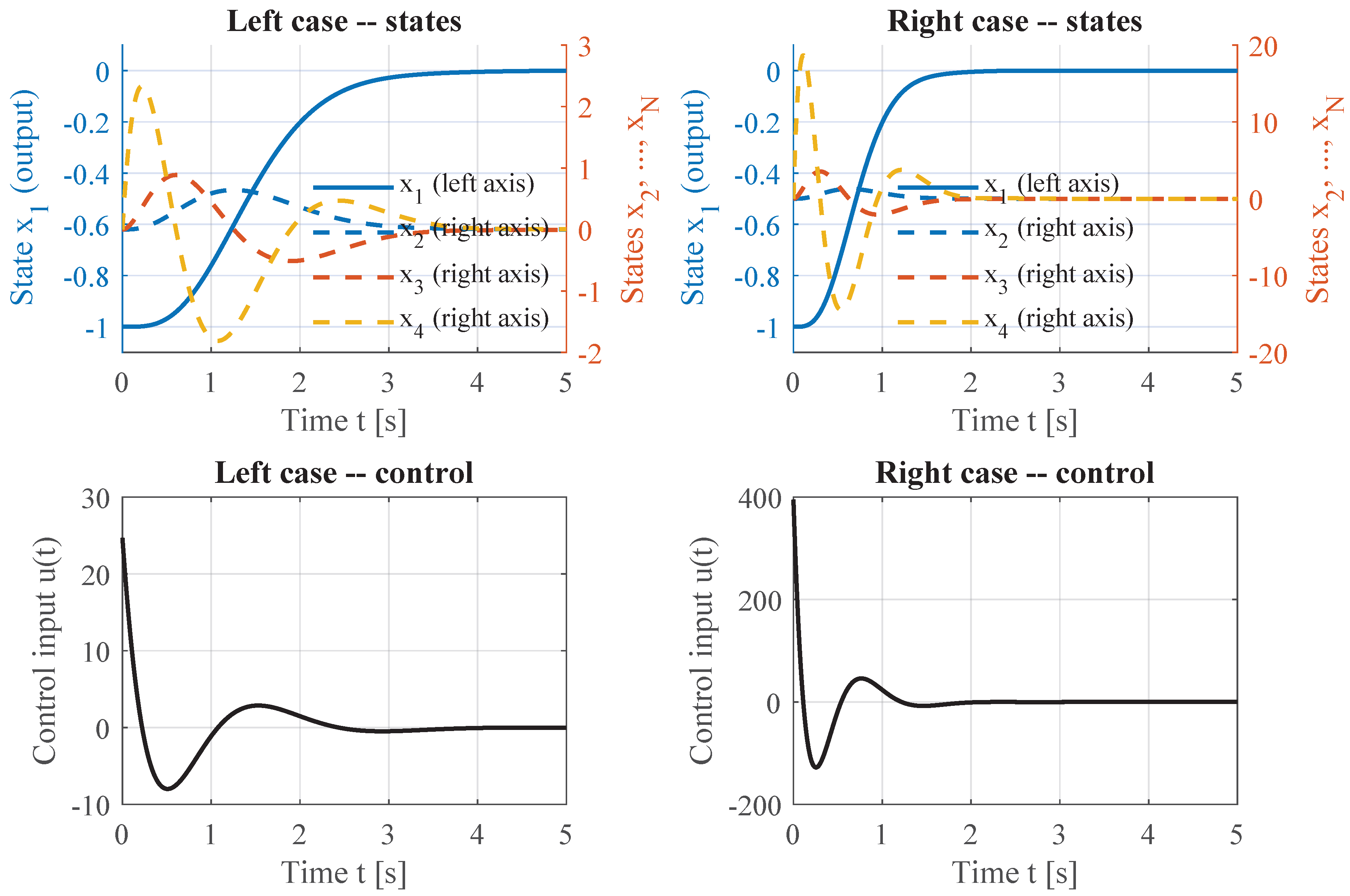
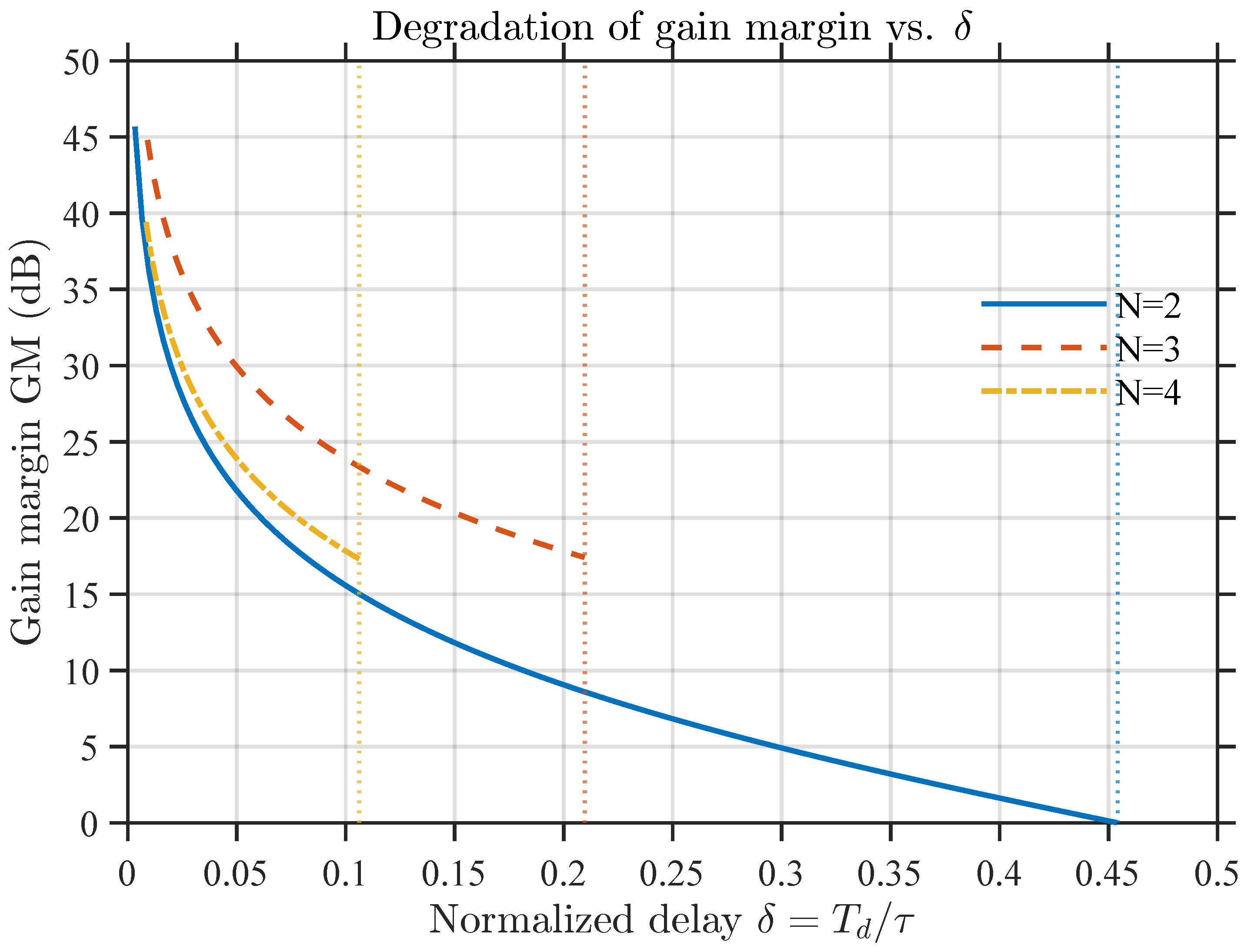
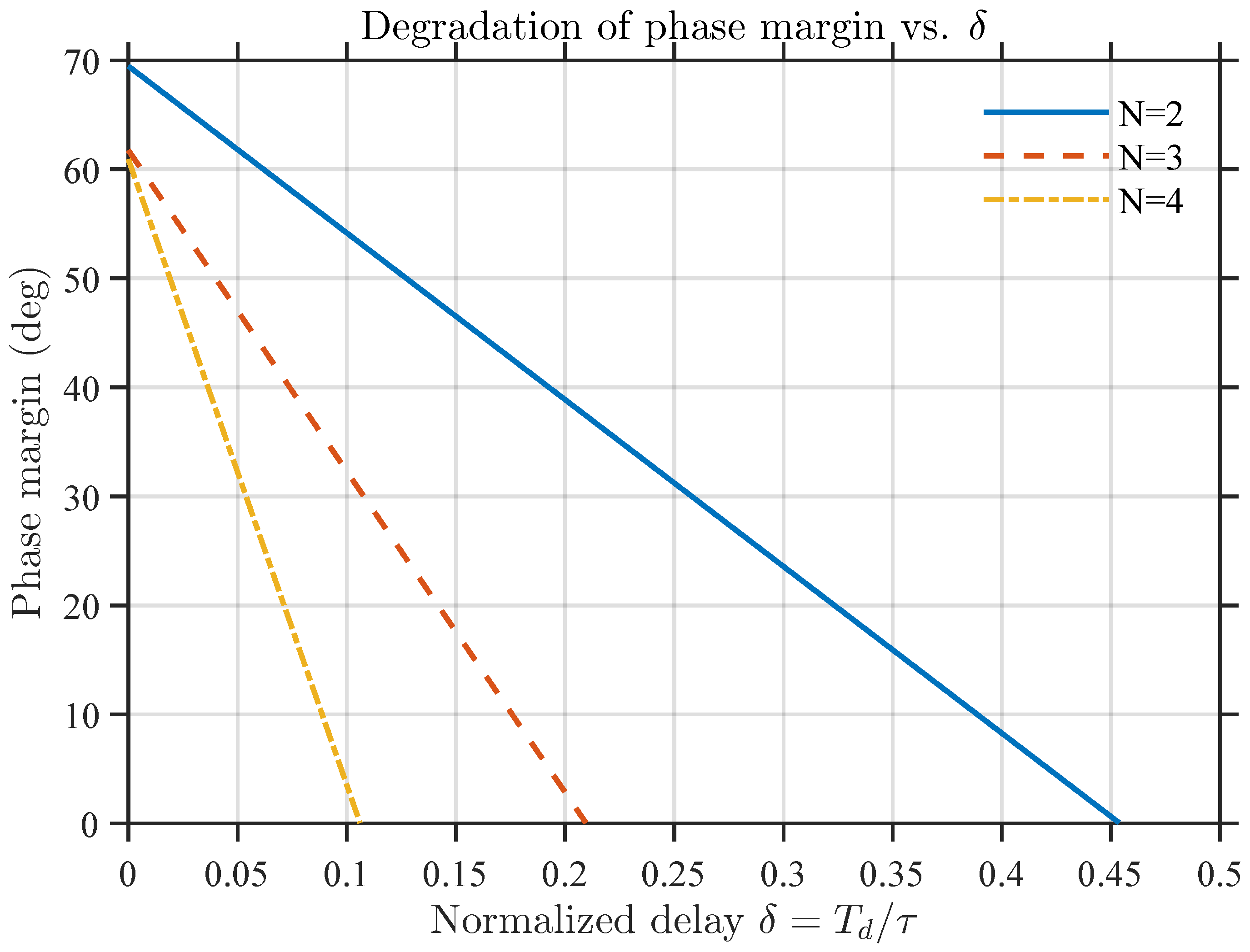
- Phase-margin (PM) and gain-margin (GM) degradation laws versus , summarized as design charts; a simple PM-based inequality is provided for selecting to meet a required robustness level, with GM treated as a verification step supported by a compact rational approximation.
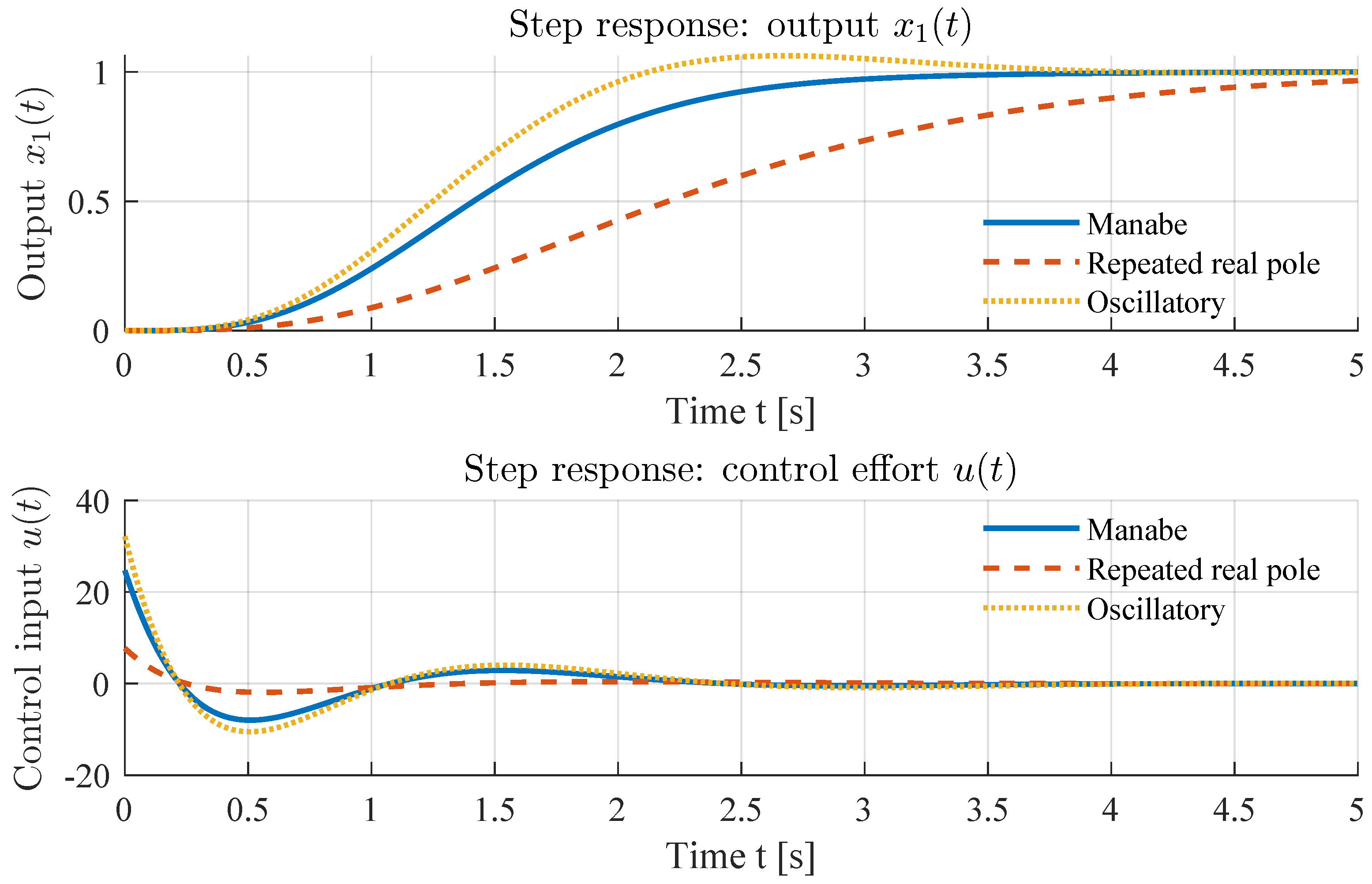
- A comparative illustration against common pole-selection patterns (repeated real poles and repeated oscillatory prototypes) under matched dominant time constants, highlighting transient-response and control-effort trade-offs.
2. Preliminaries: Plant and Controller Synthesis
2.1. Chain-of-Integrators Model and Meaning in Electric Drives
2.1.1. State Vector and Indexing Convention
2.1.2. State-Space Realization
2.1.3. Practical Meaning for Electric Drives
- (single integrator) corresponds to position as the integral of velocity. This abstraction is appropriate when the inner velocity loop is much faster than the outer position loop and can be approximated by a static gain.
- (double integrator) is the classical model for position control with acceleration as a direct input, i.e., when the commanded torque/current channel can be viewed as producing acceleration after lumping the inertia and torque constant into b.
- becomes relevant when an additional dynamic stage is explicitly represented (e.g., inner-loop actuator dynamics, a filtered torque reference, or a deliberately introduced auxiliary state), leading to additional integrator-like behavior in the outer-loop model.
- is a convenient benchmark for position regulation with an additional integral action (or auxiliary state) introduced to remove the steady-state offset under disturbances or parameter mismatch. In this case, the fourth state may represent an integral-of-error state or a higher-order kinematic relation, depending on the chosen state augmentation.
2.1.4. Scope and Limitations
2.2. State-Feedback Pole Placement for the Nominal Plant
2.2.1. Nominal Plant Model for Synthesis
2.2.2. Full State-Feedback Law (Two Degrees of Freedom)
2.2.3. Pole Placement Objective
2.2.4. Ackermann Formula (Single-Input Case)
2.2.5. Reference Tracking via a Static Prefilter
2.2.6. Remark on State Availability
3. Manabe Polynomials
3.1. Historical Notes and Context
3.2. Construction of a Manabe Polynomial
Explicit Manabe Polynomials for
- Order . For the polynomial is simply
3.3. Pole Patterns and Step-Response Comparison (Fourth-Order Illustration)
3.3.1. Three Fourth-Order Reference Polynomials
(A) Manabe Polynomial (Order 4)
(B) Quadruple Real Pole (Order 4)
(C) Squared Second-Order Oscillatory Pattern (Order 4)
Matching the Dominant Time Constant Across Pole-Selection Methods
- For the repeated-real-pole design, the desired characteristic polynomial is , i.e., all closed-loop poles are located at . Therefore,
3.3.2. Qualitative Comparison
- The repeated real pole (36) typically yields a monotonic response (no oscillations) but with a comparatively “heavy” transient tail due to pole multiplicity.
- The squared oscillatory pattern (37) produces pronounced oscillatory transients whose overshoot and ringing depend strongly on ; pole multiplicity tends to increase peaking for a given damping ratio.
4. Effect of Unmodeled Input Delay
4.1. Sources of Input Delay in Drive Control Loops
4.2. Effect of Unmodeled Input Delay on Stability
4.2.1. Nominal Manabe Polynomials for and
4.2.2. Characteristic Equation with Input Delay
4.2.3. Stability Depends Primarily on the Ratio
4.2.4. Delay Margin for the Adopted Manabe Template
4.3. Phase Margin and Gain Margin: Use as Delay-Robustness Indicators
4.3.1. Phase Margin (PM)
4.3.2. Gain Margin (GM)
4.4. Computing the Phase Margin as a Function of the Normalized Delay
4.4.1. Gain Crossover Is Independent of
4.4.2. Exact Affine Law for
4.4.3. PM-Driven Tuning Rule for
4.5. Computing the Gain Margin as a Function of the Normalized Delay
4.5.1. Open-Loop Model Used for Margin Evaluation
4.5.2. Dependence on and Numerical Evaluation
4.5.3. Closed-Form Reduction for
4.5.4. Extension to
4.5.5. Role in the Tuning Workflow
4.5.6. Rat22 Approximation for Quick Checks
5. Conclusions and Future Work
Funding
Data Availability Statement
Conflicts of Interest
References
- Saif, A.W.A.; El-Ferik, S.; Elkhider, S.M. Robust Stabilization of Linear Time-Delay Systems under Denial-of-Service Attacks. Sensors 2023, 23, 5773. [Google Scholar] [CrossRef] [Scilit] [PubMed]
- Jiang, Y.; Yang, H.; Ivanov, I.G. Reachable Set Estimation and Controller Design for Linear Time-Delayed Control System with Disturbances. Mathematics 2024, 12, 176. [Google Scholar] [CrossRef] [Scilit]
- Ackermann, J. Der Entwurf linearer Regelungssysteme im Zustandsraum. Regelungstechnik 1972, 20, 297–300. [Google Scholar] [CrossRef] [Scilit]
- Ackermann, J. Robust Control: The Parameter Space Approach, 2nd ed.; Communications and Control Engineering; Springer: London, UK, 2002. [Google Scholar] [CrossRef] [Scilit]
- Butterworth, S. On the Theory of Filter Amplifiers. Exp. Wirel. Wirel. Eng. 1930, 7, 536–541. [Google Scholar]
- Manabe, S. Coefficient Diagram Method. IFAC Proc. Vol. 1998, 31, 211–222. [Google Scholar] [CrossRef] [Scilit]
- Kim, Y.C.; Manabe, S. Introduction to Coefficient Diagram Method. IFAC Proc. Vol. 2001, 34, 147–152. [Google Scholar] [CrossRef] [Scilit]
- Manabe, S. Importance of Coefficient Diagram in Polynomial Method. In Proceedings of the 42nd IEEE Conference on Decision and Control (CDC 2003), Maui, HI, USA, 9–12 December 2003; pp. 3489–3494. [Google Scholar] [CrossRef] [Scilit]
- Manabe, S.; Kim, Y.C. Coefficient Diagram Method for Control System Design; Intelligent Systems, Control and Automation: Science and Engineering Series; Springer: Singapore, 2021; Volume 99. [Google Scholar] [CrossRef] [Scilit]
- Iswanto, I.; Ma’arif, A. Robust Integral State Feedback Using Coefficient Diagram in Magnetic Levitation System. IEEE Access 2020, 8, 57003–57011. [Google Scholar] [CrossRef] [Scilit]
- Ma’arif, A.; Cahyadi, A.I.; Herdjunanto, S.; Wahyunggoro, O. Tracking Control of High Order Input Reference Using Integrals State Feedback and Coefficient Diagram Method Tuning. IEEE Access 2020, 8, 182731–182741. [Google Scholar] [CrossRef] [Scilit]
- Gardecki, S.; Giernacki, W.; Goslinski, J. Speed Control of Drive Unit in Four-rotor Flying Robot. In Proceedings of the 10th International Conference on Informatics in Control, Automation and Robotics: ICINCO, Reykjavík, Iceland, 29–31 July 2013; SciTePress: Setúbal, Portugal, 2013; pp. 245–250. [Google Scholar] [CrossRef] [Scilit]
- Liu, N.; Pang, H.; Yao, R. Robust Mixed H2/Hinf State Feedback Controller Development for Uncertain Automobile Suspensions with Input Delay. Processes 2020, 8, 359. [Google Scholar] [CrossRef] [Scilit]
- Wei, Y.; Wei, Y.; Sun, Y.; Qi, H.; Guo, X.; Li, M. A Smith Structure-Based Delay Compensation Method for Model Predictive Current Control of PMSM System. IEEE J. Emerg. Sel. Top. Power Electron. 2022, 10, 4090–4101. [Google Scholar] [CrossRef] [Scilit]
- Wang, H.; Gan, C.; Ren, H.; Zhang, C.; Shan, X.; Qu, R. An Input-Delay Compensation Strategy for Deadbeat Predictive Current Control of PMSM. IEEE Trans. Ind. Electron. 2025, 72, 11141–11146. [Google Scholar] [CrossRef] [Scilit]
- Baek, J.; Cho, S.; Han, S. Practical Time-Delay Control with Adaptive Gains for Trajectory Tracking of Robot Manipulators. IEEE Trans. Ind. Electron. 2018, 65, 5682–5692. [Google Scholar] [CrossRef] [Scilit]
- Ma, M.; Yao, S.; Ma, W. Study on Control Approaches for Servo Systems Exhibiting Uncertain Time Delays. Machines 2025, 13, 264. [Google Scholar] [CrossRef] [Scilit]
- Druzhinina, O.V.; Sedova, N.O. On the Output Stabilization Problem: Constructing a Delay Feedback for a Chain of Integrators. Autom. Remote Control 2022, 83, 180–190. [Google Scholar] [CrossRef] [Scilit]
- Koo, M.S.; Choi, H.L.; Lim, J.T. Output Feedback Regulation of a Chain of Integrators with an Unbounded Time-Varying Delay in the Input. IEEE Trans. Autom. Control 2012, 57, 2662–2667. [Google Scholar] [CrossRef] [Scilit]
- Oh, S.Y.; Choi, H.L. Adaptive Zero-Order-Hold Triggered Control of a Chain of Integrators with Unknown Input Delay and Interexecution Time by Output Feedback. IEEE Trans. Autom. Control 2025, 70, 1281–1288. [Google Scholar] [CrossRef] [Scilit]



| N | [°] | ||
|---|---|---|---|
| 2 | 0.4541 | 2.6696 | 69.46 |
| 3 | 0.2097 | 5.1388 | 61.75 |
| 4 | 0.1062 | 10.0163 | 60.92 |
| N | |||||
|---|---|---|---|---|---|
| 2 | |||||
| 3 | |||||
| 4 |
Disclaimer/Publisher’s Note: The statements, opinions and data contained in all publications are solely those of the individual author(s) and contributor(s) and not of MDPI and/or the editor(s). MDPI and/or the editor(s) disclaim responsibility for any injury to people or property resulting from any ideas, methods, instructions or products referred to in the content. |
© 2026 by the author. Licensee MDPI, Basel, Switzerland. This article is an open access article distributed under the terms and conditions of the Creative Commons Attribution (CC BY) license.
Share and Cite
Brock, S. Feedback Control Design for Time-Delay Systems Based on the Manabe Polynomial Concept Under Unmodeled Input Delay. AppliedMath 2026, 6, 51. https://doi.org/10.3390/appliedmath6030051
Brock S. Feedback Control Design for Time-Delay Systems Based on the Manabe Polynomial Concept Under Unmodeled Input Delay. AppliedMath. 2026; 6(3):51. https://doi.org/10.3390/appliedmath6030051
Chicago/Turabian StyleBrock, Stefan. 2026. "Feedback Control Design for Time-Delay Systems Based on the Manabe Polynomial Concept Under Unmodeled Input Delay" AppliedMath 6, no. 3: 51. https://doi.org/10.3390/appliedmath6030051
APA StyleBrock, S. (2026). Feedback Control Design for Time-Delay Systems Based on the Manabe Polynomial Concept Under Unmodeled Input Delay. AppliedMath, 6(3), 51. https://doi.org/10.3390/appliedmath6030051