Article

Survival Probabilities for Correlated Drifted Brownian Motions via Exit from Simplicial Cones


by
Tristan Guillaume
Laboratoire Thema, CY Cergy Paris Université, 33 Boulevard du Port, F-95011 Cergy, France
AppliedMath 2026, 6(3), 45; https://doi.org/10.3390/appliedmath6030045
Submission received: 29 January 2026 / Revised: 25 February 2026 / Accepted: 2 March 2026 / Published: 10 March 2026
(This article belongs to the Section Probabilistic & Statistical Mathematics)

Abstract

This paper investigates the finite-horizon survival probability for a system of correlated arithmetic Brownian motions with heterogeneous drifts and volatilities, focusing on the event in which one component remains strictly below all others. Using a whitening transformation of the covariance structure, we reduce the problem to the survival of a standard Brownian motion in a simplicial cone, characterized by its spherical cross-section. While explicit solutions are available in low dimensions, we address the computationally challenging tetrahedral angular case. We derive a semi-analytic formula for the survival probability via an eigenfunction expansion of the Dirichlet Laplace–Beltrami operator on this curved domain. For efficient implementation, we construct a diffeomorphism from the spherical tetrahedron to a fixed Euclidean tetrahedron, enabling the computation of angular eigenpairs through a stable finite-element scheme. For higher-dimensional regimes, we also introduce a covariance-based difficulty index and geometric bounds based on an inscribed spherical cap to assess spectral convergence and estimate long-time decay rates. Numerical experiments show that this offline–online approach achieves high accuracy and substantial speedups relative to Monte Carlo benchmarks.

1. Introduction

Let ( X i ( t ) ) t 0 , i = 1 , , m , be m  correlated ABMs (Arithmetic Brownian Motions) with heterogeneous drifts and volatilities. We assume
X i ( t ) = x i + μ i t + σ i W i ( t ) , i = 1 , , m ,
where x 1 , , x m R are pairwise distinct, μ i R , σ i > 0 , and ( W 1 , , W m ) is an m -dimensional ABM with a constant instantaneous correlation matrix ( ρ i j ) , i.e., d W i , W j t = ρ i j d t . We study the probability that X 1 remains strictly below all the other components throughout a time interval [ 0 , T ] :
P X 1 ( t ) < X i ( t )   for   all   i = 2 , , m   and   all   t [ 0 , T ]
With the stopping time
τ : = i n f { t 0 : X 1 ( t ) X i ( t )   for   some   i { 2 , , m } } ,
and the quantity of interest is P ( τ > T ) .
The passage to results involving geometric Brownian motion follows via an elementary exponential transformation.
The finite-horizon survival event is a central object in the theory of Gaussian processes and arises naturally in problems of ranking, sequential dominance, and first-passage phenomena [1,2]. In mathematical finance, the set { τ > T } is a prototypical multidimensional barrier event, which we will refer to as the “survival” event. In barrier/knockout pricing, one commonly encounters quantities of the form
E P ( 0 , T ) g X 1 , . . . , X m 1 { τ > T } ,
where P ( 0 , T ) and g denote a discount factor and a payoff function, respectively. Accordingly, survival probabilities such as P τ > T , together with change-of-measure and change-of-numeraire techniques, are fundamental ingredients in the pricing of many variants of the standard barrier and lookback contracts. A first extension consists of defining multi-asset payoffs in which knockout (or knock-in) conditions are imposed on several underlying assets; see [3] for an application to lookback options, and [4] for an application to barrier options. The survival event is also central to the valuation and risk management of contracts with stochastic barriers [5,6,7], and it underpins models of continuous default risk for vulnerable options [8,9,10]. Additional credit risk applications include the valuation of CDOSs (Collateralized Debt Obligations), n-th-to-default swaps, and mutual liabilities; see [11,12,13].
However, explicit or semi-analytical formulas are available only in low dimension: for general correlation structures, they are known essentially for three or four correlated ABMs (see [13,14]), and for certain restrictive correlation structures in [15]. Addressing (and at least partly overcoming) these limitations is precisely the aim of the present paper.
Beyond mathematical finance, events of the form { τ > T } arise whenever one tracks the relative ordering of correlated Gaussian signals over time. Typical examples include sequential ranking/selection and best-arm identification with correlated performance proxies [16], race/competition models in psychology [17], and neuroscience (e.g., “first among several accumulating evidence processes”; see [18]), as well as reliability/engineering settings in which failure is triggered by crossing a set of linear inequalities.

1.1. Reduction to Cone Survival and the Role of Spherical Spectra

Introduce the ( m 1 ) -dimensional gap process
Y ( t ) = X 2 ( t ) X 1 ( t ) , , X m ( t ) X 1 ( t ) R d , d : m 1 .
Then, { τ > T } is exactly an orthant survival event for the gap process. The process Y is a Brownian motion with constant drift and a nondegenerate constant covariance matrix Σ . After whitening the covariance, one obtains a standard multivariate Brownian motion with drift, which is killed upon exiting a polyhedral cone K R d . Let S m 1 : = { x R m : x = 1 } denote the unit sphere in R m endowed with its standard Riemannian structure, and let d σ be the associated surface measure. In the present setting, K is simplicial, and its spherical cross-section
Θ : = K S d 1
is a spherical ( d 1 ) -simplex.
A classical approach to heat kernels and exit problems in cones is the separation of variables in polar/spherical coordinates. This leads to a radial special-function factor coupled with the Dirichlet spectral data of the Laplace–Beltrami operator on Θ . In general cones, one obtains series representations for the killed transition density and for the survival probability in terms of Dirichlet eigenpairs on Θ ; see, for example, the general cone framework in [19,20]. In low dimensions and/or highly symmetric cones, one may sometimes bypass the spectral step via reflection principles and group symmetries: the Weyl chamber literature provides prominent examples, with determinantal or Pfaffian expressions for transition densities and survival probabilities in such structured geometries [21,22].
For a generic correlation structure, however, the whitened cone is typically neither a Weyl chamber nor close to a right circular cone, and the angular Dirichlet problem on Θ becomes the main obstacle. This difficulty already appears in dimension d = 3 (three-dimensional orthant), where Θ is a spherical triangle. Although a semi-analytical method for that case was developed in [13], we include a specialization of our approach for completeness and to make the transition to more complex cases fully transparent. The next case, d = 4 (corresponding to m = 5 one-dimensional components), is substantially harder: Θ is then a spherical tetrahedron, and one must compute Dirichlet eigenpairs on a curved three-dimensional domain.

1.2. The 4D Orthant Case and the High-Dimensional Perspective

The main focus of this paper is the first genuinely nontrivial step beyond the octant, namely m = 5 (gap dimension d = 4 ). An explicit semi-analytical representation of P ( τ > T ) is obtained, which reduces the evaluation to: (i) a one-dimensional quadrature, and (ii) an eigen expansion over the Dirichlet spectrum of the Laplace–Beltrami operator on a spherical tetrahedron. In addition, an alternative fully explicit double series form is provided, in which the radial factors are expressed in terms of confluent hypergeometric functions.
A second objective is to make the representation computationally effective. To this end, we construct an explicit diffeomorphism from the spherical tetrahedron Θ to a fixed Euclidean tetrahedron, together with closed-form expressions for the pullback metric, its inverse, and its determinant. This transforms the angular Dirichlet problem on a curved domain into a variable-coefficient elliptic eigenproblem on a flat tetrahedron, enabling stable and efficient finite-element computation of the eigenpairs. The resulting offline/online pipeline (precomputation stage/evaluation stage) precomputes the angular spectral data for a given correlation structure, after which survival probabilities for many parameter sets ( μ i , σ i , x i , T ) can be evaluated rapidly.
Finally, the high-dimensional regime is addressed. Although the cone/eigenfunction expansion is valid in any dimension, solving the angular eigenproblem on a spherical simplex becomes rapidly expensive as the dimension grows. To complement the semi-analytical formulas with dimension-robust information, we introduce a covariance-only geometric diagnostic and bound. Starting from the gap covariance Σ , we construct an explicit inscribed spherical cap contained in Θ . This yields (i) a computable difficulty index I ( Σ ) , which measures cone narrowness, and (ii) a spectrum-free comparison bound on the principal Dirichlet eigenvalue λ 1 ( Θ ) , and hence on the driftless cone exponent governing the polynomial prefactor in long-time survival asymptotics.

1.3. Organization of This Paper

Section 2 introduces the model and reduces the problem to the orthant survival of the gap process. Section 3 performs the whitening transform and sets the framework of survival in a simplicial cone K with spherical cross-section Θ . Section 4 develops the covariance-only geometric bound and the difficulty index I ( Σ ) . Section 5 presents the general cone expansion for the killed transition density and survival probability. Section 6 specializes the results to the spherical tetrahedron case ( d = 4 ) and states evaluation-ready formulas. Section 7 describes the Euclidean tetrahedron pullback and the finite-element computation of angular eigenpairs. Section 8 discusses the full numerical procedure, truncation strategies, and the role of I ( Σ ) as a diagnostic. Section 9 reports numerical experiments along with Monte Carlo approximations. Section 10 presents the general-dimensional extension and discusses the high-dimensional regime. Appendix A works out the spherical triangle case (dimension d = 3 ). Appendix B includes a consolidated notation table.

2. Model and Reduction to an Orthant Survival Event

2.1. Correlated Brownian System with Heterogeneous Drifts and Volatilities

Fix an integer m 2 . Let ( X i ( t ) ) t 0 , i = 1 , , m , be defined as in (1). It is assumed throughout that R = ( ρ i j ) 1 i , j m is positive definite.
Let x = ( x 1 , , x m ) R m be the vector of initial positions, μ = ( μ 1 , , μ m ) R m the drift vector, and σ = ( σ 1 , , σ m ) ( 0 , ) m the volatility vector. Define the diagonal matrix
Σ σ : = d i a g ( σ 1 , , σ m ) .
The m processes of Equation (1) can be written in vector form as
X ( t ) = x + μ t + Σ σ W ( t ) .
Then, X is a Gaussian diffusion with constant drift μ and instantaneous covariance matrix
d X t = Σ σ R Σ σ d t .
The following event is considered
E T : = X 1 ( t ) < X i ( t )   for   all   i = 2 , , m   and   all   t [ 0 , T ] .
Because the paths are continuous, E T is an event of the “non-collision” type. Note that P ( E T ) = 0 if x 1 x i for some i 2 , since the strict inequalities must hold at t = 0 . Henceforth we assume
x 1 < x i , i = 2 , , m .
so that E T is nontrivial.
Define the first violation time of the survival ordering,
τ : = i n f { t 0 : i { 2 , , m }   such   that   X 1 ( t ) X i ( t ) } .
Then, E T = { τ > T } , and the quantity of interest is P ( τ > T ) .

2.2. Gap Process and Equivalence with Orthant Survival

Set d : = m 1 . Introduce the d -dimensional gap process
Y ( t ) = ( Y 1 ( t ) , , Y d ( t ) ) : = ( X 2 ( t ) X 1 ( t ) , , X m ( t ) X 1 ( t ) ) R d .
Let y = ( y 1 , , y d ) denote its initial point:
y k = x k + 1 x 1 , k = 1 , , d ,
so y ( 0 , ) d under the standing assumption x 1 < x i for i 2 .
Define the positive orthant
R + d : = ( 0 , ) d , R + d : = [ 0 , ) d .
Lemma 1 (reduction to orthant survival). 
For every T > 0 ,
E T = { Y ( t ) R + d   for   all   t [ 0 , T ] } .
Equivalently, if
τ + : = i n f { t 0 : Y ( t ) R + d } = i n f { t 0 : m i n 1 k d Y k ( t ) 0 } ,
then τ = τ + almost surely and P ( E T ) = P ( τ + > T ) .
Proof. 
By definition, Y k ( t ) = X k + 1 ( t ) X 1 ( t ) . Thus X 1 ( t ) < X k + 1 ( t ) for all k = 1 , , d is equivalent to Y k ( t ) > 0 for all k , i.e., Y ( t ) R + d . The identity of stopping times follows from the continuity of paths: the first time the strict inequalities fail is the first time at least one gap becomes 0 . □
Hence, the sought probability is exactly an orthant survival probability for Y .

2.3. Drift and Covariance Structure of the Gap Process

The process Y is itself a Brownian motion in R d with constant drift and a constant nondegenerate covariance matrix. Indeed, set
b : = ( μ 2 μ 1 , , μ m μ 1 ) R d .
and note that
Y ( t ) = y + b t + σ 2 W 2 ( t ) σ 1 W 1 ( t ) , , σ m W m ( t ) σ 1 W 1 ( t ) .
It is convenient to write this in matrix form. Define the d × m difference matrix H by
H : = 1 1 0 0 1 0 1 0 1 0 0 1 .
so that Y ( t ) = H X ( t ) and y = H x , b = H μ . Then, the instantaneous covariance matrix of Y is
Σ : = d d t Y t = H Σ σ R Σ σ H R d × d .
Under our standing assumptions ( σ i > 0 and R positive definite), Σ is positive definite, hence invertible.
Equivalently, we may represent the diffusion part using an R m -valued Brownian motion with covariance Σ : we denote by B Σ t a Brownian motion such that
C o v B Σ t = t Σ ,   for all   t 0 .
For instance, if B is a standard m -dimensional Brownian motion, one may take B Σ t = Σ 1 / 2 B t . With this notation, the gap process can be written
Y t = Y 0 + b t + B Σ t .
For later use (and to make the dependence on the model parameters transparent), we record the entries of Σ . For i , j { 2 , , m } , set k = i 1 , l = j 1 , so that Y k = X i X 1 and Y l = X j X 1 . Then
Σ k k = V a r ( X i ( 1 ) X 1 ( 1 ) ) = σ i 2 + σ 1 2 2 σ 1 σ i ρ 1 i .
and for i j ,
Σ k l = C o v ( X i ( 1 ) X 1 ( 1 ) , X j ( 1 ) X 1 ( 1 ) ) = σ i σ j ρ i j + σ 1 2 σ 1 σ i ρ 1 i σ 1 σ j ρ 1 j .
This explicit form will be used both in the whitening step and in the geometric diagnostics introduced later.

3. Whitening and Simplicial Cone Formulation

3.1. Whitening Transform

Let Σ R d × d be symmetric positive definite. Define the symmetric inverse square root
A : = Σ 1 / 2 ,
so that A Σ A = I d . Set
Z ( t ) : = A Y ( t ) , z : = A y , β : = A b .
Then
Z ( t ) = z + β t + A B Σ ( t ) ,
where B Σ is as defined in Section 2.3 (i.e., C o v B Σ t = t Σ ).
Lemma 2 (standardization of the covariance). 
The process W ( t ) : = A B Σ ( t ) is a standard d -dimensional Brownian motion, i.e.,
d W t = I d d t .
Consequently,
Z ( t ) = z + β t + W ( t )
is a Brownian motion in R d with drift β and identity diffusion matrix.
Proof. 
Since d B Σ t = Σ d t , we have
d W t = A d B Σ t A = A Σ A d t = I d d t .
The representation of Z follows by linearity. □
Remark 1 (conditioning of whitening). 
The construction above requires Σ to be symmetric positive definite; when λ m i n Σ is small (e.g., correlations close to ± 1 ), the whitening map x Σ 1 / 2 x becomes ill-conditioned, with sensitivity governed by κ Σ = λ m a x Σ / λ m i n Σ (equivalently, amplification on the order of κ Σ 1 / 2 ). In computations, we therefore avoid forming Σ 1 / 2 by explicit inversion, and implement whitening via a Cholesky factorization Σ = L L and triangular solves (apply L 1 to vectors). Large κ Σ corresponds to strongly anisotropic diffusion and typically produces a very “narrow”/distorted whitened cone geometry—precisely the stiff regime later quantified by the difficulty index in Section 4.
Thus, whitening transfers all dependence on the original covariance into the geometry of the transformed domain.

3.2. Image of the Orthant: A Simplicial Cone in R d

Define the positive orthant R + d = ( 0 , ) d . Since Z = A Y , the event { Y ( t ) R + d } becomes { Z ( t ) K } , where the cone K is defined by
K : = A R + d = { A u : u R + d } .
Equivalently,
K = { z R d : A 1 z R + d } = d i = 1 { z R d : e i A 1 z > 0 } .
Since A is symmetric, so is A 1 = Σ 1 / 2 , and we may write the half-space description in inner-product form. Define the (non-unit) inward facet normals
a i : = ( A 1 ) e i = A 1 e i = Σ 1 / 2 e i , i = 1 , , d ,
and the corresponding inward unit normals
ν i : = a i a i , i = 1 , , d .
Then
K = d i = 1 { z R d : a i , z > 0 } = d i = 1 { z R d : ν i , z > 0 } .
Lemma 3 (simplicial structure). 
The cone K is simplicial: it has exactly d facets and exactly d extreme rays. Its extreme rays are generated by the vector
r i : = A e i , i = 1 , , d ,
in the sense that
K = i = 1 d α i r i : α i > 0 .
Proof. 
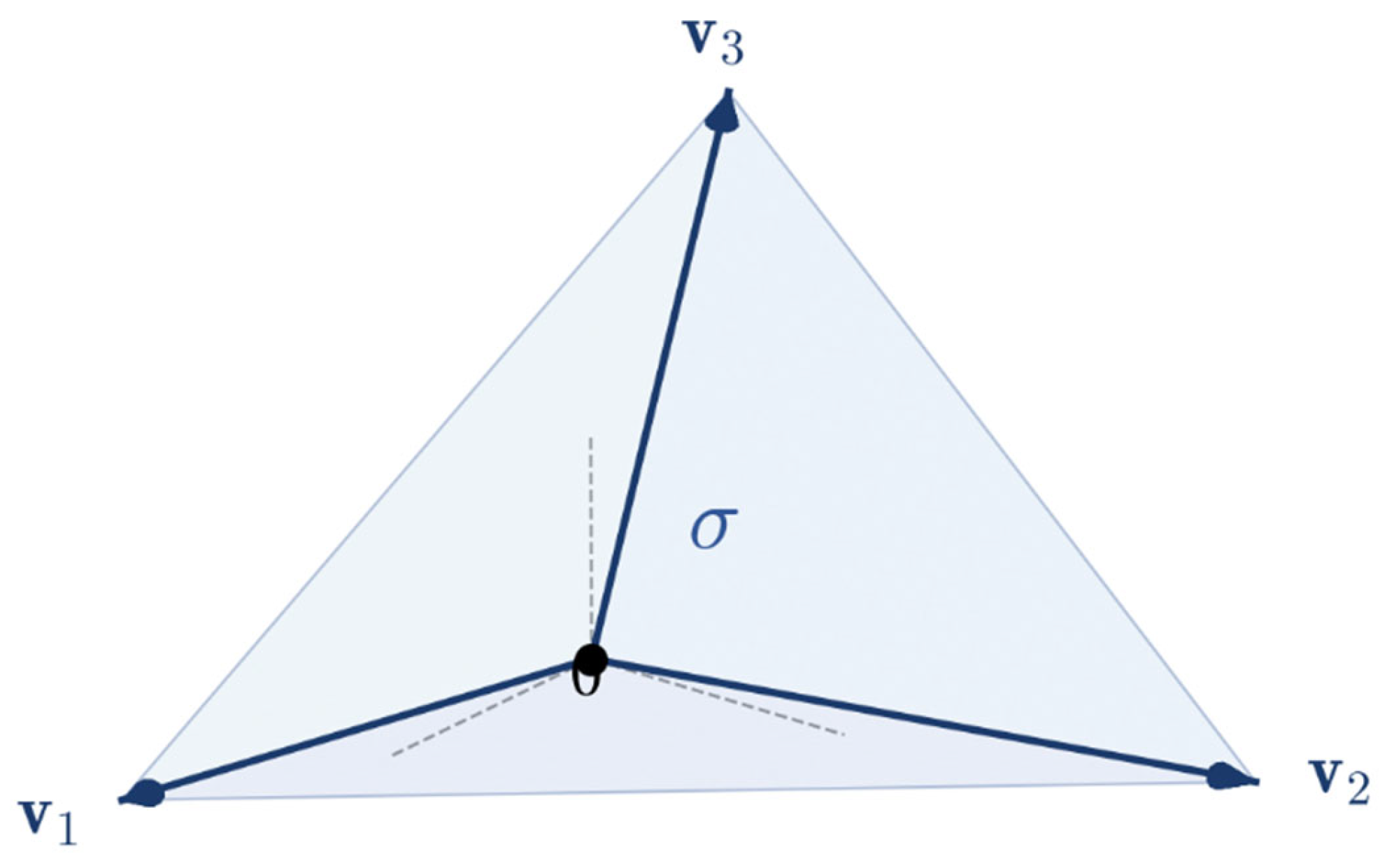
Since R + d is the simplicial cone generated by { e i } i = 1 d , and A is invertible, the linear image A R + d is a simplicial cone generated by { A e i } i = 1 d (cf. Figure 1 below). The half-space representation above shows that K has exactly d supporting hyperplanes { a i , z = 0 } , hence d facets. □
This explicit description will be useful later: the facet geometry is characterized by the Gram matrix ν i , ν j , while the vertex (ray) geometry is characterized by the Gram matrix r i , r j . Both are explicit functions of Σ .

3.3. Exit Times and Equivalence of Survival Probabilities

Let
τ + : = i n f { t 0 : Y ( t ) R + d } .
be the orthant exit time for Y , and define the cone exit time for Z by
τ K : = i n f { t 0 : Z ( t ) K } .
Lemma 4 (equivalence of exit times under whitening). 
One has τ + = τ K almost surely. In particular,
P y ( τ + > T ) = P z ( τ K > T ) , z = A y .
Proof. 
Since A is invertible and Z ( t ) = A Y ( t ) , the inclusion Y ( t ) R + d is equivalent to Z ( t ) A R + d = K . By continuity of sample paths, the first time one process leaves its domain coincides with the first time the transformed process leaves the transformed domain. □
Thus, the survival probability is an exit probability for a standard Brownian motion with drift in a cone.

3.4. Spherical Cross-Section and Polar Coordinates

Define the spherical cross-section (angular domain)
Θ : = K S d 1 .
Since K is simplicial, Θ is a spherical ( d 1 ) -simplex. In particular, for the main case m = 5 (hence d = 4 ), Θ S 3 is a spherical tetrahedron.
We will repeatedly use polar coordinates in R d : any x R d { 0 } can be written as x = r θ , where r = x > 0 and θ S d 1 . Under this parametrization,
x K θ Θ .
This decomposition is the basis for the separation-of-variables representation of the killed transition density in K : the radial part produces modified Bessel/confluent hypergeometric factors, while the angular part is governed by the Dirichlet spectrum of the Laplace–Beltrami operator on Θ .

4. Geometry of the Whitened Cone: Difficulty Index and Dimension-Robust Bounds

This section extracts from the gap covariance matrix Σ a set of geometric quantities attached to the whitened cone K = A R + d from Section 3, where A = Σ 1 / 2 and d = m 1 . The output is twofold:
(i)
A covariance-only scalar diagnostic I ( Σ ) that measures the “narrowness” of the spherical simplex Θ : = K S d 1 , and
(ii)
A spherical cap C a p ( r i n ) Θ , yielding computable bounds on the principal Dirichlet eigenvalue λ 1 ( Θ ) , hence on the driftless cone exponent governing long-time survival.
These quantities remain practical in high dimensions, even when the full Dirichlet spectral problem on Θ is too costly to solve.

4.1. Canonical Facet Normals and a Covariance Identity

Let
d i : = a i = Σ i i , D : = d i a g ( d 1 , , d d ) .
Lemma 5 (Gram matrix of facet normals). 
The Gram matrix of inward unit facet normals,
G : = ν i , ν j 1 i , j d
satisfies the covariance identity
G = D 1 Σ D 1 .
Proof. 
Since a i = Σ 1 / 2 e i , we have a i , a j = e i Σ e j = Σ i j , and a i = d i . Therefore,
ν i , ν j = a i , a j a i a j = Σ i j d i d j ,
which is exactly D 1 Σ D 1 . □
In particular, G is the correlation matrix associated with Σ . Thus, the angular geometry of Θ (dihedral angles, etc.) is fully determined by the (normalized) gap covariance.

4.2. An Inscribed Spherical Cap from Σ

Since K is simplicial (cf. Lemma 3), Θ = K S d 1 is a spherical ( d 1 ) -simplex. For u S d 1 , set
δ ( u ) : = m i n 1 i d ν i , u .
Then u Θ if and only if δ ( u ) > 0 . The quantity δ ( u ) admits a direct geometric interpretation: it controls the largest spherical cap centered at u that remains inside Θ .
To make this explicit, recall that the i -th boundary face of Θ is the great ( d 2 ) -sphere
i Θ = { θ S d 1 : ν i , θ = 0 } Θ
For any unit u S d 1 , the geodesic distance from u to the great sphere { θ : ν i , θ = 0 } equals a r c s i n ( ν i , u ) . Consequently, the spherical cap of radius
r ( u ) : = a r c s i n ( δ ( u ) )
centered at u is contained in Θ whenever u Θ .
We now construct a canonical choice u i n yielding a cap radius that is explicit in Σ .
Let N R d × d be the matrix whose i -th row is ν i . Since the ν i are linearly independent (simplicial cone), N is invertible.
Proposition 1 (explicit incenter candidate and explicit radius). 
Define
u i n : = N 1 1 N 1 1 , 1 = ( 1 , , 1 ) R d .
Then, ν i , u i n is the same for all i , and equals
δ i n = 1 1 ( N N ) 1 1 = 1 1 G 1 1 = 1 ( D 1 ) Σ 1 ( D 1 ) .
In particular, the spherical cap C a p ( r i n ) centered at u i n with radius
r i n : = a r c s i n ( δ i n ) ,
satisfies
C a p ( r i n ) Θ .
Proof. 
By construction, N ( N 1 1 ) = 1 . Hence, letting v : = N 1 1 ,
ν i , v = 1 for   all   i ,
and normalizing gives ν i , u i n = 1 / v = : δ i n for all i . Moreover,
v 2 = 1 ( N 1 N ) 1 = 1 ( N N ) 1 1 .
Since N N = G , this yields δ i n = ( 1 G 1 1 ) 1 / 2 . Using Lemma 5, G = D 1 Σ D 1 implies G 1 = D Σ 1 D , hence 1 G 1 1 = ( D 1 ) Σ 1 ( D 1 ) . Finally, since the distance from u i n to the i -th supporting great sphere equals a r c s i n ( ν i , u i n ) , the cap of radius a r c s i n ( δ i n ) around u i n lies in every defining hemisphere, hence in their intersection Θ . □
Remark 2 (relation to the true inradius). 
The spherical inradius of  Θ  is
r : = s u p u Θ a r c s i n m i n 1 i d ν i , u .
The construction above produces a guaranteed inscribed cap and therefore a lower bound  r i n r . In many generic simplicial configurations, u i n coincides with the true incenter (all facets are active at the maximizer), but this is not required for the inclusions and bounds below.

4.3. A Covariance “Difficulty Index”

Definition 1 (difficulty index). 
Define
I ( Σ ) = ( D 1 ) Σ 1 ( D 1 ) , D = d i a g Σ 11 , , Σ d d ,
so that
δ i n = 1 I ( Σ ) , r i n = a r c s i n 1 I ( Σ ) .
The difficulty index I ( Σ ) is dimensionless and depends only on the gap covariance. It increases when the spherical simplex Θ becomes “narrow” in the sense of having a small inradius. In the numerical pipeline developed later, large I ( Σ ) is a reliable indicator that the angular Dirichlet eigenproblem may be stiffer (more modes required for a fixed tolerance).

4.4. A Dimension-Robust Bound on the Principal Spherical Eigenvalue

Let λ 1 ( Θ ) denote the principal Dirichlet eigenvalue of the Laplace–Beltrami operator on Θ . The driftless cone exponent controlling the polynomial prefactor in long-time survival depends monotonically on λ 1 ( Θ ) (this is recalled in the general cone asymptotic discussion later in this paper). Consequently, bounds on λ 1 ( Θ ) translate immediately into bounds on that exponent.
A key input is the domain monotonicity of Dirichlet eigenvalues on the sphere.
Lemma 6 (Dirichlet domain monotonicity on S d 1 ). 
Let Ω 1 Ω 2 S d 1 be nonempty open sets with (say) Lipschitz boundary. Let λ 1 Ω denote the principal Dirichlet eigenvalue of Δ S d 1 on Ω . Then,
λ 1 Ω 2 λ 1 Ω 1 .
More generally, the same monotonicity holds for all Dirichlet eigenvalues λ k .
Proof. 
By the Rayleigh–Ritz characterization,
λ 1 Ω = i n f 0 u H 0 1 Ω Ω S u 2 d σ Ω u 2 d σ .
If Ω 1 Ω 2 , any u H 0 1 Ω 1 extended by 0 outside Ω 1 belongs to H 0 1 Ω 2 , so the infimum is taken over a larger set for Ω 2 , hence λ 1 Ω 2 λ 1 Ω 1 . □
This applies in particular to spherical caps (smooth boundary) and to spherical simplices such as Θ , whose boundary is piecewise smooth and hence Lipschitz.
Let C a p ( r ) S d 1 denote a spherical cap of geodesic radius r . Its principal Dirichlet eigenvalue λ 1 ( C a p ( r ) ) is computable via a one-dimensional Sturm–Liouville problem in the polar angle.
Proposition 2 (cap comparison bound). 
With r i n as in Proposition 1, one has
λ 1 ( Θ ) λ 1 C a p ( r i n ) .
Proof. 
Proposition 1 gives C a p ( r i n ) Θ . Lemma 6 then yields λ 1 ( C a p ( r i n ) ) λ 1 ( Θ ) , i.e., the stated inequality. □
Corollary 1 (a high-dimensional estimate for the driftless exponent). 
Any formula in this paper that expresses the driftless cone exponent as a monotone function of λ 1 ( Θ ) immediately yields a computable upper bound by substituting λ 1 ( C a p ( r i n ) ) for λ 1 ( Θ ) . Since r i n is explicit in Σ , this bound requires no angular eigencomputation on Θ .
Remark 3 (computation and tightness of λ 1 ( C a p ( r ) ) ). 
The cap eigenvalue λ 1 ( C a p ( r ) ) is characterized by a one-dimensional boundary value problem: the principal eigenfunction is radial, and in polar angle θ ( 0 , r ) it solves
f ( θ ) + ( d 2 ) c o t ( θ ) f ( θ ) + λ f ( θ ) = 0 ,     f ( 0 ) = 0 , f ( r ) = 0 .
Thus, λ 1 ( C a p ( r ) ) can be obtained by a fast scalar root search even for very large d . In particular, Proposition 2 provides a practical bound on λ 1 ( Θ ) that remains computationally trivial in high dimension.
The cap comparison λ 1 Ω λ 1 cap r i n is a certified bound driven by an explicit inscribed radius r i n . It is sharp when Ω is close to a cap and, more generally, when the incenter candidate is active on all facets. For highly skewed spherical tetrahedra, the guaranteed r i n may be strictly smaller than the true inradius, so the bound can be conservative; in the 4D/tetrahedron computations, we therefore use it mainly as a diagnostic/sanity check.

4.5. Geometric Intuition

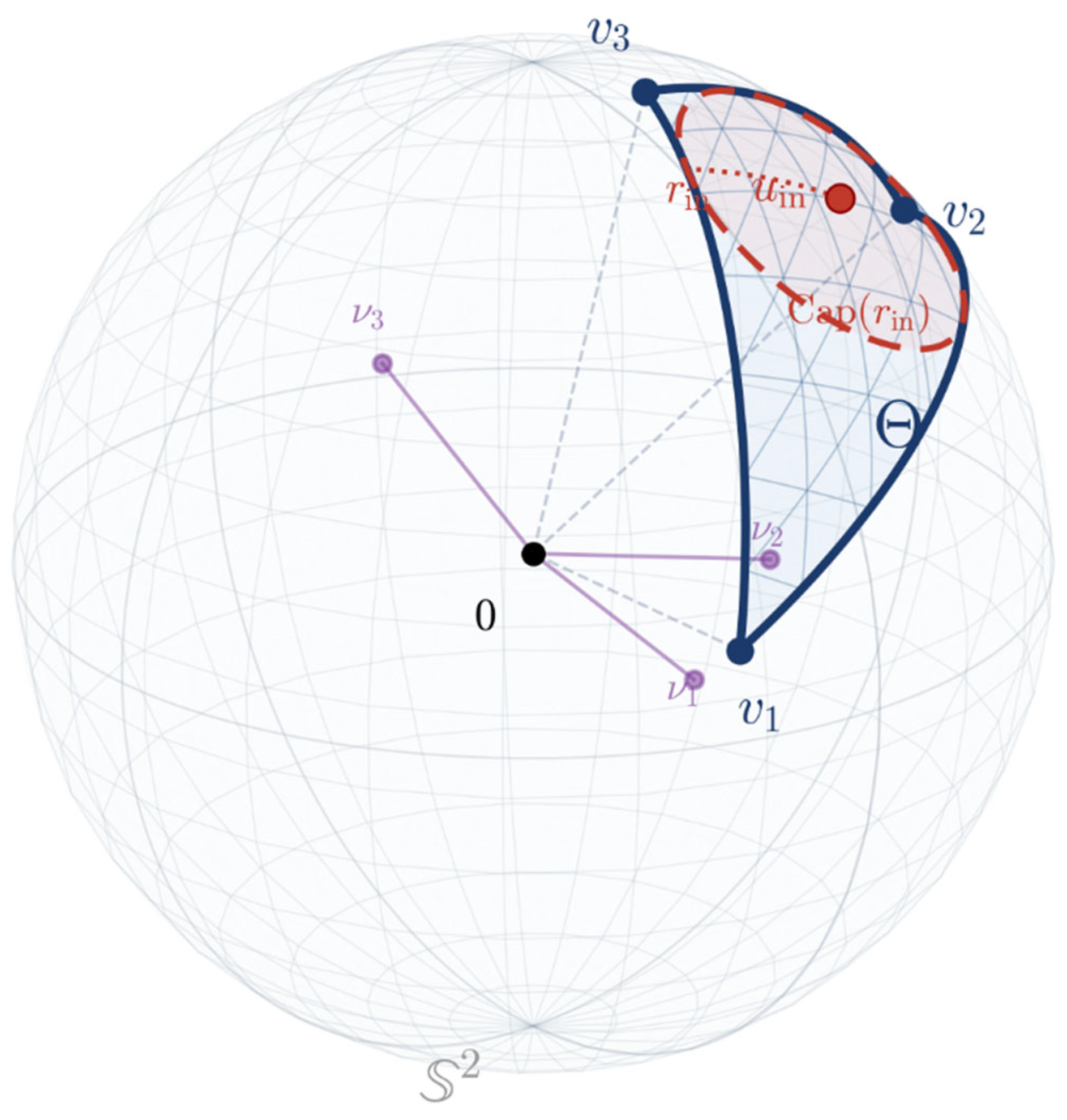
Retracing our steps, the method can be informally described as follows. After whitening, the problem reduces to a standard Brownian motion killed when it leaves a cone K . Looking only at directions, this cone becomes a region Θ on the unit sphere (a spherical simplex), bounded by a few great-circle arcs (see Figure 2 at the end of Section 4.5). The point u i n is a “most central” direction inside Θ , and the inscribed spherical cap is simply the largest spherical disk centered at u i n that still fits inside Θ . The difficulty index I ( Σ ) measures how tight this fit is: if Θ is narrow, the cap radius is small (so the index is large), and the angular eigenproblem becomes harder.
The difficulty index is not purely empirical: it is introduced precisely because it is the single covariance-driven scalar that controls the explicit inscribed spherical cap constructed in Section 4.2, hence a certified proxy for the spherical inradius/narrowness of the spherical simplex. Through domain monotonicity and the cap comparison bound (Proposition 2), I ( Σ ) yields a rigorous, spectrum-free bound on the principal spherical Dirichlet eigenvalue (and thus on the driftless cone exponent). Its use later as a predictor of “numerical stiffness” (more angular modes/finer mesh needed) is then a heuristic diagnostic, motivated by the fact that narrower domains (smaller inradius) typically generate sharper boundary layers and slower spectral/FEM convergence.

5. Cone Heat Kernel and Survival Probability: General Semi-Analytic Representation

This section establishes a dimension-free representation of the finite-horizon survival probability in a (whitened) cone for a Brownian motion with drift. In the sequel, this will be specialized to the simplicial cones arising from the gap process, where the angular spectral data can be exploited, and the remaining integrals can be treated semi-analytically.

5.1. Setting and Notation

Let d 2 . Let K R d be an open cone with vertex at the origin, generated by an open connected subset Θ S d 1 via
K = { r θ : r > 0 , θ Θ } .
We assume Θ is regular for the Dirichlet problem on S d 1 (this holds in particular for spherical polyhedra, hence for the polyhedral cones occurring in our reduction).
Let W = ( W t ) t 0 be a standard d -dimensional Brownian motion and fix a drift vector β R d .
For z K , define
Z t = z + β t + W t , τ K = i n f { t > 0 : Z t K } .
Our object is the survival probability on a finite horizon:
u β ( t , z ) = P z ( τ K > t ) , t ( 0 , T ] .
From a PDE viewpoint, this is a Dirichlet heat problem. By the Markov property (equivalently, Feynman–Kac for killing at K ), the survival function u β t , x : = P x τ > t is the unique bounded solution of the Dirichlet initial–boundary value problem
t u β = 1 / 2 Δ u β + β u β on   0 , × K ,
u β t , x = 0   on   0 , × K , u β 0 , x = 1   on   K .
It is convenient to begin by separating the driftless Dirichlet heat kernel in K from the drift contribution. Denoted by p K ( t , z , y ) , the transition density of Brownian motion in R d is killed upon exiting K , i.e., the Dirichlet heat kernel for the operator 1 2 Δ in K .
In polar form, we write z = r θ , y = s η , with r = z , s = y , θ = z / z Θ , η = y / y Θ .

5.2. Angular Spectral Data on the Spherical Cross-Section

Let Δ S d 1 denote the Laplace–Beltrami operator on S d 1 . Consider the Dirichlet eigenvalue problem on Θ :
1 2 Δ S d 1 m j ( θ ) = λ j m j ( θ ) for   θ Θ , m j ( θ ) = 0 for   θ Θ .
The eigenvalues satisfy
0 < λ 1 < λ 2 λ 3 , λ j .
and we choose the eigenfunctions ( m j ) j 1 to form an orthonormal basis of L 2 ( Θ , d σ ) , where d σ is the surface measure on S d 1 .
Define the associated indices
α j = λ j + d 2 1 2 , a j = α j d 2 1 > 0 .
The quantity a 1 is the survival exponent already tied in Section 4 to the principal spherical eigenvalue, and therefore to the geometric “difficulty” of K .
In the driftless case μ = 0 , the survival probability in the cone has a polynomial decay as t , governed by the principal spherical Dirichlet eigenvalue λ 1 on Ω : writing α 1 = ( m 2 2 ) 2 + λ 1 m 2 2 , one has P x τ > t C x α 1 ψ 1 θ x t α 1 / 2 (see Section 10.4 for a precise statement and proof).

5.3. Dirichlet Heat Kernel in a Cone

The seminal reference for this subsection is [19]. For completeness, we include a short self-contained derivation of the eigen–Bessel expansion.
Theorem 1 (Cone Dirichlet heat kernel; eigen–Bessel expansion). 
For  t > 0 and z = r θ K , y = s η K ,
p K ( t , z , y ) = e x p r 2 + s 2 2 t t ( r s ) d 2 1 j = 1 I α j r s t m j ( θ ) m j ( η ) ,
where I ν  is the modified Bessel function of the first kind of order  ν . The series converges absolutely and locally uniformly in  ( t , z , y )  on sets of the form  [ t 0 , ) × K 0 × K 0 , with  t 0 > 0  and  K 0 K .
Proof. 
A self-contained but synthetic proof is given here, as the calculations involved are classical; see DeBlassie [10] for more details. Let p K ( t , z , y ) denote the transition density of standard Brownian motion in R d killed upon exiting the cone K . Equivalently, for each fixed y K , the function ( t , z ) p K ( t , z , y ) is the Dirichlet heat kernel on K : it solves the heat equation ( ( / t ) ( 1 / 2 ) Δ ) p = 0 on ( 0 , ) × K , vanishes on K , and converges to δ y as t 0 in the sense of distributions.
Write ( z = r θ ) and ( y = s η ) with ( r , s > 0 ) and ( θ , η Θ : = K S d 1 ) . In polar coordinates, the Laplacian splits into a radial part and the Laplace–Beltrami operator on the unit sphere. In particular, one may separate variables, and killing on K corresponds to Dirichlet boundary conditions on Θ for the angular variable.
Let ( λ j , m j ) j 1 be the Dirichlet eigenpairs of the spherical Laplace–Beltrami operator on Θ , chosen so that ( m j ) j 1 is an orthonormal basis of L 2 ( Θ , d σ ) . Expand the kernel in this basis, i.e., write p K ( t , r θ , s η ) as a series j 1 f j ( t ; r , s ) m j ( θ ) m j ( η ) , where the radial coefficients f j are obtained by projecting onto m j in the angular variable.
Plugging this expansion into the heat equation and using the eigenvalue relation in the angular variable shows that each coefficient f j solves a one-dimensional parabolic equation of Bessel type in the radial variable, with parameter λ j and with the natural delta initial condition coming from p K ( t , , y ) δ y as t 0 .
Introduce ν : = d 2 1 and α j : = ( λ j + ν 2 ) 1 / 2 (so that a j = α j ν as in Section 5.2). The standard rescaling f j ( t ; r , s ) = ( r s ) ν g j ( t ; r , s ) converts the radial equation into the heat equation for a Bessel operator of index α j . Its fundamental solution is explicit and involves the modified Bessel function I α j ; substituting it back yields (72).
Absolute and local uniform convergence on sets { t t 0 , z , y K 0 } with t 0 > 0 and compact K 0 K follows from standard heat-kernel bounds in cones together with spectral estimates on Θ . □
This representation isolates all the geometry of the cone into the angular spectral data ( λ j , m j ) , while the radial dependence is universal through Bessel functions.

5.4. Survival Probability Without Drift: Confluent Hypergeometric Series

In the driftless case β = 0 , the survival probability is the integral of the killed kernel:
u 0 ( t , z ) = K p K ( t , z , y ) d y .
Let F 1 1 ( ; ; ) denote Kummer’s confluent hypergeometric function.
Theorem 2 (Driftless survival series). 
For t > 0 and z = r θ K ,
u 0 ( t , z ) = j = 1 γ j r 2 2 t a j 2 F 1 1 a j 2 ; a j + d 2 ; r 2 2 t m j ( θ ) ,
where
γ j = Γ a j + d 2 Γ a j + d 2 M j .
The convergence is locally uniform on [ t 0 , ) × K 0 for any t 0 > 0 , K 0 K .
Proof. 
Recall that, when β = 0 , the survival probability is the integral of the killed heat kernel:
u 0 ( t , z ) = K p K ( t , z , y ) d y .
Write z = r θ and y = s η with r , s > 0 and θ , η Θ , and use polar coordinates d y = s d 1 d s d σ ( η ) . Insert the eigen–Bessel expansion of Theorem 1. Since p K 0 , Tonelli’s theorem permits integrating the series term-by-term (equivalently, one may use the local uniform convergence asserted in Theorem 1).
The angular integration yields the constants M j : = Θ m j ( η ) d σ ( η ) , so u 0 ( t , r θ ) becomes a series in j whose j -th term is m j ( θ ) M j times a one-dimensional radial Gaussian–Bessel integral involving I α j . To evaluate this radial integral, we need the following lemma. □
Lemma 7 (Gaussian–Bessel integral). 
Let t > 0 , r 0 , ν > 1 , and let μ > 0 . Define
J μ , ν ( t , r ) : = 0 ρ μ 1 e x p ρ 2 2 t I ν r ρ t d ρ ,
where I ν is the modified Bessel function of the first kind. Then,
J μ , ν ( t , r ) = r t ν 2 ν + 1 ( 2 t ) μ + ν 2 Γ μ + ν 2 Γ ( ν + 1 ) F 1 1 μ + ν 2 ; ν + 1 ; r 2 2 t .
Equivalently (same identity, slightly rearranged),
J μ , ν ( t , r ) = 1 2 ( 2 t ) μ / 2 r 2 2 t ν / 2 Γ μ + ν 2 Γ ( ν + 1 ) F 1 1 μ + ν 2 ; ν + 1 ; r 2 2 t .
In particular, if one has an extra prefactor e x p r 2 2 t outside the ρ -integral, then Kummer’s transformation
e x F 1 1 ( a ; b ; x ) = F 1 1 ( b a ; b ; x )
converts the right-hand side into a F 1 1 ( ; ; r 2 2 t ) term (this is exactly the form used in the driftless survival series).
Proof. 
We start from the defining power series of I ν :
I ν ( z ) = k = 0 1 k ! Γ ( k + ν + 1 ) z 2 2 k + ν , z R .
Insert z = r ρ t into (81) and substitute into the integral defining J μ , ν ( t , r ) in (77). Since every term in (81) is nonnegative for r , ρ , t 0 , Tonelli’s theorem yields term-by-term integration:
J μ , ν ( t , r ) = k = 0 1 k ! Γ ( k + ν + 1 ) r 2 t 2 k + ν 0 ρ μ + 2 k + ν 1 e x p ρ 2 2 t d ρ .
Evaluate the Gaussian–Gamma integral by the substitution u = ρ 2 / ( 2 t ) :
0 ρ μ + 2 k + ν 1 e ρ 2 / ( 2 t ) d ρ = 1 2 ( 2 t ) μ + 2 k + ν 2 Γ μ + 2 k + ν 2 .
Plugging (83) into (82) gives
J μ , ν ( t , r ) = 1 2 r 2 t ν ( 2 t ) μ + ν 2 k = 0 Γ μ + ν 2 + k k ! Γ ( ν + 1 + k ) r 2 2 t k .
Now, rewrite the Gamma ratios in terms of Pochhammer symbols ( q ) k = Γ ( q + k ) / Γ ( q ) :
Γ μ + ν 2 + k = Γ μ + ν 2 μ + ν 2 k , Γ ( ν + 1 + k ) = Γ ( ν + 1 ) ( ν + 1 ) k .
Substituting (85) into (84), we obtain
J μ , ν ( t , r ) = 1 2 r 2 t ν ( 2 t ) μ + ν 2 Γ μ + ν 2 Γ ( ν + 1 ) k = 0 μ + ν 2 k ( ν + 1 ) k 1 k ! r 2 2 t k .
The series in (86) is precisely the defining series of Kummer’s confluent hypergeometric function:
F 1 1 ( a ; b ; x ) = k = 0 ( a ) k ( b ) k x k k ! .
With a = μ + ν 2 , b = ν + 1 , and x = r 2 2 t , (86) becomes (78).
The local uniform convergence of the resulting series follows from the same domination argument as that used for Theorem 1. □
This is a “semi-closed form”: once the eigenpairs ( λ j , m j ) are known (analytically in special geometries, or numerically otherwise), each term is explicit in standard special functions, and truncations yield controlled approximations for finite horizons.

5.5. Adding Drift: Exponential Tilt

We now return to the drifted process Z t = z + β t + W t .
Proposition 3 (General drifted survival representation). 
Let z = r θ K . For each j 1 , define the drift-weighted angular transform
L j ( s ; β ) = Θ e s β , η m j ( η ) d σ ( η ) , s > 0 .
Then, for t > 0 ,
u β ( t , r θ ) = e x p β , r θ 1 2 β 2 t e r 2 / ( 2 t ) t r d 2 1 j = 1 m j ( θ ) 0 e s 2 / ( 2 t ) s d 2 I α j r s t L j ( s ; β ) d s .
The series converges locally uniformly on [ t 0 , ) × K 0 under the same conditions as in Theorem 1.
Proof. 
By Cameron–Martin/Girsanov [23], the killed transition density with drift satisfies
p β K t , x , y = e β , y x 1 2 β 2 t p K t , x , y .
Indeed, let W be standard Brownian motion in R d and set
M t : = e x p β , W t x 1 / 2 β 2 t .
For the exit time τ K , the stopped process M t τ K t 0 is a uniformly integrable martingale. Hence, Girsanov’s theorem applies on F t with stopping at τ K , and for any bounded measurable f on K ,
E x β f W t 1 { τ K > t } = E x f W t M t 1 { τ K > t } ,
which by disintegration yields (90).
Hence, integrating over y K ,
u β t , x = e β , x 1 2 β 2 t K e β , y p K t , x , y d y ,
which is (89).
Let p N K t , x , y denote the N -term truncation of the eigen–Bessel expansion (72). By Theorem 1, p N K p K locally uniformly on t 0 , T × K × K for any 0 < t 0 < T . Moreover, 0 p N K p K p , where p is the free heat kernel. Therefore, for fixed β and t t 0 ,
e β , y p N K t , x , y e β , y p t , x , y = 2 π t d / 2 e x p y x + t β 2 / 2 t + β , x + 1 / 2 β 2 t ,
and the right-hand side is integrable in y (uniformly for t , x in compacts). Dominated convergence then justifies
K e β , y p N K t , x , y d y K e β , y p K t , x , y d y ,
which is precisely the required interchange of integration with the infinite expansion. Writing y = s η then produces L j s ; β and yields (88) and (89). □

5.6. Remarks

(i) When β = 0 , L j ( s ; 0 ) = M j is constant, the remaining one-dimensional integral can be evaluated in closed form, recovering Theorem 2.
(ii) For general β 0 , the drift only enters through L j ( ; β ) , an explicitly defined transform on Θ . In simplicial/polyhedral cones, Θ is a spherical simplex and L j can often be reduced further (symmetries, linear changes in variables, or numerically stable quadratures on Θ ). Once L j is available, each term is again a one-dimensional radial integral against standard special functions.
(iii) Dominant spectral contribution: for large times or for sharp bounds, the principal mode j = 1 controls the leading behavior; in particular, the exponent a 1 (hence λ 1 ) governs the polynomial prefactor in the driftless regime and interfaces directly with the geometric bounds of Section 4.

6. Specialization to m = 5 (i.e., d = 4 ): The Spherical Tetrahedron Case

In this section, we specialize the general cone survival representation of Section 5 to the case m = 5 , for which the gap process has dimension d = m 1 = 4 . The whitening step identifies the relevant angular domain as a spherical tetrahedron Θ S 3 , and the survival probability reduces to spectral data of the Dirichlet Laplace–Beltrami operator on Θ together with a one-dimensional special-function integral. This is the most explicit semi-analytic regime: the only non-closed objects are the eigenpairs ( λ j , m j ) on Θ , which are computed numerically once and for all for a given covariance geometry.

6.1. The Whitened Cone, Its Spherical Cross-Section, and the Spectral Data on Θ

Let Z = ( Z t ) t 0 denote the whitened four-dimensional gap process constructed in Section 2, with drift β R 4 and unit diffusion, as given by Equation (65).
Z t = z + β t + W t ,
where W t   is a standard four-dimensional Brownian motion.
Let K R 4 be the simplicial cone determined by the whitening matrix (Section 3), equivalently by its inward unit face normal n 1 , , n 4 S 3 :
K = { y R 4 : n i , y > 0 , i = 1 , , 4 } .
Its spherical cross-section is the spherical tetrahedron
Θ : = K S 3 = { θ S 3 : n i , θ > 0 , i = 1 , , 4 } .
A useful invariant descriptor is the Gram matrix G = ( n i , n l ) 1 i , l 4 , which fixes the dihedral angles of Θ ; in particular, for fixed m = 5 , all dependence on the correlation structure enters through Θ (equivalently through G ).
We write the starting point in spherical coordinates z = r θ with r = z > 0 and θ = z / z Θ .
Let Δ S 3 denote the Laplace–Beltrami operator on S 3 . Consider the Dirichlet eigenproblem on the spherical tetrahedron Θ :
Δ S 3 m j = λ j m j on   Θ , m j = 0 on   Θ , Θ m j ( η ) m k ( η ) d σ ( η ) = δ j k ,
where d σ is the surface measure on S 3 restricted to Θ . Next, define the Bessel index
α j : = λ j + 1 .
Here, the shift “ + 1 ” is the d = 4 specialization of the general cone separation parameter.

6.2. Cone Heat Kernel in d = 4 and Drift Tilting

Let p K ( t , y , y ) denote the killed heat kernel of the driftless Brownian motion in K with the Dirichlet boundary at K . Writing y = r θ , y = s η with θ , η Θ and r , s > 0 , the separation-of-variables expansion in dimension 4 yields
p K ( t , r θ , s η ) = e ( r 2 + s 2 ) / ( 2 t ) t r s j = 1 I α j r s t m j ( θ ) m j ( η ) .
With drift β , the killed density satisfies the standard exponential tilting identity
p K , β ( t , y , y ) = e x p β , y y 1 2 β 2 t p K ( t , y , y ) ,
and therefore, the survival probability
u β ( T , z ) : = P z τ K > T , τ K : = i n f { t 0 : Z t K } ,
admits the representation
u β ( T , z ) = e x p β , z 1 2 β 2 T K e β , y p K ( T , z , y ) d y .

6.3. A Single Laguerre–Eigenfunction Representation

Theorem 3 (single-integral semi-analytic formula in d = 4 ). 
For z = r θ K with θ Θ , the survival probability u β ( T , z ) admits the semi-analytic expansion
u β ( T , r θ ) = e x p β , r θ 1 2 β 2 T e r 2 / ( 2 T ) T r j = 1 m j ( θ ) R j ( T , r ; β ) ,
where
R j ( T , r ; β ) = 0 e s 2 / ( 2 T ) s 2 I α j r s T L j ( s ; β ) d s ,
and the angular Laplace transform is
L j ( s ; β ) : = Θ e s β , η m j ( η ) d σ ( η ) .
Equivalently, under the change in variables u = s 2 / ( 2 T ) ,
R j ( T , r ; β ) = 2 T 3 / 2 0 e u u 1 / 2 I α j r 2 u T L j 2 T u ; β d u ,
and hence
u β T , r θ = e x p β , r θ 1 2 β 2 T 2 T e r 2 / ( 2 T ) r j = 1 m j ( θ ) 0 e u u 1 / 2 I α j r 2 u T L j 2 T u ; β d u .
This last form is Gauss–Laguerre-ready with parameter 1 / 2 .
Proof. 
Start from (104), which is obtained from the exponential-tilting identity for the killed density with drift β . Write y 0 = r θ and y = s η with r , s > 0 and θ , η Θ . In dimension d = 4 , the polar Jacobian is d y = s 3 d s d σ ( η ) . Next, insert into (104) the d = 4 eigen–Bessel expansion of the cone heat kernel:
p K ( T , r θ , s η ) = e ( r 2 + s 2 ) / ( 2 T ) T r s j 1 I α j r s T m j ( θ ) m j ( η ) .
Then, multiply by e β , s η and integrate over η Θ . The orthonormal expansion diagonalizes the angular variable and, by definition of the angular Laplace transform,
Θ e s β , η m j ( η ) d σ ( η ) = L j ( s ; β ) .
This leaves a one-dimensional radial integral for each j . Collecting the remaining radial factors gives (105) and (106). The interchange of the j -sum with the η - and s -integrals is justified on compact subsets: the series in Theorem 1 converges absolutely and locally uniformly, while e s β , η e β s and the Gaussian factor e s 2 / ( 2 T ) provides integrable domination on ( 0 , ) .
In (106), set u = s 2 / ( 2 T ) . Then, s 2 d s = 2 T 3 / 2 u 1 / 2 d u and r s / T = r 2 u / T . Substituting yields the equivalent u -integral representation and the final Gauss–Laguerre-ready form. □

6.4. Explicit Moment Expansion and a Double Series

The single-integral representation above is usually the numerically stable route when β T is moderate or large, because L j ( s ; β ) can be computed directly by quadrature on Θ .
When one needs many evaluations across parameters (e.g., many quadrature nodes), it is useful to expand L j in powers of s and perform the radial integrals in closed form.
Definition 2 (angular moments). 
For integers n 0 , define the angular moments
M j , n ( β ) : = Θ β , η n m j ( η ) d σ ( η ) .
Then
L j ( s ; β ) = n = 0 s n n ! M j , n ( β ) ,
for all s 0 , with absolute convergence for each fixed s (and uniform convergence on bounded s -intervals).
Lemma 8 (Gaussian–Bessel integral in closed form). 
Let T > 0 , r > 0 , α > 1 , and n 0 . Then,
0 e s 2 2 T s n + 2 I α r s T d s = 1 2 r α ( 2 T ) ( n + 3 α ) / 2 Γ n + α + 3 2 Γ ( α + 1 ) F 1 1 n + α + 3 2 ; α + 1 ; r 2 2 T ,
where F 1 1 denotes Kummer’s confluent hypergeometric function.
Proof. 
Start from the defining power-series expansion of the modified Bessel function:
I α ( x ) = k = 0 1 k ! Γ ( k + α + 1 ) x 2 2 k + α .
Substitute this series into the integral. Since r > 0 , the summands are nonnegative for s 0 , so Tonelli’s theorem permits term-by-term integration. Each term involves the Gaussian moment
0 e s 2 / ( 2 T ) s n + 2 + 2 k + α d s = 1 2 ( 2 T ) n + 2 + 2 k + α + 1 2 Γ n + 2 + 2 k + α + 1 2 .
Collect the constants and rewrite the remaining sum in k using rising factorials. The resulting series matches the defining series of the confluent hypergeometric function F 1 1 ( n + α + 3 ) / 2 ; α + 1 ; r 2 / ( 2 T ) , yielding exactly the stated closed form. □
Theorem 4. 
Assume y 0 = r θ K . Then, u β ( T , r θ ) admits the semi-analytic double series representation
u β ( T , r θ ) = e x p β , r θ 1 2 β 2 T j = 1 m j ( θ ) n = 0 M j , n ( β ) n ! Ψ j , n ( T , r )
where, with u = r 2 / ( 2 T ) and α j = λ j + 1 ,
Ψ j , n ( T , r ) = r α j 1 ( 2 T ) n + 1 α j 2 Γ n + α j + 3 2 Γ α j + 1 F 1 1 α j n 1 2 ; α j + 1 ; r 2 2 T .
Note that one may equivalently use the + u form from Lemma 8 together with the global factor e u from Theorem 3; the displayed u form follows from Kummer’s transformation and is often more stable numerically.
Proof. 
From Definition 2 and the exponential power series, for each j and every s 0 , we have the absolutely convergent expansion
L j ( s ; β ) = n 0 s n n ! M j , n ( β ) .
Insert this expansion into (106). The bound
L j ( s ; β ) Θ e s β m j ( η ) d σ ( η ) ,
together with the Gaussian factor e s 2 / ( 2 T ) provides an integrable majorant on ( 0 , ) . Therefore, dominated convergence justifies exchanging the n -sum with the s -integral. This yields
R j ( T , r ; β ) = n 0 M j , n ( β ) n ! 0 e s 2 / ( 2 T ) s n + 2 I α j r s T d s ,
and hence
u β T , r θ = e x p β , r θ 1 2 β 2 T j 1 m j ( θ ) n 0 M j , n ( β ) n ! e r 2 / ( 2 T ) T r 0 e s 2 / ( 2 T ) s n + 2 I α j r s T d s .
Next, apply Lemma 8 with α = α j and n as above. Substituting the resulting closed form into (105) gives the stated double series representation. Finally, applying Kummer’s transformation
e u F 1 1 ( a ; b ; u ) = F 1 1 ( b a ; b ; u )
yields the equivalent numerically stable form mentioned after the theorem. □

6.5. Practical Remarks

(i) All geometry is in Θ : the spectral pairs ( λ j , m j ) and the angular functionals L j ( ; β ) or moments M j , n ( β ) depend on model parameters only through the cone K , hence through Θ .
(ii) Computing L j and M j , n on a mesh: once Θ is represented via a pullback to a Euclidean tetrahedron and a FEM eigenbasis is computed, both L j ( s ; β ) and M j , n ( β ) are standard surface integrals on Θ , evaluated by tetrahedral quadrature on the mesh
(iii) For moderate/large β T , the single 1 D integral (Theorem 3) is typically more stable.
(iv) For many repeated evaluations (many T , many quadrature nodes), the moment expansion (Theorem 4) can be accelerated substantially by precomputing M j , n ( β ) up to a moderate order n .

7. Computing the Angular Spectrum on Θ : Euclidean Tetrahedron Pullback and FEM (Finite Element Method)

This section describes how to compute the Dirichlet spectrum ( λ j , m j ) of the Laplace–Beltrami operator on the spherical tetrahedron Θ S 3 introduced in Section 6. The key idea is an explicit diffeomorphism from Θ to a fixed Euclidean tetrahedron, which converts the spherical eigenproblem into a variable-coefficient elliptic eigenproblem on a flat tetrahedron with standard Dirichlet boundary conditions. All formulas needed for assembly are explicit and efficient (rank-one updates).

7.1. Vertices of the Spherical Tetrahedron and a Normalized Simplex Chart

Recall that Θ = { θ S 3 : n i , θ > 0 , i = 1 , , 4 } , where n 1 , , n 4 S 3 are the inward unit normals of the four faces. Each vertex of Θ is the intersection of three great 2 -spheres { n i , θ = 0 } . A convenient explicit formula uses the f o u r -dimensional analogue of a cross product.
Definition 3 (4D triple cross product). 
For a , b , c R 4 , define a × b × c R 4 by
( a × b × c ) l = i , j , k = 1 4 ε l i j k a i b j c k ,
where ε l i j k is the Levi–Civita symbol. Then, a × b × c is orthogonal to each of a , b , c .
For each k { 1,2 , 3,4 } , set
v k : = n i × n j × n l , { i , j , l } = { 1 , 2 , 3 , 4 } { k } ,
and define the unit vertex direction
v k : = ± v k v k ,
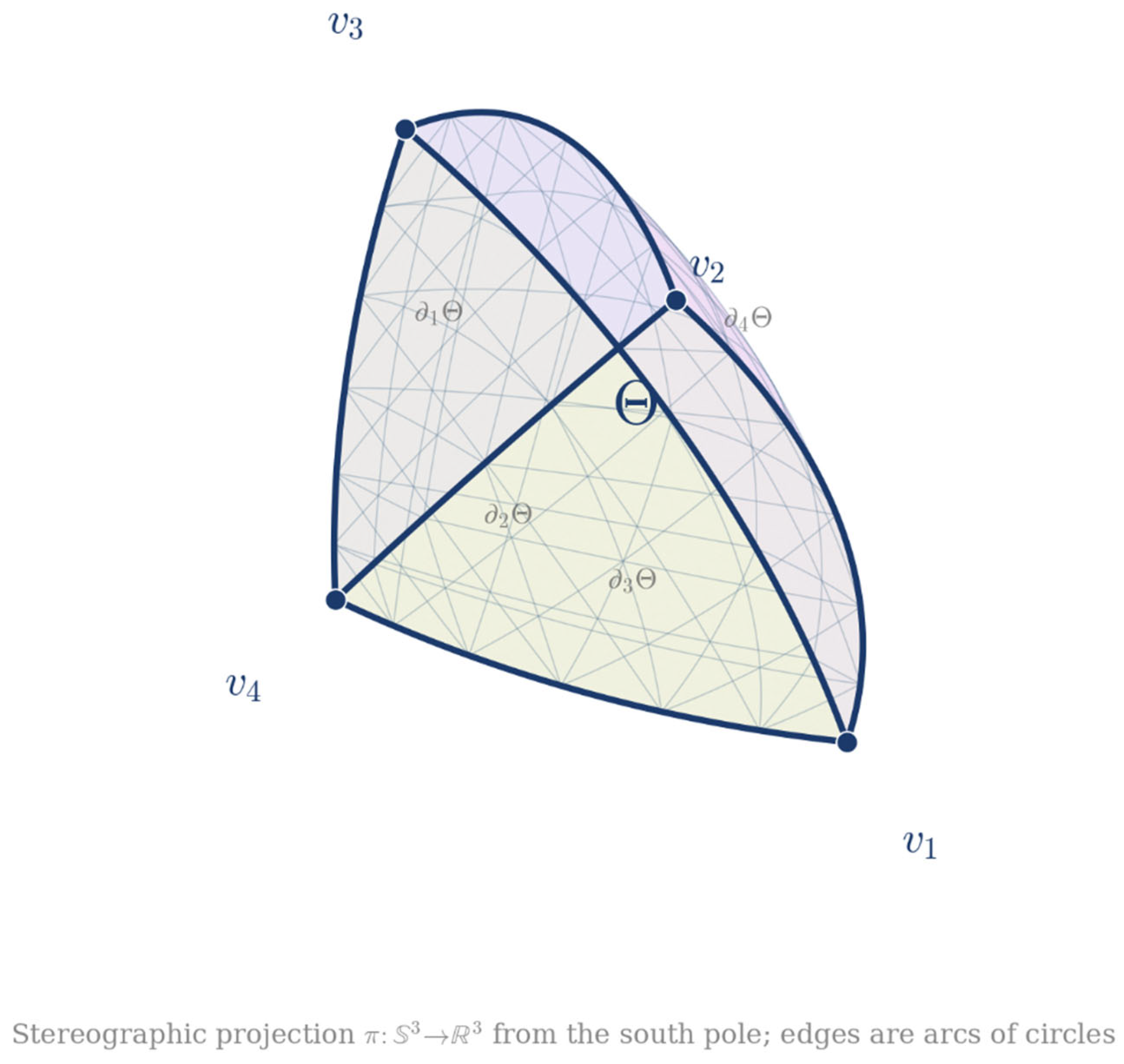
with the sign chosen so that v k Θ (i.e., it satisfies the remaining strict inequality n k , v k > 0 ). Then, { v 1 , , v 4 } are the four vertices of the spherical tetrahedron Θ (cf. Figure 3 below).
Next, we introduce the chart that flattens Θ .
Let the Euclidean reference tetrahedron be the barycentric simplex
Δ : = u = ( u 1 , u 2 , u 3 , u 4 ) R + 4 : u 1 + u 2 + u 3 + u 4 = 1 .
Define the (non-unit) conic combination
Φ ( u ) : = k = 1 4 u k v k R 4 { 0 }
and its normalization
Φ ( u ) : = Φ ( u ) Φ ( u ) S 3 .
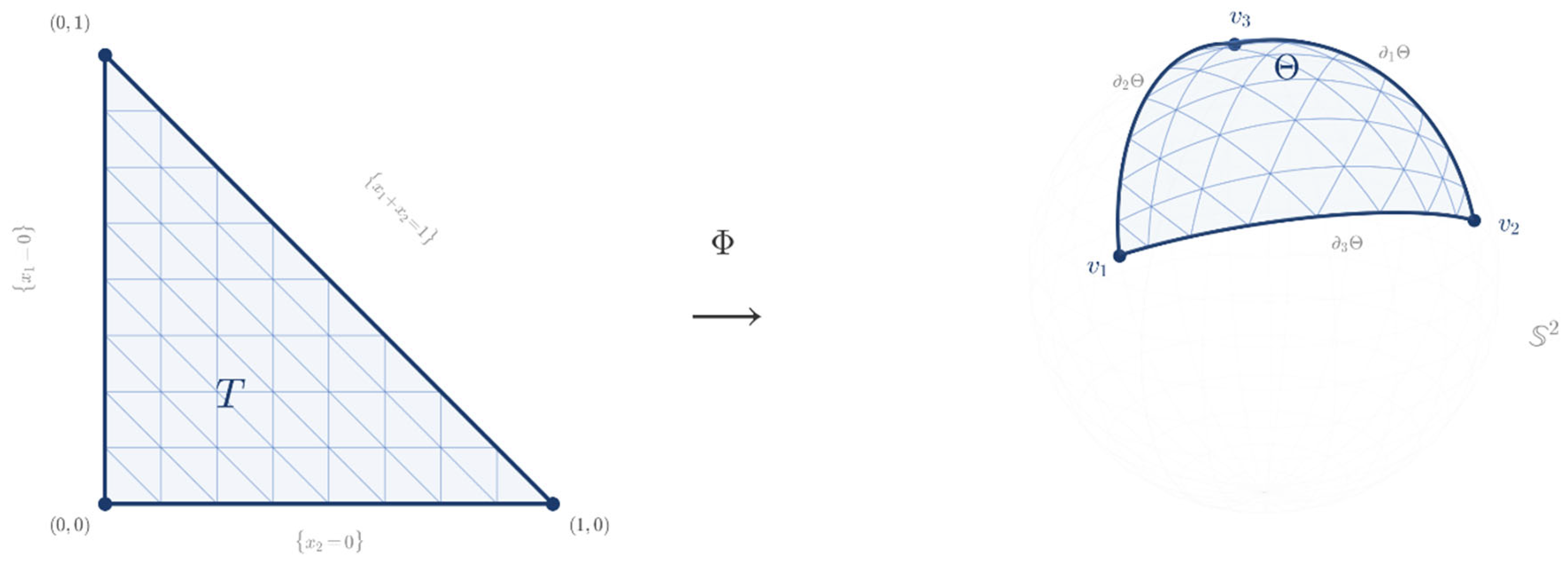
Then, Φ : Δ Θ is a diffeomorphism, and the faces of Δ correspond exactly to the absorbing faces of Θ : u k = 0 Φ ( u ) Θ on the k -th facet (cf. Figure 4 inserted after Remark 4).
For numerical work, it is convenient to eliminate one barycentric coordinate. Write x = ( x 1 , x 2 , x 3 ) Δ ^ , where
Δ ^ : = x R + 3 : x 1 + x 2 + x 3 < 1 , u 4 = 1 x 1 x 2 x 3 .
Set
E v 1 v 4 v 2 v 4 v 3 v 4 R 4 × 3 , ϕ ( x ) : = v 4 + E x , ϕ ( x ) : = ϕ ( x ) ϕ ( x ) .
Then, ϕ is the chart Φ expressed in the x -coordinates.
Remark 4 (Non-uniqueness and regularity of the chart). 
The diffeomorphism between the spherical tetrahedron Θ S 3 and the Euclidean reference tetrahedron Δ (equivalently, to Δ ^ in barycentric coordinates) is not unique: many smooth bijections would serve to pull back the Laplace–Beltrami eigenproblem to Δ . We use the explicit normalized simplex map (129) because it is closed-form, preserves the face correspondence (each facet u i = 0 maps to the corresponding spherical face), and yields explicit metric coefficients used in Section 7.2. Different choices would lead to different variable-coefficient operators on Δ but the same continuous Dirichlet spectrum on Θ . Under the standing nondegeneracy assumption (equivalently, the matrix V = v 1 , , v 4 of vertex/ray generators is invertible/the cone is simplicial), the induced pullback metric is positive definite on Δ and the coefficient fields in the pulled-back weak formulation (Section 7.3) are smooth and uniformly elliptic.

7.2. Pullback Metric on the Euclidean Tetrahedron

Let P ( z ) : = I 4 z z denote orthogonal projection onto the tangent space of S 3 at z S 3 . A key identity for the differential of the normalization map gives, for q ( x ) : = ϕ ( x ) 2 ,
D ϕ ( x ) = 1 q ( x ) P ( ϕ ( x ) ) E .
The pullback metric g ( x ) R 3 × 3 induced by the ambient Euclidean metric on S 3 R 4 is therefore
g ( x ) = ( D ϕ ( x ) ) D ϕ ( x ) = 1 q ( x ) E P ( ϕ ( x ) ) E .
Using ϕ ( x ) = h ( x ) / q ( x ) , one obtains a particularly efficient closed form:
g x = 1 q x G 1 q x a ( x ) a ( x ) G : = E E ( constant ) , a ( x ) : = E ϕ ( x ) .
This is a rank-one update of the constant matrix G , and it yields fast, stable formulas for g 1 and d e t g .
Assume G is invertible (equivalently, the vertices are in general position; this holds whenever the cone is genuinely simplicial). Define
γ ( x ) : = q ( x ) a ( x ) G 1 a ( x ) .
Then, γ ( x ) > 0 and g ( x ) is positive definite.
Proposition 4 (explicit inverse and determinant). 
For all x Δ ^ ,
g ( x ) 1 = q ( x ) G 1 + q ( x ) γ ( x ) G 1 a ( x ) a ( x ) G 1
and
d e t g ( x ) = d e t ( G ) γ ( x ) q ( x ) 4 .
Equivalently, the induced volume element on Θ in x -coordinates is
d σ ( θ ) = d e t g ( x ) d x = d e t ( G ) γ ( x ) q ( x ) 2 d x , θ = ϕ ( x ) .
Proof. 
This is a direct application of the Sherman–Morrison formula and the matrix determinant lemma to G 1 q a a , followed by the scaling d e t ( ( 1 / q ) ) = q 3 d e t ( ) in dimension 3 . □
These formulas are the main computational take-away: at quadrature points one computes only the scalar q ( x ) , the vector a ( x ) , and γ ( x ) , while G and G 1 are precomputed once.

7.3. Pulled-Back Dirichlet Eigenproblem on Δ ^

Let m solve the Dirichlet eigenproblem for the Laplace–Beltrami operator on the spherical tetrahedron Θ S 3 :
Δ S 3 m θ = λ m θ , θ Θ , m θ = 0 , θ Θ           w i t h   Θ m 2 d σ = 1 .
Let Φ : Δ ^ Θ be the chart introduced in Section 7.1, and define the pullback
m ^ ξ : = m Φ ξ , ξ Δ ^ .
Since Φ maps facets of Δ ^ to facets of Θ , the Dirichlet condition transfers to
m ^ ξ = 0 , ξ Δ ^ .
Denote by
g ξ : = ( D Φ ξ ) D Φ ξ ,
the (Riemannian) metric induced by the embedding Φ , and write g ξ : = d e t g ξ . The pullback of Δ S 3 then yields a second-order operator in divergence form on Δ ^ . In particular, m ^ satisfies
1 g ξ ξ g ξ g ξ 1 ξ m ^ ξ = λ m ^ ξ , ξ Δ ^ ,
together with m ^ | Δ ^ = 0 .
Proposition 5 (weak formulation on Δ ^ ). 
Let H 1 Δ ^ be the usual Sobolev space and H 0 1 Δ ^ H 1 Δ ^ the subspace of functions with zero trace on Δ ^ . Then, the pulled-back Dirichlet eigenproblem is equivalent to: find m ^ , λ H 0 1 Δ ^ \ { 0 } × R such that
a m ^ , v = λ m m ^ , v , v H 0 1 Δ ^ ,
where
a u , v : = Δ ^ u ξ g ξ 1 v ξ g ξ d ξ , m u , v : = Δ ^ u ξ v ξ g ξ d ξ .
Moreover, if m ^ , λ satisfies (144) and we set m = m ^ Φ 1 , then m , λ is a Dirichlet eigenpair of (139) on Θ .
Sketch of Proof. 
Multiply the pulled-back divergence-form equation by v H 0 1 Δ ^ , integrate over Δ ^ , and integrate by parts. The boundary term vanishes because m ^ and v have zero trace on Δ ^ , yielding (144). Conversely, the weak form is the standard variational formulation of the symmetric uniformly elliptic Dirichlet eigenproblem on Δ ^ . For more details on Laplace–Beltrami weak forms and surface finite elements, see [24,25]; eigenvalue convergence for symmetric elliptic problems follows the classical theory in [26,27]. □
Remark 5 (coercivity and ellipticity). 
Since Δ ^ is compact and Φ is smooth with full-rank Jacobian on Δ ^ , the metric g ξ is smooth and uniformly positive definite on Δ ^ . Hence, there exist constants 0 < c C < such that, for all ξ Δ ^ and all ζ R 3 ,
c ζ 2 ζ g ξ 1 ζ C ζ 2 , c g ξ C .
It follows that a , is continuous and coercive on H 0 1 Δ ^ (by Poincaré’s inequality), and m , is a continuous, positive definite inner product. Therefore, (144) is a standard symmetric uniformly elliptic Dirichlet eigenproblem on Δ ^ with smooth coefficients.
Remark 6 (FEM eigenvalue convergence rates). 
Let T h be a shape-regular tetrahedral mesh of Δ ^ with maximal diameter h , and let V h H 0 1 Δ ^ be the conforming P 1 space. Denote by λ j , h , m ^ j , h the discrete eigenpairs of (144). By the classical theory for symmetric elliptic eigenproblems [26,27], λ j , h λ j as h 0 , and if m ^ j H 1 + s Δ ^ for some s ( 0,1 ] , and then
m ^ j m ^ j , h H 1 Δ ^ C h s , λ j λ j , h C h 2 s .
In our setting, the coefficients are smooth; however, the reduced regularity of eigenfunctions near edges/vertices of Δ ^ (reflecting singular behavior at edges/vertices of Θ ) may lower s for higher modes, which motivates the graded/adaptive refinements discussed later.

7.4. FEM Discretization and Elementwise Assembly

Let T h be a tetrahedral mesh of Δ ^ . We use standard continuous, piecewise affine ( P 1 ) basis functions { φ i } i = 1 n h H 0 1 Δ ^ , so that
V h : = s p a n { φ i } H 0 1 Δ ^ .
The discretization of Proposition 5 yields the generalized eigenproblem: find λ h , u h R × V h \ { 0 } such that
a u h , v h = λ h m u h , v h , v h V h ,
where, in the ξ -coordinates on Δ ^ ,
a u , v Δ ^ ( u ξ ) g ξ 1 v ξ d e t g ξ d ξ , m u , v : = Δ ^ u ξ v ξ d e t g ξ d ξ .
In the nodal basis u h = j U j φ j , we have
K U = λ h M U ,
with stiffness and mass matrices
K i j = a φ j , φ i , M i j = m φ j , φ i .
On each element K T h , φ i | K is constant, while g ξ and d e t g ξ vary smoothly, so we compute the element contributions by quadrature. Next, we fix quadrature points { ξ ^ q } q = 1 Q and weights { ω q } q = 1 Q on a fixed reference tetrahedron K ^ . For each mesh element K T h , let F K : K ^ K be the affine map with Jacobian J K and d e t J K . For each quadrature node ξ q : = F K ξ ^ q , compute:
(i)
ξ q and the scalar/vector quantities entering Proposition 4 (at ξ = ξ q ),
(ii)
g ξ q 1 and d e t g ξ q using the closed forms of Proposition 4.
Then, add the element contributions
K i j K q = 1 Q ω q d e t J K φ i ) K g ξ q 1 ( φ j K d e t g ξ q , M i j K q = 1 Q ω q d e t J K φ i ξ q φ j ξ q d e t g ξ q .
In practice, moderate-order tetrahedral quadrature (e.g., order 3 4 ) is sufficient for accurate low eigenpairs.
After global assembly, enforce Dirichlet boundary conditions by eliminating all nodes lying on Δ ^ (equivalently, all nodes with at least one barycentric coordinate equal to zero), and then solve K U = λ h M U . Next, normalize eigenvectors so that
U M U = 1 ,
which is the discrete analogue of Δ ^ m ^ h 2 ξ d e t g ξ d ξ = 1 . Finally, define the spherical eigenfunction by
m h θ : = m ^ h Φ 1 θ .

7.5. Evaluating Eigenfunctions on Θ and Angular Integrals

For numerical evaluation, one repeatedly needs values m j ( θ ) at given θ Θ , and integrals of the form Θ F ( η ) m j ( η ) d σ ( η ) . Both are computed through the chart ϕ of Section 7.1.
(i)
Point evaluation m j ( θ )
Given θ Θ , first compute barycentric coordinates u Δ by expressing θ in the conic vertex basis. Concretely, solve the 4 × 4 linear system
θ = k = 1 4 α k v k ,
obtain α k > 0 , then set u k = α k / l α l . This gives ϕ ( u ) = θ . With x = ( u 1 , u 2 , u 3 ) , locate the tetrahedral mesh cell containing x , compute its barycentric coordinates in that cell, and interpolate φ j (piecewise affine), hence m j ( θ ) = φ j ( x ) .
(ii)
Angular integrals.
For any integrable F on Θ ,
Θ F ( η ) m j ( η ) d σ ( η ) = Δ ^ F ( h ( x ) ) φ j ( x ) d e t g ( x ) d x .
On each element, φ j is affine and d e t g is evaluated by the explicit formulas above, so standard tetrahedral quadrature applies directly.

7.6. Conditioning and Mesh Refinement

The geometry enters the FEM problem through the metric g , hence through the cone geometry (equivalently the correlation structure). Two practical diagnostics are helpful.
(i)
Positive definiteness/near-degeneracy
A nearly singular underlying covariance produces a “thin” cone and a stretched metric on Δ ^ , slowing spectral convergence. Basic sanity checks (positive definiteness, geometric consistency of vertices/normals, and Rayleigh quotient checks for computed eigenpairs) are straightforward and worth reporting.
(ii)
Mesh refinement near edges and corners
Even on a flat tetrahedron, Dirichlet eigenfunctions develop reduced regularity near edges and vertices. Uniform meshes converge slowly for higher modes; mild grading toward boundary facets (and especially toward edges/vertices where two or three barycentric coordinates are small) can substantially improve accuracy. More aggressive (residual-based) adaptive refinement can also be used when higher angular modes are required.

8. Algorithmic Pipeline and Truncation Strategy Enhanced by I ( Σ )

This section turns the semi-analytic representation of Section 6 into a practical and rigorous numerical scheme, with explicit truncation and refinement rules. The guiding principle is to separate:
  • An offline geometric stage (dependent only on the cone geometry, hence on Σ ), and
  • An online evaluation stage (dependent on ( z , β , T ) once Σ is fixed),
The covariance difficulty index I ( Σ ) from Section 4 can be used as a diagnostic for both (i) angular spectral resolution and (ii) truncation budgets.
Throughout this section, we remain in the whitened coordinates and in the case m = 5 (thus d = 4 ), so that Θ S 3 is a spherical tetrahedron, and the survival probability is given by Theorem 3.

8.1. Inputs, Outputs, and the Two-Level Structure

  • Inputs (original variables)
Initial positions x 1 , , x 5 , drifts μ 1 , , μ 5 , volatilities σ 1 , , σ 5 , correlation coefficients ( ρ i j ) , and horizon T > 0 .
  • Derived quantities for the gap model
The gap start y ( 0 , ) 4 , gap drift b R 4 , and covariance matrix Σ R 4 × 4 (positive definite) (if any component of y is nonpositive, the target probability is 0 ).
  • Whitened quantities for the cone model
Let A = Σ 1 / 2 (symmetric). Set
z = A y , β = A b , r = z , θ = z z Θ .
  • The target probability equals
    P ( E T ) = P z ( τ K > T )
    for the drifted standard Brownian motion Z t = z + β t + W t killed upon exiting the simplicial cone K = A R + 4 with spherical section Θ = K S 3 .

8.2. Offline Stage: Geometry, Mesh, Spectrum, and Quadrature Data

The offline stage is performed once per cone geometry, i.e., once per Σ . In applications where ρ is fixed and ( σ i ) varies, Σ changes, and the offline stage must be rerun; when only drifts ( μ i ) , starts ( x i ) , or horizons T vary, Σ stays fixed, and the offline stage is reused.

8.2.1. Compute the Difficulty Index and the Inradius Bound

Compute I ( Σ ) and the spherical inradius r i n as in Section 4:
I ( Σ ) = ( D 1 ) Σ 1 ( D 1 ) , r i n = a r c s i n 1 I ( Σ ) , D = d i a g Σ 11 , , Σ 44 .
This quantity will be used as:
(i)
A mesh/spectrum difficulty diagnostic (large I ( Σ ) suggests sharper angular boundary layers and slower spectral convergence), and
(ii)
A sanity check on the computed principal eigenvalue via the cap comparison C a p ( r i n ) Θ ; hence, λ 1 ( Θ ) λ 1 ( C a p ( r i n ) ) .
This check is inexpensive since λ 1 ( C a p ( r ) ) is obtained from a 1D Sturm–Liouville problem (cf. Remark 3).

8.2.2. Build Θ and the Pullback Map

Using Section 7, compute:
(i)
Inward unit normals of faces (from Σ ),
(ii)
Vertices v 1 , , v 4 S 3 (via the 4D triple cross product),
(iii)
The normalized simplex map h : Δ ^ Θ , and the explicit metric quantities g 1 ( x ) , d e t g ( x ) on Δ ^ .

8.2.3. Mesh Selection Guided by I ( Σ )

Eigenfunctions inherit corner/edge singularity effects and develop large gradients near boundary strata; consequently, uniform tetrahedral meshes may converge slowly for higher modes.
We recommend the following deterministic, index-driven rule:
(i)
If I ( Σ ) is “moderate” (cone not extremely narrow), start with a moderately refined quasi-uniform mesh on Δ ^ .
(ii)
If I ( Σ ) is “large” (narrow cone), use a graded mesh biased toward Δ ^ and especially toward edges/vertices where two or three barycentric coordinates are small.
Adaptive refinement (residual-based AFEM for generalized eigenpairs) is the robust alternative when high modes are required; the estimator/mark/refine loop can be used without modification.

8.2.4. FEM Eigenpairs and a Posteriori Spectral Validation

Solve the pulled-back generalized eigenproblem on Δ ^ (Section 7):
K c = λ M c ,
and compute the first J max eigenpairs ( λ j , φ j ) , normalized so that φ j M φ j = 1 . Map back m j = φ j h 1 on Θ .
A geometry-based validation is recommended. Compute λ 1 ( C a p ( r i n ) ) and check that the numerically obtained λ 1 ( Θ ) satisfies
λ 1 ( Θ ) λ 1 ( C a p ( r i n ) ) + ( expected   FEM   discretization   error ) .
A persistent violation indicates under-resolution (mesh too coarse or eigen-solver tolerance too loose), and the offline stage should be refined.

8.3. Online Stage: Stable 1D Quadrature + Fast Angular Transforms

Fix a horizon T > 0 , start z = r θ K , and drift β R 4 . The online task is: (i) approximate the Laguerre integral, and (ii) compute L j efficiently for several s -values.

8.3.1. Generalized Gauss–Laguerre Quadrature in u

Choose a generalized Gauss–Laguerre quadrature for weight e u u 1 / 2 on [ 0 , ) , with nodes ( u k ) k = 1 N L and weights ( w k ) k = 1 N L . Then,
Q j ( T , r ; β ) k = 1 N L w k I α j r 2 u k T L j 2 T u k ; β .
This is a stabilization step: the Gaussian tail is absorbed by the Laguerre weight, leaving a smooth integrand evaluated at finitely many 2 T u k nodes.

8.3.2. Fast Evaluation of L j ( s ; β ) as Linear Algebra

To avoid repeated elementwise integration on Θ for each s , we precompute a global quadrature rule on the tetrahedral mesh of Δ ^ , with quadrature points x q and weights W q already including element Jacobians and the factor d e t g ( x q ) . Let η q = h ( x q ) Θ .
Store the eigenfunction values at quadrature points M j q : = m j η q . Then, for any s 0 ,
L j ( s ; β ) q = 1 Q W q e s β , η q M j q .
In vector form, with
v q ( s ; β ) : = W q e s β , η q , v ( s ; β ) R Q ,
the entire vector L j s ; β i j J max is approximated by a single matrix–vector multiplication
L ( s ; β ) M v ( s ; β ) ,
where M J max × Q . This is a major speedup in practice.
The cost per s -node can be precisely measured. Computing v ( s ; β ) costs O ( Q ) exponentials; multiplying by M costs O J max Q operations (highly optimized BLAS). For N L Laguerre nodes, total online complexity is essentially O N L J max Q , with a small constant factor once M is stored.

8.3.3. Optional Acceleration: Moment Expansion (Many s -Nodes with Fixed β )

If one must evaluate L j ( s ; β ) at many s -nodes (e.g., very large N L , or repeated evaluations at multiple T with the same β ), we propose a moment precomputation:
M j , n ( β ) = Θ β , η n m j ( η ) d σ ( η ) q = 1 Q W q β , η q n M j q ,
followed by the power series
L j s ; β n = 0 N max s n n ! M j , n β .
This can reduce the per-node cost to a few vector operations, but it should be used only when s β remains moderate on the relevant Laguerre nodes; otherwise, direct evaluation of e s β , η q is safer.

8.4. Truncation Strategy: Three Coupled Tolerances

The evaluation has three truncation/approximation layers:
(i)
Laguerre quadrature in u (parameter N L ),
(ii)
Spectral truncation of the angular eigen-sum (parameter J ),
(iii)
(Optional) moment truncation (parameter N max ).
We now state practical rules that increase the convergence rate.

8.4.1. Truncation of the Angular Eigen-Sum

Define the truncated approximation (using Laguerre quadrature with N L nodes)
u β ( J , N L ) ( T , r θ ) = e x p β , r θ 1 2 β 2 T 2 T e r 2 / ( 2 T ) r j = 1 J m j ( θ ) Q ^ j ( N L ) ( T , r ; β ) ,
with
Q ^ j ( N L ) ( T , r ; β ) = k = 1 N L w k I α j r 2 u k T L ^ j 2 T u k ; β .
J can be moderate because two effects jointly kill high modes:
(i)
Weyl-type growth of the spherical Dirichlet eigenvalues on a 3D domain: λ j grows on the order of j 2 / 3 (hence, α j j 1 / 3 ).
(ii)
For fixed argument x , the modified Bessel I α j ( x ) decays very rapidly as α j (heuristically like ( x / 2 ) α j / Γ ( α j + 1 ) ).
In Laguerre quadrature, the Bessel argument is x = r 2 u k / T with ( u k ) concentrated in a moderate range due to the e u weight, which further improves effective truncation.
The following practical J -stopping rule (difference test) can be derived: compute u β ( J , N L ) for J = J 0 , J 0 + Δ J , J 0 + 2 Δ J , and stop when
u β ( J + Δ J , N L ) u β ( J , N L ) m a x ( u β ( J + Δ J , N L ) , 10 300 ) ε s p e c ,
for two consecutive increments. This “difference test” is stable even when individual spectral terms are not sign-definite.
The choice of J 0 guided by I ( Σ ) , i.e., I ( Σ ) can be used as a budget selector as follows:
(i)
If I ( Σ ) is small/moderate: start with J 0 in the “tens” range.
(ii)
If I ( Σ ) is large (narrow cone): start larger, and expect either larger J , or more mesh refinement, or both.
The probability is dominated by low modes unless the start is very near the boundary and/or drift pushes toward the boundary, and narrow geometries increase the demand for higher angular resolution.
In the Gauss–Laguerre-ready form, the modified Bessel term is evaluated at arguments that scale like z x / t along the quadrature nodes (the Laguerre weight concentrates the auxiliary variable in a moderate range). Hence, increasing the horizon t decreases the effective Bessel argument and strengthens the large-order decay of I ν n z , so fewer angular modes are typically needed for larger t , whereas short horizons (or larger x ) can require larger N . The remaining parameter dependence is primarily geometric and directional: narrower cones (large difficulty index η ) and starts/drifts close to or pointing toward the absorbing faces increase the angular resolution demand. In practice, we select N adaptively using the stable difference test (169).

8.4.2. Truncation of the Laguerre Quadrature

For fixed J , increase N L until stability:
u β ( J , 2 N L ) u β ( J , N L ) m a x ( u β ( J , 2 N L ) , 10 300 ) ε L a g .
In typical regimes, N L can be kept modest because the quadrature targets the correct weight e u u 1 / 2 and the remaining integrand is smooth.

8.4.3. Truncation of the Moment Expansion (Optional Branch)

If the moment expansion is used for L j , then for each s -node the truncation error is governed by the tail of n 0 s n M j , n ( β ) / n ! . A robust practical rule is the following:
(i)
Choose N max so that the last included term is below a relative tolerance for all relevant s = 2 T u k ,
(ii)
Cross-check against the direct exponential evaluation at a few representative nodes.
This acceleration is most effective when s remains moderate at the quadrature nodes; otherwise, the direct exponential form is preferred.

8.5. How I ( Σ ) Enters the Full Adaptive Loop

We summarize the recommended adaptive loop, now using I ( Σ ) as a global “difficulty knob”.

9. Numerical Experiments

9.1. Test Design

This section compares numerical results obtained using the semi-analytical formula obtained in Section 6 with Monte Carlo approximations for a genuinely four-dimensional orthant survival event (equivalently, for a five-dimensional process with correlated components). Concretely, we estimate P ( τ > T ) as given by (2) for m = 5 and T = 1 . We take strictly ordered starts x 1 = 0 ,   x 2 = 0.1 , x 3 = 0.2 , x 4 = 0.3 ,   and x 5 = 0.4 , so that X 1 ( 0 ) < X i ( 0 ) for i 2 .
Two different drift regimes are considered. In the first one, denoted as D 1 , drifts are homogeneous: β i = 0.05 , i = 1 , , 5 . In the second one, denoted as D 2 , we have: β 1 = 0.12 ,   β 2 = 0.05 , β 3 = 0.04 , β 4 = 0.03 , β 5 = 0.02 . When all drift coefficients are equal, the gap drift is zero. So, the whitened gap process is driftless, and the survival probability uses the driftless specialization of Section 5 and Section 6 (no drift-weighted Laplace transform needed).
Three volatility vectors are used:
Set A (“low” volatility): ( 0.15,0.18,0.20,0.22,0.25 ) , range = [15%, 25%], mean volatility = 20%.
Set B (“intermediate” volatility): ( 0.30,0.33,0.37,0.40,0.45 ) , range = [30%, 45%], mean volatility = 37%.
Set C (“high” volatility): ( 0.50,0.55,0.60,0.65,0.70 ) , range = [50%, 70%], mean volatility = 60%.
The first set of correlation coefficients, denoted as C 1 , represents “moderate” co-movement, in the range 0.07,0.45 in absolute value:
C 1 = ρ 12 = 0.23 , ρ 13 = 0.34 , ρ 14 = 0.28 , ρ 15 = 0.45 , ρ 23 = 0.37 , ρ 24 = 0.41 , ρ 25 = 0.07 , ρ 34 = 0.09 , ρ 35 = 0.24 , ρ 45 = 0.35 .
The second set of correlation coefficients, denoted as C 2 , includes more extreme co-movement, in the range 0.57,0.94 in absolute value, reflective of a near-degenerative variance–covariance matrix, in order to test the robustness of our proposed numerical scheme:
C 2 = ρ 12 = 0.94 , ρ 13 = 0.93 , ρ 14 = 0.82 , ρ 15 = 0.84 , ρ 23 = 0.94 , ρ 24 = 0.79 , ρ 25 = 0.91 , ρ 34 = 0.93 , ρ 35 = 0.79 , ρ 45 = 0.57 .
For each parameter set, we form the instantaneous covariance matrix Σ of the 4D gap process Y , whiten via the symmetric inverse square root, and obtain a simplicial cone K R 4 whose spherical cross-section Ω : = K S 3 is a spherical tetrahedron. We then evaluate p ( T ) using the eigenfunction expansion representation of Section 5 and Section 6, where the radial part is explicit (special functions/one-dimensional quadrature), and the angular part enters through Dirichlet eigenpairs ( λ n , φ n ) of the Laplace–Beltrami operator on Ω , computed numerically via the Euclidean tetrahedron pullback and FEM (cf. Section 7).
The Monte Carlo approximations are obtained by simulating 10 6 i.i.d. sample paths of the five-dimensional diffusion processes X t on a uniform grid 0 = t 0 < t 1 < < t n = T with Δ t = T / n = 4 × 10 3 . Since the dynamics have constant drift and covariance, the grid point update is exact: for each step,
X t k + 1 = X t k + β Δ t + D σ Σ Δ t Z k ,   Z k N 0 , I ,
where Σ is a Cholesky factorization of the correlation matrix and D σ = d i a g σ 1 , , σ m is the volatility matrix
The robust Mersenne–Twister random number generator is used [28].

9.2. Numerical Results and Discussion

The following Table 1, Table 2, Table 3 and Table 4 report numerical results for various combinations of the drift regimes and correlation matrices defined in Section 9.1.

9.3. Discussion and Interpretation

In terms of convergence, the maximum observed discrepancy between semi-analytical and Monte Carlo values is 0.9%, while the average discrepancy stands at 0.475%. A simple binomial noise estimate confirms that these divergences are consistent with Monte Carlo sampling variability: with M = 10 6 paths, the standard error is p 1 p / M , which ranges from about 4.7 × 10 4 (when p 0.02 ) up to 1.6 × 10 3 (when p 0.48 ). Hence, the observed semi-analytical/Monte Carlo gaps are well within expected Monte Carlo noise at this M . Moreover, the reported relative divergences occur mainly when the survival probability is small, so that relative errors inflate even when absolute errors remain of the order 10 4 .
In particular, the correlation matrix C 2 does not entail any significant loss of precision; it is even in this setting that the minimum discrepancy is observed (in the low volatility environment, though). The introduction of different drifts does not raise any issue in terms of accuracy either, compared with the identical drift setting.
The covariance difficulty index quantifies that C 2 is a significantly more ill-conditioned regime than C 1 : I Σ [ 4.1 6.1 ] in C 2 versus I Σ [ 1.94 2.14 ] in C 1 , depending on the volatility set. This is precisely the setting where one expects the angular eigenproblem to become numerically stiffer (more angular modes and/or mesh grading near edges/vertices). The fact that the semi-analytical method remains stable and accurate in C 2 therefore supports the robustness of the proposed FEM pullback and truncation strategy in near-degenerate correlation regimes.
The truncation levels required to guarantee 10−4 accuracy range from ( J , L ) = ( 28,33 ) for “low” volatility in the C 1 correlation environment to ( J , L ) = ( 42,58 ) for “high” volatility in the C 2 correlation environment, which is consistent with fast decay in the Bessel/special-function factors at a large angular index. Let λ 1 be the principal angular eigenvalue and λ N the N -th.
A safe truncation is:
N   such   that   e x p λ N λ 1 T 10 4 .
Equivalently:
λ N λ 1 + l o g 10 4 T λ 1 + 9.21 T .
So, for T = 1 , one needs modes until λ N λ 1 + 9 . For T = 1 , this corresponds empirically to N 40 60 .
The dominant cost is the one-time computation of the angular spectrum for the induced spherical tetrahedron. For this numerical experiment, quasi-uniform meshes with 2 × 10 4 to 8 × 10 4 tetrahedra have been enough here to stabilize the first 30–60 eigenpairs.
After that, each new evaluation (for fixed cone geometry) is inexpensive compared with Monte Carlo, whose cost scales linearly with both the number of paths and the time discretization: with Δ t = 4 × 10 3 and T = 1 , each run uses n = T / Δ t = 250 steps, i.e., M n = 2.5 × 10 7 correlated Gaussian updates per parameter set. In contrast, once the angular spectral data for a given cone geometry (i.e., a given Σ ) have been computed offline, each new survival evaluation reduces to a one-dimensional quadrature and finite spectral summations (Section 8), so the marginal online cost per query is negligible compared with simulating 2.5 × 10 7 time steps. This offline/online separation is particularly advantageous here because D 1 and   D 2 share the same covariances Σ : the same precomputed angular eigenpairs can be reused to evaluate both drift regimes with essentially no additional offline cost. Turning to parameter effects, the sensitivity of survival with regard to volatility is noticeable: as volatility increases, crossings become more likely, and the survival probability decreases; a near-exponential decay of p ( T ) as a function of the mean volatility level σ ¯ can be reported. Switching from homogeneous drifts D 1 to heterogeneous drifts D 2 also decreases survival, because the induced gap drift β 2 β 1 , , β 5 β 1 is negative here and therefore pushes the gap process toward the absorbing boundary.
Finally, the stronger co-movement regime C 2 yields larger survival probabilities than C 1 , reflecting the reduced relative dispersion between components under near-common-factor dynamics.

9.4. Relation to Rare-Event Monte Carlo and Importance Sampling

For very small survival probabilities ( p 1 ), crude Monte Carlo becomes inefficient, and one typically resorts to variance-reduction methods (importance sampling, state-dependent tilting, and splitting). Such schemes can yield a bounded relative error but require a problem-specific change in measure and careful tuning across cone geometries. In the present cone setting, near-optimal changes in measure are naturally connected to the same Dirichlet boundary value problem that underlies our representation. The zero-variance (ideal) change in measure is essentially a Doob h -transform based on the (unknown) survival function; practically, good schemes often approximate this using principal eigenfunctions/subsolutions of the associated Dirichlet problem. Our approach computes exactly the angular spectral data that would naturally feed such an IS (importance-sampling) design. So, the methods are complementary rather than competing. A full head-to-head benchmark against specialized rare-event simulation schemes would require implementing at least one modern IS/splitting scheme and tuning it across the same range of cone geometries. This is a substantial extra methodological component, left for future work.

10. General Dimension, Asymptotics, and Further Remarks

This section records the extension of the preceding analysis to an arbitrary number m 6 of correlated drifted arithmetic Brownian motions, and clarifies what remains computationally feasible as the gap dimension d = m 1 grows.
We separate two regimes:
(i)
Moderate d : numerical eigencomputations on the spherical simplex Θ remain realistic, and the finite-horizon survival probabilities can be evaluated via the semi-analytic formulas of Section 5, Section 6, Section 7 and Section 8.
(ii)
High d : full angular eigen-resolutions become infeasible, but the geometric diagnostics and bounds from Section 4 remain informative (e.g., principal spectral bounds and tail exponents).

10.1. Universal Cone Formulation in Dimension d = m 1

Fix m 6 and set d = m 1 . The event under consideration reduces to the survival of a drifted standard Brownian motion in a simplicial cone K with d facets. Writing the cone in half-space form with inward face normals n 1 , , n d S d 1 ,
K = x R d : n i , x > 0 , i = 1 , , d , Θ : = K S d 1 .
Because K is simplicial, Θ is a spherical ( d 1 ) -simplex in S d 1 with ( d 1 ) -dimensional spherical facets; the absorbing boundary K corresponds exactly to the Dirichlet boundary Θ .
Let ( λ j , m j ) j 1 be an L 2 ( Θ ) -orthonormal Dirichlet eigenbasis of the Laplace–Beltrami operator on Θ :
Δ S d 1 m j = λ j m j   on   Θ , m j = 0   on   Θ .
Define the standard Bessel indices
α j : = λ j + d 2 1 2 , a j : = α j d 2 1 .
Then, the analytic structure of Section 5 and Section 6 extends verbatim to any d : the killed heat kernel in K separates into an explicit radial Bessel factor and an angular spectral expansion on Θ , and drift is handled by exponential tilting.
For later use, define the drift-weighted angular Laplace transforms
L j ( s ; β ) : = Θ e s β , η m j ( η ) d σ ( η ) , s > 0 .
The computationally preferred representation (as in Section 6 for d = 4 ) is a single one-dimensional radial integral after tilting, involving I α j and L j ( ; β ) , followed by truncation of the spectral sum. If one expands L j ( s ; β ) in powers of s , one obtains a fully explicit double series with Kummer F 1 1 radial factors.

10.2. Geometry Shift: Spherical Simplex Θ to a Euclidean Simplex

A key computational simplification used earlier—turning facetwise Dirichlet conditions on the spherical simplex Θ into standard Dirichlet conditions on the faces of a Euclidean simplex—generalizes cleanly to every dimension d .
Because K is simplicial with inward normals n 1 , , n d , it has exactly d extreme rays. Let v 1 , , v d S d 1 be the corresponding unit extreme-ray directions (they can be computed algebraically from the normals via the d -dimensional Hodge-dual wedge construction, i.e., the natural generalization of the 4D triple cross product used earlier).
Let
Δ d 1 : = x R d : x i > 0 , i = 1 d x i = 1
be the standard Euclidean ( d 1 ) -simplex, and define the conic map.
Φ : Δ d 1 Θ , Φ ( x ) : = i = 1 d x i v i i = 1 d x i v i .
Then, Φ is a diffeomorphism, and—crucially—the faces correspond: the face { x i = 0 } maps to the spherical facet { θ Θ : n i , θ = 0 } . Hence, the Dirichlet boundary condition on Θ becomes a standard Dirichlet condition on the coordinate faces of Δ d 1 , uniformly in d . The Laplace–Beltrami operator pulls back to a variable-coefficient elliptic operator on Δ d 1 determined by the pullback metric, exactly as in the d = 4 case.
This isolates what truly scales with dimension: not boundary bookkeeping (faces remain “coordinate faces”), but the fact that the angular eigenproblem lives in ( d 1 ) variables.

10.3. Two Regimes: Moderate d Versus High d

10.3.1. Moderate Dimension: Numerical Eigenpairs on Θ Remain Feasible

For moderate d , one can compute a truncated collection of eigenpairs ( λ j , m j ) by solving the pulled-back generalized eigenproblem on Δ d 1 (via FEM or spectral discretization). The offline/online separation remains unchanged:
(i)
Offline: build Φ , assemble metric-weighted stiffness and mass matrices on Δ d 1 , and compute eigenpairs ( λ j , m j ) ;
(ii)
Online: evaluate the one-dimensional radial integrals (often by Gauss–Laguerre quadrature) and truncate the spectral sum using fast angular quadrature/linear-algebra acceleration.
What changes with d is quantitative (mesh resolution, number of modes needed), not qualitative: the formulae and the numerical pipeline remain identical. The dominant cost rapidly becomes the offline computation of angular eigenpairs on the m 2 -dimensional simplex (mesh resolution and sparse generalized EVP). By contrast, once eigenfunctions are stored at quadrature points, the online cost is essentially O Q N per Laguerre node (dense matrix–vector multiplications) plus O N special-function evaluations; its growth is driven mainly by the larger Q and N needed in higher dimensions.
To provide a concrete scalability datapoint beyond d = 4 , we tested a 6-dimensional structure with m = 7 equicorrelated ABMs ( ρ = 0.3 ), identical drifts μ i 0.03 (hence zero gap drift), horizon T = 1 , and initial values x i = 0.1 i 1 . The SA (semi-analytical) pipeline returned a probability equal to 0.1303, while Monte Carlo with M = 10 6 paths and Δ t = 0.004 ( 250 grid points) returned a value of 0.1309. The MC standard error is p 1 p / M 3.37 × 10 4 , giving a 95% confidence interval 0.130239,0.131561 , which contains the obtained SA value; moreover, the slight upward shift of MC is consistent with discrete monitoring, which tends to overestimate survival. The gap-covariance difficulty index computed for this d = 6 geometry is I Σ 1.96 . This yields guaranteed inscribed-cap parameters δ i n 0.714 and r i n 0.795 r a d 45.6 ° . So, this produces a moderate-width spherical simplex (not a “narrow cone” regime): the scalar diagnostic predicts no extreme stiffness. In line with Algorithm 1, such values typically require only moderate angular resolution (initial N in the tens) and quasi-uniform meshing, whereas substantially larger I Σ would be the regime where more aggressive mesh grading and larger N become necessary. Finally, note that the MC benchmark corresponds to M n = 2.5 × 10 8 time steps of a seven-dimensional correlated Gaussian update, while—once the angular spectrum is available—the SA evaluation reduces to a one-dimensional quadrature and O Q N dense linear algebra per query, so the offline/online separation becomes increasingly attractive when multiple queries share the same covariance geometry.
Algorithm 1. Refined offline/online evaluation
Step 1: offline (for a given Σ )
1: Compute I ( Σ ) and r i n = a r c s i n ( 1 / I ( Σ ) ) .
2: Build Θ (normals/vertices) and the pullback map h with explicit metric coefficients.
3: Choose an initial mesh: quasi-uniform if I ( Σ ) moderate, graded/adaptive if I ( Σ ) large.
4: Solve for J max eigenpairs; validate λ 1 ( Θ ) λ 1 ( C a p ( r i n ) ) up to discretization error.
5: Build a global quadrature set { ( η q , W q ) } q = 1 Q and store M j q = m j ( η q ) .
Step 2: Online (for each query ( z , β , T ) )
6: Choose N L and J initially as monotone functions of I ( Σ ) (small I smaller budgets).
7: Evaluate u β ( J , N L ) using Laguerre quadrature and fast L ( s ; β ) M v ( s ; β ) .
8: Increase N L until the Laguerre difference test passes ( ε L a g ).
9: Increase J until the spectral difference test passes ( ε s p e c ).
10: If either test fails to stabilize within reasonable budgets (especially for large I ( Σ ) ), return to the offline stage and refine the mesh/recompute eigenpairs.

10.3.2. High Dimension: When Full Angular Eigen-Computation Is Infeasible

When d is large, resolving an eigenproblem in ( d 1 ) variables quickly becomes computationally prohibitive. In this regime, the main exportable outputs are those depending on coarse geometric information about Θ , rather than on many eigenpairs. This is precisely where the geometric diagnostics and bounds of Section 4 remain effective:
(i)
Geometry diagnostics and certified bounds via spherical-cap comparison.
Quantities such as inradius-based comparisons with spherical caps yield explicit upper/lower bounds on principal spectral quantities (and therefore on survival) without computing a full eigenbasis.
(ii)
Driftless long-time behavior via a single exponent.
Even in high dimensions, the driftless persistence over long horizons is governed by a single scalar spectral quantity: the principal Dirichlet eigenvalue λ 1 on Θ , which is equivalently the cone exponent a 1 defined above. Bounds on λ 1 immediately yield bounds on the survival tail.
(iii)
Drifted qualitative dichotomy and what remains computable.
With drift β , survival may have a strictly positive limit or decay to 0 , depending on the relation of β to the cone geometry. Even without many eigenpairs, one can approximate the limiting survival probability (when it exists) through elliptic methods (ground-state/ h -transform techniques) rather than through high-mode spectral expansions.

10.4. Driftless Asymptotics: Cone Exponent and Polynomial Survival Tail

We now focus on the driftless case β = 0 . Let
u 0 ( t , x ) : = P x ( τ K > t ) , τ K : = i n f { t 0 : X t K } ,
where X t = x + W t is a driftless Brownian motion in R d .
Define the cone exponent
γ : = a 1 = α 1 d 2 1 , α 1 = λ 1 + d 2 1 2 .
Let x = r θ with r = x and θ Θ . Define the harmonic profile
h ( x ) : = r γ m 1 ( θ ) .
This h is (up to scale) the unique positive harmonic function in K with the Dirichlet boundary condition on K .
Theorem 5 (Polynomial tail and harmonic profile). 
Assume β = 0 . Then, there exists a constant C Σ ( 0 , ) such that for every x K ,
q ( t , x ) C Σ h ( x ) t α 1 / 2 , ( t )
where the cone exponent α 1 is given by
b j λ j + ( d 2 ) 2 4 , α 1 : = b 1 d 2 2 = λ 1 + ( d 2 ) 2 4 d 2 2
and the harmonic profile h is the (unique up to scale) positive harmonic function in K with the Dirichlet boundary condition, which can be written in polar form as
h ( x ) = x α 1 m 1 x x .
Moreover, C Σ can be made explicit in terms of Σ and m 1 (in particular via Σ m 1 ).
Proof. 
This is a classical cone-exit asymptotic for driftless Brownian motion. Under the regularity assumptions on the spherical cross-section Σ (satisfied in particular for the spherical simplices arising from polyhedral cones in this paper), it is proven in [19] that the survival probability has the polynomial tail
P x ( τ K > t ) C Σ x α 1 m 1 x x t α 1 / 2 , ( t ) ,
where α 1 is determined by the principal Dirichlet eigenvalue λ 1 of Δ S d 1 on Σ , and m 1 is the corresponding positive Dirichlet eigenfunction. Since q ( t , x ) = P x ( τ K > t ) , this is exactly the stated asymptotic with h ( x ) = x α 1 m 1 ( x / x ) . □
Remark 7. 
(consistency with the spectral expansion of Section 5). The same asymptotic is visible directly from the driftless cone survival expansion of Section 5 (Theorem 2), which reads (for x = r θ , r = x , θ = x / x Σ )
q ( t , r θ ) = j 1 γ j r 2 2 t α j / 2 F 1 1 α j 2 ; α j + d 2 ; r 2 2 t m j ( θ ) ,
with
α j : = b j d 2 2 , b j = λ j + ( d 2 ) 2 4 ,
and coefficients of the form
γ j = Γ α j + d 2 Γ α j + d 2 Σ m j ( η ) d σ ( η ) .
As t , one has r 2 2 t 0 , and therefore
F 1 1 α j 2 ; α j + d 2 ; r 2 2 t 1 for   each   fixed   j .
Hence, each mode behaves like
γ j r 2 2 t α j / 2 m j ( θ ) = γ j 2 α j / 2 r α j m j ( θ ) t α j / 2 .
Since 0 < λ 1 < λ 2 , one has b 1 < b 2 , hence α 1 < α 2 , and therefore the j = 1 term dominates, yielding
q ( t , r θ ) γ 1 2 α 1 / 2 r α 1 m 1 ( θ ) t α 1 / 2 .
In particular, in the normalization above one may take
C Σ = γ 1 2 α 1 / 2 = Γ α 1 + d 2 Γ α 1 + d 2 2 α 1 / 2 Σ m 1 ( η ) d σ ( η ) .
A fully rigorous justification of the dominance of the principal mode (uniform control of the tail j 2 ) can either be obtained by standard spectral estimates on Σ , or simply by referring to [19], which precisely deals with the required uniform bounds.

10.5. Long-Time Asymptotics in the Inward-Drift Regime

Theorem 6 (Driftless tail and interior-drift limit; Garbit–Raschel/DeBlassie). 
Let K R d be a (normal) cone with spherical cross-section Θ : = K S d 1 .
Let ( m j ) j 1 be an L 2 ( Θ ) -orthonormal Dirichlet eigenbasis of the Laplace–Beltrami operator on Θ ,
Δ S d 1 m j = λ j m j on   Θ , m j = 0 on   Θ ,
with 0 < λ 1 < λ 2 . Define
α j : = λ j + d 2 1 2 ,
Let p K ( t , x , y ) denote the killed heat kernel in K for driftless Brownian motion, and for a drift vector β R d set
τ K : = i n f { t > 0 : x + β t + B t K } , q β ( t , x ) : = P x ( τ K > t ) , x K .
If β K (interior drift), then the infinite-horizon survival probability exists and satisfies
q β ( , x ) : = l i m t q β ( t , x ) = P x ( τ K = ) = ( 2 π ) d / 2 e x p 1 2 x β 2 p K ( 1 , x , β ) .
In particular, if β K , then q β ( , x ) > 0 for every x K .
This corresponds to Theorem C in [29].
Proof. 
We start from the tilting identity (cf. Section 5):
q β ( t , x ) = e β , x 1 2 t β 2 K e β , y p K ( t , x , y ) d y .
Rewrite the exponent in the integrand by completing the square:
1 2 t β 2 + β , y = 1 2 t β y 2 + 1 2 y 2 .
Thus,
q β ( t , x ) = e β , x K e y 2 / 2 p K ( 1 , x , y ) t d / 2 e 1 2 t β y 2 d y ,
where we used Brownian scaling for the killed kernel p K ( t , x , y ) = t d / 2 p K ( 1 , x , y ) after factoring the Gaussian term.
Because β K , we may localize the integral near y = β . If β K , choose δ > 0 such that B ( β , δ ) K ; on this ball the function y e y 2 / 2 p K ( 1 , x , y ) is continuous and bounded. Then, with the change in variables y = β + v / t ,
t d / 2 B ( β , δ ) e 1 2 t β y 2 d y = B ( 0 , t δ ) e v 2 / 2 d v ( 2 π ) d / 2 .
Dominated convergence yields
q β ( t , x ) e β , x ( 2 π ) d / 2 e β 2 / 2 p K ( 1 , x , β ) .
Finally,
e β , x e β 2 / 2 = e x p 1 2 x β 2 1 2 x 2 ,
and the usual normalization of the killed kernel gives the stated concise form
q β ( , x ) = ( 2 π ) d / 2 e x p 1 2 x β 2 p K ( 1 , x , β ) .
If β K { 0 } , the same identity still holds and yields q β ( , x ) = 0 since p K ( 1 , x , β ) = 0 on the Dirichlet boundary; in any case, the limit exists and is given by the same formula (cf. [29]). □
Remark 8 (Pointer to exterior drift). 
Although we do not rely on refined drifted asymptotics beyond the inward-drift regime (C) in this paper, it is worth noting that one can find in [29] a complete drift classification for Brownian exit times from cones. In particular, in the generic exterior-drift regime
β K K ,
and under additional regularity assumptions on the cone boundary (real analyticity near the set of contact points and a finiteness condition on the projection set), they prove the asymptotic
u β ( t , x ) = h E ( x ) t 3 / 2 e x p 1 2 d ( β , K ) 2 t ( 1 + o ( 1 ) ) , t ,
where
d ( β , K ) : = i n f y K β y ,
and h E admits an explicit representation in terms of normal derivatives of the driftless killed heat kernel at the contact points. We only use this as contextual background for the drifted problem.

11. Conclusions and Outlook

This work provides a semi-analytical evaluation of finite-horizon survival in simplicial cones by coupling the classical radial–angular separation with a practical offline/online numerical pipeline for the angular Dirichlet spectrum on spherical simplices (Section 5, Section 6, Section 7 and Section 8). Beyond the 4D-gap (spherical tetrahedron) case, the main computational barrier is the angular eigenproblem in m 2 variables (Section 10.3). Natural directions for future research include: (i) scalable angular solvers for m > 5 (e.g., reduced-basis/randomized eigensolvers/adaptive FEM tailored to corner singularities); (ii) sharper geometry-driven bounds (improving the inscribed-cap comparison and quantifying when it is tight for skewed simplices); (iii) refined drifted asymptotics and effective computation of the constants in the exterior-drift regime (cf. Remark 8); and (iv) a fully a posteriori error-control framework that couples mesh refinement, eigenmode truncation, and radial quadrature tolerances (Section 8.4).

Funding

This research received no external funding.

Data Availability Statement

No new data were created or analyzed in this study.

Conflicts of Interest

The author declares no conflict of interest.

Appendix A. The Spherical Triangle Case ( d = 3 )

Appendix A.1. Whitening and the Induced 3D Cone

Consider the gap process Y R 3 (so d = 3 ), with drift μ and covariance Σ (symmetric positive definite). Whitening sets
Z = A Y , A = Σ 1 / 2 ,
so that Z has identity diffusion and drift b = A μ . The survival event Y t R + 3 becomes survival of Z in the simplicial cone
K = { z R 3 : A 1 z R + 3 } .
Equivalently, K is the intersection of three half-spaces determined by inward unit normals n i i = 1 3 :
K = { z R 3 : n i , z > 0 , i = 1,2 , 3 } .
A convenient choice of (non-unit) inward normals is
a i : = A T e i = Σ 1 / 2 e i , n i : = a i a i , i = 1,2 , 3 ,
so that the Gram matrix H = n i , n j i , j is exactly the correlation matrix associated with Σ (hence it embeds the triangle’s dihedral angles). This is the d = 3 specialization of the general “geometry is in the Gram matrix” viewpoint used throughout.
The spherical cross-section is the spherical triangle
Θ : = K S 2 = { θ S 2 : n i , θ > 0 , i = 1,2 , 3 } .

Appendix A.2. Vertices of the Spherical Triangle

Each vertex is the intersection of two great circles { n i , θ = 0 } . Thus, up to sign,
v 1 n 2 × n 3 , v 2 n 3 × n 1 , v 3 n 1 × n 2 ,
and we fix the sign by requiring the remaining inequality, e.g.,
v 1 : = n 2 × n 3 n 2 × n 3
with the sign chosen so that n 1 , v 1 > 0 , and similarly, for v 2 , v 3 . Then, { v 1 , v 2 , v 3 } are precisely the three vertices of Θ .
This provides an explicit geometric bridge from Σ (via n i ) to the spherical triangle Θ .

Appendix A.3. Specialization of the General Drifted Survival Representation to d = 3

Let the start be z 0 = r 0 θ 0 K , with r 0 = z 0 and θ 0 = z 0 / z 0 Θ . Let λ j , m j be the Dirichlet eigenpairs on Θ S 2 for the operator 1 / 2 Δ S 2 :
1 2 Δ S 2 m j θ = λ j m j θ , θ Θ , m j | Θ = 0 ,
with m j orthonormal in L 2 Θ , d σ . Define the Bessel index (adapting (71))
α j = λ j + ( d 2 1 ) 2 = λ j + 1 4 .
For s > 0 , define the drift-weighted angular transform (specializing (88))
L j s ; β = Θ e s β , η m j η d σ η .
Then, Proposition 3 becomes, in dimension d = 3 ,
u β t , r 0 θ 0 = e x p β , r 0 θ 0 1 2 β 2 t e r 0 2 / 2 t t r 0 1 / 2 j 1 m j θ 0 0 e s 2 / 2 t s 3 / 2 I α j r 0 s t L j s ; β d s .
In the driftless case β = 0 , L j s ; 0 M j : = Θ m j η d σ η is constant and the remaining integral is one-dimensional (Gaussian–Bessel) as in the general discussion.
A Gauss–Laguerre-ready form follows from u = s 2 / 2 t , yielding a Laguerre weight u 1 / 2 e u (parameter 1 / 2 ), exactly as the tetrahedron case yields parameter 1 when d = 4 .

Appendix A.4. Euclidean Triangle Pullback and a 2D FEM Eigenproblem

To compute λ j , m j numerically, one can flatten Θ to a fixed Euclidean triangle exactly as in the tetrahedron pullback of Section 7, but now in 2D. Let the reference triangle be
T = { x 1 , x 2 R 2 : x 1 > 0 , x 2 > 0 , x 1 + x 2 < 1 } ,
and set x 3 = 1 x 1 x 2 . Define the conic combination and normalization
c x = x 1 v 1 + x 2 v 2 + x 3 v 3 , Φ x = c x c x S 2 .
Then, Φ : T Θ is a diffeomorphism, and the sides of T correspond to the absorbing arcs of Θ . Let
J = v 1 v 3 , v 2 v 3 R 3 × 2 , ρ x = c x 2 , q x = J c x R 2 , S = J J R 2 × 2 .
Using the standard differential identity for normalization (the 2D analogue of the tetrahedron formulas), the pullback metric on T is
g x = 1 ρ x S 1 ρ x q x q x ,
a rank-one update of the constant matrix S . Consequently, by Sherman–Morrison and the matrix determinant lemma,
g x 1 = ρ x S 1 + S 1 q x q x S 1 ρ x q x S 1 q x , d e t g x = ρ x 2 d e t S 1 q x S 1 q x ρ x .
This gives explicit, fast-to-evaluate coefficients for assembling the pulled-back weak form.
The Dirichlet eigenproblem on Θ becomes the variable-coefficient generalized eigenproblem on T : find λ , φ with φ | T = 0 such that for all test functions ψ ,
T ( φ x ) g x 1 ψ x d e t g x d x = 2 λ T φ x ψ x d e t g x d x .
A standard 2D P 1 FEM discretization on T then yields the spectrum λ j and (mapped) eigenfunctions m j = φ j Φ 1 on Θ .

Appendix B. Consolidated Notation Table

Table A1. Model and survival event (Section 2.1, Section 2.2 and Section 2.3).
SymbolMeaningWhere Introduced
m Number of correlated Brownian motions in the original systemSection 2.1
X i t i -th drifted Brownian motion ( i = 1 , , m )Section 2.1
X t Vector process X 1 t , , X m t Section 2.1
x R m Initial position vector of X Section 2.1
μ R m Drift vector of the original systemSection 2.1
σ 0 , m Volatility vector σ 1 , , σ m Section 2.1
D σ Diagonal volatility matrix d i a g σ 1 , , σ m Section 2.1
R = ρ i j Correlation matrix of the driving Brownian motionsSection 2.1
E T Survival (non-collision/maintained ordering) event up to time T Section 2.1
τ First violation time of the survival orderingSection 2.1
Table A2. Gap-process reduction and covariance structure (Section 2.2 and Section 2.3).
SymbolMeaningWhere Introduced
d : = m 1 Dimension of the gap processSection 2.2
Y t R d Gap process (differences relative to X 1 )Section 2.2
y 0 , d Initial gap vectorSection 2.2
R + d Positive orthant (gap survival domain)Section 2.2
H R d × m Difference matrix such that Y t = H X t Section 2.3
b = H μ Drift vector of the gap processSection 2.3
Σ R d × d Gap covariance matrix (SPD)Section 2.3
B t Σ Brownian motion with covariance Σ (i.e., C o v B t Σ = t Σ )Section 2.3
Table A3. Whitening and cone formulation (Section 3).
SymbolMeaningWhere Introduced
A = Σ 1 / 2 Symmetric inverse square root (whitening matrix)Section 3.1
Z t (or Z t )Whitened gap process Z = A Y Section 3.1
z = A y Whitened initial pointSection 3.1
β = A b Drift of the whitened processSection 3.1/Section 5.5
W t Standard Brownian motion in R d after whiteningSection 3.1
K R d Whitened simplicial cone (image of R + d under A )Section 3.2
a i Inward (non-unit) facet normal of K Section 3.2/Section 4.1
ν i Inward unit facet normal of K Section 3.2/Section 4.1
r i Extreme-ray generators of the simplicial cone K Section 3.2
τ + Orthant exit time of Y Section 3.3
τ K Cone exit time of Z Section 3.3
Table A4. Spherical geometry and difficulty index (Section 3.4 and Section 4).
SymbolMeaningWhere Introduced
Θ = K S d 1 Spherical cross-section of the cone (a spherical simplex)Section 3.4
r , θ Polar variables in R d : x = r θ , r > 0 , θ S d 1 Section 3.4
S d 1 Unit sphere in R d Section 3.4
G Gram matrix of inward unit facet normals: G = ν i , ν j Lemma 5
D Diagonal normalization matrix used in G = D 1 Σ D 1 Lemma 5
N Matrix whose i -th row is ν i Proposition 1
u i n Canonical incenter candidate (cap center) in Θ Proposition 1
δ i n Common facet inner product ν i , u i n (all i )Proposition 1
r i n Explicit inscribed-cap radius (geodesic), used for boundsProposition 1
C a p r Spherical cap of geodesic radius r Section 4.4
I Σ Covariance difficulty index (cone narrowness/stiffness indicator)Definition 1
λ 1 Θ Principal Dirichlet eigenvalue of Δ S d 1 on Θ Section 4.4
λ 1 C a p r Principal cap eigenvalue used for the comparison boundProposition 2
Table A5. Spectral representation on the spherical simplex (Section 5 and Section 6).
SymbolMeaningWhere Introduced
Δ S d 1 Laplace–Beltrami operator on the unit sphereSection 3.4/Section 6.1
λ j , m j j 1 Dirichlet eigenpairs of Δ S d 1 on Θ Section 5/Section 6.1
M j Angular integral of m j (driftless case; constant angular coefficient)Section 5.6
L j s ; β Drift-weighted angular transform in the drifted representationProposition 3
T Time horizon in the finite-time survival probabilitythroughout
N Spectral truncation level (number of angular modes kept)Section 5, Section 8 and Section 9
Table A6. Pullback to a Euclidean simplex and FEM notation (Section 7).
SymbolMeaningWhere Introduced
Δ Reference Euclidean tetrahedron (pullback domain for d = 4 )Section 7.1
Φ : Δ Θ Geometric chart/pullback map from Δ to Θ Section 7.1/Section 7.3
g ξ Induced metric tensor on Δ Section 7.2/Proposition 4
g ξ 1 Inverse metric tensorSection 7.2/Proposition 4
d e t g ξ Metric determinant (volume factor)Section 7.2/Proposition 4
γ ξ , a ξ Auxiliary geometric quantities used in the explicit metric formulasProposition 4
a u , v FEM stiffness bilinear form (pulled-back operator)Proposition 5/Section 7.4
m u , v FEM mass bilinear formProposition 5/Section 7.4
T h Tetrahedral mesh of Δ Section 7.4
V h H 0 1 Δ P1 finite-element trial spaceSection 7.4
h Mesh size parameterSection 7.4
K h , M h Discrete stiffness and mass matricesSection 7.4
λ j , h , u j , h Discrete FEM eigenpairsSection 7.4
Table A7. Numerical implementation and experiments (Section 8, Section 9 and Section 10).
SymbolMeaningWhere Introduced
η q , W q q = 1 Q Angular quadrature nodes and weights on Θ Section 8.4/Algorithm 1
Q Number of angular quadrature pointsSection 8
SASemi-analytical estimator/value (spectral + radial quadrature)Section 9
MCMonte Carlo estimator/valueSection 9
D1, D2Drift regimes used in numerical experimentsSection 9.1
C1, C2Correlation regimes (moderate/near-degenerate) used in experimentsSection 9.1

References

  1. Metzler, R.; Redner, S.; Oshanin, G. First-Passage Phenomena and Their Applications; World Scientific: Singapore, 2014. [Google Scholar]
  2. Masoliver, J. Random Processes: First-Passage and Escape; World Scientific: Singapore, 2018. [Google Scholar]
  3. He, H.; Keirstead, W.P.; Rebholz, J. Double Lookbacks. Math. Finance 1998, 8, 201–228. [Google Scholar] [CrossRef]
  4. Escobar, M.; Ferrando, S.; Wen, X. Barrier options in three dimensions. Int. J. Financ. Mark. Deriv. 2014, 3, 260–292. [Google Scholar] [CrossRef]
  5. Che, X.; Dassios, A. Stochastic boundary crossing probabilities for the Brownian motion. J. Appl. Probab. 2012, 50, 419–429. [Google Scholar] [CrossRef]
  6. Wang, X. Pricing vulnerable options with stochastic default barriers. Finance Res. Lett. 2016, 19, 305–313. [Google Scholar] [CrossRef]
  7. Guillaume, T. Closed form valuation of barrier options with stochastic barriers. Ann. Oper. Res. 2022, 313, 1021–1050. [Google Scholar] [CrossRef]
  8. Liao, S.L.; Huang, H.H. Pricing Black-Scholes Options with Correlated Interest Rate Risk and Credit Risk: An Extension. Quant. Finance 2005, 5, 443–457. [Google Scholar] [CrossRef]
  9. Kim, D.; Yoon, J.-H. Analytic Method for Pricing Vulnerable External Barrier Options. Comput. Econ. 2022, 61, 1561–1591. [Google Scholar] [CrossRef]
  10. Guillaume, T. Less vulnerable valuation of vulnerable options. Ann. Oper. Res. 2025, 1–45. [Google Scholar] [CrossRef]
  11. Zhou, C. An analysis of default correlations and multiple defaults. Rev. Financ. Stud. 2001, 14, 555–576. [Google Scholar] [CrossRef]
  12. Patras, F. A reflection principle for correlated defaults. Stoch. Process. Appl. 2005, 116, 690–698. [Google Scholar] [CrossRef]
  13. Kaushansky, V.; Lipton, A.; Reisinger, C. Transition probability of Brownian motion in the octant and its application to default modelling. Appl. Math. Finance 2018, 25, 434–465. [Google Scholar] [CrossRef]
  14. Guillaume, T. On the first exit time of geometric Brownian motion from stochastic exponential boundaries. Int. J. Appl. Comput. Math. 2018, 4, 120. [Google Scholar] [CrossRef]
  15. Escobar, M.; Ferrando, S.; Wen, X. Three dimensional distribution of Brownian motion extrema. Stochastics 2013, 85, 807–832. [Google Scholar] [CrossRef]
  16. Gupta, S.; Joshi, G.; Yağan, O. Best-Arm Identification in Correlated Multi-Armed Bandits. IEEE J. Sel. Areas Inf. Theory 2021, 2, 549–563. [Google Scholar] [CrossRef]
  17. Heathcote, A.; Matzke, D. Winner takes all! What are race models, and why and how should psychologists use them? Curr. Dir. Psychol. Sci. 2022, 31, 383–394. [Google Scholar] [CrossRef]
  18. Tajima, S.; Drugowitsch, J.; Patel, N.; Pouget, A. Optimal policy for multi-alternative decisions. Nat. Neurosci. 2019, 22, 1503–1511. [Google Scholar] [CrossRef]
  19. DeBlassie, R.D. Exit times from cones in ℝn of Brownian motion. Probab. Theory Relat. Fields 1987, 74, 1–29. [Google Scholar] [CrossRef]
  20. Bañuelos, R.; Smits, R.G. Brownian motion in cones. Probab. Theory Relat. Fields 1997, 108, 299–319. [Google Scholar] [CrossRef]
  21. Grabiner, D.J. Brownian motion in a Weyl chamber, non-colliding particles, and random matrices. Ann. Inst. H. Poincaré Probab. Statist. 1999, 35, 177–204. [Google Scholar] [CrossRef]
  22. Doumerc, Y.; O’Connell, N. Exit problems associated with finite reflection groups. Probab. Theory Relat. Fields 2005, 132, 501–538. [Google Scholar] [CrossRef]
  23. Revuz, D.; Yor, M. Continuous Martingales and Brownian Motion, 3rd ed.; Springer: Berlin/Heidelberg, Germany, 2005. [Google Scholar]
  24. Dziuk, G.; Elliott, C.M. Finite element methods for surface PDEs. Acta Numer. 2013, 22, 289–396. [Google Scholar] [CrossRef]
  25. Bonito, A.; Demlow, A.; Nochetto, R.H. Finite element methods for the Laplace–Beltrami operator. In Handbook of Numerical Analysis; Geometric Partial Differential Equations—Part I; Elsevier: Amsterdam, The Netherlands, 2020; Volume 21, pp. 1–103. [Google Scholar] [CrossRef]
  26. Babuška, I.; Osborn, J.E. Eigenvalue problems. In Handbook of Numerical Analysis; Finite Element Methods (Part 1); Ciarlet, P.G., Lions, J.-L., Eds.; Elsevier: North-Holland, The Netherlands, 1991; Volume 2, pp. 641–787. [Google Scholar]
  27. Boffi, D. Finite element approximation of eigenvalue problems. Acta Numer. 2010, 19, 1–120. [Google Scholar] [CrossRef]
  28. Matsumoto, M.; Nishimura, T. Mersenne Twister: A 623-dimensionally equidistributed uniform pseudo-random number generator. ACM Trans. Model. Comput. Simul. 1998, 8, 3–30. [Google Scholar] [CrossRef]
  29. Garbit, R.; Raschel, K. On the exit time from a cone for Brownian motion with drift. Electron. J. Probab. 2014, 19, 1–27. [Google Scholar] [CrossRef]
Figure 1. A truncated simplicial cone K R 3 . Three generating rays v1, v2, v3 with arrowheads, emanate from the origin 0. The three 2-dimensional faces are shaded in light blue. Boundary edges connect the ray tips. The cone interior is labeled σ.
Appliedmath 06 00045 g001
Figure 2. A 3D perspective of the spherical triangle Θ (blue), the inscribed C a p ( r i n ) (red dashed), the incenter u i n , the geodesic inradius r i n , the facet normals ν i from the origin, and the dashed extreme rays to the vertices v i .
Appliedmath 06 00045 g002
Figure 3. A stereographic projection of the spherical tetrahedron Θ ⊂ S3 to ℝ3. The four vertices v 1 , , v 4 are computed via the 4D triple cross product (Definition 3), and then stereographically projected from the south pole (0, 0, 0, −1). The six edges—great circle arcs on S3—become arcs of circles in ℝ3 under stereographic projection; the visible curvature of each edge is the key signature that these are not straight-line segments of a flat tetrahedron. The four faces 1Θ, …, 4Θ—spherical triangles lying on great 2-spheres in S3—become curved triangular patches on 2-spheres in ℝ3. Each face is shaded in a different color (blue, orange, green, and purple). Finally, one can notice the barycentric mesh on each face, showing the coordinate lines that bend along the spherical geometry.
Appliedmath 06 00045 g003
Figure 4. Illustration of the chart Φ : Δ ^ Θ : a barycentric mesh on the Euclidean reference tetrahedron is mapped to a curved mesh on the spherical tetrahedron Θ S 3 , with facet correspondence preserved.
Appliedmath 06 00045 g004
Table 1. 4D orthant survival probabilities for five correlated ABMs with drift regime D 1 and correlation matrix C 1 .
Volatility Set p T
Semi-Analytical
p ( T )
Monte Carlo
Divergence
A0.244860.244380.2%
B0.081320.081670.4%
C0.032460.032650.6%
Table 2. 4D orthant survival probabilities for five correlated ABMs with drift regime D 1 and correlation matrix C 2 .
Volatility Set p T
Semi-Analytical
p T
Monte Carlo
Divergence
A0.481950.481140.2%
B0.152460.1529980.4%
C0.042170.042560.9%
Table 3. 4D orthant survival probabilities for five correlated ABMs with drift regime D 2 and correlation matrix C 1 .
Volatility Set p T
Semi-Analytical
p ( T )
Monte Carlo
Divergence
A0.152390.152030.2%
B0.056880.056520.6%
C0.025670.025850.7%
Table 4. 4D orthant survival probabilities for five correlated ABMs with drift regime D 2 and correlation matrix C 2 .
Volatility Set p T
Semi-Analytical
p ( T )
Monte Carlo
Divergence
A0.204920.204810.1%
B0.068610.068970.5%
C0.022050.022240.9%
Disclaimer/Publisher’s Note: The statements, opinions and data contained in all publications are solely those of the individual author(s) and contributor(s) and not of MDPI and/or the editor(s). MDPI and/or the editor(s) disclaim responsibility for any injury to people or property resulting from any ideas, methods, instructions or products referred to in the content.