Survival Probabilities for Correlated Drifted Brownian Motions via Exit from Simplicial Cones


Abstract
1. Introduction
1.1. Reduction to Cone Survival and the Role of Spherical Spectra
1.2. The 4D Orthant Case and the High-Dimensional Perspective
1.3. Organization of This Paper
2. Model and Reduction to an Orthant Survival Event
2.1. Correlated Brownian System with Heterogeneous Drifts and Volatilities
2.2. Gap Process and Equivalence with Orthant Survival
2.3. Drift and Covariance Structure of the Gap Process
3. Whitening and Simplicial Cone Formulation
3.1. Whitening Transform
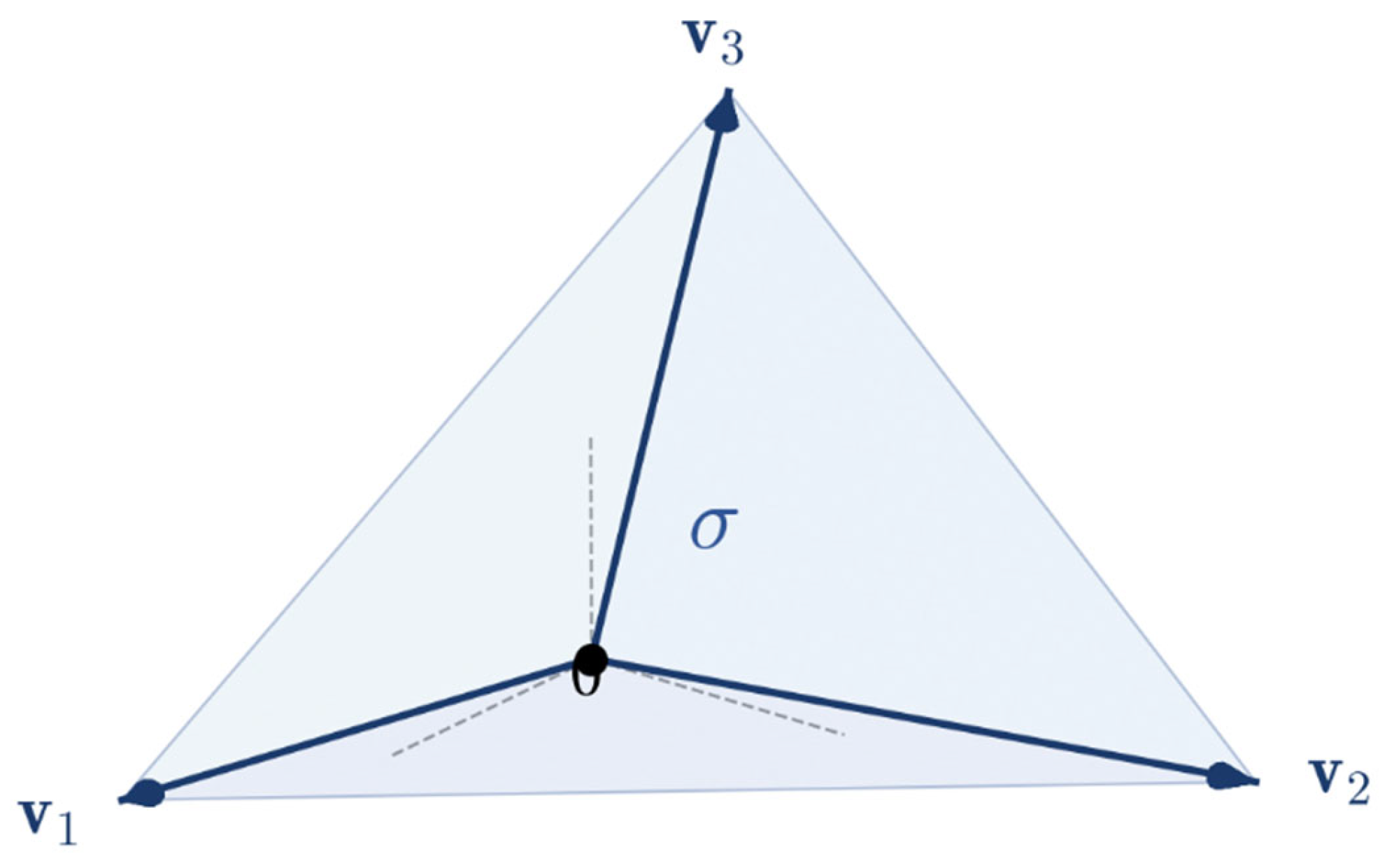
3.2. Image of the Orthant: A Simplicial Cone in
3.3. Exit Times and Equivalence of Survival Probabilities
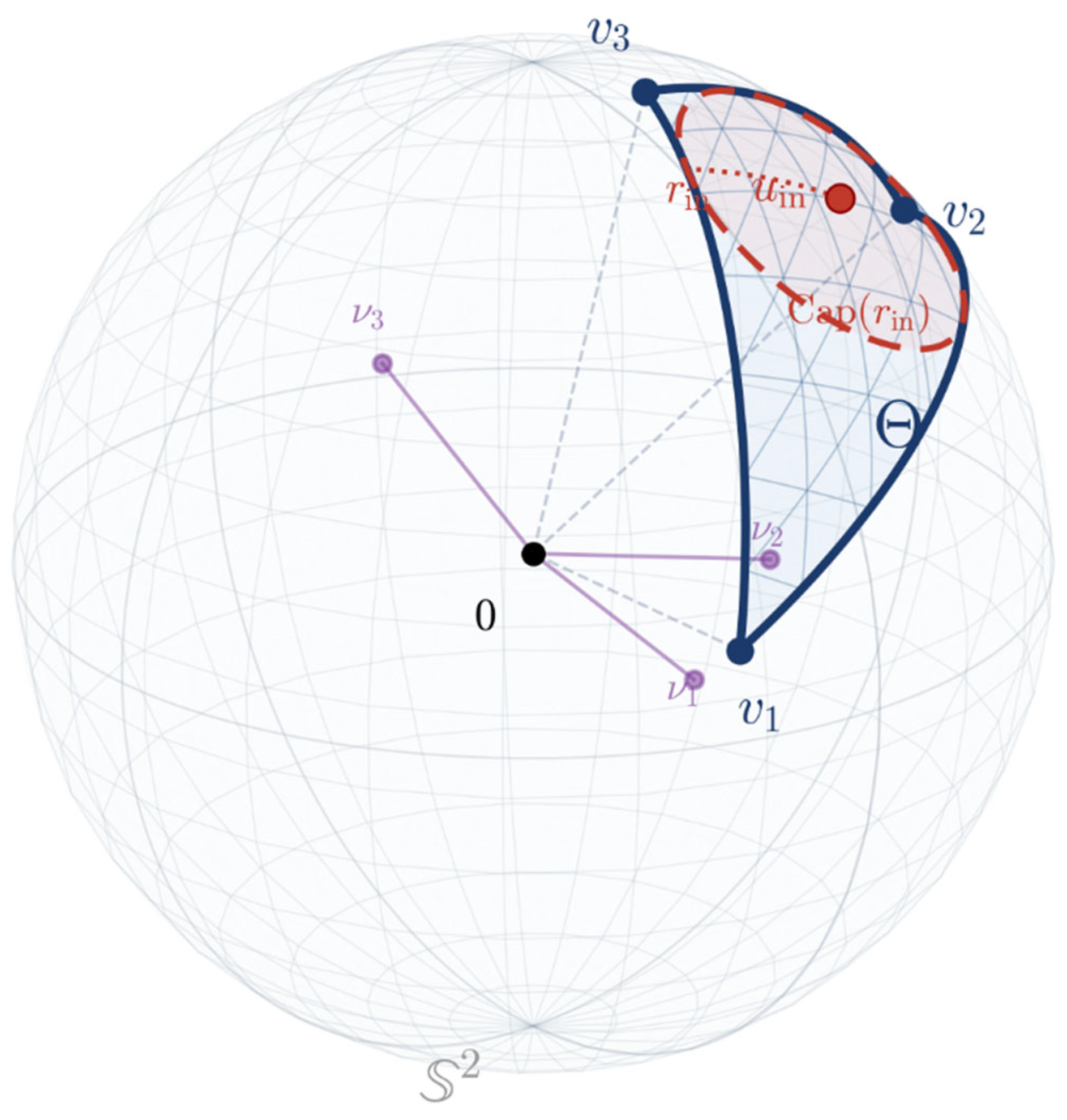
3.4. Spherical Cross-Section and Polar Coordinates
4. Geometry of the Whitened Cone: Difficulty Index and Dimension-Robust Bounds
- (i)
- A covariance-only scalar diagnostic that measures the “narrowness” of the spherical simplex , and
- (ii)
- A spherical cap , yielding computable bounds on the principal Dirichlet eigenvalue , hence on the driftless cone exponent governing long-time survival.
4.1. Canonical Facet Normals and a Covariance Identity
4.2. An Inscribed Spherical Cap from
4.3. A Covariance “Difficulty Index”
4.4. A Dimension-Robust Bound on the Principal Spherical Eigenvalue
4.5. Geometric Intuition
5. Cone Heat Kernel and Survival Probability: General Semi-Analytic Representation
5.1. Setting and Notation
5.2. Angular Spectral Data on the Spherical Cross-Section
5.3. Dirichlet Heat Kernel in a Cone
5.4. Survival Probability Without Drift: Confluent Hypergeometric Series
5.5. Adding Drift: Exponential Tilt
5.6. Remarks
6. Specialization to (i.e., ): The Spherical Tetrahedron Case
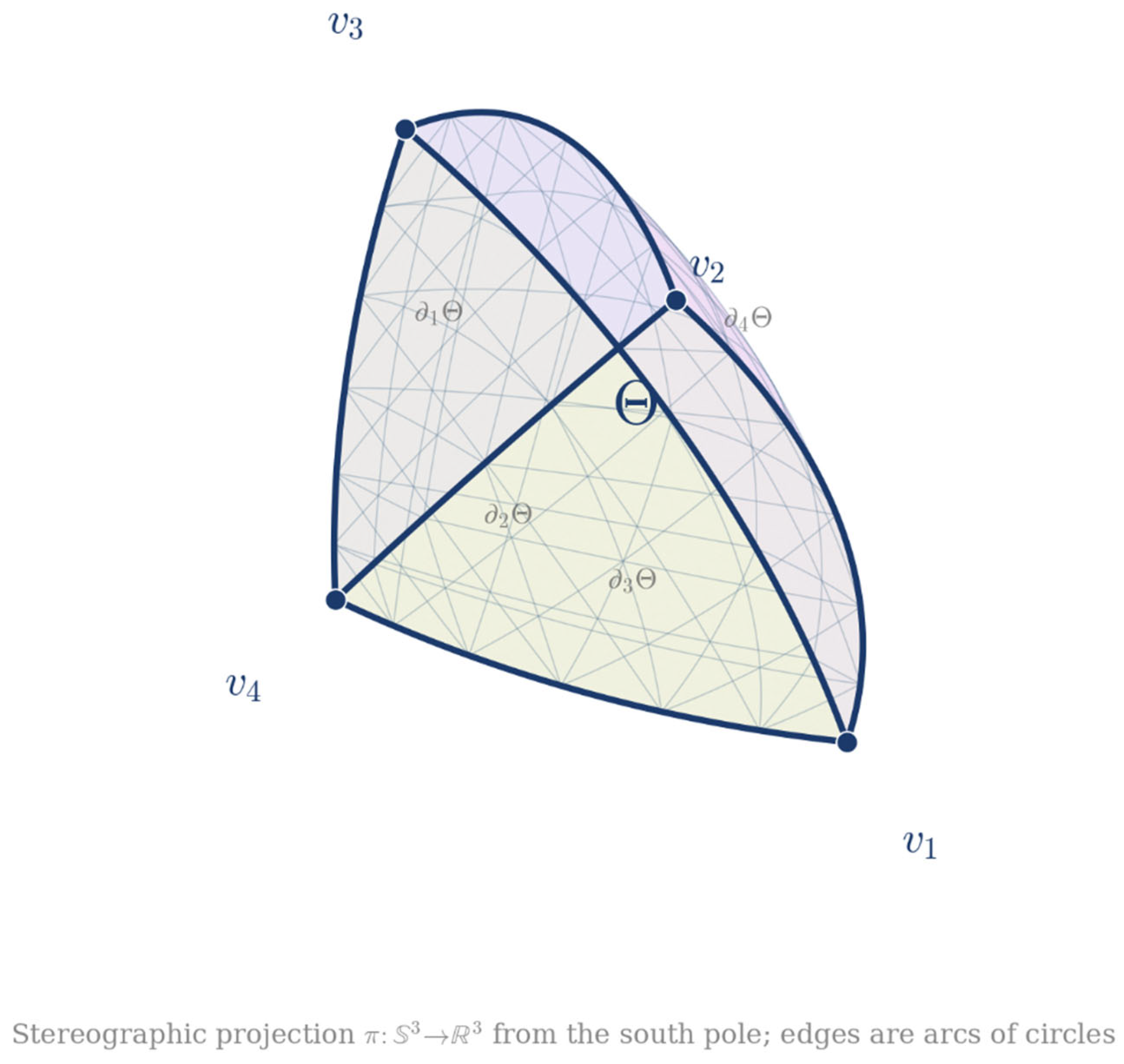
6.1. The Whitened Cone, Its Spherical Cross-Section, and the Spectral Data on
6.2. Cone Heat Kernel in and Drift Tilting
6.3. A Single Laguerre–Eigenfunction Representation
6.4. Explicit Moment Expansion and a Double Series
6.5. Practical Remarks
7. Computing the Angular Spectrum on : Euclidean Tetrahedron Pullback and FEM (Finite Element Method)
7.1. Vertices of the Spherical Tetrahedron and a Normalized Simplex Chart
7.2. Pullback Metric on the Euclidean Tetrahedron
7.3. Pulled-Back Dirichlet Eigenproblem on
7.4. FEM Discretization and Elementwise Assembly
- (i)
- and the scalar/vector quantities entering Proposition 4 (at ),
- (ii)
- and using the closed forms of Proposition 4.
7.5. Evaluating Eigenfunctions on and Angular Integrals
- (i)
- Point evaluation
- (ii)
- Angular integrals.
7.6. Conditioning and Mesh Refinement
- (i)
- Positive definiteness/near-degeneracy
- (ii)
- Mesh refinement near edges and corners
8. Algorithmic Pipeline and Truncation Strategy Enhanced by
- An offline geometric stage (dependent only on the cone geometry, hence on ), and
- An online evaluation stage (dependent on once is fixed),
8.1. Inputs, Outputs, and the Two-Level Structure
- Inputs (original variables)
- Derived quantities for the gap model
- Whitened quantities for the cone model
- The target probability equalsfor the drifted standard Brownian motion killed upon exiting the simplicial cone with spherical section .
8.2. Offline Stage: Geometry, Mesh, Spectrum, and Quadrature Data
8.2.1. Compute the Difficulty Index and the Inradius Bound
- (i)
- A mesh/spectrum difficulty diagnostic (large suggests sharper angular boundary layers and slower spectral convergence), and
- (ii)
- A sanity check on the computed principal eigenvalue via the cap comparison ; hence, .
8.2.2. Build and the Pullback Map
- (i)
- Inward unit normals of faces (from ),
- (ii)
- Vertices (via the 4D triple cross product),
- (iii)
- The normalized simplex map , and the explicit metric quantities , on .
8.2.3. Mesh Selection Guided by
- (i)
- If is “moderate” (cone not extremely narrow), start with a moderately refined quasi-uniform mesh on .
- (ii)
- If is “large” (narrow cone), use a graded mesh biased toward and especially toward edges/vertices where two or three barycentric coordinates are small.
8.2.4. FEM Eigenpairs and a Posteriori Spectral Validation
8.3. Online Stage: Stable 1D Quadrature + Fast Angular Transforms
8.3.1. Generalized Gauss–Laguerre Quadrature in
8.3.2. Fast Evaluation of as Linear Algebra
8.3.3. Optional Acceleration: Moment Expansion (Many -Nodes with Fixed )
8.4. Truncation Strategy: Three Coupled Tolerances
- (i)
- Laguerre quadrature in (parameter ),
- (ii)
- Spectral truncation of the angular eigen-sum (parameter ),
- (iii)
- (Optional) moment truncation (parameter ).
8.4.1. Truncation of the Angular Eigen-Sum
- (i)
- Weyl-type growth of the spherical Dirichlet eigenvalues on a 3D domain: grows on the order of (hence, ).
- (ii)
- For fixed argument , the modified Bessel decays very rapidly as (heuristically like ).
- (i)
- If is small/moderate: start with in the “tens” range.
- (ii)
- If is large (narrow cone): start larger, and expect either larger , or more mesh refinement, or both.
8.4.2. Truncation of the Laguerre Quadrature
8.4.3. Truncation of the Moment Expansion (Optional Branch)
- (i)
- Choose so that the last included term is below a relative tolerance for all relevant ,
- (ii)
- Cross-check against the direct exponential evaluation at a few representative nodes.
8.5. How Enters the Full Adaptive Loop
9. Numerical Experiments
9.1. Test Design
9.2. Numerical Results and Discussion
9.3. Discussion and Interpretation
9.4. Relation to Rare-Event Monte Carlo and Importance Sampling
10. General Dimension, Asymptotics, and Further Remarks
- (i)
- (ii)
- High : full angular eigen-resolutions become infeasible, but the geometric diagnostics and bounds from Section 4 remain informative (e.g., principal spectral bounds and tail exponents).
10.1. Universal Cone Formulation in Dimension
10.2. Geometry Shift: Spherical Simplex to a Euclidean Simplex
10.3. Two Regimes: Moderate Versus High
10.3.1. Moderate Dimension: Numerical Eigenpairs on Remain Feasible
- (i)
- Offline: build , assemble metric-weighted stiffness and mass matrices on , and compute eigenpairs ;
- (ii)
- Online: evaluate the one-dimensional radial integrals (often by Gauss–Laguerre quadrature) and truncate the spectral sum using fast angular quadrature/linear-algebra acceleration.
| Algorithm 1. Refined offline/online evaluation |
| Step 1: offline (for a given ) |
| 1: Compute and . |
| 2: Build (normals/vertices) and the pullback map with explicit metric coefficients. |
| 3: Choose an initial mesh: quasi-uniform if moderate, graded/adaptive if large. |
| 4: Solve for eigenpairs; validate up to discretization error. |
| 5: Build a global quadrature set and store . |
| Step 2: Online (for each query ) |
| 6: Choose and initially as monotone functions of (small smaller budgets). |
| 7: Evaluate using Laguerre quadrature and fast . |
| 8: Increase until the Laguerre difference test passes (). |
| 9: Increase until the spectral difference test passes (). |
| 10: If either test fails to stabilize within reasonable budgets (especially for large ), return to the offline stage and refine the mesh/recompute eigenpairs. |
10.3.2. High Dimension: When Full Angular Eigen-Computation Is Infeasible
- (i)
- Geometry diagnostics and certified bounds via spherical-cap comparison.
- (ii)
- Driftless long-time behavior via a single exponent.
- (iii)
- Drifted qualitative dichotomy and what remains computable.
10.4. Driftless Asymptotics: Cone Exponent and Polynomial Survival Tail
10.5. Long-Time Asymptotics in the Inward-Drift Regime
11. Conclusions and Outlook
Funding
Data Availability Statement
Conflicts of Interest
Appendix A. The Spherical Triangle Case ()
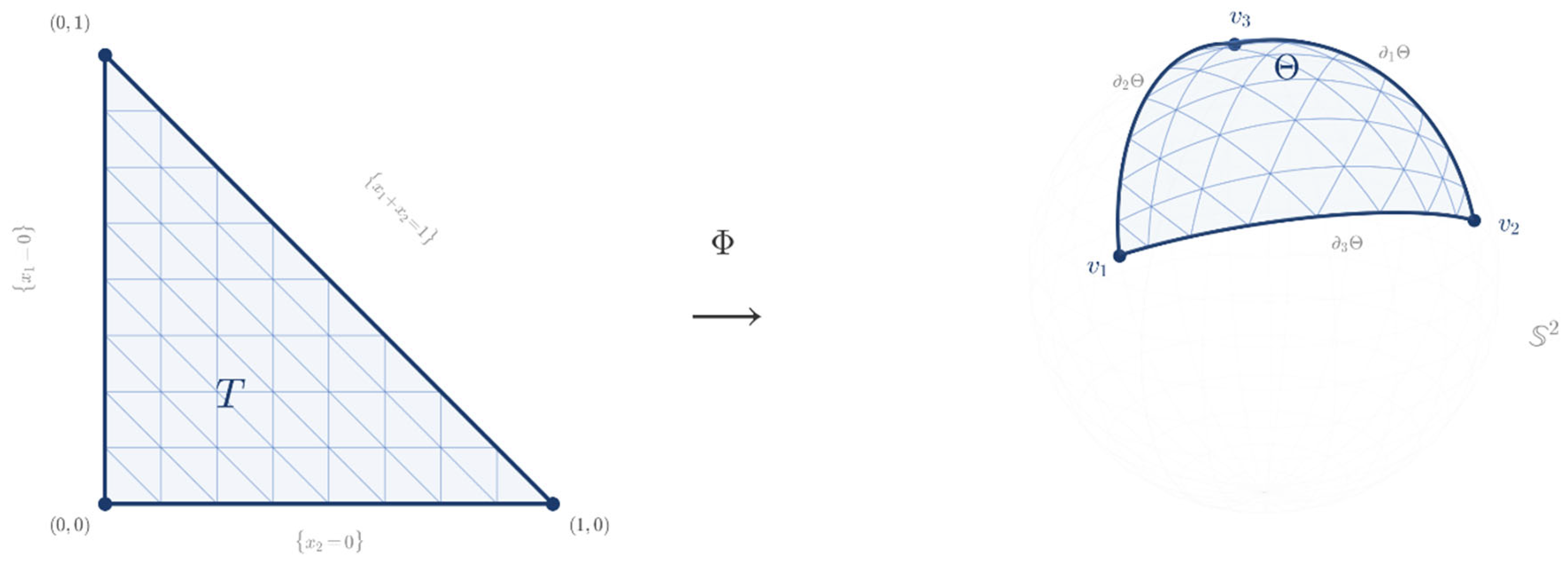
Appendix A.1. Whitening and the Induced 3D Cone
Appendix A.2. Vertices of the Spherical Triangle
Appendix A.3. Specialization of the General Drifted Survival Representation to
Appendix A.4. Euclidean Triangle Pullback and a 2D FEM Eigenproblem
Appendix B. Consolidated Notation Table

| Symbol | Meaning | Where Introduced |
|---|---|---|
| Number of correlated Brownian motions in the original system | Section 2.1 | |
| -th drifted Brownian motion () | Section 2.1 | |
| Vector process | Section 2.1 | |
| Initial position vector of | Section 2.1 | |
| Drift vector of the original system | Section 2.1 | |
| Volatility vector | Section 2.1 | |
| Diagonal volatility matrix | Section 2.1 | |
| Correlation matrix of the driving Brownian motions | Section 2.1 | |
| Survival (non-collision/maintained ordering) event up to time | Section 2.1 | |
| First violation time of the survival ordering | Section 2.1 |
| Symbol | Meaning | Where Introduced |
|---|---|---|
| Dimension of the gap process | Section 2.2 | |
| Gap process (differences relative to ) | Section 2.2 | |
| Initial gap vector | Section 2.2 | |
| Positive orthant (gap survival domain) | Section 2.2 | |
| Difference matrix such that | Section 2.3 | |
| Drift vector of the gap process | Section 2.3 | |
| Gap covariance matrix (SPD) | Section 2.3 | |
| Brownian motion with covariance (i.e., ) | Section 2.3 |
| Symbol | Meaning | Where Introduced |
|---|---|---|
| Symmetric inverse square root (whitening matrix) | Section 3.1 | |
| (or ) | Whitened gap process | Section 3.1 |
| Whitened initial point | Section 3.1 | |
| Drift of the whitened process | Section 3.1/Section 5.5 | |
| Standard Brownian motion in after whitening | Section 3.1 | |
| Whitened simplicial cone (image of under ) | Section 3.2 | |
| Inward (non-unit) facet normal of | Section 3.2/Section 4.1 | |
| Inward unit facet normal of | Section 3.2/Section 4.1 | |
| Extreme-ray generators of the simplicial cone | Section 3.2 | |
| Orthant exit time of | Section 3.3 | |
| Cone exit time of | Section 3.3 |
| Symbol | Meaning | Where Introduced |
|---|---|---|
| Spherical cross-section of the cone (a spherical simplex) | Section 3.4 | |
| Polar variables in : , , | Section 3.4 | |
| Unit sphere in | Section 3.4 | |
| Gram matrix of inward unit facet normals: | Lemma 5 | |
| Diagonal normalization matrix used in | Lemma 5 | |
| Matrix whose -th row is | Proposition 1 | |
| Canonical incenter candidate (cap center) in | Proposition 1 | |
| Common facet inner product (all ) | Proposition 1 | |
| Explicit inscribed-cap radius (geodesic), used for bounds | Proposition 1 | |
| Spherical cap of geodesic radius | Section 4.4 | |
| Covariance difficulty index (cone narrowness/stiffness indicator) | Definition 1 | |
| Principal Dirichlet eigenvalue of on | Section 4.4 | |
| Principal cap eigenvalue used for the comparison bound | Proposition 2 |
| Symbol | Meaning | Where Introduced |
|---|---|---|
| Laplace–Beltrami operator on the unit sphere | Section 3.4/Section 6.1 | |
| Dirichlet eigenpairs of on | Section 5/Section 6.1 | |
| Angular integral of (driftless case; constant angular coefficient) | Section 5.6 | |
| Drift-weighted angular transform in the drifted representation | Proposition 3 | |
| Time horizon in the finite-time survival probability | throughout | |
| Spectral truncation level (number of angular modes kept) | Section 5, Section 8 and Section 9 |
| Symbol | Meaning | Where Introduced |
|---|---|---|
| Reference Euclidean tetrahedron (pullback domain for ) | Section 7.1 | |
| Geometric chart/pullback map from to | Section 7.1/Section 7.3 | |
| Induced metric tensor on | Section 7.2/Proposition 4 | |
| Inverse metric tensor | Section 7.2/Proposition 4 | |
| Metric determinant (volume factor) | Section 7.2/Proposition 4 | |
| , | Auxiliary geometric quantities used in the explicit metric formulas | Proposition 4 |
| FEM stiffness bilinear form (pulled-back operator) | Proposition 5/Section 7.4 | |
| FEM mass bilinear form | Proposition 5/Section 7.4 | |
| Tetrahedral mesh of | Section 7.4 | |
| P1 finite-element trial space | Section 7.4 | |
| Mesh size parameter | Section 7.4 | |
| Discrete stiffness and mass matrices | Section 7.4 | |
| Discrete FEM eigenpairs | Section 7.4 |
| Symbol | Meaning | Where Introduced |
|---|---|---|
| Angular quadrature nodes and weights on | Section 8.4/Algorithm 1 | |
| Number of angular quadrature points | Section 8 | |
| SA | Semi-analytical estimator/value (spectral + radial quadrature) | Section 9 |
| MC | Monte Carlo estimator/value | Section 9 |
| D1, D2 | Drift regimes used in numerical experiments | Section 9.1 |
| C1, C2 | Correlation regimes (moderate/near-degenerate) used in experiments | Section 9.1 |
References
- Metzler, R.; Redner, S.; Oshanin, G. First-Passage Phenomena and Their Applications; World Scientific: Singapore, 2014. [Google Scholar]
- Masoliver, J. Random Processes: First-Passage and Escape; World Scientific: Singapore, 2018. [Google Scholar]
- He, H.; Keirstead, W.P.; Rebholz, J. Double Lookbacks. Math. Finance 1998, 8, 201–228. [Google Scholar] [CrossRef]
- Escobar, M.; Ferrando, S.; Wen, X. Barrier options in three dimensions. Int. J. Financ. Mark. Deriv. 2014, 3, 260–292. [Google Scholar] [CrossRef]
- Che, X.; Dassios, A. Stochastic boundary crossing probabilities for the Brownian motion. J. Appl. Probab. 2012, 50, 419–429. [Google Scholar] [CrossRef]
- Wang, X. Pricing vulnerable options with stochastic default barriers. Finance Res. Lett. 2016, 19, 305–313. [Google Scholar] [CrossRef]
- Guillaume, T. Closed form valuation of barrier options with stochastic barriers. Ann. Oper. Res. 2022, 313, 1021–1050. [Google Scholar] [CrossRef]
- Liao, S.L.; Huang, H.H. Pricing Black-Scholes Options with Correlated Interest Rate Risk and Credit Risk: An Extension. Quant. Finance 2005, 5, 443–457. [Google Scholar] [CrossRef]
- Kim, D.; Yoon, J.-H. Analytic Method for Pricing Vulnerable External Barrier Options. Comput. Econ. 2022, 61, 1561–1591. [Google Scholar] [CrossRef]
- Guillaume, T. Less vulnerable valuation of vulnerable options. Ann. Oper. Res. 2025, 1–45. [Google Scholar] [CrossRef]
- Zhou, C. An analysis of default correlations and multiple defaults. Rev. Financ. Stud. 2001, 14, 555–576. [Google Scholar] [CrossRef]
- Patras, F. A reflection principle for correlated defaults. Stoch. Process. Appl. 2005, 116, 690–698. [Google Scholar] [CrossRef]
- Kaushansky, V.; Lipton, A.; Reisinger, C. Transition probability of Brownian motion in the octant and its application to default modelling. Appl. Math. Finance 2018, 25, 434–465. [Google Scholar] [CrossRef]
- Guillaume, T. On the first exit time of geometric Brownian motion from stochastic exponential boundaries. Int. J. Appl. Comput. Math. 2018, 4, 120. [Google Scholar] [CrossRef]
- Escobar, M.; Ferrando, S.; Wen, X. Three dimensional distribution of Brownian motion extrema. Stochastics 2013, 85, 807–832. [Google Scholar] [CrossRef]
- Gupta, S.; Joshi, G.; Yağan, O. Best-Arm Identification in Correlated Multi-Armed Bandits. IEEE J. Sel. Areas Inf. Theory 2021, 2, 549–563. [Google Scholar] [CrossRef]
- Heathcote, A.; Matzke, D. Winner takes all! What are race models, and why and how should psychologists use them? Curr. Dir. Psychol. Sci. 2022, 31, 383–394. [Google Scholar] [CrossRef]
- Tajima, S.; Drugowitsch, J.; Patel, N.; Pouget, A. Optimal policy for multi-alternative decisions. Nat. Neurosci. 2019, 22, 1503–1511. [Google Scholar] [CrossRef]
- DeBlassie, R.D. Exit times from cones in ℝn of Brownian motion. Probab. Theory Relat. Fields 1987, 74, 1–29. [Google Scholar] [CrossRef]
- Bañuelos, R.; Smits, R.G. Brownian motion in cones. Probab. Theory Relat. Fields 1997, 108, 299–319. [Google Scholar] [CrossRef]
- Grabiner, D.J. Brownian motion in a Weyl chamber, non-colliding particles, and random matrices. Ann. Inst. H. Poincaré Probab. Statist. 1999, 35, 177–204. [Google Scholar] [CrossRef]
- Doumerc, Y.; O’Connell, N. Exit problems associated with finite reflection groups. Probab. Theory Relat. Fields 2005, 132, 501–538. [Google Scholar] [CrossRef]
- Revuz, D.; Yor, M. Continuous Martingales and Brownian Motion, 3rd ed.; Springer: Berlin/Heidelberg, Germany, 2005. [Google Scholar]
- Dziuk, G.; Elliott, C.M. Finite element methods for surface PDEs. Acta Numer. 2013, 22, 289–396. [Google Scholar] [CrossRef]
- Bonito, A.; Demlow, A.; Nochetto, R.H. Finite element methods for the Laplace–Beltrami operator. In Handbook of Numerical Analysis; Geometric Partial Differential Equations—Part I; Elsevier: Amsterdam, The Netherlands, 2020; Volume 21, pp. 1–103. [Google Scholar] [CrossRef]
- Babuška, I.; Osborn, J.E. Eigenvalue problems. In Handbook of Numerical Analysis; Finite Element Methods (Part 1); Ciarlet, P.G., Lions, J.-L., Eds.; Elsevier: North-Holland, The Netherlands, 1991; Volume 2, pp. 641–787. [Google Scholar]
- Boffi, D. Finite element approximation of eigenvalue problems. Acta Numer. 2010, 19, 1–120. [Google Scholar] [CrossRef]
- Matsumoto, M.; Nishimura, T. Mersenne Twister: A 623-dimensionally equidistributed uniform pseudo-random number generator. ACM Trans. Model. Comput. Simul. 1998, 8, 3–30. [Google Scholar] [CrossRef]
- Garbit, R.; Raschel, K. On the exit time from a cone for Brownian motion with drift. Electron. J. Probab. 2014, 19, 1–27. [Google Scholar] [CrossRef]


| Volatility Set | Semi-Analytical | Monte Carlo | Divergence |
|---|---|---|---|
| A | 0.24486 | 0.24438 | 0.2% |
| B | 0.08132 | 0.08167 | 0.4% |
| C | 0.03246 | 0.03265 | 0.6% |
| Volatility Set | Semi-Analytical | Monte Carlo | Divergence |
|---|---|---|---|
| A | 0.48195 | 0.48114 | 0.2% |
| B | 0.15246 | 0.152998 | 0.4% |
| C | 0.04217 | 0.04256 | 0.9% |
| Volatility Set | Semi-Analytical | Monte Carlo | Divergence |
|---|---|---|---|
| A | 0.15239 | 0.15203 | 0.2% |
| B | 0.05688 | 0.05652 | 0.6% |
| C | 0.02567 | 0.02585 | 0.7% |
| Volatility Set | Semi-Analytical | Monte Carlo | Divergence |
|---|---|---|---|
| A | 0.20492 | 0.20481 | 0.1% |
| B | 0.06861 | 0.06897 | 0.5% |
| C | 0.02205 | 0.02224 | 0.9% |
Disclaimer/Publisher’s Note: The statements, opinions and data contained in all publications are solely those of the individual author(s) and contributor(s) and not of MDPI and/or the editor(s). MDPI and/or the editor(s) disclaim responsibility for any injury to people or property resulting from any ideas, methods, instructions or products referred to in the content. |
© 2026 by the author. Licensee MDPI, Basel, Switzerland. This article is an open access article distributed under the terms and conditions of the Creative Commons Attribution (CC BY) license.
Share and Cite
Guillaume, T. Survival Probabilities for Correlated Drifted Brownian Motions via Exit from Simplicial Cones. AppliedMath 2026, 6, 45. https://doi.org/10.3390/appliedmath6030045
Guillaume T. Survival Probabilities for Correlated Drifted Brownian Motions via Exit from Simplicial Cones. AppliedMath. 2026; 6(3):45. https://doi.org/10.3390/appliedmath6030045
Chicago/Turabian StyleGuillaume, Tristan. 2026. "Survival Probabilities for Correlated Drifted Brownian Motions via Exit from Simplicial Cones" AppliedMath 6, no. 3: 45. https://doi.org/10.3390/appliedmath6030045
APA StyleGuillaume, T. (2026). Survival Probabilities for Correlated Drifted Brownian Motions via Exit from Simplicial Cones. AppliedMath, 6(3), 45. https://doi.org/10.3390/appliedmath6030045