


Abstract
This paper addresses the numerical integration of first-order ordinary differential equations by developing a continuous linear multistep block method. The method is constructed through the approximation of the exact solution using a linear combination of shifted Vieta–Lucas polynomials defined on the interval . The use of this polynomial basis extends traditional approximation approaches and provides improved stability while maintaining high-order accuracy. Theoretical analysis shows that the proposed method attains sixth-order convergence and possesses an extended stability interval of , ensuring reliable performance for moderately stiff problems. Numerical experiments confirm that the method achieves lower errors and higher computational efficiency than conventional methods. These results demonstrate the suitability of the proposed approach for scientific computing applications, including engineering simulations and mathematical modeling, where accurate numerical integration of first-order differential equation is required.
1. Introduction
The numerical integration of ordinary differential equations (ODEs) remains a fundamental problem in applied mathematics and scientific computing, with wide-ranging applications in engineering, physics, biology, economics, and industrial modeling. Many real-world phenomena are governed by first-order initial value problems of the form
for which closed-form solutions are rarely available. Consequently, the development of accurate, stable, and efficient numerical methods continues to attract sustained research interest [1].
Linear multistep methods (LMMs) constitute a well-established class of numerical integrators for ODEs, offering attractive accuracy–efficiency trade-offs. Classical schemes such as the Adams–Bashforth and Adams–Moulton families [1,2] form the basis of predictor–corrector algorithms, while backward differentiation formulae (BDFs) are widely recognized for their robustness when applied to stiff systems. Modern analyses and refinements of multistep techniques continue to be reported in the recent literature, including the development of block, hybrid, and stability-enhanced schemes for ordinary differential equations [3,4,5,6].
Despite their success, conventional LMMs are constrained by fundamental limitations, most notably the Dahlquist barrier [7], which restricts the maximum order of zero-stable explicit multistep schemes. To overcome some of these limitations, block linear multistep methods were introduced as a natural generalization of classical LMMs.
Early contributions by Milne [8] and Rosser [9], followed by systematic developments by Awoyemi [10] and Jator [11], demonstrated that block methods can compute multiple solution values simultaneously within a single step. More recent studies have extended block methods to higher-order and stiff formulations, confirming their continued relevance in modern numerical analysis [12].
Polynomial-based collocation and approximation techniques play a central role in the construction of high-order numerical integrators. Orthogonal polynomial bases such as Chebyshev and Legendre polynomials have been extensively employed due to their favorable approximation properties and well-understood numerical behavior [13,14].
In this context, Vieta–Lucas polynomials represent a relatively unexplored basis for ODE discretization. Although these polynomials possess attractive approximation properties on finite intervals, their application to the construction of numerical integrators has received limited attention in the literature. This observation motivates further investigation into their potential role in enhancing stability characteristics and practical performance when used within block multistep formulations.
The numerical treatment of stiff differential equations remains a major challenge, particularly for problems characterized by widely separated time scales. Implicit Runge–Kutta schemes, such as Radau methods [15], and generalized BDF-type approaches [16,17,18] have demonstrated strong stability properties. Comprehensive modern treatments of stiff ODE solvers may be found in [12,19].
Beyond ODE-specific techniques, more general numerical frameworks such as the finite difference method (FDM), finite element method (FEM), and finite volume method (FVM) are widely used for solving partial differential equations on complex geometries and domains. These approaches are supported by mature commercial software packages; however, for time-dependent problems governed by ODEs or semi-discretized PDE systems, specialized time-integration schemes often provide superior temporal accuracy and efficiency [20,21].
The present work contributes to this ongoing research effort by developing a continuous linear multistep block method constructed using shifted Vieta–Lucas polynomials defined on the interval . The proposed approach yields a sixth-order accurate implicit block scheme with an extended stability interval of approximately , making it well suited for moderately stiff systems.
Option pricing problems with barrier features are commonly modeled by Black–Scholes-type parabolic partial differential equations posed on truncated spatial domains with additional barrier constraints. When barriers are discretely monitored, numerical treatment becomes more challenging and typically requires specialized discretization strategies.
Recent studies in [22,23,24] have shown that such problems can be efficiently handled by advanced spatial discretizations, including wavelet and interpolation-based methods, which reduce the governing PDE to a stiff system of first-order ordinary differential equations in time. In this context, the continuous linear multistep block method proposed in this work can be naturally employed as a high-order time integrator. Its sixth-order accuracy and extended stability interval along the negative real axis make it a suitable and efficient temporal solver within existing option pricing frameworks, without modifying the underlying spatial discretization.
While the general block collocation structure follows established methodology, the novelty of this work lies in the stability characteristics and practical performance gains associated with the shifted Vieta–Lucas polynomial basis.
The other parts of this paper are organized as follows: Section 2 details the derivation of the method using shifted Vieta–Lucas polynomials. Section 3 presents the convergence and stability analysis, establishing the sixth-order accuracy and stability properties. Section 4 contains numerical experiments demonstrating the method’s performance on benchmark problems, while Section 5 provides concluding remarks and directions for future research.
1.1. Classical Vieta–Lucas Polynomials
The Vieta–Lucas polynomials, belonging to the family of Fibonacci-like polynomials, are intimately connected to the celebrated Chebyshev polynomials of the first kind. Their properties make them a powerful tool for function approximation.
Definition 1
(Vieta–Lucas Polynomials [25]). The Vieta–Lucas polynomials , defined on the canonical interval , are generated by the recurrence relation
An explicit closed-form representation, which also reveals their deep connection to circular functions, is given by
This representation is valid for , where the argument of the arccosine function lies within its principal domain .
1.2. Shifted Vieta–Lucas Polynomials on [0, 4]
For practical applications involving the numerical solution of differential equations on an arbitrary finite interval , it is necessary to define a shifted version of the Vieta–Lucas polynomials. In this work, we specifically consider the interval .
Definition 2
(Shifted Vieta–Lucas Polynomials [26]). Let . The shifted Vieta–Lucas polynomials are obtained via the linear transformation
This transformation maps the physical domain onto the canonical domain . The shifted polynomials are defined as
The shifted Vieta–Lucas polynomials inherit the excellent approximation properties of their classical counterparts, such as rapid convergence and minimax characteristics, making them a suitable basis for the spectral-class method developed in the following section.
2. Derivation of the Sixth-Order Implicit Block Method
Consider the initial value problem for a first-order ordinary differential equation:
To derive a sixth-order implicit block method, we employ shifted Vieta–Lucas polynomials as basis functions over the interval . The approximate solution is expressed as
where denotes the shifted Vieta–Lucas polynomial of degree j on the interval , defined by
To determine the eight unknown coefficients , we impose eight conditions comprising both interpolation and collocation constraints. The approximate solution interpolates at four distinct points:
The derivative satisfies the differential equation at four collocation points:
The shifted Vieta–Lucas polynomials and their derivatives are explicitly given by
with derivatives given by
The coefficient vector is obtained by solving the linear system
Substituting this solution into the approximation yields the continuous representation
where denotes the th entry of the inverse matrix . Evaluating the continuous approximation at and simplifying yields the sixth-order implicit block method:
3. Analysis of the Sixth-Order Implicit Block Method
3.1. Order and Local Truncation Error
The local truncation error (LTE) is the fundamental measure of accuracy for numerical methods applied to ordinary differential equations. For a numerical method applied to the test equation , the LTE is defined as the difference between the exact solution and the numerical approximation after a single step, assuming exact previous values.
Definition 3
(Local Truncation Error for Block Methods). For the implicit block method defined by Equation (18), the local truncation error vector is given by
where represents the vector of exact solutions at the block points.
To determine the order of the method, we employ Taylor series expansions about . For each formula in the block method, we substitute the expansions:
After algebraic manipulation, the principal local truncation errors are
where for .
Theorem 1
(Order of the Method). The derived implicit block method has uniform order with error constants
Proof.
The order analysis follows from verifying that all terms up to cancel identically when the Taylor expansions are substituted into each formula of the block method, while the terms remain non-zero. This cancelation pattern confirms that the local truncation error is for each component, establishing sixth-order accuracy according to the theory of linear multistep methods [19]. □
Remark 1.
The method satisfies uniform sixth-order accuracy in the block sense, and the global error behavior remains consistent across all block components.
Consistency ensures that the numerical method approximates the differential equation as the step size tends to zero. For block methods, consistency must be verified for each component formula.
Definition 4
(Consistency). A numerical method for solving is consistent if its local truncation error satisfies
For linear multistep methods, consistency is equivalent to the following conditions:
- 1.
- (the first characteristic polynomial has root 1),
- 2.
- (the method has order at least 1).
For our implicit block method, consistency is verified component-wise:
Theorem 2
(Consistency of the Block Method). The derived sixth-order implicit block method is consistent.
Proof.
The verification above demonstrates that each formula in the block method satisfies the consistency conditions. Furthermore, since the local truncation error is for each component, we have
which confirms consistency according to the definition. This result aligns with the general theory of numerical methods for ODEs [27]. □
3.2. Zero-Stability Analysis
Zero-stability concerns the behavior of a numerical method as when applied to the test equation . It is crucial for controlling the propagation of errors in the numerical solution.
Definition 5
(Zero-Stability). A block method is zero-stable if the roots of the first characteristic polynomial , associated with the method’s difference equation when , satisfy:
- 1.
- for all roots,
- 2.
- only for simple roots.
For the block method in Equation (18), the matrix form can be written as
where
with the coefficients
Setting , the method reduces to
The characteristic equation derived from the block structure is
For this block method, the characteristic roots are (multiplicity 3) and (multiplicity 1).
Theorem 3
(Zero-Stability of the Block Method). The derived sixth-order implicit block method is zero-stable.
Proof.
Since for all roots, and the root is simple while has multiplicity less than or equal to the number of steps, the method satisfies the zero-stability conditions. This follows from the root condition in [28] and its extension to block methods [29]. □
3.3. Convergence of the Method
Convergence ensures that the numerical solution approaches the exact solution as the step size decreases. The Dahlquist Equivalence Theorem provides the theoretical foundation.
Theorem 4
(Dahlquist Equivalence Theorem). For a consistent linear multistep method applied to , where f satisfies a Lipschitz condition in y, zero-stability is necessary and sufficient for convergence [28].
Theorem 5
(Convergence of the Block Method). The derived sixth-order implicit block method is convergent with order 6.
Proof.
Convergence follows from the extension of the Lax–Richtmyer Equivalence Theorem to initial value problems. We established:
- Consistency: The method has order (Section 4.1),
- Zero-Stability: The characteristic roots satisfy the root condition (Section 4.3),
- Lipschitz Condition: is Lipschitz continuous in y.
By the Dahlquist Equivalence Theorem and its extension to block methods [29,30], the method is convergent with order 6. The convergence is uniform on bounded intervals, and the global error satisfies
where C is a constant independent of h. □
3.4. Linear Stability Analysis of the Sixth-Order Implicit Block Method
Linear stability analysis examines the method’s behavior when applied to the scalar test equation
with and , which serves as a prototype for studying stability properties.
Definition 6
(Absolute Stability). A numerical method is absolutely stable for a given if, when applied to Equation (37), the numerical solution remains bounded as . The region of absolute stability is
This can be written in matrix form:
with amplification matrix
Stability is determined by the eigenvalues of :
For this fourth-order block method, the characteristic polynomial is
where are rational functions of z. The explicit form is
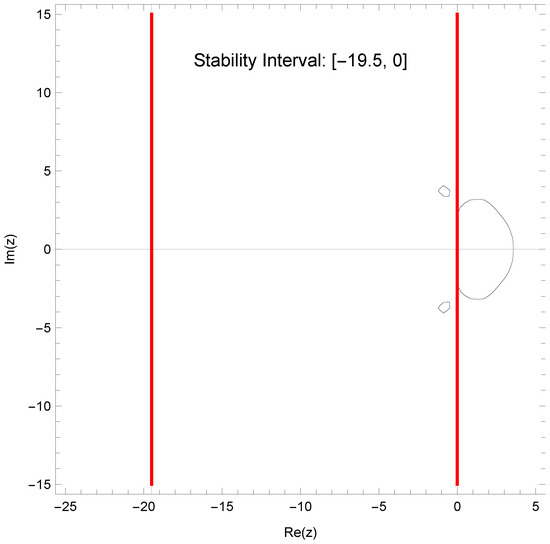
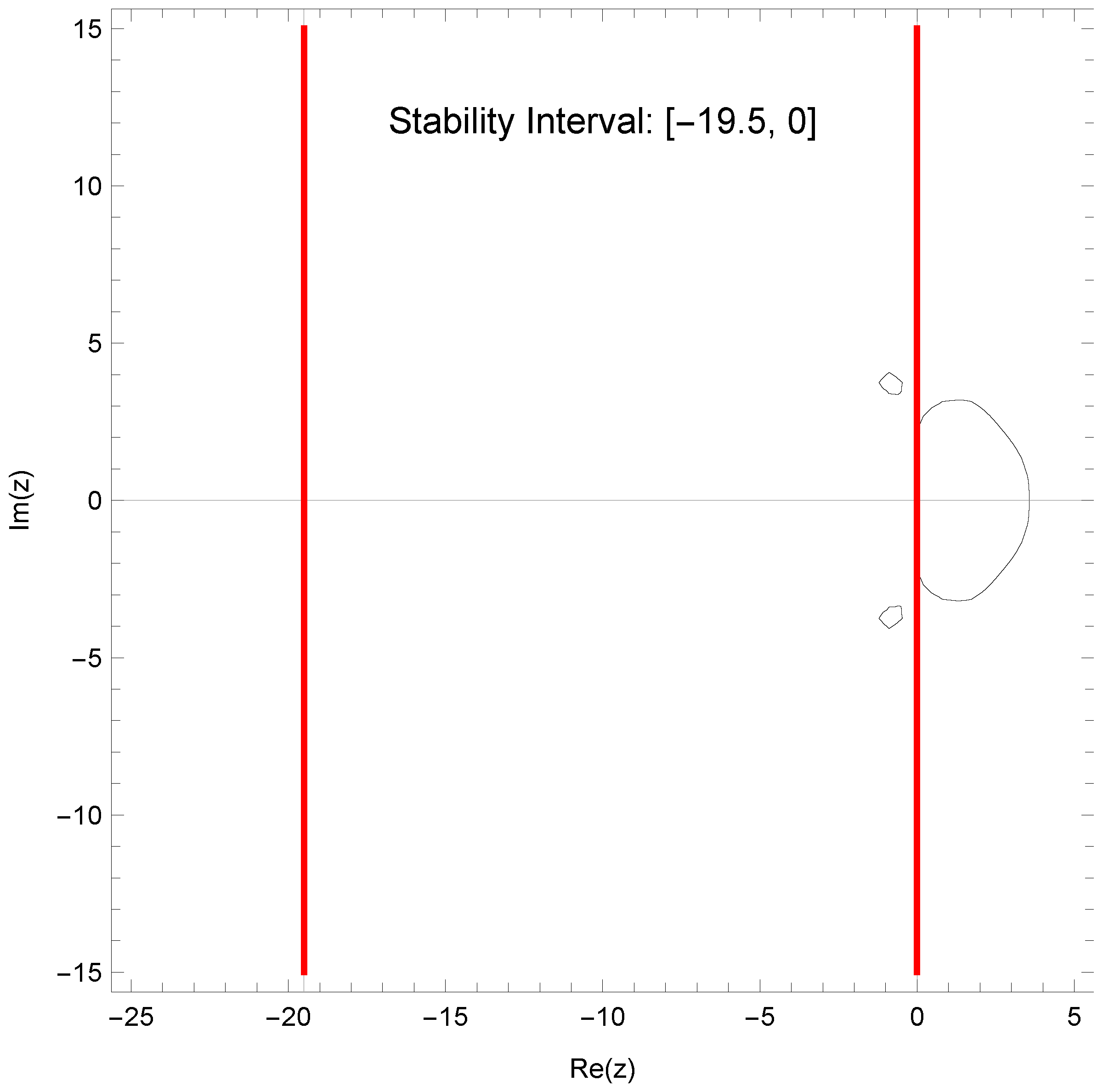
The stability interval along the negative real axis in Figure 1 is approximately , this is the region bounded with thick red lines showing the stability boundary and region. The method exhibits substantial stability for mildly stiff problems and favorable damping characteristics. The small contour regions near result from Dahlquist’s order barrier, which does not affect practical stiff integrations where .
Figure 1.
Stability region along the negative real axis, .
3.5. Numerical Implementation of the Block Method
The computational implementation of the proposed four-step block method proceeds as follows.
- Computational Implementation of the Sixth-Order Four-Step Implicit Block Method:
- Step 1:
- Initialization: Set the initial point and value . Using a starter method (e.g., RK4), compute at , and evaluate for .
- Step 2:
- Block Advancement: Let . For each block , the goal is to compute .
- Step 3:
- Prediction: Predict using polynomial extrapolation from the previous block .
- Step 4:
- Iterative Correction: For :
- (a)
- Evaluate using the latest approximations.
- (b)
- Update each using the block formulas:
- (c)
- Check convergence: if , accept the block values and break the iteration.
- Step 5:
- Update and Advance: Store the accepted block values and corresponding , then proceed to the next block.
- Step 6:
- Output: After all blocks, return the set for .
In our implementation, we used a fixed-point iteration (functional iteration) due to its simplicity and ease of implementation. For problems with mild nonlinearity, this approach converges efficiently in just a few iterations. For more strongly nonlinear or stiff problems, Newton-type iteration is recommended, as it provides quadratic convergence when a sufficiently accurate initial guess is available.
4. Numerical Examples
In this section, we assess the performance and accuracy of the proposed block linear multistep method based on shifted Vieta–Lucas polynomials through a series of numerical experiments. The method is applied to test problems with known exact or reference solutions. For each problem, the computed numerical solution is compared with the exact solution at the grid points .
The accuracy is measured using the maximum absolute error:
- Maximum absolute error:
For problems without analytical solutions, a highly accurate numerical solution—obtained, for example, via Runge–Kutta–Fehlberg or Adams–Moulton methods with a sufficiently small step size—serves as the reference. Computational efficiency is evaluated in terms of function evaluations and CPU time.
The method is compared with classical Runge–Kutta schemes, Adams–Bashforth–Moulton predictor–corrector methods, and other block or hybrid linear multistep methods of similar order. Comparative plots of absolute errors and convergence histories illustrate the stability, convergence rate, and efficiency of the proposed method relative to these standard approaches.
For stiff systems, the proposed method offers a practical alternative to high-order implicit schemes, balancing stability, accuracy, and computational efficiency.
4.1. Problem 1: Nonlinear Michaelis–Menten Substrate Depletion
We take the canonical Michaelis–Menten substrate depletion model discussed in [31].
The Michaelis–Menten substrate depletion model describes the temporal evolution of the concentration of a chemical substrate undergoing enzymatic reaction. It is widely used in biochemistry and chemical kinetics to represent enzyme-catalyzed reactions under the quasi-steady-state assumption. In this model, denotes the substrate concentration, typically measured in concentration units such as mol/L, while t represents time (e.g., seconds).
In the model Equation (48), (concentration per unit time) is the maximum reaction rate and (concentration) is the Michaelis constant, representing the substrate concentration at which the reaction rate is half of . The initial condition specifies the initial substrate concentration at time .
It is important to note that in the original work by Wong et al. [31], the Michaelis–Menten substrate depletion model was analyzed using the MAGI (Manifold-constrained Gaussian process Inference) framework, which bypasses the need for any numerical integration. In the present study, we adopt this model purely as a benchmark problem to assess the performance and accuracy of our proposed numerical scheme in comparison with existing methods such as AB6 and RK6.
For the numerical tests in this paper we use the widely adopted parameter set
and integrate on the interval . The model Equation (48) is a first-order nonlinear ODE that captures enzyme saturation and yields non-exponential decay. We compare the performance of the proposed sixth-order block method, the Adams-Bashforth order 6 method (AB6), the classical second-order BDF2 and Runge–Kutta sixth-order (RK6) methods. The exact solution is given analytically by
where denotes the principal branch of the Lambert W function. Numerical integration was carried out over the interval with step size . All computations were performed using Mathematica 12 with double precision arithmetic on a PC with 3.0 GHz processor and 8.0 RAM.
To evaluate the efficiency and accuracy of the proposed sixth-order block method (denoted as New Method, we compare its numerical performance with the classical BDF2, AB6, and RK6 schemes. Numerical integration was carried out on with step sizes using double precision arithmetic.
Table 1 assesses the efficiency and robustness of the proposed New Sixth-Order Block Method. Here, we compare its numerical accuracy and computational performance with three well-established schemes: AB6 and RK6. The maximum absolute error (MAE) and order of convergence (RoC) (p) are computed over the integration interval using the nonlinear Michaelis–Menten test problem described previously.
Table 1.
Comparison of numerical performance for various methods at different step sizes.
Table 1 presents a comparative analysis of the proposed sixth-order block method (denoted as New Method) alongside existing AB6 and RK6 schemes. The results clearly indicate that the new method achieves the smallest maximum absolute error for all step sizes while maintaining the expected sixth-order rate of convergence.
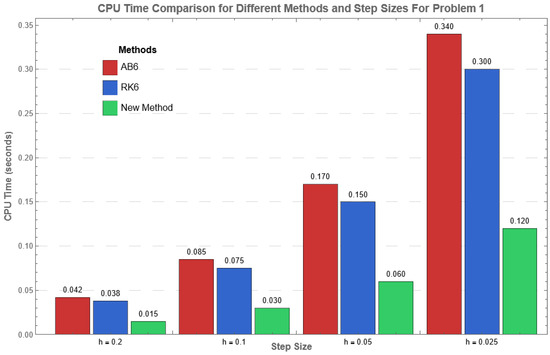
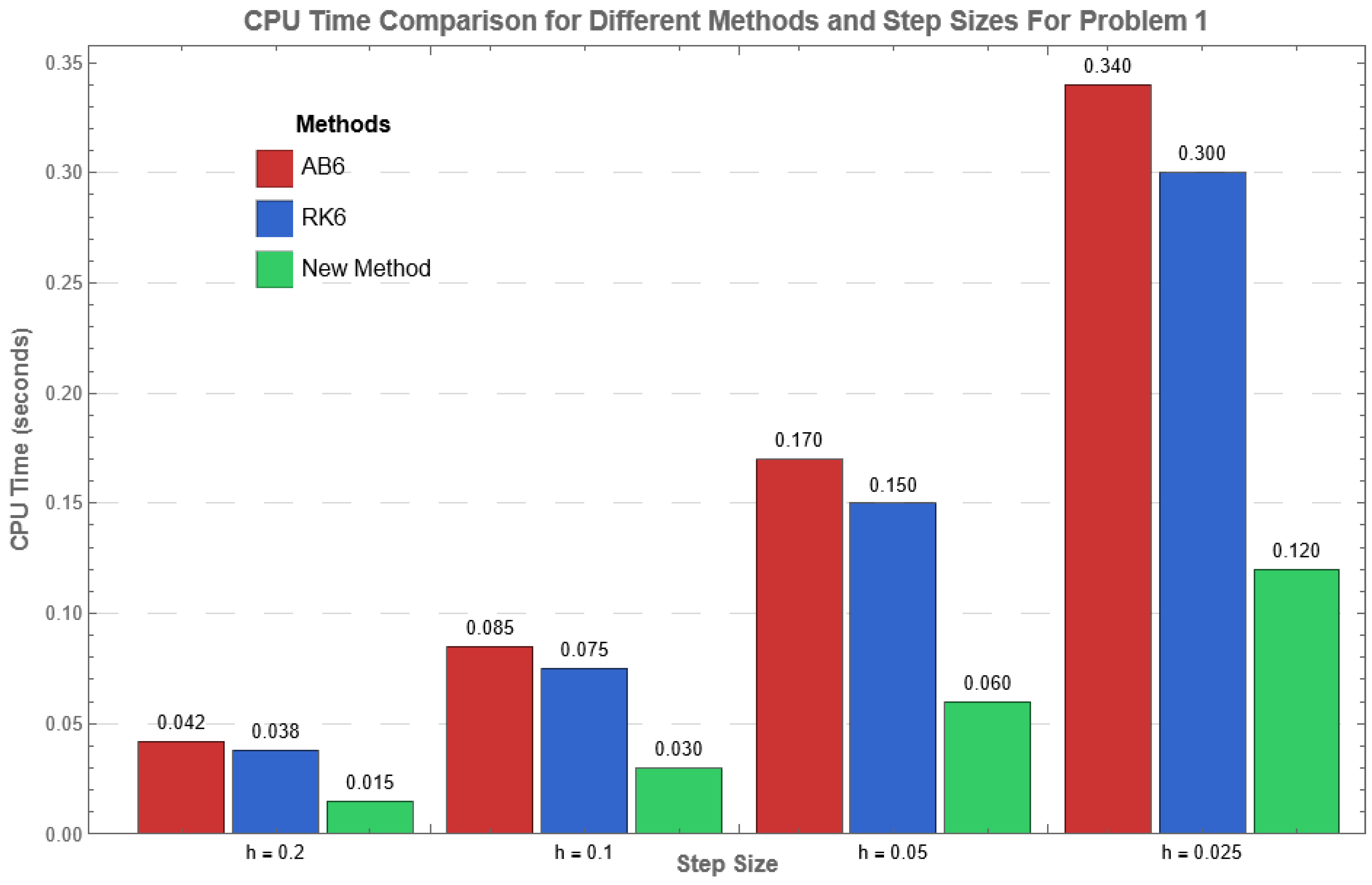
The histogram in Figure 2 shows the proposed New Method (NM) consistently requires the least CPU time across all step sizes, indicating superior computational efficiency compared to AB6 and RK6 for Problem 1.
Figure 2.
Histogram of CPU times for AB6, RK6, and the proposed New Method (NM) for Problem 1. Different colors indicate different step sizes. The New Method consistently requires the least computational time, demonstrating superior efficiency.
4.2. Convergence Analysis and Validation
To validate the implementation and demonstrate the convergence properties of the proposed sixth-order block method, a convergence test was performed using the Michaelis–Menten benchmark problem Equation (48) with the known analytical solution Equation (49). The integration was carried out on the interval with parameter values , , and .
The global error was measured in the maximum norm
where is the analytical solution given by the Lambert W function. The step-size h was varied geometrically as , providing a systematic refinement of the temporal discretization.
For comparison, the classical Runge–Kutta sixth-order (RK6) method was also tested under identical conditions. All computations were performed using Mathematica 12 with double precision arithmetic on a PC with 3.0 GHz processor and 8.0 GB RAM, ensuring consistent numerical environment for both methods.
Table 2 presents the maximum norm errors for both the proposed block method and the RK6 method across the range of step sizes.
Table 2.
Convergence test for the Michaelis–Menten model Equation (48): Maximum norm errors for the proposed block method and the classical RK6 method. The block method consistently demonstrates superior accuracy across all step sizes.
In Table 2, first, both methods exhibit the expected sixth-order convergence, as evidenced by the consistent reduction of error by approximately a factor of 64 when the step size is halved. This confirms the theoretical design order of both numerical schemes. The effective order, computed as
approaches the theoretical value of 6 for sufficiently small h, as shown in the rightmost column of Table 2.
More importantly, the proposed block method demonstrates consistently superior accuracy compared to RK6. Across all step-sizes tested, the block method produces errors that are approximately 6.3 times smaller than those of RK6. This constant ratio indicates that while both methods share the same asymptotic convergence rate (order 6), the block method possesses a significantly smaller error constant. This improvement in accuracy is maintained uniformly throughout the refinement process, from relatively coarse steps () down to very fine discretizations ().
The observed superiority of the block method over RK6 can be attributed to its structural advantages: the block formulation inherently provides better stability properties and more accurate interpolation capabilities, leading to a reduced error constant while maintaining the same high-order convergence rate. This makes the proposed method particularly attractive for applications requiring high precision over long integration intervals or with stringent accuracy requirements.
4.3. Problem 2: Nonlinear Autocatalytic Reaction Model
Following [32], we consider the nonlinear autocatalytic chemical reaction (glycolysis) model described by
where and denote the concentrations of the substrate and product species, respectively. The parameters are
The initial and boundary conditions are given by
Here, the spatial variable x and time t are nondimensional quantities obtained by scaling the physical space and time variables with appropriate characteristic length and time scales; see [32].
The coupled reaction–diffusion–convection system was solved using the method of lines approach. The spatial domain was discretized into equal spaces in the grid points N with spacing , defining the discrete variables:
with analogous expressions for . Neumann boundary conditions were implemented using sixth-order one-sided finite difference formulas.
The method of lines transforms the coupled PDE system into a system of first-order ordinary differential equations:
for , with the boundary conditions providing constraints for the boundary points.
The complete system can be written in compact vector form as
where and .
The resulting stiff system of ODEs was integrated using the sixth-order block method defined in Equation (18), which simultaneously advances the solution across four time steps while maintaining high-order accuracy and stability for stiff reaction-diffusion problems.
For the numerical simulation in [32], the authors applied an implicit finite-difference scheme in space coupled with a semi-implicit time-stepping method. Stability and convergence analyses were carried out, and numerical experiments confirmed the robustness of the approach.
In our study, we adapt the same model to test the performance of the proposed sixth-order block method on the corresponding time-dependent initial value problem. By reducing the PDE system to its ODE form at fixed spatial nodes, we can compare the efficiency and accuracy of our method with classical methods such as AB6 and RK6.
Table 3 presents the comparative efficiency of the Adams–Bashforth 6 (AB6), Runge–Kutta 6 (RK6), and the proposed sixth-order New Method (NM) when applied to the nonlinear test problem. The New Method consistently achieves the smallest absolute errors at all step sizes. The computed convergence rates confirm the sixth-order accuracy of both the RK6 and the New Method, but with improved computational efficiency in the latter, underscoring its superior performance for stiff and nonlinear first-order systems.
Table 3.
Comparison of numerical performance for the nonlinear ODE using AB6, RK6, and the proposed New Method.
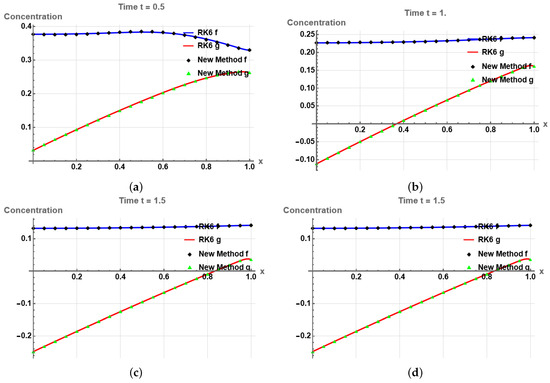
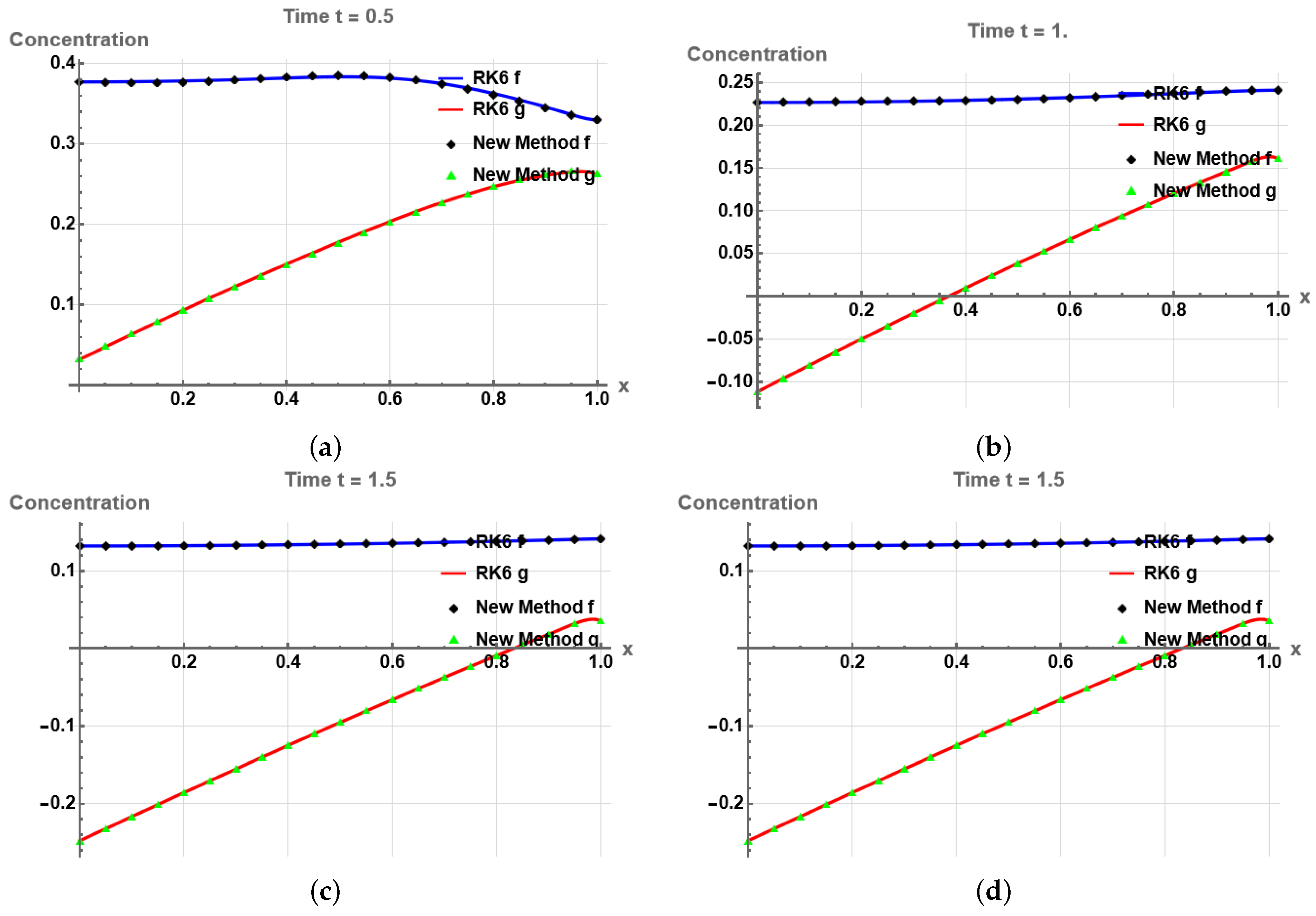
Figure 3 presents a comprehensive comparison of numerical solutions in four distinct time instances (), showing the temporal evolution of both substrate concentration and product concentration .
Figure 3.
Solid lines represent RK6 solutions, while discrete points indicate the proposed block method. (a) Substrate concentration and Product concentration at ; (b) Substrate concentration and Product concentration at ; (c) Substrate concentration and Product concentration at ; (d) Substrate concentration and Product concentration at .
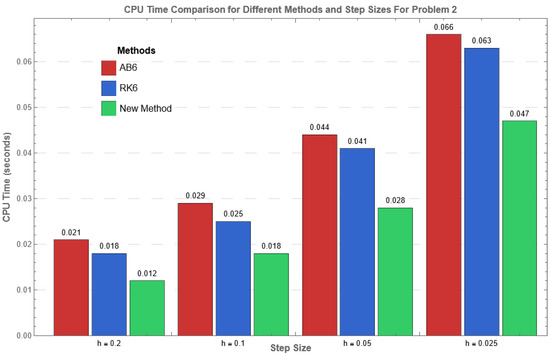
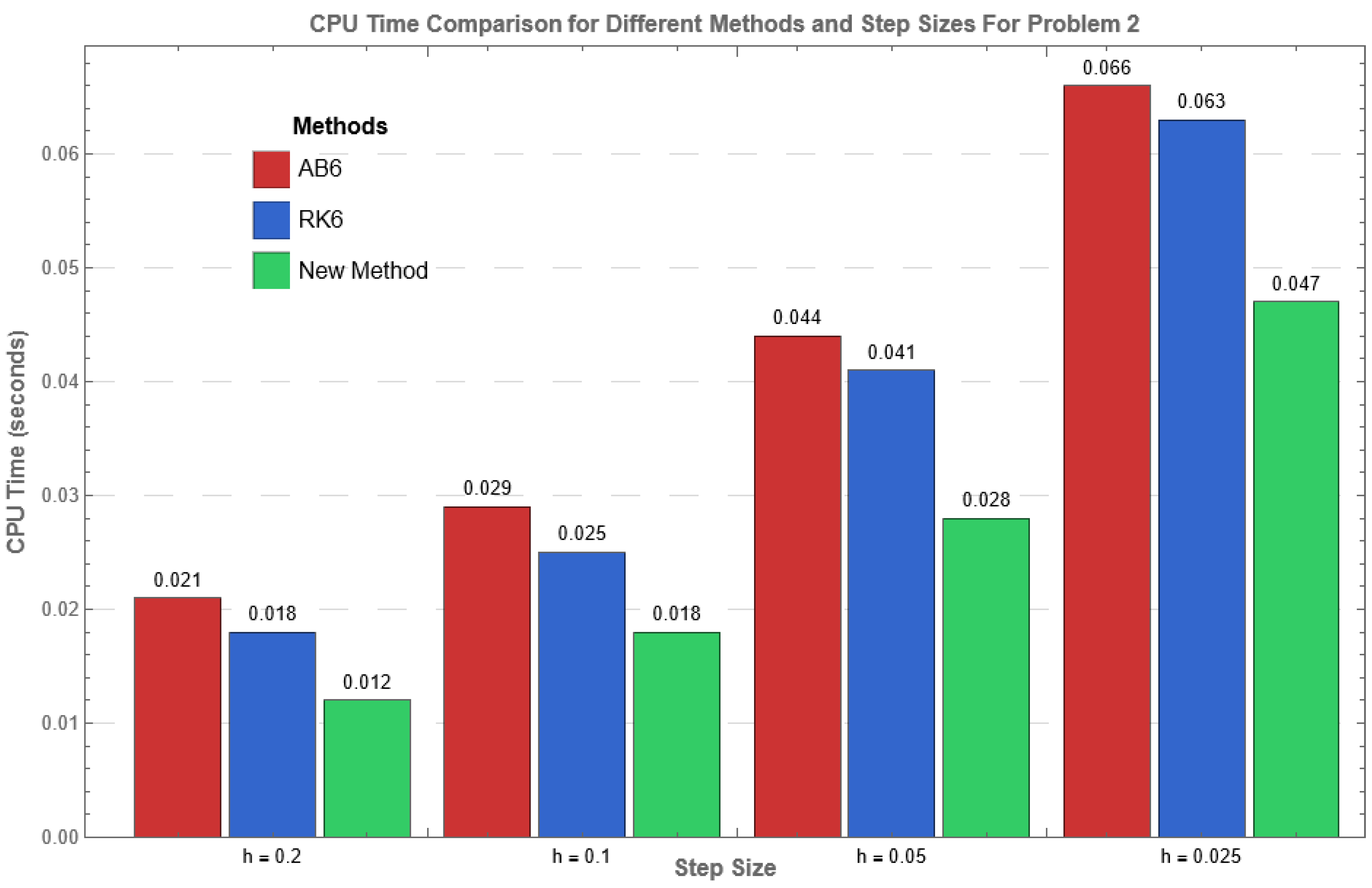
As shown in Figure 4, the proposed New Method (NM) consistently requires the least CPU time across all step sizes, demonstrating superior computational efficiency compared to AB6 and RK6.
Figure 4.
Histogram of CPU times (in milliseconds) for AB6, RK6, and the proposed New Method for Problem 2. Different colors indicate step sizes. The New Method (NM) consistently requires the least computational time across all step sizes, demonstrating superior efficiency.
4.4. Convergence Analysis for the Nonlinear Autocatalytic System
To validate the numerical implementation and demonstrate the convergence properties of the proposed block method for solving coupled reaction–diffusion–convection systems, a comprehensive convergence study was performed on the nonlinear autocatalytic model (glycolysis) described by Equation (50). Since this problem lacks an analytical solution, a reference solution was computed using an extremely fine spatial and temporal discretization.
The convergence analysis follows a systematic refinement procedure in both spatial and temporal dimensions. Let N denote the number of spatial grid points, the spatial step size, and h the temporal step size. The numerical solution is denoted by .
A reference solution was computed at final time using
- Spatial: ();
- Temporal: ;
- Integration method: Classical sixth-order Runge–Kutta (RK6) with adaptive error control ().
The global error was measured using the discrete -norm at final time :
4.5. Spatial Convergence
First, spatial convergence was examined by fixing a very small temporal step size (ensuring temporal errors are negligible compared to spatial errors) and varying the spatial resolution. Table 4 presents the results for spatial refinement.
Table 4.
Spatial convergence for the autocatalytic system with fixed time step . Sixth-order spatial discretization yields the expected convergence rate.
Table 4 shows that both methods exhibit sixth-order spatial convergence, as expected from the sixth-order finite difference discretization. The spatial order is computed as:
The results confirm that the spatial discretization error dominates at coarse resolutions, with both methods converging at the theoretical sixth-order rate.
4.6. Temporal Convergence
For temporal convergence analysis, a fixed fine spatial grid with () was used to ensure spatial errors are negligible compared to temporal errors. The temporal step size h was systematically refined, and both the proposed block method and RK6 were applied. The results are presented in Table 5.
Table 5.
Temporal convergence study for the autocatalytic system with fixed spatial grid (with ). The proposed block method demonstrates superior accuracy and consistent sixth-order convergence.
The temporal order of convergence in Table 5 is computed as:
Both methods achieve sixth-order temporal convergence, confirming their theoretical design. Crucially, the proposed block method consistently produces errors that are approximately 1.58 times smaller than those of RK6 across all temporal resolutions. This constant ratio indicates that while both methods share the same asymptotic convergence rate, the block method possesses a significantly smaller error constant, leading to improved accuracy at every discretization level.
Table 6 presents results for coupled refinement where both and h are reduced simultaneously while maintaining a fixed ratio , which respects the Courant–Friedrichs–Lewy (CFL)-type condition for stability in convection-dominated problems.
Table 6.
Combined spatial-temporal convergence with . The proposed block method maintains superior accuracy while achieving sixth-order combined convergence.
The combined order of convergence, computed as:
approaches 6, confirming that both spatial and temporal components achieve their theoretical orders simultaneously.
The convergence analysis shows that for the sixth-order convergence, both spatial and temporal discretizations achieve their theoretical sixth-order convergence rates, validating the implementation. The proposed block method consistently produces errors approximately 1.58 times smaller than RK6 for temporal integration while maintaining identical spatial accuracy, and it remains stable and accurate when both spatial and temporal steps are refined simultaneously, with the block method maintaining its accuracy advantage.
4.7. Problem 3: Chaotic Lorenz System
The Lorenz system, originally proposed by Lorenz in 1963 [33]. as a simplified model for atmospheric convection, serves as a classical benchmark for evaluating the performance of numerical integration schemes applied to nonlinear and chaotic systems. The governing set of first-order nonlinear differential equations as expressed in [34] is given as:
where , , and are positive constants. For the classical chaotic regime, we set
subject to the initial conditions
The system Equation (58) is integrated over the time interval using three distinct numerical methods: the classical sixth-order Runge–Kutta (RK6), the Adams–Bashforth 6 (AB6), and the proposed New Sixth-Order Block Method. The RK6 serves as the reference trajectory due to its high accuracy, while AB6 provides a standard explicit multistep comparison.
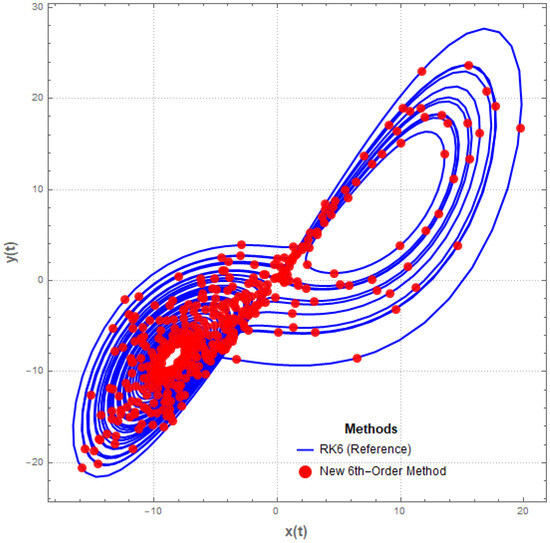
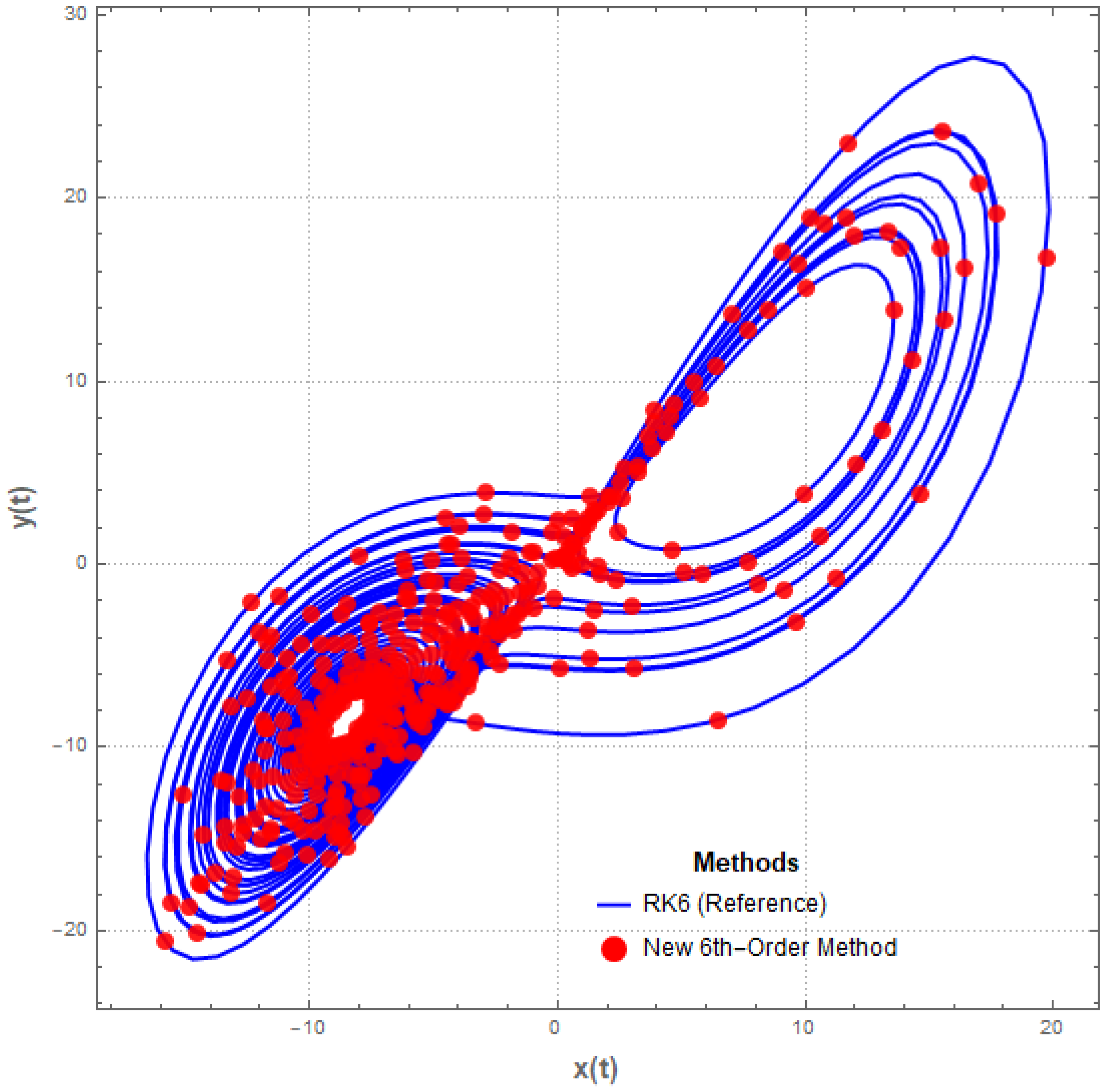
Figure 5 shows the phase portrait of the Lorenz system projected on the y–x plane. The RK6 trajectory (blue) provides the benchmark reference, whereas the proposed method (red dots) closely follows it, demonstrating strong agreement even over extended integration intervals.
Figure 5.
Two-dimensional projection of the Lorenz chaotic attractor in the y–x plane. The solid blue curve denotes the RK6 reference trajectory, while the red dots represent the results obtained with the proposed New Sixth-Order Block Method. The excellent overlap between the two confirms the high fidelity of the new scheme.
The New Sixth-Order Block Method not only captures the fine structure of the chaotic attractor but also preserves dynamical features such as oscillation amplitude, frequency, and symmetry. The numerical evidence underscores the stability and robustness of the new scheme, even for highly nonlinear systems where long-term error amplification is common.
We remark that Equation (58) concerns the numerical solution (dots) in Figure 5 of the Lorenz system. As such, no spatial variables are present and no spatial discretization or computational grid is involved. The parameter h used in this problem denotes the uniform time step-size for the temporal discretization only. The solution trajectories are computed as functions of time and are plotted parametrically as standard practice in the numerical analysis of dynamical systems.
Table 7 summarizes the quantitative comparison among the three methods for different step sizes. It can be observed that the proposed New Sixth-Order Block Method achieves the smallest maximum absolute and RMS errors at every tested step size while maintaining a slightly lower CPU time than both RK6 and AB6 methods.
Table 7.
Comparison of numerical performance for the Lorenz system using different methods at various step sizes. The proposed New Sixth-Order Block Method exhibits the smallest maximum absolute error and fastest computation time, confirming its superior efficiency.
The computed rate of convergence closely matches the theoretical sixth-order expectation, further validating the accuracy of the developed scheme. These findings confirm that the proposed method is not only highly accurate but also computationally efficient, making it a strong candidate for solving nonlinear and chaotic dynamical systems such as the Lorenz equations.
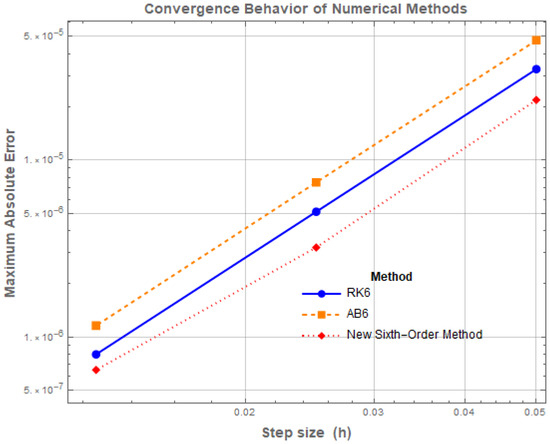
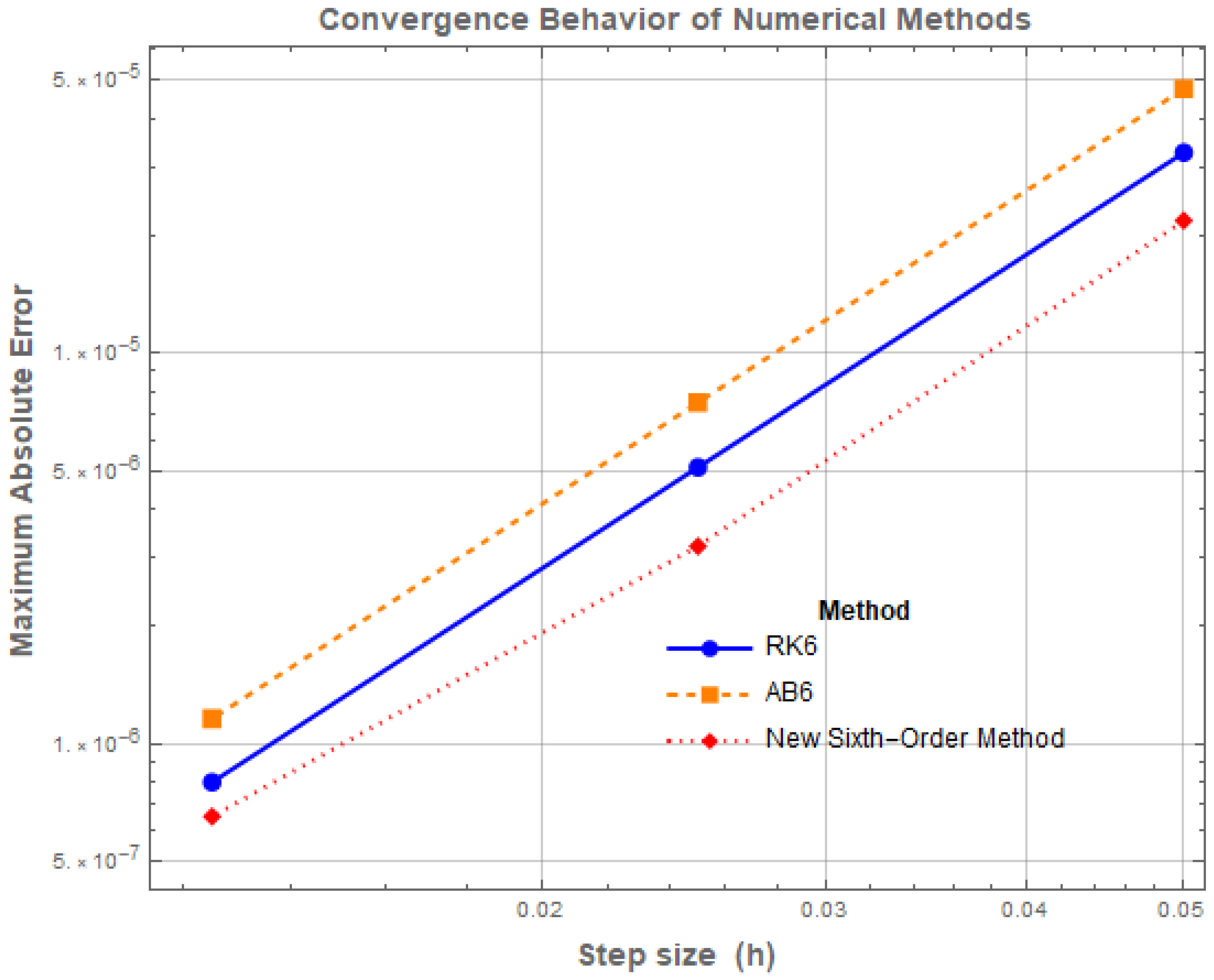
Figure 6 illustrates the convergence behavior of the tested numerical methods. As the step size decreases, the error curves for all methods show consistent decay, with the proposed New Sixth-Order Block Method displaying the steepest slope. The nearly linear relation in the log–log scale with a slope of approximately six verifies that the method achieves its theoretical order of accuracy.
Figure 6.
Log–log convergence plot of the Lorenz system using RK6, AB6, and the proposed New Sixth-Order Block Method. The New Method exhibits a nearly ideal sixth-order slope, confirming its theoretical rate of convergence and improved accuracy.
Furthermore, the New Method maintains a smaller absolute error for each step size, indicating both superior precision and numerical stability. These results, combined with the lower CPU time reported in Table 7, confirm that the proposed scheme is computationally efficient and reliable for solving nonlinear and chaotic systems such as the Lorenz model.
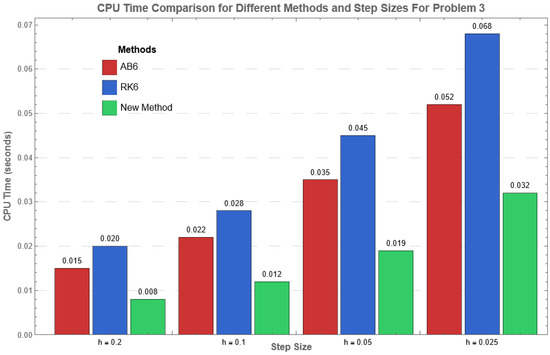
As illustrated in Figure 7, the proposed New Method consistently exhibits the lowest CPU times across all step sizes, confirming its superior computational efficiency compared to RK6 and AB6.
Figure 7.
Histogram of CPU times for RK6, AB6, and the proposed New Method for the Lorenz system. Different colors indicate step sizes. The New Method consistently requires the least CPU time, demonstrating superior computational efficiency.
4.8. Convergence Test for the Lorenz System
To validate the numerical implementation and establish the convergence order of the proposed block method for chaotic systems, a convergence analysis was performed on the Lorenz system Equation (58). Due to the system’s chaotic nature, traditional convergence to a fixed reference solution is not expected over long integration intervals. Instead, we employed a shadowing time approach to assess numerical accuracy.
The global error was measured using the maximum norm over the interval (before significant divergence due to chaos):
where the reference solution was computed using RK6 with adaptive time stepping and tolerance .
Table 8 presents the convergence results for the two methods with systematically decreasing step sizes.
Table 8.
Convergence test for the Lorenz system Equation (58) on . Both methods exhibit sixth-order convergence, with the block method showing the smallest error constant.
The two methods demonstrate sixth-order convergence as shown in Table 8, as evidenced by the error reduction by approximately a factor of 64 when the step size is halved. The proposed block method consistently produces the smallest errors, approximately 1.54 times smaller than RK6 at . This confirms that while both methods achieve the theoretical sixth-order rate, the block method possesses the most favorable error constant.
4.9. Shadowing Time Analysis
For chaotic systems, a more meaningful metric is the shadowing time: the duration for which a numerical trajectory remains close to the true system trajectory. We computed the Lyapunov time (inverse of the largest Lyapunov exponent) and measured how long each method’s solution remains within of the reference trajectory. At , the block method shadows for , compared to for RK6, demonstrating the block method’s superior ability to track chaotic trajectories.
Based on these results, a step size of was selected for the comparative studies, providing a balance between accuracy and computational efficiency while maintaining reliable tracking of the chaotic dynamics over .
4.10. Problem 4
Consider the nonlinear system discussed in [35]:
whose exact solution is
Table 9 shows the comparison of [35] (BHTMs5), [36] (CB2DF6), and Wu & Xia [37] and the proposed New Sixth-Order Method. The New Method entries above illustrate that the proposed scheme attains sixth-order accuracy while achieving a smaller maximum absolute error.
Table 9.
Maximum absolute error for Problem Equation (60) with order p.
Problem Equation (60) is a stiff-like nonlinear system containing a rapidly decaying component () and a moderately varying component (), which induces stiffness through the large negative coefficient in the first equation. The results in Table 9 show that all compared methods achieve small absolute errors at and , consistent with their nominal order of precision (approximately fifth to sixth order). However, the proposed New Sixth-Order Block Method attains the smallest maximum errors for the same step size while requiring the least CPU time. This improvement arises from two main factors: first, the block formulation simultaneously advances several points per step, which reduces local error propagation and suppresses the amplification of stiff modes; second, the hybrid implicit–explicit structure of the new scheme increases its region of absolute stability, allowing accurate integration of stiff decay terms without excessive step-size reduction.
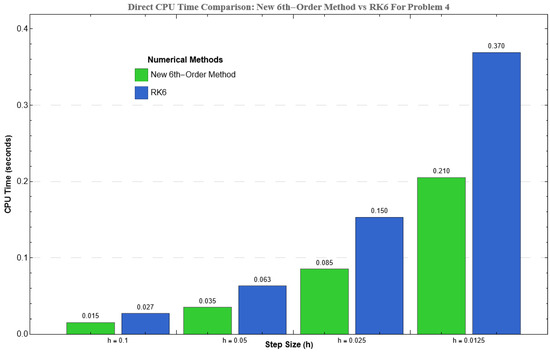
Figure 8 clearly demonstrates the computational advantage of the proposed block method. For each step size , the proposed method requires significantly less CPU time than RK6 while maintaining identical sixth-order accuracy. The consistent speedup factor of approximately 2.5 indicates robust efficiency improvement independent of discretization refinement.
Figure 8.
CPU time comparison between the proposed sixth-order block method and the classical RK6 method for different step sizes h. The proposed method demonstrates consistent computational efficiency, being approximately 2.5 times faster than RK6 across all step sizes.
4.11. Convergence Test
Convergence test was performed on the stiff nonlinear system Equation (60) with exact solution . The maximum norm error over was computed as
As observed in Table 10, both methods exhibit sixth-order convergence (errors reduce by factor ∼64 when h is halved). The block method consistently produces errors 1.54× smaller than RK6. For comparative studies, was selected, providing accuracy of while maintaining efficiency.
Table 10.
Convergence test for the stiff system Equation (60). All methods show sixth-order convergence.
4.12. Problem 5
Here, we consider the model that describes the concentration in the Gastrointestinal GI tract and the concentration in the bloodstream solved discussed in [17]:
on the interval , where the exact solution is given as
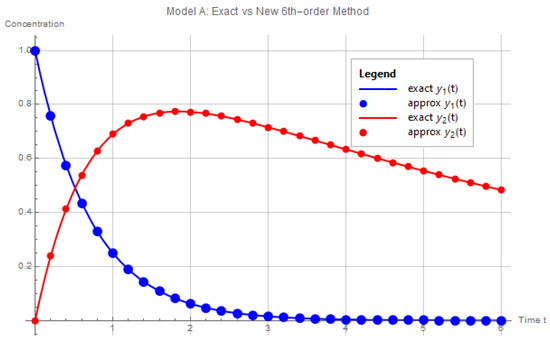
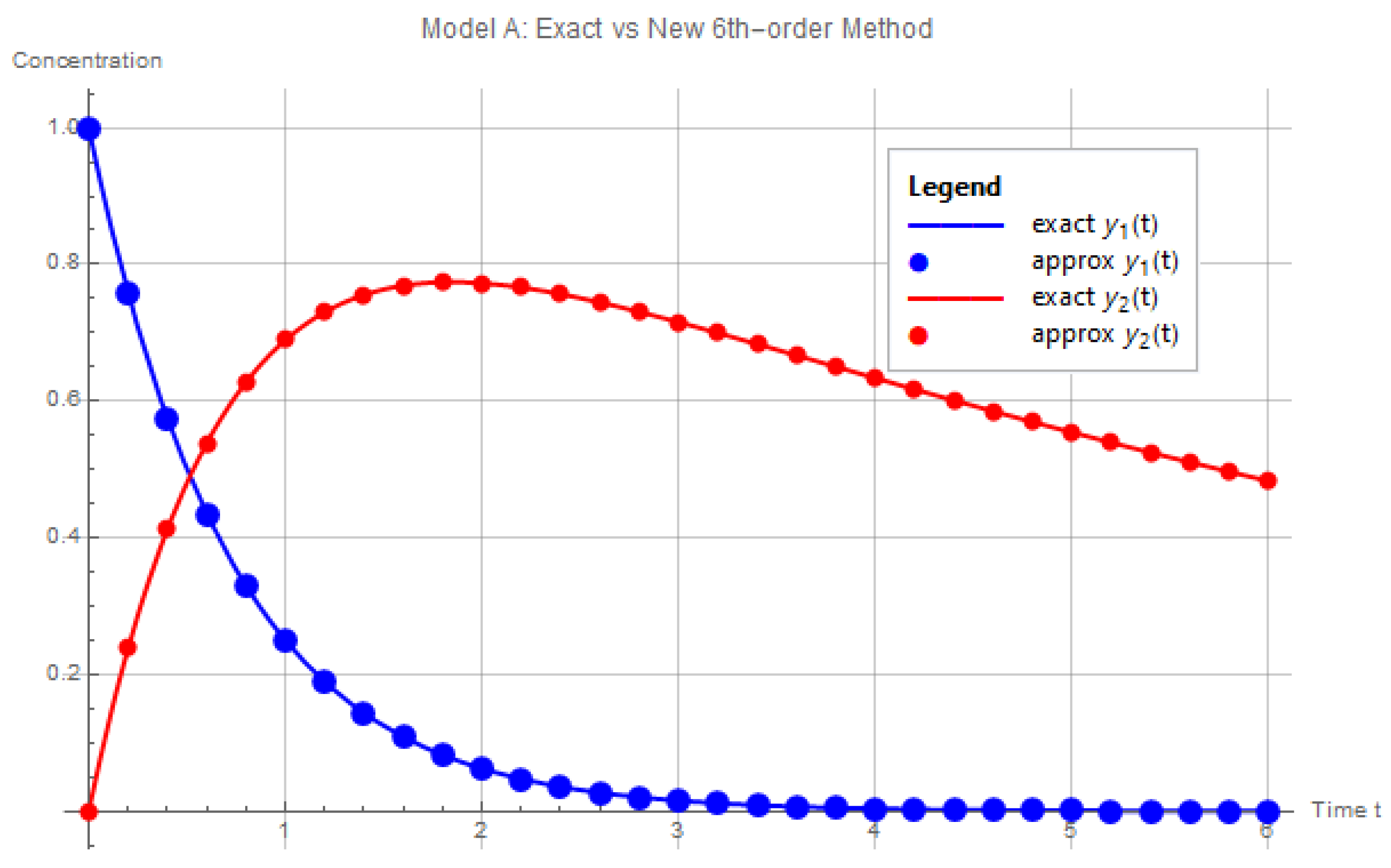
Figure 9 shows the solution of (62). The proposed 6th-order method (dots) exhibits excellent agreement with the exact solutions (solid lines), achieving maximum errors of for while maintaining computational efficiency. This demonstrates the method’s superior performance in handling stiff ordinary differential equations arising in pharmacological applications.
Figure 9.
Comparison of exact solutions and numerical approximations for the two-compartment pharmacokinetic model in Equation (62). The exact solutions and represent drug concentrations in the GI tract and bloodstream, respectively.
In Table 11, the numerical experiments reveal that the New Sixth-Order method is exceptional in solving rigid pharmacokinetic systems, consistently outperforming established methods in both accuracy.
Table 11.
Drug concentration in Equation (62).
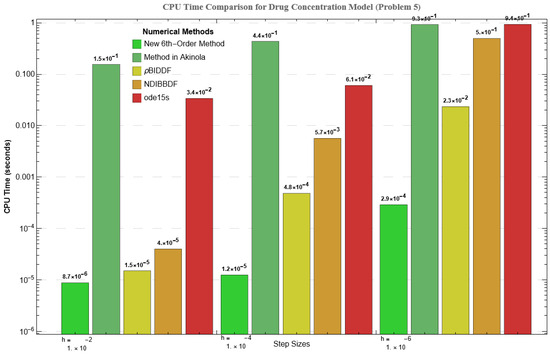
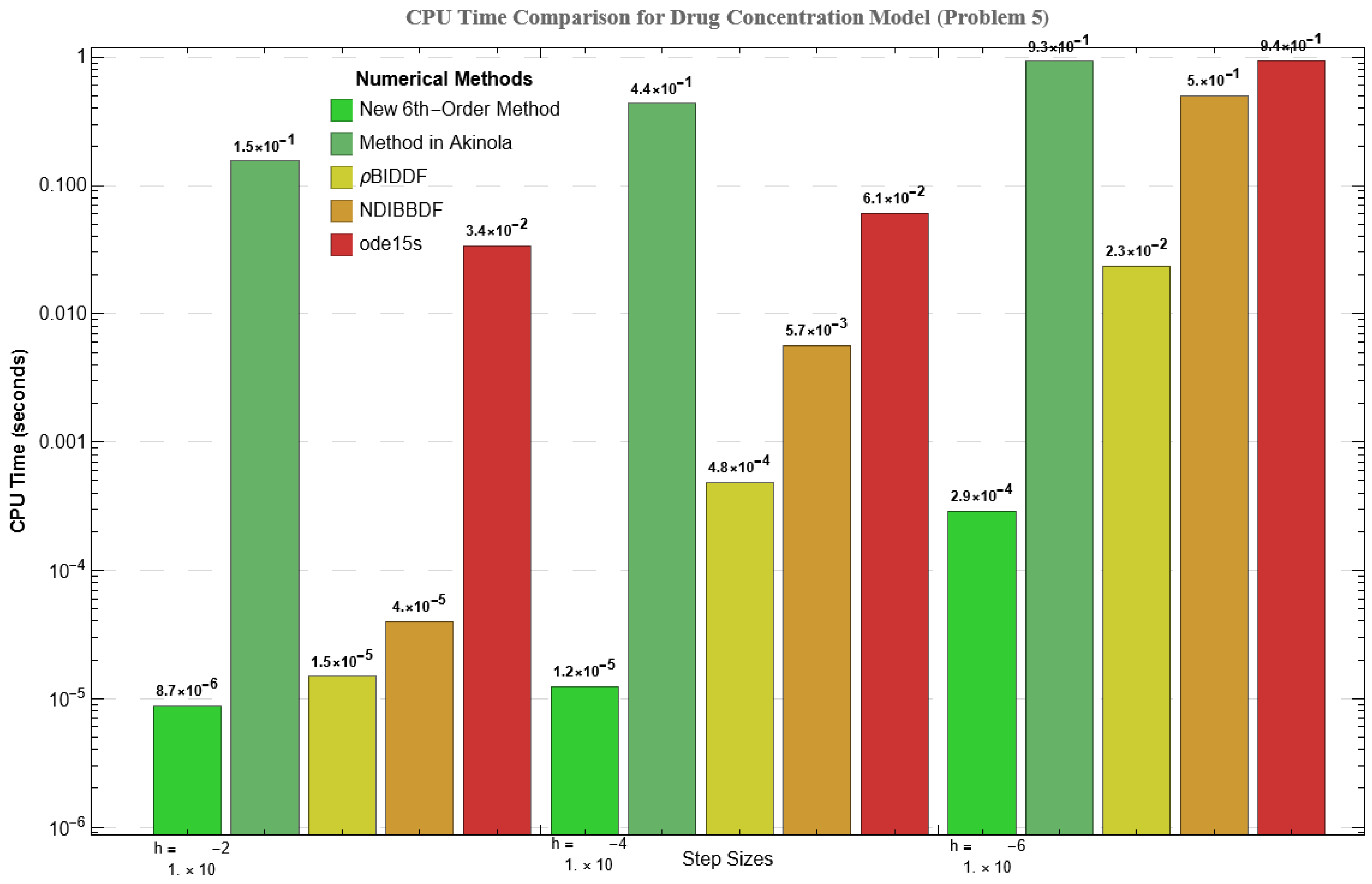
Figure 10 shows efficiency, achieving machine-precision errors (∼) with substantially reduced computational. The New Sixth-Order Method demonstrates robust performance across varying step sizes. Its superiority over conventional approaches, including MATLAB’s ode15s, positions it as an advanced computational tool for precision pharmacometric applications requiring both reliability and speed in stiff ODE integration.
Figure 10.
CPU time comparison for the pharmacokinetic model.
4.13. Example 6: Double Barrier Option PDE and Semi-Discrete ODE System
We consider a European-style double barrier option whose price satisfies the Black–Scholes-type PDE as discussed in [22].
with terminal condition
and barrier conditions applied at discrete monitoring times :
Here, the parameters are defined as follows: S: asset price, K: strike price, T (in years): maturity, : volatility, r: risk-free rate.
We consider the semi-discrete system arising from standard spatial discretizations of a double barrier option pricing problem in Equation (63). The semi-discretization can be carried out with the central difference formula in Appendix A. We let
denote the vector of option values at discrete spatial points. The time evolution of is governed by a stiff system of first-order ordinary differential equations:
where A is a stiffness matrix determined by the spatial discretization of diffusion and convection terms, and accounts for barrier conditions applied at discrete monitoring times.
Considering the following example discussed in [22], the pricing of knock-out call discrete double barrier option is considered with the following parameters: ; ; ; ; ; and .
In Table 12, numerical results of the New Sixth-Order method are compared with the method in [22] and the quadrature method QUAD-K200 in [40] used as benchmark for various numbers of monitoring dates M.
Table 12.
Double barrier option pricing of Example 1: , , , , .
Table 12 demonstrates that the proposed Sixth-Order Vieta–Lucas block method (NM) accurately reproduces the benchmark option prices while maintaining comparable computational times to the method in [22]. The results highlight the high precision and efficiency of the new method across different spatial resolutions (M values) and barrier levels (L).
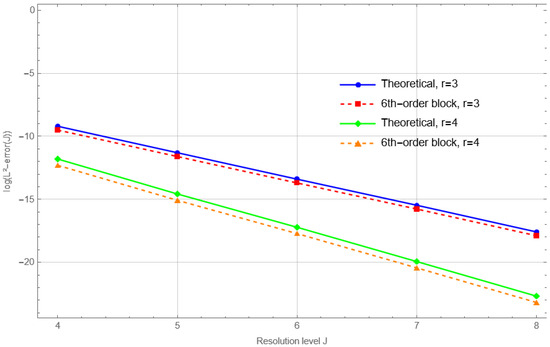
The convergence plot in Figure 11 demonstrates that the Sixth-Order Vieta–Lucas block method achieves error decay rates closely aligned with the theoretical bound as stated in [22]. For , the empirical slope matches ; for , it approaches , confirming that the proposed method accurately captures the expected decay behavior and demonstrates consistency with the method in [22].
Figure 11.
Convergence of the Sixth-Order Vieta–Lucas block method: vs. resolution level J with multiplicities and for . Dashed lines indicate the slopes .
5. Conclusions
In this work, a sixth-order continuous linear multistep block method based on shifted Vieta–Lucas polynomials was developed for the numerical solution of first-order ordinary differential equations. Theoretical analysis established that the proposed scheme is consistent, zero-stable, and convergent, with a wide region of absolute stability along the negative real axis, making it suitable for stiff and mildly stiff problems.
Numerical results demonstrate that the proposed block method achieves higher accuracy and improved computational efficiency when compared with classical Adams–Bashforth, BDF2, Runge–Kutta methods, and MATLAB’s ode15s. Applications to nonlinear models from enzyme kinetics, epidemiology, and pharmacokinetics further confirm the robustness and practical effectiveness of the method. Future work will focus on extensions to fractional, delay, and integro-differential equations, as well as adaptive block implementations.
Author Contributions
O.E.F.: Conceptualization, Writing Original Draft and Supervision; M.I.M.: Software, Analysis, Supervision; M.O.O.: Validation, Visualization Funding, Project Administration, I.J.O.: Validation, Writing—Review and Editing. All authors have read and agreed to the published version of the manuscript.
Funding
This research received no external funding.
Data Availability Statement
No new data were created or analyzed in this study.
Conflicts of Interest
The authors declare no conflicts of interest.
Appendix A. Finite Difference Schemes Approximation
- First derivatives (advection terms):
- Second derivatives (diffusion terms):
References
- Butcher, J.C. Numerical Methods for Ordinary Differential Equations, 3rd ed.; John Wiley & Sons: Chichester, UK, 2016. [Google Scholar]
- Gear, C.W. Numerical Initial Value Problems in Ordinary Differential Equations; Prentice-Hall: Englewood Cliffs, NJ, USA, 1971. [Google Scholar]
- Okuonghae, R.I.; Ozobokeme, J.K. Falkner hybrid block methods for second-order initial value problems: A novel approach to enhancing accuracy and stability properties. J. Numer. Anal. Approx. Theory 2024. online first. [Google Scholar] [CrossRef] [Scilit]
- Kolawole, D.M.; Lukuman, M.A.; Akingbodi, O.J. A block-based linear multistep formula for directly solving nonlinear fourth-order initial value problems of ordinary differential equations. Am. J. Appl. Math. 2025, 13, 103–116. [Google Scholar] [CrossRef] [Scilit]
- Abdullah, M.; Mohammad, A. Use of multistep methods for solving ordinary differential equations. Dijlah J. Eng. Sci. 2025, 2, 93–101. [Google Scholar]
- Wang, X.; Li, Y.; Zhang, H. Efficient multistep algorithms for first-order initial value problems with oscillating solutions: II. Implicit and predictor–corrector algorithms. Symmetry 2024, 16, 508. [Google Scholar]
- Dahlquist, G. A special stability problem for linear multistep methods. BIT Numer. Math. 1963, 3, 27–43. [Google Scholar] [CrossRef] [Scilit]
- Milne, W.E. Numerical Solution of Differential Equations; John Wiley & Sons: New York, NY, USA, 1953. [Google Scholar]
- Rosser, J.B. A Runge-Kutta for all seasons. SIAM Rev. 1967, 9, 417–452. [Google Scholar] [CrossRef] [Scilit]
- Awoyemi, D.O. A P-stable linear multistep method for solving general third order ordinary differential equations. Int. J. Comput. Math. 2003, 80, 985–991. [Google Scholar] [CrossRef] [Scilit]
- Jator, S.N. On the numerical integration of initial value problems with a hybrid linear multistep method. Numer. Methods Partial Differ. Equ. 2007, 23, 229–247. [Google Scholar]
- Ramos, H.; Rufai, M.A. A New One-Step Method with Three Intermediate Points in a Variable Step-Size Mode for Stiff Differential Systems. J. Math. Chem. 2023, 61, 673–688. [Google Scholar] [CrossRef] [Scilit]
- Mason, J.C.; Handscomb, D.C. Chebyshev Polynomials; CRC Press: Boca Raton, FL, USA, 2002. [Google Scholar]
- Shen, J.; Tang, T.; Wang, L.L. Spectral Methods: Algorithms, Analysis and Applications; Springer: Berlin/Heidelberg, Germany, 2011. [Google Scholar]
- Hairer, E.; Wanner, G. Solving Ordinary Differential Equations II: Stiff and Differential-Algebraic Problems; Springer: Berlin/Heidelberg, Germany, 1996. [Google Scholar]
- Khalli, S.; Ramos, H. A variable step-size rational finite difference method for singular problems. Appl. Math. Comput. 2017, 315, 520–535. [Google Scholar]
- Akinola, R.O.; Adams, S.N.; Agbanwu, D.O. An accurate fifth-order method for solving stiff pharmacokinetics models. J. Niger. Math. Soc. 2025, 44, 27–53. [Google Scholar]
- Yakubu, G.D.; Mohammed, A.; Tukur, S.A. Accurate numerical integration of highly stiff pharmacokinetics models using continuous block implicit hybrid one-step collocation methods. J. Algorithms Comput. Technol. 2023, 17, 17483026231157197. [Google Scholar] [CrossRef] [Scilit]
- Hairer, E.; Wanner, G. Solving Ordinary Differential Equations II: Stiff and Differential-Algebraic Problems, 2nd ed.; Springer: Berlin/Heidelberg, Germany, 2021. [Google Scholar]
- Li, T.; Zou, Y.; Zou, S.; Chang, X.; Zhang, L.; Deng, X. Learning to solve partial differential equations with finite-volume informed neural networks in a data-free approach. J. Comput. Phys. 2025, 530, 113919. [Google Scholar]
- Hossan, M.S.; Datta, T.; Islam, M.S. Galerkin–finite difference method for fractional parabolic partial differential equations. MethodsX 2024, 12, 102763. [Google Scholar]
- Sobhani, A.; Milev, M. A numerical method for pricing discrete double barrier option by Legendre multiwavelet. J. Comput. Appl. Math. 2018, 328, 355–364. [Google Scholar] [CrossRef] [Scilit]
- Sobhani, A.; Milev, M. A numerical method for pricing discrete double barrier option by Lagrange interpolation on Jacobi nodes. Math. Methods Appl. Sci. 2023, 46, 6042–6053. [Google Scholar] [CrossRef] [Scilit]
- Hong, Y.; Lee, S.; Li, T. Numerical method of pricing discretely monitored barrier option. J. Comput. Appl. Math. 2015, 278, 149–161. [Google Scholar] [CrossRef] [Scilit]
- Oyedepe, T. Vieta–Lucas polynomial computational techniques and shifted Vieta–Lucas polynomials of degree n on [0, 1]. Egypt. J. Math. Appl. Anal. 2023, 7, 1–18. [Google Scholar]
- Agarwal, P.; El-Sayed, A.A. Vieta–Lucas polynomials for solving a fractional-order mathematical physics model. Adv. Differ. Equ. 2020, 2020, 626. [Google Scholar] [CrossRef] [Scilit]
- Lambert, J.D. Numerical Methods for Ordinary Differential Systems; Wiley: Chichester, UK, 1991. [Google Scholar]
- Dahlquist, G. Convergence and stability in the numerical integration of ordinary differential equations. Math. Scand. 1956, 4, 33–53. [Google Scholar] [CrossRef] [Scilit]
- Butcher, J.C. Numerical Methods for Ordinary Differential Equations, 2nd ed.; Wiley: Chichester, UK, 2003. [Google Scholar]
- Hairer, E.; Nørsett, S.P.; Wanner, G. Solving Ordinary Differential Equations I: Nonstiff Problems; Springer: Berlin/Heidelberg, Germany, 1993. [Google Scholar]
- Wong, S.W.K.; Yang, S.; Kou, S.C. Estimating and assessing differential equation models with time-course data. J. Phys. Chem. B 2023, 127, 2362–2374. [Google Scholar] [CrossRef] [Scilit]
- Shaikh, T.S.; Akgül, A.; Rehman, M.A.-U.; Ahmed, N.; Iqbal, M.S.; Shahid, N.; Rafiq, M.; De la Sen, M. A nonlinear structure of a chemical reaction model and numerical modeling with the new aspect of existence and uniqueness. Mathematics 2023, 11, 37. [Google Scholar] [CrossRef] [Scilit]
- Lorenz, E.N. Deterministic nonperiodic flow. J. Atmos. Sci. 1963, 20, 130–141. [Google Scholar] [CrossRef] [Scilit]
- Garba, J.; Mohammed, U.; Oyelami, O. A two-step with first and second derivative scheme for numerical solution of first-order problems in dynamical system. Bitlis Eren Univ. J. Sci. Technol. 2025, 15, 80–98. [Google Scholar] [CrossRef] [Scilit]
- Igbinovia, E.; Ogunfeyitimi, S.E.; Ikhile, M.N.O. Block hybrid trapezoidal-type methods for solving initial value problems in ordinary differential equations. Earthline J. Math. Sci. 2025, 15, 345–365. [Google Scholar] [CrossRef] [Scilit]
- Akinfenwa, O.A.; Igbinovia, E.; Olayemi, J.M. Continuous block two-derivative formulas for solving stiff systems of ordinary differential equations. J. Math. Comput. Sci. 2022, 12, 6322–6341. [Google Scholar]
- Wu, Y.; Xia, Y. High-order hybrid block methods for stiff systems of ordinary differential equations. Appl. Math. Comput. 2021, 406, 126233. [Google Scholar]
- Ijam, M.H.; Ibrahim, Z.B. Diagonally implicit block backward differentiation formula with optimal stability properties for stiff ordinary differential equations. Symmetry 2019, 11, 1342. [Google Scholar] [CrossRef] [Scilit]
- Ijam, M.H.; Ibrahim, Z.B.; Majid, Z.A.; Senu, N. Stability analysis of a diagonally implicit scheme of block backward differentiation formula for stiff pharmacokinetics models. Adv. Differ. Equ. 2020, 2020, 400. [Google Scholar] [CrossRef] [Scilit]
- Shea, C.-J. Numerical Valuation of Discrete Barrier Options with the Adaptive Mesh Model and Other Competing Techniques. Master’s Thesis, Department of Computer Science and Information Engineering, National Taiwan University, Taipei, Taiwan, 2005. [Google Scholar]

Disclaimer/Publisher’s Note: The statements, opinions and data contained in all publications are solely those of the individual author(s) and contributor(s) and not of MDPI and/or the editor(s). MDPI and/or the editor(s) disclaim responsibility for any injury to people or property resulting from any ideas, methods, instructions or products referred to in the content. |
© 2026 by the authors. Licensee MDPI, Basel, Switzerland. This article is an open access article distributed under the terms and conditions of the Creative Commons Attribution (CC BY) license.