On Families of Elliptic Curves

 , and
, and 
Abstract
1. Introduction
1.1. Rank and Torsion (Reminder)
1.2. Contribution and Scope
2. Candidate Conditions
3. Six Sufficient Conditions
3.1. Details of Case 17:
3.2. Details of Case 26:
3.3. Details of Case 32:
- If both primes satisfy (mod 4) and (mod 4), then their product is congruent with (mod 4).
- If one prime satisfies (mod 4) and the other (mod 4), then (mod 4).
- If both primes satisfy (mod 4) and (mod 4), then (mod 4).
3.4. Details of Case 40:
3.5. Details of Case 47:
3.6. Details of Case 56:
3.7. Remark (Sufficiency of the Six Cases)
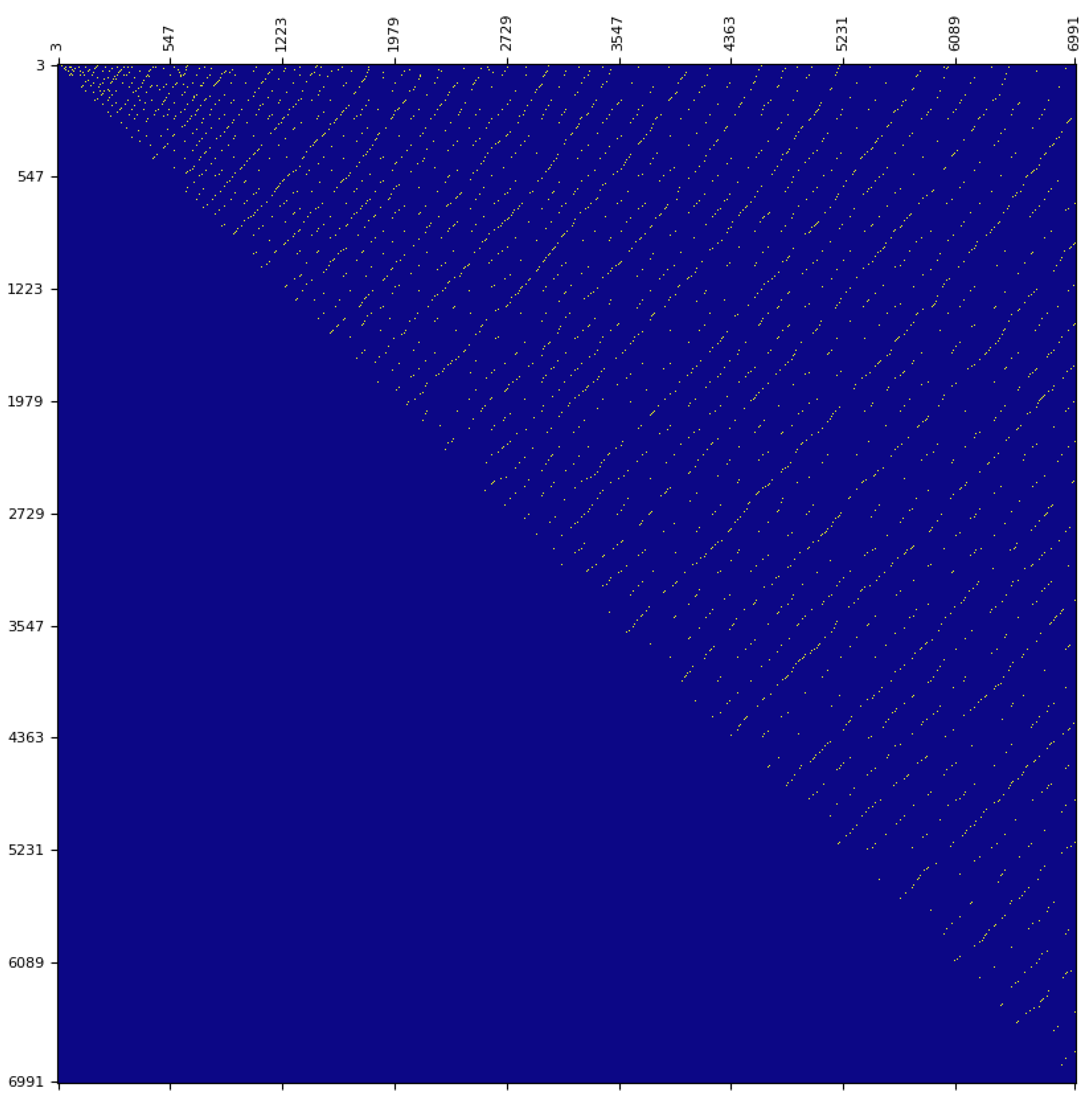
4. Graphical Structures
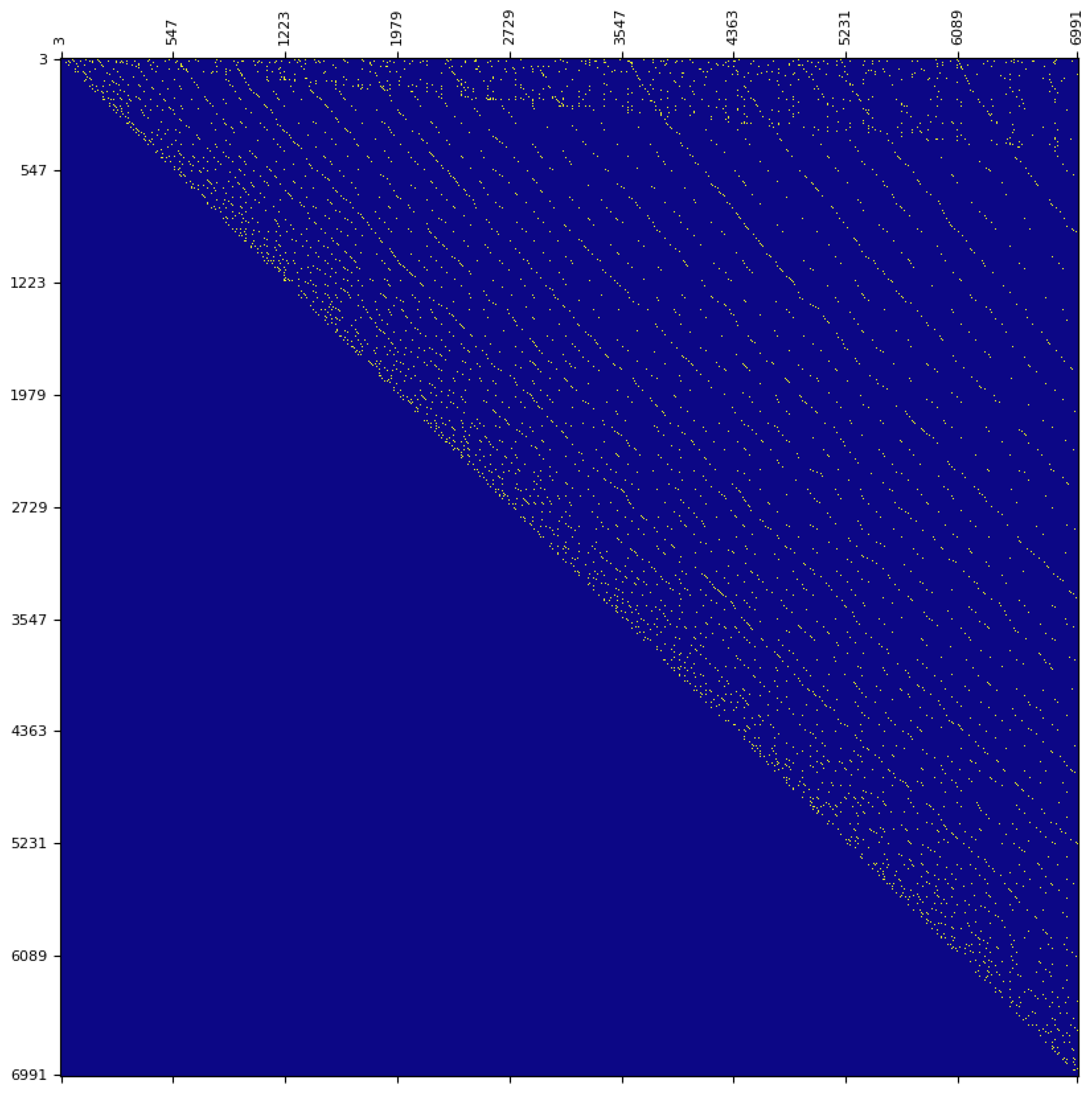
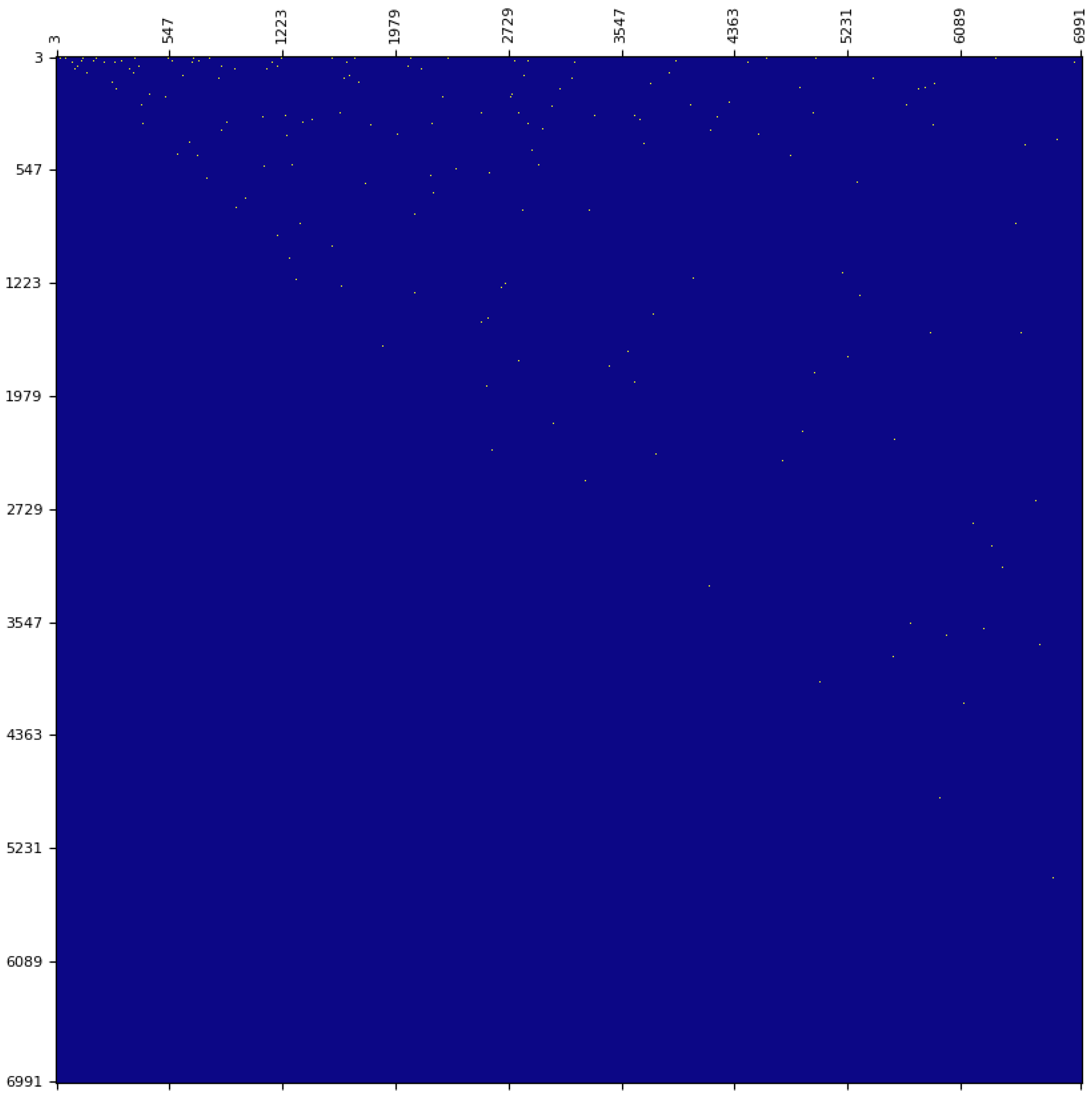
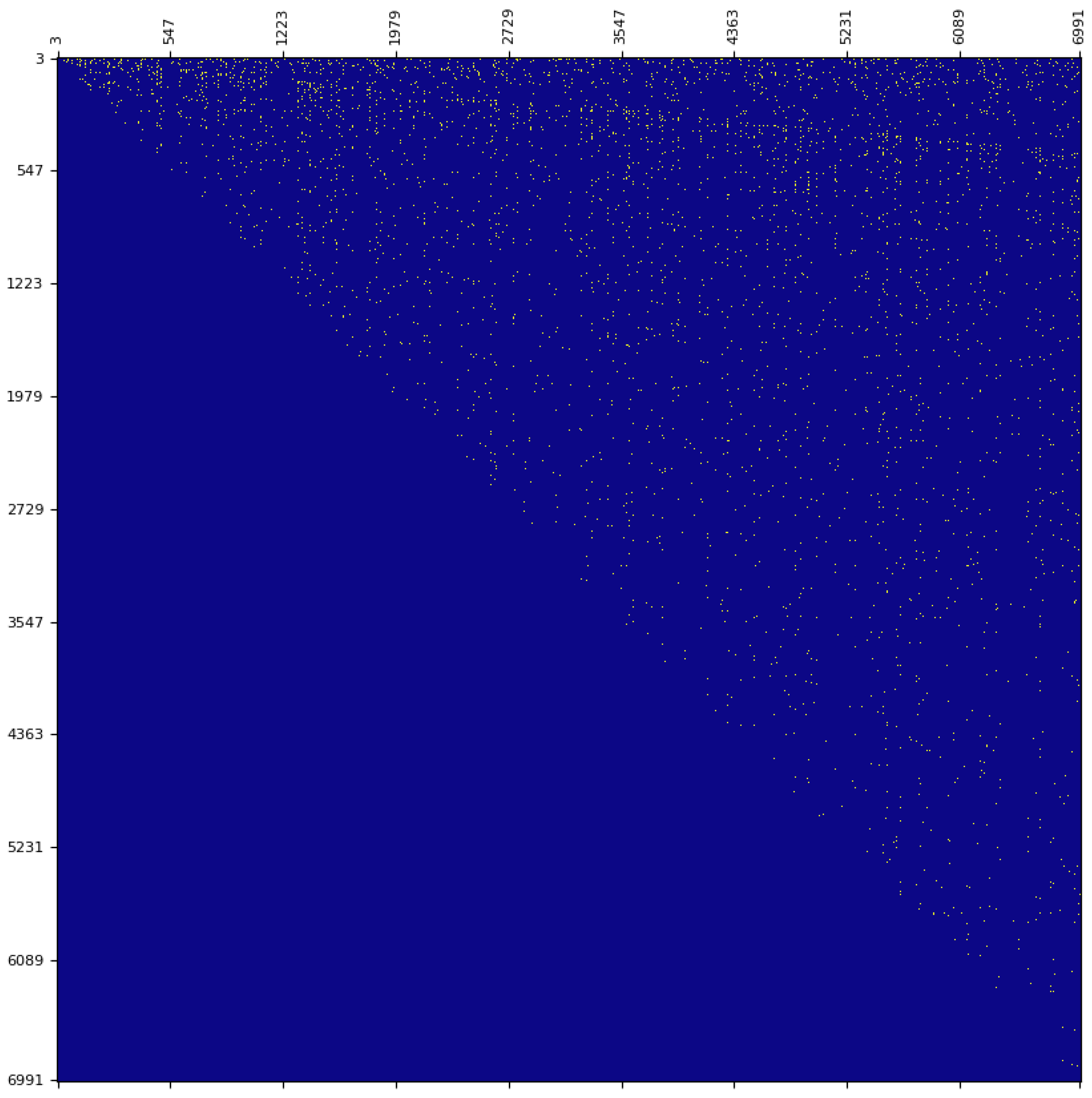
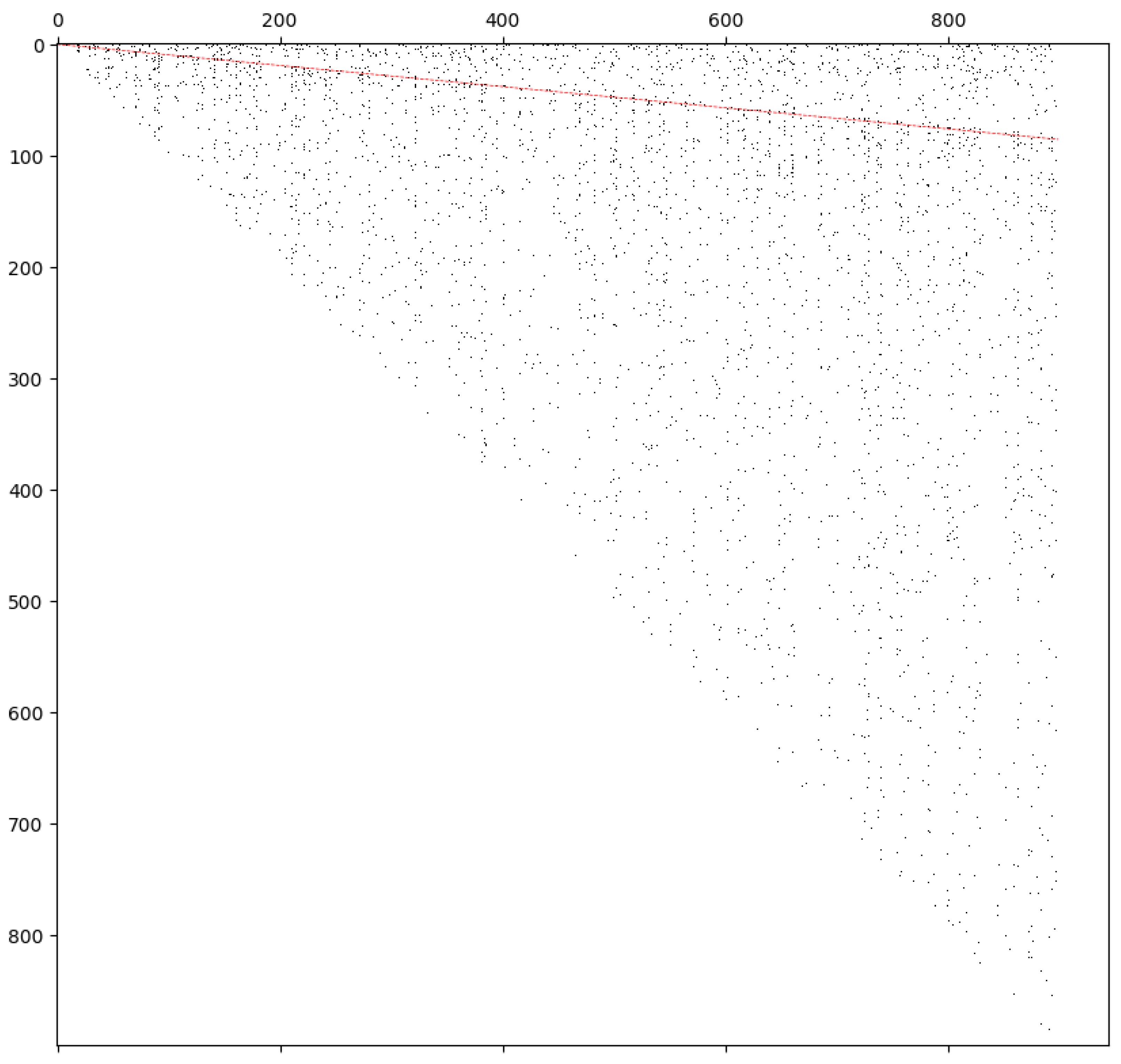
4.1. Case 17: Arc Structure and Quasi-Linear Arc Segment
4.2. Case 26: Tile Structure
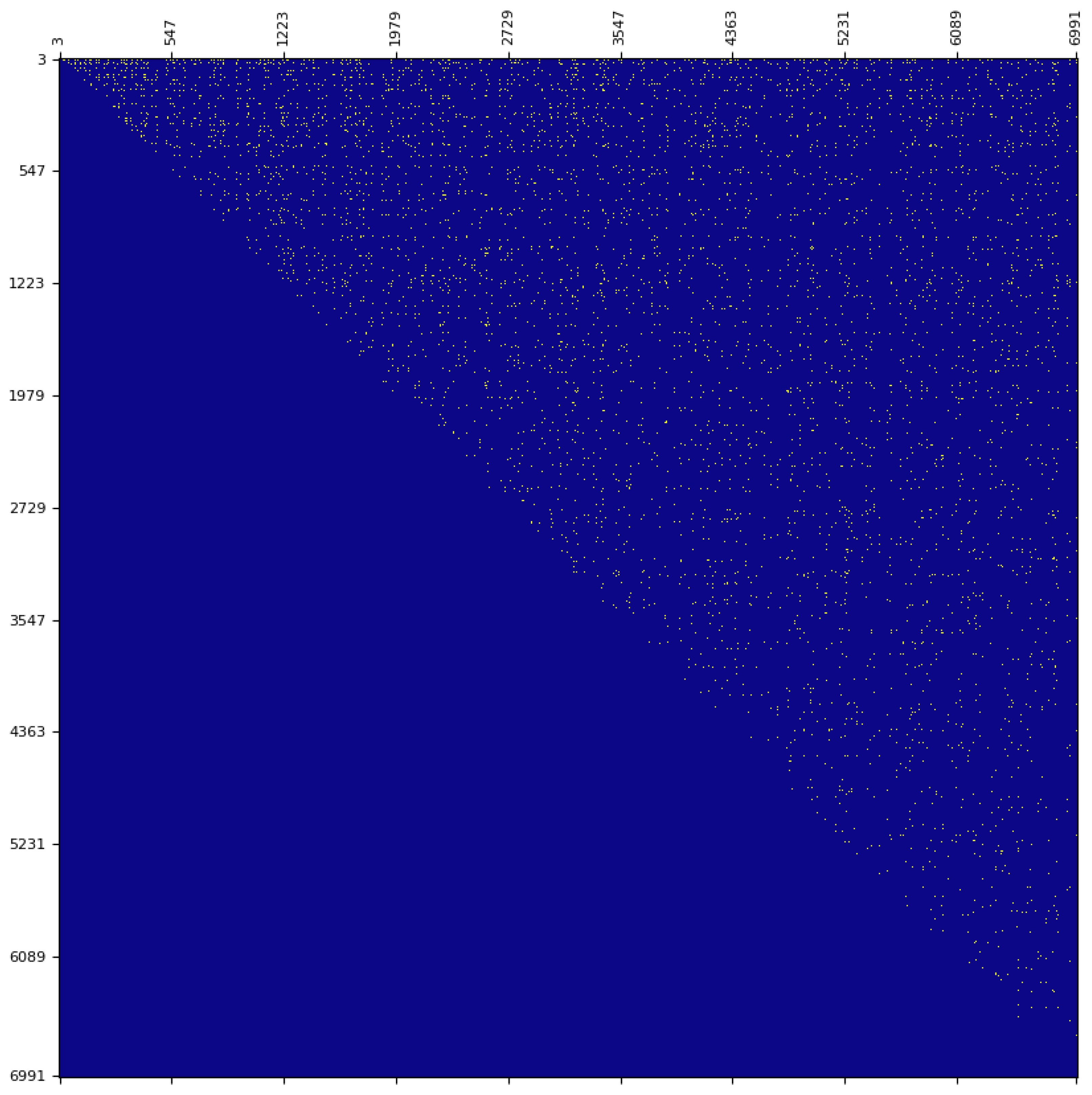
4.3. Case 32: Sparsely Populated Structure
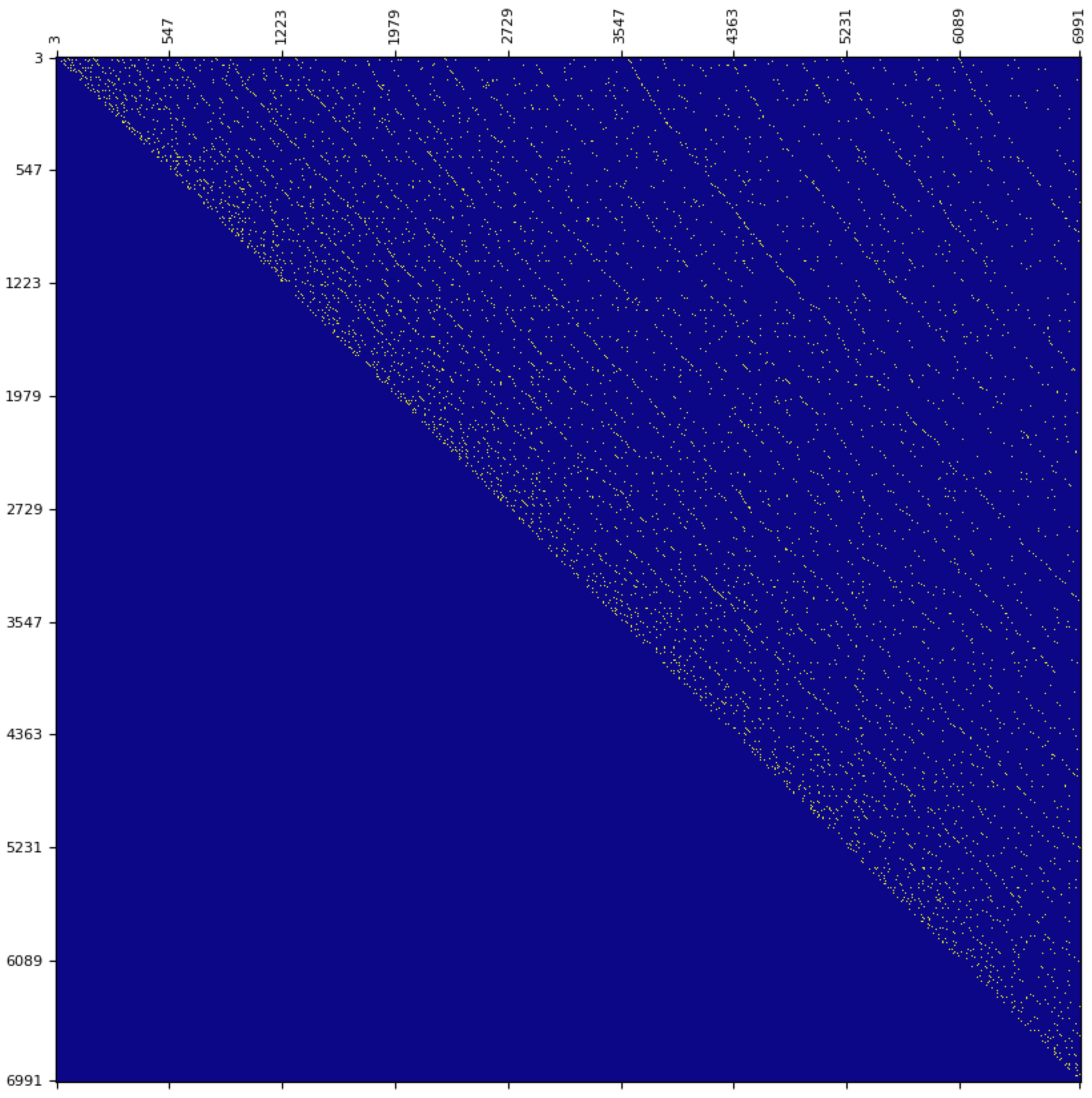
4.4. Case 40: Arc Structure
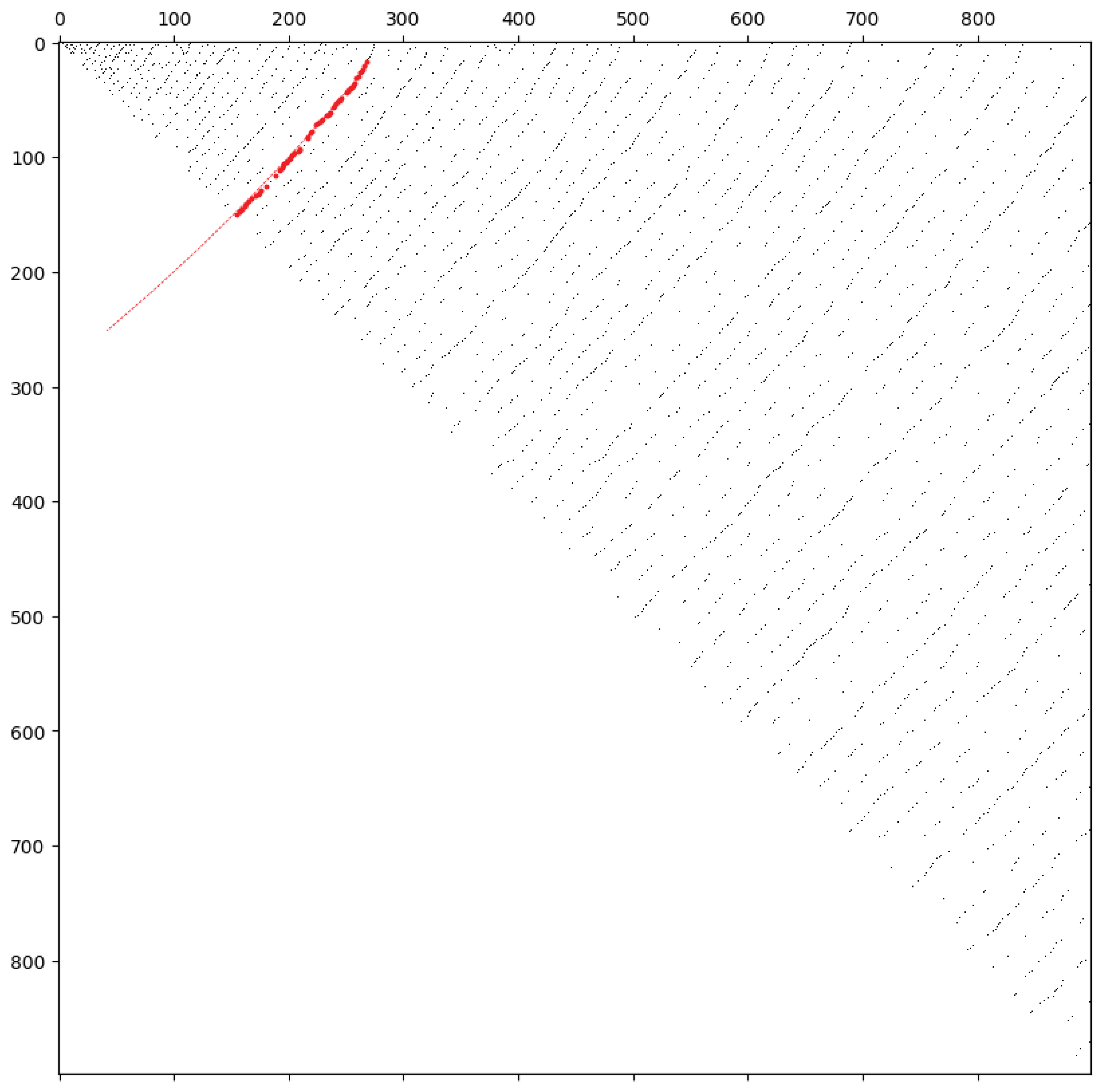
4.5. Case 47: Quasi-Linear Arc Segment
4.6. Case 56: Arc Structure
5. Discussion and Outlook
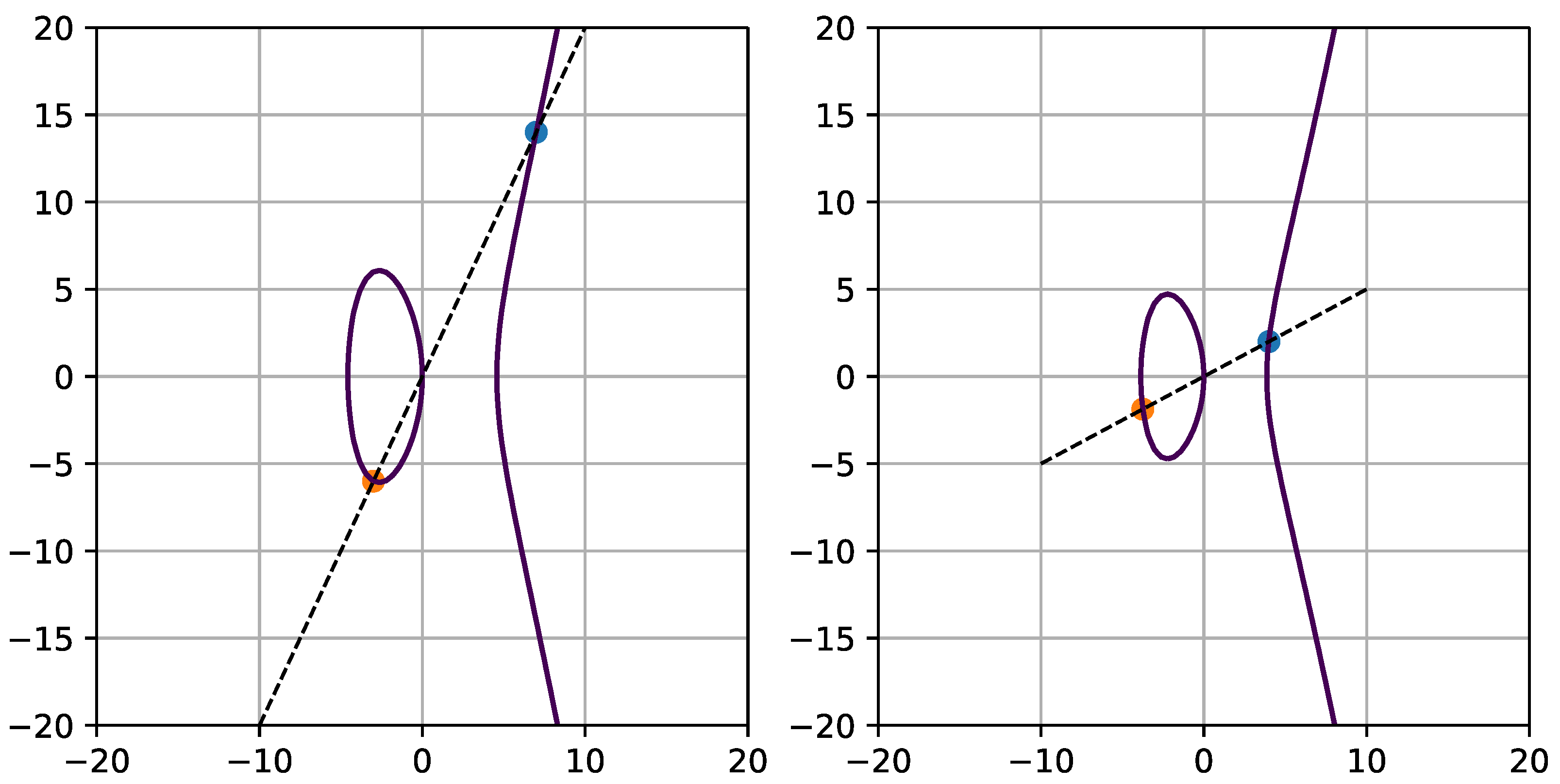
- The only rational points of finite order in are four points of order 2, namely (the point at infinity), , and ; see [31] (44). In other words, .
- What must the criteria for p and q be for this family of elliptic curves to have a positive rank?
- Under which circumstances for given primes are one of our six conditions sure to yield an elliptic curve with a positive rank?
- Fixing a line and exploring families of curves where is a congruent number. Visualizing the corresponding pairs may reveal underlying structures.
- Fixing a curve and investigating families of lines that intersect it at rational points, potentially uncovering deeper arithmetic properties.
- Analyzing the visualized structures in greater detail and interpreting them to draw meaningful conclusions about the distribution of prime numbers.
Author Contributions
Funding
Data Availability Statement
Acknowledgments
Conflicts of Interest
Appendix A. Unsolvable Conditions
- (a)
- Cases 1, 2, 3, 37, 53, and 54 are impossible to solve: This is due to the fact that is an integer that requires the fraction’s numerator to be larger than the denominator. Case 3 requires the additional argument that need to be odd, and hence, and do not provide a valid solution.
- (b)
- Cases 4, 5, 6, 11, 12, 13, 18, 19, 20, 27, 28, 33, 34, 35, 36, 41, 42, 43, 48, 49, 50, 57, and 58 are impossible to solve: The conditions in these cases force b to be even and, due to , a to be odd. Dividing the defining equation by 2 then forces to be even. Since and b is even in this case, this contradicts the parity constraints, and hence, no solution exists. As an illustration, in Case 4, the condition reduces to , which again forces a to be even, yielding the same contradiction.
- (c)
- Case 7 is unsolvable: We know that b must be even, and by substituting b with , we have to solve , which is . Since t is coprime with , we conclude that is a perfect square, which is impossible by an argument : Recall that if x is a perfect square then or [16] (p. 21).
- (d)
- Cases 9, 10, 22, and 38 are unsolvable due to the assumed inequality .
- (e)
- Cases 15 and 55 cannot be solved: Since , , and , the conditions and require , leading to and , which both have no solution.
- (f)
- Cases 16, 30, 31, 39, 46, and 60 are impossible to solve: p and q are odd primes and the difference or sum of two even integers cannot be odd. To apply the argument for case 31, we first multiply its condition by .
Appendix B. Redundant Conditions
- (a)
- Case 8: : Due to being integers, the fraction needs to be an integer. Because , solutions exist only if . The condition simplifies to , which is a special case of case 17.
- (b)
- Case 14 and Case 44: : We rewrite the conditions as . Due to being integers, the fraction needs to be an integer. Because , solutions exist only if or . For case 14, setting leads to , which is a special case of case 46 and is impossible to solve due to reason f in Appendix A. For case 14, setting leads to , which is a special case of case 47. For case 44, setting leads to , which is a special case of case 16 and is impossible to solve due to reason f in Appendix A. For case 14, setting leads to which is a special case of case 17.
- (c)
- Cases 21 and 51: : We rewrite the conditions as . Due to being integers, the fraction needs to be an integer. Because , solutions exist only if or . For case 21, setting leads to , which is a special case of case 39. For case 21, setting leads to , which is a special case of case 40. For case 51, setting leads to , which is a special case of case 9. For case 21, setting leads to , which is a special case of case 10. Both cases are impossible to solve due to reason d in Appendix A.
- (d)
- Case 23: : We rewrite the condition as . Due to being integers, the fraction needs to be an integer. Because , solutions exist only if . Setting boils the condition down to , which is a special case of case 26.
- (e)
- Case 24: : We rewrite the condition as . See the argumentation for case 23. Hence, setting boils the condition down to , which is a special case of case 26.
- (f)
- Case 25: : We rewrite the condition as . See the argumentation for case 23. Hence, setting boils the condition down to , which is a special case of case 26.
- (g)
- Case 29 and Case 59: : We rewrite the conditions as . Due to being integers, the fraction needs to be an integer. Because , solutions exist only if or . For case 29, setting reduces the condition to , which is a special case of case 33 that is impossible to solve due to reason b in Appendix A. For case 29, setting boils the condition down to , which is a special case of case 26. For case 59, setting reduces the condition to , which is a special case of case 3 that is impossible to solve due to reason a in Appendix A. For case 59, setting boils the condition down to , which is a special case of case 56.
- (h)
- Case 45: : Due to being integers, the fraction needs to be an integer. Because , solutions exist only if . This leads to , which is a special case of case 17.
- (i)
- Case 52: : See argumentation for case 45.
References
- Daghigh, H.; Didari, S. On the elliptic curves of the form y2 = x3 − pqx. Bull. Iran. Math. Soc. 2015, 10, 77–86. [Google Scholar]
- Burhanuddin, I.; Huang, M.D. On the Equation y2 = x3 − pqx. J. Numbers 2014, 2014, 1–5. [Google Scholar] [CrossRef]
- Remmert, R.; Ullrich, P. Elementare Zahlentheorie, 3rd ed.; Birkhäuser: Basel, Switzerland, 2008. [Google Scholar]
- L-functions, L.T.; Database, M.F. Elliptic Curve with LMFDB Label 135200.bq1 (Cremona Label 135200o1). 2024. Available online: https://www.lmfdb.org/EllipticCurve/Q/135200/bq/1 (accessed on 5 December 2025).
- L-functions, L.T.; Database, M.F. Elliptic Curve with LMFDB Label 14112.r1 (Cremona Label 14112bk1). 2024. Available online: https://www.lmfdb.org/EllipticCurve/Q/14112/r/1 (accessed on 5 December 2025).
- L-functions, L.T.; Database, M.F. Elliptic Curve with LMFDB Label 152352.ba1 (Cremona Label 152352y1). 2024. Available online: https://www.lmfdb.org/EllipticCurve/Q/152352/ba/1 (accessed on 5 December 2025).
- L-functions, L.T.; Database, M.F. Elliptic Curve with LMFDB Label 14400.cq1 (Cremona Label 14400de1). 2024. Available online: https://www.lmfdb.org/EllipticCurve/Q/14400/cq/1 (accessed on 5 December 2025).
- de Polignac, A. Recherches nouvelles sur les nombres premiers [New research on prime numbers]. Comptes Rendus 1849, 29, 397–401. [Google Scholar]
- Broughan, K. Bounded Gaps Between Primes; Cambridge University Press: Cambridge, UK, 2021. [Google Scholar] [CrossRef]
- Cohen, F.; Selfridge, J.L. Not every number is the sum or difference of two prime powers. Math. Comput. 1975, 29, 79–81. [Google Scholar] [CrossRef]
- Murty, M.R. The twin prime problem and generalizations (après Yitang Zhang). Resonance 2013, 18, 712–731. [Google Scholar] [CrossRef]
- Green, B.; Sawhney, M. Primes of the form p2 + nq2. arXiv 2024, arXiv:2410.04189. [Google Scholar] [CrossRef]
- Friedlander, J.; Iwaniec, H. Using a parity-sensitive sieve to count prime values of a polynomial. Proc. Natl. Acad. Sci. USA 1997, 94, 1054–1058. [Google Scholar] [CrossRef] [PubMed]
- Bordellès, O. Arithmetic Tales: Advanced Edition; Springer: Berlin/Heidelberg, Germany, 2020. [Google Scholar] [CrossRef]
- Heath-Brown, D.R. The Density of Rational Points on Curves and Surfaces. Ann. Math. 2002, 155, 553–598. [Google Scholar] [CrossRef]
- Aigner, M.; Ziegler, G.M. Proofs from the Book, 5th ed.; Springer: Berlin/Heidelberg, Germany, 2014. [Google Scholar] [CrossRef]
- Singh, K. Number Theory: Step by Step; Oxford University Press: Oxford, UK, 2020. [Google Scholar]
- LeVeque, W.J. Elementary Theory of Numbers; Dover Publications: Mineola, NY, USA, 1990. [Google Scholar]
- Cox, D.A. Primes of the Form x2 + ny2, 2nd ed.; Wiley: Hoboken, NJ, USA, 2013. [Google Scholar]
- Sultanow, E. elliptic_curves (Jupyter Notebook). 2022. Available online: https://github.com/Sultanow/elliptic_curves/blob/master/python/notebooks/congruent_numbers_fixed_6_cases.ipynb (accessed on 5 December 2025).
- Hadamard, J. Sur la distribution des zéros de la fonction ζ(s) et ses conséquences arithmétiques. Bull. SOC. Math. France 1896, 24, 199–220. [Google Scholar] [CrossRef]
- La Vallée Poussin, C.J.d. Recherches Analytiques sur la Théorie des Nombres Premiers; Hayez: Bruxelles, Belgium, 1897. [Google Scholar]
- Hardy, G.H.; Littlewood, J.E. Some problems of ‘Partitio Numerorum’ III: On the expression of a number as a sum of primes. Acta Math. 1923, 44, 1–70. [Google Scholar] [CrossRef]
- Bunyakovsky, V. Nouveaux Théorèmes Relatifs à la Distinction des Nombres Premiers et à la Décomposition des Entiers en Facteurs. Sc. Math. Phys. 1857, 6, 305–329. [Google Scholar]
- Euler, L. Observationes de theoremate quodam Fermatiano aliisque ad numeros primos spectantibus. Comment. Acad. Sci. Petrop. 1732, 5, 103–107, Reprint in Opera Omnia Ser. 1 1911, 2, 531–558. [Google Scholar]
- Euler, L. Observations on a certain theorem of Fermat and on others concerning prime numbers. arXiv 2005, arXiv:math/0501118. [Google Scholar] [CrossRef]
- Fernando, R. For Two Odd Primes p < q, Why Do Prime Indices in q = pb4 − a2 Align Along a Line with Slope ≈ 0.095? Mathematics Stack Exchange. Available online: https://math.stackexchange.com/q/5046353 (accessed on 16 March 2025).
- Yuan, Q. Unexpected Circular Arc Structures in a Matrix for Primes 2 < p < q with p · q = b4 − a2 and . Mathematics Stack Exchange. Available online: https://math.stackexchange.com/q/5035916 (accessed on 16 February 2025).
- Milne, J.S. Elliptic Curves, 2nd ed.; World Scientific: Singapore, 2021. [Google Scholar]
- Stein, W. Elementary Number Theory: Primes, Congruences, and Secrets; Undergraduate Texts in Mathematics; Springer: Berlin/Heidelberg, Germany, 2009; Available online: https://www.wstein.org/ent/ (accessed on 5 December 2025).
- Koblitz, N. Introduction to Elliptic Curves and Modular Forms, 2nd ed.; Graduate Texts in Mathematics; Springer: Berlin/Heidelberg, Germany, 1993; Volume 97. [Google Scholar] [CrossRef]
- Tian, Y. Congruent numbers with many prime factors. Proc. Natl. Acad. Sci. USA 2012, 109, 21256–21258. [Google Scholar] [CrossRef] [PubMed]
- L-functions, L.T.; Database, M.F. Elliptic Curve with LMFDB Label 78400.ga1 (Cremona Label 78400jx1). 2024. Available online: https://www.lmfdb.org/EllipticCurve/Q/78400/ga/1 (accessed on 5 December 2025).
- L-functions, L.T.; Database, M.F. Elliptic Curve with LMFDB Label 34848.ci1 (Cremona Label 34848bg1). 2024. Available online: https://www.lmfdb.org/EllipticCurve/Q/34848/ci/1 (accessed on 5 December 2025).
- Sultanow, E. elliptic_curves (Arty’s CPP Implementation). 2022. Available online: https://github.com/Sultanow/elliptic_curves/tree/master/cpp (accessed on 5 December 2025).





| Case | Condition | ||
|---|---|---|---|
| 1 | 1 | ||
| 2 | 2 | ||
| 3 | 4 | ||
| 4 | |||
| 5 | |||
| 6 | |||
| 7 | b | ||
| 8 | |||
| 9 | p | ||
| 10 | |||
| 11 | |||
| 12 | |||
| 13 | |||
| 14 | |||
| 15 | |||
| 16 | q | ||
| 17 | |||
| 18 | |||
| 19 | |||
| 20 | |||
| 21 | |||
| 22 | |||
| 23 | |||
| 24 | |||
| 25 | |||
| 26 | |||
| 27 | |||
| 28 | |||
| 29 | |||
| 30 |
| Case | Condition | ||
|---|---|---|---|
| 31 | 1 | ||
| 32 | 2 | ||
| 33 | 4 | ||
| 34 | |||
| 35 | |||
| 36 | |||
| 37 | b | ||
| 38 | |||
| 39 | p | ||
| 40 | |||
| 41 | |||
| 42 | |||
| 43 | |||
| 44 | |||
| 45 | |||
| 46 | q | ||
| 47 | |||
| 48 | |||
| 49 | |||
| 50 | |||
| 51 | |||
| 52 | |||
| 53 | |||
| 54 | |||
| 55 | |||
| 56 | |||
| 57 | |||
| 58 | |||
| 59 | |||
| 60 |
| Case | Condition | Samples a, b, p, q | Resulting Sample Elliptic Curve | Resulting Rational Points on Sample Elliptic Curve |
|---|---|---|---|---|
| 17 | ||||
| 26 | [4] | |||
| 32 | , (82025, 23491960) | |||
| 40 | [5] | |||
| 47 | [6] | |||
| 56 | [7] |
| Case | Condition | Number-Theoretic Link | Status | Visual Pattern |
|---|---|---|---|---|
| 17 | prime gaps | conjectural | arcs + quasi-linear | |
| 26 | primes | proved | tile-like gaps | |
| 32 | factorization | empirical | sparse | |
| 40 | as Case 17 (swapped) | conjectural | arcs | |
| 47 | : | empirical | quasi-linear arc | |
| 56 | prime gaps () | conjectural | arcs |
Disclaimer/Publisher’s Note: The statements, opinions and data contained in all publications are solely those of the individual author(s) and contributor(s) and not of MDPI and/or the editor(s). MDPI and/or the editor(s) disclaim responsibility for any injury to people or property resulting from any ideas, methods, instructions or products referred to in the content. |
© 2026 by the authors. Licensee MDPI, Basel, Switzerland. This article is an open access article distributed under the terms and conditions of the Creative Commons Attribution (CC BY) license.
Share and Cite
Sultanow, E.; Jeschke, A.; Tfiha, A.D.; Tehrani, M.; Buchanan, W.J.
On Families of Elliptic Curves
Sultanow E, Jeschke A, Tfiha AD, Tehrani M, Buchanan WJ.
On Families of Elliptic Curves
Sultanow, Eldar, Anja Jeschke, Amir Darwish Tfiha, Madjid Tehrani, and William J. Buchanan.
2026. "On Families of Elliptic Curves
Sultanow, E., Jeschke, A., Tfiha, A. D., Tehrani, M., & Buchanan, W. J.
(2026). On Families of Elliptic Curves